
When people hear the word Hyenas, they often think of laughing scavengers roaming African plains. In reality, hyenas are far more complex, intelligent, and diverse than their reputation suggests. This guide explores the Types of Hyenas in a clear, educational way that is easy to understand, even for beginners. From powerful hunters that dominate large territories to shy, nocturnal species with highly specialized diets, hyenas show remarkable adaptability. In this article, you will learn how to identify each type, where it lives, what it eats, and how it survives in challenging environments. By the end, you will have a deeper appreciation for why hyenas play such an important role in ecosystems across Africa, the Middle East, and parts of Asia.
Types of Hyenas: Detailed Identification Guide
1. Spotted Hyena (Crocuta crocuta)
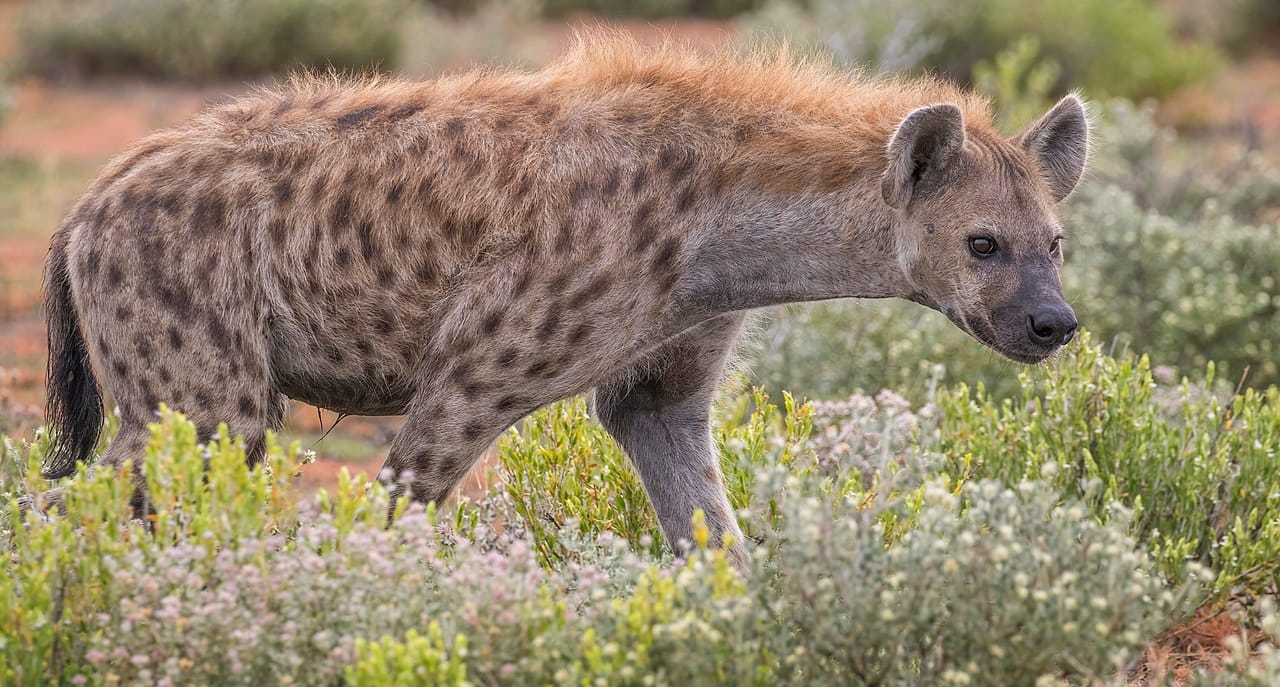
The Spotted Hyena is the largest and most well-known of all hyena species. Despite common myths, it is not merely a scavenger but one of Africa’s most successful predators. Spotted Hyenas live in large social groups called clans, which can include up to 80 individuals. These clans are highly organized and led by dominant females, making the species famous for its female-led social structure.
Physically, the Spotted Hyena is easy to recognize. It has a sloping back, powerful forelimbs, rounded ears, and a coat covered in dark spots. Its jaw strength is among the strongest of any land mammal, allowing it to crush bones and access nutrients other predators leave behind. This ability helps reduce waste in the ecosystem.
Spotted Hyenas inhabit savannas, grasslands, and open woodlands across sub-Saharan Africa. They are highly adaptable and can live close to human settlements when food is available. Their diet includes antelope, zebras, wildebeest, birds, reptiles, and carrion. They often hunt cooperatively, using teamwork rather than speed alone.
Behaviorally, Spotted Hyenas are extremely intelligent. Studies show they can solve complex problems and remember social relationships for years. Their famous “laugh” is actually a form of communication used to express excitement, stress, or submission. Among all Types of Hyenas, this species is the most socially complex and ecologically influential.
2. Brown Hyena (Parahyaena brunnea)
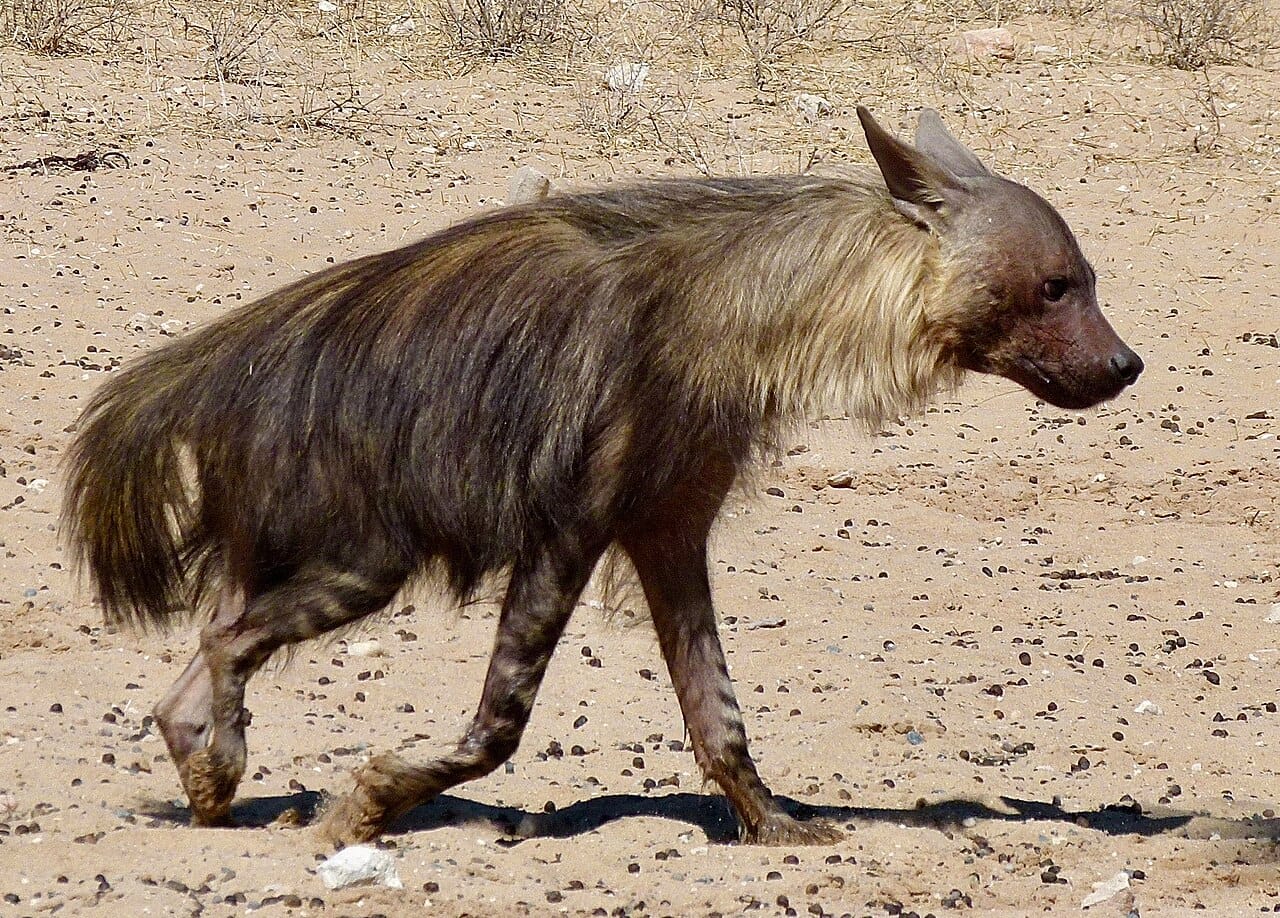
The Brown Hyena is far less known than its spotted cousin, yet it is equally fascinating. This species is mostly found in southern Africa, particularly in deserts, semi-deserts, and coastal regions. It prefers remote areas and avoids human contact whenever possible.
Brown Hyenas have long, shaggy brown fur and a mane that runs along the neck and shoulders. Their appearance gives them a rugged look, well suited for harsh environments. Unlike Spotted Hyenas, they are smaller and less aggressive, relying more on scavenging than hunting.
Their diet consists of carrion, small mammals, insects, eggs, and fruits. Along coastal areas, they may feed on seals and fish remains. Brown Hyenas play a vital role as cleaners, removing dead animals that could otherwise spread disease.
Socially, Brown Hyenas live in small clans, usually made up of extended family members. They are mostly nocturnal, traveling long distances at night to search for food. Among the Types of Hyenas, this species is one of the most secretive and least studied.
3. Striped Hyena (Hyaena hyaena)
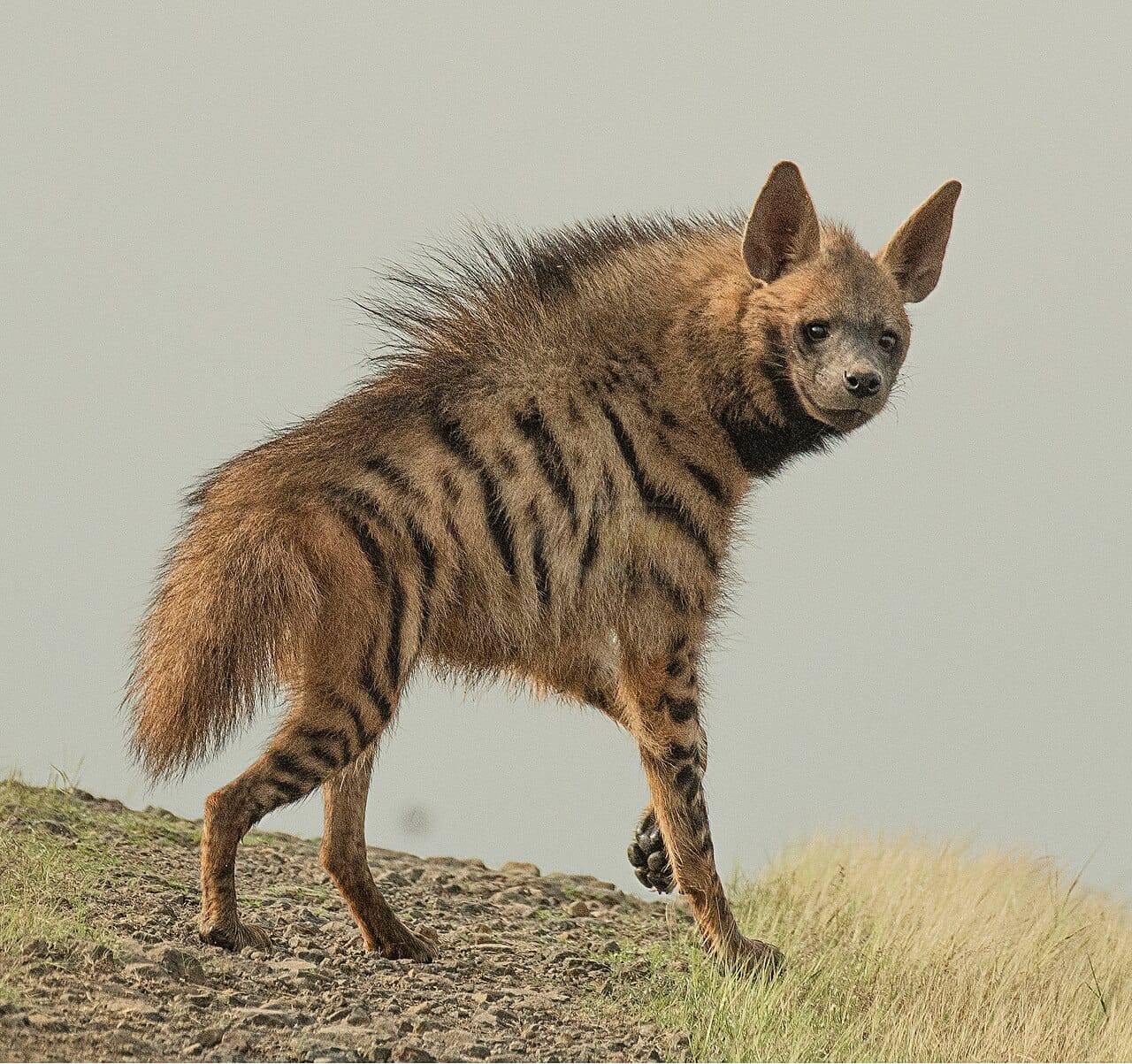
The Striped Hyena has the widest geographic range of all living hyenas. It is found across North and East Africa, the Middle East, and parts of India. This wide distribution shows how adaptable the species is to different climates and landscapes.
As its name suggests, the Striped Hyena has dark vertical stripes along a gray or beige coat. It has a bushy tail, pointed ears, and a mane that can stand upright when the animal feels threatened. Its size is moderate compared to other hyenas.
Striped Hyenas are primarily scavengers, feeding on carcasses, bones, fruits, and human waste near villages. They are mostly solitary and shy, avoiding confrontation with larger predators. Their strong jaws allow them to digest bones that many animals cannot.
Culturally, Striped Hyenas are often misunderstood and surrounded by myths. In some regions, they are feared or persecuted. Yet ecologically, they help maintain balance by removing decaying matter from the environment. This makes them an important part of the Types of Hyenas found outside Africa’s savannas.
4. Aardwolf (Proteles cristata)
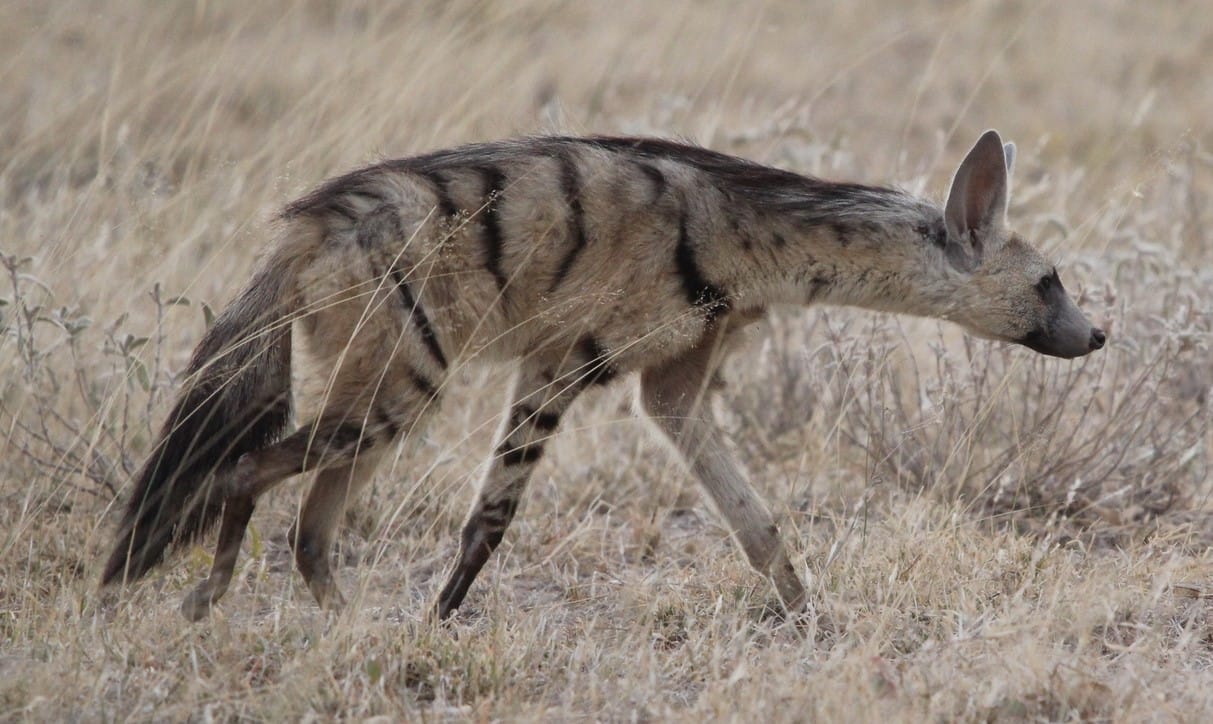
The Aardwolf is the smallest and most unusual member of the hyena family. Unlike other hyenas, it does not hunt or scavenge large animals. Instead, it feeds almost entirely on termites, especially harvester termites.
Aardwolves resemble small striped hyenas with slender bodies, pointed muzzles, and large ears. They are found in eastern and southern Africa, living in grasslands and open plains where termites are abundant.
Their teeth are reduced compared to other hyenas, as they do not need strong jaws for bone crushing. At night, an Aardwolf can consume thousands of termites using its long, sticky tongue. This feeding habit helps control insect populations.
Aardwolves are solitary and highly nocturnal. During the day, they rest in burrows, often abandoned by other animals. Among all Types of Hyenas, the Aardwolf stands out for its gentle nature and specialized diet.
5. Cave Hyena (Crocuta spelaea) – Extinct
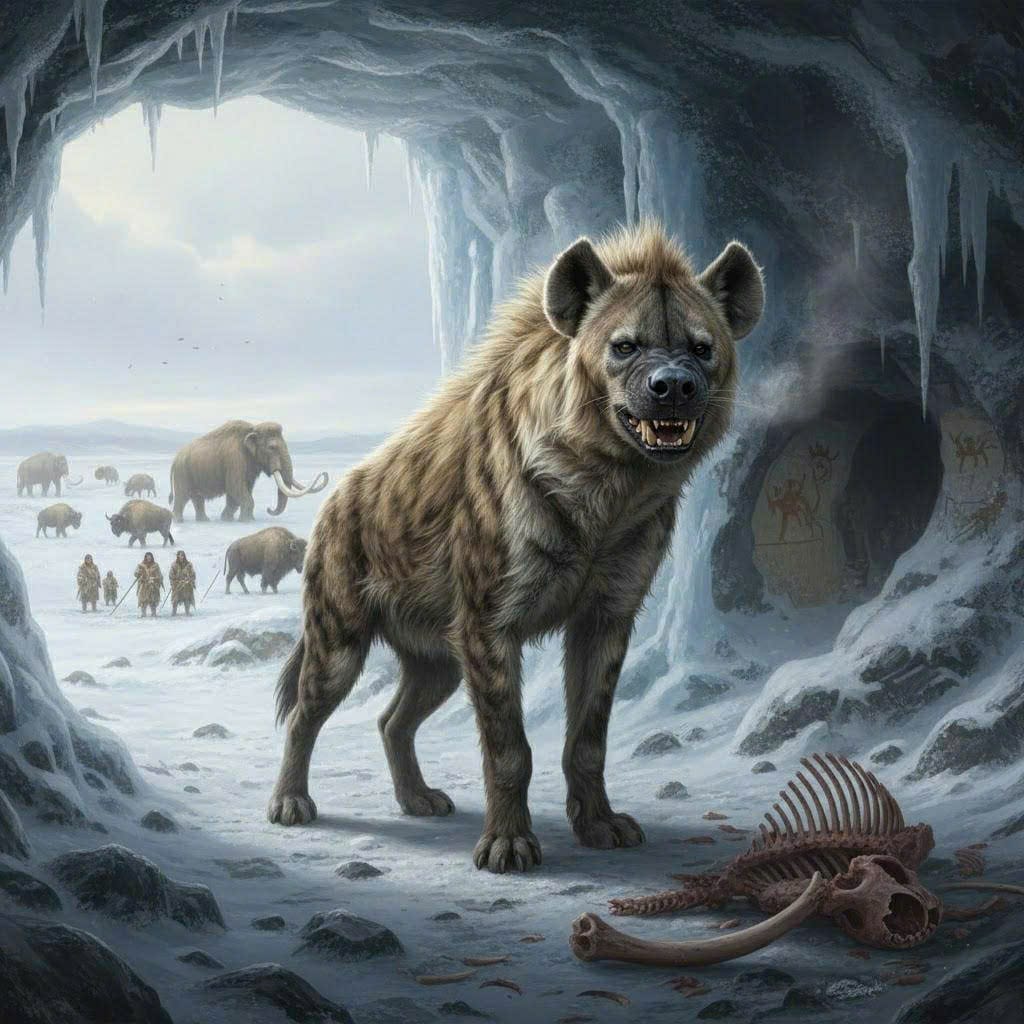
The Cave Hyena is an extinct relative of the modern Spotted Hyena that lived during the Ice Age. Fossils have been found across Europe and Asia, showing that hyenas once occupied regions far beyond Africa.
Cave Hyenas were larger and more robust than modern Spotted Hyenas. They lived in cold environments and often used caves for shelter and raising young. Evidence suggests they competed with early humans and other large predators for food.
Their diet included large herbivores such as mammoths, bison, and horses. Like modern hyenas, they were capable of crushing bones and consuming almost every part of a carcass.
Although extinct, the Cave Hyena helps scientists understand the evolutionary history of modern hyenas. It shows how adaptable and resilient the hyena family has been over millions of years.
Types of Hyenas: Continued In-Depth Reviews
6. Giant Short-Faced Hyena (Pachycrocuta brevirostris) – Extinct
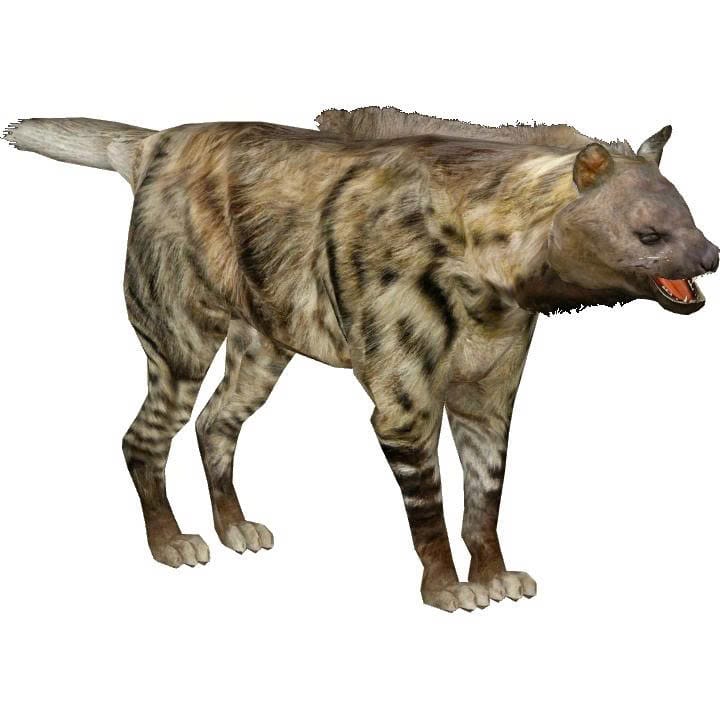
The Giant Short-Faced Hyena, scientifically named Pachycrocuta brevirostris, was one of the most powerful bone-crushing mammals ever to walk the Earth. Living during the late Pliocene and early Pleistocene epochs, this massive hyena ranged across Africa, Europe, and Asia. Among all known Types of Hyenas, it stands out for its extraordinary size and strength, surpassing even modern spotted hyenas by a large margin.
This species had a compact, muscular body with a broad skull and extremely thick jaws. Fossil evidence suggests that its bite force was immense, allowing it to crush the largest bones of prehistoric megafauna. Its teeth were blunt and thick, built for pressure rather than slicing. These physical traits made it a dominant scavenger capable of driving other predators away from carcasses.
The Giant Short-Faced Hyena likely fed on the remains of large animals such as early elephants, rhinoceroses, giant antelope, and prehistoric horses. Some scientists believe it may have relied more on scavenging than active hunting, using its size and power to claim kills made by saber-toothed cats and other predators. This behavior mirrors modern spotted hyenas but on a much larger scale.
In terms of habitat, this extinct hyena lived in open grasslands, wooded savannas, and semi-arid regions. Its wide geographic distribution suggests strong adaptability to different climates. Fossils found in Europe show it could survive colder conditions than most modern hyenas.
The extinction of Pachycrocuta brevirostris is believed to be linked to climate change, the disappearance of megafauna, and increased competition with early humans and emerging predators. Its decline marked the end of an era when giant scavengers ruled the land.
Studying this species helps scientists understand how modern hyenas evolved and why bone-crushing adaptations became so successful. It also highlights how changes in ecosystems can dramatically reshape predator hierarchies over time.
7. Howell’s Hyena (Parahyaena howelli) – Extinct
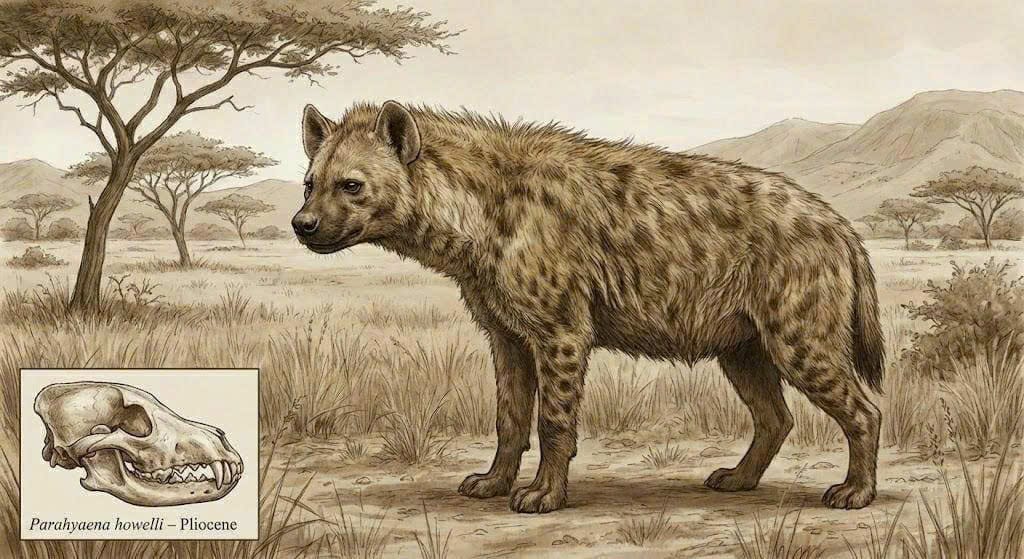
Howell’s Hyena, known scientifically as Parahyaena howelli, was an ancient member of the brown hyena lineage. It lived during the Pliocene epoch in Africa, long before modern humans appeared. This species provides key insight into how present-day brown hyenas developed their scavenging lifestyle.
Fossil remains suggest that Howell’s Hyena had a body structure similar to modern brown hyenas but with more primitive features. Its limbs were strong but not built for long-distance running. The skull shows adaptations for crushing and grinding, indicating a diet that included bones and tough organic matter.
Unlike more aggressive hyena species, Howell’s Hyena likely relied on scavenging rather than hunting large prey. It may have followed large predators or fed on carcasses left behind by saber-toothed cats. This feeding strategy reduced direct competition while still providing enough nutrition to survive.
The environment Howell’s Hyena inhabited included mixed woodlands and open plains. Seasonal changes would have influenced food availability, requiring flexibility in diet. This adaptability likely contributed to the survival of its descendants, the modern brown hyenas.
Its extinction is thought to be part of broader faunal turnovers caused by climate shifts and ecosystem changes. As environments transformed, newer and more specialized hyena species emerged, gradually replacing older forms like Parahyaena howelli.
Although not widely known, Howell’s Hyena plays an important role in understanding the evolutionary timeline of Types of Hyenas. It represents a transitional stage between early hyena ancestors and modern scavenger species.
8. Large-Toothed Aardwolf (Proteles amplidentus) – Extinct
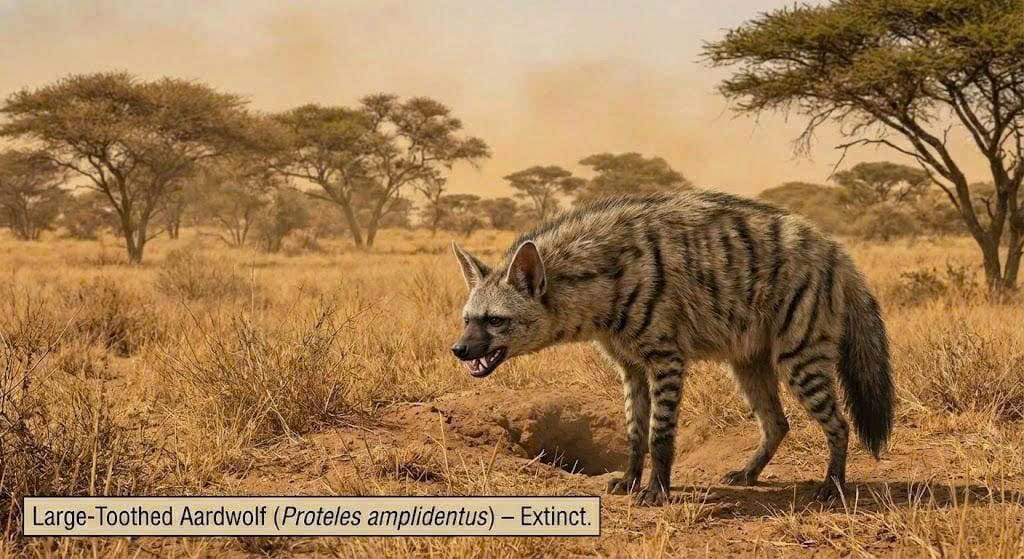
The Large-Toothed Aardwolf, or Proteles amplidentus, was an extinct relative of the modern aardwolf. It lived in Africa during the Pliocene epoch and shared many behavioral traits with today’s termite-eating hyena, but with notable differences in dental structure.
As its name suggests, this species had larger and more developed teeth than the modern aardwolf. This suggests a slightly broader diet that may have included insects, small vertebrates, and carrion in addition to termites. These dental traits hint at a less specialized feeding strategy.
Physically, Proteles amplidentus was similar in size to the modern aardwolf, with a slender body, pointed face, and large ears. Its limbs were adapted for walking rather than chasing prey, reinforcing the idea that it was not a hunter.
The habitats of this extinct aardwolf likely included grasslands and savannas with abundant insect life. Burrowing behavior was probably common, offering protection from predators and extreme temperatures.
Over time, evolutionary pressures favored specialization. Modern aardwolves developed reduced teeth and became almost entirely termite-dependent. This specialization allowed them to avoid competition with other carnivores, leading to long-term survival.
The study of Proteles amplidentus shows how dietary specialization can evolve gradually. It also explains why today’s aardwolf occupies such a distinct niche among the Types of Hyenas.
9. Adcrocuta (Extinct Hyena Genus)
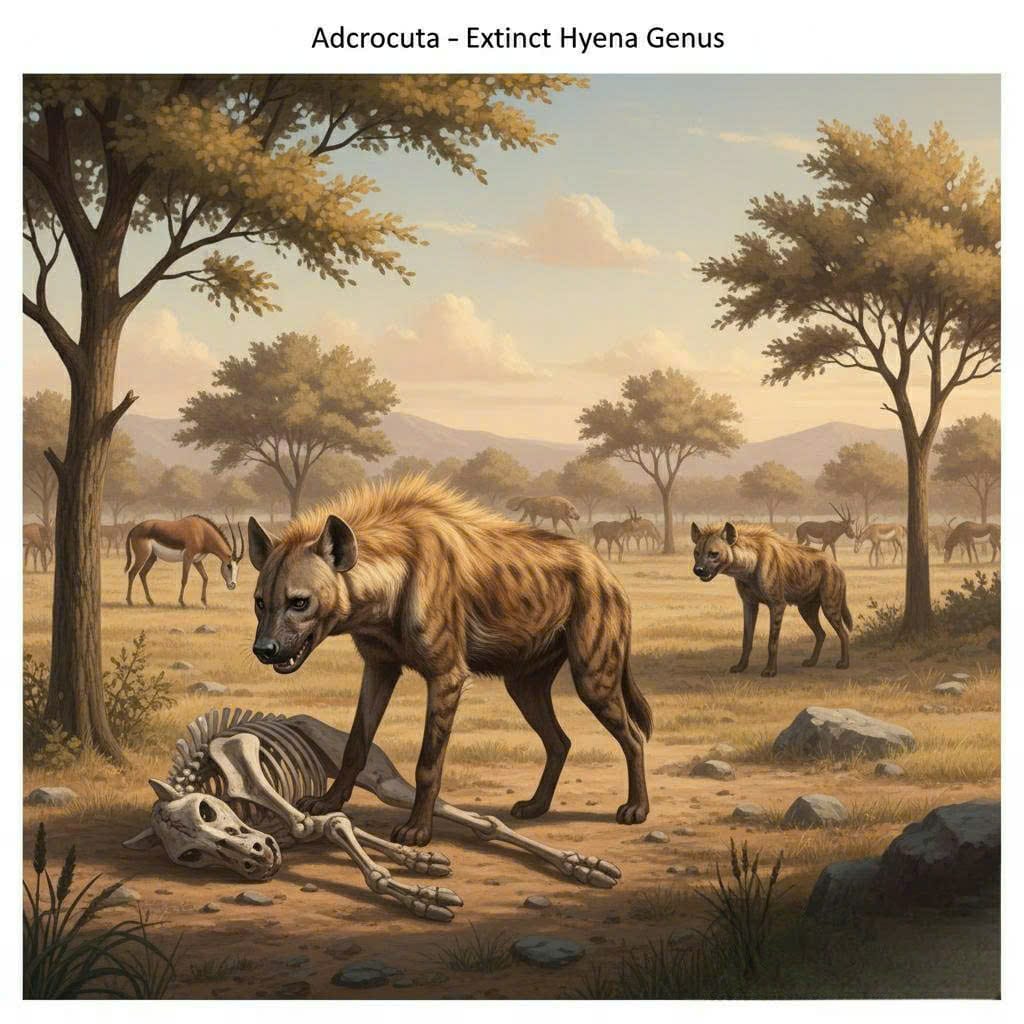
Adcrocuta was a genus of prehistoric hyenas that lived during the Late Miocene epoch across Eurasia. Though not a single species, this genus represents an important phase in hyena evolution, especially in the development of bone-crushing abilities.
Members of the Adcrocuta genus were medium to large-sized hyenas with strong jaws and thick teeth. Their skulls show early adaptations for processing bones, though not as advanced as those seen in later species like spotted hyenas.
These hyenas likely lived in open woodlands and grasslands where large herbivores were common. Their diet probably included carrion, small animals, and leftovers from larger predators. This opportunistic feeding style helped them survive in competitive environments.
Adcrocuta species are significant because they show how hyenas transitioned from more generalized carnivores into highly specialized scavengers. Their fossil record bridges the gap between early dog-like ancestors and modern hyena forms.
The extinction of Adcrocuta coincided with major environmental changes and the rise of more advanced predators. As ecosystems evolved, newer hyena species with improved adaptations replaced them.
Understanding Adcrocuta helps scientists trace the evolutionary path that led to today’s diverse Types of Hyenas. It highlights how small changes over millions of years can result in highly successful survival strategies.
10. Allohyaena (Extinct Hyena Genus)
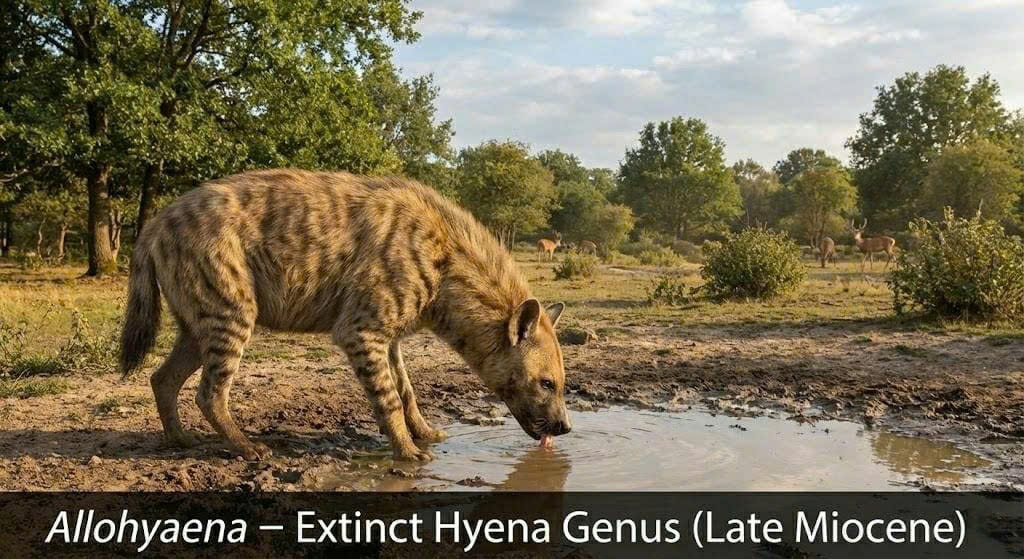
Allohyaena was another extinct genus of hyenas that lived in Europe during the Late Miocene. Though less well-known, it provides valuable clues about the early diversification of the hyena family outside Africa.
This genus displayed a mix of primitive and advanced traits. Its teeth suggest a carnivorous diet with some bone processing ability, though it may not have been a full-time scavenger. Its body structure indicates moderate speed and strength.
Allohyaena likely inhabited forest edges, open plains, and mixed landscapes. This variety of habitats suggests flexibility in behavior and diet, traits that would later define successful hyena species.
Competition with other carnivores, including early big cats, may have limited its success. As more specialized predators emerged, Allohyaena gradually disappeared from the fossil record.
Despite its extinction, Allohyaena is important for understanding how hyenas spread into Europe and adapted to different environments. It represents an early experiment in hyena evolution that shaped future lineages.
Together with other extinct forms, Allohyaena completes the picture of how Types of Hyenas evolved from diverse ancestors into the four living species we recognize today.
Conclusion: Understanding the Types of Hyenas
Hyenas are often misunderstood animals, shaped by myths rather than facts. When we look closely at the Types of Hyenas, a much richer and more fascinating story appears. From the highly social Spotted Hyena that dominates African grasslands to the quiet, termite-eating Aardwolf, each type follows a different path to survival. Even extinct hyenas, such as the Giant Short-Faced Hyena and Cave Hyena, reveal how powerful and adaptable this animal family once was.
Living hyenas play a vital role in modern ecosystems. By feeding on carrion, insects, and prey animals, they help control populations and reduce the spread of disease. Their strong jaws and efficient digestion allow them to use food sources that many other predators cannot. This makes hyenas essential contributors to environmental balance rather than simple scavengers.
The fossil record adds depth to our understanding of hyenas. Ancient species show how climate change, shifting habitats, and competition shaped their evolution over millions of years. These extinct forms help explain why today’s hyenas are so well adapted to harsh and changing environments.
By learning about all known Types of Hyenas, both living and extinct, we gain respect for their intelligence, resilience, and ecological importance. Hyenas are not villains of the wild; they are survivors, problem-solvers, and key members of the natural world. Understanding them better helps us appreciate the complex systems that keep wildlife ecosystems healthy and functioning.
Frequently Asked Questions About the Types of Hyenas
1. How many types of hyenas exist today?
There are four living hyena species today: the Spotted Hyena, Brown Hyena, Striped Hyena, and Aardwolf. Each belongs to the family Hyaenidae and shows different behaviors, diets, and social structures.
2. What is the largest of all Types of Hyenas?
The Spotted Hyena is the largest living hyena species. Extinct species such as the Giant Short-Faced Hyena were even larger and more powerful than any hyena alive today.
3. Are hyenas more closely related to dogs or cats?
Hyenas are more closely related to cats than dogs. They belong to the suborder Feliformia, which includes cats, mongooses, and civets.
4. Why do hyenas laugh?
The “laughing” sound is a form of communication, especially in Spotted Hyenas. It can signal excitement, frustration, submission, or social tension within a clan.
5. Do all hyenas live in Africa?
Most hyenas live in Africa, but the Striped Hyena also lives in the Middle East and parts of India. Fossil evidence shows that ancient hyenas once lived in Europe and Asia as well.
6. What do hyenas eat?
Hyenas eat a wide range of foods depending on the species. Diets include large prey animals, carrion, bones, insects, fruit, and human food waste.
7. Are hyenas only scavengers?
No. Spotted Hyenas are skilled hunters that kill much of their own food. Scavenging is only part of their feeding strategy.
8. Which type of hyena eats termites?
The Aardwolf feeds almost entirely on termites, especially harvester termites, using its long sticky tongue.
9. Do hyenas hunt in groups?
Spotted Hyenas often hunt cooperatively in groups, while Brown and Striped Hyenas usually feed alone or in small family units.
10. How strong is a hyena’s bite?
Hyenas have some of the strongest jaws among mammals. Their bite force allows them to crush large bones and digest marrow.
11. Can hyenas digest bones?
Yes. Their powerful jaws and strong stomach acids allow them to digest bones that other carnivores cannot process.
12. Are hyenas dangerous to humans?
Hyenas usually avoid humans. Conflicts occur mainly where food waste attracts them to villages or camps.
13. Why are female Spotted Hyenas dominant?
Female Spotted Hyenas are larger, more aggressive, and socially dominant due to hormonal influences before birth.
14. Do hyenas live in packs?
Spotted Hyenas live in large clans, while other hyena species are more solitary or live in small groups.
15. How intelligent are hyenas?
Hyenas are highly intelligent. Research shows they can solve problems, recognize individuals, and remember social relationships.
16. Do hyenas mark territory?
Yes. Hyenas use scent glands near the anus to mark territory and communicate with other hyenas.
17. What is a hyena clan?
A clan is a complex social group led by dominant females, especially in Spotted Hyenas. Clans defend large territories.
18. Are hyenas nocturnal?
Most hyenas are active at night, though Spotted Hyenas may also be active during the day.
19. How long do hyenas live?
In the wild, hyenas live 12–25 years depending on the species. In captivity, they may live longer.
20. What predators threaten hyenas?
Adult hyenas have few natural predators, but lions can kill them. Young hyenas are vulnerable to large carnivores.
21. Do hyenas climb trees?
No. Hyenas are not adapted for climbing and stay mostly on the ground.
22. Can hyenas swim?
Hyenas can swim short distances but avoid water when possible.
23. What role do hyenas play in ecosystems?
Hyenas clean up carcasses, control prey populations, and help prevent disease spread.
24. Are hyenas endangered?
Some species, like the Brown Hyena, face population declines due to habitat loss and persecution.
25. Why are hyenas often misunderstood?
Cultural myths, negative portrayals, and their scavenging behavior contribute to their poor reputation.
26. Did hyenas live during the Ice Age?
Yes. Species like the Cave Hyena lived alongside Ice Age animals and early humans.
27. Are extinct hyenas related to modern ones?
Yes. Extinct hyenas are ancestors or close relatives of today’s species.
28. Do hyenas communicate vocally?
Hyenas use a range of sounds including whoops, growls, and laughs to communicate.
29. How do hyenas raise their young?
Young hyenas are raised in dens and cared for mainly by females.
30. Are hyenas social animals?
Social behavior varies. Spotted Hyenas are highly social, while others are more solitary.
31. What habitats do hyenas prefer?
Hyenas live in savannas, deserts, grasslands, woodlands, and semi-arid regions.
32. Can hyenas survive near humans?
Some hyenas adapt to human environments, especially where food waste is available.
33. Do hyenas steal food from lions?
Yes. Hyenas may steal kills from lions, and lions also steal from hyenas.
34. How fast can hyenas run?
Spotted Hyenas can run up to 37 mph (60 km/h) over short distances.
35. Are hyenas protected by law?
Protection varies by country, with some laws limiting hunting and killing.
36. Do hyenas hibernate?
No. Hyenas remain active year-round.
37. Why do hyenas have sloping backs?
Their longer forelegs and shorter hind legs create a sloped appearance.
38. Can hyenas see well at night?
Yes. Hyenas have strong night vision adapted for nocturnal activity.
39. Do hyenas form long-term bonds?
Spotted Hyenas form long-lasting social bonds within clans.
40. Are hyenas important for conservation?
Yes. Protecting hyenas helps maintain healthy ecosystems.
41. Do hyenas compete with wolves?
Historically, hyenas and wolves competed in Eurasia during prehistoric times.
42. What is the smallest hyena species?
The Aardwolf is the smallest living hyena species.
43. How do hyenas communicate scent?
They use scent glands to mark paths, dens, and territory boundaries.
44. Do hyenas migrate?
Hyenas do not migrate but may travel long distances for food.
45. Are hyenas affected by climate change?
Changing climates alter prey availability and habitat conditions for hyenas.
46. Can hyenas be domesticated?
No. Hyenas remain wild animals and are not suitable as pets.
47. Do hyenas share food?
In clans, food sharing follows strict social ranks.
48. Are hyenas active during the day?
Some hyenas, especially Spotted Hyenas, may be active during daylight hours.
49. Why are hyenas important scavengers?
They remove carcasses quickly, reducing disease and waste.
50. What makes hyenas successful survivors?
Their intelligence, adaptability, social structure, and powerful jaws support long-term survival.
51. Can hyenas recognize individuals?
Yes. Hyenas can recognize clan members by scent, sound, and appearance.
52. Will hyenas go extinct?
With conservation efforts, living hyena species are expected to survive, though some populations remain at risk.
Read more: 35 Types of Octopus (Pictures And Identification)