
Mammals are one of the most fascinating groups of animals on Earth. From the massive blue whale to the tiny hedgehog, these creatures showcase incredible diversity in size, habitat, and behavior. In this guide, we explore 50 types of mammals, describing their physical features, lifestyles, and unique characteristics that make them stand out in the wild. Whether they are terrestrial, aquatic, or even flying mammals, each species offers an extraordinary story about survival, adaptation, and the intricate ecosystems they inhabit. Read on to discover the wonders of these incredible animals.
Types of Mammals
1. African Elephant (Loxodonta africana)

The African Elephant is the largest land mammal, known for its iconic long trunk, large ears, and impressive tusks. Found primarily in sub-Saharan Africa, these elephants inhabit savannas, forests, and deserts. Their trunks serve multiple purposes: drinking water, grabbing food, communicating, and social bonding. African elephants are highly social, living in herds led by a matriarch. They have remarkable memory and intelligence, capable of problem-solving and demonstrating empathy. Conservation efforts are crucial, as poaching and habitat loss threaten their populations.
2. Asian Elephant (Elephas maximus)

Smaller than its African cousin, the Asian Elephant has smaller ears and smoother skin. Native to South and Southeast Asia, it thrives in forests, grasslands, and scrublands. Like African elephants, Asian elephants are social animals with complex family structures. They play a vital ecological role by dispersing seeds and creating pathways in dense forests. Asian elephants face threats from human encroachment, habitat fragmentation, and conflicts with agriculture. Cultural significance is high, with elephants being revered in many Asian societies.
3. Blue Whale (Balaenoptera musculus)

The Blue Whale holds the record as the largest animal to have ever existed. These marine mammals can reach lengths of up to 100 feet and weigh over 200 tons. Despite their size, they feed primarily on tiny krill, filtering them through baleen plates. Blue whales inhabit oceans worldwide, migrating seasonally to feed and breed. Their low-frequency calls can travel vast distances underwater, aiding communication across hundreds of miles. Once heavily hunted, Blue Whales are now protected, though they remain vulnerable due to ship strikes and climate change.
4. Hippopotamus (Hippopotamus amphibius)

Hippopotamuses are large, mostly herbivorous mammals native to sub-Saharan Africa. They spend much of their day submerged in rivers and lakes to stay cool. Hippos have massive jaws with large tusks, which they use in territorial disputes. Surprisingly agile in water, they can hold their breath for up to five minutes. Hippos are social, living in groups called pods. While appearing calm, they are highly protective of their territory and young. Hippos play an important role in aquatic ecosystems by influencing vegetation and nutrient cycles.
5. Common Dolphin (Delphinus delphis)

Common Dolphins are among the most widely distributed marine mammals, inhabiting temperate and tropical oceans. Recognizable by their sleek bodies, curved dorsal fins, and striking color patterns, they are highly social and often seen in large pods. These dolphins are intelligent, using echolocation to hunt fish and squid. Their playful behavior, including leaping and riding waves, makes them popular among wildlife enthusiasts. Common Dolphins exhibit cooperative hunting strategies and strong social bonds, demonstrating complex communication and problem-solving abilities.
6. Killer Whale (Orca) – Orcinus orca

Killer Whales, also known as Orcas, are the largest members of the dolphin family. They are easily recognized by their striking black-and-white coloration and tall, triangular dorsal fins. Orcas inhabit oceans worldwide, from polar regions to tropical seas. They are apex predators, feeding on fish, seals, and even other whales, depending on their pod’s hunting culture. Orcas live in complex social structures called pods, which are matrilineal and show remarkable cohesion. These marine mammals communicate using a variety of vocalizations, each pod having its own unique dialect. Their intelligence is legendary, demonstrated in coordinated hunting techniques, problem-solving abilities, and playful behaviors such as breaching and spy-hopping. Orcas are also known to teach hunting methods to younger generations, passing down traditions similar to human culture. Conservation concerns include pollution, prey depletion, and disturbances from shipping traffic and whale-watching activities. Studying killer whales provides insight into social learning, interspecies interactions, and the ecological balance of marine ecosystems.
7. Bottlenose Dolphin – Tursiops truncatus

Bottlenose Dolphins are among the most recognizable and widely studied marine mammals. Found in warm and temperate waters globally, they are highly adaptable, thriving in both coastal and offshore habitats. Bottlenose Dolphins have a sleek, gray body and a characteristic curved dorsal fin. They are known for intelligence, social complexity, and playful nature, often interacting with humans and other species. These dolphins form pods ranging from a few individuals to over a hundred, displaying intricate social hierarchies. Communication is sophisticated, involving whistles, clicks, and body language to coordinate hunting, navigate, and maintain social bonds. Bottlenose Dolphins employ cooperative hunting strategies, sometimes using tools or creating mud rings to trap fish. They are capable of recognizing themselves in mirrors, an indicator of self-awareness. Threats include bycatch in fisheries, habitat degradation, and pollution. Conservation efforts focus on marine protected areas, public education, and research into their behavioral ecology. Observing Bottlenose Dolphins offers a glimpse into the intelligence and adaptability of marine mammals.
8. Human – Homo sapiens

Humans are the most widespread and influential mammals on the planet. Defined by upright posture, advanced cognitive abilities, and complex language, Homo sapiens have shaped ecosystems, societies, and cultures worldwide. Humans are omnivorous and highly adaptable, living in diverse habitats from arctic tundras to tropical rainforests. The brain’s capacity for abstract thought, problem-solving, and innovation sets humans apart from other mammals. Social structures range from small kin groups to vast nations, with intricate systems of cooperation and conflict. Humans rely on culture, technology, and communication to survive and thrive, from crafting tools to building cities. Despite remarkable achievements, human activity impacts other species, contributing to habitat loss, pollution, and climate change. Studying humans as mammals offers insights into physiology, reproduction, and evolution, as well as the interplay between biology and behavior. Understanding our place in the mammalian world is essential for appreciating biodiversity and promoting conservation.
9. Chimpanzee – Pan troglodytes

Chimpanzees are our closest living relatives, sharing approximately 98–99% of our DNA. Native to the forests and savannas of central and West Africa, they are highly intelligent and social primates. Chimpanzees live in communities ranging from 20 to over 100 individuals, with fluid social hierarchies based on alliances, strength, and intelligence. They use tools extensively, such as sticks to extract termites, leaves to collect water, and stones to crack nuts. Communication is rich, combining vocalizations, facial expressions, and gestures. Chimpanzees display empathy, cooperation, and even rudimentary problem-solving skills. Diet consists mainly of fruits, supplemented with leaves, seeds, and occasional hunting of small mammals. Threats include habitat destruction, poaching, and disease. Conservation programs focus on habitat protection, anti-poaching measures, and rehabilitation of rescued individuals. Observing chimpanzees helps scientists understand evolution, social behavior, and cognition, offering a mirror to our own species’ past.
10. Gorilla – Gorilla gorilla

Gorillas are the largest living primates, distinguished by their robust build, large hands, and expressive faces. They inhabit tropical forests in central Africa, including lowland and mountain regions. Gorillas are primarily herbivorous, feeding on leaves, stems, fruits, and occasionally insects. They live in stable social groups called troops, led by a dominant silverback male who makes decisions, mediates conflicts, and protects the group. Communication involves vocalizations, body postures, and gestures. Gorillas exhibit intelligence, problem-solving skills, and emotional depth, often showing curiosity, playfulness, and mourning behaviors. Their slow reproductive rate and sensitivity to human disturbance make them vulnerable. Threats include deforestation, poaching, and disease outbreaks. Conservation efforts include habitat preservation, ecotourism, anti-poaching initiatives, and research. Studying gorillas provides invaluable insight into primate behavior, ecology, and the evolutionary roots of human sociality.
11. Orangutan – Pongo pygmaeus

Orangutans are great apes native to the rainforests of Borneo and Sumatra. Recognized for their reddish-brown hair and long, powerful arms, they are highly intelligent and arboreal. Orangutans are primarily frugivorous, with fruits making up the bulk of their diet, though they also eat leaves, bark, and insects. Solitary by nature, adult males and females usually meet for mating, though females often maintain loose networks with their offspring. Orangutans are known for tool use, including creating leaf umbrellas, extracting insects, and using sticks to test water depth. Their long lifespan and slow reproduction rate make them vulnerable to habitat loss, hunting, and deforestation. Communication includes vocalizations like long calls, gestures, and facial expressions. Conservation programs focus on habitat protection, rehabilitation of rescued individuals, and community-based forest management. Studying orangutans provides critical insight into intelligence, social behavior, and human evolutionary history.
12. Lion – Panthera leo
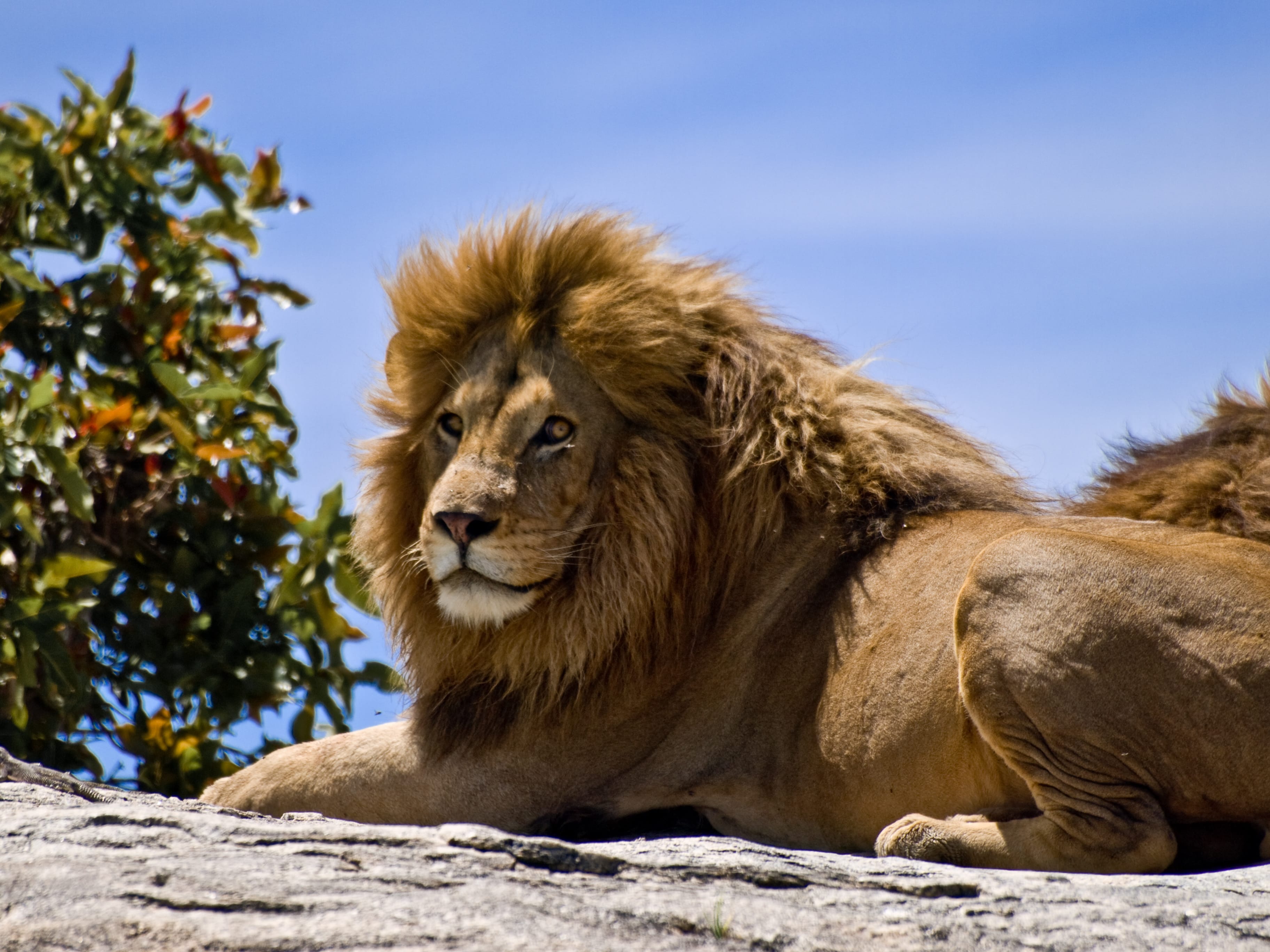
Lions, often called the “king of the jungle,” are large felines found primarily in sub-Saharan Africa, with a small population in India’s Gir Forest. They are the only social big cats, living in prides consisting of related females, their cubs, and a coalition of males. Lions are apex predators, relying on cooperative hunting to bring down prey such as wildebeest, zebras, and buffalo. Males defend the pride’s territory, while females are the primary hunters. Communication involves roars, scent markings, and body language. Lions exhibit sexual dimorphism, with males distinguished by their manes. They play a key role in regulating herbivore populations and maintaining ecosystem balance. Threats include habitat encroachment, poaching, and conflict with humans. Conservation strategies focus on protected areas, anti-poaching measures, and conflict mitigation. Observing lions reveals insights into social cooperation, territoriality, and the dynamics of predator-prey relationships.
13. Tiger – Panthera tigris

Tigers are the largest cat species, recognizable for their striking orange coat with black stripes. They are solitary predators inhabiting forests, grasslands, and wetlands across Asia. Tigers rely on stealth and strength to hunt prey including deer, wild boar, and occasionally larger animals like water buffalo. Each tiger maintains a large territory marked with scent and scratch marks. Communication involves roars, growls, and scent signals. Tigers are powerful swimmers and may travel long distances in search of food or mates. Human activity threatens tigers through habitat destruction, poaching for fur and body parts, and depletion of prey. Conservation initiatives emphasize protected reserves, anti-poaching patrols, and community awareness. Studying tigers provides insight into apex predator ecology, territorial behavior, and adaptations to diverse habitats.
14. Leopard – Panthera pardus

Leopards are highly adaptable felines distributed across Africa and parts of Asia. They are solitary, stealthy hunters, preying on a wide range of animals, from small rodents to medium-sized ungulates. Their spotted coat provides camouflage in forests, grasslands, and rocky terrains. Leopards are exceptional climbers, often storing prey in trees to avoid scavengers. They communicate through scent markings, vocalizations, and visual signals. Leopards display remarkable adaptability, thriving in close proximity to human settlements in some regions. Threats include habitat fragmentation, hunting, and human-wildlife conflict. Conservation efforts focus on habitat connectivity, anti-poaching measures, and public education. Studying leopards illuminates the intricacies of ambush predation, territory management, and survival strategies of solitary apex predators.
15. Cheetah – Acinonyx jubatus

Cheetahs are renowned for being the fastest land mammals, capable of reaching speeds up to 70 mph in short bursts. They inhabit African savannas and a small population persists in Iran. Cheetahs have a slender, aerodynamic build, with long legs, a flexible spine, and a distinctive black “tear mark” running from the eyes to the mouth. Unlike other big cats, they rely on speed rather than strength to catch prey such as gazelles and impalas. Social structure varies: males may form coalitions, while females are generally solitary. Cheetahs face threats from habitat loss, prey depletion, and genetic bottlenecks. Conservation strategies include wildlife corridors, anti-poaching initiatives, and breeding programs. Observing cheetahs highlights specialization in speed, predator-prey interactions, and the balance between energy expenditure and hunting success.
16. Jaguar – Panthera onca

Jaguars are the largest cats in the Americas, primarily inhabiting rainforests, swamps, and savannas of Central and South America. Recognizable by their stocky build and rosette-patterned coat, jaguars are powerful predators capable of taking large prey, including deer, capybara, and even caimans. Unlike many cats, they are strong swimmers and often hunt in water. Jaguars are solitary and territorial, marking ranges with scent and vocalizations. They communicate using growls, roars, and chuffing sounds. Threats include habitat destruction, poaching, and conflicts with humans. Conservation focuses on protected areas, anti-poaching measures, and maintaining habitat corridors. Studying jaguars provides insight into apex predator roles, aquatic hunting adaptations, and rainforest ecology.
17. Brown Bear – Ursus arctos

Brown bears are large, omnivorous mammals found across North America, Europe, and Asia. Recognizable by their massive build, thick fur, and powerful limbs, they inhabit forests, tundra, and mountainous regions. Brown bears feed on a varied diet including berries, roots, insects, fish, and mammals. They are solitary except during mating or when mothers care for cubs. Communication involves vocalizations, scent marking, and visual displays. They hibernate during winter, reducing metabolic rate to survive months without food. Threats include habitat loss, human conflicts, and climate change affecting food sources. Conservation efforts emphasize habitat protection, wildlife corridors, and education programs. Observing brown bears highlights the balance between omnivory, territoriality, and hibernation adaptations.
18. Polar Bear – Ursus maritimus

Polar bears are the largest terrestrial carnivores, inhabiting the Arctic Circle and sea ice regions. They are primarily dependent on seals for food, hunting them from sea ice platforms. Polar bears have dense, insulating fur and a thick layer of fat, allowing them to survive extreme cold. They are strong swimmers, capable of covering long distances in search of prey. Polar bears are mostly solitary, except for mothers with cubs. Threats include climate change leading to ice melt, hunting, and pollution. Conservation programs focus on protecting habitats, regulating hunting, and monitoring populations. Studying polar bears provides insight into Arctic ecosystem dynamics, predator adaptations, and climate change impacts on large mammals.
19. Gray Wolf – Canis lupus

Gray wolves are highly social carnivores found across North America, Europe, and Asia. They live in structured packs typically consisting of a breeding pair and their offspring. Wolves communicate via howls, body language, and scent marking. They are apex predators, hunting in coordinated groups to take down large prey such as deer, elk, and bison. Wolves exhibit territorial behavior, defending ranges from rival packs. Human activity poses threats through hunting, habitat fragmentation, and conflicts with livestock. Conservation efforts include protected areas, reintroduction programs, and public education. Studying gray wolves reveals insights into social cooperation, pack dynamics, and predator-prey relationships.
20. Red Fox – Vulpes vulpes

Red foxes are widespread, adaptable mammals found across the Northern Hemisphere. Recognizable by their reddish fur, bushy tail, and pointed ears, they thrive in forests, grasslands, mountains, and urban areas. Red foxes are omnivorous, feeding on small mammals, birds, fruits, and insects. They are primarily solitary hunters, using stealth, agility, and acute senses to capture prey. Communication includes vocalizations, scent marking, and body language. Red foxes exhibit remarkable adaptability to human-altered landscapes, sometimes living near cities. Threats include hunting, habitat loss, and disease. Conservation emphasizes coexistence, habitat preservation, and monitoring populations. Observing red foxes highlights adaptability, resourcefulness, and ecological importance of small predators.
21. Red Kangaroo – Macropus rufus

The Red Kangaroo is the largest marsupial and an iconic symbol of Australia. Males are typically larger than females, weighing up to 90 kg, while females are more slender. Red kangaroos inhabit arid and semi-arid regions, thriving in grasslands, shrublands, and deserts. Their powerful hind legs allow them to travel long distances with efficient, bounding hops, reaching speeds up to 60 km/h. They are herbivorous, feeding mainly on grasses and shrubs. Socially, they form loose groups called mobs, dominated by a male “boomer.” Communication includes thumping feet, growls, and body language. Reproduction involves embryonic diapause, allowing females to delay birth until conditions are favorable. Threats include habitat loss, hunting, and climate change affecting food and water sources. Conservation emphasizes sustainable land management, protected areas, and research on population dynamics. Studying red kangaroos offers insight into marsupial adaptations, locomotion efficiency, and survival in arid environments.
22. Koala – Phascolarctos cinereus

Koalas are tree-dwelling marsupials native to eastern Australia, known for their stout body, round ears, and grey fur. Koalas feed almost exclusively on eucalyptus leaves, which are fibrous and low in nutrients. To cope with this diet, they have a slow metabolism and a large cecum to ferment cellulose. Koalas are largely solitary, with overlapping home ranges. Communication includes bellows, grunts, and scent marking. They sleep up to 18–22 hours per day to conserve energy. Habitat loss from deforestation, bushfires, and climate change threatens their survival. Diseases like chlamydia also affect populations. Conservation programs focus on habitat preservation, reforestation, wildlife corridors, and veterinary care. Observing koalas provides insight into specialized diets, arboreal adaptations, and marsupial behavior.
23. Giraffe – Giraffa camelopardalis

Giraffes are the tallest terrestrial mammals, with adults reaching heights of up to 5.5 meters. Native to African savannas and woodlands, they are easily recognized by their long necks, long legs, and distinctive spotted coat patterns. Giraffes are herbivorous, browsing leaves, shoots, and fruits, primarily from acacia trees. Their height allows them access to food unavailable to most other herbivores. Social structure is fluid; giraffes form loose herds that change composition frequently. Communication involves infrasonic sounds, snorts, and body movements. Males engage in “necking” battles to compete for mates. Threats include habitat loss, poaching, and climate change. Conservation focuses on protected reserves, anti-poaching measures, and community involvement. Studying giraffes illuminates evolutionary adaptations, feeding strategies, and social dynamics in savanna ecosystems.
24. Hedgehog – Erinaceus europaeus

Hedgehogs are small, nocturnal mammals found across Europe and parts of Asia. They are recognizable by their spiny coat used for defense, rolling into a ball to protect against predators. Hedgehogs are omnivorous, feeding on insects, worms, small vertebrates, fruits, and fungi. They have keen senses of smell and hearing to locate food at night. Hedgehogs hibernate during winter in colder climates, reducing metabolic rate to survive low temperatures. They are generally solitary, except during mating. Threats include road traffic, habitat fragmentation, and pesticides. Conservation efforts emphasize creating wildlife-friendly habitats, reducing garden hazards, and protecting hedgerows. Observing hedgehogs offers insight into nocturnal behavior, defensive adaptations, and ecosystem roles in controlling insect populations.
25. Rabbit – Oryctolagus cuniculus

Rabbits are small herbivorous mammals native to southwestern Europe and northwest Africa, but introduced worldwide. They have strong hind legs, large ears, and a soft coat. Rabbits are prolific breeders, with females capable of multiple litters per year. They live in complex burrow systems called warrens, which provide shelter and protection from predators. Rabbits primarily feed on grasses, leaves, and bark, using hindgut fermentation to digest fibrous plants. Social structure is flexible, with some species forming colonies while others are solitary. They communicate through scent marking, thumping, and vocalizations. Threats include habitat loss, hunting, and diseases like myxomatosis. Conservation programs focus on population management, habitat restoration, and disease control. Studying rabbits highlights reproductive strategies, social organization, and ecological impact as prey and herbivores.
26. Beaver – Castor canadensis

Beavers are large, semi-aquatic rodents native to North America, known for their dam-building behavior. They construct lodges and dams from branches, mud, and stones, creating ponds that provide protection and food storage. Beavers are herbivorous, feeding on bark, leaves, and aquatic vegetation. Their strong incisors allow them to fell trees efficiently. Socially, beavers live in family units called colonies, which include a monogamous pair and offspring. Beavers are ecological engineers, shaping waterways, improving wetlands, and increasing biodiversity. Threats include trapping, habitat alteration, and pollution. Conservation focuses on wetland protection, reintroduction programs, and sustainable land management. Studying beavers illustrates the effects of ecosystem engineering, social cooperation, and adaptation to aquatic environments.
27. European Otter – Lutra lutra

European otters are semi-aquatic mammals found across Europe, inhabiting rivers, lakes, and coastal regions. They are streamlined for swimming, with webbed feet, dense fur, and a long tail for balance. Otters are carnivorous, feeding primarily on fish, crustaceans, and amphibians. They are generally solitary except during mating or maternal care. Communication includes whistles, growls, and scent markings. European otters are sensitive to water pollution and habitat degradation, making them important bioindicators. Conservation measures focus on water quality, habitat restoration, and legal protection. Observing otters provides insight into aquatic hunting strategies, territorial behavior, and the impact of environmental changes on top predators.
28. Bat (Chiroptera) – Chiroptera

Bats are the only mammals capable of sustained flight, comprising over 1,400 species worldwide. They inhabit diverse ecosystems, including forests, caves, and urban areas. Bats play crucial ecological roles as pollinators, seed dispersers, and insect controllers. Many species use echolocation to navigate and locate prey in darkness. Social structure varies, with some species forming large colonies while others are solitary. Bats exhibit diverse feeding strategies: insectivorous, frugivorous, nectarivorous, and carnivorous. Threats include habitat loss, wind turbines, and diseases like white-nose syndrome. Conservation emphasizes habitat protection, roost preservation, and public education. Studying bats sheds light on flight adaptations, nocturnal behavior, and ecosystem services provided by mammals.
29. Three-toed Sloth – Bradypus variegatus

Three-toed sloths are slow-moving arboreal mammals native to Central and South America. Recognizable by their long limbs, curved claws, and greenish fur due to symbiotic algae, they spend most of their lives hanging upside down in trees. Sloths feed primarily on leaves, which are low in energy and require slow metabolism. They descend to the ground rarely, mostly for defecation. Sloths are solitary and rely on camouflage and slow movement to avoid predators. Communication is limited, with vocalizations used primarily during mating. Threats include deforestation, habitat fragmentation, and hunting. Conservation focuses on forest preservation, wildlife corridors, and education. Studying sloths highlights energy-efficient lifestyles, arboreal adaptations, and predator avoidance strategies.
30. Nine-banded Armadillo – Dasypus novemcinctus

The Nine-banded Armadillo is a small, armored mammal native to Central and South America, now expanding into North America. They are easily recognized by their protective bony shell and flexible bands. Armadillos are primarily insectivorous, feeding on ants, termites, and other invertebrates, using their strong claws to dig burrows and forage. They are mostly solitary, with some overlap during mating. Armadillos have poor eyesight but excellent hearing and smell. They can jump vertically when startled, and their burrows provide shelter for themselves and other animals. Threats include habitat destruction, vehicle collisions, and hunting. Conservation emphasizes habitat connectivity, population monitoring, and research on disease ecology. Studying armadillos provides insight into fossorial adaptations, armored protection, and ecological roles in soil aeration and insect control.
31. Raccoon – Procyon lotor
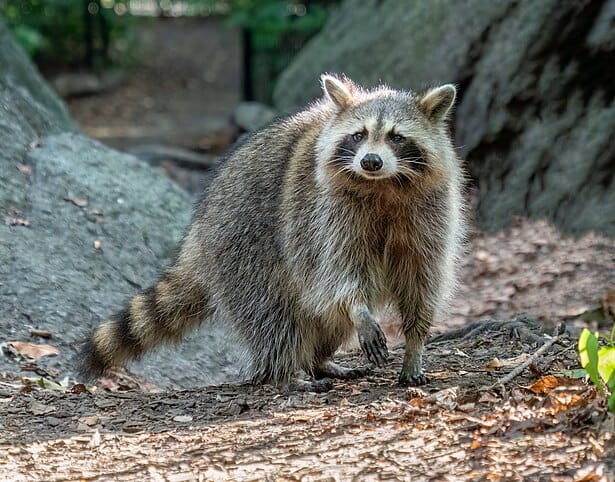
Raccoons are medium-sized mammals native to North America, easily recognized by their masked face and ringed tail. They are highly adaptable, thriving in forests, wetlands, and urban areas. Raccoons are omnivorous, feeding on fruits, nuts, insects, small animals, and human refuse. They are known for dexterous forepaws, capable of opening containers and manipulating objects. Social structure varies, often solitary but sometimes forming family groups. Raccoons are primarily nocturnal, relying on keen senses of touch, smell, and vision in low light. Threats include road mortality, habitat fragmentation, and disease such as rabies. Conservation focuses on coexistence in urban areas, public education, and wildlife rehabilitation. Studying raccoons provides insight into behavioral adaptability, problem-solving skills, and interactions between wildlife and human environments.
32. North American Porcupine – Erethizon dorsatum

The North American porcupine is a large rodent covered in quills, which serve as a defensive mechanism against predators. They inhabit forests, shrublands, and tundra regions across North America. Porcupines are primarily herbivorous, feeding on leaves, bark, and twigs. They are slow-moving and solitary, relying on quills and climbing abilities for protection. Communication involves vocalizations, scent marking, and foot stomping. Reproduction occurs annually, with females giving birth to a single young after a long gestation period. Threats include habitat loss, vehicle collisions, and predation by fishers, bobcats, and coyotes. Conservation emphasizes forest management, public awareness, and protection of critical habitats. Studying porcupines provides insight into defensive adaptations, arboreal foraging, and ecological roles in forest ecosystems.
33. Bonobo – Pan paniscus

Bonobos are great apes closely related to chimpanzees, native to the Democratic Republic of Congo. They are distinguished by a more slender build, dark face, and parted hair on the head. Bonobos are highly social and peaceful, exhibiting strong female dominance and cooperative behaviors. Their diet is primarily frugivorous, supplemented by leaves, seeds, and small animals. Bonobos are known for complex communication, including vocalizations, gestures, and facial expressions. They inhabit tropical rainforests and rely on continuous canopy connectivity for movement. Threats include habitat destruction, hunting, and human conflict. Conservation involves habitat protection, anti-poaching efforts, and research on social structures. Observing bonobos sheds light on primate behavior, social intelligence, and evolutionary comparisons with humans.
34. Giant Panda – Ailuropoda melanoleuca

The Giant Panda is a bear species native to central China, easily recognized by its black-and-white fur and round face. Pandas are specialized herbivores, feeding almost exclusively on bamboo, although they occasionally consume small animals. They have strong jaw muscles and specialized molars to process tough bamboo stems. Giant Pandas are largely solitary, with defined territories communicated through scent marking. Reproduction is challenging, with a short mating season and small litter sizes. Habitat loss and fragmentation are major threats, alongside low reproductive rates. Conservation efforts include protected reserves, captive breeding, and reforestation programs. Studying pandas provides insight into dietary specialization, conservation strategies, and the importance of habitat connectivity in maintaining endangered species populations.
35. Red Panda – Ailurus fulgens

The Red Panda is a small arboreal mammal native to the eastern Himalayas and southwestern China. Despite its name, it is not closely related to giant pandas but shares a bamboo-based diet. Red pandas are omnivorous, consuming bamboo, fruits, insects, and small animals. They are mostly solitary, with communication through scent marking and vocalizations. Adapted for climbing, they have strong, curved claws and a flexible wrist for grasping branches. Threats include habitat loss, deforestation, and poaching. Conservation focuses on habitat preservation, protected areas, and ecological research. Observing red pandas provides insight into niche specialization, arboreal adaptations, and the conservation challenges faced by small, elusive mammals.
36. Common Wombat – Vombatus ursinus
Common wombats are stout, burrowing marsupials native to Australia. They have powerful limbs and strong claws for digging extensive burrow systems, which provide shelter from predators and temperature extremes. Wombats are herbivorous, feeding on grasses, roots, and bark. They are mostly nocturnal, reducing water loss and avoiding daytime heat. Social interactions are minimal, though burrows may be shared occasionally. Threats include habitat fragmentation, road mortality, and disease such as sarcoptic mange. Conservation emphasizes habitat protection, road safety measures, and wildlife monitoring. Studying wombats highlights burrowing adaptations, nocturnal behavior, and ecosystem roles in soil aeration and vegetation management.
37. Tasmanian Devil – Sarcophilus harrisii

The Tasmanian Devil is a carnivorous marsupial native to Tasmania, known for its robust build, black fur, and distinctive screeches. Devils are primarily scavengers, feeding on carrion but also hunting small animals. They are solitary except during feeding or mating aggregations. Communication includes growls, screams, and scent marking. Threats include a contagious facial tumor disease, habitat loss, and road accidents. Conservation focuses on disease management, captive breeding, and habitat protection. Studying Tasmanian devils provides insight into scavenger ecology, disease impacts on wildlife populations, and social interactions among solitary mammals.
38. Walrus – Odobenus rosmarus
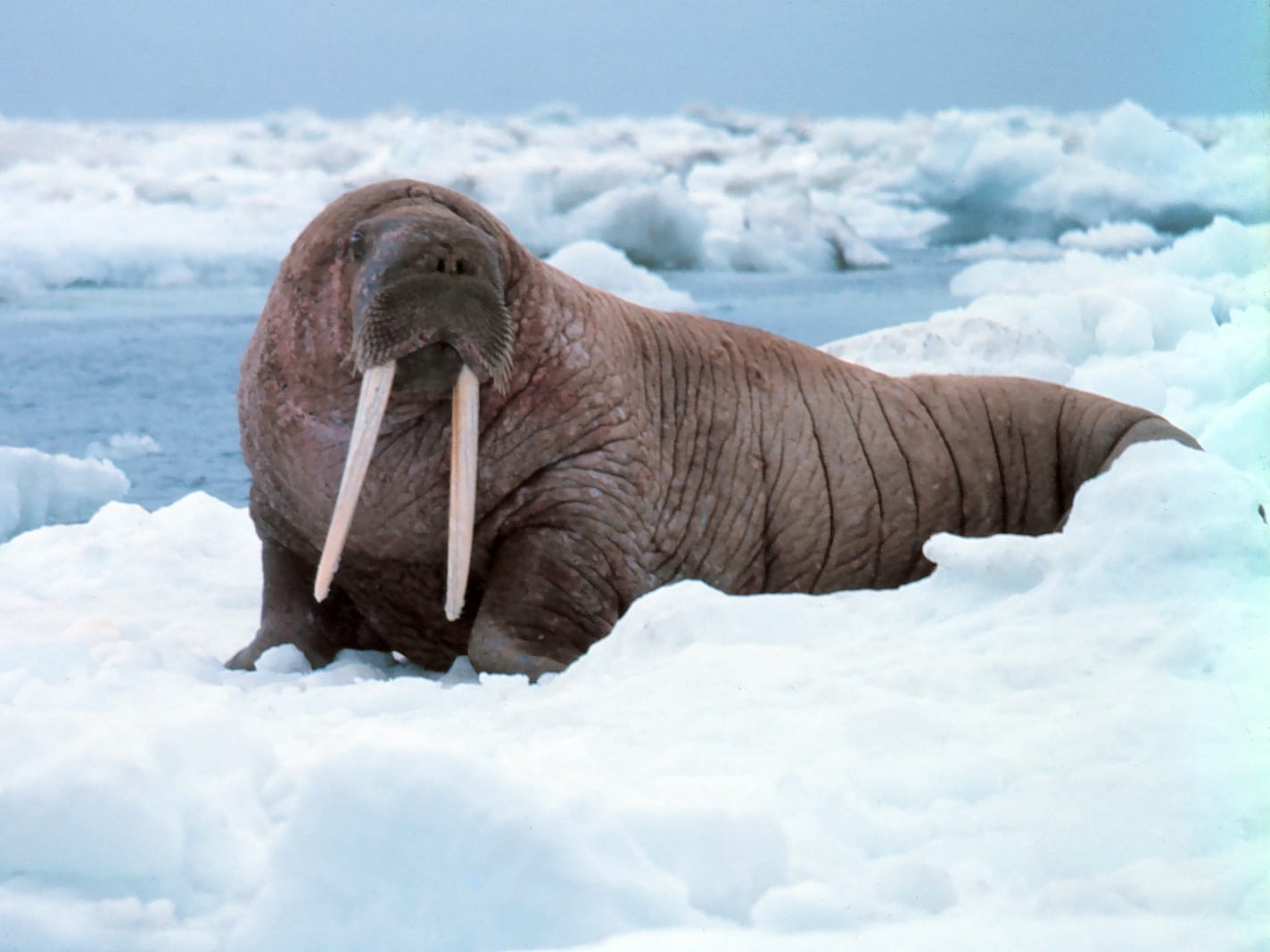
Walruses are large marine mammals inhabiting Arctic regions, recognized by their long tusks, whiskers, and thick blubber. They are highly social, forming large herds on ice floes and coastal areas. Walruses are benthic feeders, consuming mollusks, crustaceans, and other invertebrates. Males engage in dominance displays and competition for females. They rely on ice for resting, birthing, and protection from predators like polar bears. Threats include climate change, hunting, and habitat disturbance. Conservation efforts include international hunting regulations, monitoring of ice habitats, and research on population trends. Studying walruses illustrates marine adaptation, social hierarchies, and the effects of environmental changes on Arctic megafauna.
39. Harbor Seal – Phoca vitulina

Harbor seals are medium-sized pinnipeds found along temperate and Arctic coastlines in the Northern Hemisphere. They are characterized by spotted coats, rounded heads, and large eyes. Harbor seals are agile swimmers, diving to hunt fish, squid, and crustaceans. They haul out on rocks, beaches, or ice to rest, molt, and breed. Socially, they are mostly solitary, although they may form loose aggregations. Threats include entanglement in fishing gear, pollution, habitat disturbance, and climate change. Conservation involves marine protected areas, regulations on hunting and bycatch, and monitoring populations. Studying harbor seals offers insight into marine adaptations, diving physiology, and predator-prey dynamics in coastal ecosystems.
40. Manatee – Trichechus manatus

Manatees, or sea cows, are large, slow-moving aquatic mammals inhabiting freshwater and coastal habitats in the Americas and West Africa. They are herbivorous, feeding on seagrasses, algae, and aquatic vegetation. Manatees have thick skin, paddle-like flippers, and a flexible tail for propulsion. They are gentle and mostly solitary but may form small aggregations during warm seasons. Communication involves squeaks, chirps, and body movements. Threats include boat collisions, habitat loss, pollution, and entanglement in fishing gear. Conservation focuses on habitat protection, boat speed regulations, rescue programs, and public education. Studying manatees provides insight into aquatic herbivore adaptations, migration patterns, and the importance of coastal ecosystems for large mammals.
41. Sloth Bear – Melursus ursinus

The Sloth Bear is a nocturnal, insect-eating bear native to the Indian subcontinent. It has shaggy black fur, a pale muzzle, and long, curved claws specialized for tearing into termite mounds and ant hills. Sloth bears are primarily solitary, though mothers are seen with cubs. Their diet includes termites, ants, fruits, and flowers. Adapted for a nocturnal lifestyle, they have excellent hearing and smell but poor eyesight. Sloth bears exhibit unique vocalizations and defensive behaviors when threatened. Threats include habitat fragmentation, human-wildlife conflict, and poaching. Conservation efforts focus on habitat protection, conflict mitigation, and awareness programs. Studying sloth bears provides insight into specialized feeding adaptations, nocturnal behaviors, and ecological roles in controlling insect populations.
42. Meerkat – Suricata suricatta

Meerkats are small, social mammals native to the arid regions of southern Africa. They live in large cooperative groups called mobs or clans, which include several family units. Meerkats are primarily insectivorous but also eat small vertebrates, eggs, and plants. They are renowned for their sentinel behavior, standing upright to watch for predators while others forage. Communication involves a range of vocalizations, including alarm calls and social chatter. Meerkats inhabit burrow systems with complex tunnels for shelter and protection. Threats include predation by eagles, jackals, and snakes. Conservation emphasizes maintaining natural habitats and studying social structures. Observing meerkats highlights cooperative behavior, predator awareness, and survival strategies in harsh environments.
43. Puma (Cougar/Mountain Lion) – Puma concolor

The Puma, also known as the Mountain Lion or Cougar, is a large, solitary felid native to the Americas. It has a tawny coat, powerful limbs, and a long tail used for balance. Pumas are apex predators, feeding on deer, small mammals, and occasionally livestock. They inhabit forests, mountains, deserts, and grasslands, demonstrating adaptability across varied landscapes. Pumas are primarily nocturnal and crepuscular, relying on stealth and strength to hunt. Threats include habitat fragmentation, human-wildlife conflict, and vehicle collisions. Conservation involves protected areas, wildlife corridors, and public education. Studying pumas provides insight into large predator behavior, territoriality, and ecosystem regulation through prey control.
44. Impala – Aepyceros melampus

Impalas are medium-sized antelopes native to eastern and southern Africa. They are known for graceful leaps and slender, reddish-brown bodies with white underparts. Impalas are herbivorous, feeding on grasses, leaves, and fruits. They form herds for protection against predators such as lions, leopards, and hyenas. Males establish territories during the breeding season and compete for dominance through displays and physical contests. Impalas are highly social, exhibiting synchronized movements and alertness. Threats include habitat loss, hunting, and predation. Conservation focuses on protected areas and anti-poaching initiatives. Studying impalas provides insight into social behavior, predator-prey dynamics, and adaptations for speed and agility.
45. American Bison – Bison bison

The American Bison is a large, iconic mammal native to North America. It has a massive head, humped shoulders, and thick fur adapted to cold climates. Bison are herbivorous, grazing on grasses and sedges. They form herds, which provide protection against predators like wolves and bears. Historically, bison roamed vast plains, playing a key role in shaping grassland ecosystems. Threats include habitat loss, hunting, and genetic bottlenecks. Conservation involves national parks, reintroduction programs, and genetic diversity preservation. Studying bison sheds light on herd behavior, grazing impacts on ecosystems, and recovery of once-endangered species.
46. Plains Zebra – Equus quagga

Plains Zebras are African equids recognized by their striking black-and-white stripes. They inhabit savannas, grasslands, and open woodlands. Zebras are herbivorous, feeding primarily on grasses. They live in social herds with complex hierarchies, often integrating multiple family groups. Stripes serve as camouflage, social signaling, and deterrence against biting insects. Predators include lions, hyenas, and wild dogs. Threats involve habitat loss, hunting, and competition with livestock. Conservation focuses on protected reserves and anti-poaching measures. Studying zebras provides insight into social organization, predator avoidance strategies, and evolutionary adaptations like stripes and cooperative vigilance.
47. Dromedary Camel – Camelus dromedarius

The Dromedary Camel is a large desert mammal with a single hump storing fat, native to the Middle East and North Africa. It is highly adapted to arid conditions, with long legs, thick fur, and the ability to withstand dehydration. Dromedaries are herbivorous, feeding on tough desert vegetation. They are domesticated widely for transport, milk, meat, and wool. Wild populations are minimal due to domestication. Camels are social, living in herds led by dominant males. Studying camels offers insights into physiological adaptations to extreme environments, human-animal relationships, and desert ecosystem dynamics. Conservation emphasizes sustainable management and maintaining genetic diversity in domestic populations.
48. Domestic Donkey – Equus asinus

Domestic Donkeys are domesticated equids widely used as working animals for transport, agriculture, and carrying loads. They are hardy, capable of surviving in arid and rugged environments. Donkeys are herbivorous, consuming grasses, shrubs, and grains. Social structures vary, often forming small herds or family groups. Donkeys communicate through brays, body postures, and vocalizations. Breeding and domestication have created a range of sizes and traits adapted to human needs. Conservation focuses on preserving genetic diversity and sustainable use. Studying donkeys offers insight into domestication processes, adaptation to human environments, and historical roles in human societies.
49. Llama – Lama glama

Llamas are domesticated South American camelids native to the Andes Mountains. They are used for carrying loads, wool, and meat. Llamas are herbivorous, feeding on grasses, shrubs, and high-altitude vegetation. They live in herds with structured social hierarchies, communicating through vocalizations, postures, and humming sounds. Adapted to high altitudes, llamas have efficient oxygen utilization and strong, padded feet for rough terrain. Conservation involves maintaining traditional herding practices and genetic diversity. Studying llamas provides insight into domestication, high-altitude adaptations, and social behaviors in herd animals.
50. Brazilian Tapir – Tapirus terrestris

The Brazilian Tapir is a large, herbivorous mammal native to South American forests, wetlands, and grasslands. It has a prehensile snout used for grabbing foliage and fruits. Tapirs are mostly solitary and crepuscular, feeding on leaves, fruits, and aquatic plants. They play a key role in seed dispersal, maintaining forest ecosystem health. Threats include habitat destruction, hunting, and deforestation. Conservation focuses on protected areas, habitat restoration, and anti-poaching measures. Studying tapirs highlights the ecological importance of large herbivores, behavioral adaptations to dense forest habitats, and the impact of human activities on wildlife populations.
Conclusion
Exploring the 50 types of mammals offers a glimpse into the extraordinary diversity of the mammalian world. From ocean giants like the Killer Whale to tiny desert specialists such as the Meerkat, mammals display remarkable adaptations in behavior, diet, and habitat. Many species exhibit intricate social structures, complex communication, and unique survival strategies. Humans share evolutionary ties with primates, emphasizing the interconnectedness of life. Protecting mammalian biodiversity is crucial, as threats like habitat loss, climate change, hunting, and pollution continue to impact populations worldwide. By understanding these fascinating creatures, we can appreciate their ecological roles, foster conservation awareness, and ensure that future generations witness the majesty of mammals in their natural environments.
FAQ’s
1. What defines a mammal?
Mammals are warm-blooded animals with hair or fur, and females produce milk to feed their young.
2. How many species of mammals exist?
There are over 6,400 recognized species of mammals worldwide.
3. What is the largest mammal?
The Blue Whale is the largest mammal, reaching lengths over 100 feet and weights exceeding 150 tons.
4. What is the smallest mammal?
The Etruscan Shrew is considered the smallest mammal by weight, around 1.8 grams.
5. Do all mammals live on land?
No. Some mammals, like whales and dolphins, are fully aquatic, while others live on land or can fly, like bats.
6. Are all mammals viviparous?
Most mammals give birth to live young, but monotremes, like the platypus and echidna, lay eggs.
7. How do mammals communicate?
Mammals use vocalizations, body language, scent markings, and facial expressions for communication.
8. What do mammals eat?
Mammals can be herbivores, carnivores, omnivores, or specialized feeders like insectivores or nectarivores.
9. How long do mammals live?
Lifespans vary widely; some small rodents live 1–3 years, while elephants can live 60–70 years.
10. What is the fastest mammal?
The Cheetah is the fastest terrestrial mammal, reaching speeds up to 70 mph in short bursts.
11. What is the slowest mammal?
Sloths are the slowest mammals, moving about 0.03 mph when on the ground.
12. Can mammals swim?
Yes, many mammals are excellent swimmers, including seals, whales, and otters.
13. Do mammals hibernate?
Some mammals, like bears and hedgehogs, enter hibernation or torpor to conserve energy during harsh seasons.
14. Are all mammals social?
Not all. While some, like wolves and dolphins, are highly social, others, such as tigers, are solitary.
15. How do mammals regulate body temperature?
Mammals are warm-blooded and maintain stable internal temperatures using metabolic heat, fur, and behavioral adaptations.
16. What is the heaviest land mammal?
The African Elephant is the heaviest land mammal, with males weighing up to 6 tons.
17. What mammals live in cold climates?
Polar Bears, Walruses, and Arctic Foxes thrive in extreme cold, using fur, fat, and behavioral strategies for survival.
18. Do mammals migrate?
Some mammals, like caribou and whales, migrate seasonally in search of food and breeding grounds.
19. How do marine mammals breathe?
Marine mammals, such as whales and dolphins, breathe air through lungs and surface periodically to inhale.
20. What are monotremes?
Monotremes are egg-laying mammals, including the platypus and echidna, mostly found in Australia and New Guinea.
21. What is a marsupial?
Marsupials give birth to underdeveloped young that continue growing in a pouch, like kangaroos and koalas.
22. Can mammals fly?
Yes, bats are the only mammals capable of true sustained flight.
23. What is the primary sense for hunting in mammals?
Senses vary; dogs rely on smell, cats on vision and hearing, while bats use echolocation.
24. What mammals are endangered?
Many mammals are endangered due to habitat loss, poaching, and climate change, including tigers, rhinos, and orangutans.
25. How do mammals reproduce?
Most mammals reproduce sexually, with internal fertilization and live births, except monotremes.
26. Do all mammals have fur?
Most mammals have hair or fur at some stage, though marine mammals like whales have minimal hair.
27. How do mammals care for their young?
Mammals feed offspring with milk, provide protection, and teach survival skills.
28. Are all mammals intelligent?
Intelligence varies; primates, dolphins, and elephants show advanced problem-solving, while others rely on instinct.
29. What are nocturnal mammals?
Nocturnal mammals, like bats and owls, are active at night and have adaptations for low-light conditions.
30. Do mammals live in groups?
Many do, like elephants and wolves, but some are solitary, like tigers and leopards.
31. How do mammals adapt to deserts?
Desert mammals, such as camels and fennec foxes, adapt with water conservation, nocturnal activity, and heat-tolerant physiology.
32. What is the lifespan of whales?
Some whale species, like Bowhead Whales, can live over 200 years.
33. What mammals are apex predators?
Species like lions, tigers, orcas, and wolves are apex predators with no natural predators themselves.
34. How do bats navigate at night?
Bats use echolocation, emitting sound waves that bounce back to locate prey and obstacles in the dark.
35. Do all mammals drink water?
Most mammals require water, but some desert-adapted species obtain hydration from food or metabolic water.
36. Are dolphins mammals?
Yes, dolphins are mammals. They breathe air, give live birth, and nurse their young with milk.
37. Can mammals survive extreme cold?
Yes, species like polar bears and musk oxen survive extreme cold using fur, fat layers, and behavioral adaptations.
38. Do mammals communicate with sounds?
Yes, many mammals communicate vocally, from whales’ songs to primate calls and elephant rumbles.
39. What mammals hibernate?
Bears, hedgehogs, and some bats hibernate to conserve energy during cold or food-scarce seasons.
40. What are aquatic mammals?
Aquatic mammals, like whales, dolphins, and manatees, spend most or all of their lives in water while breathing air.
41. How do primates differ from other mammals?
Primates, including humans, monkeys, and apes, have highly developed brains, dexterous hands, and social behaviors.
42. How do mammals impact ecosystems?
Mammals serve roles as predators, prey, seed dispersers, and ecosystem engineers, shaping habitats and biodiversity.