
Black and brown caterpillars might not have the dazzling colors of their tropical cousins, but their subtle shades hide some of nature’s cleverest camouflage artists. These caterpillars often mimic twigs, bark, or soil, blending perfectly into their surroundings while quietly munching on leaves. In this guide, we’ll explore 20 fascinating types of black and brown caterpillars, from fuzzy woolly bears to sleek hawk-moth larvae. You’ll learn how to identify them, where they live, what they eat, and why their colors are far from boring. By the end, you’ll see that these earthy-toned insects are some of nature’s best examples of beauty in disguise.
1. Woolly Bear Caterpillar (Pyrrharctia isabella)

Physical Characteristics
The Woolly Bear Caterpillar is probably the most famous fuzzy crawler in North America. It sports alternating bands of black and rusty brown hair, giving it the look of a tiny, walking doormat. Despite its rugged appearance, those bristles aren’t venomous. They’re soft and serve as insulation during cold weather. In fact, folklore says the width of its brown band predicts the severity of winter—though scientists would politely disagree.
Behavior
These caterpillars are wanderers. In autumn, you’ll often spot them briskly crossing roads or driveways in search of a cozy spot to hibernate. When disturbed, they curl tightly into a ball, relying on their fuzzy armor to protect them. They’re tough little survivors, capable of freezing solid during winter and thawing out in spring as if nothing happened.
Habitat and Range
Woolly Bears thrive across North America, from Canada to Mexico. They prefer open fields, gardens, and forest edges where wild plants grow in abundance. Their adaptability means you can find them almost anywhere with a bit of greenery.
Diet
They have a wide-ranging palate, munching on dandelions, clover, plantains, and various weeds. This flexible diet helps them survive in diverse habitats, making them a true “jack of all leaves.”
Reproduction and Life Cycle
After spending the winter as a caterpillar, the Woolly Bear spins a fuzzy cocoon in spring. Inside, it transforms into the Isabella Tiger Moth — a gentle, tan-colored insect that lives for just a few days to mate and lay eggs.
Fun Facts / Distinct Traits
- Can survive Arctic temperatures by producing a natural antifreeze compound.
- One of the few insects known to hibernate in its caterpillar stage.
- Has inspired countless local “Woolly Bear Festivals” celebrating its folklore status.
Human Interaction
People adore these caterpillars — they’re often handled gently by children and admired by nature enthusiasts. Their harmless, fuzzy charm and “weather-predicting” legend make them one of the few insects with true celebrity status.
2. Elephant Hawk-Moth Caterpillar (Deilephila elpenor)

Physical Characteristics
Looking at this caterpillar, you might think you’ve stumbled upon a miniature snake. The **Elephant Hawk-Moth Caterpillar** has a velvety brown or black body with eye-like markings near its head. When threatened, it pulls its head in, causing the “eyes” to bulge and giving predators quite the shock. Its rear end tapers into a gentle curve that resembles an elephant’s trunk — hence its name.
Behavior
This caterpillar is an expert actor. If disturbed, it performs an impressive “snake show,” rearing up and pretending to strike. It’s harmless, of course, but the act is so convincing that birds often fall for it. During the day, it hides among leaves and stems, venturing out at dusk to feed.
Habitat and Range
Native to Europe and Asia, the Elephant Hawk-Moth Caterpillar also appears in parts of the UK, Africa, and recently, North America. It prefers gardens, meadows, and woodland edges — especially where its favorite host plants, willowherb and bedstraw, grow.
Diet
It feeds mainly on rosebay willowherb and fuchsias, occasionally sampling garden plants. Despite its exotic look, it rarely causes serious plant damage.
Reproduction and Life Cycle
After several molts, the caterpillar burrows into the soil and pupates over winter. Come summer, it emerges as the striking pink-and-green Elephant Hawk-Moth, a nighttime beauty admired by many gardeners.
Fun Facts / Distinct Traits
- Despite its fierce eyespots, completely harmless.
- Can grow up to 3 inches long before pupating.
- Transforms into one of the most colorful moths in Europe.
Human Interaction
Gardeners often tolerate this caterpillar for the sheer reward of seeing its adult moth form. Some even plant fuchsias intentionally to attract them — proof that beauty sometimes starts as a wriggly surprise.
3. Garden Tiger Moth Caterpillar (Arctia caja)

Physical Characteristics
Nicknamed the “Woolly Bear’s wilder cousin,” this caterpillar wears a shaggy coat of black and orange-brown hairs. Its coloration warns predators that it’s not worth tasting, as it can be mildly toxic from the plants it eats. It’s thick and cylindrical, often curling up when disturbed, resembling a tiny rolled-up hedgehog.
Behavior
It’s mostly nocturnal, feeding at night and hiding under leaves by day. The hairs can cause mild irritation to sensitive skin, so handling isn’t recommended — though they look like plush toys. Their slow movement and visible fuzz make them popular photography subjects.
Habitat and Range
Found across Europe, North America, and parts of Asia, this caterpillar thrives in meadows, wetlands, and gardens. It prefers cooler climates and moist habitats rich in wildflowers.
Diet
It feeds on a wide array of plants including nettles, dock, and burdock. Its flexibility helps it survive in different ecosystems.
Reproduction and Life Cycle
The caterpillar hibernates over winter and emerges in spring to pupate. The adult **Garden Tiger Moth** is a true marvel — creamy white wings with chocolate spots and bright orange hindwings that flash like warning lights when threatened.
Fun Facts / Distinct Traits
- One of the most colorful moths in Europe.
- Its bristles can deter birds and small mammals.
- Used as a model species in evolutionary camouflage studies.
Human Interaction
Although fuzzy and fascinating, this species has declined in some regions due to habitat loss. Nature lovers now encourage wildflower growth to help its recovery — a small act that supports one of nature’s hairiest wonders.
4. Saltmarsh Caterpillar (Estigmene acrea)

Physical Characteristics
The Saltmarsh Caterpillar varies in color from rusty brown to deep black, with a dense coat of long hairs. It looks like a darker version of the Woolly Bear, but with slightly longer setae (hairs). Its color depends on temperature and age — darker ones tend to emerge in cooler seasons.
Behavior
These caterpillars are lively feeders, often wandering far from their host plants when ready to pupate. When touched, they roll into tight balls, relying on their hair as a barrier.
Habitat and Range
Native to North America, they’re found in fields, gardens, and coastal areas — especially near salt marshes, hence their name. However, they’re quite adaptable and can thrive inland too.
Diet
They feed on grasses, clovers, and crop plants such as alfalfa. In large numbers, they can become minor pests, but generally their populations remain balanced.
Reproduction and Life Cycle
After feeding through summer, they form a thin cocoon near the ground. By late spring, adults emerge as pure white moths with delicate black speckles.
Fun Facts / Distinct Traits
- Dark-colored individuals absorb heat better in cool weather.
- Known for their “wandering” pre-pupation behavior.
- Adults are nocturnal and attracted to lights.
Human Interaction
These caterpillars occasionally appear in gardens, drawing curiosity rather than alarm. They’re harmless to humans, though their bristles can cause mild irritation if handled. Many wildlife photographers adore their rich color and fuzzy charm.
5. Brown-Tail Moth Caterpillar (Euproctis chrysorrhoea)
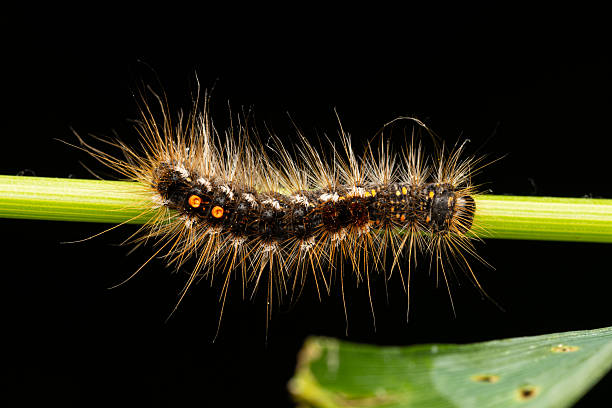
Physical Characteristics
Small but striking, this caterpillar has a dark brown body with white stripes along its sides and tufts of reddish-brown hairs. It grows up to 1.5 inches long and is easily recognized by two bright orange spots near its tail. While beautiful, it’s also one of the few species whose hairs can irritate human skin.
Behavior
Brown-Tail Moth Caterpillars are social creatures. They build communal silk webs where they overwinter together — a cozy setup that protects them from frost. Come spring, they disperse to feed individually.
Habitat and Range
Native to Europe and parts of Asia, this species has spread to North America, where it’s occasionally considered a pest. It favors coastal regions, woodlands, and hedgerows with plenty of broadleaf trees.
Diet
It feeds on oak, apple, pear, and cherry trees, occasionally defoliating branches if populations are high.
Reproduction and Life Cycle
After feeding through spring, caterpillars pupate in silken cocoons. The adult moth is snow-white with a tuft of golden hairs at the tail end — hence the name “Brown-Tail.”
Fun Facts / Distinct Traits
- Their hairs contain a toxin that can cause itching or rash.
- Known for their communal “winter tents.”
- One of few caterpillars with both social behavior and skin-irritating defenses.
Human Interaction
Although they can be troublesome near homes and orchards, Brown-Tail Moth Caterpillars play a role in natural food chains, supporting birds and predatory insects. Observing them safely from a distance reveals fascinating teamwork rarely seen among caterpillars.
6. Pink-Spotted Hawk-Moth Caterpillar (Agrius cingulata)

Physical Characteristics
The Pink-Spotted Hawk-Moth caterpillar is an eye-catching species often admired for its glossy black or deep brown body marked with diagonal pink and white stripes. Its tail horn—common among hawk-moth larvae—is usually dark with a faint pink hue, adding to its bold appearance. When viewed up close, this caterpillar’s texture resembles smooth leather with a faint sheen, giving it a polished look unlike most fuzzy or bristly caterpillars. Adults eventually develop into large, fast-flying moths with pink-striped abdomens and sleek wings.
Behavior
Despite its intimidating horn, the Pink-Spotted Hawk-Moth caterpillar is gentle and non-aggressive. When disturbed, it might curl into a defensive “C” shape or remain perfectly still to blend with its environment. This motionless stance is often enough to discourage predators that rely on movement to detect prey. Like its relatives, it prefers feeding during the evening or early morning when temperatures are cooler and birds are less active.
Habitat and Range
This caterpillar thrives in warm regions across the Americas—from the southern United States down through Central and South America. You’ll find it most often in gardens, fields, and near forest edges where its favorite host plants, such as sweet potatoes and morning glories, are abundant. Its ability to adapt to cultivated lands has made it a familiar sight to farmers and gardeners alike.
Diet
The Pink-Spotted Hawk-Moth caterpillar primarily feeds on plants in the Convolvulaceae family, particularly morning glories (Ipomoea species). It can sometimes be found munching on sweet potato leaves as well. Despite its appetite, it rarely causes severe agricultural damage due to its relatively short feeding period before pupation.
Reproduction and Life Cycle
The female moth lays spherical eggs singly on the undersides of host plant leaves. Upon hatching, the larvae grow rapidly, going through several molts. As they mature, their coloration intensifies, and their diagonal stripes become more vivid. Pupation occurs underground, where the larva transforms into a shiny brown chrysalis. After about two weeks, the adult moth emerges—ready to start the cycle again.
Fun Facts / Unique Traits
The Pink-Spotted Hawk-Moth caterpillar is a strong digger. When ready to pupate, it uses its head and thorax to burrow into loose soil, crafting a chamber for protection. Interestingly, this species can sometimes produce two generations in a single year in warm climates.
Human Interaction
While gardeners may be surprised to find these dark, horned larvae on sweet potato vines, they pose minimal risk to crops. Many nature enthusiasts actually appreciate their striking coloration and enjoy spotting them during warm summer evenings.
7. Scarce Dagger Moth Caterpillar (Acronicta auricoma)

Physical Characteristics
This striking caterpillar is clothed in dense tufts of reddish-brown and black hair, which gives it a fuzzy, almost bear-like look. It sports a series of yellow or orange dorsal patches that appear to glow in sunlight. Despite its soft appearance, those hairs can cause mild irritation if handled carelessly—so it’s best admired from a distance.
Behavior
The Scarce Dagger Moth caterpillar is solitary and prefers to feed quietly during dusk. During the day, it hides under leaves or bark crevices. When threatened, it arches its back, exposing its bright markings—a natural warning sign to potential predators.
Habitat and Range
Native to Europe and western Asia, this species frequents deciduous woodlands, hedgerows, and gardens. Its populations are scattered, living up to its name “scarce,” especially in northern areas where suitable host plants are fewer.
Diet
The larvae feed primarily on oak, willow, and birch leaves, though they occasionally consume hazel and apple foliage. Their diet contributes to the natural pruning of trees, playing a role in ecosystem balance.
Reproduction and Life Cycle
Females lay eggs in small clusters on the undersides of leaves. The larvae feed through summer and early autumn before spinning a loose cocoon near the soil surface. They overwinter in the pupal stage, emerging as adult moths the following spring.
Fun Facts / Unique Traits
The species name “auricoma” means “golden-haired,” referring to its warm-toned bristles. While uncommon, its adult form—a grayish moth with fine streaks—camouflages perfectly against tree bark.
Human Interaction
Though rarely encountered, these caterpillars occasionally appear in gardens where oaks or willows are planted. Their fuzzy look makes them a favorite among macro photographers and insect enthusiasts.
8. Drinker Moth Caterpillar (Euthrix potatoria)

Physical Characteristics
The Drinker Moth caterpillar is a charming, plump creature adorned with tufts of brown, black, and golden hair, along with small white dots along its sides. Its name comes from its peculiar behavior of “drinking” dew drops—though it’s not as thirsty as the name implies. It reaches lengths of up to 7 cm when mature, making it quite a noticeable garden visitor.
Behavior
This caterpillar is slow-moving and spends much of its time basking in sunlight. When disturbed, it curls up into a tight ball, relying on its dense hair for protection. It’s more active in the spring and early summer, feeding mostly during the day.
Habitat and Range
Found across Europe and parts of Asia, the Drinker Moth caterpillar prefers damp grasslands, marshes, and meadows. You can often spot it resting on reed stems or near water bodies, which provide ideal humidity for its development.
Diet
It feeds on various grasses, including reed canary grass and meadow grasses. Despite being a generalist feeder, it doesn’t usually damage crops or lawns, making it ecologically harmless.
Reproduction and Life Cycle
After hatching from eggs laid on grass blades, larvae grow slowly and overwinter as partly grown caterpillars. They resume feeding in early spring before pupating within a silken cocoon attached to grass stems.
Fun Facts / Unique Traits
Its common name stems from its habit of sipping dew—an unusual trait among caterpillars. The adult moth’s furry brown body and golden wings make it equally appealing to observe.
Human Interaction
Many people find the Drinker Moth caterpillar endearing due to its fuzzy look. Nature photographers often use macro lenses to capture its shimmering hairs in morning dew.
9. Fox Moth Caterpillar (Macrothylacia rubi)

Physical Characteristics
The Fox Moth caterpillar is a long, thick-bodied species, typically brown to black with orange bands running along its sides. Its dense fur gives it a velvety appearance, much like the pelt of a fox—hence its name. It can grow up to 8 cm in length, making it one of the larger hairy caterpillars found in Europe.
Behavior
This species basks in sunlight to regulate its body temperature, especially during early mornings. When threatened, it curls into a tight spiral, a behavior common among fuzzy caterpillars to protect their vulnerable undersides.
Habitat and Range
The Fox Moth caterpillar inhabits heathlands, moors, and coastal dunes across Europe and parts of Asia. It prefers open, sunny areas with low vegetation where it can warm up quickly after cold nights.
Diet
It feeds on heather, bramble, and various grasses. The diet varies with the local habitat, allowing the species to thrive in diverse ecosystems.
Reproduction and Life Cycle
After overwintering as larvae, they resume feeding in early spring before pupating in a silk cocoon among plant litter. Adult moths emerge in early summer, recognizable by their reddish-brown wings and strong, fast flight.
Fun Facts / Unique Traits
Fox Moth caterpillars often sunbathe openly—a rare behavior among caterpillars. This helps them digest food more efficiently and speeds up their development.
Human Interaction
They are harmless and sometimes admired as part of nature trails and wildlife photography projects. Their furry, fox-colored bodies make them a favorite among kids and nature lovers.
10. Oak Eggar Caterpillar (Lasiocampa quercus)
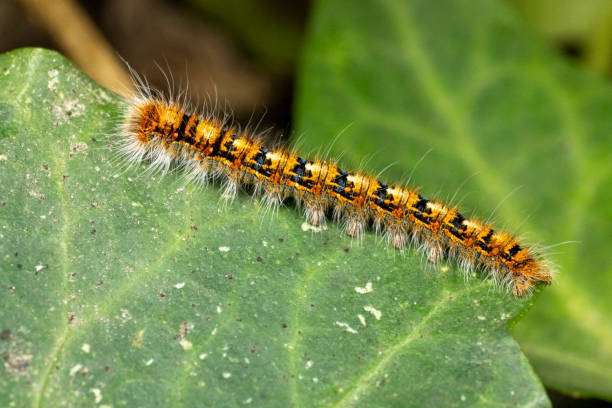
Physical Characteristics
The Oak Eggar caterpillar resembles the Fox Moth caterpillar but with more pronounced orange and brown bands. It’s heavily covered in bristles that shimmer in sunlight. Despite its name, it doesn’t feed exclusively on oak trees.
Behavior
This caterpillar spends most of its life feeding actively during daylight. In cooler climates, it may take up to two years to mature. When disturbed, it rolls up into a fuzzy ball—its best defense against birds and small mammals.
Habitat and Range
Common across Europe and the British Isles, Oak Eggar caterpillars are usually found in heathlands, grasslands, and forest edges. They thrive in areas with plenty of shrubs and sunlight.
Diet
They feed on a wide variety of plants including heather, hawthorn, and bramble. Their broad diet makes them resilient to habitat changes.
Reproduction and Life Cycle
The species has a lengthy development period. After overwintering twice as larvae, they pupate in silken cocoons among leaf litter. Adults—large and furry—emerge during summer, often mistaken for small bats at dusk due to their rapid flight.
Fun Facts / Unique Traits
The “Eggar” name comes from their rounded, egg-like cocoons. Their thick fur helps them withstand cold nights in windy moorlands.
Human Interaction
Oak Eggar caterpillars are commonly featured in British wildlife guides. They’re harmless to humans but sometimes trigger curiosity due to their dense, bear-like hair.
11. Brownish Horned Caterpillar (General Group – Multiple Species)

Physical Characteristics
The Brownish Horned Caterpillar isn’t a single species but a term describing several dark-bodied caterpillars that share one feature — a prominent horn near the rear. Their bodies range from deep chocolate brown to almost black, often highlighted with lighter brown bands or speckles. Some have subtle diagonal lines or small dots running down their sides. The horn, which may look intimidating, is soft and flexible, curving slightly upward like a tiny tail.
Behavior
Most horned caterpillars in this group are nocturnal, preferring to feed under cover of darkness. During the day, they rest motionless along branches, blending perfectly into bark and leaves. When disturbed, they may rear their heads or twitch the horn — a harmless bluff to scare off predators. They’re solitary, though you may find several feeding on the same host plant.
Habitat and Range
These caterpillars thrive in warm, humid environments such as forests, gardens, and agricultural fields. They’re found worldwide, especially in regions where plants of the nightshade or willow families are common. Their adaptability to both wild and cultivated areas explains their broad range.
Diet
They typically feed on foliage from shrubs and trees like privet, willow, cherry, and even ornamental plants. Their feeding style is steady but not overly destructive, removing sections of leaves but rarely defoliating entire branches.
Reproduction and Life Cycle
Females of the horned moth species lay eggs singly or in small groups under leaves. The larvae pass through five or six stages (instars), with the horn growing more pronounced in later phases. Pupation usually happens underground, where they form a sturdy brown chrysalis.
Fun Facts / Unique Traits
That rear horn isn’t a stinger—it’s purely for show. Many predators, including birds, are fooled into thinking the caterpillar’s tail is its head, helping it survive in the wild. Some even have eye-like spots near the horn to enhance this illusion.
Human Interaction
Gardeners often spot these caterpillars among vegetable crops and flowering shrubs. They may look intimidating, but they don’t bite, sting, or damage plants severely, making them more of a curiosity than a pest.
12. Black and Brown Spiny Caterpillar (Mixed Species Group)

Physical Characteristics
This group includes several striking caterpillars characterized by black or dark brown bodies covered with branching spines or sharp-looking bristles. The spines are usually arranged in neat rows, with small patches of reddish-brown or orange between them. Their surface appears shiny, and under sunlight, they glisten like polished wood. The legs and head capsules often show a coppery tone, giving them a distinct two-tone look.
Behavior
Spiny caterpillars are tough survivors. When disturbed, they freeze or curl into a defensive pose, with their spines raised like a miniature fortress. These spines aren’t for decoration—they can cause mild irritation if touched. Most of the time, they rely on camouflage, blending into twigs or the undersides of leaves.
Habitat and Range
These caterpillars can be found in tropical forests, temperate woodlands, and gardens. Depending on the species, they might inhabit the Americas, Asia, or Africa. Many live in areas rich in flowering plants or fruit trees, where they find both food and shelter.
Diet
They feed on a variety of broadleaf plants such as passion vines, oaks, and hibiscus. Their strong jaws allow them to chew through tough leaves with ease. Although their feeding might look intense, most populations stay small and balanced within their ecosystems.
Reproduction and Life Cycle
The eggs of spiny caterpillars are laid in clusters, often guarded by the female until hatching. As larvae grow, they molt multiple times, replacing their old spines with newer, larger ones. Pupation occurs in a silk-lined leaf curl or under loose bark.
Fun Facts / Unique Traits
Some of these species can change color slightly as they mature, shifting from deep black to a reddish-brown tone. This helps them remain camouflaged as the seasons change. Their spiny appearance is nature’s way of saying “do not touch.”
Human Interaction
Though mildly irritating if handled, these caterpillars play an important role in natural pest control by maintaining balance among plant-eating insect populations. They’re also favorites among insect photographers for their dramatic appearance.
13. Dark Furry Caterpillar with Brown Bands (Regional Woolly Bear Type)
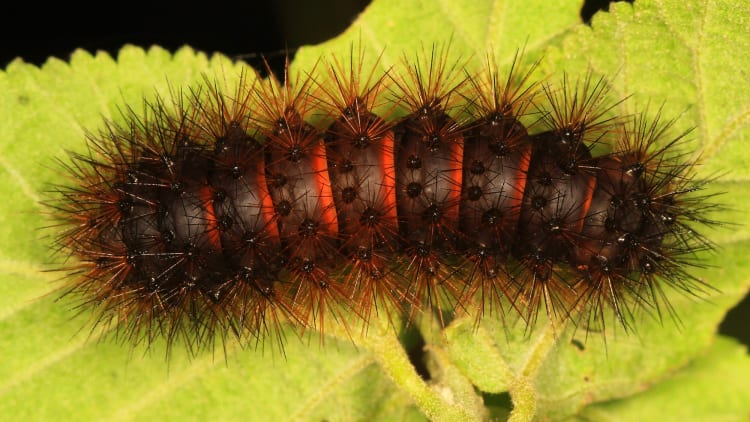
Physical Characteristics
This woolly bear–type caterpillar is instantly recognizable by its dense coat of fur, alternating black and brown bands along its body. The fuzz serves as insulation, allowing it to survive colder climates where other larvae perish. It can grow up to 5 cm long and rolls into a perfect ball when touched.
Behavior
Docile and slow-moving, this caterpillar spends its days searching for low vegetation to feed on. When threatened, it simply curls up, relying on its fur for defense. Birds tend to avoid it, likely due to its rough texture and the unappetizing bristles.
Habitat and Range
Woolly bear caterpillars are found across North America, Europe, and parts of Asia. They prefer open fields, gardens, and grassy meadows where they can bask in sunlight and feed freely on common weeds.
Diet
They’re not picky eaters—feeding on grasses, clovers, plantains, and dandelions. Their flexible diet allows them to survive in both rural and suburban environments.
Reproduction and Life Cycle
These caterpillars overwinter as larvae, freezing almost solid during winter months. When spring returns, they thaw and continue feeding before spinning silky cocoons. Adults emerge as small, tan moths ready to restart the cycle.
Fun Facts / Unique Traits
Folklore says the width of the brown band can predict the severity of winter—the wider it is, the milder the season will be. Though unscientific, it’s a charming bit of country tradition still shared today.
Human Interaction
Children often find and gently handle these caterpillars during autumn walks. They’re harmless and safe to observe up close, making them a beloved symbol of seasonal change.
14. Dark Brown Tussock Caterpillar (Tussock Moth Group)

Physical Characteristics
This fuzzy brown caterpillar is decorated with tufts of hair arranged in tiny “brushes” along its back, giving it an unmistakable silhouette. Some have orange or red stripes, while others appear nearly black with light tufts standing out in contrast. The hairs are soft but can cause mild irritation on sensitive skin.
Behavior
Active mainly during the day, the Dark Brown Tussock caterpillar crawls briskly, often pausing to feed in short bursts. When threatened, it arches its back and displays its bright tufts like warning flags. Many predators learn to avoid them quickly.
Habitat and Range
These caterpillars inhabit forests, parks, and gardens across North America, Asia, and Europe. They thrive in both urban and rural areas where deciduous trees are abundant.
Diet
They feed on a wide range of trees—oak, maple, apple, and willow among them. Their strong appetites occasionally make them mild pests in fruit orchards.
Reproduction and Life Cycle
Females lay large clusters of eggs on bark or leaves, covering them with protective hairs from their bodies. The larvae hatch and go through several molts before spinning tough cocoons that cling to tree bark. Adults emerge as delicate moths with feathered antennae.
Fun Facts / Unique Traits
Many Tussock species display sexual dimorphism: males are active flyers, while females are often flightless. Their cocoons may incorporate their own shed hairs for added strength.
Human Interaction
Though sometimes considered pests, they’re fascinating to watch as they transform through life stages. Gardeners often find them during pruning seasons.
15. Black and Brown Slug Caterpillar (Slug Moth Family – Limacodidae)

Physical Characteristics
The Black and Brown Slug Caterpillar is unlike most caterpillars—it moves without visible legs, gliding along surfaces like a slug. Its oval, flattened body sports intricate color patterns, usually deep black or brown with glossy ridges and tiny stinging spines. Its smooth, jelly-like appearance can be deceptive since its spines may deliver a mild sting.
Behavior
Slow and deliberate, this caterpillar rarely travels far. It clings tightly to leaves, feeding from the underside. When disturbed, it arches and stiffens, relying on its toxic spines for protection.
Habitat and Range
Found in Asia, Africa, and parts of the Americas, this species prefers humid tropical forests and shaded gardens. It thrives on fruit trees, ornamentals, and shrubs with tender foliage.
Diet
Its diet includes mango, citrus, and guava leaves. Because of its feeding habits, it can occasionally be a minor pest in orchards. However, populations rarely grow large enough to cause concern.
Reproduction and Life Cycle
The female moth lays eggs in neat rows under leaves. Larvae hatch within days, growing steadily through multiple molts before forming tough cocoons. These cocoons are remarkable—each is shaped like a tiny dome and covered with a sticky layer that keeps predators away.
Fun Facts / Unique Traits
Their slug-like movement comes from a muscular “creeping sole,” which allows smooth gliding without legs. Some species even glow faintly under UV light—a subtle but fascinating detail for entomologists.
Human Interaction
Though their stings can cause mild skin irritation, they’re still admired for their alien-like beauty. Gardeners handle them carefully or relocate them using leaves or twigs.
16. Dark Horned Sphinx Caterpillar (Sphingidae family – Black/Brown Horned Types)

Physical Characteristics
The Dark Horned Sphinx Caterpillar is a powerhouse of color and attitude. Typically cloaked in rich shades of black or dark brown, this caterpillar’s most defining feature is its sharp, upward-pointing horn at the rear. The body surface may appear smooth and leathery with faint diagonal lines or subtle speckles. As it matures, some individuals develop bluish or reddish tones near the horn, giving it a somewhat metallic sheen. It’s a muscular caterpillar, often stretching up to 8 centimeters in length.
Behavior
Despite its menacing horn and size, this species is surprisingly docile. When startled, it may puff up its body or rear backward in a defensive pose to display the horn. The behavior mimics a snake’s bluff, effectively scaring off potential predators. Most activity happens at dusk or dawn, as the caterpillar feeds quietly on leaves.
Habitat and Range
This caterpillar thrives in forested regions, gardens, and meadows throughout North America, Asia, and parts of Africa. Members of the Sphingidae family are adaptable—found both in wild forests and cultivated lands. Their love for host plants like tomatoes, peppers, and ornamental shrubs often brings them into contact with humans.
Diet
Like most sphinx caterpillars, the Dark Horned variety enjoys feeding on nightshades, including tobacco, potato, and jasmine. Their appetite can be impressive, yet they rarely cause serious damage because they feed for only a short time before pupating.
Reproduction and Life Cycle
After mating, females lay single, round eggs under host leaves. Larvae hatch in a few days and immediately begin feeding. Over several molts, the horn elongates and color darkens. Once mature, the caterpillar burrows underground to pupate. Depending on climate, it may produce one or two generations each year.
Fun Facts / Unique Traits
The horn of this caterpillar looks sharp but is entirely harmless. In some cultures, it’s called the “dragon caterpillar” due to its reptilian stance when threatened. The adult moth that emerges—sleek and fast-flying—is often mistaken for a small bird at night.
Human Interaction
Gardeners may occasionally find this caterpillar munching on tomato leaves, but it’s generally left alone because it transforms into a spectacular hawk moth—a valuable pollinator for night-blooming flowers.
17. Blackish Brown Oak-Leaf Caterpillar (Phoberia atomaris Group)

Physical Characteristics
This dark-bodied caterpillar takes camouflage to the next level. The Blackish Brown Oak-Leaf Caterpillar sports jagged patterns of black, gray, and dark brown across its body, resembling a dried oak leaf. Its head is small and slightly pointed, while the back may feature faint bumps or small horn-like ridges. Measuring up to 4 centimeters long, it’s built to blend seamlessly into its surroundings.
Behavior
Its primary defense strategy is mimicry. When resting on a branch or leaf litter, it’s nearly indistinguishable from decaying leaves. When disturbed, it drops to the ground and stays motionless for several minutes—a clever act that saves it from detection.
Habitat and Range
As the name suggests, this caterpillar thrives in oak forests and woodlands throughout the eastern United States and Canada. It can also be found in parks or suburban areas where oak trees are planted. The species prefers drier environments with plenty of leaf litter for camouflage.
Diet
Its menu is dominated by oak leaves, though it occasionally samples hickory or beech foliage. Because its feeding occurs mainly at night, it often goes unnoticed by predators and humans alike.
Reproduction and Life Cycle
Eggs are deposited on the underside of oak leaves. After hatching, larvae progress through five instars, growing darker each time. By late summer, they drop to the ground and pupate among the fallen leaves, emerging as small, brown moths in spring.
Fun Facts / Unique Traits
This caterpillar’s disguise is so convincing that even experienced bird predators frequently overlook it. Its mimicry extends beyond color—its rough, irregular outline enhances the illusion of being part of a dead leaf.
Human Interaction
Harmless to people and generally beneficial to forest health, this caterpillar helps recycle nutrients by feeding on older leaves rather than fresh growth. Observing one is like finding a hidden masterpiece of natural design.
18. Black/Brown Waste-Mimic Caterpillar (Bird Dropping Mimic Group)

Physical Characteristics
At first glance, you might mistake this caterpillar for something far less glamorous—a blob of bird droppings. Its combination of white, gray, brown, and black markings forms a perfect disguise. The body is slightly lumpy, with irregular bumps that add to the illusion. Despite its unappealing disguise, it’s an extraordinary example of natural defense.
Behavior
Stillness is its greatest weapon. The Waste-Mimic Caterpillar spends most of its day motionless on leaves, confident that predators won’t look twice at what seems to be waste. When threatened, it might rear up, displaying faint eye-like markings on its thorax to mimic a small snake—a second layer of defense!
Habitat and Range
This type of caterpillar occurs across tropical and subtropical regions, particularly in Asia and the Americas. It’s often seen on citrus trees, spice plants, or ornamental shrubs.
Diet
Its primary diet consists of citrus leaves, camphor, and related aromatic plants. Gardeners sometimes mistake it for a pest, though damage is typically minimal.
Reproduction and Life Cycle
The eggs are laid on young citrus shoots. After hatching, the larvae resemble bird droppings for the first few instars. Only near maturity do they change color slightly, revealing greenish or brownish tones before pupation. The chrysalis itself often mimics a twig, hanging at an angle for added camouflage.
Fun Facts / Unique Traits
Few caterpillars have mastered disguise like this one. Even experienced gardeners often overlook it entirely. This species demonstrates that survival sometimes depends on looking utterly unappetizing.
Human Interaction
While citrus growers might spot them occasionally, these caterpillars are admired more for their creativity than feared for their appetite. Their adult form—a delicate swallowtail moth or butterfly—adds beauty to local ecosystems.
19. Dark Hairy Brown Caterpillar (Common Furry Type)

Physical Characteristics
The Dark Hairy Brown Caterpillar is a modest yet endearing insect. Covered with thick, chocolate-colored hairs, it has an understated beauty that’s easy to miss. The fur can be slightly iridescent under sunlight, and a faint stripe often runs down the center of its back. Its body feels dense and springy, resembling a miniature paintbrush.
Behavior
Usually calm and slow-moving, this caterpillar relies on its thick coat for defense. Birds tend to avoid eating fuzzy larvae, associating hairiness with irritation. It spends most of its day feeding near the base of plants or among fallen leaves, venturing out during cooler hours.
Habitat and Range
Widespread across Europe, Asia, and North America, this species prefers meadows, garden beds, and woodland edges. Its adaptability allows it to live in both wild and suburban environments.
Diet
It feeds on clover, dock, and nettle leaves—essentially whatever is available. This flexibility ensures survival across different habitats and seasons.
Reproduction and Life Cycle
Eggs are laid in clusters on low vegetation. The larvae hatch and develop quickly, with several molting stages over a few weeks. Pupation occurs within a dense cocoon spun among leaf litter or on grass stems.
Fun Facts / Unique Traits
This unassuming caterpillar is one of nature’s quiet survivors. Its dense fur provides insulation, allowing it to endure chilly weather and resume activity early in spring.
Human Interaction
Harmless to touch (though slightly prickly), it’s often noticed by gardeners and kids exploring the outdoors. Its fuzzy appearance makes it a delightful sight rather than a pest concern.
20. Black & Brown Striping Caterpillar (Striped Pattern Group)
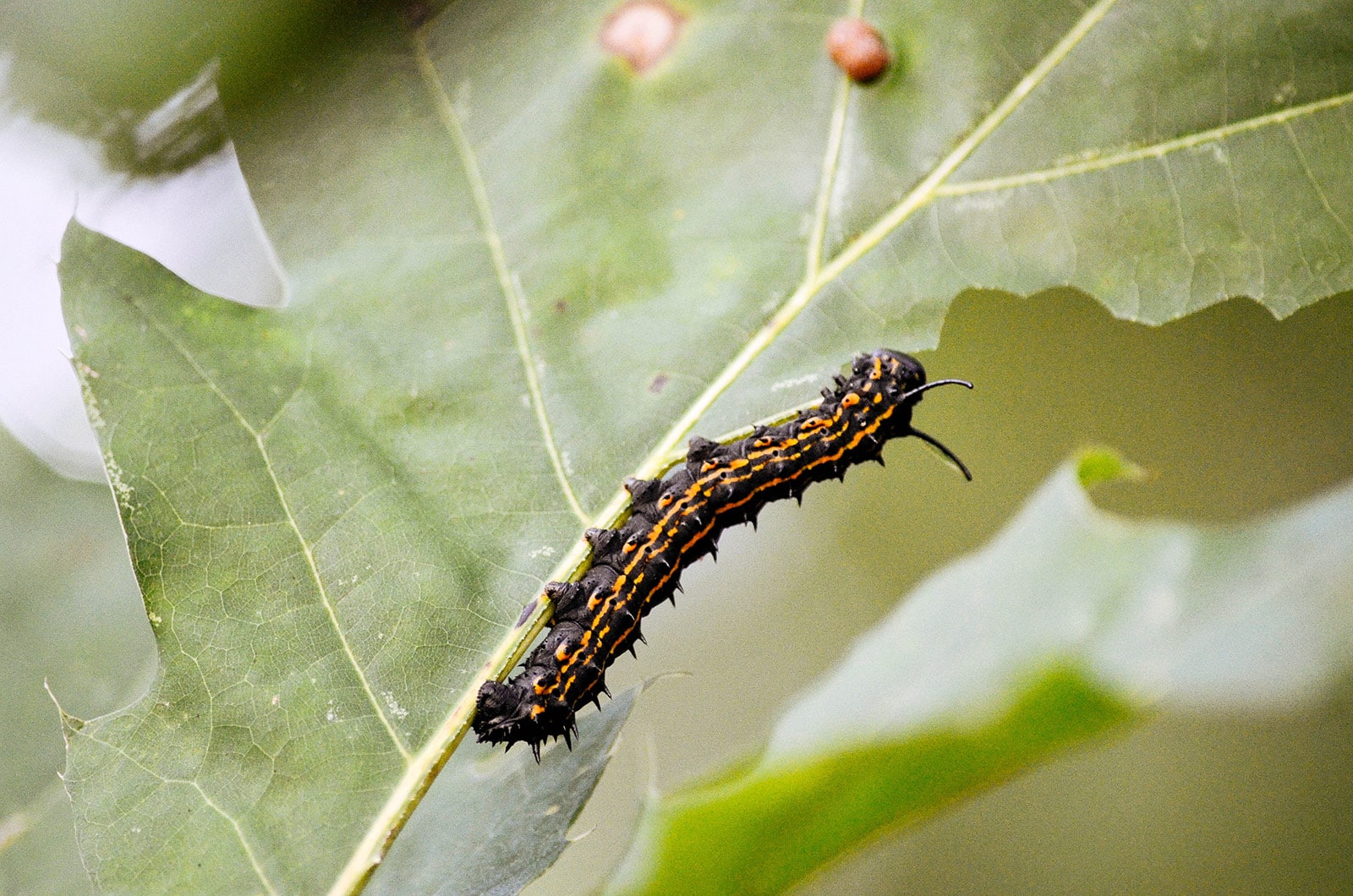
Physical Characteristics
The Black & Brown Striping Caterpillar is as stylish as nature gets. It boasts alternating bands of black and deep brown running the length of its body, sometimes with yellow or white pinstripes in between. Its head may be black, while the legs show a subtle reddish hue. This sleek, striped design serves as both camouflage and warning coloration.
Behavior
This caterpillar is active and alert, moving confidently along leaves and stems. When disturbed, it may sway side to side in an attempt to confuse predators. Its coloration helps it blend into tree bark or fallen twigs, especially under dappled sunlight.
Habitat and Range
Common in forests, orchards, and gardens, this striped species is widespread across North America and Europe. It prefers sunny spots with plenty of foliage and can be found on fruit trees and low shrubs.
Diet
It feeds on a wide range of plants, including apple, pear, oak, and willow. The larvae chew neatly along the edges of leaves, leaving distinctive scalloped patterns behind.
Reproduction and Life Cycle
Eggs are laid in small clusters by the female moth on the underside of leaves. The larvae grow through several stages before forming a silk cocoon on a branch or under bark. Adults emerge after two to three weeks as sleek, night-flying moths.
Fun Facts / Unique Traits
The sharp color contrast of black and brown stripes acts like a visual puzzle—hard for predators to track when the caterpillar is in motion. Some individuals even arch their bodies to mimic the shape of twigs.
Human Interaction
Harmless to humans and plants alike, the Black & Brown Striping Caterpillar adds quiet beauty to natural landscapes. It’s often a favorite subject of wildlife photographers due to its elegant patterning and gentle demeanor.
FAQ’s
1. What does it mean if you see a black and brown caterpillar?
Seeing a black and brown caterpillar, often a woolly bear caterpillar, has long been considered a sign of upcoming weather. Folklore says that the width of its brown band predicts the winter — a wider brown band means a mild season, while more black suggests a harsher winter. Scientifically, though, its colors mostly show age and humidity, not weather patterns.
2. Can you touch a woolly bear caterpillar?
Yes, you can safely touch a woolly bear caterpillar! They don’t sting or bite. However, their bristles can be a bit prickly and may cause mild skin irritation for sensitive people. It’s always a good idea to wash your hands afterward, just to be safe.
3. What is a black and brown caterpillar?
A black and brown caterpillar is usually a woolly bear caterpillar, the larval stage of the Isabella tiger moth. These fuzzy, banded caterpillars are known for rolling into tight balls when touched and for their folklore fame as “weather predictors.”
4. What should I do if I find a woolly bear caterpillar?
If you find a woolly bear, gently move it off paths or roads to a safe spot with grass or leaves. You can even place it in a small container with fresh leaves if you want to observe it for a day or two. Just be sure to release it back into nature afterward so it can complete its life cycle.
5. Is finding a caterpillar good luck?
Many cultures see caterpillars as symbols of **transformation, hope, and new beginnings**. Finding one can be seen as a sign of personal growth or positive change ahead. Spiritually, it reminds us that patience and transformation lead to something beautiful — much like a butterfly emerging from its cocoon.
6. What month is a woolly bear caterpillar?
Woolly bear caterpillars are most commonly seen in the **fall months**, usually between September and November. During this time, they’re searching for a place to hibernate through the winter before turning into moths the following spring.
7. Do woolly bear caterpillars turn into anything?
Yes! Woolly bear caterpillars eventually become **Isabella tiger moths**. After hibernating during winter, they spin cocoons in spring and emerge as tan-colored moths with orange markings. It’s a beautiful example of metamorphosis in action.
8. Can I touch a black swallowtail caterpillar?
Yes, black swallowtail caterpillars are safe to handle. They don’t sting or bite. When disturbed, they may extend small orange “horns” called osmeterium that release a harmless but smelly scent to scare away predators. Just handle them gently and wash your hands afterward.
9. Should I get rid of black swallowtail caterpillars?
No — you shouldn’t! Black swallowtail caterpillars are important pollinators in their adult butterfly form. They mostly feed on parsley, dill, and fennel, so instead of removing them, consider planting a few extra herbs to share. They’ll reward you later with beautiful butterflies in your garden.
10. Should I wash my hands after touching a caterpillar?
Yes, it’s always a good habit to wash your hands after touching any caterpillar. Some species have mild defensive hairs that can irritate skin, while others may carry pollen or plant residue. A quick rinse keeps you safe and clean.
11. Which caterpillar has the worst sting?
The **puss caterpillar** holds the title for the worst sting. Its soft, furry look hides venomous spines that cause severe pain, swelling, and sometimes nausea. Luckily, these caterpillars are rare and easily avoided. Most caterpillars, like woolly bears or swallowtails, are harmless.
12. Is a black and orange caterpillar?
A black and orange caterpillar could also be a **woolly bear**, especially if it has fuzzy bands. However, several other species share similar coloring, including the giant leopard moth caterpillar. The bright orange and black pattern usually acts as a warning to predators — “Don’t eat me, I might taste bad!”
13. What does a caterpillar predict?
In folklore, the woolly bear caterpillar’s color pattern predicts winter’s severity. A larger brown section means mild weather, while more black means a tough winter ahead. Though this legend isn’t scientifically proven, it’s a fun and enduring part of North American tradition.
14. What does the Bible say about caterpillars?
In the Bible, caterpillars are often used as symbols of **destruction and renewal**. They represent the stages of life where things may seem to be falling apart, only to transform into something greater later. It’s a reminder of patience and faith through change.
15. What does it mean when a caterpillar crosses your path?
When a caterpillar crosses your path, many people see it as a **sign of growth or transformation** coming your way. Spiritually, it can symbolize slowing down and being patient — life’s big changes often happen quietly, one step at a time.
16. What is the warning of the swallowtail caterpillar?
The black swallowtail caterpillar gives a clear warning when it feels threatened. It pops out a pair of bright orange, forked glands from its head called an osmeterium. These glands release a strong, unpleasant odor to scare away predators. The message is simple: “Back off, I’m not tasty!”
17. How rare are black swallowtails?
Black swallowtails aren’t rare, but they are seasonal. You can often spot them in gardens across North America during late spring through summer. Their population may seem to fluctuate from year to year depending on temperature, rainfall, and the availability of host plants like parsley, fennel, and dill.
18. Is it okay to pick up a caterpillar?
Yes, it’s perfectly fine to pick up most caterpillars as long as you’re gentle. Use a soft touch or let them crawl onto your hand rather than grabbing them. Always make sure to identify the species first—some, like the puss or saddleback caterpillar, can sting. And don’t forget to wash your hands afterward!
19. Is it safe to pick up woolly bear caterpillars?
Yes, woolly bear caterpillars are safe to handle. They might curl into a ball when touched, but that’s just their way of protecting themselves. Their bristles aren’t venomous, though they can feel a bit prickly on your skin. If you’re sensitive, it’s best to admire them with care or use gloves.
20. What kills woolly bear caterpillars?
Woolly bears face natural threats like cold snaps, parasitic wasps, and birds. In captivity, they can die from lack of proper moisture or food. If you’re keeping one to observe, provide fresh leaves, gentle humidity, and avoid over-handling. Nature is delicate, and these fuzzy travelers need the right balance to survive the winter.
21. How do you know if a caterpillar turns into a moth or a butterfly?
You can usually tell by its appearance and behavior. Butterfly caterpillars are often smooth with short hairs, and they form a chrysalis. Moth caterpillars, like hornworms or woolly bears, are usually hairier and spin a cocoon of silk. Their antennae and resting styles as adults also differ — butterflies fold wings upright, while moths spread them flat.
22. What should I do with a woolly bear caterpillar?
If you find a woolly bear, you can gently place it in a safe area with grass or fallen leaves. If you want to observe it, keep it in a small container with air holes and provide fresh plant material. Once it starts to slow down or curl up, it’s preparing to hibernate — that’s your cue to release it outdoors in a sheltered spot.
23. What is the lifespan of a woolly caterpillar?
Woolly bear caterpillars have an impressive lifespan for insects. They can live up to **eight months** or even longer, surviving winter in their fuzzy form. After hibernation, they spin a cocoon in spring and emerge as an Isabella tiger moth, living only a few days to mate and lay eggs.
24. Are woolly bear caterpillars itchy?
They can be, but only mildly. The woolly bear’s stiff bristles might cause slight itching or irritation for sensitive skin. It’s not dangerous, just a light prickly feeling. If that happens, rinse your hands with cool water and avoid rubbing the area.
Conclusion
Black and brown caterpillars may look similar at first glance, but their diversity is astonishing. From the horned sphinx with its fierce stance to the fuzzy oak-dwellers that resemble fallen leaves, each species has carved out its own niche in nature’s design. These caterpillars aren’t just leaf-eaters — they’re vital to ecosystems, feeding birds, pollinators, and even inspiring camouflage innovations in science. Whether you find one curled under an oak leaf or inching across your garden wall, take a closer look. You might just be looking at the early life of a stunning moth or butterfly, preparing for its grand transformation. So next time you see a black or brown crawler on a leaf, remember — beauty often begins with a caterpillar.
Read more: 25 Types of Moth Caterpillars (Pictures and Identification)