
Doves are some of the most graceful and widely recognized birds in the world, known for their gentle cooing and symbolic presence in cultures worldwide. Belonging to the family Columbidae, doves are closely related to pigeons, but many species are smaller, slender, and display unique patterns and colors that make them fascinating to observe. Whether you’re a beginner birdwatcher or a seasoned enthusiast, understanding the different types of doves is essential for accurate identification and appreciation of their ecological roles. This guide explores 49 dove species, providing detailed insights into their size, habitats, identifying features, and nesting habits, helping you recognize these charming birds wherever they appear.
Understanding Dove Classification
Doves belong to the Columbidae family, which includes over 300 species worldwide. These birds are highly adaptable, inhabiting forests, deserts, grasslands, and urban areas. While doves and pigeons are technically part of the same family, doves are usually smaller, more delicate, and often have soft plumage with subtle color patterns. Classification typically considers physical characteristics, behavioral traits, and geographical distribution. Understanding dove taxonomy can help enthusiasts distinguish between visually similar species and recognize rare or endangered types.
1. Mourning Dove (Zenaida macroura)

Size
The Mourning Dove is a medium-sized bird, measuring 31–37 cm (12–14.5 inches) in length with a wingspan of 45–55 cm (17–22 inches). It weighs approximately 85–170 grams (3–6 ounces), making it one of the more common and easily noticeable doves in North America. Its slender body, long tapered tail, and streamlined shape allow for fast, direct flight, often reaching speeds of 55 mph.
Habitat
Mourning Doves are highly adaptable and can thrive in diverse environments. They are commonly found in open woodlands, farmlands, grasslands, suburban areas, and parks. These birds favor habitats with scattered trees and open ground for foraging, and they often perch on telephone wires, rooftops, and fence posts. Their widespread presence across North America makes them one of the most frequently encountered dove species.
Species Identification
Mourning Doves are easily identified by their light brown to tan plumage with a slight pinkish hue on the chest. Black spots on the wings, a long pointed tail with white edges, and a soft, mournful cooing sound distinguish them from other doves. Their eyes are dark with a subtle blue orbital ring. Juveniles appear slightly duller but have the same basic markings.
Nesting Habit
These doves build simple, flimsy nests in trees, shrubs, or man-made structures. The nest is made from twigs and grasses and is often reused or repaired across breeding seasons. Females lay 1–2 eggs, and both parents participate in incubation and feeding the hatchlings with nutrient-rich crop milk. Mourning Doves can raise multiple broods in a single year, which contributes to their abundant population.
2. Eurasian Collared-Dove (Streptopelia decaocto)
Size
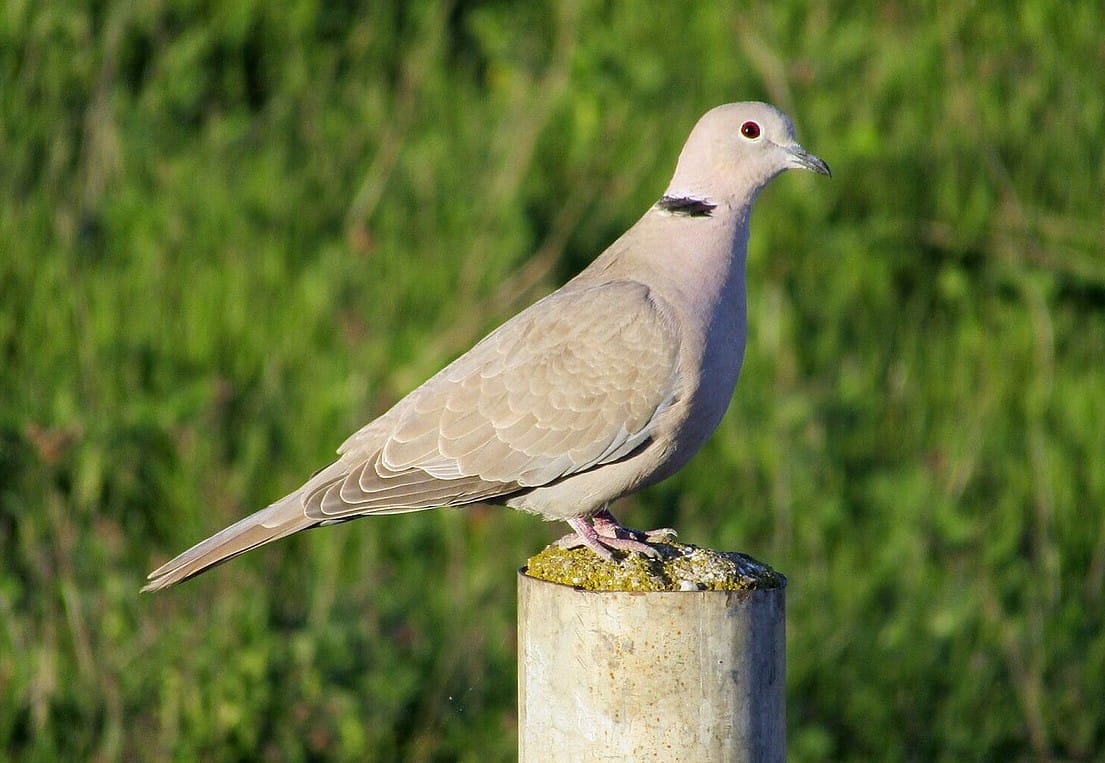
The Eurasian Collared-Dove measures about 32 cm (12.5 inches) in length, with a wingspan of 47–55 cm (18.5–21.5 inches) and an average weight of 180–200 grams (6–7 ounces). It has a slightly larger build compared to the Mourning Dove, with a rounded body and short, broad tail that aids in agile flight.
Habitat
Originally native to Europe and Asia, this species has expanded dramatically into North America. Eurasian Collared-Doves thrive in urban areas, farmlands, and small towns, often seen near human settlements. They prefer open areas with access to water and food sources such as grains and seeds. Their adaptability has enabled them to establish dense populations in new territories.
Species Identification
A defining feature of the Eurasian Collared-Dove is the black crescent-shaped “collar” on the back of its neck, contrasting with its pale gray or beige body. Its eyes are red or orange, with a subtle blue-gray orbital ring. It emits a soft, three-part cooing call that repeats rhythmically. This combination of physical traits makes it easy to identify even at a distance.
Nesting Habit
Nests are typically built in trees, shrubs, or building ledges. Like other doves, the nest is shallow, composed of twigs and minimal lining. Females lay 1–2 eggs, incubated by both parents for about 14–16 days. The young fledge approximately two weeks after hatching. Eurasian Collared-Doves are prolific breeders, sometimes producing multiple broods per year, which supports their rapid population expansion.
3. White-winged Dove (Zenaida asiatica)
Size
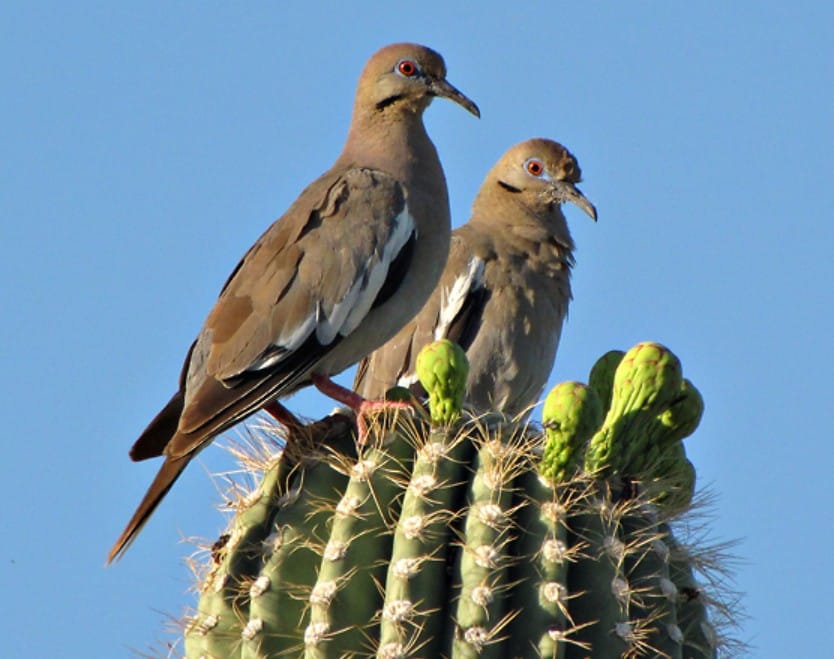
White-winged Doves are slightly larger than Mourning Doves, measuring 30–33 cm (11.5–13 inches) in length, with a wingspan of 45–48 cm (17.5–19 inches) and weighing around 120–180 grams (4–6 ounces). Their robust bodies and broad wings make them strong fliers, often gliding gracefully in open skies.
Habitat
Native to the southern United States, Mexico, and Central America, White-winged Doves inhabit deserts, woodlands, agricultural areas, and urban environments. They favor habitats with cacti, shrubs, and trees that provide food and nesting sites. Seasonal migrations occur in parts of their range in response to food availability.
Species Identification
The White-winged Dove is easily recognized by the white edge along its wings, visible in flight. Its plumage is generally light gray-brown with a slight pinkish chest, and it has a distinctive bluish eye ring. Their cooing call is loud and resonant, often repeated in pairs or flocks.
Nesting Habit
These doves build simple nests in trees, cacti, or shrubs, usually 3–10 meters above ground. They use twigs, grass, and leaves to construct shallow platforms for eggs. Each clutch usually contains 2 eggs, incubated for approximately 14 days. Both parents feed the young with crop milk, and fledglings leave the nest around 13–15 days after hatching.
4. Rock Pigeon (Columba livia)

Size
The Rock Pigeon is a medium-sized bird, measuring 29–37 cm (11–14.5 inches) in length with a wingspan of 62–72 cm (24–28 inches). They typically weigh 238–380 grams (8–13 ounces), making them heavier and more robust than most dove species. Their compact body and broad wings allow strong, sustained flight over urban and rural landscapes.
Habitat
Rock Pigeons are extremely adaptable and can thrive in urban centers, farmlands, cliffs, and parks. Originally native to Europe, North Africa, and parts of Asia, they have now been introduced worldwide. They commonly roost on building ledges, bridges, and other high structures, mimicking the cliffs they originally nested on.
Species Identification
These birds display a wide range of color variations, but most have gray plumage with two black wing bars, iridescent green or purple neck feathers, and a lighter rump. Their beak is short and dark, and the eyes are usually orange or red. Rock Pigeons are often confused with other pigeons, but their size, neck sheen, and urban presence help identify them.
Nesting Habit
Rock Pigeons build nests in sheltered locations such as building ledges or cliff crevices. Their nests are rudimentary, made of twigs and debris. Clutch size is typically 1–2 eggs, incubated for 17–19 days. Both parents feed the hatchlings with nutrient-rich crop milk. These pigeons are prolific breeders, often producing multiple broods per year.
5. African Collared-Dove (Streptopelia roseogrisea)

Size
The African Collared-Dove is slightly smaller than its Eurasian cousin, measuring about 26–30 cm (10–12 inches) in length with a wingspan of 47–50 cm (18.5–19.5 inches). It weighs 130–160 grams (4.5–5.5 ounces). Its lightweight frame and long wings enable agile, swift flight.
Habitat
This species is native to the Sahel region and parts of sub-Saharan Africa. It is commonly found in savannas, farmland, woodland edges, and urban areas. African Collared-Doves are highly adaptable to human presence and often frequent villages, feeding on grains and seeds.
Species Identification
These doves are light gray-brown with a pinkish hue on the chest and a distinctive black crescent collar on the back of the neck. The eyes are dark brown, surrounded by a subtle blue-gray orbital ring. They have a soft cooing call that repeats rhythmically, often heard during early mornings and late afternoons.
Nesting Habit
African Collared-Doves build simple platform nests from twigs, grass, and leaves, often located in low trees or bushes. Females lay 1–2 eggs per clutch, which are incubated by both parents for 13–15 days. Fledglings leave the nest about two weeks after hatching. Multiple broods may be raised in a single year, especially in areas with abundant food.
6. Inca Dove (Columbina inca)
Size
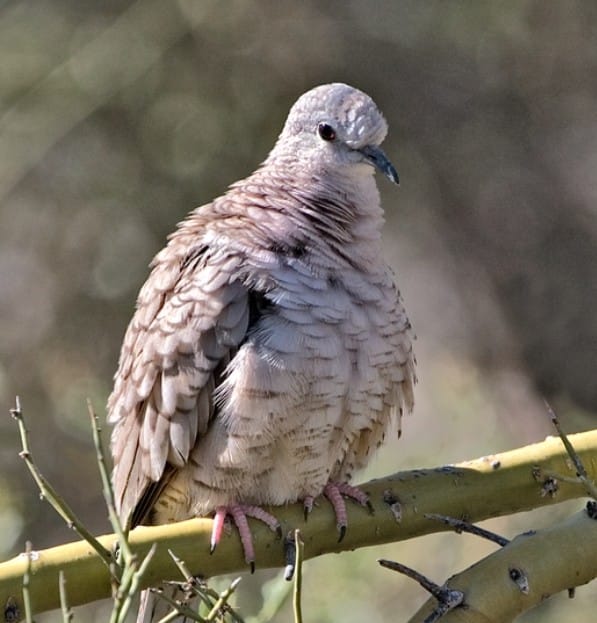
The Inca Dove is a small dove, measuring 16–18 cm (6–7 inches) in length with a wingspan of 21–25 cm (8–10 inches) and a weight of 28–40 grams (1–1.5 ounces). Its small size and delicate body make it one of the lighter members of the dove family.
Habitat
Inca Doves are native to the southwestern United States, Mexico, and Central America. They prefer open habitats such as deserts, scrublands, farmlands, and urban parks. They are often seen on the ground, foraging in small flocks and avoiding dense forests.
Species Identification
This species is distinguished by its finely scaled feather pattern, giving it a unique mosaic-like appearance. The plumage is light brown with subtle gray and buff tones. Its long tail is squared with white tips, and its eyes are dark with a thin pale orbital ring. The cooing call is soft and high-pitched.
Nesting Habit
Inca Doves build small, flimsy nests in shrubs, cacti, or low trees. They typically lay 2 eggs per clutch, and both parents participate in incubation for about 13–15 days. Young doves fledge roughly 14 days after hatching. Inca Doves often nest in close proximity, forming loose colonies.
7. Common Ground Dove (Columbina passerina)

Size
The Common Ground Dove is one of the smallest doves in North America, measuring 15–18 cm (6–7 inches) in length with a wingspan of 22–25 cm (8.5–10 inches). It weighs just 26–40 grams (1–1.5 ounces). Its small size makes it highly agile and able to move quickly on the ground while foraging.
Habitat
This species prefers open, semi-arid habitats such as fields, desert edges, scrublands, and urban gardens. It is commonly found in the southern United States, Mexico, and parts of Central America. These doves are ground foragers and thrive in areas with scattered shrubs or low vegetation for cover.
Species Identification
Common Ground Doves have a rounded body with soft gray-brown plumage. Their wings display subtle black spots, and the tail is short and squared. The eyes are dark with a faint blue orbital ring, and the beak is small and slightly curved. Their cooing call is gentle, often consisting of soft “whoop” notes.
Nesting Habit
Nests are small, fragile platforms made of twigs and grasses, usually placed in low shrubs, cacti, or thorny bushes. Females lay 1–2 eggs per clutch, and both parents incubate them for about 12–14 days. The chicks fledge approximately 12–13 days after hatching. Common Ground Doves may raise multiple broods in a year, especially in warmer climates.
8. Diamond Dove (Geopelia cuneata)

Size
The Diamond Dove is a small, delicate species, measuring 19–21 cm (7.5–8.5 inches) in length, with a wingspan of 25–28 cm (10–11 inches). It weighs around 30–40 grams (1–1.5 ounces), making it lightweight and extremely agile during flight.
Habitat
Native to Australia, Diamond Doves prefer arid and semi-arid regions, including grasslands, scrublands, and agricultural areas. They are often found near water sources and are highly social, commonly forming flocks. Their habitats are open with scattered vegetation that provides both food and nesting cover.
Species Identification
This species is easily identified by its pale gray-brown body, contrasting black and white speckled wings (hence the “diamond” name), and striking red eyes with bright orange eye rings. The tail is long and narrow, often fanned during flight. Diamond Doves emit soft, repetitive cooing calls that are delicate and melodious.
Nesting Habit
Diamond Doves build small, simple nests of twigs, grasses, and leaves, typically 1–2 meters above ground in shrubs or low trees. Females lay 1–2 eggs per clutch, incubated by both parents for about 14 days. The fledglings leave the nest around two weeks after hatching. These doves may produce multiple broods annually, especially in favorable conditions.
9. Zebra Dove (Geopelia striata)

Size
The Zebra Dove is slender and small, measuring 20–23 cm (8–9 inches) in length, with a wingspan of 25–30 cm (10–12 inches) and weighing 40–60 grams (1.4–2.1 ounces). Its lightweight body allows swift, direct flight across urban and rural areas.
Habitat
Native to Southeast Asia, Zebra Doves have adapted to open woodlands, farmlands, urban gardens, and parks. They are often seen foraging on the ground in pairs or small groups and prefer habitats with low shrubs or scattered trees for nesting.
Species Identification
Zebra Doves are named for the fine barring pattern on their chest and flanks, resembling zebra stripes. Their plumage is soft brown with a pinkish hue on the chest. The eyes are dark brown, and the beak is small and slightly curved. Their call is soft, repeated, and high-pitched, often described as a gentle cooing trill.
Nesting Habit
They build shallow nests of twigs and grasses in shrubs, small trees, or even on building ledges. Clutch size is usually 2 eggs, with incubation lasting around 13–14 days. Both parents feed the chicks with crop milk until fledging, approximately 12–14 days after hatching. Zebra Doves may raise multiple broods per year, particularly in regions with abundant food.
10. Laughing Dove (Spilopelia senegalensis)

Size
The Laughing Dove is small to medium-sized, measuring 20–25 cm (8–10 inches) in length, with a wingspan of 30–35 cm (12–14 inches). It weighs 80–120 grams (2.8–4.2 ounces), making it lightweight and highly agile.
Habitat
Native to Africa and the Middle East, the Laughing Dove thrives in semi-arid habitats, scrublands, farmlands, and urban areas. It is highly adaptable and often forages near human settlements, feeding on seeds and small insects.
Species Identification
These doves have a pinkish-brown body, light gray head, and spotted black neck markings. The tail is long and slightly rounded, and the eyes are dark with a subtle pale eye ring. Their call resembles a soft, rapid “coo-coo-coo,” often repeated in a laughing sequence, which gives the species its name.
Nesting Habit
Nests are built low in shrubs, trees, or cacti, composed of twigs and grasses. Females lay 2 eggs per clutch, with both parents sharing incubation duties for 13–15 days. The chicks fledge about 12–14 days post-hatching. Multiple broods are common in favorable environments, making the species prolific in its range.
11. Pink-necked Green Pigeon (Treron vernans)

Size
The Pink-necked Green Pigeon is medium-sized, measuring 24–27 cm (9.5–10.5 inches) in length, with a wingspan of 40–45 cm (15.5–17.5 inches). Weighing 120–150 grams (4–5 ounces), it has a compact, stocky body and a short tail.
Habitat
Native to Southeast Asia, this species inhabits forests, gardens, and mangroves. They are often spotted perched quietly in fruiting trees, feeding on figs, berries, and other soft fruits. They prefer areas with dense canopy cover that offers protection from predators.
Species Identification
Males are easily recognized by their vibrant pinkish neck, green wings, and yellow belly. Females are more subdued, with green plumage and subtle yellow tones. The eyes are reddish-brown, and the beak is short and slightly curved. Their call is a soft “coo” repeated rhythmically.
Nesting Habit
These pigeons build small, flat nests in trees, often using twigs and leaves. Females lay 1–2 eggs per clutch, with both parents participating in incubation for around 13–15 days. Chicks are fed crop milk initially and fledge approximately two weeks after hatching. Multiple broods are possible in regions with abundant fruit.
12. White-tipped Dove (Leptotila verreauxi)

Size
White-tipped Doves are medium-sized, measuring 26–31 cm (10–12 inches) in length, with a wingspan of 40–45 cm (15.5–17.5 inches). They weigh about 130–160 grams (4.5–5.5 ounces), giving them a moderately robust build.
Habitat
Native to Central and South America, these doves inhabit forests, woodland edges, plantations, and urban gardens. They prefer shaded areas with dense foliage and are often seen foraging on the ground for seeds and fruits.
Species Identification
The White-tipped Dove gets its name from the distinctive white tips on the tail feathers, visible in flight. Its plumage is mainly gray-brown with a slightly pinkish chest. The eyes are dark with a blue-gray orbital ring. Their call is a loud, mournful cooing that is often repeated in series.
Nesting Habit
Nests are simple platforms of twigs and grasses, usually placed in low trees or shrubs. Females lay 2 eggs per clutch, incubated by both parents for 14–16 days. Chicks fledge approximately two weeks after hatching. They often raise multiple broods in one breeding season, especially where food is abundant.
13. Pacific Emerald Dove (Chalcophaps longirostris)

Size
The Pacific Emerald Dove is a medium-sized dove, measuring 25–30 cm (10–12 inches) in length with a wingspan of 40–45 cm (15.5–17.5 inches). It weighs approximately 120–150 grams (4–5 ounces). Its compact body and strong wings allow it to navigate through dense forest foliage with ease.
Habitat
This species inhabits lowland and coastal forests, mangroves, and dense woodland areas throughout Indonesia, New Guinea, and northern Australia. Pacific Emerald Doves are typically ground foragers, feeding among leaf litter for seeds and fallen fruits. They prefer shaded areas with dense understory for cover and protection from predators.
Species Identification
These doves are easily recognized by their vibrant emerald-green back and wings, contrasting with a reddish-brown head and chest. The eyes are red-orange, and the tail is short and squared with white tips. Their soft cooing call is often repeated, providing a melodious sound within the forest understory.
Nesting Habit
Pacific Emerald Doves build small, shallow nests of twigs and leaves, usually located in low shrubs or tree branches. Females lay 2 eggs per clutch, and both parents participate in incubation for 13–15 days. Fledglings leave the nest about two weeks after hatching. These doves may produce multiple broods per year when food is plentiful.
14. Thick-billed Ground Dove (Trugon terrestris)

Size
The Thick-billed Ground Dove is small to medium, measuring 18–22 cm (7–8.5 inches) in length with a wingspan of 25–30 cm (10–12 inches). It weighs 35–50 grams (1.2–1.8 ounces). Its stocky body and short wings are adapted for quick bursts of flight near the ground.
Habitat
Native to South America, this species prefers open woodlands, forest edges, and scrublands. It forages primarily on the forest floor for seeds, fallen fruits, and small insects. Thick-billed Ground Doves are often found in areas with thick underbrush, which provides concealment from predators.
Species Identification
These doves are light brown with subtle gray and rufous tones. The thick, short beak is adapted for ground foraging. Their tail is short and slightly rounded, and the eyes are dark. The cooing call is soft and low-pitched, often repeated at intervals.
Nesting Habit
The nests are simple, constructed from small twigs and grass in low shrubs or on the ground among dense vegetation. Clutch size is usually 2 eggs, incubated for 12–14 days by both parents. Fledging occurs approximately two weeks post-hatching. Multiple broods are common in tropical habitats with abundant resources.
15. Emerald Dove (Chalcophaps indica)
Size
The Emerald Dove measures 25–30 cm (10–12 inches) in length, with a wingspan of 40–45 cm (15.5–17.5 inches) and a weight of 120–160 grams (4–5.5 ounces). Its compact build makes it an agile flier, particularly suited for navigating dense forests.
Habitat
Native to South and Southeast Asia, Emerald Doves are found in lowland forests, plantations, and gardens near dense vegetation. They are shy birds, often remaining on the forest floor or low branches while foraging for seeds, fruits, and fallen berries.
Species Identification
Emerald Doves are striking, with glossy green wings and back contrasted with a pinkish chest and gray head. Their eyes are red, and the tail is short with white tips. Their call is a soft, repetitive cooing, often used in territorial displays.
Nesting Habit
Nests are constructed from twigs and grasses in low shrubs or small trees. Females lay 2 eggs per clutch, with both parents sharing incubation duties for about 14 days. Fledglings leave the nest around 13–15 days after hatching. Multiple broods are possible in areas with abundant food.
16. Little Brown Dove (Phapitreron leucotis)

Size
The Little Brown Dove is a small species, measuring 21–24 cm (8–9.5 inches) in length with a wingspan of 30–35 cm (12–14 inches). It weighs 60–80 grams (2–2.8 ounces). Its small frame allows quick flight through thick forest vegetation.
Habitat
Endemic to the Philippines, this dove inhabits lowland and mid-elevation forests. It prefers dense woodland areas and plantations where food like seeds and berries is readily available. Little Brown Doves are shy and often remain in thick understory to avoid predators.
Species Identification
These doves have light brown plumage with subtle gray tones and a slightly darker head. The eyes are brown, and the beak is short and dark. Their call is soft and melodic, often repeated in a series.
Nesting Habit
The nests are small and delicate, made of twigs and grasses, and placed in low shrubs or tree branches. Clutch size is typically 2 eggs, incubated by both parents for 12–14 days. Fledging occurs around two weeks after hatching. Multiple broods may be raised in favorable habitats.
17. Pink-headed Imperial Pigeon (Ducula rosacea)

Size
This medium-sized dove measures 35–40 cm (14–16 inches) in length, with a wingspan of 60–70 cm (24–28 inches) and a weight of 250–350 grams (8.8–12.3 ounces). Its robust body supports long flights between fruiting trees in forests.
Habitat
Native to Indonesia, Pink-headed Imperial Pigeons inhabit lowland and hill forests, mangroves, and forest edges. They primarily forage for fruits in the canopy but occasionally descend to lower vegetation.
Species Identification
They are strikingly colored, with a pink head, grayish body, and greenish wings. The tail is broad, and eyes are red. Their cooing call is deep and resonant, often echoing through forest valleys.
Nesting Habit
These pigeons build large platform nests in tall trees using twigs and leaves. Females lay a single egg per clutch, with both parents incubating for about 20–22 days. Fledging occurs 18–20 days after hatching. They are generally solitary breeders but may nest in loose colonies in fruit-abundant areas.
18. Nicobar Pigeon (Caloenas nicobarica)

Size
Nicobar Pigeons are medium to large, measuring 40–45 cm (16–18 inches) in length, with a wingspan of 70–75 cm (28–30 inches) and a weight of 570–640 grams (20–22 ounces). Their long neck and iridescent plumage make them one of the most visually striking dove species.
Habitat
Endemic to the Nicobar Islands, the Andaman Islands, and nearby Southeast Asian regions, they inhabit coastal forests, mangroves, and small islands. Nicobar Pigeons forage on the forest floor, feeding on seeds, fruits, and berries.
Species Identification
These pigeons feature iridescent green and bronze plumage with a dark gray head and white undertail coverts. Their eyes are dark, and the long neck feathers create a lacy appearance. Their call is a soft, low-pitched cooing, rarely loud in dense forests.
Nesting Habit
Nests are shallow platforms of twigs and leaves, built in trees or dense shrubs. Females lay 1 egg per clutch, incubated by both parents for 28–30 days. Fledging occurs roughly 30 days after hatching. Nicobar Pigeons usually breed singly or in small groups, depending on food availability.
19. Spinifex Pigeon (Geophaps plumifera)

Size
The Spinifex Pigeon is a small, ground-dwelling dove, measuring 22–25 cm (8.5–10 inches) in length, with a wingspan of 30–35 cm (12–14 inches). It weighs approximately 80–100 grams (2.8–3.5 ounces). Its compact body and strong legs make it highly adapted for terrestrial movement in arid habitats.
Habitat
Endemic to the arid interior regions of Australia, Spinifex Pigeons inhabit spinifex grasslands, rocky outcrops, and desert plains. They prefer open, sparsely vegetated areas where they can forage for seeds and small insects. Their strong legs allow them to run quickly across rough terrain to avoid predators.
Species Identification
Spinifex Pigeons display sandy brown plumage with darker streaks, allowing excellent camouflage in desert environments. Males have a distinctive red patch on the face, while females are generally duller. Their short, rounded tails and dark eyes complete the ground-adapted appearance. The call is a soft, low-pitched coo repeated intermittently.
Nesting Habit
Nests are small scrapes in the ground or shallow depressions lined with grass and twigs. Females lay 2 eggs per clutch, incubated by both parents for around 14 days. Fledging occurs about two weeks post-hatching. Breeding typically coincides with periods of rainfall when food is more abundant.
20. Crested Pigeon (Ocyphaps lophotes)

Size
The Crested Pigeon is a medium-sized dove, measuring 32–35 cm (12.5–14 inches) in length with a wingspan of 50–55 cm (19.5–21.5 inches). It weighs between 170–200 grams (6–7 ounces). Its long tail and prominent crest make it highly recognizable in the field.
Habitat
Native to Australia, Crested Pigeons thrive in open woodlands, grasslands, farmlands, and urban parks. They are commonly observed foraging on the ground in small flocks, often near human activity. They require access to open spaces for feeding and scattered trees or shrubs for nesting.
Species Identification
These doves are easily identified by their pointed crest, gray-brown plumage, and black wing markings. Their wings display a subtle iridescence, and the tail is long with white tips. Eyes are orange-red, and the soft cooing call is repeated rhythmically. In flight, a distinctive whistling sound is produced by the wings.
Nesting Habit
Crested Pigeons build fragile nests of twigs and grass in trees or shrubs. Females lay 2 eggs per clutch, incubated by both parents for 17–19 days. Fledging occurs about two weeks after hatching. Multiple broods are raised per year, especially in areas with abundant food and water.
21. Ruddy Ground Dove (Columbina talpacoti)

Size
The Ruddy Ground Dove is a small species, measuring 14–16 cm (5.5–6 inches) in length, with a wingspan of 22–25 cm (8.5–10 inches). It weighs approximately 26–40 grams (1–1.5 ounces). Its small body enables quick movement along the ground.
Habitat
Native to Central and South America, this species prefers open habitats, farmland, gardens, and forest edges. Ruddy Ground Doves forage mainly on seeds, grains, and small insects, often forming small flocks for safety. They are adaptable to human presence.
Species Identification
These doves have warm reddish-brown plumage with grayish underparts and subtle black wing spots. Their tail is short and squared, and eyes are dark with a pale orbital ring. The call is a soft, low-pitched coo repeated in short sequences.
Nesting Habit
Nests are small, shallow platforms made from twigs and grass, placed low in shrubs, cacti, or small trees. Females lay 2 eggs per clutch, incubated for 12–14 days by both parents. Fledging occurs around 12–13 days post-hatching. Multiple broods are common during the wet season when food is abundant.
22. Black-billed Cuckoo Dove (Macropygia nigrirostris)

Size
This medium-sized dove measures 30–34 cm (12–13.5 inches) in length, with a wingspan of 50–55 cm (19.5–21.5 inches). It weighs 140–180 grams (5–6.5 ounces). Its slender, elongated body is well-suited for maneuvering through dense forest vegetation.
Habitat
Native to Indonesia and nearby islands, the Black-billed Cuckoo Dove inhabits lowland and hill forests, secondary growth, and mangroves. They are primarily frugivorous, foraging in the forest canopy for figs and berries.
Species Identification
These doves have uniform brownish-gray plumage with a slightly darker tail and subtle iridescence on the wings. The beak is black and slightly curved, adapted for fruit consumption. Eyes are dark, and the call is a soft, mournful coo.
Nesting Habit
Nests are small platforms of twigs and leaves built in low to mid-level trees or shrubs. Females lay a single egg per clutch, incubated for 18–20 days by both parents. Fledging occurs roughly three weeks after hatching. Breeding may occur once or twice per year depending on food availability.
23. Zebra Finch Dove (Geopelia striata decipiens)
(Closely related to the Zebra Dove, with regional variation)

Size
Measuring 20–23 cm (8–9 inches) in length with a wingspan of 25–30 cm (10–12 inches), this small dove weighs 40–55 grams (1.4–2 ounces). Its lightweight body enables swift, low-level flight.
Habitat
Native to Southeast Asia, it inhabits open farmlands, gardens, and lowland scrub areas. Prefers regions with scattered shrubs and grasses where seeds are abundant. Often observed foraging in pairs or small groups.
Species Identification
The dove features fine barring on the chest and flanks, brown-gray upperparts, and pinkish underparts. Eyes are dark, and the beak is short and slightly curved. Its cooing call is soft and rapid, resembling a gentle trill.
Nesting Habit
Nests are constructed in shrubs, small trees, or on ledges using twigs and grass. Females lay 2 eggs per clutch, incubated for 13–14 days. Fledglings leave the nest approximately two weeks after hatching. Multiple broods are common where food is plentiful.
24. Little Green Pigeon (Treron olax)

Size
This medium-small species measures 22–26 cm (8.5–10 inches) in length with a wingspan of 35–40 cm (13.5–15.5 inches). It weighs around 100–130 grams (3.5–4.5 ounces). Its compact body and strong wings allow agile flight through forest canopies.
Habitat
Native to Southeast Asia, Little Green Pigeons inhabit lowland forests, secondary growth, and plantations. They are primarily frugivorous, foraging for figs and small fruits in the forest canopy.
Species Identification
Males display bright green upperparts with a yellowish-green belly and subtle gray head, while females are generally duller green. The eyes are dark, and the short tail has rounded edges. Their soft, repeated cooing is melodious and used for territory marking.
Nesting Habit
Nests are small twig platforms built 2–6 meters above ground in trees or shrubs. Clutch size is usually 1–2 eggs, incubated for 12–15 days. Fledglings leave the nest approximately two weeks after hatching. Multiple broods may occur depending on fruit availability.
25. Orange-breasted Green Pigeon (Treron bicinctus)

Size
The Orange-breasted Green Pigeon is medium-sized, measuring 25–28 cm (10–11 inches) in length with a wingspan of 40–45 cm (15.5–17.5 inches). It weighs approximately 120–150 grams (4–5 ounces). Its compact body and strong wings enable agile flight through forest canopies.
Habitat
Native to South and Southeast Asia, this species inhabits forests, plantations, and gardens near dense vegetation. They prefer areas with fruiting trees, particularly figs, which are a primary food source. They often forage in the canopy, occasionally descending to lower branches.
Species Identification
Males are easily recognized by their orange-colored chest, green wings, and yellowish-green belly. Females have duller green plumage with subtle yellow tones. Both sexes have dark eyes and a short, rounded tail. Their call is a soft, repetitive “coo” used for communication and territorial marking.
Nesting Habit
Nests are small twig platforms built in low to mid-level trees. Females lay 1–2 eggs per clutch, with both parents sharing incubation for about 14 days. Fledglings leave the nest approximately two weeks post-hatching. Multiple broods may be raised in a season when fruit is abundant.
26. Pink-headed Fruit Dove (Ptilinopus porphyreus)

Size
This medium-sized dove measures 30–33 cm (12–13 inches) in length, with a wingspan of 50–55 cm (19.5–21.5 inches). It weighs 150–180 grams (5.3–6.3 ounces). Its strong, rounded body is suited for short bursts of flight in dense forests.
Habitat
Endemic to Indonesia, Pink-headed Fruit Doves inhabit lowland forests, hill forests, and secondary growth areas. They prefer dense tree canopies where fruiting trees are plentiful, feeding mainly on figs and other soft fruits.
Species Identification
Males are distinguished by a bright pink head and throat with green wings and yellowish-green underparts. Females are duller green with subtle pink markings on the head. Eyes are dark, and the short tail is rounded. The call is soft and melodious, typically repeated in short sequences.
Nesting Habit
Nests are shallow platforms of twigs and leaves in low to mid-level trees. Females lay a single egg, incubated by both parents for around 18 days. Fledging occurs 18–20 days after hatching. These doves usually breed once or twice per year depending on food availability.
27. Black-chinned Fruit Dove (Ptilinopus leclancheri)

Size
This medium-sized dove measures 27–30 cm (10.5–11.5 inches) in length, with a wingspan of 45–50 cm (17.5–19.5 inches). It weighs 130–160 grams (4.5–5.5 ounces). Its compact body and strong wings allow agile flight through dense forest foliage.
Habitat
Native to Southeast Asia, Black-chinned Fruit Doves inhabit lowland and hill forests, forest edges, and secondary growth. They primarily feed on fruits, particularly figs, and are mostly seen perched quietly in fruiting trees.
Species Identification
These doves are green overall with a distinctive black patch under the throat and pinkish or yellowish belly. Eyes are dark, and the tail is short and rounded. Their soft cooing is repeated frequently, especially during territorial or mating displays.
Nesting Habit
Nests are constructed from twigs and leaves in trees 2–6 meters above the ground. Females lay a single egg per clutch, incubated by both parents for about 14–16 days. Fledging occurs roughly two weeks after hatching. Multiple broods are uncommon, as fruit availability influences breeding frequency.
28. Green Imperial Pigeon (Ducula aenea)

Size
The Green Imperial Pigeon is a large dove, measuring 40–45 cm (16–18 inches) in length, with a wingspan of 70–75 cm (28–30 inches). It weighs 450–600 grams (16–21 ounces), making it one of the heavier members of the dove family.
Habitat
Native to Southeast Asia, this species inhabits lowland forests, mangroves, and forest edges. They are primarily frugivorous, feeding on figs and other soft fruits in the canopy. They prefer dense forests but may forage near plantations or gardens.
Species Identification
Green Imperial Pigeons are striking, with glossy green wings and back, gray head and chest, and a yellowish underbelly. Eyes are red, and the tail is broad and rounded. Their call is a deep, resonant coo that can carry across the forest.
Nesting Habit
They build large twig nests in tall trees, typically laying one egg per clutch. Both parents incubate for 20–22 days, and fledging occurs about three weeks post-hatching. These pigeons usually breed once or twice per year, depending on fruit availability.
29. Pinon Imperial Pigeon (Ducula pinon)

Size
The Pinon Imperial Pigeon measures 36–40 cm (14–16 inches) in length with a wingspan of 65–70 cm (25.5–27.5 inches). It weighs 350–450 grams (12–16 ounces). Its strong, rounded body supports long flights between fruiting trees.
Habitat
Endemic to New Guinea and surrounding islands, these pigeons inhabit lowland forests, forest edges, and plantations. They primarily forage in the canopy for figs and other fruits and occasionally descend to lower vegetation.
Species Identification
Pinon Imperial Pigeons are green on the back and wings with a gray head and chest. The eyes are reddish, and the tail is broad with slightly rounded tips. The call is a low-pitched coo repeated intermittently.
Nesting Habit
Nests are made of twigs and leaves, placed in mid to high tree branches. Females lay a single egg per clutch, incubated for 18–20 days. Fledging occurs around three weeks after hatching. They usually breed once or twice per year, depending on food abundance.
30. Pied Imperial Pigeon (Ducula bicolor)

Size
The Pied Imperial Pigeon is large, measuring 42–45 cm (16.5–18 inches) in length, with a wingspan of 70–75 cm (28–30 inches). It weighs 450–600 grams (16–21 ounces). Its long, broad wings enable strong and sustained flight over open areas.
Habitat
Native to Southeast Asia and Northern Australia, this species inhabits coastal forests, mangroves, islands, and plantations. They are frugivorous, often feeding on figs and other fruits high in the canopy, and may forage in small flocks.
Species Identification
The Pied Imperial Pigeon is strikingly white with black wingtips and tail edges. Eyes are orange-red, and the beak is pale. Their call is deep and resonant, often heard over long distances in forested and coastal areas.
Nesting Habit
They build large twig nests in tall trees or shrubs, laying a single egg per clutch. Both parents share incubation duties for 20–22 days. Fledglings leave the nest about three weeks after hatching. They generally breed once per year, synchronized with fruiting seasons.
31. Torresian Imperial Pigeon (Ducula spilorrhoa)

Size
The Torresian Imperial Pigeon is a large dove, measuring 40–45 cm (16–18 inches) in length with a wingspan of 70–75 cm (28–30 inches). It weighs approximately 450–600 grams (16–21 ounces). Its robust, muscular body supports powerful flight across forested areas and coastal regions.
Habitat
Native to northern Australia, New Guinea, and surrounding islands, this pigeon inhabits lowland forests, coastal woodlands, and mangroves. They primarily feed on fruits, particularly figs, foraging in the canopy and occasionally descending to lower vegetation.
Species Identification
Torresian Imperial Pigeons are primarily white with subtle gray or cream shading on the head and underparts. Their wings have grayish tones, and eyes are bright orange-red. Their call is deep and resonant, often echoing through forest valleys. They are larger and heavier than most other doves in their range.
Nesting Habit
These pigeons build large twig nests in tall trees, often high above the ground. Females lay one egg per clutch, and both parents incubate for about 20–22 days. Fledging occurs approximately three weeks after hatching. They usually breed once a year, timed with the fruiting season.
32. White-bellied Imperial Pigeon (Ducula forsteni)

Size
This medium-large dove measures 38–42 cm (15–16.5 inches) in length with a wingspan of 65–70 cm (25.5–27.5 inches). It weighs around 400–550 grams (14–19 ounces). Its large wings and sturdy body allow strong, sustained flight over forest canopies.
Habitat
Native to Indonesia, these pigeons inhabit lowland forests, forest edges, and secondary growth. They are primarily frugivorous, feeding on figs and other soft fruits. They prefer dense forest canopies for safety and foraging.
Species Identification
White-bellied Imperial Pigeons have a gray head, greenish back, and white belly. Eyes are orange-red, and the tail is broad and slightly rounded. Their call is a deep, resonant coo repeated over long distances. They are distinguished by the contrast between the white belly and darker back.
Nesting Habit
Nests are built from twigs and leaves, placed in mid- to high-level trees. Females lay a single egg per clutch, incubated for about 18–20 days by both parents. Fledging occurs roughly three weeks post-hatching. Multiple broods are uncommon; breeding is typically linked to fruit availability.
33. Pied Cuckoo-dove (Reinwardtoena browni)
Size
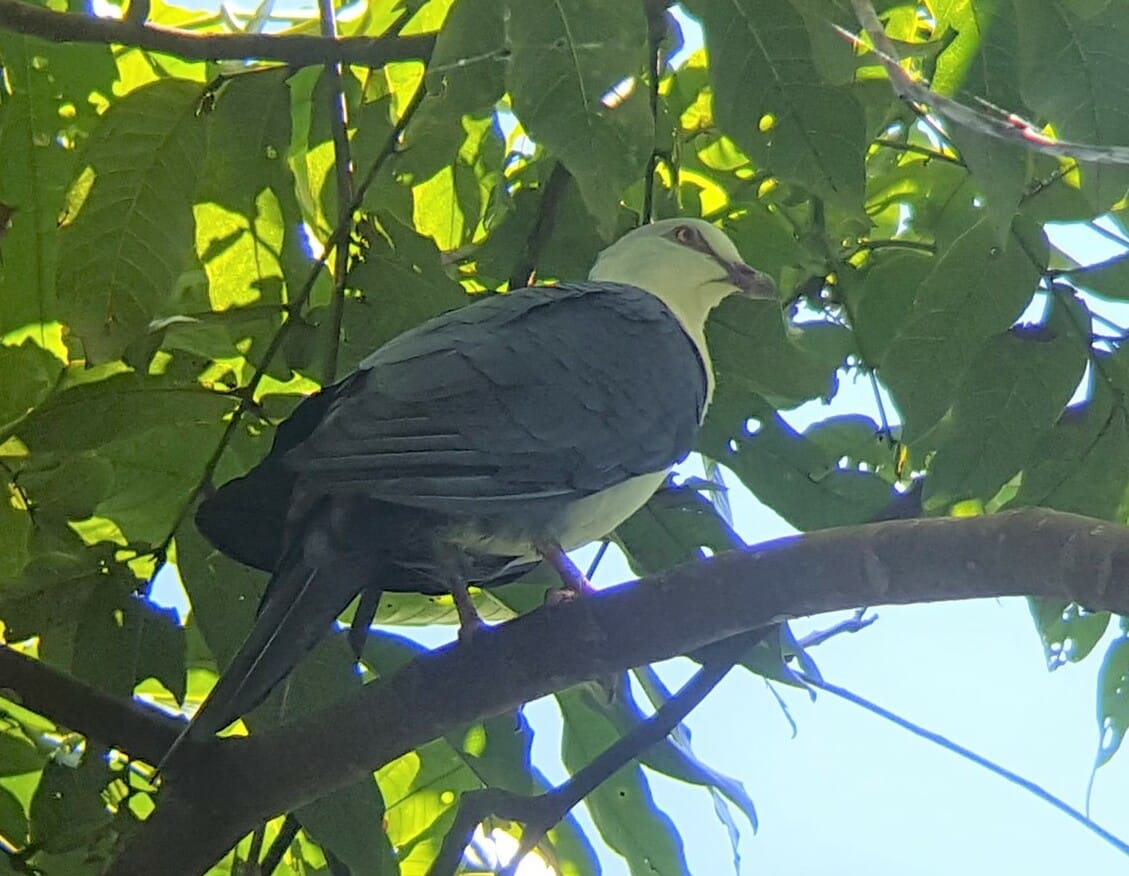
This medium-sized dove measures 34–38 cm (13–15 inches) in length, with a wingspan of 60–65 cm (24–25.5 inches). It weighs 300–400 grams (10–14 ounces). Its elongated body and strong wings allow agile flight in forested environments.
Habitat
Pied Cuckoo-doves are native to Papua New Guinea and nearby islands. They inhabit lowland and hill forests, forest edges, and secondary growth areas. They primarily feed on fruits, occasionally supplementing with seeds and small invertebrates.
Species Identification
They are characterized by black and white plumage, with a white belly, black wings, and a black head. The eyes are dark, and the tail is long and slightly rounded. Their soft, low-pitched cooing is often repeated in short sequences.
Nesting Habit
Nests are constructed from twigs and leaves in trees 2–6 meters above the ground. Females lay a single egg per clutch, with both parents incubating for 18–20 days. Fledglings leave the nest around three weeks after hatching. Breeding frequency depends on fruit abundance.
34. White-crowned Pigeon (Patagioenas leucocephala)

Size
The White-crowned Pigeon is a medium-large species, measuring 38–43 cm (15–17 inches) in length with a wingspan of 60–65 cm (24–25.5 inches). It weighs approximately 360–450 grams (12–16 ounces). Its strong body supports both short bursts and long-distance flights.
Habitat
Native to the Caribbean and parts of Florida, this dove inhabits coastal forests, mangroves, and tropical woodlands. It primarily feeds on fruits, particularly wild berries and figs, often foraging in flocks.
Species Identification
The White-crowned Pigeon is dark gray or blue-gray with a distinctive white crown on the head. The eyes are red, and the tail is broad with dark edges. Their call is a soft, repetitive coo that can be heard throughout their territory.
Nesting Habit
Nests are shallow platforms of twigs and leaves, usually built in trees or mangroves. Females lay 1–2 eggs per clutch, incubated by both parents for 16–18 days. Fledging occurs about three weeks after hatching. They usually breed once a year, synchronized with fruiting seasons.
35. White-tipped Fruit Dove (Ptilinopus leucotis)

Size
This medium-sized dove measures 26–30 cm (10–12 inches) in length with a wingspan of 45–50 cm (17.5–19.5 inches). It weighs 120–150 grams (4–5 ounces). Its compact body and strong wings allow agile movement in forest canopies.
Habitat
Native to Southeast Asia, White-tipped Fruit Doves inhabit lowland and hill forests, secondary growth, and plantations. They primarily feed on fruits and berries and are often seen in the canopy foraging quietly.
Species Identification
They are green overall with subtle white tips on the tail and a slightly paler head. Eyes are dark, and the tail is rounded. Their soft, melodic cooing is repeated intermittently, especially during breeding season.
Nesting Habit
Nests are small platforms of twigs and leaves built in low to mid-level trees. Females lay a single egg per clutch, incubated by both parents for 14–16 days. Fledging occurs roughly two weeks after hatching. Multiple broods may occur if fruit is plentiful.
36. Rose-crowned Fruit Dove (Ptilinopus regina)

Size
This medium-sized dove measures 24–28 cm (9.5–11 inches) in length with a wingspan of 45–50 cm (17.5–19.5 inches). It weighs around 120–150 grams (4–5 ounces). Its compact body allows agile flight among dense foliage.
Habitat
Native to Australia and New Guinea, Rose-crowned Fruit Doves inhabit lowland forests, forest edges, and plantations. They feed mainly on figs and other soft fruits, often remaining hidden in the canopy.
Species Identification
Males have a vibrant pink or rose-colored crown with green wings and yellowish underparts. Females are duller green with subtle pink markings. Eyes are dark, and the tail is short and rounded. Their call is a soft, repeated “coo,” typically during territorial or mating displays.
Nesting Habit
Nests are small twig platforms built in low shrubs or trees. Females lay 1–2 eggs per clutch, incubated by both parents for about 14 days. Fledging occurs approximately two weeks after hatching. Breeding may be influenced by fruit availability, with multiple broods possible in favorable conditions.
37. Black-naped Fruit Dove (Ptilinopus melanospilus)

Size
The Black-naped Fruit Dove is medium-sized, measuring 26–30 cm (10–12 inches) in length, with a wingspan of 45–50 cm (17.5–19.5 inches). It weighs approximately 120–150 grams (4–5 ounces). Its compact body and strong wings allow swift flight through dense forests.
Habitat
Native to Southeast Asia, this species inhabits lowland forests, secondary growth, and plantations. It primarily feeds on fruits such as figs and berries, usually foraging high in the canopy. Dense foliage provides cover from predators and ideal breeding sites.
Species Identification
Males are recognized by a bright green body, yellow belly, and a black patch on the nape. Females are generally duller green with subtle yellow tones. Their eyes are dark, and the tail is rounded. The call is a soft, repeated coo, often used for territory marking.
Nesting Habit
Nests are small twig platforms built in low to mid-level trees. Females lay 1–2 eggs per clutch, incubated by both parents for 14–16 days. Fledging occurs roughly two weeks post-hatching. Breeding frequency depends on fruit availability, with multiple broods possible in favorable conditions.
38. Superb Fruit Dove (Ptilinopus superbus)

Size
The Superb Fruit Dove measures 21–25 cm (8–10 inches) in length with a wingspan of 40–45 cm (15.5–17.5 inches). It weighs 100–130 grams (3.5–4.5 ounces). Its small, agile body is well-suited for navigating dense forest canopies.
Habitat
Native to eastern Australia and New Guinea, Superb Fruit Doves inhabit rainforests, lowland forests, and forest edges. They feed primarily on figs and other small fruits, often remaining hidden in the canopy while foraging.
Species Identification
Males are colorful, with a deep purple head, emerald green back, and bright yellow belly. Females are duller green with a faint yellow chest. Eyes are dark, and the tail is short and rounded. Their soft, melodic cooing is used for communication and territorial displays.
Nesting Habit
Nests are small twig platforms placed 2–6 meters above the ground. Females lay a single egg, incubated by both parents for 14–16 days. Fledging occurs approximately two weeks after hatching. Breeding often coincides with periods of fruit abundance.
39. Wompoo Fruit Dove (Ptilinopus magnificus)

Size
This large dove measures 38–45 cm (15–18 inches) in length with a wingspan of 60–70 cm (24–28 inches). It weighs 350–450 grams (12–16 ounces). Its robust body and long tail make it a powerful flier, capable of traveling between fruiting trees.
Habitat
Native to Australia, Papua New Guinea, and nearby islands, Wompoo Fruit Doves inhabit lowland and hill forests, rainforest edges, and secondary growth. They feed almost exclusively on fruits, particularly figs, often moving between trees in search of food.
Species Identification
They have a striking combination of green, purple, and yellow plumage. The head and chest are purple, back and wings green, and the belly yellow. Eyes are orange-red, and the tail is broad and rounded. Their call is a deep, resonant “wompoo” coo, giving the species its common name.
Nesting Habit
Nests are large twig platforms built high in trees. Females lay a single egg, incubated by both parents for 18–20 days. Fledging occurs about three weeks after hatching. They typically breed once a year, timed with fruiting seasons.
40. Orange-bellied Fruit Dove (Ptilinopus iozonus)

Size
The Orange-bellied Fruit Dove is medium-sized, measuring 25–28 cm (10–11 inches) in length with a wingspan of 45–50 cm (17.5–19.5 inches). It weighs 120–150 grams (4–5 ounces). Its compact, agile body allows it to maneuver easily in dense forest canopies.
Habitat
Native to New Guinea and surrounding islands, this species inhabits lowland and hill forests, plantations, and secondary growth. It feeds primarily on figs and small fruits, often foraging in the upper canopy.
Species Identification
Males display green wings, a gray head, and a bright orange belly. Females are generally duller green with subtle yellowish-orange on the chest. Eyes are dark, and the tail is rounded. Their call is soft and repeated, often used for territory marking.
Nesting Habit
Nests are small twig platforms built 2–6 meters above the ground. Females lay 1–2 eggs, incubated by both parents for 14–16 days. Fledging occurs approximately two weeks after hatching. Multiple broods are possible depending on fruit availability.
41. Claret-breasted Fruit Dove (Ptilinopus viridis)
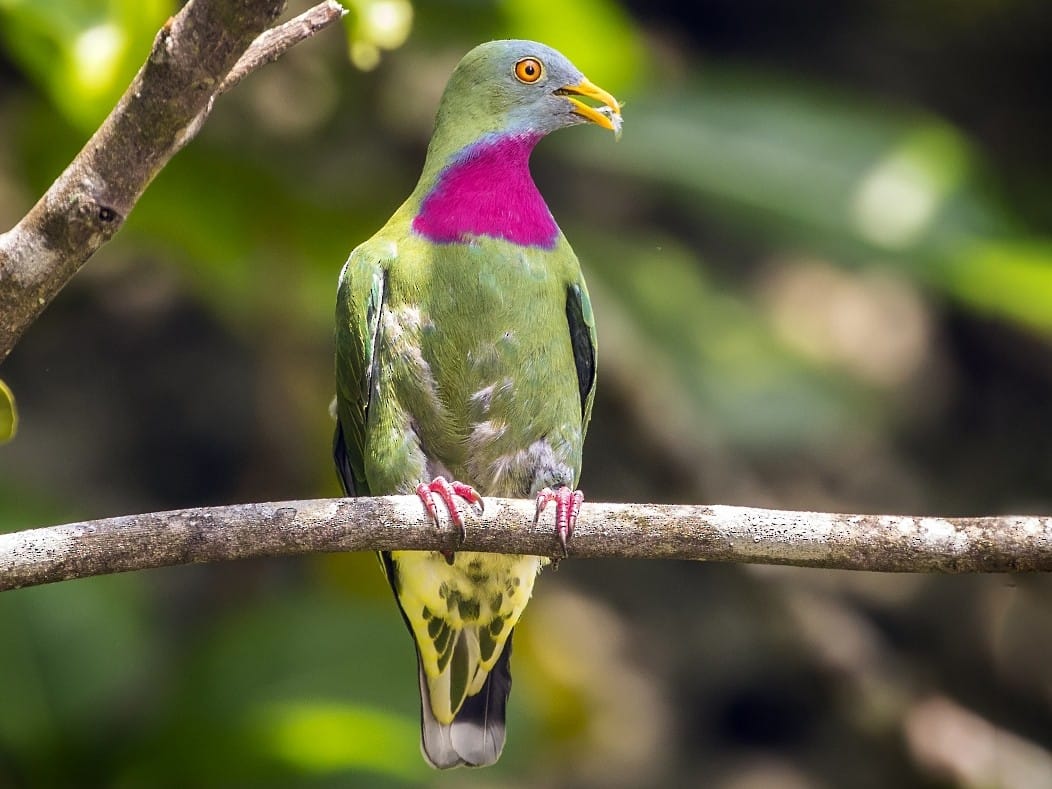
Size
This medium-sized dove measures 28–32 cm (11–12.5 inches) in length with a wingspan of 50–55 cm (19.5–21.5 inches). It weighs 150–180 grams (5–6 ounces). Its strong body and short tail make it an agile canopy dweller.
Habitat
Native to Southeast Asia, Claret-breasted Fruit Doves inhabit lowland and hill forests, forest edges, and plantations. They primarily feed on figs and other small fruits, foraging high in trees and often remaining hidden.
Species Identification
Males have a claret-red chest, green back, and yellowish-green belly. Females are mostly green with subtle yellow underparts. Eyes are dark, and the tail is rounded. The call is a soft, repeated coo, often during territorial or mating behavior.
Nesting Habit
Nests are small platforms of twigs and leaves built in mid-level trees. Females lay 1–2 eggs per clutch, incubated by both parents for 14–16 days. Fledging occurs roughly two weeks after hatching. Breeding frequency is linked to fruit availability.
42. Pink-spotted Fruit Dove (Ptilinopus perlatus)

Size
This medium-sized dove measures 24–28 cm (9.5–11 inches) in length with a wingspan of 45–50 cm (17.5–19.5 inches). It weighs 120–150 grams (4–5 ounces). Its compact build allows agile flight through dense foliage.
Habitat
Native to the Moluccas and nearby islands, Pink-spotted Fruit Doves inhabit lowland forests, secondary growth, and plantations. They feed mainly on figs and small fruits, often remaining concealed in the canopy.
Species Identification
Males have green plumage with small pink spots on the wings and back. Females are duller green with fewer pink spots. Eyes are dark, and the tail is short and rounded. Their call is soft and melodious, repeated in short sequences for communication.
Nesting Habit
Nests are small twig platforms placed in low to mid-level trees. Females lay 1–2 eggs per clutch, incubated by both parents for 14–16 days. Fledging occurs approximately two weeks after hatching. Multiple broods may be raised in a season when fruits are abundant.
43. Black-headed Fruit Dove (Ptilinopus granulifrons)

Size
The Black-headed Fruit Dove is medium-sized, measuring 26–30 cm (10–12 inches) in length with a wingspan of 45–50 cm (17.5–19.5 inches). It weighs approximately 120–150 grams (4–5 ounces). Its compact, muscular body allows agile maneuvering in dense forest canopies.
Habitat
Native to the lowland forests of Indonesia, this species prefers primary and secondary forests, forest edges, and plantations. They primarily feed on small fruits, particularly figs, often staying high in the canopy for safety and foraging efficiency.
Species Identification
Males have a striking black head with bright green wings and a yellowish-green belly. Females are generally duller green with subtle yellow underparts. Eyes are dark, and the tail is short and rounded. Their call is soft and melodious, often repeated in short sequences.
Nesting Habit
Nests are small twig platforms placed in low to mid-level trees. Females lay 1–2 eggs per clutch, incubated by both parents for 14–16 days. Fledging occurs roughly two weeks after hatching. Breeding frequency depends on fruit availability, with multiple broods possible in productive seasons.
44. White-bibbed Fruit Dove (Ptilinopus rivoli)

Size
This medium-sized dove measures 28–32 cm (11–12.5 inches) in length with a wingspan of 50–55 cm (19.5–21.5 inches). It weighs 140–170 grams (5–6 ounces). Its strong, compact body allows agile flight through forested habitats.
Habitat
Native to Southeast Asia, White-bibbed Fruit Doves inhabit lowland and hill forests, forest edges, and plantations. They are primarily frugivorous, feeding on figs and other small fruits, often moving quietly through the canopy.
Species Identification
Males have a white “bib” on the chest contrasting with green wings and back and a yellowish underbelly. Females are duller green with subtle yellow tones. Eyes are dark, and the tail is rounded. Their call is soft and repeated, used in territorial and mating communication.
Nesting Habit
Nests are small twig platforms built 2–6 meters above the ground. Females lay 1–2 eggs per clutch, incubated by both parents for 14–16 days. Fledging occurs about two weeks post-hatching. Multiple broods may be raised if fruit is abundant.
45. Superb Green Fruit Dove (Ptilinopus superbus)
Size
The Superb Green Fruit Dove measures 21–25 cm (8–10 inches) in length with a wingspan of 40–45 cm (15.5–17.5 inches). It weighs 100–130 grams (3.5–4.5 ounces). Its small, agile body allows efficient flight through dense canopy foliage.
Habitat
Native to eastern Australia and New Guinea, these doves inhabit rainforests, lowland forests, and forest edges. They primarily feed on figs and other small fruits, usually remaining hidden in the canopy while foraging.
Species Identification
Males display a bright green back, emerald wings, and yellow underparts with subtle purple markings on the head. Females are mostly green with faint purple highlights. Eyes are dark, and the tail is short and rounded. The call is soft, melodious, and repeated intermittently.
Nesting Habit
Nests are small platforms of twigs and leaves, built in low to mid-level trees. Females lay 1–2 eggs per clutch, incubated by both parents for 14–16 days. Fledging occurs roughly two weeks after hatching. Breeding may produce multiple broods if fruiting conditions are favorable.
46. Orange-fronted Fruit Dove (Ptilinopus aurantiifrons)

Size
This medium-sized dove measures 24–28 cm (9.5–11 inches) in length, with a wingspan of 45–50 cm (17.5–19.5 inches). It weighs 120–150 grams (4–5 ounces). Its compact body and rounded wings support agile flight in dense forest canopies.
Habitat
Native to New Guinea and surrounding islands, Orange-fronted Fruit Doves inhabit lowland forests, forest edges, and secondary growth areas. They primarily feed on figs and other small fruits high in the canopy.
Species Identification
Males have green plumage with an orange forehead, yellowish underparts, and a subtle purple patch on the head. Females are duller green with faint orange markings. Eyes are dark, and the tail is short and rounded. Their call is soft and repeated, typically for territorial or mating communication.
Nesting Habit
Nests are small twig platforms placed 2–6 meters above the ground. Females lay 1–2 eggs per clutch, incubated by both parents for 14–16 days. Fledging occurs about two weeks post-hatching. Multiple broods may be raised when fruit is plentiful.
47. Gray-headed Fruit Dove (Ptilinopus hyogaster)

Size
The Gray-headed Fruit Dove is medium-sized, measuring 25–28 cm (10–11 inches) in length with a wingspan of 45–50 cm (17.5–19.5 inches). It weighs 120–150 grams (4–5 ounces). Its compact body allows agile movement through dense forest canopies.
Habitat
Native to Indonesia and Papua New Guinea, this species inhabits lowland forests, forest edges, and plantations. They primarily feed on figs and other small fruits high in the canopy.
Species Identification
Males have gray heads, green wings, and yellowish underparts. Females are duller green with subtle gray on the head. Eyes are dark, and the tail is rounded. Their soft, melodic coo is repeated intermittently during territorial or mating displays.
Nesting Habit
Nests are small twig platforms built in mid-level trees. Females lay 1–2 eggs per clutch, incubated by both parents for 14–16 days. Fledging occurs roughly two weeks after hatching. Breeding may produce multiple broods if fruiting conditions are favorable.
48. White-headed Fruit Dove (Ptilinopus eugeniae)

Size
The White-headed Fruit Dove is medium-sized, measuring 26–30 cm (10–12 inches) in length with a wingspan of 45–50 cm (17.5–19.5 inches). It weighs approximately 120–150 grams (4–5 ounces). Its compact body supports agile flight through dense foliage.
Habitat
Native to New Guinea, this species inhabits lowland forests, forest edges, and secondary growth. It feeds primarily on figs and other small fruits, often foraging in the upper canopy.
Species Identification
Males have a striking white head with green wings and yellowish underparts. Females are duller green with subtle white head markings. Eyes are dark, and the tail is short and rounded. The call is soft, repeated, and melodious, often used for communication within their territory.
Nesting Habit
Nests are small twig platforms built 2–6 meters above the ground. Females lay 1–2 eggs per clutch, incubated by both parents for 14–16 days. Fledging occurs about two weeks after hatching. Multiple broods may be raised depending on fruit abundance.
49. Red-bellied Fruit Dove (Ptilinopus greyii)

Size
The Red-bellied Fruit Dove is medium-sized, measuring 24–28 cm (9.5–11 inches) in length, with a wingspan of 45–50 cm (17.5–19.5 inches). It weighs around 120–150 grams (4–5 ounces). Its compact, muscular body supports agile flight among dense forest canopies.
Habitat
Endemic to New Guinea, this dove inhabits lowland and hill forests, secondary growth, and plantations. It feeds mainly on figs and other small fruits, foraging quietly in the upper canopy. Dense foliage provides both food and shelter from predators.
Species Identification
Males display green wings and back, with a striking red belly and yellowish underparts. Females are duller green with subtle red highlights on the belly. Eyes are dark, and the tail is short and rounded. Their soft, melodious call is repeated intermittently and is used for communication and territory defense.
Nesting Habit
Nests are small twig platforms built in low to mid-level trees or shrubs. Females lay 1–2 eggs per clutch, incubated by both parents for 14–16 days. Fledging occurs approximately two weeks after hatching. Multiple broods can be raised during fruit-abundant seasons.
FAQ’s
1. How many types of doves are there?
There are over 300 species of doves and pigeons worldwide. While “dove” and “pigeon” are often used interchangeably, doves are generally smaller and more delicate-looking.
2. How to identify a dove?
Doves are usually small to medium-sized birds with slender bodies, soft plumage, and a small head. They have long tails and cooing calls. Their gentle, smooth flight and rounded wings are also typical.
3. What species is dove?
“Dove” refers to many species in the Columbidae family, which includes pigeons. Popular species include mourning doves, rock doves (pigeons), and zebra doves.
4. What is the most common type of dove?
The mourning dove is the most common in North America, while the rock dove (the city pigeon) is widespread worldwide.
5. What is the rarest type of dove?
Some of the rarest include the Pink-headed Fruit Dove and the Socorro Dove, which are endangered and found only in small regions.
6. Can doves and pigeons breed together?
Yes, because doves and pigeons belong to the same family, they can interbreed, although hybrids are uncommon in the wild.
7. Can you tell a male dove from a female dove?
It’s tricky! Males are usually slightly larger, more vocal, and sometimes display courtship behaviors like bowing and cooing. In many species, males and females look almost identical.
8. Can doves recognize human faces?
Yes, doves are surprisingly intelligent. They can remember people who feed them and may become tame or approach familiar humans.
9. What is the difference between a mourning dove and a European dove?
A mourning dove is slender with a long tail and soft gray-brown color, common in North America. A European dove, like the Eurasian collared dove, has a smaller head, shorter tail, and a distinctive black neck ring.
10. Where do doves sleep at night?
Doves sleep in trees, shrubs, or ledges, often close to other doves for safety. They prefer high and sheltered spots to avoid predators.
11. Do mourning doves recognize people?
Yes, they can recognize humans who feed or interact with them and may even approach their feeders confidently.
12. Do doves mate for life?
Many dove species, including mourning doves, are monogamous and often stay with the same partner for life.
13. How long do doves live?
In the wild, doves usually live 2–5 years, but in captivity, they can live up to 10–15 years.
14. Can two female doves live together?
Yes, two female doves can live together peacefully, especially if they are bonded or introduced gradually.
15. Are doves aggressive to other birds?
Doves are generally peaceful, but they may defend their nests aggressively against intruders.
16. Do doves find another mate if one dies?
Yes, doves will often find a new mate if their partner dies, especially if they are young or still capable of breeding.
17. Do doves bond with humans?
Yes, doves can become tame and friendly with humans, especially if fed or handled gently from a young age.
18. Do doves lay eggs twice a year?
Many doves lay multiple clutches per year, sometimes 2–4, depending on food availability and climate.
19. Do mourning doves return to the same place every year?
Yes, mourning doves often return to familiar nesting or feeding areas, especially if they were successful there previously.
20. Why don’t I ever see a baby pigeon?
Baby pigeons, called squabs, usually stay in the nest until fully feathered. By the time they leave, they look almost like adults, so they’re easy to miss.
21. How long do baby doves stay with their parents?
Baby doves stay 2–4 weeks in the nest before fledging. Parents may continue feeding them for another week or two.
22. Do doves remember humans?
Yes, doves have good spatial and social memory and can recognize humans who feed them repeatedly.
23. Do doves sleep together at night?
Yes, doves often roost closely in groups for warmth and safety.
24. How intelligent are doves?
Doves are moderately intelligent birds. They can recognize people, learn routines, solve simple problems, and navigate long distances.
25. What does it mean when a dove stays in your yard?
A dove staying in your yard usually means it feels safe, finds food, or is nesting nearby. It’s a good sign of a dove-friendly environment.
26. What is a mourning dove’s favorite food?
Mourning doves mostly eat seeds, especially sunflower, millet, and cracked corn. They rarely eat insects.
27. Do doves see in the dark?
Doves have good daytime vision but are not nocturnal, so they see poorly in the dark. They rely on roosting safely at night.
28. What is the most aggressive dove?
The Nicobar pigeon can be territorial, but most doves are gentle. Aggression usually only occurs around nesting or feeding areas.
29. What is the most beautiful dove?
Beauty is subjective, but many consider the Victoria crowned pigeon and the Emerald dove particularly striking because of their colorful plumage and elegant appearance.
30. What is the difference between a mourning dove and a common ground dove?
The mourning dove is larger, has a long, pointed tail, and soft gray-brown color. The common ground dove is smaller, plumper, and often has a shorter tail and spotted neck.
Conclusion
Doves are truly remarkable birds, offering an incredible variety of colors, sizes, and behaviors. From the vibrant Pink-headed Fruit Dove to the majestic Green Imperial Pigeon, each species has unique traits that make it fascinating to observe and study. Understanding the types of doves—their size, habitats, identification features, and nesting habits—not only enriches our knowledge of wildlife but also helps in conserving these beautiful birds and their natural environments.
Whether you are a beginner birdwatcher, a wildlife enthusiast, or someone interested in tropical and forest ecosystems, learning about these 50 types of doves can deepen your appreciation for nature’s diversity. Many doves rely on fruiting trees and forest habitats, highlighting the importance of protecting forests and natural landscapes. Observing their soft coos, vibrant plumage, and nesting behaviors provides insight into the delicate balance of ecosystems where these birds thrive.
Exploring the world of doves also reminds us that wildlife conservation is crucial. By understanding the habits and habitats of each species, we can make better efforts to preserve forests, prevent habitat loss, and support sustainable environments for future generations of these gentle, fascinating birds.
In summary, doves are not just symbols of peace—they are living testimonies to the beauty, diversity, and intricacy of our natural world. By learning about the 49 types of doves detailed in this guide, you are taking the first step toward becoming a more informed, engaged, and responsible lover of wildlife.
Read more: