
Scotland’s misty glens and sprawling moors are home to some of the most graceful animals in the British Isles — the deer. From the mighty red deer roaming the Highlands to the shy roe deer hiding in woodland edges, these animals have shaped both the landscape and Scottish culture for centuries. In fact, five species of deer now live wild across the country, each with its own fascinating habits, habitats, and stories.
Whether you’re a keen wildlife watcher, photographer, or a curious hiker, learning about these deer brings a new dimension to exploring Scotland’s countryside. Below, we’ll look at five remarkable types of deer found across the nation — how to identify them, where they live, and what makes each one special.
1. Red Deer (Cervus elaphus)

Physical Characteristics & Identification Tips
The red deer is the largest land mammal in the UK and arguably the most iconic symbol of the Scottish Highlands. Adult stags can stand over 1.2 meters at the shoulder and weigh up to 190 kilograms, making them a majestic presence against the heather-covered hills. Their name comes from the reddish-brown summer coat that turns darker and thicker in winter, helping them withstand Scotland’s harsh weather.
Mature stags grow impressive branched antlers, often boasting 10 to 12 points. These antlers are shed and regrown each year — a cycle of strength and renewal. A handy way to tell males and females apart is by size: hinds (females) are noticeably smaller and lack antlers. If you spot a large group grazing on open moorland, you’re likely seeing a herd of hinds, as stags tend to form bachelor groups or stay solitary outside the breeding season.
Behavior
Red deer are social creatures, often moving in herds for protection and warmth. During autumn, however, things get a little dramatic. The rutting season — typically from late September to early November — brings thunderous roars echoing across the glens. Stags clash antlers in fierce battles for dominance, and one can compare this behavior to a Highland “deer dance-off,” where the prize is mating rights with a group of hinds.
Outside the rut, they become quieter and more cautious. They’re crepuscular animals, most active during dawn and dusk, which helps them avoid human disturbance.
Habitat and Range
In Scotland, red deer thrive mainly in the Highlands, the Outer Hebrides, and parts of Argyll. You’ll often find them in open moorlands, mountain slopes, and rough grasslands. However, in recent years, they’ve expanded their range into lower farmlands and woodland fringes — occasionally wandering near villages or forestry plantations.
Interestingly, their population growth has sparked debates about woodland regeneration, as overgrazing can limit tree regrowth.
Diet
Red deer are grazers by nature. They feed on grasses, heather shoots, sedges, and occasionally browse young tree shoots in winter when food is scarce. In forests, they may also eat bark or strip soft wood from trees, which sometimes causes conflicts with foresters.
Reproduction and Life Cycle
After the rut, successful stags mate with multiple hinds. The gestation period lasts about 8 months, and most calves are born in late May or June. A single reddish-brown calf is typical, which hides in vegetation for the first week before joining the herd. In the wild, red deer live around 12–16 years, though few reach such an age due to predators, disease, or harsh winters.
Fun Facts / Unique Traits
Antlers can grow up to 1 inch per day during summer.
Red deer are strong swimmers and have been spotted crossing lochs or narrow sea inlets.
Some Highland estates manage deer herds for centuries, blending conservation and tradition.
Human Interaction
These deer are both admired and managed. They’re a major draw for wildlife tourism and stalking (regulated hunting), which contributes to rural economies. Yet, balancing their numbers with habitat conservation remains a continuing challenge. Spotting a red deer silhouetted against the rising mist is a Scottish memory few ever forget.
2. Roe Deer (Capreolus capreolus)

Physical Characteristics & Identification Tips
Roe deer are the most widespread deer species in Scotland and perhaps the most frequently seen. They’re smaller than red deer — standing about 65–75 cm at the shoulder — but no less striking. Their sleek summer coat is a rich reddish-brown, which turns grey-brown in winter. Males, or bucks, have small but sharp antlers with usually three tines on each side.
One easy way to recognize a roe deer is by its distinctive white rump patch, which flares when alarmed — almost like a warning flag signaling danger to others.
Behavior
Unlike the gregarious red deer, roe deer are more solitary or live in small family groups. They’re graceful movers, often gliding through woodland glades almost silently. During the breeding season in late July to early August, bucks can become territorial and chase females in wide circles — behavior that leaves telltale “roe rings” in the grass. One might compare this display to a playful yet persistent courtship dance.
Habitat and Range
Roe deer adapt remarkably well to a variety of habitats. From dense conifer forests in the north to farmland edges and even suburban parks in the Central Belt, they’re masters of blending into the landscape. Their population has grown steadily thanks to reduced hunting and milder winters.
They’re most active during twilight hours — if you’ve ever driven along a forest road at dawn and seen a slender shape dart across, it was likely a roe deer.
Diet
They’re browsers rather than grazers, preferring tender shoots, buds, and young leaves. In summer, they enjoy brambles and herbs, while in winter they survive on heather and ivy. Their selective feeding helps shape woodland undergrowth but can occasionally damage young tree plantations.
Reproduction and Life Cycle
A fascinating feature of roe deer reproduction is delayed implantation. Though mating occurs in summer, the fertilized egg doesn’t implant until winter, meaning fawns are born in late May or early June — when food is plentiful. Typically, females give birth to twins hidden carefully in long grass or under bracken.
Young fawns stay motionless when threatened, relying on their spotted coats for camouflage.
Fun Facts / Unique Traits
Roe deer have an excellent sense of smell and hearing.
They bark loudly when alarmed — a sharp sound often mistaken for a dog.
Unlike many deer, they can thrive near towns, occasionally spotted even in gardens or golf courses.
Human Interaction
Because they live so close to people, road collisions and garden browsing are common. Yet, their graceful presence is widely appreciated. Wildlife photographers often consider roe deer among Scotland’s most photogenic mammals, especially at sunrise when their russet coats glow golden in the light.
3. Fallow Deer (Dama dama)
Physical Characteristics & Identification Tips
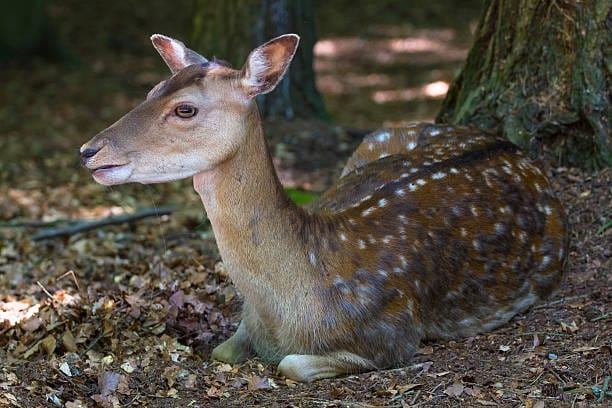
Fallow deer are immediately recognizable thanks to their beautiful spotted coats — think of them as the “fashion models” of Scotland’s deer family. Their summer coat is reddish with white spots, turning darker and thicker in winter. Adult males, or bucks, can weigh 90 kilograms and are distinguished by broad, palmated antlers shaped like a shovel — unlike the branched ones of red deer.
Their body size sits between red and roe deer, making them medium-sized. The tail is relatively long with a black stripe running down the back, which helps with identification even at a distance.
Behavior
Fallow deer are social animals, often forming large herds, especially in open parklands. They’re generally more tolerant of human presence than other species, which is why they’re often seen in estates or historic grounds. During the rutting season in October, bucks engage in loud groaning calls and sparring contests to win females — a spectacle that feels like nature’s theatrical performance.
Habitat and Range
Originally introduced to Britain by the Normans centuries ago, fallow deer have long since established self-sustaining populations. In Scotland, they’re common in Perthshire, Fife, and parts of Argyll, thriving in mixed woodland and farmland mosaics.
They prefer areas with both cover and open grass for grazing, often venturing into agricultural fields — sometimes to the frustration of farmers.
Diet
Their diet includes grasses, herbs, acorns, and young shoots. In parklands, they’ll happily browse ornamental plants or crops. Their mixed diet makes them versatile and adaptable, allowing them to thrive across varied landscapes.
Reproduction and Life Cycle
The fallow deer rut peaks in October. Bucks establish small “rutting stands” where they call loudly and challenge rivals. After mating, does carry their fawns for about 230 days, giving birth in early summer. Typically, one fawn is born, spotted and well-camouflaged.
Fawns grow quickly, joining their mothers in herds within weeks. The lifespan of fallow deer can reach 15 years in the wild, though many live shorter lives due to natural predation or environmental pressures.
Fun Facts / Unique Traits
Fallow deer come in several color morphs: common (spotted), menil (light), melanistic (dark brown), and white.
Their distinctive antlers are often used as wall trophies — but they’re also shed annually and regrown.
They’re excellent jumpers, easily clearing fences over two meters high.
Human Interaction
Because of their approachable nature, fallow deer are often the stars of wildlife parks and country estates. They contribute greatly to Scotland’s eco-tourism and are admired by visitors for their elegance. However, like other deer species, their growing numbers require careful management to prevent overgrazing and crop damage.
4. Sika Deer (Cervus nippon)
Physical Characteristics & Identification Tips
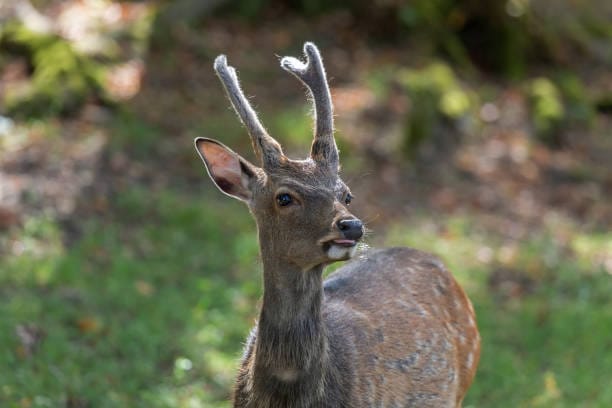
Sika deer might look like smaller cousins of red deer, but once you know what to look for, they’re easy to tell apart. Adult males weigh around 70 kilograms and stand roughly 75–95 cm tall at the shoulder. Their summer coat is chestnut-brown with distinct white spots along the flanks — though in winter, it turns a duller grey-brown.
One of the most reliable identification clues is the white rump patch, edged with black, and a short black-tipped tail that flicks nervously when the animal is alert. Unlike the heavy branching antlers of red deer, sika stags have slimmer antlers with up to eight points, giving them a more elegant appearance.
Behavior
Sika deer are shy and elusive, often active during the twilight hours. They prefer to stay near cover and are quick to vanish at the slightest hint of danger. During the rut, which peaks around October, males become vocal — producing a distinctive high-pitched whistle, quite unlike the deep roar of the red deer. It’s a sound that carries eerily through the misty glens, sometimes confusing those who mistake it for a bird or strange wind.
Although generally less aggressive than red deer, sika stags still engage in fierce rutting duels, locking antlers to establish dominance.
Habitat and Range
Sika deer were introduced to Scotland from Japan in the 19th century, originally kept on estates before escaping into the wild. Today, they’re found mainly in the central and northern Highlands, Argyll, and parts of Perthshire. They prefer forest edges, rough grassland, and moorland fringes — anywhere that offers both shelter and feeding grounds.
A key ecological concern is hybridization with red deer, as the two species can interbreed, blurring genetic lines. Conservationists now monitor certain populations closely to protect the native red deer gene pool.
Diet
Sika deer have a flexible diet, feeding on grasses, heather, sedges, and tree shoots. In dense forests, they browse shrubs and brambles, while in open areas, they graze like sheep. Their adaptability helps them thrive in Scotland’s variable climate, though it can also make them challenging to manage in commercial forests.
Reproduction and Life Cycle
The breeding season, or rut, begins in late September. After successful mating, females (hinds) carry their fawns for about seven months, giving birth around May or June. Typically, one fawn is born, with a beautiful spotted coat that helps it stay hidden from predators.
Sika deer live up to 15 years in the wild, though most survive around 10. Fawns remain with their mothers for several months before forming small family groups or joining mixed herds.
Fun Facts / Unique Traits
Sika deer can swim long distances and have been spotted crossing rivers and lochs.
Their whistle-like rutting call is one of the most unusual sounds in Scotland’s forests.
They’re superb jumpers and can clear fences of 2 meters with ease.
Human Interaction
Sika deer are both admired and controversial. On one hand, they add diversity to Scotland’s wildlife; on the other, their hybridization with red deer and browsing habits have sparked conservation debates. Many wildlife enthusiasts travel specifically to hear their haunting rut calls in autumn — a sound that, once heard, is hard to forget.
5. Muntjac Deer (Muntiacus reevesi)
Physical Characteristics & Identification Tips
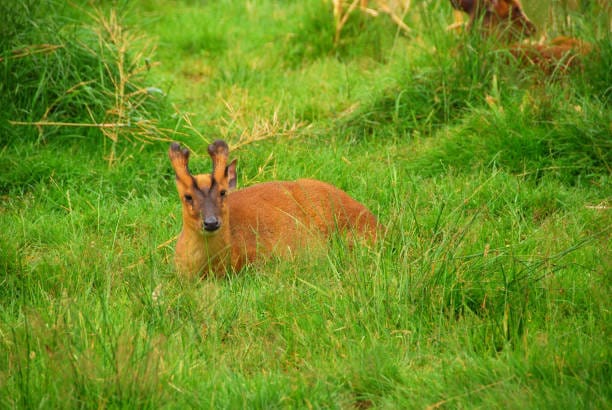
The smallest of Scotland’s deer species, the muntjac looks almost toy-like compared to its towering red relatives. Standing just 45–52 cm tall at the shoulder and weighing around 15 kilograms, they’re compact, sturdy, and surprisingly agile.
Their coat is reddish-brown with a paler belly and dark facial markings that give them a rather “frowning” expression. Males sport small, backward-curving antlers, usually only 10 cm long, along with visible tusk-like upper canines — a throwback to their ancient evolutionary history.
Behavior
Muntjac are secretive and often live solitary lives, though sometimes you’ll spot a pair or a mother with a fawn. Unlike most deer that are seasonal breeders, muntjac can reproduce all year round — a key reason for their rapid population growth.
They’re also highly vocal. Males bark loudly to warn off rivals or to locate mates, a call that echoes sharply through woodlands and can startle unsuspecting walkers. Their movements are quick and darting, often vanishing into undergrowth with barely a rustle.
Habitat and Range
Originally from China, muntjac were introduced to England in the early 20th century and have been steadily spreading northward. While still relatively scarce in Scotland, small populations have been recorded in southern regions, especially around the Borders.
They prefer dense woodland with thick undergrowth — brambles, hawthorn, and ivy — where they can browse safely. Their ability to adapt to gardens, parks, and roadside verges hints that they may expand further in the coming decades.
Diet
Muntjac are browsers rather than grazers. They feed on young shoots, herbs, fruit, bark, and fungi. Their small size allows them to maneuver easily through thick vegetation, nibbling on plants that larger deer overlook. However, their habit of browsing woodland understorey has led to some concern about impacts on native flora.
Reproduction and Life Cycle
Unlike other deer species, muntjac don’t have a defined breeding season. Females can conceive again shortly after giving birth, which means populations can double quickly if unchecked. Gestation lasts about 7 months, and single fawns are born hidden in dense cover.
Their lifespan averages 10–12 years in the wild. Because of their rapid reproduction and adaptability, muntjac have become one of the fastest-spreading deer species in Britain.
Fun Facts / Unique Traits
Sometimes called “barking deer” because of their sharp, dog-like calls.
Among the oldest deer lineages, dating back millions of years.
Their fangs are used for sparring rather than chewing — a rare feature among deer.
Human Interaction
Muntjac deer evoke mixed feelings. Gardeners may curse them for nibbling roses, yet wildlife watchers find them fascinating for their size and behavior. As they expand in Scotland, ecologists are studying their effect on local ecosystems. Seeing one quietly stepping out of a hedge at dawn feels like spotting a relic from another age — small, ancient, and oddly charming.
Conclusion
From the thundering roars of red stags on Highland hills to the delicate steps of roe deer at woodland edges, Scotland’s deer population is a living emblem of the country’s wild spirit. Each species — whether native or introduced — adds its own story to the landscape, shaping how forests grow and how people connect with nature.
The challenge now lies in balance: conserving habitats, managing populations responsibly, and allowing both deer and humans to thrive side by side. Next time you wander through a Scottish glen or forest, keep your eyes open and your pace slow — you might just catch a glimpse of a majestic stag or a shy fawn vanishing into the mist.
FAQ about Deer in Scotland
1. How many types of deer live in Scotland?
There are five wild deer species in Scotland: red deer, roe deer, fallow deer, sika deer, and muntjac deer. Of these, red and roe deer are native; the rest were introduced.
2. What is the most common deer in Scotland?
Roe deer are the most widespread, thriving in woodlands, farmlands, and even near suburban areas. Red deer dominate the Highlands.
3. Where is the best place to see red deer in Scotland?
Head to the Scottish Highlands — areas like Glencoe, Cairngorms National Park, and Isle of Skye offer excellent chances to spot red deer in the wild.
4. Do all Scottish deer have antlers?
Only males grow antlers, though the shape and size vary by species. Red and fallow stags have large, branching antlers, while roe and muntjac bucks have smaller ones.
5. Are there any threats to Scotland’s deer population?
Main concerns include habitat loss, vehicle collisions, and hybridization between red and sika deer. Controlled culling and habitat management help maintain healthy populations.
6. What kind of deer are in Scotland?
Scotland is home to four main species of deer: Red Deer, Roe Deer, Fallow Deer, and Sika Deer. Red Deer are the largest and most iconic, while Roe Deer are smaller and common in woodlands.
7. What is a male deer in Scottish called?
In Scotland, a male Red Deer is called a “stag,” while a female is a “hind.” For smaller species like Roe Deer, the male is known as a “buck,” and the female a “doe.”
8. What is the biggest deer in Scotland?
The Red Deer (Cervus elaphus) is the biggest deer in Scotland and the largest land mammal in the UK. Stags can weigh over 400 pounds and are often found in the Highlands.
9. Do reindeer exist in Scotland?
Yes, reindeer do exist in Scotland. A small herd lives in the Cairngorms, reintroduced in the 1950s. They are the only free-ranging reindeer in the UK.
10. Why does Scotland have so many deer?
Scotland’s deer population has grown because of fewer natural predators, mild winters, and large open habitats. Limited culling and fewer human settlements in rural areas have also allowed herds to thrive.
11. Does Scotland have elk or deer?
Scotland has deer but no wild elk. The European “elk” is another name for moose, which do not live in Scotland. However, Red Deer fill a similar ecological role.
12. Are there big predators in Scotland?
No, Scotland no longer has large natural predators like wolves or bears. As a result, deer populations are managed by humans through hunting and culling programs.
13. Can I shoot deer in Scotland?
Yes, deer stalking (hunting) is legal in Scotland but requires proper permission and licensing. It’s often done to control populations and support conservation and land management.
14. Why are deer a problem in Scotland?
In some areas, deer numbers are too high, causing overgrazing and damage to forests and young trees. This affects reforestation efforts and natural habitats for other wildlife.
15. What happens if you hit a deer in Scotland?
If you hit a deer, it’s important to stop safely, report it to the police, and avoid approaching the injured animal. Wildlife rescue teams or gamekeepers usually handle such cases.
16. What predators do deer have in Scotland?
Deer in Scotland have very few natural predators today. Golden Eagles may occasionally take young deer, but humans are the main population control through regulated hunting.
17. Where are the most deer in Scotland?
The Scottish Highlands have the largest populations, especially of Red Deer. Roe Deer are more common in the Lowlands and woodland areas throughout the country.
18. Is it illegal for dogs to chase deer in Scotland?
Yes, under Scotland’s wildlife laws, it is illegal for dogs to chase or harm deer. Dog owners must keep their pets under control, especially in rural and forested areas.
Read more:
- 30 Types of Deer (Pictures and Identification)
- 15 Types of Deer in North America (Pictures And Identification)
- 12 Types of Deer in USA (Pictures And Identification)
- 25 Types of Deer in Africa (Pictures And Identification)
- What Do Deer Eat? Complete Guide to Deer Diet, Foods, and Seasonal Feeding Habits
- 8 Types of Deer in UK (Pictures And Identification)
- 8 Types of Deer in Texas (Pictures and Identification)
- How to Hunt Deer from the Ground: Expert Tips for Successful Ground-Level Deer Hunting
- 8 Types of Deer in California (Pictures And Identification)
- 5 Types of Deer in Colorado: Species Identification with Pictures
- 5 Types of Deer in Illinois (Pictures And Identification)
- 5 Types of Deer in Oregon (Pictures and Identification)
- 5 Types of Deer in New Mexico (Pictures and Identification)
- 5 Types of Deer in Wisconsin (Pictures And Identification)
- 11 Moose Facts About the Majestic Herbivorous Giant
- 15 Types of Elk (Pictures And Identification)
- 5 Types of Deer in Montana (Pictures And Identification)