
Arizona’s diverse landscapes—from desert valleys and canyon cliffs to riparian forests—make it one of the richest states in the Southwest for dove species. Here, both native and expanding populations thrive, offering birdwatchers a unique variety of colors, sizes, and calls. This detailed guide explores all dove species found in Arizona, providing clear descriptions, identification cues, habitat insights, and behavior characteristics to help you understand and spot each bird with ease.
1. Mourning Dove (Zenaida macroura)

Physical Characteristics
The Mourning Dove is a medium-sized bird with a slender body, long pointed tail, and delicate features. Its plumage is primarily soft gray-brown with black spots on the wings and a light buff-colored breast. The tail feathers have white edges that are particularly noticeable during flight. Adult Mourning Doves typically measure 9 to 13 inches in length and have a wingspan of 17 to 18 inches. Their eyes are dark and expressive, often surrounded by a subtle blue or gray eye-ring.
Habitat and Distribution
Mourning Doves are extremely adaptable and can be found across a wide variety of habitats in Arizona. They inhabit grasslands, deserts, farmlands, and suburban areas. These birds are often seen near open fields and parks, where they can forage for seeds and grains. In urban areas, they are commonly observed perched on telephone wires, rooftops, and fence posts. Mourning Doves are widely distributed throughout the state and are one of the most frequently sighted birds in both rural and urban settings.
Behavior
Mourning Doves are known for their gentle and non-aggressive behavior. They often form loose flocks, especially in winter, and are primarily ground feeders. While they can fly quickly with a distinctive whistling sound from their wings, they usually remain close to the ground when foraging. Mourning Doves are monogamous and often mate for life, displaying courtship behaviors that include bowing, cooing, and aerial displays.
Diet
The diet of Mourning Doves consists mainly of seeds from grasses, weeds, grains, and occasionally small fruits. They forage primarily on the ground, pecking at seeds individually or in small groups. While they are not predators, they may occasionally consume small insects or snails, particularly during the breeding season to supplement protein intake.
Breeding
Mourning Doves breed multiple times per year, with two or more broods common in Arizona. They construct simple platform-like nests from twigs and grasses, typically in trees, shrubs, or sometimes on building ledges. The female usually lays two white eggs, which both parents incubate for 12 to 14 days. The chicks fledge in about two weeks but may continue to receive care from the parents for several days after leaving the nest.
Identification Tips
Adults can be identified by their soft gray-brown plumage, black wing spots, long pointed tail with white edges, and gentle cooing call. Juveniles have slightly duller plumage with less distinct markings but can be distinguished by size and tail shape. They are often confused with Eurasian Collared-Doves, but the Mourning Dove lacks the black collar around the neck and has a more muted overall coloration.
Conservation Status
The Mourning Dove is abundant and not considered threatened. Their populations are stable due to adaptability to human-modified landscapes and abundant food supply. They are protected under the Migratory Bird Treaty Act, ensuring their continued conservation in Arizona and across North America.
2. Eurasian Collared-Dove (Streptopelia decaocto)
Physical Characteristics
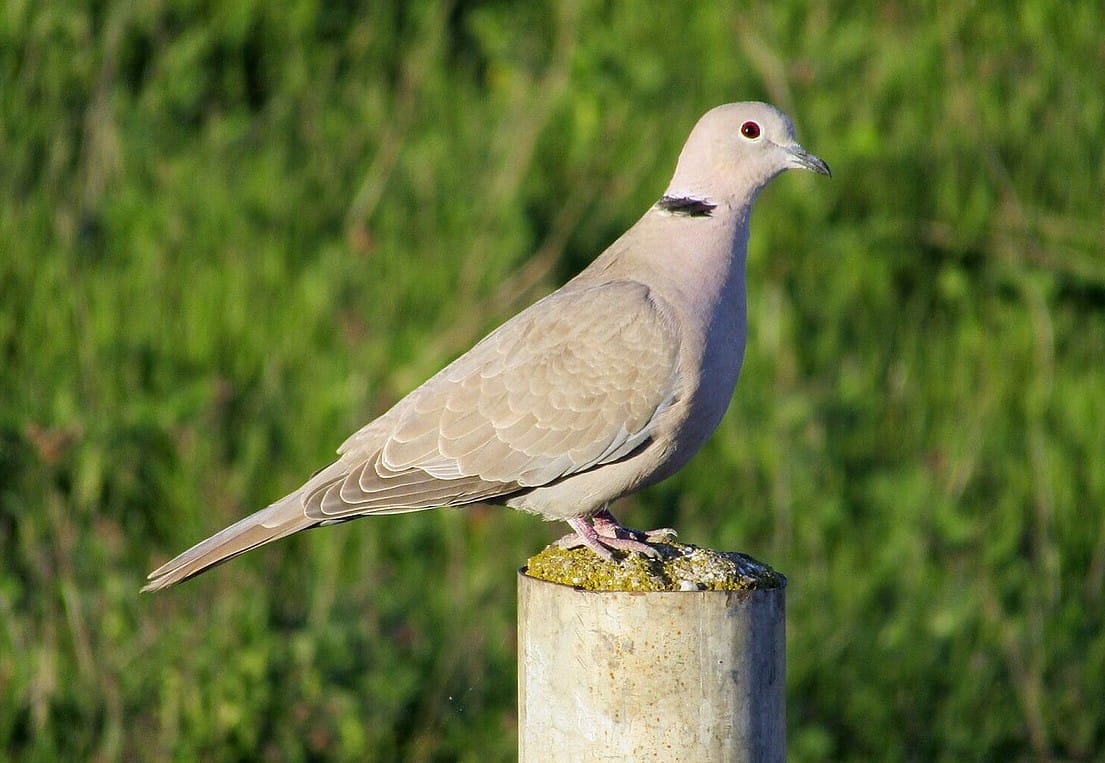
The Eurasian Collared-Dove is slightly larger than the Mourning Dove, with a pale grayish-tan body and a distinctive black half-collar around the nape of the neck. They have a square-tipped tail with white edges, and their wings show subtle darker markings. Adults typically measure 12 to 14 inches in length, with a wingspan of 18 to 22 inches. The eyes are dark with a noticeable pale blue or gray eye-ring, and their beaks are short and slightly curved.
Habitat and Distribution
Originally introduced from Europe, Eurasian Collared-Doves have spread rapidly and are now common throughout Arizona. They thrive in urban and suburban settings, agricultural lands, and open woodlands. They are highly adaptable, often nesting near human dwellings, including rooftops, ledges, and large trees. Their widespread presence makes them one of the most visible doves in both cities and rural landscapes.
Behavior
These doves are social and often seen in pairs or small flocks. They are gentle and slow-moving, frequently observed foraging on the ground for seeds. Their flight is strong but not as rapid as the Mourning Dove, with a distinct wingbeat pattern. Eurasian Collared-Doves are vocal, producing soft cooing sounds that are repetitive and rhythmic. Courtship involves bowing, tail fanning, and vocal calls.
Diet
The diet consists mainly of seeds, grains, and occasionally fruits. They forage on the ground, often near feeding stations, agricultural fields, or backyard bird feeders. While primarily granivorous, they may supplement their diet with small insects during the breeding season.
Breeding
Breeding occurs year-round in Arizona, especially in warmer months. They build simple nests in trees, shrubs, or on man-made structures, often reusing old nests. Each clutch usually contains two white eggs, incubated by both parents for about 14 days. Fledglings leave the nest in 15 to 18 days, and pairs may produce multiple broods annually.
Identification Tips
Look for the black half-collar on the nape, pale gray-tan plumage, and square-tipped tail with white edges. Their repetitive cooing and larger size compared to Mourning Doves are also key identification points. Juveniles are slightly duller but retain the distinctive collar and tail markings.
Conservation Status
The Eurasian Collared-Dove is thriving in Arizona, with populations increasing steadily. They are considered non-native but not invasive in a manner that threatens native doves. Protection under general bird laws ensures that they remain part of Arizona’s urban and suburban bird communities.
3. White-winged Dove (Zenaida asiatica)
Physical Characteristics
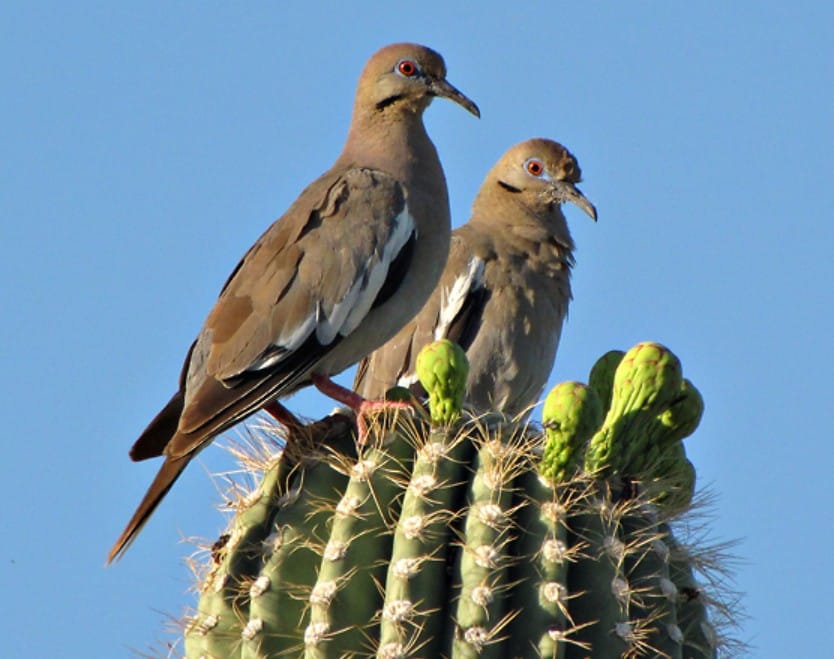
White-winged Doves are larger than Mourning and Eurasian Collared-Doves, measuring 11 to 13 inches in length with a wingspan of 17 to 20 inches. Their plumage is mostly gray-brown, with a distinct white stripe across the wings visible in flight. The eye-ring is bright blue, making them particularly striking. They have strong, pointed wings and a long tail with a squared-off tip and white edges.
Habitat and Distribution
White-winged Doves are widespread in southern Arizona, especially near desert washes, riparian zones, and agricultural areas with fruit trees or grain crops. They are also common in urban settings, often near gardens, parks, and water sources. They require open areas for foraging and trees or shrubs for nesting and roosting.
Behavior
These doves are social and often seen in large flocks. They exhibit fast, direct flight and are very vocal, producing loud, repetitive cooing calls. White-winged Doves are diurnal, spending most of the day feeding, socializing, and bathing in shallow water sources. During migration or seasonal movements, they gather in spectacular flocks at feeding grounds.
Diet
The diet includes seeds, grains, and fruits. In agricultural areas, they feed on crops like corn and sorghum, while in the desert, they consume seeds from native plants and cacti. They also occasionally eat cultivated fruits, including grapes, berries, and figs.
Breeding
White-winged Doves build platform nests in trees, shrubs, and sometimes large cacti. Both parents share incubation duties, which last 13 to 15 days. Chicks fledge in roughly two weeks and are cared for by the parents for several additional days. They may have two or more broods per year, depending on food availability and environmental conditions.
Identification Tips
Key features include the prominent white wing stripe, bright blue eye-ring, and large size. Their loud, repetitive cooing is another distinguishing trait. Juveniles are slightly duller but retain the white wing edges and blue eye-ring, making identification relatively straightforward.
Conservation Status
White-winged Doves are common and not considered threatened. Their populations have benefited from agricultural expansion and urban landscaping that provides both food and nesting opportunities. Conservation efforts focus on monitoring populations and ensuring that nesting habitats remain protected.
4. Inca Dove (Columbina inca)
Physical Characteristics
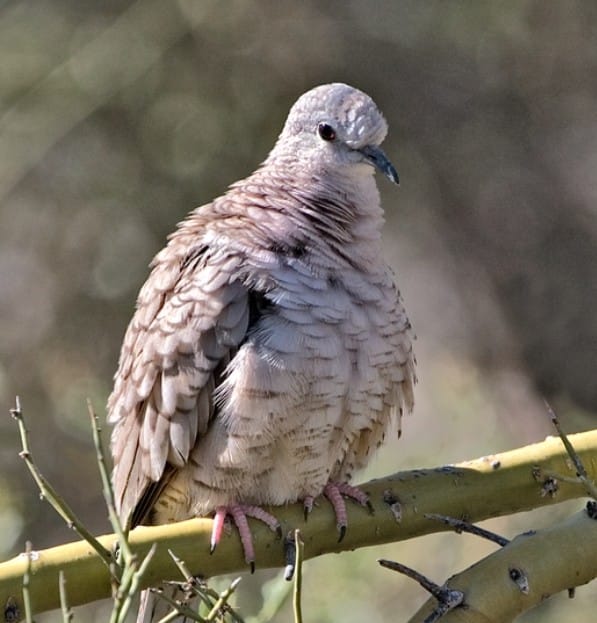
Inca Doves are small and delicate, measuring 6 to 7 inches in length with a wingspan of 9 to 11 inches. They have brownish-gray plumage with light-edged feathers giving a scaly appearance. Their long tail has white edges and is slightly rounded. They have a small head with dark eyes and a thin beak. Their appearance is distinctly dainty compared to larger dove species.
Habitat and Distribution
Inca Doves are common in southern Arizona deserts, suburban areas, and residential gardens. They prefer open, arid areas with scattered trees or shrubs for perching and nesting. Unlike larger doves, they are comfortable in very close proximity to humans and are frequently observed in urban courtyards, parks, and parking lots.
Behavior
These birds are social, forming small flocks of 5 to 20 individuals, especially during feeding. They are ground feeders and often seen foraging for seeds in open areas. Inca Doves have a soft, gentle cooing call, which is continuous and soothing. They are non-aggressive and may share feeding grounds peacefully with other dove species.
Diet
Inca Doves feed almost exclusively on small seeds from grasses, weeds, and cultivated plants. Occasionally, they may consume small insects, particularly when feeding young. They forage on the ground, walking and pecking at seeds methodically.
Breeding
Inca Doves construct small, flimsy nests in trees, shrubs, or even on ledges of buildings. They lay two eggs per clutch, and both parents participate in incubation, which lasts about 14 days. Fledging occurs in roughly two weeks, and pairs may produce multiple broods per season. They are highly adaptive breeders and can thrive in both urban and desert environments.
Identification Tips
Inca Doves are identifiable by their small size, scaly plumage, long white-edged tail, and soft cooing calls. They are smaller than all other Arizona doves and often forage in loose flocks. Juveniles resemble adults but have even softer, muted scaly patterns.
Conservation Status
Inca Doves are abundant in Arizona and not considered threatened. Their adaptability to urban environments and arid habitats ensures stable populations. Like other doves, they are protected under migratory bird laws.
Conclusion
Arizona hosts a diverse array of doves, each with unique characteristics, calls, and behaviors. Birdwatchers can enjoy identifying these species by their distinct markings, habitats, and sounds. From the common Mourning Dove to the striking White-winged Dove, Arizona’s doves offer a fascinating glimpse into the adaptability and beauty of these birds.
FAQs
- Q: Which dove is most commonly seen in Arizona?
- A: The Mourning Dove is the most widespread and commonly observed dove in Arizona.
- Q: Can I differentiate a White-winged Dove from a Mourning Dove easily?
- A: Yes, White-winged Doves have a distinctive white wing stripe and a blue eye-ring, whereas Mourning Doves do not.
- Q: Are Eurasian Collared-Doves native to Arizona?
- A: No, they were introduced but have spread widely across the state.
- Q: What do Inca Doves eat?
- A: Inca Doves primarily feed on small seeds and occasionally insects.
- Q: Can doves be found in urban areas of Arizona?
- A: Yes, Eurasian Collared-Doves, Mourning Doves, and Inca Doves adapt well to urban environments.
- Q: How can I attract doves to my backyard?
- A: Provide seeds, grains, water sources, and some trees or shrubs for shelter.
- Q: Do doves migrate in Arizona?
- A: Some species, like Mourning Doves, may migrate short distances, while others remain year-round.
- Q: How big are White-winged Doves?
- A: They are medium-large doves, slightly bigger than Mourning Doves, with a wingspan of around 17–20 inches.
- Q: Do Inca Doves form flocks?
- A: Yes, they often form loose flocks, especially during feeding.
- Q: How do I identify an Inca Dove?
- A: Look for small size, scaly feather patterns, long tail with white edges, and soft cooing sounds.
- Q: Are any Arizona doves threatened or endangered?
- A: No, all four common species are currently considered stable.
- Q: Where do White-winged Doves nest?
- A: They build platform-like nests in trees, shrubs, or sometimes cacti.
- Q: How many eggs do doves lay?
- A: Typically 2 eggs per clutch, with some species raising multiple broods each year.
- Q: Do doves eat insects?
- A: Primarily seeds, but some, like Inca Doves, occasionally eat small insects.
- Q: Are doves noisy?
- A: They are generally soft cooing birds, though White-winged Doves have louder calls.
- Q: Can Mourning Doves be found in deserts?
- A: Yes, they adapt well to a variety of habitats, including deserts.
- Q: How long do doves live?
- A: In the wild, doves typically live 1–5 years, though some may reach 10 years.
- Q: What is the difference between Eurasian Collared-Dove and Inca Dove?
- A: Eurasian Collared-Doves are larger with a black collar and pale gray plumage, while Inca Doves are small with scaly feathers and long tails.
- Q: Do doves need water daily?
- A: Yes, they drink water daily, especially in arid Arizona regions.
- Q: Can doves coexist with other birds in the backyard?
- A: Yes, they generally coexist peacefully with other bird species.
Read more: 3 Types of Doves in Delaware (Pictures and Identification)