
Ohio’s skies are home to a remarkable variety of hawks, from the ubiquitous Red-tailed Hawk soaring above farmland to the secretive Northern Goshawk darting through dense forests. These raptors are essential predators, helping maintain balanced ecosystems by controlling populations of small mammals and birds. In this guide, we will explore 12 types of hawks in Ohio, highlighting their physical features, behaviors, habitats, diets, reproduction, and interesting quirks. Whether you are a dedicated birdwatcher or a curious nature enthusiast, this article will provide a detailed, approachable overview of Ohio’s most fascinating hawks.
1. Red-tailed Hawk (Buteo jamaicensis)
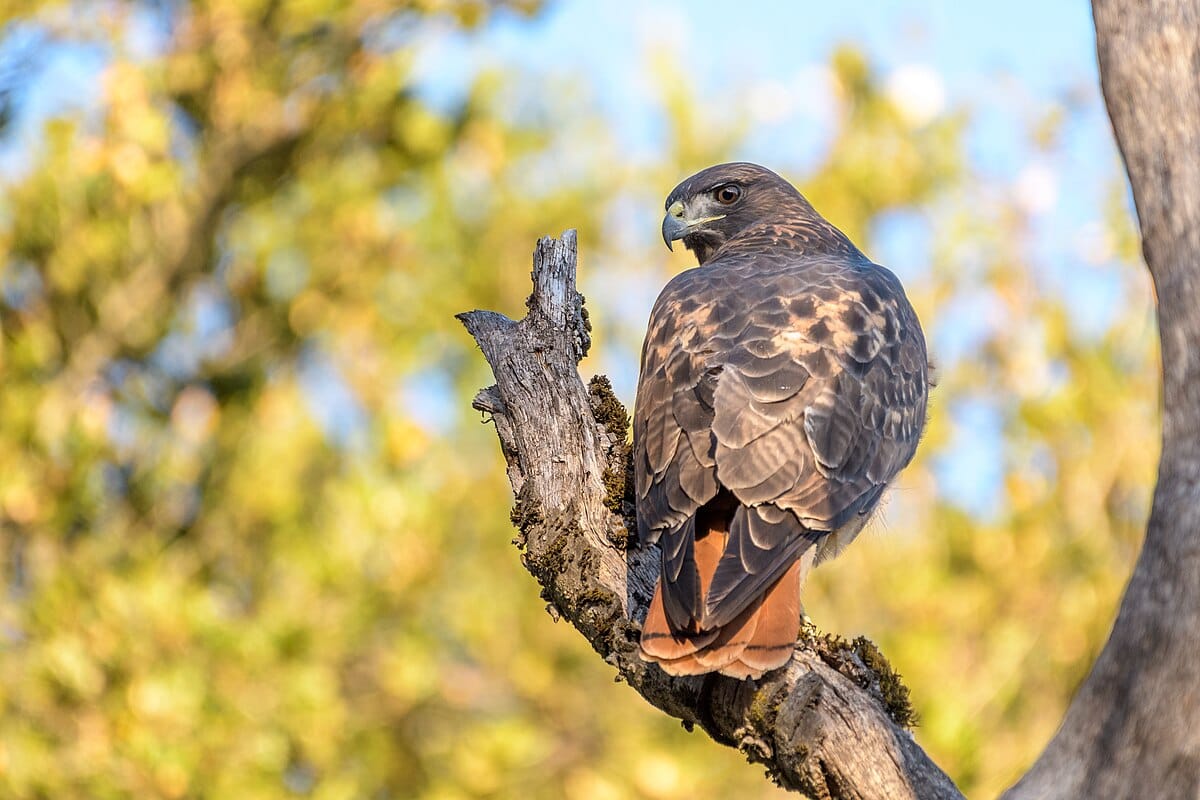
Physical Characteristics & Identification Tips
Red-tailed Hawks are easily recognized by their broad, rounded wings and rich, rust-colored tail. Adults display a pale underbelly with a distinctive dark belly band, while juveniles have a more streaked and mottled appearance. Their size, with wingspans reaching nearly 4 feet, makes them one of the most noticeable raptors in Ohio.
Behavior and Nesting Habits
These hawks are often seen perched high on telephone poles, fence posts, or soaring above open fields. They build large stick nests in tall trees or on cliff ledges and are fiercely territorial during the breeding season. Their calls—a loud, raspy “kee-eee-arr”—carry over long distances.
Habitat and Range
Red-tailed Hawks are highly adaptable and occupy diverse habitats in Ohio, including forests, agricultural lands, and urban areas. Their widespread presence makes them a familiar sight year-round.
Diet
Red-tailed Hawks primarily hunt small mammals such as rodents, rabbits, and squirrels, occasionally taking birds or reptiles. They often hunt by perching and scanning for prey or soaring to spot movement below.
Reproduction and Life Cycle
Females typically lay 1–3 eggs per clutch, incubated for approximately 28–35 days. Both parents feed the young, which fledge in roughly 6 weeks. Juveniles remain near nesting areas to practice hunting before dispersing.
Fun Facts / Unique Traits
Red-tailed Hawks are sometimes called the “chicken hawk,” though they rarely hunt domestic fowl. Their soaring flight and distinctive call are iconic symbols of North American raptors.
Human Interaction
They adapt well to human-altered landscapes, and birdwatchers often spot them along highways, fields, and parks. Conservation of open spaces and mature trees ensures their continued presence.
2. Red-shouldered Hawk (Buteo lineatus)
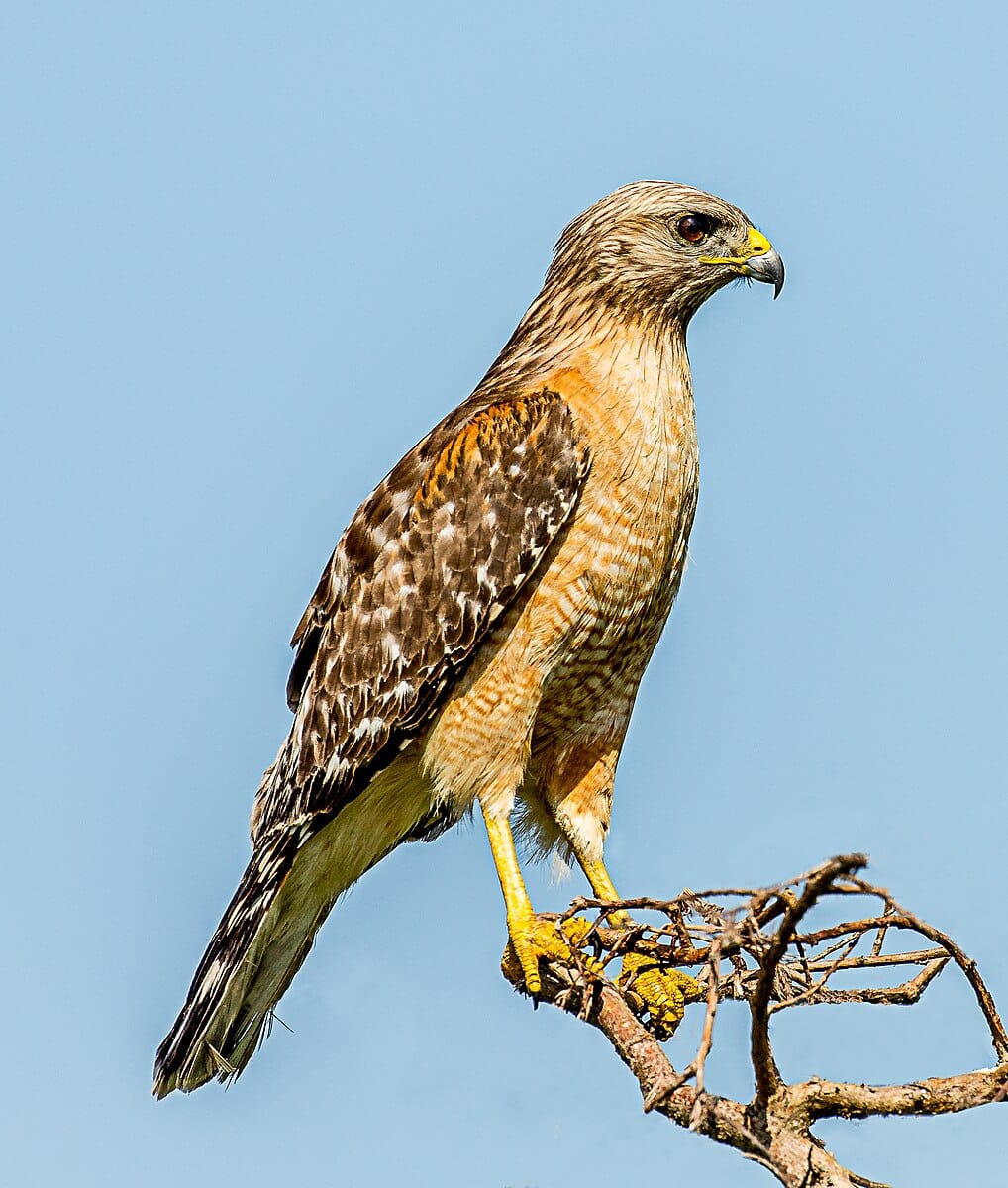
Physical Characteristics & Identification Tips
Red-shouldered Hawks are medium-sized with rufous-colored underparts and striking black-and-white checkered wings. Their tail shows narrow white bands, and adults possess a rich reddish shoulder patch. Juveniles are browner and less vividly marked.
Behavior and Nesting Habits
These hawks are vocal and territorial, often heard before seen. They prefer nesting in tall trees near water, constructing stick nests lined with foliage. Mating pairs defend nesting areas vigorously.
Habitat and Range
Red-shouldered Hawks inhabit forests, swamps, and riparian areas in Ohio. They are permanent residents in southern regions but may show some local movements in winter.
Diet
Their diet consists of small mammals, amphibians, reptiles, and birds. Hunting typically involves quiet perches followed by a sudden swoop to capture prey.
Reproduction and Life Cycle
Females lay 2–4 eggs per clutch. Both parents feed the chicks, which fledge in 5–6 weeks. Juveniles gradually gain independence while still learning to hunt efficiently.
Fun Facts / Unique Traits
Red-shouldered Hawks are notable for their vocalizations, including a clear, high-pitched call that resonates across wetlands and forests. They often engage in aerial displays to defend territory.
Human Interaction
They tolerate moderate human activity, and their presence near rivers and wetlands makes them a favorite among birdwatchers.
3. Cooper’s Hawk (Accipiter cooperii)
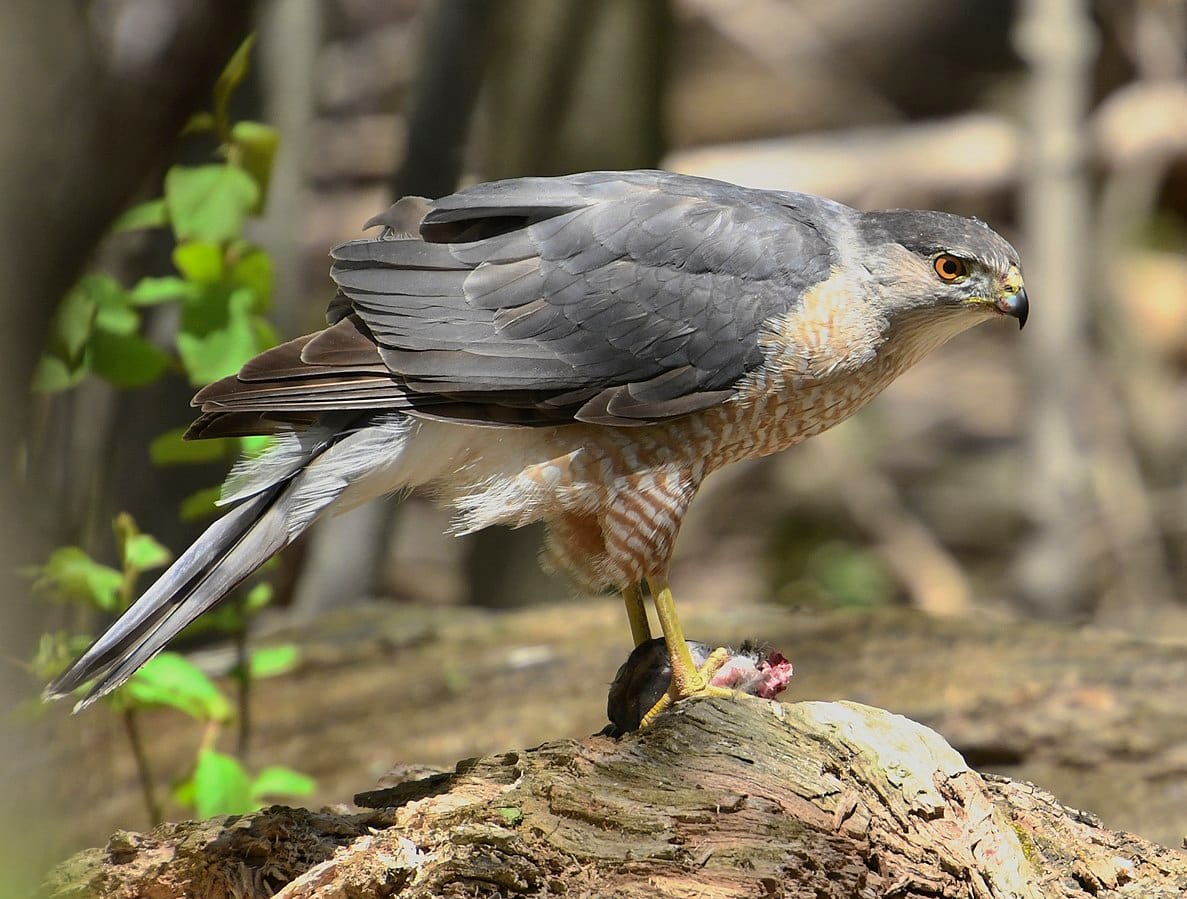
Physical Characteristics & Identification Tips
Cooper’s Hawks are agile forest hunters with rounded wings and long tails. Adults have blue-gray upperparts, rufous barring on the chest, and a banded tail. Juveniles are brown with streaked underparts. Their size helps distinguish them from the smaller Sharp-shinned Hawk.
Behavior and Nesting Habits
Cooper’s Hawks are swift, stealthy predators, often pursuing birds through wooded areas with impressive speed. They build nests in dense tree canopies and defend them vigorously during breeding season.
Habitat and Range
These hawks prefer forests and woodlots but have adapted to suburban areas in Ohio, where bird feeders attract prey. Their range covers most of the state year-round.
Diet
Cooper’s Hawks primarily hunt medium-sized birds like doves, pigeons, and songbirds. They occasionally take small mammals, using surprise attacks and rapid chases to capture prey.
Reproduction and Life Cycle
Females lay 3–5 eggs per clutch. Incubation lasts about a month, and fledglings leave the nest after 4–5 weeks. Juveniles practice hunting skills nearby before fully dispersing.
Fun Facts / Unique Traits
Cooper’s Hawks are known for their speed and agility. Their ability to weave through dense forests while hunting is a remarkable adaptation among raptors.
Human Interaction
They are increasingly seen in suburban neighborhoods, hunting birds visiting feeders. Awareness of their presence helps minimize conflicts with domestic pets.
4. Sharp-shinned Hawk (Accipiter striatus)
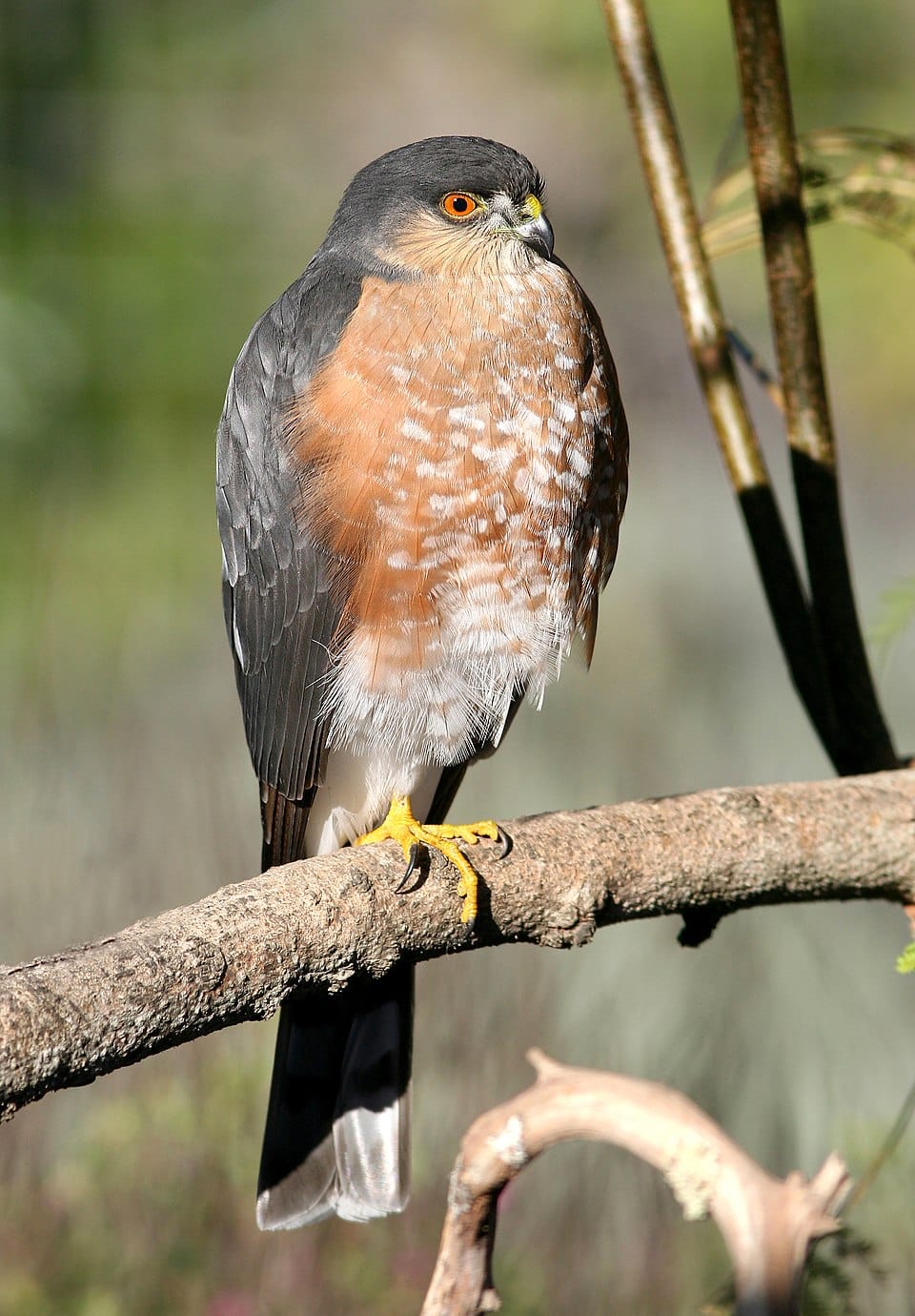
Physical Characteristics & Identification Tips
Sharp-shinned Hawks are the smallest Accipiters in Ohio, easily recognized by their compact size, short rounded wings, and long, squared tail. Adults have blue-gray upperparts with orange barring on the chest, while juveniles display brown upperparts and streaked underparts. They are often mistaken for Cooper’s Hawks but are smaller and more delicate in flight.
Behavior and Nesting Habits
These hawks are agile predators, darting through dense forests in pursuit of birds. Nests are built in coniferous or deciduous trees, lined with twigs and soft materials. They are secretive and may reuse or refurbish old nests from previous years.
Habitat and Range
Sharp-shinned Hawks inhabit forested areas throughout Ohio, especially deciduous woodlands. During migration, they may be seen in mixed habitats including parks and suburban areas.
Diet
Their diet primarily consists of small birds, which they hunt with rapid, stealthy flights. Occasionally, they take small mammals or large insects when birds are scarce.
Reproduction and Life Cycle
Females lay 3–6 eggs per clutch, incubated for about three weeks. Fledglings leave the nest around 3–4 weeks but remain under parental care while learning to hunt.
Fun Facts / Unique Traits
Sharp-shinned Hawks are known for their astonishing speed and maneuverability, capable of weaving through dense branches with incredible precision. Birdwatchers often spot them darting unexpectedly in backyards.
Human Interaction
They occasionally visit backyard feeders in pursuit of small birds. Observing these hawks offers a glimpse of Ohio’s stealthy forest predators in action.
5. Northern Harrier (Circus hudsonius)
Physical Characteristics & Identification Tips
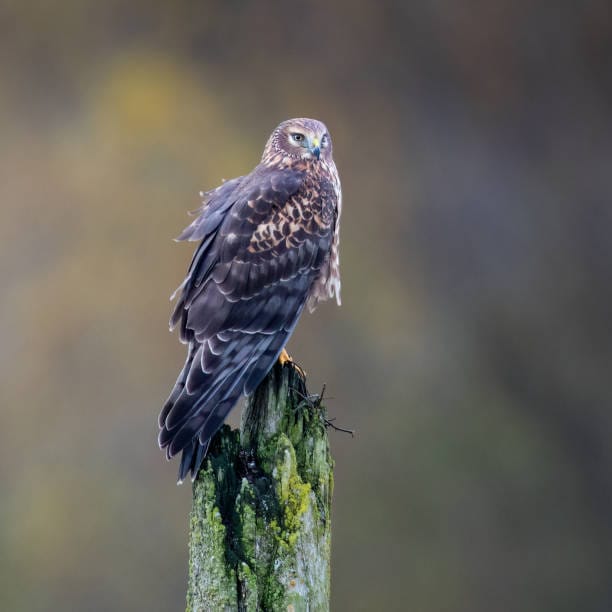
Northern Harriers are medium-sized raptors with a slim body, long wings, and a distinctive owl-like facial disc that aids in hunting. Adults are gray above (males) or brown (females) with a white rump patch visible in flight. Their low, gliding flight over fields is a key identification feature.
Behavior and Nesting Habits
Northern Harriers hunt low over marshes, grasslands, and agricultural fields, often tilting side-to-side to detect prey. They nest on the ground in dense vegetation, constructing simple nests from grasses and reeds.
Habitat and Range
They are common in Ohio’s open landscapes, wetlands, and prairies. Winter visitors may expand into southern agricultural areas, while breeding occurs in northern and central regions.
Diet
Their diet consists mainly of small mammals like voles and mice, but they also take birds and amphibians. They use acute hearing and low flight to locate hidden prey.
Reproduction and Life Cycle
Females lay 4–7 eggs per clutch. Incubation lasts about 30–32 days, with fledging occurring around 4–5 weeks. Juveniles often remain in nearby fields while practicing hunting techniques.
Fun Facts / Unique Traits
Northern Harriers are among the few raptors with facial discs, similar to owls, allowing them to hunt by sound as well as sight. Their graceful, low gliding is a signature behavior.
Human Interaction
They avoid dense human populations but can be observed in natural preserves and farmland areas. Protecting wetlands and open fields is crucial for their survival.
6. Broad-winged Hawk (Buteo platypterus)
Physical Characteristics & Identification Tips
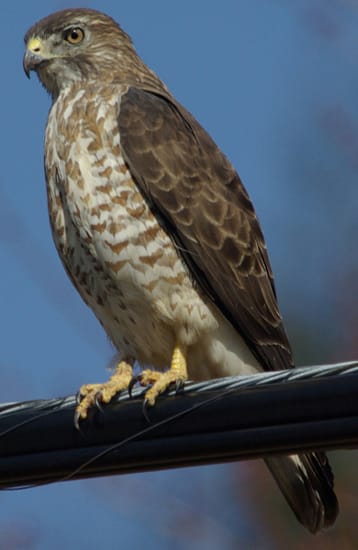
Broad-winged Hawks are small Buteos with broad, rounded wings and a short tail. Adults show rich brown upperparts, pale underparts with narrow chest streaking, and distinctive black-and-white barring on the tail. During migration, they form large flocks or “kettles” that can number in the thousands.
Behavior and Nesting Habits
These hawks are forest-dwellers that hunt from perches or soaring flight. Nests are built in the canopy using sticks and lined with softer materials. They are highly social during migration but territorial during breeding season.
Habitat and Range
Broad-winged Hawks breed in Ohio’s deciduous and mixed forests. They migrate to Central and South America for the winter, forming large aggregations along thermals.
Diet
Their diet primarily includes small mammals, amphibians, reptiles, and insects. Hunting involves a combination of perch observation and short flights to capture prey.
Reproduction and Life Cycle
Females lay 1–5 eggs per clutch, incubated for roughly 28–33 days. Fledglings leave the nest after 5–6 weeks, gradually dispersing during autumn migration.
Fun Facts / Unique Traits
Broad-winged Hawks are famous for their massive migratory kettles, sometimes observed numbering in the thousands. These flights are spectacular displays of coordinated movement.
Human Interaction
They are mostly observed during migration, providing excellent opportunities for birdwatchers. Preserving forested habitats ensures breeding success and safe migratory stopovers.
7. Rough-legged Hawk (Buteo lagopus)
Physical Characteristics & Identification Tips
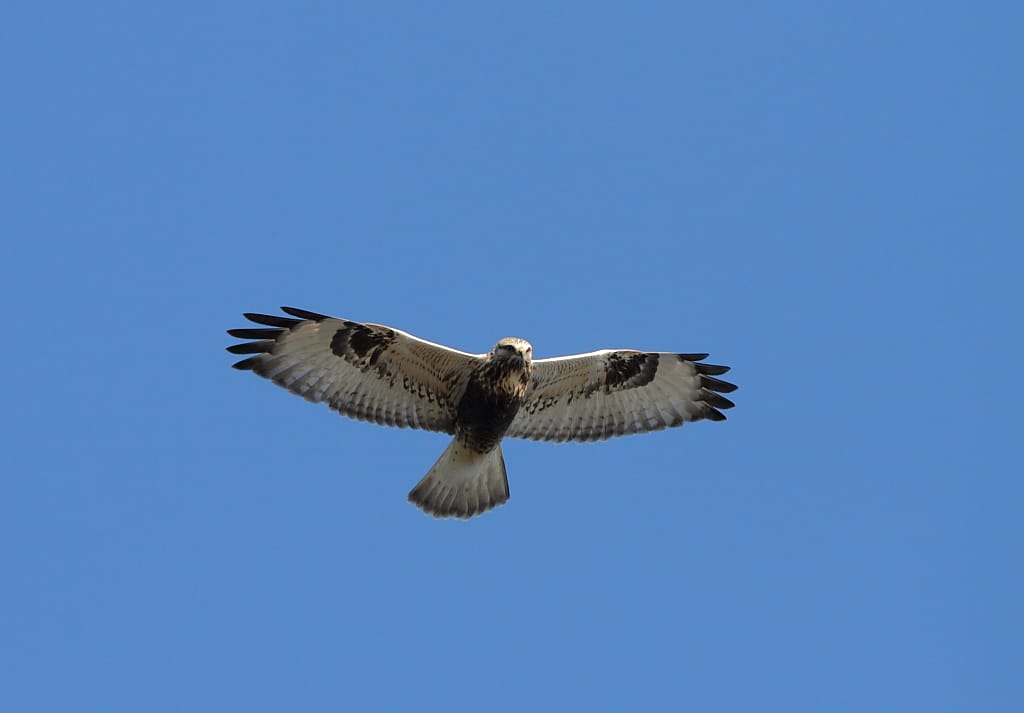
Rough-legged Hawks are medium-sized raptors notable for their feathered legs, which help insulate them in colder climates. Adults display a light underside with a dark belly band and variable dark markings on the wings. In flight, their wings show distinct dark patches at the “wrist” and a broad tail band, making them identifiable even from a distance. Juveniles are mottled brown with similar feathered legs.
Behavior and Nesting Habits
These hawks are often seen hovering over open fields or tundra-like areas while hunting. In Ohio, they are primarily winter visitors and do not breed locally. Their nesting habits are observed in Arctic regions, where they use elevated sites such as cliffs or stumps to build stick nests.
Habitat and Range
Rough-legged Hawks migrate from northern breeding grounds in Alaska and Canada to Ohio’s open fields and farmlands during winter. They favor wide, open landscapes for hunting and roosting.
Diet
Their diet consists largely of small mammals like voles and lemmings, but they also take birds and insects. They often hunt by hovering and scanning the ground carefully for movement.
Reproduction and Life Cycle
Although Rough-legged Hawks do not breed in Ohio, in their Arctic range females lay 2–5 eggs per clutch, incubated for around 28 days. Fledging occurs approximately 4–5 weeks after hatching.
Fun Facts / Unique Traits
These hawks are among the few raptors that hover while hunting, reminiscent of kestrels, and their feathered legs provide insulation against icy winds—a distinctive trait among Buteos.
Human Interaction
Rough-legged Hawks are generally tolerant of human activity while wintering. Observers often spot them perched on fence posts or utility poles along Ohio’s open farmland.
8. Northern Goshawk (Accipiter gentilis)
Physical Characteristics & Identification Tips
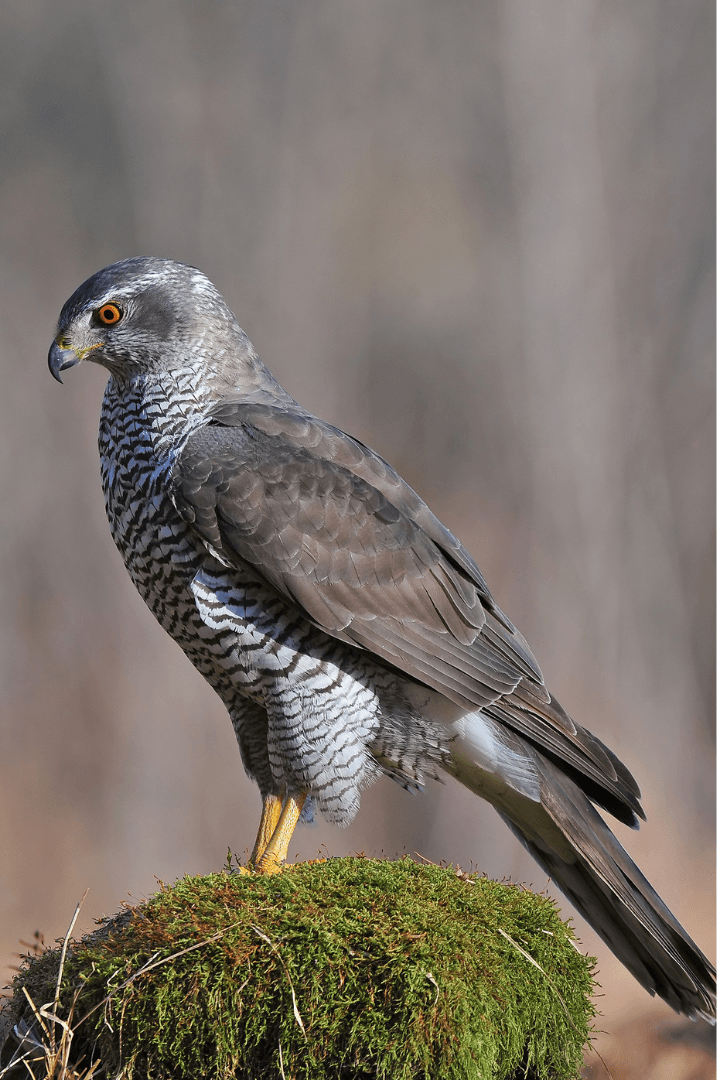
Northern Goshawks are large Accipiters with broad wings and long tails, adapted for fast, agile flight through dense forests. Adults are slate-gray with pale underparts and fine horizontal barring, while juveniles are brown and streaked. Their striking red eyes and powerful talons make them formidable predators.
Behavior and Nesting Habits
These hawks are stealthy hunters, often ambushing birds and small mammals in woodland areas. Nests are constructed high in mature trees, using sticks and lining with leaves. Breeding pairs are highly territorial and will vigorously defend nesting sites.
Habitat and Range
Northern Goshawks inhabit Ohio’s dense forests, particularly in northern and central regions. They are present year-round but remain secretive, making sightings rare.
Diet
Their diet primarily includes birds like grouse, woodpeckers, and pigeons, supplemented by squirrels and rabbits. Hunting involves swift, low-level flight through forest corridors.
Reproduction and Life Cycle
Females lay 2–4 eggs per clutch, incubated for approximately 28–32 days. Fledglings leave the nest after 5–6 weeks, and juveniles practice hunting with parental guidance.
Fun Facts / Unique Traits
Northern Goshawks are known as the “ghosts of the forest” due to their elusive nature and incredible speed while maneuvering through dense trees. Their combination of power, agility, and stealth is unmatched among Ohio raptors.
Human Interaction
They are sensitive to disturbance and rarely venture into populated areas. Responsible forest management and preservation of mature woodlands help maintain their populations.
9. Swainson’s Hawk (Buteo swainsoni)
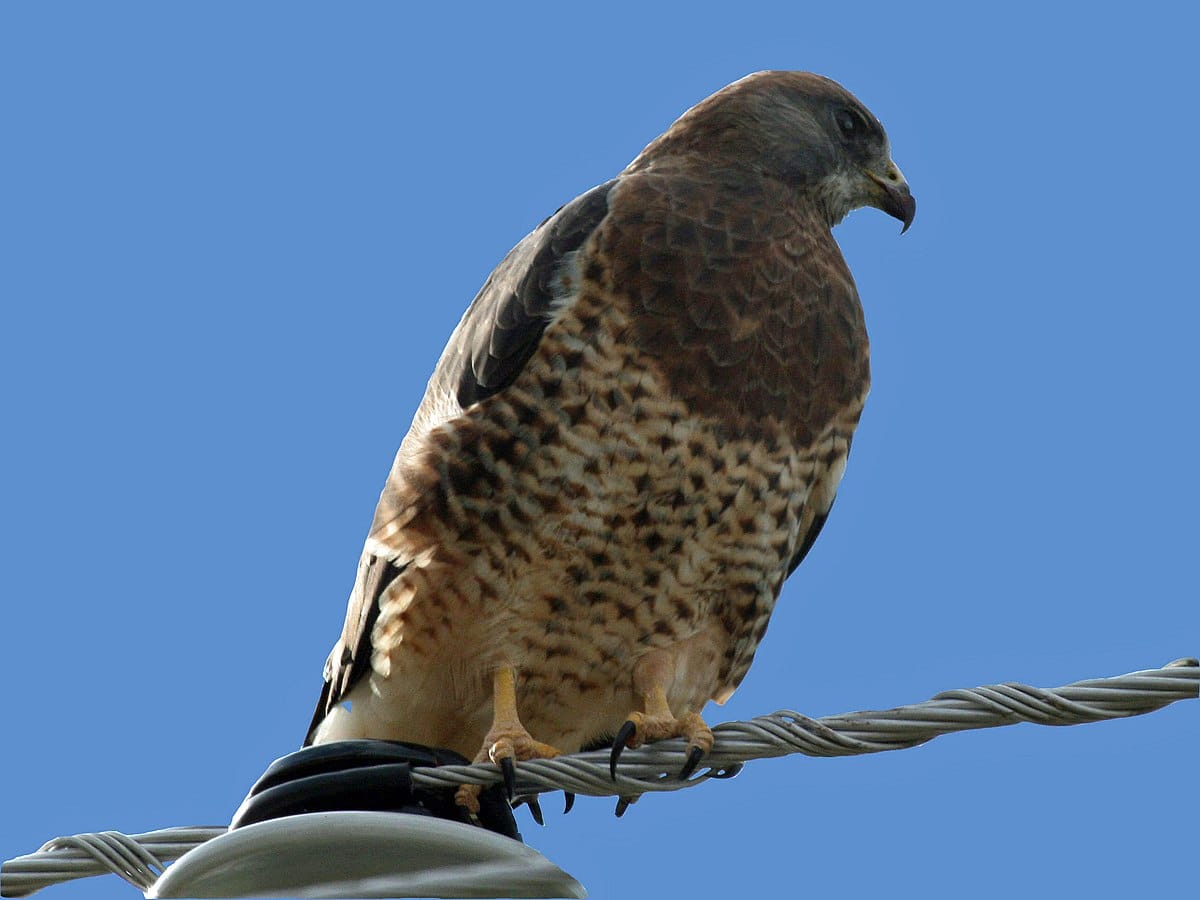
Physical Characteristics & Identification Tips
Swainson’s Hawks are medium-sized Buteos with long wings and a relatively slender body. Adults display pale underparts with a darker chest band and brown upperparts. Their flight is graceful, with wings held in a shallow “V” during soaring. Juveniles are streaked and less vividly colored.
Behavior and Nesting Habits
These hawks are highly migratory, traveling from North American breeding grounds to South America. In Ohio, they are seen primarily during migration. Nests are built in trees on the prairie or woodland edges, made of sticks and lined with softer materials.
Habitat and Range
Swainson’s Hawks prefer open grasslands, agricultural fields, and lightly wooded areas. In Ohio, they are rare visitors in spring and fall during migration.
Diet
They primarily hunt small mammals, insects, and occasionally birds. In wintering grounds, they often feed heavily on grasshoppers and other insects, highlighting their adaptability.
Reproduction and Life Cycle
Breeding occurs primarily in the western United States. Females lay 3–5 eggs, incubated for about a month. Fledging occurs in roughly 5–6 weeks.
Fun Facts / Unique Traits
Swainson’s Hawks are famous for their long-distance migration of up to 12,000 miles round-trip to South America, making them among the most traveled raptors in North America.
Human Interaction
Observing these hawks in Ohio is a rare treat for birdwatchers. Their migratory presence highlights the importance of protecting stopover habitats and open fields.
10. Ferruginous Hawk (Buteo regalis)
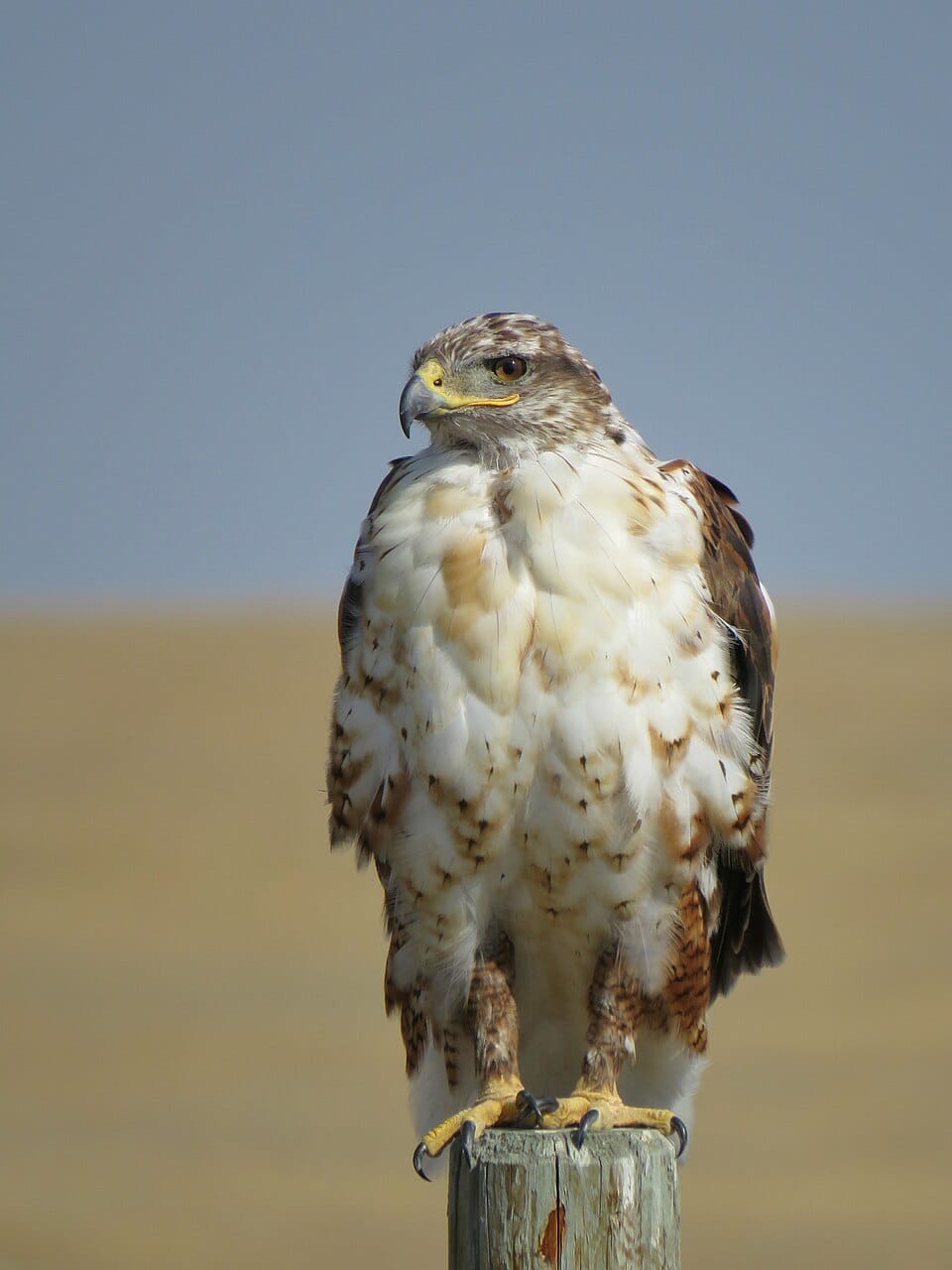
Physical Characteristics & Identification Tips
Ferruginous Hawks are large, powerful Buteos with broad wings and a robust build. Adults exhibit a pale underbody with rusty-colored legs and a rufous back, while juveniles are streaked brown above and below. Their wingspan can reach up to 4.5 feet, making them one of the largest hawks occasionally seen in Ohio.
Behavior and Nesting Habits
These hawks are typically ground hunters, often seen soaring over open prairies or farmlands. Nests are large stick platforms, usually located in trees or on cliff edges. Ferruginous Hawks are territorial and return to the same nesting areas annually.
Habitat and Range
While native to the western plains, Ferruginous Hawks are rare visitors to Ohio, mostly during migration. They favor open landscapes with minimal tree cover and wide vistas for hunting.
Diet
Their diet consists mainly of small mammals like rabbits, prairie dogs, and ground squirrels. They occasionally hunt birds, relying on their keen eyesight and strong talons.
Reproduction and Life Cycle
In breeding areas, females lay 2–5 eggs. Incubation lasts roughly 28–33 days, with fledging occurring after 5–6 weeks. Juveniles gain independence gradually while practicing hunting techniques.
Fun Facts / Unique Traits
Ferruginous Hawks are sometimes called “ferruginous buteos” due to their iron-rust coloration. Their long wings and soaring flight are adaptations for covering vast open areas in search of prey.
Human Interaction
They rarely interact with humans in Ohio, but birdwatchers occasionally spot these majestic hawks during migration in open farmlands or prairie-like areas.
11. Osprey (Pandion haliaetus)
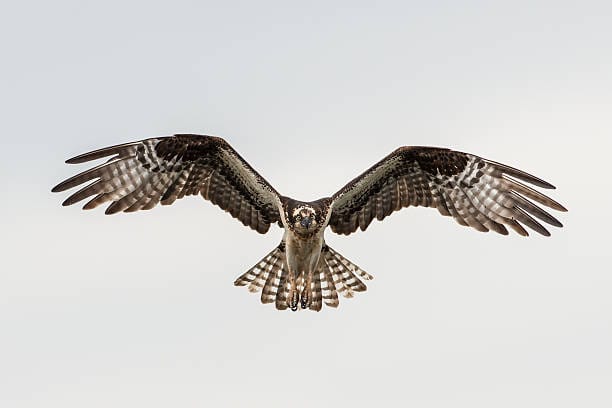
Physical Characteristics & Identification Tips
Ospreys are large raptors with a distinctive white head, dark eye stripe, and dark brown upperparts. Their underparts are mostly white with some streaking. Long, narrow wings and a hooked beak make them excellent fish hunters. Juveniles have buff-colored streaking and a less pronounced facial mask.
Behavior and Nesting Habits
Ospreys are specialized fish hunters, often seen hovering over lakes or rivers before plunging talons-first into the water. They build massive stick nests near water bodies, frequently on man-made platforms, utility poles, or tall trees.
Habitat and Range
In Ohio, Ospreys inhabit lakes, rivers, and reservoirs. They are primarily summer residents, breeding in suitable wetland habitats throughout the state.
Diet
Ospreys feed almost exclusively on fish, catching them with their sharp talons. Their diet is a reflection of their highly specialized hunting skills, allowing them to thrive near water bodies.
Reproduction and Life Cycle
Females lay 2–4 eggs, incubated for about 35–42 days. Fledglings leave the nest after 8–10 weeks. Both parents provide care and teach fishing skills to their young.
Fun Facts / Unique Traits
Ospreys are sometimes called “fish hawks” due to their diet. They possess reversible outer toes to grasp slippery fish and specialized talon pads to prevent prey from slipping.
Human Interaction
Conservation efforts in Ohio have successfully increased Osprey populations. Nesting platforms installed by humans provide safe breeding sites and excellent birdwatching opportunities.
12. Harris’s Hawk (Parabuteo unicinctus)

Physical Characteristics & Identification Tips
Harris’s Hawks are medium-sized raptors with dark brown plumage, chestnut shoulders, and white-tipped tails. They have long legs and a slim build. Juveniles are paler with streaked underparts. This species is distinctive for its social behavior, uncommon among hawks.
Behavior and Nesting Habits
Harris’s Hawks are cooperative hunters, often working in groups to flush out and capture prey. They nest in trees, shrubs, or cacti in their native range, though in Ohio they are very rare visitors or introduced birds.
Habitat and Range
Primarily found in arid southwestern habitats, Harris’s Hawks are rare in Ohio and mainly observed in captivity or as escapees. They prefer open areas with perches for cooperative hunting.
Diet
Their diet includes mammals, birds, and reptiles. The cooperative hunting strategy allows them to tackle prey larger than themselves, making them fascinating observers of group dynamics.
Reproduction and Life Cycle
In natural habitats, females lay 2–4 eggs per clutch. Both males and females participate in incubation and feeding young. Fledging occurs after 6–7 weeks.
Fun Facts / Unique Traits
Harris’s Hawks are among the few raptors exhibiting cooperative hunting. Groups of up to six individuals can work together, showcasing remarkable social coordination.
Human Interaction
They are popular in falconry due to their social nature and trainability. In Ohio, encounters are rare but educational for raptor enthusiasts.
Conclusion
Ohio hosts a fascinating array of hawks, from the widespread Red-tailed Hawk to the rare and specialized Ferruginous Hawk. Each species brings unique behaviors, adaptations, and ecological roles that contribute to the balance of local ecosystems. Observing these raptors offers a window into the state’s diverse habitats, from dense forests and open fields to wetlands and lakes. Understanding their diets, nesting habits, and migratory patterns deepens appreciation for these skilled hunters.
Whether you are a birdwatcher, a student of wildlife, or simply a nature enthusiast, Ohio’s hawks provide endless opportunities for discovery. Protecting forests, wetlands, and open spaces ensures these magnificent birds continue to thrive. By learning to identify the 12 types of hawks in Ohio, you can enhance your outdoor experiences and support local conservation efforts. Next time you see a soaring hawk overhead, take a moment to appreciate the remarkable adaptations that allow these raptors to dominate the skies.
Frequently Asked Questions About Hawks in Ohio
1. What types of hawks can be found in Ohio?
Ohio is home to 12 main types of hawks, including Red-tailed Hawk, Red-shouldered Hawk, Cooper’s Hawk, Sharp-shinned Hawk, Northern Harrier, Broad-winged Hawk, Rough-legged Hawk, Northern Goshawk, Swainson’s Hawk, Ferruginous Hawk, Osprey, and Harris’s Hawk.
2. Are Red-tailed Hawks common in Ohio?
Yes, Red-tailed Hawks are among the most common hawks in Ohio and can be seen throughout the state in forests, farmlands, and even suburban areas.
3. Where do Northern Harriers live in Ohio?
Northern Harriers prefer open fields, wetlands, and grasslands in Ohio, often hunting low over the ground to catch small mammals and birds.
4. Can you spot a Cooper’s Hawk in Ohio suburbs?
Absolutely. Cooper’s Hawks have adapted to suburban areas, often hunting backyard birds near feeders in Ohio neighborhoods.
5. Do Swainson’s Hawks breed in Ohio?
Swainson’s Hawks are rare in Ohio and are typically seen only during migration. They breed primarily in the western United States.
6. When is the best time to see Broad-winged Hawks in Ohio?
Broad-winged Hawks are most noticeable during migration in spring and fall, when they form large “kettles” of hundreds or thousands of birds.
7. How can you identify a Sharp-shinned Hawk in Ohio?
Look for a small Accipiter with short rounded wings, long tail, and orange barring on the chest. They are often mistaken for the slightly larger Cooper’s Hawk.
8. Do Ospreys live in Ohio year-round?
Ospreys are primarily summer residents in Ohio, nesting near lakes and rivers, and migrate south during winter.
9. What is the diet of Red-shouldered Hawks in Ohio?
Red-shouldered Hawks feed on small mammals, amphibians, reptiles, and birds. They often hunt from perches near wetlands or forest edges.
10. Are Rough-legged Hawks permanent residents in Ohio?
No, Rough-legged Hawks are winter visitors in Ohio, migrating south from their Arctic breeding grounds.
11. How can you distinguish a Northern Goshawk in Ohio?
Northern Goshawks are large forest hawks with broad wings, long tails, red eyes, and a stealthy flight through dense woods.
12. Do Ferruginous Hawks live in Ohio naturally?
Ferruginous Hawks are rare visitors to Ohio and are primarily native to the western plains of North America.
13. Are Harris’s Hawks common in Ohio?
No, Harris’s Hawks are very rare in Ohio, often appearing as escapees or in falconry programs.
14. Where do Red-tailed Hawks nest in Ohio?
They build large stick nests in tall trees, on cliff ledges, or even on human structures such as poles and towers.
15. What are common prey items for Ohio hawks?
Hawks in Ohio hunt small mammals like mice, voles, rabbits, birds, reptiles, and insects depending on the species.
16. Can you see Rough-legged Hawks in summer in Ohio?
No, Rough-legged Hawks are winter visitors and migrate north during the breeding season.
17. How do Northern Harriers hunt in Ohio?
They fly low over open fields, tilting side-to-side to listen and look for small mammals and birds hiding in the grass.
18. Are Ospreys protected in Ohio?
Yes, Ospreys are protected under federal and state law. Conservation efforts, including nest platforms, have helped their populations recover in Ohio.
19. Do Cooper’s Hawks attack humans in Ohio?
No, Cooper’s Hawks avoid humans but may prey on small birds and pets if they are left unattended outdoors.
20. What habitats do Broad-winged Hawks prefer in Ohio?
They prefer deciduous and mixed forests for breeding, often migrating over open areas during fall and spring.
21. How long do Ferruginous Hawks live in the wild?
In their natural habitats, Ferruginous Hawks can live up to 12–15 years, though in Ohio they are rarely observed outside of migration.
22. What makes Harris’s Hawks unique in Ohio?
They are cooperative hunters, which is rare among hawks. Groups can hunt together to capture larger prey.
23. Do Northern Goshawks migrate through Ohio?
They are mostly resident, but some northern populations may move slightly south into Ohio during harsh winters.
24. Can Red-shouldered Hawks be found near water in Ohio?
Yes, they favor wooded wetlands, rivers, and swamps, where they hunt amphibians and small mammals.
25. How do Sharp-shinned Hawks catch prey?
They use stealth and speed, darting through dense forests to ambush small birds and mammals.
26. Are Swainson’s Hawks easy to see in Ohio?
No, they are rare in Ohio and primarily observed during migration periods.
27. What is a key identification feature of Rough-legged Hawks in Ohio?
Look for feathered legs, dark wrist patches on the wings, and a broad tail band during flight.
28. How do Red-tailed Hawks communicate in Ohio?
They use loud, raspy calls that can be heard over long distances to establish territory and signal mates.
29. Do Ospreys in Ohio fish in rivers or lakes?
Yes, Ospreys hunt primarily in freshwater lakes and rivers, diving talons-first to catch fish.
30. Are Northern Harriers easy to spot in Ohio?
They are more visible during winter over open fields and wetlands, flying low in search of prey.
31. How can birdwatchers help hawks in Ohio?
Protecting forests, wetlands, and open fields, minimizing pesticide use, and supporting conservation programs all help sustain hawk populations in Ohio.
Read more: 13 Types of Hawks in Michigan (Pictures And Identification)