
1. Striped Skunk (Mephitis mephitis)
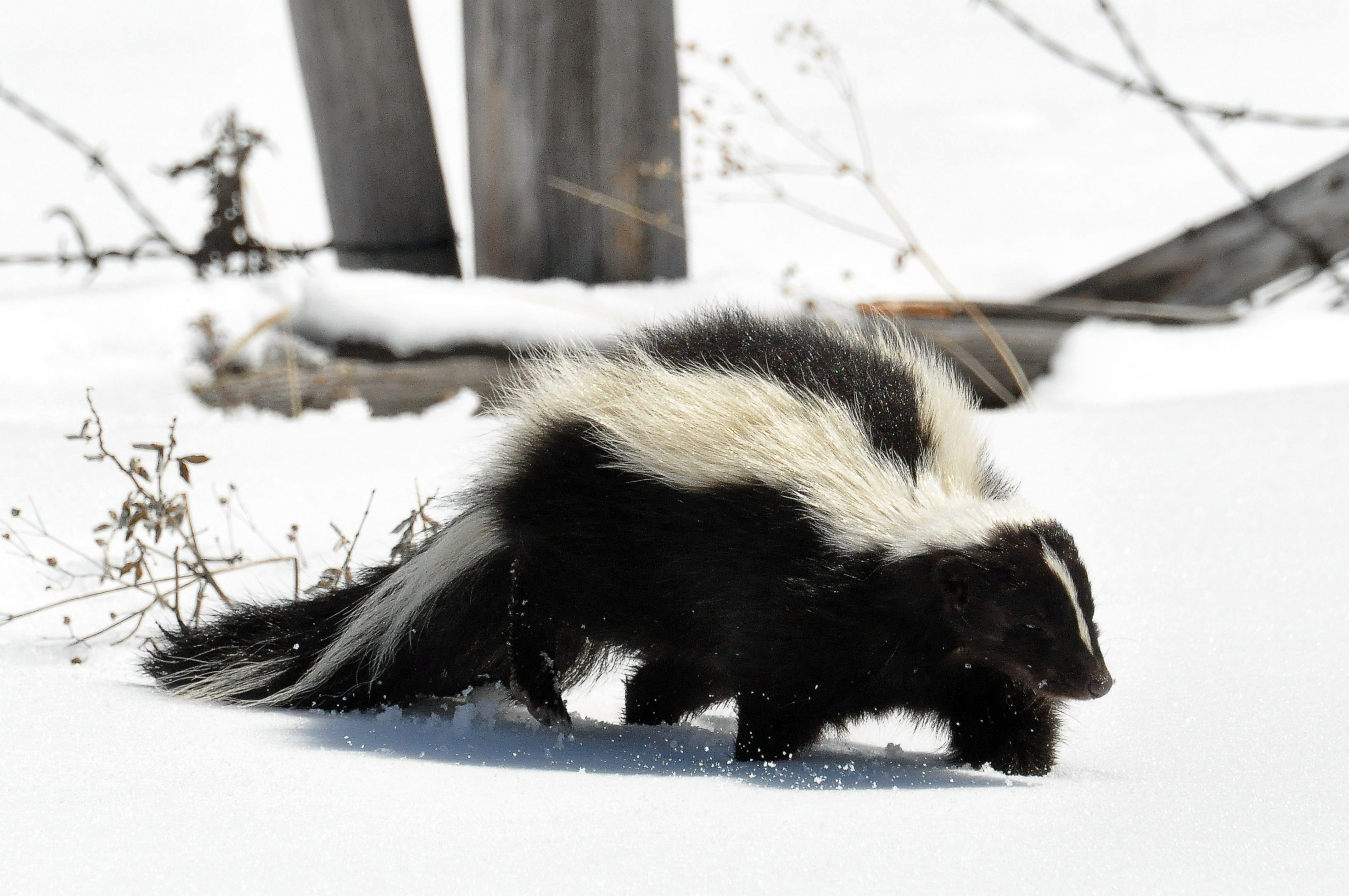
Physical Characteristics & Identification Tips
The Striped Skunk is the familiar black-and-white mammal most people imagine when they hear “skunk.” Look for a glossy black coat accented by two bold white stripes running from the head along the back to the tail; the stripes often meet near the shoulders, forming a V-shaped pattern. Adults typically measure 20–32 inches in total length (including tail) and weigh between 4–12 pounds depending on sex, season, and food availability. Their bushy tails, short legs, pointed snouts, and small rounded ears complete the classic silhouette.
Juveniles may show thinner or slightly offset stripes, but the contrasting pattern remains the quickest field cue. In low light, the white markings stand out and help you identify them at a distance—handy during evening walks or when checking a backyard fence line.
Behavior
Striped skunks are primarily nocturnal and mostly solitary outside of family groups. They forage soon after dusk and often follow consistent nightly routes that pass through lawns, wood edges, and garden beds. When threatened they typically provide warning displays—hissing, foot-stomping, tail-raising—before resorting to their infamous spray. Because producing the musk is energetically expensive, spraying is a last-resort defense.
They are also excellent diggers, rooting for grubs and larvae in lawns and compost piles, which makes them unwitting gardeners in suburban areas.
Habitat and Range
Striped skunks are adaptable and occur statewide in Michigan, from urban neighborhoods and agricultural lands to forest edges and wetlands. They readily use den sites such as hollow logs, rock crevices, brush piles, abandoned burrows, and spaces under porches or sheds. Museum and specimen records confirm a long history of striped skunks in Michigan. :contentReference[oaicite:1]{index=1}
Diet
These omnivores have a broad diet that shifts seasonally. Insects—beetles, grubs, and crickets—are key in warm months, while small mammals, eggs, fruits, and carrion supplement the menu. Their appetite for insect larvae can benefit lawns and crops by reducing pest loads.
Reproduction and Life Cycle
Mating typically occurs in late winter; after a gestation of roughly 60–75 days, females give birth to litters of about 4–6 kits in late spring. Kits are born blind and grow rapidly, beginning to explore outside the den after a few weeks and dispersing in late summer. Many wild individuals live 2–4 years, though those in protected settings can survive longer.
Fun Facts / Noteworthy Traits
- Striped skunks are meticulous groomers despite their reputation for odor.
- A single skunk can accurately spray a predator 10–15 feet away, several times in a row if needed.
- Because they reduce insect larvae in turf and gardens, they provide a natural pest-control service.
Human Interaction
Encounters with striped skunks are common in Michigan’s towns and rural properties. To minimize conflicts: secure trash containers, avoid leaving pet food outside overnight, and block access beneath porches or decks. If a skunk sprays a pet or a space, carefully follow neutralization guidance (ventilate, wash affected animals, and use appropriate cleaning solutions). Avoid direct contact—skunks can carry rabies—and contact local animal control if you find a sick or unusually tame animal.
2. Eastern Spotted Skunk (Spilogale putorius) — Rare / Historically Declined
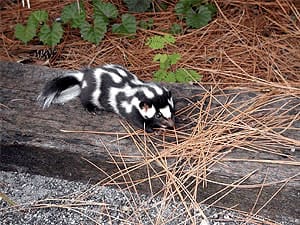
Physical Characteristics & Identification Tips
The Eastern Spotted Skunk is smaller and more weasel-like than the striped skunk. It typically weighs less (often under 3 pounds) and measures ~14–24 inches long. Instead of solid longitudinal stripes, this species has broken white stripes and spots across a black background—hence the name. The tail is bushy but proportionally shorter, and their overall build is more slender and agile than Mephitis species.
Because of its small size and secretive habits, you may only glimpse a spotted skunk briefly; look for the broken stripe pattern and the leaner profile when identifying one.
Behavior
Eastern spotted skunks are notably active and acrobatic. They can climb low trees and structures and are more likely than striped skunks to use elevated refuges. When threatened they may perform the famous “handstand” warning—rearing up on their front feet with the rear end and tail pointed at a threat—before spraying. They are mostly nocturnal and solitary, being insectivorous and opportunistic in their feeding.
Habitat and Range
Historically, eastern spotted skunks occupied a broad swath of the eastern and central United States. However, their range and numbers have contracted sharply over recent decades. In the Midwest, including areas near Michigan, verified records have declined and modern detections are sparse; broad-scale surveys and county-level records show a contraction of their historical distribution. While isolated and historical records exist across many states, their presence in Michigan today is uncertain and considered extremely rare if present at all—the species has declined across much of its former northern range. Researchers continue to compile county records and camera-trap detections to refine current distribution maps. :contentReference
Diet
Spotted skunks have a strong insect diet—beetles, grasshoppers, and larvae—supplemented by small rodents, eggs, fruits, and occasional carrion. Their agility and small size let them forage in tight spaces, brush piles, and even climb to reach bird nests or insect-rich spots.
Reproduction and Life Cycle
Breeding generally occurs in late winter and early spring. Eastern spotted skunks may experience delayed implantation (a reproductive strategy seen in some mustelids and other small carnivores), resulting in spring births timed when food is becoming more abundant. Litters typically number 4–6 kits, which remain dependent on the mother for several weeks before dispersing.
Fun Facts / Noteworthy Traits
- The “handstand” defense display is an unmistakable, theatrical behavior unique among common North American mammals.
- They are among the more acrobatic skunks—capable climbers that exploit a variety of microhabitats.
- Population declines in recent decades make modern sightings rare and conservation attention important.
Human Interaction
Because eastern spotted skunks are so elusive and rare in many parts of their former range, human interactions are uncommon in Michigan. Conservationists encourage habitat features that support insect prey and protective cover—woody fencerows, shrubby edges, brush piles, and abandoned farm structures—wherever the species persists. Reporting verified sightings to state natural resource agencies or university mammal collection programs helps inform conservation status assessments and management planning.
Conclusion
Michigan’s skunk story is straightforward but important: the Striped Skunk is a common, adaptable resident found across the state and appreciated for its pest-control role, while the Eastern Spotted Skunk has undergone steep declines and is now extremely rare or locally absent in many areas of the Midwest—its status in Michigan is uncertain and warrants continued monitoring. Respecting these nocturnal mammals, securing attractants, and reporting unusual sightings all support safe coexistence and useful conservation data. If you encounter an odd-looking small skunk or suspected spotted skunk, document it (photo, location, time) and share the details with local wildlife authorities to improve our knowledge of their distribution.
Frequently Asked Questions About Skunks in Michigan
1. How many skunk species are in Michigan?
Michigan has one widespread resident—the Striped Skunk—and the Eastern Spotted Skunk is historically recorded but now extremely rare or uncertain in the state.
2. Which skunk is most common in Michigan?
The Striped Skunk (Mephitis mephitis) is the most common and widely distributed species.
3. Are spotted skunks gone from Michigan?
Not definitively “gone,” but modern confirmed records in and near Michigan are very limited; the species has declined across much of the Midwest and requires targeted surveys to clarify current presence.
4. Where do skunks live around homes?
Look for den sites under porches, decks, in woodpiles, hollow trees, or abandoned buildings—places that provide shelter and cover.
5. How can I reduce skunk encounters?
Secure garbage lids, remove outdoor pet food at night, seal gaps beneath structures, and reduce brush piles near buildings.
6. What should I do if a skunk sprays my pet?
Keep your pet calm and outdoors. Use a skunk-odor neutralizing solution (follow vet guidance), and consult your veterinarian—especially if there was contact or a bite. Avoid getting the solution in the pet’s eyes or mouth.
7. Can skunks carry rabies in Michigan?
Yes—like many wild mammals, skunks can carry rabies. If you see odd daytime behavior, staggering, or unusual tameness, contact local animal control. Do not approach the animal.
8. Do skunks hibernate in Michigan?
Skunks do not truly hibernate but may enter torpor and reduce activity during prolonged cold spells, occasionally emerging on milder winter nights.
9. How far can a skunk spray?
Skunks can accurately spray up to 10–15 feet; multiple discharges are possible but metabolically costly for the animal.
10. Who should I report a suspected spotted skunk sighting to?
Contact the Michigan Department of Natural Resources (MDNR), local university mammalogy collections, or regional naturalist groups—verified reports (photos, time, place) are valuable for conservation.