

Best Hunting Scope Under $500: 11 Practical Options Compared
Finding the best hunting scope under $500 can be surprisingly difficult: a low price may hide blurry glass, unreliable adjustments, awkward eye relief, or a reticle that doesn’t suit your cartridge. The wrong choice can slow target acquisition, make zeroing frustrating, and undermine confidence when a clean, ethical shot matters.
At this budget, the key trade-off is usually between optical clarity, durability, magnification, and useful features such as an illuminated reticle, adjustable objective, or ballistic aiming points. This guide compares 11 practical options across those factors, with attention to hunting scenarios, compatibility, mounting, maintenance, and common setup mistakes.
Whether you hunt deer with a traditional centerfire rifle, use a straight-wall cartridge, or want a dependable scope for occasional field use, the goal is to help you narrow the choices without paying for features you won’t use. Start with the Quick Picks to see which models best match your rifle and hunting priorities.
For most general hunting applications, a clear 3-9x or 4-12x scope with a practical reticle and dependable adjustments is more useful than extreme magnification. Safe identification of the target, a stable rest, legal compliance, and proper zeroing remain more important than any single feature.
As an Amazon Associate I earn from qualifying purchases.
Quick Picks
- Best Overall: Leupold VX-Freedom 3-9x40mm Riflescope — A balanced choice for general deer hunting and lightweight rifles.
- Best for Versatile Magnification: Vortex Diamondback Second Focal Plane, 1-inch Tube Riflescopes — Useful when open-country shots require additional magnification.
- Best for Straight-Wall Cartridges: Neos 3-9×40 Straight-Wall BDC300 riflescope — Designed around straight-wall hunting applications.
- Best for Illuminated Reticle Use: Hawke Vantage IR 3-9×40 Riflescope — An option for hunters who prefer reticle illumination in changing light.
- Best for Rimfire and Versatile Range: Athlon Optics Neos Second Focal Plane Riflescopes — Suitable for comparing compact hunting setups and moderate-range use.
How to Choose the Best Hunting Scope Under $500

A hunting scope should match the rifle and the environment rather than simply offer the largest zoom range. For woods hunting, a lower starting magnification helps with finding moving game and maintaining a wider field of view. For open terrain, additional magnification can help with careful target evaluation, provided the rifle, ammunition, and shooter support the intended distance.
Also check whether the product uses a 1-inch or 30mm tube. Rings must match the tube diameter, and the rifle must have enough mounting clearance for the objective bell. A scope with an illuminated reticle may be useful in dim conditions, but illumination does not replace positively identifying the target or confirming a safe background.
Comparison Table
| Product | Magnification | Objective | Tube | Reticle/Use | Best Match | Check Price |
|---|---|---|---|---|---|---|
| Vortex Diamondback | Verify variation | Verify variation | 1 inch | Verify selected reticle | General hunting | Check Price On Amazon |
| Leupold VX-Freedom | 3-9x | 40mm | Verify listing | General hunting | Deer and big-game rifles | Check Price On Amazon |
| Mueller APV | Verify variation | Verify variation | Verify listing | Adjustable-objective design | Flexible range use | Check Price On Amazon |
| Vortex Crossfire II 30mm | Verify variation | Verify variation | 30mm | Verify selected reticle | Open-country setups | Check Price On Amazon |
| Hawke Vantage 3-9×40 | 3-9x | 40mm | 1 inch | General hunting | All-purpose hunting | Check Price On Amazon |
| Athlon Neos | Verify variation | Verify variation | Verify listing | Second focal plane | Entry-level hunting | Check Price On Amazon |
| Vortex Crossfire II 1-inch | Verify variation | Verify variation | 1 inch | Verify selected reticle | Budget rifle upgrades | Check Price On Amazon |
| Burris Fullfield II | Verify variation | Verify variation | Verify listing | Ballistic Plex | Simple holdover reference | Check Price On Amazon |
| Monstrum Guardian | 3-9x | 40mm | Verify listing | Adjustable parallax | Range practice and hunting | Check Price On Amazon |
| Hawke Vantage IR | 3-9x | 40mm | 1 inch | Illuminated reticle | Changing-light hunts | Check Price On Amazon |
| Athlon Neos Straight-Wall | 3-9x | 40mm | Verify listing | BDC300 | Straight-wall rifles | Check Price On Amazon |
Individual Scope Reviews
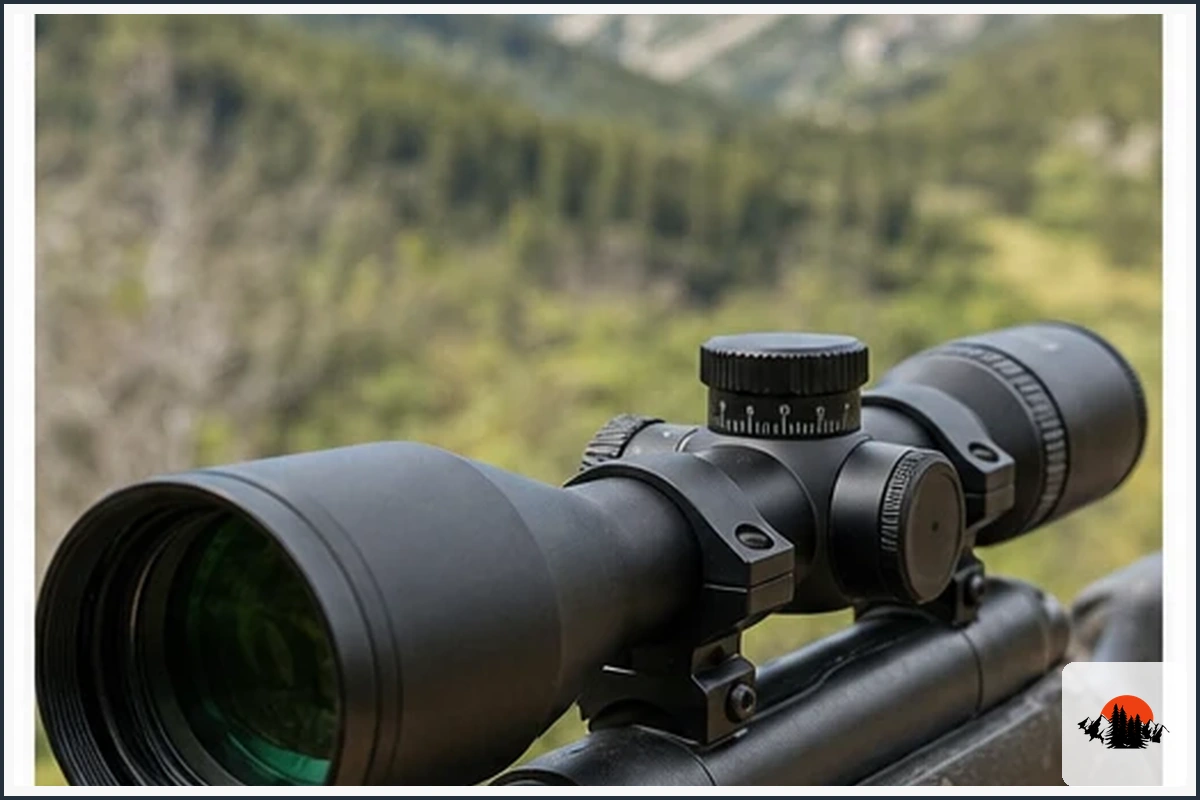
1. Vortex Diamondback Second Focal Plane, 1-inch Tube Riflescopes

The Vortex Diamondback line is a strong candidate for hunters who want a traditional 1-inch tube and more magnification flexibility than a basic fixed-power optic. The exact configuration should be confirmed because the product family includes multiple magnification and reticle variations.
Its second focal plane layout keeps the reticle appearance consistent as magnification changes. That can be comfortable for conventional hunting, although holdover references must be understood at the magnification for which they are intended.
Key Features
- 1-inch tube configuration.
- Second focal plane reticle design.
- Multiple listing variations may be available.
- Suitable for comparing general hunting magnification ranges.
Pros
- Familiar 1-inch mounting format.
- Useful magnification flexibility on open terrain.
- Second focal plane reticle remains visually consistent.
Cons
- Exact configuration must be verified before ordering.
- Higher magnification can make target acquisition slower in thick cover.
- Mounts and rings are not assumed to be included.
Who It’s Best For
This scope suits hunters using a conventional centerfire rifle across mixed terrain who want more reach than a simple 3-9x design. Confirm the exact objective, reticle, eye relief, and tube specifications before purchasing.
Zero it on the intended rifle with the intended ammunition, and confirm any reticle holdover references at the range.
2. Best Overall: Leupold VX-Freedom 3-9x40mm Riflescope

The Leupold VX-Freedom 3-9x40mm is the most balanced choice in this group for ordinary deer and big-game hunting. Its 3-9x range is familiar, versatile, and practical for wooded cover through moderate open-country distances.
The 40mm objective keeps the design within a conventional hunting format. Buyers should verify the selected reticle and exact variation, then choose rings that provide adequate clearance and correct eye position on the rifle.
Key Features
- 3-9x magnification range.
- 40mm objective.
- Conventional hunting-scope format.
- Suitable for general-purpose rifle setups.
Pros
- Versatile magnification for common hunting conditions.
- 40mm objective balances light-gathering potential and mounting practicality.
- Simple format is approachable for new hunters.
Cons
- Less magnification than some open-country options.
- Exact reticle and included accessories depend on the selected variation.
- Not automatically suited to every cartridge or rifle mounting system.
Who It’s Best For
This is the strongest overall fit for a hunter seeking one straightforward scope for whitetail woods, mixed farmland, and general range confirmation. It is also a sensible starting point for beginners who do not need specialized ballistic references.
Before hunting, confirm zero, eye relief, ring torque, and the reticle’s visibility under the local legal shooting conditions.
3. Mueller Optics (APV) All Purpose Hunting Rifle Scope

The Mueller APV is aimed at hunters and shooters who want an adjustable-objective style scope with flexibility across shorter and longer practice distances. The listing describes it as an all-purpose hunting scope, but the exact magnification and reticle should be checked carefully.
An adjustable objective can help manage parallax at different distances when correctly set, but it adds another control to learn. That feature is most useful when the hunter spends time confirming the optic at the range before the season.
Key Features
- All-purpose hunting scope design.
- Adjustable-objective configuration indicated by the product family.
- Intended for varied range use.
- Exact variation should be verified before purchase.
Pros
- Flexible design for hunters who also practice at varied distances.
- Adjustable objective can help refine parallax setup.
- Useful alternative to a basic fixed-parallax hunting optic.
Cons
- Exact specifications are variation-dependent.
- Additional adjustment may complicate quick field use.
- Requires careful setup and familiarization before hunting.
Who It’s Best For
This scope best fits a hunter who enjoys range work and wants more control over optical setup. It is less ideal for someone seeking the simplest possible hunting optic.
Learn the objective-adjustment markings at the range rather than trying to diagnose parallax while watching game.
4. Vortex Crossfire II Second Focal Plane, 30mm Tube Riflescopes

This Crossfire II listing uses a 30mm tube, which separates it from the 1-inch Crossfire II option later in the list. That larger tube is not automatically optically superior, but it requires compatible rings and may affect mounting height.
The second focal plane design is familiar for conventional hunting. Because the exact configuration is not fully specified in the supplied listing summary, confirm magnification, objective size, reticle, and included components before ordering.
Key Features
- 30mm tube.
- Second focal plane configuration.
- Multiple model variations may exist.
- Designed for rifle-scope applications.
Pros
- 30mm format offers a clear compatibility distinction.
- Second focal plane layout is straightforward for traditional hunting.
- Crossfire II family provides a familiar entry-level platform.
Cons
- Requires 30mm rings rather than standard 1-inch rings.
- Exact reticle and magnification must be verified.
- May sit higher than expected depending on the ring system.
Who It’s Best For
This option suits a hunter who already owns compatible 30mm rings or specifically wants that tube format. It is not the simplest choice for a first-time buyer who has not yet selected a mounting system.
Check bolt-handle, barrel, and objective clearance before finalizing the ring height.
5. Hawke Vantage 3-9×40 Riflescope
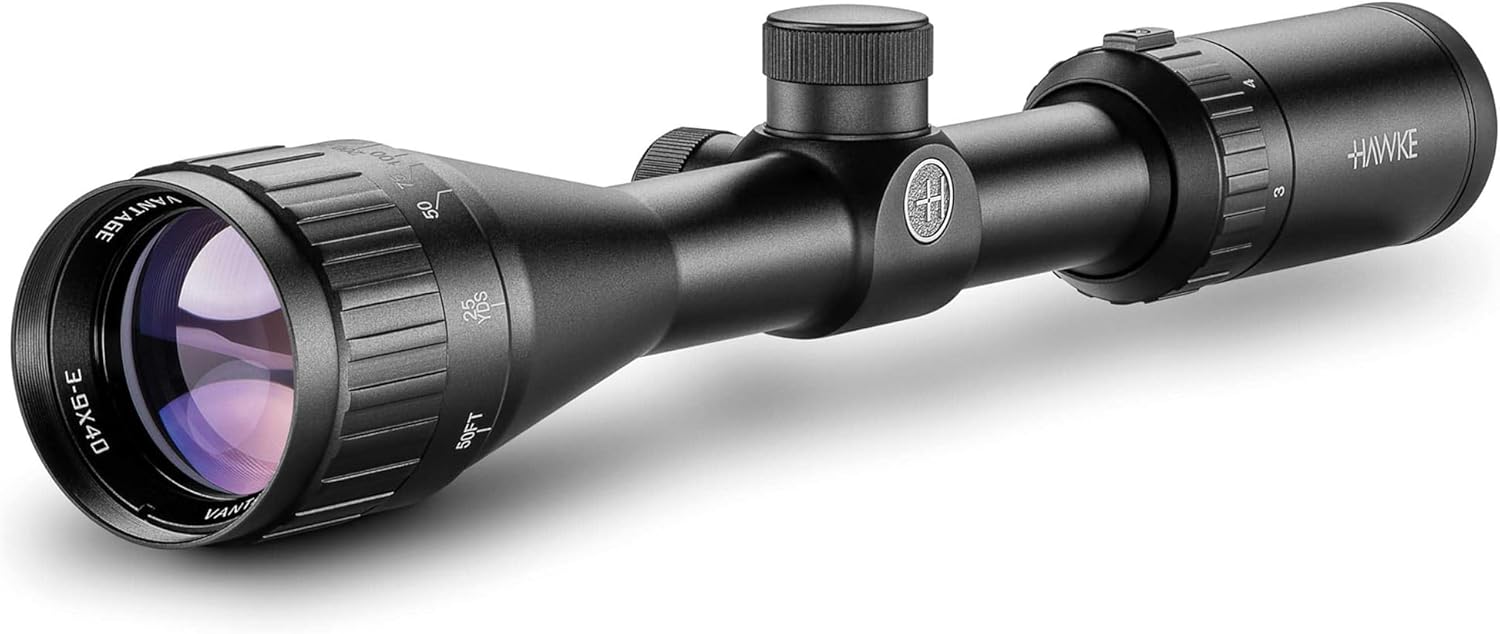
The Hawke Vantage 3-9×40 is a conventional hunting scope with a practical magnification range and a 1-inch mono-tube format. The supplied listing describes shockproof, waterproof, and fogproof construction, but buyers should still inspect the current manufacturer specifications for the exact variation.
Capped, low-profile turrets are useful for hunting because they reduce the chance of unintended adjustment during transport. A fast-focus eyepiece can also help establish a comfortable reticle view, but proper eye relief remains essential.
Key Features
- 3-9x magnification.
- 40mm objective.
- 1-inch mono-tube design.
- Capped low-profile turrets described in the listing.
- Fast-focus eyepiece described in the listing.
Pros
- Practical magnification for general hunting.
- Capped turrets suit carry-and-hunt use.
- Conventional 1-inch format simplifies ring selection.
Cons
- Less specialized than scopes with dedicated ballistic or illuminated reticles.
- Exact reticle variation requires confirmation.
- 40mm objective may require medium-height rings depending on the rifle.
Who It’s Best For
This scope is a good match for hunters wanting a straightforward optic for woods and mixed-terrain hunting without excessive controls.
Keep the protective caps installed during transport and inspect the turrets after hard knocks or rough travel.
6. Athlon Optics Neos Second Focal Plane Riflescopes

The Athlon Neos is an entry-level second focal plane scope family intended for hunters and recreational shooters. Its exact magnification and objective should be matched to the selected variation rather than assumed from the family name.
Second focal plane scopes work well for conventional hunting because the reticle remains visually consistent. However, any ballistic references should be tested with the chosen rifle and ammunition instead of treated as universal.
Key Features
- Second focal plane design.
- Multiple variation choices may be available.
- Entry-level hunting-scope format.
- Suitable for rifle and range applications.
Pros
- Accessible design for new scope buyers.
- Second focal plane reticle is easy to understand.
- Available in configurations for different hunting needs.
Cons
- Exact specifications vary by selected model.
- May lack specialized features found on more expensive optics.
- Requires careful reticle and tube-size verification.
Who It’s Best For
The Neos is best for beginners and budget-conscious hunters who want a conventional optic without a complicated control layout. It can work well on a general-purpose rifle when the selected variation matches the cartridge and terrain.
Confirm the eye-relief position and zero from a stable bench before carrying it into the field.
7. Vortex Crossfire II Second Focal Plane, 1-inch Tube Riflescopes
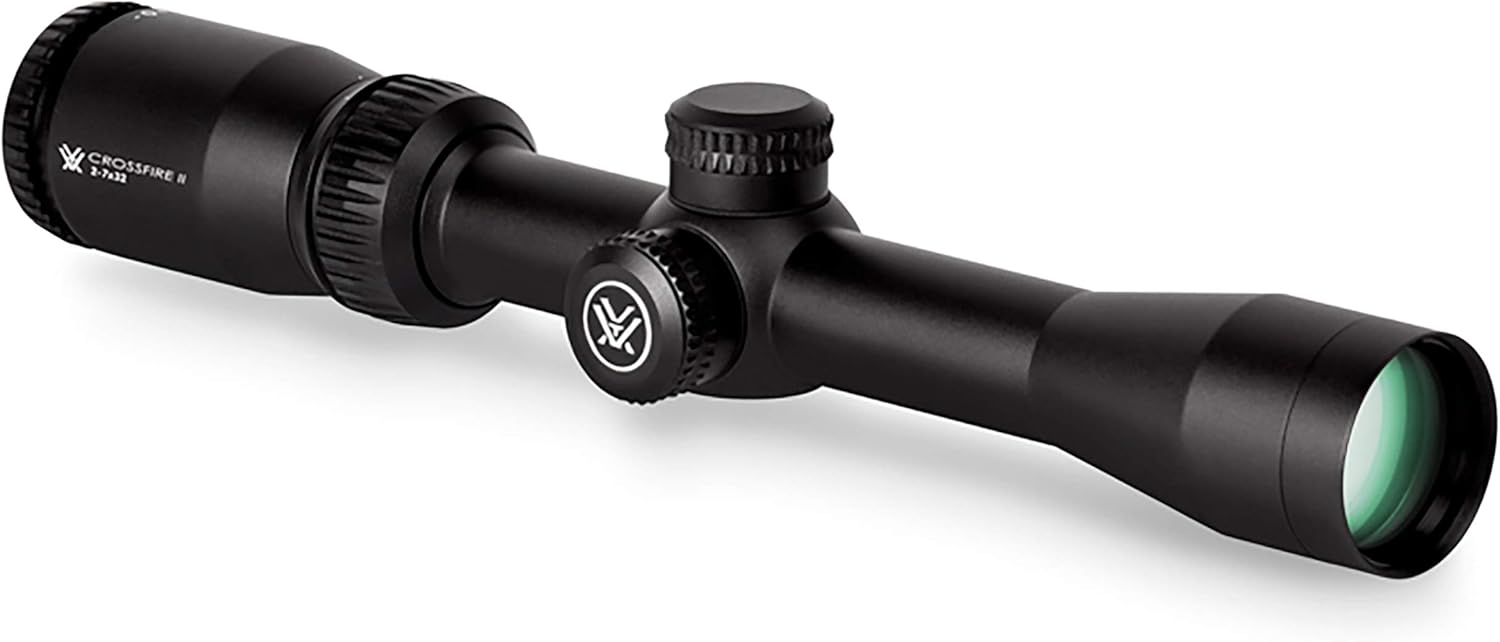
This 1-inch Crossfire II variation is a practical alternative to the 30mm model. The key difference is mounting compatibility, not simply a claim that one tube size is better than the other.
The second focal plane design is well suited to traditional hunting reticles and ordinary field distances. Verify the exact magnification, objective, reticle, and included accessories because the Crossfire II family contains several configurations.
Key Features
- 1-inch tube.
- Second focal plane design.
- Multiple magnification and reticle variations.
- Conventional rifle-scope application.
Pros
- Compatible with widely available 1-inch rings.
- Familiar reticle behavior for hunting.
- Useful platform for a budget rifle upgrade.
Cons
- Exact model details must be confirmed.
- May not provide specialized holdover references.
- Higher magnification variations can be less convenient in thick timber.
Who It’s Best For
This is a sensible choice for a hunter who wants a conventional 1-inch scope and already owns compatible rings. It suits general deer hunting, range practice, and mixed terrain when the selected variation is appropriate.
Use a proper torque sequence during installation and confirm the rifle’s zero after transport.
8. Burris Fullfield II Hunting Scope, Ballistic Plex Reticle
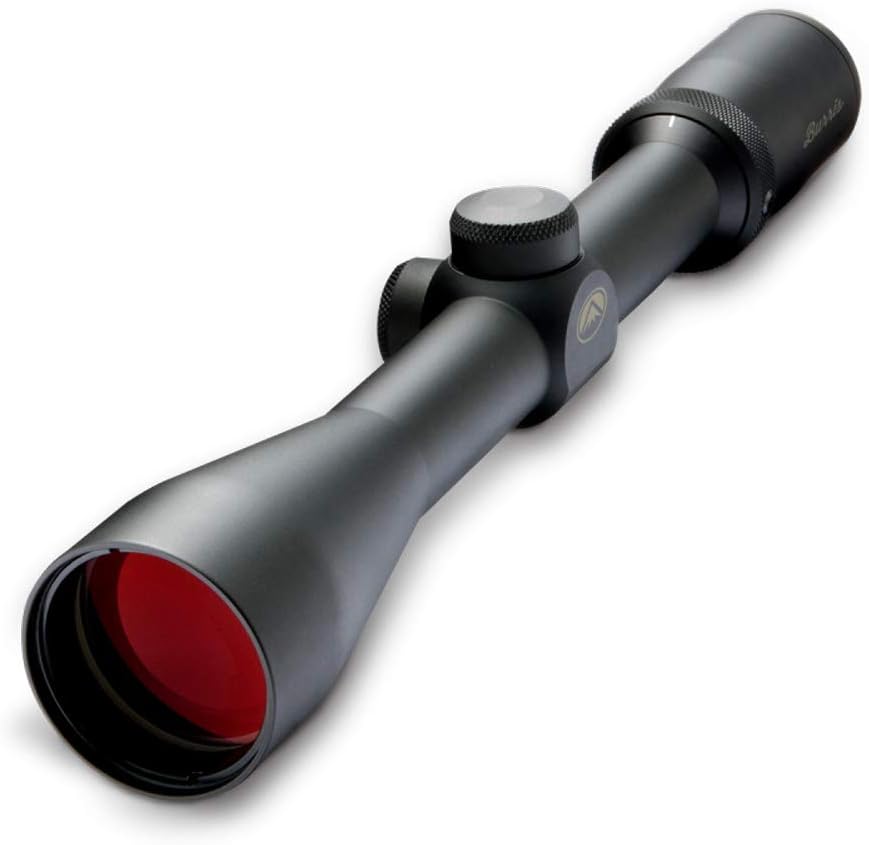
The Burris Fullfield II stands out because the supplied product name specifically identifies a Ballistic Plex reticle. That can give hunters a structured way to study holdover references, but the marks must be verified with the actual rifle, ammunition, and sight-in distance.
This type of reticle is most useful for someone willing to practice rather than assume that every reference corresponds perfectly to a particular cartridge. The exact magnification and objective variation should still be confirmed.
Key Features
- Ballistic Plex reticle.
- Hunting-scope configuration.
- Multiple variation details may apply.
- Designed for practical rifle use.
Pros
- Ballistic references can support disciplined range practice.
- Purpose-built hunting reticle reduces reliance on plain duplex holds.
- Useful for hunters who want a reticle with additional aiming references.
Cons
- Reticle references require cartridge-specific confirmation.
- Exact optical configuration should be checked before purchase.
- Additional marks may distract beginners unfamiliar with ballistic reticles.
Who It’s Best For
This scope suits a hunter who will verify the reticle at the range and wants more reference points than a basic crosshair. It is less suitable for someone who wants a completely uncluttered sight picture.
Use only verified, lawful shooting distances and never treat ballistic marks as a substitute for identifying a safe target and background.
9. Monstrum Guardian 3-9×40 AO Rifle Scope with Parallax Adjustment

The Monstrum Guardian provides a 3-9×40 format with adjustable objective, according to the supplied product name. That combination may appeal to hunters who also spend time practicing at different distances and want a way to manage parallax adjustment.
The extra control adds setup responsibility. A hunter should learn how the adjustment works before the season and avoid making unfamiliar changes while trying to follow game.
Key Features
- 3-9x magnification.
- 40mm objective.
- Adjustable-objective design.
- Parallax adjustment indicated in the product name.
Pros
- Practical magnification range for general hunting.
- Adjustable objective supports more deliberate range setup.
- 40mm objective fits a familiar hunting format.
Cons
- Adjustment markings must be learned and verified.
- More controls can slow a beginner’s setup.
- Ring height and exact tube specifications require confirmation.
Who It’s Best For
This scope is best for a hunter who wants a versatile 3-9x optic and is comfortable practicing with parallax adjustment. It can also serve a range-oriented rifle setup.
Set the optic at the range, then avoid changing adjustments in the field unless the procedure is familiar and appropriate.
10. Hawke Vantage IR 3-9×40 Riflescope

The Hawke Vantage IR adds an illuminated reticle to a familiar 3-9×40 hunting format. The supplied listing describes a waterproof 1-inch tube, capped low-profile turrets, and multi-coated lenses, but current specifications should be verified for the exact model.
Illumination can help a reticle remain visible against a dark or cluttered background, but it does not create light or make an unsafe shot acceptable. Battery condition and brightness control should be checked before every hunt.
Key Features
- 3-9x magnification.
- 40mm objective.
- Illuminated reticle.
- 1-inch tube described in the listing.
- Capped low-profile turrets.
Pros
- Illumination offers additional reticle visibility options.
- 3-9x range suits common hunting distances.
- Capped turrets reduce accidental adjustment risk.
Cons
- Requires battery and brightness management.
- Illumination cannot replace positive target identification.
- Exact reticle and illumination color should be confirmed.
Who It’s Best For
This is a useful choice for hunters who frequently encounter changing light and prefer an illuminated aiming reference. It is especially appropriate for someone willing to maintain spare batteries and practice brightness settings.
Turn illumination off when not needed and follow local hunting regulations governing legal shooting hours and equipment.
11. Best for Straight-Wall Cartridges: Neos 3-9×40 Straight-Wall BDC300 riflescope

The Neos Straight-Wall BDC300 is the most specialized product in this group. Its name identifies a BDC300 reticle intended for straight-wall hunting applications, making it more targeted than a general duplex-style scope.
Ballistic references still depend on the exact cartridge, bullet, velocity, sight height, and zero distance. Treat the BDC as a starting reference and confirm it at a safe, lawful range with the actual rifle and ammunition.
Key Features
- 3-9x magnification.
- 40mm objective.
- Straight-wall BDC300 reticle.
- Second focal plane hunting-scope design.
Pros
- Purpose-specific reticle for straight-wall hunting setups.
- 3-9x range remains practical for woods and field use.
- 40mm objective follows a familiar hunting format.
Cons
- BDC references must be verified with the actual cartridge.
- Less broadly useful if the rifle is not chambered for a straight-wall cartridge.
- Reticle may be unnecessarily specialized for simple short-range hunting.
Who It’s Best For
This scope is best for hunters using a straight-wall rifle and willing to confirm the BDC references at the range. It is not the best general-purpose choice for a rifle that uses a different ballistic profile.
Keep a written record of the confirmed zero and conditions, and follow all local regulations for straight-wall rifle hunting.
Buying Guidance for a Budget Hunting Scope
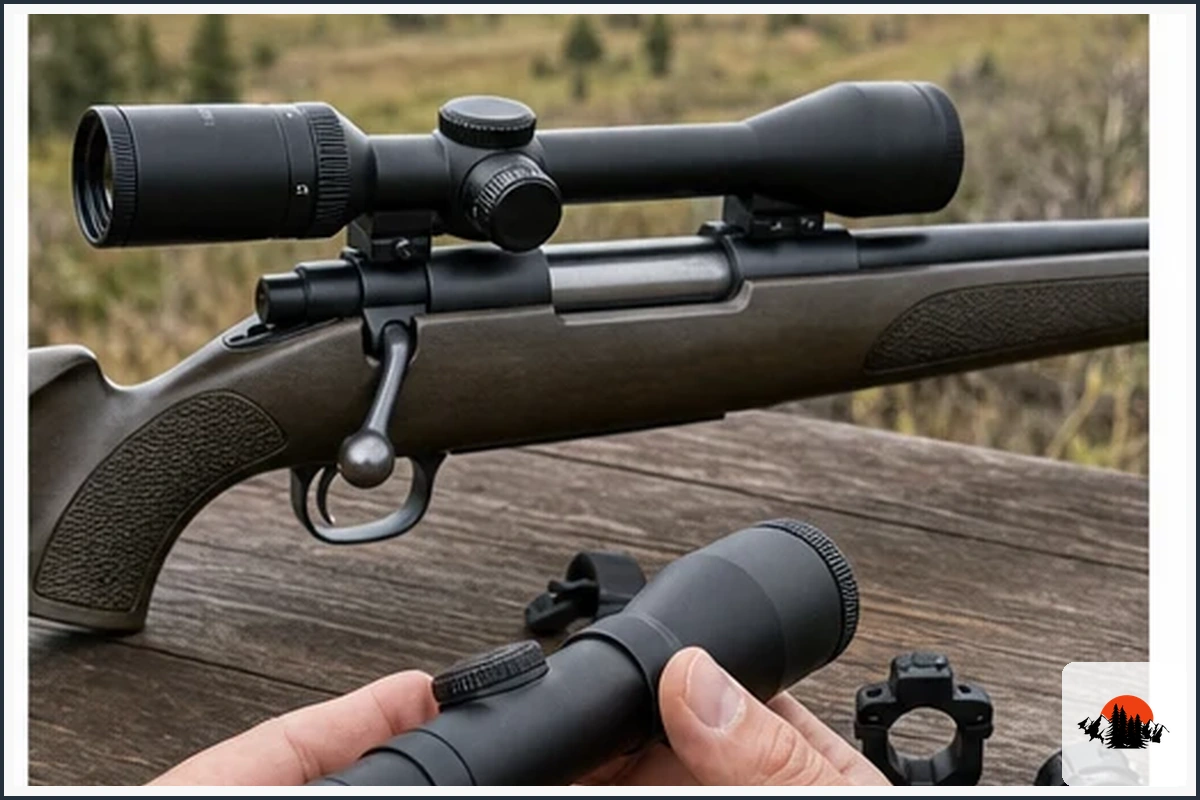
- Match magnification to terrain. Choose a lower starting power for dense timber and a broader range when hunting open country.
- Confirm tube diameter. A 1-inch scope needs compatible 1-inch rings; a 30mm scope needs 30mm rings.
- Check objective clearance. Confirm that the objective bell clears the barrel and that the bolt handle can operate normally.
- Choose the reticle deliberately. A simple reticle is often easiest for beginners, while ballistic references require range verification.
- Consider mounting height. Keep the scope low enough for a comfortable cheek weld without creating clearance problems.
- Verify eye relief. Set the scope for a full sight picture from the rifle’s normal shooting position.
- Inspect the exact variation. Product families can include different reticles, objectives, tube sizes, and included accessories.
- Zero with the hunting ammunition. Do not assume that a reticle or ballistic reference matches every load.
Safety and Compatibility Checks
Use qualified instruction and follow the four basic firearm-safety rules. Keep the muzzle pointed in a safe direction, treat every firearm as loaded, keep your finger outside the trigger guard until ready to fire, and positively identify the target and what lies beyond it.
Confirm hunting seasons, licenses, permits, legal equipment, shooting hours, land access, and cartridge restrictions with the appropriate wildlife agency. A scope does not make a shot safe or lawful.
Install rings and bases according to their manufacturer instructions. Check screw torque with the appropriate tool, inspect for movement after initial range use, and confirm zero whenever the rifle receives a hard impact or significant transport.
Maintenance and Troubleshooting
- Use a blower and lens-safe cloth for dust; avoid wiping grit across glass.
- Keep lens caps on during transport and storage.
- Inspect ring screws, bases, turret caps, and adjustment covers before a hunt.
- Replace or carry a spare battery for illuminated models.
- If the image is blurry, check eye position, focus, parallax setting, and lens cleanliness.
- If the rifle will not hold zero, stop using it until mounts, bases, ammunition, and the optic are checked.
- If the scope sits too high, reassess ring height and cheek weld rather than forcing an unstable position.
Common Mistakes
- Buying a 30mm scope when the existing rings are 1 inch.
- Choosing excessive magnification for thick timber.
- Assuming a BDC reticle matches every cartridge.
- Skipping eye-relief checks before tightening the rings.
- Failing to confirm objective clearance.
- Zeroing with one ammunition load and hunting with another without verification.
- Leaving illuminated reticles powered on during storage.
- Using a scope as a substitute for safe target identification.
Frequently Asked Questions
1. What is the best hunting scope under $500?
The Leupold VX-Freedom 3-9x40mm Riflescope is the strongest overall match here for general hunting because its 3-9x range suits many woods and mixed-terrain situations.
2. Is 3-9x enough magnification for deer hunting?
For many woods and mixed-terrain hunts, 3-9x is a practical range. The ideal setting depends on terrain, distance, visibility, and the hunter’s ability to identify the target safely.
3. Is 4-12x better than 3-9x for hunting?
Not automatically. A 4-12x scope may help in open country, while 3-9x can be easier to use in thick cover because of its lower starting power and broader field of view.
4. What does second focal plane mean?
A second focal plane reticle generally appears the same visual size as magnification changes. Any ballistic references must be confirmed at the magnification and ammunition used.
5. What is a 1-inch scope tube?
It describes the main tube diameter. The scope requires rings designed for a 1-inch tube.
6. What is a 30mm scope tube?
A 30mm tube is wider than a 1-inch tube and requires matching 30mm rings. It should not be mounted with 1-inch rings.
7. Does a larger tube guarantee a clearer image?
No. Optical quality depends on the complete design, glass, coatings, construction, and configuration. Tube diameter alone does not guarantee better performance.
8. Is a 40mm objective good for hunting?
A 40mm objective is a common compromise between light-gathering potential, size, weight, and mounting clearance. It still requires suitable ring height.
9. Do I need an illuminated reticle?
Not necessarily. Illumination can help reticle visibility in some backgrounds, but it adds battery maintenance and does not replace safe target identification.
10. Are illuminated scopes legal for hunting?
Rules vary by location and species. Check current regulations with the relevant wildlife agency before hunting.
11. What is a BDC reticle?
A bullet-drop-compensating reticle includes reference marks intended to correspond to different holds. Actual results depend on ammunition, velocity, sight height, zero, and conditions.
12. Can a BDC reticle be used with any rifle?
It can be used as a reference, but its marks are not universal. Confirm the references with the exact rifle and load at the range.
13. Is the Neos Straight-Wall BDC300 only for straight-wall rifles?
It is designed around straight-wall applications. Its specialized references may be less useful on cartridges with a different ballistic profile.
14. Is adjustable parallax important for deer hunting?
It can help with deliberate range setup, but many hunters prefer a simpler optic for ordinary field distances. The value depends on distance and the hunter’s willingness to practice.
15. What is parallax?
Parallax is an apparent reticle-to-target shift caused by eye position when the optic is not properly set for the viewing distance. Proper cheek position and adjustment help reduce the issue.
16. Should beginners choose a simple reticle?
Usually, yes. A simple reticle can reduce confusion, while ballistic or illuminated designs require additional learning and maintenance.
17. How high should a hunting scope be mounted?
Use the lowest height that clears the barrel, bolt, and objective while providing comfortable eye relief and a consistent cheek weld.
18. Do scopes include rings?
Do not assume so. Verify the current listing and plan for rings that match the tube diameter and rifle base.
19. How do I know which rings fit?
Match the ring diameter to the scope tube and the base system to the rifle. Confirm objective clearance and ring height before ordering.
20. What is eye relief?
Eye relief is the distance between your eye and the ocular lens while receiving a full sight picture. Set it from a normal, safe shooting position.
21. How should I zero a hunting scope?
Follow safe range procedures, use the intended ammunition, shoot from a stable position, and confirm the final zero before hunting.
22. How often should I check zero?
Check zero after mounting, transport, hard impacts, major weather changes when relevant, or any unexplained shift in point of impact.
23. Can I use a rimfire scope on a centerfire rifle?
Only if the manufacturer supports the rifle’s recoil and intended use. Verify the scope’s specifications before pairing it with a different cartridge.
24. Can I use a hunting scope on a rimfire rifle?
Often, but magnification, parallax, mounting height, and reticle suitability still matter. Confirm the selected scope’s intended range and compatibility.
25. Is more magnification better for elk hunting?
Not necessarily. Terrain, field of view, light, rifle stability, and safe target identification matter more than maximum magnification alone.
26. What scope works best in thick woods?
A scope with a useful low-power setting, manageable size, and a reticle visible against dark backgrounds is generally practical. The Hawke Vantage IR may suit hunters who specifically want illumination.
27. What scope works best in open country?
A model with additional magnification may be useful, provided the rifle and shooter can support the intended distance and the exact reticle is understood.
28. Are capped turrets useful for hunting?
They can help protect adjustments from accidental movement during transport and field carry. They may be less convenient for frequent target-style adjustments.
29. Should I use scope covers?
Yes. Covers help protect lenses from dust, rain, brush, and accidental contact during transport.
30. How should I clean scope lenses?
Remove loose grit with air first, then use a clean lens-safe cloth or manufacturer-approved method. Avoid household cleaners unless the manufacturer specifically permits them.
31. Why is my scope blurry?
Check the eyepiece focus, eye position, lens condition, parallax setting if present, and whether the selected magnification is appropriate for the distance.
32. Why will my scope not hold zero?
Inspect rings, bases, screw torque, ammunition consistency, rifle condition, and possible optic damage. Stop relying on the setup until the cause is found.
33. Can weather affect a scope?
Rain, fog, condensation, dust, and temperature changes can affect visibility and handling. Keep lenses protected and follow the manufacturer’s care guidance.
34. Do waterproof claims mean I can submerge a scope?
No. Follow the manufacturer’s limits. A general weather-resistance claim should not be interpreted as permission for intentional submersion.
35. How should I store a hunting scope?
Store it clean, dry, protected from impacts, and with lens covers installed. Remove batteries from illuminated models if recommended for long-term storage.
36. Is the Vortex Diamondback suitable for open terrain?
Its available variations may suit open terrain when additional magnification is useful, but confirm the exact model and ensure the rifle and shooter are appropriate for the intended distance.
37. Is the Leupold VX-Freedom good for beginners?
Its conventional 3-9×40 format is approachable for beginners who want a general-purpose hunting scope without excessive controls.
38. Is the Hawke Vantage 3-9×40 good for deer hunting?
Its conventional magnification and 40mm objective make it a reasonable general deer-hunting candidate, subject to verifying the exact reticle and specifications.
39. What makes the Burris Fullfield II different?
The supplied product name identifies a Ballistic Plex reticle, giving it more holdover references than a basic reticle. Those references require cartridge-specific confirmation.
40. Does adjustable objective improve accuracy?
It can help reduce parallax error when correctly set, but it cannot compensate for poor mounting, inconsistent shooting position, or inadequate practice.
41. Are budget scopes durable enough for hunting?
Some may be suitable, but durability depends on the exact design, rifle recoil, handling, weather, mounting, and care. Inspect the optic and confirm zero before relying on it.
42. Should I buy a scope with the highest magnification available?
No. Excessive magnification can narrow the field of view and make target acquisition slower. Match the range to the terrain and hunting style.
43. Can I hunt immediately after mounting a scope?
No. Mount it correctly, confirm eye relief and clearance, zero it with the intended ammunition, and verify the setup before hunting.
44. What should I carry with a scoped rifle?
Carry appropriate eye and ear protection for range work, lens protection, a safe transport case, navigation and communication equipment, water, first aid, and legally required hunting documentation.
45. Does a scope replace binoculars?
No. Binoculars are generally better for scanning and identifying game before handling or aiming a rifle.
46. When should I ask for professional help?
Ask a qualified gunsmith, range instructor, optics professional, or manufacturer support team when mounting, compatibility, damage, or zeroing problems cannot be safely resolved.
Conclusion
For most hunters comparing the best hunting scope under $500, the Leupold VX-Freedom 3-9x40mm Riflescope is the strongest overall choice. Its practical magnification range and familiar hunting format suit a broad range of deer and mixed-terrain applications.
Hunters needing a specialized setup should consider the Neos 3-9×40 Straight-Wall BDC300 riflescope for compatible straight-wall rifles, or the Hawke Vantage IR 3-9×40 Riflescope when illuminated reticle visibility is a priority. Always verify the exact variation, mounting compatibility, current availability, and specifications before ordering.