

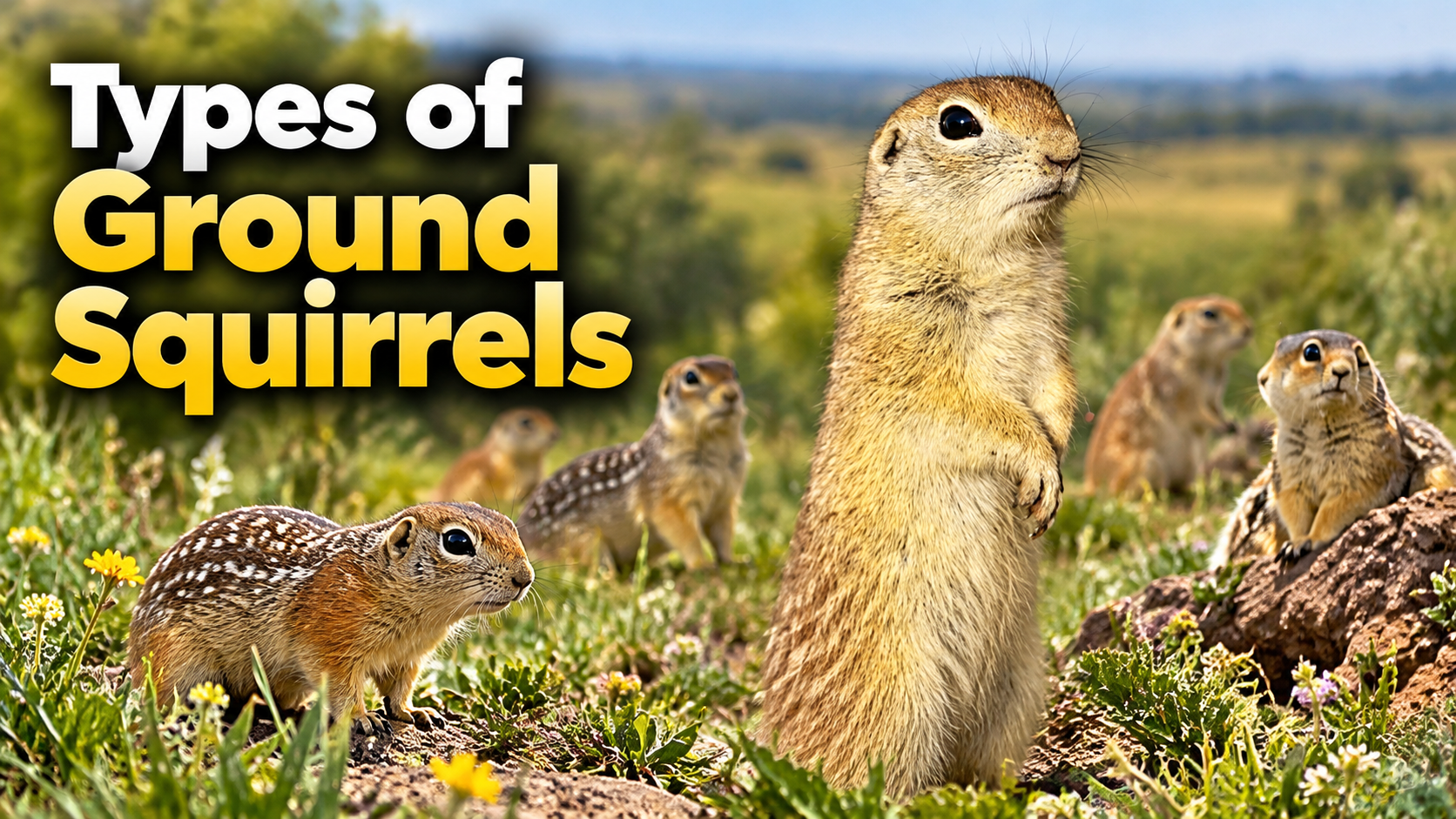
Ground squirrels are burrowing members of the squirrel family that spend much of their lives on or below the ground. The many types of ground squirrels vary dramatically in color, body size, habitat, social behavior, hibernation strategy, and geographic range
This guide covers 47 living ground squirrel species in eight closely related genera historically associated with the broad Spermophilus group. Modern mammal taxonomy has divided these animals among genera such as Urocitellus, Ictidomys, Otospermophilus, and Xerospermophilus, while Spermophilus is now primarily Eurasian. The broader ground-squirrel branch of the squirrel family also contains prairie dogs, marmots, chipmunks, and antelope squirrels, but those groups are not counted as separate entries here.
Whether you are watching wildlife in a western desert, exploring an alpine meadow, crossing a North American prairie, or learning about the steppes of Eurasia, identification becomes easier when you compare coat patterns, tail length, habitat, posture, and geographic location.
What Are the Main Types of Ground Squirrels?
The main types of ground squirrels covered here belong to Notocitellus, Otospermophilus, Callospermophilus, Ictidomys, Poliocitellus, Xerospermophilus, Urocitellus, and Spermophilus. Some are striped prairie animals, others are spotted desert specialists, and several live in cold mountain or Arctic environments. Most dig burrows and forage during daylight, but their diets, social systems, and seasonal activity differ considerably.
Quick Guide to 47 Types of Ground Squirrels
| Number | Ground Squirrel | Scientific Name | General Range |
|---|---|---|---|
| 1 | Tropical Ground Squirrel | Notocitellus adocetus | Western Mexico |
| 2 | Ring-tailed Ground Squirrel | Notocitellus annulatus | Western Mexico |
| 3 | California Ground Squirrel | Otospermophilus beecheyi | California and nearby areas |
| 4 | Douglas’s Ground Squirrel | Otospermophilus douglasii | Pacific Coast of the United States |
| 5 | Rock Squirrel | Otospermophilus variegatus | Southwestern United States and Mexico |
| 6 | Golden-mantled Ground Squirrel | Callospermophilus lateralis | Western North America |
| 7 | Sierra Madre Ground Squirrel | Callospermophilus madrensis | Northern Mexico |
| 8 | Cascade Golden-mantled Ground Squirrel | Callospermophilus saturatus | Pacific Northwest |
| 9 | Mexican Ground Squirrel | Ictidomys mexicanus | Mexico |
| 10 | Rio Grande Ground Squirrel | Ictidomys parvidens | Texas and northeastern Mexico |
| 11 | Thirteen-lined Ground Squirrel | Ictidomys tridecemlineatus | Central North America |
| 12 | Franklin’s Ground Squirrel | Poliocitellus franklinii | Central North America |
| 13 | Mohave Ground Squirrel | Xerospermophilus mohavensis | Mojave Desert region |
| 14 | Perote Ground Squirrel | Xerospermophilus perotensis | Central-eastern Mexico |
| 15 | Spotted Ground Squirrel | Xerospermophilus spilosoma | Southwestern North America |
| 16 | Round-tailed Ground Squirrel | Xerospermophilus tereticaudus | Southwestern deserts |
| 17 | Uinta Ground Squirrel | Urocitellus armatus | Western United States |
| 18 | Belding’s Ground Squirrel | Urocitellus beldingi | Great Basin and mountain meadows |
| 19 | Idaho Ground Squirrel | Urocitellus brunneus | Idaho |
| 20 | Merriam’s Ground Squirrel | Urocitellus canus | Western United States |
| 21 | Columbian Ground Squirrel | Urocitellus columbianus | Northwestern North America |
| 22 | Wyoming Ground Squirrel | Urocitellus elegans | Interior western United States |
| 23 | Snake River Plains Ground Squirrel | Urocitellus idahoensis | Idaho |
1. Tropical Ground Squirrel
The tropical ground squirrel, Notocitellus adocetus, is unusual because it occurs in warmer parts of western Mexico rather than the cool grasslands and steppes associated with many other ground squirrels. Its coat is generally brownish to gray-brown, helping it blend into dry vegetation and soil.
It uses burrows for shelter, resting, and protection from predators. Open woodland, agricultural edges, scrub, and seasonally dry landscapes can provide suitable habitat. Like many ground squirrels, it feeds heavily on plant material, including seeds and other available vegetation, while opportunistically taking additional foods.
For identification, location is especially useful. A medium-sized ground squirrel in western Mexico with a relatively plain coat and without the dramatic striping of an Ictidomys species may belong to this genus.
2. Ring-tailed Ground Squirrel
Notocitellus annulatus is named for the ringed appearance of its relatively long tail. This feature makes it look somewhat different from the short-tailed ground squirrels of open prairie environments.
The species occurs in western Mexico, where it uses dry forests, brushy habitats, field edges, and other places offering both food and shelter. It is primarily terrestrial but can appear more agile around vegetation than many strictly grassland ground squirrels.
When identifying it, look for the combination of geographic range, a comparatively long tail, and a generally brownish body. The visible tail pattern is one of the most useful field marks.
3. California Ground Squirrel
The California ground squirrel, Otospermophilus beecheyi, is one of the most familiar ground squirrels of western North America. It has a mottled brown-gray coat, a moderately bushy tail, and a body that can appear surprisingly large compared with smaller prairie ground squirrels.
It commonly occupies grasslands, rocky slopes, roadsides, ranches, parks, and other open environments. Colonies may contain many burrow entrances, although social relationships are not identical to those of prairie dogs.
These squirrels eat seeds, grasses, fruits, and other plant foods while also taking insects and other opportunistic foods. Their habit of sitting upright near burrows makes them easy to watch from a respectful distance.
4. Douglas’s Ground Squirrel
Douglas’s ground squirrel, Otospermophilus douglasii, is closely related to the California ground squirrel and was historically treated within the same species complex. Modern mammal taxonomy recognizes it separately, with a distribution along portions of the Pacific Coast.
Its overall appearance is similar to a California ground squirrel: mottled earthy fur, a substantial body, and a tail longer and bushier than that of many Urocitellus species.
Range is therefore one of the most valuable identification clues. Observers should avoid relying on coat color alone, because individual coloration and seasonal pelage can overlap strongly among related ground squirrels.
5. Rock Squirrel
The rock squirrel, Otospermophilus variegatus, is a large, robust ground squirrel strongly associated with rocky landscapes. It occurs across parts of the southwestern United States and Mexico.
Look for it around cliffs, canyon walls, boulder fields, stone structures, desert slopes, and rocky roadsides. Its coat can vary substantially, but the animal generally appears heavier and longer-tailed than the tiny ground squirrels of open desert flats.
Rock squirrels are adaptable omnivorous foragers. Seeds, fruits, plant material, and invertebrates can all become part of their diet. Around heavily visited areas, they may become accustomed to people, but wild animals should not be hand-fed.
6. Golden-mantled Ground Squirrel
The golden-mantled ground squirrel, Callospermophilus lateralis, is often mistaken for a large chipmunk because of the light and dark stripes running along its sides.
The easiest distinction is the head. Chipmunks typically have obvious facial stripes, while a golden-mantled ground squirrel has a comparatively plain face. Its reddish or golden shoulder area also contributes to its distinctive appearance.
This species is common in mountain forests, rocky clearings, campgrounds, and high-elevation environments across western North America. It stores food and spends the inactive season underground in colder portions of its range.
7. Sierra Madre Ground Squirrel
Callospermophilus madrensis, the Sierra Madre ground squirrel, is a mountain species associated with northern Mexico. Its pattern resembles other golden-mantled ground squirrels, with contrasting stripes along the sides of the body.
Forest openings and mountainous habitats help separate it ecologically from desert-adapted species such as the round-tailed or spotted ground squirrel.
Because several striped squirrel species occur in Mexico, identification should combine the animal’s stripe pattern, absence or presence of facial stripes, elevation, vegetation, and precise geographic range rather than relying on a single feature.
8. Cascade Golden-mantled Ground Squirrel
The Cascade golden-mantled ground squirrel, Callospermophilus saturatus, is associated with the Cascade region of the Pacific Northwest.
It resembles the widespread golden-mantled ground squirrel, making geography especially important during identification. Both have attractive side striping and can be encountered around forest openings, mountain meadows, rocky areas, and recreational landscapes.
Like its relatives, it spends considerable time foraging near the ground and uses underground retreats for protection and seasonal dormancy.
9. Mexican Ground Squirrel
The Mexican ground squirrel, Ictidomys mexicanus, is a distinctly patterned grassland squirrel. Longitudinal pale lines and rows of light spots run along its darker back, producing an appearance similar to the thirteen-lined ground squirrel.
It favors relatively open terrain where low vegetation allows animals to scan for predators. Seeds, grasses, plant material, and insects can all contribute to the diet.
Because members of Ictidomys can look similar, geographic location is essential. The arrangement of stripes and spots can help, but range should always be considered alongside coat pattern.
10. Rio Grande Ground Squirrel
Ictidomys parvidens, commonly called the Rio Grande ground squirrel, occurs around the Rio Grande region and adjoining areas of the southern United States and northeastern Mexico.
It belongs to the same lined-ground-squirrel group as the Mexican and thirteen-lined species. Its back displays a combination of lighter longitudinal markings and spots that break up the outline of the animal in grassy surroundings.
The species was historically associated taxonomically with the Mexican ground squirrel, which explains why older field guides may use different names. Modern identification is most reliable when coat pattern is paired with geographic range.
11. Thirteen-lined Ground Squirrel
The thirteen-lined ground squirrel, Ictidomys tridecemlineatus, is among the easiest ground squirrels to recognize. Alternating dark and pale lines, together with rows of pale spots, form a striking pattern along the back.
It thrives in short grass, prairies, lawns, golf-course-like landscapes, roadsides, and other open areas across central North America. The animal often freezes upright to inspect its surroundings before quickly disappearing into a burrow.
Seeds and vegetation are important foods, but insects also contribute to the diet. Seasonal dormancy allows the species to survive long periods when cold weather reduces food availability.
12. Franklin’s Ground Squirrel
Franklin’s ground squirrel, Poliocitellus franklinii, looks less strongly patterned than the thirteen-lined ground squirrel. Its gray-brown body and relatively long, bushy tail can even create a superficial resemblance to a small tree squirrel.
It frequently prefers taller vegetation, grassland edges, and transitions between prairie and woodland. This preference can make it harder to see than species living in short grass.
Franklin’s ground squirrels consume a varied diet of vegetation, seeds, insects, and other available foods. Their combination of a long tail, muted coat, and dense grassy habitat is useful for field identification.
13. Mohave Ground Squirrel
The Mohave ground squirrel, Xerospermophilus mohavensis, is a desert specialist associated with the Mojave region of California.
Its coat is generally sandy or brownish, providing effective camouflage against desert soil. Unlike striped species, it has a relatively plain appearance. Adaptations to seasonal food availability allow it to survive in an environment where productive conditions can be brief.
Its restricted range makes geographic location one of the strongest identification clues. Responsible wildlife observation is especially important with localized desert species because habitat disturbance can have disproportionate effects on small populations.
14. Perote Ground Squirrel
The Perote ground squirrel, Xerospermophilus perotensis, has a limited distribution in parts of Veracruz and Puebla in Mexico.
It is a small ground squirrel of relatively open landscapes, where suitable soil is important for burrow construction. Its coat is subdued and adapted to dry grassland surroundings rather than strongly striped.
The species’ restricted distribution makes habitat knowledge more useful than color alone. For naturalists, confirmed location information is particularly important when identifying small Mexican ground squirrels.
15. Spotted Ground Squirrel
Xerospermophilus spilosoma earns its common name from the numerous pale spots scattered over its back. The spots are generally much more important for identification than any continuous stripe pattern.
This small squirrel occurs across arid grasslands, desert edges, and sandy landscapes of the southwestern United States and Mexico. Its pale coloration helps it disappear quickly against dusty soil.
It feeds on seeds and other plant material while also taking insects when available. Look for its small size, spotted coat, shortish tail, and preference for open dry ground.
16. Round-tailed Ground Squirrel
The round-tailed ground squirrel, Xerospermophilus tereticaudus, is a familiar animal of hot desert environments in the American Southwest and northwestern Mexico.
Its sandy coat, slender body, and relatively long rounded tail distinguish it from many heavier ground squirrels. In intense heat, activity is often concentrated during more favorable parts of the day.
These squirrels are frequently observed standing upright near burrows in open desert flats. Plants, seeds, and other seasonally available foods form much of the diet.
17. Uinta Ground Squirrel
Urocitellus armatus, the Uinta ground squirrel, lives in parts of the interior western United States. It is a compact brownish ground squirrel without the dramatic stripes seen in Ictidomys.
Mountain valleys, meadows, open grasslands, and sagebrush landscapes can provide suitable habitat. The above-ground season may be relatively short, with much of the year spent underground.
For identification, pay attention to location, elevation, habitat, and the relatively uniform mottled coat. Similar Urocitellus species can be very difficult to separate by appearance alone.
18. Belding’s Ground Squirrel
Belding’s ground squirrel, Urocitellus beldingi, is closely associated with mountain meadows and other open habitats of the western United States.
It has a sturdy body, short ears, a relatively short tail, and gray-brown to cinnamon-brown fur. Colonies can contain numerous animals, and individuals use alarm calls when potential predators appear.
Because snowy mountain environments have short growing seasons, Belding’s ground squirrels spend a substantial part of the year below ground and must make efficient use of the warmer months for feeding and reproduction.
19. Idaho Ground Squirrel
The Idaho ground squirrel, Urocitellus brunneus, is a localized species associated with Idaho. It has a modest, gray-brown appearance that can make visual identification difficult without knowing exactly where an observation occurred.
The squirrel uses open grassland, meadow, and shrub-influenced landscapes where soils allow burrowing. Seasonal activity is strongly shaped by local weather and vegetation.
Because its distribution is restricted, avoiding disturbance to burrow colonies and staying on established trails are sensible practices when observing the species.
20. Merriam’s Ground Squirrel
Merriam’s ground squirrel, Urocitellus canus, occupies dry landscapes in parts of the western United States. The coat is generally pale gray-brown, providing camouflage in sagebrush and open semi-arid habitat.
The species was historically confused with or grouped alongside related Great Basin ground squirrels. Range, skull characteristics, genetics, and other evidence have helped mammalogists refine the boundaries between these forms.
For a casual observer, exact geographic location is usually more dependable than subtle differences in coat shade.
21. Columbian Ground Squirrel
The Columbian ground squirrel, Urocitellus columbianus, is a robust species of northwestern North America. It is often encountered in mountain valleys and lush meadows.
Its coat commonly combines gray, brown, and warmer reddish tones, particularly around the face or front of the body. Compared with many dry-country ground squirrels, it can look heavier and more colorful.
Individuals graze on green vegetation and forage near their burrows during the relatively short active season. They are particularly conspicuous when sitting upright above meadow vegetation.
22. Wyoming Ground Squirrel
Urocitellus elegans, the Wyoming ground squirrel, occupies grasslands, mountain valleys, sagebrush country, and related open habitats in the western United States.
The coat is generally mottled brown or gray-brown, making location and habitat valuable identification tools. Burrows provide protection from predators and temperature extremes.
Like several relatives, it can spend much of the year underground. During the active season it concentrates on feeding, breeding, and accumulating the energy reserves required for dormancy.
23. Snake River Plains Ground Squirrel
The Snake River Plains ground squirrel, Urocitellus idahoensis, represents an important recent taxonomic update. Populations previously associated with the Piute ground squirrel were supported as a distinct Idaho-endemic lineage and are recognized as a species by the Mammal Diversity Database.
The species inhabits cold-desert and open landscapes connected with the Snake River Plain. It resembles other small Urocitellus, so reliable identification is strongly tied to geographic distribution.
This species is also a good example of why wildlife lists can change as genetic, morphological, and geographic evidence improves.
How Are These Ground Squirrels Classified?
All 47 species in this guide belong to the squirrel family Sciuridae, subfamily Xerinae, and tribe Marmotini. Their classification has changed significantly as molecular studies have revealed evolutionary relationships that were not obvious from appearance alone.
Many North American species were once placed together with Eurasian species in a huge genus called Spermophilus. Modern classification divides those former members among several genera.
- Notocitellus: Mexican ground squirrels with relatively distinctive tails and tropical or subtropical distributions.
- Otospermophilus: large western ground squirrels including the California and rock squirrels.
- Callospermophilus: golden-mantled ground squirrels with bold side stripes.
- Ictidomys: lined and spotted grassland squirrels.
- Poliocitellus: represented by Franklin’s ground squirrel.
- Xerospermophilus: small ground squirrels adapted largely to dry environments.
- Urocitellus: North American and northern Asian ground squirrels occupying grassland, sagebrush, alpine, and Arctic habitats.
- Spermophilus: Eurasian ground squirrels associated mainly with steppe, grassland, semi-desert, and mountain environments.
Where Do Ground Squirrels Live?
Ground squirrels occupy an impressive variety of open habitats across North America, Europe, and Asia. Their dependence on underground burrows means that soil characteristics can be almost as important as vegetation.
- Prairies and grasslands: Thirteen-lined, Richardson’s, European, and speckled ground squirrels.
- Deserts: Mohave, round-tailed, spotted, and several Central Asian species.
- Mountain meadows: Belding’s, Columbian, golden-mantled, and Caucasian mountain ground squirrels.
- Sagebrush and shrub-steppe: Piute, Washington, Townsend’s, and Merriam’s ground squirrels.
- Arctic tundra: Arctic ground squirrel.
- Rocky landscapes: Rock squirrel.
- Dry Mexican forests and scrub: Tropical and ring-tailed ground squirrels.
- Eurasian steppe: Numerous species of Spermophilus.
How to Identify Different Types of Ground Squirrels
Ground squirrel identification is easiest when several characteristics are considered together rather than relying on color alone.
- Stripes: Thirteen-lined and Mexican ground squirrels have distinctive longitudinal patterns.
- Side bands: Golden-mantled species show bold lateral stripes but lack the facial stripes typical of chipmunks.
- Spots: Spotted and speckled ground squirrels have conspicuous pale spotting.
- Tail: Rock and ring-tailed ground squirrels have more noticeable tails than many short-tailed species.
- Body size: Yellow and rock squirrels are much more robust than tiny desert species.
- Coat color: Desert species frequently have sandy or pale gray coloration.
- Habitat: Tundra, prairie, alpine meadow, rocky canyon, and desert habitat can quickly narrow the possibilities.
- Range: Geographic location is often the most important clue when distinguishing closely related species.
- Behavior: Upright vigilance, alarm calling, colony size, and seasonal activity can provide additional clues.
Ground Squirrel vs. Chipmunk
Chipmunks are close relatives of ground squirrels, and both belong to the Marmotini branch of the squirrel family. However, the animals most commonly called ground squirrels usually have stockier bodies and less obvious facial striping.
A useful example is the golden-mantled ground squirrel. It has strong stripes along its sides and is regularly mistaken for a chipmunk, but its face lacks the bold dark-and-light stripes normally seen on chipmunks.
Ground Squirrel vs. Prairie Dog
Prairie dogs are also close ground-squirrel relatives, but they belong to the genus Cynomys. They tend to be highly social animals that create conspicuous colonies often called towns.
Many smaller ground squirrels are less strongly colonial, although several species still live near one another and use alarm calls to communicate danger.
Ground Squirrel vs. Tree Squirrel
Tree squirrels are adapted primarily for climbing and usually have long, bushy tails. Ground squirrels spend substantially more time on the ground and normally depend on underground burrows for shelter.
There are exceptions to any simple visual rule. Rock squirrels and Franklin’s ground squirrels, for example, can have relatively substantial tails. Behavior and habitat are therefore more dependable than tail shape alone.
What Do Ground Squirrels Eat?
Most ground squirrels are flexible herbivores or omnivores. Diet changes with species, habitat, and season.
- Grass and fresh shoots
- Leaves
- Seeds
- Flowers
- Roots and bulbs
- Fruits and berries
- Grains
- Insects and other invertebrates
- Occasional animal material in some species
Animals preparing for seasonal dormancy may spend much of their active period feeding intensively or storing food, depending on the species.
Why Do Ground Squirrels Live in Burrows?
Burrows are central to ground squirrel survival. Underground tunnels provide shelter from predators, storms, cold temperatures, and extreme daytime heat.
Burrow systems may include nesting areas, sleeping chambers, escape routes, and separate entrances. Complexity varies widely among species and local soil conditions.
For hibernating species, the burrow also provides a comparatively stable environment during months when surface temperatures become unsuitable.
Do Ground Squirrels Hibernate?
Many ground squirrels undergo prolonged seasonal dormancy, particularly species living in cold or strongly seasonal environments. Arctic, Belding’s, Richardson’s, and many Eurasian ground squirrels are well known for spending long periods underground.
Not every species follows exactly the same schedule. Desert squirrels may also reduce above-ground activity during extremely hot or dry periods. The timing varies according to climate, sex, age, elevation, and food availability.
Outdoor Tips for Finding and Observing Ground Squirrels
- Search open habitat during daylight hours.
- Look for burrow openings before trying to find the animals themselves.
- Scan rocks, fence posts, mounds, and other elevated lookout points.
- Use binoculars instead of approaching a colony closely.
- Listen for whistles, chirps, or other alarm calls.
- Watch during cooler morning periods in hot desert environments.
- Check regional range maps when similar species occur nearby.
- Photograph the sides, face, back, and tail when attempting identification.
- Do not block, dig into, or alter active burrows.
- Avoid feeding wild ground squirrels.
Safety, Sustainability, and Conservation Notes
Ground squirrels are important components of grassland, desert, tundra, and mountain ecosystems. Their digging can move soil, alter vegetation, create underground habitat, and influence the distribution of nutrients.
They also form part of the food web for many predators. Because of this ecological role, wildlife management should be based on local conditions rather than assuming every ground squirrel colony is simply a pest problem.
Some species have highly restricted ranges and can be vulnerable to habitat loss, fragmentation, development, agricultural change, or other disturbances. Never capture, move, poison, or intentionally kill wildlife without understanding applicable local laws and ecological consequences.
For personal safety, avoid touching wild squirrels or entering close contact with sick or dead animals. Observe wildlife from a respectful distance and keep pets away from active colonies.
Fun Facts About Ground Squirrels
- Ground squirrels belong to the same family as tree squirrels and flying squirrels.
- Prairie dogs, marmots, and chipmunks are close relatives within the broader ground-squirrel lineage.
- Many species stand upright to watch for predators.
- Alarm calls can warn nearby squirrels of danger.
- Some ground squirrels spend more of the year underground than above ground.
- The Arctic ground squirrel survives one of the harshest climates occupied by any squirrel.
- Golden-mantled ground squirrels are commonly mistaken for chipmunks.
- Desert species often have pale coats that match sandy soil.
- Taxonomic research has divided the old broad genus Spermophilus into several distinct genera.
- New species continue to be recognized as scientists combine genetic, geographic, and morphological evidence.
Final Thoughts on Types of Ground Squirrels
The 47 types of ground squirrels in this guide demonstrate how diverse these burrowing rodents really are. They range from tiny desert specialists and striped prairie squirrels to robust mountain species and Arctic animals capable of surviving months of extreme cold.
The best way to identify a ground squirrel is to combine geographic range with coat pattern, body shape, tail length, habitat, and behavior. Learning these distinctions makes wildlife watching more rewarding and also reveals how strongly each species is connected to its local ecosystem.
When exploring areas with ground squirrels, observe them quietly, protect their burrows, and leave natural colonies undisturbed so future visitors can enjoy these remarkable animals as well.
Frequently Asked Questions
1. What is a ground squirrel?
A ground squirrel is a terrestrial member of the squirrel family that spends much of its time on the ground and typically uses underground burrows for shelter.
2. How many types of ground squirrels are there?
This guide recognizes 47 living species within eight closely related genera historically associated with the broad Spermophilus ground-squirrel group. A broader taxonomic definition can produce a larger number because prairie dogs, marmots, chipmunks, antelope squirrels, and additional relatives may also be described as ground squirrels.
3. Are ground squirrels actually squirrels?
Yes. Ground squirrels belong to the family Sciuridae, the same mammal family that includes tree squirrels, flying squirrels, chipmunks, marmots, and prairie dogs.
4. Are chipmunks ground squirrels?
Chipmunks are close members of the broader ground-squirrel evolutionary branch, but field guides normally treat chipmunks as a recognizable group of their own.
5. Are prairie dogs ground squirrels?
Yes in the broad taxonomic sense. Prairie dogs belong to the genus Cynomys within the ground-squirrel tribe Marmotini, although they are normally discussed separately because of their distinctive ecology and social systems.
6. Are marmots ground squirrels?
Marmots are large members of the same broader ground-squirrel lineage. Their size and distinctive lifestyle are why wildlife guides commonly discuss them as a separate group.
7. What is the easiest ground squirrel to identify?
The thirteen-lined ground squirrel is among the easiest because of its distinctive alternating stripes and rows of pale spots.
8. How can you tell a chipmunk from a golden-mantled ground squirrel?
Look at the face. Chipmunks normally have obvious facial stripes, while golden-mantled ground squirrels have side stripes but a comparatively unstriped face.
9. Where are ground squirrels found?
Ground squirrels occur across North America, Europe, and Asia in grasslands, deserts, steppes, mountain meadows, shrublands, rocky areas, and Arctic tundra.
10. Do ground squirrels live in trees?
Most ground squirrels spend far more time on the ground than tree squirrels. Some can climb, but underground burrows are normally more important than tree nests.
11. Where do ground squirrels sleep?
They generally sleep in underground burrows that provide protection from predators and temperature extremes.
12. What do ground squirrels eat?
Common foods include grasses, seeds, shoots, leaves, flowers, fruits, roots, and insects. Diet varies considerably by species and season.
13. Do ground squirrels eat insects?
Many species do. Although plant foods dominate the diets of numerous ground squirrels, insects and other invertebrates can provide valuable protein.
14. Do ground squirrels hibernate?
Many species undergo prolonged winter dormancy, particularly those living in temperate, alpine, steppe, or Arctic climates. The length and physiology of dormancy vary between species.
15. Do desert ground squirrels hibernate?
Some desert species spend extended periods underground, but their seasonal cycles can be influenced by both winter conditions and extreme summer heat or drought.
16. Why do ground squirrels stand on their hind legs?
Standing upright gives them a better view of their surroundings and helps them detect predators while remaining close to a burrow entrance.
17. Why do ground squirrels whistle?
Many species use alarm calls to communicate potential danger. Calls can differ according to species and circumstances.
18. Do ground squirrels live in colonies?
Some live in conspicuous groups or colonies, while others are more solitary. Even neighboring squirrels may maintain individual burrows or territories.
19. How deep are ground squirrel burrows?
Burrow dimensions vary greatly among species, soil types, climates, and purposes. Some are simple retreats while others contain more complex tunnel and chamber systems.
20. What is an Arctic ground squirrel?
The Arctic ground squirrel, Urocitellus parryii, is a northern species adapted to tundra and other cold environments in Alaska, Canada, and northeastern Asia.
21. What is a California ground squirrel?
Otospermophilus beecheyi is a large mottled ground squirrel widely associated with open habitats in California.
22. What ground squirrel has stripes?
The thirteen-lined, Mexican, Rio Grande, golden-mantled, Sierra Madre, and Cascade golden-mantled ground squirrels all have noticeable linear markings, although their patterns differ.
23. What ground squirrel has spots?
The spotted ground squirrel has prominent pale spots, while the speckled ground squirrel also shows noticeable light markings. The thirteen-lined ground squirrel combines both stripes and spots.
24. Are ground squirrels dangerous?
They normally avoid people rather than attack them. However, wild rodents should never be handled, cornered, or treated as pets.
25. Should you feed ground squirrels?
No. Feeding can encourage unnatural concentrations of wildlife, alter normal behavior, create conflicts with people, and expose animals to unsuitable foods.
26. What should I do if I find a ground squirrel burrow?
Observe it without blocking the entrance or digging into the tunnel. Keeping some distance also increases your chance of seeing the animal behave naturally.
27. How can I photograph ground squirrels?
Use a telephoto lens or zoom from a comfortable distance. Stay still near an established trail or viewing area rather than approaching an active burrow.
28. Why are geographic ranges important for identification?
Many ground squirrels look extremely similar. Knowing the country, state, region, elevation, and habitat can eliminate species that do not occur in the area.
29. Why have ground squirrel scientific names changed?
Genetic and morphological research showed that the old broad classification did not accurately represent evolutionary relationships. Scientists therefore divided many former Spermophilus species among several genera.
30. Can the number of recognized ground squirrel species change?
Yes. Taxonomy changes when stronger genetic, morphological, geographic, or behavioral evidence supports splitting, combining, or reclassifying populations. Recent recognition of species such as the Snake River Plains ground squirrel and Vorontsov’s ground squirrel demonstrates that this process is still active.