
Wisconsin is a state blessed with diverse habitats, from dense northern forests to open farmland and marshlands. This variety provides a haven for a remarkable array of birds of prey, including hawks. Hawks are raptors renowned for their keen eyesight, precise hunting skills, and vital role in maintaining ecological balance. In this guide, we will explore 11 types of hawks in Wisconsin, highlighting their physical characteristics, behavior, habitat, diet, reproduction, and interesting facts. Whether you are a seasoned birder or a curious wildlife enthusiast, this guide will help you identify and appreciate these majestic raptors soaring across Wisconsin skies.
1. Red-tailed Hawk (Buteo jamaicensis)
Physical Characteristics & Identification Tips
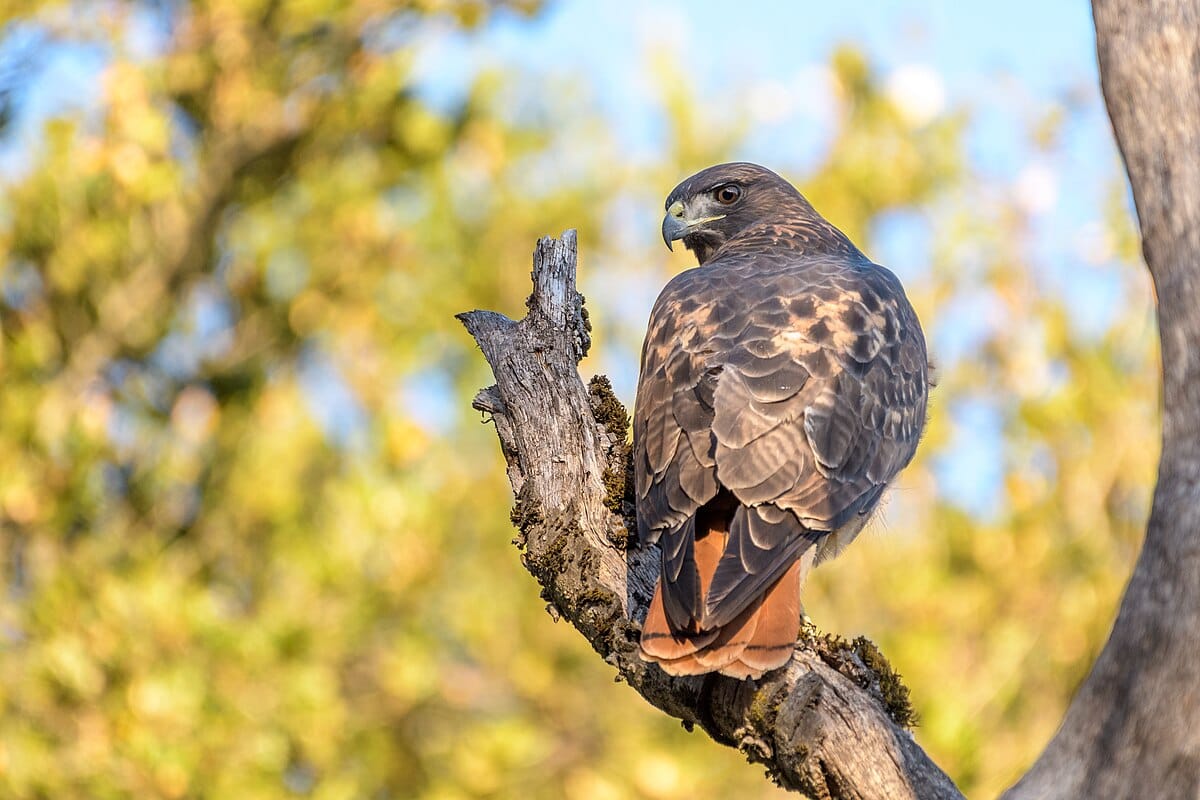
The Red-tailed Hawk is one of the most familiar raptors in Wisconsin. Adults typically have broad, rounded wings and a distinctive reddish-brown tail, which is especially visible in flight. Juveniles display a brown, barred tail and a streaked underbelly. Their size varies from medium to large, with wingspans reaching up to 4 feet. Observers often note the hawk’s robust body and relatively short, broad wings as key identification markers.
Behavior and Nesting Habits
Red-tailed Hawks are versatile hunters, often seen perched on fence posts, tree branches, or soaring above fields. They hunt mainly during daylight, using their keen vision to spot small mammals from above. Nesting occurs primarily in tall trees, though urban areas may host nests on utility poles or building ledges. The species is known for its adaptability, occasionally modifying hunting and nesting behaviors to local conditions.
Habitat and Range
This species inhabits a variety of environments in Wisconsin, including open woodlands, grasslands, and agricultural areas. They are year-round residents in much of the state, although northern populations may migrate south during harsher winters. Their flexibility in habitat preference contributes to their widespread distribution across the region.
Diet
Red-tailed Hawks primarily feed on rodents, rabbits, and other small mammals, but their diet can include birds and reptiles when available. They employ a sit-and-wait hunting technique, scanning the landscape from a high perch before swooping down on unsuspecting prey.
Reproduction and Life Cycle
Mating pairs are monogamous for the season and build large nests lined with sticks and foliage. Females typically lay 2–3 eggs, which are incubated for around a month. Chicks fledge approximately 6 weeks after hatching, gradually learning to hunt under parental supervision.
Fun Facts / Unique Traits
Red-tailed Hawks are famous for their screeching call, often used in films to represent all raptors. They can detect prey from distances exceeding a mile and are capable of impressive flight maneuvers when pursuing prey.
Human Interaction
These hawks are commonly observed by birdwatchers in Wisconsin. While generally tolerant of human presence, they may nest near suburban areas, offering opportunities for close observation without disturbance.
2. Cooper’s Hawk (Accipiter cooperii)
Physical Characteristics & Identification Tips
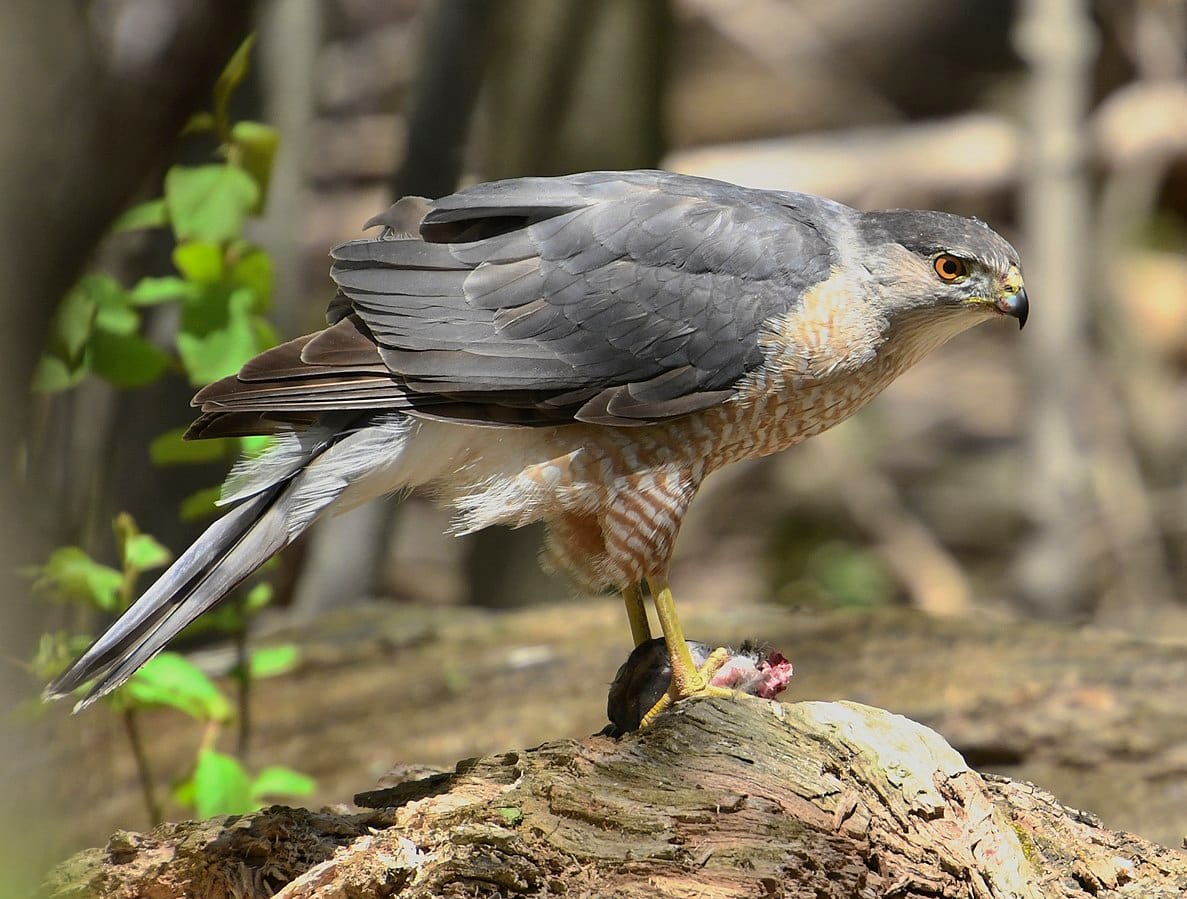
Cooper’s Hawks are medium-sized raptors with long tails and rounded wings, adapted for agile flight through forested habitats. Adults display a slate-gray back, reddish barring on the chest, and a finely banded tail. Juveniles are brown with streaked underparts and a similar tail pattern. Their small head relative to body size and rounded wings are useful field identification cues.
Behavior and Nesting Habits
Cooper’s Hawks are stealthy predators, often hunting birds in woodland and suburban areas. They exhibit remarkable agility, weaving through trees at high speeds to capture prey. Nests are constructed in tall trees, hidden within dense foliage to reduce detection.
Habitat and Range
These hawks inhabit forests, woodlots, and increasingly suburban neighborhoods throughout Wisconsin. They are primarily resident, though some northern individuals may migrate south during winter months.
Diet
Their diet is almost exclusively birds, ranging from small songbirds to medium-sized pigeons. They also occasionally take small mammals. Hunting involves sudden bursts of speed and surprise attacks from cover.
Reproduction and Life Cycle
Cooper’s Hawks typically lay 3–5 eggs per clutch. Both parents participate in feeding, though the female does most of the incubation. Juveniles fledge after about 4–5 weeks, continuing to rely on adults for food for some time.
Fun Facts / Unique Traits
Cooper’s Hawks are often mistaken for Sharp-shinned Hawks due to their similar appearance, but careful observation of size and tail shape helps differentiate them. They are highly adaptable and increasingly common in suburban areas where bird feeders attract prey.
Human Interaction
While some bird enthusiasts may worry about backyard birds, Cooper’s Hawks help control populations of common species like pigeons and starlings. They are appreciated for their role in maintaining local ecosystem balance.
3. Sharp-shinned Hawk (Accipiter striatus)
Physical Characteristics & Identification Tips
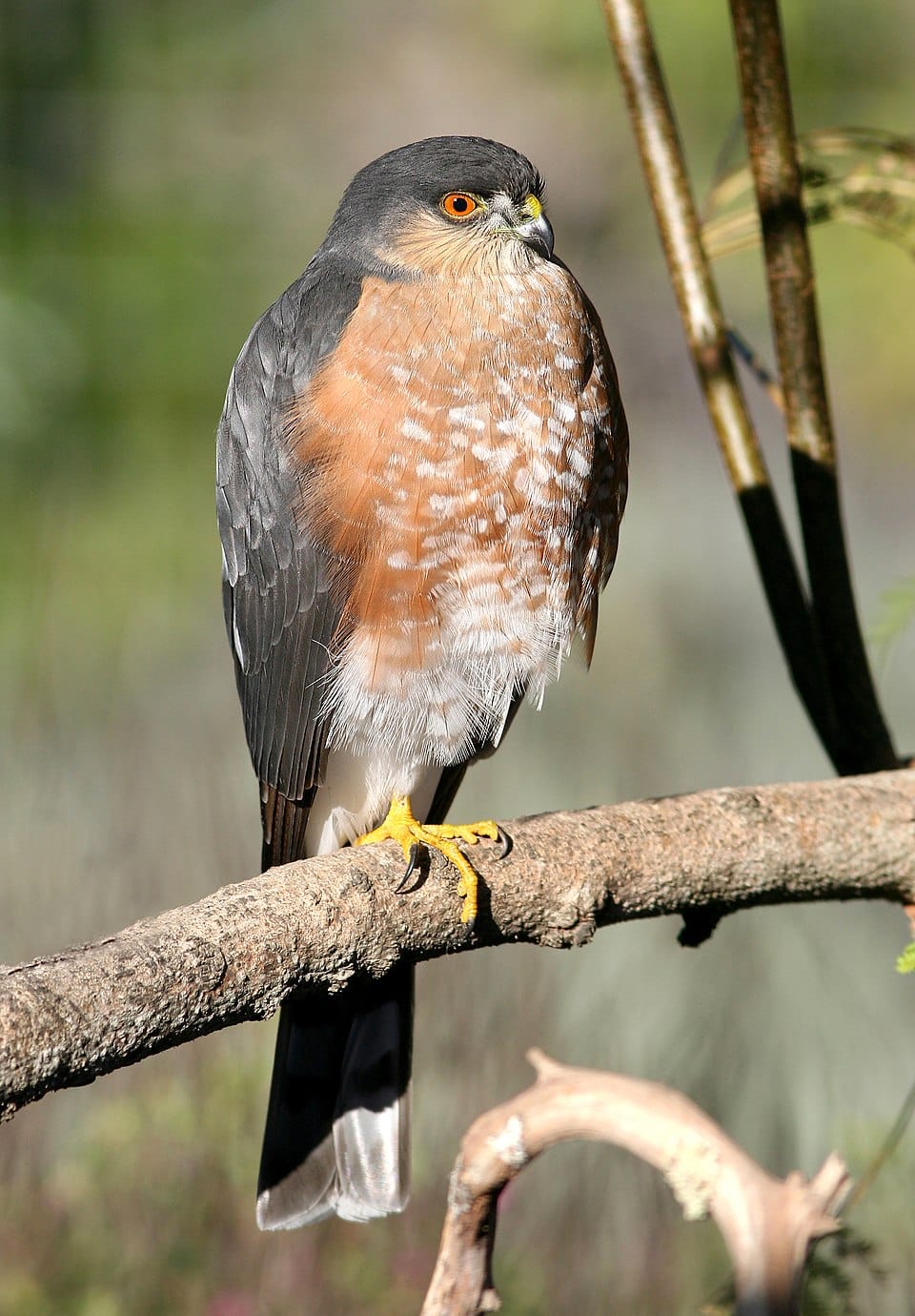
Sharp-shinned Hawks are the smallest accipiters in Wisconsin, with short, rounded wings and long tails. Adults are blue-gray above with reddish barring on the chest, while juveniles are brown with streaked underparts. They have a fine, square-tipped tail, which is a key identification feature when compared to Cooper’s Hawks.
Behavior and Nesting Habits
These hawks are swift, stealthy hunters, specializing in capturing small birds mid-flight. They build compact nests in dense forest canopies, which helps conceal them from predators and human observers.
Habitat and Range
Sharp-shinned Hawks are found in wooded areas throughout Wisconsin and may venture into suburban areas during migration. They are migratory, often traveling to the southern United States during winter.
Diet
They feed almost entirely on small birds, occasionally taking insects or small mammals. Hunting is characterized by sudden bursts of speed and maneuvering through dense vegetation.
Reproduction and Life Cycle
Females lay 3–8 eggs in early spring. Incubation lasts about 30 days, and fledglings leave the nest after 4–5 weeks. Parental care continues as juveniles learn to hunt independently.
Fun Facts / Unique Traits
Despite their small size, Sharp-shinned Hawks are fierce predators. They can fly swiftly and silently through thick foliage, earning a reputation for being nearly invisible to prey until it is too late.
Human Interaction
These hawks are often spotted at backyard feeders in fall, drawn by the concentration of small birds. Their presence is a sign of a healthy ecosystem and contributes to natural population control.
4. Northern Harrier (Circus hudsonius)
Physical Characteristics & Identification Tips
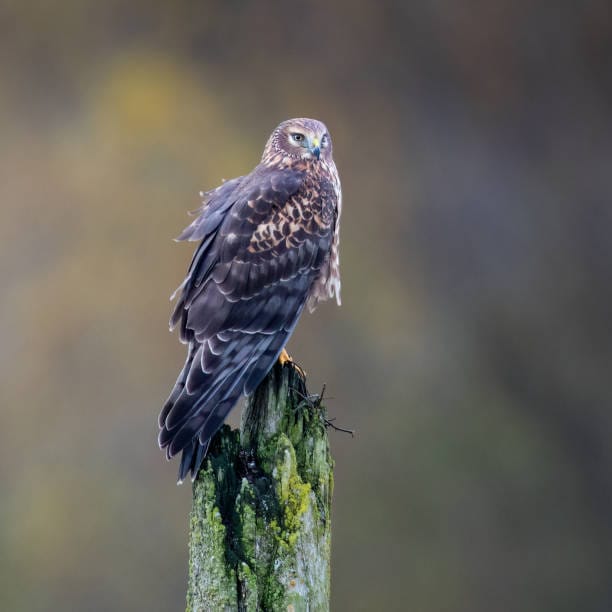
Northern Harriers are medium-sized raptors, easily recognized by their long wings and distinctive white rump patch visible in flight. Males display grayish upperparts, while females and juveniles are brown. Their facial disc, similar to an owl’s, helps funnel sound to their ears, enhancing their ability to detect prey in dense grasslands or marshes.
Behavior and Nesting Habits
Northern Harriers are low-flying hunters, gliding just above fields or marshes in search of small mammals and birds. They build ground nests, usually concealed among tall grasses or reeds. Both parents contribute to nest building and feeding the chicks, which develop quickly in open habitats where concealment is crucial.
Habitat and Range
These hawks prefer open habitats like wetlands, marshes, prairies, and agricultural fields throughout Wisconsin. They are present year-round in southern areas but migrate south from northern breeding grounds during winter.
Diet
Northern Harriers feed primarily on small mammals, birds, and occasionally amphibians. Their hunting style involves low, slow flights over open terrain, using both sight and hearing to locate prey hidden in grasses.
Reproduction and Life Cycle
Females lay 4–6 eggs, incubating them for about a month. Fledglings leave the nest in 30–40 days but remain under parental supervision for several weeks as they perfect their hunting skills.
Fun Facts / Unique Traits
One striking trait is the male’s sky-blue coloration contrasted with its white rump, making it a favorite among birders. Northern Harriers are known to fly in a characteristic V-shaped pattern during courtship displays.
Human Interaction
These hawks are indicators of healthy wetland ecosystems. Observing them hunting low over fields is a favorite pastime for wildlife enthusiasts, and they generally avoid direct interaction with humans.
5. Broad-winged Hawk (Buteo platypterus)
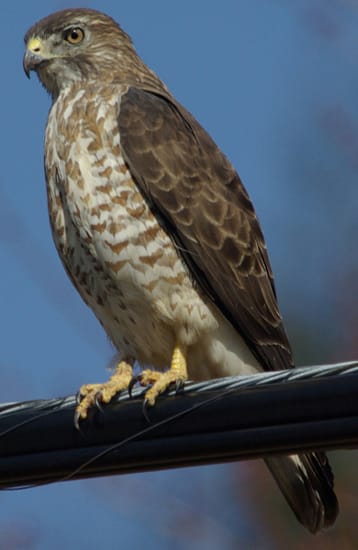
Physical Characteristics & Identification Tips
Broad-winged Hawks are small but stocky raptors with broad, rounded wings and a short tail. Adults have brown upperparts, a pale underside with reddish barring, and a distinct black-and-white tail pattern. Juveniles appear more streaked but retain the characteristic wing shape.
Behavior and Nesting Habits
Broad-winged Hawks are often observed in large flocks, called “kettles,” during migration. They build nests high in deciduous trees, carefully hidden within foliage. These hawks rely on soaring flight for energy-efficient migration and hunting.
Habitat and Range
They inhabit deciduous and mixed forests across Wisconsin, particularly in areas near water. They are primarily migratory, leaving for Central and South America during winter months.
Diet
Their diet includes small mammals, amphibians, reptiles, and insects. Hunting generally occurs from perches or during soaring flights, with sudden stoops to capture prey.
Reproduction and Life Cycle
Females lay 2–4 eggs in spring. Incubation lasts about 28–30 days, and fledglings remain in the nest for approximately six weeks, during which parents teach them hunting techniques.
Fun Facts / Unique Traits
Broad-winged Hawks are famous for their migratory kettles, which can include thousands of individuals traveling together. This spectacle is one of nature’s most remarkable mass migration events.
Human Interaction
Birdwatchers often time their trips to coincide with fall migration, when kettles provide excellent viewing opportunities. These hawks benefit from forest conservation, which preserves nesting and hunting grounds.
6. Rough-legged Hawk (Buteo lagopus)
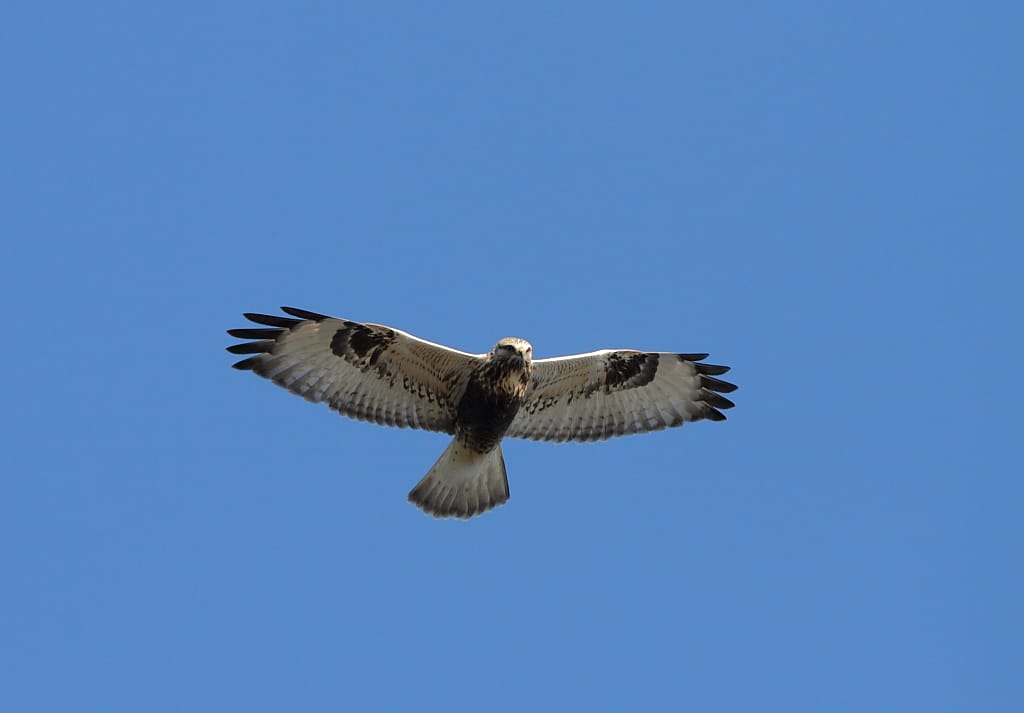
Physical Characteristics & Identification Tips
Rough-legged Hawks are distinguished by their feathered legs, which provide insulation in cold environments. Adults have pale underparts with dark belly bands and variable brown upperparts. They possess broad wings with dark patches near the wrist, making them identifiable in flight.
Behavior and Nesting Habits
These hawks hover while hunting, often seen suspending themselves over open fields in search of rodents. Nesting occurs in Arctic tundra regions; Wisconsin populations are winter visitors rather than breeders.
Habitat and Range
Rough-legged Hawks are winter visitors in Wisconsin, favoring open fields, prairies, and agricultural lands. Their breeding range lies much farther north, in Arctic regions.
Diet
Their diet primarily consists of small mammals, particularly voles and lemmings in northern habitats. In Wisconsin, they adapt to available rodents in open areas, employing hovering and slow gliding techniques to spot prey.
Reproduction and Life Cycle
Rough-legged Hawks do not breed in Wisconsin. In their Arctic range, they lay 2–5 eggs per clutch, with fledging occurring approximately 35–40 days after hatching.
Fun Facts / Unique Traits
These hawks are among the few raptors that hover regularly while hunting. Their feathered legs and ability to survive in extreme cold are notable adaptations, giving them a unique appearance compared to other Buteos.
Human Interaction
Winter observers in Wisconsin enjoy spotting Rough-legged Hawks in open fields. They are generally unafraid of humans but benefit from undisturbed habitats for hunting.
7. Red-shouldered Hawk (Buteo lineatus)
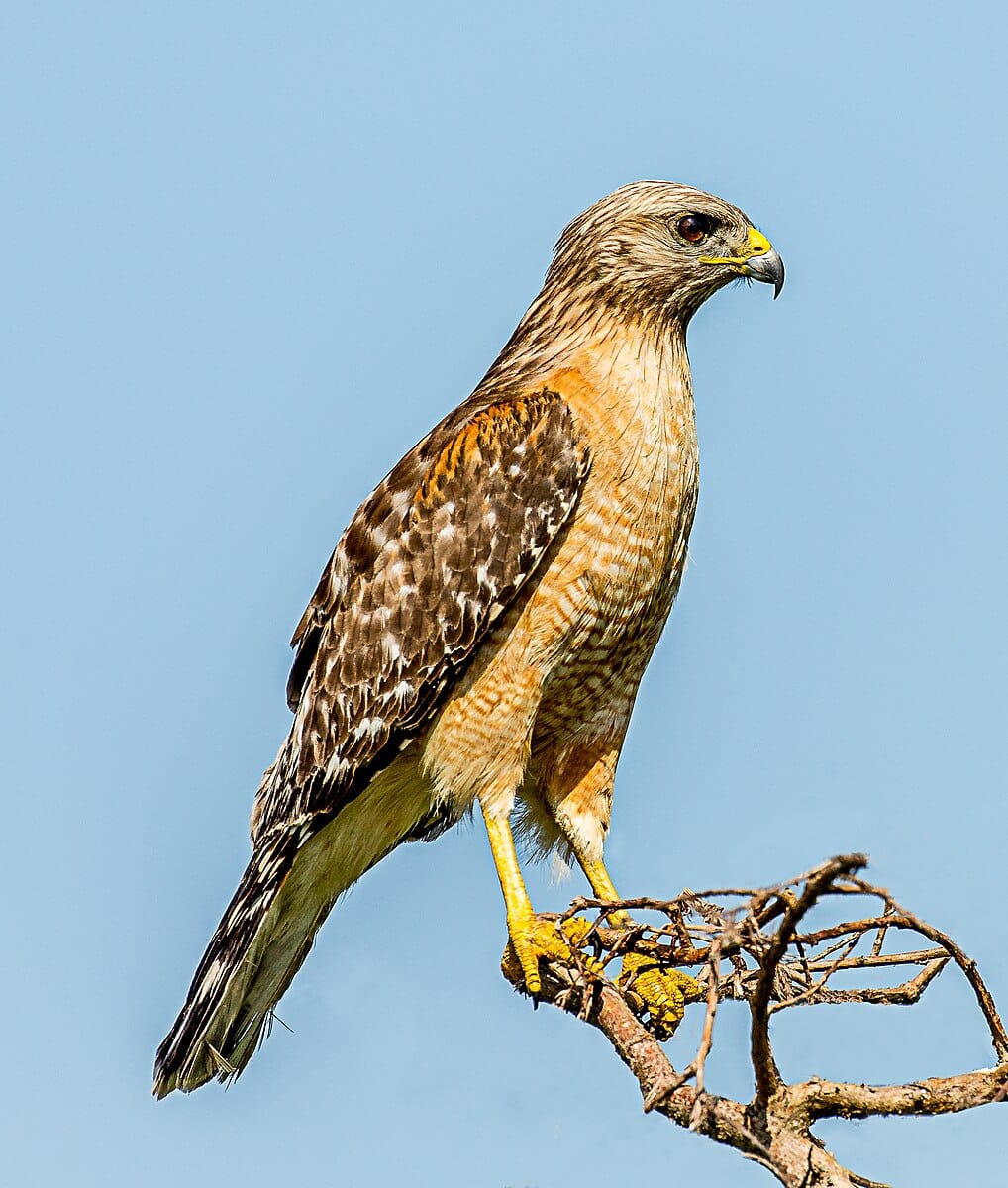
Physical Characteristics & Identification Tips
Red-shouldered Hawks are medium-sized raptors with striking rufous coloration on the chest and distinct reddish barring on the wings and shoulders. Their tails display narrow black-and-white bands, which are visible in flight. Juveniles are brown and streaked, with less vivid coloration, making adult markings a key identification feature.
Behavior and Nesting Habits
These hawks prefer wooded habitats and are often heard before being seen, with their characteristic high-pitched, repetitive call. Nests are built in tall trees near water, lined with sticks and foliage. They are territorial and may defend nesting sites vigorously during the breeding season.
Habitat and Range
Red-shouldered Hawks inhabit deciduous and mixed forests in Wisconsin, often near rivers, lakes, and wetlands. They are considered residents in many southern areas, while northern populations may migrate short distances.
Diet
Their diet consists mainly of small mammals, amphibians, reptiles, and occasionally birds. Hunting usually involves perching silently and swooping down on prey when detected.
Reproduction and Life Cycle
Females typically lay 2–4 eggs per clutch. Both parents participate in feeding chicks, which fledge in 5–6 weeks. Juveniles gradually gain independence but may remain nearby as they hone hunting skills.
Fun Facts / Unique Traits
Red-shouldered Hawks are excellent vocalists, often giving clear, ringing calls that carry through the forest. Their territorial displays include aerial circling and calling, a treat for birdwatchers lucky enough to witness it.
Human Interaction
These hawks are generally tolerant of human presence, though habitat loss can impact nesting success. Observers often enjoy listening for their distinctive calls near wetland areas.
8. Northern Goshawk (Accipiter gentilis)
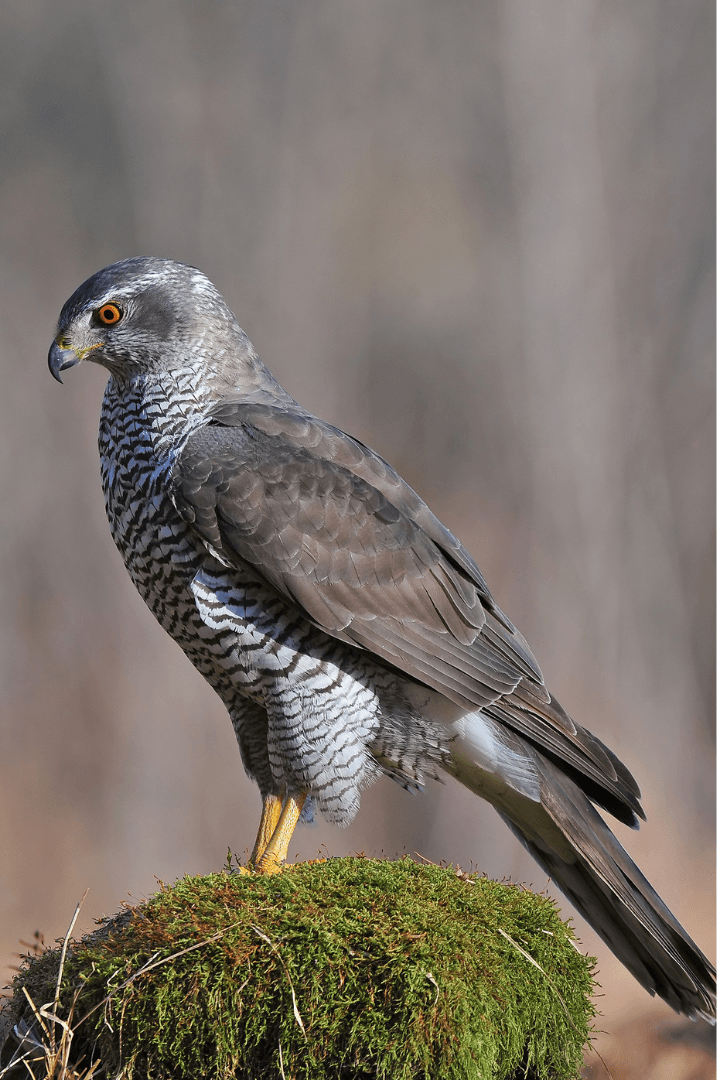
Physical Characteristics & Identification Tips
Northern Goshawks are large forest raptors with slate-gray upperparts, a pale underside with fine barring, and a distinctive white supercilium above the eye. Their broad wings and long tail allow rapid, agile flight through dense forests. Juveniles appear browner with streaked underparts.
Behavior and Nesting Habits
These hawks are secretive and highly territorial. They hunt by stealth, weaving through trees to catch birds and small mammals. Nests are built high in mature trees, often reused for several years.
Habitat and Range
Northern Goshawks prefer mature deciduous and coniferous forests in Wisconsin. They are primarily residents, though some may migrate southward in winter if food is scarce.
Diet
Their diet mainly consists of medium-sized birds, such as grouse and crows, and mammals like squirrels and rabbits. Hunting involves surprise attacks and incredible maneuverability through dense foliage.
Reproduction and Life Cycle
Females lay 2–4 eggs, incubated for roughly a month. Chicks fledge after 40–50 days, gradually learning to hunt under parental guidance. Goshawks exhibit strong parental care and territorial defense.
Fun Facts / Unique Traits
Northern Goshawks are known for their fearless nature and agility. Observers often note their sudden appearance in dense forests and rapid pursuit of prey — almost like a flash of gray through the trees.
Human Interaction
They are rarely seen by casual observers due to their secretive habits. Conservation of large forest tracts is vital to maintaining stable populations in Wisconsin.
9. Swainson’s Hawk (Buteo swainsoni)
Physical Characteristics & Identification Tips
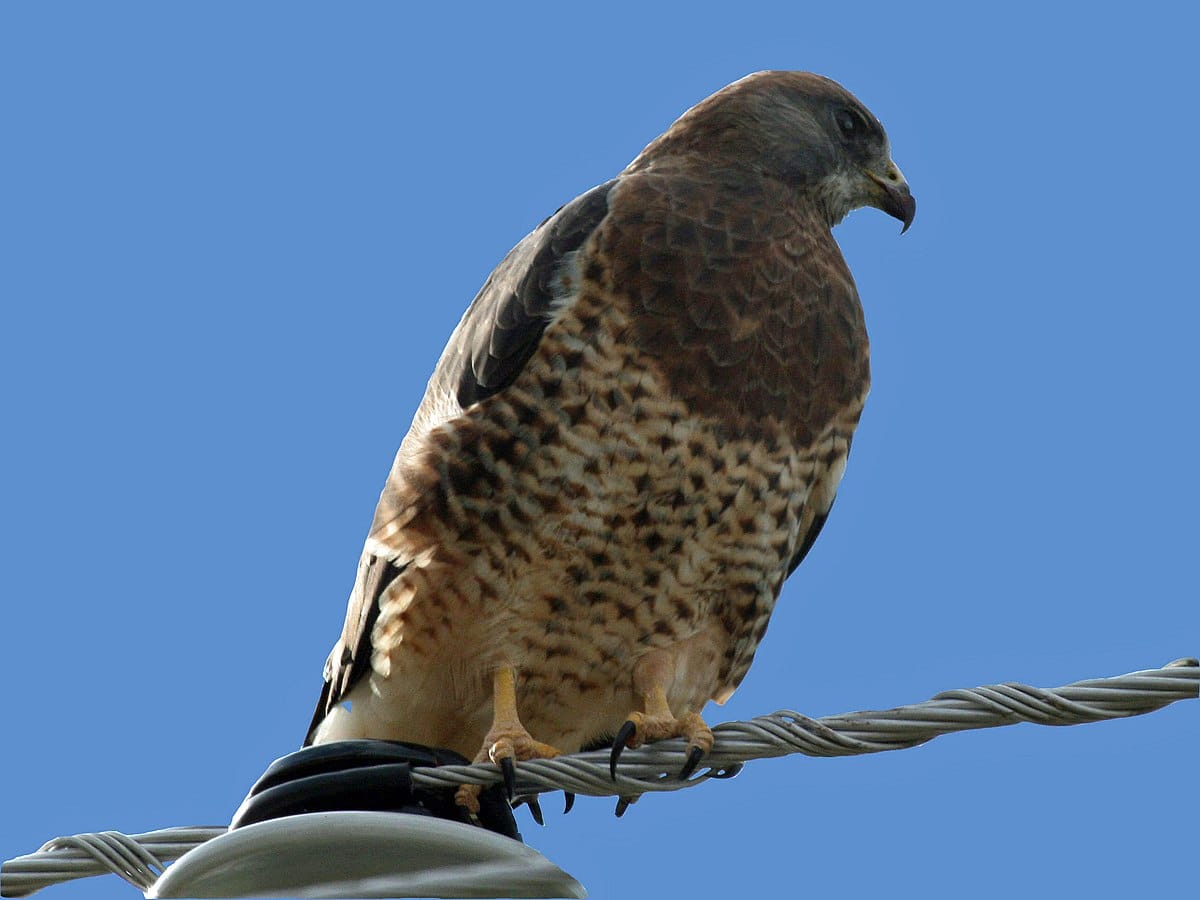
Swainson’s Hawks are medium-sized, slender Buteos with long, narrow wings and a small head. Adults have pale underparts with a dark chest band and brown upperparts. Juveniles are more uniformly brown. In flight, they exhibit slow, buoyant wingbeats with occasional glides.
Behavior and Nesting Habits
These hawks are migratory and often hunt in open fields or prairies. Nesting is primarily in trees on the western breeding grounds; in Wisconsin, sightings are mostly during migration. They feed in large flocks during migration, sometimes called “roving raptors.”
Habitat and Range
Swainson’s Hawks are rare visitors to Wisconsin, usually during spring and fall migration. They prefer open grasslands, agricultural fields, and prairies when observed in the state.
Diet
Their diet consists largely of small mammals and insects. During migration, they can feed extensively on grasshoppers and other abundant insects, demonstrating remarkable adaptability.
Reproduction and Life Cycle
In their primary western range, Swainson’s Hawks lay 3–5 eggs, with incubation lasting about 28–32 days. Fledglings leave the nest after approximately 5–6 weeks, learning to hunt as they follow adults during migration.
Fun Facts / Unique Traits
Swainson’s Hawks are famous for their long migrations to South America, one of the longest of any North American raptor. They can travel thousands of miles, often in large, mixed flocks.
Human Interaction
Although uncommon in Wisconsin, birders actively track migration sightings. They are not known to interact closely with humans, but their presence highlights healthy prairie and field ecosystems.
10. Ferruginous Hawk (Buteo regalis)
Physical Characteristics & Identification Tips
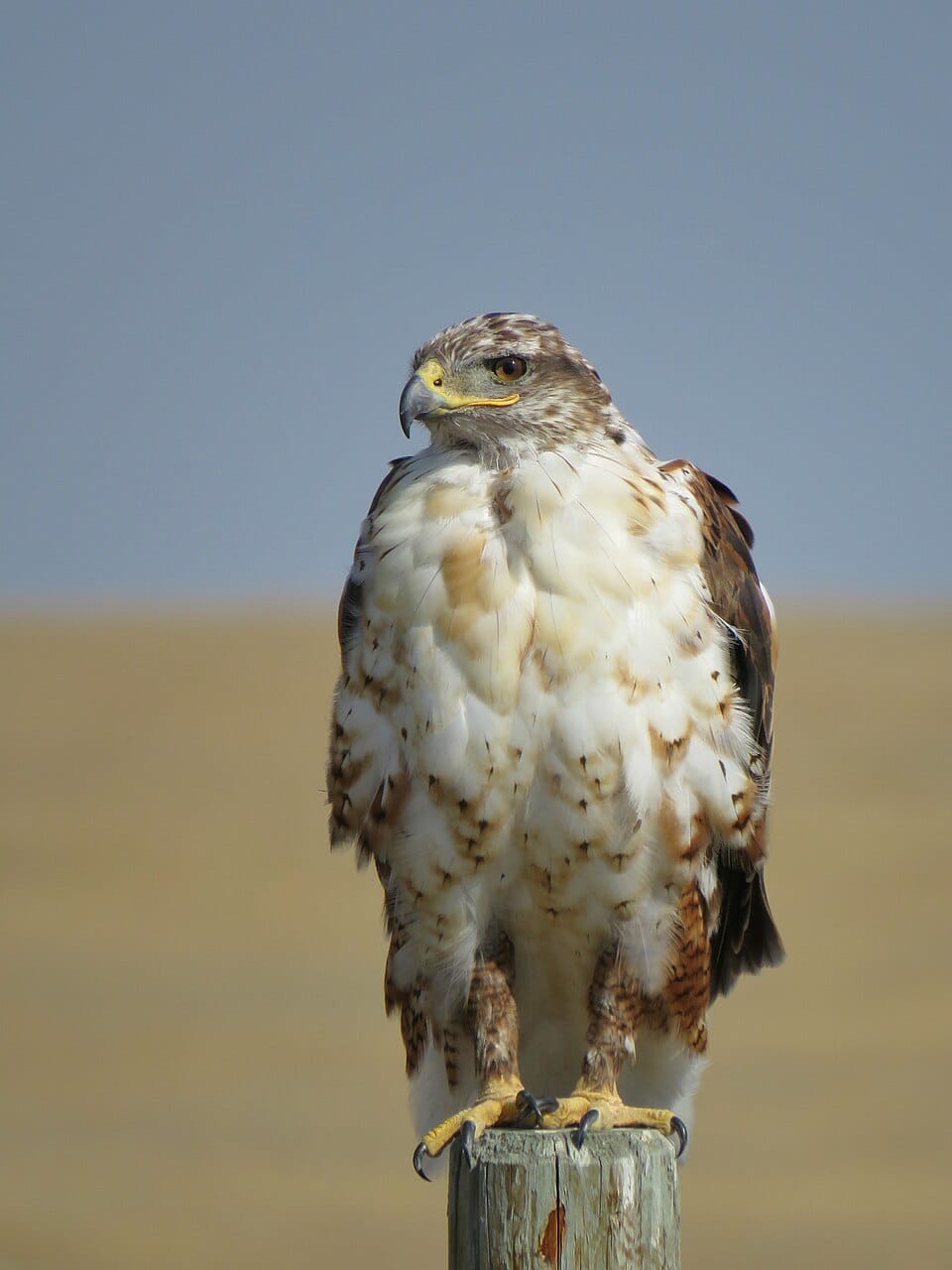
Ferruginous Hawks are the largest Buteos found in North America, easily recognized by their broad wings and pale underparts. Adults exhibit rusty-colored shoulders and back, while juveniles are generally lighter with streaked brown patterns. Their massive size and wingspan of up to 5 feet make them unmistakable in flight.
Behavior and Nesting Habits
These hawks are primarily ground hunters, using a combination of soaring and slow flight to spot prey across open landscapes. Nests are built in trees or on cliffs, lined with sticks and soft materials. Wisconsin sightings are rare and typically occur during migration or dispersal from western populations.
Habitat and Range
Ferruginous Hawks are winter visitors in Wisconsin, preferring open fields, prairies, and agricultural lands. Their breeding range is mainly in the western United States, including Great Plains grasslands.
Diet
Their diet consists mostly of small to medium-sized mammals, such as prairie dogs, rabbits, and ground squirrels. They may also take birds occasionally. Hunting is often performed by soaring high and dropping swiftly on prey.
Reproduction and Life Cycle
In their primary breeding grounds, females lay 2–4 eggs, with incubation lasting around a month. Fledging occurs in 5–6 weeks. Wisconsin sightings usually involve adult or subadult individuals moving through during the non-breeding season.
Fun Facts / Unique Traits
Ferruginous Hawks are sometimes called “Ferrugies” by raptor enthusiasts. They are well-adapted to open landscapes and capable of hunting larger prey than most Buteos, giving them an edge in grassland ecosystems.
Human Interaction
These hawks are rarely seen by the general public in Wisconsin, making sightings a treat for birdwatchers. They benefit from conservation of open fields and prairie habitats, which support their hunting and roosting needs.
11. Zone-tailed Hawk (Buteo albonotatus)
Physical Characteristics & Identification Tips
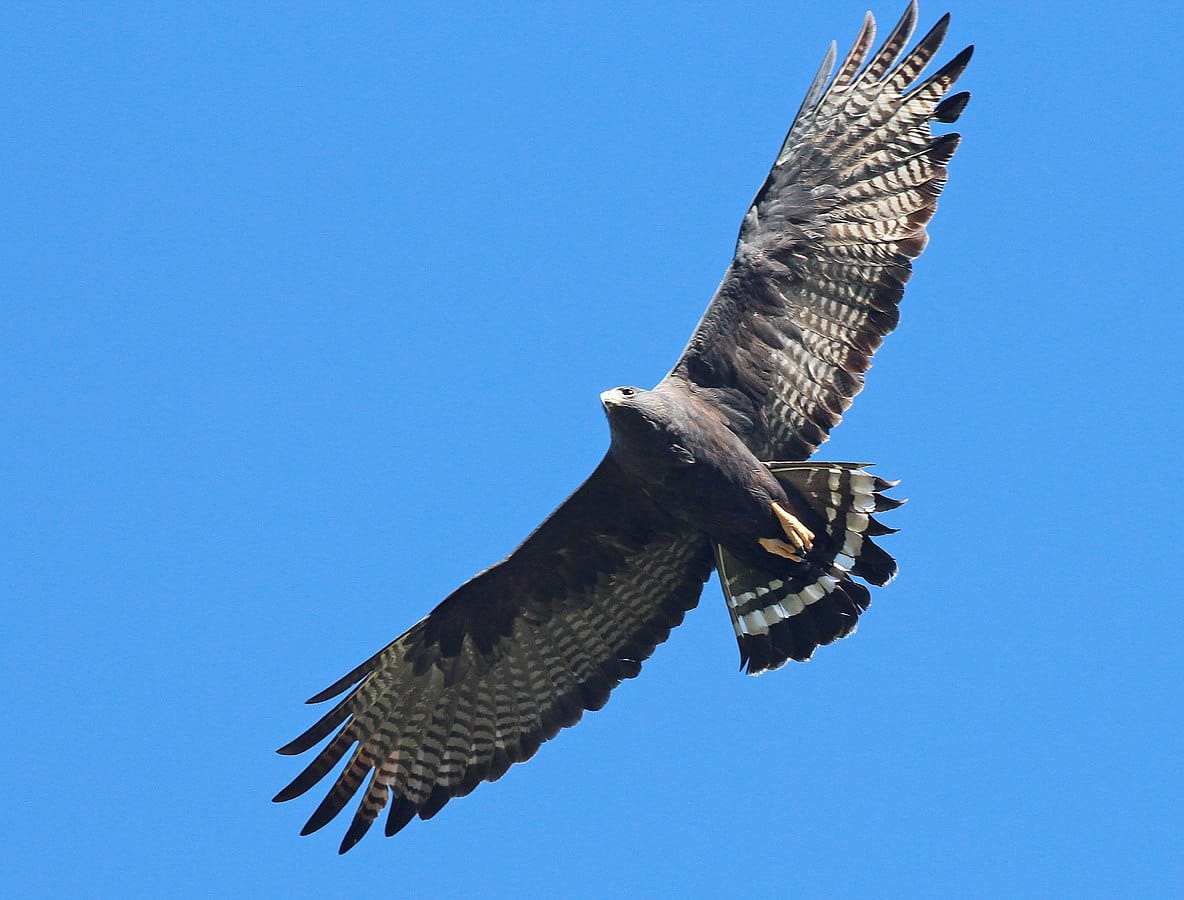
Zone-tailed Hawks are medium-sized raptors with dark plumage and conspicuous white bands on their tail. Their flight pattern closely resembles that of turkey vultures, often allowing them to approach prey unsuspected. Adults have dark brown to black feathers with subtle streaking, while juveniles are slightly lighter and more mottled.
Behavior and Nesting Habits
These hawks are highly secretive and often soar above open landscapes, using mimicry to blend in with turkey vultures. Nests are constructed in tall trees or on cliff edges, lined with sticks. Wisconsin sightings are extremely rare and considered accidental, usually involving vagrants from southern populations.
Habitat and Range
Zone-tailed Hawks inhabit arid and semi-arid regions in the southwestern United States and Mexico. Occasional sightings in Wisconsin are typically during unusual migratory dispersal.
Diet
Their diet consists mostly of reptiles, small mammals, and occasionally birds. They rely on surprise attacks and their vulture-like flight patterns to ambush prey.
Reproduction and Life Cycle
In their normal range, females lay 2–3 eggs per clutch, with incubation lasting about 30 days. Fledging occurs after 5–6 weeks, with juveniles practicing hunting under parental guidance.
Fun Facts / Unique Traits
Zone-tailed Hawks are known for their remarkable mimicry of turkey vultures, which reduces attention from prey and allows them to hunt more effectively. Their stealthy approach is a fascinating adaptation among raptors.
Human Interaction
Sightings in Wisconsin are extremely rare, making them highly sought after by birders. They generally avoid human contact, and their unusual flight behavior makes observation a unique experience.
Conclusion
Wisconsin hosts a fascinating variety of hawks, ranging from the familiar Red-tailed Hawk soaring over fields to the rare Zone-tailed Hawk glimpsed on exceptional occasions. Each species contributes uniquely to the state’s ecosystems, controlling rodent populations, maintaining bird communities, and enhancing biodiversity. By observing these raptors, whether in forests, marshlands, or open prairies, one gains a deeper appreciation for the delicate balance of nature. Protecting their habitats ensures that Wisconsin’s skies continue to host these majestic hunters for generations to come. From the common Northern Harrier to the migratory Swainson’s Hawk, the diversity of hawks in Wisconsin offers endless opportunities for education, observation, and conservation. Whether a casual observer or dedicated birder, learning to identify these species enhances understanding of local wildlife and fosters a respectful connection to the natural world.
Frequently Asked Questions About Hawks in Wisconsin
1. What types of hawks can be found in Wisconsin?
Wisconsin hosts a variety of hawks, including Red-tailed Hawk, Cooper’s Hawk, Sharp-shinned Hawk, Northern Harrier, Broad-winged Hawk, Rough-legged Hawk, Red-shouldered Hawk, Northern Goshawk, Swainson’s Hawk, Ferruginous Hawk, and Zone-tailed Hawk.
2. Which hawks are most common in Wisconsin?
Red-tailed Hawks, Cooper’s Hawks, and Sharp-shinned Hawks are among the most commonly observed hawks throughout the state.
3. Are there migratory hawks in Wisconsin?
Yes, species like Broad-winged Hawk, Swainson’s Hawk, and Rough-legged Hawk migrate through Wisconsin seasonally.
4. What habitats do hawks prefer in Wisconsin?
Hawks inhabit forests, wetlands, prairies, and open farmland, depending on species and food availability.
5. Can hawks be seen year-round in Wisconsin?
Some hawks, such as Red-tailed Hawks and Red-shouldered Hawks, are residents, while others are migratory visitors.
6. What do Wisconsin hawks eat?
Hawks in Wisconsin feed on small mammals, birds, reptiles, and insects, varying by species.
7. How can I identify a Red-tailed Hawk in Wisconsin?
Look for broad wings, reddish-brown tail, and a robust body. They are often perched on posts or soaring above open fields.
8. Are Northern Goshawks rare in Wisconsin?
Yes, Northern Goshawks are secretive and less commonly observed, preferring mature forest habitats.
9. Where do Rough-legged Hawks go in winter?
They migrate from Arctic breeding grounds to open fields in Wisconsin during the winter months.
10. Do Broad-winged Hawks travel in groups in Wisconsin?
Yes, they form large “kettles” during migration, sometimes including thousands of individuals.
11. Can Swainson’s Hawks be seen in Wisconsin?
They are rare visitors, primarily during spring and fall migration through open prairies and fields.
12. How do Northern Harriers hunt in Wisconsin?
They fly low over marshes and fields, using sight and hearing to locate small mammals and birds.
13. Are Ferruginous Hawks common in Wisconsin?
No, they are rare visitors, mostly appearing during migration or dispersal from western populations.
14. Do Zone-tailed Hawks live in Wisconsin?
Zone-tailed Hawks are extremely rare in Wisconsin, usually seen as accidental vagrants from southern regions.
15. What is the average wingspan of Wisconsin hawks?
Wingspans vary: Red-tailed Hawks reach about 4 feet, Ferruginous Hawks up to 5 feet, and smaller hawks like Sharp-shinned Hawks around 2 feet.
16. How do hawks contribute to Wisconsin’s ecosystem?
They control rodent and bird populations, maintain ecological balance, and serve as indicators of habitat health.
17. Can I watch hawks at feeders in Wisconsin?
Yes, smaller hawks like Cooper’s and Sharp-shinned Hawks may visit areas with abundant small birds, especially during migration.
18. What is the best time to see hawks in Wisconsin?
Spring and fall migrations are ideal for observing a wide variety of hawks, including Broad-winged and Swainson’s Hawks.
19. Are there hawks that nest in urban Wisconsin areas?
Red-tailed Hawks and Cooper’s Hawks sometimes nest near suburban areas, utilizing tall trees or ledges.
20. How can I distinguish a Cooper’s Hawk from a Sharp-shinned Hawk in Wisconsin?
Cooper’s Hawks are larger with rounded tails, while Sharp-shinned Hawks are smaller with square-tipped tails.
21. Do Wisconsin hawks migrate long distances?
Yes, species like Swainson’s Hawks travel thousands of miles to Central and South America.
22. How do Northern Harriers differ from other Wisconsin hawks?
They fly low over open fields and marshes and have a distinct facial disc for enhanced hearing.
23. Are hawk populations in Wisconsin stable?
Most resident hawk species are stable, though habitat loss and environmental changes can impact certain populations.
24. Can children learn to identify hawks in Wisconsin?
Absolutely. Observing flight patterns, plumage, and hunting behavior makes learning both engaging and educational.
25. What types of prey do Ferruginous Hawks hunt in Wisconsin?
They focus on small to medium-sized mammals, including rabbits, prairie dogs, and ground squirrels.
26. Are Red-shouldered Hawks vocal in Wisconsin?
Yes, their loud, repetitive calls make them easier to detect in forested habitats.
27. How often are Zone-tailed Hawks spotted in Wisconsin?
Very rarely; sightings are considered accidental and highly notable for birders.
28. Do hawks face threats from humans in Wisconsin?
Yes, habitat loss and pesticide use can negatively affect hawk populations, though most adapt well to preserved areas.
29. Can Wisconsin hawks be seen in winter?
Resident species like Red-tailed Hawks remain, while migratory species such as Rough-legged Hawks appear seasonally.
30. Are hawks in Wisconsin important for education?
Absolutely. Observing hawks teaches ecological balance, species identification, and conservation awareness.
31. How can I attract hawks for observation in Wisconsin?
Providing open fields, minimal disturbance, and bird-friendly habitats can increase chances of observation.
Read more: 12 Types of Hawks in Ohio (Pictures And Identification)