
Sparrows are among the most recognizable and beloved songbirds across the globe. From backyard feeders in bustling cities to remote grasslands and deserts, these small, adaptable birds have evolved into dozens of unique species. In this guide, we’ll explore 32 types of sparrows from every corner of the world — how they look, where they live, and what makes each one special. Whether you’re a birdwatcher, nature enthusiast, or simply curious, this detailed identification guide will help you appreciate these fascinating little birds even more.
1. House Sparrow (Passer domesticus)

The House Sparrow is probably the most familiar sparrow in the world — the cheerful brown bird hopping on sidewalks and chirping from rooftops. Native to Europe and parts of Asia, it has spread almost everywhere humans have gone. Its adaptability is legendary. You’ll find it nesting in crevices, eaves, or even traffic lights in cities. Males have a distinctive gray crown and black bib, while females are plainer, with warm brown and tan tones that blend into urban and rural backgrounds.
House Sparrows are social birds. They live in noisy colonies and are rarely seen alone. Their diet is varied — grains, crumbs, insects, and seeds make up most of their meals. During breeding season, males chirp persistently to attract mates and defend small nesting territories. These sparrows are also incredibly smart. Studies show that they’ve learned to open automatic doors and wait near cafés for crumbs. Despite being common, they’re experiencing population declines in some European cities due to habitat loss and pollution. Still, the House Sparrow remains one of the most iconic birds on Earth, representing a successful bond between wildlife and human civilization.
2. Eurasian Tree Sparrow (Passer montanus)
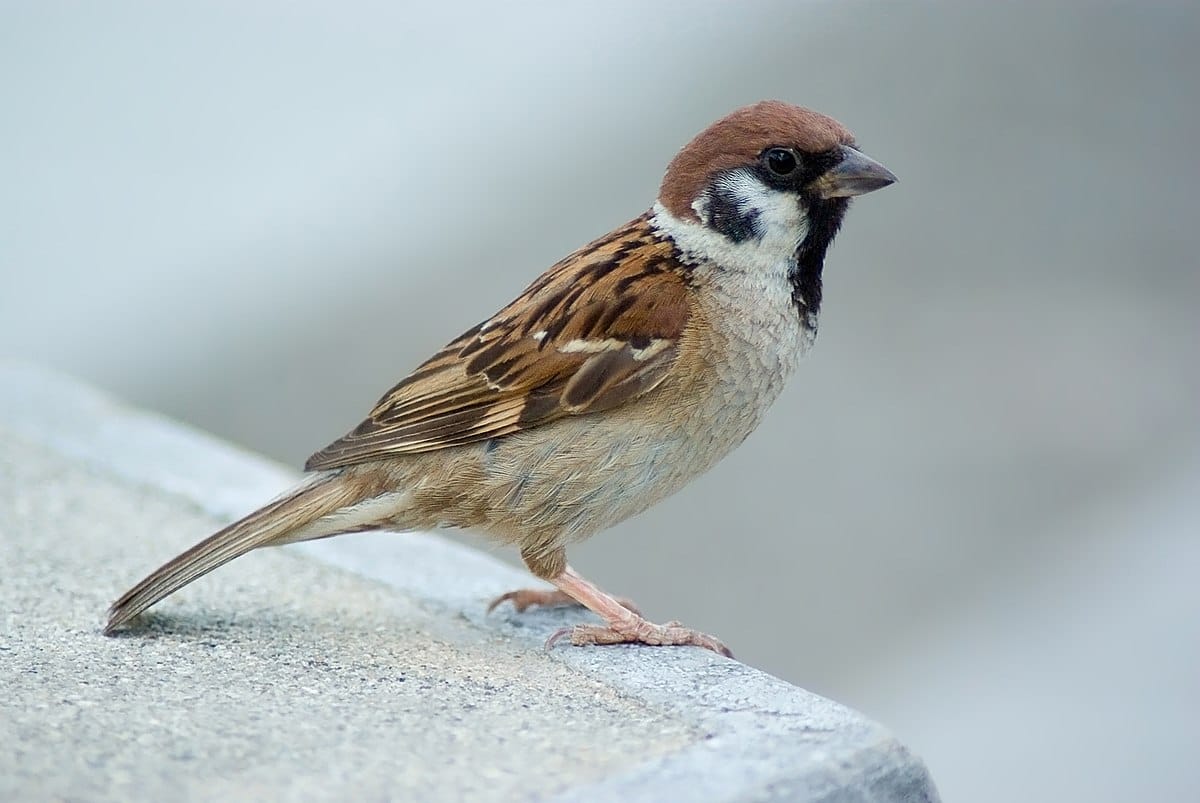
The Eurasian Tree Sparrow is a close cousin of the House Sparrow but with a few telltale differences. It has a rich chestnut-brown cap and a distinct black spot on each white cheek — features that make it instantly recognizable to birdwatchers. This species is found across Europe and Asia and has even been introduced to North America. Unlike its urban relative, the Tree Sparrow prefers gardens, farmlands, and forest edges rather than bustling cities.
Tree Sparrows often nest in tree holes or old woodpecker cavities, hence their name. They are highly social, forming flocks that move together in graceful flight patterns. Their calls are softer and more musical than the harsh chirps of House Sparrows. In some Asian cultures, they are symbols of simplicity and freedom. The Eurasian Tree Sparrow’s adaptability allows it to thrive in both natural and semi-urban habitats. Watching a group forage for seeds among autumn leaves is one of the small joys of birdwatching.
3. Spanish Sparrow (Passer hispaniolensis)

The Spanish Sparrow brings Mediterranean charm to the sparrow family. Found across southern Europe, North Africa, and parts of the Middle East, this species is often spotted in large colonies near agricultural areas. Males are particularly striking — they have a deep chestnut head, white cheeks, and a heavily streaked chest that gives them a rugged appearance. Females, as usual in the sparrow world, are subtler but still beautifully patterned.
Spanish Sparrows are known for their cooperative nesting behavior. They sometimes share massive communal nests with starlings or other sparrows, creating buzzing bird “villages” in trees or on power poles. Their diet consists mostly of seeds and grains, but during breeding season, they feed insects to their chicks. These sparrows are highly vocal, with a melodious chatter that fills vineyards and olive groves. Birdwatchers in Spain, Italy, or Morocco can often see them perching proudly on fences or scuttling through wheat fields — a reminder that even common farmland birds can have remarkable character and beauty.
4. Italian Sparrow (Passer italiae)

The Italian Sparrow is a fascinating hybrid species found primarily in Italy, where its genetics mix traits from the House and Spanish Sparrows. For years, ornithologists debated whether it was a true species or a hybrid form. Today, it’s recognized as distinct due to its stable population and unique characteristics. Males resemble House Sparrows but with warmer tones and less black on the chest, while females are softly brown with a refined elegance.
This sparrow thrives in rural villages, vineyards, and coastal towns of the Mediterranean. Its behavior mirrors that of the House Sparrow — gregarious, curious, and quick to adapt. The Italian Sparrow’s song is cheerful and rhythmic, often heard echoing through cobblestone streets. What makes it particularly interesting is its evolutionary story: it represents how adaptable sparrows can be, evolving through hybridization and environment-driven change. Birders visiting Tuscany or Sicily might spot them dust-bathing near olive groves or darting through fig trees in search of seeds.
5. Dead Sea Sparrow (Passer moabiticus)

The Dead Sea Sparrow is a desert specialist — a small, sandy-colored bird perfectly adapted to arid environments. Found in the Middle East, especially near the Jordan Valley and parts of Iran and Afghanistan, this species lives where few others can survive. Its plumage is subtle — pale gray and buff tones blend seamlessly with the dry landscape. Males have a faint black bib and yellow-tinged breast, which becomes more vivid in breeding season.
Unlike its urban relatives, the Dead Sea Sparrow is shy and elusive. It prefers dense tamarisk or acacia bushes near water sources. It feeds mainly on seeds but will also take insects when available. Observing one in the wild is a special experience, as their populations are scattered and often localized. Despite their harsh surroundings, Dead Sea Sparrows maintain tight-knit flocks, communicating with soft, buzzing calls. Their resilience in one of the planet’s toughest climates is a reminder of nature’s adaptability — a theme that defines the sparrow family as a whole.
6. Desert Sparrow (Passer simplex)

The Desert Sparrow is a true symbol of endurance and quiet beauty. Found across the Sahara and parts of North Africa, this bird thrives in some of the harshest landscapes on Earth. It’s a small, pale sparrow that blends perfectly into its sandy surroundings. Males have soft gray upperparts, creamy underparts, and a black throat patch, while females are a bit duller but equally graceful in their simplicity. Their coloring makes them nearly invisible against dunes and dry wadis — a perfect adaptation to desert life.
Desert Sparrows prefer to live near oases or remote settlements, where a few shrubs or date palms offer shelter. They are incredibly resourceful birds, often nesting in crevices of mud walls or inside traditional clay buildings. Their diet consists mainly of seeds and small insects, especially during the breeding season. These sparrows are social and often form small flocks, their chirps carrying softly across the dry air. For desert travelers, catching sight of one perched atop a dune bush is like finding a living jewel in the sand. The Desert Sparrow’s calm presence and survival skills make it one of the most resilient and captivating sparrows in existence.
7. Somali Sparrow (Passer castanopterus)

The Somali Sparrow is a charming little bird native to the Horn of Africa, found mainly in Somalia, eastern Ethiopia, and parts of Kenya. It thrives in dry savannas, thorn scrub, and semi-arid landscapes. Males are handsome with chestnut-colored wings, gray heads, and a subtle black bib. Females, on the other hand, display softer brown hues that help them stay camouflaged in dry vegetation. Together, they represent the balance of beauty and practicality that defines many African birds.
Unlike some of its relatives, the Somali Sparrow often forages quietly on the ground, hopping between clumps of grass in search of seeds. It forms small, social flocks and is known for its sweet, twittering calls that echo softly through the scrublands. Nests are built in thorny bushes or acacia trees — usually a well-hidden, dome-shaped structure made of fine grasses. During courtship, males perform small fluttering flights and chirp excitedly to attract mates. Despite living in a demanding habitat, Somali Sparrows exhibit a calm and steady lifestyle. For bird enthusiasts visiting East Africa, spotting this species is a delightful experience that showcases how life flourishes even in seemingly inhospitable places.
8. Kenya Sparrow (Passer rufocinctus)

The Kenya Sparrow, found mainly in central and southern Kenya and northern Tanzania, is an elegant bird with a striking mix of gray, brown, and rufous tones. It was once considered a subspecies of the Great Sparrow, but its unique plumage and distribution have earned it full species status. The male is particularly attractive with its gray head, chestnut back, and dark bib, while the female’s subtle hues make her blend beautifully with the African savanna’s dry grass tones.
This sparrow inhabits open woodlands, grasslands, and farmlands. It often associates with human settlements and can even be found near rural homesteads. The Kenya Sparrow’s song is cheerful and lively — a series of chirps and trills that are pleasant to the ear. During breeding season, they nest in tree holes or cavities in walls, lining their nests with soft grasses. Their adaptability makes them successful in both wild and semi-urban environments. Observing them hopping around acacia trees or feeding in open clearings offers a glimpse of how adaptable the sparrow family truly is. This species beautifully represents the natural harmony between wildlife and human presence in Africa.
9. Cape Sparrow (Passer melanurus)

The Cape Sparrow is one of southern Africa’s most recognizable birds. With its bold markings and strong personality, it’s a common yet striking sight across South Africa, Namibia, and Botswana. Males have a dramatic black-and-white head pattern with a chestnut nape and gray crown, while females are softer, dressed in brownish-gray tones with less contrast. Despite its name, the Cape Sparrow isn’t limited to the coastal regions — it thrives in farmlands, open country, and suburban gardens alike.
Highly sociable and often seen in small flocks, Cape Sparrows are known for their lively behavior. They chatter constantly, especially when feeding in the mornings. Their diet includes grains, seeds, insects, and sometimes fruit. They are frequent visitors to bird feeders and water baths in suburban areas. The male often takes the lead in choosing a nesting site, usually in tree holes or the eaves of buildings, before the female builds a grass-lined nest. These sparrows are bold, curious, and endearing — a favorite among bird lovers in southern Africa. Watching a Cape Sparrow fluff its feathers after a bath or squabble good-naturedly over food is one of those everyday scenes that bring joy to anyone who loves wildlife.
10. Great Sparrow (Passer motitensis)

The Great Sparrow, also known as the Southern Grey-headed Sparrow, is a robust and confident bird that inhabits the arid regions of southern Africa. As its name suggests, it’s slightly larger than most other sparrows, with a sturdy build and strong beak. Males are easily identified by their gray heads, chestnut backs, and white underparts, while females are browner and less distinctly marked. Their solid, compact form and upright stance give them an air of quiet authority among the small birds of the savanna.
Great Sparrows are adaptable and thrive in dry regions, agricultural fields, and even desert edges. They’re often seen perching on thorn trees or fences, calling loudly with a series of sharp chirps. These birds are seed-eaters but readily take insects, especially when feeding young. Their nests are built in tree holes or even in the structures of old buildings, showcasing their flexibility. They are also known for their strong pair bonds — mated pairs often remain together throughout the year. In many African cultures, the Great Sparrow symbolizes endurance and the beauty of ordinary life. Observing their confident behavior under the harsh African sun reminds us of how even small birds can thrive through resilience and cooperation.
11. Southern Grey-headed Sparrow (Passer diffusus)

The Southern Grey-headed Sparrow is one of Africa’s most adaptable and widespread small birds. Found throughout southern and eastern Africa, it thrives in both urban areas and open savannas. This sparrow is known for its smooth gray head, chestnut back, and soft brown wings. Its underparts are clean and pale, giving it a crisp, tidy appearance. The overall look is understated but elegant — a perfect example of how subtle beauty often defines the sparrow family.
Unlike its urban cousins, the Southern Grey-headed Sparrow often lives in small, close-knit flocks. It perches on acacia trees or rooftops, chirping cheerfully in the early morning light. Its diet includes seeds, insects, and the occasional grain from farm fields. When nesting, pairs show remarkable teamwork. They build dome-shaped nests using dry grass, sometimes even reusing old weaver bird nests. This species is also a common sight in gardens and towns across southern Africa, where it readily accepts human company. Birdwatchers appreciate its gentle presence and calm behavior. Though not flashy, the Southern Grey-headed Sparrow embodies the spirit of quiet resilience — a bird perfectly at home amid Africa’s ever-changing landscapes.
12. Northern Grey-headed Sparrow (Passer griseus)

The Northern Grey-headed Sparrow occupies much of sub-Saharan Africa, from Senegal to Ethiopia. Closely related to the southern species, it’s slightly smaller but shares similar plumage — a neat gray head, brown back, and light underparts. It’s often found around villages, farmlands, and open woodlands, comfortably living alongside people. Its pleasant, sharp chirping calls can often be heard at dawn and dusk, signaling the start and end of another warm African day.
These sparrows are opportunistic feeders, eating a mix of seeds, insects, and crumbs near human habitation. They are particularly fond of millet and maize, making them regular visitors to granaries and field edges. The Northern Grey-headed Sparrow nests in tree holes or under roof eaves, crafting compact, grass-lined nests. Their breeding season often coincides with the rainy months when food is plentiful. Watching them dart through patches of sunlight, it’s easy to appreciate how seamlessly they blend into both nature and community life. They’re not shy birds — they often perch fearlessly near people, chirping as if to announce their enduring partnership with humanity.
13. Swainson’s Sparrow (Passer swainsonii)

Named after the British naturalist William Swainson, this sparrow is another resilient species found in the Horn of Africa, especially Ethiopia, Eritrea, and surrounding regions. Swainson’s Sparrow has a distinct gray head, dark upperparts, and clean white underparts. It closely resembles the Great Sparrow but tends to be smaller and more slender. Its measured behavior and strong flocking instinct make it a common yet pleasant companion across the Ethiopian highlands.
Swainson’s Sparrow thrives in dry forests, cultivated lands, and small villages. Its diet includes seeds, grains, and insects — it often follows herds or grazers to catch disturbed insects from the ground. During the breeding season, pairs form strong bonds, nesting in trees or on man-made structures. The male’s gentle chirp and protective nature make it a caring partner and parent. In Ethiopian folklore, these sparrows are often seen as symbols of good fortune and family unity. For birdwatchers, spotting Swainson’s Sparrows flitting among acacia trees or village rooftops adds a sense of warmth and familiarity to the African landscape — a small reminder of how interconnected life can be.
14. Parrot-billed Sparrow (Passer gongonensis)

The Parrot-billed Sparrow stands out immediately for its distinctive thick bill — a powerful, slightly curved tool that resembles that of a small parrot. Native to eastern Africa, this species ranges from Tanzania and Kenya to Somalia and Ethiopia. Its large bill isn’t just for show — it allows the bird to crack open tougher seeds that other sparrows might struggle with. Males have gray heads, chestnut backs, and pale underparts, while females display a slightly duller version of this pattern.
These sparrows prefer dry savannas, thorny scrublands, and semi-arid habitats. They are social birds and often move in loose flocks that chatter softly as they feed. The Parrot-billed Sparrow’s call is low and buzzing, quite different from the sharp chirps of other species. During breeding season, pairs nest in tree cavities or sometimes in abandoned weaver nests. Their resourcefulness in choosing nesting sites and their ability to thrive in challenging environments demonstrate remarkable adaptability. Observing one up close reveals how nature shapes even the smallest details — from bill shape to feather tone — to help a bird thrive in its chosen world. The Parrot-billed Sparrow is a quiet marvel of African avifauna, perfectly suited for its rugged terrain.
15. Shelley’s Sparrow (Passer shelleyi)

Shelley’s Sparrow, named in honor of English ornithologist George Ernest Shelley, inhabits northeastern Africa — primarily Ethiopia, Somalia, and northern Kenya. This species prefers dry acacia scrub and semi-desert habitats where vegetation offers both food and shelter. At first glance, it might resemble other gray-headed sparrows, but closer observation reveals subtle differences — a paler gray crown, warm brown wings, and a lighter, cleaner underside. Its delicate markings give it a refined appearance, making it a joy for birdwatchers to identify.
Behaviorally, Shelley’s Sparrow is both curious and cautious. It forages in small groups, feeding mainly on grass seeds and small insects. During the breeding season, pairs construct neat nests hidden among thorny bushes or tree cavities. The call is soft and musical — a series of short trills that carry gently across the open terrain. Unlike urban sparrows, Shelley’s Sparrow maintains a wilder, more natural lifestyle, rarely venturing close to human dwellings. Its understated beauty and calm demeanor make it a perfect representative of Africa’s lesser-known sparrow species. Watching one in the soft light of dawn, perched quietly on a thorn branch, feels like witnessing a small secret of the desert come to life.
16. Sudan Golden Sparrow (Passer luteus)

The Sudan Golden Sparrow is one of the most visually stunning members of the sparrow family. Its vibrant golden-yellow plumage shines brightly against the dusty backdrop of Africa’s Sahel region, stretching from Mauritania and Chad to Sudan. Males are truly eye-catching — gleaming gold with contrasting brown wings and a black bill. Females are paler, with soft yellow-buff tones that help them blend into their arid surroundings. Despite their dainty size, these birds bring a burst of color to otherwise barren landscapes.
Sudan Golden Sparrows prefer dry savannas and semi-desert areas where they form large, lively flocks. During breeding season, they gather in impressive colonies, building dome-shaped grass nests in thorn trees or palm fronds. Their social behavior is fascinating — hundreds of pairs can nest in a single acacia tree, chattering constantly like a living symphony of golden wings. Their diet includes grass seeds and small insects, making them important participants in the delicate balance of desert ecosystems. When seen in flight, a flock of Sudan Golden Sparrows glimmers in the sunlight like falling leaves of gold — a sight that leaves birdwatchers and photographers in awe.
17. Arabian Golden Sparrow (Passer euchlorus)

The Arabian Golden Sparrow, sometimes considered the eastern cousin of the Sudan species, is an equally dazzling bird found across the Arabian Peninsula, particularly in Yemen, Oman, and southwestern Saudi Arabia. Males wear bright golden plumage with a hint of orange on the crown and wings, while females and juveniles have softer sandy-yellow hues. This coloration isn’t just for show — it helps the birds stay camouflaged among the golden dunes and sun-baked rocks of their desert homes.
Living in some of the driest regions on Earth, the Arabian Golden Sparrow exemplifies resilience. These birds form tight flocks that travel together in search of food and water. During the cooler hours of morning and evening, they can be seen perching on acacia shrubs or descending on seeding grasses. They are known for their gentle, musical chirps, which sound almost like the tinkling of tiny bells. Breeding colonies are usually established near rare water sources, and males perform fluttering display flights to attract mates. In regions where life is scarce, the Arabian Golden Sparrow stands out as a symbol of hope and vitality — a golden thread in the vast tapestry of desert wildlife.
18. Chestnut Sparrow (Passer eminibey)

The Chestnut Sparrow is a small, rich-colored bird native to northeastern Africa, especially Sudan, Ethiopia, and northern Uganda. True to its name, the male’s plumage features deep chestnut tones on the head and upperparts, contrasted by a gray belly and black throat. Females are duller brown with lighter underparts, yet still display a warm, inviting charm. Their compact bodies and short, conical beaks make them perfectly built for cracking seeds — their main source of food.
What makes the Chestnut Sparrow particularly fascinating is its communal nesting behavior. These birds often build large colonies in acacia trees or even share the massive, woven nests of buffalo weavers. The colonies can be noisy places filled with constant movement and chirping as sparrows flutter in and out. Their breeding season usually follows the rains when grasses are abundant. Outside the breeding months, they roam in nomadic flocks across the dry grasslands. Despite their small size, Chestnut Sparrows play an important ecological role by spreading seeds and controlling insect populations. Watching a group of them feeding together, with flashes of chestnut plumage glowing in the sunlight, is a delightful experience for anyone exploring Africa’s arid zones.
19. Socotra Sparrow (Passer insularis)

The Socotra Sparrow is an island endemic — found only on the isolated island of Socotra, located off the coast of Yemen in the Arabian Sea. Its limited range makes it one of the most unique sparrows in the world. Adapted to the island’s rocky plains and scrubby vegetation, this species displays a blend of gray, brown, and sandy tones that match the rugged landscape. Males are slightly darker with a hint of a black bib, while females are lighter and more uniform in color.
Because of its isolation, the Socotra Sparrow has evolved specific traits suited to island life. It feeds mainly on seeds, small fruits, and insects, often foraging among low shrubs and rocky outcrops. It also takes advantage of human settlements, feeding near villages or small farms. The birds nest in cavities or among dense shrubs, building simple but sturdy structures of grass. With its calm temperament and charming calls, the Socotra Sparrow embodies the quiet beauty of island ecosystems. Observing one perched on a rock at sunrise, framed by the surreal landscape of dragon’s blood trees, is an unforgettable sight — a reminder that even remote islands hold their own little treasures of biodiversity.
20. Pale Rock Sparrow (Carpospiza brachydactyla)

The Pale Rock Sparrow, also known as the Pale Rockfinch, is a fascinating bird that blurs the line between sparrows and finches. Found in parts of the Middle East, Central Asia, and the Arabian Peninsula, it inhabits rocky deserts, plateaus, and open hillsides. At first glance, it looks unassuming — pale gray-brown above and whitish below — but closer inspection reveals delicate patterns on its wings and a slightly pinkish wash on the underparts. This subtle beauty helps it stay well hidden in its rocky environment.
Unlike most sparrows, the Pale Rock Sparrow often nests in rock crevices or abandoned burrows. It’s a highly mobile species, moving nomadically depending on rainfall and food availability. Its diet consists mainly of seeds, complemented by insects during the breeding season. The song is a sweet, tinkling series of notes, often delivered from a prominent perch like a boulder or wire. Birdwatchers admire this species for its understated elegance and hardy nature. The Pale Rock Sparrow may not draw attention with bright colors, but its quiet perseverance and adaptability to extreme conditions make it one of the most remarkable birds of the dry world — a subtle gem among the sparrow family.
21. Rock Sparrow (Petronia petronia)

The Rock Sparrow is a bird of rugged beauty — a hardy little survivor that thrives in rocky hillsides and mountainous regions of southern Europe, North Africa, and parts of Asia. It’s also known as the Rock Petronia, and though its colors may seem muted at first glance, its subtle plumage hides a natural charm. The bird’s body is covered in sandy-brown feathers with darker streaks, and a soft yellow patch decorates the throat, particularly in breeding males. This understated pattern helps it disappear among stones and scrub.
Rock Sparrows are strong flyers and often gather in small, loose flocks. Their preferred habitats are dry, open slopes dotted with bushes and boulders. They feed mainly on seeds, but during summer, they include insects in their diet to feed their chicks. Their call is a clear, whistling “twee-twee” that echoes across cliffs and valleys, especially in the early morning. The species builds its nest in rock crevices or stone walls — a testament to its name. Birdwatchers often find Rock Sparrows nesting near mountain villages or ancient ruins, blending nature with history. Their quiet confidence and simple grace make them an enduring favorite for bird enthusiasts exploring the Mediterranean’s wild highlands.
22. Yellow-throated Sparrow (Gymnoris xanthocollis)

The Yellow-throated Sparrow, also known as the Chestnut-shouldered Petronia, is a striking and lively bird common across South Asia — from India and Sri Lanka to Pakistan and Afghanistan. Its bright yellow throat patch is its signature feature, glowing against a background of grayish-brown plumage. Males show stronger yellow coloration, while females are subtler but no less charming. This sparrow is often seen in pairs or small groups, flitting among trees in gardens, farmlands, and even city parks.
Unlike many sparrows that stick to the ground, the Yellow-throated Sparrow spends much of its time in trees, foraging for seeds, fruits, and small insects. Its cheerful chirping is a familiar sound in Indian villages, particularly during the early hours of the day. They nest in tree cavities, building their homes with grass and feathers. During breeding season, males become particularly vocal and territorial, showing off their bright throats as they sing from branches. These sparrows are symbols of adaptability and harmony — birds that thrive near people but still hold on to their wild essence. Watching one bask in sunlight, its yellow throat gleaming like gold, is a reminder of nature’s quiet artistry.
23. Chestnut-shouldered Petronia (Gymnoris xanthocollis)

Sometimes considered the same species as the Yellow-throated Sparrow, the Chestnut-shouldered Petronia highlights the colorful variation that nature can produce. Its distinct chestnut shoulder patch gives it its name, and its bright yellow throat adds a touch of vibrancy to its otherwise earthy tones. It’s commonly found across India, Nepal, and parts of the Middle East, frequenting dry woodlands, scrub, and agricultural areas.
This bird’s behavior is lively and sociable. It often gathers in small groups to feed on grass seeds, grains, and berries. During the hot months, they can be seen near waterholes, dipping quickly for a drink before fluttering back to the trees. Their flight is swift and energetic, and their calls are a series of cheerful, short notes that brighten up any landscape. The Chestnut-shouldered Petronia also holds a special place in local culture — in India, it’s often seen as a bringer of good fortune and rain. Birdwatchers love observing them dust-bathing in open patches or perching gracefully on electric wires, their small bodies glowing softly in the afternoon light.
24. Bush Petronia (Gymnoris dentata)

The Bush Petronia is a true native of Africa’s dry regions — from Senegal and Mali across to Ethiopia and northern Kenya. It’s a modestly colored bird, with sandy-brown plumage streaked with darker lines that blend well with its bushland surroundings. A faint yellow wash on its throat and a hint of white on its wings add a touch of contrast. These sparrows may not be as flashy as some of their relatives, but their adaptability and resilience make them a cornerstone species of Africa’s semi-arid ecosystems.
Living mostly in savannas, acacia scrub, and thorny plains, Bush Petronias forage actively on the ground for seeds, sometimes catching insects or termites for extra protein. They are often seen in small family groups, chattering softly while hopping among shrubs. During the dry season, they stay close to sparse water sources. Their nests are built in holes in trees, walls, or even under roof tiles. Despite their plain looks, these birds play an important ecological role as seed dispersers. Their steady presence and calm nature make them a comforting sight in Africa’s vast, open spaces — a small, steadfast creature that endures where few others can.
25. Yellow-spotted Petronia (Gymnoris pyrgita)

The Yellow-spotted Petronia, sometimes called the Yellow-spotted Bush Sparrow, is another African gem found across sub-Saharan regions. Its plumage is subtly elegant: brown upperparts streaked with darker shades, a grayish head, and a faint yellow spot on the throat — the feature from which it gets its name. The yellow spot may be small, but it flashes beautifully when sunlight hits it at the right angle. These sparrows are well adapted to dry habitats, especially thorny savannas and lightly wooded areas.
Unlike many sparrows that stay near human settlements, Yellow-spotted Petronias prefer the wild, open countryside. They feed primarily on grass seeds and occasionally on insects, hopping methodically across the ground in search of food. Their flight is quick and low, and their calls are sharp, short chirps repeated in rhythmic bursts. Nests are typically built in tree holes or crevices, lined with fine grass and feathers. Watching a small flock of these sparrows foraging together under the African sun reveals their quiet cooperation and endurance. They’re not birds that demand attention, but their presence adds life and subtle motion to Africa’s open landscapes — the essence of understated natural beauty.
26. Cinnamon Sparrow (Passer cinnamomeus)

The Cinnamon Sparrow is one of Asia’s most charming little birds, instantly recognizable by its warm cinnamon-brown tones. Found across eastern Asia — particularly in China, Japan, and parts of Korea — this sparrow is often mistaken for the more common Eurasian Tree Sparrow. However, its overall plumage is richer, with a distinct rusty-brown back and crown that give it a soft, glowing appearance under sunlight. Its underparts are a gentle grayish-white, and its wings display fine black and brown streaks that add texture and detail to its otherwise smooth coloration.
Cinnamon Sparrows are highly adaptable and can be found in woodlands, rural farmlands, and even the outskirts of cities. They feed primarily on seeds and small insects, often foraging in pairs or family groups. Their chirps are clear, sharp, and cheerful — a pleasant soundtrack to early mornings in the countryside. During the breeding season, they become highly territorial, building nests in tree holes or even in the eaves of traditional wooden houses. Both parents take turns incubating eggs and feeding chicks, showcasing strong family bonds. Birdwatchers often note how this species exhibits a calm confidence, never as nervous as some urban sparrows, and always exuding a quiet, natural grace. Their warm colors and gentle behavior make them a delight to observe year-round.
27. Italian Sparrow (Passer italiae)
The Italian Sparrow is a fascinating species that blurs the boundaries between the House Sparrow and the Spanish Sparrow. Found primarily across Italy and nearby islands, it’s a perfect example of how nature’s diversity doesn’t always fit neatly into categories. This bird combines features from both parent species — the rich chestnut crown of the Spanish Sparrow and the gray cheeks of the House Sparrow — creating a unique hybrid that has since stabilized into a distinct species.
Italian Sparrows thrive in towns, villages, and farmlands, often nesting in walls or under roof tiles. They’re bold and sociable, easily seen hopping around outdoor cafés or cobblestone squares in Rome and Florence. Their diet is omnivorous: seeds, crumbs, insects, and whatever else they can find. Males are particularly striking during the breeding season, displaying bright chestnut and black markings. Females, on the other hand, wear softer browns but share the same inquisitive nature. Researchers continue to study the genetic makeup of these birds to better understand how hybridization contributes to evolution. To bird enthusiasts, the Italian Sparrow represents beauty born from complexity — a living testament to nature’s ability to adapt and redefine itself over time.
28. Kordofan Sparrow (Passer cordofanicus)

The Kordofan Sparrow is an African species named after the Kordofan region of Sudan, where it is most commonly found. This small, understated bird might not be as flashy as its tropical cousins, but its charm lies in its subtlety. The Kordofan Sparrow sports a sandy-brown upper body, pale gray underparts, and faint streaking that helps it blend perfectly into the dry savanna landscape. A small black bib and a white cheek patch distinguish the males, while females are softer in tone with more muted contrasts.
These sparrows thrive in dry grasslands, semi-deserts, and open woodland. They are often seen near water sources or villages, where they feed on grass seeds and tiny insects. Social by nature, Kordofan Sparrows usually form small flocks, chattering softly as they forage. Their nests are built in shrubs or low trees, constructed from fine grasses and lined with feathers for comfort. During breeding season, the males become vocal, emitting a series of high-pitched chirps to attract mates. Though not a widely studied bird, the Kordofan Sparrow embodies the quiet resilience of Africa’s arid wildlife — surviving gracefully in harsh climates where few others can.
29. Grey-headed Sparrow (Passer griseus)

The Grey-headed Sparrow is a familiar face across sub-Saharan Africa, where it is one of the most common and widespread species. Its name perfectly describes its appearance — a soft gray head, warm brown back, and pale underparts. Males and females look similar, both exuding a clean and simple beauty. These sparrows are often the first birds people notice around African villages, hopping confidently across dusty roads or resting on fences and rooftops.
Grey-headed Sparrows are adaptable and versatile, inhabiting everything from dry savannas and open woodlands to city gardens and farmlands. They feed mainly on seeds but also take insects, especially when feeding young. Their chirps are short, sweet, and repeated frequently, adding a gentle background melody to rural life. They build dome-shaped nests in trees or cavities, using grass and feathers. Sometimes, they reuse old nests of weavers or swallows. Because of their abundance, Grey-headed Sparrows are often overlooked by birdwatchers, but their calm demeanor and clean markings make them a delight to observe. They embody what makes sparrows so special — small, unassuming, but full of life and personality.
30. Sahel Sparrow (Passer hispaniolensis)

The Sahel Sparrow is native to the Sahel region of Africa, stretching from Senegal to Sudan. It has a warm brown back, pale underparts, and a subtle black bib, with males showing slightly darker head markings. Females are lighter and more camouflaged. These sparrows are well-adapted to semi-arid grasslands, savannas, and cultivated fields, thriving even in areas with limited vegetation.
Sahel Sparrows are social and often seen in small to medium-sized flocks. They feed primarily on grass seeds, supplemented with insects during the breeding season. Nests are built in thorny shrubs, palm trees, or abandoned weaver nests, lined with grass and feathers. Their soft chirping calls help maintain flock cohesion. Observing them feeding in open fields or flitting through low bushes reveals the resourcefulness and adaptability of small birds in challenging environments. The Sahel Sparrow’s presence across a broad range highlights its ability to thrive in Africa’s semi-arid regions.
31. Plain-backed Sparrow (Passer flaveolus)

The Plain-backed Sparrow is a small, subtle bird found across West Africa, including Ghana, Ivory Coast, and Nigeria. Its upperparts are soft brown with minimal streaking, while the underparts are pale gray. Males display a faint black throat patch during the breeding season, whereas females are more muted. Its understated plumage provides excellent camouflage in savannas, open woodlands, and farmlands.
Plain-backed Sparrows feed primarily on grass seeds and small insects. They are social birds, often seen in small flocks hopping through low vegetation or foraging near water sources. Nests are built in shrubs, small trees, or abandoned weaver nests, lined with grass and feathers. Their soft calls allow flock members to communicate effectively. Observing these sparrows offers insight into the subtle beauty and resilience of West African avifauna, where even the smallest birds thrive through adaptability and social cooperation.
32. Pale-winged Sparrow (Passer diffusus)

The Pale-winged Sparrow is native to southern Africa, including South Africa, Zimbabwe, and Namibia. It is closely related to the Southern Grey-headed Sparrow but is distinguished by its paler wing feathers and lighter underparts. Males exhibit a slightly darker head and throat patch, while females are uniformly muted. This sparrow thrives in open grasslands, farmlands, and urban areas.
Pale-winged Sparrows are social, often forming small flocks that forage together for seeds and insects. Their nests are built in shrubs, tree cavities, or under eaves, lined with grass and feathers. During breeding season, males become more vocal and territorial, performing soft display flights to attract mates. Observing them hop confidently across fields or rooftops highlights their adaptability and resourcefulness, illustrating how small birds thrive in both wild and human-altered landscapes.
Frequently Asked Questions About Sparrows
1. What bird is mistaken for a sparrow?
Many people confuse finches, wrens, or even some types of chickadees with sparrows. The key difference is often in the size, shape, and markings of the wings and head.
2. What is the most beautiful sparrow in the world?
The Java Sparrow is often considered the most beautiful. Its striking gray and white feathers, along with its pink beak and cheeks, make it very attractive.
3. Do sparrows have 4 sexes?
No, sparrows have only two sexes: male and female. However, some birds may display subtle differences in appearance that confuse casual observers.
4. What is the most common sparrow in the world?
The House Sparrow is the most common, found in cities, towns, and farms almost everywhere around the world.
5. What is the rarest type of sparrow?
The Socorro Sparrow is among the rarest. It’s native to a tiny island off Mexico and has very few remaining individuals.
6. What is the most misunderstood bird?
Sparrows are often misunderstood as noisy pests, but they play important roles in ecosystems by eating insects and spreading seeds.
7. Do Sparrows mate for life?
Yes, many sparrows are monogamous and form strong pair bonds, often returning to the same mate year after year.
8. What animal species has three sexes?
Some fish and certain fungi have three sexes, but this is very rare in the animal kingdom and not found in sparrows.
9. How to tell a female sparrow from a male sparrow?
Male sparrows usually have brighter markings and more distinct coloration, especially on their heads, while females are more muted in tone.
10. What is the top 1 rarest bird?
The Kakapo, a flightless parrot from New Zealand, is often considered the rarest bird in the world, with only around 300 individuals left.
11. Are sparrows good to have around?
Yes, sparrows help control insects and spread seeds, which benefits gardens and ecosystems. They also bring lively energy to any area.
12. Are sparrows intelligent?
Sparrows are quite smart for their size. They can recognize humans, adapt to urban environments, and remember food sources.
13. What is the most genius bird?
Crows and ravens are considered the most intelligent birds, capable of problem-solving, using tools, and even recognizing themselves in mirrors.
14. What do sparrows symbolize?
Sparrows symbolize simplicity, community, and diligence. They often remind people to appreciate the small joys in life.
15. What is the most elegant bird in the world?
The swan is widely considered the most elegant bird, known for its graceful movements and pristine white feathers.
16. Do sparrows feel sadness?
Yes, sparrows and other birds can feel emotions like sadness, especially when separated from their mate or young.
17. What bird has the highest IQ in the world?
Crows, ravens, and African grey parrots are known for having the highest intelligence among birds.
18. Are sparrows aggressive?
Sparrows can be aggressive when defending their nests or food, but generally, they are peaceful birds.
19. What does God say about sparrows?
In the Bible, sparrows are mentioned as creatures that God cares for, symbolizing His attention to even the smallest beings.
20. What does the sparrow mean in Chinese culture?
In Chinese culture, sparrows symbolize happiness, loyalty, and community. They are often seen in art and poetry as symbols of joy.
21. Why are sparrows special?
Sparrows are special because they thrive alongside humans, bring vitality to urban spaces, and show remarkable adaptability.
22. What are 5 interesting facts about Sparrow?
1. Sparrows are found worldwide. 2. They eat seeds and insects. 3. They build complex nests. 4. They can recognize humans. 5. Some species mate for life.
23. Why do the sparrows have so much power?
Sparrows have “power” because of their large populations, adaptability, and ability to influence ecosystems through seed dispersal.
24. Are sparrows lucky or not?
In many cultures, seeing a sparrow is considered lucky, symbolizing hope, community, and protection.
25. What is the most common type of sparrow?
The House Sparrow is the most common species, easily recognizable by its brown and gray feathers and black throat patch in males.
26. Which is the rarest bird on Earth?
The Spix’s Macaw is considered the rarest bird, with very few individuals left in captivity and reintroduction programs.
27. What is the fastest sparrow?
Sparrows are not particularly fast compared to raptors, but they can reach speeds up to 30 mph when flying quickly.
28. Are sparrows good to have around your house?
Yes, sparrows help control insects and add lively activity around your home, making gardens and yards feel vibrant.
29. What is the lifespan of a sparrow?
Most sparrows live 3–5 years in the wild, but some can reach 10 years under good conditions.
30. Do sparrows return to the same nest every year?
Many sparrows are loyal to their nesting sites and may reuse them year after year if the area is safe and suitable.
31. What bird has the highest IQ?
Crows, ravens, and African grey parrots are widely regarded as the smartest birds, capable of complex problem-solving.
32. Do sparrows have emotions?
Yes, sparrows experience emotions like fear, affection, and sadness, especially in social and family contexts.
33. What does it mean when a sparrow visits you?
In folklore, a sparrow visiting you is often a sign of good luck, a message of hope, or a reminder to pay attention to simple joys.
34. Do sparrows symbolize love?
Yes, sparrows symbolize love, loyalty, and companionship because of their strong pair bonds and family-oriented behavior.
35. What are some interesting facts about sparrows?
Sparrows are social, adaptable, intelligent, and important for seed dispersal. They can thrive in cities and remember humans.
36. What do sparrows symbolize in Christianity?
In Christianity, sparrows represent God’s care and protection, showing that even the smallest creatures matter to Him.
37. How does a sparrow cry?
Sparrows communicate using chirps, trills, and tweets. Each sound can signal alarm, mating, or social interaction.
38. Are sparrows scared of humans?
Some sparrows are cautious, but many, especially urban ones, have learned to coexist closely with humans.
39. Can birds show affection to humans?
Yes, birds can bond with humans, show trust, and even engage in gentle preening or nuzzling if comfortable.
40. What will Sparrows not eat?
Sparrows avoid foods that are toxic or very bitter, such as chocolate, avocado, or certain pesticides.
41. What bird is not afraid of humans?
Pigeons and urban sparrows are examples of birds that are very comfortable around humans and will feed nearby without fear.
42. Why do birds fly away when you approach them?
Birds have a natural flight response to protect themselves from predators. Quick movements or close proximity can trigger them to fly away.
Conclusion
Sparrows are more than just common birds in our backyards — they are a fascinating and diverse group with remarkable adaptations, colors, and behaviors. From the golden hues of the Sudan Golden Sparrow to the subtle camouflage of the Pale Rock Sparrow, each species demonstrates unique strategies for survival, social interaction, and thriving in various habitats around the world. By learning to identify different types of sparrows, you not only enhance your birdwatching skills but also gain a deeper appreciation for their role in ecosystems, such as seed dispersal, insect control, and adding vibrancy to natural landscapes.
Observing sparrows offers a glimpse into the resilience and adaptability of wildlife, reminding us that even the smallest birds play vital roles in maintaining ecological balance. Whether in cities, farms, deserts, or forests, sparrows are a testament to nature’s ingenuity. Keep exploring, listening to their songs, and watching their behaviors, and you’ll discover that these small birds carry big stories of survival, beauty, and connection with the natural world.
Read more: