
Colorado’s mix of mountains, grasslands, foothills, and suburban environments creates ideal habitats for a surprising variety of doves. From widespread native species to recent arrivals expanding their range, doves have become a year-round part of the state’s avian landscape. In this article, we break down every type of dove found in Colorado, offering in-depth descriptions, identification features, habitat preferences, and behavioral notes to support both new and experienced bird enthusiasts.
1. Mourning Dove (Zenaida macroura)

Physical Characteristics
The Mourning Dove is a medium-sized bird characterized by a slender body, long pointed tail, and soft gray-brown plumage with black spots on the wings. Its breast is a light buff color, and tail feathers have white edges visible during flight. Adults are 9 to 13 inches in length with a wingspan of 17 to 18 inches, and they weigh about 85 to 170 grams. The eyes are dark, often accented with a subtle blue-gray ring.
Habitat and Distribution
Mourning Doves are widespread across Colorado and highly adaptable to various habitats, including open woodlands, grasslands, farmlands, deserts, and suburban areas. They often perch on telephone wires, fence posts, and trees, and are frequently seen foraging in fields, parks, and backyards. Their adaptability allows them to thrive both in rural and urban landscapes.
Behavior
Mourning Doves are gentle and primarily ground-feeding birds. They form loose flocks, especially during winter, and their flight produces a distinctive whistling sound. They are monogamous, often mating for life, and engage in courtship displays such as bowing, cooing, and aerial maneuvers. They are non-aggressive and tend to coexist peacefully with other bird species.
Diet
Their diet mainly consists of seeds from grasses, weeds, and grains, with occasional small fruits and insects. They forage on the ground, pecking individually or in small groups, and rarely eat in trees. During the breeding season, they may consume more protein-rich foods to nourish their chicks.
Breeding
Mourning Doves breed several times a year in Colorado, typically producing two white eggs per clutch. The simple twig-and-grass nests are placed in trees, shrubs, or ledges. Both parents share incubation, which lasts 12 to 14 days, and chicks fledge about two weeks after hatching, receiving additional parental care for a few days.
Identification Tips
Adults are easily identified by gray-brown plumage, black wing spots, long pointed tail with white edges, and soft cooing calls. Juveniles are duller in color and may be mistaken for Eurasian Collared-Doves but lack the black collar marking. Observing tail shape and call helps differentiate them.
Conservation Status
Mourning Doves are abundant and stable across Colorado. They are protected under the Migratory Bird Treaty Act, and their populations benefit from adaptability to human-modified habitats and plentiful food sources.
2. Eurasian Collared-Dove (Streptopelia decaocto)
Physical Characteristics
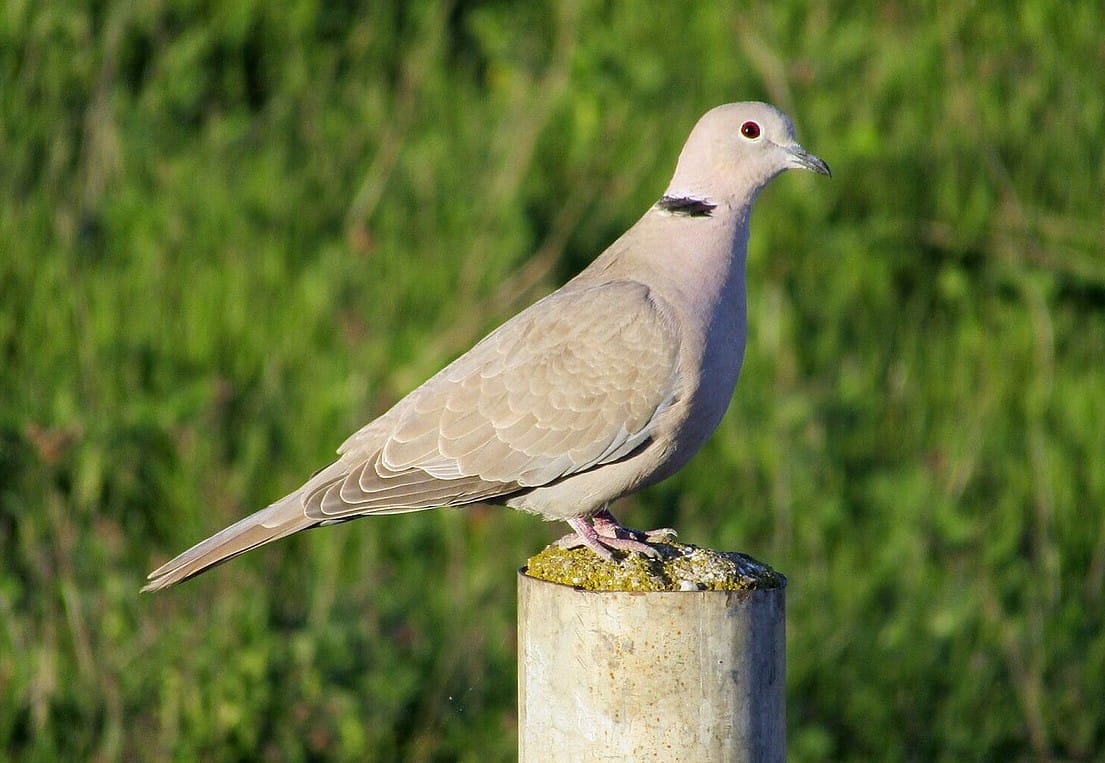
Eurasian Collared-Doves are slightly larger than Mourning Doves, measuring 12 to 14 inches in length with a wingspan of 18 to 22 inches. Their plumage is pale gray-tan with a distinctive black crescent-shaped collar on the nape. They have a square-tipped tail with white edges, dark eyes with pale blue-gray eye-rings, and short curved beaks. Their appearance is sleek and uniform.
Habitat and Distribution
Introduced from Europe, Eurasian Collared-Doves have spread widely across Colorado, thriving in urban, suburban, and agricultural areas. They are commonly seen around homes, parks, and farmlands, often nesting in trees, shrubs, and on man-made structures. They are particularly successful in regions with open spaces interspersed with human habitation.
Behavior
These doves are social, usually forming small flocks or pairs. They are calm, slow-moving, and forage primarily on the ground. Their flight is strong but steady, with a consistent wingbeat. Eurasian Collared-Doves are vocal, producing repetitive cooing sounds. Courtship includes bowing, tail fanning, and vocalizations to attract mates.
Diet
Their diet is mainly seeds, grains, and fruits. They feed in agricultural fields, gardens, and backyard feeders. Occasionally, they consume small insects during the breeding season. They are non-predatory and feed largely by pecking on the ground.
Breeding
Breeding can occur year-round in Colorado’s warmer regions. Nests are simple structures made of twigs and placed in trees, shrubs, or on buildings. Clutches usually consist of two white eggs incubated for approximately 14 days. Fledglings leave the nest in about 15–18 days, and multiple broods are possible annually.
Identification Tips
The black collar on the nape, pale gray-tan plumage, and square-tipped tail with white edges are key features. Their repetitive cooing and slightly larger size help distinguish them from Mourning Doves. Juveniles are duller but retain collar and tail markings.
Conservation Status
Eurasian Collared-Doves are thriving in Colorado and are considered non-native but not aggressively invasive. They are protected under general bird conservation laws and are now an integral part of the urban and suburban avian communities.
3. White-winged Dove (Zenaida asiatica)
Physical Characteristics
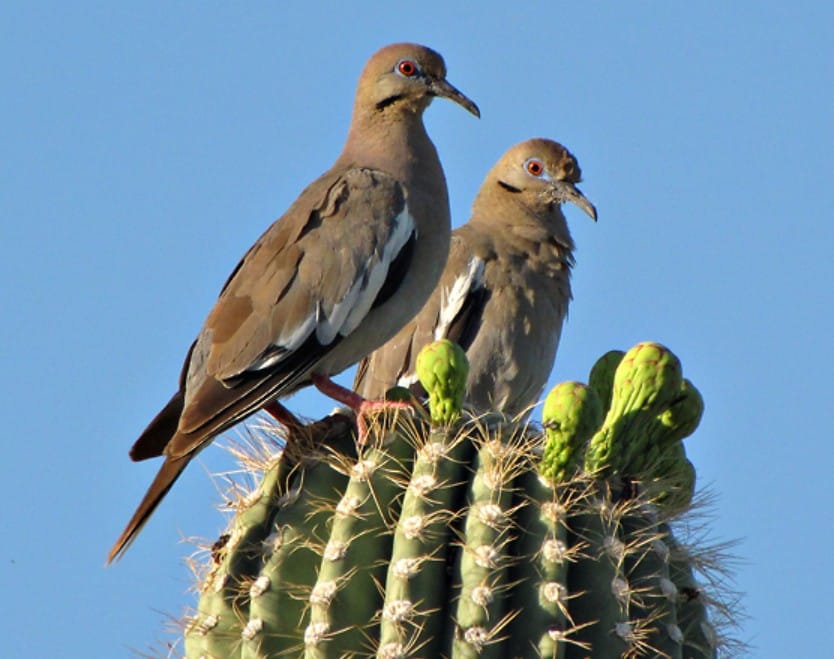
White-winged Doves are medium-large, measuring 11–13 inches in length with a wingspan of 17–20 inches. They have gray-brown plumage with a prominent white stripe along the wings visible in flight. Their eyes have a bright blue eye-ring, and the tail is long with a squared tip and white edges. They have a strong, streamlined body with pointed wings.
Habitat and Distribution
In Colorado, White-winged Doves are most common in the southern parts of the state and along the Arkansas River corridor. They inhabit riparian zones, agricultural fields, desert edges, and urban gardens. These doves require open areas for foraging and trees or shrubs for roosting and nesting.
Behavior
White-winged Doves are highly social and often form large flocks. They exhibit fast, direct flight patterns and are very vocal, producing loud, repetitive cooing calls. They are diurnal, feeding primarily during daylight hours, and are frequently observed bathing in shallow water sources.
Diet
Their diet includes seeds, grains, and fruits, often feeding on cultivated crops like corn, sorghum, and native desert plants. They occasionally eat berries and other fruits from garden plants. They forage mostly on the ground in groups and may concentrate in areas where food is abundant.
Breeding
White-winged Doves build platform nests in trees, shrubs, and sometimes in large cacti. Both parents incubate the 1–2 eggs for 13–15 days. Fledglings leave the nest after about two weeks, with continued parental care for several days. They may have two or more broods per year, depending on food availability and climate conditions.
Identification Tips
Look for the white wing stripe, bright blue eye-ring, and medium-large size. Their loud, repetitive cooing and social behavior also help identify them. Juveniles are duller but retain white wing edges and blue eye-ring.
Conservation Status
White-winged Doves are common and not considered threatened in Colorado. Populations benefit from agriculture and urban landscaping, which provide abundant food and nesting opportunities. Conservation efforts focus on habitat protection and monitoring population trends.
4. Inca Dove (Columbina inca)
Physical Characteristics
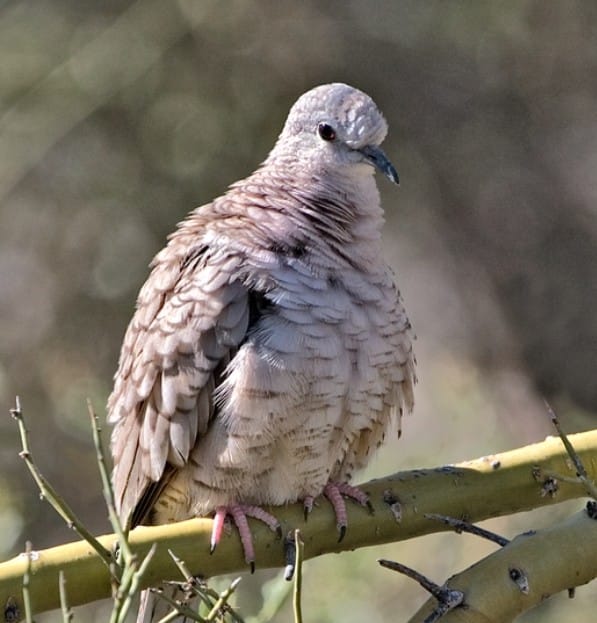
Inca Doves are small, measuring 6–7 inches in length with a wingspan of 9–11 inches. Their brownish-gray plumage has light-edged feathers giving a scaly appearance. They have a long, slightly rounded tail with white edges, a small head, dark eyes, and a thin beak. Their delicate appearance makes them distinct from larger doves.
Habitat and Distribution
Inca Doves are most common in southern Colorado, particularly in arid and suburban areas. They prefer open spaces with scattered trees or shrubs for perching and nesting. Inca Doves are highly adaptable to human presence and are often seen in gardens, parks, and urban courtyards.
Behavior
These doves are social, forming small flocks of 5–20 individuals. They are primarily ground foragers, pecking for small seeds and occasionally insects. Their flight is rapid and direct, and their soft, continuous cooing is distinctive. They coexist peacefully with other dove species and are non-aggressive.
Diet
Inca Doves feed mainly on small seeds from grasses, weeds, and cultivated plants. Occasionally, they eat insects to supplement protein, particularly during the breeding season. They forage on open ground, often near human habitation.
Breeding
Inca Doves build small, flimsy nests in trees, shrubs, or on man-made ledges. They lay two eggs per clutch, and both parents share incubation for approximately 14 days. Chicks fledge in about two weeks and may be cared for by parents for several more days. They are capable of multiple broods per year.
Identification Tips
They are easily recognized by their small size, scaly brown-gray plumage, long white-edged tail, and soft cooing calls. Juveniles are slightly duller but maintain the scaly feather pattern and tail shape.
Conservation Status
Inca Doves are abundant and not considered threatened. Their adaptability to urban and desert habitats ensures stable populations, and they are protected under migratory bird conservation laws.
Conclusion
Colorado hosts a diverse range of doves, from the widespread Mourning Dove to the adaptable Eurasian Collared-Dove, the southern White-winged Dove, and the small Inca Dove. Each species has unique physical traits, habitats, behaviors, and diets, reflecting the state’s varied ecosystems from urban areas to deserts and riparian zones. Observing these doves can be both enjoyable and educational, whether birdwatching in backyards, parks, or open fields. Protecting their habitats and understanding their life cycles ensures that Colorado’s dove populations remain abundant and thriving for generations to come.
Frequently Asked Questions (FAQs) about Doves in Colorado
- What types of doves can be found in Colorado? Mourning Dove, Eurasian Collared-Dove, White-winged Dove, and Inca Dove are the most common.
- Which dove is the most widespread in Colorado? The Mourning Dove is the most widespread and adaptable species.
- Are Eurasian Collared-Doves native to Colorado? No, they were introduced from Europe but have now established populations.
- What habitats do Mourning Doves prefer? They inhabit grasslands, farmlands, open woodlands, and suburban areas.
- Where can I see White-winged Doves in Colorado? Mostly in southern Colorado, along rivers, riparian zones, and agricultural fields.
- What is the diet of Inca Doves? Small seeds from grasses and weeds, with occasional insects.
- How can I differentiate a Mourning Dove from an Eurasian Collared-Dove? Look for the black crescent collar on Eurasian Collared-Doves and smaller size with pointed tail for Mourning Doves.
- Do doves form flocks? Yes, all species may form small or large flocks, especially outside the breeding season.
- Are any doves endangered in Colorado? No, all common species are abundant and stable.
- What time of year do Mourning Doves breed? They breed multiple times per year, typically in spring and summer.
- Do White-winged Doves migrate? Some populations are migratory, while others remain in southern Colorado year-round.
- Can I attract doves to my backyard? Yes, with bird feeders containing seeds like millet, cracked corn, and sunflower seeds.
- What is the average lifespan of a Mourning Dove? In the wild, about 1–5 years, though some may live longer.
- How do doves communicate? Through soft cooing calls, tail displays, and courtship bowing.
- Do Inca Doves breed multiple times a year? Yes, they are capable of multiple broods annually in suitable conditions.
- Which dove has a distinct white wing stripe? White-winged Dove.
- Do Eurasian Collared-Doves compete with native doves? They may compete for food and nesting sites, but populations are stable.
- What is the typical clutch size for Mourning Doves? Usually two eggs per clutch.
- Where do Inca Doves typically nest? In trees, shrubs, or ledges in urban and desert areas.
- How can juveniles be distinguished from adults? Juveniles are usually duller and lack full adult markings, but key features like tail shape and wing edges help.
- Are doves protected by law? Yes, most are protected under the Migratory Bird Treaty Act.
- Do doves eat insects? Occasionally, mainly during breeding season for extra protein.
- Which dove is smallest in Colorado? Inca Dove is the smallest.
- What color are Mourning Dove eyes? Dark with subtle blue-gray eye-ring.
- Do doves nest in urban areas? Yes, many species adapt well to human environments.
- What is the flight pattern of Inca Doves? Rapid, direct, and close to the ground.
- How can I identify a Eurasian Collared-Dove? Look for the black crescent-shaped collar on the nape and pale gray-tan plumage.
- Are White-winged Doves social? Yes, they often form large flocks, especially when feeding.
- What is a key distinguishing feature of Mourning Doves? Long pointed tail with white edges visible in flight.
- Do doves require water sources? Yes, they often bathe and drink from shallow water daily.
- Can doves adapt to Colorado winters? Yes, most species are hardy and survive winter by foraging and flocking for warmth.
- Do doves help in seed dispersal? Yes, they play an important role in spreading seeds of native and cultivated plants.
- Which dove has a scaly feather pattern? Inca Dove.
- Do doves perch on wires? Yes, Mourning and Eurasian Collared-Doves commonly do.
- Can I attract White-winged Doves to feeders? Yes, using seeds like millet, cracked corn, and sunflower seeds.
- How can I tell a juvenile White-winged Dove? Duller plumage with less pronounced white wing edges; eye-ring may not be fully bright.
- Do doves show courtship behaviors? Yes, including bowing, cooing, and aerial displays in some species.
- Are doves aggressive? No, they are generally peaceful and coexist with other birds.
Read more: 4 Types of Doves in Arizona (Pictures & Identification)