
Delaware is home to a variety of dove species, each with unique appearances and behaviors. Whether in urban areas, farmland, or along the coast, these birds are a delight for birdwatchers. Below is a detailed guide to the most common doves found in Delaware.
1. Mourning Dove (Zenaida macroura)

Physical Characteristics
Mourning Doves are slender, medium-sized birds with long, pointed tails and soft gray-brown plumage. They have a subtle pinkish hue on the chest and black spots on their wings. Adults measure 9–13 inches in length with a wingspan of 17–18 inches and weigh approximately 100–170 grams. Juveniles are slightly duller and lack the full wing pattern of adults.
Habitat and Distribution
These doves are common throughout Delaware, inhabiting open fields, suburban neighborhoods, parks, and woodland edges. They often nest in shrubs, small trees, or even on building ledges near open areas for foraging.
Behavior
Mourning Doves are known for their soft, mournful cooing calls. They are primarily ground feeders, picking seeds and grains from the soil. These doves fly quickly with rapid wing beats and are highly alert, taking off abruptly if threatened.
Diet
Their diet mainly consists of seeds, grains, and occasionally small insects. They often feed in open fields, along roadsides, or at backyard feeders.
Identification Tips
Look for their slender body, long pointed tail with white edges, soft gray-brown plumage, and distinctive cooing call. Black wing spots and pinkish breast are other key identifiers.
Conservation Status
Mourning Doves are abundant in Delaware and across North America. They are protected under the Migratory Bird Treaty Act, and regulated hunting ensures sustainable populations.
2. Eurasian Collared-Dove (Streptopelia decaocto)
Physical Characteristics
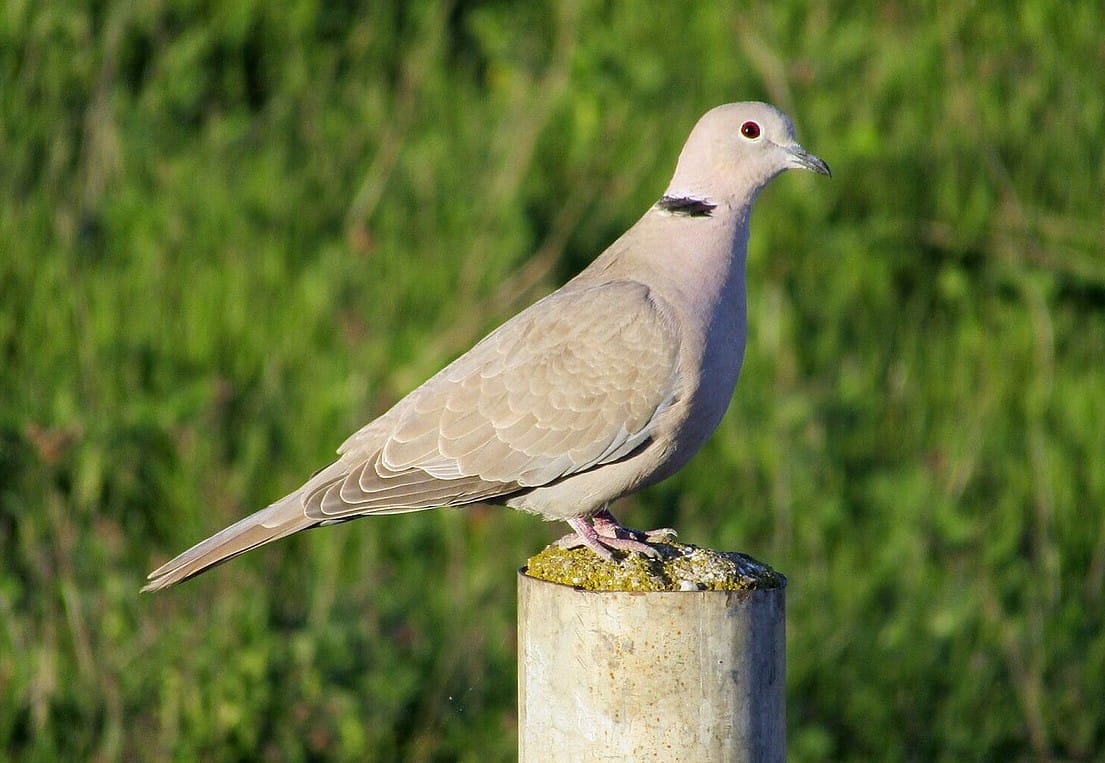
Eurasian Collared-Doves are medium-sized doves with light grayish-brown plumage and a distinctive black crescent or “collar” on the back of the neck. Adults are 12–14 inches long with a wingspan of 18–22 inches. Their eyes are dark, surrounded by pale skin, and their tail has white tips.
Habitat and Distribution
These doves thrive in suburban areas, farmlands, parks, and even along highways throughout Delaware. They are highly adaptable to human presence and often nest on ledges, in trees, or on rooftops.
Behavior
Eurasian Collared-Doves are social birds, often forming flocks. They are known for their loud, three-part cooing call. They are monogamous during the breeding season, and pairs will vigorously defend nesting sites.
Diet
They feed primarily on seeds, grains, and occasionally small fruits. They forage on the ground or at bird feeders, often in small flocks.
Identification Tips
Look for their pale gray-brown body, black neck collar, white tail tips, and distinctive three-part cooing call. Their larger size and more robust body compared to Mourning Doves are also helpful for identification.
Conservation Status
The Eurasian Collared-Dove is a non-native species that has become well-established in Delaware. Populations are growing but currently not considered harmful or invasive.
3. White-winged Dove (Zenaida asiatica)
Physical Characteristics
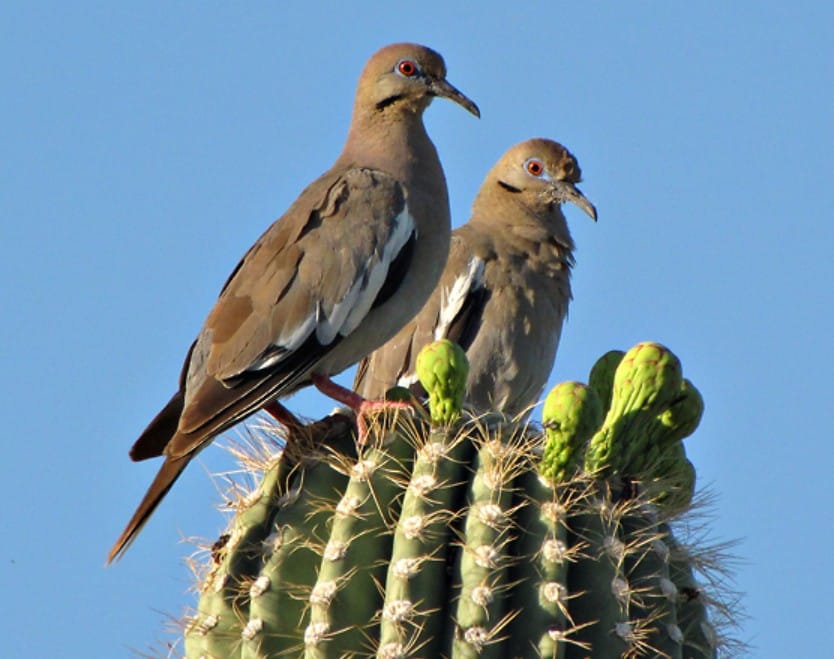
White-winged Doves are slightly larger than Mourning Doves, measuring 12–14 inches with a wingspan of around 22 inches. They have gray-brown plumage with prominent white wing edges that are visible in flight. Their eyes have subtle blue rings, and their tails have white tips.
Habitat and Distribution
While more common in the southern United States, occasional White-winged Doves are found in southern Delaware, especially near agricultural areas and urban regions with feeders. They prefer areas with trees for nesting and open spaces for foraging.
Behavior
White-winged Doves are social and often seen in small flocks. Their cooing calls are loud and rolling. During breeding season, pairs establish territories and build stick nests in trees or shrubs.
Diet
These doves primarily feed on seeds and grains, supplemented with fruits, berries, and occasionally insects. They often forage in agricultural fields or backyard feeders.
Identification Tips
Look for the white wing edges visible in flight, robust body shape, and blue eye ring. Their loud cooing calls help distinguish them from other species.
Conservation Status
White-winged Doves are protected under the Migratory Bird Treaty Act. Their presence in Delaware is less common, but populations in the U.S. are stable.
Conclusion
Delaware is home to several dove species, each with unique appearances, behaviors, and habitats. The Mourning Dove, Eurasian Collared-Dove, and White-winged Dove are the most commonly observed. Learning to identify these doves enhances birdwatching experiences and fosters appreciation for the diversity of wildlife in the state.
Frequently Asked Questions (FAQs)
- Q: What is the most common dove in Delaware?
A: The Mourning Dove is the most frequently observed dove in Delaware. - Q: Do doves migrate in Delaware?
A: Mourning Doves often migrate south in winter, while Eurasian Collared-Doves and White-winged Doves may remain year-round. - Q: Are doves protected in Delaware?
A: Yes, most dove species are protected under federal law through the Migratory Bird Treaty Act. - Q: Can I attract doves to my backyard?
A: Yes, providing seeds like millet, corn, and sunflower seeds along with water will attract doves. - Q: How can I tell Mourning Doves from Eurasian Collared-Doves?
A: Mourning Doves are smaller, with soft gray-brown plumage and black wing spots, while Eurasian Collared-Doves are larger, paler, and have a black neck collar. - Q: Are White-winged Doves common in Delaware?
A: They are less common but occasionally seen in southern Delaware near agricultural areas. - Q: What do doves eat?
A: Primarily seeds, grains, fruits, and occasionally small insects. - Q: How can I identify an Inca Dove in Delaware?
A: Inca Doves are not native to Delaware and are rarely seen. They are small with scaly-patterned feathers. - Q: Do doves mate for life?
A: Many species form seasonal monogamous pairs, but long-term pair bonds are possible. - Q: When is the best time to see doves in Delaware?
A: Spring and fall are ideal for observing migratory and breeding doves.
Read more: 3 Types of Doves in Texas (Pictures and Identification)