
Types of Eels are among the most fascinating fish on Earth. Long, flexible, and often mistaken for snakes, eels live in oceans, rivers, reefs, and even muddy riverbanks across the globe. Some migrate thousands of miles between freshwater and the deep sea, while others spend their lives tucked inside coral crevices, waiting for nightfall to hunt. This guide introduces you to the most notable eel species in a clear and friendly way. Each profile highlights how to identify them, where they live, and what makes their lifestyle so interesting. Hop in, and let’s get to know these slippery but remarkable creatures a little better.
Types of Eels
1. European Eel (Anguilla anguilla)
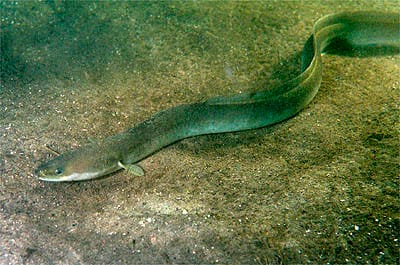
The European eel is often called one of nature’s great travelers. At first glance, it looks like a simple brownish eel with a smooth body and small eyes, but its life story is anything but ordinary. This species spends most of its adult life in rivers, lakes, and streams across Europe and parts of North Africa, yet it is born far away in the Sargasso Sea of the Atlantic Ocean.
Young European eels, known as glass eels because of their transparent bodies, drift on ocean currents for months before reaching European coasts. From there, they swim inland, sometimes climbing damp obstacles and wriggling across wet ground to reach suitable freshwater homes. One might even imagine them as tiny explorers, stubbornly pushing forward no matter what stands in the way.
As they grow, their bodies darken into yellowish-brown tones, and they become skilled nocturnal hunters. European eels feed on insects, worms, crustaceans, and small fish. During the day, they prefer to hide under rocks, in mud, or among submerged roots. Their secretive habits mean many people live near eels for years without ever seeing one.
After spending anywhere from 5 to more than 20 years in freshwater, something remarkable happens. The eel’s body changes: the eyes enlarge, the belly turns silvery, and the digestive system shuts down. This “silver eel” stage marks the start of its long return journey to the Sargasso Sea, where it will spawn once and then die. No one has ever observed their spawning directly, which adds a touch of mystery to their already dramatic life.
In terms of identification, European eels have a long dorsal fin that runs continuously along the back and around to the tail, blending into the anal fin. They can reach about 1.5 meters in length, though most are smaller. Their skin feels leathery and is coated in mucus, making them hard to grasp, much like trying to hold a bar of soap in the bath.
Sadly, European eels are now critically endangered. Barriers in rivers, overfishing, pollution, and changes in ocean currents have all taken a toll. Today, conservation programs focus on helping young eels reach inland waters and improving river habitats. Learning about this species is more than an exercise in curiosity; it is a reminder of how delicate long-distance life cycles can be.
Among all Types of Eels, the European eel stands out for its epic migration and quiet presence in everyday waterways. It is a fish of patience, endurance, and unanswered questions.
2. American Eel (Anguilla rostrata)
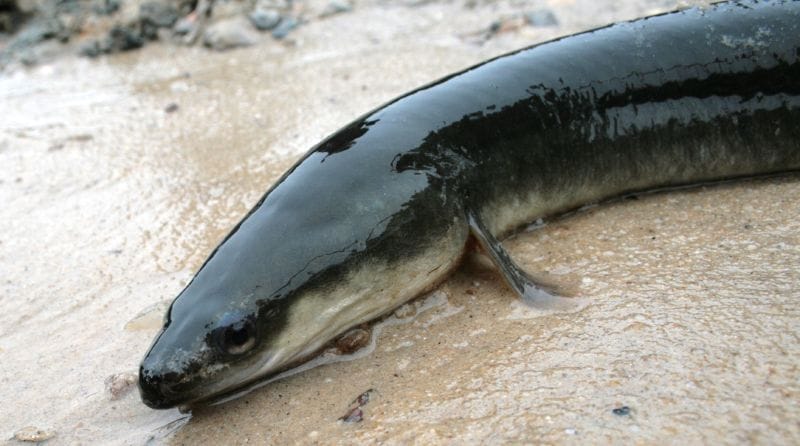
The American eel is the New World cousin of the European eel, and their lives read like parallel stories written on opposite sides of the Atlantic. Found throughout eastern North America, from Canada down to the Caribbean, this eel inhabits rivers, lakes, and coastal waters, often blending into muddy bottoms with ease.
Like its European relative, the American eel is born in the Sargasso Sea. The tiny larvae drift with currents until they reach North American shores. From there, they begin their inland journey, moving into freshwater systems where they will spend most of their growth years. If eels kept travel journals, these would be thick books.
American eels are opportunistic feeders. They eat insects, crayfish, small fish, and even dead material when the chance arises. This flexible diet helps them survive in a wide range of habitats, from slow-moving rivers to quiet ponds. At night, one might see their heads poking from the mud as they test the water for food.
In appearance, American eels are typically dark olive or brown on top, fading to a pale underside. They usually grow to about one meter, though larger individuals do occur. Their snake-like movement often surprises people who encounter them while fishing or wading, leading to startled shouts and a few quick steps backward.
As adults mature, they transform into silver eels and begin their journey back to the Sargasso Sea. This migration can cover thousands of kilometers, all without feeding. It is a one-way trip, powered by stored energy and instinct passed down through countless generations.
American eels play an important role in freshwater ecosystems. They help control populations of smaller animals and also serve as prey for birds, larger fish, and mammals. In this way, they sit quietly in the middle of the food web, doing their part without much fanfare.
Although still more common than the European eel, American eel numbers have declined in many areas. Dams, habitat loss, and fishing pressure have made their journeys harder. Fish ladders and river restoration projects now try to give these travelers a clearer path.
Within the broad list of Types of Eels, the American eel represents resilience. It adapts, persists, and keeps moving, reminding us that even ordinary-looking creatures can live extraordinary lives.
3. Japanese Eel (Anguilla japonica)

The Japanese eel is one of East Asia’s most familiar eel species, both in nature and on the dinner table. Native to Japan, China, Korea, and nearby regions, it inhabits rivers, lakes, and estuaries, often preferring warm, slow-moving waters with soft bottoms.
Its life begins far out in the western Pacific Ocean, where larvae drift back to coastal waters before entering freshwater. Young eels make their way upstream, settling into quiet stretches of river where food is plentiful and hiding spots abound. Watching a juvenile eel slip into a narrow crack is like seeing liquid pour into a bottle.
Japanese eels feed on aquatic insects, small crustaceans, and fish. They are mostly active at night, using a keen sense of smell to locate prey. During daylight hours, they stay tucked away in mud or under stones, waiting patiently for darkness to return.
Physically, the Japanese eel has a slender body with a dark greenish-brown back and a pale belly. It can reach about 1.3 meters in length. Its smooth skin and continuous fin make it easy to recognize as a true freshwater eel.
In many parts of Asia, this species has long been valued as food, especially in traditional dishes where grilled eel is thought to boost stamina during hot summers. This cultural importance, however, has also led to heavy fishing pressure.
Like other freshwater eels, the Japanese eel undergoes a silvering transformation before its final migration to sea for spawning. Scientists believe they return to specific ocean areas, guided by cues we are only beginning to understand. It is a bit like having a built-in compass set at birth.
Today, Japanese eels face serious population declines. Habitat loss, river barriers, and overharvesting of young glass eels have reduced their numbers. Conservation efforts now aim to protect river systems and regulate trade to give the species breathing room.
Among the many Types of Eels, the Japanese eel bridges nature and culture. It is both a wild river dweller and a symbol deeply rooted in human tradition.
4. Giant Moray (Gymnothorax javanicus)
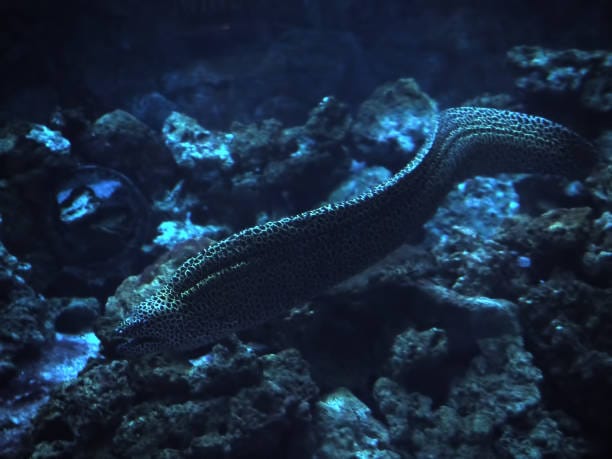
The giant moray is a very different kind of eel, built for life among coral reefs rather than river mud. Found across the Indo-Pacific, from the Red Sea to Hawaii, this species is the largest moray eel in the world, sometimes exceeding three meters in length.
At first sight, the giant moray can look intimidating. Its head is broad, the jaws strong, and the mouth often held open. This open-mouth pose is not a threat display but a way to pump water over the gills for breathing. Still, if looks could talk, this one might say, “Give me some space.”
Its body is thick and muscular, marked with dark spots and blotches over a yellowish or brown background. These patterns help it blend into rocky reef surfaces, making it nearly invisible until it decides to move.
Giant morays are ambush predators. They spend daylight hours hidden in crevices, with only the head visible, then emerge at night to hunt fish, octopus, and crustaceans. With lightning-fast strikes, they grab prey and retreat back into their holes to swallow it.
Despite their fearsome reputation, giant morays are not naturally aggressive toward humans. Most bites happen when people try to feed them or get too close. Given a little respect, they usually prefer to mind their own business.
These eels also play a key role in reef ecosystems by controlling populations of smaller reef fish. In some places, they have even been observed cooperating with groupers, working together to flush prey from hiding spots. It is teamwork, reef-style.
Identification is fairly straightforward: huge size, thick body, spotted pattern, and a powerful head. Unlike freshwater eels, morays lack pectoral fins, giving them an even more snake-like appearance.
In the wide list of Types of Eels, the giant moray represents strength and presence. It is a reminder that reefs are home to both delicate beauty and formidable hunters.
5. Snowflake Moray (Echidna nebulosa)

The snowflake moray is one of the most recognizable reef eels, thanks to its striking pattern of white and yellow blotches scattered over a dark body. Native to the Indo-Pacific, it lives among coral reefs, rocky shores, and lagoons, usually in shallow waters.
Compared to the giant moray, the snowflake moray is modest in size, growing to about one meter. Still, its bold markings and curious nature make it a favorite among divers and even in public aquariums.
This species has a rounded snout and blunt teeth designed for crushing rather than slicing. That tells us a lot about its diet. Snowflake morays mainly eat crustaceans such as crabs and shrimp, along with sea urchins and mollusks. Fish are on the menu too, but less often.
During the day, one might see a snowflake moray peeking from a rocky hole, its patterned head swaying gently with the water. At night, it becomes more active, gliding over the reef in search of food. Its movement is smooth and almost ribbon-like, a quiet dance through coral corridors.
Snowflake morays are generally calm around people and often become accustomed to divers. Some individuals even appear to “recognize” regular visitors, giving the impression of a curious neighbor checking who is at the door.
In terms of identification, look for the snow-like blotches, thick body, and yellowish highlights around the head. Like other morays, it lacks pectoral fins and relies on its long dorsal fin for balance as it swims.
These eels contribute to reef health by keeping populations of hard-shelled invertebrates in check. Without predators like the snowflake moray, some reef areas could become overrun by crabs or urchins.
Among all Types of Eels, the snowflake moray shows that not every impressive predator has to be huge or scary. Sometimes, a striking pattern and a calm attitude are enough to steal the show.
“`html
6. Giant Moray (Gymnothorax javanicus)
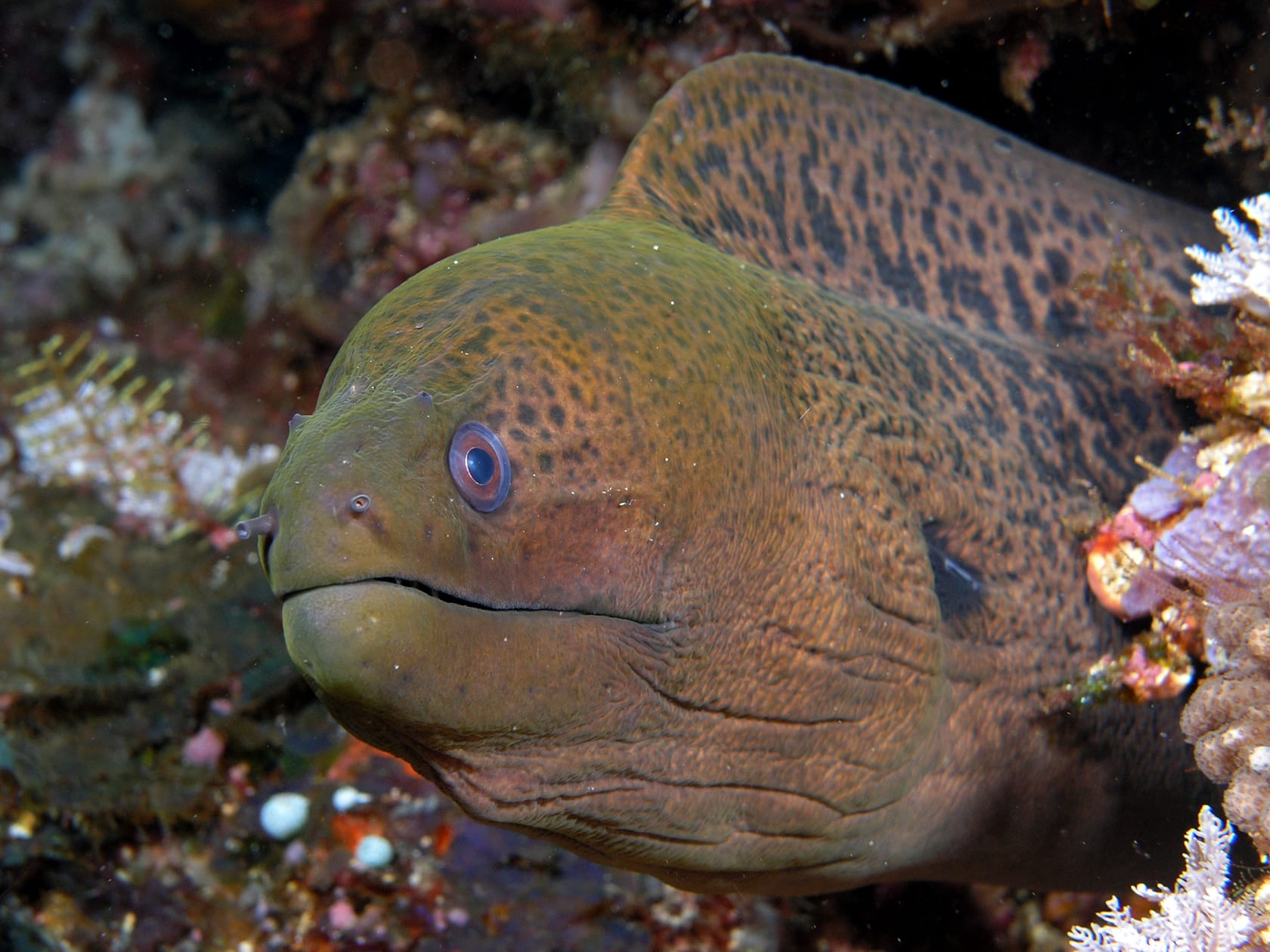
The giant moray is often the first eel people think of when imagining a powerful reef predator. Found throughout the Indo-Pacific region, from the Red Sea and East Africa to Hawaii, this impressive eel rules coral reefs and rocky slopes with quiet confidence. It is the largest moray eel in the world, capable of growing over 3 meters long and weighing more than 30 kilograms.
At first glance, the giant moray looks fierce. Its head is broad, the jaws are packed with sharp teeth, and its mouth is usually open. This open-mouth posture is not a threat display. It is simply how the eel breathes, pumping water across its gills while resting in a crevice. Still, for a diver drifting past, that toothy grin can raise the heartbeat a notch.
The body of the giant moray is thick and muscular, colored yellowish to brown with dark spots and blotches. These patterns break up its outline and help it blend into coral and rock. When the eel is tucked into its shelter, only the head may be visible, making it look like part of the reef itself.
Giant morays are ambush hunters. During the day, they stay hidden in caves or cracks, conserving energy. As dusk falls, they become active, gliding across the reef in search of prey. Their diet includes fish, octopus, cuttlefish, and crustaceans. With a sudden strike, they grab prey and retreat to their lair to swallow it whole.
One fascinating behavior seen in giant morays is cooperative hunting. In some reefs, they have been observed teaming up with groupers. The grouper signals the eel, and together they flush prey out of hiding places that either hunter alone could not reach. It is a fine example of teamwork in the underwater neighborhood.
Despite their reputation, giant morays are not naturally aggressive toward humans. Most incidents happen when people try to hand-feed them or get too close for comfort. Left alone, they usually show little interest in divers. Think of them as grumpy neighbors who just want peace and quiet.
Identification is straightforward among the Types of Eels. The giant moray stands out for its sheer size, thick body, spotted pattern, and massive head. Unlike freshwater eels, it has no pectoral fins, which gives it an even more snake-like look.
Ecologically, giant morays play an important role as top predators on reefs. By keeping fish and invertebrate populations in balance, they help maintain healthy reef systems. Without predators like them, reef communities could easily tip out of balance.
Seeing a giant moray in the wild is a memorable experience. It is a reminder that reefs are not just gardens of colorful fish, but living systems shaped by strong and skilled hunters.
7. Snowflake Moray (Echidna nebulosa)

The snowflake moray is one of the most recognizable reef eels, thanks to its bold pattern of white and yellow blotches scattered across a dark body. Native to the Indo-Pacific, it inhabits coral reefs, rocky shores, and lagoons, often in shallow, clear waters where divers and snorkelers can easily spot it.
Compared to giants like Gymnothorax javanicus, the snowflake moray is modest in size, usually reaching about one meter in length. What it lacks in size, however, it makes up for in charm. Its rounded snout and expressive eyes give it an almost curious look, as if it is always watching the world go by.
One might often see a snowflake moray poking its head out from a rocky hole during the day. It sways gently with the current, tasting the water with its sense of smell. This calm daytime behavior contrasts with its nighttime routine, when it leaves its shelter to hunt.
Snowflake morays have blunt, molar-like teeth rather than sharp slicing teeth. This tells us a lot about their diet. They mainly feed on hard-shelled prey such as crabs, shrimp, sea urchins, and mollusks. Fish are eaten too, but crustaceans are the real favorites. It is like having a built-in nutcracker for dinner.
The body coloration of the snowflake moray varies from dark brown to black, overlaid with pale yellow or white blotches that look like scattered snowflakes, hence the name. These markings help break up its outline against reef backgrounds, offering camouflage among corals and rocks.
Snowflake morays are generally tolerant of human presence. In many popular dive sites, they appear accustomed to divers and may even approach out of curiosity. Some aquarists keep them in large marine tanks, where their hardy nature and striking look make them popular display animals.
Like other morays, the snowflake lacks pectoral fins and relies on its long dorsal fin that runs from head to tail for stability. Its thick, muscular body allows it to wedge firmly into crevices, where it can anchor itself against waves and currents.
Within reef ecosystems, snowflake morays help control populations of crustaceans and other invertebrates. This keeps reef surfaces from being overgrazed or overcrowded, quietly supporting coral health.
Among all Types of Eels, the snowflake moray shows that predators do not always have to look intimidating. Sometimes, a patterned face peeking from a rock is enough to steal the show.
8. Zebra Moray (Gymnomuraena zebra)

The zebra moray is hard to miss. With bold black and white bands running the length of its body, this eel looks like it borrowed its wardrobe from a savanna zebra and brought it underwater. Found across the Indo-Pacific, it lives on coral reefs, rocky slopes, and coastal lagoons.
Zebra morays can grow up to about 1.5 meters long, giving them a solid, thick appearance. Their bodies are muscular, and their heads are broad with blunt snouts. Unlike many morays, zebra morays have rounded, crushing teeth rather than sharp fangs.
This dental setup hints at their preferred meals. Zebra morays mainly eat hard-shelled prey such as crabs, snails, sea urchins, and other invertebrates. Watching one crunch through a crab shell is a bit like hearing someone crack nuts at a picnic.
During the day, zebra morays usually stay hidden in crevices, with only their striped heads visible. At night, they become more active, moving slowly across the reef in search of food. Their swimming style is calm and deliberate, more like a slow parade than a chase.
Despite their size, zebra morays are known for their gentle nature. They are often described as one of the more docile moray species and rarely show aggression toward divers. Many underwater photographers favor them because they tend to stay put long enough for a good photo.
In appearance, the zebra moray’s bold bands are its main identifying feature. The contrast between black and creamy white makes it stand out even in the colorful reef environment. Its thick body and blunt face further separate it from slimmer, sharper-toothed morays.
Zebra morays also play a role in reef balance by preying on invertebrates that might otherwise multiply quickly. In doing so, they help keep reef surfaces from becoming overcrowded or damaged.
Within the broad list of Types of Eels, the zebra moray brings a touch of graphic design to the ocean. It proves that nature has a flair for bold patterns as well as subtle camouflage.
9. Banded Moray (Gymnothorax rueppelliae)

The banded moray is another striking reef eel, known for its alternating dark and light bands that run along its long, slender body. Native to the Indo-Pacific, it inhabits coral reefs, rocky shores, and coastal waters, often hiding among crevices and coral heads.
Growing to about one meter in length, the banded moray is slimmer than some of its heavier cousins. Its narrow body allows it to slip easily into tight spaces, where it can wait in ambush for passing prey.
The bands on its body vary in shade, usually dark brown or black alternating with pale yellow or white. This pattern provides camouflage among coral branches and reef shadows, breaking up the eel’s outline and making it hard for prey to detect.
Banded morays are carnivorous, feeding mainly on small fish, crustaceans, and occasionally cephalopods. They rely on quick strikes from their hiding spots, grabbing prey before it has a chance to react. It is a game of patience followed by sudden action.
During daylight hours, one might see only the head of a banded moray peeking out from a hole, mouth gently opening and closing as it breathes. At night, it becomes more active, weaving through the reef in search of food.
Compared to larger morays, banded morays are less intimidating, though they still deserve respect. Like all morays, they will defend themselves if threatened, but they usually prefer to retreat into their shelters.
Identification is based on the clear banding pattern, slender body, and relatively pointed head. These features make it easier to tell apart from thicker, blotch-patterned morays.
Ecologically, the banded moray helps regulate small fish and invertebrate populations on reefs. By doing so, it quietly contributes to the balance of reef communities.
Among the many Types of Eels, the banded moray is a classic example of reef adaptation: slim, stealthy, and perfectly at home among coral shadows.
10. Fimbriated Moray (Gymnothorax fimbriatus)

The fimbriated moray, sometimes called the dark-edged moray, is a colorful reef eel found throughout the Indo-Pacific. It lives among coral reefs, rocky coastlines, and lagoons, often in shallow waters where sunlight brings out its vivid patterns.
This species usually grows to about one to 1.2 meters in length. Its body is thick and muscular, marked with mottled patterns of brown, yellow, and cream. Dark edges around the fins give it a fringed appearance, which is where the name “fimbriated” comes from.
The head of the fimbriated moray is broad, with strong jaws and sharp teeth suited for gripping slippery prey. Its diet includes fish, crustaceans, and octopus. Like many morays, it is a patient ambush hunter, relying on surprise rather than long chases.
During the day, fimbriated morays rest in crevices with just their heads showing. As night falls, they leave their shelters to patrol the reef. Their movement is smooth and flowing, as if they are gliding rather than swimming.
Fimbriated morays are generally shy but can become bold if accustomed to human presence, especially in areas where divers are common. Still, they are best admired from a respectful distance. A curious eel is charming; a startled one is best avoided.
Identification is based on the mottled coloration, dark fin edges, and thick body. Compared to snowflake or zebra morays, the fimbriated moray’s pattern is more irregular, giving it a marbled look.
Like other reef morays, this species plays a role as a mid-level predator, helping control populations of reef fish and invertebrates. Its presence adds another thread to the complex web of reef life.
Among all Types of Eels, the fimbriated moray stands out for its rich colors and classic moray shape. It is a living piece of reef art, shaped by evolution and perfectly suited to its coral home.
“`
“`html
11. Slender Giant Moray (Strophidon sathete)
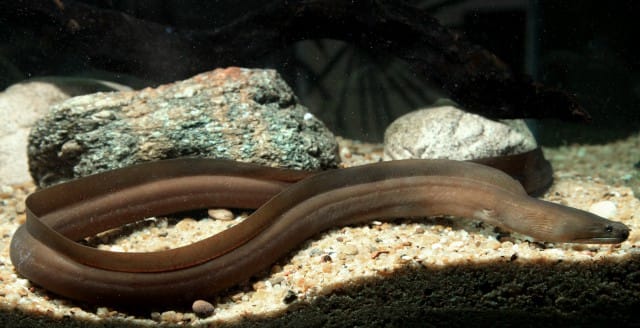
The slender giant moray is a true giant hiding behind a misleading name. Although it sounds delicate, this species is actually the longest eel in the world, capable of reaching lengths of more than 4 meters. Found across the Indo-Pacific, from East Africa to Australia and Japan, it lives in coral reefs, rocky shores, estuaries, and even murky coastal waters.
Unlike the bulky giant moray, the slender giant moray has a long, narrow body that looks almost ribbon-like when stretched out. Its coloration is usually dark brown to gray, sometimes with faint mottling. This subdued look helps it blend into shadowy reef cracks and rocky crevices.
One might mistake it for a thick rope tucked into a hole until it suddenly moves. When it does, the eel reveals a powerful swimmer capable of quick bursts of speed. Despite its size, it often keeps a low profile, spending much of the day hidden away.
The slender giant moray feeds on fish, crustaceans, and occasionally octopus. Its long jaws are lined with sharp teeth, perfect for gripping slippery prey. Like most morays, it is an ambush predator, waiting patiently before striking with precision.
Behavior-wise, this eel is usually shy and avoids open water. Divers rarely see the full length of its body unless it decides to move between shelters. Most encounters involve just a head peeking out, watching calmly as bubbles drift past.
Identification among the Types of Eels is based on its extreme length, narrow body, and relatively plain coloration. When fully extended, it looks more like a sea serpent from old sailor tales than a typical reef eel.
Ecologically, the slender giant moray sits near the top of the reef food chain. Its presence helps regulate populations of medium-sized fish and invertebrates, contributing to balance within coastal systems.
Seeing one in the wild is rare and memorable. It is a reminder that the ocean still holds creatures that stretch our sense of scale and imagination.
12. Tire Track Eel (Mastacembelus armatus)
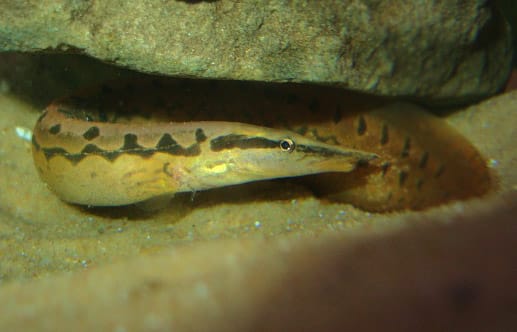
The tire track eel brings us back to freshwater, though it is not a true eel in the scientific sense. Still, its long body and eel-like shape earn it a place in most guides to eels. Native to South and Southeast Asia, it inhabits rivers, streams, ponds, and floodplains with muddy or sandy bottoms.
This eel gets its common name from the dark, looping patterns along its back, which resemble tire tracks pressed into wet ground. These markings make it one of the easiest eel-like fish to identify at a glance.
Tire track eels usually grow to about 60 to 90 centimeters in length. Their bodies are long and flexible, with a pointed snout and small spines along the back. During the day, they often bury themselves in soft substrate, leaving only the head exposed.
At night, they become active hunters, searching for insects, worms, crustaceans, and small fish. Their sense of smell is well developed, allowing them to locate food even in murky water. One might think of them as nighttime gardeners, quietly patrolling the riverbed.
In aquariums, tire track eels are known for their shy but curious nature. They may hide at first but often become more visible once they grow accustomed to their surroundings. Many fish keepers describe them as having distinct personalities, which adds to their charm.
Identification is straightforward: look for the looping dark patterns on a lighter brown or tan background, along with the long, snake-like body. Unlike morays and congers, tire track eels have a series of small dorsal spines near the head.
In the wild, they play a role in controlling insect and invertebrate populations in freshwater systems. Their burrowing behavior also helps stir up sediments, which can influence how nutrients move in the water.
Among the many Types of Eels, the tire track eel stands out for its striking pattern and freshwater lifestyle. It shows that eel-like forms thrive far beyond coral reefs and open seas.
13. European Conger (Conger conger)

The European conger is one of the largest true eels in the Atlantic Ocean and a powerful presence along European coasts. Found from Norway to Senegal, including the Mediterranean Sea, it lives on rocky bottoms, wrecks, and offshore reefs, often at considerable depths.
European congers can grow over 3 meters long and weigh more than 100 kilograms, making them among the heaviest eels on Earth. Their bodies are thick and muscular, colored gray to black with a pale underside. Compared to morays, they look smoother and more streamlined.
During the day, conger eels usually hide in holes, caves, or shipwrecks, with just the head protruding. At night, they leave their shelters to hunt across the seafloor. Their diet includes fish, squid, octopus, and crustaceans. With size comes confidence, and few prey items are safe once a conger sets its sights on them.
The head of the European conger is broad, with strong jaws and sharp teeth. Unlike morays, congers have pectoral fins just behind the head, which helps distinguish them. Their eyes are relatively large, adapted for low-light conditions in deeper water.
European congers are known for their strength. Fishermen have long told stories of large congers tangling lines, breaking gear, and even trying to wedge themselves into rocks when hooked. It is a bit like trying to reel in a living cable.
Reproduction in congers remains mysterious. Like freshwater eels, they are believed to spawn in deep ocean waters and die afterward, but their exact spawning grounds are still not fully known.
Ecologically, European congers are top predators in many coastal habitats. They help regulate fish and invertebrate populations, contributing to the structure of seabed communities.
Among all Types of Eels, the European conger represents raw strength and size in cold and temperate seas. It is a heavyweight champion of the eel family.
14. American Conger (Conger oceanicus)
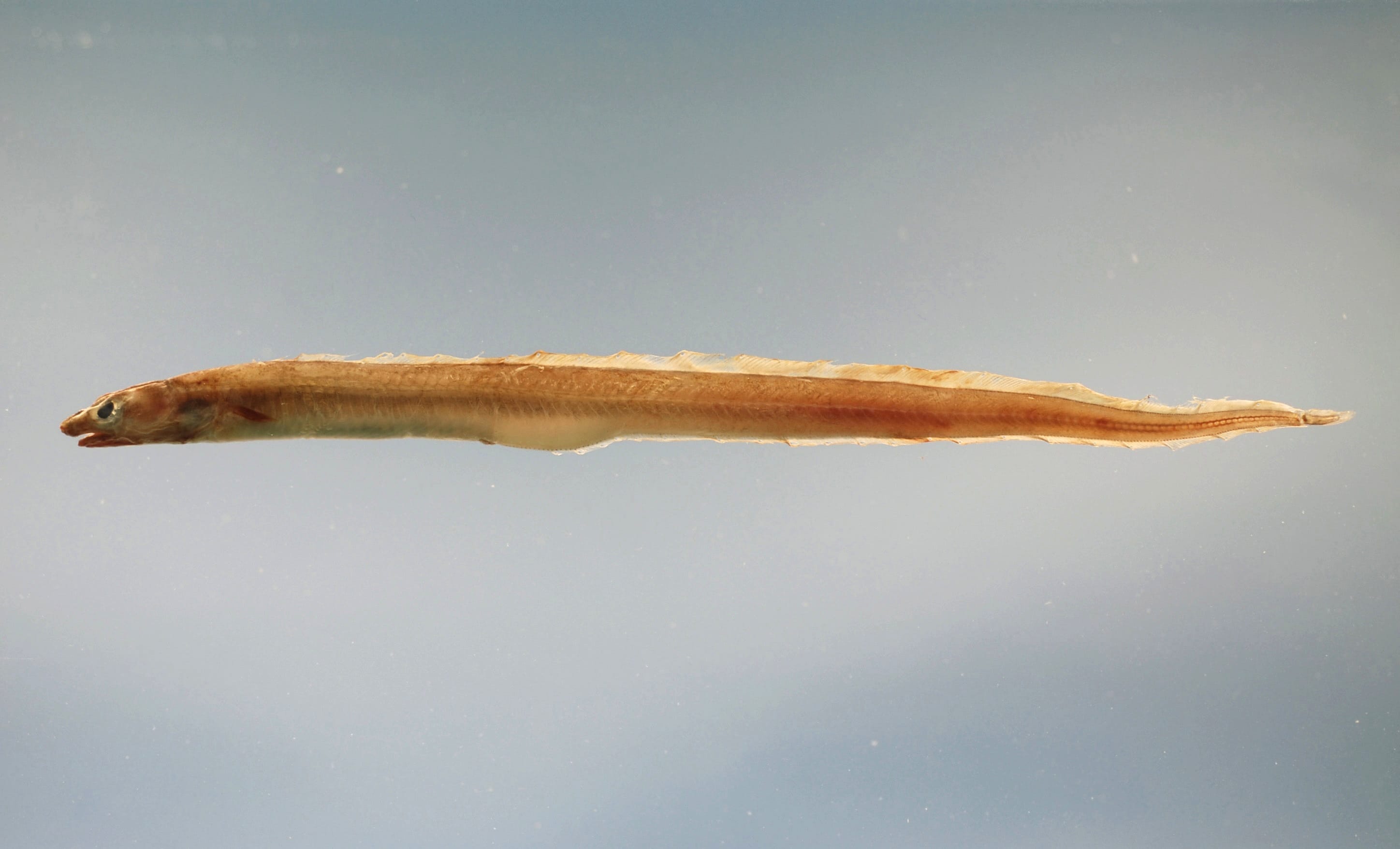
The American conger is the western Atlantic counterpart to the European conger, ranging from Nova Scotia down to the Gulf of Mexico and the Caribbean. It inhabits rocky bottoms, reefs, and sandy areas, from shallow coastal waters to deep offshore zones.
Although generally smaller than its European cousin, the American conger can still reach impressive lengths of over 2 meters. Its body is long and muscular, usually gray to bluish-gray, with a pale belly. The smooth skin and continuous fin give it a sleek, torpedo-like appearance.
American congers are mostly nocturnal. By day, they hide in crevices, under ledges, or within wrecks. As darkness falls, they roam the seafloor in search of prey, which includes fish, squid, crabs, and other bottom-dwelling animals.
One might picture them as nighttime patrol officers of the seabed, quietly moving along while most other creatures sleep. Their sense of smell helps them locate food even in murky or dark waters.
Identification among the Types of Eels includes noting the presence of pectoral fins, a large mouth, and a more streamlined head compared to morays. These features mark it clearly as a conger rather than a reef moray.
American congers are sometimes caught by anglers, often unintentionally, and are known for putting up a strong fight. Once on deck, they can be hard to handle due to their strength and slippery bodies.
In coastal ecosystems, they act as important predators, helping control populations of fish and invertebrates. Their role keeps the balance of life along rocky and sandy bottoms.
Among the many Types of Eels, the American conger stands as a symbol of quiet power in Atlantic waters, moving unseen until night gives it free rein.
15. Grey Conger (Conger cinereus)

The grey conger, sometimes called the longfin African conger, is a lesser-known but fascinating member of the conger family. Found mainly in the eastern Atlantic and parts of the Indian Ocean, it inhabits coastal reefs, rocky bottoms, and deeper offshore areas.
This species has a long, slender body compared to the bulkier European conger. Its coloration is typically uniform gray or gray-brown, which provides excellent camouflage against rocky seabeds and shadowed reef faces.
Grey congers can grow to around 1.5 to 2 meters in length. They have well-developed pectoral fins and a pointed head, giving them a streamlined profile built for cruising along the bottom in search of food.
Like other congers, they are mostly active at night. During the day, they hide in crevices, caves, or under rocks, often sharing shelter with other marine creatures. When darkness arrives, they venture out to hunt fish, squid, and crustaceans.
Because they often live at greater depths, grey congers are not commonly seen by divers. Most knowledge about them comes from deep-sea observations and fishing records, which adds a touch of mystery to their story.
Identification is based on the plain gray coloration, elongated body, and presence of pectoral fins. Compared to patterned morays, the grey conger looks simple, but that simplicity suits its shadowy lifestyle.
Ecologically, grey congers fill the role of mid- to top-level predators in deeper coastal habitats. They help shape the communities of fish and invertebrates living along the seafloor.
Among all Types of Eels, the grey conger represents the quieter side of ocean giants. It may not wear bold patterns, but it holds its place as a steady hunter in the dim light of deeper waters.
“`
“`html
16. White-spotted Conger (Conger myriaster)

The white-spotted conger is a well-known eel in the western Pacific, especially around Japan, Korea, and China. It lives along rocky coasts, sandy bottoms, and continental shelves, often at moderate depths where daylight fades into a bluish haze.
This species can reach lengths of around 1.5 meters. Its body is thick and muscular, colored gray to brown, with small pale spots scattered along the sides. These spots give it a speckled look that helps break up its outline against rocky or sandy backgrounds.
White-spotted congers are mostly nocturnal. During the day, they hide in burrows or crevices, sometimes sharing space with other bottom-dwellers. When night falls, they emerge to hunt fish, squid, shrimp, and other invertebrates that roam the seabed.
The head is broad with a strong jaw and sharp teeth, well suited for gripping slippery prey. Like other congers, this species has pectoral fins just behind the gills, a helpful feature for identifying it among the many Types of Eels.
In East Asia, the white-spotted conger is also valued as food and appears in local seafood markets. Its firm flesh is used in soups and grilled dishes, making it both an ecological player and a cultural ingredient.
Ecologically, it serves as an important predator in coastal ecosystems, helping regulate populations of fish and invertebrates on the seafloor.
The white-spotted conger may not be as famous as some reef morays, but in temperate seas, it holds a similar role as a steady, nighttime hunter.
17. Threadtail Conger (Uroconger lepturus)
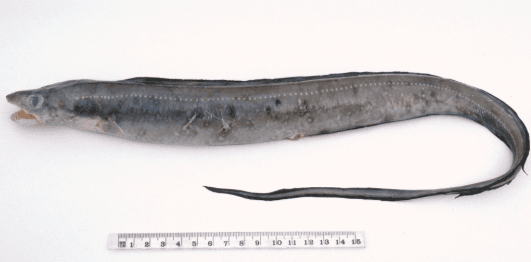
The threadtail conger looks as if its tail was pulled into a long, thin thread, giving the species its memorable name. Found in tropical and subtropical oceans worldwide, it lives near sandy bottoms and continental slopes, often at considerable depths.
This eel has a slender body that tapers dramatically into a whip-like tail. The front half is thicker and more muscular, while the tail becomes extremely thin, sometimes looking almost like a piece of string trailing behind.
Threadtail congers can reach lengths of about 1 to 1.5 meters. Their coloration is usually brownish to gray, helping them blend into dim seafloor environments where light is scarce.
Little is known about their daily behavior because they often live deeper than most divers can reach. However, like many congers, they are thought to be nocturnal hunters, feeding on small fish and invertebrates near the bottom.
Identification among the Types of Eels is easy once you notice the extremely thin tail, which sets this species apart from most other congers and morays.
Although rarely seen, the threadtail conger reminds us that eel diversity extends far beyond reefs and rivers, into quieter, deeper corners of the ocean.
18. Blacktail Buckbill Eel (Saurenchelys fierasfer)

The blacktail buckbill eel is a curious deep-sea species with a head shape that truly stands out. Found in parts of the Indo-Pacific, it inhabits deep waters along continental slopes, where sunlight never reaches.
Its most distinctive feature is its long, flattened snout that resembles a duck’s bill. This unusual shape gives the eel its common name and hints at a specialized feeding style.
The body is slender and pale, often pinkish or light brown, while the tail tip is dark, almost black. This contrast makes the tail look like it has been dipped in ink.
Blacktail buckbill eels feed mainly on small fish and crustaceans, using their extended snouts to probe into soft sediments. In the deep sea, where food can be scarce, every adaptation counts.
Because of their deep habitat, encounters with this eel are rare, usually limited to deep-sea surveys or accidental captures. That adds a sense of mystery to their story.
Among the many Types of Eels, the blacktail buckbill eel shows how unusual body shapes can evolve when life pushes into dark, demanding environments.
19. Stippled Spoon-nose Eel (Echiophis punctifer)

The stippled spoon-nose eel is another species with a distinctive head shape. Its snout is broad and rounded, resembling a spoon, which sets it apart from most other eels. This eel is found in tropical Indo-Pacific waters, often near sandy or muddy bottoms.
Its body is long and slender, marked with small dark spots that give it a stippled appearance. These spots help camouflage the eel against speckled seabed sediments.
Spoon-nose eels spend much of their time buried in sand, with only the head exposed. From this position, they wait for small fish or crustaceans to pass by, then strike quickly.
This sit-and-wait strategy saves energy and suits life on open seabeds where hiding places are limited. It is a bit like waiting behind a curtain and pulling it aside at just the right moment.
Identification among the Types of Eels comes down to the spoon-shaped snout and spotted pattern, both of which are unusual features in the eel family.
The stippled spoon-nose eel may not be colorful, but its shape and habits make it a fine example of how eels adapt to sandy environments.
20. Black-striped Snake Eel (Callechelys catostoma)

The black-striped snake eel lives up to its name with a body that looks remarkably like a striped sea snake. Found in tropical Atlantic waters, it inhabits sandy and muddy bottoms near reefs and coastal areas.
This eel has a long, slender body marked by dark longitudinal stripes running from head to tail. These stripes help it blend into rippled sand patterns created by waves and currents.
Black-striped snake eels are burrowers. They spend much of their time hidden beneath the sand, with only the head sticking out. When disturbed, they can vanish in seconds, sliding backward into the substrate like a zipper closing.
They feed on small fish and invertebrates, lunging from their burrows to grab passing prey. This ambush style suits their hidden lifestyle perfectly.
Unlike morays, snake eels often have reduced or absent fins and a pointed tail adapted for digging. This makes them excellent sand specialists among the Types of Eels.
Seeing one in the wild is often a fleeting moment, just a striped head peeking out before it disappears again.
21. Purple Spaghetti Eel (Moringua raitaborua)
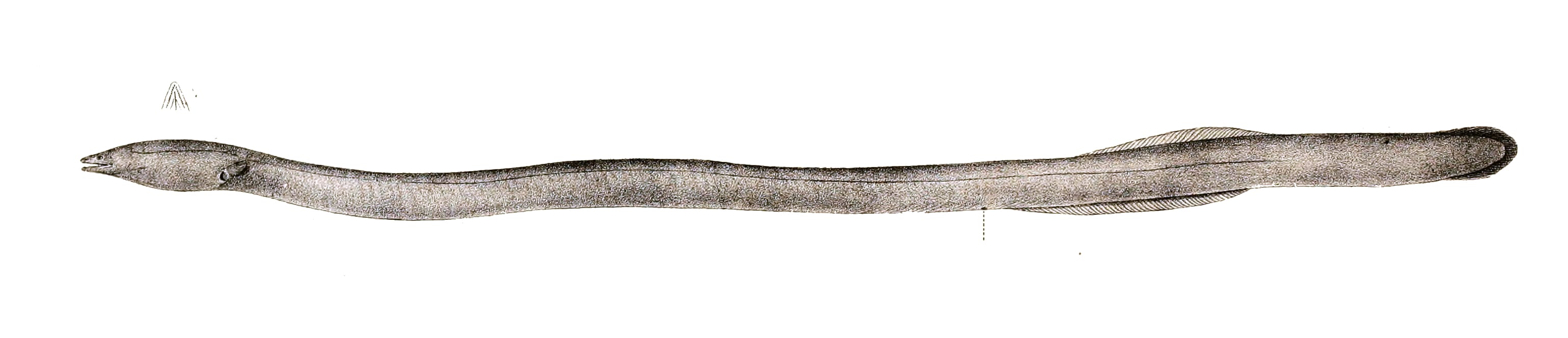
The purple spaghetti eel looks exactly as its name suggests: thin, noodle-like, and often tinged with purplish or pink hues. Found in tropical Indo-Pacific waters, it lives on sandy and muddy bottoms near reefs and lagoons.
This eel’s body is extremely slender, much thinner than most people expect when they hear the word “eel.” Adults may reach around 60 to 80 centimeters, but their thickness is more like that of a pencil.
Purple spaghetti eels spend most of their time buried in sand, with only the head exposed. They sway gently in the current, waiting for plankton and tiny prey to drift close enough to snap up.
Unlike many eels that hunt larger prey, spaghetti eels often feed on very small animals, making them more like plankton pickers than classic predators.
Identification among the Types of Eels is easy thanks to the ultra-thin body and delicate appearance. Few other eels look so much like living threads.
They may be small, but purple spaghetti eels add another layer of variety to sandy seabed communities, showing that eels come in many shapes and lifestyles.
22. Bengal Spaghetti Eel (Moringua javanica)

The Bengal spaghetti eel is closely related to the purple spaghetti eel but is found mainly in the Indian Ocean, including coastal waters of India, Southeast Asia, and nearby regions.
Like its cousin, it has a very slender, thread-like body that allows it to burrow easily into soft sand and mud. Its coloration is usually pale brown to pinkish, helping it blend into seabed sediments.
Bengal spaghetti eels spend most of their lives hidden, with only the head protruding. From this position, they catch tiny crustaceans and plankton drifting by in the current.
This lifestyle keeps them safe from many predators while also letting them feed with minimal effort. It is a quiet existence, but a successful one.
Identification is based on the extremely thin body, small head, and subtle coloration. Among the Types of Eels, spaghetti eels stand out as the delicate end of the spectrum.
Though rarely noticed, Bengal spaghetti eels are part of the rich tapestry of life in shallow tropical seas.
23. Finless Eel (Apterichtus kendalli)
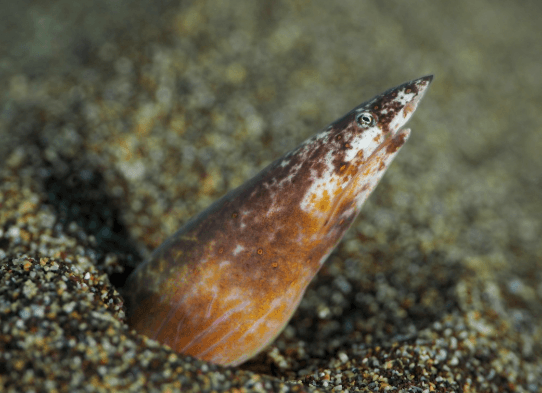
The finless eel is a specialist of sandy bottoms, found in tropical Indo-Pacific waters. As its name suggests, it lacks the prominent fins seen in many other eels, giving it a smooth, almost worm-like appearance.
This species has a slender body and a pointed tail adapted for digging. Its coloration is usually pale brown or pinkish, matching the sand it lives in.
Finless eels spend much of their time buried beneath the surface, moving through sand much like an earthworm moves through soil. They emerge mainly to feed on small invertebrates hidden in the sediment.
Because of their burrowing habits, finless eels are rarely seen unless the sand is disturbed. When uncovered, they quickly dive back under, disappearing in moments.
Identification among the Types of Eels includes noting the lack of obvious fins and the smooth, cylindrical body shape.
The finless eel shows how some eels have traded swimming power for digging skills, perfectly suited to a life beneath the sand.
24. Equatorial Eel (Apterichtus equatorialis)

The equatorial eel is another burrowing species from the Indo-Pacific, especially around equatorial regions. It shares many traits with other finless or reduced-fin eels but has its own distinct range and proportions.
This eel has a long, slender body and reduced fins, making it ideal for slipping through soft substrates. Its color is usually light brown or gray, blending well with sandy bottoms.
Equatorial eels live mostly buried in sand, coming out at night to hunt small worms, crustaceans, and other tiny creatures living in the sediment.
Because they spend so much time hidden, little is known about their behavior in the wild. Most sightings occur when storms or human activity uncover them.
Identification relies on body shape, reduced fins, and geographic location. Among the Types of Eels, it represents the quiet burrowers that shape life beneath the seabed.
Though rarely seen, equatorial eels are part of the unseen workforce of sandy habitats, helping recycle nutrients through their feeding.
25. Sooty Sand Eel (Bascanichthys bascanoides)

The sooty sand eel is a snake eel species found in tropical Atlantic waters. It prefers sandy and muddy bottoms near reefs and coastal areas, where it can easily bury itself for shelter and hunting.
This eel has a long, slender body colored dark brown to almost black, giving it a “sooty” look. This dark coloration helps it blend into shadowed sand and mud.
Sooty sand eels are expert burrowers. They spend much of their time hidden beneath the surface, with only the head exposed. From there, they ambush small fish and invertebrates that wander too close.
Unlike morays, snake eels like this one have pointed tails designed for digging, and often lack large fins that would get in the way underground.
Identification among the Types of Eels is based on the dark body color, slender shape, and burrowing behavior typical of snake eels.
The sooty sand eel may not be flashy, but it plays a steady role in coastal ecosystems, quietly hunting and shaping life just beneath the sand.
“`
“`html
26. Garden Eel (Heteroconger spp.)

Garden eels look nothing like the classic image of a roaming predator. Instead, they resemble a field of waving grass planted in the sand. Found in tropical Indo-Pacific and Atlantic waters, these eels live in colonies on sandy bottoms near reefs, where currents bring a steady supply of food.
Each garden eel lives in its own burrow, tail anchored deep in the sand like a tent peg. Only the upper part of the body is visible as it sways with the current. When danger approaches, the eel vanishes into its hole in a split second, as if someone pulled an invisible string.
Garden eels are relatively small, usually reaching 30 to 50 centimeters in length. Their bodies are slender, often patterned with spots or bands that vary by species. Common colors include brown, white, and black, arranged in eye-catching designs.
Unlike many Types of Eels that hunt larger prey, garden eels feed mainly on plankton drifting past in the water column. They extend from their burrows to snap up tiny crustaceans and larvae, turning the current into a moving buffet.
They are active during the day, especially when currents are strong. At night or in rough conditions, they retreat fully into their burrows. Watching a colony feed feels a bit like observing underwater wheat bending in the wind.
Identification is based on their upright posture, colony lifestyle, and burrow-dwelling behavior. No other eels look quite like this when seen in large groups.
Ecologically, garden eels link plankton from open water to the sandy seabed, passing energy into reef systems. They may be small, but in numbers they matter.
Among all Types of Eels, garden eels are the gentle gardeners of the sand, adding motion and life to otherwise quiet seabed plains.
27. Wolf Eel (Anarrhichthys ocellatus)
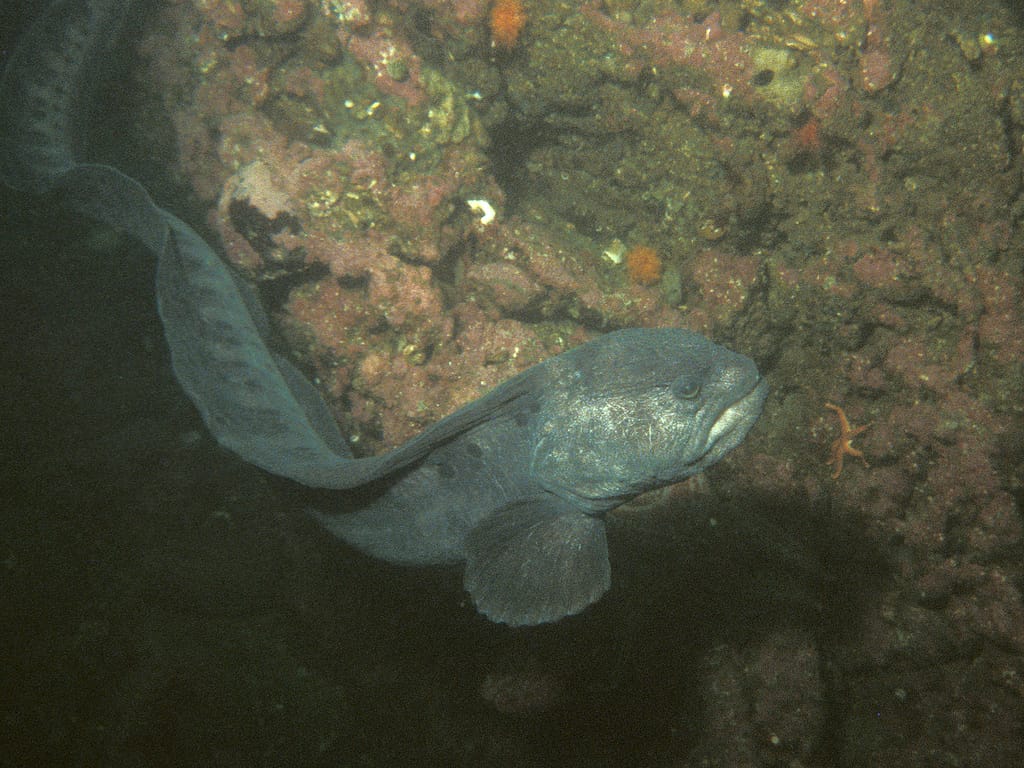
The wolf eel is a bit of an oddball. Despite its name, it is not a true eel but a close relative that looks and behaves like one. Found in the cold waters of the North Pacific, from Japan to California, it lives among rocky reefs, kelp forests, and crevices along the coast.
Wolf eels are thick-bodied and powerful, growing up to 2.4 meters long. Their skin is smooth and scaleless, often gray, brown, or purplish, sometimes with darker spots. The head is large, with strong jaws and blunt, crushing teeth.
Those teeth reveal their favorite foods: sea urchins, crabs, clams, and other hard-shelled prey. A wolf eel can crack shells with ease, much like a living nutcracker patrolling the reef.
Unlike many solitary eels, wolf eels are known to form long-term pairs. A male and female may share the same den for years, guarding their eggs together. This family-oriented side gives them a reputation as one of the more “romantic” fish in cold seas.
During the day, wolf eels usually stay tucked into rocky shelters, with just their heads visible. At night, they venture out to forage along the bottom.
Identification among the Types of Eels includes the bulky body, large head, blunt teeth, and cold-water habitat. They look more like underwater bulldogs than snakes.
Wolf eels play an important role in controlling sea urchin populations, which helps protect kelp forests from overgrazing.
Though not a true eel, the wolf eel earns its place here by showing how eel-like shapes thrive even in chilly northern waters.
28. Dragon Moray (Enchelycore pardalis)
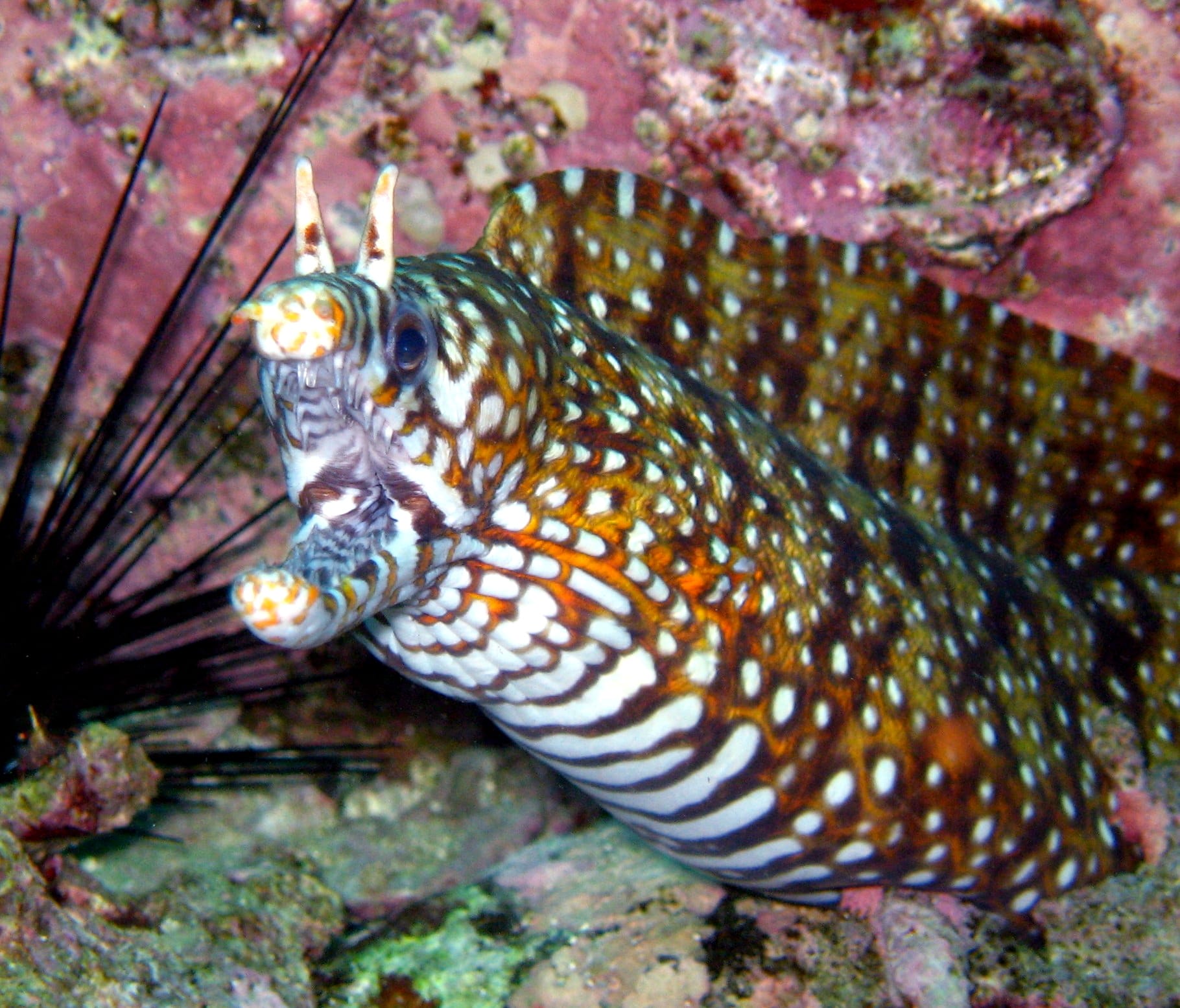
The dragon moray is often called one of the most striking eels in the ocean. Native to the Indo-Pacific, it lives among coral reefs and rocky slopes, usually in deeper or shaded areas.
This moray’s body is dark brown to black, covered with vivid orange or yellow blotches. Its head is adorned with curved nostrils that look like little horns, giving it a dragon-like appearance worthy of its name.
Dragon morays can reach about one meter in length. Their jaws are long and arched, armed with sharp teeth that remain visible even when the mouth is closed. The result is a permanent, fierce-looking grin.
Like most morays, they are nocturnal hunters, feeding mainly on fish and crustaceans. During the day, they hide in crevices, letting only their dramatic heads show.
Despite their fearsome look, dragon morays are generally shy and avoid confrontation. They prefer to retreat into their shelters rather than stand their ground.
Identification among the Types of Eels is easy thanks to the horn-like nostrils, bold color contrast, and elongated jaws.
In reef ecosystems, dragon morays act as mid-level predators, adding to the complex balance of reef food webs.
Seeing a dragon moray in the wild feels like spotting a creature from legend, proof that the sea still has a flair for fantasy.
29. Ribbon Eel (Rhinomuraena quaesita)

The ribbon eel is one of the most colorful and unusual eels in the ocean. Found in the Indo-Pacific, it inhabits sandy bottoms near reefs, where it lives in burrows with just its head and part of the body exposed.
Ribbon eels are famous for changing color as they grow. Juveniles are usually black with yellow markings, adult males turn bright blue with yellow highlights, and mature females become yellow or greenish. It is like watching a fish cycle through different outfits over its lifetime.
The body is long, thin, and ribbon-like, with a tall dorsal fin running along much of its length. The snout is long, with flared nostrils that look like little flags waving in the current.
Ribbon eels feed mainly on small fish that pass near their burrows. They strike quickly, then retreat back into the sand to swallow their prey.
They are often seen during the day, swaying in the current while watching for food. This makes them popular subjects for underwater photographers.
Identification among the Types of Eels includes the bright colors, ribbon-like fin, and long snout with flared nostrils.
In reef systems, ribbon eels contribute to fish population control and add a splash of color to sandy habitats.
The ribbon eel proves that elegance and color have a place even among stealthy predators.
30. Electric Eel (Electrophorus spp.)
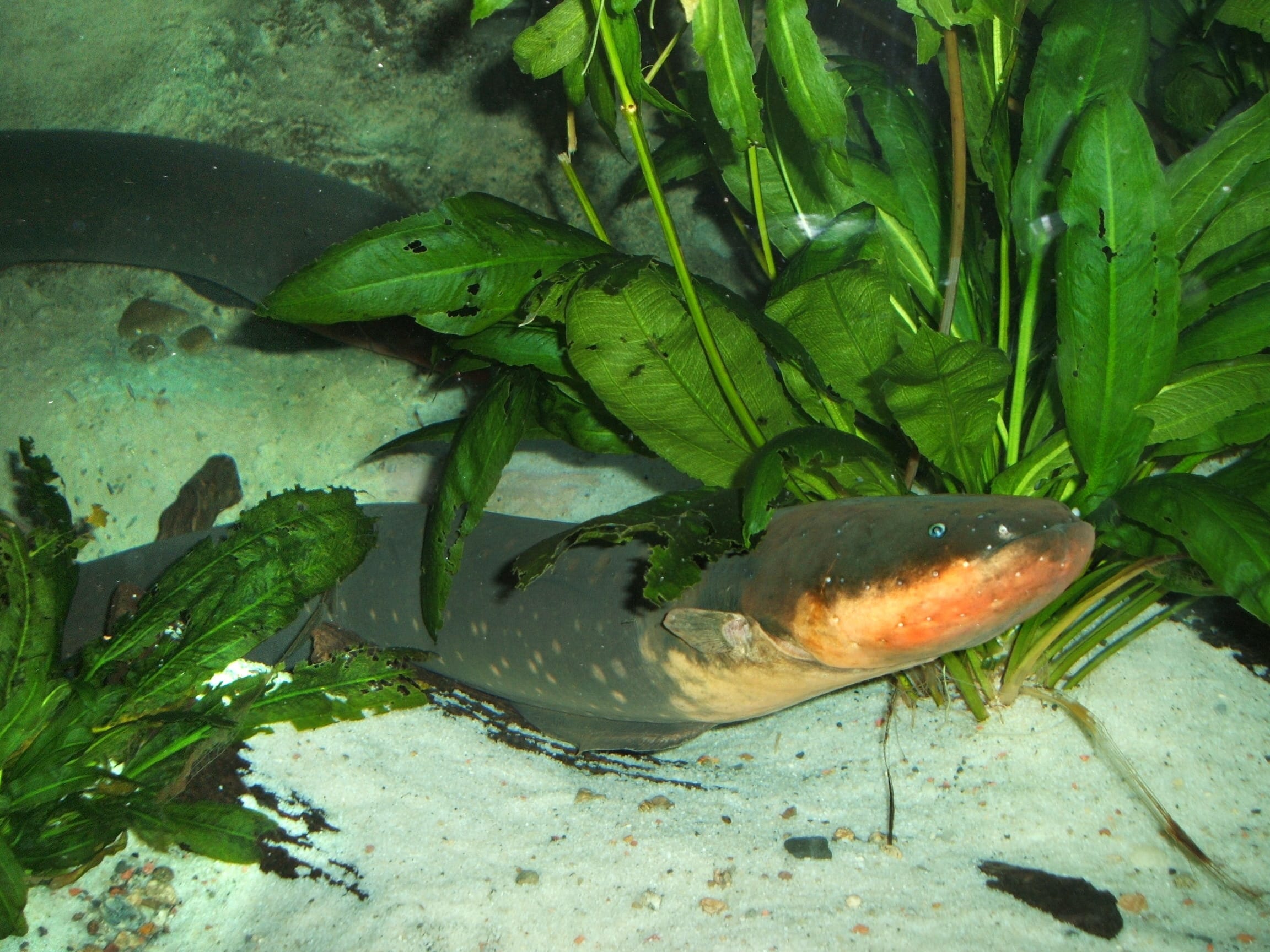
The electric eel is perhaps the most famous eel of all, though, like the wolf eel, it is not a true eel. Native to the rivers and floodplains of the Amazon and Orinoco basins in South America, it lives in warm, slow-moving freshwater.
Electric eels have long, cylindrical bodies that can reach over 2 meters in length. Their coloration is usually dark gray or brown on top, fading to a lighter underside. The head is blunt, with small eyes and a large mouth.
What sets this eel apart is its ability to produce powerful electric discharges. Specialized organs in its body generate electricity used for navigation, communication, and stunning prey. Strong shocks can deter predators or immobilize fish, making hunting highly effective.
Electric eels breathe air as well as using gills, often surfacing to gulp air from above the water. One might spot them breaking the surface like a slow-moving submarine.
They feed mainly on fish but will also take amphibians and small animals that wander too close. Using short electric pulses, they sense their surroundings even in muddy, low-visibility water.
Identification among the Types of Eels includes the thick body, freshwater habitat, and, of course, the remarkable electric ability that no other eel can match.
Ecologically, electric eels are top predators in their habitats, shaping fish communities and influencing how other animals move through flooded forests and rivers.
As the final entry in this guide, the electric eel reminds us that eels are not just slippery fish. Some carry living power plants inside their bodies, closing our journey through the diverse and surprising world of eels.
“`
“`html
Conclusion: The Remarkable Diversity of Eels
Eels are among the most fascinating fish on Earth. From reef-dwelling morays with permanent grins to freshwater giants that can generate electricity, the many Types of Eels show how a single body shape can adapt to almost every aquatic environment. They live in tropical coral reefs, cold coastal waters, muddy rivers, open oceans, and even deep sea slopes, each species shaped by its own challenges and opportunities.
Throughout this guide, we have seen that eels are not just secretive predators hiding in cracks and crevices. Some wave gently from sandy burrows, others roam reefs at night, and a few travel thousands of kilometers between rivers and oceans to complete their life cycles. This range of lifestyles highlights their resilience and evolutionary success.
Understanding different Types of Eels also helps us appreciate their roles in nature. Many control populations of fish and invertebrates, others recycle nutrients in rivers and coastal systems, and some act as indicators of healthy habitats. When eel numbers decline, it often signals broader changes in water quality and ecosystem balance.
For people, eels inspire both curiosity and respect. They appear in legends, cuisine, scientific studies, and underwater photography, each culture seeing something different in their sinuous forms. Whether admired for beauty, feared for sharp teeth, or studied for electric power, eels rarely leave anyone indifferent.
As human activities continue to shape rivers, coasts, and oceans, protecting eel habitats becomes increasingly important. Clean water, connected waterways, and healthy reefs give these animals a chance to continue their ancient journeys.
In the end, learning about the Types of Eels is a reminder that even creatures often hidden from view can tell powerful stories about life in water. If you ever spot one peeking from a rock or rising from a river’s surface, take a moment to watch. You may be looking at one of nature’s quiet masterpieces.
“`
“`html
1. What are eels?
Eels are long, snake-like fish found in both freshwater and saltwater, known for their flexible bodies and secretive behavior.
2. How many Types of Eels exist?
Scientists recognize over 800 species of eels worldwide, grouped into several families such as morays, congers, and freshwater eels.
3. Are all eels true eels?
No. Some fish, like wolf eels and electric eels, look like eels but belong to different groups and are not true eels.
4. Where do eels live?
Eels live in oceans, rivers, lakes, estuaries, coral reefs, and even deep sea habitats around the globe.
5. Can eels live in freshwater and saltwater?
Yes. Some Types of Eels, such as European and American eels, migrate between freshwater and the ocean during their life cycle.
6. What do eels eat?
Most eels eat fish, crustaceans, worms, and mollusks, while some species feed mainly on plankton.
7. Are eels dangerous to humans?
Most eels avoid people. Moray eels may bite if threatened, and electric eels can deliver shocks, but attacks are rare.
8. Do eels have scales?
Many eels have very tiny, hidden scales or none at all, giving them a smooth, slippery appearance.
9. How do eels breathe?
Eels breathe through gills, and some species can also absorb oxygen through their skin or gulp air at the surface.
10. How long can eels live?
Depending on the species, eels may live from 10 to over 50 years in the wild.
11. Why do eels look like snakes?
Their long, flexible bodies help them move through narrow spaces, burrows, rocks, and dense vegetation.
12. Are eels fish or reptiles?
Eels are fish, even though their shape often makes people think of snakes.
13. Do eels have teeth?
Yes. Many Types of Eels have sharp teeth for gripping prey, while others have blunt teeth for crushing shells.
14. What is the largest eel species?
The European conger is among the largest true eels, sometimes reaching lengths over 3 meters.
15. What is the smallest eel species?
Some spaghetti eels and worm eels grow only a few tens of centimeters long.
16. Can eels see well?
Eels often have small eyes and rely more on smell and touch, especially in dark or murky water.
17. Are eels active during the day?
Many eels are nocturnal, hiding by day and hunting at night, though some species feed in daylight.
18. How do eels reproduce?
Most eels spawn in the ocean, releasing eggs that hatch into larvae before drifting to new habitats.
19. Where do freshwater eels spawn?
Species like European and American eels migrate to the Sargasso Sea to reproduce.
20. Do eels migrate?
Yes. Some Types of Eels travel thousands of kilometers between rivers and oceans during their lives.
21. What is a moray eel?
Moray eels are reef-dwelling eels known for their wide mouths, sharp teeth, and habit of hiding in crevices.
22. Why do moray eels open their mouths?
They open their mouths to pump water over their gills for breathing, not as a threat.
23. What makes electric eels special?
Electric eels can generate strong electric shocks used for hunting, defense, and sensing their surroundings.
24. Are electric eels true eels?
No. Despite their name, electric eels belong to a different group of fish.
25. Can eels survive out of water?
Some eels can survive short periods out of water if their skin stays moist.
26. Do eels bite?
Eels may bite if provoked or cornered, but they usually try to escape instead.
27. Are eels important to ecosystems?
Yes. Eels help control prey populations and serve as food for larger predators.
28. Are eels endangered?
Some species, like the European eel, are critically endangered due to habitat loss and overfishing.
29. What threats do eels face?
Major threats include pollution, dams, climate change, and unsustainable fishing.
30. Can eels be kept as pets?
Some small species are kept in aquariums, but many eels need special care and large tanks.
31. Do eels make sounds?
Most eels are silent, but some may produce faint clicking or grinding noises.
32. How do eels swim?
Eels swim by undulating their bodies in wave-like motions from head to tail.
33. What is a garden eel?
Garden eels live in sandy burrows and stick upright from the seabed, feeding on plankton.
34. Are eels social animals?
Most eels are solitary, though some species live close together in suitable habitats.
35. Do eels change color?
Some Types of Eels, like ribbon eels, change color as they grow and mature.
36. How fast can eels move?
Eels are usually slow and cautious but can strike very quickly when hunting.
37. Are eels good to eat?
In many cultures, eels are considered a delicacy, though harvesting must be managed carefully.
38. How do scientists study eels?
Researchers use tagging, tracking, and lab studies to learn about eel migration and behavior.
39. Why are eels hard to study?
Their secretive nature and long ocean migrations make them difficult to observe in the wild.
40. What is the lifespan of an electric eel?
Electric eels can live around 15 years or more in natural conditions.
41. Do eels have good memory?
Studies suggest eels can learn and remember simple patterns related to food and shelter.
42. Can eels recognize humans?
Some captive eels appear to recognize regular feeders, though this is based on behavior rather than proof.
43. Why are eels important to humans?
Eels are part of food traditions, scientific research, and natural heritage in many regions.
44. What is the rarest eel species?
Some deep-sea and freshwater eels are rarely seen, but exact rarity is still being studied.
45. How can we help protect eels?
Protecting clean waterways, supporting conservation programs, and choosing sustainable seafood all help eels survive.