
There are seven living types of gar fish in the family Lepisosteidae. These ancient-looking predators are recognized by long jaws, sharp teeth, armored diamond-shaped scales, and an air-breathing swim bladder. They occur naturally in North America, Central America, and Cuba, with different species favoring rivers, bayous, wetlands, lakes, reservoirs, and brackish coastal water.
Gar are not pike, despite the old name “garpike,” and they are not the same as marine needlefish sometimes called garfish. This guide focuses only on the seven living true gars.
What Are the Main Types of Gar Fish?
The seven living species are alligator, Cuban, tropical, longnose, shortnose, spotted, and Florida gar. Three belong to Atractosteus, a genus of broad-snouted gars, and four belong to Lepisosteus, which includes the longnose and smaller North American species.
| Species | Scientific name | Best field mark | Native range |
|---|---|---|---|
| Alligator Gar | Atractosteus spatula | Broad, short snout; two rows of large teeth in the upper jaw | Mississippi River basin and Gulf coastal drainages |
| Cuban Gar | Atractosteus tristoechus | Broad snout and heavy body similar to alligator gar | Western Cuba and Isla de la Juventud |
| Tropical Gar | Atractosteus tropicus | Broad snout, gray-green body, irregular dark markings | Southern Mexico and Central America |
| Longnose Gar | Lepisosteus osseus | Extremely long, narrow snout | Broad eastern and central North America |
| Shortnose Gar | Lepisosteus platostomus | Short, broad snout without the alligator gar’s double upper tooth row | Mississippi and Missouri river systems and connected waters |
| Spotted Gar | Lepisosteus oculatus | Numerous dark spots on head, body, and fins | Great Lakes, Mississippi basin, Gulf and Atlantic coastal drainages |
| Florida Gar | Lepisosteus platyrhincus | Broad short snout and irregular dark spots | Florida and parts of nearby Georgia |
1. Alligator Gar
Alligator Gar (Atractosteus spatula) is identified most quickly by broad, short snout; two rows of large teeth in the upper jaw. Its native range includes mississippi river basin and gulf coastal drainages, where it uses fresh water, large rivers, bayous, reservoirs, and brackish coastal areas.
The largest living gar and a powerful apex predator. Like other gars, it can gulp air at the surface, an adaptation that helps it survive in warm or oxygen-poor water. It usually waits or cruises slowly before striking prey with a rapid sideways sweep of the head.
Anglers should use strong tackle, long pliers, and careful handling because the jaws contain sharp teeth and the ganoid scales are hard. Regulations and conservation status vary, so always confirm local rules before targeting or keeping gar.
2. Cuban Gar
Cuban Gar (Atractosteus tristoechus) is identified most quickly by broad snout and heavy body similar to alligator gar. Its native range includes western cuba and isla de la juventud, where it uses freshwater rivers, lakes, wetlands, and occasional brackish areas.

A geographically restricted species with important conservation value. Like other gars, it can gulp air at the surface, an adaptation that helps it survive in warm or oxygen-poor water. It usually waits or cruises slowly before striking prey with a rapid sideways sweep of the head.
Anglers should use strong tackle, long pliers, and careful handling because the jaws contain sharp teeth and the ganoid scales are hard. Regulations and conservation status vary, so always confirm local rules before targeting or keeping gar.
3. Tropical Gar
Tropical Gar (Atractosteus tropicus) is identified most quickly by broad snout, gray-green body, irregular dark markings. Its native range includes southern mexico and central america, where it uses warm lowland rivers, floodplains, lakes, and wetlands.
Important in regional fisheries and aquaculture. Like other gars, it can gulp air at the surface, an adaptation that helps it survive in warm or oxygen-poor water. It usually waits or cruises slowly before striking prey with a rapid sideways sweep of the head.
Anglers should use strong tackle, long pliers, and careful handling because the jaws contain sharp teeth and the ganoid scales are hard. Regulations and conservation status vary, so always confirm local rules before targeting or keeping gar.
4. Longnose Gar
Longnose Gar (Lepisosteus osseus) is identified most quickly by extremely long, narrow snout. Its native range includes broad eastern and central north america, where it uses rivers, lakes, reservoirs, estuaries, and coastal waters.
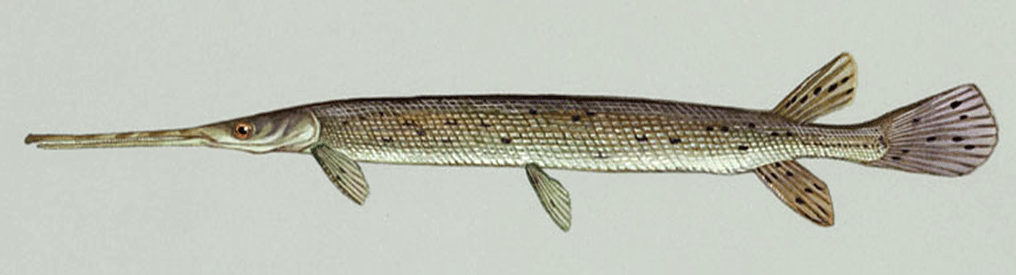
One of the most widespread gars and easily recognized by its beak-like jaws. Like other gars, it can gulp air at the surface, an adaptation that helps it survive in warm or oxygen-poor water. It usually waits or cruises slowly before striking prey with a rapid sideways sweep of the head.
Anglers should use strong tackle, long pliers, and careful handling because the jaws contain sharp teeth and the ganoid scales are hard. Regulations and conservation status vary, so always confirm local rules before targeting or keeping gar.
5. Shortnose Gar
Shortnose Gar (Lepisosteus platostomus) is identified most quickly by short, broad snout without the alligator gar’s double upper tooth row. Its native range includes mississippi and missouri river systems and connected waters, where it uses large rivers, backwaters, oxbows, and reservoirs.
Usually smaller and less heavily spotted than spotted gar. Like other gars, it can gulp air at the surface, an adaptation that helps it survive in warm or oxygen-poor water. It usually waits or cruises slowly before striking prey with a rapid sideways sweep of the head.
Anglers should use strong tackle, long pliers, and careful handling because the jaws contain sharp teeth and the ganoid scales are hard. Regulations and conservation status vary, so always confirm local rules before targeting or keeping gar.
6. Spotted Gar
Spotted Gar (Lepisosteus oculatus) is identified most quickly by numerous dark spots on head, body, and fins. Its native range includes great lakes, mississippi basin, gulf and atlantic coastal drainages, where it uses vegetated lakes, bayous, swamps, and slow rivers.
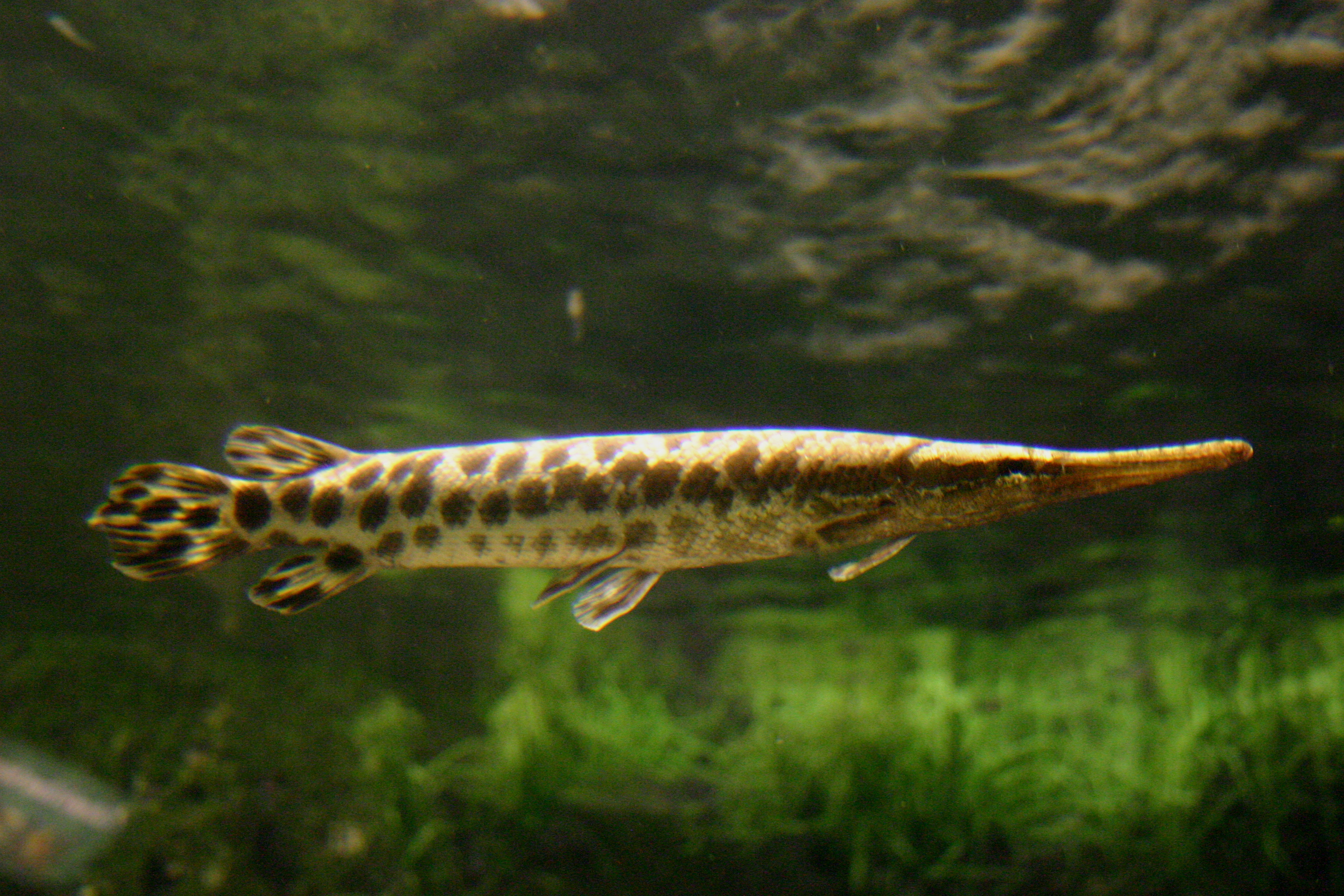
Prefers clear, shallow, plant-rich habitats. Like other gars, it can gulp air at the surface, an adaptation that helps it survive in warm or oxygen-poor water. It usually waits or cruises slowly before striking prey with a rapid sideways sweep of the head.
Anglers should use strong tackle, long pliers, and careful handling because the jaws contain sharp teeth and the ganoid scales are hard. Regulations and conservation status vary, so always confirm local rules before targeting or keeping gar.
7. Florida Gar
Florida Gar (Lepisosteus platyrhincus) is identified most quickly by broad short snout and irregular dark spots. Its native range includes florida and parts of nearby georgia, where it uses canals, lakes, ponds, swamps, and slow rivers.
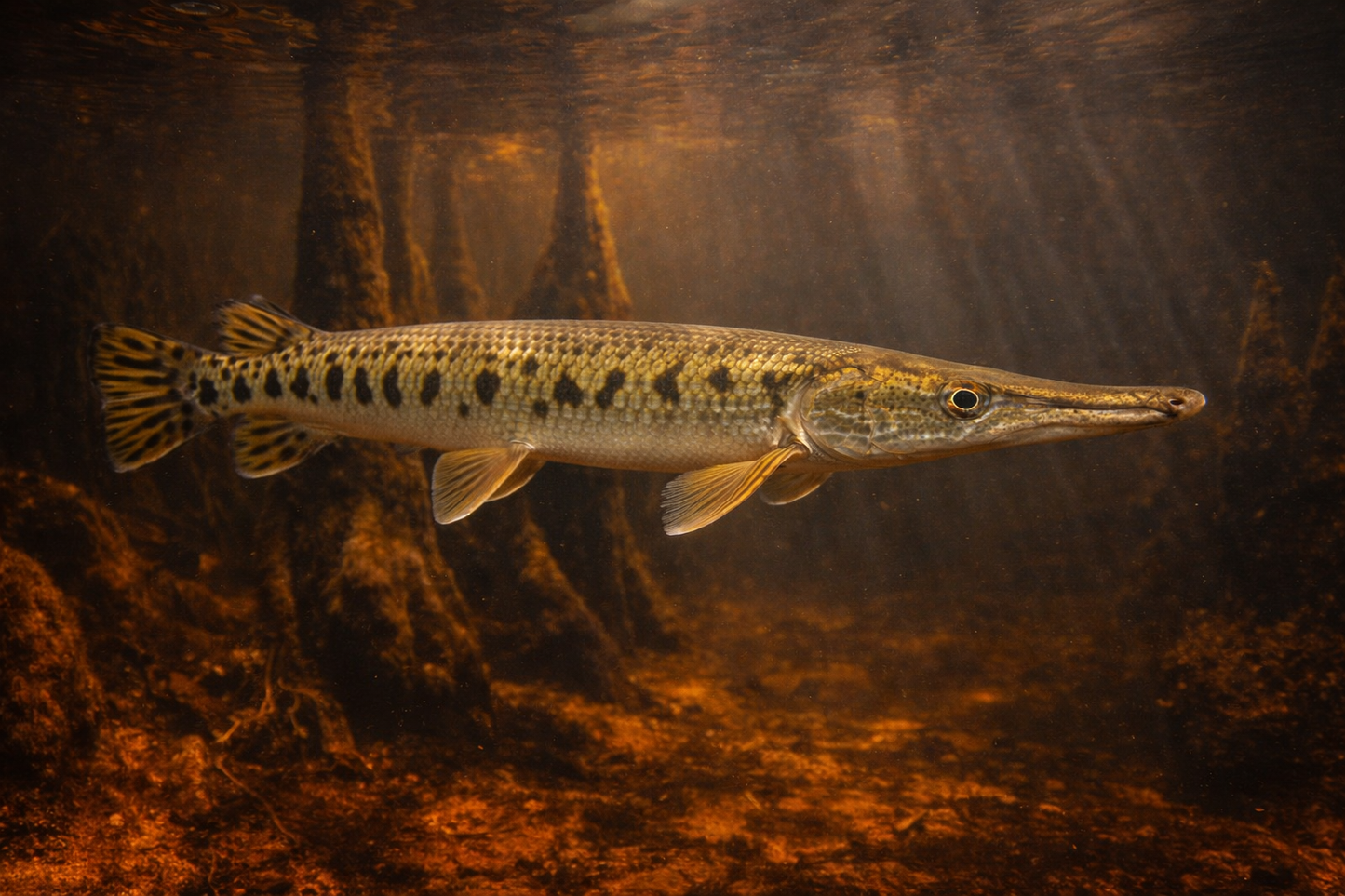
Often confused with spotted gar but has a more restricted southeastern range. Like other gars, it can gulp air at the surface, an adaptation that helps it survive in warm or oxygen-poor water. It usually waits or cruises slowly before striking prey with a rapid sideways sweep of the head.
Anglers should use strong tackle, long pliers, and careful handling because the jaws contain sharp teeth and the ganoid scales are hard. Regulations and conservation status vary, so always confirm local rules before targeting or keeping gar.
How Are These Types of Fish Classified?
| Genus | Living species | General pattern |
|---|---|---|
| Atractosteus | Alligator, Cuban, tropical gar | Broad-snouted, heavy-bodied gars; alligator gar has two rows of large upper-jaw teeth. |
| Lepisosteus | Longnose, shortnose, spotted, Florida gar | Includes the extremely long-snouted longnose gar and several smaller, spotted or short-snouted species. |
Where Do These Fish Live?
Gars use slow rivers, large river channels, oxbows, swamps, backwaters, reservoirs, lakes, canals, floodplains, and brackish estuaries. They often favor warm shallow areas with vegetation or woody cover, although large alligator gar also use major river systems. Surface access is essential because gars regularly breathe air.
How to Identify Different Types of Gar Fish
- Snout length: longnose gar has the narrowest, longest snout; shortnose and Florida gar have much shorter jaws.
- Tooth rows: adult alligator gar has two rows of large teeth in the upper jaw.
- Spots: spotted gar usually has abundant spots on the head, body, and fins; shortnose gar is less heavily marked.
- Range: Cuban and tropical gars have restricted southern distributions, while longnose gar is widespread.
- Body size: alligator gar becomes much larger and heavier-bodied than spotted, Florida, or shortnose gar.
- Use a local key: juvenile gars can be difficult to separate by photographs alone.
Fishing Tips and Notes
- Use tackle matched to powerful fish and abrasive mouths.
- Employ a leader appropriate for local techniques and regulations.
- Wait for a secure hook placement rather than striking wildly at the first movement.
- Use a large knotless landing net or safe boat-side release method.
- Keep hands away from the jaws and use long-handled tools.
- Support the body horizontally and minimize air exposure.
- Report tagged fish or notable catches when local agencies request data.
Safety, Sustainability, and Conservation Notes
Gar eggs are toxic and must not be eaten. Gar flesh is eaten in some regions, but cleaning requires care because of the hard scales. Populations, legal status, harvest seasons, and size limits differ widely. Large mature gars can be long-lived and valuable breeders, so selective harvest and careful release are important. Never move live gar between waters or release aquarium specimens.
Fun Facts About Gar Fish
- Only seven true gar species are alive today.
- Gar scales are hard, diamond-shaped, and coated with ganoine.
- Their swim bladder functions partly like a lung.
- Gars often appear motionless before accelerating quickly at prey.
- Alligator gar has a distinctive double row of upper-jaw teeth.
- Longnose gar has one of the most elongated jaws among freshwater fishes.
- Gar fossils show that their broader lineage is ancient.
- They are closer to bowfin than to modern pike.
- Some species tolerate brackish water.
- Gar eggs are toxic even though the properly prepared flesh is eaten in some regions.
Final Thoughts on Types of Gar Fish
The seven living types of gar fish can be separated by snout shape, tooth rows, spotting, size, and native range. Alligator gar is the giant broad-snouted species; longnose gar has the longest jaws; spotted and Florida gar are heavily patterned; shortnose gar has a compact snout; and Cuban and tropical gar have restricted southern ranges. Respect their teeth, protect large breeding fish, and follow local laws.
Frequently Asked Questions
1. How many species of gar are alive today?
Seven living species are recognized in the family Lepisosteidae.
2. What are the seven types of gar?
Alligator, Cuban, tropical, longnose, shortnose, spotted, and Florida gar.
3. Are gar and garfish the same?
Not always. True gars are freshwater and brackish fishes in Lepisosteidae, while several marine needlefish are also called garfish.
4. Are gars related to pike?
No. The old name garpike is misleading; gars and pike belong to different evolutionary groups.
5. Which gar is the largest?
Alligator gar is the largest living species.
6. Which gar has the longest nose?
Longnose gar has an extremely long, narrow snout.
7. How do I identify an alligator gar?
Look for a broad short snout, massive body, and two rows of large teeth in the upper jaw of adults.
8. How do I identify a spotted gar?
It usually has many dark spots on the head, body, and fins and favors vegetated shallow water.
9. How do I tell Florida gar from spotted gar?
Range, snout proportions, scale counts, and pattern help. Use a regional key because the species can look similar.
10. Where do Cuban gar live?
They are native to Cuba, including western Cuban waters and Isla de la Juventud.
11. Where do tropical gar live?
They occur from southern Mexico into parts of Central America.
12. Can gars live in salt water?
They are primarily freshwater fish, but some species enter brackish and occasionally coastal marine water.
13. Why do gars gulp air?
Their vascularized swim bladder allows them to use atmospheric oxygen, helping in warm or low-oxygen water.
14. What do gar eat?
They mainly eat fish, but may also take crustaceans and other available aquatic prey.
15. How do gar catch prey?
They often approach slowly and strike with a quick sideways sweep of the jaws.
16. Are gars dangerous to swimmers?
They have sharp teeth and should not be handled carelessly, but they are not normally aggressive toward people in the water.
17. Can gar bite anglers?
Yes, especially during handling. Keep hands away from the mouth and use long pliers.
18. Are gar scales sharp?
They are extremely hard and can have rough edges, so gloves and careful handling are useful.
19. Can people eat gar?
The flesh is eaten in some regions when legally harvested and properly prepared.
20. Can people eat gar eggs?
No. Gar roe is toxic and should never be eaten.
21. Does cooking make gar eggs safe?
Do not rely on cooking to make gar roe safe. Avoid eating it entirely.
22. What is the best habitat for gar?
Many use warm, slow, shallow waters with vegetation, woody cover, backwaters, or access to floodplains.
23. Are gar native to North America?
Yes. Living gars are native to North America, Central America, and Cuba.
24. Are gar invasive anywhere?
Gars introduced outside their native range can create ecological and legal concerns. Never move or release them.
25. Can gar be kept in an aquarium?
Only expert keepers with extremely large, secure systems should consider them. Most species quickly outgrow normal home aquariums.
26. How long do gar live?
Lifespan varies by species, and large gars can be long-lived. Age and growth are important reasons to protect mature fish.
27. When do gar spawn?
Timing varies with species and region, often following seasonal warming and access to shallow vegetated habitat.
28. Why are gar important?
They are native predators that help shape aquatic food webs and provide scientific, cultural, and recreational value.
29. Are alligator gar endangered?
Status varies across their range. Some populations have recovered or are managed, while others remain limited; consult local agencies.
30. What tackle is used for gar?
Anglers use strong rods, abrasion-resistant leaders, suitable hooks, and long handling tools, but legal methods vary.
31. How should I release a gar?
Keep it in the water when possible, control the head safely, remove the hook with long tools, support the body, and release it promptly.
32. Can I grab a gar by the snout?
This is risky because of teeth and leverage. Use species-appropriate handling tools and experienced guidance.
33. Why do gars have armored scales?
Their ganoid scales form a hard protective covering unlike the thin overlapping scales of many modern fishes.
34. Are gars living fossils?
The phrase is informal, but gars belong to an ancient lineage and retain several distinctive ancestral features.
35. What fish are gars most closely related to?
Among living fishes, gars are grouped with bowfin within Holostei.