

The phrase types of grouper fish covers a remarkably diverse collection of marine predators. Some are compact reef hinds with jewel-like markings, while others are enormous fish associated with reefs, wrecks, ledges, mangroves, and deep rocky slopes. This guide introduces 80 recognized species and widely used grouper names, with practical notes on identification, habitat, behavior, fishing relevance, aquarium suitability, food safety, and conservation.
What Are the Main Types of Grouper Fish?
Most fish called groupers belong to genera such as Epinephelus, Mycteroperca, Hyporthodus, Cephalopholis, and Plectropomus. They are usually ambush predators with large mouths, thick bodies, and powerful suction feeding. The most reliable identification combines body shape, tail profile, fin margins, spots or bars, geographic range, and depth.
Quick Comparison of Popular Grouper Types
| Grouper | Scientific name | General size | Field clue |
|---|---|---|---|
| Atlantic Goliath Grouper | Epinephelus itajara | Very large | Broad head, large mouth, structure-oriented behavior |
| Giant Grouper | Epinephelus lanceolatus | Very large | Broad head, large mouth, structure-oriented behavior |
| Nassau Grouper | Epinephelus striatus | Large | Broad head, large mouth, structure-oriented behavior |
| Red Grouper | Epinephelus morio | Large | Broad head, large mouth, structure-oriented behavior |
| Black Grouper | Mycteroperca bonaci | Large | Broad head, large mouth, structure-oriented behavior |
| Gag Grouper | Mycteroperca microlepis | Large | Broad head, large mouth, structure-oriented behavior |
| Scamp Grouper | Mycteroperca phenax | Small to medium | Broad head, large mouth, structure-oriented behavior |
| Snowy Grouper | Hyporthodus niveatus | Small to medium | Broad head, large mouth, structure-oriented behavior |
| Warsaw Grouper | Hyporthodus nigritus | Very large | Broad head, large mouth, structure-oriented behavior |
| Yellowedge Grouper | Hyporthodus flavolimbatus | Small to medium | Broad head, large mouth, structure-oriented behavior |
| Misty Grouper | Hyporthodus mystacinus | Small to medium | Broad head, large mouth, structure-oriented behavior |
| Speckled Hind | Epinephelus drummondhayi | Small to medium | Broad head, large mouth, structure-oriented behavior |
| Red Hind | Epinephelus guttatus | Small to medium | Broad head, large mouth, structure-oriented behavior |
| Rock Hind | Epinephelus adscensionis | Small to medium | Broad head, large mouth, structure-oriented behavior |
| Coney | Cephalopholis fulva | Small to medium | Broad head, large mouth, structure-oriented behavior |
How Are Grouper Fish Classified?
Modern references commonly place groupers in the family Epinephelidae, although older books often treat them within Serranidae. The everyday word “grouper” does not map perfectly onto one genus. It includes classic groupers, coral groupers, hinds, lyretails, and several specialized lineages. Scientific names are therefore more dependable than market names, which can vary by country.
The genus Epinephelus contains many familiar reef and food-fish species. Mycteroperca includes several important western Atlantic and eastern Pacific groupers, Hyporthodus contains deepwater and large-bodied species, Cephalopholis includes colorful hinds, and Plectropomus contains the fast-moving coral groupers of the Indo-Pacific.
1. Atlantic Goliath Grouper
The Atlantic Goliath Grouper (Epinephelus itajara) is a very large marine grouper with the sturdy profile, broad head, and oversized mouth typical of the family. Color and pattern can change with age, depth, mood, and habitat, so identification should not rely on one photograph. Compare the tail, dorsal-fin outline, head markings, spot arrangement, and known range.
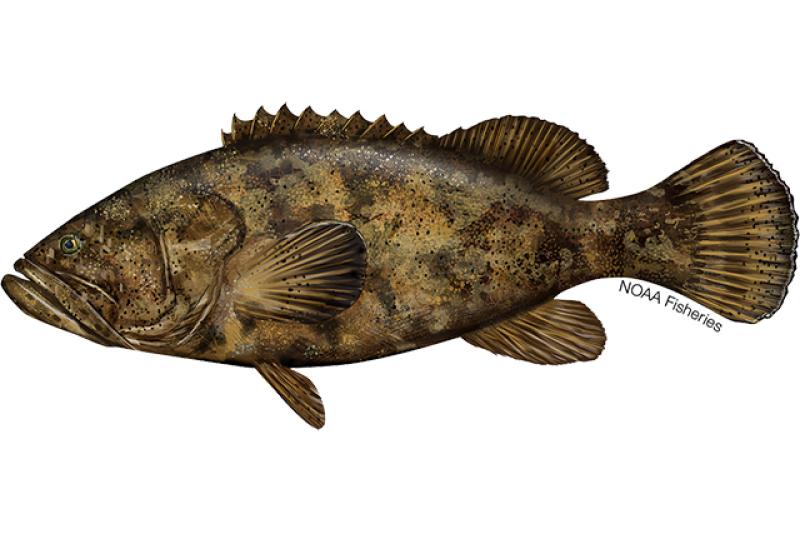
This species stays close to reef, rock, ledge, wreck, or other seafloor structure within its natural distribution. Like most groupers, it feeds by waiting near cover and lunging at fish, crabs, shrimp, squid, or other suitable prey.
2. Giant Grouper
Giant Grouper, scientifically named Epinephelus lanceolatus, is a very large member of the grouper group. Its field marks may include mottling, saddles, bars, colored fin edges, or scattered spots, but these features can fade underwater or differ between juveniles and adults. Location, depth, and body proportions are often as important as color.

It normally remains close to complex structure rather than cruising continuously in open water. Where harvest is legal, anglers should check current size limits, seasons, closed areas, protected-species rules, and release requirements.
3. Nassau Grouper
The Nassau Grouper (Epinephelus striatus) is best understood as a large, structure-oriented predator. It may rest beneath coral heads, beside boulders, around drop-offs, or near artificial structure. A compact body and strong tail provide short bursts of acceleration instead of sustained high-speed swimming.
For reliable identification, photograph both sides, the tail, dorsal fin, and head. Large individuals from some tropical reefs may present ciguatera risk, so local seafood advisories matter as much as species identification.
4. Red Grouper
Red Grouper is the common name used here for Epinephelus morio. This large grouper is part of a reef-fish community in which ambush predators influence the abundance and behavior of smaller fishes and crustaceans. Individuals often use the same shelter or limited home range for long periods.
Many groupers mature slowly, form predictable spawning aggregations, or change sex during life. These traits can make local populations vulnerable even when adults appear powerful and abundant.
5. Black Grouper
The Black Grouper (Mycteroperca bonaci) is a large marine grouper with the sturdy profile, broad head, and oversized mouth typical of the family. Color and pattern can change with age, depth, mood, and habitat, so identification should not rely on one photograph. Compare the tail, dorsal-fin outline, head markings, spot arrangement, and known range.
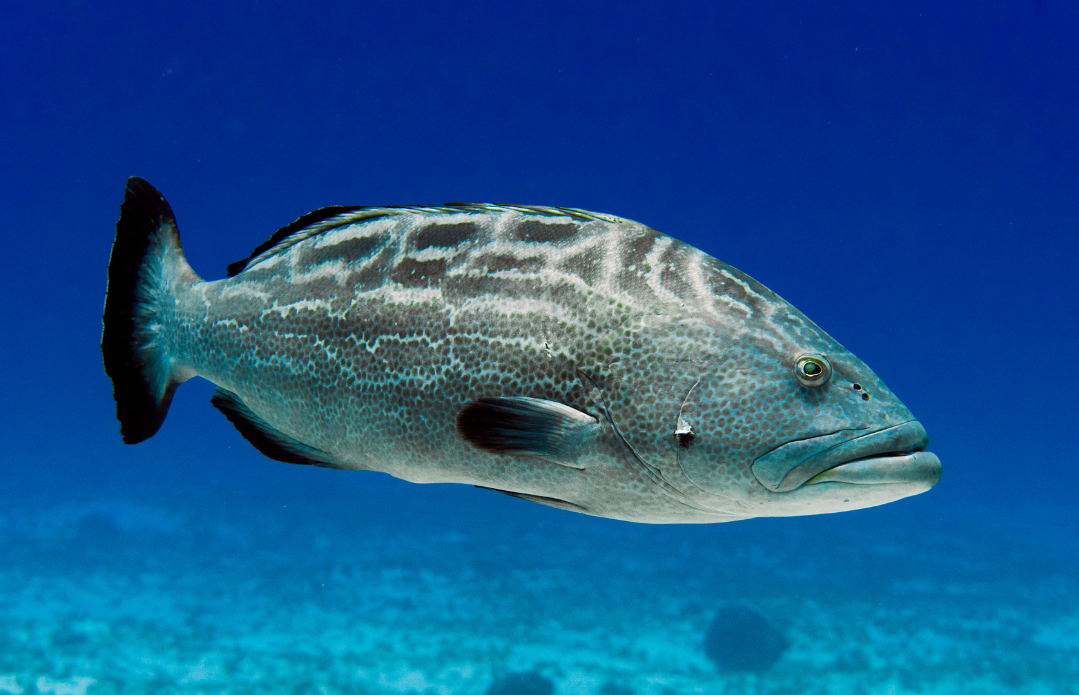
This species stays close to reef, rock, ledge, wreck, or other seafloor structure within its natural distribution. Like most groupers, it feeds by waiting near cover and lunging at fish, crabs, shrimp, squid, or other suitable prey.
6. Gag Grouper
Gag Grouper, scientifically named Mycteroperca microlepis, is a large member of the grouper group. Its field marks may include mottling, saddles, bars, colored fin edges, or scattered spots, but these features can fade underwater or differ between juveniles and adults. Location, depth, and body proportions are often as important as color.
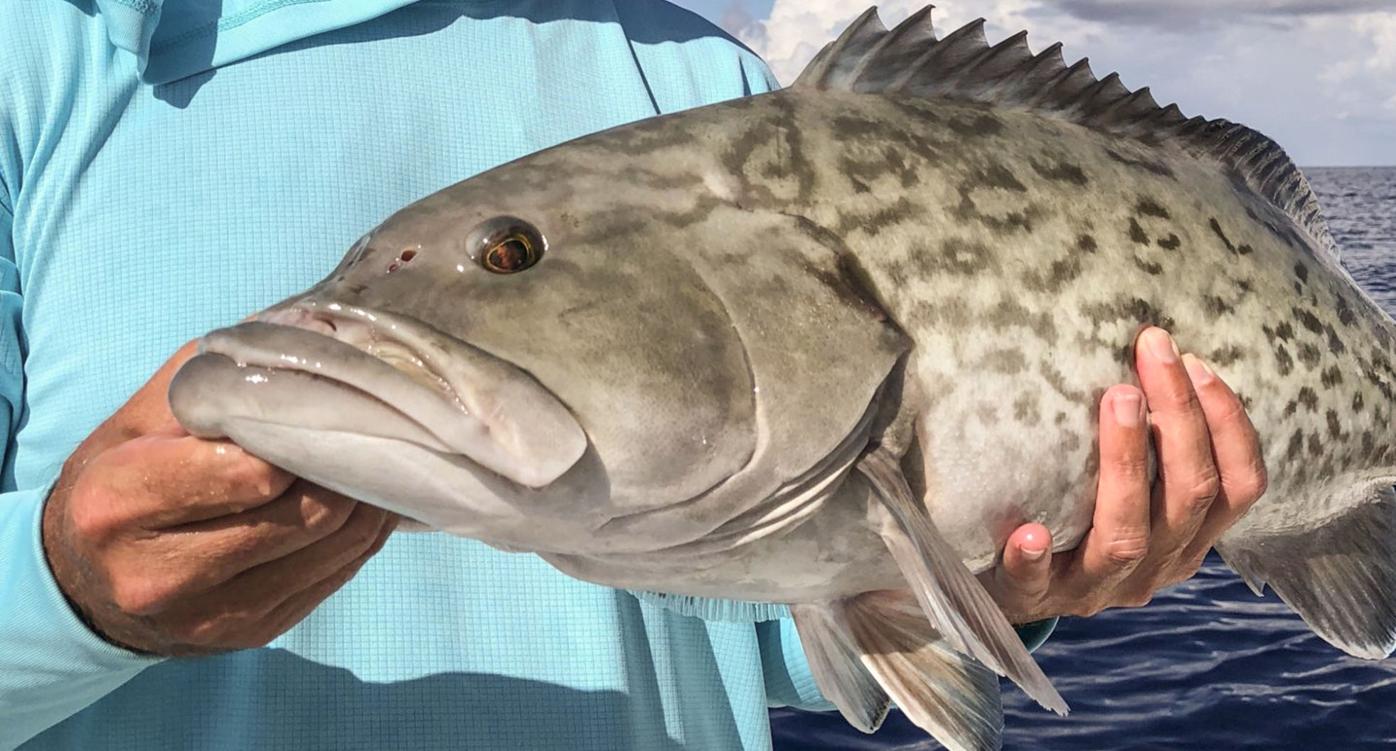
It normally remains close to complex structure rather than cruising continuously in open water. Where harvest is legal, anglers should check current size limits, seasons, closed areas, protected-species rules, and release requirements.
7. Scamp Grouper
The Scamp Grouper (Mycteroperca phenax) is best understood as a medium-sized, structure-oriented predator. It may rest beneath coral heads, beside boulders, around drop-offs, or near artificial structure. A compact body and strong tail provide short bursts of acceleration instead of sustained high-speed swimming.
For reliable identification, photograph both sides, the tail, dorsal fin, and head. Large individuals from some tropical reefs may present ciguatera risk, so local seafood advisories matter as much as species identification.
8. Snowy Grouper
Snowy Grouper is the common name used here for Hyporthodus niveatus. This medium-sized grouper is part of a reef-fish community in which ambush predators influence the abundance and behavior of smaller fishes and crustaceans. Individuals often use the same shelter or limited home range for long periods.
Many groupers mature slowly, form predictable spawning aggregations, or change sex during life. These traits can make local populations vulnerable even when adults appear powerful and abundant.
9. Warsaw Grouper
The Warsaw Grouper (Hyporthodus nigritus) is a very large marine grouper with the sturdy profile, broad head, and oversized mouth typical of the family. Color and pattern can change with age, depth, mood, and habitat, so identification should not rely on one photograph. Compare the tail, dorsal-fin outline, head markings, spot arrangement, and known range.
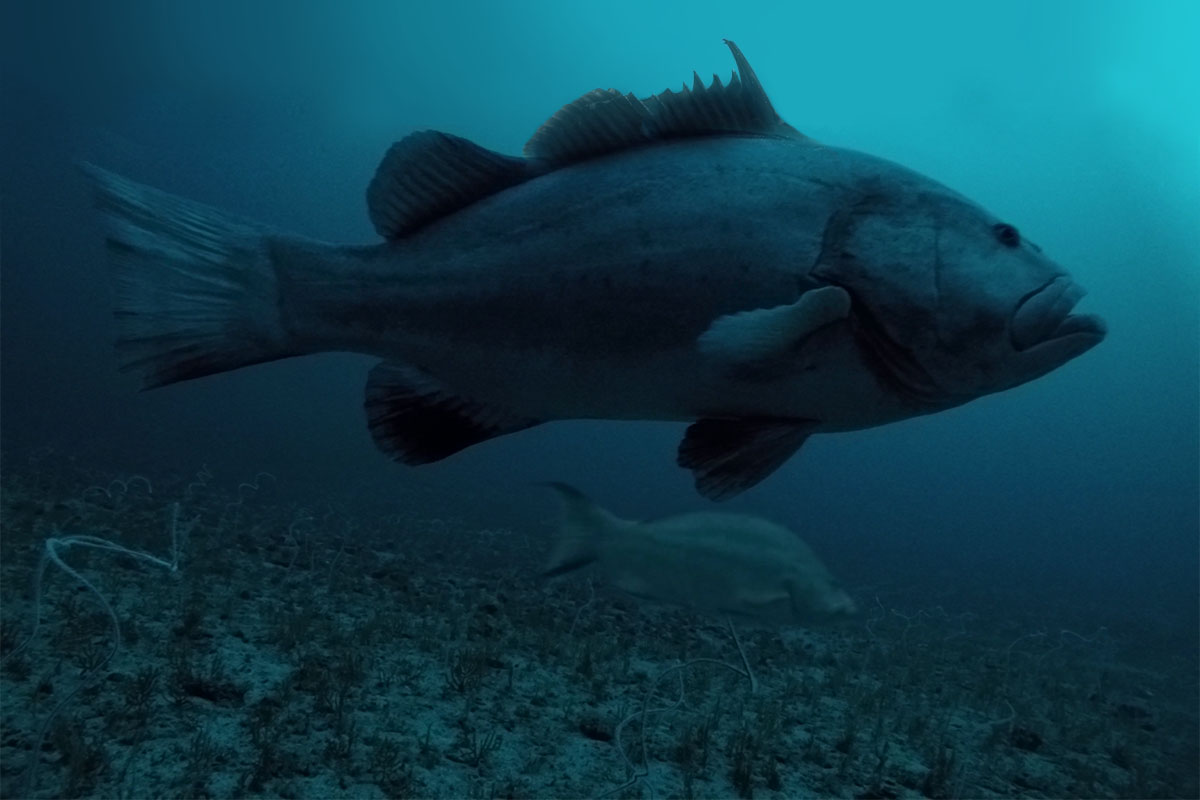
This species stays close to reef, rock, ledge, wreck, or other seafloor structure within its natural distribution. Like most groupers, it feeds by waiting near cover and lunging at fish, crabs, shrimp, squid, or other suitable prey.
10. Yellowedge Grouper
Yellowedge Grouper, scientifically named Hyporthodus flavolimbatus, is a medium-sized member of the grouper group. Its field marks may include mottling, saddles, bars, colored fin edges, or scattered spots, but these features can fade underwater or differ between juveniles and adults. Location, depth, and body proportions are often as important as color.
It normally remains close to complex structure rather than cruising continuously in open water. Where harvest is legal, anglers should check current size limits, seasons, closed areas, protected-species rules, and release requirements.
11. Misty Grouper
The Misty Grouper (Hyporthodus mystacinus) is best understood as a medium-sized, structure-oriented predator. It may rest beneath coral heads, beside boulders, around drop-offs, or near artificial structure. A compact body and strong tail provide short bursts of acceleration instead of sustained high-speed swimming.
For reliable identification, photograph both sides, the tail, dorsal fin, and head. Large individuals from some tropical reefs may present ciguatera risk, so local seafood advisories matter as much as species identification.
12. Speckled Hind
Speckled Hind is the common name used here for Epinephelus drummondhayi. This small to medium-sized grouper is part of a reef-fish community in which ambush predators influence the abundance and behavior of smaller fishes and crustaceans. Individuals often use the same shelter or limited home range for long periods.

Many groupers mature slowly, form predictable spawning aggregations, or change sex during life. These traits can make local populations vulnerable even when adults appear powerful and abundant.
13. Red Hind
The Red Hind (Epinephelus guttatus) is a small to medium-sized marine grouper with the sturdy profile, broad head, and oversized mouth typical of the family. Color and pattern can change with age, depth, mood, and habitat, so identification should not rely on one photograph. Compare the tail, dorsal-fin outline, head markings, spot arrangement, and known range.
This species stays close to reef, rock, ledge, wreck, or other seafloor structure within its natural distribution. Like most groupers, it feeds by waiting near cover and lunging at fish, crabs, shrimp, squid, or other suitable prey.
14. Rock Hind
Rock Hind, scientifically named Epinephelus adscensionis, is a small to medium-sized member of the grouper group. Its field marks may include mottling, saddles, bars, colored fin edges, or scattered spots, but these features can fade underwater or differ between juveniles and adults. Location, depth, and body proportions are often as important as color.
It normally remains close to complex structure rather than cruising continuously in open water. Where harvest is legal, anglers should check current size limits, seasons, closed areas, protected-species rules, and release requirements.
15. Coney
The Coney (Cephalopholis fulva) is best understood as a small to medium-sized, structure-oriented predator. It may rest beneath coral heads, beside boulders, around drop-offs, or near artificial structure. A compact body and strong tail provide short bursts of acceleration instead of sustained high-speed swimming.

For reliable identification, photograph both sides, the tail, dorsal fin, and head. Large individuals from some tropical reefs may present ciguatera risk, so local seafood advisories matter as much as species identification.
16. Graysby
Graysby is the common name used here for Cephalopholis cruentata. This small to medium-sized grouper is part of a reef-fish community in which ambush predators influence the abundance and behavior of smaller fishes and crustaceans. Individuals often use the same shelter or limited home range for long periods.
Many groupers mature slowly, form predictable spawning aggregations, or change sex during life. These traits can make local populations vulnerable even when adults appear powerful and abundant.
17. Yellowfin Grouper
The Yellowfin Grouper (Mycteroperca venenosa) is a medium-sized marine grouper with the sturdy profile, broad head, and oversized mouth typical of the family. Color and pattern can change with age, depth, mood, and habitat, so identification should not rely on one photograph. Compare the tail, dorsal-fin outline, head markings, spot arrangement, and known range.
This species stays close to reef, rock, ledge, wreck, or other seafloor structure within its natural distribution. Like most groupers, it feeds by waiting near cover and lunging at fish, crabs, shrimp, squid, or other suitable prey.
18. Tiger Grouper
Tiger Grouper, scientifically named Mycteroperca tigris, is a medium-sized member of the grouper group. Its field marks may include mottling, saddles, bars, colored fin edges, or scattered spots, but these features can fade underwater or differ between juveniles and adults. Location, depth, and body proportions are often as important as color.
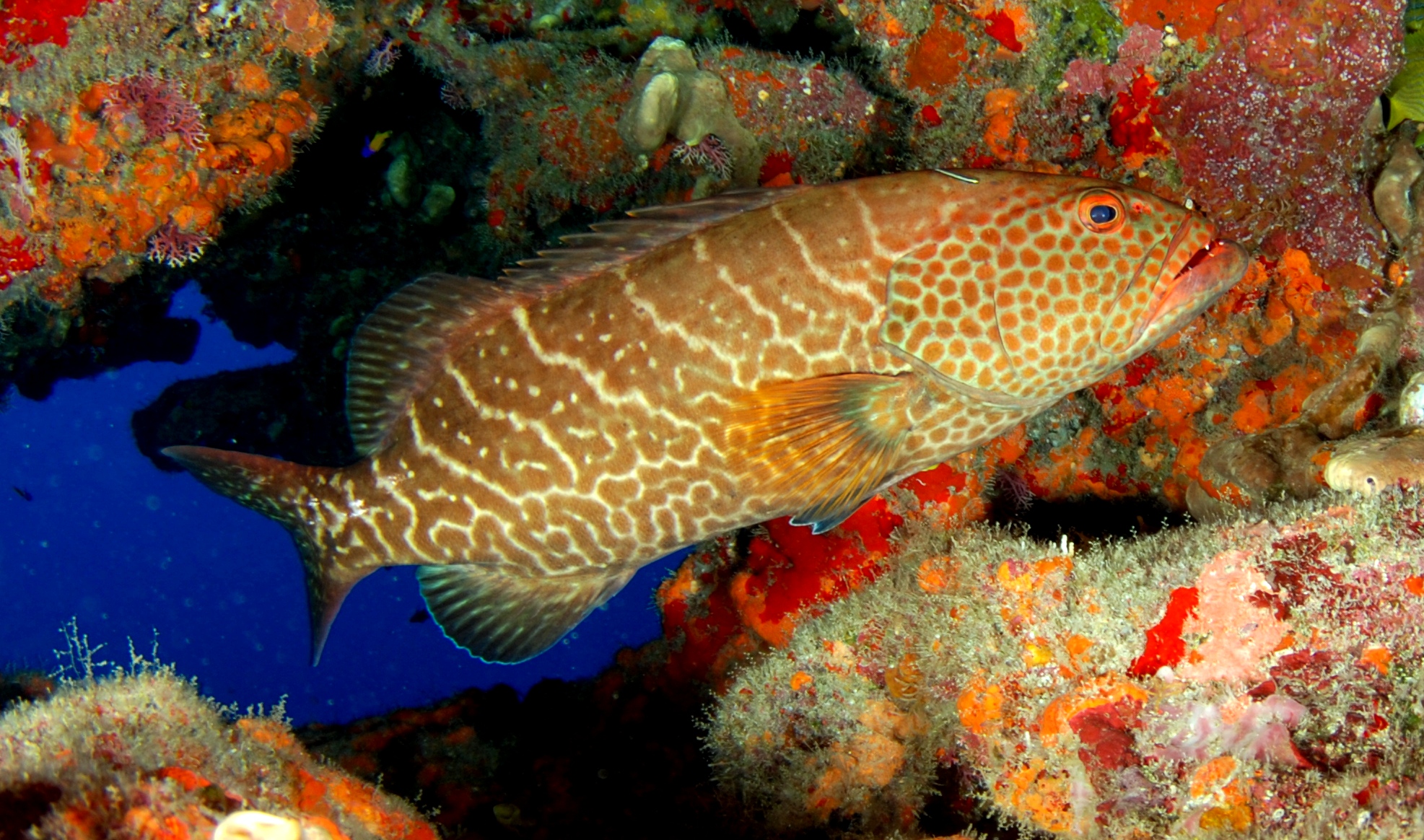
It normally remains close to complex structure rather than cruising continuously in open water. Where harvest is legal, anglers should check current size limits, seasons, closed areas, protected-species rules, and release requirements.
19. Yellowmouth Grouper
The Yellowmouth Grouper (Mycteroperca interstitialis) is best understood as a medium-sized, structure-oriented predator. It may rest beneath coral heads, beside boulders, around drop-offs, or near artificial structure. A compact body and strong tail provide short bursts of acceleration instead of sustained high-speed swimming.
For reliable identification, photograph both sides, the tail, dorsal fin, and head. Large individuals from some tropical reefs may present ciguatera risk, so local seafood advisories matter as much as species identification.
20. Dusky Grouper
Dusky Grouper is the common name used here for Epinephelus marginatus. This large grouper is part of a reef-fish community in which ambush predators influence the abundance and behavior of smaller fishes and crustaceans. Individuals often use the same shelter or limited home range for long periods.
Many groupers mature slowly, form predictable spawning aggregations, or change sex during life. These traits can make local populations vulnerable even when adults appear powerful and abundant.
21. White Grouper
The White Grouper (Epinephelus aeneus) is a medium-sized marine grouper with the sturdy profile, broad head, and oversized mouth typical of the family. Color and pattern can change with age, depth, mood, and habitat, so identification should not rely on one photograph. Compare the tail, dorsal-fin outline, head markings, spot arrangement, and known range.

This species stays close to reef, rock, ledge, wreck, or other seafloor structure within its natural distribution. Like most groupers, it feeds by waiting near cover and lunging at fish, crabs, shrimp, squid, or other suitable prey.
22. Goldblotch Grouper
Goldblotch Grouper, scientifically named Epinephelus costae, is a medium-sized member of the grouper group. Its field marks may include mottling, saddles, bars, colored fin edges, or scattered spots, but these features can fade underwater or differ between juveniles and adults. Location, depth, and body proportions are often as important as color.
It normally remains close to complex structure rather than cruising continuously in open water. Where harvest is legal, anglers should check current size limits, seasons, closed areas, protected-species rules, and release requirements.
23. Dogtooth Grouper
The Dogtooth Grouper (Epinephelus caninus) is best understood as a large, structure-oriented predator. It may rest beneath coral heads, beside boulders, around drop-offs, or near artificial structure. A compact body and strong tail provide short bursts of acceleration instead of sustained high-speed swimming.
For reliable identification, photograph both sides, the tail, dorsal fin, and head. Large individuals from some tropical reefs may present ciguatera risk, so local seafood advisories matter as much as species identification.
24. Orange-Spotted Grouper
Orange-Spotted Grouper is the common name used here for Epinephelus coioides. This medium-sized grouper is part of a reef-fish community in which ambush predators influence the abundance and behavior of smaller fishes and crustaceans. Individuals often use the same shelter or limited home range for long periods.

Many groupers mature slowly, form predictable spawning aggregations, or change sex during life. These traits can make local populations vulnerable even when adults appear powerful and abundant.
25. Brown-Marbled Grouper
The Brown-Marbled Grouper (Epinephelus fuscoguttatus) is a large marine grouper with the sturdy profile, broad head, and oversized mouth typical of the family. Color and pattern can change with age, depth, mood, and habitat, so identification should not rely on one photograph. Compare the tail, dorsal-fin outline, head markings, spot arrangement, and known range.
This species stays close to reef, rock, ledge, wreck, or other seafloor structure within its natural distribution. Like most groupers, it feeds by waiting near cover and lunging at fish, crabs, shrimp, squid, or other suitable prey.
26. Malabar Grouper
Malabar Grouper, scientifically named Epinephelus malabaricus, is a large member of the grouper group. Its field marks may include mottling, saddles, bars, colored fin edges, or scattered spots, but these features can fade underwater or differ between juveniles and adults. Location, depth, and body proportions are often as important as color.
It normally remains close to complex structure rather than cruising continuously in open water. Where harvest is legal, anglers should check current size limits, seasons, closed areas, protected-species rules, and release requirements.
27. Greasy Grouper
The Greasy Grouper (Epinephelus tauvina) is best understood as a medium-sized, structure-oriented predator. It may rest beneath coral heads, beside boulders, around drop-offs, or near artificial structure. A compact body and strong tail provide short bursts of acceleration instead of sustained high-speed swimming.
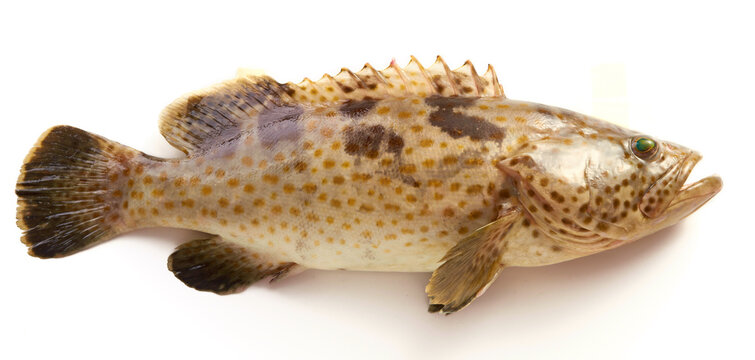
For reliable identification, photograph both sides, the tail, dorsal fin, and head. Large individuals from some tropical reefs may present ciguatera risk, so local seafood advisories matter as much as species identification.
28. Potato Grouper
Potato Grouper is the common name used here for Epinephelus tukula. This very large grouper is part of a reef-fish community in which ambush predators influence the abundance and behavior of smaller fishes and crustaceans. Individuals often use the same shelter or limited home range for long periods.
Many groupers mature slowly, form predictable spawning aggregations, or change sex during life. These traits can make local populations vulnerable even when adults appear powerful and abundant.
29. Honeycomb Grouper
The Honeycomb Grouper (Epinephelus merra) is a medium-sized marine grouper with the sturdy profile, broad head, and oversized mouth typical of the family. Color and pattern can change with age, depth, mood, and habitat, so identification should not rely on one photograph. Compare the tail, dorsal-fin outline, head markings, spot arrangement, and known range.
This species stays close to reef, rock, ledge, wreck, or other seafloor structure within its natural distribution. Like most groupers, it feeds by waiting near cover and lunging at fish, crabs, shrimp, squid, or other suitable prey.
30. Areolate Grouper
Areolate Grouper, scientifically named Epinephelus areolatus, is a medium-sized member of the grouper group. Its field marks may include mottling, saddles, bars, colored fin edges, or scattered spots, but these features can fade underwater or differ between juveniles and adults. Location, depth, and body proportions are often as important as color.
It normally remains close to complex structure rather than cruising continuously in open water. Where harvest is legal, anglers should check current size limits, seasons, closed areas, protected-species rules, and release requirements.
31. Blacktip Grouper
The Blacktip Grouper (Epinephelus fasciatus) is best understood as a medium-sized, structure-oriented predator. It may rest beneath coral heads, beside boulders, around drop-offs, or near artificial structure. A compact body and strong tail provide short bursts of acceleration instead of sustained high-speed swimming.
For reliable identification, photograph both sides, the tail, dorsal fin, and head. Large individuals from some tropical reefs may present ciguatera risk, so local seafood advisories matter as much as species identification.
32. Blue-and-Yellow Grouper
Blue-and-Yellow Grouper is the common name used here for Epinephelus flavocaeruleus. This medium-sized grouper is part of a reef-fish community in which ambush predators influence the abundance and behavior of smaller fishes and crustaceans. Individuals often use the same shelter or limited home range for long periods.
Many groupers mature slowly, form predictable spawning aggregations, or change sex during life. These traits can make local populations vulnerable even when adults appear powerful and abundant.
33. Longtooth Grouper
The Longtooth Grouper (Epinephelus bruneus) is a medium-sized marine grouper with the sturdy profile, broad head, and oversized mouth typical of the family. Color and pattern can change with age, depth, mood, and habitat, so identification should not rely on one photograph. Compare the tail, dorsal-fin outline, head markings, spot arrangement, and known range.

This species stays close to reef, rock, ledge, wreck, or other seafloor structure within its natural distribution. Like most groupers, it feeds by waiting near cover and lunging at fish, crabs, shrimp, squid, or other suitable prey.
34. Hong Kong Grouper
Hong Kong Grouper, scientifically named Epinephelus akaara, is a medium-sized member of the grouper group. Its field marks may include mottling, saddles, bars, colored fin edges, or scattered spots, but these features can fade underwater or differ between juveniles and adults. Location, depth, and body proportions are often as important as color.
It normally remains close to complex structure rather than cruising continuously in open water. Where harvest is legal, anglers should check current size limits, seasons, closed areas, protected-species rules, and release requirements.
35. Yellow Grouper
The Yellow Grouper (Epinephelus awoara) is best understood as a medium-sized, structure-oriented predator. It may rest beneath coral heads, beside boulders, around drop-offs, or near artificial structure. A compact body and strong tail provide short bursts of acceleration instead of sustained high-speed swimming.
For reliable identification, photograph both sides, the tail, dorsal fin, and head. Large individuals from some tropical reefs may present ciguatera risk, so local seafood advisories matter as much as species identification.
36. Duskytail Grouper
Duskytail Grouper is the common name used here for Epinephelus bleekeri. This medium-sized grouper is part of a reef-fish community in which ambush predators influence the abundance and behavior of smaller fishes and crustaceans. Individuals often use the same shelter or limited home range for long periods.
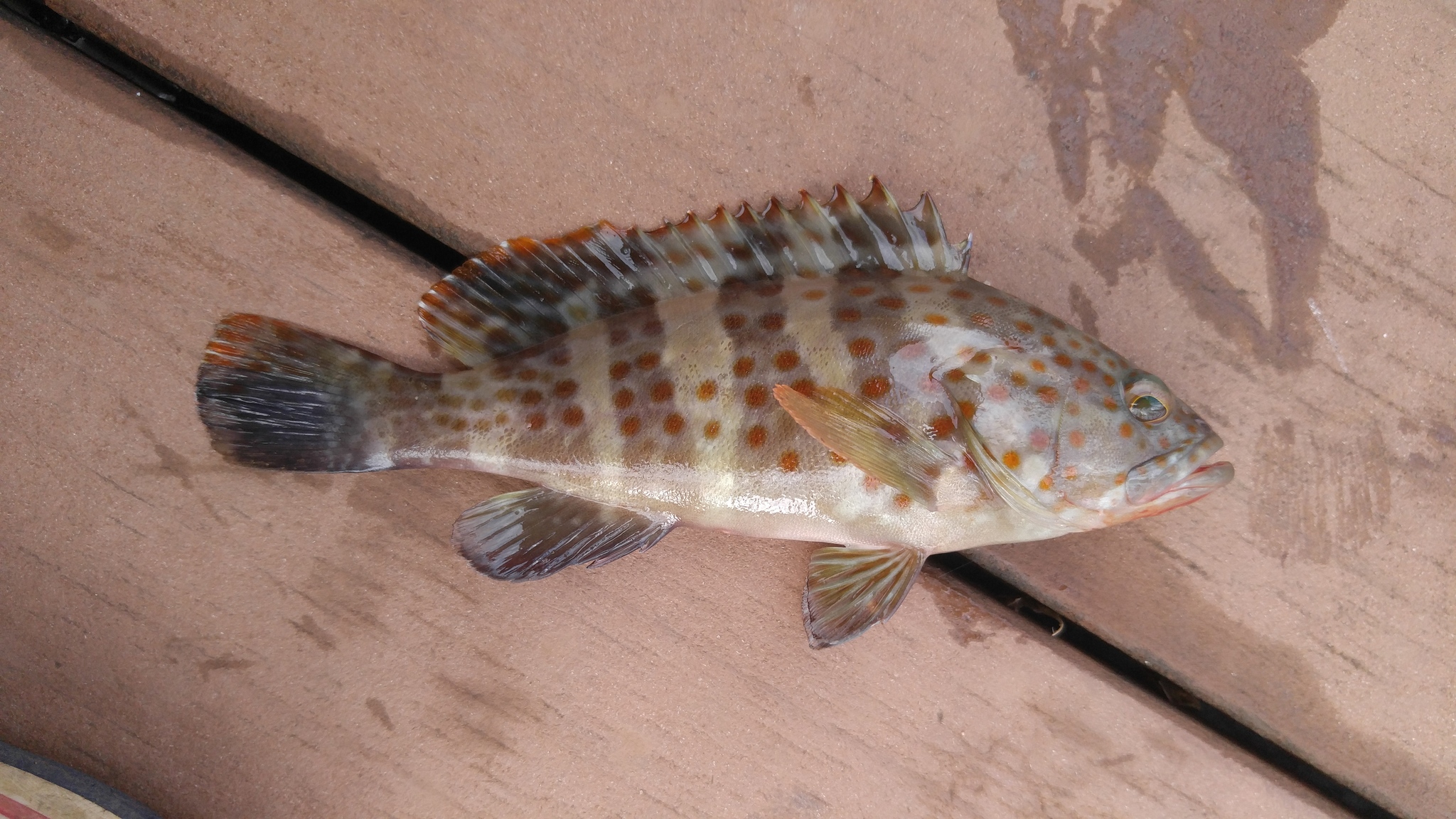
Many groupers mature slowly, form predictable spawning aggregations, or change sex during life. These traits can make local populations vulnerable even when adults appear powerful and abundant.
37. Sixbar Grouper
The Sixbar Grouper (Epinephelus sexfasciatus) is a medium-sized marine grouper with the sturdy profile, broad head, and oversized mouth typical of the family. Color and pattern can change with age, depth, mood, and habitat, so identification should not rely on one photograph. Compare the tail, dorsal-fin outline, head markings, spot arrangement, and known range.
This species stays close to reef, rock, ledge, wreck, or other seafloor structure within its natural distribution. Like most groupers, it feeds by waiting near cover and lunging at fish, crabs, shrimp, squid, or other suitable prey.
38. Camouflage Grouper
Camouflage Grouper, scientifically named Epinephelus polyphekadion, is a large member of the grouper group. Its field marks may include mottling, saddles, bars, colored fin edges, or scattered spots, but these features can fade underwater or differ between juveniles and adults. Location, depth, and body proportions are often as important as color.
It normally remains close to complex structure rather than cruising continuously in open water. Where harvest is legal, anglers should check current size limits, seasons, closed areas, protected-species rules, and release requirements.
39. Starspotted Grouper
The Starspotted Grouper (Epinephelus hexagonatus) is best understood as a medium-sized, structure-oriented predator. It may rest beneath coral heads, beside boulders, around drop-offs, or near artificial structure. A compact body and strong tail provide short bursts of acceleration instead of sustained high-speed swimming.

For reliable identification, photograph both sides, the tail, dorsal fin, and head. Large individuals from some tropical reefs may present ciguatera risk, so local seafood advisories matter as much as species identification.
40. Blacksaddle Grouper
Blacksaddle Grouper is the common name used here for Epinephelus howlandi. This medium-sized grouper is part of a reef-fish community in which ambush predators influence the abundance and behavior of smaller fishes and crustaceans. Individuals often use the same shelter or limited home range for long periods.
Many groupers mature slowly, form predictable spawning aggregations, or change sex during life. These traits can make local populations vulnerable even when adults appear powerful and abundant.
41. Longfin Grouper
The Longfin Grouper (Epinephelus quoyanus) is a medium-sized marine grouper with the sturdy profile, broad head, and oversized mouth typical of the family. Color and pattern can change with age, depth, mood, and habitat, so identification should not rely on one photograph. Compare the tail, dorsal-fin outline, head markings, spot arrangement, and known range.
This species stays close to reef, rock, ledge, wreck, or other seafloor structure within its natural distribution. Like most groupers, it feeds by waiting near cover and lunging at fish, crabs, shrimp, squid, or other suitable prey.
42. Halfmoon Grouper
Halfmoon Grouper, scientifically named Epinephelus rivulatus, is a medium-sized member of the grouper group. Its field marks may include mottling, saddles, bars, colored fin edges, or scattered spots, but these features can fade underwater or differ between juveniles and adults. Location, depth, and body proportions are often as important as color.

It normally remains close to complex structure rather than cruising continuously in open water. Where harvest is legal, anglers should check current size limits, seasons, closed areas, protected-species rules, and release requirements.
43. Epaulet Grouper
The Epaulet Grouper (Epinephelus stoliczkae) is best understood as a medium-sized, structure-oriented predator. It may rest beneath coral heads, beside boulders, around drop-offs, or near artificial structure. A compact body and strong tail provide short bursts of acceleration instead of sustained high-speed swimming.
For reliable identification, photograph both sides, the tail, dorsal fin, and head. Large individuals from some tropical reefs may present ciguatera risk, so local seafood advisories matter as much as species identification.
44. Wavy-Lined Grouper
Wavy-Lined Grouper is the common name used here for Epinephelus undulosus. This medium-sized grouper is part of a reef-fish community in which ambush predators influence the abundance and behavior of smaller fishes and crustaceans. Individuals often use the same shelter or limited home range for long periods.
Many groupers mature slowly, form predictable spawning aggregations, or change sex during life. These traits can make local populations vulnerable even when adults appear powerful and abundant.
45. Dotted Grouper
The Dotted Grouper (Epinephelus epistictus) is a medium-sized marine grouper with the sturdy profile, broad head, and oversized mouth typical of the family. Color and pattern can change with age, depth, mood, and habitat, so identification should not rely on one photograph. Compare the tail, dorsal-fin outline, head markings, spot arrangement, and known range.

This species stays close to reef, rock, ledge, wreck, or other seafloor structure within its natural distribution. Like most groupers, it feeds by waiting near cover and lunging at fish, crabs, shrimp, squid, or other suitable prey.
46. White-Blotched Grouper
White-Blotched Grouper, scientifically named Epinephelus multinotatus, is a medium-sized member of the grouper group. Its field marks may include mottling, saddles, bars, colored fin edges, or scattered spots, but these features can fade underwater or differ between juveniles and adults. Location, depth, and body proportions are often as important as color.
It normally remains close to complex structure rather than cruising continuously in open water. Where harvest is legal, anglers should check current size limits, seasons, closed areas, protected-species rules, and release requirements.
47. One-Blotch Grouper
The One-Blotch Grouper (Epinephelus melanostigma) is best understood as a medium-sized, structure-oriented predator. It may rest beneath coral heads, beside boulders, around drop-offs, or near artificial structure. A compact body and strong tail provide short bursts of acceleration instead of sustained high-speed swimming.
For reliable identification, photograph both sides, the tail, dorsal fin, and head. Large individuals from some tropical reefs may present ciguatera risk, so local seafood advisories matter as much as species identification.
48. Specklefin Grouper
Specklefin Grouper is the common name used here for Epinephelus ongus. This medium-sized grouper is part of a reef-fish community in which ambush predators influence the abundance and behavior of smaller fishes and crustaceans. Individuals often use the same shelter or limited home range for long periods.
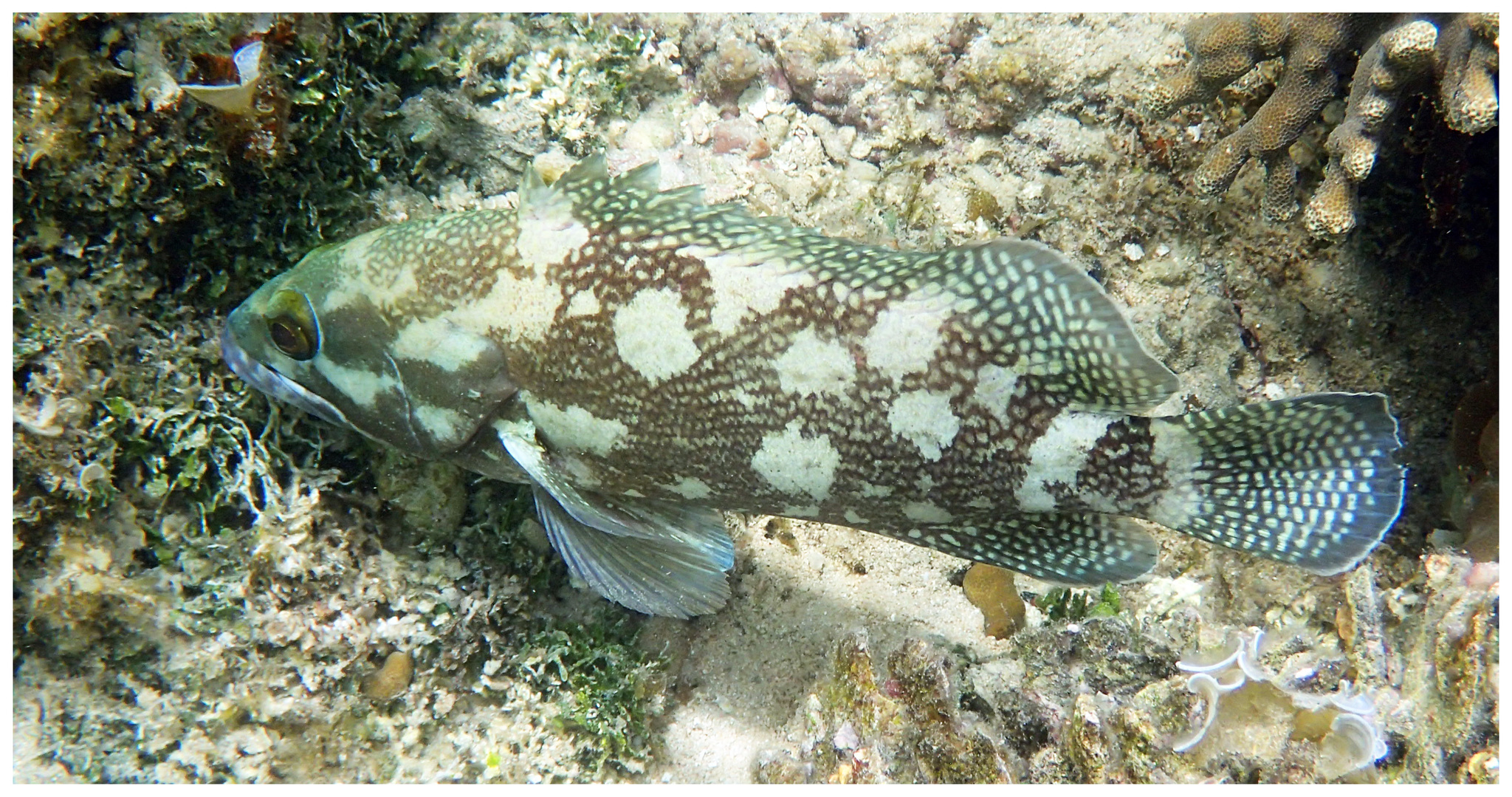
Many groupers mature slowly, form predictable spawning aggregations, or change sex during life. These traits can make local populations vulnerable even when adults appear powerful and abundant.
49. Coral Grouper
The Coral Grouper (Epinephelus corallicola) is a medium-sized marine grouper with the sturdy profile, broad head, and oversized mouth typical of the family. Color and pattern can change with age, depth, mood, and habitat, so identification should not rely on one photograph. Compare the tail, dorsal-fin outline, head markings, spot arrangement, and known range.
This species stays close to reef, rock, ledge, wreck, or other seafloor structure within its natural distribution. Like most groupers, it feeds by waiting near cover and lunging at fish, crabs, shrimp, squid, or other suitable prey.
50. Banded Grouper
Banded Grouper, scientifically named Epinephelus amblycephalus, is a medium-sized member of the grouper group. Its field marks may include mottling, saddles, bars, colored fin edges, or scattered spots, but these features can fade underwater or differ between juveniles and adults. Location, depth, and body proportions are often as important as color.
It normally remains close to complex structure rather than cruising continuously in open water. Where harvest is legal, anglers should check current size limits, seasons, closed areas, protected-species rules, and release requirements.
51. Spotted Grouper
The Spotted Grouper (Epinephelus analogus) is best understood as a medium-sized, structure-oriented predator. It may rest beneath coral heads, beside boulders, around drop-offs, or near artificial structure. A compact body and strong tail provide short bursts of acceleration instead of sustained high-speed swimming.
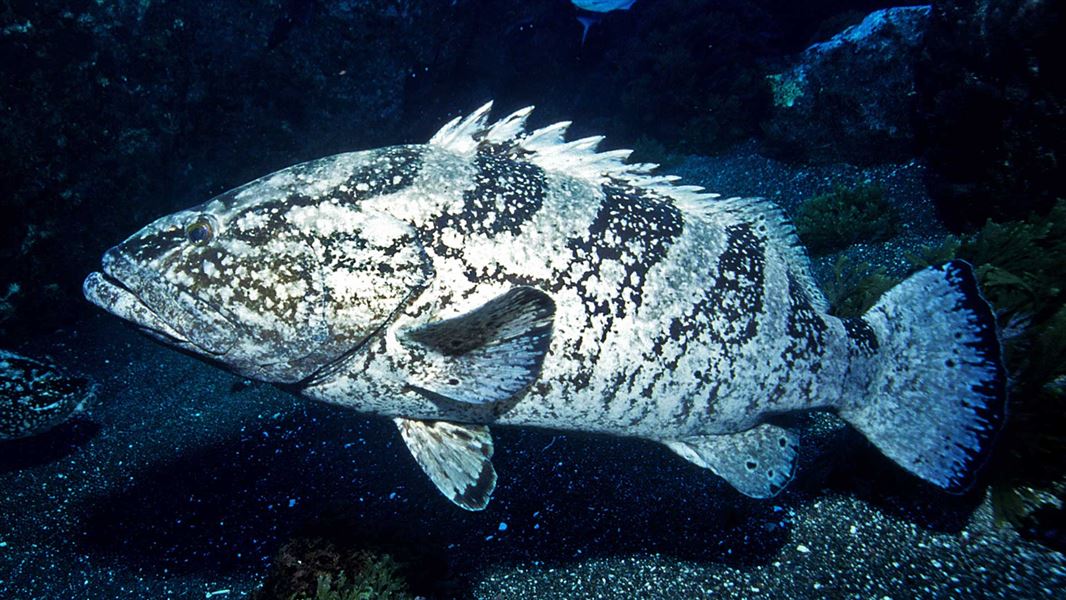
For reliable identification, photograph both sides, the tail, dorsal fin, and head. Large individuals from some tropical reefs may present ciguatera risk, so local seafood advisories matter as much as species identification.
52. Catface Grouper
Catface Grouper is the common name used here for Epinephelus andersoni. This medium-sized grouper is part of a reef-fish community in which ambush predators influence the abundance and behavior of smaller fishes and crustaceans. Individuals often use the same shelter or limited home range for long periods.
Many groupers mature slowly, form predictable spawning aggregations, or change sex during life. These traits can make local populations vulnerable even when adults appear powerful and abundant.
53. White-Edged Grouper
The White-Edged Grouper (Epinephelus albomarginatus) is a medium-sized marine grouper with the sturdy profile, broad head, and oversized mouth typical of the family. Color and pattern can change with age, depth, mood, and habitat, so identification should not rely on one photograph. Compare the tail, dorsal-fin outline, head markings, spot arrangement, and known range.
This species stays close to reef, rock, ledge, wreck, or other seafloor structure within its natural distribution. Like most groupers, it feeds by waiting near cover and lunging at fish, crabs, shrimp, squid, or other suitable prey.
54. Longspine Grouper
Longspine Grouper, scientifically named Epinephelus longispinis, is a medium-sized member of the grouper group. Its field marks may include mottling, saddles, bars, colored fin edges, or scattered spots, but these features can fade underwater or differ between juveniles and adults. Location, depth, and body proportions are often as important as color.

It normally remains close to complex structure rather than cruising continuously in open water. Where harvest is legal, anglers should check current size limits, seasons, closed areas, protected-species rules, and release requirements.
55. Snubnose Grouper
The Snubnose Grouper (Epinephelus macrospilos) is best understood as a medium-sized, structure-oriented predator. It may rest beneath coral heads, beside boulders, around drop-offs, or near artificial structure. A compact body and strong tail provide short bursts of acceleration instead of sustained high-speed swimming.
For reliable identification, photograph both sides, the tail, dorsal fin, and head. Large individuals from some tropical reefs may present ciguatera risk, so local seafood advisories matter as much as species identification.
56. Highfin Grouper
Highfin Grouper is the common name used here for Epinephelus maculatus. This medium-sized grouper is part of a reef-fish community in which ambush predators influence the abundance and behavior of smaller fishes and crustaceans. Individuals often use the same shelter or limited home range for long periods.
Many groupers mature slowly, form predictable spawning aggregations, or change sex during life. These traits can make local populations vulnerable even when adults appear powerful and abundant.
57. Red-Tipped Grouper
The Red-Tipped Grouper (Epinephelus retouti) is a medium-sized marine grouper with the sturdy profile, broad head, and oversized mouth typical of the family. Color and pattern can change with age, depth, mood, and habitat, so identification should not rely on one photograph. Compare the tail, dorsal-fin outline, head markings, spot arrangement, and known range.
This species stays close to reef, rock, ledge, wreck, or other seafloor structure within its natural distribution. Like most groupers, it feeds by waiting near cover and lunging at fish, crabs, shrimp, squid, or other suitable prey.
58. Oblique-Banded Grouper
Oblique-Banded Grouper, scientifically named Epinephelus radiatus, is a medium-sized member of the grouper group. Its field marks may include mottling, saddles, bars, colored fin edges, or scattered spots, but these features can fade underwater or differ between juveniles and adults. Location, depth, and body proportions are often as important as color.
It normally remains close to complex structure rather than cruising continuously in open water. Where harvest is legal, anglers should check current size limits, seasons, closed areas, protected-species rules, and release requirements.
59. Foursaddle Grouper
The Foursaddle Grouper (Epinephelus spilotoceps) is best understood as a medium-sized, structure-oriented predator. It may rest beneath coral heads, beside boulders, around drop-offs, or near artificial structure. A compact body and strong tail provide short bursts of acceleration instead of sustained high-speed swimming.
For reliable identification, photograph both sides, the tail, dorsal fin, and head. Large individuals from some tropical reefs may present ciguatera risk, so local seafood advisories matter as much as species identification.
60. Peacock Grouper
Peacock Grouper is the common name used here for Cephalopholis argus. This medium-sized grouper is part of a reef-fish community in which ambush predators influence the abundance and behavior of smaller fishes and crustaceans. Individuals often use the same shelter or limited home range for long periods.

Many groupers mature slowly, form predictable spawning aggregations, or change sex during life. These traits can make local populations vulnerable even when adults appear powerful and abundant.
61. Coral Hind
The Coral Hind (Cephalopholis miniata) is a small to medium-sized marine grouper with the sturdy profile, broad head, and oversized mouth typical of the family. Color and pattern can change with age, depth, mood, and habitat, so identification should not rely on one photograph. Compare the tail, dorsal-fin outline, head markings, spot arrangement, and known range.
This species stays close to reef, rock, ledge, wreck, or other seafloor structure within its natural distribution. Like most groupers, it feeds by waiting near cover and lunging at fish, crabs, shrimp, squid, or other suitable prey.
62. Tomato Hind
Tomato Hind, scientifically named Cephalopholis sonnerati, is a small to medium-sized member of the grouper group. Its field marks may include mottling, saddles, bars, colored fin edges, or scattered spots, but these features can fade underwater or differ between juveniles and adults. Location, depth, and body proportions are often as important as color.
It normally remains close to complex structure rather than cruising continuously in open water. Where harvest is legal, anglers should check current size limits, seasons, closed areas, protected-species rules, and release requirements.
63. Strawberry Hind
The Strawberry Hind (Cephalopholis spiloparaea) is best understood as a small to medium-sized, structure-oriented predator. It may rest beneath coral heads, beside boulders, around drop-offs, or near artificial structure. A compact body and strong tail provide short bursts of acceleration instead of sustained high-speed swimming.
For reliable identification, photograph both sides, the tail, dorsal fin, and head. Large individuals from some tropical reefs may present ciguatera risk, so local seafood advisories matter as much as species identification.
64. Bluespotted Hind
Bluespotted Hind is the common name used here for Cephalopholis cyanostigma. This small to medium-sized grouper is part of a reef-fish community in which ambush predators influence the abundance and behavior of smaller fishes and crustaceans. Individuals often use the same shelter or limited home range for long periods.
Many groupers mature slowly, form predictable spawning aggregations, or change sex during life. These traits can make local populations vulnerable even when adults appear powerful and abundant.
65. Bluelined Hind
The Bluelined Hind (Cephalopholis formosa) is a small to medium-sized marine grouper with the sturdy profile, broad head, and oversized mouth typical of the family. Color and pattern can change with age, depth, mood, and habitat, so identification should not rely on one photograph. Compare the tail, dorsal-fin outline, head markings, spot arrangement, and known range.
This species stays close to reef, rock, ledge, wreck, or other seafloor structure within its natural distribution. Like most groupers, it feeds by waiting near cover and lunging at fish, crabs, shrimp, squid, or other suitable prey.
66. Leopard Hind
Leopard Hind, scientifically named Cephalopholis leopardus, is a small to medium-sized member of the grouper group. Its field marks may include mottling, saddles, bars, colored fin edges, or scattered spots, but these features can fade underwater or differ between juveniles and adults. Location, depth, and body proportions are often as important as color.

It normally remains close to complex structure rather than cruising continuously in open water. Where harvest is legal, anglers should check current size limits, seasons, closed areas, protected-species rules, and release requirements.
67. Sixblotch Hind
The Sixblotch Hind (Cephalopholis sexmaculata) is best understood as a small to medium-sized, structure-oriented predator. It may rest beneath coral heads, beside boulders, around drop-offs, or near artificial structure. A compact body and strong tail provide short bursts of acceleration instead of sustained high-speed swimming.
For reliable identification, photograph both sides, the tail, dorsal fin, and head. Large individuals from some tropical reefs may present ciguatera risk, so local seafood advisories matter as much as species identification.
68. Harlequin Hind
Harlequin Hind is the common name used here for Cephalopholis polleni. This small to medium-sized grouper is part of a reef-fish community in which ambush predators influence the abundance and behavior of smaller fishes and crustaceans. Individuals often use the same shelter or limited home range for long periods.
Many groupers mature slowly, form predictable spawning aggregations, or change sex during life. These traits can make local populations vulnerable even when adults appear powerful and abundant.
69. Redflag Grouper
The Redflag Grouper (Cephalopholis urodeta) is a medium-sized marine grouper with the sturdy profile, broad head, and oversized mouth typical of the family. Color and pattern can change with age, depth, mood, and habitat, so identification should not rely on one photograph. Compare the tail, dorsal-fin outline, head markings, spot arrangement, and known range.
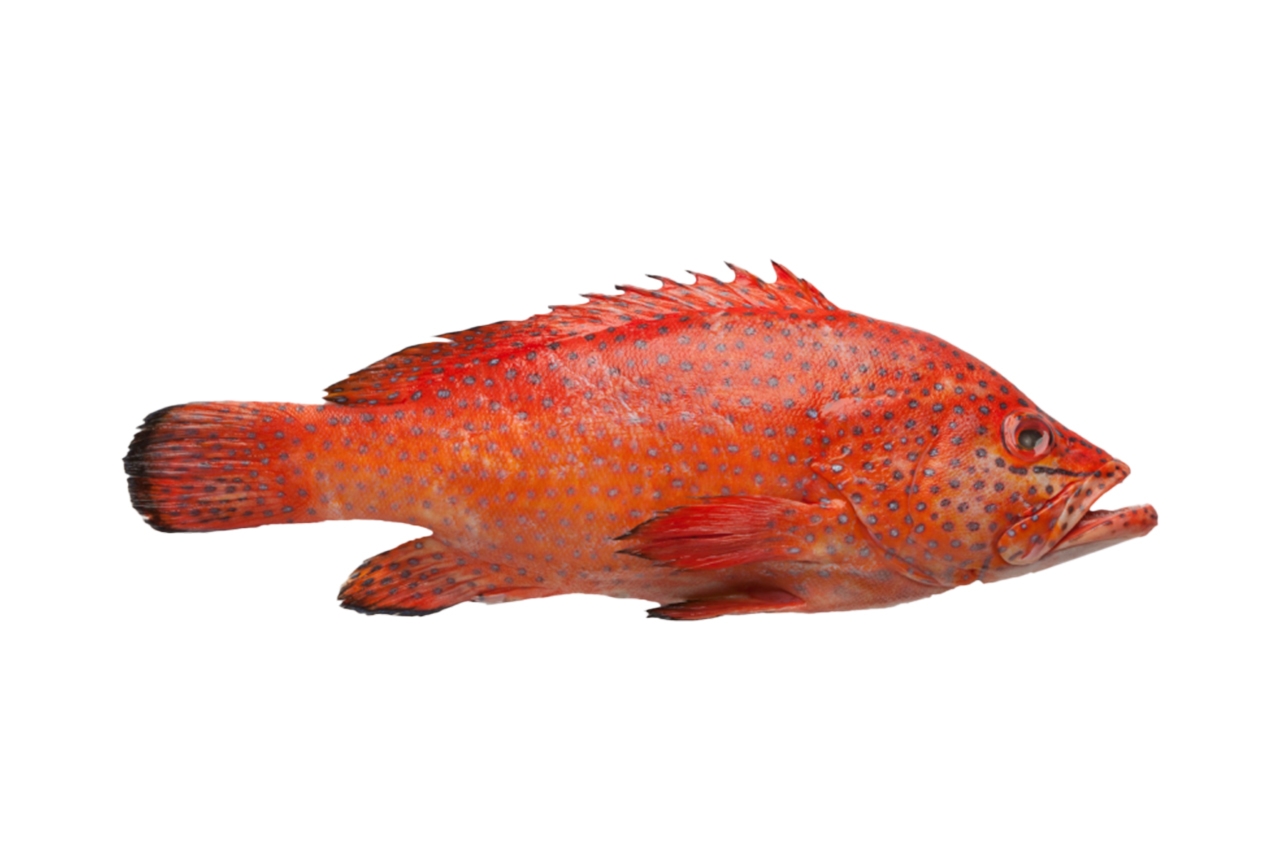
This species stays close to reef, rock, ledge, wreck, or other seafloor structure within its natural distribution. Like most groupers, it feeds by waiting near cover and lunging at fish, crabs, shrimp, squid, or other suitable prey.
70. Redmouth Grouper
Redmouth Grouper, scientifically named Aethaloperca rogaa, is a medium-sized member of the grouper group. Its field marks may include mottling, saddles, bars, colored fin edges, or scattered spots, but these features can fade underwater or differ between juveniles and adults. Location, depth, and body proportions are often as important as color.
It normally remains close to complex structure rather than cruising continuously in open water. Where harvest is legal, anglers should check current size limits, seasons, closed areas, protected-species rules, and release requirements.
71. Slender Grouper
The Slender Grouper (Anyperodon leucogrammicus) is best understood as a medium-sized, structure-oriented predator. It may rest beneath coral heads, beside boulders, around drop-offs, or near artificial structure. A compact body and strong tail provide short bursts of acceleration instead of sustained high-speed swimming.
For reliable identification, photograph both sides, the tail, dorsal fin, and head. Large individuals from some tropical reefs may present ciguatera risk, so local seafood advisories matter as much as species identification.
72. Humpback Grouper
Humpback Grouper is the common name used here for Cromileptes altivelis. This medium-sized grouper is part of a reef-fish community in which ambush predators influence the abundance and behavior of smaller fishes and crustaceans. Individuals often use the same shelter or limited home range for long periods.

Many groupers mature slowly, form predictable spawning aggregations, or change sex during life. These traits can make local populations vulnerable even when adults appear powerful and abundant.
73. Leopard Coral Grouper
The Leopard Coral Grouper (Plectropomus leopardus) is a large marine grouper with the sturdy profile, broad head, and oversized mouth typical of the family. Color and pattern can change with age, depth, mood, and habitat, so identification should not rely on one photograph. Compare the tail, dorsal-fin outline, head markings, spot arrangement, and known range.
This species stays close to reef, rock, ledge, wreck, or other seafloor structure within its natural distribution. Like most groupers, it feeds by waiting near cover and lunging at fish, crabs, shrimp, squid, or other suitable prey.
74. Squaretail Coral Grouper
Squaretail Coral Grouper, scientifically named Plectropomus areolatus, is a large member of the grouper group. Its field marks may include mottling, saddles, bars, colored fin edges, or scattered spots, but these features can fade underwater or differ between juveniles and adults. Location, depth, and body proportions are often as important as color.
It normally remains close to complex structure rather than cruising continuously in open water. Where harvest is legal, anglers should check current size limits, seasons, closed areas, protected-species rules, and release requirements.
75. Black-Saddled Coral Grouper
The Black-Saddled Coral Grouper (Plectropomus laevis) is best understood as a large, structure-oriented predator. It may rest beneath coral heads, beside boulders, around drop-offs, or near artificial structure. A compact body and strong tail provide short bursts of acceleration instead of sustained high-speed swimming.
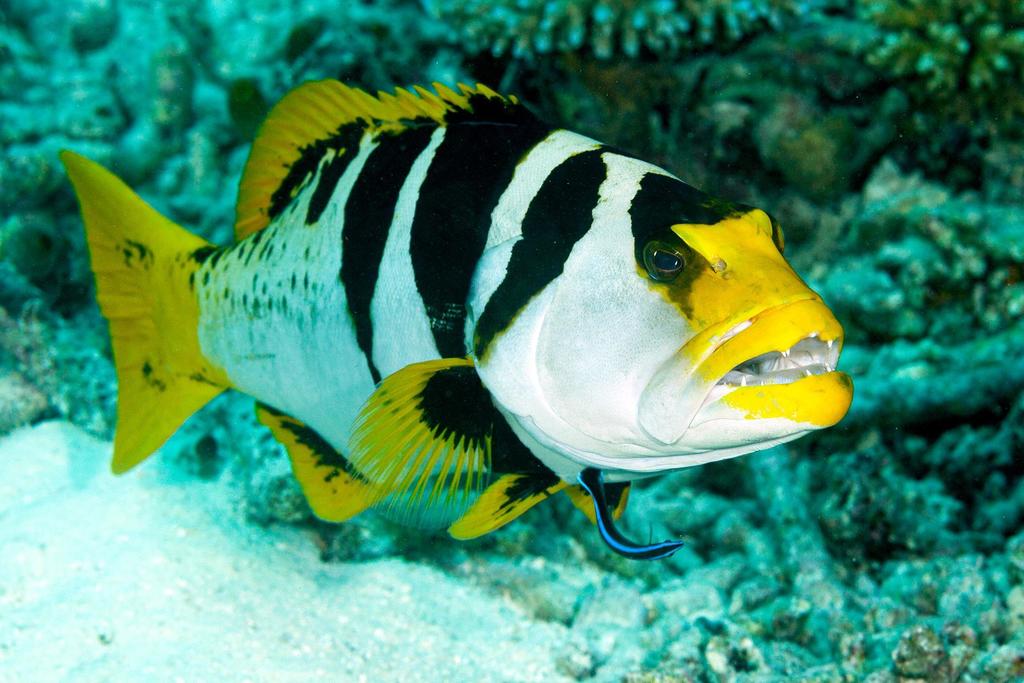
For reliable identification, photograph both sides, the tail, dorsal fin, and head. Large individuals from some tropical reefs may present ciguatera risk, so local seafood advisories matter as much as species identification.
76. Spotted Coral Grouper
Spotted Coral Grouper is the common name used here for Plectropomus maculatus. This medium-sized grouper is part of a reef-fish community in which ambush predators influence the abundance and behavior of smaller fishes and crustaceans. Individuals often use the same shelter or limited home range for long periods.
Many groupers mature slowly, form predictable spawning aggregations, or change sex during life. These traits can make local populations vulnerable even when adults appear powerful and abundant.
77. Highfin Coral Grouper
The Highfin Coral Grouper (Plectropomus oligacanthus) is a medium-sized marine grouper with the sturdy profile, broad head, and oversized mouth typical of the family. Color and pattern can change with age, depth, mood, and habitat, so identification should not rely on one photograph. Compare the tail, dorsal-fin outline, head markings, spot arrangement, and known range.
This species stays close to reef, rock, ledge, wreck, or other seafloor structure within its natural distribution. Like most groupers, it feeds by waiting near cover and lunging at fish, crabs, shrimp, squid, or other suitable prey.
78. Roving Coral Grouper
Roving Coral Grouper, scientifically named Plectropomus pessuliferus, is a medium-sized member of the grouper group. Its field marks may include mottling, saddles, bars, colored fin edges, or scattered spots, but these features can fade underwater or differ between juveniles and adults. Location, depth, and body proportions are often as important as color.

It normally remains close to complex structure rather than cruising continuously in open water. Where harvest is legal, anglers should check current size limits, seasons, closed areas, protected-species rules, and release requirements.
79. Yellow-Edged Lyretail
The Yellow-Edged Lyretail (Variola louti) is best understood as a medium-sized, structure-oriented predator. It may rest beneath coral heads, beside boulders, around drop-offs, or near artificial structure. A compact body and strong tail provide short bursts of acceleration instead of sustained high-speed swimming.
For reliable identification, photograph both sides, the tail, dorsal fin, and head. Large individuals from some tropical reefs may present ciguatera risk, so local seafood advisories matter as much as species identification.
80. White-Edged Lyretail
White-Edged Lyretail is the common name used here for Variola albimarginata. This medium-sized grouper is part of a reef-fish community in which ambush predators influence the abundance and behavior of smaller fishes and crustaceans. Individuals often use the same shelter or limited home range for long periods.
Many groupers mature slowly, form predictable spawning aggregations, or change sex during life. These traits can make local populations vulnerable even when adults appear powerful and abundant.
Where Do Grouper Fish Live?
Grouper diversity is highest in tropical and subtropical seas. Coral reefs support many Indo-Pacific species, while rocky reefs, ledges, wrecks, and deep banks hold numerous Atlantic and Mediterranean species. Juveniles of some groupers use mangroves, seagrass beds, estuaries, and shallow rubble zones before moving to deeper adult habitat.
Depth alone is not enough for identification. Record the location, approximate depth, bottom type, and whether the fish was solitary or near a cleaning station. These details can resolve an identification that color alone cannot.
How to Identify Different Types of Grouper Fish
- Body shape: Look for a deep or elongated body, thick tail base, broad head, and large mouth.
- Tail shape: Rounded, truncate, concave, and lyre-shaped tails help separate genera and species.
- Pattern: Count bars, saddles, blotches, and rows of spots instead of describing the fish only as brown or red.
- Fin margins: Yellow, white, black, or blue edging can be diagnostic.
- Head details: Note lines behind the eye, cheek spots, dark jaws, and the preopercle angle.
- Range and depth: Eliminate species that do not occur in the region or habitat.
- Life stage: Juveniles may look dramatically different from adults.
Fishing Tips and Notes
- Identify likely structure with charts, sonar, local knowledge, or visual observation.
- Use tackle matched to the species and nearby cover.
- Control the first part of the fight so the fish cannot immediately return to a cave or wreck.
- Use circle hooks where required or useful with natural bait.
- Prepare dehookers and descending devices before fishing deep water.
- Photograph unusual fish quickly and release them when identification or legality is uncertain.
- Never assume that a local nickname is the legal species name.
Aquarium Care Notes
Only a small number of grouper species are realistic aquarium choices. Even these often grow rapidly, eat smaller tankmates, and create a heavy filtration load. Juveniles sold at a few inches may become large predators. Confirm adult size, diet, territorial behavior, and long-term system volume before purchase.
Safety, Sustainability, and Conservation Notes
Grouper regulations can change by species, region, season, and management zone. Some species are protected, while others have strict minimum sizes, bag limits, spawning-season closures, or gear rules. Identification mistakes can therefore have legal and conservation consequences.
Ciguatera is an additional concern in tropical and subtropical regions. The toxin cannot be reliably detected by smell, taste, or normal cooking. Follow local public-health guidance and never treat a generic online rule as a guarantee of safety.
Fun Facts About Grouper Fish
- Groupers capture prey mainly by opening the mouth rapidly and creating suction.
- Several species use cleaning stations where smaller fish remove parasites.
- Some coral groupers have been observed coordinating hunts with moray eels.
- Many grouper species are protogynous, meaning some females later become males.
- Spawning aggregations may bring normally solitary fish together.
- Juveniles and adults can occupy different habitats.
- Color can change with stress, courtship, dominance, depth, and background.
- The name “grouper” is used differently among fisheries and markets.
- Some of the largest reef-associated bony fishes are groupers.
- Healthy reef structure provides both hunting cover and shelter.
Final Thoughts on Types of Grouper Fish
Learning the major types of grouper fish requires more than memorizing colors. Start with scientific names, geographic range, body shape, tail profile, and the arrangement of spots or bars. Whether you fish, dive, photograph reefs, buy seafood, or manage a marine aquarium, careful identification supports safer decisions and more responsible treatment of these important predators.
Frequently Asked Questions
1. How many types of grouper fish are there?
There are well over one hundred species under modern family-level treatments. The exact total changes as taxonomists revise genera and synonyms.
2. What family do groupers belong to?
Modern classifications commonly place groupers in Epinephelidae. Older sources may place them in Epinephelinae within Serranidae.
3. What is the largest grouper?
The giant grouper and Atlantic goliath grouper are among the largest and are unsuitable for ordinary home aquariums.
4. Are all groupers reef fish?
No. Many use coral or rocky reefs, but others inhabit deep banks, muddy bottoms, estuaries, mangroves, seagrass, wrecks, and artificial reefs.
5. Why do groupers have large mouths?
Their mouths and gill chambers generate suction that pulls prey inward. They usually engulf prey rather than cutting off pieces.
6. What do groupers eat?
Most eat fishes and large invertebrates such as crabs, shrimp, lobsters, squid, and octopus.
7. Are groupers aggressive toward people?
Most avoid people or remain near cover, although very large individuals should always be given space.
8. Can groupers change sex?
Many species show protogynous sex change, but reproductive systems differ and should not be assumed for every species.
9. How can I identify a grouper underwater?
Use body shape, tail shape, fin edges, spot pattern, bars, head markings, depth, and geographic range.
10. Why do grouper colors change?
Lighting, depth, stress, background, age, social behavior, and reproductive condition can all affect visible color.
11. What is a hind?
Hind is a common name used for several smaller or colorful grouper relatives, especially species in Cephalopholis.
12. What is a coral grouper?
Coral grouper usually refers to species in Plectropomus, although common names are not perfectly consistent.
13. Are groupers good to eat?
Many are valued food fish, but legality, sustainability, ciguatera risk, species identity, and local advisories must be checked.
14. Can cooking destroy ciguatera toxin?
Normal cooking, freezing, or marinating does not reliably eliminate ciguatoxins.
15. Are large groupers more likely to carry ciguatera?
Risk may increase higher in the food chain, but local reef history and public-health advice are essential.
16. Why are spawning aggregations vulnerable?
Large numbers gather at predictable times and places, allowing many breeding adults to be removed quickly.
17. Are all groupers legal to catch?
No. Protected species and seasonal closures vary by jurisdiction.
18. What tackle is used for grouper fishing?
Strong tackle is often needed because hooked fish immediately try to reach structure.
19. What is barotrauma in grouper?
A fish brought rapidly from deep water may suffer expanding internal gases. Approved descending devices can help.
20. Can I keep a grouper in a home aquarium?
Only a limited number are suitable, and even smaller species need large systems, strong filtration, and secure tankmates.
21. Will a grouper eat other aquarium fish?
Usually yes if a tankmate fits into its mouth.
22. Are panther groupers beginner fish?
No. Juveniles are attractive but grow quickly and require very large marine systems.
23. Do groupers live alone?
Many adults are solitary or territorial outside breeding periods.
24. How long do groupers live?
Many can live for decades, especially large species.
25. What is the difference between grouper and sea bass?
The names overlap historically and commercially, so a scientific name is the safest reference.
26. Why are scientific names important?
Common names may refer to different species in different countries.
27. Are groupers endangered?
Status varies. Some populations are stable, while others are threatened by overfishing, habitat loss, or aggregation fishing.
28. How should a grouper be released?
Minimize air exposure, support the body, remove the hook quickly, and use a descending device when appropriate.
29. Where is grouper diversity highest?
The Indo-West Pacific has especially high diversity, although groupers also occur in the Atlantic, Mediterranean, eastern Pacific, and Indian Ocean.
30. What is the easiest grouper feature to notice?
The broad head and large mouth are obvious family traits, but species identification needs more detail.
31. Do juvenile groupers look like adults?
Not always. Juveniles may have different bars, spots, colors, and nursery habitats.
32. Can groupers control invasive lionfish?
Some large groupers eat lionfish, but predator recovery alone is not a complete control strategy.
33. Are groupers fast swimmers?
They are powerful over short distances, but many rely on ambush rather than sustained chases.
34. What should seafood buyers ask?
Ask for species, harvest area, catch method, and traceability.
35. What is the best way to learn local grouper species?
Use a regional field guide, current regulations, verified photographs, and scientific names.