

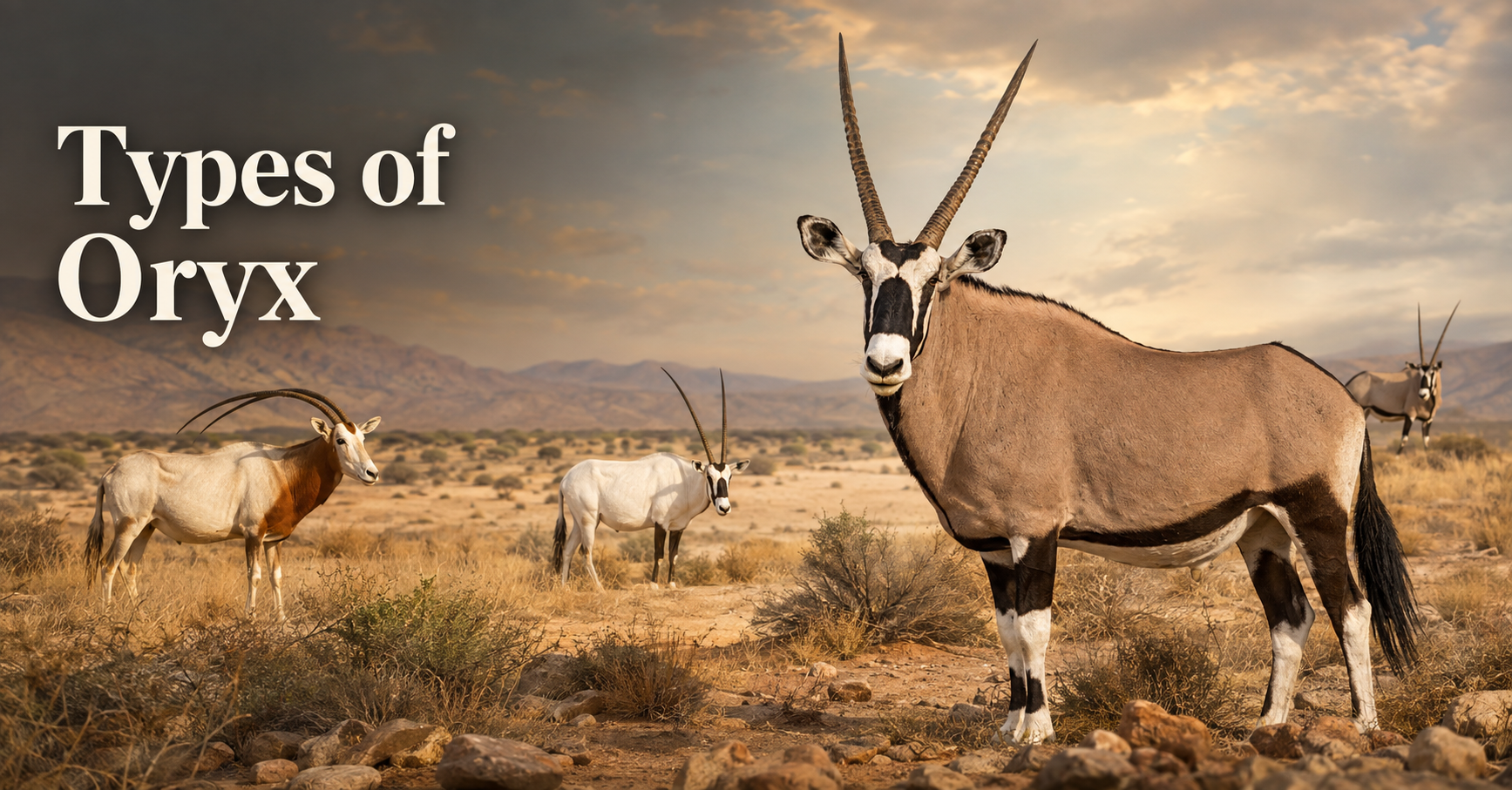
There are four widely recognized types of oryx living today, each adapted to some of the driest landscapes in Africa or the Arabian Peninsula. These large antelopes share long horns, muscular bodies, pale coats, and an extraordinary ability to survive where water and shade are scarce.
This guide explains how to identify every living oryx species, where each one occurs, what it eats, how it behaves, and why its conservation status matters. It also clarifies the relationship between the East African oryx, beisa oryx, and fringe-eared oryx—names that often cause confusion.
What Are the Main Types of Oryx?
The four main types of oryx are the Arabian oryx, scimitar-horned oryx, East African oryx, and gemsbok. The Arabian oryx is native to the Arabian Peninsula, while the other three species originated in Africa. The easiest features for telling them apart are coat color, facial markings, horn shape, body size, and geographic range.
| Oryx Type | Scientific Name | Native Region | Key Identification Feature | IUCN Status |
|---|---|---|---|---|
| Arabian oryx | Oryx leucoryx | Arabian Peninsula | Mostly white coat with dark legs and facial markings | Vulnerable |
| Scimitar-horned oryx | Oryx dammah | North Africa and the Sahel | Backward-curving horns and reddish-brown neck | Endangered |
| East African oryx | Oryx beisa | East Africa | Gray-tan coat with bold black side stripe | Endangered |
| Gemsbok | Oryx gazella | Southern Africa | Large body, black-and-white facial mask, and dark flank markings | Least Concern |
1. Arabian Oryx
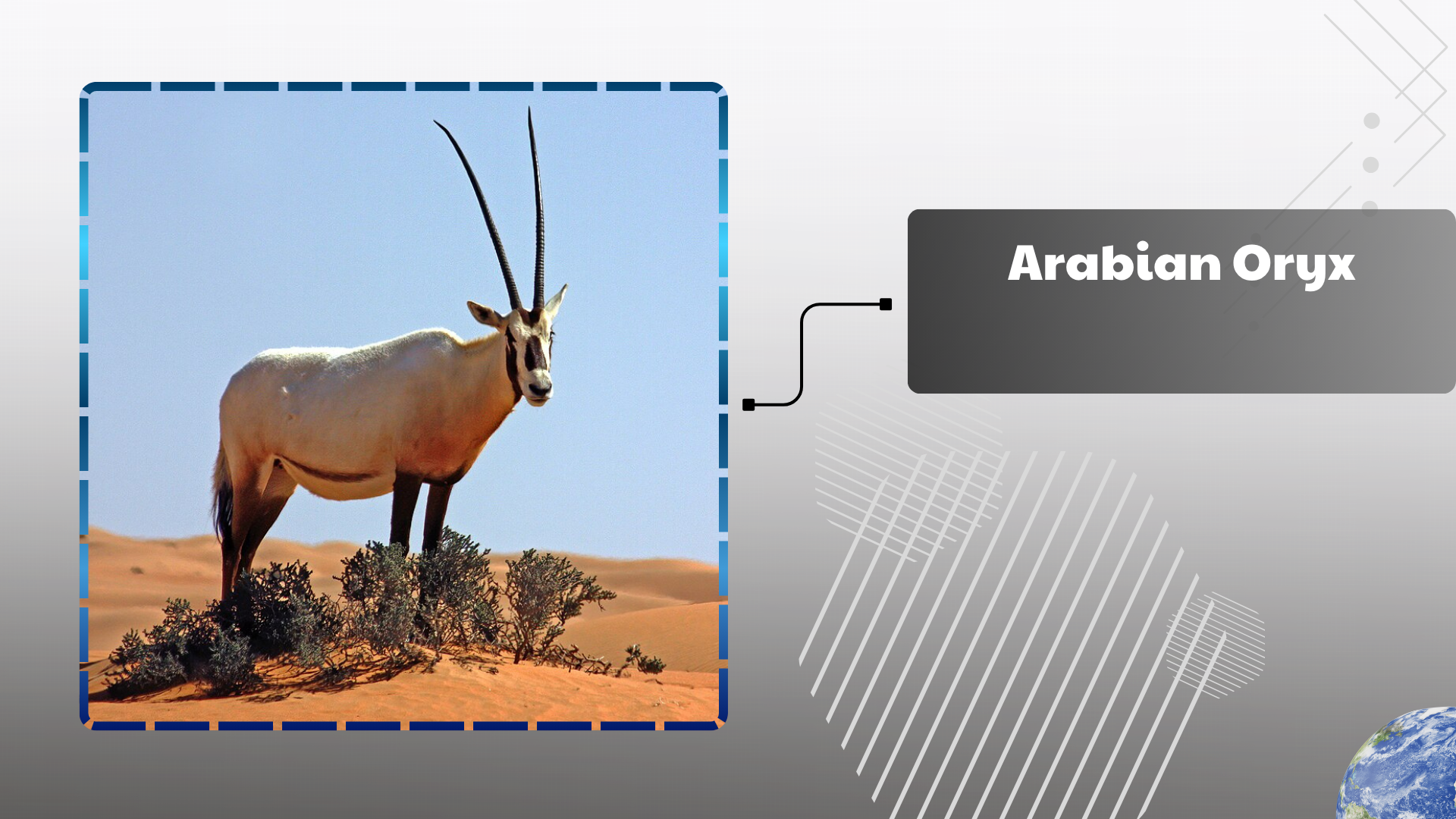
The Arabian oryx, scientifically known as Oryx leucoryx, is the smallest and palest member of the oryx genus. It is native to the deserts and gravel plains of the Arabian Peninsula and is also called the white oryx or, locally, al maha.
An adult Arabian oryx has a bright white or cream-colored coat that reflects sunlight. Its lower legs, tail tip, and parts of its face are dark brown or black. Both males and females carry long, narrow horns that rise almost straight from the head. Viewed from the side, the two horns may overlap and appear to form a single spike, which has sometimes been suggested as one possible source of the unicorn legend.
Most adults stand approximately one meter at the shoulder and commonly weigh about 65 to 90 kilograms, although measurements vary among individuals and populations. Their relatively compact bodies help distinguish them from the larger African species.
Arabian oryx inhabit sandy deserts, gravel plains, rocky areas, and shallow valleys where scattered grasses and shrubs grow. They feed on grasses, herbs, roots, shrubs, seedpods, and succulent plants. They can survive for long periods without drinking because they obtain moisture from vegetation and reduce activity during the hottest part of the day.
These antelopes may travel considerable distances after detecting conditions associated with recent rainfall and fresh plant growth. They usually live in small herds with an established social hierarchy, although group size changes with food availability.
The Arabian oryx disappeared from the wild during the twentieth century because of intensive hunting. Captive breeding and carefully managed releases later restored wild populations in parts of Oman, Saudi Arabia, Jordan, Israel, and the United Arab Emirates. It is currently classified as Vulnerable and remains dependent on habitat protection, anti-poaching measures, and responsible population management.
2. Scimitar-Horned Oryx
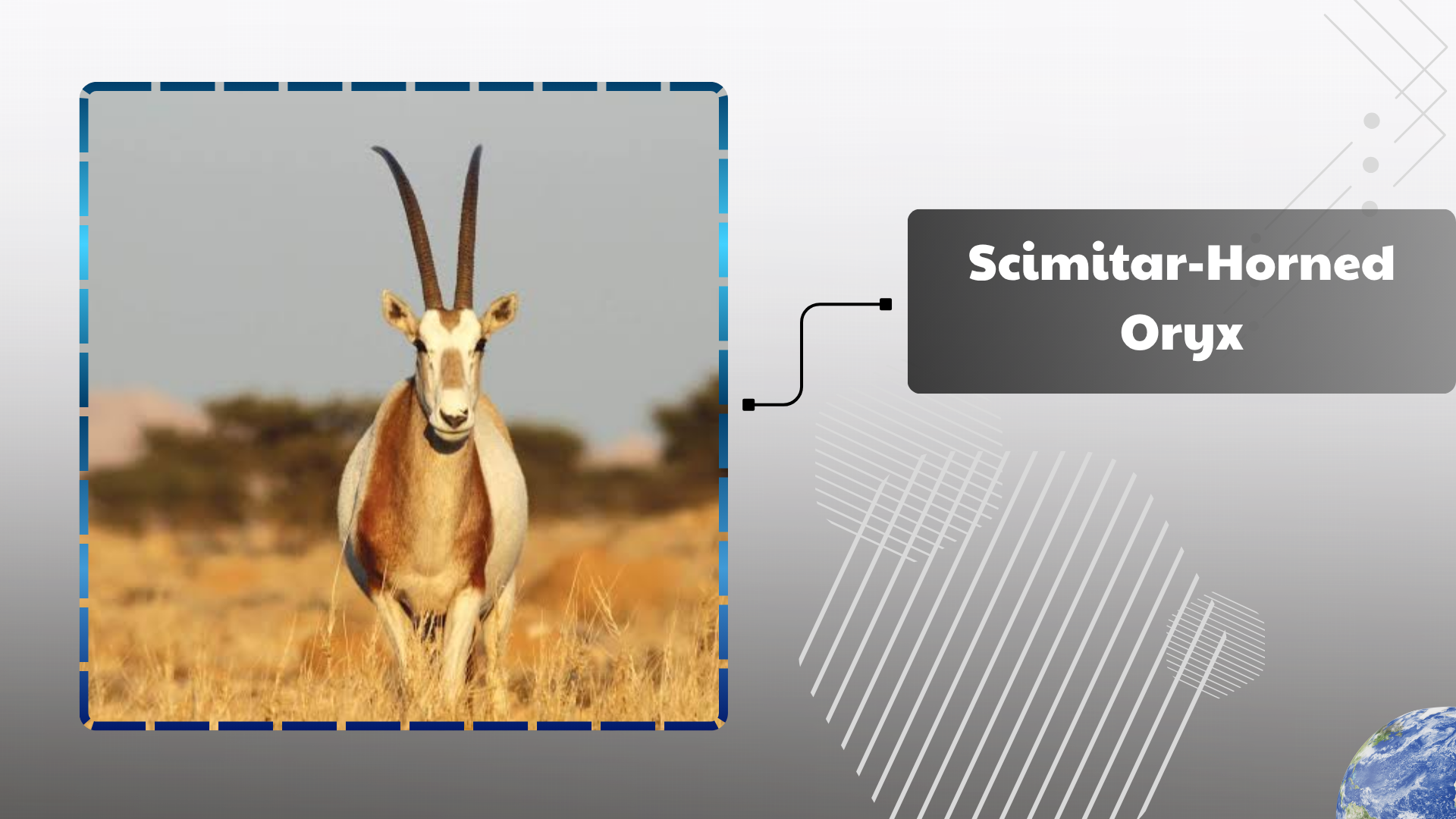
The scimitar-horned oryx, Oryx dammah, is the easiest species to recognize because its horns curve backward like scimitar swords. Other oryx species have much straighter horns. It is also called the scimitar oryx or Sahara oryx.
This species has a mostly white coat with a reddish-brown or chestnut neck, shoulders, and upper chest. Its facial markings are less dramatic than those of the gemsbok and East African oryx. Both sexes possess curved, ringed horns, although those of females are usually more slender.
Adults generally stand a little over one meter at the shoulder. Males are usually heavier than females and may weigh more than 200 kilograms, while many females weigh between approximately 90 and 140 kilograms. The pale coat reflects solar radiation, and the animal’s physiology helps it tolerate high daytime temperatures and limited access to water.
Historically, vast herds moved through the Sahel and the southern margins of the Sahara. Their former range extended across several North African countries. Instead of remaining in barren dune fields, these oryx generally favored desert grasslands, open steppes, and semi-arid plains where seasonal vegetation was available.
Scimitar-horned oryx eat grasses, herbs, leaves, seedpods, roots, and other desert plants. Rainfall once encouraged herds to migrate across large areas in search of new growth. Their mobility was essential in a region where suitable grazing could appear briefly and unpredictably.
Uncontrolled hunting, livestock competition, drought, political instability, and habitat degradation caused the wild population to collapse. The species was declared Extinct in the Wild in 2000. A major reintroduction program began releasing captive-bred animals into a protected reserve in Chad in 2016. Following successful reproduction in the wild, the species was reclassified as Endangered in 2023. This recovery is encouraging, but the restored population still requires intensive protection and monitoring.
3. East African Oryx
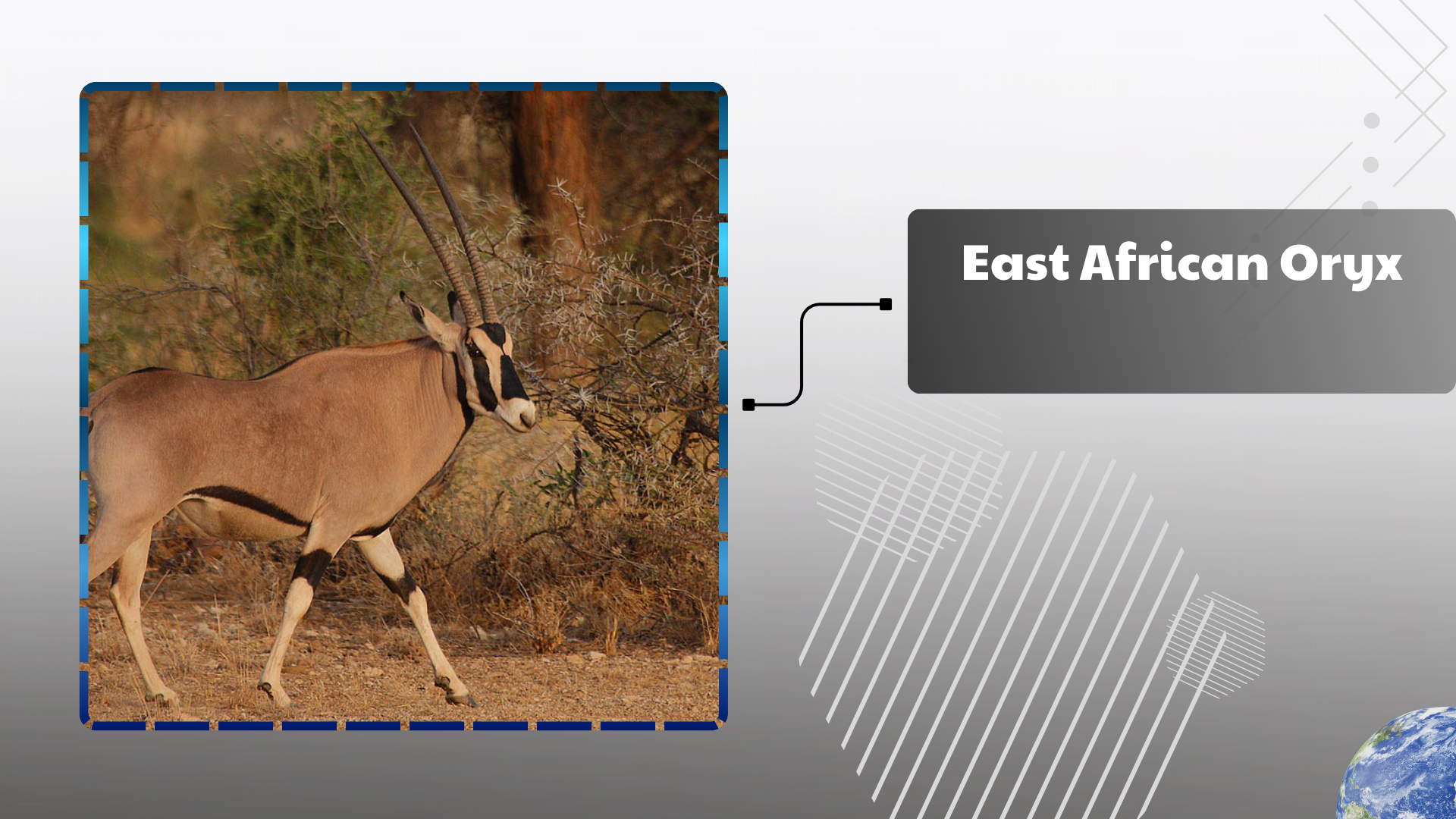
The East African oryx, Oryx beisa, is a tall, powerfully built antelope of dry East African landscapes. It is frequently called the beisa oryx, although that name can also refer more specifically to the nominate subspecies, Oryx beisa beisa.
Its coat is generally gray, fawn, or sandy brown. A bold black stripe separates the upper body from the white underside, while dark bands mark the face, throat, knees, and lower legs. Its black-and-white facial mask resembles that of the gemsbok, but the East African oryx is usually lighter and has a narrower dark band along its sides.
Adults commonly stand around 110 to 125 centimeters at the shoulder. Both sexes carry long, nearly straight horns, which can reach approximately one meter in length. Females often have slightly longer and more slender horns, while males tend to have thicker horn bases.
The species occupies arid grasslands, thornbush, scrub, and semi-desert areas in countries including Ethiopia, Kenya, Somalia, South Sudan, and Tanzania. Its distribution is increasingly fragmented, and populations are not evenly spread throughout this historical range.
East African oryx graze on grasses when conditions are favorable but can switch to leaves, shrubs, herbs, roots, and succulent plants during dry periods. They often feed during cooler morning and evening hours and rest in shade when midday temperatures rise.
Two commonly recognized forms are the beisa oryx and the fringe-eared oryx. The fringe-eared form, generally written as Oryx beisa callotis, has distinctive tufts of hair extending from the tips of its ears. Some taxonomic treatments elevate it to a separate species named Oryx callotis, but it is frequently presented as a subspecies of the East African oryx.
The East African oryx is classified as Endangered. Major threats include habitat loss, livestock competition, hunting, human settlement, fencing, and reduced access to traditional movement routes.
4. Gemsbok
The gemsbok, Oryx gazella, is the largest and most robust of the four oryx species. It is widespread across arid regions of southern Africa and is especially associated with Namibia, Botswana, and South Africa. Its striking appearance has made it one of the most recognizable animals of the Kalahari and Namib regions.
Gemsbok have gray, taupe, or light brown coats with a dramatic black-and-white facial mask. A dark stripe runs from the chin down the throat, while additional black markings appear along the flanks, rump, tail, and upper legs. The tail is long, dark, and horse-like.
Adults generally stand about 115 to 125 centimeters at the shoulder. Females often weigh approximately 180 to 225 kilograms, while large males may reach around 240 kilograms. Both sexes have long, ringed horns. Female horns are often longer and thinner, whereas male horns tend to be thicker and better suited to territorial contests.
Gemsbok live in desert plains, dunes, dry savannas, scrublands, and open woodland. Their natural range includes much of southwestern Africa. Introduced populations also occur outside Africa, including free-ranging animals in parts of New Mexico in the United States. These introduced herds should not be confused with the species’ native distribution.
The gemsbok eats grasses, leaves, roots, bulbs, wild melons, and other moisture-rich vegetation. During droughts, individuals may dig for underground plant parts. Their ability to tolerate increased body temperature helps reduce water loss through sweating.
Gemsbok usually form small or medium-sized groups, although much larger gatherings can develop where grazing is abundant. They are alert and capable of defending themselves with their horns, so wildlife observers should always maintain a safe distance.
The gemsbok is classified as Least Concern because it remains widespread and relatively numerous. However, local populations can still be affected by excessive hunting, fencing, drought, and poorly planned land use.
How Are These Types of Oryx Classified?
Oryx are mammals in the family Bovidae, which also contains cattle, sheep, goats, gazelles, and many other antelopes. They belong to the tribe Hippotragini, a group of sturdy, long-horned antelopes that also includes sable and roan antelopes.
- Kingdom: Animalia
- Phylum: Chordata
- Class: Mammalia
- Order: Artiodactyla
- Family: Bovidae
- Tribe: Hippotragini
- Genus: Oryx
Modern references generally recognize four living species in the genus: Oryx leucoryx, Oryx dammah, Oryx beisa, and Oryx gazella. Older references sometimes treated the East African oryx as a subspecies of the gemsbok. The taxonomic rank of the fringe-eared oryx also varies, so readers may encounter either Oryx beisa callotis or Oryx callotis.
Where Do Oryx Live?
Wild oryx are native to Africa and the Arabian Peninsula. All four species favor dry, open environments, but their ranges do not naturally overlap across the entire region.
- Arabian oryx: Desert plains, gravel flats, dunes, and wadis on the Arabian Peninsula.
- Scimitar-horned oryx: Sahelian grasslands and semi-desert areas along the southern edge of the Sahara.
- East African oryx: Dry grasslands, thorn scrub, and semi-desert in eastern Africa.
- Gemsbok: Deserts, dry savannas, dunes, and scrublands in southern Africa.
Oryx survival depends on access to large, connected landscapes. Fences, roads, farms, and settlements can prevent herds from reaching seasonal grazing areas even when some protected habitat remains.
How to Identify Different Types of Oryx
- Check the horns: Strongly curved horns indicate a scimitar-horned oryx. The other species have straighter, spear-like horns.
- Look at the coat: Arabian and scimitar-horned oryx are mostly white. East African oryx and gemsbok are gray, tan, or brown.
- Study the neck: A reddish-brown neck is a defining feature of the scimitar-horned oryx.
- Compare facial markings: Gemsbok have the boldest black-and-white masks. East African oryx also have strong facial markings, while scimitar-horned oryx have less black on the face.
- Inspect the flanks: Gemsbok have extensive dark markings around the lower body and rump. East African oryx have a narrower black side stripe.
- Notice the ears: Hairy ear tufts can identify the fringe-eared form of the East African oryx.
- Consider body size: Arabian oryx are generally the smallest, while gemsbok are the largest and most muscular.
- Confirm the location: Geographic range is useful, but reintroduced and non-native populations mean it should not be the only identification clue.
Outdoor Tips for Observing Oryx
- Visit recognized national parks, reserves, or conservation areas with experienced local guides.
- Use binoculars or a telephoto lens instead of approaching a herd.
- Observe during the cooler morning or late-afternoon hours, when oryx are often more active.
- Never stand between an animal and the rest of its herd.
- Do not feed oryx or attempt to attract them with water or food.
- Stay inside the vehicle where park rules require it.
- Give extra space to territorial males and females with calves.
- Avoid blocking trails or routes leading to shade, grazing, or water.
- Follow all instructions from guides, rangers, and reserve staff.
- Record the habitat, markings, horn shape, and group size to support later identification.
Safety, Sustainability, and Conservation Notes
Oryx may appear calm, but their long horns can cause serious injury. They should never be approached, cornered, or treated like domesticated animals. Responsible observation means keeping a generous distance and avoiding any behavior that changes the animals’ movements.
Conservation priorities differ among species. The Arabian and scimitar-horned oryx demonstrate that captive breeding and reintroduction can restore animals that have disappeared from the wild. However, releases work only when suitable habitat, genetic diversity, monitoring, community cooperation, and long-term protection are available.
The East African oryx requires particular attention because its populations have declined and become fragmented. Even the more secure gemsbok can experience local pressure from drought, fencing, habitat alteration, and unsustainable hunting.
Travelers can help by choosing ethical wildlife operators, respecting protected-area rules, avoiding products obtained from threatened wildlife, and supporting conservation programs that involve local communities.
Fun Facts About Oryx
- Both male and female oryx grow permanent horns.
- Scimitar-horned oryx are the only living oryx with strongly curved horns.
- Oryx can obtain much of the moisture they need from plants.
- They often reduce activity during the hottest hours of the day.
- Gemsbok may dig underground to reach roots and moisture-rich plant parts.
- Arabian oryx can move toward areas where recent rain has produced fresh vegetation.
- A white coat helps Arabian and scimitar-horned oryx reflect intense sunlight.
- Young oryx generally have less distinct coat markings than adults.
- The scimitar-horned oryx returned to the wild after being classified as Extinct in the Wild.
- The gemsbok appears on Namibia’s national coat of arms.
Final Thoughts on Types of Oryx
The four living types of oryx are the Arabian oryx, scimitar-horned oryx, East African oryx, and gemsbok. Horn shape provides the fastest identification clue, while coat color, facial markings, body size, and location help confirm the species.
Every oryx is impressively adapted to dry environments, but not every population is secure. Learning to recognize these antelopes also reveals how habitat protection, responsible wildlife tourism, reintroduction, and community-led conservation can help desert wildlife survive.
Frequently Asked Questions
1. How many types of oryx are there?
Four living species are widely recognized: the Arabian oryx, scimitar-horned oryx, East African oryx, and gemsbok.
2. What is an oryx?
An oryx is a large, long-horned antelope in the genus Oryx. Oryx are adapted to deserts, semi-deserts, dry grasslands, and scrublands.
3. Is an oryx an antelope?
Yes. Oryx are bovids and belong to the same broad family as other antelopes, cattle, goats, and sheep.
4. Where are oryx native?
Oryx are native to Africa and the Arabian Peninsula. Each species has its own natural range within these regions.
5. Which is the largest type of oryx?
The gemsbok is generally considered the largest and most heavily built living oryx species.
6. Which is the smallest oryx?
The Arabian oryx is generally the smallest of the four species.
7. Which oryx has curved horns?
The scimitar-horned oryx has long horns that curve backward. Other oryx species have horns that are much straighter.
8. Do female oryx have horns?
Yes. Both males and females have horns, although female horns are often longer and more slender.
9. Are oryx horns dangerous?
Yes. Oryx can use their long horns defensively, so people should observe them from a safe distance and never corner them.
10. What do oryx eat?
Oryx are herbivores that eat grasses, leaves, herbs, shrubs, roots, bulbs, seedpods, and succulent plants.
11. Can an oryx survive without drinking water?
Oryx can survive for extended periods without free-standing water by obtaining moisture from vegetation and limiting water loss. They still drink when water is available.
12. How do oryx survive desert heat?
They conserve water, rest during extreme heat, use shade when available, and possess physiological adaptations that allow them to tolerate high body temperatures.
13. Are oryx nocturnal?
Oryx are not strictly nocturnal. They may shift more activity to mornings, evenings, or nighttime when daytime temperatures become severe.
14. Do oryx live in herds?
Yes. Most oryx live in social groups, although herd size varies with species, season, habitat, and food availability.
15. How fast can an oryx run?
Oryx are powerful runners capable of moving quickly across open ground. Exact maximum-speed estimates vary, so speed alone is not a dependable identification feature.
16. What is the difference between a gemsbok and an oryx?
A gemsbok is a specific species of oryx. Its scientific name is Oryx gazella, while “oryx” refers to the entire genus.
17. Is the Arabian oryx the same as the white oryx?
The name white oryx is sometimes applied to the Arabian oryx, but it may also be used for the scimitar-horned oryx. Scientific names prevent confusion.
18. Is the East African oryx the same as the beisa oryx?
East African oryx is the broader common name for Oryx beisa. Beisa oryx may refer to the species or, more narrowly, its nominate subspecies.
19. What is a fringe-eared oryx?
The fringe-eared oryx is an East African form with visible tufts at the ends of its ears. It is commonly classified as Oryx beisa callotis, although some authorities treat it as a separate species.
20. How can you distinguish an East African oryx from a gemsbok?
The East African oryx generally has a lighter coat and a narrower black stripe along its sides. Gemsbok are heavier and have more extensive dark markings on the lower body and rump.
21. Why is the scimitar-horned oryx important?
Its restoration in Chad shows how coordinated captive breeding, habitat protection, and reintroduction can return a species to the wild.
22. Is the scimitar-horned oryx extinct?
No. It was once classified as Extinct in the Wild, but a successful reintroduction established a breeding wild population. It is now classified as Endangered.
23. Is the Arabian oryx endangered?
The Arabian oryx is currently classified as Vulnerable. Its recovery remains dependent on protection and conservation management.
24. Is the East African oryx endangered?
Yes. The East African oryx is classified as Endangered because of population decline, habitat fragmentation, hunting, and competition with livestock.
25. Is the gemsbok endangered?
No. The gemsbok is classified as Least Concern, although individual populations may still face local threats.
26. What predators hunt oryx?
Lions, leopards, hyenas, African wild dogs, and other large predators may hunt African oryx. Calves are generally more vulnerable than healthy adults.
27. How do oryx defend themselves?
They may flee, remain close to the herd, or lower their heads and direct their horns toward an attacker.
28. How long do oryx live?
Depending on the species and conditions, oryx can live for roughly 15 to 20 years. Animals receiving managed care may sometimes live longer than wild individuals.
29. How many calves does an oryx have?
A female usually gives birth to one calf after a gestation lasting approximately eight to nine months, depending on the species.
30. What color are baby oryx?
Calves commonly have tan, yellowish, or light brown coats with less pronounced markings than adults. Their mature patterns develop as they grow.
31. Do oryx migrate?
Some populations make seasonal or irregular movements in response to rainfall, fresh vegetation, drought, and access to water.
32. Can oryx detect rain?
Oryx may respond to environmental cues associated with distant rainfall and travel toward areas where new plant growth is likely.
33. Are oryx territorial?
Adult males may defend territories or status within a herd. Social behavior differs among species and can change with population density and resources.
34. Are oryx aggressive toward people?
They normally avoid people, but an oryx may defend itself if threatened, trapped, or approached too closely.
35. Can oryx be kept as pets?
No. Oryx are large wild animals requiring specialized habitat, veterinary care, secure facilities, and legal authorization.
36. Are there wild oryx in the United States?
Yes. A non-native gemsbok population lives in New Mexico. These animals descend from introduced stock and are not native to North America.
37. What is the best time to see oryx in the wild?
Early morning and late afternoon are often productive because temperatures are cooler and the animals may be actively feeding.
38. Can oryx horns grow back?
No. Oryx horns are permanent structures with a bony core. A seriously damaged or broken horn does not regenerate completely like a deer antler.
39. Do oryx shed their horns?
No. Unlike deer antlers, oryx horns are not shed and regrown annually.
40. What is the biggest threat to oryx?
Threats vary by species but include illegal hunting, habitat loss, livestock competition, fencing, drought, political instability, and fragmented migration routes.