
When most people think of skunks, one image comes to mind: a black-and-white animal with a fluffy tail and a powerful smell that no one wants to experience. While that picture isn’t wrong, it’s only a small part of the story. Skunks are fascinating mammals with a surprising variety of species, each with its own unique look, behavior, and habitat.
In this guide, we’ll explore the different types of skunks, how to recognize them, and what makes each species special. Whether you’re a nature enthusiast, a student, or simply curious about these striped little wanderers, this article will help you understand skunks far beyond their famous defensive spray.
What is a Skunk?
Skunks belong to the family Mephitidae, which includes about a dozen species found in North and South America, as well as a couple of unusual relatives in Southeast Asia. They are small to medium-sized mammals, easily identified by their contrasting coat patterns and strong scent glands.
But skunks are more than their smell. They are insect-eaters, rodent controllers, and surprisingly adaptable survivors. They live in forests, grasslands, deserts, and even close to cities where food is easy to find. In the wild, skunks play an important role in keeping ecosystems balanced.
General Characteristics of Skunks
1. Physical Traits
Size: Most skunks are about the size of a house cat, though hog-nosed skunks can be much larger.
Fur: Bold patterns of black and white, often with stripes or spots, help warn predators to keep their distance.
Tail: Fluffy and dramatic, often raised as part of their warning signal.
2. Behavior
Nocturnal: Skunks are mostly active at night, searching for insects, small animals, fruit, and even human leftovers.
Defense: Their spray is legendary — a sulfur-based liquid that can travel up to 10 feet and linger for days.
Warning Signals: Before spraying, skunks often stomp, hiss, or even do a handstand (in the case of spotted skunks).
3. Diet
Skunks are omnivores, which means they eat a wide range of foods: beetles, grasshoppers, grubs, berries, roots, bird eggs, and even small rodents.
4. Reproduction
Most skunks breed in late winter or early spring. After a short gestation, females give birth to litters of 2–10 kits. The young stay with their mother until fall.
5. Conservation Status
While many skunks are common, some species such as the pygmy spotted skunk face serious threats due to habitat loss and limited range.
Skunk Genera Overview
Scientists divide skunks into four main genera:
Hog-nosed skunks (Conepatus) – Large, powerful diggers with long snouts used for rooting in soil.
Striped skunks (Mephitis) – The “classic” skunks, including the familiar striped skunk of North America.
Spotted skunks (Spilogale) – Smaller, acrobatic species with distinctive white spots and broken stripes.
Stink badgers (Mydaus) – Odd skunk relatives found in Southeast Asia, sometimes called “honorary skunks.”
14 Types of Skunks: Species, Facts and Photos
We’ll now look at the first half of skunk species, covering their appearance, behavior, and habitats. Each entry includes a suggested photo caption to make your article more engaging.
1. American Hog-nosed Skunk (Conepatus leuconotus)
The American hog-nosed skunk is one of the largest skunk species. Found across the southwestern United States, Mexico, and Central America, it’s instantly recognizable by its broad white stripe running from head to tail and its long, hairless snout. Unlike the smaller striped skunk, this species looks more like a miniature badger.
They use their long claws and snouts to dig for insects, grubs, and roots. Their powerful digging ability often leaves noticeable holes in the ground. While they can spray like other skunks, they rely more on their size and digging skills to stay safe.
Fun Fact: Early settlers sometimes called them “rooter skunks” because of their habit of rooting through soil like pigs.
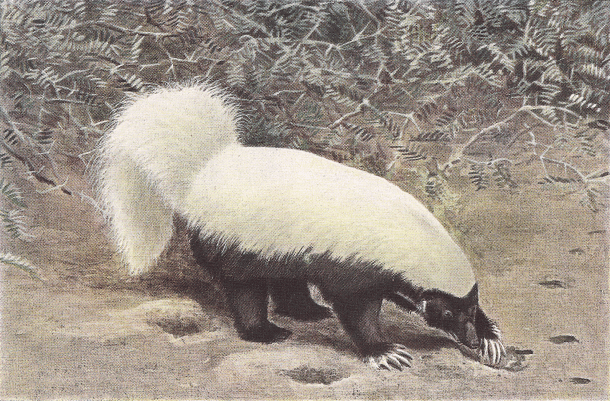
The American hog-nosed skunk uses its long snout and claws to search for insects underground.
2. Striped Hog-nosed Skunk (Conepatus semistriatus)
Native to Central and South America, the striped hog-nosed skunk has a striking coat pattern: two white stripes running down its back rather than one broad stripe. Smaller than the American hog-nosed skunk, this species is still a strong digger, using its snout to root around for beetles and other insects.
They are often seen in open grasslands and agricultural fields, where they play a role in controlling pest insects. Despite their bold appearance, they are shy animals and avoid human contact when possible.
Fun Fact: Farmers sometimes welcome their presence because they reduce crop-damaging insects.
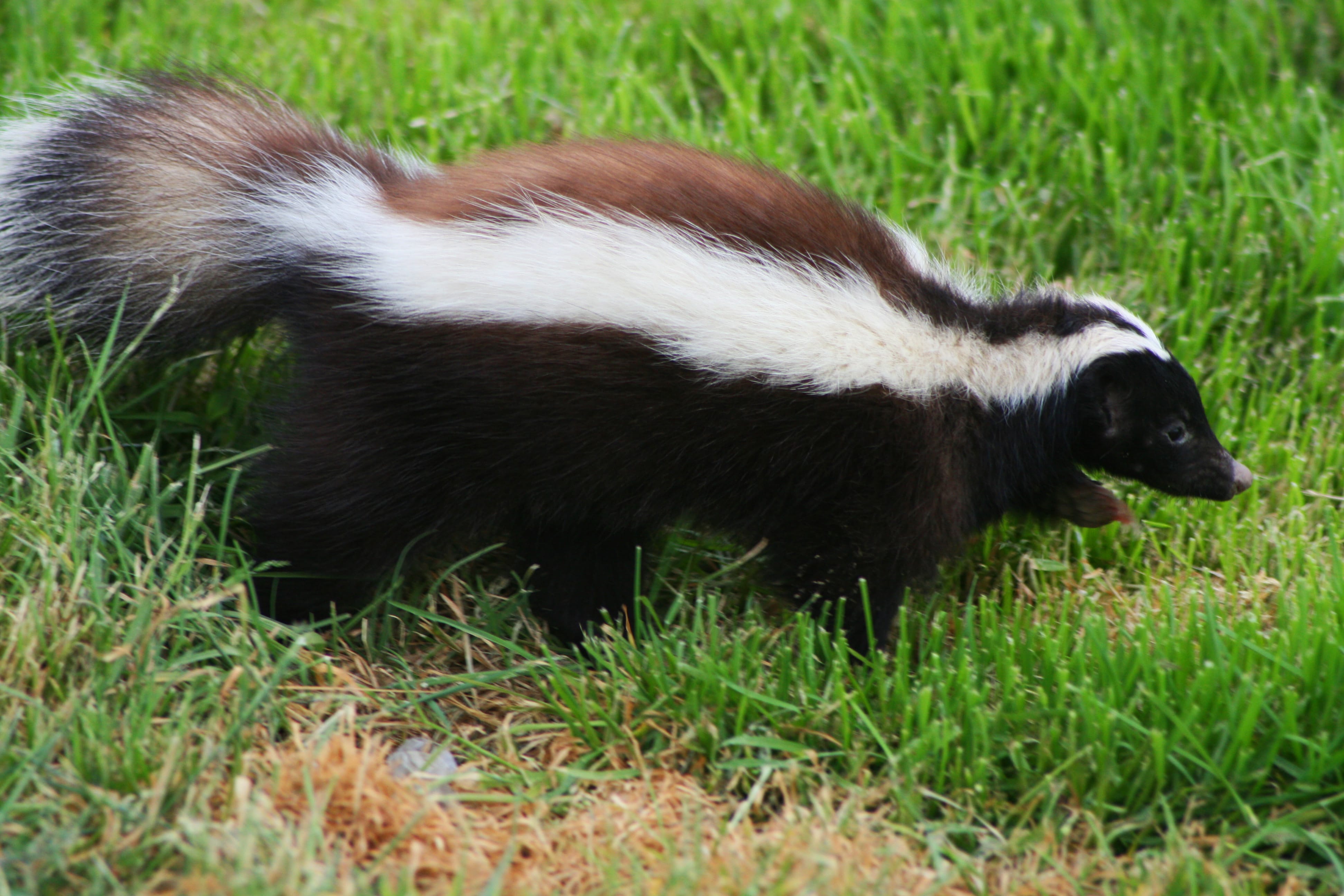
The striped hog-nosed skunk is smaller than its American cousin and has two narrow stripes.
3. Humboldt’s Hog-nosed Skunk (Conepatus humboldtii)
Named after the explorer Alexander von Humboldt, this species is found in southern South America, particularly Argentina and Chile. They are adapted to cold, open grasslands and scrubland environments.
Humboldt’s hog-nosed skunks are well-equipped for digging, with strong claws and a pig-like snout. Their diet includes beetles, worms, and small vertebrates. During harsh winters, they may scavenge to survive.
Fun Fact: In Chile, they are locally called “chinguay,” and their fur was once used in traditional clothing.

This hardy skunk thrives in the cold climates of southern South America.
4. Molina’s Hog-nosed Skunk (Conepatus chinga)
This species has one of the widest ranges among hog-nosed skunks, spreading across Argentina, Bolivia, Brazil, Chile, Paraguay, Peru, and Uruguay. It has a single wide white stripe and a very prominent pig-like snout.
Molina’s hog-nosed skunk is mostly nocturnal and solitary, foraging for insects, fruit, and roots. They are resilient and often survive in disturbed landscapes near human settlements.
Fun Fact: Some locals mistakenly believe these skunks dig up crops, but they actually eat insects that harm plants.
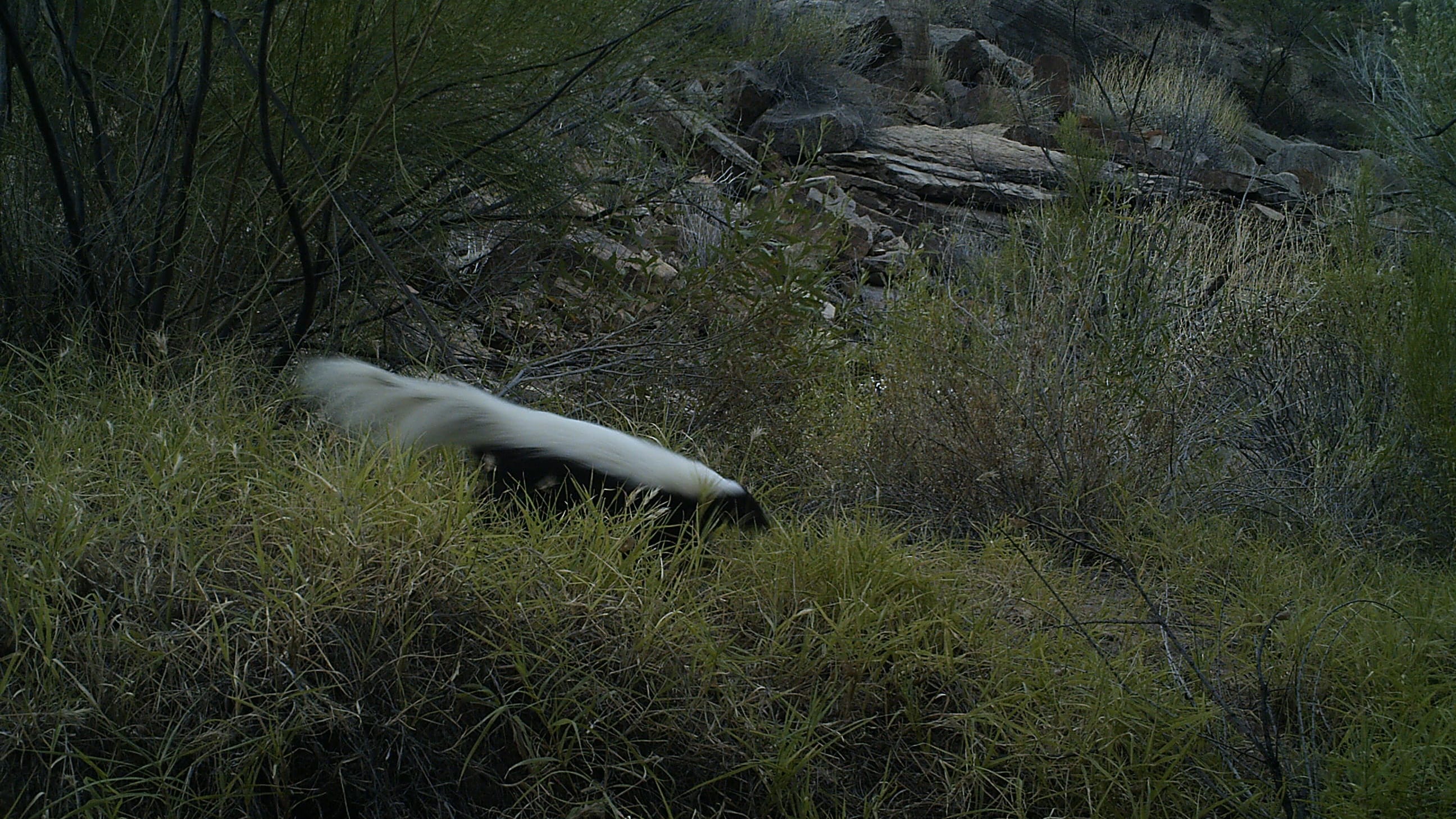
Molina’s hog-nosed skunk is a skilled forager with a strong pig-like nose.
5. Striped Skunk (Mephitis mephitis)
The striped skunk is the iconic skunk of North America and the species most people imagine when they hear the word “skunk.” With a glossy black coat and bold white stripes running from head to tail, it’s both beautiful and unmistakable.
This species is highly adaptable, living in forests, grasslands, farms, and even suburban neighborhoods. Their diet includes insects, small mammals, berries, and garbage when available. Because they thrive near humans, they are often seen crossing roads at night.
Fun Fact: The striped skunk is so common in the U.S. and Canada that it’s sometimes nicknamed “the little stinker.”

The striped skunk is the most widespread and familiar species in North America.
6. Hooded Skunk (Mephitis macroura)
The hooded skunk, found in the southwestern U.S., Mexico, and Central America, is known for its extra-long, fluffy tail and the “hood” of long white fur that covers its back and shoulders. This gives it a more dramatic appearance than the striped skunk.
Hooded skunks are skilled diggers but also excellent fruit-eaters. They are more slender and graceful than their striped cousins. They are nocturnal, shy, and rarely aggressive unless cornered.
Fun Fact: Hooded skunks are sometimes mistaken for domestic cats because of their slim build and long fur.
7. Western Spotted Skunk (Spilogale gracilis)
The Western Spotted Skunk is one of the most agile and acrobatic members of the skunk family. Unlike the bold stripe of its more famous cousins, this species wears a striking pattern of broken white spots and swirls across its body, which gives it a dazzling, almost painterly appearance. Adults typically measure 14–18 inches long, including the tail, and weigh under 2 pounds, making them significantly smaller than striped skunks.
🏞️ Habitat & Distribution:
Native to the western and central United States, as well as parts of Mexico and British Columbia, this skunk thrives in woodlands, shrublands, rocky hillsides, and semi-arid regions. It’s an excellent climber and is often seen navigating trees, fences, or brush piles in search of food.
💡 Behavior & Diet:
Western spotted skunks are omnivores, feeding on insects, small rodents, bird eggs, berries, and fruits. They are mostly nocturnal and solitary, but what truly sets them apart is their “handstand defense display.” When threatened, they will stand on their front legs, arch their back, and lift their tail — a dramatic warning before they spray.
🌟 Fun Fact:
This species is sometimes called the “acrobat skunk” because of its gymnastic defense behavior — a trait almost unique among mammals.
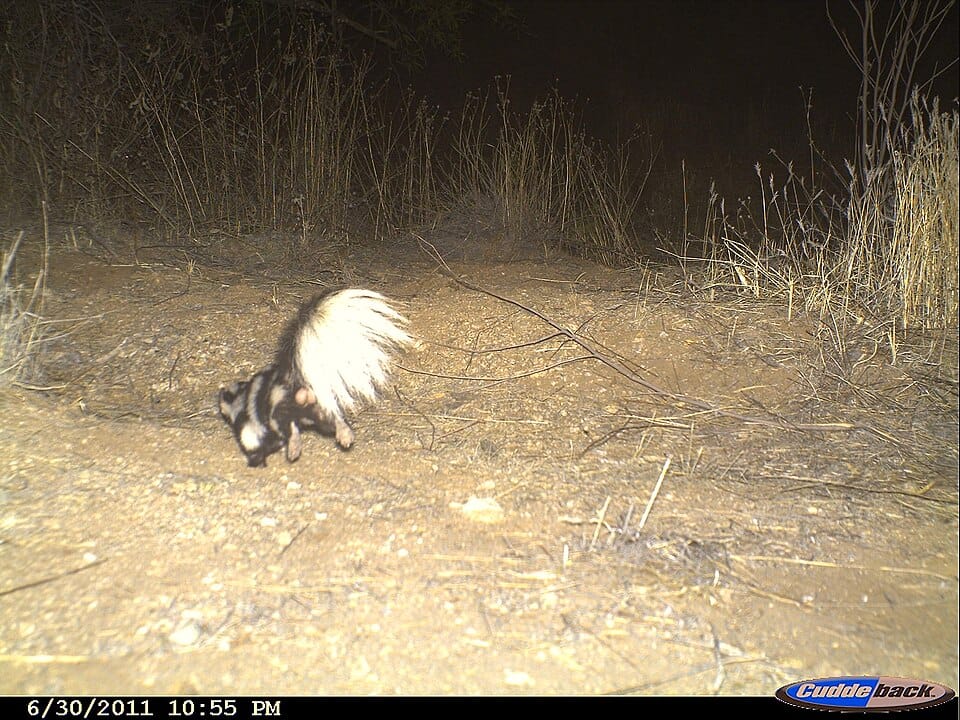
“The agile Western Spotted Skunk often climbs trees and performs handstands as part of its defensive display.”
8. Eastern Spotted Skunk (Spilogale putorius)
The Eastern Spotted Skunk shares many physical traits with its western relative but tends to have a slimmer body, a longer tail, and slightly different spot patterns. Measuring around 15–24 inches long, this species is small but energetic — and is often mistaken for a juvenile striped skunk by those unfamiliar with its species.
🏞️ Habitat & Distribution:
This skunk is native to the central and eastern United States, ranging from the Great Plains to the Appalachian Mountains. It prefers grassy fields, forest edges, and farmlands, often making dens in abandoned burrows, hollow logs, or beneath barns.
💡 Behavior & Diet:
Like most skunks, the Eastern spotted skunk is nocturnal and omnivorous, eating a mix of insects, small vertebrates, and fruit. It’s also an excellent climber and jumper, skills that help it escape predators and reach bird nests.
🌟 Fun Fact:
Once common across much of the U.S., the Eastern spotted skunk has declined significantly in population due to habitat loss and changes in farming practices, leading to conservation efforts in several states.
9. Pygmy Spotted Skunk (Spilogale pygmaea)
The Pygmy Spotted Skunk is the smallest member of the skunk family and one of the most elusive. Adults measure only 11–13 inches from nose to tail and weigh less than a pound — about the size of a large squirrel. Despite its tiny stature, it sports the same bold black-and-white spotted coat characteristic of its genus.
🏞️ Habitat & Distribution:
This species is endemic to the Pacific coast of Mexico, inhabiting dry forests, scrublands, and coastal areas. Its limited range and secretive nature make it one of the least studied skunks in the world.
💡 Behavior & Diet:
Pygmy spotted skunks are primarily insectivorous, feeding on beetles, crickets, and other small arthropods. Their small size allows them to navigate dense undergrowth and narrow burrows where larger predators can’t follow.
🌟 Fun Fact:
Because of its rarity and small range, the Pygmy Spotted Skunk was once considered a myth by locals — many believed it was just a juvenile of another species until it was scientifically described.
10. Southern Spotted Skunk (Spilogale angustifrons)
Closely related to the Eastern and Western spotted skunks, the Southern Spotted Skunk inhabits parts of Central America and southern Mexico. It has a similar appearance — with striking black-and-white spots — but often shows narrower white streaks and a longer, fluffier tail.
🏞️ Habitat & Distribution:
This skunk prefers tropical forests, dry woodlands, and agricultural landscapes. It is more tolerant of warmer climates than its northern cousins and is often seen at lower elevations.
💡 Behavior & Diet:
Its diet consists of insects, small vertebrates, fruits, and even bird eggs. Like other Spilogale species, it performs the iconic handstand warning before spraying and can even climb low shrubs in search of food.
🌟 Fun Fact:
The Southern Spotted Skunk is a key insect controller in many agricultural areas — a natural ally to farmers by keeping pest populations in check.
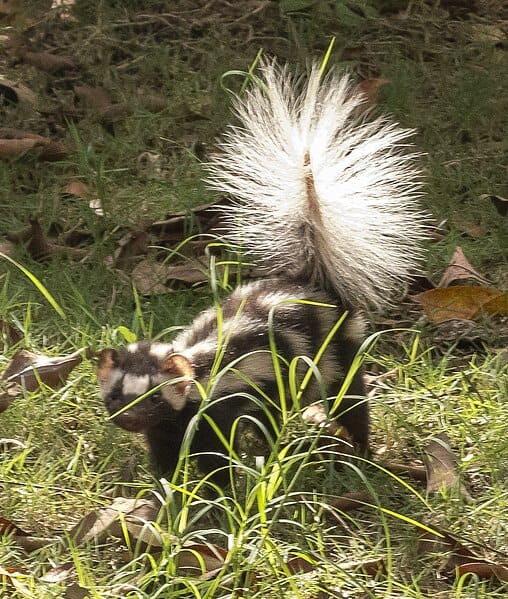
11. American Hog-nosed Skunk (Conepatus leuconotus)
With a body built for digging and a distinctively long, white stripe that covers most of its back, the American Hog-nosed Skunk is quite different from other skunks. Its elongated snout is designed for rooting in the ground — much like a pig, hence the name. Adults can grow up to 30 inches long and weigh 4–10 pounds, making them one of the largest skunk species.
🏞️ Habitat & Distribution:
This species is native to the southern United States, Mexico, and Central America, often found in deserts, grasslands, and scrublands.
💡 Behavior & Diet:
Hog-nosed skunks specialize in digging for grubs, beetle larvae, and roots, and their powerful front claws are perfect for excavating soil. They are generally solitary and nocturnal, and their large size makes them less vulnerable to predators.
🌟 Fun Fact:
These skunks are often mistaken for badgers due to their robust build and digging behavior, but they are gentle and shy unless threatened.
12. Striped Hog-nosed Skunk (Conepatus semistriatus)
The Striped Hog-nosed Skunk is a striking species easily recognized by the two thin white stripes that run down its back, contrasting sharply with its dark fur. Medium-sized and robust, it measures 20–30 inches in length and is a highly adaptable species.
🏞️ Habitat & Distribution:
Native to Central and South America, this skunk inhabits savannas, tropical forests, and open grasslands. It’s often seen near villages and farms, where it scavenges for food.
💡 Behavior & Diet:
Its diet is mainly insects, roots, and small animals, but it is also known to scavenge from garbage or carcasses. Like its relatives, it sprays a strong-smelling musk when threatened, though it often prefers to stomp and hiss as a warning first.
🌟 Fun Fact:
This species is often active earlier in the evening than most skunks, making it one of the few that might be seen at dusk.
13. Molina’s Hog-nosed Skunk (Conepatus chinga)
Also known as the Andean Skunk, Molina’s Hog-nosed Skunk is a hardy species found in the mountains, grasslands, and scrublands of southern South America. It is stockier and fluffier than most skunks, with a broad white stripe covering its back and a bushy tail.
🏞️ Habitat & Distribution:
This species thrives in Chile, Argentina, Uruguay, and parts of Brazil, often in cooler climates and higher elevations.
💡 Behavior & Diet:
It feeds primarily on insects and small vertebrates, but its strong claws also make it a skilled burrower. In some regions, it plays an important ecological role by aerating soil and controlling pests.
🌟 Fun Fact:
Molina’s skunk is highly resistant to snake venom, allowing it to prey on small snakes — a rare trait among mammals.
14. Humboldt’s Hog-nosed Skunk (Conepatus humboldtii)
Rounding out our list is Humboldt’s Hog-nosed Skunk, a rare species named after the famous naturalist Alexander von Humboldt. This skunk is similar in size and shape to Molina’s but is generally found farther south and often in Patagonian habitats.
🏞️ Habitat & Distribution:
It inhabits southern Chile and Argentina, preferring grasslands, coastal dunes, and dry shrublands.
💡 Behavior & Diet:
Humboldt’s skunk primarily hunts insects, grubs, and small vertebrates, and like its relatives, uses its snout to dig deep into the soil. It is solitary and shy, rarely seen by humans.
🌟 Fun Fact:
This species is sometimes considered a “ghost of Patagonia” due to its elusive nature and pale coloration compared to other hog-nosed skunks.
FAQ’s
1. What are the 12 types of skunks?
There are 12 recognized species of skunks, divided into four main genera: Mephitis, Spilogale, Conepatus, and Mydaus. These include the Striped Skunk, Hooded Skunk, Eastern and Western Spotted Skunks, American Hog-Nosed Skunk, and several species of Pygmy Spotted Skunks. Additionally, the Indonesian and Palawan Stink Badgers are also classified as skunks despite their different appearance. Each species varies in size, habitat, and behavior, with some adapted to forests, deserts, or grasslands. While they share the same defense mechanism — a powerful spray — their markings and lifestyles are unique.
2. Can a skunk be all black?
Yes, some skunks can be almost entirely black due to natural genetic variations. While most species have distinct white stripes or spots, certain individuals may have very faint markings or none at all. These all-black skunks are rare and often harder to spot in the wild, which can give them a slight advantage when hiding from predators. However, even without visible stripes, they still possess the same scent glands and defensive spray.
3. What are rare skunk colors?
While black and white is the most common coloration, rare skunks can display brown, cream, or even gray fur. Albino skunks, which are completely white with pink eyes, are extremely uncommon and usually result from genetic mutations. Some spotted skunks also show unique pattern combinations that differ from the standard stripes. These unusual colors don’t affect the skunk’s ability to defend itself but often make them more noticeable to predators.
4. How many skunks are there?
There are 12 known species of skunks in the world, though their populations vary widely by region. The striped skunk is the most common and widely distributed across North America. Spotted skunks and hog-nosed skunks tend to have smaller ranges and are less frequently seen. While exact population numbers are difficult to measure, skunks are generally considered stable and not endangered overall.
5. What is a skunk’s worst enemy?
Great horned owls are considered the skunk’s primary natural enemy because they are immune to its spray and hunt mostly at night. Other predators include coyotes, bobcats, and foxes, though most mammals avoid skunks due to their powerful defense. Humans also pose significant threats through vehicles, habitat loss, and pest control measures. Despite these dangers, skunks’ scent glands provide them with one of the most effective deterrents in the animal kingdom.
6. What is a group of 100 skunks called?
A group of skunks is called a surfeit, although they rarely gather in such large numbers in the wild. Skunks are mostly solitary, coming together only during the breeding season or in colder weather to share dens for warmth. Seeing even a small group together is uncommon, and a group of 100 would be extremely rare outside captivity. The term “surfeit” reflects the unusual nature of such a gathering.
7. Can a skunk be a pet?
Yes, skunks can be kept as pets in some places, but it requires special care, legal permits, and a deep understanding of their needs. Domesticated skunks are often bred to be more docile and usually have their scent glands removed. They can form strong bonds with humans and show affection, but they are still wild animals at heart. Owners must provide proper diet, space, and enrichment to keep them healthy and happy.
8. What do skunks hate most?
Skunks dislike strong scents such as citrus, ammonia, and predator urine, which is why these are often used as natural repellents. They also avoid bright lights and loud noises, preferring quiet, dark areas to rest and search for food. Because they are shy animals, regular human activity near their dens often causes them to relocate. These dislikes are helpful for safely keeping skunks away from homes and gardens.
9. Will a skunk fight a dog?
A skunk will rarely fight a dog unless it feels cornered or threatened. Instead of attacking, it relies on its spray to deter the dog from coming closer. If the warning signs — such as raised tail and stamping — are ignored, the skunk will spray as a last resort. Direct physical fights are uncommon, but they can occur if the dog persists, which can lead to injuries on both sides.
10. Are skunks friendly?
Wild skunks are naturally shy and prefer to avoid humans and other animals. They are not aggressive unless provoked and will give multiple warning signals before spraying. Domesticated skunks, however, can be quite social, playful, and affectionate with people they trust. While they aren’t “friendly” in the way dogs or cats are, they can adapt well to human presence over time.
11. What does skunk poop look like?
Skunk droppings are usually dark brown or black, measuring about ½ to 1 inch in diameter and 2 to 4 inches long. They often contain visible bits of undigested food like seeds, insect shells, or berries. Their shape is tubular with blunt ends, and they may resemble cat or raccoon feces but are usually smaller. Finding such droppings near a porch, deck, or garden is often one of the first signs of skunk activity in the area.
12. Why do skunks lose their stripes?
Some skunks may lose or fade their stripes due to aging, genetic variations, or health conditions. Just like other animals, their fur patterns can change slightly as they grow older, sometimes becoming less defined. Illness or poor nutrition might also affect coat color and texture. While losing stripes doesn’t impact their ability to spray or survive, it can make them less recognizable in the wild.
13. How smart are skunks?
Skunks are surprisingly intelligent for small mammals, capable of learning routines and solving basic problems. In captivity, they can recognize their names, learn to use litter boxes, and even respond to commands. Their problem-solving skills help them find food, open containers, and adapt to new environments in the wild. Although not as smart as raccoons, skunks show a good level of curiosity and memory, especially when food is involved.
14. What are baby skunks called?
Baby skunks are called kits. They are born blind, deaf, and completely dependent on their mothers for warmth and food. Kits begin to open their eyes at about three weeks old and start exploring outside the den by six to eight weeks. By the time they’re two to three months old, they’re ready to follow their mother on foraging trips and learn survival skills.
15. Why don’t pet skunks spray?
Pet skunks usually have their scent glands surgically removed when they are very young, which means they lose the ability to spray. This is a common practice in countries or states where skunk ownership is legal. Without these glands, they rely on other behaviors to communicate or defend themselves. However, they still retain their playful, curious nature and often become affectionate companions when raised in a safe environment.
16. What animals hate skunks?
Many predators avoid skunks because of their powerful spray, which can cause temporary blindness and intense irritation. Larger carnivores like wolves, foxes, and coyotes typically steer clear unless they are desperate for food. Even bears often leave skunks alone, choosing easier prey. Most animals learn quickly that attacking a skunk is not worth the risk of getting sprayed.
17. What is a skunk’s favorite food?
Skunks are omnivores and enjoy a wide variety of foods, but insects such as beetles, grubs, and crickets are among their favorites. They also eat fruits, berries, small rodents, bird eggs, and even garbage if available. Their diet changes with the seasons — in summer, they eat more insects and fruit, while in winter, they may rely on stored fat or scavenge for leftovers. This flexible diet helps them survive in many different environments.
18. Where do skunks sleep?
Skunks usually sleep in dens, which they dig themselves or take over from other animals like groundhogs or foxes. These dens are often located under decks, hollow logs, rock piles, or abandoned burrows. They prefer dark, quiet, and secure spaces where they can stay hidden during the day, as they are mostly nocturnal. In colder climates, skunks may share dens with others in winter to conserve warmth.
19. Are skunks deaf?
No, skunks are not deaf. In fact, they have fairly good hearing, which helps them detect predators or prey, especially at night. Their sense of smell and hearing are much more developed than their eyesight, which is relatively poor. Because of this, they rely more on their nose and ears to navigate and survive in their environment.
20. What does skunk smell like?
A skunk’s spray has a strong, sulfur-like odor often compared to rotten eggs or burning rubber. The smell comes from thiols — chemical compounds that are incredibly pungent and can linger for days or even weeks. Even a tiny amount of spray can be overwhelming and cause nausea or watery eyes. It’s one of the most recognizable and unpleasant scents in the animal world.
21. Do skunks eat snakes?
Yes, skunks do eat snakes, including venomous ones. Their thick fur offers some protection against bites, and they are naturally resistant to certain snake venoms. While snakes are not a major part of their diet, skunks will eat them if the opportunity arises, especially when food is scarce. This makes them useful for controlling snake populations in some regions.
22. What is the only animal that will eat a skunk?
The great horned owl is the most notable predator that regularly eats skunks. Unlike most mammals, this owl is unaffected by the skunk’s spray and relies on its silent flight and powerful talons to capture them. Because owls hunt at night — when skunks are active — they are among the few predators that successfully target them. Other animals may eat skunks if they are desperate or encounter them as carrion, but this is rare.
23. Do skunks mate for life?
No, skunks do not mate for life. They are generally solitary and come together only during the breeding season, which usually occurs in late winter or early spring. Males may mate with several females during this period. After mating, the female raises the kits alone, and the male plays no role in parenting.
24. Do skunks hate rats?
Skunks don’t necessarily “hate” rats, but they may hunt and eat them if given the chance. Since they are opportunistic feeders, small rodents like rats and mice are a natural part of their diet. In this way, skunks can actually help control rodent populations around homes and farms. However, they don’t actively seek them out unless food is scarce.
25. Can skunks love humans?
Pet skunks can form strong bonds with their human caretakers and often show affection by following them around, playing, or seeking attention. While their version of “love” isn’t the same as a dog’s loyalty, they are social animals that enjoy interaction. Over time, they may recognize their owners and show trust and comfort in their presence. Wild skunks, however, remain wary of humans and avoid close contact.
26. Why do skunks spray every night?
Skunks don’t actually spray every night — in fact, they try to avoid it because producing the spray takes time and energy. However, if they feel threatened repeatedly, they may use their spray more often as a defense. Frequent spraying might also indicate that a skunk is living near predators, pets, or humans. In most cases, they rely on warning signals like stamping or hissing before spraying.
27. How many babies can a skunk have at once?
A female skunk usually gives birth to 4 to 7 kits per litter, though some litters can have as many as 10. The young are born in spring after a gestation period of about two months. They stay in the den for several weeks before exploring the outside world. Only one litter is born each year, and the mother is very protective until the kits are old enough to fend for themselves.
28. What to do if a skunk sprays you?
If you or your pet are sprayed by a skunk, the best solution is to wash immediately with a mixture of hydrogen peroxide, baking soda, and dish soap. This helps neutralize the sulfur compounds and reduce the odor. Avoid using water alone, as it can spread the oils and make the smell worse. Wash clothes separately and keep pets outdoors until the smell fades significantly.
29. What do skunks drink?
Skunks drink fresh water from natural sources such as streams, ponds, or puddles. They may also sip water from birdbaths, pet bowls, or outdoor containers if they live near humans. Staying hydrated is important, especially in warmer months, so they will actively seek out water sources at night. Like many mammals, they can survive a few days without food but not without water.
30. Do skunks carry diseases?
Yes, skunks can carry diseases, the most notable being rabies. They can also spread leptospirosis, canine distemper, and parasites like fleas and ticks. However, the risk of transmission to humans is relatively low if you avoid direct contact and keep pets vaccinated. Observing a skunk acting strangely — such as wandering in daylight or behaving aggressively — can be a sign of illness and should be reported to local wildlife authorities.
🦨 Final Thoughts: Skunks Are More Than Just Their Smell
Skunks are often misunderstood — remembered mainly for their potent spray — but they are far more than nature’s little stinkers. Across the Americas, these animals showcase a wide range of adaptations, from the acrobatic defense displays of the spotted skunks to the powerful digging tools of the hog-nosed species. Each one plays an important role in its ecosystem, whether as a natural pest controller, seed disperser, or soil aerator.
Understanding these species not only deepens our appreciation for biodiversity but also highlights the importance of protecting their habitats. Many skunks are under threat from habitat loss, road accidents, and human misunderstanding — yet they remain one of nature’s most fascinating and essential creatures.
Read more: 49 Types of Doves: Species Identification with Pictures