

Crocodiles are among the most powerful and efficient predators in the animal kingdom. They have existed for over 200 million years with very few evolutionary changes, making them true survivors of Earth’s ancient ecosystems. Found in rivers, swamps, lakes, and coastal regions across Africa, Asia, Australia, and the Americas, crocodiles are apex predators that dominate their habitats with strength, patience, and precision.
Understanding what crocodiles eat is essential for studying aquatic ecosystems and predator-prey relationships. As opportunistic carnivores, crocodiles do not rely on a single food source. Instead, they consume a wide variety of animals depending on size, habitat, and availability. Their diet changes dramatically throughout their life stages—from tiny insects and small fish as hatchlings to large mammals like deer and cattle as adults.
One of the most fascinating aspects of crocodile feeding behavior is their ambush hunting strategy. They are not active chasers like many land predators. Instead, crocodiles remain nearly motionless in water, waiting for prey to come close. When the opportunity arises, they strike with explosive speed, using one of the strongest bite forces in the animal world.
Crocodiles also play an important ecological role. By controlling populations of fish, birds, and mammals, they help maintain balance in aquatic and riparian ecosystems. In many regions, they are considered keystone species due to their impact on biodiversity and waterway health.
This guide explores 30 foods that crocodiles commonly eat, ranging from small aquatic creatures to large terrestrial mammals. Each food type reveals how adaptable and powerful these reptiles truly are.
Let’s begin exploring the diverse and sometimes surprising diet of crocodiles in the wild.
What Do Crocodiles Eat in the Wild?
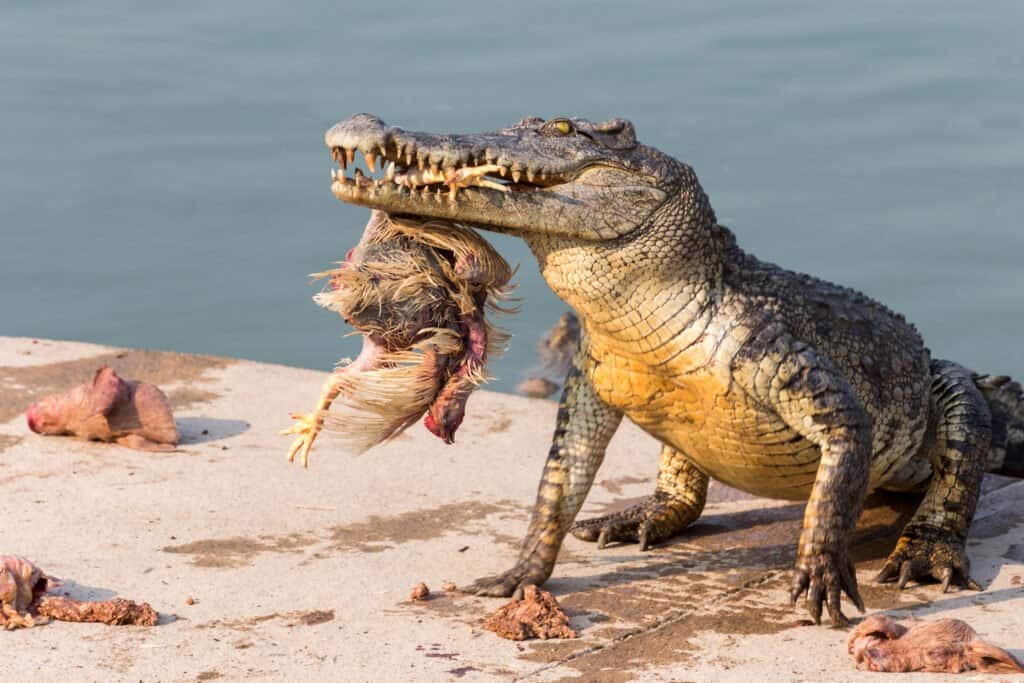
1. Fish
Fish are one of the most fundamental food sources in a crocodile’s diet and often make up the majority of what juveniles and medium-sized crocodiles consume. Living in rivers, lakes, estuaries, and wetlands gives crocodiles constant access to fish populations, making them an efficient and reliable prey category.
Crocodiles are highly skilled aquatic hunters. They remain submerged and motionless for long periods, blending into their environment until a fish swims within striking distance. With a sudden burst of speed, they snap their powerful jaws shut, capturing prey with minimal effort. Their sensory system, including pressure receptors along their jaws, allows them to detect even the slightest movement in water.
Fish provide essential nutrients such as protein and healthy fats that support growth and energy needs. For younger crocodiles especially, fish are easier to catch and digest compared to larger or more dangerous prey. This makes fish a crucial stepping stone in their development toward becoming apex predators.
Different species of fish are consumed depending on habitat, including freshwater and brackish varieties. Fish availability also influences crocodile distribution, as these reptiles tend to inhabit areas with abundant aquatic life.
Overall, fish represent a stable and accessible energy source that supports crocodile survival across a wide range of environments.
2. Catfish
Catfish are a particularly important prey item for crocodiles, especially in freshwater ecosystems. These bottom-dwelling fish are commonly found in muddy rivers and lakes, which overlap with crocodile habitats. Their abundance and size make them a valuable food source.
Crocodiles often hunt catfish by lying still near riverbeds or shallow waters where catfish forage. Once the fish comes close enough, the crocodile strikes with incredible speed, using its strong jaws to secure the catch. Catfish may attempt to hide in sediment, but crocodiles are well adapted to detecting movement even in murky conditions.
Nutritionally, catfish provide high levels of protein and fats, supporting energy storage and muscle development. Larger catfish can offer a substantial meal, reducing the need for frequent hunting. This efficiency is particularly beneficial for adult crocodiles, which require large amounts of energy but may not feed daily.
Catfish also play an important role in maintaining ecosystem balance. By preying on them, crocodiles help regulate fish populations in freshwater systems, contributing to healthier aquatic environments.
Because of their abundance and nutritional value, catfish remain one of the most reliable prey items for crocodiles in inland waters.
3. Tilapia
Tilapia are another common fish species consumed by crocodiles, especially in warm freshwater environments such as rivers, ponds, and lakes. These fish are highly adaptable and reproduce quickly, making them widely available across crocodile habitats.
Crocodiles use stealth-based hunting techniques to catch tilapia. They often position themselves near vegetation or submerged structures where tilapia gather. When the fish approach, the crocodile launches a rapid attack, minimizing escape chances.
Tilapia are nutritionally valuable due to their balanced protein content and moderate fat levels. They are easier to digest compared to larger prey, making them suitable for crocodiles of various sizes. Juvenile crocodiles particularly rely on tilapia as a primary food source during early growth stages.
In ecosystems where tilapia are abundant, crocodiles benefit from a consistent and predictable food supply. This reduces energy expenditure in hunting and allows for more stable growth and reproduction rates.
Tilapia also support crocodile populations indirectly by thriving in similar warm-water habitats, ensuring long-term prey availability.
4. Eels
Eels are elongated, slippery fish that inhabit rivers, swamps, and coastal waters. They are a challenging but rewarding prey item for crocodiles due to their high fat content and energy density.
Hunting eels requires precision. Crocodiles often ambush them in narrow waterways or muddy bottoms where eels travel. Their strong jaws and rapid strike speed allow them to secure these agile fish before they can escape into crevices.
Eels are particularly rich in fats, which provide long-lasting energy reserves for crocodiles. This is especially important in environments where food may be inconsistent. The high caloric value of eels makes them an efficient meal despite their slippery nature.
Younger crocodiles may struggle to catch larger eels, but adults are well equipped to handle them. The ability to consume such elusive prey demonstrates the crocodile’s adaptability as a predator.
Eels contribute to dietary diversity and help sustain crocodiles in complex aquatic ecosystems.
5. Sharks
Although uncommon, crocodiles are capable of preying on small sharks, particularly in coastal or estuarine environments where freshwater and saltwater ecosystems overlap. This behavior is most often observed in larger crocodile species such as the saltwater crocodile.
Sharks are not typical prey due to their strength and predatory nature, but crocodiles can overpower smaller or juvenile sharks through ambush tactics. A sudden strike near shallow waters allows crocodiles to take advantage of vulnerable individuals.
Shark meat provides substantial protein and fat, making it a high-energy food source when available. However, due to the rarity of such encounters, sharks are not considered a regular part of the crocodile diet.
This occasional predation highlights the crocodile’s position as an apex predator capable of interacting with a wide range of marine life.
Even though rare, shark predation showcases the crocodile’s adaptability in diverse aquatic environments.
6. Frogs
Frogs are an essential food source for juvenile crocodiles and smaller individuals. These amphibians are abundant in wetlands, marshes, and riverbanks, making them easy targets for young crocodiles learning to hunt.
Crocodiles capture frogs using quick reflex strikes, often targeting them near water edges where frogs breed and feed. Their small size makes them easy to swallow whole without the need for tearing or processing.
Frogs provide protein and essential nutrients necessary for growth. Although small, they are abundant, allowing juvenile crocodiles to consume multiple frogs in a single feeding session.
As crocodiles mature, frogs become less significant in their diet, but they remain an important early-life food source that supports survival during vulnerable stages.
Frogs help bridge the dietary transition from insects to larger prey in crocodile development.
7. Tadpoles
Tadpoles are the larval stage of frogs and serve as an important food source for young crocodiles. Found in shallow ponds, marshes, and slow-moving waters, tadpoles are easy to capture and consume.
Crocodiles feed on tadpoles by sweeping through shallow water with their jaws or snapping at clusters of them near vegetation. Their small size makes them effortless to digest and highly accessible.
Although not energy-dense compared to larger prey, tadpoles provide essential nutrients during early growth stages. They are especially important in ecosystems where larger prey is not yet accessible to juvenile crocodiles.
Tadpoles represent one of the earliest prey types in a crocodile’s life cycle, supporting their transition into more advanced predators.
Their abundance ensures a steady food supply for hatchlings and juveniles.
8. Salamanders
Salamanders are amphibians found in freshwater and moist terrestrial environments. They are occasional prey for crocodiles, particularly in regions where amphibian diversity is high.
Crocodiles capture salamanders using ambush techniques, often in shallow water or near riverbanks. Their slow movement makes them relatively easy to catch compared to fish or birds.
Salamanders provide protein and moisture, contributing to hydration and energy intake. While not a primary food source, they add variety to the crocodile’s diet.
Their presence in wetland ecosystems ensures they are available when other prey is less abundant.
Salamanders highlight the crocodile’s opportunistic feeding behavior and dietary flexibility.
9. Snakes
Snakes are occasionally consumed by crocodiles, especially in swampy or riverine environments where both species coexist. Crocodiles may encounter snakes while basking or swimming near shorelines.
Using rapid strikes, crocodiles can capture and subdue snakes before they escape. Their strong jaws and ability to drown prey make them effective predators even against agile reptiles.
Snakes provide moderate protein content and are consumed whole. Although not a primary food source, they contribute to dietary variety.
Some larger crocodiles may even prey on venomous snake species, although this is less common.
Snakes demonstrate the crocodile’s ability to exploit diverse terrestrial and semi-aquatic prey.
10. Lizards
Lizards are part of the crocodile diet, especially for smaller individuals or those living near forested riverbanks. These reptiles are commonly found basking on rocks or vegetation near water sources.
Crocodiles use stealth to approach and capture lizards before they can escape. Their quick reflexes ensure successful strikes even against fast-moving prey.
Lizards provide protein and are easy to digest. While not a major food source for large crocodiles, they are important for juveniles and sub-adults.
The availability of lizards in riparian zones makes them a consistent supplementary food source.
They contribute to early-stage crocodile development and hunting skill refinement.
11. Turtles
Turtles are a highly nutritious but challenging prey item for crocodiles due to their hard protective shells. However, crocodiles are well equipped to handle this difficulty thanks to their extremely powerful bite force, one of the strongest in the animal kingdom.
In the wild, crocodiles often encounter turtles basking on riverbanks, logs, or shallow waters. They use stealth to approach slowly and then strike with sudden force. Once captured, the turtle is typically crushed in the crocodile’s jaws or drowned before being consumed. Juvenile turtles may be swallowed whole, while larger individuals require more effort to break apart.
Nutritionally, turtles provide a rich source of protein, fat, and essential minerals, especially from their meat and internal organs. The shell also provides calcium, although crocodiles primarily consume the soft tissues inside.
Because turtles are relatively slow-moving and often abundant in freshwater ecosystems, they are a consistent food source for adult crocodiles. Their presence adds dietary diversity and helps crocodiles sustain energy in environments where fish populations fluctuate.
Overall, turtles represent a high-reward prey item that demonstrates the crocodile’s ability to overcome heavily armored defenses.
12. Smaller Crocodiles
Cannibalism is a natural and well-documented behavior among crocodiles. Larger crocodiles will occasionally prey on smaller individuals, especially in environments where competition for food and territory is intense.
This behavior typically occurs among territorial adults or during periods of food scarcity. Juvenile crocodiles are particularly vulnerable when they venture too close to larger adults. Ambush attacks are common, as crocodiles rely on surprise rather than pursuit.
Smaller crocodiles provide a significant amount of protein and fat, making them a high-energy meal. However, cannibalism is not the primary food source and usually occurs opportunistically rather than as a regular feeding strategy.
This behavior helps regulate population density within crocodile habitats and reinforces dominance hierarchies among individuals.
While aggressive, cannibalism is part of the natural survival strategy in crocodile ecosystems.
13. Ducks
Ducks are common prey for crocodiles, especially in wetlands, rivers, and lakes where waterfowl gather. These birds frequently enter crocodile habitats to feed or rest, making them vulnerable to ambush attacks.
Crocodiles typically wait submerged near the water’s surface or along shorelines. When ducks swim too close, the crocodile strikes quickly, pulling the bird underwater to prevent escape. The drowning method is a key part of crocodile hunting strategy.
Ducks provide a good balance of protein and fat, particularly during migration seasons when they may be more abundant. They are relatively easy to capture compared to larger birds, making them a reliable food source.
Their presence in aquatic environments ensures crocodiles have access to seasonal food opportunities.
Ducks contribute to the crocodile’s role as an opportunistic predator in wetland ecosystems.
14. Herons
Herons are large wading birds often found hunting or resting near water bodies. Their behavior brings them into close proximity with crocodiles, making them potential prey.
Crocodiles use stealth to approach herons that are focused on fishing or standing still in shallow water. A rapid strike allows the crocodile to capture the bird before it can take flight.
Herons provide substantial nutritional value due to their size, offering protein-rich meat and fats. However, they are more alert and cautious than smaller birds, making them a moderately challenging target.
Despite this, crocodiles exploit moments of distraction to successfully hunt herons in suitable environments.
Their inclusion in the diet reflects crocodiles’ adaptability in targeting both aquatic and semi-terrestrial prey.
15. Waterfowl
Waterfowl, including various species of ducks, geese, and similar birds, are frequently consumed by crocodiles in wetland ecosystems. These birds depend on water bodies for feeding and nesting, placing them within crocodile hunting zones.
Crocodiles capitalize on this behavior by remaining motionless near feeding grounds or nesting areas. When waterfowl approach the water’s edge, crocodiles strike with speed and precision.
Waterfowl provide a rich source of protein and fat, making them an efficient energy source. Larger birds can sustain crocodiles for extended periods, reducing the need for frequent hunting.
Their seasonal migrations also create predictable feeding opportunities for crocodiles in certain regions.
Waterfowl are an important part of the crocodile’s opportunistic feeding strategy.
16. Wading Birds
Wading birds such as storks, ibises, and egrets are common prey for crocodiles due to their feeding habits in shallow waters. These birds often focus on catching fish or insects, which can distract them from nearby predators.
Crocodiles take advantage of this by positioning themselves in concealed locations along riverbanks or marshes. A sudden strike is often enough to capture a wading bird before it reacts.
These birds offer a substantial amount of protein and are larger than many other avian prey, making them a valuable food source. However, they require precise timing to catch successfully.
Wading birds highlight the crocodile’s patience and ambush hunting efficiency in aquatic environments.
They contribute significantly to dietary diversity in wetland ecosystems.
17. Deer
Deer are among the larger terrestrial mammals hunted by crocodiles, particularly in regions where forests or grasslands meet rivers and lakes. These animals often approach water sources to drink, making them vulnerable.
Crocodiles rely on ambush tactics, waiting just below the surface or near the shoreline. When a deer comes close enough, the crocodile launches a powerful attack, dragging it into the water to drown it.
Deer provide a large amount of protein and fat, making them a highly rewarding meal. A successful hunt can sustain a crocodile for days or even weeks.
However, deer are more cautious than smaller animals, so successful predation requires perfect timing and positioning.
This prey type demonstrates the crocodile’s ability to hunt large mammals when conditions allow.
18. Wild Boar
Wild boar are strong, aggressive mammals that occasionally fall prey to crocodiles when they come to water sources. Despite their toughness, crocodiles can overpower them using ambush and drowning techniques.
Crocodiles typically target boars when they are drinking or crossing shallow water. The element of surprise is critical, as boars can otherwise be difficult to subdue.
Wild boar meat is rich in protein and fat, providing substantial energy. Larger crocodiles especially benefit from such high-calorie meals.
These encounters highlight the crocodile’s role as a dominant predator even against formidable land mammals.
Wild boar represent one of the more challenging but rewarding prey species.
19. Antelope
Antelope are fast-moving herbivores that often live near rivers and lakes, where they are at risk of crocodile attacks. When drinking or crossing water, they become vulnerable to ambush.
Crocodiles rely on patience and timing, waiting for the perfect moment to strike. Once captured, antelope are dragged underwater to ensure a successful kill.
Antelope provide a large and nutrient-rich food source, making them highly valuable prey. A single successful hunt can feed a crocodile for an extended period.
However, their speed and awareness make them difficult targets, requiring precision hunting strategies.
Antelope highlight the crocodile’s ability to hunt agile terrestrial animals.
20. Zebras
Zebras are among the largest and most powerful prey items occasionally hunted by crocodiles. These encounters typically occur during river crossings in African ecosystems.
Crocodiles exploit the vulnerability of zebras while they are in water, where their mobility is limited. A sudden attack can pull a zebra underwater, where the crocodile’s strength and drowning strategy take effect.
Zebras provide an enormous amount of energy, making them one of the most rewarding prey items available. However, successful hunts are rare due to the zebra’s size and herd protection behavior.
These events demonstrate the crocodile’s apex predator status and ability to take down large mammals under the right conditions.
Zebras represent high-risk, high-reward prey in crocodile ecosystems.
21. Wildebeest
Wildebeest are one of the most iconic large prey animals hunted by crocodiles, especially during seasonal migrations in African river systems. These herbivores often cross rivers in large herds, creating rare but highly rewarding feeding opportunities for crocodiles waiting below the surface.
Crocodiles use ambush tactics during river crossings, positioning themselves in deeper sections where wildebeest must swim. The moment an animal enters the water, crocodiles strike with explosive speed, grabbing limbs or the body and pulling it underwater. Drowning is the primary method of subduing such large prey.
Wildebeest provide an enormous amount of energy-rich meat, making them one of the most valuable prey items available. A single successful kill can sustain a crocodile for a long period, reducing the need for frequent hunting.
However, wildebeest are highly alert and often travel in groups, which increases their chances of detecting danger. This makes successful predation relatively rare and dependent on timing and environmental conditions.
Despite the difficulty, wildebeest remain a key example of crocodiles’ ability to exploit large migratory herbivores.
22. Monkeys
Monkeys are occasional prey for crocodiles, particularly in forested river environments where primates descend to drink or cross water. Species such as baboons or macaques are most vulnerable when they approach riverbanks.
Crocodiles often wait submerged near watering points, watching for movement above the surface. When a monkey lowers itself to drink or slips into shallow water, the crocodile strikes quickly, pulling it underwater before escape is possible.
Monkeys provide moderate amounts of protein and fat, and although not a primary food source, they contribute to dietary variety. Their intelligence and alertness make them more challenging than many other small mammals.
This predation highlights the crocodile’s opportunistic nature and ability to exploit even arboreal animals when they interact with water systems.
Monkeys serve as an example of crocodiles expanding their diet beyond purely aquatic prey.
23. Rodents
Rodents are small but common prey for crocodiles, especially in wetland and riverbank environments. These animals frequently move near water in search of food, making them accessible targets.
Crocodiles capture rodents using rapid strike movements when they approach the shoreline. Due to their small size, rodents are typically swallowed whole and require little processing.
Although individually low in calories, rodents are abundant and easy to catch, making them a consistent supplementary food source. Juvenile crocodiles in particular rely on rodents during early growth stages.
Their presence in nearly all ecosystems ensures crocodiles have access to this prey category regardless of habitat type.
Rodents demonstrate the crocodile’s efficiency in exploiting small terrestrial animals.
24. Bats
Bats are an unusual but occasional prey item for crocodiles, typically captured when they fly low over water surfaces. This behavior is more likely in caves, river systems, or mangrove habitats where bats frequently drink or hunt insects near water.
Crocodiles may snap at bats that skim the water or fall into it. Although rare, these opportunistic strikes can be successful due to the crocodile’s fast reflexes.
Bats provide small amounts of protein and energy. While not a significant food source, they represent the crocodile’s ability to exploit unexpected opportunities.
This feeding behavior demonstrates how crocodiles take advantage of any animal interacting with their aquatic environment.
Bats are a minor but interesting part of the crocodile’s diverse diet.
25. Cattle
Cattle are one of the most well-known large mammal prey items for crocodiles, especially in regions where livestock grazing overlaps with crocodile habitats. These animals often approach rivers and lakes to drink, placing them at risk of ambush.
Crocodiles typically wait in shallow water or near riverbanks. When cattle enter the water, crocodiles launch powerful attacks, dragging them into deeper water to drown them. Their immense bite force allows them to hold even large animals firmly.
Cattle provide a massive amount of energy-rich meat, making them extremely valuable prey. A single successful attack can sustain a crocodile for days or even weeks.
However, adult cattle are large and can sometimes resist, making successful hunts dependent on size, opportunity, and environmental conditions.
Cattle interactions also highlight human-wildlife conflict in regions where agriculture overlaps with crocodile habitats.
26. Goats
Goats are smaller livestock animals that are occasionally preyed upon by crocodiles, particularly in rural areas near rivers and wetlands. Their grazing habits often bring them close to water sources.
Crocodiles take advantage of this behavior by ambushing goats when they come to drink or cross shallow water. The attack is swift, and the prey is quickly pulled underwater to prevent escape.
Goats provide a moderate but valuable source of protein and fat. Compared to larger livestock, they are easier for crocodiles to subdue and consume.
Because goats are commonly raised near water in some regions, they represent a recurring opportunistic food source.
This prey type reflects crocodiles’ adaptability to human-altered environments.
27. Dogs
Dogs are not natural prey for crocodiles, but they can become victims in areas where domestic animals roam near waterways. These incidents are opportunistic and typically occur when dogs enter shallow water or approach riverbanks.
Crocodiles rely on surprise attacks, pulling dogs underwater rapidly. The drowning strategy is essential for overpowering such agile mammals.
Dogs provide moderate nutritional value, though they are not a preferred prey species. These encounters are more closely linked to habitat overlap between humans, pets, and crocodiles.
Such interactions highlight the importance of caution in crocodile-inhabited regions.
Dogs are an occasional and opportunistic component of the crocodile diet.
28. Insects
Insects are an important food source for juvenile crocodiles, especially hatchlings that are too small to capture larger prey. Found abundantly in wetland environments, insects provide an accessible and energy-efficient food option.
Young crocodiles catch insects by snapping at the water surface or picking them off vegetation. Common prey includes beetles, dragonflies, and aquatic larvae.
Although small, insects are rich in protein relative to their size and support early growth and development. They allow juvenile crocodiles to build strength before transitioning to larger prey.
Insects are a foundational part of the crocodile life cycle diet.
They ensure survival during the most vulnerable stage of development.
29. Crustaceans
Crustaceans such as crabs and shrimp are commonly eaten by crocodiles, especially in estuarine and coastal environments. These animals are abundant in muddy and shallow waters where crocodiles frequently hunt.
Crocodiles capture crustaceans using quick strikes or by stirring sediment to expose hidden prey. Their hard shells require strong jaws to crush and consume.
Crustaceans provide protein, fats, and minerals that contribute to crocodile growth and energy maintenance. They are especially important in environments where fish populations fluctuate.
Because they are widely available, crustaceans serve as a reliable supplementary food source.
They highlight the crocodile’s ability to exploit both aquatic vertebrates and invertebrates.
30. Snails
Snails are slow-moving mollusks found in freshwater and wetland ecosystems. Although small, they are frequently consumed by juvenile crocodiles and occasionally by adults when other prey is scarce.
Crocodiles locate snails along riverbeds and vegetation. They consume them whole or crush their shells using jaw pressure. Their abundance makes them easy to find and capture.
Snails provide modest nutritional value, including protein and calcium. While not a primary food source, they contribute to dietary diversity and support survival in low-prey conditions.
Snails demonstrate how crocodiles utilize even the smallest available food sources in their environment.
They complete the wide spectrum of prey types in the crocodile diet, from insects to large mammals.
Conclusion
Crocodiles are among the most adaptable and powerful predators on Earth, and their diet reflects this evolutionary success. From tiny insects and fish in their early life stages to massive mammals like deer, wildebeest, and cattle as adults, crocodiles demonstrate an extraordinary ability to exploit almost any available food source in their environment.
As opportunistic carnivores, they do not depend on a single type of prey. Instead, their feeding behavior is shaped by habitat, size, and availability. This flexibility allows them to survive in diverse ecosystems such as rivers, swamps, lakes, estuaries, and coastal waters across multiple continents.
One of the most important ecological roles of crocodiles is their function as apex predators. By controlling populations of fish, birds, reptiles, and mammals, they help maintain balance within aquatic and riparian ecosystems. Their presence often indicates a healthy and functioning environment.
Crocodiles are also highly efficient hunters, relying on stealth, patience, and explosive power rather than endurance. Their ambush strategy, combined with one of the strongest bite forces in the animal kingdom, makes them extremely effective at capturing both aquatic and terrestrial prey.
Overall, understanding what crocodiles eat provides valuable insight into their survival strategy and ecological importance. These ancient reptiles are not just fearsome predators—they are essential components of biodiversity and natural balance in the ecosystems they inhabit.
Frequently Asked Questions (FAQ) About What Crocodiles Eat
1. What do crocodiles eat in the wild?
Crocodiles are opportunistic carnivores, meaning they eat a very wide range of animals depending on availability. Their diet includes fish, birds, reptiles, amphibians, mammals, and even crustaceans. Young crocodiles mostly eat insects and small fish, while adults can take down large animals like deer, cattle, and wildebeest. Their feeding behavior depends heavily on habitat and size.
2. Do crocodiles eat fish?
Yes, fish are one of the most important food sources for crocodiles, especially for juveniles and medium-sized individuals. They are abundant in rivers and lakes, making them easy targets. Crocodiles use stealth and rapid strikes to catch fish efficiently in murky waters.
3. Do crocodiles eat humans?
Crocodiles can attack humans, but such cases are rare and usually happen when humans enter crocodile habitats. These reptiles do not specifically hunt humans but may mistake them for prey or act defensively. Most incidents occur near rivers, lakes, or wetlands where crocodiles live.
4. What is a crocodile’s favorite food?
Crocodiles do not have a single favorite food, but they commonly prefer fish, birds, and medium-sized mammals because they are easier to catch and provide good energy. Larger crocodiles often target big mammals when the opportunity arises.
5. Do crocodiles eat meat only?
Yes, crocodiles are strict carnivores. They do not eat plants and rely entirely on animal protein for survival. Their digestive system is adapted for processing meat, bones, and even tough hides.
6. How often do crocodiles eat?
Crocodiles do not need to eat daily. Depending on size and prey availability, they may eat once every few days or even once a week. After consuming large prey, they can survive for long periods without food.
7. Do crocodiles eat birds?
Yes, crocodiles frequently eat birds such as ducks, herons, and other waterfowl. Birds are often caught when they land near water or forage at the shoreline.
8. Do crocodiles eat snakes?
Yes, crocodiles occasionally eat snakes, especially in swampy environments. They use quick strikes to capture them before they can escape.
9. Do crocodiles eat turtles?
Yes, turtles are part of the crocodile diet. Crocodiles use their strong jaws to crush turtle shells and access the meat inside.
10. Do crocodiles eat other crocodiles?
Yes, larger crocodiles sometimes eat smaller ones. This behavior, known as cannibalism, occurs mainly due to competition or food scarcity.
11. Do crocodiles eat deer?
Yes, crocodiles can prey on deer when they come to rivers or lakes to drink water. They use ambush tactics to drag them underwater.
12. Do crocodiles eat fish or mammals more?
Younger crocodiles eat more fish, while adults tend to consume more mammals and birds because they are larger and provide more energy.
13. Do crocodiles eat crocodile eggs?
Yes, crocodiles may eat eggs, including their own species’ eggs in some cases, especially if food is scarce.
14. What do baby crocodiles eat?
Baby crocodiles mainly eat insects, small fish, tadpoles, and tiny amphibians. These foods are easy to catch and digest.
15. Do crocodiles eat insects?
Yes, insects are a major food source for juvenile crocodiles. They provide essential protein during early growth stages.
16. Do crocodiles eat crabs?
Yes, crocodiles eat crustaceans like crabs, especially in coastal and estuarine environments.
17. Do crocodiles eat frogs?
Yes, frogs are commonly eaten by young crocodiles because they are easy to catch and widely available in wetlands.
18. Do crocodiles eat monkeys?
Yes, crocodiles can eat monkeys when they come near water sources. This is opportunistic rather than a primary food source.
19. Do crocodiles eat cattle?
Yes, large crocodiles sometimes attack cattle that enter rivers or lakes to drink water, especially in rural areas.
20. Do crocodiles eat goats?
Yes, goats may be preyed upon when they approach water bodies in crocodile habitats.
21. Do crocodiles eat dogs?
Dogs can occasionally be attacked if they enter crocodile-inhabited waters, but this is not a natural prey preference.
22. Do crocodiles eat bats?
Rarely, crocodiles may catch bats that fly too low over water or fall into the water surface.
23. Do crocodiles eat sharks?
In rare cases, large crocodiles may attack small sharks in coastal waters, but this is uncommon.
24. Do crocodiles eat eels?
Yes, eels are part of the crocodile diet and are especially rich in fat and energy.
25. Do crocodiles eat tilapia?
Yes, tilapia are commonly eaten fish in freshwater ecosystems where crocodiles live.
26. Do crocodiles eat catfish?
Yes, catfish are a major food source due to their abundance in rivers and lakes.
27. Do crocodiles eat rodents?
Yes, rodents are frequently eaten by crocodiles near riverbanks and wetlands.
28. Do crocodiles eat lizards?
Yes, lizards are consumed by smaller crocodiles and juveniles in particular.
29. Do crocodiles eat salamanders?
Yes, salamanders are occasionally eaten in freshwater habitats.
30. Do crocodiles eat ants or termites?
Juvenile crocodiles may consume insects including ants or termites when available.
31. Do crocodiles eat mollusks?
Yes, crocodiles eat mollusks like snails and other soft-bodied invertebrates.
32. Do crocodiles eat snails?
Yes, snails are part of their diet, especially for younger crocodiles.
33. Do crocodiles eat crustaceans?
Yes, crustaceans like shrimp and crabs are commonly eaten in aquatic habitats.
34. Do crocodiles eat zebras?
Yes, crocodiles may attack zebras during river crossings in Africa.
35. Do crocodiles eat wildebeest?
Yes, wildebeest are common prey during migration river crossings.
36. Do crocodiles eat antelope?
Yes, antelope are frequently hunted when they approach water.
37. Do crocodiles eat wild boar?
Yes, crocodiles can overpower wild boar when they come near water sources.
38. Do crocodiles eat herons?
Yes, herons are often caught when they are feeding or standing in shallow water.
39. Do crocodiles eat ducks?
Yes, ducks are common prey in wetland ecosystems.
40. Do crocodiles eat waterfowl?
Yes, waterfowl are frequently eaten when they are near or on the water surface.
41. Do crocodiles eat wading birds?
Yes, crocodiles often ambush wading birds such as storks and egrets.
42. Do crocodiles eat plants?
No, crocodiles are strict carnivores and do not eat plants.
43. Do crocodiles chew their food?
No, crocodiles do not chew. They tear or swallow food in large chunks.
44. How do crocodiles kill prey?
They usually use a powerful bite and then drown prey by dragging it underwater.
45. Do crocodiles store food?
No, crocodiles do not store food but may hide large carcasses underwater temporarily.
46. Do crocodiles eat dead animals?
Yes, crocodiles can scavenge carrion when available.
47. Why do crocodiles eat so many different animals?
Their opportunistic nature allows them to eat whatever is available in their habitat.
48. Are crocodiles picky eaters?
No, crocodiles are not picky and will eat a wide variety of prey.
49. Do crocodiles hunt every day?
No, they can go days or weeks without eating depending on meal size.
50. Why are crocodiles important in ecosystems?
Crocodiles help control prey populations and maintain balance in aquatic ecosystems as apex predators.
51. What is the biggest food crocodiles can eat?
The largest crocodiles can take down large mammals such as cattle, buffalo, or zebras depending on habitat conditions.
Read more: