

Loons are among the most fascinating aquatic birds in the Northern Hemisphere, instantly recognizable by their haunting calls and striking black-and-white plumage. Belonging to the genus Gavia, these birds are highly adapted to life on the water, spending nearly all of their time swimming, diving, and hunting beneath the surface. Unlike many birds that rely on flight or land-based feeding, loons are expert underwater predators, using their powerful legs and streamlined bodies to chase down prey with remarkable precision.
Understanding what loons eat is essential not only for bird enthusiasts but also for conservationists and environmental researchers. A loon’s diet offers valuable insights into the health of freshwater lakes and coastal ecosystems. Because they sit near the top of the aquatic food chain, changes in their feeding habits can signal shifts in fish populations, water quality, and biodiversity.
In the wild, loons are primarily piscivorous, meaning fish make up the majority of their diet. However, their feeding behavior is more diverse than many people realize. Depending on availability, season, and habitat, loons also consume crustaceans, insects, amphibians, and even small amounts of plant material. This flexibility allows them to survive in a variety of environments, from remote northern lakes to coastal marine waters during migration.
Loons are visual hunters that rely heavily on clear water to locate prey. They dive silently, often reaching depths of 10 to 20 meters, and use their sharp bills to grab or spear fish. Unlike many birds, loons typically swallow their prey underwater, an adaptation that helps them avoid losing their catch to competitors.
Their diet also changes throughout their life stages. Adult loons focus on larger, energy-rich prey like fish, while chicks are often fed smaller, softer foods such as aquatic insects and tiny crustaceans. This ensures that young loons receive easily digestible nutrients necessary for rapid growth.
Seasonal variation plays a major role as well. During the breeding season on freshwater lakes, loons rely heavily on species like minnows, perch, and sunfish. In winter, when many populations migrate to coastal areas, their diet expands to include marine fish such as herring and flounder, as well as crustaceans like crabs.
Another interesting aspect of loon feeding behavior is their ability to adapt to prey availability. If fish populations decline, loons will shift to alternative food sources, including frogs, salamanders, or invertebrates. This adaptability is key to their survival, especially in changing environments affected by climate change and human activity.
Studying loon diets also helps scientists monitor environmental threats. For example, loons can accumulate toxins such as mercury from the fish they consume. By analyzing their feeding patterns, researchers can better understand pollution levels in aquatic ecosystems and take steps to protect both wildlife and human health.
In this comprehensive guide, we’ll explore 30 of the most common foods loons eat in the wild. Each section will break down not only what they eat, but also why these foods are important, how loons catch them, and what role they play in the broader ecosystem.
Whether you’re a wildlife enthusiast, a birdwatcher, or simply curious about these iconic water birds, this article will give you a deep understanding of loon feeding habits and the diverse diet that supports their survival.
What Do Loons Eat in the Wild ?
1. Minnows
Minnows are one of the most important and commonly consumed foods in a loon’s diet, especially in freshwater lakes during the breeding season. These small, schooling fish are abundant, easy to catch, and provide a reliable source of energy. Because minnows tend to swim in groups, loons can often capture multiple individuals in a single dive, making them an efficient prey choice.
From a nutritional standpoint, minnows are rich in protein and contain moderate levels of fat, which help sustain loons during long periods of activity such as nesting and chick-rearing. Their small size also makes them ideal for feeding young chicks, who are not yet capable of handling larger prey.
Loons hunt minnows using a stealth approach. They dive quietly beneath the surface and pursue the fish underwater, using their powerful legs to propel themselves forward. Their sharp, pointed bills allow them to grasp the fish quickly before it can escape. Because minnows often inhabit shallow areas near vegetation, loons frequently forage along lake edges where visibility is high.
2. Yellow Perch
Yellow perch are another staple in the loon diet, particularly in northern freshwater ecosystems. These fish are slightly larger than minnows and provide a higher caloric value, making them especially important for adult loons that require more energy.
Perch are rich in protein and contain essential fatty acids that contribute to the bird’s overall health, feather condition, and energy reserves. Their moderate size makes them suitable for both adult consumption and feeding older chicks.
Loons typically target juvenile perch, which are easier to catch and swallow. Using their exceptional underwater vision, they track individual fish and strike with precision. Perch often inhabit deeper waters than minnows, so loons may need to dive further and remain submerged longer to capture them.
3. Sunfish
Sunfish, including species like pumpkinseed and other panfish, are commonly eaten by loons in calm, warm freshwater lakes. These fish are relatively slow swimmers, which makes them an appealing target for a diving predator.
Sunfish provide a good balance of protein and fats, supporting the loon’s daily energy needs. They are particularly important during the summer months when these fish are most active and abundant in shallow waters.
Loons often hunt sunfish near aquatic vegetation, where the fish seek shelter. The birds rely on stealth and speed, approaching slowly before making a quick strike. Because sunfish have a slightly wider body shape, loons must position them carefully before swallowing.
4. Bluegill
Bluegill, a type of sunfish, are another frequent prey item for loons. These fish are abundant in many North American lakes and are known for their predictable behavior, which makes them easier for loons to locate and capture.
Bluegill are nutritionally valuable, offering a high protein content along with beneficial fats. They are often consumed whole, providing calcium and other minerals from their bones.
Loons hunt bluegill in a similar manner to other sunfish, diving into shallow waters and using their sharp eyesight to detect movement. Because bluegill often gather in colonies, loons may return to the same feeding spots repeatedly.
5. Pumpkinseed Fish
Pumpkinseed fish are brightly colored members of the sunfish family and are commonly found in weedy freshwater habitats. For loons, they represent an accessible and nutritious food source.
These fish are high in protein and relatively easy to digest, making them suitable for both adult loons and their chicks. Their abundance during the warmer months ensures a steady food supply.
Loons typically catch pumpkinseed fish by diving into vegetated areas and flushing them out from cover. The bird’s streamlined body allows it to maneuver efficiently through underwater plants while pursuing prey.
6. Suckers
Suckers are bottom-feeding fish that inhabit deeper parts of lakes and rivers. Although they are not as commonly eaten as smaller fish, they still play a role in the loon’s diet when available.
These fish are larger and more robust, providing a substantial energy boost when captured. However, their size means that loons must be selective, often targeting smaller individuals that can be swallowed whole.
Catching suckers requires deeper dives and more effort. Loons rely on their strong swimming ability to reach the lakebed, where these fish are typically found. This type of hunting demonstrates the loon’s versatility and endurance.
7. Small Catfish
Small catfish are occasionally consumed by loons, particularly in lakes where these fish are abundant. Catfish offer a rich source of protein and fats, making them a valuable addition to the diet.
Because catfish often inhabit murky or deeper waters, loons must rely heavily on their keen vision and patience to locate them. They may spend longer periods underwater when targeting this type of prey.
Despite their nutritional value, catfish are not a primary food source, as their behavior and habitat make them less accessible than other fish species.
8. Trout
Trout are among the more energy-rich fish that loons consume, especially in colder, oxygen-rich lakes. These fish are known for their speed and agility, making them a more challenging prey item.
Trout provide high-quality protein and significant fat content, which is particularly beneficial during periods of high energy demand, such as migration or breeding.
Loons must rely on speed and precision when hunting trout. They often pursue them in deeper waters, using rapid bursts of movement to close the distance before striking.
9. Salmon
Salmon are typically part of the loon’s diet in coastal or migratory environments rather than inland lakes. These fish are larger and extremely rich in fats, offering a dense source of energy.
While adult loons may occasionally capture smaller salmon, they are not a primary prey item due to their size and strength. However, when available, they provide significant nutritional benefits.
Loons hunting in marine environments may encounter salmon during seasonal runs, taking advantage of the increased availability of these fish.
10. Pike
Pike are predatory fish themselves and can grow quite large, but smaller individuals may fall prey to loons. These fish are highly nutritious, containing both protein and fats that support the loon’s energy needs.
Because pike are fast and aggressive, capturing them requires skill and timing. Loons typically target younger or smaller pike that are easier to handle.
The pursuit of pike highlights the loon’s role as a top predator within its ecosystem, capable of hunting a wide range of fish species, including those that are themselves formidable hunters.
11. Smelt
Smelt are small, silvery fish commonly found in both freshwater and coastal environments, making them an important seasonal food source for loons. These fish are especially abundant in colder regions and are often present in large schools, which increases hunting efficiency for loons.
Nutritionally, smelt are rich in oils and protein, providing a high-energy meal that supports long dives and sustained activity. Their soft bodies make them easy to swallow whole, which is ideal for both adult loons and their growing chicks.
Loons typically hunt smelt in open water, diving beneath schools and chasing individual fish. Their streamlined bodies and powerful leg strokes allow them to maneuver quickly, while their sharp eyesight helps them track movement even in dim underwater conditions.
12. Whitefish
Whitefish are another valuable dietary component, particularly in northern lakes where they are abundant. These fish are slightly larger and provide a substantial amount of protein and fat, making them an excellent energy source.
Whitefish tend to inhabit deeper waters, requiring loons to perform longer and more demanding dives. This makes them a more energy-intensive prey item to capture, but the nutritional payoff is significant.
Loons often target juvenile whitefish, which are easier to handle and swallow. Their ability to adapt their hunting depth demonstrates their flexibility as aquatic predators.
13. Herring
Herring are a key part of the loon’s diet in marine environments, particularly during migration and wintering periods. These fish form dense schools, allowing loons to exploit them efficiently.
Rich in omega-3 fatty acids and protein, herring provide essential nutrients that support feather health, energy storage, and overall vitality. This is especially important when loons are far from their breeding grounds.
Loons often dive beneath herring schools and attack from below, scattering the group and isolating individual fish. This hunting strategy increases their success rate and minimizes energy expenditure.
14. Flounder
Flounder are flatfish that live along the bottom of coastal waters. Although not a primary food source, they are occasionally consumed by loons that winter near marine environments.
These fish are high in protein and relatively easy to digest, but their bottom-dwelling behavior requires loons to adjust their hunting technique.
To catch flounder, loons dive to the seabed and search for camouflaged individuals. This type of hunting demands patience and keen observation, as flounder often blend seamlessly with their surroundings.
15. Rockfish
Rockfish are commonly found in rocky coastal habitats and may be part of a loon’s diet during migration. These fish vary in size, but smaller individuals are suitable prey.
They provide a good balance of protein and fats, contributing to the loon’s overall energy intake. Rockfish are particularly valuable in environments where other prey may be less abundant.
Loons hunt rockfish by diving near rocky outcrops and using their agility to navigate complex underwater terrain. This demonstrates their adaptability to different habitats.
16. Haddock
Haddock are marine fish that loons may encounter during their time in coastal waters. While not a primary food source, they can be an opportunistic addition to the diet.
These fish are rich in lean protein and provide essential nutrients that help maintain muscle strength and endurance.
Loons typically target smaller haddock, capturing them during dives in open or moderately deep waters. Their ability to exploit a variety of fish species highlights their opportunistic feeding behavior.
17. Crayfish
Crayfish are one of the most important non-fish food sources for loons, particularly in freshwater ecosystems. These crustaceans are abundant in many lakes and rivers, making them a reliable alternative when fish are less available.
Crayfish are rich in protein and contain essential minerals such as calcium, which are beneficial for bone strength and egg production. They are especially important for feeding chicks, as they are easier to digest than larger fish.
Loons capture crayfish by diving to the lakebed and searching among rocks and vegetation. Their ability to forage along the bottom expands their feeding opportunities beyond mid-water prey.
18. Freshwater Shrimp
Freshwater shrimp are small, soft-bodied crustaceans that provide an easily digestible source of nutrition. These organisms are particularly valuable for young loons, which require softer food items.
Despite their size, shrimp are rich in protein and contribute to the overall dietary diversity of loons. They are often consumed in large numbers to meet energy needs.
Loons typically find freshwater shrimp in shallow, vegetated areas. They may use quick, repetitive dives to gather multiple individuals in a short period.
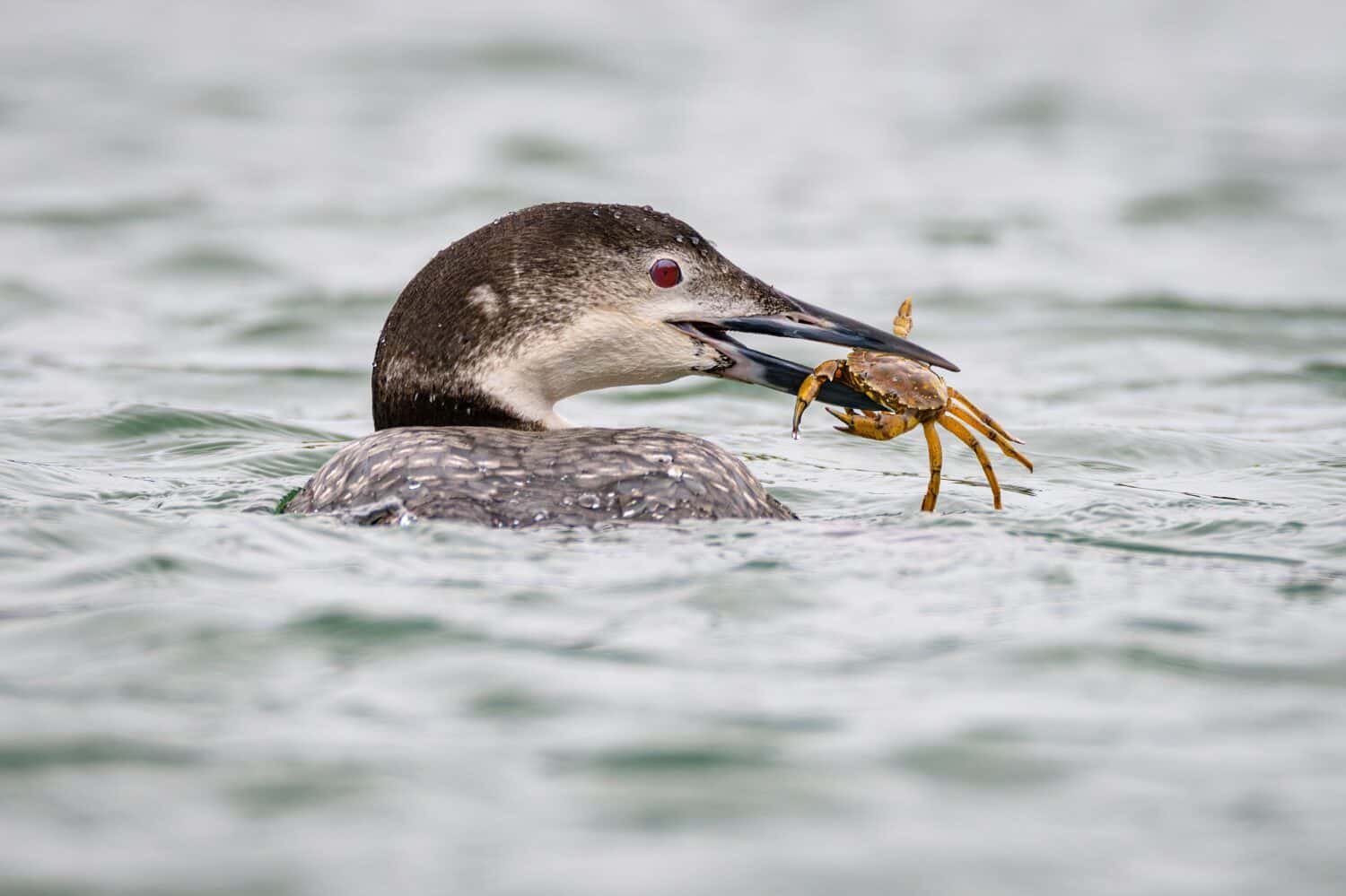
19. Crabs
Crabs are more commonly eaten by loons in coastal environments, where these crustaceans are abundant. While not a staple food, they provide an additional source of protein and minerals.
Crabs can be more challenging to handle due to their hard shells and defensive claws. As a result, loons often target smaller or recently molted individuals that are easier to consume.
Hunting crabs requires loons to dive to the seabed and use precise movements to capture and manipulate their prey before swallowing.
20. Lobster
Lobster consumption by loons is relatively rare but has been documented in coastal regions. These crustaceans are highly nutritious, offering a dense source of protein and essential nutrients.
Due to their size and strength, loons are more likely to target juvenile lobsters, which are easier to capture and ingest.
Catching lobster requires deep dives and careful handling, showcasing the loon’s impressive underwater hunting abilities and adaptability to different prey types.
21. Aquatic Insects
Aquatic insects play a crucial role in the diet of loons, particularly for chicks and juveniles. These include larvae and adult forms of insects such as dragonflies, mayflies, and beetles that live in or near water. While they may seem insignificant compared to fish, aquatic insects provide an easily digestible and protein-rich food source.
For young loons, aquatic insects are essential during the early stages of life. Their soft bodies make them easier to swallow and digest, allowing chicks to gain strength before transitioning to larger prey. These insects also contain important nutrients like amino acids that support growth and feather development.
Adult loons often consume aquatic insects opportunistically, especially when fish are scarce or when feeding their young. They typically hunt these insects in shallow waters or near the surface, making short dives or quick pecks to capture them.
22. Leeches
Leeches are another soft-bodied invertebrate that loons consume, particularly in freshwater habitats. Though not a primary food source, they are readily available in many lakes and provide a convenient supplemental meal.
Leeches are rich in protein and are relatively easy to digest, making them suitable for both adult loons and chicks. Their slow movement and tendency to cling to surfaces make them easy targets.
Loons typically find leeches along the lakebed or attached to vegetation. By diving and foraging in these areas, they can gather multiple prey items in a short time, especially when other food sources are limited.
23. Snails
Snails are commonly found in freshwater ecosystems and are occasionally eaten by loons. Although their hard shells present a challenge, loons are capable of swallowing smaller snails whole.
Snails provide a modest amount of protein along with minerals such as calcium, which is important for bone health and eggshell formation. This makes them a valuable, though secondary, dietary component.
Loons typically locate snails while foraging along the bottom of lakes. They may pick them off rocks, plants, or sediment as they search for other prey.
24. Clams
Clams and other small mollusks are occasionally consumed by loons, particularly in areas where they are abundant. These shellfish are more commonly part of the diet in coastal or brackish environments.
Clams offer protein and essential minerals, but their hard shells make them less appealing compared to softer prey. Loons generally select smaller individuals that can be swallowed without difficulty.
To find clams, loons dive to the bottom and probe the substrate. This type of feeding behavior highlights their ability to exploit a wide range of food sources beyond active swimming prey.
25. Frogs
Frogs are an important alternative prey item for loons, particularly in freshwater habitats where amphibians are abundant. They provide a high-protein meal and are relatively easy to catch compared to fast-moving fish.
Frogs are especially valuable during periods when fish populations are low. Their soft bodies and moderate size make them suitable for both adult loons and their chicks.
Loons typically capture frogs near the water’s edge or in shallow areas where amphibians are most active. Their ability to hunt both aquatic and semi-aquatic prey demonstrates their versatility as predators.
26. Salamanders
Salamanders, like frogs, are amphibians that occasionally form part of the loon’s diet. These creatures are commonly found in freshwater environments and provide a nutritious source of protein.
Salamanders are particularly important for feeding chicks due to their soft bodies and manageable size. They are easy to swallow and digest, making them an ideal food during early development.
Loons typically find salamanders in shallow waters or along the lakebed. Their slow movement compared to fish makes them an easier target, requiring less energy to capture.
27. Aquatic Worms
Aquatic worms, including various species of annelids, are another supplementary food source for loons. These organisms are commonly found in sediment at the bottom of lakes and ponds.
Although small, aquatic worms are rich in protein and can be consumed in large quantities to meet energy needs. They are especially useful when other prey is scarce.
Loons locate worms by diving and probing the lakebed. This feeding method allows them to exploit hidden food resources that are not accessible to many other birds.
28. Pondweed
Pondweed is an aquatic plant that loons may ingest occasionally, though it is not a primary food source. Most plant material consumed by loons is likely accidental, occurring while capturing prey.
Despite this, pondweed can provide trace nutrients and fiber. It may also play a role in digestion, although this is not fully understood.
Loons encounter pondweed frequently while hunting in vegetated areas. As they chase fish or invertebrates, small amounts of plant matter may be swallowed along with their prey.
29. Algae
Algae, like pondweed, is not intentionally targeted by loons but may be consumed incidentally. It is commonly present in the environments where loons feed, especially in nutrient-rich waters.
While algae does not contribute significantly to the loon’s nutritional intake, it may provide minor amounts of vitamins and minerals.
Loons typically ingest algae while feeding on fish or invertebrates in areas with dense aquatic growth. Its presence in their diet reflects the interconnected nature of aquatic ecosystems.
30. Seeds
Seeds from aquatic plants are occasionally found in the diet of loons, though they are not a deliberate food choice. Like other plant materials, seeds are usually ingested accidentally.
These seeds may offer small amounts of nutrients, but they do not play a significant role in the loon’s overall diet. Their presence simply highlights the bird’s interaction with its environment.
Loons encounter seeds while foraging in shallow waters or among vegetation. This incidental consumption underscores their primary focus on animal-based prey while still reflecting the complexity of their feeding habits.
Conclusion
Loons are highly specialized aquatic predators with a diet that revolves primarily around fish, but extends far beyond it. From minnows and perch to crustaceans, amphibians, and even occasional plant matter, their feeding habits reveal a remarkable level of adaptability. This diverse diet allows loons to thrive in a range of environments, from quiet freshwater lakes to dynamic coastal waters.
One of the most striking aspects of loon feeding behavior is their efficiency underwater. Their streamlined bodies, powerful legs, and exceptional vision make them formidable hunters capable of pursuing prey at impressive depths. Unlike many birds, loons swallow most of their food underwater, reducing competition and increasing feeding success.
Their diet also changes depending on life stage and season. Adult loons prioritize energy-rich fish, while chicks depend on softer, smaller prey such as insects and crustaceans. During winter migrations, loons expand their diet to include marine species, demonstrating their ability to adapt to new food sources.
Understanding what loons eat is more than just a matter of curiosity—it provides insight into the health of aquatic ecosystems. Because loons are top predators, changes in their diet can reflect shifts in fish populations, water quality, and environmental conditions. Protecting their habitats ensures not only their survival but also the balance of the ecosystems they inhabit.
In summary, loons are opportunistic yet highly skilled hunters whose diet reflects both specialization and flexibility. Their reliance on clean, fish-rich waters makes them important indicators of environmental health and valuable species in conservation efforts.
Frequently Asked Questions (FAQs)
1. What do loons eat the most?
Loons primarily eat fish, which make up the majority of their diet. Common prey includes minnows, perch, sunfish, and other small to medium-sized fish species found in freshwater and coastal environments.
2. Do loons only eat fish?
No, while fish are their main food source, loons also eat crustaceans, aquatic insects, amphibians, and occasionally mollusks. This varied diet helps them adapt to different environments and food availability.
3. What do baby loons eat?
Baby loons are fed small, soft prey such as minnows, aquatic insects, and tiny crustaceans. These foods are easier to digest and provide the nutrients needed for rapid growth.
4. How do loons catch their food?
Loons dive underwater and use their powerful legs to swim after prey. They rely on excellent vision to spot fish and capture them with their sharp, pointed bills.
5. Do loons eat plants?
Loons may occasionally ingest plant material like algae or pondweed, but this is usually accidental. They are primarily carnivorous birds.
6. Can loons eat large fish?
Loons typically prefer smaller fish that are easier to swallow whole. However, they may occasionally catch and consume larger fish if they can manage them.
7. Do loons eat frogs?
Yes, loons sometimes eat frogs, especially in freshwater habitats where amphibians are abundant. Frogs provide a good source of protein.
8. What do loons eat in winter?
During winter, loons often migrate to coastal areas where they feed on marine fish such as herring and flounder, as well as crustaceans like crabs.
9. Are loons picky eaters?
Loons are somewhat selective but also opportunistic. They prefer fish but will eat other prey when necessary, depending on availability.
10. Do loons eat insects?
Yes, especially aquatic insects. These are particularly important for chicks and young loons because they are easy to digest.
11. How deep can loons dive to find food?
Loons can dive to depths of around 10 to 20 meters, and sometimes deeper, in search of prey.
12. Do loons eat at night?
Loons are primarily daytime hunters, relying on their vision to locate prey. However, they may occasionally feed in low-light conditions.
13. Do loons compete with other birds for food?
Yes, loons may compete with other fish-eating birds, but their ability to dive deeply often gives them an advantage.
14. What role do loons play in the ecosystem?
Loons are top predators in aquatic ecosystems. They help regulate fish populations and serve as indicators of environmental health.
15. Do loons eat crayfish?
Yes, crayfish are a common part of their diet, especially in freshwater environments where these crustaceans are abundant.
16. Can loons eat shellfish?
Loons may eat small shellfish like clams or snails, but these are not a primary food source.
17. How often do loons need to eat?
Loons need to eat regularly to maintain their energy levels, especially during breeding and migration periods.
18. Do loons feed their chicks?
Yes, parent loons actively catch and deliver food to their chicks during the early stages of life.
19. What happens if loons cannot find fish?
If fish are scarce, loons will switch to alternative prey such as insects, amphibians, or crustaceans.
20. Are loons affected by water pollution?
Yes, pollution can impact fish populations and introduce toxins into the loon’s diet, affecting their health and reproduction.
21. Do loons eat leeches?
Yes, leeches are occasionally eaten and provide a small but useful source of protein.
22. Can loons survive without fish?
Loons rely heavily on fish, but they can temporarily survive on other prey. However, long-term lack of fish can negatively impact their health.
23. Do loons hunt alone?
Loons usually hunt alone, relying on their own skills to capture prey.
24. How do loons swallow their food?
Loons typically swallow their prey whole underwater, which helps prevent other animals from stealing their catch.
25. Do loons eat during migration?
Yes, loons continue to feed during migration, often taking advantage of coastal food sources.
26. What size fish do loons prefer?
Loons generally prefer small to medium-sized fish that can be easily swallowed whole.
27. Do loons eat dead fish?
Loons usually prefer live prey but may occasionally consume dead fish if available.
28. Can loons overfish a lake?
No, loons typically do not consume enough fish to significantly impact fish populations in a healthy ecosystem.
29. Do loons eat salamanders?
Yes, salamanders are sometimes eaten, particularly in freshwater habitats.
30. Why is a loon’s diet important to study?
Studying their diet helps scientists understand ecosystem health, pollution levels, and changes in aquatic biodiversity.
31. Do loons eat worms?
Yes, aquatic worms are occasionally consumed, especially when other food sources are limited.
32. Are loons carnivores?
Yes, loons are primarily carnivorous birds that feed on a variety of animal prey.
33. Do loons eat crabs?
Yes, especially in coastal areas where crabs are readily available.
34. How do loons find food underwater?
They rely on excellent vision and quick reflexes to detect and capture prey while diving.
35. Do loons eat every day?
Yes, loons must eat daily to maintain their energy, especially during active periods.
36. Can loons eat large prey?
They can handle moderately large prey, but they generally prefer smaller items that are easier to swallow.
37. Do loons share food?
Adult loons do not share food with each other but will feed their chicks.
38. What is the easiest prey for loons to catch?
Small, slow-moving fish like minnows are among the easiest prey for loons to capture.
39. Do loons eat in groups?
Loons usually hunt alone, although multiple loons may feed in the same area if food is abundant.
40. How does water clarity affect loon feeding?
Clear water is essential because loons rely on vision to locate prey underwater.
41. Do loons eat algae?
Algae may be consumed accidentally, but it is not a significant part of their diet.
42. Do loons eat seeds?
Seeds may be ingested incidentally while feeding but are not intentionally targeted.
43. Do loons eat bottom-dwelling animals?
Yes, loons can dive to the bottom to catch prey like crayfish, worms, and mollusks.
44. Are loons dependent on freshwater fish?
During the breeding season, yes. However, they adapt to marine fish when in coastal environments.
45. Do loons eat shrimp?
Yes, freshwater shrimp are commonly eaten, especially by younger loons.
46. What time of day do loons hunt?
Loons primarily hunt during daylight hours when visibility is best.
47. Do loons eat fast-moving fish?
They can catch fast fish like trout, but these require more effort and skill.
48. Do loons need a lot of food?
Yes, due to their active lifestyle, loons require a consistent intake of high-protein food.
49. Do loons eat different foods in different regions?
Yes, their diet varies depending on local prey availability and habitat conditions.
50. How does climate change affect loon diets?
Climate change can alter fish populations and water conditions, potentially impacting the availability of food for loons.
51. Why are loons considered important indicators of ecosystem health?
Because they are top predators, changes in their diet and health can reflect broader environmental issues such as pollution and declining fish populations.
Read more: