

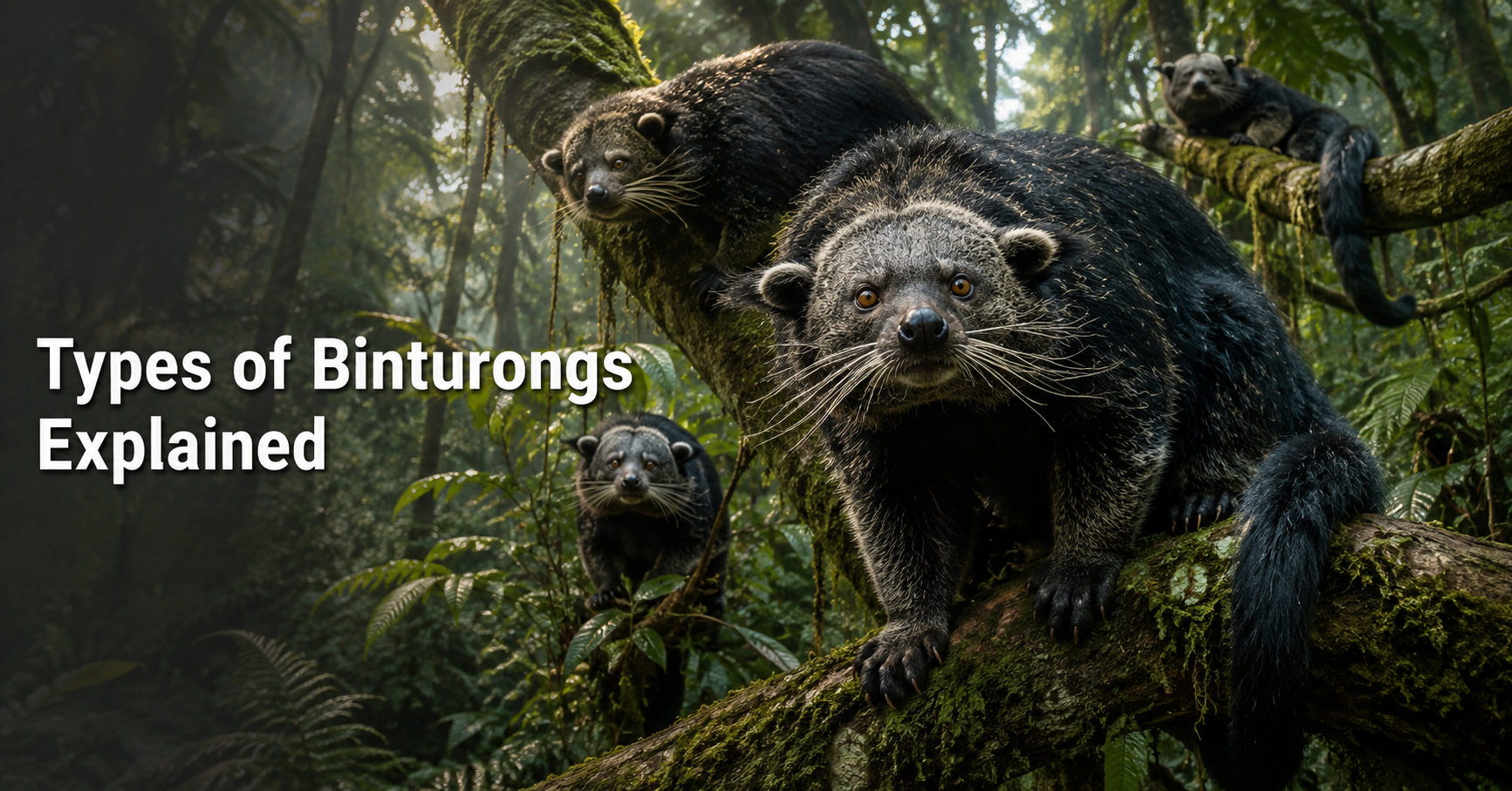
People searching for types of binturongs often expect to find several distinct species. Current mammal taxonomy, however, recognizes only one living species: the binturong, Arctictis binturong. It is also the only species in the genus Arctictis. Several geographic subspecies were proposed in older classifications, but their boundaries and validity require further taxonomic study.
This guide explains the single recognized binturong species, the nine regional names commonly found in older references, and the features that make this unusual Asian forest mammal easy to recognize. It also covers range, habitat, size, diet, behavior, reproduction, conservation, responsible observation, and common identification mistakes.
What Are the Main Types of Binturongs?
There is one recognized species of binturong: Arctictis binturong. Historical sources have divided it into as many as nine named subspecies based largely on geography and specimens from places such as mainland Southeast Asia, Palawan, Borneo, Java, Nias, Bangka, and Yunnan. These names are useful for understanding taxonomic history and regional conservation, but they should not be presented as nine confirmed species or nine equally secure modern types.
| Taxonomic level | Recognized name | Current interpretation |
|---|---|---|
| Species | Arctictis binturong | The single living binturong species |
| Genus | Arctictis | A monotypic genus containing one species |
| Historical regional forms | Nine frequently listed subspecies names | Proposed names whose modern boundaries need revision |
1. Binturong
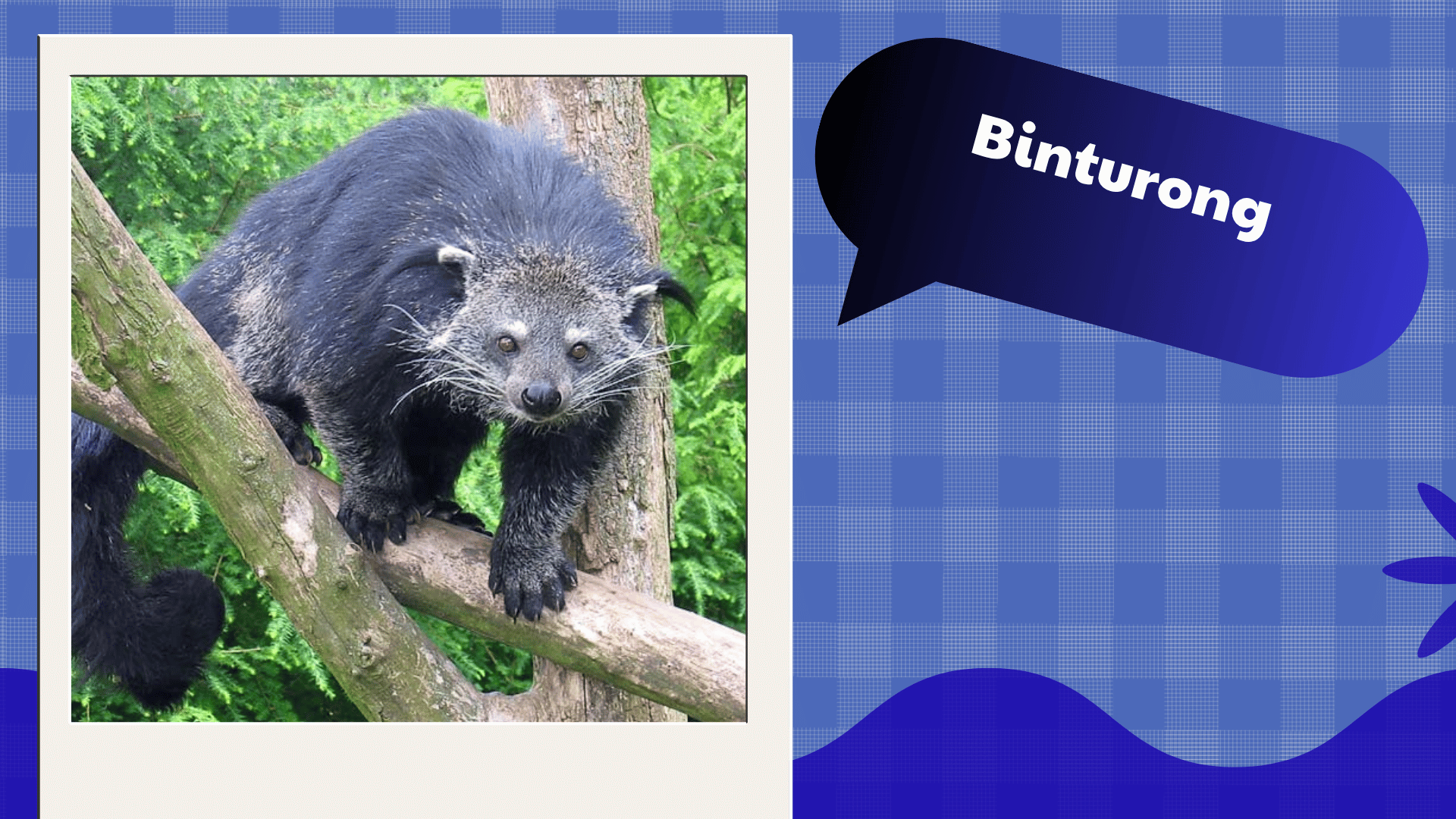
The binturong, Arctictis binturong, is a large, shaggy member of the civet family, Viverridae. It is often called a bearcat because its heavy body, dark fur, rounded ears, and cat-like face seem to combine features of several familiar animals. The nickname is misleading in a scientific sense: a binturong is neither a bear nor a cat.
An adult has a long body, short strong legs, coarse black or dark brown fur, pale-tipped hairs, prominent white whiskers, and rounded ears edged with pale hair and black tufts. The long muscular tail is prehensile, meaning it can curl around and grip branches. It acts as a stabilizer and extra support while the animal moves through the canopy. Few carnivorous mammals have a truly prehensile tail, making this one of the binturong’s most distinctive adaptations.
Body color varies from almost black to charcoal gray or grizzled brown depending on the individual, age, lighting, and the amount of pale tipping on the coat. Young animals may appear lighter. Color variation does not by itself prove that two animals belong to different subspecies.
Binturongs are native to South and Southeast Asia. Their range includes parts of Nepal, northeastern India, Bhutan, Bangladesh, southern China, Myanmar, Thailand, Laos, Cambodia, Vietnam, Malaysia, Indonesia, Brunei, and the Philippine island of Palawan. Distribution is not continuous; populations are tied to remaining forest and have disappeared or become rare in many altered landscapes.
They live mainly in tropical and subtropical forest, including primary forest, secondary forest, evergreen forest, and some forest mosaics. Although highly arboreal, they descend to the ground when gaps prevent travel between tree crowns. Their deliberate climbing style may look slow, but their grip, balance, and ability to rotate their ankles make them confident in complex branches.
Binturongs are omnivores with a strong dependence on fruit, especially figs. They also eat insects, birds, eggs, rodents, and other small animals when available. By swallowing fruit and depositing seeds elsewhere, they can contribute to forest regeneration. This ecological role is one reason the loss of binturongs matters beyond the fate of a single species.
Activity varies among sites and individuals, but binturongs are commonly active at night and around dawn or dusk. They rest on large branches or in dense canopy cover. They are generally solitary, though ranges can overlap and animals come together for breeding. Scent marking is important because smell carries information through dark, visually cluttered forest.
Are There Really Nine Binturong Subspecies?
Nine names are often repeated as binturong subspecies. Most originated from specimens collected in particular regions or on islands. A name appearing in a historical checklist does not automatically mean that the population is genetically distinct, consistently identifiable, or accepted as a valid subspecies by every modern authority.
Current species-level databases recognize one species and may treat these old infraspecific names as synonyms rather than active subspecies. Genetic research has found meaningful geographic structure, including broad northern mainland and southern Sundaic lineages, but researchers have also emphasized the need for a comprehensive revision. Until that work is complete, the most accurate wording is one recognized species with several historically proposed regional forms.
| Historically proposed name | Associated locality or region | How to describe it responsibly |
|---|---|---|
| A. b. binturong | Peninsular Malaysia | Nominotypical historical form |
| A. b. albifrons | Northern mainland range | Older mainland name based on pale facial features |
| A. b. whitei | Palawan, Philippines | Palawan regional form of high conservation interest |
| A. b. pageli | Northern Borneo | Historically named Bornean form |
| A. b. gairdneri | Thailand | Historically proposed Thai mainland form |
| A. b. niasensis | Nias Island, Indonesia | Island form named from Nias |
| A. b. penicillatus | Java, Indonesia | Historical Javan form |
| A. b. kerkhoveni | Bangka Island, Indonesia | Island name based on a Bangka specimen |
| A. b. menglaensis | Yunnan, China | Historical name from the northern edge of the range |
Historically Proposed Regional Forms
Malayan Binturong
Arctictis binturong binturong is the nominotypical name associated with the Malayan population and the original species description. Binturongs in Peninsular Malaysia occupy evergreen and secondary forest but face forest conversion, roads, hunting, and wildlife trade. It is appropriate to call an animal a Malayan binturong geographically. It is less appropriate to claim that its coat color alone proves a distinct subspecies without supporting taxonomic evidence.
Northern Mainland Form
The name A. b. albifrons has been applied to binturongs from the northern mainland portion of the range. The name refers to a pale-fronted appearance, but facial grizzling varies among individuals and with age. Regional descriptions may include populations from parts of the eastern Himalayas and Indochina, depending on the source. Because published boundaries are inconsistent, modern wildlife reporting should use country or landscape names unless a study explicitly follows a defined subspecies treatment.
Palawan Binturong
A. b. whitei is the historical name for the Palawan binturong of the Philippines. Palawan is separated from most of the species’ range by sea, making this population especially interesting for evolution and conservation. Genetic research supports its distinctiveness at a population level, but it remains within the single recognized binturong species. Restricted range, forest loss, and wildlife exploitation make protection of its habitat and genetic identity important.
Northern Bornean Form
A. b. pageli was named from northern Borneo. Bornean binturongs live in one of the world’s major tropical forest regions and may use both intact and previously logged forest. Persistence in modified forest should not be mistaken for immunity to habitat degradation. Canopy breaks, roads, hunting access, and conversion to plantations can still reduce survival and movement.
Thai Binturong
The name A. b. gairdneri was based on a specimen from Thailand. Studies of wild binturongs in Thailand have provided valuable information about activity, movement, and habitat use, but those ecological findings do not independently validate a subspecies. A Thai binturong is best understood as a geographic population of A. binturong unless the historical trinomial is required in a taxonomic discussion.
Nias Island Form
A. b. niasensis was proposed for animals from Nias, an island west of Sumatra. Island populations can become genetically or morphologically distinctive through isolation, but each claim requires adequate samples and comparison. Information about living binturongs on small islands is often limited, so conservation surveys should avoid assuming that old specimen records describe a secure modern population.
Javan Form
A. b. penicillatus is associated with Java. The island has a long history of human settlement, agriculture, forest fragmentation, and wildlife trade. A historical name documents the origin of specimens but does not confirm the present distribution or abundance of wild binturongs. Verified camera-trap and field records are particularly valuable where surviving habitat is isolated.
Bangka Island Form
A. b. kerkhoveni was described from Bangka Island near Sumatra. As with other island names, it is best treated as part of the species’ taxonomic history until a modern revision establishes its status. Mining, forest conversion, roads, and hunting can be severe pressures on island wildlife, even when the population receives little scientific attention.
Yunnan Form
A. b. menglaensis was named from Yunnan in southern China, near the northern edge of the binturong’s range. Edge populations may be small and separated from larger populations by habitat loss. Reports from this region require careful verification because dark arboreal mammals can be difficult to identify from brief observations. The current species name remains Arctictis binturong.
How Are Binturongs Classified?
| Rank | Classification |
|---|---|
| Class | Mammalia |
| Order | Carnivora |
| Suborder | Feliformia |
| Family | Viverridae |
| Subfamily | Paradoxurinae |
| Genus | Arctictis |
| Species | Arctictis binturong |
The binturong’s closest broader relatives include Asian palm civets and other members of Paradoxurinae. It is not a bear, cat, raccoon, or monkey. Similarity to those animals reflects a combination of shared carnivore ancestry and adaptation to life in trees, not membership in the same family.
Where Do Binturongs Live?
Binturongs occur from the eastern Himalayan region through mainland Southeast Asia and parts of the Sunda Islands, with an isolated population on Palawan. Countries within the recognized range include Bangladesh, Bhutan, Cambodia, China, India, Indonesia, Laos, Malaysia, Myanmar, Nepal, the Philippines, Thailand, and Vietnam, with records also associated with Brunei.
The species is primarily forest-dependent. It uses tropical evergreen forest, subtropical forest, secondary forest, and some logged habitat where enough canopy, fruiting trees, and refuge remain. A forest that still contains binturongs is not necessarily high quality, and occupancy does not reveal whether the population is stable or reproducing successfully.
How to Identify a Binturong
- Large shaggy body: heavier and more robust than most Asian civets.
- Dark coarse coat: usually blackish with gray, white, or buff-tipped hairs.
- Long pale whiskers: prominent against the dark face.
- Rounded tufted ears: small ears with pale edges and dark hair tufts.
- Prehensile tail: long, thick, muscular, and capable of gripping branches.
- Slow, deliberate climbing: often moves carefully rather than leaping rapidly between trees.
- Plantigrade stance: walks with much of the sole contacting the surface.
- Arboreal setting: often photographed on large branches in forest canopy.
Do not identify a regional subspecies from coat color alone. Camera angle, wet fur, infrared illumination, age, and individual variation can produce dramatic differences. Location data and genetic sampling are far more informative for studying geographic structure.
Binturong Size and Appearance
Binturongs are among the largest viverrids. Adults commonly weigh roughly 9 to 20 kilograms, although published extremes and captive weights may be higher. Head-and-body length is often around 60 to 95 centimeters, with a tail that may approach the body in length. Females can be larger than males, an unusual pattern among many carnivores.
The fur is long and coarse, helping protect the animal in wet forest. Strong limbs and curved claws provide grip. The tail is muscular at the base and can wrap around a branch, but an adult does not normally hang freely by the tail alone for extended periods. Its primary roles are support, stability, and controlled movement.
What Do Binturongs Eat?
Binturongs are omnivores, but fruit is a major part of their diet. Figs are especially important in many forests because different fig species can fruit at different times, providing food when other resources are scarce. Binturongs also eat insects, birds, eggs, small mammals, and other opportunistic foods.
Their digestive passage can transport seeds away from a parent tree. This makes the binturong a seed disperser and links its survival to forest structure and plant diversity. Calling it a strict carnivore because it belongs to Carnivora would be misleading; taxonomic order describes ancestry, not an exclusively meat-based diet.
Binturong Behavior
Binturongs spend much of their time in trees but regularly descend to cross gaps. They can rotate their hind feet to improve control while climbing down headfirst. Activity is often nocturnal or crepuscular, though daytime movement occurs and patterns differ among landscapes.
They communicate with scent and a variety of sounds, including grunts, hisses, chuckle-like calls, and loud defensive vocalizations. The famous popcorn-like smell comes from a volatile chemical in scent-marked urine. It is used for communication and should not be interpreted as evidence that the animal has recently eaten popcorn.
Reproduction and Young
Much of what is known about reproduction comes from managed populations. Binturongs can breed during different parts of the year, and litters usually contain a small number of young. Newborns are dependent on their mother and develop climbing skills as they grow.
Females show reproductive adaptations that may help coordinate birth with favorable conditions. Exact timing, litter size, and maturity figures vary among studies and individuals, so captive averages should not be assumed to describe every wild population. Maintaining accurate ancestry records is important in conservation breeding because animals from different geographic populations may carry distinct genetic lineages.
Outdoor Tips for Observing Binturongs
- Visit protected forest with an experienced local wildlife guide.
- Scan large horizontal branches and fruiting fig trees at dawn, dusk, and night.
- Use low-intensity light and avoid keeping a beam on the animal’s eyes.
- Never shake branches, imitate distress calls, or throw objects to force movement.
- Do not bait binturongs with fruit or processed food.
- Keep quiet and allow the animal an unobstructed escape route.
- Record time, location, habitat, behavior, and the tree species if known.
- Use camera traps only with permission and in accordance with local law.
Safety, Sustainability, and Conservation Notes
The binturong is classified as Vulnerable, and its population trend is declining. Major threats include deforestation, forest degradation, hunting, road expansion, capture for the wildlife trade, and use in attractions or commercial wildlife operations. Island and range-edge populations may face additional risk because they are small or isolated.
Do not purchase a binturong, pay for direct-contact photo sessions, or support facilities that allow unregulated handling. A legitimate conservation or accredited zoological program should prioritize animal welfare, professional care, public education, and traceable legal acquisition rather than forced interaction.
Forest protection is the most important long-term measure. Connected canopy, diverse fruiting trees, limits on hunting, enforcement against trafficking, responsible infrastructure planning, and research on genetic structure all help. Consumer choices that reduce demand for products linked to illegal wildlife use or destructive land conversion can also support habitat conservation.
Fun Facts About Binturongs
- The binturong is the only living species in the genus Arctictis.
- Its nickname “bearcat” is misleading because it is neither a bear nor a cat.
- It belongs to the same family as civets.
- Its muscular tail can grip branches and support climbing.
- Females are often larger than males.
- Its scent is frequently compared to buttered popcorn.
- The popcorn-like odor is associated with the compound 2-acetyl-1-pyrroline.
- Figs form an important part of its diet.
- Binturongs can help disperse seeds through tropical forests.
- They may climb down a trunk headfirst with help from flexible ankles and strong claws.
Final Thoughts on Types of Binturongs
The most accurate answer to a search for types of binturongs is that there is one recognized species, Arctictis binturong. Nine subspecies names appear in historical literature, but they represent proposed regional forms rather than nine confirmed species, and their taxonomy needs modern revision. The regional variation still matters because isolated populations can hold unique genetic diversity and face different conservation pressures. Protecting connected Asian forests, preventing illegal trade, and reporting taxonomy carefully are the best ways to support this remarkable bearcat.
Frequently Asked Questions
1. How many species of binturong are there?
There is one recognized living species, Arctictis binturong. It is also the only species in its genus.
2. Are there different types of binturongs?
There are geographically separated populations and several historical subspecies names. Modern taxonomy still treats all living binturongs as one species.
3. How many binturong subspecies have been proposed?
Nine names are frequently listed. Their current validity and boundaries are not equally secure, and a comprehensive revision is needed.
4. What is the scientific name of the binturong?
The scientific name is Arctictis binturong.
5. Is a binturong a bear?
No. It is a viverrid, while true bears belong to the family Ursidae.
6. Is a binturong a cat?
No. Although it is part of the cat-like carnivore branch, it belongs to Viverridae rather than the cat family Felidae.
7. Why is it called a bearcat?
The nickname comes from its bear-like build and cat-like face and movements. It does not indicate a hybrid or close relationship to either group.
8. Where do binturongs live?
They live in forests across parts of South and Southeast Asia, from the eastern Himalayan region to the Sunda Islands and Palawan.
9. Do binturongs live in the Philippines?
Yes, the native Philippine population occurs on Palawan and nearby associated islands, not throughout the entire country.
10. What is a Palawan binturong?
It is the geographically isolated binturong population of Palawan, historically named A. b. whitei. It remains part of the one recognized species.
11. What habitat do binturongs need?
They need forest with sufficient canopy structure, resting sites, fruiting trees, and access to diverse foods. They can use some secondary forest.
12. Are binturongs arboreal?
Yes, they are strongly adapted to life in trees, but they also travel on the ground when crossing canopy gaps.
13. Can a binturong hang by its tail?
The tail can grip and support the body during climbing. It is better described as an anchor and stabilizer than as a device for prolonged free hanging.
14. How large is a binturong?
Adults commonly weigh about 9 to 20 kilograms, with considerable variation. Their long tail adds substantially to total length.
15. Are female binturongs larger than males?
Females are often larger, which is an unusual example of female-biased size difference among carnivores.
16. What do binturongs eat?
They are omnivores that eat large amounts of fruit, especially figs, along with insects, eggs, birds, rodents, and other small prey.
17. Are binturongs carnivores or herbivores?
They belong to the order Carnivora but have an omnivorous, often fruit-heavy diet. Taxonomic membership does not mean they eat only meat.
18. Why do binturongs smell like popcorn?
Their scent markings contain 2-acetyl-1-pyrroline, a compound also associated with the aroma of cooked popcorn and toasted foods.
19. Are binturongs nocturnal?
They are often active at night and around twilight, but activity patterns vary and daytime movement is possible.
20. Do binturongs live alone?
They are generally solitary, although home ranges can overlap and animals associate for breeding or while young remain with their mother.
21. What sounds do binturongs make?
They can grunt, hiss, growl, purr, chuckle, and produce louder calls when alarmed or communicating.
22. Are binturongs dangerous?
They generally avoid people, but their teeth and claws can cause serious injury if they are frightened, restrained, or cornered.
23. Can binturongs be pets?
They are unsuitable pets. They require specialist care, large complex spaces, social and behavioral management, and legal documentation.
24. Are binturongs endangered?
The species is classified as Vulnerable rather than Endangered at the global level. Its population is declining, and some regional populations may be at greater risk.
25. Why are binturongs threatened?
Major threats include deforestation, forest fragmentation, hunting, wildlife trafficking, road development, and capture for commercial use.
26. Are binturongs used in kopi luwak production?
Although Asian palm civets are the animals most associated with civet coffee, binturongs have also been reported in exploitative wildlife coffee operations.
27. How do binturongs help forests?
They consume fruit and disperse seeds, potentially moving them away from parent trees and supporting forest regeneration.
28. What animals are related to binturongs?
Their relatives include civets and Asian palm civets within Viverridae. They are not closely related to bears or raccoons.
29. How long do binturongs live?
They can live for many years, especially under managed care, but lifespan estimates from captivity should not be assumed to equal survival in the wild.
30. How many young do binturongs have?
Litters are usually small, often around two young, although larger and smaller litters have been recorded.
31. Can binturongs swim?
They can enter or cross water, but they are forest climbers rather than aquatic specialists.
32. How can I identify a binturong on a camera trap?
Look for a large shaggy black body, pale whiskers, rounded tufted ears, short legs, and an exceptionally long thick tail.
33. Can coat color identify a binturong subspecies?
No. Coat color varies with age, individual genetics, lighting, and fur condition. Reliable geographic taxonomy requires broader evidence.
34. Where is the best place to see a wild binturong?
Protected forests within its range offer the best chance, especially with an ethical local guide. Sightings remain uncommon because the animal is arboreal and secretive.
35. How can people help protect binturongs?
Support forest conservation, reject wildlife pet sales and direct-contact attractions, avoid products tied to illegal wildlife use, and report trafficking to appropriate authorities.