

Wild turtles are fascinating reptiles that have thrived on Earth for millions of years. From the oceans to freshwater rivers and ponds, these creatures come in many shapes, sizes, and colors. In this guide, we explore 40 types of wild turtles, providing identification, behavior, and habitats. Understanding wild turtles helps us appreciate their ecological role, their unique adaptations, and the ways they survive in diverse environments. Whether you’re a wildlife enthusiast, student, or nature lover, this article gives clear and friendly explanations about each type of wild turtle. By the end, you’ll know what makes each turtle species special and why conserving them is so important.
1. Leatherback Sea Turtle (Dermochelys coriacea)

Appearance and Identification
The Leatherback Sea Turtle is the largest of all turtles, weighing up to 900 kg (2,000 lbs) and measuring 2 meters (6.5 ft) long. Unlike other sea turtles, it has a leathery shell instead of a hard carapace. Its dark body features pale spots and ridges that run along its back. The turtle’s flippers are long and tapered, ideal for deep ocean swimming.
Behavior and Habitat
Leatherbacks are highly migratory, traveling thousands of kilometers across oceans. They prefer open seas and can dive to depths of over 1,000 meters to hunt jellyfish. Despite their size, they are agile swimmers. Leatherbacks usually come ashore only to lay eggs on sandy beaches.
Diet and Feeding
These turtles feed primarily on jellyfish. Their sharp, pointed mouths help capture slippery prey. Leatherbacks play an important ecological role by controlling jellyfish populations in oceans. Conservation efforts are critical as their numbers have declined due to bycatch, pollution, and habitat loss.
2. Loggerhead Sea Turtle (Caretta caretta)

Appearance and Identification
Loggerheads are medium-sized sea turtles, weighing 80–200 kg (176–440 lbs) with a reddish-brown shell and large head. Their flippers are strong and slightly tapered, aiding in long-distance swimming. The shell is heart-shaped in juveniles and becomes more oval in adults.
Behavior and Habitat
Loggerheads inhabit coastal waters, bays, and estuaries. They are strong swimmers and can travel thousands of kilometers during migrations. Loggerheads are solitary but may congregate in feeding grounds. They nest on sandy beaches, where females return annually to lay eggs.
Diet and Feeding
Their diet includes crabs, mollusks, jellyfish, and fish. Loggerheads use their strong jaws to crush hard shells. They help maintain healthy marine ecosystems by controlling prey populations. Threats include fishing gear entanglement, habitat loss, and climate change.
3. Green Sea Turtle (Chelonia mydas)

Appearance and Identification
Green Sea Turtles are named for the greenish color of their fat, not their shell. Adults weigh 110–190 kg (240–420 lbs) and have a smooth, olive-colored shell. They have a rounded head, small beak, and flippers adapted for swimming long distances.
Behavior and Habitat
Green Sea Turtles inhabit tropical and subtropical waters. They are mostly herbivorous as adults, grazing on seagrass and algae. Juveniles are more omnivorous, eating small invertebrates. These turtles migrate seasonally to nesting beaches, sometimes traveling thousands of kilometers.
Diet and Feeding
Adults feed mainly on seagrass and algae, shaping underwater vegetation habitats. Their grazing supports ecosystem balance and healthy seagrass beds. Conservation efforts focus on protecting nesting sites and reducing bycatch in fishing operations.
4. Hawksbill Sea Turtle (Eretmochelys imbricata)

Appearance and Identification
The Hawksbill Sea Turtle is easily recognized by its pointed beak and overlapping, colorful scales on the shell. Adults weigh 45–70 kg (99–154 lbs) and have a heart-shaped carapace with amber, brown, and gold patterns. Their flippers are long and slender, perfect for maneuvering among coral reefs.
Behavior and Habitat
Hawksbills primarily inhabit tropical coral reefs, lagoons, and rocky areas. They are solitary swimmers but gather during nesting season on sandy beaches. These turtles are excellent climbers in water, navigating coral crevices with ease.
Diet and Feeding
They feed mainly on sponges, algae, and small invertebrates. Hawksbills play a critical role in reef health by preventing sponge overgrowth. Their populations are threatened by illegal shell trade, bycatch, and habitat destruction.
5. Olive Ridley Sea Turtle (Lepidochelys olivacea)

Appearance and Identification
Olive Ridley Turtles are small, weighing 35–50 kg (77–110 lbs), with an olive-green, heart-shaped shell. They have a slightly upturned beak and streamlined flippers, making them agile swimmers.
Behavior and Habitat
These turtles inhabit warm, tropical oceans worldwide. They are famous for “arribadas,” mass nesting events where thousands come ashore together. Solitary in the water, they feed and migrate over long distances between feeding and nesting sites.
Diet and Feeding
Olive Ridleys are omnivorous, eating jellyfish, shrimp, algae, and crabs. They help maintain healthy ocean ecosystems by regulating prey populations. Threats include coastal development, fishing gear, and egg collection.
6. Kemp’s Ridley Sea Turtle (Lepidochelys kempii)

Appearance and Identification
Kemp’s Ridley is the smallest sea turtle, weighing 35–45 kg (77–99 lbs) and measuring about 60 cm (2 ft) in length. Their shells are gray-green, slightly oval, with a relatively broad head and strong flippers.
Behavior and Habitat
Found mainly in the Gulf of Mexico, Kemp’s Ridleys are social during nesting, often nesting en masse. They are active swimmers, migrating hundreds of kilometers between feeding grounds and nesting beaches.
Diet and Feeding
They feed on crabs, mollusks, jellyfish, and fish. Kemp’s Ridleys play a role in controlling prey populations in coastal ecosystems. Conservation programs focus on protecting nesting beaches and reducing bycatch.
7. Flatback Sea Turtle (Natator depressus)

Appearance and Identification
Flatbacks have a flattened, olive-green to gray shell, weighing 90–120 kg (198–265 lbs). They have broad, paddle-like flippers and a rounded head. The shell is smooth and low-domed, giving them a distinctive flat profile.
Behavior and Habitat
Native to the waters of northern Australia and nearby islands, Flatbacks prefer shallow coastal waters and estuaries. They are less migratory than other sea turtles, often staying near feeding grounds.
Diet and Feeding
Flatbacks eat soft-bodied invertebrates, jellyfish, and crustaceans. By feeding selectively, they help maintain healthy coastal ecosystems. Threats include habitat loss, coastal development, and accidental capture in fishing gear.
8. Common Snapping Turtle (Chelydra serpentina)

Appearance and Identification
The Common Snapping Turtle is a freshwater species with a rugged, dark brown shell and a long tail. Adults weigh 4–35 kg (9–77 lbs) and have strong jaws and a distinctive hooked beak. Their legs are thick with sharp claws for digging and swimming.
Behavior and Habitat
They inhabit lakes, rivers, and swamps across North America. These turtles are primarily nocturnal and spend most of their time submerged, ambushing prey. Despite their fierce appearance, they are usually shy around humans.
Diet and Feeding
Snapping Turtles are omnivores, eating fish, amphibians, insects, plants, and carrion. They play an important role in freshwater ecosystems by controlling populations of smaller animals and scavenging dead matter.
9. Alligator Snapping Turtle (Macrochelys temminckii)

Appearance and Identification
Alligator Snapping Turtles are massive freshwater turtles with heavily ridged, spiky shells. Adults can weigh up to 100 kg (220 lbs) and have a massive head with a worm-like tongue used to lure fish. Their powerful jaws are capable of biting through bone.
Behavior and Habitat
They live in rivers, lakes, and swamps of the southeastern United States. They are largely sedentary, often lying motionless on the bottom waiting for prey. Despite their fierce appearance, they are slow-moving on land.
Diet and Feeding
Alligator Snapping Turtles are carnivorous, feeding on fish, amphibians, mollusks, and sometimes smaller turtles. By controlling aquatic prey populations, they maintain balance in freshwater ecosystems. Threats include habitat destruction and overharvesting.
10. Painted Turtle (Chrysemys picta)

Appearance and Identification
Painted Turtles are small freshwater turtles with smooth, dark shells featuring red, orange, or yellow markings along the edges. Adults weigh 0.4–1 kg (0.9–2.2 lbs) and have a flat, oval-shaped shell and webbed feet for swimming.
Behavior and Habitat
These turtles inhabit ponds, lakes, and slow-moving rivers in North America. They are semi-aquatic and spend time basking on logs or rocks. Painted Turtles are generally peaceful and social when basking together.
Diet and Feeding
Painted Turtles are omnivorous, eating aquatic plants, insects, small fish, and algae. They help control aquatic invertebrate populations and contribute to nutrient cycling. Habitat preservation and clean waterways are essential for their survival.
11. Spotted Turtle (Clemmys guttata)

Appearance and Identification
The Spotted Turtle is a small freshwater turtle with a dark, smooth carapace adorned with yellow spots. Adults weigh around 0.2–0.5 kg (0.4–1 lb) and have a domed shell with a bright yellow underside. Their head and neck also feature yellow spots.
Behavior and Habitat
They inhabit shallow freshwater wetlands, marshes, and slow-moving streams in North America. Spotted Turtles are semi-aquatic and spend time both in water and basking on logs or vegetation. They are known for their slow movements and shy nature.
Diet and Feeding
Spotted Turtles are omnivorous, feeding on insects, worms, snails, and aquatic plants. They contribute to controlling invertebrate populations and maintaining wetland ecosystem balance. Threats include habitat loss and road mortality.
12. Blanding’s Turtle (Emydoidea blandingii)

Appearance and Identification
Blanding’s Turtles have a domed, dark shell with bright yellow spots or streaks. They weigh 0.5–1.5 kg (1–3 lbs) and have a distinctive yellow throat and chin. Their long neck helps them reach vegetation and prey.
Behavior and Habitat
They are semi-aquatic, living in marshes, ponds, and shallow lakes of North America. Blanding’s Turtles are shy and slow-moving but may travel overland to find new wetlands. They spend much of their time submerged in shallow water.
Diet and Feeding
Blanding’s Turtles are omnivores, eating aquatic plants, insects, small fish, and amphibians. Their foraging helps maintain wetland health. Conservation is critical due to wetland drainage and road mortality during migrations.
13. Western Pond Turtle (Actinemys marmorata)

Appearance and Identification
Western Pond Turtles are medium-sized freshwater turtles with a dark brown or olive carapace and yellowish markings. Adults weigh 0.5–1.5 kg (1–3 lbs) and have webbed feet for swimming in slow rivers and ponds.
Behavior and Habitat
Native to the western United States, they inhabit ponds, streams, and marshes. They are mostly aquatic but often bask on rocks or logs. They are shy and may retreat quickly into water when disturbed.
Diet and Feeding
Western Pond Turtles are omnivorous, eating insects, crustaceans, algae, and small fish. They help regulate aquatic prey populations and maintain clean waterways. Habitat loss is their main threat.
14. European Pond Turtle (Emys orbicularis)

Appearance and Identification
European Pond Turtles have dark shells with yellowish spots or streaks. Adults weigh 0.8–1.5 kg (1.8–3.3 lbs) and have a smooth, oval carapace. They also have webbed feet and a long neck for hunting aquatic prey.
Behavior and Habitat
They are native to freshwater habitats across Europe, including rivers, lakes, and marshes. They are shy, spending much of their time in water but basking during sunny periods. They are active from spring to early autumn.
Diet and Feeding
European Pond Turtles are omnivores, consuming insects, mollusks, small fish, and aquatic vegetation. By controlling invertebrate populations, they contribute to healthy freshwater ecosystems. Threats include habitat destruction and water pollution.
15. Wood Turtle (Glyptemys insculpta)

Appearance and Identification
Wood Turtles are medium-sized with a sculpted brown shell and rough, ridged surface. Adults weigh 0.5–1.5 kg (1–3 lbs) and have orange-colored legs and a dark, patterned head. They are terrestrial and aquatic, adapted to forests and streams.
Behavior and Habitat
They inhabit rivers, streams, and adjacent forests in North America. Wood Turtles spend time both on land and in water, often digging or foraging in leaf litter. They are shy and slow-moving but highly resilient in diverse habitats.
Diet and Feeding
Wood Turtles are omnivorous, feeding on earthworms, insects, fruits, and vegetation. They play a role in soil aeration and nutrient cycling. Habitat loss, collection for the pet trade, and road mortality are significant threats.
16. Bog Turtle (Glyptemys muhlenbergii)

Appearance and Identification
Bog Turtles are very small, weighing 0.1–0.2 kg (0.2–0.4 lbs), with dark brown or black shells and bright orange or yellow patches on their neck and head. Their small size helps them hide in marshy wetlands.
Behavior and Habitat
They inhabit high-quality wetlands, bogs, and wet meadows in North America. Bog Turtles are secretive and spend most of their time hidden under vegetation or mud. They are excellent swimmers in shallow water.
Diet and Feeding
Bog Turtles are omnivorous, eating insects, snails, worms, and small plant matter. They help control invertebrate populations in wetlands. Wetland drainage and human disturbance are major threats to their survival.
17. Common Box Turtle (Terrapene carolina)

Appearance and Identification
Common Box Turtles have domed, brown or black shells with yellow or orange patterns. Adults weigh 0.5–1.5 kg (1–3 lbs) and can close their shells completely with a hinged plastron for protection.
Behavior and Habitat
They inhabit forests, grasslands, and marsh edges in North America. Box Turtles are mostly terrestrial but require access to water for hydration. They are slow-moving and often hide under leaves or soil when threatened.
Diet and Feeding
They are omnivores, eating insects, worms, fruits, and plants. They contribute to seed dispersal and insect control. Habitat loss and collection for the pet trade are major conservation concerns.
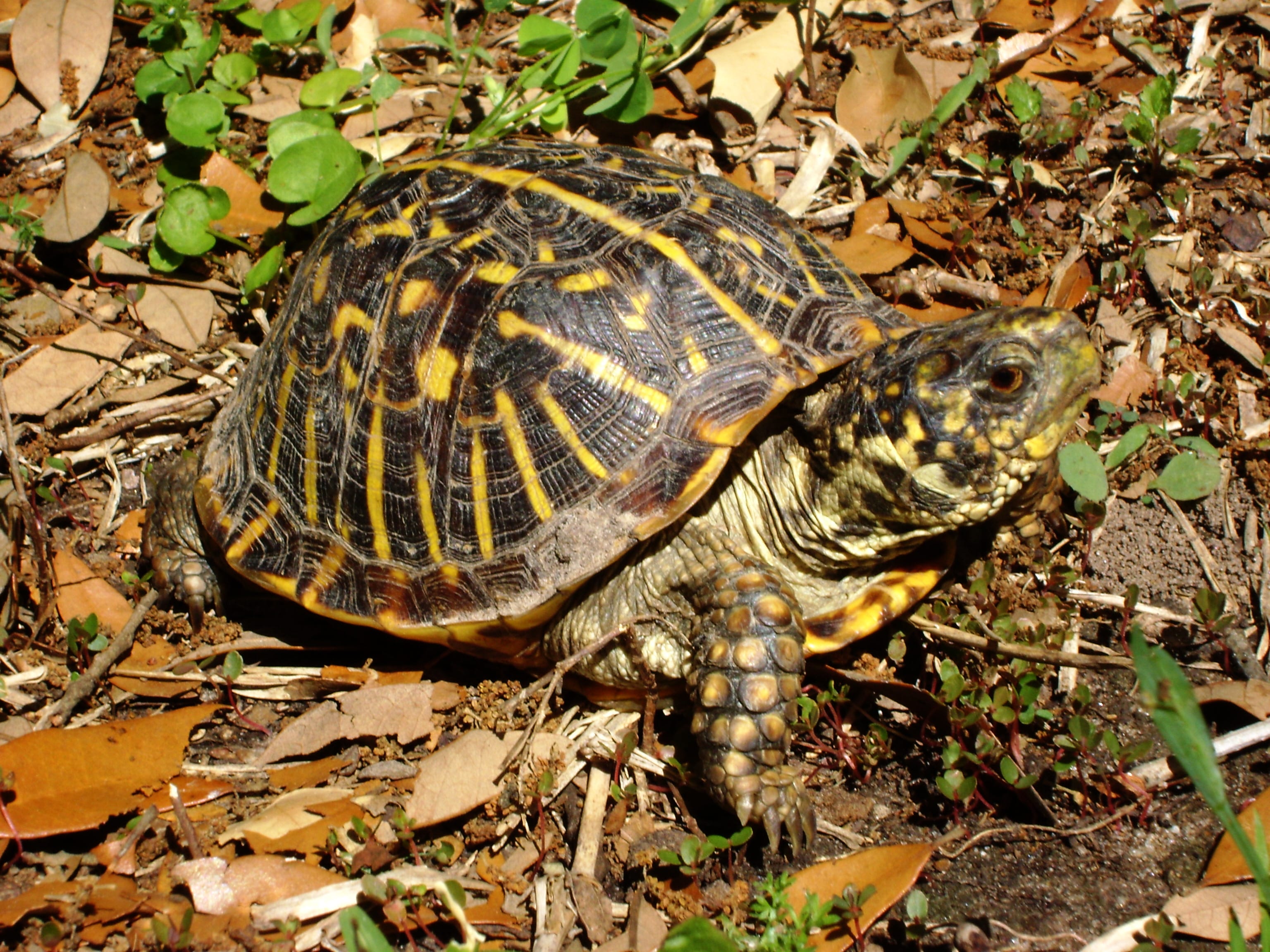
18. Ornate Box Turtle (Terrapene ornata)
Appearance and Identification
Ornate Box Turtles have flat, domed shells with intricate yellow or orange lines forming star-like patterns on a dark background. Adults weigh 0.4–1.2 kg (0.9–2.6 lbs) and are smaller than other box turtles.
Behavior and Habitat
They live in prairies, grasslands, and open woodlands in the central United States. Ornate Box Turtles are terrestrial, often burrowing to escape heat and predators. They are generally slow and secretive.
Diet and Feeding
They feed on insects, berries, mushrooms, and small plants. Their feeding behavior helps control insect populations and disperse seeds. Habitat loss due to agriculture and urban development threatens their populations.
19. Spotted Box Turtle (Terrapene nelsoni / similar species)

Appearance and Identification
Spotted Box Turtles have a domed shell with distinct yellow or orange spots on dark brown or black carapaces. Adults weigh around 0.5–1 kg (1–2 lbs). Their hinged plastron allows complete shell closure for protection.
Behavior and Habitat
They are terrestrial and inhabit forests, grasslands, and scrub areas. They are shy, often hiding under leaf litter or soil. They are active during the day and require access to water for hydration.
Diet and Feeding
Spotted Box Turtles are omnivorous, feeding on insects, worms, fruits, and fungi. They contribute to ecosystem balance by controlling insect populations and dispersing seeds. Conservation efforts focus on habitat preservation.
20. Map Turtle (general / map-turtle group, Graptemys spp.)

Appearance and Identification
Map Turtles are medium-sized freshwater turtles with dark carapaces and yellow or orange lines resembling a map. Adults weigh 0.5–1.5 kg (1–3 lbs) and have webbed feet for swimming.
Behavior and Habitat
They inhabit rivers, lakes, and streams in North America. Map Turtles are aquatic and spend most of their time swimming or basking on logs and rocks. They are shy but alert, retreating quickly into water when threatened.
Diet and Feeding
They are mostly carnivorous, feeding on mollusks, insects, and small fish. Their feeding helps control aquatic invertebrate populations. Threats include water pollution, habitat loss, and collection for the pet trade.
21. Mississippi Map Turtle (Graptemys pseudogeographica kohnii)

Appearance and Identification
The Mississippi Map Turtle has a dark carapace with yellow lines resembling a geographic map. Adults weigh 0.5–1.5 kg (1–3 lbs) and have a moderately domed shell. They have webbed feet and a slender head for catching prey.
Behavior and Habitat
They are native to rivers and lakes of the central United States. Mostly aquatic, they spend time basking on logs or rocks. They are shy and quick to dive into water when threatened.
Diet and Feeding
Mississippi Map Turtles feed on mollusks, insects, and small fish. They help maintain aquatic ecosystem balance by controlling invertebrate populations. Water pollution and habitat loss are major threats.
22. Yellow-blotched Map Turtle (Graptemys flavimaculata)

Appearance and Identification
Yellow-blotched Map Turtles are medium-sized with olive to brown carapaces and distinctive yellow blotches. Adults weigh 0.5–1 kg (1–2 lbs). Their head and neck also feature yellow markings, making them visually striking.
Behavior and Habitat
These turtles are native to the Pascagoula River system in Mississippi. They are highly aquatic, spending most of their time in river water. They are timid and retreat quickly into the water when approached.
Diet and Feeding
They primarily feed on snails, insects, and small crustaceans. Their feeding behavior helps regulate freshwater invertebrate populations. Habitat destruction and river pollution threaten their survival.
23. Mud Turtle (generic, Kinosternidae family)

Appearance and Identification
Mud Turtles are small freshwater turtles with dark, smooth shells and domed carapaces. Adults weigh 0.2–0.5 kg (0.4–1 lb). They have webbed feet and a long tail, adapted for slow swimming in muddy waters.
Behavior and Habitat
Mud Turtles inhabit ponds, streams, and marshes across North America. They are semi-aquatic and often burrow in mud for protection. These turtles are generally shy and secretive.
Diet and Feeding
They are omnivorous, eating insects, worms, small fish, and plant matter. By controlling invertebrate populations, they support wetland health. Habitat degradation and water pollution are significant threats.
24. Musk Turtle (generic, Sternotherus spp.)

Appearance and Identification
Musk Turtles are small, dark freshwater turtles with domed shells and two distinct yellow stripes on their heads. Adults weigh 0.2–0.4 kg (0.4–0.9 lb) and have strong jaws for feeding on small aquatic prey.
Behavior and Habitat
They live in ponds, streams, and rivers of North America. Musk Turtles are mostly aquatic, often hiding under vegetation or debris. They are slow-moving and secretive, secreting a strong odor when threatened.
Diet and Feeding
They are omnivorous, feeding on insects, mollusks, crustaceans, and plant matter. Musk Turtles play a role in controlling invertebrate populations and maintaining healthy aquatic ecosystems.
25. Softshell Turtle (generic, Trionychidae family)

Appearance and Identification
Softshell Turtles have flat, leathery shells and a long snorkel-like snout. Adults weigh 2–45 kg (4–99 lbs) depending on the species. Their soft, flexible shells and webbed feet make them fast swimmers.
Behavior and Habitat
They inhabit rivers, lakes, and sandy-bottomed streams. Softshell Turtles are highly aquatic, spending most of their time buried in sand with only the head exposed. They are excellent ambush predators.
Diet and Feeding
They are carnivorous, feeding on fish, amphibians, insects, and crustaceans. By controlling prey populations, they help maintain ecosystem balance. Habitat loss and human collection are major threats.
26. African Sideneck Turtle (or other side-necked turtle, Podocnemididae family)

Appearance and Identification
African Sideneck Turtles have flattened, olive to brown shells and a distinctive neck that bends sideways under the shell. Adults weigh 5–15 kg (11–33 lbs) and have webbed feet for aquatic life.
Behavior and Habitat
They inhabit rivers, lakes, and wetlands across Africa. Side-necked turtles are mostly aquatic, spending time in shallow waters and basking occasionally. They are slow-moving on land but agile swimmers.
Diet and Feeding
They are omnivorous, eating aquatic plants, small fish, and invertebrates. Their feeding helps regulate prey populations and contributes to nutrient cycling in freshwater habitats. Water pollution and hunting threaten them.
27. Asian Box Turtle (box-turtle species native to Asia, Cuora spp.)

Appearance and Identification
Asian Box Turtles have high-domed, dark carapaces with yellow or orange markings. Adults weigh 0.5–2 kg (1–4 lbs) and have a hinged plastron to close their shell completely for defense.
Behavior and Habitat
They inhabit forests, rice paddies, and slow-moving streams across Southeast Asia. These turtles are terrestrial and semi-aquatic, often hiding in leaf litter or mud. They are slow and shy.
Diet and Feeding
They are omnivores, feeding on insects, worms, fruits, and vegetation. Asian Box Turtles aid in seed dispersal and insect control. Habitat loss and illegal pet trade are key threats.
28. Painted Terrapin (or Painted Batagur, Batagur borneoensis)

Appearance and Identification
Painted Terrapins are large freshwater turtles with dark shells and striking red, yellow, or orange markings on the head and neck. Adults weigh 10–25 kg (22–55 lbs) and have flattened, streamlined shells.
Behavior and Habitat
They inhabit rivers, estuaries, and mangrove forests in Southeast Asia. They are largely aquatic but come ashore for nesting. Painted Terrapins are shy and slow-moving on land.
Diet and Feeding
They feed on aquatic plants, algae, and small invertebrates. Their feeding supports nutrient cycling and ecosystem balance. Overharvesting and habitat destruction threaten their survival.
29. River Terrapin (general / river-terrapin group, Batagur spp.)

Appearance and Identification
River Terrapins have broad, flattened shells and webbed feet for swimming. Adults can weigh 10–30 kg (22–66 lbs) depending on the species. Their coloration varies from dark green to brown with lighter markings.
Behavior and Habitat
They inhabit rivers, estuaries, and coastal areas in Asia. River Terrapins are primarily aquatic, spending most of their time in water but nesting on sandy banks. They are timid and avoid human interaction.
Diet and Feeding
They are omnivorous, eating mollusks, small fish, algae, and plant matter. They help maintain healthy aquatic ecosystems by controlling prey populations. Habitat loss and poaching are major threats.
30. Giant Tortoise (one of the giant tortoise species, Aldabrachelys spp. / Chelonoidis spp.)

Appearance and Identification
Giant Tortoises are massive, slow-moving land turtles with domed, heavy shells. Adults can weigh 250–400 kg (550–880 lbs) and measure over 1.5 meters (5 ft) in length. They have thick, sturdy legs for walking on land.
Behavior and Habitat
They inhabit islands such as the Galápagos or Aldabra Atoll. Giant Tortoises are mostly terrestrial, grazing on vegetation and resting under shade. They are slow-moving but resilient in harsh environments.
Diet and Feeding
They are herbivorous, feeding on grasses, leaves, fruits, and cacti. Giant Tortoises help shape vegetation structure and disperse seeds. Threats include habitat destruction, invasive species, and human exploitation.
31. Radiated Tortoise (Astrochelys radiata)

Appearance and Identification
Radiated Tortoises are medium-sized land tortoises with dark shells patterned with bright yellow lines radiating from the center of each scute. Adults weigh 8–14 kg (18–31 lbs) and have high-domed shells and sturdy legs for walking on rocky terrain.
Behavior and Habitat
They inhabit dry forests and scrublands of southern Madagascar. Radiated Tortoises are primarily terrestrial, grazing on grasses and succulents. They are slow-moving but resilient, often hiding under shrubs for protection.
Diet and Feeding
They are herbivorous, feeding on grasses, leaves, fruits, and succulents. By grazing, they help maintain vegetation structure and disperse seeds. Threats include habitat destruction and collection for the pet trade.
32. Egyptian Tortoise (Testudo kleinmanni)

Appearance and Identification
Egyptian Tortoises are small, pale-colored tortoises with high-domed, sandy-brown shells. Adults weigh 0.4–0.9 kg (0.9–2 lbs) and measure about 10–15 cm (4–6 in). Their coloration helps camouflage them in desert environments.
Behavior and Habitat
They inhabit desert and semi-desert regions of North Africa. Egyptian Tortoises are terrestrial, burrowing in sand or under rocks to avoid heat. They are active during cooler parts of the day and hide during extreme heat.
Diet and Feeding
They feed on grasses, leaves, flowers, and small fruits. Their grazing supports desert ecosystem health. Overcollection and habitat loss make them critically endangered.
33. Flat-tailed Tortoise (or Madagascan Flat-tailed Tortoise, Pyxis planicauda)

Appearance and Identification
Flat-tailed Tortoises are small with a flattened, brown shell and a unique tail shape. Adults weigh 0.5–0.8 kg (1–2 lbs) and have short legs and a low-profile carapace adapted for navigating leaf litter and rocky terrain.
Behavior and Habitat
They are endemic to dry forests and spiny thickets of Madagascar. These tortoises are terrestrial and secretive, often hiding under leaves and logs. They are slow-moving and primarily solitary.
Diet and Feeding
They are herbivorous, feeding on grasses, succulents, and fallen fruits. By grazing, they help maintain vegetation and seed dispersal. Habitat destruction threatens their survival.
34. Spider Tortoise (or Madagascan Spider Tortoise, Pyxis arachnoides)

Appearance and Identification
Spider Tortoises have small, high-domed shells with intricate radiating patterns resembling a spider web. Adults weigh 0.4–0.7 kg (0.9–1.5 lbs) and have short, sturdy legs for walking on sandy or rocky soil.
Behavior and Habitat
They inhabit dry forests and scrublands of Madagascar. Spider Tortoises are terrestrial and mostly active during the rainy season. They hide under vegetation or burrows during dry periods.
Diet and Feeding
They feed on grasses, leaves, and fruits. Their grazing helps maintain ecosystem balance and seed dispersal. Habitat loss and collection for the pet trade are major threats.
35. Red-footed Tortoise (Chelonoidis carbonarius)

Appearance and Identification
Red-footed Tortoises are medium-sized with dark brown to black shells and bright red or orange scales on their limbs. Adults weigh 25–40 kg (55–88 lbs) and have high-domed shells with colorful markings.
Behavior and Habitat
They inhabit tropical forests, savannas, and scrublands in South America. They are terrestrial, often seeking shade under bushes and trees. Red-footed Tortoises are active during the day and slow-moving on land.
Diet and Feeding
They are omnivorous, eating fruits, vegetables, leaves, and occasionally insects. By foraging, they aid seed dispersal and ecosystem health. Habitat loss and collection threaten their populations.
36. Burmese Star Tortoise (Geochelone platynota)

Appearance and Identification
Burmese Star Tortoises have high-domed shells with yellow star-like patterns radiating from each scute. Adults weigh 5–7 kg (11–15 lbs) and have short, sturdy legs adapted for walking in dry forests.
Behavior and Habitat
They inhabit dry forest and grassland areas in Myanmar. These tortoises are terrestrial and slow-moving, often hiding in leaf litter or under bushes. They are active during cooler parts of the day.
Diet and Feeding
They feed on grasses, leaves, flowers, and fruits. By grazing, they maintain vegetation balance. Overcollection and habitat degradation threaten their survival.
37. Geometric Tortoise (Psammobates geometricus)

Appearance and Identification
Geometric Tortoises are small with highly patterned, domed shells featuring yellow or orange geometric shapes on dark brown. Adults weigh 0.7–1.4 kg (1.5–3 lbs).
Behavior and Habitat
They are endemic to the fynbos shrublands of South Africa. They are terrestrial, moving slowly among shrubs and grasses. These tortoises are secretive and spend much of their time hiding.
Diet and Feeding
They feed on fynbos plants, flowers, and leaves. By grazing selectively, they influence plant community structure. Habitat loss is a critical threat to their survival.
38. Pancake Tortoise (Malacochersus tornieri)

Appearance and Identification
Pancake Tortoises have flattened, flexible shells allowing them to squeeze into rock crevices. Adults weigh 0.7–1.3 kg (1.5–3 lbs) and are smaller than other tortoises. Their legs are strong for climbing rocky terrain.
Behavior and Habitat
They inhabit rocky outcrops and arid grasslands in East Africa. These tortoises are terrestrial, using crevices for shelter and protection from predators. They are slow-moving but agile climbers.
Diet and Feeding
They feed on grasses, leaves, and succulents. Their grazing helps maintain plant diversity. Habitat degradation and collection for the pet trade threaten their populations.
39. River Turtle (generic for freshwater river turtles)

Appearance and Identification
River Turtles are medium to large freshwater turtles with webbed feet and streamlined shells for swimming. Their coloration ranges from dark green to brown with markings depending on species. Adults weigh 1–20 kg (2–44 lbs).
Behavior and Habitat
They inhabit rivers, streams, and lakes worldwide. River Turtles are mostly aquatic, basking on logs or riverbanks. They are generally shy and retreat quickly into water when threatened.
Diet and Feeding
They are omnivorous, feeding on fish, aquatic plants, insects, and mollusks. By regulating prey populations, they maintain healthy freshwater ecosystems. Threats include habitat destruction and overharvesting.
40. Pond Turtle (generic for various pond-dwelling turtle species)
Appearance and Identification
Pond Turtles are small to medium freshwater turtles with smooth, domed shells and webbed feet. Adults weigh 0.3–2 kg (0.7–4 lbs). Coloration varies from olive to brown with patterns depending on the species.
Behavior and Habitat
They inhabit ponds, lakes, and slow-moving rivers worldwide. Pond Turtles are semi-aquatic, often basking on rocks, logs, or vegetation. They are generally timid and retreat to water when disturbed.
Diet and Feeding
They are omnivorous, feeding on aquatic plants, insects, mollusks, and small fish. Pond Turtles play a key role in maintaining aquatic ecosystem balance. Habitat loss, pollution, and predation are significant threats.
Conclusion
These 40 types of wild turtles showcase the incredible diversity of turtles worldwide, from massive Giant Tortoises to tiny Bog Turtles. Understanding and protecting wild turtles is vital for maintaining ecosystem health and biodiversity. Each species has unique adaptations, habitats, and behaviors that make them fascinating to study and observe. By conserving wetlands, rivers, forests, and coastal areas, we help these remarkable reptiles thrive for future generations. Observing, learning about, and supporting turtle conservation ensures that wild turtles continue to play their vital roles in nature.
FAQs About Types of Wild Turtles
1. What are types of wild turtles?
Types of wild turtles refer to the various species of turtles that live in natural habitats such as rivers, ponds, forests, deserts, and oceans.
2. How many species of wild turtles are there?
There are over 350 species of wild turtles worldwide, including freshwater, terrestrial, and sea turtles.
3. What is the difference between a turtle and a tortoise?
Turtles generally live in water and have webbed feet or flippers, while tortoises are land-dwelling and have sturdy, dome-shaped shells.
4. Where do wild turtles live?
Wild turtles inhabit freshwater ponds, rivers, lakes, wetlands, forests, deserts, and coastal areas depending on the species.
5. Are all wild turtles endangered?
Not all, but many wild turtles face threats such as habitat loss, pollution, poaching, and climate change, putting several species at risk.
6. What do wild turtles eat?
Diet varies: some turtles are herbivorous, eating plants and fruits, while others are omnivorous or carnivorous, feeding on insects, fish, and aquatic animals.
7. How long do wild turtles live?
Wild turtles can live from 20 years up to 150 years, depending on the species. Giant Tortoises often live the longest.
8. Can wild turtles swim?
Yes, freshwater and sea turtles are excellent swimmers, using webbed feet or flippers to move through water efficiently.
9. What is the smallest wild turtle?
The Bog Turtle is among the smallest, weighing only 0.1–0.2 kg (0.2–0.4 lbs) and measuring a few inches in length.
10. What is the largest wild turtle?
Giant Tortoises, such as those from the Galápagos and Aldabra, can weigh up to 400 kg (880 lbs) and measure over 1.5 meters (5 ft).
11. Do turtles hibernate?
Yes, many freshwater and terrestrial turtles hibernate in cold climates during winter, burrowing into mud or leaf litter to survive low temperatures.
12. How do turtles protect themselves?
Turtles use their hard shells, camouflage, and some species, like Box Turtles, can fully close their shells to avoid predators.
13. What is the lifespan of a sea turtle?
Sea turtles can live 50–100 years depending on the species, with adults taking decades to reach reproductive maturity.
14. Are turtles reptiles?
Yes, turtles are reptiles, characterized by scaly skin, cold-blooded metabolism, and egg-laying behavior.
15. Can wild turtles walk on land?
Yes, terrestrial turtles like tortoises and Box Turtles move on land using sturdy legs, although they are generally slow.
16. Do wild turtles lay eggs?
Yes, turtles lay eggs on land. Sea turtles crawl onto beaches, while freshwater and terrestrial turtles nest near water or on soil.
17. How many eggs do turtles lay?
It varies by species: small turtles may lay 2–10 eggs, while large sea turtles can lay over 100 eggs per nesting season.
18. How fast do turtles grow?
Growth rates depend on species, diet, and environment. Some turtles reach maturity in a few years, while larger species may take decades.
19. What threats do wild turtles face?
Threats include habitat destruction, pollution, poaching, invasive species, climate change, and human disturbances.
20. Can wild turtles recognize humans?
Wild turtles do not recognize humans individually, but they may respond to movement or presence, especially if associated with food.
21. What is a side-necked turtle?
Side-necked turtles bend their necks sideways under their shell rather than pulling them straight back like other turtles.
22. What is a softshell turtle?
Softshell turtles have flat, flexible shells and long snouts, allowing them to swim quickly and ambush prey in rivers and lakes.
23. Do turtles migrate?
Some turtles, especially sea turtles, migrate long distances between feeding grounds and nesting beaches, sometimes thousands of kilometers.
24. How do turtles breathe underwater?
Freshwater turtles can absorb oxygen through their skin, throat lining, or cloaca, allowing them to stay submerged for hours.
25. What is the difference between a map turtle and a pond turtle?
Map Turtles have distinctive shell patterns resembling maps and are more aquatic, while Pond Turtles are a general group of freshwater turtles living in still waters.
26. What is the purpose of a turtle’s shell?
A turtle’s shell provides protection from predators and environmental hazards, and supports the body structure for movement on land or in water.
27. Can turtles survive in captivity?
Yes, many species can live in captivity if provided proper diet, water quality, habitat space, and temperature conditions.
28. What is a Bog Turtle?
Bog Turtles are tiny, endangered turtles that live in high-quality wetlands in North America and are known for their yellow-orange neck patches.
29. What is a Radiated Tortoise?
Radiated Tortoises are medium-sized tortoises from Madagascar with dark shells adorned with yellow star-like patterns on each scute.
30. What do Giant Tortoises eat?
Giant Tortoises are herbivorous, feeding mainly on grasses, leaves, fruits, and succulents, helping shape vegetation on islands.
31. Can turtles retract their heads?
Yes, many turtles can retract their heads into their shells for protection, although side-necked turtles fold them sideways.
32. How do Painted Terrapins differ from River Terrapins?
Painted Terrapins have bright colorful markings and inhabit Southeast Asian rivers and mangroves, while River Terrapins are a group of aquatic turtles feeding and nesting in freshwater rivers.
33. Are turtles cold-blooded?
Yes, turtles are ectothermic, relying on external heat sources like the sun to regulate body temperature.
34. What is a Pancake Tortoise?
Pancake Tortoises are flat, flexible tortoises from East Africa that can squeeze into rock crevices for protection against predators.
35. Can wild turtles bite?
Yes, turtles have strong jaws and may bite if threatened, but most are not dangerous to humans.
36. Do turtles have good eyesight?
Turtles have good vision, especially underwater. Sea turtles can see colors and detect movement, while terrestrial turtles rely on sight for food and predators.
37. How do turtles communicate?
Turtles communicate mostly through visual signals, head movements, and sometimes sounds or vibrations in water during courtship or aggression.
38. Are Red-footed Tortoises aggressive?
No, Red-footed Tortoises are generally calm and slow-moving, using their shells for defense instead of aggression.
39. How do turtles help the environment?
Turtles contribute by controlling insect and aquatic populations, dispersing seeds, aerating soil, and maintaining ecosystem balance.
40. Can turtles survive without water?
It depends on the species. Terrestrial tortoises can survive in dry conditions, while aquatic and semi-aquatic turtles need water to thrive.
41. How do turtles find nesting sites?
Female turtles use environmental cues like sand, temperature, and proximity to water to select safe nesting sites for their eggs.
42. Why are some turtles endangered?
Habitat loss, poaching, pollution, climate change, and illegal pet trade threaten many turtle species worldwide, making conservation critical.
43. Can turtles carry diseases?
Yes, turtles can carry bacteria like Salmonella, which can infect humans, so proper hygiene is important when handling them.
44. What is a softshell turtle’s advantage?
Its flat, flexible shell allows faster swimming, easier burrowing, and camouflage in sandy or muddy riverbeds.
45. How do turtles mate?
Mating involves the male mounting the female, usually in water for aquatic species, and fertilizing internally before egg-laying on land.
Read more: 35 Types of Wild Wolves (Pictures And Identification)