

Discus are famous for their round shape, graceful movement, and extraordinary variety of colors. However, a guide to types of discus fish needs to separate scientifically recognized wild lineages from aquarium trade strains. Wild discus belong to the genus Symphysodon, while names such as pigeon blood, blue diamond, leopard snakeskin, and red melon describe selectively bred color forms rather than separate species.
This article covers 48 practical discus types seen in the hobby. Because strain names are not governed by one global standard, two breeders may use the same name for somewhat different fish—or different names for closely related lines. Use the descriptions as an identification guide, then confirm the actual parent line and adult appearance with the breeder.
What Are the Main Types of Discus Fish?
The main categories are wild or locality-associated discus, classic turquoise strains, solid blue strains, pigeon blood strains, snakeskin strains, leopard and ring-spotted strains, solid red strains, golden and albino strains, and pale white or metallic strains. All require warm, exceptionally stable, clean water, a suitably large aquarium, compatible tankmates, and careful quarantine.
Discus Fish Comparison Table
| Type | Category | Key Appearance | Important Note |
|---|---|---|---|
| Heckel Discus | Wild Form | A Brown To Blue Body Crossed By Nine Vertical Bars | It is closely associated with very soft, acidic blackwater and is usually recommended for experienced keepers |
| Blue Heckel Discus | Wild-Form Trade Variant | Blue Iridescent Lines Over The Classic Heckel Bar Pattern | The trade name describes appearance rather than a separate scientifically recognized species |
| Red Heckel Discus | Wild-Form Trade Variant | Warm Red-Brown Ground Color With The Strong Central Heckel Bar | Color intensity varies with locality, condition, lighting, and seller terminology |
| Brown Discus | Wild Lineage And Foundational Domestic Form | A Warm Tan To Brown Body With Relatively Restrained Blue Markings | Brown discus contributed to many domestic strains and can show elegant natural patterning |
| Blue Discus | Wild Lineage And Foundational Domestic Form | Blue Horizontal Striations Across A Brown Or Bluish Base | The name is broad and may refer to locality fish or selectively bred lines |
| Green Discus | Wild Lineage | Greenish Or Turquoise Body Tones | Wild green discus are strongly associated with western Amazon floodplain habitats |
| Royal Green Discus | Wild-Form Trade Name | Dense Turquoise Lines And Red Spotting On A Green Base | “Royal” is a descriptive grade used by sellers and is not a formal taxonomic rank |
| Red-Spotted Green Discus | Wild Form | Numerous Red Spots Over Green Or Turquoise Coloration | Spot coverage differs considerably among individuals and collection localities |
| Tefé Green Discus | Locality-Associated Wild Form | Green-Blue Coloration With Fine Red Spotting | Fish sold under locality names should have credible collection or breeding records |
| Alenquer Red Discus | Locality-Associated Wild Form | Deep Rust-Red To Brick Coloration With Dark Bars | It is valued for warm natural color rather than the uniform solid red of domestic strains |
| Santarém Discus | Locality-Associated Wild Form | Brown | Appearance varies because the name refers to origin more than a single fixed pattern |
| Nhamundá Discus | Locality-Associated Wild Form | Blue Or Reddish Markings Depending On Collection Area | Some Nhamundá fish are sold as Heckel-influenced forms; accurate locality data is important |
| Turquoise Discus | Classic Domestic Strain | Bright Turquoise Horizontal Lines Across The Body And Fins | This is one of the foundational captive-bred patterns and appears in many later strains |
| Red Turquoise Discus | Classic Domestic Strain | Red Ground Color Covered By Turquoise Lines | Balanced contrast and even pattern coverage are commonly valued by breeders |
| Blue Turquoise Discus | Classic Domestic Strain | A Blue Base With Turquoise Maze-Like Lines | Stress bars may appear or disappear depending on mood and background |
| Brilliant Turquoise Discus | Classic Domestic Strain | Highly Reflective Turquoise Patterning With A Luminous Finish | The exact name may be used differently by individual hatcheries |
1. Heckel Discus
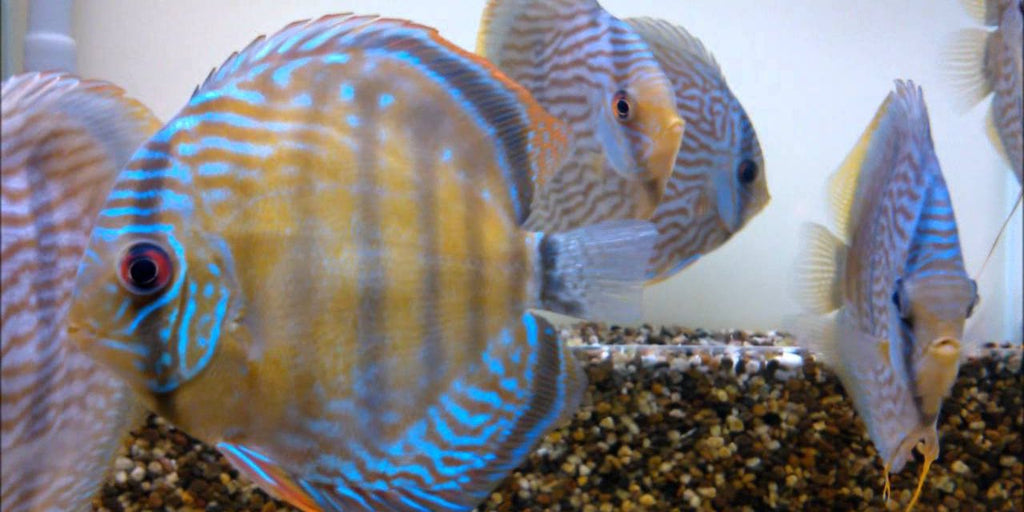
Heckel Discus is a wild form recognized by a brown to blue body crossed by nine vertical bars, with the central fifth bar especially bold. It is closely associated with very soft, acidic blackwater and is usually recommended for experienced keepers.
2. Blue Heckel Discus
Within the aquarium trade, Blue Heckel Discus is grouped as a wild-form trade variant. Its typical appearance is blue iridescent lines over the classic Heckel bar pattern. The trade name describes appearance rather than a separate scientifically recognized species.
3. Red Heckel Discus
The defining feature of Red Heckel Discus is warm red-brown ground color with the strong central Heckel bar. It belongs to the broader wild-form trade variant category. Color intensity varies with locality, condition, lighting, and seller terminology.
4. Brown Discus
Brown Discus is a wild lineage and foundational domestic form recognized by a warm tan to brown body with relatively restrained blue markings. Brown discus contributed to many domestic strains and can show elegant natural patterning.
5. Blue Discus
Within the aquarium trade, Blue Discus is grouped as a wild lineage and foundational domestic form. Its typical appearance is blue horizontal striations across a brown or bluish base. The name is broad and may refer to locality fish or selectively bred lines.

6. Green Discus
The defining feature of Green Discus is greenish or turquoise body tones, often with red spots. It belongs to the broader wild lineage category. Wild green discus are strongly associated with western Amazon floodplain habitats.
7. Royal Green Discus
Royal Green Discus is a wild-form trade name recognized by dense turquoise lines and red spotting on a green base. “Royal” is a descriptive grade used by sellers and is not a formal taxonomic rank.
8. Red-Spotted Green Discus
Within the aquarium trade, Red-Spotted Green Discus is grouped as a wild form. Its typical appearance is numerous red spots over green or turquoise coloration. Spot coverage differs considerably among individuals and collection localities.
9. Tefé Green Discus
The defining feature of Tefé Green Discus is green-blue coloration with fine red spotting. It belongs to the broader locality-associated wild form category. Fish sold under locality names should have credible collection or breeding records.
10. Alenquer Red Discus
Alenquer Red Discus is a locality-associated wild form recognized by deep rust-red to brick coloration with dark bars. It is valued for warm natural color rather than the uniform solid red of domestic strains.
11. Santarém Discus
Within the aquarium trade, Santarém Discus is grouped as a locality-associated wild form. Its typical appearance is brown, blue, or reddish tones with natural vertical bars. Appearance varies because the name refers to origin more than a single fixed pattern.
12. Nhamundá Discus
The defining feature of Nhamundá Discus is blue or reddish markings depending on collection area. It belongs to the broader locality-associated wild form category. Some Nhamundá fish are sold as Heckel-influenced forms; accurate locality data is important.
13. Turquoise Discus
Turquoise Discus is a classic domestic strain recognized by bright turquoise horizontal lines across the body and fins. This is one of the foundational captive-bred patterns and appears in many later strains.
14. Red Turquoise Discus
Within the aquarium trade, Red Turquoise Discus is grouped as a classic domestic strain. Its typical appearance is red ground color covered by turquoise lines. Balanced contrast and even pattern coverage are commonly valued by breeders.
15. Blue Turquoise Discus
The defining feature of Blue Turquoise Discus is a blue base with turquoise maze-like lines. It belongs to the broader classic domestic strain category. Stress bars may appear or disappear depending on mood and background.
16. Brilliant Turquoise Discus
Brilliant Turquoise Discus is a classic domestic strain recognized by highly reflective turquoise patterning with a luminous finish. The exact name may be used differently by individual hatcheries.

17. Cobalt Blue Discus
Within the aquarium trade, Cobalt Blue Discus is grouped as a solid or lightly patterned blue strain. Its typical appearance is deep cobalt body color with limited line pattern. Stable blue color is best judged after acclimation, not immediately after shipping.
18. Blue Diamond Discus
The defining feature of Blue Diamond Discus is nearly patternless powder-blue to electric-blue coloration. It belongs to the broader solid blue strain category. Many blue diamonds show reduced vertical bars, but quality and genetics vary by line.
19. Ocean Green Discus
Ocean Green Discus is a green-blue domestic strain recognized by smooth aqua or sea-green coloration. It is a trade strain rather than a wild green discus and may have several breeder-specific versions.
20. Pigeon Blood Discus
Within the aquarium trade, Pigeon Blood Discus is grouped as a pattern-reduced domestic lineage. Its typical appearance is cream, yellow, orange, or red color with reduced black vertical bars. Some individuals develop black peppering, especially on dark backgrounds.
21. Checkerboard Pigeon Discus
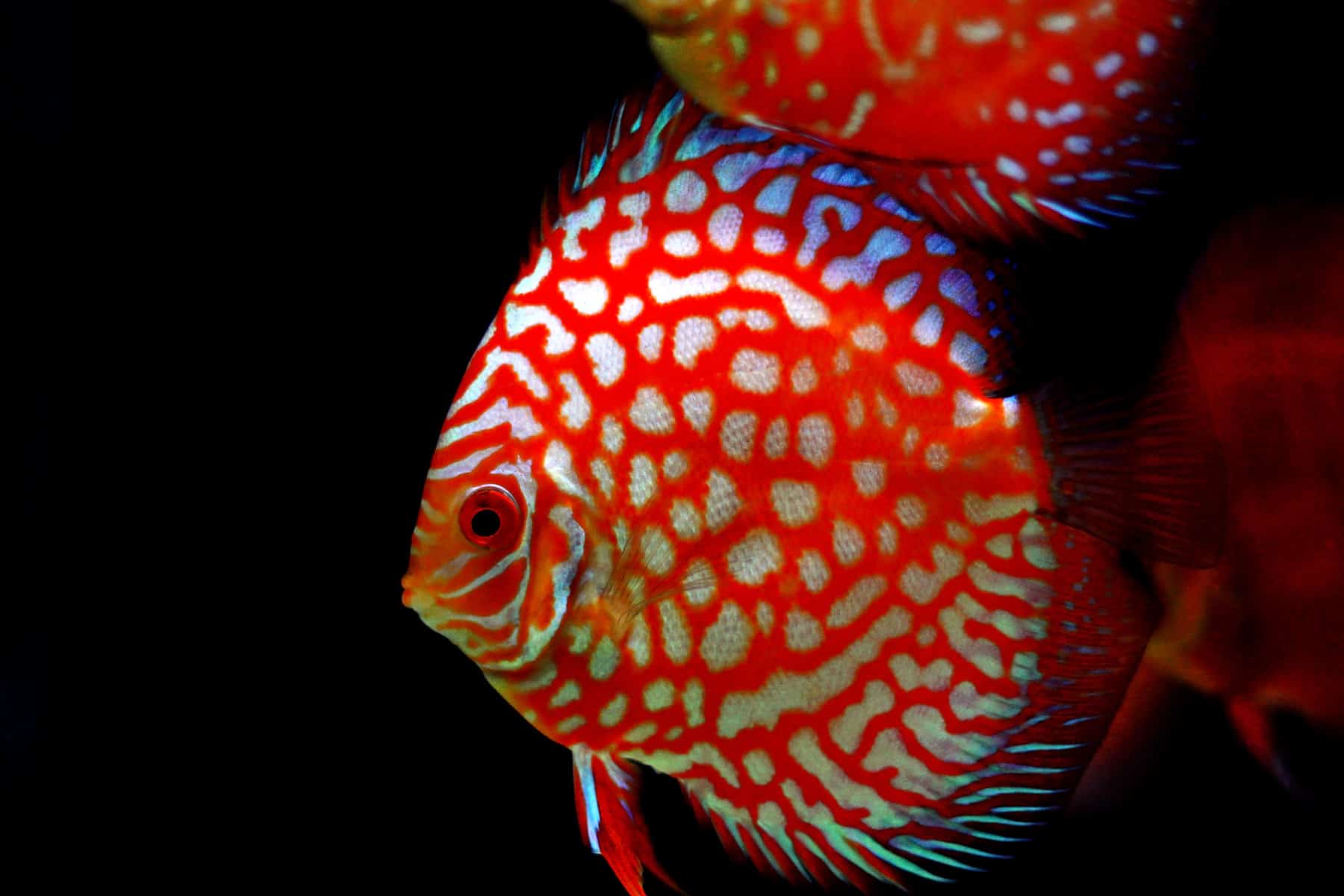
The defining feature of Checkerboard Pigeon Discus is red or orange checkerboard markings over a pale base. It belongs to the broader pigeon-pattern strain category. Clean pattern edges and low peppering are often preferred in show-quality fish.
22. Snakeskin Discus
Snakeskin Discus is a fine-pattern domestic strain recognized by very fine, dense lines created from fish with additional vertical bar divisions. The term describes a pattern lineage, and the exact number of bars is not always visible in adults.
23. Blue Snakeskin Discus
Within the aquarium trade, Blue Snakeskin Discus is grouped as a snakeskin strain. Its typical appearance is fine blue lines over a darker blue or brown base. The tight pattern can extend into the dorsal and anal fins.
24. Red Snakeskin Discus
The defining feature of Red Snakeskin Discus is red base color overlaid with intricate blue lines. It belongs to the broader snakeskin strain category. High contrast makes this strain visually complex, but stable color still depends on health and environment.
25. Leopard Discus
Leopard Discus is a spotted domestic strain recognized by distinct red spots distributed across a pale or blue-green body. Spot size, density, and ring formation differ among breeder lines.
26. Leopard Snakeskin Discus
Within the aquarium trade, Leopard Snakeskin Discus is grouped as a combined patterned strain. Its typical appearance is fine snakeskin lines mixed with dense leopard spotting. It is selected for visual complexity and often shows pattern over the face and fins.
27. Leopard Ring Discus
The defining feature of Leopard Ring Discus is red spots that form open circles or ring-like shapes. It belongs to the broader ring-spotted strain category. Names such as ring leopard and leopard ring are sometimes used inconsistently.
28. Red Melon Discus
Red Melon Discus is a solid red domestic strain recognized by red to orange body with a lighter face and limited blue pattern. Dark peppering may occur if pigeon blood ancestry is present.
29. White Melon Discus
Within the aquarium trade, White Melon Discus is grouped as a pale melon strain. Its typical appearance is cream or white face and body with soft orange or red areas. A pale appearance should not be confused with stress-related color loss.
30. Marlboro Red Discus
The defining feature of Marlboro Red Discus is strong red body with a pale or white face. It belongs to the broader red domestic strain category. The idealized pattern is clean and bold, but real fish vary among hatcheries.
31. Red Cover Discus
Red Cover Discus is a solid red strain recognized by red pigment covering most of the body, often including the head. Coverage is the defining visual goal; intensity changes with age, diet, and condition.
32. Red Rose Discus
Within the aquarium trade, Red Rose Discus is grouped as a solid red strain. Its typical appearance is rich rose-red body with minimal contrasting pattern. The trade name overlaps with other red lines, so breeder photos are more useful than the name alone.
33. Golden Discus
The defining feature of Golden Discus is golden-yellow body with reduced dark bars. It belongs to the broader yellow domestic strain category. Golden genetics are used in several pale, red, and spotted crosses.
34. Golden Sunrise Discus
Golden Sunrise Discus is a golden-red strain recognized by yellow to orange body with a warm red sunrise-like wash. The name is descriptive and may cover slightly different appearances.
35. Golden Leopard Discus
Within the aquarium trade, Golden Leopard Discus is grouped as a golden spotted strain. Its typical appearance is red leopard spots over a yellow-gold background. Pattern clarity becomes easier to judge as the fish matures.
36. Albino Discus
The defining feature of Albino Discus is reduced melanin, pale body color, and red or pink eyes. It belongs to the broader albino domestic lineage category. Albino lines can appear white, yellow, orange, red, or patterned depending on additional genetics.
37. Albino Red Cover Discus
Albino Red Cover Discus is a albino red strain recognized by a bright red or orange body combined with albino eyes. Because dark pigment is reduced, the fish lacks normal stress bars and black peppering.
38. Albino Snakeskin Discus
Within the aquarium trade, Albino Snakeskin Discus is grouped as a albino patterned strain. Its typical appearance is fine red, orange, or pale line patterns with red eyes. Its delicate pattern is often easiest to appreciate under neutral lighting.
39. Snow White Discus
The defining feature of Snow White Discus is clean white to ivory coloration with little visible pattern. It belongs to the broader white domestic strain category. Lighting, background, and diet can add a slight cream or pink cast.
40. White Butterfly Discus
White Butterfly Discus is a white patterned strain recognized by pale white body with colored edging or butterfly-like fin accents. The name is used for several breeder-specific white pattern combinations.
41. Ghost Discus
Within the aquarium trade, Ghost Discus is grouped as a melanin-reduced domestic strain. Its typical appearance is soft gray, beige, or pale blue body with reduced bars. Ghost is not the same as albino; the eyes are usually normally pigmented.
42. Platinum Discus
The defining feature of Platinum Discus is silvery white or pale blue body with a reflective sheen. It belongs to the broader metallic pale strain category. Some sellers use platinum for very light blue diamond or white metallic lines.
43. Eruption Discus
Eruption Discus is a high-density spotted strain recognized by dense red spotting that can merge into an eruptive pattern. Quality is judged by coverage, contrast, and pattern continuity rather than a formal standard.
44. Mosaic Discus
Within the aquarium trade, Mosaic Discus is grouped as a mixed-pattern strain. Its typical appearance is irregular interlocking red, blue, and pale patches. Mosaic lines are intentionally complex and may not breed perfectly true.
45. Pearl Diamond Discus
The defining feature of Pearl Diamond Discus is pearly blue-white body with sparkling reflective pattern. It belongs to the broader metallic patterned strain category. The trade name often indicates a cross between diamond-like and pearl-pattern lines.
46. Yellow Crystal Discus
Yellow Crystal Discus is a yellow pale strain recognized by clear yellow body with a clean, lightly translucent appearance. A healthy fish should still show full body shape, alert behavior, and clear eyes.
47. Blue Scorpion Discus
Within the aquarium trade, Blue Scorpion Discus is grouped as a blue patterned strain. Its typical appearance is intense blue color with fine snakeskin or scorpion-like patterning. Breeder line determines whether the emphasis is solid blue, fine lines, or both.
48. Red Scorpion Discus
The defining feature of Red Scorpion Discus is red body color combined with intricate blue linework. It belongs to the broader red-blue patterned strain category. The label is not standardized, so compare actual adult fish from the same line.
How Are Discus Fish Classified?
At the scientific level, discus belong to the cichlid genus Symphysodon. Taxonomy has been debated, and different references may recognize or synonymize names differently. For aquarium keepers, it is safest to speak broadly about Heckel discus, green discus, and blue or brown discus lineages while acknowledging that scientific naming can be revised.
Domestic discus are classified informally by visible traits and breeding history:
- Base color: Blue, red, yellow, white, brown, green, or orange.
- Pattern: Horizontal lines, fine snakeskin lines, spots, rings, checkerboards, mosaics, or nearly solid color.
- Melanin expression: Normal bars, reduced bars, pigeon blood peppering, ghost reduction, or albino absence of dark pigment.
- Wild locality: Tefé, Alenquer, Santarém, Nhamundá, and other Amazon localities.
- Breeder line: A named line maintained by a particular hatchery, sometimes with its own selection standard.
Wild Discus Versus Domestic Discus
Wild discus usually display natural vertical bars, locality-linked color, and stronger sensitivity to water chemistry and transport stress. Domestic discus have been selected for generations in captivity and are often more adaptable, although they still need high water quality and warm, stable conditions.
Do not mix fish casually from different sources. Pathogen exposure, parasite load, feeding history, and preferred water conditions may differ. A quarantine period is one of the most important steps in keeping a healthy group.
How to Identify Different Types of Discus Fish
- Central fifth bar: A strongly emphasized middle bar is the classic clue for Heckel-type discus.
- Fine line density: Very tight lines suggest snakeskin ancestry.
- Round red spots: Spots indicate leopard lines; open circles suggest ring-selected strains.
- Pale base with red pattern: Often associated with pigeon blood or albino-based strains.
- Black peppering: Common in some pigeon blood fish, especially against dark décor.
- Red or pink eyes: A key albino clue, though lighting can affect photographs.
- Locality claim: Requires credible records; appearance alone cannot prove collection origin.
- Juvenile color: Young discus may not show the final adult pattern, so avoid judging a strain too early.
Aquarium Care Notes for Every Discus Variety
Most domestic discus do well in warm water around the low-to-mid 80s Fahrenheit when temperature is stable, but the exact target should match the breeder’s conditions and the needs of tankmates. Stable water is more important than chasing a perfect number. Ammonia and nitrite should remain undetectable, nitrate should be controlled, and filtration should provide strong biological capacity without creating exhausting current.
Discus are social cichlids. A group requires enough space to dilute aggression and waste, while a bonded breeding pair may be maintained separately. Feed a varied diet in portions the fish can finish quickly. Remove leftovers, observe feces and appetite, and quarantine new fish and live foods.
Choosing Healthy Discus
- Select fish with a round, well-filled body rather than a pinched forehead or thin belly.
- Look for clear eyes proportional to the body; unusually large-looking eyes can indicate stunting.
- Avoid fish that remain dark, clamp their fins, breathe rapidly, hide continuously, or produce persistent abnormal feces.
- Ask what water temperature, pH, hardness, food, and medication history the seller uses.
- Compare several fish from the same group; behavior differences are easier to see in context.
- Do not buy by color alone. Shape, appetite, breathing, posture, and quarantine history are more important.
Breeding and Color Development
Discus form pairs, clean a vertical spawning surface, guard eggs, and provide specialized skin mucus that free-swimming fry graze from both parents. Pair formation is more reliable when several juveniles are raised together than when an unrelated male and female are simply purchased.
Color and pattern develop with age. Genetics set the potential, but health, social stress, diet, background, lighting, and water quality affect appearance. Color-enhancing food cannot transform a fish into a strain it did not inherit, and excessive pigment additives should not replace balanced nutrition.
Safety, Ethics, and Responsible Aquarium Keeping
Buy captive-bred fish when possible and request honest labeling of wild-caught stock. Never release aquarium fish or water into natural waterways. Avoid unnecessary medication, and do not combine drugs without understanding interactions. A veterinarian or experienced aquatic health professional is appropriate when valuable fish show persistent disease signs.
Fun Facts About Discus Fish
- Discus are cichlids, even though their calm swimming style looks very different from many territorial cichlids.
- Parents feed newly free-swimming fry with nutrient-rich skin mucus.
- Wild discus live in the Amazon Basin among flooded forests, roots, and slow water.
- Domestic strain names are not controlled by a single international registry.
- Some patterns become much clearer only after the fish matures.
- Pigeon blood strains often show reduced vertical bars.
- Albino discus lack normal dark melanin and have red or pink eyes.
- Discus can recognize feeding routines and individual keepers.
- Stable conditions are usually more important than forcing a specific pH.
- Body shape and health should be evaluated before color intensity.
Final Thoughts on Types of Discus Fish
The 48 types of discus fish in this guide include wild forms, locality names, classic domestic strains, and modern breeder lines. Treat the names as useful visual categories rather than rigid scientific labels. A healthy, well-shaped fish from a transparent breeder is a better purchase than a weak fish with a fashionable strain name.
Frequently Asked Questions
1. How many species of discus fish are there?
Scientific classification remains debated, and references may treat some names as valid species or synonyms. The aquarium trade contains far more color strains than scientific species.
2. Are discus varieties separate species?
Most named aquarium varieties are selectively bred strains of the genus Symphysodon, not separate species.
3. What is the easiest discus type for beginners?
A healthy, locally bred domestic strain already adapted to similar water is usually easier than a newly imported wild fish. Color does not determine difficulty.
4. What is a Heckel discus?
Heckel discus are associated with Symphysodon discus and are recognized by a particularly bold central vertical bar.
5. What is a pigeon blood discus?
Pigeon blood is a domestic lineage with reduced dark bars and bright cream, yellow, orange, or red patterning. Some fish show black peppering.
6. What is a snakeskin discus?
Snakeskin discus have unusually fine, dense line patterns and often show more bar divisions than classic discus.
7. What is a leopard discus?
Leopard discus are selected for red spots across the body. Spot size and coverage vary by line.
8. What is a blue diamond discus?
Blue diamond is a largely patternless blue domestic strain, usually with reduced visible bars.
9. What is the difference between albino and ghost discus?
Albino discus lack normal melanin and have red or pink eyes. Ghost discus have reduced dark pigment but typically retain normally colored eyes.
10. Why does my pigeon blood discus have black spots?
Black peppering is a common expression in many pigeon blood lines and can become more visible against dark backgrounds or under stress.
11. Do discus change color?
Yes. Mood, hierarchy, health, light, background, age, breeding condition, and water quality can all change visible color.
12. How large do discus fish grow?
Well-kept adults commonly reach a substantial round body size, but exact size depends on genetics, nutrition, space, and early growth conditions.
13. How warm should a discus tank be?
Discus generally prefer warm tropical water, commonly in the low-to-mid 80s Fahrenheit. Match the breeder’s conditions and maintain stability.
14. What pH do discus need?
Domestic discus can adapt to a range when conditions are stable. Wild fish and breeding projects may require softer, more acidic water.
15. Do discus need soft water?
Not every domestic fish requires extremely soft water for daily care, but soft water is often useful or necessary for successful egg fertilization and wild-fish husbandry.
16. How many discus should be kept together?
Discus are social, and groups help distribute aggression. The correct number depends on tank volume, filtration, fish size, and whether a bonded pair is separated.
17. Can one discus be kept alone?
Long-term solitary keeping is generally not ideal unless there is a specific health, quarantine, or breeding reason.
18. What tank size is best for discus?
A large tank that provides swimming space and dilution of waste is essential. Stocking should be based on adult size and maintenance capacity, not juvenile size.
19. Can discus live with angelfish?
They can share similar conditions, but disease risk, feeding competition, temperament, and parasite transfer make the combination controversial.
20. What are good discus tankmates?
Peaceful warm-water fish that do not outcompete discus may work. Compatibility must include temperature tolerance, behavior, disease risk, and tank size.
21. What do discus fish eat?
A varied diet can include quality pellets or granules, frozen foods, and carefully sourced live foods. Avoid overfeeding and remove waste.
22. Why is my discus hiding?
Possible causes include recent transport, bullying, poor water quality, excessive light, unsuitable décor, disease, or a group that is too small.
23. Why is my discus turning dark?
Darkening can signal stress, social submission, breeding condition, illness, or an attempt to communicate with fry. Observe other symptoms.
24. How can I tell male and female discus apart?
Reliable sexing is difficult outside breeding condition. The breeding tubes are among the best clues, but even experienced keepers can be mistaken.
25. How do discus breed?
A pair cleans a vertical surface, lays and fertilizes eggs, guards the clutch, and later allows fry to feed from parental skin mucus.
26. Why do discus fry eat from their parents?
The parents produce nutrient-rich skin mucus that supports fry during the first stage of free swimming.
27. Should wild and domestic discus be mixed?
It is risky because water preferences, pathogens, parasites, and stress tolerance may differ. Long quarantine and expert planning are necessary.
28. How long should new discus be quarantined?
There is no universal duration for every situation, but quarantine should be long enough to observe feeding, feces, breathing, and delayed disease signs.
29. Do discus need daily water changes?
Frequency depends on stocking, feeding, filtration, and nitrate production. Growing juveniles and heavily fed tanks often need very frequent changes.
30. Can discus be kept in a planted aquarium?
Yes, if plants tolerate warm water and the layout still allows cleaning, feeding, and open swimming space.
31. Why are discus expensive?
Costs reflect slow grow-out, warm clean water, frequent feeding, selective breeding, shipping risk, and the time required to produce well-shaped adults.
32. Do strain names guarantee quality?
No. Health, body shape, breeder transparency, and actual appearance matter more than a fashionable label.
33. Can different discus strains breed together?
Yes. Domestic strains can interbreed, but offspring may not reproduce the parents’ exact color or pattern.
34. What causes stunted discus?
Poor early nutrition, crowding, chronic water-quality problems, disease, and inconsistent care can limit growth.
35. How long do discus fish live?
With excellent care, discus can live for many years. Lifespan depends on genetics, water quality, nutrition, and disease prevention.