

When people search for types of cod fish, they may be looking for true cod, close relatives such as haddock and whiting, or market fish that merely carry the word “cod” in their common name. Those groups are not the same. True cod belong to the genus Gadus, while the wider cod family, Gadidae, also includes pollock, haddock, whiting, pouts, tomcods, and several small Arctic or deep-water species.
This guide covers 22 living cod-family species reported in current fisheries databases, including one provisionally accepted species whose status remains debated. You will learn how each fish looks, where it lives, how large it grows, how it behaves, and why it matters to anglers, seafood buyers, and anyone interested in marine wildlife. A separate section also explains well-known “cod” names that do not belong to the cod family.
What Are the Main Types of Cod Fish?
The best-known types of cod fish are Atlantic cod, Pacific cod, and Alaska pollock, all placed in the genus Gadus. The broader cod family contains 11 genera and about 21 clearly accepted species, plus Norwegian pollock, which some databases list provisionally but many researchers treat as the same species as Alaska pollock. Other important cod-family fish include haddock, whiting, saithe, pollack, polar cod, saffron cod, blue whiting, and tomcods.
Quick Comparison of the 22 Cod-Family Species
| Type | Scientific Name | Main Habitat and Range | Maximum Size | Key Identification Feature |
|---|---|---|---|---|
| Atlantic cod | Gadus morhua | Cold North Atlantic and adjacent Arctic waters | About 200 cm | Pale lateral line, mottled body, strong chin barbel |
| Pacific cod | Gadus macrocephalus | North Pacific shelf and Arctic margins | About 119 cm | Large head, chin barbel, brown mottling |
| Alaska pollock | Gadus chalcogrammus | North Pacific, especially the Bering Sea | About 91 cm | Slender schooling cod with a spotted back |
| Norwegian pollock | Gadus finnmarchicus | Rare records from northern Norway and the Barents Sea | Large; limited records | Provisionally accepted and probably Alaska pollock |
| Silvery pout | Gadiculus argenteus | Western Mediterranean and nearby eastern Atlantic | About 15 cm | Small silvery body and large eyes |
| Silvery cod | Gadiculus thori | Northeast Atlantic from the Bay of Biscay northward | About 15 cm | Tiny deep-water cod with large eyes |
| Whiting | Merlangius merlangus | Northeast Atlantic, Black Sea, and nearby seas | About 92 cm | Small or absent barbel and dark pectoral-base spot |
| Navaga | Eleginus nawaga | White, Barents, and Kara seas | About 42 cm | Cold-water coastal cod with small dark blotches |
| Saffron cod | Eleginus gracilis | North Pacific, Bering region, and Arctic coasts | About 55 cm | Short chin barbel and wide salinity tolerance |
| Pouting | Trisopterus luscus | Northeast Atlantic and western Mediterranean | About 46 cm | Deep-bodied fish with a dark pectoral-base spot |
| Poor cod | Trisopterus minutus | Northeast Atlantic and Atlantic coast of Morocco | About 40 cm | Slender body, chin barbel, dark pectoral spot |
| Mediterranean poor cod | Trisopterus capelanus | Mediterranean Sea | About 32 cm | Similar to poor cod but geographically and genetically distinct |
| Norway pout | Trisopterus esmarkii | Northeast Atlantic, Iceland, and Barents region | About 35 cm | Gray-brown body with a dark pectoral spot |
| Pollack | Pollachius pollachius | Rocky Northeast Atlantic coasts | About 130 cm | Curved lateral line and projecting lower jaw |
| Saithe | Pollachius virens | North Atlantic on both sides of the ocean | About 130 cm | Dark back, pale straight lateral line, forked tail |
| Polar cod | Boreogadus saida | Circumpolar Arctic, often near sea ice | About 40 cm | Small ice-associated cod with a forked tail |
| Haddock | Melanogrammus aeglefinus | North Atlantic and adjacent Arctic waters | About 112 cm | Black lateral line and dark shoulder blotch |
| Blue whiting | Micromesistius poutassou | Deep North Atlantic and western Mediterranean | About 50 cm | Slender bluish fish living in large offshore schools |
| Southern blue whiting | Micromesistius australis | Patagonia, southern islands, Chile, and New Zealand | About 90 cm | Southern Hemisphere cod-family species |
| Pacific tomcod | Microgadus proximus | Eastern North Pacific coastal waters | About 31 cm | Olive back, pale belly, small cod-like body |
| Atlantic tomcod | Microgadus tomcod | Northwest Atlantic estuaries and coastal rivers | About 38 cm | Mottled body and strong tolerance of brackish water |
| Arctic cod | Arctogadus glacialis | Deep Arctic basin and Greenland waters | About 33 cm | Rudimentary or absent chin barbel |
What Counts as a Cod Fish?
In strict biological terms, “true cod” usually refers to members of the genus Gadus. In a broader sense, codfish can refer to species in the family Gadidae. Most members of this family have elongated bodies, soft-rayed fins, three dorsal fins, two anal fins, and pelvic fins positioned far forward beneath or ahead of the pectoral fins. Many also have a sensory barbel on the chin.
Common names make the subject confusing. Haddock, whiting, pollock, and pouts are genuine cod-family fish even though “cod” is not part of their everyday name. By contrast, black cod, lingcod, rock cod, Murray cod, and coral cod belong to other families. This article uses the scientifically useful family-level meaning and clearly marks the one disputed entry.
1. Atlantic Cod
Atlantic cod (Gadus morhua) is the classic fish most people picture when they hear the word cod. It lives across the cold North Atlantic, from the northeastern coast of North America to Greenland, Iceland, the Barents Sea, and northern European waters. Different populations form regional stocks that may have distinct migration routes, spawning grounds, growth rates, and management rules.
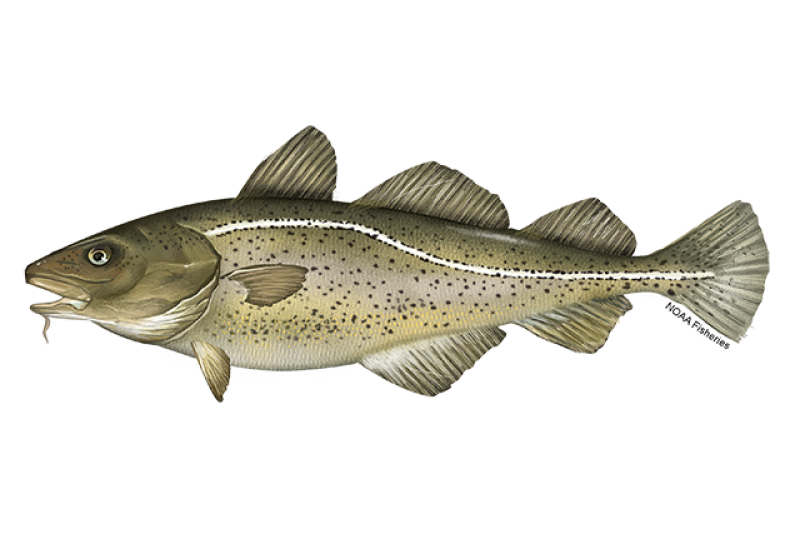
Atlantic cod usually has a brown, greenish, gray, or reddish back covered with irregular spots. A pale lateral line runs along the side, the upper jaw projects beyond the lower jaw, and a noticeable chin barbel helps the fish sense prey near the seabed. Most caught fish are much smaller than the species’ maximum reported length of roughly two meters.
Adults are mainly bottom-associated predators, although they may rise into the water column. They eat crustaceans, worms, mollusks, and fish, including smaller members of their own species. Atlantic cod is highly important in commercial fisheries and traditional cuisines, but its condition differs greatly among stocks. Responsible buyers and anglers should therefore check the origin, current stock advice, season, and local regulations rather than assuming that all Atlantic cod comes from the same population.
2. Pacific Cod
Pacific cod (Gadus macrocephalus) is the major true cod of the North Pacific. It occurs from the Yellow Sea and waters around Japan and Russia across the Bering region to Alaska and the west coast of North America. It is mainly a demersal fish found on continental shelves and slopes, commonly over sand, mud, gravel, or mixed bottoms.
This species resembles Atlantic cod but often looks darker and has a proportionally large head. It carries the familiar cod combination of three dorsal fins, two anal fins, a pale lateral line, and a chin barbel. Large individuals can exceed one meter, although market fish are normally much smaller.
Pacific cod feeds on clams, worms, crabs, shrimps, octopuses, and smaller fish. It may gather in large groups during seasonal movements and spawning. For anglers, it is often targeted near the bottom with baited hooks or jigs where regulations allow. In the seafood trade, its mild flavor, lean flesh, and large flakes make it suitable for baking, frying, steaming, soups, and fish tacos. Greenland cod was once widely listed as a separate species, but many modern treatments place it within Pacific cod.
3. Alaska Pollock
Alaska pollock (Gadus chalcogrammus) is scientifically closer to true cod than its common name suggests. It was formerly placed in the genus Theragra, but modern classifications commonly place it in Gadus beside Atlantic and Pacific cod. The species is abundant in the North Pacific, with especially important concentrations in the eastern Bering Sea.
Alaska pollock is more slender than a heavy-bodied adult cod. Its back is generally olive, brownish, or gray with darker mottling, while the underside is pale. It often forms immense schools in midwater or near the bottom and can shift vertically as it follows prey. The diet includes krill, copepods, small fish, and other pelagic organisms.
This is one of the world’s most commercially important whitefish. Its mild flesh is used for fillets, fish sticks, sandwiches, roe products, and surimi. Because catches come from different regions and management systems, sustainability should be judged by the specific fishery rather than the common name alone. Alaska pollock also demonstrates why everyday names can be misleading: it is not a member of the Atlantic pollock genus Pollachius.
4. Norwegian Pollock
Norwegian pollock (Gadus finnmarchicus) is included here because some fisheries databases still list it as a provisionally accepted cod-family species. It was described from rare specimens collected in northern Norwegian and Barents Sea waters. Very few individuals were historically known, which made comparisons difficult.
Later genetic studies found little or no meaningful separation from Alaska pollock, and many specialists now regard Norwegian pollock as the same biological species as Gadus chalcogrammus. Some morphological differences have been reported, but they may represent local variation rather than a separate species. For that reason, the most accurate description is “taxonomically disputed” rather than unquestionably distinct.
Readers should be cautious when counting cod species. A database that includes Norwegian pollock may report 22 Gadidae species, while a stricter list that treats it as a synonym will report 21. Including it with an explanation is more useful than either hiding the uncertainty or presenting the fish as settled fact.
5. Silvery Pout
Silvery pout (Gadiculus argenteus) is one of the smallest members of the cod family. It reaches only about 15 centimeters and has a slim, silvery to pinkish body, a large eye, and a relatively large mouth. Those features suit a fish living in dim offshore water where detecting small moving prey is important.
This species has a southern distribution compared with its close relative Gadiculus thori. It occurs in the western Mediterranean and nearby Atlantic waters, including the region around the Strait of Gibraltar and the coast of Morocco. It is generally associated with deeper water rather than shallow coastal habitat.
Silvery pout feeds on small crustaceans and other planktonic or midwater organisms. It has little direct value as a recreational target and only minor local commercial importance, although it may enter catches used for bait or reduction. Its real importance in a cod guide is biological: it shows that not all cod-family species are large bottom fish. Some are tiny, deep-water schooling species that occupy a very different ecological niche.
6. Silvery Cod
Silvery cod (Gadiculus thori) is another tiny gadid that normally grows no longer than about 15 centimeters. It has conspicuously large eyes, a small silvery body, and dark flecks on the head and upper body. The large eye is a useful identification clue for a species commonly found from roughly 100 to 1,000 meters deep.

Its range extends through the Northeast Atlantic, broadly from the Bay of Biscay north toward the North Cape. Older references often treated it as a northern subspecies of Gadiculus argenteus. Morphological, otolith, pigmentation, and genetic evidence supported recognizing the northern and southern forms as separate species.
Silvery cod is not a major food or sport fish. It consumes small pelagic prey and is itself eaten by larger fish, marine mammals, and seabirds. For identification, location matters: a small Gadiculus from northern Atlantic waters is more likely to be G. thori, while the western Mediterranean and adjacent southern Atlantic are associated more strongly with G. argenteus.
7. Whiting
Whiting (Merlangius merlangus) is a familiar North Atlantic food fish and a genuine member of the cod family. It ranges from Iceland and the Barents region south toward Portugal and also occurs in the Black Sea, Aegean Sea, Adriatic Sea, and nearby waters. It commonly lives over sand, mud, or mixed bottoms at moderate depths.
Whiting has an elongated body, a relatively small head, and a chin barbel that is tiny or absent in adults. Color varies from yellowish brown or greenish blue on the back to silvery white below. A small dark blotch near the upper base of the pectoral fin is often visible. Although exceptional fish can grow large, most are far shorter than the maximum reported length of about 92 centimeters.
Young whiting eat crustaceans and small bottom organisms, while larger fish increasingly prey on fish and squid. The species is caught commercially and recreationally. Its flesh is light, delicate, and best handled carefully because it is softer than dense cod fillets. Anglers should distinguish it from small haddock, pouting, and poor cod by checking the lateral line, chin barbel, body proportions, and pectoral marking.
8. Navaga
Navaga (Eleginus nawaga) is a cold-water coastal cod found in the White, Barents, and Kara seas and adjacent Arctic shorelines. It can enter brackish and low-salinity water and often moves close to shore, especially during colder seasons. This behavior makes it more accessible to small-scale fisheries than many offshore gadids.
The fish reaches about 42 centimeters. It is brownish above, paler below, and commonly marked with small darker blotches. Like many cod relatives, it has three dorsal fins, two anal fins, and a chin barbel. Its body is more compact than that of many open-water species.
Navaga feeds on bottom invertebrates and small fish. It is regionally important as food and may be caught through winter ice where local laws and conditions permit. Anyone fishing Arctic coastal waters should avoid relying on the common name “Arctic cod,” which is used for several species. Navaga is best identified through its scientific name, regional range, fin arrangement, barbel, and blotched coloration.
9. Saffron Cod
Saffron cod (Eleginus gracilis) occurs from the North Pacific into Arctic coastal waters. Its range includes areas around Korea, Russia, the Bering Sea, Alaska, and parts of Arctic Canada. It is highly tolerant of changing salinity and may move among marine coasts, estuaries, river mouths, and occasionally freshwater-influenced habitats.
The species grows to roughly 55 centimeters. It has three dorsal fins, two anal fins, a lower jaw shorter than the upper jaw, and a short chin barbel. The body is usually brownish or olive with darker mottling, helping it blend with nearshore bottoms. The gap between the second and third dorsal fins can help separate it from similar gadids.
Saffron cod eats worms, shrimps, crabs, small fish, and other coastal prey. It supports regional commercial and subsistence fisheries and may be taken by shore or ice anglers. Because it uses shallow bays and estuaries, its condition can be influenced by local pollution, habitat alteration, and warming water. Safe consumption decisions should follow local harvest advisories, especially near industrialized estuaries.
10. Pouting
Pouting (Trisopterus luscus) is a compact cod-family fish of the Northeast Atlantic and western Mediterranean. It is found from Norway and the British Isles south toward Morocco, often around rocky ground, wrecks, reefs, harbor structures, and mixed seabeds. It usually lives in shallower water than many offshore cod relatives.
Pouting can reach about 46 centimeters but is commonly closer to 30 centimeters. It has a relatively deep body, a noticeable chin barbel, and a dark blotch near the upper base of the pectoral fin. The back may appear coppery, brown, or yellowish, while the belly is pale. Vertical banding can be visible in fresh fish.
It feeds on crustaceans, worms, mollusks, and small fish. Pouting is taken by recreational anglers using small baits close to structure and is also landed commercially in parts of Europe. It is easily confused with poor cod and Norway pout. Compared with poor cod, pouting is generally deeper-bodied and more robust, but identification should use several features rather than body shape alone.
11. Poor Cod
Poor cod (Trisopterus minutus) is a small Northeast Atlantic gadid found from northern European waters south to Portugal and the Atlantic coast of Morocco. Modern taxonomic work separates it from the Mediterranean species Trisopterus capelanus, so recent range descriptions generally exclude the Mediterranean.
Most poor cod are around 20 centimeters, although the reported maximum is about 40 centimeters. The species has a slender body, a well-developed chin barbel, brownish-yellow upper surfaces, a pale belly, and a dark mark near the pectoral-fin base. It occupies sandy or muddy bottoms, usually from shallow shelf water to a few hundred meters.
Poor cod eats small crustaceans, polychaete worms, and fish. It is not usually a premier angling target, but it may be common in mixed catches. Some landings go to fishmeal, while the species is also eaten regionally. The most frequent identification mistake is calling any small Trisopterus a poor cod. Geographic location, body depth, fin spacing, and the form of the dark pectoral marking all help refine the identification.
12. Mediterranean Poor Cod
Mediterranean poor cod (Trisopterus capelanus) is a Mediterranean member of the cod family. For many years it was treated as a subspecies or synonym of poor cod, which caused confusing maps and species lists. Genetic and morphological studies now support recognizing it as a separate species.
It grows to about 32 centimeters and has the general Trisopterus appearance: three dorsal fins, two anal fins, a chin barbel, a brownish upper body, and paler sides. It is more closely related to pouting than older classifications suggested. Because visual differences can be subtle, geographic origin is an important clue.
The species lives near the seabed and feeds on small crustaceans, worms, and fish. It has local fishery value but is not widely marketed by its scientific identity. For seafood buyers, a label such as “poor cod” may not reveal whether the fish came from the Atlantic or Mediterranean. Traceable origin information is therefore more useful than the market name alone.
13. Norway Pout
Norway pout (Trisopterus esmarkii) is a small, short-lived gadid of the Northeast Atlantic. It occurs from the Barents region and Norwegian Sea to Iceland, the Faroe Islands, the North Sea, and areas near the English Channel and Bay of Biscay. It commonly occupies water between about 100 and 200 meters over muddy bottoms, although its full depth range is wider.
The species grows to about 35 centimeters but is usually much smaller. It is gray-brown above, silvery on the sides, white below, and marked by a dark blotch at the upper base of the pectoral fin. The body is more slender than pouting and suited to life partly above the bottom.
Norway pout feeds heavily on planktonic crustaceans such as copepods, amphipods, krill, and shrimps, along with fish eggs, larvae, and small fish. Much of the catch has historically been used for fishmeal and animal feed rather than sold as fillets. Ecologically, it is an important forage fish connecting plankton production with larger predatory fish and marine mammals.
14. Pollack
Pollack (Pollachius pollachius) is a large, powerful cod-family fish of the Northeast Atlantic. It is associated with rocky coasts, kelp beds, reefs, steep drop-offs, offshore pinnacles, and wrecks from Norway and Iceland south to the Bay of Biscay. Juveniles often use shallow coastal habitat, while adults may occupy deeper structure.
Pollack can reach about 130 centimeters. It has a projecting lower jaw, no obvious chin barbel, and a lateral line that curves noticeably above the pectoral fin. The back may be brown, olive, or dark green, while the sides are bronze or silvery. The tail is moderately forked.
This species is an active predator of sandeels, herring-like fish, young gadids, and squid. It is valued by sport anglers because it strikes lures aggressively and fights strongly. Pollack is also eaten, although its market identity is sometimes confused with Alaska pollock or saithe. The scientific name is the fastest way to avoid confusion: true Atlantic pollack is Pollachius pollachius.
15. Saithe
Saithe (Pollachius virens) is also called coalfish, coley, or Atlantic pollock in different markets. It inhabits both sides of the North Atlantic, from the Barents Sea and Iceland to western Europe, Greenland, Canada, and the northeastern United States. Young fish may gather near rocky shores, while larger saithe range offshore and make long seasonal movements.
Saithe grows to about 130 centimeters. It is more streamlined than Atlantic cod, with a dark charcoal, greenish, or brownish back, a nearly straight pale lateral line, a projecting lower jaw, and a distinctly forked tail. The chin barbel is absent or extremely small.
It is a fast-swimming schooling predator that feeds on herring, sandeels, capelin, crustaceans, and other fish. Anglers target it with jigs, lures, and bait in deep water or around current-swept structure. Its flesh is darker when raw than classic cod but becomes lighter when cooked. Because “pollock” may refer to Alaska pollock, pollack, or saithe, buyers should check the scientific name and harvest origin.
16. Polar Cod
Polar cod (Boreogadus saida) is one of the most important small fish in Arctic food webs. It is distributed around the Arctic and occurs beneath or near sea ice, in coastal water, and over deep basins. Its body contains adaptations that allow it to function in extremely cold seawater.
The species usually measures around 25 centimeters and can reach about 40 centimeters. It has a slender shape, pale sides, a darker back, a small chin barbel, and a forked tail. Juveniles may shelter in channels and spaces associated with sea ice, where they feed and avoid larger predators.
Polar cod eats copepods, amphipods, krill, and other small animals. In turn, it is prey for seals, whales, seabirds, and larger fish. It has some fishery value but is even more important ecologically. Do not confuse polar cod with Arctic cod, Arctogadus glacialis. Both common names are used inconsistently, so scientific names are especially valuable in Arctic field notes.
17. Haddock
Haddock (Melanogrammus aeglefinus) is one of the easiest cod-family fish to identify. It lives across the North Atlantic and nearby Arctic waters, commonly over sand, gravel, shell, or mixed bottoms from coastal shelves to several hundred meters deep.
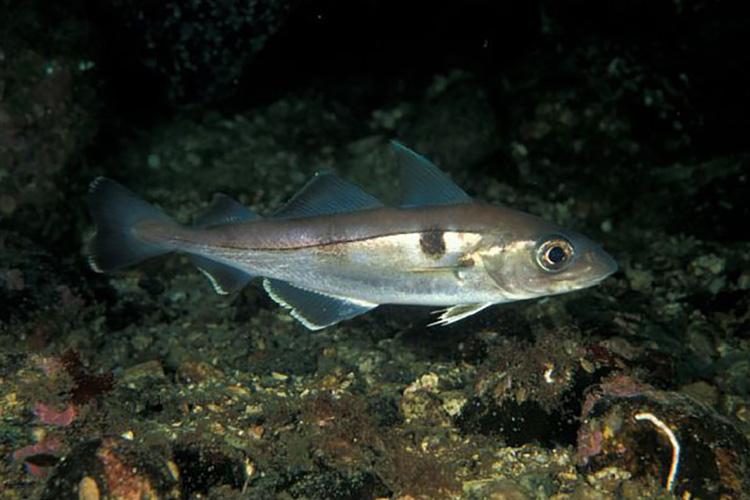
The body is gray, brownish, or purple above and silvery below. A bold black lateral line runs along each side, and a large dark blotch sits above the pectoral fin. This shoulder mark is sometimes called the “devil’s thumbprint” or “St. Peter’s mark.” Haddock has a small chin barbel and can reach about 112 centimeters, although most fish are much smaller.
Haddock probes the seabed for worms, brittle stars, mollusks, crustaceans, sea urchins, and fish eggs. It is a major commercial food fish valued for lean, white, flaky flesh and is commonly smoked, baked, poached, or fried. Anglers should not identify a small fish as haddock based only on the pectoral blotch, because pouts and whiting can also show dark marks. The black lateral line is the strongest field clue.
18. Blue Whiting
Blue whiting (Micromesistius poutassou) is a slender, deep-water schooling gadid of the North Atlantic and western Mediterranean. It is found from high northern latitudes south along the eastern Atlantic and also occurs westward near Greenland, Canada, and the northeastern United States. It commonly occupies offshore water hundreds of meters deep and can descend much farther.
The fish has a bluish-gray back, silvery sides, a pale underside, and an elongated body built for open-water swimming. It generally reaches around 50 centimeters. Unlike bottom-heavy cod, blue whiting spends much of its time in the midwater zone and undertakes extensive migrations between feeding and spawning areas.
Its diet includes krill, copepods, small fish, and squid. Large fisheries use blue whiting for human food, surimi, fishmeal, and fish oil. It is rarely encountered by casual shore anglers because of its offshore habitat. Stock condition can change with recruitment, fishing pressure, and ocean conditions, so current fishery assessments are more reliable than broad claims about the species as a whole.
19. Southern Blue Whiting
Southern blue whiting (Micromesistius australis) is unusual because it is the only cod-family species centered in the Southern Hemisphere. Separate populations occur around Patagonia, the Falkland Islands, Chile, subantarctic islands, and New Zealand. The fish generally lives over continental slopes and deep shelves, often between about 200 and 400 meters.
It resembles northern blue whiting but grows much larger, reaching about 90 centimeters. The body is slender and silvery with a bluish or gray upper surface. Large eyes and a streamlined profile suit a fish that searches for prey in dim offshore water.
Southern blue whiting feeds on krill, small fish, and squid and forms schools that can support commercial fisheries. It is sold as frozen fillets, blocks, and processed whitefish products. Buyers should not assume that “blue whiting” always refers to the North Atlantic species; the harvest country and scientific name distinguish the two.
20. Pacific Tomcod
Pacific tomcod (Microgadus proximus) is a small coastal cod found along the eastern North Pacific from the southeastern Bering Sea to central California. It occurs in marine and brackish water, including bays, estuaries, nearshore shelves, and soft-bottom habitat, usually at modest depths.
The species reaches about 31 centimeters. Its back is olive green or brownish, the underside is pale, and the fins may have dusky margins. It has the typical multiple dorsal and anal fins of the cod family, along with a small barbel and a compact body.
Pacific tomcod feeds on worms, crustaceans, and small fish. It may be caught incidentally by pier, bay, and bottom anglers and has modest local fishery importance. Because of its size and habitat, it can be confused with juvenile Pacific cod or saffron cod. Check body proportions, local range, barbel length, and the exact fin arrangement before making an identification.
21. Atlantic Tomcod
Atlantic tomcod (Microgadus tomcod) lives along the Northwest Atlantic coast from Labrador toward Virginia. It is strongly associated with estuaries, tidal rivers, bays, and other shallow habitats influenced by freshwater. Some populations spend much of their life in estuarine or freshwater systems.
This small fish reaches about 38 centimeters. It has an elongated body, a small head, olive-brown or yellowish upper surfaces, dark mottling, and a pale underside. The pelvic fins may have a slightly extended ray. Its camouflage works well over mud, gravel, and mixed estuary bottoms.
Atlantic tomcod eats worms, shrimps, amphipods, small mollusks, and fish. It may spawn during winter, sometimes beneath ice in northern rivers. The species has been studied for its ability to tolerate polluted environments in certain urbanized waterways, but that does not mean fish from contaminated locations are safe to eat. Harvesters should always follow local waterbody advisories and closures.
22. Arctic Cod
Arctic cod (Arctogadus glacialis) is a deep, cold-water cod of the Arctic basin and waters around Greenland. It may occur from the surface to roughly 1,000 meters, although much of its life is associated with offshore polar water rather than shallow coastal fishing grounds.
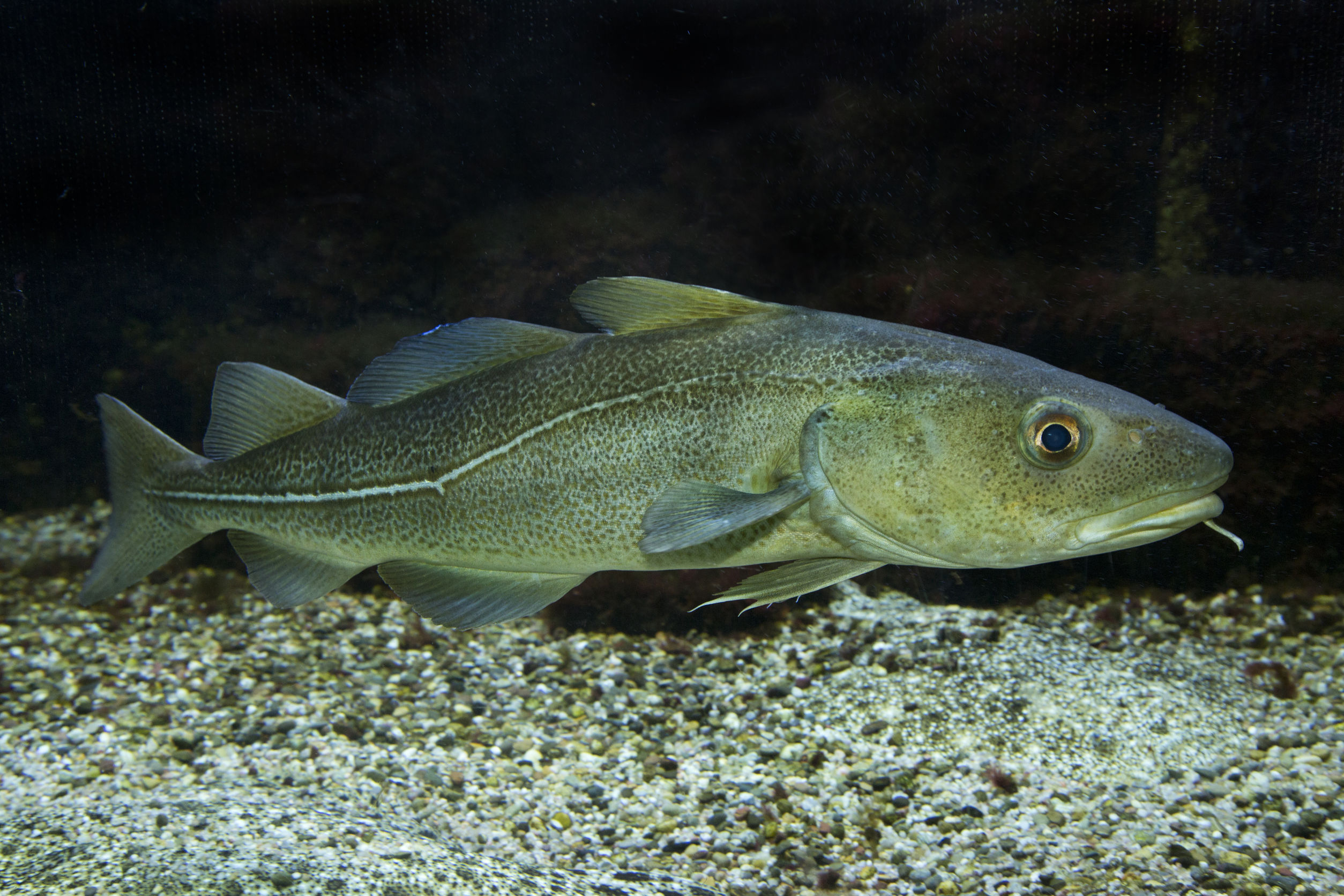
The species reaches about 33 centimeters. It has a slender, pale to gray body, large eyes, and a chin barbel that is rudimentary or absent. That weak barbel helps separate it from many bottom-feeding gadids. Its body shape and fins identify it as a cod relative, but field separation from polar cod can still be difficult without careful examination.
Arctic cod eats small fish and pelagic crustaceans and is prey for larger Arctic predators. It has limited direct importance to most recreational anglers but significant value in studies of polar marine ecosystems. Common-name confusion is frequent: some sources call Boreogadus saida Arctic cod and others call it polar cod. Scientific names prevent the two species from being mixed.
Fish Called Cod That Are Not True Cod
Many unrelated fish acquired “cod” names because they have white flesh, a cod-like shape, or regional culinary importance. They should not be added to a scientific count of Gadidae species.
- Black cod or sablefish (Anoplopoma fimbria) belongs to the sablefish family Anoplopomatidae and has rich, oily flesh.
- Lingcod (Ophiodon elongatus) is a greenling-family predator from the North Pacific.
- Rock cod is a loose market or regional name applied to various rockfishes and other unrelated species.
- Murray cod (Maccullochella peelii) is a large Australian freshwater perch relative.
- Coral cod commonly refers to groupers in the genus Cephalopholis.
- Blue cod (Parapercis colias) is a New Zealand sandperch, not a gadid.
How Are These Types of Fish Classified?
All species in the main list belong to the order Gadiformes and the family Gadidae. The family is divided into 11 living genera:
- Gadus: Atlantic cod, Pacific cod, Alaska pollock, and the disputed Norwegian pollock.
- Gadiculus: the two tiny silvery pouts or silvery cods.
- Merlangius: whiting.
- Eleginus: navaga and saffron cod.
- Trisopterus: pouting, poor cod, Mediterranean poor cod, and Norway pout.
- Pollachius: pollack and saithe.
- Boreogadus: polar cod.
- Melanogrammus: haddock.
- Micromesistius: northern and southern blue whiting.
- Microgadus: Pacific and Atlantic tomcod.
- Arctogadus: Arctic cod.
Older books may place burbot, cusk, hakes, rocklings, or other gadiform fish inside a broader Gadidae. Modern classifications commonly separate several of those groups into their own families. That is why older sources may give a much larger number of “cod-family” species.
Where Do These Fish Live?
Most cod-family species live in cool or cold water of the Northern Hemisphere. The North Atlantic contains Atlantic cod, haddock, whiting, pollack, saithe, blue whiting, pouts, and tomcod. The North Pacific supports Pacific cod, Alaska pollock, saffron cod, and Pacific tomcod. Arctic waters are home to navaga, polar cod, Arctic cod, and northern populations of several other gadids.
Habitats vary widely. Atlantic and Pacific cod are mainly shelf and slope fish near the seabed. Pollack favors rocky structure and kelp. Tomcods use bays and estuaries. Blue whiting and Alaska pollock form offshore midwater schools. Polar cod is closely tied to Arctic marine systems, including sea-ice habitat. Southern blue whiting is the major exception to the northern pattern, living around the southern tip of South America, subantarctic islands, and New Zealand.
How to Identify Different Types of Cod Fish
- Count the fins: many Gadidae have three separate dorsal fins and two anal fins.
- Look for a chin barbel: Atlantic cod, Pacific cod, pouts, and haddock have one, while pollack and saithe lack a prominent barbel.
- Study the lateral line: Atlantic cod has a pale line, haddock has a dark line, pollack has a curved line, and saithe has a pale, straighter line.
- Check the pectoral area: haddock has a large shoulder blotch; whiting and several pouts have smaller dark marks near the pectoral base.
- Observe body depth: pouting is relatively deep-bodied, while poor cod, blue whiting, and Alaska pollock are more slender.
- Examine the jaw: pollack and saithe have a projecting lower jaw; true cod generally have the upper jaw projecting.
- Consider habitat: a fish from a tidal river is more likely to be tomcod than blue whiting, while a tiny fish from deep Northeast Atlantic water may be Gadiculus.
- Use geographic range: Atlantic and Pacific species may look similar but occur in different oceans.
- Do not rely on color alone: cod colors change with habitat, age, stress, and freshness.
- Photograph key features: capture the chin, lateral line, pectoral mark, dorsal fins, anal fins, and tail before release or cleaning.
Fishing Tips and Notes
Cod-family fish are caught with bait, jigs, soft plastics, metal lures, and trawling gear, but the correct method depends on the species and local law. Atlantic and Pacific cod are commonly targeted close to the bottom. Pollack and saithe may strike lures in midwater around reefs, current lines, kelp edges, or wrecks. Tomcods and saffron cod are more likely in bays, estuaries, or nearshore channels.
- Use tackle strong enough to control the expected species without making small fish difficult to detect.
- Keep bait or lures near the depth where fish are feeding instead of assuming all cod stay directly on the seabed.
- Use circle hooks where required or helpful for reducing deep hooking during bait fishing.
- Learn the differences among juvenile cod, haddock, whiting, and pouts before keeping fish.
- Check minimum size, season, bag limit, closed area, gear, and protected-stock rules before fishing.
- Release unwanted fish promptly with wet hands and minimal air exposure when conditions allow survival.
- Do not depend on a common name used by a charter operator or market; verify the species and local rule.
Cooking and Buying Tips
Atlantic cod, Pacific cod, Alaska pollock, haddock, whiting, saithe, and pollack are all mild whitefish, but their texture and fat content differ. Thick cod loins suit baking, roasting, poaching, and frying. Haddock is slightly sweeter and more delicate. Whiting can soften quickly and benefits from gentle handling. Saithe has a firmer texture and stronger flavor. Alaska pollock is widely used in processed products because of its mild taste and dependable supply.
- Choose fish with a clean sea smell, firm flesh, and no excessive drying or discoloration.
- Frozen-at-sea fish can be excellent quality; “fresh” is not automatically better.
- Match fillet thickness to the cooking method so thin pieces do not overcook.
- Thaw frozen fish in the refrigerator, not at room temperature.
- Ask for the scientific name, harvest area, and fishing method when labels are unclear.
- Remember that black cod is richer and oilier because it is sablefish, not a true cod.
- Follow current food-safety and local consumption guidance for the harvest area.
Safety, Sustainability, and Conservation Notes
Cod conservation cannot be summarized with one global label. A species may contain many separately managed stocks, and their conditions can differ sharply. Atlantic cod provides the clearest example: some stocks have struggled after heavy fishing and environmental change, while others are managed under different conditions. Pacific cod, Alaska pollock, haddock, and other gadids also require stock-specific assessment.
- Use current regional seafood guidance rather than an undated statement that a whole species is sustainable or unsustainable.
- Respect catch limits, closed spawning grounds, minimum sizes, and bycatch rules.
- Avoid wasting fish and handle released catches carefully.
- Support traceability so the species, stock, harvest area, and gear type can be verified.
- Protect estuaries, seagrass, kelp, cold-water reefs, and seabed habitat used by juvenile and adult gadids.
- Never move live marine fish between waters; doing so can spread disease or create invasive-species problems.
- Check local advisories before eating self-caught fish from polluted rivers, harbors, or industrialized estuaries.
Fun Facts About Cod Fish
- Atlantic cod can change shade to better match different seabed habitats.
- Most Gadidae have three dorsal fins and two anal fins, an unusually recognizable fin pattern.
- Alaska pollock belongs to the genus Gadus, despite being called pollock.
- Haddock has a black lateral line, while Atlantic cod usually has a pale one.
- Polar cod is a central food source for many Arctic predators.
- Southern blue whiting is the only cod-family species centered in the Southern Hemisphere.
- Atlantic tomcod can complete much of its life in estuaries and freshwater-influenced rivers.
- Silvery pouts grow only about 15 centimeters, making them far smaller than Atlantic cod.
- Greenland cod is now commonly treated as part of Pacific cod rather than a separate species.
- The number of recognized cod-family species changes depending on whether Norwegian pollock is counted separately.
Final Thoughts on Types of Cod Fish
The 22 types of cod fish in this guide show how diverse the Gadidae family really is. It includes giant Atlantic cod, open-water Alaska pollock, reef-hunting pollack, estuary-dwelling tomcod, deep blue whiting, tiny silvery pouts, and ice-associated polar species. The most important distinction is between true cod in the genus Gadus, other genuine cod-family fish, and unrelated species that merely use “cod” as a common or market name.
For reliable identification, combine fin arrangement, chin barbels, lateral-line color, pectoral markings, jaw shape, body proportions, habitat, and geographic range. Taxonomy and fishery status can change, so use current scientific names and regional regulations whenever you identify, catch, buy, or eat cod-family fish.
Frequently Asked Questions
1. How many types of cod fish are there?
The answer depends on the definition. The genus Gadus contains three widely accepted living species: Atlantic cod, Pacific cod, and Alaska pollock. The wider family Gadidae contains about 21 clearly accepted living species. Some databases also count Norwegian pollock provisionally, producing a total of 22, even though it is probably the same species as Alaska pollock.
2. What are the three true cod species?
The three widely accepted species in the genus Gadus are Atlantic cod (Gadus morhua), Pacific cod (Gadus macrocephalus), and Alaska pollock (Gadus chalcogrammus). Common names can be misleading because Alaska pollock is genetically and taxonomically a true Gadus species.
3. Is Greenland cod a separate species?
Greenland cod was traditionally listed as Gadus ogac. Many modern taxonomic treatments regard it as the same species as Pacific cod, Gadus macrocephalus. Older field guides and seafood references may still list Greenland cod separately, so readers should check the date and authority behind the name.
4. Is Alaska pollock really a cod?
Yes. Alaska pollock is currently placed in the cod genus as Gadus chalcogrammus. It was formerly known as Theragra chalcogramma, which is why older books may separate it from true cod. Its common name did not change when its scientific classification changed.
5. Are pollack and pollock the same fish?
Not necessarily. Pollack usually means Pollachius pollachius, a Northeast Atlantic species. Alaska pollock is Gadus chalcogrammus. Saithe, Pollachius virens, is also called Atlantic pollock in some markets. Scientific names and harvest origin are the safest way to know which fish is being discussed.
6. Is haddock a type of cod?
Haddock is not a true cod in the genus Gadus, but it is a genuine member of the cod family Gadidae. Its scientific name is Melanogrammus aeglefinus. It is easily recognized by its black lateral line and dark blotch above the pectoral fin.
7. Is whiting related to cod?
European whiting, Merlangius merlangus, belongs to Gadidae and is closely related to cod, haddock, pollack, and pouts. However, the word “whiting” is also applied to unrelated fish in other parts of the world. The scientific name is needed when the geographic context is unclear.
8. Is black cod a true cod?
No. Black cod is another name for sablefish, Anoplopoma fimbria, in the family Anoplopomatidae. It has rich, oily flesh and lives in the North Pacific. It is culinary valuable but should not be counted among true cod or cod-family species.
9. Is lingcod a type of cod?
No. Lingcod, Ophiodon elongatus, belongs to the greenling family Hexagrammidae. It is a large North Pacific predator with a broad mouth and strong teeth. The “cod” portion of its common name reflects resemblance and culinary use, not close classification.
10. What is rock cod?
Rock cod is an imprecise regional or market name. It may refer to rockfishes in the genus Sebastes, reef-associated species, or other firm whitefish. Because it does not identify one species, buyers and anglers should ask for the scientific name and harvest region.
11. What is the largest cod-family fish?
Atlantic cod is the largest species in the modern Gadidae family, with exceptional records approaching two meters. Pollack, saithe, Pacific cod, and haddock can also grow large, but most fish encountered by anglers or sold in markets are much smaller than species maximums.
12. What is the smallest cod-family fish?
The two species in the genus Gadiculus, silvery pout and silvery cod, are among the smallest. They reach only about 15 centimeters. Both are deep-water or offshore fish with large eyes and limited direct importance to commercial or recreational fisheries.
13. How can I tell Atlantic cod from Pacific cod?
Geographic origin is the simplest clue because their natural ranges are in different oceans. Both have mottled bodies, three dorsal fins, two anal fins, pale lateral lines, and chin barbels. Pacific cod often has a proportionally larger head and darker coloration, but photographs without location data may be difficult to identify confidently.
14. How can I tell cod from haddock?
Atlantic cod usually has a pale lateral line and mottled body. Haddock has a bold black lateral line and a large dark shoulder blotch above the pectoral fin. Haddock also tends to have a smaller mouth and a more pointed first dorsal fin.
15. How can I tell pollack from saithe?
Pollack generally has a curved lateral line, bronze or brownish sides, and a less deeply forked tail. Saithe usually has a straighter pale lateral line, a darker charcoal back, and a strongly forked tail. Both have projecting lower jaws and no prominent chin barbel.
16. What do cod fish eat?
Diets vary by size and species. Small gadids may eat copepods, krill, amphipods, worms, and fish larvae. Larger cod, pollack, and saithe consume crabs, shrimps, mollusks, squid, and fish. Atlantic cod may also eat smaller cod when food and size conditions allow.
17. Are cod fish bottom dwellers?
Many are demersal or benthopelagic and spend substantial time near the seabed. However, not all cod-family fish are strict bottom dwellers. Alaska pollock, blue whiting, silvery cod, and some life stages of other species form schools in midwater or open-ocean habitat.
18. How deep do cod fish live?
The family occupies habitats from estuaries and shallow coastal water to depths exceeding 1,000 meters. Atlantic tomcod may live in tidal rivers, while blue whiting and Arctic cod can occur in very deep offshore water. The typical fishing depth depends entirely on the species, season, and region.
19. Can cod live in freshwater?
Most cod-family fish are marine, but several tolerate brackish water. Atlantic tomcod can live in estuaries and freshwater-influenced rivers, and some populations complete their life cycle in freshwater. Navaga and saffron cod may also enter low-salinity coastal systems.
20. Can cod fish be kept in a home aquarium?
Most cod-family species are poor choices for home aquariums because they require cold, oxygen-rich water, substantial swimming space, specialized filtration, and often large tanks. They may also grow quickly and eat smaller fish. Public aquariums are better equipped to keep suitable gadids under controlled conditions.
21. Where are Atlantic cod found?
Atlantic cod occur across the North Atlantic, including waters off eastern North America, Greenland, Iceland, the British Isles, Scandinavia, the Barents Sea, and parts of western Europe. The species is divided into regional stocks with different migration patterns and management status.
22. Where are Pacific cod found?
Pacific cod live around the North Pacific rim, including waters off Japan, Russia, the Bering Sea, Alaska, Canada, and the western United States. Some modern treatments include fish formerly called Greenland cod within the same species.
23. Where do polar cod live?
Polar cod, Boreogadus saida, has a circumpolar Arctic distribution. It occurs in coastal water, beneath or near sea ice, over shelves, and in deeper basins. Young fish may use ice-associated habitat as feeding ground and refuge from predators.
24. What is the difference between polar cod and Arctic cod?
In this guide, polar cod is Boreogadus saida and Arctic cod is Arctogadus glacialis. Polar cod is widespread and strongly linked to the Arctic food web and sea-ice habitat. Arctic cod is more offshore and deep-water, with a rudimentary or absent chin barbel. Common names are sometimes reversed, so scientific names matter.
25. Which cod fish is most commonly sold?
Atlantic cod, Pacific cod, Alaska pollock, haddock, saithe, and whiting are widely sold, but availability changes by country. Alaska pollock is common in processed seafood, while Atlantic or Pacific cod is more likely to appear as thick fillets or loins. Labels should identify the species and origin.
26. What does cod taste like?
Atlantic and Pacific cod are mild, lean, and lightly sweet with large flakes. Haddock is similarly mild but often slightly more delicate. Alaska pollock is mild and softer, while saithe has a firmer texture and more noticeable flavor. Freshness, handling, freezing, and cooking method affect taste as much as species.
27. What is the best way to cook cod?
Thick cod pieces can be baked, roasted, fried, poached, steamed, or added to stews. Use moderate heat and stop cooking when the center becomes opaque and separates into moist flakes. Thin fillets cook quickly, so timing should be adjusted to thickness rather than following one fixed cooking time.
28. Is frozen cod lower quality than fresh cod?
Not automatically. Fish frozen soon after capture can retain excellent texture and flavor, sometimes better than fish held on ice for many days. Quality depends on freezing speed, storage temperature, glazing, packaging, thawing, and whether the product has been repeatedly temperature-abused.
29. What is salt cod?
Salt cod is fish preserved with salt and often dried. Atlantic cod has traditionally been used, but related whitefish may also appear in salted products depending on labeling rules and region. Salt cod must usually be soaked before cooking to remove excess salt and restore moisture.
30. Does cod contain mercury?
Like most seafood, cod can contain trace amounts of mercury and other contaminants. Levels vary by species, size, harvest area, and environmental conditions. Follow current national seafood guidance and local advisories, especially for pregnancy, young children, or self-caught fish from contaminated waters.
31. Is cod liver oil made from all cod species?
Cod liver oil is traditionally produced from the livers of cod-family fish, especially Atlantic cod and related commercial species. Product sources and processing methods vary. Consumers should read labels carefully and follow professional guidance because concentrated oils can contain high levels of vitamins A and D.
32. Are cod populations endangered?
There is no single answer for every species or stock. Some Atlantic cod stocks have experienced severe declines, while other gadid fisheries operate under different biological and management conditions. Conservation decisions should use current stock assessments for the exact species, region, and fishery.
33. How can I buy more sustainable cod?
Look for traceable labels showing species, harvest area, fishing method, and certification or management information. Compare that information with current regional seafood guidance. Avoid relying on a broad claim such as “all Pacific cod is sustainable” because stock conditions and fishing impacts differ.
34. Why do cod species have chin barbels?
The chin barbel contains sensory structures that help many bottom-feeding gadids locate prey on or within the seabed. Its size differs among species. Atlantic and Pacific cod have obvious barbels, haddock has a smaller one, and pollack, saithe, and Arctic cod lack a prominent barbel.
35. Can cod taxonomy change again?
Yes. Taxonomy changes when scientists obtain better genetic, anatomical, larval, or geographic evidence. Greenland cod has been merged with Pacific cod in many modern treatments, Alaska pollock moved into Gadus, and Norwegian pollock remains disputed. Future revisions may change the accepted species count or scientific names.
Read more:
80 Types of Blue Fish: Species, Habitats & ID Tips