

Blue is one of the most eye-catching colors in the underwater world, but the phrase types of blue fish can mean several different things. It may describe naturally blue reef fish, freshwater species with blue iridescence, game fish with blue backs or fins, or selectively bred aquarium varieties such as royal blue bettas and electric blue rams. It can also refer to the single species called bluefish, Pomatomus saltatrix.
This guide brings those meanings together without treating every trade name as a separate species. The 80 entries include marine, freshwater, reef, pelagic, temperate, and domestic aquarium examples. For each fish, you will find the accepted or commonly used scientific name, appearance, approximate adult size, habitat, range, diet, behavior, aquarium or fishing relevance, and an identification or responsibility note.
Some fish are truly blue over most of the body. Others show blue stripes, spots, fins, faces, or reflective scales. A few are called “blue” even though adults look silver, green, violet, or blue-gray. Understanding those differences is more useful than choosing a fish from color alone.
What Are the Main Types of Blue Fish?
The main groups are blue reef fish such as tangs, angelfish, damselfish, wrasses, and parrotfish; open-water species such as bluefin tuna, blue marlin, blue shark, and mahi-mahi; freshwater cichlids, rainbowfish, killifish, tetras, and loaches; and domestic color forms such as electric blue acara, blue diamond discus, and royal blue betta. Not every example is a solid-blue species. In many cases, the useful blue feature is a stripe, spot pattern, fin, head, or changing iridescent sheen.
Types of Blue Fish Comparison Table
| Type | Scientific Name | Habitat | Approximate Adult Size | Key Blue Feature |
|---|---|---|---|---|
| Blue Tang | Paracanthurus hepatus | coral and rocky reefs of the Indo-Pacific | up to about 12 in (30 cm) | royal-blue body, black palette-shaped marking, and yellow tail |
| Atlantic Blue Tang | Acanthurus coeruleus | shallow coral reefs, rocky areas, and seagrass edges | up to about 15 in (38 cm) | bright blue adult body with a yellow caudal spine; juveniles are yellow |
| Powder Blue Tang | Acanthurus leucosternon | clear outer reefs and surge zones | up to about 9 in (23 cm) | powder-blue sides, black face, white chest, and yellow dorsal area |
| Sohal Surgeonfish | Acanthurus sohal | wave-washed reefs and reef flats | up to about 16 in (40 cm) | blue-and-white horizontal striping with orange accents |
| Bluespine Unicornfish | Naso unicornis | reef slopes, channels, and coastal rocky areas | commonly over 24 in and up to roughly 28 in (70 cm) | blue-gray body, blue-edged fins, and blue caudal spines |
| Queen Angelfish | Holacanthus ciliaris | coral reefs and rocky reef faces | up to about 18 in (45 cm) | electric blue edging over a yellow body and a crown-like forehead spot |
| Bermuda Blue Angelfish | Holacanthus bermudensis | rocky and coral reefs | up to about 15 in (38 cm) | blue-gray body with yellow highlights and no queen angelfish crown |
| Emperor Angelfish | Pomacanthus imperator | lagoons, channels, and coral-rich outer reefs | up to about 15 in (38 cm) | adult has curved blue-and-yellow stripes; juvenile has blue, white, and black rings |
| Blueface Angelfish | Pomacanthus xanthometopon | coral reefs, caves, and protected lagoons | up to about 15 in (38 cm) | deep blue facial mask, yellow scale margins, and yellow tail |
| Blue-Girdled Angelfish | Pomacanthus navarchus | coral-rich lagoons, channels, and outer reef slopes | up to about 11 in (28 cm) | dark blue body bordered by brilliant yellow and a blue facial pattern |
| Cherubfish | Centropyge argi | deep and shallow rocky reefs with abundant shelter | about 3 in (8 cm) | cobalt-blue body with an orange-yellow face and chest |
| Azure Damselfish | Chrysiptera hemicyanea | shallow lagoons and protected reefs around branching coral | about 3 in (7.5 cm) | bright blue upper body with a yellow belly and tail region |
| Blue Devil Damselfish | Chrysiptera cyanea | shallow lagoons, rubble zones, and protected reef areas | about 3.5 in (9 cm) | intense electric blue, with sex- and locality-related fin differences |
| Yellowtail Blue Damselfish | Chrysiptera parasema | sheltered coral reefs and lagoons | about 3 in (7.5 cm) | solid blue body with a sharply contrasting yellow tail |
| Fiji Blue Devil | Chrysiptera taupou | coral-rich lagoons and coastal reefs | about 3 in (8 cm) | electric blue body with yellow-orange belly and fin accents |
| Springer’s Damselfish | Chrysiptera springeri | coral and rubble reefs with many crevices | about 3 in (7.5 cm) | dark blue body broken by black markings and luminous blue highlights |
| Caribbean Blue Chromis | Chromis cyanea | clear coral reefs, usually above reef structure | up to about 6 in (15 cm) | uniform luminous blue with dark fin edging |
| Blue-Green Chromis | Chromis viridis | shallow lagoons and reefs dominated by branching corals | about 4 in (10 cm) | iridescent blue-green that shifts with light and viewing angle |
| Sapphire Damselfish | Pomacentrus pavo | lagoons, reef flats, and sheltered coral areas | up to about 4 in (10 cm) | bright blue to blue-green body, sometimes with yellow fin areas |
| Bluehead Wrasse | Thalassoma bifasciatum | coral reefs and adjacent rubble or seagrass areas | up to about 9 in (23 cm) | terminal males have blue heads, green bodies, and dark shoulder bands |
| Moon Wrasse | Thalassoma lunare | reef flats, lagoons, and seaward reefs | up to about 10 in (25 cm) | blue-green body with magenta facial lines and a yellow crescent tail |
| Bluestreak Cleaner Wrasse | Labroides dimidiatus | coral reefs where cleaning stations attract client fish | about 5.5 in (14 cm) | electric blue stripe bordered by black along a slender body |
| Blue Ribbon Eel | Rhinomuraena quaesita | sandy or rubble reef areas where it occupies a burrow | often 36–48 in (90–120 cm) | adult males are vivid blue with a yellow mouth and dorsal fin |
| Bluespotted Jawfish | Opistognathus rosenblatti | cooler sandy-rubble bottoms beside rocky reefs | about 4 in (10 cm) | brown to olive body covered with brilliant blue spots |
| Bluebanded Goby | Lythrypnus dalli | rocky reefs and crevices, often in cooler coastal water | about 2.5 in (6 cm) | red-orange body crossed by narrow neon-blue bands |
| Neon Goby | Elacatinus oceanops | coral reefs and cleaning stations | about 2 in (5 cm) | black body marked by a brilliant blue stripe |
| Blue Gudgeon Dartfish | Ptereleotris heteroptera | sand and rubble zones close to reef shelter | up to about 5 in (13 cm) | pale blue to turquoise, sometimes with yellow in the tail |
| Blue Assessor | Assessor macneilli | dark reef caves, overhangs, and vertical crevices | about 2.5 in (6 cm) | deep navy to violet-blue over the entire body |
| Mandarin Dragonet | Synchiropus splendidus | sheltered lagoons and rubble reefs | about 3 in (8 cm) | intricate blue, green, orange, and red maze-like pattern |
| Blue-Spotted Puffer | Canthigaster solandri | coral and rocky reefs | up to about 4.5 in (11 cm) | brown-orange body covered in blue spots and lines |
| Redtoothed Triggerfish | Odonus niger | outer reef slopes and channels with strong current | up to about 20 in (50 cm) | deep blue to purple body with red teeth and a forked tail |
| Blue Triggerfish | Pseudobalistes fuscus | reef slopes, lagoons, and rocky coastal zones | up to about 22 in (55 cm) | adults become blue-gray with dark scale patterns; juveniles are yellow with spots |
| Blue Parrotfish | Scarus coeruleus | coral reefs, seagrass areas, and nearby hard bottoms | can exceed 40 in (1 m) | nearly uniform blue in adults, with a blunt head and beak-like teeth |
| Queen Parrotfish | Scarus vetula | coral reefs and rocky reef zones | up to about 20 in (50 cm) | terminal males are blue-green with bold facial bands; earlier phases are duller |
| Blue-Barred Parrotfish | Scarus ghobban | coral reefs, rocky coasts, lagoons, and seagrass beds | up to about 30 in (75 cm) | blue-green adults with yellow or orange scale centers and facial lines |
| Eastern Blue Devil | Paraplesiops bleekeri | caves, ledges, overhangs, and estuarine reefs | up to about 16 in (40 cm) | dark body with vivid blue-and-white bands and blue spots |
| Southern Blue Devil | Paraplesiops meleagris | rocky caves, ledges, and deep crevices | up to about 13 in (33 cm) | dark blue-gray body densely covered with bright blue spots |
| Blue Maomao | Scorpis violacea | rocky reefs, islands, and coastal drop-offs | often 12–20 in (30–50 cm) | blue to violet body with a deeply forked tail |
| Blue Cod | Parapercis colias | rocky reefs, sand edges, and coastal channels | commonly to about 24 in (60 cm) | large males become blue-green while females and young fish are browner |
| Blue Rockfish | Sebastes mystinus | kelp forests, rocky reefs, and nearshore schools | up to about 21 in (53 cm) | dark blue-gray body with dusky blotches and a relatively small mouth |
| Bluefin Trevally | Caranx melampygus | coral reefs, lagoons, channels, and coastal flats | can exceed 40 in (1 m) | silver-blue body with electric-blue fins and scattered blue spots |
| Blue Runner | Caranx crysos | open coastal water, reefs, wrecks, and offshore structures | up to about 28 in (70 cm) | blue-green back, silver sides, and yellowish fins |
| Bluestripe Snapper | Lutjanus kasmira | coral reefs, lagoons, and wrecks | up to about 16 in (40 cm) | yellow body crossed by four bright blue horizontal stripes |
| Five-Lined Snapper | Lutjanus quinquelineatus | coral-rich lagoons and reef slopes | up to about 14 in (35 cm) | yellow body with five blue horizontal lines and a dark side spot |
| Blue-Striped Grunt | Haemulon sciurus | coral reefs, rocky areas, and nearby seagrass | up to about 18 in (46 cm) | yellow body marked by narrow blue horizontal stripes |
| Bluefish | Pomatomus saltatrix | coastal ocean, surf zones, estuaries, and continental-shelf waters | commonly 1–3 ft, with large fish approaching 4 ft (1.2 m) | blue-green back, silver sides, and a powerful forked tail |
| Atlantic Bluefin Tuna | Thunnus thynnus | open Atlantic waters, shelf edges, and seasonally productive coastal seas | can exceed 10 ft (3 m) | metallic dark blue above, silver below, with short bluish fins |
| Pacific Bluefin Tuna | Thunnus orientalis | open ocean, productive fronts, and coastal feeding areas | can approach 10 ft (3 m) | dark metallic blue dorsally with silvery sides |
| Southern Bluefin Tuna | Thunnus maccoyii | cool temperate open ocean and productive feeding grounds | can exceed 8 ft (2.5 m) | dark blue-black back, silver-white sides, and bluish finlets |
| Blue Marlin | Makaira nigricans | warm open-ocean waters, current edges, and offshore feeding zones | exceptionally large females may exceed 14 ft (4.3 m) | cobalt-blue upper body, silvery lower body, and pale vertical bars when excited |
| Blue Shark | Prionace glauca | open ocean from the surface into deeper water | commonly 6–10 ft, with larger individuals around 12 ft (3.8 m) | indigo-blue back, bright blue sides, white underside, and very long pectoral fins |
| Mahi-Mahi | Coryphaena hippurus | warm open water, weed lines, floating debris, and current boundaries | commonly 3–5 ft, occasionally over 6 ft (1.8 m) | electric blue-green back, golden sides, and scattered blue spots |
| Opah | Lampris guttatus | open ocean from surface waters into the deep mesopelagic zone | often 3–6 ft (0.9–1.8 m) | round silver-blue body covered with white spots and edged by red-orange fins |
| Bluespotted Cornetfish | Fistularia commersonii | reefs, lagoons, seagrass, and open coastal bottoms | can approach 6.5 ft (2 m) | long blue-green body with blue spots and a whip-like tail filament |
| Peacock Flounder | Bothus mancus | sandy reef flats, rubble, and open patches near coral | up to about 18 in (45 cm) | tan to brown body with many vivid blue rings and spots |
| Blue Acara | Andinoacara pulcher | slow rivers, streams, and floodplain waters with cover | up to about 6 in (15 cm) | blue-gray scales with turquoise facial lines and fin highlights |
| German Blue Ram | Mikrogeophagus ramirezi | warm, slow, shallow waters with fine substrate and plant cover | about 3 in (7.5 cm) | yellow-gold body with blue iridescent spots, a black flank mark, and red eyes |
| Electric Blue Hap | Sciaenochromis fryeri | rocky shores and intermediate sand-rock zones | up to about 8 in (20 cm) | adult males are intense metallic blue; females are gray-brown |
| Maingano Cichlid | Melanochromis cyaneorhabdos | rocky shoreline habitat | about 4 in (10 cm) | dark blue body with two bright horizontal blue stripes |
| Cobalt Blue Zebra Cichlid | Maylandia callainos | rocky shores and reef-like lake structure | about 5 in (13 cm) | solid cobalt to powder blue, sometimes with faint bars |
| Demasoni Cichlid | Chindongo demasoni | shallow rocky habitat | about 4 in (10 cm) | alternating dark navy and bright blue vertical bars |
| Powder Blue Cichlid | Chindongo socolofi | rocky areas with algae-covered surfaces | about 5 in (13 cm) | pale powder-blue body with darker fin margins |
| Blue Dolphin Cichlid | Cyrtocara moorii | sandy bottoms near rocky zones | up to about 10 in (25 cm) | soft blue body; mature males develop a rounded forehead hump |
| Frontosa Cichlid | Cyphotilapia frontosa | deep rocky slopes and caves | up to about 14 in (35 cm) | pale blue-white body crossed by bold black vertical bars |
| Neon Dwarf Rainbowfish | Melanotaenia praecox | clear tributaries and vegetated margins | about 3 in (8 cm) | metallic neon-blue body with red or orange fins |
| Lake Kutubu Rainbowfish | Melanotaenia lacustris | clear lake water, tributary mouths, and vegetated margins | up to about 5 in (12 cm) | turquoise to sky-blue body with shifting iridescence |
| Boesemani Rainbowfish | Melanotaenia boesemani | lakes and connected streams with vegetation | about 4.5 in (11 cm) | adult males show a blue-violet front half and orange-yellow rear half |
| Blue Lyretail Killifish | Fundulopanchax gardneri | small forest streams, pools, and swampy waters | about 2.5 in (6.5 cm) | males have a blue-green base with red spots and yellow-edged fins |
| Bluefin Nothobranch | Nothobranchius rachovii | temporary seasonal pools | about 2.5 in (6 cm) | males display intense blue scales, red-orange patterning, and blue fins |
| Bluefin Killifish | Lucania goodei | clear vegetated springs, streams, and marsh edges | about 2.5 in (6 cm) | breeding males show bright blue dorsal and anal fins with red-orange accents |
| Blue Emperor Tetra | Inpaichthys kerri | soft, slow forest streams | about 2 in (5 cm) | iridescent blue-purple body with a dark horizontal stripe |
| Cochu’s Blue Tetra | Boehlkea fredcochui | flowing tributaries and open freshwater channels | about 2 in (5 cm) | silvery body with a cool blue sheen that strengthens in groups |
| Blue Botia | Yasuhikotakia modesta | large rivers and seasonally flooded systems | up to about 10 in (25 cm) | blue-gray body with orange to red fins |
| Electric Blue Acara | Andinoacara pulcher domestic color form | aquariums; derived from a South American blue acara lineage | about 6 in (15 cm) | uniform metallic turquoise-blue produced through selective breeding |
| Electric Blue Ram | Mikrogeophagus ramirezi domestic color form | aquariums; derived from the warm-water ram cichlid | about 3 in (7.5 cm) | nearly solid neon blue with reduced wild-type black patterning |
| Blue Diamond Discus | Symphysodon spp. domestic strain | aquariums; selectively bred from Amazonian discus ancestry | commonly 6–8 in (15–20 cm) | solid powder to cobalt blue with little or no body pattern |
| Royal Blue Betta | Betta splendens domestic color variety | aquariums; descended from Southeast Asian betta populations | about 2.5–3 in (6–7.5 cm) excluding long fins | deep, saturated royal blue across body and fins |
| Blue Moscow Guppy | Poecilia reticulata domestic strain | aquariums; selectively bred from guppy stock | males around 1.5–2 in, females larger | metallic dark blue from head through tail, especially in males |
| Blue Gourami | Trichopodus trichopterus domestic color form | aquariums; derived from Southeast Asian three-spot gourami | up to about 6 in (15 cm) | pale blue to lavender body with two dark flank spots |
| Powder Blue Dwarf Gourami | Trichogaster lalius domestic color form | aquariums; bred from the South Asian dwarf gourami | about 3.5 in (9 cm) | soft powder-blue body with reduced red striping |
1. Blue Tang
Blue Tang (Paracanthurus hepatus) is a marine reef fish. Its royal-blue body, black palette-shaped marking, and yellow tail. Adults reach up to about 12 in (30 cm), making body proportions and mature coloration important identification clues rather than relying on blue alone.
In nature it occupies coral and rocky reefs of the Indo-Pacific across East Africa to Japan, Australia, and Pacific islands. It feeds on mainly algae as an adult, with small planktonic foods also taken. The species is active, laterally compressed surgeonfish that shelters in reef crevices. These ecological details explain both its appearance and the space, food, or structure it needs.
For EnjoyTheWild readers, it is an iconic reef fish, but it needs a large, mature marine aquarium and expert disease prevention. The sharp spine near the tail can cut handlers, and wild collection should come from traceable, responsible sources.
2. Atlantic Blue Tang
The most useful field mark for Atlantic Blue Tang (Acanthurus coeruleus) is its bright blue adult body with a yellow caudal spine; juveniles are yellow. This marine reef fish grows up to about 15 in (38 cm); juveniles, females, breeding males, or stressed fish may look less blue than a perfect photograph.
Its natural setting is shallow coral reefs, rocky areas, and seagrass edges, within the tropical and subtropical western Atlantic. Typical food includes benthic algae scraped from hard surfaces, while its behavior is best described as often grazes during the day and may join loose feeding groups. Watching how it moves and where it stays is often more reliable than judging color under changing light.
It is valuable as a reef grazer and occasionally kept by advanced marine aquarists. Its dramatic yellow-to-blue color change with age is a stronger identification clue than the common name alone.
3. Powder Blue Tang
Powder Blue Tang is the common name used for Acanthurus leucosternon, a marine reef fish recognized by a powder-blue sides, black face, white chest, and yellow dorsal area. It may grow up to about 9 in (23 cm). The blue can come from pigment, reflective skin structures, or a combination, so the shade changes with angle and condition.
This fish occurs in clear outer reefs and surge zones through the tropical Indian Ocean. Its diet consists of film algae and fine plant material from reef surfaces, and it is fast, territorial, and constantly moving when healthy. Those traits determine whether it grazes, schools, hides, hunts, or defends a territory.
Its main relevance is that it is one of the most striking blue aquarium fish, yet demanding because it needs space, oxygen, stable water, and regular grazing. It is notably sensitive to stress and external parasites, so it is unsuitable as a first saltwater fish.
4. Sohal Surgeonfish
Among the many types of blue fish, Sohal Surgeonfish (Acanthurus sohal) stands out for its blue-and-white horizontal striping with orange accents. It is a marine reef fish that reaches up to about 16 in (40 cm). Color should be checked together with fin shape, body depth, and markings.
The species is associated with wave-washed reefs and reef flats in the Red Sea and nearby northwestern Indian Ocean. It eats algae growing on rocks and reef pavement. In everyday life it is powerful, territorial, and often aggressive toward other surgeonfish, a pattern that can be missed when the fish is seen only in a shop or single photograph.
It is spectacular for public or very large private aquariums rather than ordinary community reef tanks. Its tail spine and assertive behavior require careful planning; never buy one for a small aquarium.
5. Bluespine Unicornfish
Bluespine Unicornfish (Naso unicornis) is a marine reef fish. Its blue-gray body, blue-edged fins, and blue caudal spines. Adults reach commonly over 24 in and up to roughly 28 in (70 cm), making body proportions and mature coloration important identification clues rather than relying on blue alone.
In nature it occupies reef slopes, channels, and coastal rocky areas across the Indo-Pacific from East Africa to the central Pacific. It feeds on mostly large brown and red algae. The species is strong-swimming grazer that may travel over broad reef areas. These ecological details explain both its appearance and the space, food, or structure it needs.
For EnjoyTheWild readers, it is important in reef ecology but too large for most home aquariums. Adults develop a forehead horn; the blue spines at the tail base can cause injury.
6. Queen Angelfish
The most useful field mark for Queen Angelfish (Holacanthus ciliaris) is its electric blue edging over a yellow body and a crown-like forehead spot. This marine reef fish grows up to about 18 in (45 cm); juveniles, females, breeding males, or stressed fish may look less blue than a perfect photograph.
Its natural setting is coral reefs and rocky reef faces, within the western Atlantic, Caribbean, and Gulf region. Typical food includes largely sponges, supplemented with algae and small invertebrates, while its behavior is best described as confident reef browser, usually seen alone or in pairs. Watching how it moves and where it stays is often more reliable than judging color under changing light.
It is a famous blue-and-yellow marine fish best suited to very large, established systems. The crown marking helps separate it from the similar Bermuda blue angelfish.
7. Bermuda Blue Angelfish
Bermuda Blue Angelfish is the common name used for Holacanthus bermudensis, a marine reef fish recognized by a blue-gray body with yellow highlights and no queen angelfish crown. It may grow up to about 15 in (38 cm). The blue can come from pigment, reflective skin structures, or a combination, so the shade changes with angle and condition.
This fish occurs in rocky and coral reefs through the western Atlantic from Bermuda and the southeastern United States into the Gulf. Its diet consists of sponges, tunicates, algae, and other attached organisms, and it is territorial around favored reef habitat. Those traits determine whether it grazes, schools, hides, hunts, or defends a territory.
Its main relevance is that it is occasionally displayed in large marine aquariums, where it may nip sessile invertebrates. It can hybridize with queen angelfish where their ranges overlap, making field identification challenging.
8. Emperor Angelfish
Among the many types of blue fish, Emperor Angelfish (Pomacanthus imperator) stands out for its adult has curved blue-and-yellow stripes; juvenile has blue, white, and black rings. It is a marine reef fish that reaches up to about 15 in (38 cm). Color should be checked together with fin shape, body depth, and markings.
The species is associated with lagoons, channels, and coral-rich outer reefs in the Indo-Pacific. It eats sponges, tunicates, algae, and small benthic animals. In everyday life it is bold and territorial, especially toward similar angelfish, a pattern that can be missed when the fish is seen only in a shop or single photograph.
It is admired for its complete juvenile-to-adult transformation but requires a spacious, mature marine tank. Juveniles and adults look so different that beginners may mistake them for separate species.
9. Blueface Angelfish
Blueface Angelfish (Pomacanthus xanthometopon) is a marine reef fish. Its deep blue facial mask, yellow scale margins, and yellow tail. Adults reach up to about 15 in (38 cm), making body proportions and mature coloration important identification clues rather than relying on blue alone.
In nature it occupies coral reefs, caves, and protected lagoons across the eastern Indian Ocean and western Pacific. It feeds on sponges, tunicates, algae, and encrusting organisms. The species is secretive when young but increasingly assertive with age. These ecological details explain both its appearance and the space, food, or structure it needs.
For EnjoyTheWild readers, it is a showpiece fish for advanced aquarists with large systems. Its blue face is the quickest adult field mark; juveniles have curved pale bands.
10. Blue-Girdled Angelfish
The most useful field mark for Blue-Girdled Angelfish (Pomacanthus navarchus) is its dark blue body bordered by brilliant yellow and a blue facial pattern. This marine reef fish grows up to about 11 in (28 cm); juveniles, females, breeding males, or stressed fish may look less blue than a perfect photograph.
Its natural setting is coral-rich lagoons, channels, and outer reef slopes, within the Indo-Australian Archipelago and western Pacific. Typical food includes sponges, tunicates, and other benthic foods, while its behavior is best described as often stays close to caves and reef structure. Watching how it moves and where it stays is often more reliable than judging color under changing light.
It is smaller than many Pomacanthus angelfish but still an advanced marine species. It is also called the majestic angelfish; it may damage corals and clams in a reef aquarium.
11. Cherubfish
Cherubfish is the common name used for Centropyge argi, a marine reef fish recognized by a cobalt-blue body with an orange-yellow face and chest. It may grow about 3 in (8 cm). The blue can come from pigment, reflective skin structures, or a combination, so the shade changes with angle and condition.
This fish occurs in deep and shallow rocky reefs with abundant shelter through the tropical western Atlantic and Caribbean. Its diet consists of algae, detritus, and tiny benthic invertebrates, and it is small but bold, defending crevices from rivals. Those traits determine whether it grazes, schools, hides, hunts, or defends a territory.
Its main relevance is that it is one of the most practical naturally blue marine angelfish for experienced keepers with limited space. Its small size does not guarantee peaceful behavior, and it may nip some corals.
12. Azure Damselfish
Among the many types of blue fish, Azure Damselfish (Chrysiptera hemicyanea) stands out for its bright blue upper body with a yellow belly and tail region. It is a marine reef fish that reaches about 3 in (7.5 cm). Color should be checked together with fin shape, body depth, and markings.
The species is associated with shallow lagoons and protected reefs around branching coral in the eastern Indian Ocean and western Pacific. It eats zooplankton, algae, and small benthic foods. In everyday life it is active and territorial near shelter, a pattern that can be missed when the fish is seen only in a shop or single photograph.
It is a vivid aquarium species that is hardy once established, though social planning matters. Do not confuse it with the yellowtail blue damselfish; the azure damsel carries more yellow along the lower body.
13. Blue Devil Damselfish
Blue Devil Damselfish (Chrysiptera cyanea) is a marine reef fish. Its intense electric blue, with sex- and locality-related fin differences. Adults reach about 3.5 in (9 cm), making body proportions and mature coloration important identification clues rather than relying on blue alone.
In nature it occupies shallow lagoons, rubble zones, and protected reef areas across the Indo-West Pacific. It feeds on plankton, algae, and small crustaceans. The species is highly territorial despite its compact size. These ecological details explain both its appearance and the space, food, or structure it needs.
For EnjoyTheWild readers, it is durable in aquariums but capable of bullying peaceful fish. Its color is strongest under reef lighting, yet temperament—not color—should guide tankmate selection.
14. Yellowtail Blue Damselfish
The most useful field mark for Yellowtail Blue Damselfish (Chrysiptera parasema) is its solid blue body with a sharply contrasting yellow tail. This marine reef fish grows about 3 in (7.5 cm); juveniles, females, breeding males, or stressed fish may look less blue than a perfect photograph.
Its natural setting is sheltered coral reefs and lagoons, within the western central Pacific. Typical food includes small planktonic animals and algae, while its behavior is best described as territorial but often less severe than several other blue damselfish. Watching how it moves and where it stays is often more reliable than judging color under changing light.
It is a common beginner saltwater fish when given rockwork and compatible companions. The yellow is concentrated on the tail, unlike the broader yellow underside of the azure damselfish.
15. Fiji Blue Devil
Fiji Blue Devil is the common name used for Chrysiptera taupou, a marine reef fish recognized by a electric blue body with yellow-orange belly and fin accents. It may grow about 3 in (8 cm). The blue can come from pigment, reflective skin structures, or a combination, so the shade changes with angle and condition.
This fish occurs in coral-rich lagoons and coastal reefs through Fiji, Tonga, and nearby parts of the South Pacific. Its diet consists of plankton and small benthic organisms, and it is energetic and strongly territorial around caves. Those traits determine whether it grazes, schools, hides, hunts, or defends a territory.
Its main relevance is that it is beautiful but better for carefully planned, robust marine communities. Its limited regional distribution and aggressive nature deserve more attention than its bright color in purchase decisions.
16. Springer’s Damselfish
Among the many types of blue fish, Springer’s Damselfish (Chrysiptera springeri) stands out for its dark blue body broken by black markings and luminous blue highlights. It is a marine reef fish that reaches about 3 in (7.5 cm). Color should be checked together with fin shape, body depth, and markings.
The species is associated with coral and rubble reefs with many crevices in parts of the western Pacific, especially Indonesia and the Philippines. It eats zooplankton, algae, and small invertebrates. In everyday life it is territorial but often manageable in a structured aquarium, a pattern that can be missed when the fish is seen only in a shop or single photograph.
It is popular for its sapphire pattern and modest adult size. Rockwork should create separate sight lines; several individuals added carelessly may fight.
17. Caribbean Blue Chromis
Caribbean Blue Chromis (Chromis cyanea) is a marine reef fish. Its uniform luminous blue with dark fin edging. Adults reach up to about 6 in (15 cm), making body proportions and mature coloration important identification clues rather than relying on blue alone.
In nature it occupies clear coral reefs, usually above reef structure across the tropical western Atlantic and Caribbean. It feeds on zooplankton captured from moving water. The species is forms loose schools above reefs and retreats quickly into coral. These ecological details explain both its appearance and the space, food, or structure it needs.
For EnjoyTheWild readers, it is a classic blue schooling fish, though long-term group dynamics in aquariums can be difficult. It differs from the Indo-Pacific blue-green chromis in color, range, and body appearance.
18. Blue-Green Chromis
The most useful field mark for Blue-Green Chromis (Chromis viridis) is its iridescent blue-green that shifts with light and viewing angle. This marine reef fish grows about 4 in (10 cm); juveniles, females, breeding males, or stressed fish may look less blue than a perfect photograph.
Its natural setting is shallow lagoons and reefs dominated by branching corals, within the Indo-Pacific. Typical food includes zooplankton and suspended particles, while its behavior is best described as schools over coral heads and darts into branches when threatened. Watching how it moves and where it stays is often more reliable than judging color under changing light.
It is widely sold as a peaceful schooling species, but groups still need excellent water quality and observation. Its color may appear turquoise, green, or blue rather than one fixed shade.
19. Sapphire Damselfish
Sapphire Damselfish is the common name used for Pomacentrus pavo, a marine reef fish recognized by a bright blue to blue-green body, sometimes with yellow fin areas. It may grow up to about 4 in (10 cm). The blue can come from pigment, reflective skin structures, or a combination, so the shade changes with angle and condition.
This fish occurs in lagoons, reef flats, and sheltered coral areas through the Indo-Pacific. Its diet consists of plankton, algae, and tiny bottom-dwelling animals, and it is active and territorial around a small home range. Those traits determine whether it grazes, schools, hides, hunts, or defends a territory.
Its main relevance is that it is an attractive aquarium fish for keepers prepared for normal damselfish aggression. Color can vary geographically and with mood, so body shape and locality also aid identification.
20. Bluehead Wrasse
Among the many types of blue fish, Bluehead Wrasse (Thalassoma bifasciatum) stands out for its terminal males have blue heads, green bodies, and dark shoulder bands. It is a marine reef fish that reaches up to about 9 in (23 cm). Color should be checked together with fin shape, body depth, and markings.
The species is associated with coral reefs and adjacent rubble or seagrass areas in the tropical western Atlantic and Caribbean. It eats small crustaceans, mollusks, brittle stars, and fish eggs. In everyday life it is fast-swimming, socially complex, and able to change sex, a pattern that can be missed when the fish is seen only in a shop or single photograph.
It is important to reef ecology and interesting to divers, but very active in captivity. Young fish and females are yellowish, so the blue-headed male is only one life-stage appearance.
21. Moon Wrasse
Moon Wrasse (Thalassoma lunare) is a marine reef fish. Its blue-green body with magenta facial lines and a yellow crescent tail. Adults reach up to about 10 in (25 cm), making body proportions and mature coloration important identification clues rather than relying on blue alone.
In nature it occupies reef flats, lagoons, and seaward reefs across the Indo-Pacific. It feeds on mobile invertebrates, fish eggs, and small fishes. The species is restless, intelligent, and likely to investigate every part of a reef. These ecological details explain both its appearance and the space, food, or structure it needs.
For EnjoyTheWild readers, it is a vivid fish for large fish-only systems rather than delicate reef communities. It may eat ornamental crustaceans and needs a secure lid because wrasses can jump.
22. Bluestreak Cleaner Wrasse
The most useful field mark for Bluestreak Cleaner Wrasse (Labroides dimidiatus) is its electric blue stripe bordered by black along a slender body. This marine reef fish grows about 5.5 in (14 cm); juveniles, females, breeding males, or stressed fish may look less blue than a perfect photograph.
Its natural setting is coral reefs where cleaning stations attract client fish, within the Indo-Pacific. Typical food includes parasites, mucus, and damaged tissue removed from other fish, while its behavior is best described as performs specialized cleaning displays recognized by many reef species. Watching how it moves and where it stays is often more reliable than judging color under changing light.
It is fascinating in the wild but often difficult to sustain ethically and nutritionally in home aquariums. Its ecological role makes observation by divers preferable to impulse purchase.
23. Blue Ribbon Eel
Blue Ribbon Eel is the common name used for Rhinomuraena quaesita, a marine reef fish recognized by a adult males are vivid blue with a yellow mouth and dorsal fin. It may grow often 36–48 in (90–120 cm). The blue can come from pigment, reflective skin structures, or a combination, so the shade changes with angle and condition.
This fish occurs in sandy or rubble reef areas where it occupies a burrow through the Indo-Pacific. Its diet consists of small fishes and crustaceans, and it is spends most of its body hidden while extending its head into the current. Those traits determine whether it grazes, schools, hides, hunts, or defends a territory.
Its main relevance is that it is visually extraordinary but an expert-only aquarium species with demanding feeding and escape-proof housing needs. Color and sex change during life: juveniles are dark, adult males blue, and large females yellow.
24. Bluespotted Jawfish
Among the many types of blue fish, Bluespotted Jawfish (Opistognathus rosenblatti) stands out for its brown to olive body covered with brilliant blue spots. It is a marine reef fish that reaches about 4 in (10 cm). Color should be checked together with fin shape, body depth, and markings.
The species is associated with cooler sandy-rubble bottoms beside rocky reefs in the Gulf of California. It eats zooplankton and small drifting invertebrates. In everyday life it is constructs and guards a deep burrow, retreating tail-first, a pattern that can be missed when the fish is seen only in a shop or single photograph.
It is a prized aquarium species requiring deep mixed substrate, cooler stable water, and a tight lid. Its restricted natural range and specialized burrowing behavior make careful sourcing and setup essential.
25. Bluebanded Goby
Bluebanded Goby (Lythrypnus dalli) is a marine reef fish. Its red-orange body crossed by narrow neon-blue bands. Adults reach about 2.5 in (6 cm), making body proportions and mature coloration important identification clues rather than relying on blue alone.

In nature it occupies rocky reefs and crevices, often in cooler coastal water across California and the Gulf of California. It feeds on tiny crustaceans and plankton. The species is perches near shelter and maintains small territories. These ecological details explain both its appearance and the space, food, or structure it needs.
For EnjoyTheWild readers, it is a colorful nano-scale display fish when temperature and compatibility are appropriate. It is also called the Catalina goby and generally fares poorly in overly warm tropical tanks.
26. Neon Goby
The most useful field mark for Neon Goby (Elacatinus oceanops) is its black body marked by a brilliant blue stripe. This marine reef fish grows about 2 in (5 cm); juveniles, females, breeding males, or stressed fish may look less blue than a perfect photograph.
Its natural setting is coral reefs and cleaning stations, within the western Atlantic, especially Florida and the Caribbean. Typical food includes ectoparasites plus small meaty foods and plankton, while its behavior is best described as offers cleaning services to larger reef fish. Watching how it moves and where it stays is often more reliable than judging color under changing light.
It is small, useful, and commonly captive-bred, making it one of the better ethical choices for a blue marine aquarium. Its blue stripe runs along the upper body and helps distinguish it from related cleaner gobies.
27. Blue Gudgeon Dartfish
Blue Gudgeon Dartfish is the common name used for Ptereleotris heteroptera, a marine reef fish recognized by a pale blue to turquoise, sometimes with yellow in the tail. It may grow up to about 5 in (13 cm). The blue can come from pigment, reflective skin structures, or a combination, so the shade changes with angle and condition.
This fish occurs in sand and rubble zones close to reef shelter through the Indo-Pacific. Its diet consists of zooplankton captured above the bottom, and it is hovers in pairs or groups and dives into a shared burrow when alarmed. Those traits determine whether it grazes, schools, hides, hunts, or defends a territory.
Its main relevance is that it is peaceful but timid, requiring a covered aquarium and nonaggressive tankmates. A mature sand-and-rock environment helps it express natural hovering and retreat behavior.
28. Blue Assessor
Among the many types of blue fish, Blue Assessor (Assessor macneilli) stands out for its deep navy to violet-blue over the entire body. It is a marine reef fish that reaches about 2.5 in (6 cm). Color should be checked together with fin shape, body depth, and markings.
The species is associated with dark reef caves, overhangs, and vertical crevices in the western Pacific and northeastern Australia. It eats small zooplankton and drifting crustaceans. In everyday life it is often swims sideways or upside down under cave roofs, a pattern that can be missed when the fish is seen only in a shop or single photograph.
It is an excellent small blue reef fish when captive-bred individuals are available. Its unusual orientation is normal cave behavior, not a sign of illness.
29. Mandarin Dragonet
Mandarin Dragonet (Synchiropus splendidus) is a marine reef fish. Its intricate blue, green, orange, and red maze-like pattern. Adults reach about 3 in (8 cm), making body proportions and mature coloration important identification clues rather than relying on blue alone.
In nature it occupies sheltered lagoons and rubble reefs across the western Pacific. It feeds on tiny copepods and other minute benthic crustaceans. The species is moves slowly over rock while hunting continuously. These ecological details explain both its appearance and the space, food, or structure it needs.
For EnjoyTheWild readers, it is one of the most colorful fish on Earth, yet unsuitable for a new aquarium without a dependable food plan. Blue is only part of its pattern; its specialized diet is more important than its appearance.
30. Blue-Spotted Puffer
The most useful field mark for Blue-Spotted Puffer (Canthigaster solandri) is its brown-orange body covered in blue spots and lines. This marine reef fish grows up to about 4.5 in (11 cm); juveniles, females, breeding males, or stressed fish may look less blue than a perfect photograph.
Its natural setting is coral and rocky reefs, within the Indo-Pacific. Typical food includes algae, sponges, mollusks, crustaceans, and other benthic foods, while its behavior is best described as curious, alert, and equipped with a beak for crushing hard material. Watching how it moves and where it stays is often more reliable than judging color under changing light.
It is an engaging fish-only aquarium resident that may nip fins and invertebrates. It is also called the blue-spotted toby; pufferfish toxins and handling risks mean it should never be treated as food.
31. Redtoothed Triggerfish
Redtoothed Triggerfish is the common name used for Odonus niger, a marine reef fish recognized by a deep blue to purple body with red teeth and a forked tail. It may grow up to about 20 in (50 cm). The blue can come from pigment, reflective skin structures, or a combination, so the shade changes with angle and condition.
This fish occurs in outer reef slopes and channels with strong current through the Indo-Pacific. Its diet consists of zooplankton, krill-like crustaceans, and larger benthic prey, and it is often swims in open water above the reef. Those traits determine whether it grazes, schools, hides, hunts, or defends a territory.
Its main relevance is that it is more planktivorous than many triggers but still a large, powerful aquarium fish. The common aquarium name Niger triggerfish refers to the species name, not its geographic origin.
32. Blue Triggerfish
Among the many types of blue fish, Blue Triggerfish (Pseudobalistes fuscus) stands out for its adults become blue-gray with dark scale patterns; juveniles are yellow with spots. It is a marine reef fish that reaches up to about 22 in (55 cm). Color should be checked together with fin shape, body depth, and markings.
The species is associated with reef slopes, lagoons, and rocky coastal zones in the Indo-Pacific. It eats sea urchins, crustaceans, mollusks, and other hard-shelled prey. In everyday life it is strong-jawed, territorial, and capable of rearranging its surroundings, a pattern that can be missed when the fish is seen only in a shop or single photograph.
It is best reserved for very large, robust fish-only systems. Its adult blue color is striking, but its eventual size and bite strength make it inappropriate for beginners.
33. Blue Parrotfish
Blue Parrotfish (Scarus coeruleus) is a marine reef fish. Its nearly uniform blue in adults, with a blunt head and beak-like teeth. Adults reach can exceed 40 in (1 m), making body proportions and mature coloration important identification clues rather than relying on blue alone.
In nature it occupies coral reefs, seagrass areas, and nearby hard bottoms across the tropical and subtropical western Atlantic. It feeds on algae and associated material scraped from reef surfaces. The species is large daytime grazer that helps process reef substrate. These ecological details explain both its appearance and the space, food, or structure it needs.
For EnjoyTheWild readers, it is best observed while snorkeling or diving, not kept in ordinary home aquariums. Its blue body and lack of strong contrasting markings make adults unusually distinctive.
34. Queen Parrotfish
The most useful field mark for Queen Parrotfish (Scarus vetula) is its terminal males are blue-green with bold facial bands; earlier phases are duller. This marine reef fish grows up to about 20 in (50 cm); juveniles, females, breeding males, or stressed fish may look less blue than a perfect photograph.
Its natural setting is coral reefs and rocky reef zones, within the western Atlantic and Caribbean. Typical food includes algae scraped from hard surfaces, while its behavior is best described as active grazer with socially controlled color and sex phases. Watching how it moves and where it stays is often more reliable than judging color under changing light.
It is important to reef function and a favorite subject for underwater identification. Color phase matters: a non-blue individual may still be the same species.
35. Blue-Barred Parrotfish
Blue-Barred Parrotfish is the common name used for Scarus ghobban, a marine reef fish recognized by a blue-green adults with yellow or orange scale centers and facial lines. It may grow up to about 30 in (75 cm). The blue can come from pigment, reflective skin structures, or a combination, so the shade changes with angle and condition.

This fish occurs in coral reefs, rocky coasts, lagoons, and seagrass beds through the Indo-Pacific and parts of the eastern Pacific. Its diet consists of algae and organic material scraped from rock and coral substrate, and it is travels widely while feeding and may change appearance with maturity. Those traits determine whether it grazes, schools, hides, hunts, or defends a territory.
Its main relevance is that it is an ecologically useful grazer primarily encountered by divers and fishers. Regional color variation is substantial, so photographs should be matched with range and body markings.
36. Eastern Blue Devil
Among the many types of blue fish, Eastern Blue Devil (Paraplesiops bleekeri) stands out for its dark body with vivid blue-and-white bands and blue spots. It is a temperate reef fish that reaches up to about 16 in (40 cm). Color should be checked together with fin shape, body depth, and markings.
The species is associated with caves, ledges, overhangs, and estuarine reefs in the east coast of Australia. It eats small crustaceans, brittle stars, and other reef animals. In everyday life it is secretive, cave-dwelling, and more active in low light, a pattern that can be missed when the fish is seen only in a shop or single photograph.
It is a celebrated Australian fish for responsible observation. It is protected in New South Wales; collection or possession without authorization is illegal.
37. Southern Blue Devil
Southern Blue Devil (Paraplesiops meleagris) is a temperate reef fish. Its dark blue-gray body densely covered with bright blue spots. Adults reach up to about 13 in (33 cm), making body proportions and mature coloration important identification clues rather than relying on blue alone.
In nature it occupies rocky caves, ledges, and deep crevices across southern Australia. It feeds on small fish, crabs, gastropods, and other reef prey. The species is shy and strongly associated with shelter. These ecological details explain both its appearance and the space, food, or structure it needs.
For EnjoyTheWild readers, it is an excellent target for patient, nonintrusive underwater observation. It should not be confused with blue devil damselfish, which are much smaller tropical species.
38. Blue Maomao
The most useful field mark for Blue Maomao (Scorpis violacea) is its blue to violet body with a deeply forked tail. This temperate reef fish grows often 12–20 in (30–50 cm); juveniles, females, breeding males, or stressed fish may look less blue than a perfect photograph.
Its natural setting is rocky reefs, islands, and coastal drop-offs, within New Zealand and nearby southwestern Pacific waters. Typical food includes zooplankton and small drifting animals, while its behavior is best described as forms schools in clear coastal water. Watching how it moves and where it stays is often more reliable than judging color under changing light.
It is important to divers and regional recreational fishers. Its color can look gray at depth and turn more violet or blue under strong light.
39. Blue Cod
Blue Cod is the common name used for Parapercis colias, a temperate reef fish recognized by a large males become blue-green while females and young fish are browner. It may grow commonly to about 24 in (60 cm). The blue can come from pigment, reflective skin structures, or a combination, so the shade changes with angle and condition.
This fish occurs in rocky reefs, sand edges, and coastal channels through New Zealand. Its diet consists of crabs, mollusks, worms, small fish, and other bottom prey, and it is bottom-oriented and capable of changing sex. Those traits determine whether it grazes, schools, hides, hunts, or defends a territory.
Its main relevance is that it is a culturally and recreationally important New Zealand fish managed by regional rules. Despite its name, it is a sandperch, not a true cod; anglers must follow current local limits.
40. Blue Rockfish
Among the many types of blue fish, Blue Rockfish (Sebastes mystinus) stands out for its dark blue-gray body with dusky blotches and a relatively small mouth. It is a temperate reef fish that reaches up to about 21 in (53 cm). Color should be checked together with fin shape, body depth, and markings.
The species is associated with kelp forests, rocky reefs, and nearshore schools in the northeastern Pacific coast of North America. It eats zooplankton, jelly organisms, and small crustaceans. In everyday life it is often schools in midwater above reef structure, a pattern that can be missed when the fish is seen only in a shop or single photograph.
It is encountered by divers and anglers along the Pacific coast. Rockfish are long-lived and fisheries rules are location-specific, so correct identification matters.
41. Bluefin Trevally
Bluefin Trevally (Caranx melampygus) is a coastal predatory fish. Its silver-blue body with electric-blue fins and scattered blue spots. Adults reach can exceed 40 in (1 m), making body proportions and mature coloration important identification clues rather than relying on blue alone.
In nature it occupies coral reefs, lagoons, channels, and coastal flats across the tropical Indo-Pacific. It feeds on small fish, squid, and crustaceans. The species is fast, visual predator that hunts alone or in groups. These ecological details explain both its appearance and the space, food, or structure it needs.
For EnjoyTheWild readers, it is highly valued by divers and sport fishers for color and speed. Its blue fins are vivid in living fish but fade quickly after capture.
42. Blue Runner
The most useful field mark for Blue Runner (Caranx crysos) is its blue-green back, silver sides, and yellowish fins. This coastal predatory fish grows up to about 28 in (70 cm); juveniles, females, breeding males, or stressed fish may look less blue than a perfect photograph.
Its natural setting is open coastal water, reefs, wrecks, and offshore structures, within the Atlantic Ocean. Typical food includes small fish, shrimp, squid, and planktonic animals, while its behavior is best described as forms fast-moving schools. Watching how it moves and where it stays is often more reliable than judging color under changing light.
It is used as bait and caught recreationally, though it is not uniformly blue. Its long pectoral fins and jack-like shape help distinguish it from similarly colored schooling fish.
43. Bluestripe Snapper
Bluestripe Snapper is the common name used for Lutjanus kasmira, a marine reef fish recognized by a yellow body crossed by four bright blue horizontal stripes. It may grow up to about 16 in (40 cm). The blue can come from pigment, reflective skin structures, or a combination, so the shade changes with angle and condition.
This fish occurs in coral reefs, lagoons, and wrecks through the Indo-Pacific, with introduced populations in Hawaii. Its diet consists of small fish, crustaceans, and other reef animals, and it is often forms dense daytime schools. Those traits determine whether it grazes, schools, hides, hunts, or defends a territory.
Its main relevance is that it is easy to recognize and important in discussions of introduced reef fish. In Hawaii it is nonnative, illustrating why aquarium or fishery species should never be moved between ecosystems.
44. Five-Lined Snapper
Among the many types of blue fish, Five-Lined Snapper (Lutjanus quinquelineatus) stands out for its yellow body with five blue horizontal lines and a dark side spot. It is a marine reef fish that reaches up to about 14 in (35 cm). Color should be checked together with fin shape, body depth, and markings.
The species is associated with coral-rich lagoons and reef slopes in the Indo-West Pacific. It eats small fishes and crustaceans. In everyday life it is schools near coral shelter, a pattern that can be missed when the fish is seen only in a shop or single photograph.
It is a useful comparison species for identifying blue-striped snappers underwater. Count the blue lines and look for the dark spot rather than relying only on overall color.
45. Blue-Striped Grunt
Blue-Striped Grunt (Haemulon sciurus) is a marine reef fish. Its yellow body marked by narrow blue horizontal stripes. Adults reach up to about 18 in (46 cm), making body proportions and mature coloration important identification clues rather than relying on blue alone.
In nature it occupies coral reefs, rocky areas, and nearby seagrass across the western Atlantic and Caribbean. It feeds on nocturnal feeder on crustaceans, worms, and small mollusks. The species is rests in schools by day and disperses to feed after dark. These ecological details explain both its appearance and the space, food, or structure it needs.
For EnjoyTheWild readers, it is a familiar Caribbean reef fish for snorkelers and divers. Its feeding schedule explains why large daytime groups may appear inactive.
46. Bluefish
The most useful field mark for Bluefish (Pomatomus saltatrix) is its blue-green back, silver sides, and a powerful forked tail. This pelagic coastal fish grows commonly 1–3 ft, with large fish approaching 4 ft (1.2 m); juveniles, females, breeding males, or stressed fish may look less blue than a perfect photograph.
Its natural setting is coastal ocean, surf zones, estuaries, and continental-shelf waters, within temperate and subtropical seas worldwide except much of the central and eastern Pacific. Typical food includes schooling fish, squid, and crustaceans, while its behavior is best described as aggressive, fast-moving predator that often hunts in schools. Watching how it moves and where it stays is often more reliable than judging color under changing light.
It is a major sport fish and the singular species most directly meant by the word bluefish. Its sharp teeth require careful handling, and anglers must check local seasons, limits, and size rules.
47. Atlantic Bluefin Tuna
Atlantic Bluefin Tuna is the common name used for Thunnus thynnus, a large pelagic fish recognized by a metallic dark blue above, silver below, with short bluish fins. It may grow can exceed 10 ft (3 m). The blue can come from pigment, reflective skin structures, or a combination, so the shade changes with angle and condition.
This fish occurs in open Atlantic waters, shelf edges, and seasonally productive coastal seas through the Atlantic Ocean and Mediterranean Sea. Its diet consists of schooling fish, squid, and crustaceans, and it is warm-bodied, highly migratory, and capable of sustained high-speed swimming. Those traits determine whether it grazes, schools, hides, hunts, or defends a territory.
Its main relevance is that it is ecologically and commercially important but subject to strict international management. Bluefin refers mainly to fin and upper-body coloration; it is not a small ornamental blue fish.
48. Pacific Bluefin Tuna
Among the many types of blue fish, Pacific Bluefin Tuna (Thunnus orientalis) stands out for its dark metallic blue dorsally with silvery sides. It is a large pelagic fish that reaches can approach 10 ft (3 m). Color should be checked together with fin shape, body depth, and markings.
The species is associated with open ocean, productive fronts, and coastal feeding areas in the North Pacific, with long transoceanic migrations. It eats fish, squid, and crustaceans. In everyday life it is migrates across entire ocean basins and can maintain elevated body temperatures, a pattern that can be missed when the fish is seen only in a shop or single photograph.
It is a tightly managed fishery species whose status and catch rules can change. Its abundance has improved under management in some assessments, but harvest remains quota-controlled and current guidance is essential.
49. Southern Bluefin Tuna
Southern Bluefin Tuna (Thunnus maccoyii) is a large pelagic fish. Its dark blue-black back, silver-white sides, and bluish finlets. Adults reach can exceed 8 ft (2.5 m), making body proportions and mature coloration important identification clues rather than relying on blue alone.
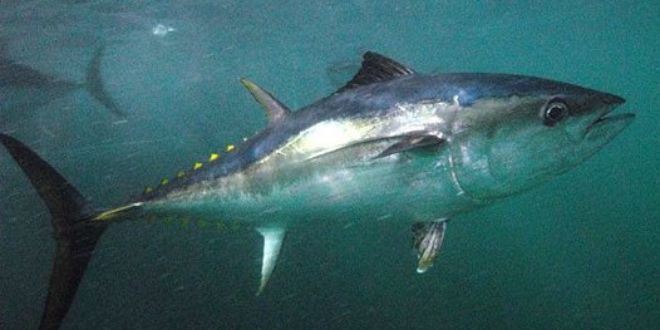
In nature it occupies cool temperate open ocean and productive feeding grounds across the Southern Hemisphere oceans. It feeds on fish, squid, and crustaceans. The species is highly migratory and capable of crossing vast ocean areas. These ecological details explain both its appearance and the space, food, or structure it needs.
For EnjoyTheWild readers, it is a premium fishery species managed internationally after severe historical depletion. Consumers and anglers should consult current regional sustainability and legal guidance rather than relying on the name alone.
50. Blue Marlin
The most useful field mark for Blue Marlin (Makaira nigricans) is its cobalt-blue upper body, silvery lower body, and pale vertical bars when excited. This large pelagic fish grows exceptionally large females may exceed 14 ft (4.3 m); juveniles, females, breeding males, or stressed fish may look less blue than a perfect photograph.
Its natural setting is warm open-ocean waters, current edges, and offshore feeding zones, within the Atlantic Ocean. Typical food includes tuna, mackerel-like fish, squid, and other pelagic prey, while its behavior is best described as solitary, fast, and built for open-water pursuit. Watching how it moves and where it stays is often more reliable than judging color under changing light.
It is an iconic game fish that should be handled under current billfish regulations and conservation practices. Color bars can intensify during feeding and fade rapidly after death.
51. Blue Shark
Blue Shark is the common name used for Prionace glauca, a pelagic shark recognized by a indigo-blue back, bright blue sides, white underside, and very long pectoral fins. It may grow commonly 6–10 ft, with larger individuals around 12 ft (3.8 m). The blue can come from pigment, reflective skin structures, or a combination, so the shade changes with angle and condition.
This fish occurs in open ocean from the surface into deeper water through temperate and tropical oceans worldwide. Its diet consists of squid, small fish, and pelagic invertebrates, and it is wide-ranging migrant that may travel in sex- and size-segregated groups. Those traits determine whether it grazes, schools, hides, hunts, or defends a territory.
Its main relevance is that it is important to open-ocean ecosystems and vulnerable to bycatch pressure. It is a shark, not an aquarium fish; wildlife encounters should be respectful and fishing rules followed.
52. Mahi-Mahi
Among the many types of blue fish, Mahi-Mahi (Coryphaena hippurus) stands out for its electric blue-green back, golden sides, and scattered blue spots. It is a pelagic game fish that reaches commonly 3–5 ft, occasionally over 6 ft (1.8 m). Color should be checked together with fin shape, body depth, and markings.
The species is associated with warm open water, weed lines, floating debris, and current boundaries in tropical and subtropical oceans worldwide. It eats flying fish, squid, small pelagic fish, and crustaceans. In everyday life it is fast-growing, fast-swimming, and often found around floating structure, a pattern that can be missed when the fish is seen only in a shop or single photograph.
It is a celebrated sport and food fish. Living colors can shift dramatically with excitement and fade within minutes after capture.
53. Opah
Opah (Lampris guttatus) is a large pelagic fish. Its round silver-blue body covered with white spots and edged by red-orange fins. Adults reach often 3–6 ft (0.9–1.8 m), making body proportions and mature coloration important identification clues rather than relying on blue alone.
In nature it occupies open ocean from surface waters into the deep mesopelagic zone across temperate and tropical oceans worldwide. It feeds on squid, krill, and midwater fish. The species is a deep-diving predator with whole-body heat conservation. These ecological details explain both its appearance and the space, food, or structure it needs.
For EnjoyTheWild readers, it is scientifically notable and occasionally caught in pelagic fisheries. Its disc-shaped body and spotted blue sides are unlike the streamlined shape of tuna.
54. Bluespotted Cornetfish
The most useful field mark for Bluespotted Cornetfish (Fistularia commersonii) is its long blue-green body with blue spots and a whip-like tail filament. This coastal predatory fish grows can approach 6.5 ft (2 m); juveniles, females, breeding males, or stressed fish may look less blue than a perfect photograph.
Its natural setting is reefs, lagoons, seagrass, and open coastal bottoms, within the Indo-Pacific, with an introduced range in the Mediterranean. Typical food includes small fish and crustaceans, while its behavior is best described as uses an elongated body and tubular snout to stalk prey. Watching how it moves and where it stays is often more reliable than judging color under changing light.
It is fascinating to divers and important as an example of marine biological invasion. Its spread into the Mediterranean shows how shipping corridors and connected seas can reshape fish distributions.
55. Peacock Flounder
Peacock Flounder is the common name used for Bothus mancus, a bottom-dwelling marine fish recognized by a tan to brown body with many vivid blue rings and spots. It may grow up to about 18 in (45 cm). The blue can come from pigment, reflective skin structures, or a combination, so the shade changes with angle and condition.
This fish occurs in sandy reef flats, rubble, and open patches near coral through the Indo-Pacific. Its diet consists of small fish, shrimp, and other bottom animals, and it is lies flat, changes pattern rapidly, and buries itself in sand. Those traits determine whether it grazes, schools, hides, hunts, or defends a territory.
Its main relevance is that it is a superb fish for observing camouflage rather than for typical home aquariums. Both eyes are on one side of the adult body, and the blue markings remain visible even as the background color changes.
56. Blue Acara
Among the many types of blue fish, Blue Acara (Andinoacara pulcher) stands out for its blue-gray scales with turquoise facial lines and fin highlights. It is a freshwater cichlid that reaches up to about 6 in (15 cm). Color should be checked together with fin shape, body depth, and markings.
The species is associated with slow rivers, streams, and floodplain waters with cover in northern South America and Trinidad. It eats insects, crustaceans, worms, small fish, and some plant material. In everyday life it is pair-forming cichlid with parental care and moderate territoriality, a pattern that can be missed when the fish is seen only in a shop or single photograph.
It is hardier and usually more manageable than many large cichlids. The naturally colored species is different from the brighter domestic electric blue acara form listed later.
57. German Blue Ram
German Blue Ram (Mikrogeophagus ramirezi) is a freshwater cichlid. Its yellow-gold body with blue iridescent spots, a black flank mark, and red eyes. Adults reach about 3 in (7.5 cm), making body proportions and mature coloration important identification clues rather than relying on blue alone.
In nature it occupies warm, slow, shallow waters with fine substrate and plant cover across the Orinoco basin of Venezuela and Colombia. It feeds on tiny invertebrates and edible material sifted from the substrate. The species is small, pair-forming, and more sensitive than its size suggests. These ecological details explain both its appearance and the space, food, or structure it needs.
For EnjoyTheWild readers, it is a popular planted-aquarium fish for experienced keepers who can maintain warm, clean, stable water. The German blue ram name is a trade name for the species; the electric blue ram is a domestic color form.
58. Electric Blue Hap
The most useful field mark for Electric Blue Hap (Sciaenochromis fryeri) is its adult males are intense metallic blue; females are gray-brown. This african freshwater cichlid grows up to about 8 in (20 cm); juveniles, females, breeding males, or stressed fish may look less blue than a perfect photograph.
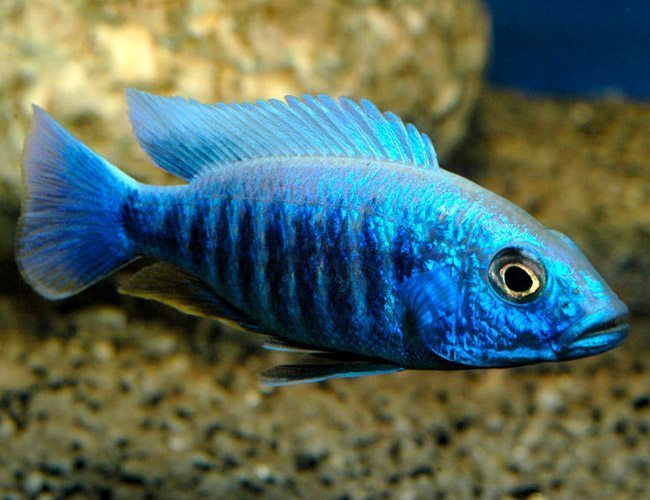
Its natural setting is rocky shores and intermediate sand-rock zones, within Lake Malawi in East Africa. Typical food includes small fish and mobile aquatic animals, while its behavior is best described as open-water predator that may become territorial when breeding. Watching how it moves and where it stays is often more reliable than judging color under changing light.
It is a classic blue Malawi cichlid needing a spacious, carefully stocked hard-water aquarium. It is often sold under the older trade name electric blue ahli, which can cause confusion with related species.
59. Maingano Cichlid
Maingano Cichlid is the common name used for Melanochromis cyaneorhabdos, a african freshwater cichlid recognized by a dark blue body with two bright horizontal blue stripes. It may grow about 4 in (10 cm). The blue can come from pigment, reflective skin structures, or a combination, so the shade changes with angle and condition.
This fish occurs in rocky shoreline habitat through a restricted part of Lake Malawi. Its diet consists of algae, small invertebrates, and edible material gathered from rocks, and it is territorial mbuna; both sexes share similar blue patterning. Those traits determine whether it grazes, schools, hides, hunts, or defends a territory.
Its main relevance is that it is beautiful in a properly structured Malawi aquarium with many rock shelters. Its narrow natural distribution makes responsible captive breeding and accurate labeling important.
60. Cobalt Blue Zebra Cichlid
Among the many types of blue fish, Cobalt Blue Zebra Cichlid (Maylandia callainos) stands out for its solid cobalt to powder blue, sometimes with faint bars. It is a african freshwater cichlid that reaches about 5 in (13 cm). Color should be checked together with fin shape, body depth, and markings.
The species is associated with rocky shores and reef-like lake structure in Lake Malawi. It eats algae-rich aufwuchs and small organisms picked from rocks. In everyday life it is territorial, active, and adapted to hard alkaline water, a pattern that can be missed when the fish is seen only in a shop or single photograph.
It is a recognizable mbuna for dedicated African cichlid communities. The name blue zebra is also used loosely for other Maylandia forms, so the scientific name prevents mix-ups.
61. Demasoni Cichlid
Demasoni Cichlid (Chindongo demasoni) is a african freshwater cichlid. Its alternating dark navy and bright blue vertical bars. Adults reach about 4 in (10 cm), making body proportions and mature coloration important identification clues rather than relying on blue alone.
In nature it occupies shallow rocky habitat across a very limited area of Lake Malawi. It feeds on aufwuchs dominated by algae and tiny organisms. The species is small but intensely territorial, especially toward similarly patterned fish. These ecological details explain both its appearance and the space, food, or structure it needs.
For EnjoyTheWild readers, it is best kept by aquarists familiar with mbuna group management and vegetable-rich feeding. Its compact size is misleading; aggression and restricted wild range make careless purchases risky.
62. Powder Blue Cichlid
The most useful field mark for Powder Blue Cichlid (Chindongo socolofi) is its pale powder-blue body with darker fin margins. This african freshwater cichlid grows about 5 in (13 cm); juveniles, females, breeding males, or stressed fish may look less blue than a perfect photograph.
Its natural setting is rocky areas with algae-covered surfaces, within Lake Malawi. Typical food includes algae and associated small organisms, while its behavior is best described as territorial mbuna that uses caves and rock boundaries. Watching how it moves and where it stays is often more reliable than judging color under changing light.
It is a strong-color species for a hard-water African cichlid setup. Aquarium diet should not rely heavily on rich animal protein because its natural feeding is largely algae-based.
63. Blue Dolphin Cichlid
Blue Dolphin Cichlid is the common name used for Cyrtocara moorii, a african freshwater cichlid recognized by a soft blue body; mature males develop a rounded forehead hump. It may grow up to about 10 in (25 cm). The blue can come from pigment, reflective skin structures, or a combination, so the shade changes with angle and condition.
This fish occurs in sandy bottoms near rocky zones through Lake Malawi. Its diet consists of small invertebrates exposed by other bottom-feeding fish, and it is often follows digging cichlids to capture disturbed prey. Those traits determine whether it grazes, schools, hides, hunts, or defends a territory.
Its main relevance is that it is a comparatively calm but large Malawi cichlid needing open swimming room and sand. The dolphin nickname refers to the forehead shape, not a relationship with marine mammals.
64. Frontosa Cichlid
Among the many types of blue fish, Frontosa Cichlid (Cyphotilapia frontosa) stands out for its pale blue-white body crossed by bold black vertical bars. It is a african freshwater cichlid that reaches up to about 14 in (35 cm). Color should be checked together with fin shape, body depth, and markings.
The species is associated with deep rocky slopes and caves in Lake Tanganyika. It eats fish, mollusks, and other lake animals. In everyday life it is slow-moving, social, and adapted to deeper dimmer water, a pattern that can be missed when the fish is seen only in a shop or single photograph.
It is a long-lived centerpiece cichlid requiring a very large Tanganyika-style aquarium. Several geographic forms differ in bar count and blue intensity, so locality names should not be treated as separate species automatically.
65. Neon Dwarf Rainbowfish
Neon Dwarf Rainbowfish (Melanotaenia praecox) is a freshwater rainbowfish. Its metallic neon-blue body with red or orange fins. Adults reach about 3 in (8 cm), making body proportions and mature coloration important identification clues rather than relying on blue alone.
In nature it occupies clear tributaries and vegetated margins across the Mamberamo region of New Guinea. It feeds on small insects, crustaceans, algae, and prepared foods in captivity. The species is peaceful, active schooling fish. These ecological details explain both its appearance and the space, food, or structure it needs.
For EnjoyTheWild readers, it is one of the most practical small blue fish for a planted community aquarium. Keep it in a proper group; solitary fish show poorer behavior and often weaker color.
66. Lake Kutubu Rainbowfish
The most useful field mark for Lake Kutubu Rainbowfish (Melanotaenia lacustris) is its turquoise to sky-blue body with shifting iridescence. This freshwater rainbowfish grows up to about 5 in (12 cm); juveniles, females, breeding males, or stressed fish may look less blue than a perfect photograph.
Its natural setting is clear lake water, tributary mouths, and vegetated margins, within Lake Kutubu in Papua New Guinea. Typical food includes insects, crustaceans, algae, and planktonic foods, while its behavior is best described as energetic schooling fish that uses open water. Watching how it moves and where it stays is often more reliable than judging color under changing light.
It is a striking blue community fish for a spacious, well-oxygenated aquarium. Its restricted native habitat makes conservation-minded captive breeding valuable.
67. Boesemani Rainbowfish
Boesemani Rainbowfish is the common name used for Melanotaenia boesemani, a freshwater rainbowfish recognized by a adult males show a blue-violet front half and orange-yellow rear half. It may grow about 4.5 in (11 cm). The blue can come from pigment, reflective skin structures, or a combination, so the shade changes with angle and condition.
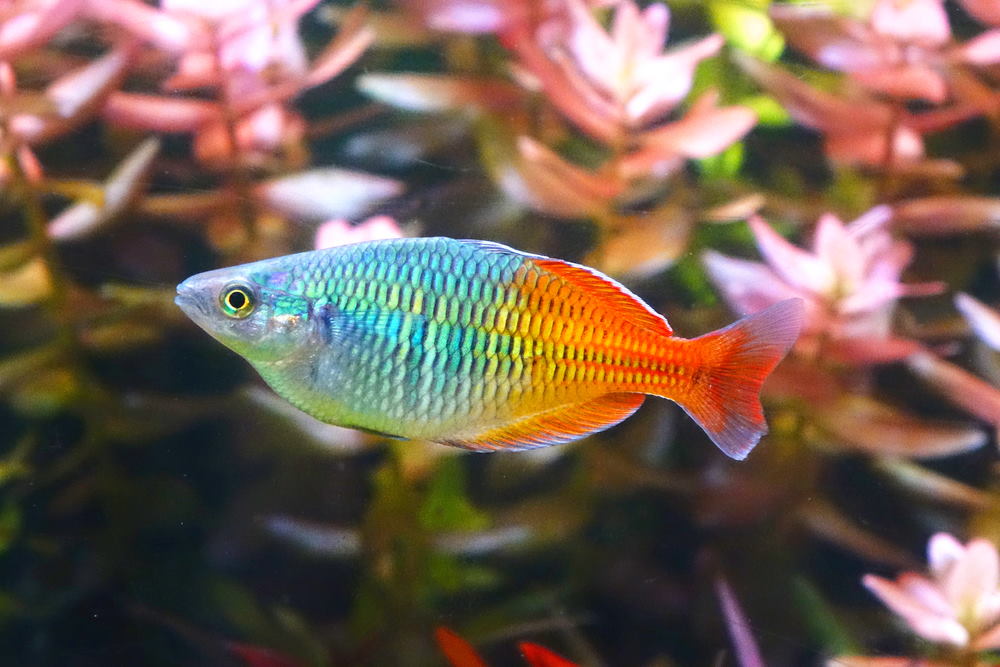
This fish occurs in lakes and connected streams with vegetation through the Bird’s Head region of West Papua. Its diet consists of small invertebrates, algae, and varied omnivorous foods, and it is active schooling fish whose best color appears in mature, unstressed males. Those traits determine whether it grazes, schools, hides, hunts, or defends a territory.
Its main relevance is that it is one of the world’s most recognizable aquarium rainbowfish. Only the front half is blue, but the sharp two-color division makes it highly relevant to blue-fish searches.
68. Blue Lyretail Killifish
Among the many types of blue fish, Blue Lyretail Killifish (Fundulopanchax gardneri) stands out for its males have a blue-green base with red spots and yellow-edged fins. It is a freshwater killifish that reaches about 2.5 in (6.5 cm). Color should be checked together with fin shape, body depth, and markings.
The species is associated with small forest streams, pools, and swampy waters in Nigeria and Cameroon. It eats small insects, worms, and crustaceans. In everyday life it is surface-oriented, pair-spawning, and capable of jumping, a pattern that can be missed when the fish is seen only in a shop or single photograph.
It is a colorful entry into nonannual killifish keeping. Use a tight lid and keep track of locality strains, which can differ in pattern and should not be mixed casually.
69. Bluefin Nothobranch
Bluefin Nothobranch (Nothobranchius rachovii) is a freshwater annual killifish. Its males display intense blue scales, red-orange patterning, and blue fins. Adults reach about 2.5 in (6 cm), making body proportions and mature coloration important identification clues rather than relying on blue alone.
In nature it occupies temporary seasonal pools across southeastern Africa. It feeds on small live aquatic invertebrates. The species is short-lived annual fish whose drought-resistant eggs survive dry seasons. These ecological details explain both its appearance and the space, food, or structure it needs.
For EnjoyTheWild readers, it is a specialist aquarium species valued for extraordinary color and unusual life history. Egg incubation and annual-cycle care are very different from ordinary community-fish keeping.
70. Bluefin Killifish
The most useful field mark for Bluefin Killifish (Lucania goodei) is its breeding males show bright blue dorsal and anal fins with red-orange accents. This freshwater killifish grows about 2.5 in (6 cm); juveniles, females, breeding males, or stressed fish may look less blue than a perfect photograph.
Its natural setting is clear vegetated springs, streams, and marsh edges, within Florida and nearby parts of the southeastern United States. Typical food includes small insects, crustaceans, and other tiny aquatic foods, while its behavior is best described as small schooling fish that remains close to vegetation. Watching how it moves and where it stays is often more reliable than judging color under changing light.
It is a native North American option for suitable cool-to-warm freshwater setups. Collecting native fish may require permits; captive-bred stock is the responsible aquarium route.
71. Blue Emperor Tetra
Blue Emperor Tetra is the common name used for Inpaichthys kerri, a freshwater tetra recognized by a iridescent blue-purple body with a dark horizontal stripe. It may grow about 2 in (5 cm). The blue can come from pigment, reflective skin structures, or a combination, so the shade changes with angle and condition.
This fish occurs in soft, slow forest streams through the Aripuanã drainage of Brazil. Its diet consists of small invertebrates and plant-associated foods, and it is peaceful schooling fish, with males displaying to one another. Those traits determine whether it grazes, schools, hides, hunts, or defends a territory.
Its main relevance is that it is a manageable blue shimmer fish for planted community aquariums. It is also called the royal tetra, but it is not the same species as the emperor tetra Nematobrycon palmeri.
72. Cochu’s Blue Tetra
Among the many types of blue fish, Cochu’s Blue Tetra (Boehlkea fredcochui) stands out for its silvery body with a cool blue sheen that strengthens in groups. It is a freshwater tetra that reaches about 2 in (5 cm). Color should be checked together with fin shape, body depth, and markings.
The species is associated with flowing tributaries and open freshwater channels in the upper Amazon basin. It eats small insects, crustaceans, and prepared omnivorous foods. In everyday life it is active schooling fish that prefers swimming room, a pattern that can be missed when the fish is seen only in a shop or single photograph.
It is a subtle alternative to artificially dyed or fluorescent fish. Blue color is reflective rather than pigment-heavy, so it changes with light, background, and stress.
73. Blue Botia
Blue Botia (Yasuhikotakia modesta) is a freshwater loach. Its blue-gray body with orange to red fins. Adults reach up to about 10 in (25 cm), making body proportions and mature coloration important identification clues rather than relying on blue alone.
In nature it occupies large rivers and seasonally flooded systems across the Mekong and other river basins of mainland Southeast Asia. It feeds on snails, insects, crustaceans, and other bottom foods. The species is social, nocturnal-leaning, and sometimes boisterous. These ecological details explain both its appearance and the space, food, or structure it needs.
For EnjoyTheWild readers, it is an appealing loach only for large aquariums with a group, strong filtration, and hiding places. It is much larger and more assertive than many shops imply, and wild river populations face regional pressures.
74. Electric Blue Acara
The most useful field mark for Electric Blue Acara (Andinoacara pulcher domestic color form) is its uniform metallic turquoise-blue produced through selective breeding. This domestic freshwater color variety grows about 6 in (15 cm); juveniles, females, breeding males, or stressed fish may look less blue than a perfect photograph.
Its natural setting is aquariums; derived from a South American blue acara lineage, within captive-bred worldwide. Typical food includes quality pellets plus insects, crustaceans, and other varied foods, while its behavior is best described as generally moderate for a cichlid, with stronger territoriality during breeding. Watching how it moves and where it stays is often more reliable than judging color under changing light.
It is a popular centerpiece fish for medium-to-large community aquariums. It is not a separate wild species; sellers should identify it as a domestic form and avoid vague claims about origin.
75. Electric Blue Ram
Electric Blue Ram is the common name used for Mikrogeophagus ramirezi domestic color form, a domestic freshwater color variety recognized by a nearly solid neon blue with reduced wild-type black patterning. It may grow about 3 in (7.5 cm). The blue can come from pigment, reflective skin structures, or a combination, so the shade changes with angle and condition.
This fish occurs in aquariums; derived from the warm-water ram cichlid through captive-bred worldwide. Its diet consists of small sinking foods, frozen invertebrates, and fine live foods, and it is pair-forming and peaceful outside breeding territories. Those traits determine whether it grazes, schools, hides, hunts, or defends a territory.
Its main relevance is that it is visually intense but often less forgiving than the standard German blue ram. Stable warm water, careful sourcing, and quarantine matter more than color intensity.
76. Blue Diamond Discus
Among the many types of blue fish, Blue Diamond Discus (Symphysodon spp. domestic strain) stands out for its solid powder to cobalt blue with little or no body pattern. It is a domestic freshwater color variety that reaches commonly 6–8 in (15–20 cm). Color should be checked together with fin shape, body depth, and markings.
The species is associated with aquariums; selectively bred from Amazonian discus ancestry in captive-bred worldwide. It eats high-quality prepared foods and varied protein-rich aquarium fare. In everyday life it is social, laterally compressed cichlid that can become shy under poor conditions, a pattern that can be missed when the fish is seen only in a shop or single photograph.
It is a premium display strain for experienced discus keepers. Domestic discus strains may involve mixed ancestry, so a strain name is not a scientifically separate species.
77. Royal Blue Betta
Royal Blue Betta (Betta splendens domestic color variety) is a domestic freshwater color variety. Its deep, saturated royal blue across body and fins. Adults reach about 2.5–3 in (6–7.5 cm) excluding long fins, making body proportions and mature coloration important identification clues rather than relying on blue alone.
In nature it occupies aquariums; descended from Southeast Asian betta populations across captive-bred worldwide. It feeds on small insects and protein-rich prepared foods. The species is males are territorial toward rival males and need warm, calm, clean water. These ecological details explain both its appearance and the space, food, or structure it needs.
For EnjoyTheWild readers, it is one of the easiest blue fish to recognize, though fin shape and health vary by breeding line. Color labels are trade descriptions; royal blue, steel blue, and turquoise are domestic phenotypes, not species.
78. Blue Moscow Guppy
The most useful field mark for Blue Moscow Guppy (Poecilia reticulata domestic strain) is its metallic dark blue from head through tail, especially in males. This domestic freshwater color variety grows males around 1.5–2 in, females larger; juveniles, females, breeding males, or stressed fish may look less blue than a perfect photograph.
Its natural setting is aquariums; selectively bred from guppy stock, within captive-bred worldwide. Typical food includes algae, small invertebrates, and varied prepared foods, while its behavior is best described as active livebearer that reproduces readily. Watching how it moves and where it stays is often more reliable than judging color under changing light.
It is a practical blue community fish when water quality and population control are managed. Do not release unwanted guppies; they can establish invasive populations in warm waters.
79. Blue Gourami
Blue Gourami is the common name used for Trichopodus trichopterus domestic color form, a domestic freshwater color variety recognized by a pale blue to lavender body with two dark flank spots. It may grow up to about 6 in (15 cm). The blue can come from pigment, reflective skin structures, or a combination, so the shade changes with angle and condition.
This fish occurs in aquariums; derived from Southeast Asian three-spot gourami through captive-bred worldwide. Its diet consists of insects, small crustaceans, algae, and prepared omnivorous foods, and it is uses a labyrinth organ to breathe air and may become territorial. Those traits determine whether it grazes, schools, hides, hunts, or defends a territory.
Its main relevance is that it is hardy and adaptable, but adult temperament requires thoughtful tankmates. The eye is sometimes described as the third spot, explaining the species name three-spot gourami.
80. Powder Blue Dwarf Gourami
Among the many types of blue fish, Powder Blue Dwarf Gourami (Trichogaster lalius domestic color form) stands out for its soft powder-blue body with reduced red striping. It is a domestic freshwater color variety that reaches about 3.5 in (9 cm). Color should be checked together with fin shape, body depth, and markings.
The species is associated with aquariums; bred from the South Asian dwarf gourami in captive-bred worldwide. It eats small insects, planktonic foods, and quality prepared diets. In everyday life it is surface-oriented labyrinth fish; males may defend small territories, a pattern that can be missed when the fish is seen only in a shop or single photograph.
It is popular for compact size and gentle color in planted aquariums. Choose robust, responsibly bred fish and quarantine carefully because commercial dwarf gourami lines can have health problems.
How Are These Types of Fish Classified?
“Blue fish” is not a formal scientific group. The fish in this guide belong to many unrelated families and are connected only by coloration or a common name. A blue tang is a surgeonfish, a blue acara is a cichlid, a blue shark is a shark, and bluefish is a predatory species in its own family. They do not share one blue-fish ancestor or one lifestyle.
Natural Blue Species
Some species naturally carry large areas of blue, including blue tangs, Caribbean blue chromis, blue parrotfish, blue assessors, blue sharks, and several rainbowfish. Their color may be produced by structural reflection, pigments, or layered skin cells. Because reflected color depends on light, the same animal can look turquoise, violet, gray, or green in different conditions.
Fish With Blue Markings
Many entries are not entirely blue. Queen angelfish have blue edging, bluestripe snapper have blue lines, peacock flounder have blue rings, and bluefin trevally have blue fins and spots. These patterns often provide better identification marks than an overall color label.
Sex, Age, and Color Phase
Color can change with age or sex. Juvenile Atlantic blue tangs are yellow before becoming blue. Adult male ribbon eels are blue, while juveniles and females have different colors. Male electric blue haps are bright blue, whereas females are much duller. Parrotfish and wrasses may change both sex and color phase.
Domestic Aquarium Varieties
Electric blue acara, electric blue ram, blue diamond discus, royal blue betta, blue Moscow guppy, blue gourami, and powder blue dwarf gourami are domestic color forms or strains. They belong to existing species or mixed captive lineages and should not be presented as newly discovered wild species.
Where Do These Fish Live?
Blue fish occur in nearly every major aquatic environment. Tropical coral reefs support tangs, angelfish, damselfish, gobies, wrasses, parrotfish, triggerfish, and snapper. Clear reef water contains strong blue wavelengths, and blue patterns can play roles in recognition, camouflage, display, and communication.
Temperate rocky reefs are home to blue devils, blue maomao, blue cod, and blue rockfish. Open oceans hold bluefin tuna, blue marlin, blue shark, mahi-mahi, and opah. These pelagic fish usually combine a dark blue back with a pale belly, a form of countershading that makes them harder to see from above or below.
Freshwater examples are concentrated in several biodiversity centers. Lake Malawi and Lake Tanganyika contain blue cichlids adapted to rocky or deep-lake habitats. New Guinea supports blue and turquoise rainbowfish. South American waters hold blue acara, German blue ram, and reflective tetras, while Southeast Asian rivers are home to blue botia.
How to Identify Different Types of Blue Fish
- Body shape: Tangs are disk-shaped, wrasses are streamlined, flounders are flat, and ribbon eels are extremely elongated.
- Blue location: Check whether blue covers the body or appears only on the head, stripes, spots, fins, or tail.
- Pattern direction: Horizontal lines, vertical bars, rings, and scattered spots separate many similar species.
- Life stage: Juveniles and adults may have completely different colors, especially angelfish, tangs, triggerfish, and ribbon eels.
- Sex: Male cichlids, killifish, rainbowfish, and wrasses are often bluer than females.
- Habitat and range: An Atlantic species cannot normally be identified from an Indo-Pacific look-alike without considering location.
- Fins and special structures: Look for surgeonfish tail spines, parrotfish beaks, jawfish burrows, triggerfish dorsal spines, or the tail filament of a cornetfish.
- Lighting: Iridescent fish can appear blue, green, violet, or silver as the viewing angle changes.
- Scientific name: Trade names such as blue zebra, blue tetra, and blue devil may be used for more than one fish.
Aquarium Care Notes for Blue Fish
Color alone is never a safe way to choose an aquarium fish. The list includes tiny peaceful tetras, territorial damselfish, specialized pod-eating dragonets, large predatory triggers, and ocean fish that cannot be kept in home aquariums. Research adult size, water type, temperature, diet, swimming behavior, and social needs before purchase.
- Choose captive-bred fish when practical. Neon gobies, assessors, bettas, guppies, gouramis, discus, and many cichlids are available from captive production.
- Plan for adult size. A juvenile tang, frontosa, triggerfish, or blue botia can quickly outgrow a small tank.
- Match water chemistry. Malawi and Tanganyika cichlids need mineral-rich alkaline water, while many South American fish favor softer conditions.
- Respect social structure. Rainbowfish and tetras need groups; male bettas cannot be housed together casually; mbuna require carefully managed stocking and rockwork.
- Feed the natural role. Grazing tangs need plant-rich food, mandarins need tiny prey, and annual killifish need a specialized breeding cycle.
- Quarantine new arrivals. Blue coloration can hide early skin damage, while stress often dulls color before other symptoms appear.
- Never release aquarium fish. Guppies, snappers, cornetfish, and many other species can become invasive outside their native ranges.
Fishing Tips and Notes
Several “blue” fish are major sport species, including bluefish, bluefin tuna, blue marlin, blue runner, bluefin trevally, blue cod, and mahi-mahi. Their rules may involve licenses, seasonal closures, quotas, size limits, protected areas, or mandatory release practices. Regulations change, so anglers should use the current authority for the exact water they are fishing.
- Use teeth-resistant handling methods for bluefish and avoid placing fingers near the mouth.
- Identify tuna carefully because bluefin management differs from other tuna species.
- Handle billfish and large pelagic fish efficiently to reduce stress when release is required.
- Use descending devices or other legally recommended techniques for deep-caught rockfish where barotrauma is a concern.
- Do not collect protected blue devil fish or remove reef aquarium species without permits.
- Photograph living color quickly, because blue and green tones often fade after capture.
Why Are So Many Fish Blue?
Blue coloration can serve several functions. A dark blue back provides countershading in open water. Bright stripes may help members of a species recognize one another or advertise cleaning behavior. Reef fish can use blue spots and lines to break up their outline against moving light, coral shade, and open water. In breeding males, intense blue may signal maturity or condition.
Not all blue is created by blue pigment. Many fish use microscopic structures that reflect and scatter light. This structural color is why a rainbowfish or tetra can flash brilliant blue at one angle and look gray at another. Stress, diet, hormones, age, health, water quality, and lighting all influence the color that humans see.
Safety, Sustainability, and Conservation Notes
- Observe without touching. Surgeonfish spines, triggerfish teeth, pufferfish toxins, and large predator mouths can cause injury.
- Follow protected-species laws. The eastern blue devil is protected in New South Wales, and other local protections may apply elsewhere.
- Check current fishery status. Bluefin tuna and billfish are internationally managed, while bluefish and rockfish rules vary by region.
- Prefer traceable aquarium sources. Captive breeding can reduce pressure on reefs and avoid destructive collection practices.
- Protect habitat. Coral loss, river alteration, pollution, invasive species, and sedimentation can harm blue fish even when direct harvest is limited.
- Do not confuse color with abundance. A species can be common in the aquarium trade yet have a small natural range.
- Avoid artificial dyeing. Naturally blue or selectively bred fish are preferable to fish injected or exposed to dyes.
Fun Facts About Blue Fish
- Bluefish is one actual species, Pomatomus saltatrix, while “blue fish” can describe hundreds of unrelated fishes.
- Juvenile Atlantic blue tangs are yellow before becoming blue.
- Blue ribbon eels change color and sex during their lives.
- Some blue devils are Australian cave-dwelling fish, while blue devil damselfish are small tropical reef fish.
- Blue cod is a sandperch rather than a true cod.
- Blue structural color can disappear when the viewing angle changes.
- Male electric blue haps are blue, but females are usually gray-brown.
- The bluehead wrasse can change sex in response to its social group.
- Living mahi-mahi may flash electric blue, green, and gold before the colors fade after capture.
- Domestic labels such as royal blue betta and blue diamond discus describe strains, not separate wild species.
Final Thoughts on Types of Blue Fish
The 80 types of blue fish in this guide show that “blue” can describe an entire body, a reflective sheen, a few stripes, a life stage, a male breeding color, a fin, or a domestic aquarium strain. The most recognizable examples include blue tangs, blue chromis, blue parrotfish, blue shark, bluefin tuna, Lake Kutubu rainbowfish, electric blue hap, royal blue betta, and the true bluefish.
Good identification requires more than color. Use body shape, pattern, size, habitat, geographic range, behavior, sex, and age. Aquarium keepers should prioritize adult needs and ethical sourcing, while fishers and wildlife observers should follow current regulations and protect habitat. Learning why each species appears blue makes the underwater world far more interesting than a simple color list.
Frequently Asked Questions
1. What does the term blue fish mean?
It may mean any fish with blue coloration, a fish with blue markings, a domestic blue aquarium strain, or the single species called bluefish. Context is essential because it is not one scientific category.
2. Is bluefish one species?
Yes. Bluefish is the common name of Pomatomus saltatrix, a fast predatory coastal fish. The plural phrase blue fish is much broader and may refer to many unrelated species.
3. How many types of blue fish are there?
There is no fixed total because blue is a visual trait rather than a taxonomic group. Hundreds of fish show blue bodies, fins, stripes, spots, or iridescence. This guide selects 80 practical and recognizable examples.
4. What is the most famous blue aquarium fish?
The blue tang is probably the most famous marine example. In freshwater aquariums, royal blue bettas, electric blue acara, blue rams, blue cichlids, and turquoise rainbowfish are widely recognized.
5. Are blue tangs freshwater or saltwater fish?
Blue tangs are tropical marine reef fish. They require saltwater, strong filtration, substantial swimming room, algae-rich feeding, and experienced care.
6. What is the difference between a blue tang and an Atlantic blue tang?
The blue tang Paracanthurus hepatus is an Indo-Pacific fish with a black palette marking and yellow tail. The Atlantic blue tang Acanthurus coeruleus lives in the western Atlantic, and juveniles are yellow before adults become blue.
7. Are powder blue tangs good beginner fish?
No. They are beautiful but sensitive to stress, water instability, crowding, and parasites. They need a large mature system, excellent oxygenation, regular grazing food, and careful quarantine.
8. Which blue fish stay small?
Small examples include neon gobies, blue assessors, bluebanded gobies, azure damselfish, neon dwarf rainbowfish, blue emperor tetras, Cochu’s blue tetras, bettas, and guppies. Temperament and water needs still differ.
9. Which blue fish grow very large?
Blue marlin, bluefin tuna, blue shark, blue parrotfish, bluefin trevally, bluespine unicornfish, and several triggerfish become far too large for home aquariums.
10. What are the best blue freshwater community fish?
Neon dwarf rainbowfish, Lake Kutubu rainbowfish, blue emperor tetras, Cochu’s blue tetras, guppies, and carefully chosen gouramis can work. Match group size, water chemistry, adult size, and temperament.
11. Are electric blue acara a separate species?
No. Electric blue acara are domestic color forms generally associated with Andinoacara pulcher. They are selectively bred aquarium fish rather than a distinct wild species.
12. Are electric blue rams natural?
They are a domestic color form of Mikrogeophagus ramirezi. Wild-type rams have blue iridescent spots, but the nearly solid electric-blue appearance was intensified through selective breeding.
13. Is a royal blue betta a separate species?
No. It is a color variety of the domesticated Betta splendens complex. Royal blue, steel blue, turquoise, marble, and other labels describe color genetics and breeding lines.
14. Why do blue fish change color?
Light angle, stress, mood, age, sex, breeding condition, diet, health, and water quality can all alter appearance. Structural blue is especially angle-dependent.
15. Do fish have blue pigment?
Some blue effects involve pigment, but much fish blue comes from microscopic structures that reflect and scatter light. This is called structural coloration.
16. Why are open-ocean fish blue on top?
A dark blue back can blend with deep water when viewed from above, while a pale belly blends with bright surface light from below. This countershading helps conceal both predators and prey.
17. Which blue fish can change sex?
Bluehead wrasses, many parrotfish, blue cod, and blue ribbon eels have sex-changing life histories. The exact pattern differs among species.
18. Are blue devil fish dangerous?
The name is used for unrelated fish. Small blue devil damselfish are territorial but not dangerous to people. Australian blue devils are shy cave fish. Neither should be confused with a hazardous marine animal based only on the name.
19. Can I keep a blue ribbon eel in a home aquarium?
Only highly experienced marine aquarists should attempt it. The species has demanding feeding needs, escapes easily, requires an appropriate burrow setup, and often performs poorly after collection.
20. Can mandarin dragonets eat normal fish flakes?
Many do not thrive on flakes alone. They naturally hunt tiny crustaceans throughout the day. A mature system, reliable live-food population, or a verified trained individual is essential.
21. Are blue parrotfish good aquarium fish?
No for ordinary home aquariums. They grow very large, travel widely, and have specialized grazing behavior. They are best appreciated in the wild.
22. What blue fish are found in the Caribbean?
Examples include Atlantic blue tang, queen angelfish, Bermuda blue angelfish, Caribbean blue chromis, bluehead wrasse, blue parrotfish, queen parrotfish, blue-striped grunt, and bluefish.
23. What blue fish are found in the Indo-Pacific?
Examples include blue tang, powder blue tang, emperor angelfish, blue-green chromis, moon wrasse, ribbon eel, mandarin dragonet, bluefin trevally, and bluestripe snapper.
24. What blue fish live in freshwater African lakes?
Electric blue hap, maingano, cobalt blue zebra, demasoni, powder blue cichlid, blue dolphin cichlid, and frontosa are prominent examples from Lakes Malawi and Tanganyika.
25. What blue fish come from New Guinea?
Lake Kutubu rainbowfish, neon dwarf rainbowfish, and Boesemani rainbowfish come from New Guinea-region freshwater systems. Several have restricted natural distributions.
26. Are blue cichlids aggressive?
Many African rock-dwelling blue cichlids are territorial, but aggression varies by species, sex, group structure, and aquarium design. Blue acara and rams are usually less aggressive outside breeding periods.
27. Can different blue cichlids be mixed?
Only when their water requirements, adult sizes, diets, and aggression patterns are compatible. Similar-looking mbuna may attack one another, and Malawi fish should not be mixed casually with soft-water South American cichlids.
28. What is the easiest blue fish for a beginner?
A healthy captive-bred blue betta, blue guppy, or a school of neon dwarf rainbowfish can be approachable when their specific needs are met. No fish is maintenance-free.
29. Do blue fish need blue aquarium lighting?
No. Fish need appropriate day-night cycles and suitable light intensity, not blue light simply because they are blue. Overly intense lighting can stress fish and promote algae.
30. Why does my blue fish look gray?
Stress, poor water quality, illness, social pressure, subdued lighting, juvenile coloration, or a normal change in angle can reduce blue. Check behavior and water conditions before trying to enhance color with food or light.
31. What food makes blue fish bluer?
A complete species-appropriate diet supports normal coloration, but no safe food can replace genetics, health, and proper conditions. Avoid products promising instant artificial color.
32. Are artificially dyed blue fish safe to buy?
Artificial dyeing can harm fish and should not be supported. Choose naturally blue species or transparent selectively bred strains from responsible breeders.
33. Can blue fish be poisonous?
Some blue fish, such as pufferfish, may contain potent toxins. Color itself does not predict toxicity. Never eat an unfamiliar fish based on an aquarium or common name.
34. Are blue tang tail spines dangerous?
Yes. Surgeonfish have sharp spines near the tail that can cut skin. Use containers rather than bare hands when moving them, and avoid trapping the tail in nets.
35. Are bluefish dangerous to anglers?
Bluefish have sharp teeth and powerful jaws. Use suitable tools, control the fish securely, and keep fingers away from the mouth.
36. Can I eat bluefish?
Bluefish is widely eaten, but quality is best when the fish is bled, chilled quickly, and handled well. Follow local harvest rules and health advisories for the water where it was caught.
37. Are bluefin tuna endangered?
Conservation status and stock condition differ among Atlantic, Pacific, and southern bluefin tuna and can change with new assessments. All are heavily managed, so consult current fishery and seafood guidance.
38. Why are some blue fish protected?
Protection may address small ranges, low abundance, habitat damage, overfishing, or aquarium collection. The eastern blue devil, for example, is legally protected in New South Wales.
39. Can aquarium blue fish become invasive?
Yes. Released guppies, cichlids, snappers, and other fish can establish outside their native range. Never release pets, bait, or unwanted fish into natural water.
40. How should I photograph blue fish accurately?
Use neutral white balance, avoid excessive blue aquarium lighting, include habitat context, and photograph several angles. Underwater strobes or lights can restore colors lost with depth.