

Wild parrots have always fascinated people with their colors, their sharp minds, and their ability to live in environments that range from tropical forests to harsh island landscapes. In this guide, we explore 25 types of wild parrots and highlight their characteristics, behaviors, and natural habitats. This collection blends practical field identification with friendly storytelling, making it easier for readers to understand how these birds survive and interact with their surroundings. Whether you’re a birdwatcher, a wildlife enthusiast, or simply curious about wild parrots, this article provides a clear, structured review of each species. Hop in—there’s plenty to admire along the way.
1. African Grey Parrot
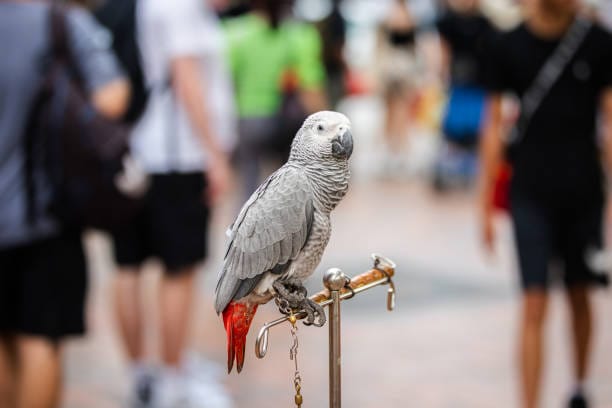
Physical Characteristics & Identification Tips
The African Grey Parrot is widely recognized for its ash-colored feathers, scalloped patterning, and bright red tail. Adults often show a pale facial patch that contrasts strongly with their dark eyes. Their medium-sized build, strong beak, and smooth plumage make them fairly easy to spot. If you ever see a parrot that looks like it’s dipped in silver dust, chances are you’ve met an African Grey. Their voice projection can also give them away, as they have powerful vocal ranges even in dense forests.
Behavior
African Greys are thoughtful and observant. They spend long moments watching their surroundings before making a move, almost as if they’re weighing every possibility. Socially, they form tight flocks and communicate with a symphony of clicks, whistles, and mechanical-like sounds. Their intelligence is often compared to that of young children, and in the wild they use this sharp mind to solve problems and adapt to shifting conditions. They are cautious fliers who prefer deliberate wingbeats instead of flashy maneuvers.
Habitat and Range
These parrots inhabit Central and West African tropical forests. They thrive in humid lowlands, forest edges, gallery forests, and even agricultural zones where tree cover remains sufficient. While the species has experienced habitat loss in many regions, they persist in remote forests where logging has yet to reach.
Diet
Their diet includes nuts, palm fruits, seeds, young bark, and the occasional insect. They break tough shells with ease, and in some areas they have been seen visiting mineral-rich clay sites to balance nutrients. African Greys consume a wide variety of forest fruits depending on seasonal availability, shifting food sources with precision.
Reproduction and Life Cycle
Breeding pairs select tall, mature trees with deep cavities. Females typically lay 2–4 eggs and handle most of the incubation while the male brings food. Chicks hatch blind and featherless, developing gradually until they fledge several months later. Family groups remain connected even after juveniles become independent.
Fun Facts / Unique Traits
Many African Grey Parrots mimic surrounding wildlife instead of human speech—imitating hornbills, baboons, and rainforest sounds. Some researchers describe their communication style as “layered,” meaning they adapt calls depending on the context.
Human Interaction
Human contact has created challenges for wild populations. Capture for the pet trade remains a concern, although stronger protections in several African nations have improved their situation. In places where communities coexist with them, locals consider their arrival in orchards a sign of healthy forest cycles.
2. Blue-and-Yellow Macaw
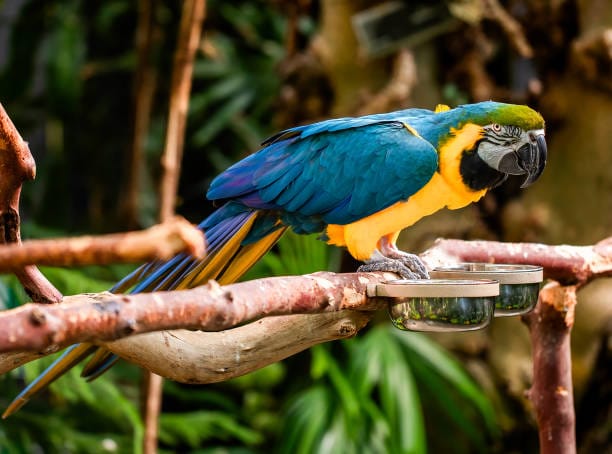
Physical Characteristics & Identification Tips
The Blue-and-Yellow Macaw wears unmistakable plumage: sapphire wings, a bright golden chest, and a bold black facial line etched across white bare skin. Their long tail feathers sweep behind them like a painter’s brushstroke. With their enormous curved beak and expressive facial patches, they’re among the easiest South American parrots to identify. Their calls are loud, raw, and carry across long distances, so you often hear them before spotting them.
Behavior
This macaw species is spirited and playful. They form lifelong pair bonds and frequently fly in pairs or small groups. Their synchronized flights—sometimes described by birders as “sky dances”—show how well partners coordinate in mid-air. On the ground and in trees, they interact using gentle nips, head tilts, and raspy chatter. They investigate everything, often poking, tapping, and testing objects as if conducting experiments.
Habitat and Range
The Blue-and-Yellow Macaw inhabits northern and central South America, particularly rainforests, flooded woodlands, and riverbank forests. They rely heavily on mature canopy trees for nesting and feeding. In certain regions, they move seasonally to follow fruiting cycles or water availability.
Diet
Their diet focuses on fruits, nuts, seeds, and palm materials. They’re known for cracking extremely hard nuts that few other animals can access. In some river regions, they gather in large groups at clay licks, consuming mineral deposits thought to counter toxins from certain wild fruits.
Reproduction and Life Cycle
Macaws often nest in tree cavities high above floodwaters. Pairs raise usually 2–3 chicks, but often only one survives to fledging due to natural competition. Young macaws stay with their parents for extended periods as they learn flight routes, food sources, and social etiquette.
Fun Facts / Unique Traits
The species is known for its dramatic wingbeats—long, sweeping strokes that make them look like they’re gliding in slow motion. They are also among the most expressive wild parrots, using facial skin flushing to signal emotions.
Human Interaction
In some Amazon regions, macaws are admired as indicators of ecosystem health. Ecotourism programs encourage visitors to watch them at clay licks, generating income for local villages. Habitat loss remains their biggest threat, though community-led conservation efforts continue to expand.
3. Scarlet Macaw
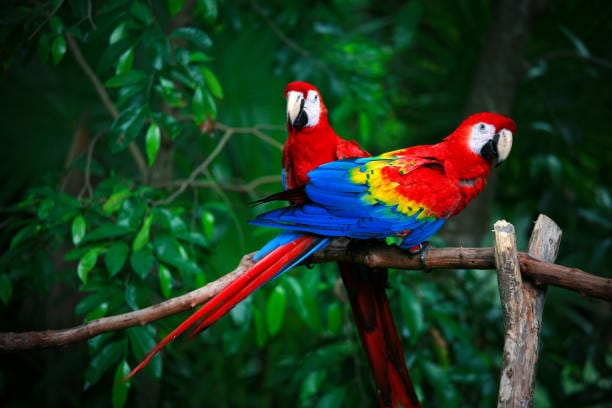
Physical Characteristics & Identification Tips
The Scarlet Macaw is a bird that seems painted by hand—deep red body, cobalt wings, and lemon-yellow panels across its mid-wing. Their long tail blends red and blue into a striking gradient. The white facial patch is lined with tiny feather streaks, creating a textured look that bird enthusiasts often mention. Powerful wings and vibrant coloration make the Scarlet Macaw stand out even in dense rainforest canopies.
Behavior
The species is bold, energetic, and highly social. They travel in pairs or noisy groups, communicating with sharp arcing calls. Their social bonds are strong: pairs preen each other regularly, share food, and rarely separate. They are active explorers, sometimes hanging upside down from branches just to interact with new textures. Their curiosity has made them the stars of many jungle ecotours.
Habitat and Range
Scarlet Macaws range across Central and South America. They prefer humid lowland forests, river margins, and remote woodlands where old trees still stand. While many populations remain stable, forest fragmentation threatens the connectivity between their feeding and nesting sites.
Diet
They eat fruits, nuts, seeds, and certain clay deposits. Their digestive adaptations allow them to handle mildly toxic fruits that other animals avoid. During drier months, they expand their foraging radius, often following fruiting figs and large seed-bearing trees.
Reproduction and Life Cycle
Scarlet Macaws nest in large hollows of ancient trees. Females lay 1–3 eggs, with chicks hatching several weeks later. Young macaws stay with their parents for months and learn complex social behaviors like group flight coordination and food selection. Their lifespan in the wild can exceed five decades if habitat remains intact.
Fun Facts / Unique Traits
The Scarlet Macaw is one of the loudest wild parrots—its voice can cut through miles of forest. Their strong pair bonds often lead locals to call them “the married birds of the canopy.”
Human Interaction
Indigenous communities often view macaws as symbols of harmony and strength. Modern ecotourism relies heavily on their presence, reinforcing the idea that preserving forests directly benefits both wildlife and rural livelihoods.
4.Hyacinth Macaw
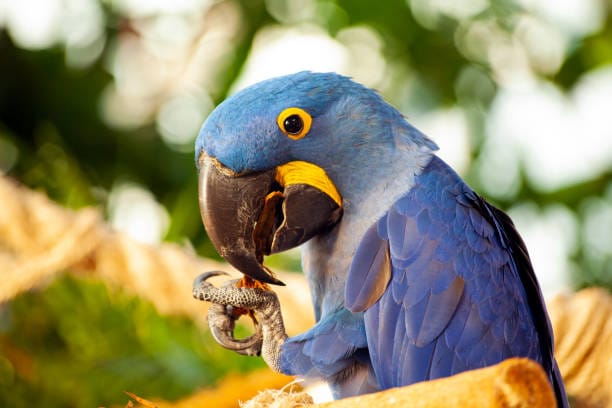
Physical Characteristics & Identification Tips
The Hyacinth Macaw is often described as the “gentle giant” of wild parrots, and its appearance makes that nickname feel fitting. Stretching up to 40 inches from beak to tail, this is the largest flying parrot on Earth. Its entire body is covered in deep cobalt feathers that shimmer in sunlight, giving the bird a naturally dramatic look. What usually surprises first-time observers are the bright yellow eye-rings and the matching yellow skin patch along the lower bill. These markings act like built-in highlighters, making the bird stand out even in dense woodland.
Identification becomes easier the moment you see that massive charcoal-black bill. It looks like it could crush a coconut—and truthfully, it almost can. The Hyacinth Macaw uses that strong bill to open tough nuts that most animals ignore. Another helpful tip for spotting them is their long, tapered tail, which makes their silhouette appear unusually elongated when they glide overhead.
Behavior
Despite their imposing size, Hyacinth Macaws behave more like easygoing giants. They move in pairs or small family groups, calling to one another with vocalizations that sound rough but carry an oddly affectionate tone. These parrots spend much of the day foraging on the forest floor or high in palm trees. Their social nature means they often pause to preen a partner, engage in gentle bill-touching, or perform small playful bouts that look like slow-motion wrestling sessions.
Flight patterns are typically calm and steady. They rely on long, powerful wingbeats instead of quick flicks, which gives them a distinctive gliding style. And while they are generally peaceful birds, they switch to defensive mode if a nest hole is threatened, sometimes puffing up and making themselves appear even larger.
Habitat and Range
The Hyacinth Macaw inhabits scattered regions across Brazil, eastern Bolivia, and parts of Paraguay. Unlike parrots that prefer thick rainforest, Hyacinths thrive in more open environments—especially savannas dotted with palms. They rely heavily on the nut-bearing palm species of the Pantanal and Cerrado. These areas provide a mix of tall vegetation for nesting and scattered food sources spread out across the landscape.
In some seasons, the birds shift between wetlands, grasslands, and lightly wooded zones as different trees produce fruit. This semi-nomadic behavior makes sightings unpredictable, but local guides often track their seasonal routes based on palm fruit cycles.
Diet
Their diet centers around extremely hard nuts, especially those from the acuri and bocaiuva palm. Few animals can crack these, so the Hyacinth Macaw faces little competition. They supplement with small fruits, seeds, and occasionally soft vegetation when palm nuts are scarce. Watching one eat is a show in itself: the bird braces a nut with its foot, gnaws through the shell, and extracts the kernel with remarkable precision.
Reproduction and Life Cycle
Hyacinth Macaws breed slowly, which is one reason their populations remain vulnerable. They typically choose hollow cavities in tall trees, though old woodpecker holes are also prized nesting sites. Pairs show strong bonding and often remain together for many years. Females lay 1–2 eggs, but in many cases, only one chick survives to fledging.
The chick remains with its parents long after leaving the nest, sometimes following them for months as it learns how to open nuts and identify safe feeding grounds. These slow life cycles mean every successful chick is significant for long-term population stability.
Fun Facts / Distinctive Traits
- Their beaks are strong enough to open Brazil nuts that humans normally crack with tools.
- They occasionally “stash” nuts in small crevices, unintentionally helping palm trees spread.
- Despite their size, they sound surprisingly conversational when interacting with partners.
Human Interaction
Human activity has shaped Hyacinth Macaw populations through habitat changes and illegal trade. Conservation work in Brazil—especially community-driven nest monitoring and palm habitat restoration—has helped stabilize numbers in some regions. In places where they coexist with cattle ranchers, the birds sometimes feed on fallen palm fruit near grazing areas, creating occasional close encounters with humans. Many locals enjoy seeing them around, and some ecotourism operations protect nesting trees because they draw birdwatchers from around the world.
5. Rainbow Lorikeet
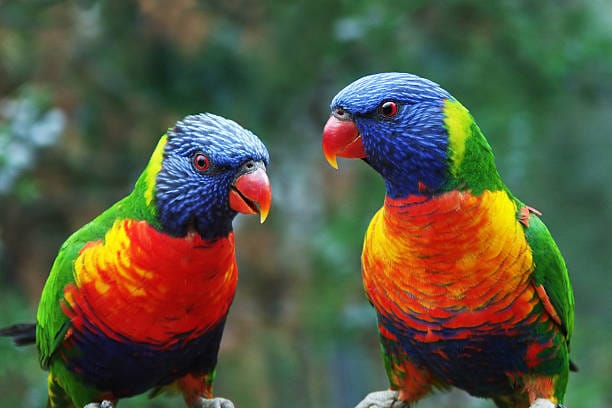
Physical Characteristics & Identification Tips
Spotting a Rainbow Lorikeet feels like stumbling into a box of crayons. Their plumage is a vivid patchwork: a sapphire-blue head, bright green wings, a fiery orange chest, and a belly banded with deep purple. Even at a distance, these parrots look like flying sparks. They are medium-sized, usually around 10–12 inches long, and their long, pointed tail gives them a sleek profile.
A distinctive feature is their brush-tipped tongue. It’s specially shaped for lapping up nectar, and if you’re close enough, you may see it flick out as they feed. Their call—an unmistakable shrill chatter—also helps identify them long before they appear.
Behavior
Rainbow Lorikeets behave like social butterflies. They move quickly, chatter constantly, and seem to thrive on chaos. Flocks can transform a quiet grove into a noisy, colorful scene. Their acrobatic feeding habits are especially entertaining: they dangle upside down, hop between flowers, and occasionally squabble over prime nectar spots.
These parrots are strong fliers, darting through open spaces with surprising speed. They form long-term pair bonds, and partners often travel side by side during flight, calling back and forth as if keeping track of each other.
Habitat and Range
Rainbow Lorikeets primarily inhabit coastal regions of Australia, though some populations have expanded into urban parks and suburban neighborhoods. They prefer areas with abundant flowering trees—especially eucalyptus and banksia forests. Their adaptability has allowed them to thrive even in modified landscapes, making them one of the more commonly observed wild parrots in cities like Brisbane, Sydney, and Perth.
Outside Australia, small introduced populations exist in New Zealand and parts of Southeast Asia. These groups often flourish due to the birds’ ability to exploit ornamental flowering trees.
Diet
Nectar makes up a large portion of their diet. Their specialized tongue allows them to extract nectar with remarkable efficiency. They also feed on pollen, soft fruits, and occasionally insects. Because they travel frequently in search of flowering trees, they act as important pollinators. Their feeding behavior often leaves them dusted with pollen, making them walking (or flying) advertisements for the plant species they visit.
Reproduction and Life Cycle
Rainbow Lorikeets nest in tree hollows, returning to the same sites year after year. Pairs share responsibilities—one incubates while the other gathers food. They usually lay two eggs per clutch, and chicks grow quickly due to the high-energy diet provided by both adults.
Once fledged, young lorikeets continue following their parents until they master the art of nectar-hunting. During this time, their plumage gradually brightens, giving them that classic “rainbow” appearance as they mature.
Fun Facts / Distinctive Traits
- They sometimes get “drunk” on fermented nectar, leading to clumsy behavior.
- Their tongues resemble tiny paintbrushes.
- They form lifelong pair bonds and frequently preen each other.
Human Interaction
In many Australian cities, Rainbow Lorikeets have become everyday companions. Residents often see them visiting backyard feeders or roosting in huge evening flocks. Their bold personality makes them fun to watch, though occasionally they cause mischief—especially when raiding fruit trees. Conservation-wise, they remain stable, but wildlife agencies remind people to avoid feeding them sugary human foods that can harm their health.
6. Eclectus Parrot
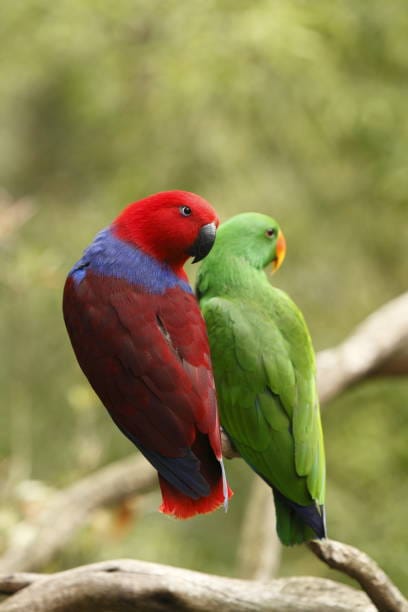
Physical Characteristics & Identification Tips
The Eclectus Parrot stands out for its dramatic color difference between males and females—one of the most striking examples of sexual dimorphism among parrots. Males are bright emerald green with pops of red and blue under the wings, while females boast crimson-red bodies and royal-blue bellies. Their beaks also differ: males feature a bright orange upper mandible, while females have a deep black one.
These contrasting color forms were once mistakenly believed to be separate species. They are medium-sized parrots with a sturdy build, round heads, and a calm expression that hints at their composed temperament.
Behavior
Eclectus Parrots are generally calm, observant, and deliberate in their movements. They prefer slow, methodical climbing over chaotic flapping, though they fly strongly when necessary. Unlike certain parrots that chatter constantly, Eclectus vocalizations tend to be more measured—though they can be quite loud when alarmed.
Females tend to dominate nesting territories, sometimes guarding them aggressively. Males, on the other hand, act as providers during the breeding season, traveling long distances to gather fruit and deliver it to the female and chicks.
Habitat and Range
These parrots inhabit rainforests across Papua New Guinea, the Solomon Islands, and parts of northeastern Australia. They prefer dense canopy layers, where they move between fruiting trees with ease. Because they rely heavily on natural hollows for nesting, they stay close to mature forest structures.
Some populations also occupy lowland scrub, mangrove edges, and forest-savanna borders. Their range remains patchy, influenced heavily by food availability.
Diet
Eclectus Parrots are predominantly frugivores. They feast on figs, berries, and a wide range of rainforest fruit. Their digestive system is adapted for processing high-fiber plant material, allowing them to extract nutrients efficiently. They occasionally consume flowers and leafy buds.
Because fruiting trees can be unpredictable, Eclectus Parrots often shift feeding sites daily, making them hard to track.
Reproduction and Life Cycle
Their breeding system is unusual. Females defend nest hollows so fiercely that several males may court and feed the same female. This polyandrous tendency is rare in parrots and leads to complicated social dynamics around nesting trees. Females lay 1–2 eggs, and the incubation period lasts just over a month.
Chicks grow slowly and remain in the nest longer than many parrot species. Even after fledging, they rely on their parents for guidance until they gain confidence among the high forest branches.
Fun Facts / Distinctive Traits
- One of the few parrot species where males and females look dramatically different.
- Their feathers have a hair-like texture up close, giving them a soft appearance.
- Females sometimes vocalize loudly at intruders to warn them away from nest hollows.
Human Interaction
Eclectus Parrots have long drawn interest for their striking colors and calm demeanor. In their native regions, they are occasionally seen near village edges where fruit trees are abundant. Habitat reduction remains the biggest issue for wild populations, especially in areas where old trees are removed. Conservation groups focus on protecting mature forests and maintaining natural nesting cavities.
Local communities often participate in monitoring nest sites, and ecotourism has helped raise awareness about their needs.
7. Sun Parakeet

Physical Characteristics & Identification Tips
The Sun Parakeet (also called the Sun Conure) is a living splash of sunrise. Adults display a dazzling palette: golden-orange heads and breasts, green backs and wings edged with blue, and a short, rounded tail that often shows red and blue highlights. They measure roughly 12 inches (30 cm) in total length including the tail, and their stout, hooked bill is coal-black. Young birds are duller and greener; the full orange plumage develops as juveniles mature. In flight the bird’s bright underside peeks out, making the species easy to identify even at distance. Look also for a white eye-ring and vocal, nasal calls — both good field clues when color alone is obscured by light or canopy.
Behavior
Sun Parakeets are dynamic and social. In the wild they form noisy flocks that move through fruiting trees in coordinated bursts. Their activity is highest in early morning and late afternoon. They can be bold and curious around new objects, investigating branches, seed pods, and tree cavities with rapid hops and short flights. Pair bonds are strong; mates preen each other frequently and call with soft contact notes when nearby. These birds are also opportunistic problem-solvers: they pry at bark, manipulate food items with their feet, and test new food sources cautiously but persistently.
Habitat and Range
Sun Parakeets are native to northeastern South America, principally northeastern Brazil, with small occurrences in Guyana and Venezuela. They favor woodland edges, gallery forests along rivers, and seasonally flooded forests where fruiting trees are abundant. Unlike deep-forest specialists, they tolerate partially open landscapes and clearings if food is present. Seasonal movements follow fruiting schedules; during lean periods they may concentrate around reliable fruit sources or isolated fruiting palms.
Diet
Fruits and seeds dominate the Sun Parakeet’s menu. They eat figs, palm fruits, berries, and a variety of forest seeds. Their strong bill handles medium-hard fruits and seed pods; they strip husks and chew kernels with deliberate bites. Occasionally they take blossoms and nectar, and small insects may be eaten by youngsters for extra protein. Because they feed on a diverse suite of forest plants, they can act as seed dispersers for several tree species.
Reproduction and Life Cycle
Sun Parakeets nest in tree cavities, often high above ground to reduce predation risk. Courtship includes mutual feeding and close preening. Females typically lay 3–4 eggs, which hatch after roughly three weeks of incubation. Both parents feed the chicks; fledging occurs around six to eight weeks, though youngsters often cling near the nesting tree longer while learning flight paths and food sources. Maturity is reached in under a year, but full breeding competence and stable pair bonds usually develop later.
Fun Facts / Unique Traits
- Their brilliant plumage makes them conspicuous, which is why they rely on flocking and alarm calls rather than stealth to avoid predators.
- Sun Parakeets often bathe in fresh fruit juice spilled during feeding sessions, a quirky behavior that helps clean feathers and remove sticky residues.
- They are frequently one of the earliest species to show up at fruiting trees at dawn, making them useful indicators of seasonal food availability for other species.
Human Interaction
Historically prized for their striking appearance, Sun Parakeets have suffered from habitat loss and capture for the pet trade. Conservation measures in parts of Brazil and community education programs aim to reduce illegal trapping. In areas where ecotourism is growing, parakeets are often a highlight for visitors, providing income incentives to local people to protect habitat. Responsible conservation balances protection of nesting trees and fruiting sites with outreach that discourages capture and promotes habitat restoration.
8. Turquoise-Fronted Amazon
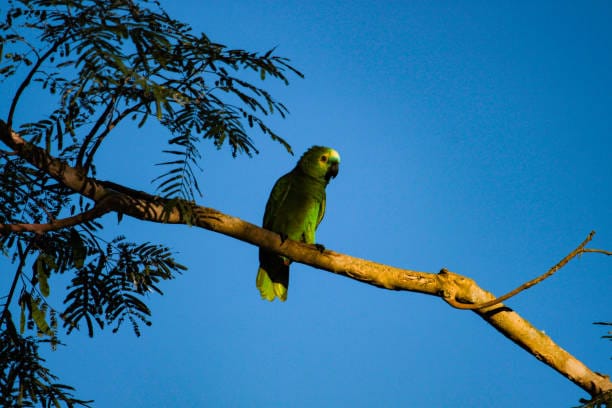
Physical Characteristics & Identification Tips
The Turquoise-Fronted Amazon (sometimes called the Blue-fronted Amazon in avian literature) is a medium-sized parrot, about 13–16 inches (33–40 cm) long. It shows vivid green plumage overall, with a distinctive turquoise or blue wash on the forehead and upper crown that gives the species its common name. The face and throat often feature variable yellow and orange highlights, and flight feathers may flash blue and red. A hooked, pale beak and a broad tail complete the profile. Listen for clear, penetrating calls and mimicry elements; the species is vocally versatile and often betrays its presence by sound before color is seen.
Behavior
These Amazons are gregarious and energetic. Flocks feed openly in the canopy, moving methodically between fruiting trees and seed stands. They are bold, sometimes approaching cleared fields and farmlands to feed on cultivated fruits. Social hierarchies within flocks are expressed through subtle bill-waving, feather-ruffling, and displacement at favored perches. Breeding pairs cooperate on nest defense, and group members may act as sentinels while others forage. In flight they show strong, direct wingbeats and can cover significant distances to reach seasonal feeding areas.
Habitat and Range
Native to central and eastern South America, Turquoise-Fronted Amazons occupy savanna woodlands, forest edges, and disturbed areas where fruiting trees persist. They are tolerant of secondary growth and agroforestry landscapes, which has allowed some populations to persist near human settlements. Seasonal use of wetlands and river margins also occurs when food resources are concentrated along waterways.
Diet
A mixed diet of seeds, fruits, blossoms, and occasionally cultivated crops sustains these birds. They are known to exploit agricultural fields—especially maize, sorghum, and fruit orchards—bringing them into conflict with farmers in some regions. Seeds with hard coats are opened using the parrot’s strong bill, while softer fruits are manipulated and swallowed with quick, repeated pecks.
Reproduction and Life Cycle
Nesting typically occurs in tree cavities or termite mounds in some localities. Clutch sizes usually range from 2–4 eggs, incubated chiefly by the female while the male supplies food. Chicks are altricial and require intensive parental care; they fledge after several weeks but may remain dependent for longer as they learn foraging techniques. Life expectancy in the wild can reach two decades under favorable conditions.
Fun Facts / Unique Traits
- These Amazons are adept vocal imitators and can copy a range of environmental sounds, which helps maintain flock cohesion.
- They sometimes engage in “food displays” during courtship where a male offers a prized fruit to a female as part of pair bonding.
- Juveniles often have duller foreheads, acquiring the turquoise tint as they age.
Human Interaction
Because they sometimes raid crops, Turquoise-Fronted Amazons can be perceived as pests, prompting local mitigation measures such as guarding fields and using deterrents. Conversely, where birdwatching and ecotourism are established, they are a valued attraction that supports habitat protection. Conservation strategies emphasize coexistence: promoting fruit tree corridors and maintaining old trees for nesting reduces conflict while helping populations remain stable.
9. Spix’s Macaw
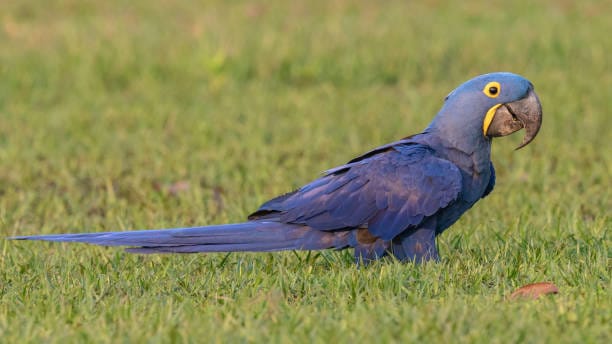
Physical Characteristics & Identification Tips
Spix’s Macaw is a small-to-medium macaw famed for its pale, powder-blue plumage and subtle grayish head tones. Historically it showed a slim profile, a long tapered tail, and a pale, hooked bill. In the field, its light coloration and distinctive flight silhouette made it unmistakable among the green-dominated parrot community of the Brazilian caatinga and gallery forests. Males and females appear similar, though careful observers may note slight size differences. Because the species spent recent decades virtually absent in the wild, many identification records come from historical accounts and pre-extinction observations.
Behavior
Traditionally, Spix’s Macaws were reported as shy and somewhat secretive, occurring in small family groups. They foraged on the ground and in low trees, probing for seeds and fruits with deliberate, careful movements. Their flight was described as fast and direct, with long loops between feeding sites. Vocal behavior included harsh, metallic calls used to maintain contact across the open Caatinga.
Habitat and Range
Spix’s Macaw was endemic to a very narrow range in northeastern Brazil, primarily the riparian gallery forests and adjacent dry scrub known as the caatinga. This habitat mosaic—riverine trees amid otherwise arid scrub—provided specialized food and nesting trees. The species’ reliance on a tight habitat band made it extremely vulnerable to disturbance and deforestation.
Diet
Diet mainly consisted of seeds from native trees and shrubs, as well as fruits and certain palm kernels. Their bill allowed them to open tougher seeds other species could not process. Seasonal availability of favored seeds dictated local movements and nesting timing.
Reproduction and Life Cycle
Nesting historically occurred in hollow trees along river corridors. Clutches were likely small—commonly 2 eggs—and chick survival depended on stable water regimes and intact riparian stands. Natural breeding was curtailed heavily as populations collapsed; most recent reproduction has taken place under managed, captive-breeding programs aimed at reintroduction.
Fun Facts / Unique Traits
- Spix’s Macaw became globally famous after dramatic declines and an iconic conservation story that inspired books and films.
- Its pale blue color is especially striking against the parched backdrop of caatinga vegetation, a rare bright note in an otherwise muted landscape.
- The species’ tiny natural range once made it a flagship for habitat protection in northeastern Brazil.
Human Interaction
Spix’s Macaw suffered catastrophic decline due to habitat loss, river diversion, and capture for the international pet trade. By the early 21st century it was functionally extinct in the wild. Intensive international captive-breeding programs have now produced birds for carefully managed reintroduction efforts. These programs combine habitat restoration, nest-tree protection, and community engagement to attempt a cautious return of the species to protected forest corridors. The Spix’s story remains a powerful reminder of both the damage humans can cause and the focused recovery work that can offer a second chance.
10. Western Rosella
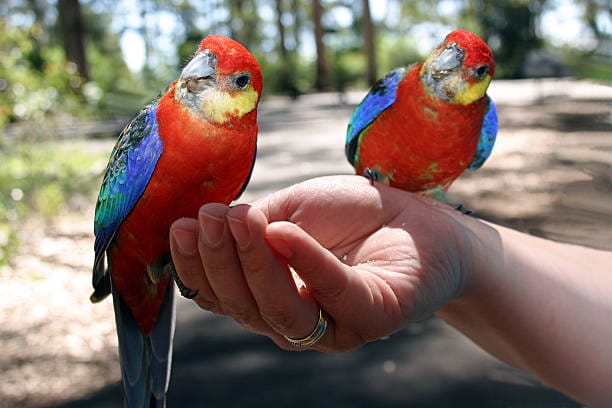
Physical Characteristics & Identification Tips
The Western Rosella (Platycercus icterotis) wears a neatly painted outfit: a warm, speckled chest, red face, and a mix of olive, yellow, and blue across wings and back. This medium-sized parrot, roughly 28–30 cm long, shows a distinct scalloped pattern on the underparts that helps separate it from other rosellas at a glance. Adult males usually have brighter red on the head and throat, while females and juveniles present a somewhat duller tone and less pronounced throat coloration. The bill is short and stout, suited for manipulating seeds and peeling fruit. When trying to identify one in the field, look for that combination of red facial mask and speckled breast — together they form a reliable field mark even when the bird is perched partially obscured by foliage.
Behavior
The Western Rosella is alert and deliberate. It forages with a patient rhythm, clambering through low branches and tussocks in search of seeds, grasses, and fruits. Unlike some parrots that scream and fly as a flock, Western Rosellas often move in small family groups or pairs, giving the observer quiet moments to appreciate their behavior. They can be surprisingly curious, approaching new clearings or waterholes cautiously rather than boldly. During the breeding season, adults intensify calls and increase territorial displays, often chasing rivals with rapid, low flights that look like short, purposeful sprints through the undergrowth.
Habitat and Range
Endemic to southwestern Australia, the Western Rosella inhabits scrublands, eucalypt woodlands, and coastal heaths. It prefers landscapes that combine open ground for foraging with scattered trees for nesting and roosting. These birds also frequent agricultural margins and orchards, where fallen fruit and seeds are easy pickings. Seasonal shifts in food availability prompt local movements; during dry spells they may concentrate near permanent water and irrigated farmland.
Diet
Seeds form the backbone of the Western Rosella’s diet. They feed on grass seeds, native shrub fruits, and occasional insect larvae. Their strong bill peels seed husks and extracts nutritious kernels with efficient, repeated motions. In orchards and gardens they will take ripe fruit and fallen grain, which sometimes brings them into conflict with growers. However, their role in consuming and dispersing seeds also contributes to natural regeneration in their native habitats.
Reproduction and Life Cycle
Western Rosellas nest in natural tree hollows, typically in mature eucalypts. Pairs defend nest sites vigorously, and clutch sizes average 4–6 eggs. Females handle most of the incubation while males deliver food and stand guard. Chicks are altricial and require considerable parental investment; both adults feed the young until fledging, and juveniles often hang back near family groups while learning to forage and avoid predators. The species can raise one to two broods in good seasons, making them resilient where habitat remains intact.
Fun Facts / Distinctive Traits
- The Western Rosella’s speckled underbelly is an excellent camouflage in sun-dappled grassland, breaking up its outline when it forages at ground level.
- They sometimes form loose associations with other seed-eating birds, exploiting the same patches of fallen seed and grain.
- Young birds show noticeably plainer plumage, which slowly brightens over their first year.
Human Interaction
Where human land use keeps scattered trees and hedgerows, Western Rosellas often persist and even thrive in mixed landscapes. Conservation measures that retain mature hollow-bearing trees are crucial, because nest cavities are a limiting resource. Urban expansion and intensive agriculture that remove old trees reduce nesting opportunities. Community programs that protect remnant woodlands and plant native seed-producing shrubs can make a tangible difference for local populations. Birdwatchers prize these rosellas for their understated beauty and approachable behavior, and citizen science surveys often rely on public sightings to monitor population changes.
11. Pale-Headed Rosella
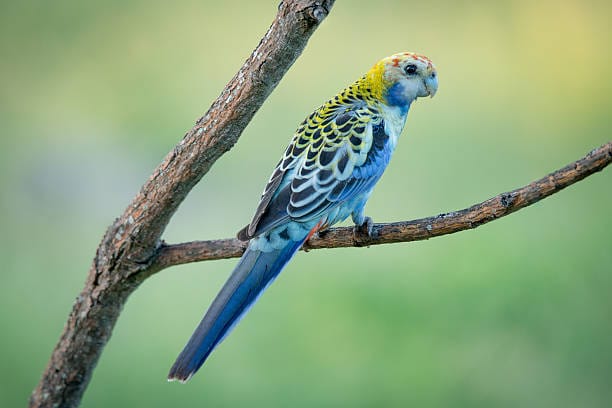
Physical Characteristics & Identification Tips
The Pale-Headed Rosella (Platycercus adscitus) combines soft elegance with clear field marks. As the name suggests, adults show a pale cream-to-pinkish head that contrasts with a green back, blue cheek patches, and a red rump. The chest has subtle scalloping similar to other rosellas, but the pale head quickly distinguishes this species. Size is comparable to the Western Rosella—around 28–30 cm—and the bill is well-adapted for seed-eating. When observing a rosella with a noticeably light head and a splash of blue on the cheeks, you’re likely looking at this species.
Behavior
Pale-Headed Rosellas are lively but less conspicuous than some parrots. They forage in pairs or small groups, often under tree canopies or in open paddocks. They display winter-into-spring flurries of activity during the breeding season, with increased calling and aerial chases among males vying for nesting hollows. They are alert for predators, and their flight between feeding trees is typically quick and low, a zig-zagging pattern that helps them slip through vegetation.
Habitat and Range
This species inhabits eastern Australia—from Queensland down through New South Wales into northeastern Victoria. It favors open woodland, dry forest edges, farmlands with scattered trees, and sometimes suburban parks. The availability of hollow-bearing trees for nesting defines much of their local distribution. They adapt well to edge habitats where food resources are interspersed with safe nesting sites.
Diet
Seeds and small fruits dominate the diet, with grasses and legumes featuring heavily. They may descend to the ground to glean fallen seed heads, and they are adept at extracting seeds from pods. Occasional insect prey supplements protein intake for growing chicks. During seasons of abundant fruiting, they shift behavior to exploit high-energy food sources, which supports breeding and juvenile growth.
Reproduction and Life Cycle
Pale-Headed Rosellas nest in tree hollows, preferring depths that shelter eggs and chicks from heat and predators. Typically, 4–6 eggs are laid per clutch, with incubation lasting a few weeks. Both parents feed the chicks, and fledging occurs after several weeks, followed by an extended period of post-fledging dependence. The species is able to raise multiple broods in favorable years, but scarcity of nesting hollows often limits reproductive success.
Fun Facts / Distinctive Traits
- The pale head may help reflect sunlight, a subtle adaptation to hotter, more open habitats.
- They sometimes hybridize with related rosella species where ranges overlap, producing intermediate plumages.
- Pale-Headed Rosellas often have a stately, measured foraging style—less frantic than some lorikeets or conures.
Human Interaction
Agricultural landscapes that preserve paddock trees and hedgerows support Pale-Headed Rosella populations. Removal of old trees and over-clearing have localized impacts. Community-driven restoration that replaces lost hollows—using nest boxes—has proven effective in some areas. Because they remain reasonably tolerant of human presence, these rosellas serve as ambassadors for small-scale conservation efforts: protecting a few mature trees can help several breeding pairs each year.
12. Black Lory
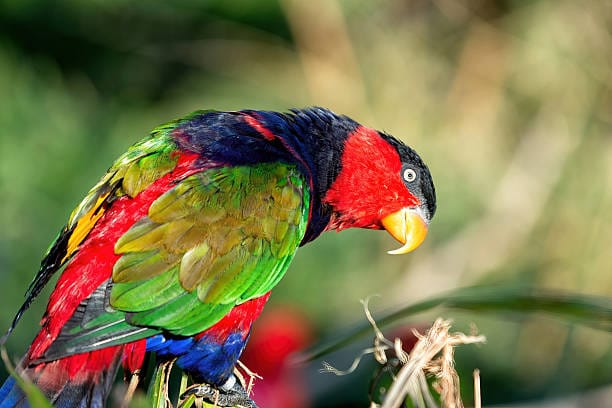
Physical Characteristics & Identification Tips
The Black Lory (Chalcopsitta atra) is a strikingly dark parrot from New Guinea and nearby islands. Its plumage ranges from glossy black to very deep green-black, often showing subtle iridescence in good light. A vivid red patch on the underwing or rump (in some individuals) and yellow bare skin at the base of the bill provide contrast and aid identification. They measure around 30–35 cm and have a somewhat compact, muscular build. Look for a stout red or orange bill in some subspecies, and strong zygodactyl feet—typical of lories—that grip branches tightly while they feed.
Behavior
Black Lories are energetic and noisy. They move in noisy flocks, calling constantly as they travel between flowering trees and fruiting stands. They are acrobatic feeders, clinging to branches, hanging upside down, and probing flowers with brush-tipped tongues when nectar is available. Their social interactions include mutual preening, aggressive scolding at intruders, and coordinated flight patterns that make for dramatic roost exits at dawn.
Habitat and Range
Native to New Guinea, the Black Lory inhabits lowland and hill forests, forest edges, and occasionally plantations with abundant flowering trees. They use various forest strata but often feed and travel through mid-canopy levels where flowers and fruits are plentiful. Their distribution includes several islands, and local populations may vary in plumage sheen and rump coloration.
Diet
Unlike most seed-cracking parrots, lories specialize on nectar, pollen, and soft fruits. The Black Lory’s brush-tipped tongue is perfect for lapping nectar from flowers and scraping pollen. They also take figs, berries, and occasionally small insects for protein. This diet makes them important pollinators for several native plant species, and their feeding movements can dust plant parts with pollen that aids cross-pollination.
Reproduction and Life Cycle
Black Lories nest in tree hollows or sometimes cliff cavities, laying 2–3 eggs per clutch. Both parents share duties: incubating, guarding, and later feeding highly dependent chicks. Fledging follows several weeks of intensive feeding. Juveniles often remain with family parties for extended learning, absorbing complex feeding routes and vocal dialects.
Fun Facts / Distinctive Traits
- As nectar feeders, Black Lories are often seen zipping between flowers like tiny hummingbirds in function, if not in size.
- Their brush-tipped tongues are specialized tools that look almost like paintbrushes—nature’s version of a honey-dipper.
- They can be quite bold around human habitations that have flowering ornamentals, leading to frequent local sightings.
Human Interaction
Habitat loss and capture for the pet trade have affected some local Black Lory populations, though they are less targeted than brighter, rarer parrots. In regions where native forests are intact, they remain common and are valued for their role as pollinators. Conservation efforts that protect forested corridors and flowering tree assemblages benefit both lories and the broader ecosystem. Community education helps reduce trapping and emphasizes the ecological role these birds play in maintaining diverse plant communities.
13. Blue Lorikeet
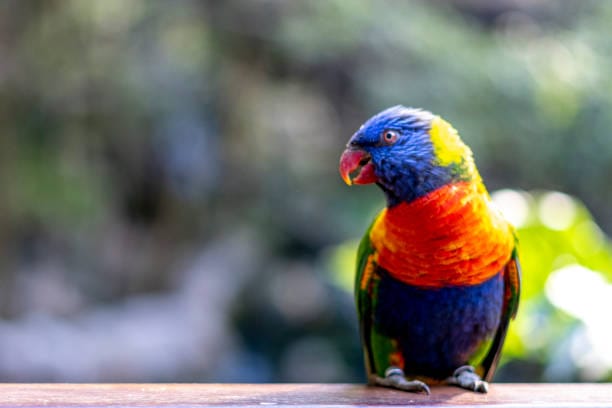
Physical Characteristics & Identification Tips
The Blue Lorikeet is a compact, vividly colored parrot, almost entirely cloaked in rich cobalt and sapphire tones. Adults measure roughly 15–18 cm in length with a bright orange-red bill and reddish-orange eyes that contrast sharply with the blue plumage. The underparts sometimes show paler blue or slight purplish hues while the wings may reflect teal in certain lights. Its compact size, uniform blue coloring and the intense color of the bill make the species easy to distinguish in coastal forests and gardens. Observers will often notice a rapid, high-pitched chatter and quick, darting flight before the bird itself becomes visible.
Behavior
Blue Lorikeets are active, social birds that forage in small flocks. They spend much of their time clinging to flowers and shrubs, using a brush-tipped tongue to gather nectar and pollen. Their movements are quick and deliberate; they frequently dart between flowering branches and engage in short chases around favored food sources. These lorikeets are bold foragers and will defend rich nectar patches from competitors, using loud calls and brief aggressive displays to maintain access. They are also playful, often seen hanging upside down or performing rapid acrobatic moves while feeding.
Habitat and Range
Native to parts of the South Pacific, including islands in French Polynesia, the Blue Lorikeet inhabits coastal forests, coconut groves and scrublands where flowering plants are abundant. They prefer areas with a good supply of nectar-bearing plants and can adapt to slightly disturbed habitats that still provide floral resources. Due to limited island ranges, their distribution is patchy and sensitive to habitat change.
Diet
The diet of the Blue Lorikeet is centered on nectar and pollen, supplemented with soft fruits and occasional small insects. The specialized, brush-tipped tongue allows efficient access to floral rewards, and birds frequently move between tree species to follow flowering cycles. Their feeding behavior often results in pollen transfer between plants, making them effective pollinators within their native ecosystems.
Reproduction and Life Cycle
Blue Lorikeets nest in tree cavities, commonly choosing palm hollows or other sheltered sites. Pairs lay typically two eggs per clutch, and both parents participate in provisioning the chicks. Chicks hatch altricial and are fed nutrient-rich regurgitated food until they fledge. Young birds mature relatively quickly and begin to experiment with nectar feeding and social interactions within a few months of fledging.
Fun Facts / Unique Traits
Blue Lorikeets display an unusually uniform blue coloration that distinguishes them from many other parrots; their brush-like tongues are specialized tools for nectar feeding; and they closely track flowering patterns, shifting local ranges according to bloom availability.
Human Interaction
Historically kept locally as pets on some islands, Blue Lorikeets benefit from habitat protection and invasive-species control. Conservation efforts focus on protecting floral resources and preventing introduced predators. When present in village gardens, they are often appreciated for their vivid color and pollination role, though populations remain vulnerable to habitat alteration.
14. Galah
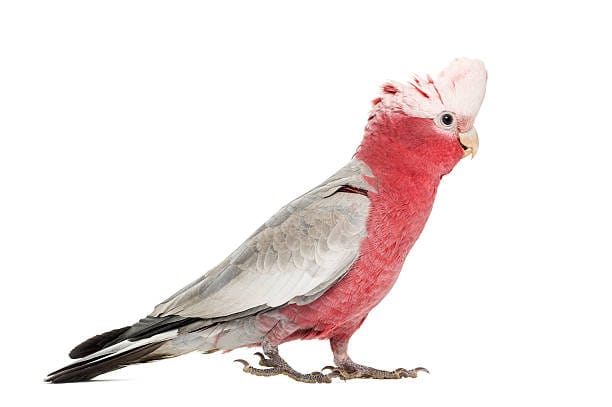
Physical Characteristics & Identification Tips
The Galah is a medium-sized cockatoo noted for its soft rose-pink chest and face, paired with pale grey wings and a silver-white crown. Adults measure around 30–38 cm in length and show a stout body and short, rounded tail. Juveniles appear duller than adults but quickly brighten as they mature. The distinctive pastel coloration, stout shape and characteristic flight pattern—strong wingbeats with loud calls—make the Galah one of the most recognizable Australian parrots.
Behavior
Galahs are highly social and gregarious. They form large flocks and engage in energetic social interactions that include aerial acrobatics, vocal exchanges and playful behaviors such as raucous chases and branch-rolling. They display strong problem-solving skills, often working together to access food or water sources. Pairs show close bonds and may be seen preening each other frequently. The species is also known for playful behaviors in response to rain or novelty objects.
Habitat and Range
Widespread across Australia, Galahs inhabit grasslands, open woodlands, agricultural areas and urban fringes. They are adaptable to human-altered landscapes and often exploit water sources and croplands provided by agricultural practices. Their range has expanded in some regions where cleared landscapes create abundant seed resources and new water points.
Diet
Seed-based diets dominate, with grass seeds and cereal crops making up a large proportion of their intake. They forage largely on the ground in flocks, gleaning fallen seeds and occasionally feeding on fruit, flowers and small invertebrates for additional protein. In agricultural zones, flocks may exploit sowed fields and pastures, sometimes causing conflicts with farmers.
Reproduction and Life Cycle
Galahs form long-term pair bonds and nest in tree hollows. Clutches usually contain two to five eggs, and both parents contribute to incubation and chick rearing. Chicks are fed by regurgitation and remain dependent on adult provisioning for several weeks after fledging. Parental care and cooperative behaviors help ensure strong juvenile survival where nesting sites remain available.
Fun Facts / Unique Traits
Galahs are famed for their playful antics and capacity for mimicry; they may “dance” during rainfall and engage in complex social play. Their long-term pair bonds have cultural resonance in Australia as symbols of loyalty and companionship.
Human Interaction
Galahs tolerate human proximity well and often forage near farms and towns. While they can be agricultural pests when present in large numbers, many people appreciate their charismatic behavior. Conservation attention focuses on preserving large hollow-bearing trees used for nesting, as loss of mature trees can limit breeding opportunities.
15. Pesquet’s Parrot (Dracula Parrot)
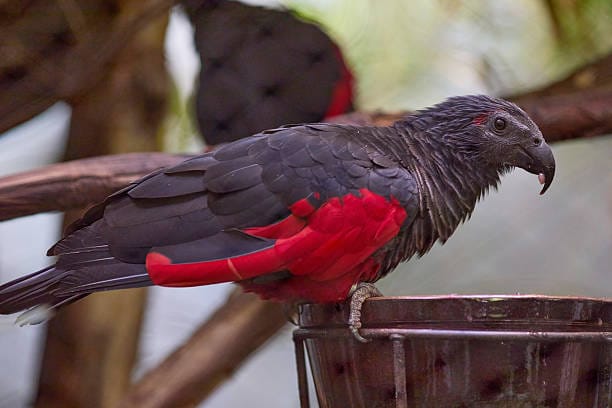
Physical Characteristics & Identification Tips
Pesquet’s Parrot, commonly dubbed the Dracula Parrot, is notable for a striking combination of bare black facial skin, charcoal-gray body feathers and a deep crimson breast and belly. Adults measure approximately 45 cm in length with a strong, hooked beak adapted for consuming large, fleshy fruits. The bare head likely serves to reduce feather fouling when feeding on sticky fruits such as figs. Their dramatic coloration and distinctive silhouette make them unmistakable among New Guinea’s rainforest parrots.
Behavior
Pesquet’s Parrots are relatively quiet and deliberate in behavior compared with many other parrots. They often move through the canopy in small parties, making resonant, low calls that carry over distances. During feeding bouts they perch calmly on exposed branches and may remain stationary while consuming large fruits. Their flight is direct and powerful, and pairs or small groups maintain close proximity while traveling between fig and fruit trees.
Habitat and Range
Endemic to the rainforests of New Guinea, Pesquet’s Parrot prefers mid-elevation forests and foothills where fig trees and other large-fruited species are common. They are most often encountered in relatively intact forest tracts and are sensitive to heavy disturbance or clearance that removes key food resources.
Diet
This species is a specialized frugivore, heavily reliant on figs and other large fruits. Their strong bill allows them to open tough fruit skins and access the nutritious pulp inside. The bare head and neck facilitate feeding on sticky fruit while reducing the risk of feather matting. They seldom consume seeds or flowers and show a marked preference for certain fig species that drive local movements and seasonal patterns.
Reproduction and Life Cycle
Nesting takes place in large tree hollows, often high above the forest floor. Clutch sizes are small, typically one to two eggs, and chicks develop under extended parental care. Young fledge slowly as they learn the complex skills required to locate and handle large, seasonal fruits. Longevity in the wild is not well documented, but adults that survive early pressures may persist for many years in stable forest habitats.
Fun Facts / Unique Traits
Pesquet’s Parrot’s bare black face gives it the “Dracula” nickname, but this adaptation is a practical trait linked to its dietary specialization on sticky figs. It is one of the few parrots whose appearance diverges so strongly from the common image of a feathered head, and this makes it an instantly memorable species for birdwatchers.
Human Interaction
Pesquet’s Parrot faces threats from habitat loss and hunting for feathers and meat in some localities. Conservation efforts emphasize protection of fig-rich forest tracts and community engagement to reduce hunting pressure. Because of its striking appearance and ecological role as a frugivore, it is a charismatic target for ecotourism initiatives that can support local conservation while providing economic benefits to communities that protect forest stands.
16. Bourke’s Parrot
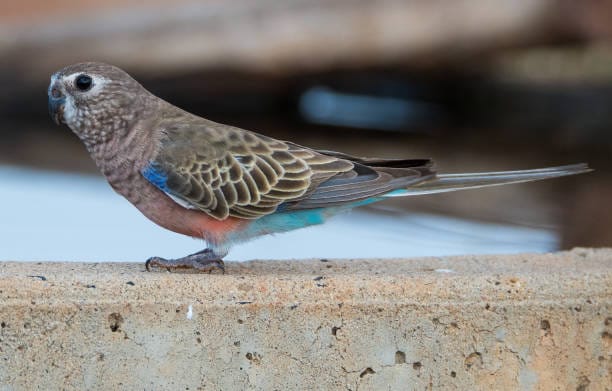
Physical Characteristics & Identification Tips
Bourke’s Parrot is a small, slender-bodied species known for its soft pastel coloration. Adults display a rosy-pink breast, blue undertail, and subtle brown wings with bluish edging. Their calm demeanor and gentle flight make them stand out among more vocal Australian parrots. At roughly 19–23 cm long, they can be identified by their quiet flight calls and smooth, gliding movements at dusk and dawn.
Behavior
This species is notably peaceful and often moves in small, loose flocks. Bourke’s Parrots are most active during twilight, where they feed and travel while avoiding the midday heat. They communicate with soft, musical chirps rather than loud calls and spend considerable time foraging quietly on the ground.
Habitat and Range
Native to Australia’s arid inland regions, Bourke’s Parrots inhabit dry grasslands, scrublands, and open woodlands dominated by acacia and eucalyptus. Their distribution follows areas with reliable water sources and suitable ground vegetation.
Diet
Their diet consists mainly of grass seeds, herb seeds, and tender plant shoots. During wetter periods, they may also consume flowers and small fruits for supplemental moisture.
Reproduction and Life Cycle
Nesting occurs in tree hollows or crevices in dead branches. Females typically lay three to five eggs, with males assisting by feeding the female during incubation. Chicks fledge after several weeks and remain close to their parents until they can forage independently.
Fun Facts / Unique Traits
Bourke’s Parrots are one of the few parrot species that are crepuscular, being most active at dawn and dusk.
Human Interaction
They have adapted well to rural landscapes where water tanks and scattered trees are present. Conservation status remains stable thanks to their tolerance of semi-modified habitats.
17. Golden-Shouldered Parrot
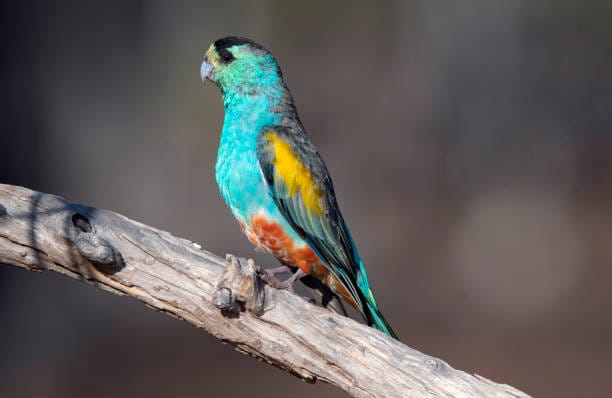
Physical Characteristics & Identification Tips
The Golden-Shouldered Parrot is a striking small parrot native to northern Australia. Males show vibrant turquoise bodies, black crowns, and bright golden-yellow shoulder patches—the species’ hallmark feature. Females are duller, predominantly green with subtler yellow tones. Their slender build and swift, direct flight help distinguish them from similar grassland parrots.
Behavior
This species is active, alert, and often seen foraging in pairs or small groups. They rely on open visibility in grasslands to detect predators and frequently perch on low shrubs to scan their surroundings. Courtship behaviors include gentle chattering, wing displays, and coordinated feeding.
Habitat and Range
Golden-Shouldered Parrots inhabit tropical savannas and open woodland-grassland mosaics in Cape York Peninsula. They depend on termite mounds for nesting, choosing mounds with specific shapes and orientations that provide heat regulation.
Diet
Their diet consists mainly of grass seeds, especially native sorghum and other annual grasses. They supplement seeds with small invertebrates, particularly during breeding season when protein needs increase.
Reproduction and Life Cycle
Uniquely, this species nests inside termite mounds. The female excavates a burrow in the mound where two to four eggs are laid. Termite activity helps regulate temperature, creating a stable incubation environment. Both parents assist in feeding the chicks until fledging.
Fun Facts / Unique Traits
The Golden-Shouldered Parrot’s dependence on termite-mound nesting makes it one of Australia’s most specialized parrot species.
Human Interaction
Habitat alteration and predation by invasive species have reduced populations. Conservation programs focus on controlled burning, habitat restoration, and predator management.
18. Moluccan Cockatoo
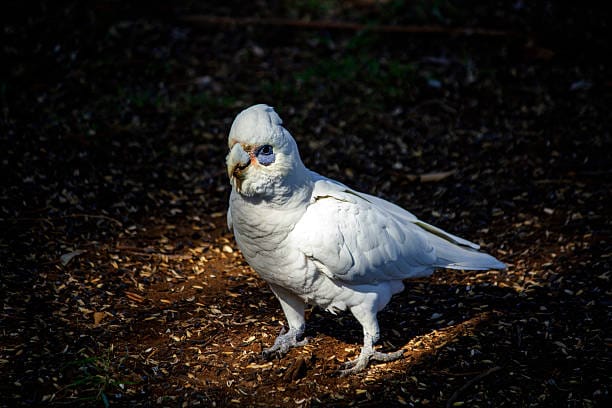
Physical Characteristics & Identification Tips
The Moluccan Cockatoo is a large, charismatic parrot recognized by its Salmon-pink plumage and spectacular crest. Adults reach up to 50 cm in length and display a powerful beak and broad wings. The expanding fan-shaped crest, colored in peach and salmon shades, is a key identifier.
Behavior
Highly intelligent and emotionally expressive, Moluccan Cockatoos form strong pair bonds and communicate through loud, resonant calls. They are playful, curious, and often engage in complex social behaviors. Their vocalizations can carry long distances through the forest canopy.
Habitat and Range
Endemic to the Moluccan Islands of Indonesia, they inhabit lowland rainforests, forest edges, and partially disturbed woodlands. They rely heavily on large old-growth trees for nesting cavities and feeding perches.
Diet
The diet consists of seeds, nuts, fruits, berries, and occasionally insects. Their powerful beaks allow them to crack tough seeds and extract flesh from hard-shelled fruits.
Reproduction and Life Cycle
Moluccan Cockatoos usually lay two eggs per clutch, with both parents participating in incubation and chick feeding. Chicks develop slowly and remain dependent on adults for an extended period, learning complex social behaviors.
Fun Facts / Unique Traits
They are considered one of the most emotionally expressive parrots—capable of showing excitement, anxiety, and affection through crest movements and vocal tones.
Human Interaction
Due to habitat loss and trapping for trade, the species is listed as vulnerable. Conservation efforts include habitat protection, anti-poaching patrols, and captive-breeding programs aimed at supporting wild populations.
19. Red-Tailed Black Cockatoo
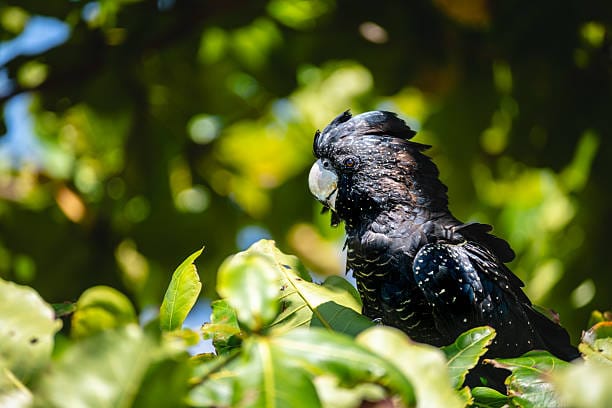
Physical Characteristics & Identification Tips
The Red-Tailed Black Cockatoo is a large, visually impressive parrot native to Australia. Males are easily recognized by their deep black plumage and vivid red tail panels, while females display dark brown feathers with yellow spotting and orange-yellow barring on the tail. Their large curved bills, strong flight silhouette, and loud, rolling calls make them unmistakable in the wild.
Behavior
These cockatoos are social birds that often move in flocks, particularly during feeding or traveling between roosts. Their behavior includes playful aerial maneuvers, mutual preening, and strong loyalty to established flight paths passed down through generations. They are known for their loud contact calls, which help flock members keep track of each other in open landscapes.
Habitat and Range
Red-Tailed Black Cockatoos occupy a wide range of habitats across northern and inland Australia. They are commonly found in eucalyptus woodlands, open forests, and regions with abundant hardwood trees. Specific populations are tied to particular tree species that supply nesting hollows and food sources.
Diet
Their diet consists of seeds from native trees, nuts, fruits, and occasionally insect larvae. They often feed on the ground beneath trees, breaking open seed pods with their powerful bills. In some regions, they also feed on seeds of desert oak, casuarina, and eucalyptus.
Reproduction and Life Cycle
Breeding pairs nest in large tree hollows high off the ground. Females usually lay one egg per season. The chick remains in the nest for several weeks and depends heavily on parental feeding until it gains independence. Their slow breeding rate makes habitat protection especially important for population stability.
Fun Facts / Unique Traits
These cockatoos can live for decades in the wild, with some individuals believed to reach nearly 50 years of age.
Human Interaction
Habitat loss and reduced availability of nesting hollows have affected certain regional populations. Conservation measures focus on protecting old-growth trees and minimizing disturbance around established nesting areas.
20. Glossy Black Cockatoo
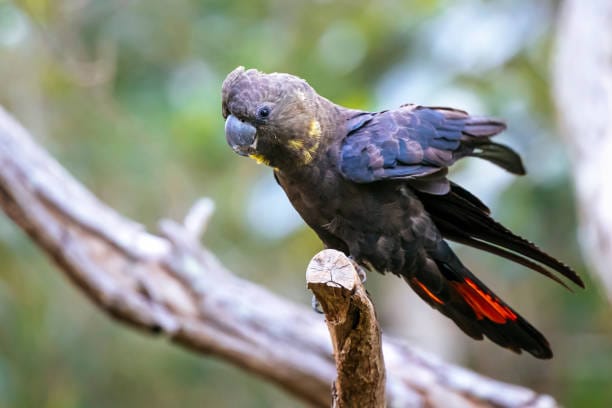
Physical Characteristics & Identification Tips
The Glossy Black Cockatoo is a smaller and more understated relative of the Red-Tailed species. Males are predominantly dark black with a bright red panel on the tail, while females have scattered yellow patches on the head and neck. Their overall softer appearance makes them easier to identify among Australia’s cockatoos. Their stout bill is adapted for cracking she-oak cones, a signature food item.
Behavior
This cockatoo is quieter and more reserved compared to other large parrots. They often feed in small family groups and spend long periods carefully chewing through cones. Their calm, methodical feeding makes them easier to observe once located. Mated pairs form strong lifelong bonds and communicate through soft grunts and whistles.
Habitat and Range
Glossy Black Cockatoos inhabit coastal forests, woodlands, and areas dominated by she-oak stands in eastern Australia. Their distribution is patchy because they depend heavily on specific tree species for both feeding and nesting.
Diet
This species is a specialist feeder, relying mainly on the seeds of she-oaks. They extract seeds using their powerful bills and specialized tongues. Their dependence on a single food source makes them highly vulnerable to changes in landscape composition.
Reproduction and Life Cycle
Nesting usually occurs in deep hollows of large eucalypt trees. Females lay one egg per clutch, and both parents help raise the chick. Fledging takes several weeks, followed by an extended dependency period where parents continue to feed the juvenile.
Fun Facts / Unique Traits
After feeding, they leave behind distinctive piles of chewed seed cones known as “orts,” a telltale sign of their presence.
Human Interaction
Loss of she-oak forests has significantly impacted some regional populations. Restoration projects planting she-oaks have become a crucial conservation tool.
21. Kea
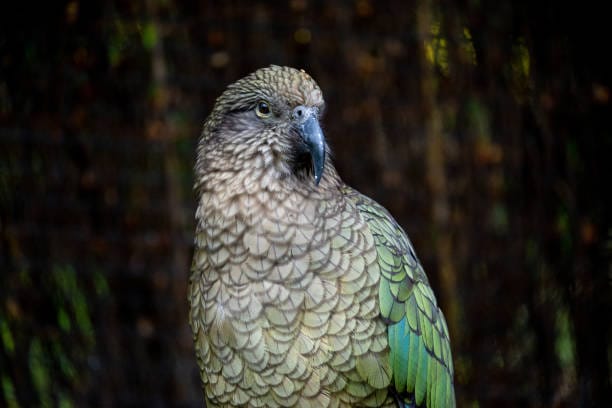
Physical Characteristics & Identification Tips
The Kea is a highly intelligent alpine parrot found in New Zealand. It has olive-green plumage with darker edging and a brilliant orange underwing visible in flight. Its long, narrow, curved bill and confident posture make it instantly recognizable. Juveniles have pale yellow around the eyes and nostrils, while adults develop deeper coloration with age.
Behavior
Kea behavior is famously mischievous. These parrots are curious, playful, and bold—often investigating backpacks, cars, and anything left unattended. They use problem-solving skills to exploit new food sources, often working together in inventive ways. Vocalizations range from sharp contact calls to haunting, flute-like whistles.
Habitat and Range
Kea inhabit alpine and subalpine regions of the South Island, frequenting forests, rocky slopes, and high-altitude meadows. They move seasonally, descending to lower elevations in winter when food becomes scarce.
Diet
Kea have an extremely varied diet, feeding on fruits, roots, leaves, nectar, seeds, and insects. They also scavenge carrion and may visit human settlements for scraps. Their omnivorous feeding habits allow them to survive in harsh mountain environments.
Reproduction and Life Cycle
Nesting occurs in cavities among rocks, fallen logs, or underground crevices. Females lay two to four eggs, with males providing food throughout the incubation period. Chicks fledge after several weeks but continue to rely on adults for guidance.
Fun Facts / Unique Traits
The Kea is the only alpine parrot in the world and is widely regarded as one of the most intelligent bird species on the planet.
Human Interaction
Historically persecuted due to damage they occasionally caused to property or livestock, Kea populations have declined. Conservation programs now focus on education, predator control, and habitat protection to prevent further losses.
22. Kakapo
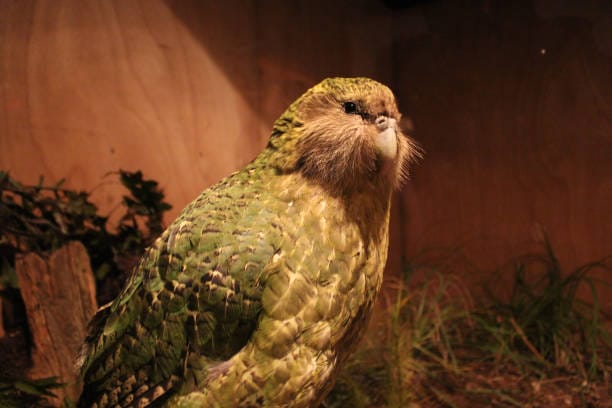
Physical Characteristics & Identification Tips
The Kakapo is one of the most extraordinary parrots on Earth. This large, flightless, moss-green bird has a rounded body, soft owl-like facial discs, and finely mottled plumage that blends perfectly into New Zealand forests. Adults can weigh over 3 kg, making them the heaviest parrot. Their wings are short, used more for balance than flight, and their gait resembles a slow, deliberate waddle. The pale blue bill and expressive eyes add to their “wise old forest guardian” appearance.
Behavior
Kakapos are nocturnal and solitary, spending most nights foraging quietly along forest floors. Males perform low-frequency “booming” calls during breeding seasons—sounds that travel for kilometers. They dig shallow bowls in the ground and use them like natural amplifiers. Their calm, gentle demeanor makes them unlike most parrots known for constant chatter.
Habitat and Range
Kakapos historically inhabited much of New Zealand’s forests, but today they survive only on predator-free islands. Their preferred habitat includes dense native vegetation, shady understories, and areas rich in rimu trees—an important seasonal food source.
Diet
They eat leaves, fruits, seeds, bark, and plant shoots. The rimu fruit plays a critical role in triggering breeding cycles, and years of heavy rimu fruiting lead to successful nesting seasons.
Reproduction and Life Cycle
Kakapos have one of the slowest reproductive rates of any bird. Females may breed only once every 2–4 years depending on food availability. A typical clutch includes 1–3 eggs, incubated solely by the female. Chicks grow rapidly but stay vulnerable for extended periods due to the species’ ground-nesting habits.
Fun Facts / Unique Traits
The Kakapo is the world’s only flightless parrot and the only parrot species that uses a “lek breeding system”—where males compete with deep booming calls rather than bright plumage.
Human Interaction
Human arrival, habitat clearing, and introduced predators nearly wiped Kakapos out. Today, intensive conservation—round-the-clock monitoring, supplemental feeding, and genetic management—keeps their fragile population slowly rising.
23. Cockatiel
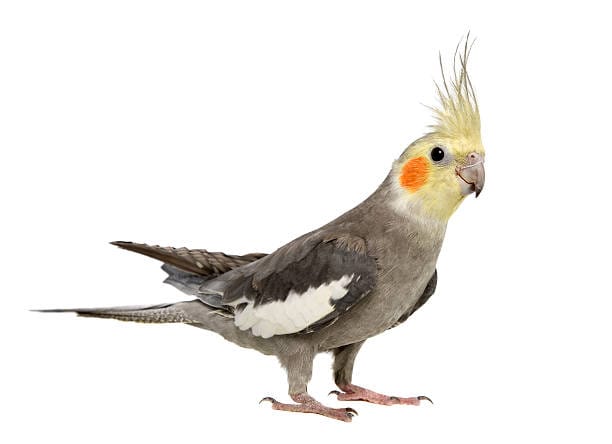
Physical Characteristics & Identification Tips
The Cockatiel is a slender, long-tailed parrot with a charming crest that rises when excited or curious. They display soft gray plumage in the wild, accompanied by a bright yellow face and orange cheek patches in males. Females typically show muted colors and horizontal barring under their tail. Their graceful silhouette, pointed wings, and lively crest movements make identification straightforward.
Behavior
Cockatiels are sociable, vocal, and gentle. Wild birds travel in small flocks, often communicating through soft whistles. They are strong fliers capable of long-distance travel between feeding and watering sites. Their curious and calm nature makes them easy to observe in the wild.
Habitat and Range
Native to Australia, Cockatiels inhabit arid and semi-arid regions, open grasslands, and woodland edges. They often remain near water sources and tree-lined riverbanks, where nesting hollows are abundant. Their adaptability allows them to thrive across much of the continent.
Diet
They feed primarily on grass seeds, grains, and small insects. After rainfall, they gather near fresh plant growth to consume tender shoots. Their nimble foraging behavior includes ground feeding and quick takeoffs when alarmed.
Reproduction and Life Cycle
Cockatiels breed opportunistically after good rains. They nest in tree hollows, laying 4–7 eggs per clutch. Both parents incubate the eggs and share chick-rearing duties. Fledglings leave the nest after several weeks but remain loosely attached to their flock.
Fun Facts / Unique Traits
Their expressive crest acts like a mood indicator—standing tall when surprised and lying flat when relaxed.
Human Interaction
While common as pets, wild populations remain healthy throughout Australia. Agricultural expansion has even increased available food in many regions, leading to population stability.
24. Budgerigar (Budgie)
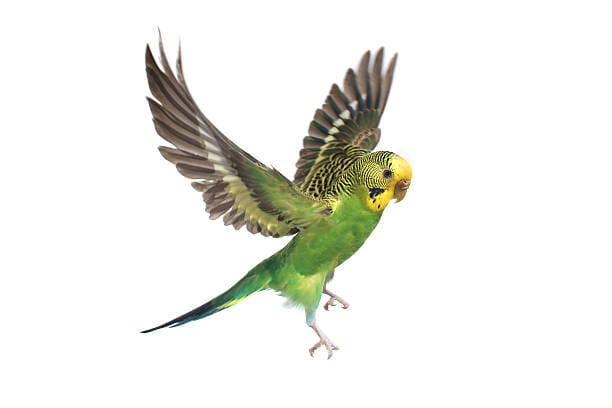
Physical Characteristics & Identification Tips
The Budgerigar is a small, slender parrot with bright green plumage, scalloped black markings, and a long tapered tail. Their blue ceres (the fleshy area above the beak) indicate males, while females typically show brown or whitish ceres. In flight, their rapid wingbeats and sharp chirps make them easy to identify.
Behavior
Budgerigars form large, lively flocks that move across the landscape in search of food and water. They are playful, energetic, and constantly vocalizing. Their coordinated flock movements resemble waves of color sweeping across the sky. They are excellent problem solvers and display strong flock loyalty.
Habitat and Range
Wild Budgerigars inhabit Australia’s open plains, inland scrub, and arid grasslands. They travel nomadically, following seasonal rains to locate areas with abundant seeds. Their ability to adapt to changing climates allows them to survive even in challenging conditions.
Diet
Their diet consists mainly of grass seeds, grain, and occasional fruits. After rainfall, they take advantage of new seed growth, often forming dense feeding flocks.
Reproduction and Life Cycle
Budgies breed whenever food is plentiful. They lay 4–8 eggs inside tree hollows or fallen logs. The rapid development of their chicks allows flocks to rebuild quickly after favorable weather conditions.
Fun Facts / Unique Traits
Budgies are one of the most widespread wild parrots in Australia and can form massive flocks that darken the sky during flight.
Human Interaction
Domesticated budgies differ significantly in color from wild populations. Despite their popularity as pets, wild numbers remain strong thanks to their nomadic resilience and fast breeding cycles.
25. Plum-Headed Parakeet

Physical Characteristics & Identification Tips
The Plum-Headed Parakeet is a medium-sized parrot native to the Indian subcontinent. Males display striking purple-red heads, contrasting with their bright green bodies and blue tail. Females have a duller grayish head, making the species strongly dimorphic. Their slender body shape, long tail streamers, and elegant flight help distinguish them from similar parakeets.
Behavior
These parakeets are calm, gentle, and often travel in small groups. Their flight is swift and direct, punctuated by soft, musical calls. During feeding, they may hang upside down from branches, displaying impressive agility.
Habitat and Range
Found across India, Nepal, and Sri Lanka, they inhabit wooded foothills, forest edges, plantations, and rural orchards. They prefer areas with scattered trees, where food is abundant and nesting hollows are accessible.
Diet
They feed on fruits, seeds, flower buds, and cultivated grains. They occasionally visit orchards, where their fondness for soft fruits is well known among farmers.
Reproduction and Life Cycle
Nesting occurs in natural tree cavities. A typical clutch contains 4–5 eggs. Chicks grow steadily and fledge within several weeks, remaining near parents or siblings for extended periods before joining new flock groups.
Fun Facts / Unique Traits
The species is known for its graceful flight; their long tail streamers create a pleasant ribbon-like silhouette against the sky.
Human Interaction
While not endangered, Plum-Headed Parakeets face some habitat pressure from deforestation. They coexist relatively well with humans, frequenting gardens and farmlands with minimal conflict.
Conclusion
Wild parrots represent some of the most vibrant, intelligent, and ecologically significant birds on the planet. From the critically endangered Kakapo to the charismatic Kea and the brilliantly colored macaws and lorikeets, each species carries its own story, behaviors, and adaptations that highlight the diversity of the parrot family. Understanding these species not only deepens our appreciation for their beauty but also emphasizes the urgent need for global conservation efforts. As habitats shrink and illegal wildlife trade continues to threaten populations, protecting wild parrots becomes essential to preserving the balance of their ecosystems. By learning about these remarkable birds, we take one step closer to ensuring their survival for future generations.
Frequently Asked Questions About Wild Parrots
1. What defines a wild parrot?
Wild parrots are naturally occurring parrot species that live in forests, savannas, mountains, or islands without human domestication.
2. Where are wild parrots commonly found?
They are most commonly found in Australia, South America, Africa, Southeast Asia, and various Pacific islands.
3. Are wild parrots endangered?
Many species are endangered due to habitat loss, illegal trade, and climate change.
4. Why are some wild parrots so brightly colored?
Their bright colors help with mate attraction, camouflage in tropical environments, and species recognition.
5. What do wild parrots eat?
They typically eat seeds, fruits, nuts, flowers, nectar, insects, and sometimes tree bark.
6. How long do wild parrots live?
Lifespan varies widely, ranging from 10 years in small species to 60+ years in larger macaws and cockatoos.
7. Do wild parrots mimic sounds like pet parrots?
Yes, many wild parrots mimic other birds, predators, or environmental sounds as communication tools.
8. How many species of wild parrots exist?
There are roughly 400–430 parrot species worldwide, depending on taxonomic classification.
9. Are wild parrots monogamous?
Most parrot species form lifelong pair bonds and share nesting duties.
10. How do parrots communicate?
They use vocal calls, squawks, body posture, feather positioning, and mimicry.
11. What is the rarest wild parrot?
The Spix’s Macaw and the Kakapo are among the rarest, both critically endangered.
12. Do wild parrots migrate?
Most do not migrate long distances, but some make seasonal movements in search of food.
13. How do wild parrots choose nesting sites?
Many nest in tree cavities, cliffs, termite mounds, or burrows depending on species.
14. What predators hunt wild parrots?
Predators include snakes, raptors, large mammals, and feral cats.
15. Are wild parrots intelligent?
Yes, parrots are considered highly intelligent with advanced problem-solving skills.
16. Can wild parrots fly long distances?
Most species are strong flyers and can cover large distances when searching for food.
17. Why do parrots flock together?
Flocking provides safety from predators, better foraging, and social interaction.
18. What causes population decline in wild parrots?
Deforestation, poaching for the pet trade, climate change, and invasive species are major threats.
19. Are wild parrots noisy?
Yes, many species use loud calls to communicate across forest canopies.
20. Do wild parrots use tools?
Some species, like the Kea, have shown primitive tool use and advanced manipulation skills.
21. Do wild parrots bathe?
Yes, many bathe in rainwater, rivers, or dew-covered foliage.
22. What is a parrot’s main defense?
Flight, loud alarm calls, strong beaks, and flock cooperation help protect them.
23. Do all parrots have curved beaks?
Yes, their hooked beaks are a defining trait and essential for climbing and cracking food.
24. How do parrots help the environment?
They disperse seeds, pollinate plants, and support forest regeneration.
25. Can wild parrots be albino?
Yes, but it is extremely rare due to their need for camouflage and survival.
26. How do baby wild parrots develop?
Nestlings hatch blind and featherless, relying on both parents for feeding and protection.
27. Are wild parrots territorial?
Some species defend strong territories, while others live cooperatively in large groups.
28. Do wild parrots mate for life?
Many species do, forming strong lifelong pair bonds.
29. What sounds do wild parrots make?
They produce chirps, whistles, squawks, screeches, and complex vocal patterns.
30. Do wild parrots recognize individual flock members?
Yes, parrots can identify partners and flockmates by voice and behavior.
31. How fast can wild parrots fly?
Speed varies by species, but many can fly 30–50 mph, with some reaching higher speeds.
32. Do wild parrots drink nectar?
Species like lorikeets specialize in nectar feeding using brush-tipped tongues.
33. Why do parrots chew wood?
Chewing helps maintain beak shape and creates nesting cavities.
34. Are wild parrots good parents?
Yes, parents often share feeding duties and protect their young fiercely.
35. Can wild parrots survive in cold climates?
A few species like the Kea thrive in colder mountain regions, but most prefer warm climates.
36. How do wild parrots find food?
They use sight, memory, and flock cooperation to locate fruiting trees and food sources.
37. Do wild parrots migrate at night?
Most parrots are diurnal and travel only during daylight hours.
38. Are wild parrots protected by law?
Many species are protected under CITES and national wildlife laws to prevent illegal trade.
39. What is the biggest wild parrot?
The Hyacinth Macaw is the largest flying parrot species.
40. What is the smallest wild parrot?
The Buff-faced Pygmy Parrot is among the smallest, weighing only a few grams.
41. Do wild parrots interact with humans?
Some species living near villages or urban areas become accustomed to human presence.
42. How can we help conserve wild parrots?
Supporting habitat protection, ethical tourism, anti-poaching programs, and sustainable forestry can help protect wild parrot populations.
Read more: 30 Types of Spiders in Texas (Pictures And Identification)