

Types of Flying fish are among the most fascinating creatures in the ocean, known for their ability to glide above the water using wing-like fins. Found mainly in warm tropical seas, these fish use their unique adaptation to escape predators such as tuna, marlin, and even large crustaceans like the King crab. In simple terms, flying fish don’t truly fly—they glide across the ocean surface for distances of up to 200 meters. In this guide, we’ll explore 50 different species, starting with the first 10 types, helping you identify them easily while learning their behaviors, habitats, and unique features.
50 Types of Flying Fish
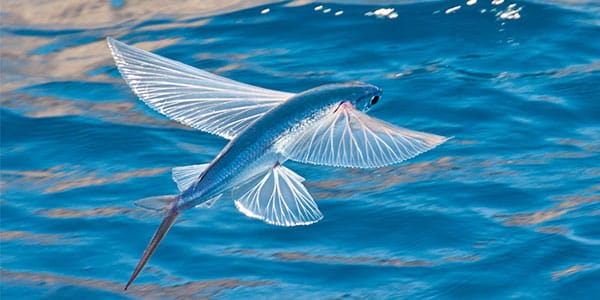
1. Exocoetus volitans (Tropical Two-Wing Flying Fish)
Exocoetus volitans is one of the most widely recognized flying fish species in the world. Found across tropical and subtropical oceans, this species is often the first one people encounter when learning about flying fish. It has a streamlined body with long pectoral fins that act like wings, allowing it to glide gracefully above the water.
This species typically grows up to 30 cm in length and feeds mainly on plankton and small crustaceans. Its ability to escape predators is remarkable, launching itself from the water at high speed and gliding for several seconds. The body is usually silver-blue, helping it blend with the ocean surface.
What makes this species unique is its efficiency in gliding. It can adjust its fins mid-air to extend flight distance. For beginners, this is the classic example when identifying Types of Flying fish in the wild.
2. Exocoetus obtusirostris (Bluntnose Flying Fish)
This species is easily identified by its shorter, rounded snout compared to other flying fish. It lives in warm ocean waters and prefers open seas far from shorelines. Its body is sleek and slightly darker than other species, helping it stay hidden from predators below.
The bluntnose flying fish relies heavily on quick bursts of speed to escape danger. It launches itself using rapid tail movements, then spreads its fins to glide. Its flights are usually shorter but more frequent compared to other species.
This fish plays an important role in the marine food chain, serving as prey for larger fish and seabirds. Its presence often indicates a healthy ocean ecosystem.
3. Exocoetus monocirrhus (Bearded Flying Fish)
The bearded flying fish is named for a small filament or “beard” located under its chin. This unique feature makes it easy to identify among other Types of Flying fish. It inhabits tropical waters and is commonly seen near the surface.
This species is known for its agility. It can quickly change direction mid-glide, making it harder for predators to catch. Its diet consists mainly of tiny marine organisms.
The bearded flying fish is also important for scientific studies because it shows how small physical differences can impact flight behavior.
4. Exocoetus peruvianus (Peruvian Flying Fish)
Found along the Pacific coast of South America, this species is adapted to slightly cooler waters compared to other flying fish. It has a strong, muscular body that allows for powerful takeoffs.
Its fins are slightly shorter, meaning it glides shorter distances but compensates with stronger bursts of speed. Fishermen in Peru often recognize this species as part of the local marine biodiversity.
This species demonstrates how flying fish adapt to different ocean conditions, making it a valuable example for understanding evolution in marine animals.
5. Exocoetus gibbosus (Humpback Flying Fish)
This species gets its name from the slight hump on its back. Though subtle, this feature helps distinguish it from similar species. It is found in tropical oceans and is often seen in schools.
The humpback flying fish is a strong glider and can travel impressive distances when escaping predators. It feeds on plankton and small marine life near the surface.
Its schooling behavior increases survival rates, as predators find it harder to target a single fish.
6. Parexocoetus brachypterus (Sailfin Flying Fish)
This species is famous for its large, sail-like fins. These fins allow it to glide longer distances than many other species. It is commonly found in warm waters across the Indo-Pacific region.
The sailfin flying fish is highly active at night, feeding on plankton near the surface. Its large fins make it one of the most visually striking Types of Flying fish.
This species is often studied for its aerodynamic efficiency, inspiring designs in engineering and aviation.
7. Parexocoetus mento (Mento Flying Fish)
Parexocoetus mento is a smaller species but equally fascinating. It has a compact body and shorter fins, making it better suited for quick, short glides.
This fish is often found near coral reefs, where it can quickly escape into open water when threatened. Its behavior shows how flying fish adapt to different environments.
Despite its size, it plays an important role in the ecosystem by feeding on small organisms and serving as prey for larger species.
8. Parexocoetus hillianus (Hill’s Flying Fish)
This species is less commonly known but widely distributed in tropical oceans. It has a balanced body shape that allows for both speed and gliding ability.
Hill’s flying fish is often seen traveling in groups, especially during feeding times. Its coloration helps it blend into the ocean surface, reducing the risk of predation.
This species is a great example of how adaptation helps survival in open ocean environments.
9. Cheilopogon pinnatibarbatus (California Flying Fish)
This is one of the largest flying fish species, found along the Pacific coast. It has long fins and a powerful body, allowing it to glide over long distances.
Unlike many tropical species, this fish can tolerate cooler waters. It is often seen near the surface during calm weather conditions.
Its size and strength make it a favorite subject for marine researchers studying flight mechanics in fish.
10. Cheilopogon heterurus (Atlantic Flying Fish)
The Atlantic flying fish is widely distributed across the Atlantic Ocean. It has long, narrow fins that help it glide efficiently across the water.
This species is known for its endurance, often gliding multiple times in succession to escape predators. Its diet includes plankton and small marine organisms.
It is one of the most important species when studying Types of Flying fish due to its wide distribution and adaptability.
11. Cheilopogon nigricans (Dusky Flying Fish)
Cheilopogon nigricans, commonly known as the dusky flying fish, is recognized for its darker body coloration compared to many other flying fish species. This subtle but important feature helps it blend into deeper ocean waters, offering protection from predators below.
This species is typically found in tropical and subtropical seas, where it spends most of its life near the surface. Like other members of the Exocoetidae family, it feeds on plankton and small marine organisms.
The dusky flying fish is an efficient glider. It launches itself out of the water using rapid tail beats and spreads its large pectoral fins to glide smoothly above the waves. Its darker tone makes it slightly harder to spot, especially during low-light conditions.
For wildlife enthusiasts studying Types of Flying fish, this species is a great example of how coloration can play a key role in survival.
12. Cheilopogon suttoni (Sutton’s Flying Fish)
Cheilopogon suttoni is a lesser-known species but equally fascinating. It inhabits warm ocean waters and is often found far from shore, making sightings relatively rare.
This species has long, narrow fins that allow it to glide efficiently for moderate distances. Its body is slender and streamlined, designed for quick takeoffs and sustained glides.
One of its key traits is its adaptability. It can survive in varying ocean conditions, which makes it an important species for studying environmental changes.
Although not as famous as other Types of Flying fish, Sutton’s flying fish contributes significantly to marine biodiversity.
13. Cheilopogon cyanopterus (Blue-Wing Flying Fish)
The blue-wing flying fish stands out due to its striking fin coloration. Its pectoral fins often display a bluish tint, making it one of the more visually appealing species.
This species is commonly found in tropical waters, where it glides above the ocean surface to escape predators. Its gliding ability is well-developed, allowing it to travel impressive distances.
It feeds mainly on plankton and small crustaceans, playing a vital role in the ocean food web. Its bright fins may also serve as a form of communication or camouflage in certain lighting conditions.
For beginners learning about Types of Flying fish, this species is easy to recognize thanks to its unique coloration.
14. Cheilopogon furcatus (Forktail Flying Fish)
Cheilopogon furcatus is named for its distinctly forked tail, which plays a crucial role in its ability to launch out of the water. This tail design provides strong propulsion, allowing for powerful takeoffs.
It is widely distributed across warm ocean regions and is often seen gliding in groups. Its body is typically silver with subtle markings that help it blend into the ocean environment.
This species is known for its quick reflexes and ability to escape predators efficiently. It can perform multiple glides in succession, increasing its chances of survival.
The forktail flying fish is a classic example of how physical adaptations improve performance in the wild.
15. Cheilopogon agoo (Agoo Flying Fish)
Cheilopogon agoo is commonly found in the Indo-Pacific region. It is a medium-sized species with well-developed fins that allow for stable gliding.
This species is often seen near the surface during feeding periods. It consumes plankton and small marine organisms, contributing to the balance of ocean ecosystems.
Its gliding style is smooth and controlled, making it one of the more efficient species among the Types of Flying fish. It can travel significant distances when escaping predators.
Its presence in large numbers often indicates a healthy marine environment.
16. Cheilopogon atrisignis (Dark-Marked Flying Fish)
This species is named for the dark markings on its body and fins. These markings help it blend into shadowy areas of the ocean surface, reducing visibility to predators.
Cheilopogon atrisignis is typically found in tropical waters and prefers open ocean habitats. It is an active glider, capable of rapid escapes when threatened.
Its diet consists mainly of plankton, and it often feeds in schools, which increases safety and efficiency.
This species highlights how even small visual differences can provide major survival advantages.
17. Cheilopogon doederleinii (Doederlein’s Flying Fish)
Doederlein’s flying fish is a well-adapted species found in the Pacific Ocean. It has long, slender fins that allow for extended gliding across the water surface.
This species is known for its endurance. It can glide multiple times in a single escape sequence, making it harder for predators to catch.
It plays an important role in marine ecosystems, both as a consumer of plankton and as prey for larger animals.
Among the Types of Flying fish, this species is often studied for its efficient energy use during flight.
18. Cheilopogon melanurus (Black-Tail Flying Fish)
The black-tail flying fish is easily identified by the dark coloration on its tail. This feature makes it stand out from many other species in the same genus.
It is commonly found in warm ocean waters and is known for its strong gliding ability. Its tail not only aids in propulsion but also plays a role in steering during flight.
This species is often seen traveling in schools, especially during feeding times. Its behavior increases survival rates in predator-rich environments.
It is a great example of how visual traits can assist both identification and survival.
19. Cheilopogon spilopterus (Spotted Flying Fish)
Cheilopogon spilopterus is known for the spotted patterns on its fins and body. These markings provide camouflage, breaking up its outline when viewed from below.
This species is widely distributed in tropical oceans and is often observed gliding in calm conditions. Its glides are smooth and controlled, allowing it to cover moderate distances.
It feeds on small marine organisms and plays a key role in the ocean food chain.
For those studying Types of Flying fish, the spotted flying fish is one of the easiest to identify due to its distinctive pattern.
20. Cheilopogon unicolor (Uniform Flying Fish)
The uniform flying fish is named for its consistent body coloration. Unlike other species with markings or color variations, this fish has a more even tone across its body.
It is found in tropical and subtropical waters, where it glides above the surface to escape predators. Its gliding ability is reliable, though not as long-distance as some larger species.
This species feeds on plankton and small organisms, contributing to the balance of marine ecosystems.
Its simple appearance makes it an excellent comparison species when learning to identify different Types of Flying fish.
21. Cypselurus hiraii (Hirai’s Flying Fish)
Cypselurus hiraii is a lesser-known yet fascinating species within the flying fish family. It is typically found in warm Indo-Pacific waters, where it spends most of its life near the ocean surface. Like many Types of Flying fish, it relies on speed and gliding ability to escape predators.
This species has elongated pectoral fins that allow for smooth and controlled glides. Its body is slender and well-adapted for quick bursts of acceleration. When threatened, it rapidly beats its tail against the water before launching into the air.
Hirai’s flying fish feeds mainly on plankton and microscopic marine organisms. Though not widely studied, it plays an essential role in maintaining balance within its ecosystem.
22. Cypselurus katoptron (Mirror Flying Fish)
The mirror flying fish gets its name from its highly reflective, silver body. This reflective surface helps it blend with sunlight on the ocean, making it difficult for predators to detect.
It is commonly found in tropical seas and is known for its impressive gliding ability. Its fins are wide and slightly translucent, allowing for efficient air movement during flight.
This species demonstrates how physical adaptations like reflective scales can significantly improve survival in open water environments.
23. Cypselurus oligolepis (Small-Scaled Flying Fish)
Cypselurus oligolepis is distinguished by its smaller scales compared to other species. This feature gives its body a smoother appearance and may reduce drag while swimming.
It inhabits warm ocean waters and is often seen gliding just above the surface. Its flights are typically short but frequent, helping it evade predators effectively.
This species feeds on plankton and plays a crucial role in transferring energy through the marine food chain.
24. Cypselurus opisthopus (Rear-Fin Flying Fish)
This species is known for the positioning of its fins, which are slightly set toward the rear of its body. This unique feature may influence its gliding style and stability in the air.
Cypselurus opisthopus is found in tropical oceans and prefers open-water habitats. It is an active species that frequently glides to escape threats.
Its streamlined body and fin placement make it an interesting subject for researchers studying flight mechanics in fish.
25. Cypselurus poecilopterus (Variegated Flying Fish)
The variegated flying fish is known for its colorful and patterned fins. These patterns can vary, making each individual slightly unique in appearance.
This species is commonly found in warm ocean regions and is often seen gliding in schools. Its glides are stable and moderately long, helping it escape predators such as larger fish and seabirds.
Its striking appearance makes it one of the more visually interesting Types of Flying fish for wildlife observers.
26. Cypselurus callopterus (Beautiful-Fin Flying Fish)
As its name suggests, this species is admired for its elegant and well-developed fins. These fins allow for long, graceful glides above the water surface.
It is typically found in tropical and subtropical waters, where it feeds on plankton and small marine organisms. Its gliding ability is among the more refined within its genus.
This species is often used as an example when studying aerodynamic efficiency in marine animals.
27. Cypselurus angusticeps (Narrow-Head Flying Fish)
The narrow-head flying fish is characterized by its slimmer head shape. This adaptation may help reduce water resistance, allowing for faster swimming speeds.
It inhabits warm ocean environments and is an active glider. Its takeoff is quick, and it can cover moderate distances when escaping predators.
This species highlights how even small structural differences can influence performance in the wild.
28. Cypselurus naresii (Nares’ Flying Fish)
Cypselurus naresii is a widely distributed species found in tropical oceans. It has a streamlined body and large fins that enable efficient gliding.
This species is often seen near the surface during feeding times. It consumes plankton and small crustaceans, contributing to the marine food web.
Its adaptability makes it a key species for understanding environmental changes in ocean ecosystems.
29. Cypselurus comatus (Hair-Fin Flying Fish)
This unique species is known for the hair-like extensions on its fins, which give it a distinctive appearance. These structures may influence airflow during gliding.
Cypselurus comatus is found in warm ocean waters and is an active glider. Its flights are smooth and controlled, helping it evade predators effectively.
Its unusual fin structure makes it a favorite among researchers and wildlife enthusiasts.
30. Cypselurus hexazona (Six-Banded Flying Fish)
The six-banded flying fish is named for the distinct bands visible along its body. These markings provide camouflage, helping it blend into the ocean environment.
It is commonly found in tropical waters and is known for its strong gliding ability. Its flights can cover impressive distances when necessary.
This species is a great example of how coloration and patterning can enhance survival among Types of Flying fish.
31. Hirundichthys affinis (Fourwing Flying Fish)
Hirundichthys affinis, commonly known as the fourwing flying fish, is one of the most recognizable species in tropical Atlantic waters. Unlike two-wing species, it uses both its enlarged pectoral and pelvic fins to glide, giving it better lift and stability.
This species is widely observed near coastal and offshore waters, where it feeds on plankton and small marine organisms. Its gliding ability allows it to travel impressive distances when escaping predators.
Among all Types of Flying fish, this species is often used to demonstrate the evolution of extended gliding capabilities.
32. Hirundichthys rondeletii (Blackwing Flying Fish)
The blackwing flying fish is named for the dark coloration on its fins. This feature provides camouflage against the ocean surface when viewed from above.
It is commonly found in warm waters and is known for its quick, powerful takeoffs. Its glides are usually medium in length but highly controlled.
This species plays an important role in marine ecosystems as both predator and prey, contributing to ocean biodiversity.
33. Hirundichthys oxycephalus (Sharphead Flying Fish)
This species is easily identified by its pointed head, which helps reduce drag while swimming. Hirundichthys oxycephalus is widely distributed in tropical oceans.
It is an efficient glider, capable of escaping predators through rapid acceleration and stable flight. Its streamlined body enhances both swimming and gliding performance.
For those studying Types of Flying fish, this species highlights the importance of body shape in survival.
34. Hirundichthys speculiger (Mirrorwing Flying Fish)
The mirrorwing flying fish is known for its reflective fins, which shimmer in sunlight. This reflective quality helps confuse predators during flight.
It inhabits warm ocean regions and is often seen gliding near the surface. Its flights are smooth and visually striking.
This species demonstrates how visual adaptations can enhance both survival and identification.
35. Hirundichthys coromandelensis (Coromandel Flying Fish)
Found primarily in the Indian Ocean, this species is well adapted to coastal and open-water environments. It has strong fins that allow for stable gliding.
Its diet consists mainly of plankton, and it is often seen feeding near the surface. Its presence indicates a healthy marine ecosystem.
This species is a great example of regional adaptation among Types of Flying fish.
36. Hirundichthys marginatus (Margined Flying Fish)
The margined flying fish is named for the distinct edges on its fins. These markings make it easier to identify in the wild.
It is commonly found in tropical waters and is known for its consistent gliding performance. Its flights are steady and controlled.
This species shows how subtle physical traits can aid both survival and recognition.
37. Hirundichthys orbignyanus (Orbigny’s Flying Fish)
This species is found in warmer ocean regions and is known for its balanced body structure. It combines speed and gliding ability effectively.
Its fins are well-developed, allowing for efficient escapes from predators. It is often seen in small groups near the surface.
Orbigny’s flying fish is an excellent example of adaptability in open ocean environments.
38. Hirundichthys socorroensis (Socorro Flying Fish)
Named after Socorro Island, this species has a more limited distribution compared to others. It prefers specific ocean conditions, making it less commonly observed.
Despite its limited range, it is a capable glider with strong fins and a streamlined body. Its behavior is similar to other flying fish but adapted to its unique habitat.
This species highlights the diversity found within Types of Flying fish.
39. Hirundichthys rondeletii atlanticus (Atlantic Variant Flying Fish)
This regional variant of the blackwing flying fish is adapted specifically to Atlantic Ocean conditions. It shares many traits with its parent species but shows slight differences in size and coloration.
It is an active glider and plays a key role in the local marine food web. Its adaptability makes it an important subject for ecological studies.
This variation shows how species evolve differently based on geographic location.
40. Prognichthys brevipinnis (Short-Fin Flying Fish)
Prognichthys brevipinnis is known for its relatively shorter fins compared to other flying fish. While this limits its gliding distance, it compensates with quick and frequent launches.
This species is found in warm ocean waters and feeds on plankton. Its rapid escape strategy makes it effective at avoiding predators.
Among the Types of Flying fish, it stands out as an example of how different strategies can achieve the same goal—survival.
41. Prognichthys gibbifrons (Humphead Flying Fish)
Prognichthys gibbifrons is recognized for the slight hump on its head, which gives it a distinctive profile among flying fish. This structural feature may contribute to improved hydrodynamics when swimming at high speeds.
It is typically found in tropical ocean waters, where it feeds on plankton and small marine organisms. Its gliding ability is moderate but effective for escaping predators.
This species demonstrates how even small anatomical variations can influence survival strategies among Types of Flying fish.
42. Prognichthys sealei (Seale’s Flying Fish)
Seale’s flying fish is a lesser-known species but plays an important role in marine ecosystems. It has a streamlined body and well-proportioned fins that allow for balanced gliding.
It is found in warm ocean environments and often remains near the surface. Its feeding habits include plankton and tiny crustaceans.
This species is an excellent example of how many Types of Flying fish remain understudied yet ecologically important.
43. Prognichthys tringa (Tringa Flying Fish)
Prognichthys tringa is known for its agile movements both in water and air. It has relatively short fins but compensates with rapid, repeated glides.
This species is commonly found in tropical waters and prefers open ocean habitats. Its quick escape responses make it difficult for predators to catch.
It highlights how speed and agility can be just as important as gliding distance.
44. Prognichthys occidentalis (Western Flying Fish)
The western flying fish is found primarily in the eastern Pacific Ocean. It has a strong body and moderately long fins, allowing for stable gliding.
This species is often seen near the surface and feeds on plankton. It is well adapted to its regional environment.
Its distribution makes it an important species for studying geographic variation in Types of Flying fish.
45. Fodiator acutus (Sharpfin Flying Fish)
Fodiator acutus is known for its sharply pointed fins, which may improve aerodynamic efficiency during gliding. It is a fast swimmer and an effective glider.
This species inhabits warm ocean waters and feeds on small marine organisms. Its quick takeoff ability helps it evade predators successfully.
It represents the more specialized end of the flying fish adaptation spectrum.
46. Fodiator rostratus (Longnose Flying Fish)
This species is easily identified by its elongated snout. The longnose flying fish uses its streamlined body to move quickly through the water before launching into the air.
It is commonly found in tropical regions and is known for its smooth gliding style. Its diet mainly consists of plankton.
This species shows how body shape diversity contributes to survival among Types of Flying fish.
47. Fodiator phos (Luminous Flying Fish)
Fodiator phos is sometimes referred to as the luminous flying fish due to its reflective body that shines under sunlight. This effect can confuse predators.
It is an active glider and is often seen near the ocean surface. Its gliding distance is moderate but reliable.
This species demonstrates how light reflection can be used as a defensive adaptation.
48. Fodiator maculatus (Spotted Fodiator Flying Fish)
This species features small spots along its body and fins, which help break up its outline in the water. This camouflage is especially useful when viewed from below.
It is found in warm seas and is known for its steady gliding ability. Its feeding habits are similar to other flying fish, focusing on plankton.
Its patterned appearance makes it easy to identify among other Types of Flying fish.
49. Fodiator rubescens (Reddish Flying Fish)
Fodiator rubescens is known for its slightly reddish coloration, which is uncommon among flying fish. This unique color may help it blend into certain ocean lighting conditions.
It is a capable glider and is often seen escaping predators with quick launches. Its diet includes small marine organisms.
This species adds to the visual diversity found within the flying fish family.
50. Parexocoetus typus (Common Sailfin Flying Fish)
Parexocoetus typus is one of the most well-known sailfin flying fish species. It has large, wing-like fins that allow for long and stable glides.
This species is widely distributed in tropical oceans and is often seen near the surface. It feeds on plankton and small crustaceans.
Its impressive gliding ability makes it one of the standout species when studying Types of Flying fish.
Conclusion
The ocean is full of wonders, but few are as captivating as the Types of Flying fish. Across all 50 species, we’ve seen how these remarkable animals have evolved different body shapes, fin sizes, colors, and gliding techniques to survive in one of the most competitive environments on Earth. From long-distance gliders like the sailfin species to quick, agile sprinters with shorter fins, each flying fish represents a unique solution to the same challenge—escaping predators and thriving in open water.
What makes flying fish truly special is not just their ability to glide, but how they connect different parts of the marine ecosystem. They serve as both predators of tiny plankton and prey for larger animals, including fish, seabirds, and even creatures like the King crab in certain ecological chains. This balance highlights their importance in maintaining healthy ocean life.
For wildlife lovers, learning about Types of Flying fish is more than just identification—it’s about understanding evolution, adaptation, and survival in the wild. Whether you’re observing them in documentaries or hoping to spot one in real life, these gliding fish never fail to impress.
As you reflect on all 50 Types of Flying fish, one thing becomes clear: nature always finds a way to innovate—so which of these incredible species would you most want to witness gliding across the ocean?
Frequently Asked Questions About Types of Flying Fish
1. What are flying fish?
Flying fish are marine fish that can glide above the water using large wing-like fins. They belong to the Exocoetidae family and are commonly found in warm ocean regions.
2. How do flying fish actually fly?
Flying fish do not truly fly like birds. Instead, they use rapid tail movements to launch themselves out of the water and glide using their enlarged fins.
3. How far can flying fish glide?
Some Types of Flying fish can glide up to 200 meters or more, depending on wind conditions and species.
4. Why do flying fish glide above water?
They glide primarily to escape predators such as tuna, marlin, and seabirds.
5. Where are flying fish commonly found?
They are mostly found in tropical and subtropical oceans around the world.
6. How many Types of Flying fish exist?
There are over 60 known species, grouped into several genera like Exocoetus, Cheilopogon, and Cypselurus.
7. What do flying fish eat?
Flying fish mainly feed on plankton, small crustaceans, and tiny marine organisms near the surface.
8. Are flying fish dangerous to humans?
No, flying fish are harmless to humans and pose no threat.
9. Can flying fish breathe in the air?
No, they cannot breathe in air. Their gliding time is limited because they rely on oxygen from water.
10. How long can flying fish stay in the air?
Most glides last a few seconds, but some can extend up to 45 seconds with favorable conditions.
11. What are the main predators of flying fish?
Predators include tuna, marlin, dolphins, and seabirds.
12. Do all Types of Flying fish have the same fin size?
No, fin size varies by species, affecting how far and efficiently they can glide.
13. What is the largest flying fish species?
Cheilopogon pinnatibarbatus is one of the largest known species.
14. What is the smallest flying fish?
Some species like Parexocoetus mento are relatively small compared to others.
15. How fast can flying fish swim?
They can reach speeds of up to 60 km/h when launching out of water.
16. Do flying fish live alone or in groups?
Most species live and travel in groups, which increases survival chances.
17. Are flying fish important to the ecosystem?
Yes, they play a key role as both predators and prey in marine food chains.
18. Can flying fish change direction in the air?
Yes, some species can adjust their fins to slightly change direction while gliding.
19. What color are flying fish?
They are usually silver or blue, helping them blend into ocean surroundings.
20. How do flying fish reproduce?
They lay eggs that attach to floating objects in the ocean.
21. Are flying fish edible?
Yes, they are consumed in many parts of the world, especially in tropical regions.
22. Which country is famous for flying fish dishes?
Barbados is well known for dishes made from flying fish.
23. Do flying fish migrate?
Some species show seasonal movement based on water temperature and food availability.
24. What is unique about four-wing flying fish?
They use both pectoral and pelvic fins for longer glides.
25. How do flying fish avoid birds?
They glide quickly and unpredictably to escape aerial predators.
26. Are flying fish related to other fish?
Yes, they are part of the ray-finned fish group.
27. Do flying fish sleep?
Like most fish, they rest rather than sleep deeply.
28. How deep do flying fish swim?
They usually stay near the surface but may dive deeper when threatened.
29. Can flying fish glide at night?
Yes, they can glide at night, often using moonlight for navigation.
30. Do flying fish use wind to glide?
Yes, wind can help extend their gliding distance.
31. What is the lifespan of flying fish?
Most flying fish live around 3 to 5 years in the wild.
32. Are flying fish found in freshwater?
No, all Types of Flying fish live in saltwater environments.
33. Do flying fish have scales?
Yes, they have smooth, reflective scales.
34. Why are flying fish shiny?
Their reflective scales help them blend with sunlight on the ocean surface.
35. Can flying fish glide multiple times?
Yes, they can touch the water and relaunch several times in one escape sequence.
36. What is the role of the tail in flying fish?
The tail provides thrust for launching out of the water.
37. Are flying fish endangered?
Most species are not endangered, but some face threats from overfishing.
38. Do flying fish live near coral reefs?
Some species are found near reefs, but many prefer open ocean.
39. Can flying fish be kept in aquariums?
They are difficult to keep due to their need for space and open water.
40. What makes flying fish different from other fish?
Their ability to glide above water sets them apart.
41. Do flying fish interact with humans?
Mostly through fishing and observation; they rarely interact directly.
42. Are flying fish fast swimmers?
Yes, speed is essential for launching into the air.
43. What is the scientific family of flying fish?
They belong to the Exocoetidae family.
44. Do flying fish glow?
No, but their scales can reflect light, creating a glowing effect.
45. Can flying fish glide in rough seas?
They prefer calmer waters but can still glide in moderate waves.
46. What is the rarest flying fish species?
Some region-specific species like Hirundichthys socorroensis are rarely seen.
47. How do flying fish avoid ocean predators?
They rely on speed, gliding, and group behavior.
48. Are flying fish related to King crab?
No, they are completely different species, but both are part of marine ecosystems.
49. Do flying fish have good eyesight?
Yes, they rely on vision to detect predators and navigate while gliding.
50. What is the best time to see flying fish?
They are most active during the day and early evening.
51. Why are Types of Flying fish important to study?
Studying Types of Flying fish helps scientists understand evolution, aerodynamics, and marine ecosystems.
52. What is the main takeaway about Types of Flying fish?
They are highly adapted marine animals that use gliding as a survival strategy, showcasing the incredible diversity of ocean life.
Read more: