

There are two widely recognized types of kudu: the greater kudu and the lesser kudu. Both are elegant African antelopes with white body stripes, large ears, and impressive spiral horns on adult males. However, they differ considerably in size, markings, distribution, habitat preferences, and conservation status.
This guide explains how to identify both kudu species, where they live, what they eat, how they behave, and which features separate them in the field. It also clarifies regional names and alternative taxonomic systems that sometimes make the number of kudu species appear more complicated than it is.
What Are the Main Types of Kudu?
The two main types of kudu are the greater kudu, Tragelaphus strepsiceros, and the lesser kudu, Tragelaphus imberbis. Greater kudu are larger, more widespread, and have a noticeable throat mane. Lesser kudu are smaller, have more vertical stripes, and are mainly found in the dry bushlands of East Africa.
| Feature | Greater Kudu | Lesser Kudu |
|---|---|---|
| Scientific name | Tragelaphus strepsiceros | Tragelaphus imberbis |
| Typical range | Eastern, central, and southern Africa | Eastern and northeastern Africa |
| Male shoulder height | Approximately 120–150 centimeters | Approximately 95–105 centimeters |
| Typical male weight | Approximately 190–270 kilograms | Approximately 90–105 kilograms |
| Body stripes | Usually about 6–10, with regional variation | Usually about 11–14 |
| Throat appearance | Noticeable throat beard or mane | No long throat beard |
| Horns | Long, open spirals on males | Shorter, tighter spirals on males |
| IUCN status | Least Concern | Near Threatened |
1. Greater Kudu
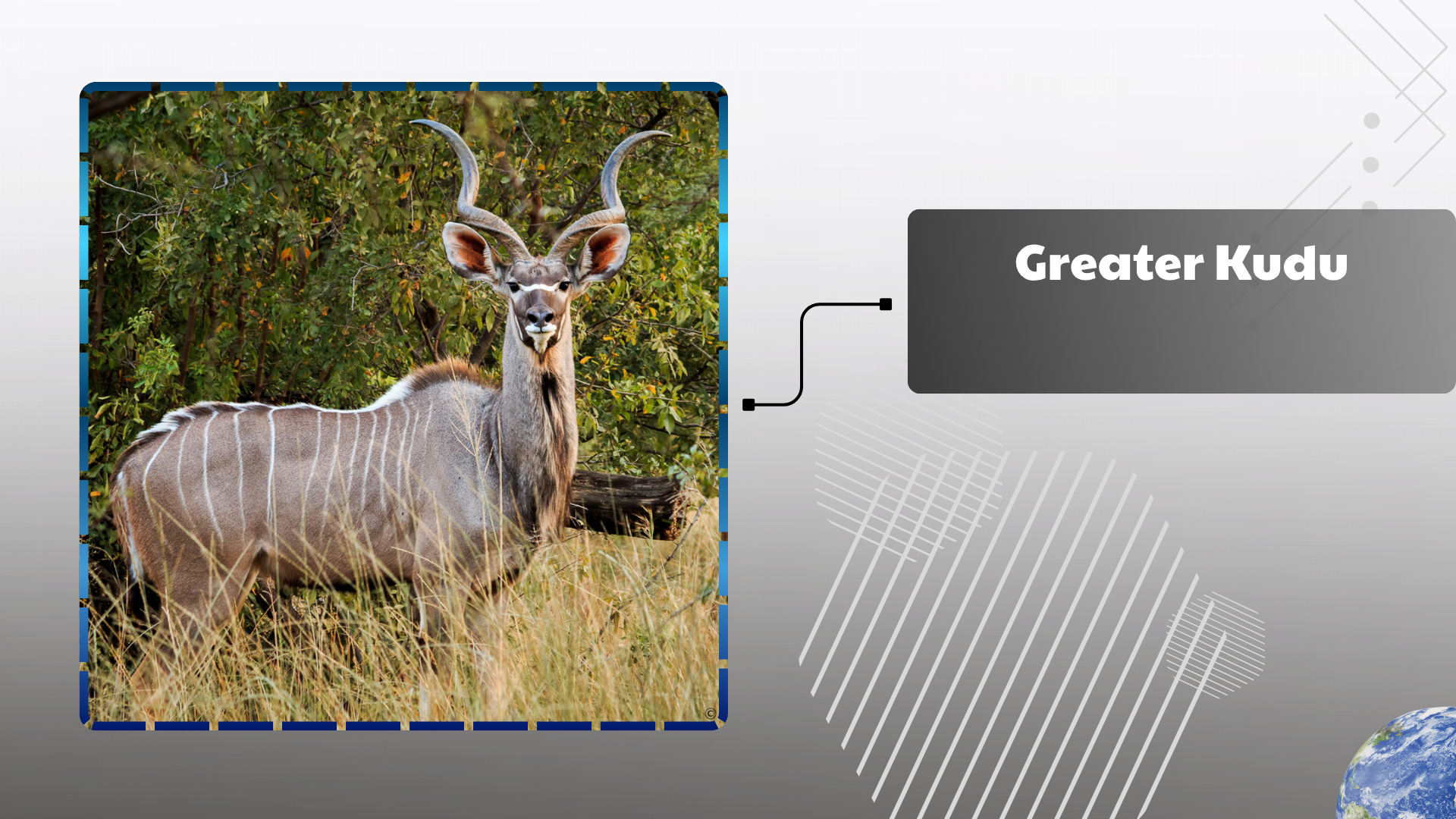
The greater kudu, Tragelaphus strepsiceros, is one of Africa’s largest and most visually distinctive antelopes. It has a tall, narrow body, long legs, enormous rounded ears, and a sloping back. Its shape allows it to move through woodland and dense bush more easily than its size might suggest.
Coat color varies from reddish brown to gray-brown or bluish gray. Several thin white stripes run vertically down the flanks, although their number and clarity differ among individuals and regional populations. Most greater kudu also display a white chevron between the eyes, pale cheek markings, a white patch on the throat, and a narrow crest of hair along the back.
Adult males are considerably larger and darker than females. A mature bull also develops a noticeable throat beard and a heavy pair of widely spiraled horns. The horns usually form about two and a half twists when fully developed. Measured along the curve, exceptional horns can approach 1.8 meters, although most are shorter. Females are hornless and have slimmer bodies with warmer brown coats.
Greater kudu occur across a broad but fragmented area of eastern, central, and southern Africa. Their range includes parts of Ethiopia, Kenya, Tanzania, Zambia, Angola, Namibia, Botswana, Zimbabwe, Mozambique, Malawi, Eswatini, and South Africa. Smaller or more isolated populations occur elsewhere within the species’ historical range.
Preferred habitats include open woodland, wooded savanna, dry riverine vegetation, rocky hills, thorn scrub, and bush-covered slopes. Greater kudu usually avoid extensive open grassland because woodland provides both food and protection from predators.
Greater kudu are browsers rather than specialized grazers. They feed on leaves, shoots, vines, flowers, herbs, seedpods, fruits, roots, and occasionally fresh grass. Their varied diet allows them to use many plant communities and survive seasonal changes in food availability.
Females and young usually form small herds, while mature bulls are often solitary or live in temporary bachelor groups. Greater kudu are currently classified as Least Concern, but some regional populations are declining because of habitat loss, excessive hunting, fencing, disease, and human expansion.
2. Lesser Kudu
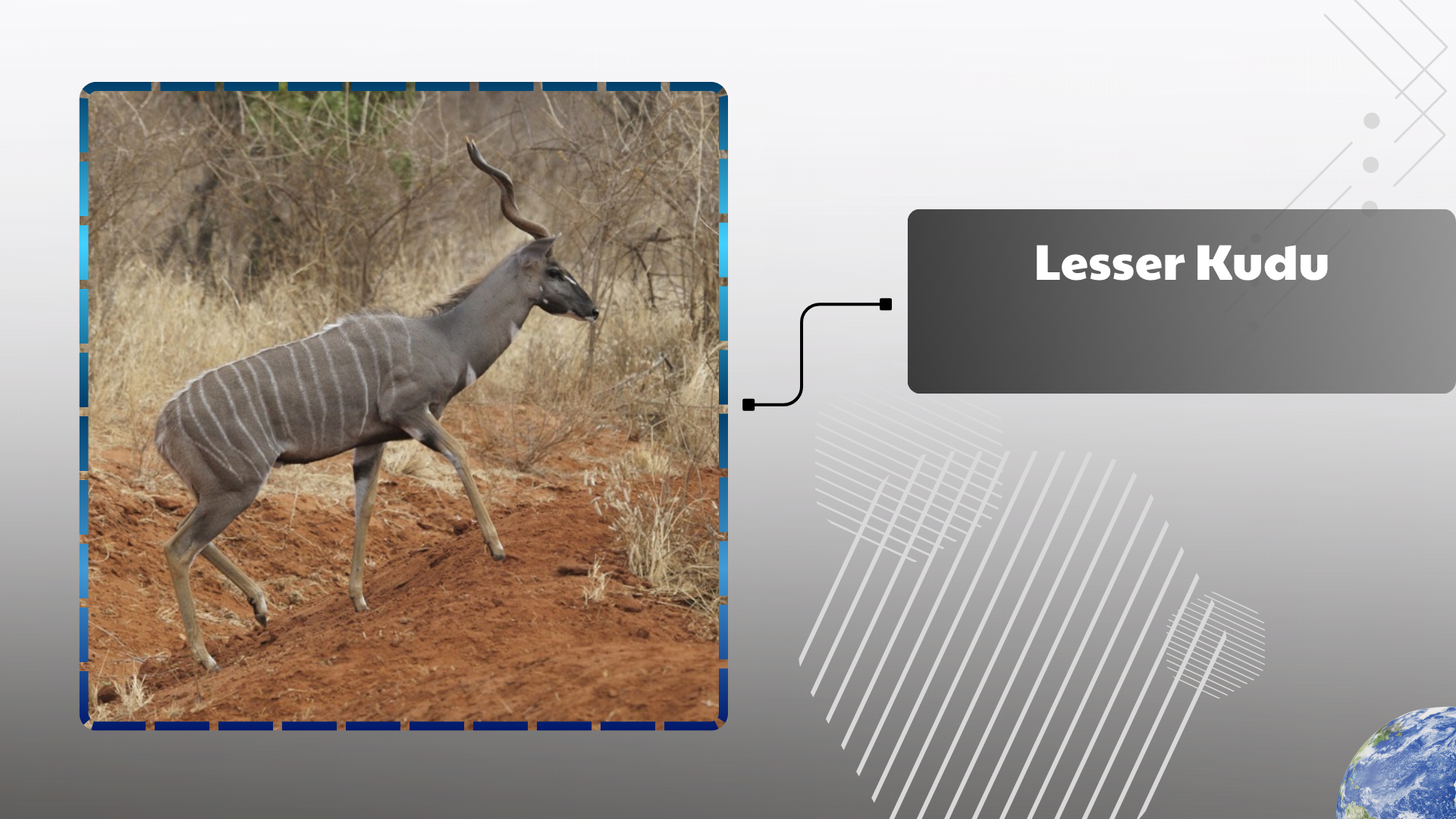
The lesser kudu, Tragelaphus imberbis, is a smaller, slimmer, and more secretive relative of the greater kudu. It is specially adapted to dry thornbush and dense scrub in East Africa, where its striped coat provides excellent camouflage.
Adult males usually have gray, blue-gray, or brown-gray coats, while females and young animals are generally warmer reddish brown. Lesser kudu have more numerous and sharply defined white body stripes than greater kudu, commonly displaying about 11 to 14 on each side. They also possess white facial lines, cheek spots, white lips, throat patches, and pale underparts.
Adult males have long, tightly spiraled horns that normally complete about two to two and a half turns. The horns are more compact and less widely spread than those of a greater kudu. Females do not have horns. Lesser kudu also lack the greater kudu bull’s prominent hanging throat beard, which explains the scientific name imberbis, meaning “beardless.”
Males commonly stand about one meter at the shoulder and weigh approximately 90 to 105 kilograms. Females are smaller and may weigh around 55 to 70 kilograms. This substantial size difference is one of the most reliable field clues when the two species occur in the same general region.
Lesser kudu are native to parts of Ethiopia, Somalia, Kenya, Tanzania, South Sudan, Uganda, and Djibouti. Their distribution is associated with the dry Somali-Masai region of eastern Africa. They inhabit thornbush, scrubland, light woodland, and semi-arid areas dominated by drought-resistant shrubs and small trees.
These kudu feed primarily on leaves, shoots, herbs, vines, flowers, and fruit. Succulent vegetation can provide much of the moisture they need, allowing them to live in areas without reliable surface water.
Lesser kudu are most active during the night and around dawn and dusk. During hot daylight hours, they hide and ruminate in thick vegetation. Females may form small groups, while adult males are often solitary. The species is classified as Near Threatened because of habitat degradation, settlement, livestock expansion, hunting, drought, and past disease outbreaks.
How Are These Types of Kudu Classified?
Both kudu species belong to the family Bovidae and the tribe Tragelaphini. This group contains several spiral-horned African antelopes, including nyala, bushbuck, bongo, sitatunga, and eland.
- Kingdom: Animalia
- Phylum: Chordata
- Class: Mammalia
- Order: Artiodactyla
- Family: Bovidae
- Tribe: Tragelaphini
- Genus: Tragelaphus
- Greater kudu: Tragelaphus strepsiceros
- Lesser kudu: Tragelaphus imberbis
Some taxonomic publications place the lesser kudu in a separate genus called Ammelaphus. Other treatments divide greater kudu populations into several species or regional forms, including Cape, northern, western, and Zambezi kudu.
However, the widely used modern classification recognizes one greater kudu species and one lesser kudu species. The regional greater kudu forms may be treated as subspecies or populations rather than universally accepted separate species. For a clear and practical wildlife guide, two living kudu species is therefore the most appropriate number.
Regional Forms of the Greater Kudu
Greater kudu vary across their extensive African range. Differences in coat color, stripe number, horn shape, and body size have led zoologists to name several regional forms.
Southern or Cape Greater Kudu
The southern form is found across much of southern Africa, including parts of South Africa, Namibia, Botswana, Zimbabwe, and neighboring countries. It is the greater kudu most frequently seen in wildlife photography and on southern African safaris.
Northern Greater Kudu
Northern greater kudu occur in northeastern Africa, including parts of Ethiopia, Sudan, Eritrea, Kenya, and surrounding areas. They may differ in coloration and stripe pattern from southern populations.
Western Greater Kudu
The western form has a restricted and fragmented distribution in parts of Chad, Sudan, and the Central African region. Its limited range makes the protection of remaining populations especially important.
Zambezi Greater Kudu
Zambezi kudu is a name applied in some taxonomic systems to populations from parts of southeastern and south-central Africa. This form is not universally recognized as a separate species or subspecies.
These names describe meaningful geographic variation, but travelers should not count them as universally accepted kudu species without stating which taxonomic system is being followed.
Where Do These Wild Animals Live?
Kudu are native to sub-Saharan Africa, but the two species occupy different ranges and habitat types.
- Greater kudu: Found from northeastern and eastern Africa through parts of central Africa and into southern Africa.
- Lesser kudu: Concentrated in eastern and northeastern Africa, particularly within dry Somali-Masai bushlands.
Both species require vegetation that provides browse and concealment. Greater kudu use a wider selection of wooded landscapes, including rocky slopes and riverine bush. Lesser kudu are more closely associated with dense, semi-arid thorn scrub.
Habitat connectivity is important because kudu may move in response to water, food availability, disturbance, and seasonal conditions. Roads, livestock fences, farms, and settlements can isolate populations or prevent animals from reaching suitable feeding areas.
How to Identify Different Types of Kudu
- Overall size: A greater kudu is much taller and heavier than a lesser kudu.
- Number of stripes: Lesser kudu usually have more white vertical stripes.
- Throat beard: Mature male greater kudu have a prominent throat mane, while lesser kudu lack this long beard.
- Horn shape: Greater kudu horns are longer and form wider spirals. Lesser kudu horns are shorter and more tightly twisted.
- Coat color: Adult male greater kudu are often brown-gray or bluish gray. Male lesser kudu may appear darker gray, while females of both species are generally browner.
- Body shape: Greater kudu have a heavier chest and taller frame. Lesser kudu are more compact and delicate.
- Facial markings: Lesser kudu typically have more complex white facial spots and lines.
- Chest markings: Lesser kudu show distinctive dark and white chest patches rather than the greater kudu’s hanging throat beard.
- Habitat: Lesser kudu favor dense, dry thornbush, while greater kudu occupy a wider variety of woodland and scrub habitats.
- Range: A kudu in southern Africa is almost certainly a greater kudu because lesser kudu are native to East Africa.
Greater Kudu vs. Lesser Kudu Tracks
Both species leave cloven-hoofed tracks consisting of two narrow, pointed sections. Greater kudu tracks are noticeably larger and broader because of the animal’s greater weight. Lesser kudu tracks are smaller and may be confused with the prints of other medium-sized antelopes.
Tracks alone can be difficult to identify accurately. Look for additional signs such as droppings, browsing height, habitat, herd size, and nearby photographs. In areas with several antelope species, an experienced guide can help prevent misidentification.
Outdoor Tips for Finding and Observing Kudu
- Search woodland edges, dry riverbeds, thorn scrub, and bush-covered slopes.
- Plan observations for early morning or late afternoon, when kudu are more active.
- Scan shaded vegetation carefully instead of looking only at open ground.
- Watch for large ears, white stripes, or the movement of a white-tipped tail.
- Use binoculars to examine facial markings, stripe numbers, and horn shape.
- Remain quiet because kudu have excellent hearing and are easily disturbed.
- Check dense thickets for lesser kudu during East African wildlife trips.
- Look along woodland boundaries for greater kudu, especially near fresh browse.
- Never surround an animal or block its escape route.
- Follow all reserve rules and instructions from guides or rangers.
Safety, Sustainability, and Conservation Notes
Kudu are normally shy and prefer to retreat from people. However, an injured, trapped, or cornered animal can be dangerous. Mature bulls possess powerful spiral horns, and females can defend themselves with forceful kicks. Wildlife observers should remain at a respectful distance.
Greater kudu remain widespread, but a Least Concern classification does not mean that every population is secure. Local declines can occur where hunting pressure, habitat clearing, fencing, or disease becomes severe.
Lesser kudu require greater conservation attention because their population is decreasing and their dry bushland habitat is being modified by settlement, agriculture, livestock, and infrastructure. Climate-related drought may intensify pressure on both wildlife and pastoral communities competing for limited land and vegetation.
Responsible travelers can help by using ethical safari operators, respecting park regulations, avoiding wildlife products, supporting community conservancies, and never encouraging guides to chase or crowd animals for photographs.
Fun Facts About Kudu
- Only male greater and lesser kudu normally grow horns.
- A mature greater kudu bull’s horns can form about two and a half complete twists.
- The lesser kudu’s scientific name means “beardless.”
- Kudu stripes help break up the outline of the body among branches and shadows.
- Their enormous ears provide excellent hearing and help them detect predators.
- Adult male kudu are often solitary outside the breeding season.
- Kudu can jump over high obstacles despite their large bodies.
- They often freeze when alarmed, relying on camouflage before fleeing.
- A sharp bark may warn other animals that danger is nearby.
- Kudu obtain water from leaves, fruit, roots, and other moisture-rich vegetation.
Final Thoughts on Types of Kudu
The two recognized types of kudu are the greater kudu and the lesser kudu. Greater kudu are larger, more widespread, and distinguished by broad spiral horns and a male’s throat beard. Lesser kudu are smaller, more heavily striped, and closely associated with the dry thornbush of East Africa.
Learning these differences makes identification much easier in the field. Observing habitat, size, stripe pattern, horn shape, and throat markings together is more reliable than relying on a single feature. Ethical wildlife observation and habitat conservation will help ensure that both kudu species remain part of Africa’s remarkable natural heritage.
Frequently Asked Questions
1. How many types of kudu are there?
There are two widely recognized living species: the greater kudu and the lesser kudu.
2. What is a kudu?
A kudu is a striped, spiral-horned African antelope belonging to the tribe Tragelaphini. Adult males have horns, while females are normally hornless.
3. What are the scientific names of the two kudu species?
The greater kudu is Tragelaphus strepsiceros, and the lesser kudu is Tragelaphus imberbis.
4. What is the main difference between greater and lesser kudu?
Greater kudu are considerably larger and have longer, more open spiral horns. Lesser kudu have more body stripes and lack the greater kudu bull’s long throat beard.
5. Which type of kudu is larger?
The greater kudu is much larger. Mature males can weigh more than twice as much as male lesser kudu.
6. Which kudu has more stripes?
The lesser kudu usually has more stripes, commonly about 11 to 14. Greater kudu often have approximately 6 to 10, although markings vary.
7. Do female kudu have horns?
No. Females of both kudu species are normally hornless, while adult males develop spiral horns.
8. How long are greater kudu horns?
Mature bulls may develop horns longer than one meter when measured along the curve. Exceptional examples can approach 1.8 meters.
9. How many twists do kudu horns have?
Fully developed male horns commonly form about two to two and a half twists. Horn development continues for several years.
10. Do kudu shed their horns?
No. Kudu horns are permanent and are not shed annually like deer antlers.
11. Can broken kudu horns grow back?
A broken horn does not fully regenerate. Limited growth may continue from the base, but the damaged portion is not replaced.
12. Where do greater kudu live?
Greater kudu live across parts of eastern, central, and southern Africa in woodland, savanna, scrub, rocky hills, and riverine bush.
13. Where do lesser kudu live?
Lesser kudu inhabit dry bushland and thorn scrub in eastern and northeastern Africa, including parts of Ethiopia, Kenya, Somalia, Tanzania, Uganda, South Sudan, and Djibouti.
14. Are there lesser kudu in South Africa?
Lesser kudu are not naturally found in South Africa. Wild kudu seen there are greater kudu.
15. What habitat do kudu prefer?
Kudu prefer landscapes with shrubs, trees, or thickets that provide leaves to eat and cover from predators.
16. What do kudu eat?
Kudu browse on leaves, shoots, vines, herbs, flowers, fruits, seedpods, roots, and other plant material. They eat relatively little mature grass.
17. Are kudu grazers or browsers?
Kudu are primarily browsers. They feed mainly on leaves and other plant parts above ground level rather than depending on grass.
18. Do kudu need to drink every day?
Not always. They can obtain moisture from vegetation, but they drink readily when water is available.
19. Are kudu active during the day?
Kudu may be active during cooler daylight hours, but they often feed most actively around dawn, dusk, and nighttime.
20. Do kudu live in herds?
Females and young usually live in small groups. Mature bulls are commonly solitary or form temporary bachelor groups.
21. Are kudu territorial?
Kudu generally use overlapping home ranges rather than defending rigid territories. Mature males establish dominance during encounters and the breeding season.
22. Are kudu aggressive?
Kudu are usually shy and avoid confrontation. However, males may spar with each other, and any cornered or injured kudu can be dangerous.
23. How do male kudu fight?
Males interlock their spiral horns and push against one another. Rarely, their horns may become permanently entangled.
24. How do kudu escape predators?
They rely on camouflage, sharp senses, rapid acceleration, and powerful leaps through or over dense vegetation.
25. How high can a kudu jump?
Kudu are capable of clearing obstacles around 2.5 meters high under favorable conditions, although they do not jump unnecessarily.
26. What predators hunt kudu?
Lions, leopards, spotted hyenas, African wild dogs, and crocodiles may prey on kudu. Smaller predators are more likely to target calves.
27. Why do kudu have stripes?
The vertical stripes help break up the outline of the body among tree trunks, branches, grass, and patches of sunlight.
28. Why do kudu have such large ears?
Their large, mobile ears provide excellent hearing, helping them detect predators and other disturbances in dense vegetation.
29. What sound does a kudu make?
Kudu can produce barks, grunts, clucks, and other sounds. A loud bark commonly serves as an alarm call.
30. How long do kudu live?
Lifespan varies with species and environmental conditions. Wild kudu may live for approximately 7 to 15 years, while managed animals can live longer.
31. How many calves does a kudu have?
A female usually gives birth to one calf after a gestation of approximately eight months.
32. Where do female kudu hide their calves?
A mother conceals her newborn in dense vegetation during its first weeks, returning regularly to nurse it.
33. How can you tell a male kudu from a female?
Adult males are larger, darker, and have spiral horns. Females are smaller, hornless, and often have warmer reddish-brown coats.
34. Is the greater kudu endangered?
The greater kudu is classified as Least Concern, although some local populations face significant hunting and habitat pressures.
35. Is the lesser kudu endangered?
The lesser kudu is classified as Near Threatened rather than Endangered. Its population is decreasing, so continued conservation is important.
36. What threatens kudu populations?
Main threats include habitat loss, settlement, livestock expansion, hunting, fencing, drought, disease, and fragmentation of natural landscapes.
37. Are Cape kudu a separate species?
Cape kudu are treated as a distinct species in some alternative classifications. Most widely used modern references include them within the greater kudu.
38. What is a northern kudu?
Northern kudu is a name for greater kudu populations in northeastern Africa. It may be treated as a regional form, subspecies, or separate species depending on the taxonomic system.
39. What is a western kudu?
Western kudu refers to a geographically restricted greater kudu form found in parts of central and northeastern Africa. It is not universally recognized as a separate species.
40. What is the best way to identify a kudu?
Consider the animal’s size, number of stripes, horn shape, throat markings, habitat, and location together. Using several features is more reliable than relying on one characteristic.