

Bony fish are the largest and most familiar group of fish on Earth, ranging from tiny aquarium species to giant ocean predators, reef fish, freshwater sport fish, flatfish, forage fish, and unusual ancient lineages. This guide to the main types of bony fish is designed for readers who want a practical, beginner-friendly way to understand what bony fish are, how they differ from sharks and rays, and how to identify common examples in rivers, lakes, reefs, aquariums, and open oceans.
In simple terms, bony fish are fish with skeletons made mostly of bone rather than cartilage. Most familiar fish belong to the ray-finned branch, but the broader bony fish story also includes lobe-finned fish such as lungfish and coelacanths. The examples below cover scientific names, habitats, approximate sizes, field marks, behavior, aquarium relevance, fishing notes, food importance, and conservation awareness so you can recognize these fish with more confidence.
What Are the Main Types of Bony Fish?
The main types of bony fish are usually divided into ray-finned fish and lobe-finned fish. Ray-finned fish include most familiar species such as bass, trout, salmon, tuna, cod, carp, goldfish, tetras, clownfish, flatfish, snapper, and many reef fish. Lobe-finned fish are much less common today and include living lungfish and coelacanths, which have fleshy fins supported by internal bones. For practical identification, it is helpful to group bony fish by habitat, body shape, feeding style, and human use.
Types of Bony Fish Comparison Table
| Type | Scientific Name | Habitat | Size | Key Feature |
|---|---|---|---|---|
| Largemouth Bass | Micropterus salmoides | Freshwater lakes, ponds, reservoirs, and slow rivers | 12–25 in | Large mouth reaching past the eye |
| Smallmouth Bass | Micropterus dolomieu | Clear rivers, rocky lakes, and cool reservoirs | 10–20 in | Bronze body and strong fight |
| Bluegill | Lepomis macrochirus | Ponds, lakes, slow rivers, and weedy shallows | 4–10 in | Round panfish with blue-black gill flap |
| Pumpkinseed Sunfish | Lepomis gibbosus | Vegetated lakes, ponds, and quiet streams | 4–8 in | Bright orange, blue, and green markings |
| Black Crappie | Pomoxis nigromaculatus | Lakes, reservoirs, and backwaters with cover | 6–14 in | Speckled body and deep compressed shape |
| Walleye | Sander vitreus | Large lakes, reservoirs, and deeper rivers | 14–28 in | Reflective eyes and sharp canine teeth |
| Yellow Perch | Perca flavescens | Cool lakes, ponds, and slow rivers | 6–12 in | Golden sides with vertical dark bars |
| Northern Pike | Esox lucius | Weedy lakes, marshes, and slow rivers | 18–40 in | Long body, duckbill snout, and sharp teeth |
| Muskellunge | Esox masquinongy | Large lakes and rivers with cover | 28–50 in | Large esocid with barred or spotted sides |
| Rainbow Trout | Oncorhynchus mykiss | Cold streams, rivers, lakes, and some coastal waters | 10–24 in | Pink side stripe and black spotting |
| Brown Trout | Salmo trutta | Cold rivers, spring creeks, reservoirs, and lakes | 10–30 in | Golden-brown body with red and black spots |
| Brook Trout | Salvelinus fontinalis | Cold, clean streams, ponds, and headwaters | 6–16 in | Worm-like back markings and orange fins |
| Atlantic Salmon | Salmo salar | North Atlantic rivers and ocean waters | 20–40 in | Anadromous salmon with silver ocean phase |
| Chinook Salmon | Oncorhynchus tshawytscha | Pacific rivers, estuaries, and ocean waters | 24–48 in | Largest Pacific salmon, black gums |
| Sockeye Salmon | Oncorhynchus nerka | Pacific lakes, rivers, and ocean waters | 18–31 in | Bright red spawning body and green head |
| Common Carp | Cyprinus carpio | Rivers, lakes, ponds, canals, and reservoirs | 16–32 in | Large scales, barbels, and bottom-feeding mouth |
| Goldfish | Carassius auratus | Aquariums, ponds, and some introduced waters | 2–12 in | Domesticated carp with many shapes and colors |
| Koi | Cyprinus rubrofuscus | Garden ponds and ornamental water features | 12–36 in | Large ornamental carp with bold color patterns |
| Zebrafish | Danio rerio | Slow streams, rice fields, and aquariums | 1–2 in | Small striped minnow |
| Betta Fish | Betta splendens | Shallow tropical wetlands and aquariums | 2–3 in | Labyrinth organ and colorful fins |
| Guppy | Poecilia reticulata | Streams, pools, ditches, and aquariums | 1–2.5 in | Livebearer with colorful males |
| Molly | Poecilia sphenops | Fresh, brackish, and coastal waters; aquariums | 2–4 in | Livebearer tolerant of varied water conditions |
| Swordtail | Xiphophorus hellerii | Streams, rivers, and planted aquariums | 3–5 in | Male lower tail extension |
| Neon Tetra | Paracheirodon innesi | Blackwater streams and aquariums | 1–1.5 in | Blue stripe and red lower body |
| Cardinal Tetra | Paracheirodon axelrodi | Blackwater rivers and aquariums | 1.5–2 in | Full-length red stripe below blue stripe |
| Freshwater Angelfish | Pterophyllum scalare | Amazon basin floodplains and aquariums | Up to 6 in body length | Tall triangular fins and flat body |
| Oscar | Astronotus ocellatus | Slow rivers, floodplains, and large aquariums | 10–14 in | Large intelligent cichlid with eye spot |
| Discus | Symphysodon aequifasciatus | Warm Amazon floodplain waters and aquariums | 5–8 in | Round disc-shaped cichlid |
| Ocellaris Clownfish | Amphiprion ocellaris | Coral reefs and marine aquariums | 3–4 in | Orange body with white bands |
| Blue Tang | Paracanthurus hepatus | Indo-Pacific coral reefs | 5–12 in | Bright blue body and yellow tail |
| Yellow Tang | Zebrasoma flavescens | Coral and rocky reefs | 4–8 in | Solid yellow body and disk shape |
| Moorish Idol | Zanclus cornutus | Tropical reefs and lagoons | 6–9 in | Long dorsal streamer and bold bands |
| Red Lionfish | Pterois volitans | Reefs, rocky areas, and invasive Atlantic habitats | 8–15 in | Venomous spines and fan-like fins |
| Common Seahorse | Hippocampus kuda | Seagrass beds, mangroves, reefs, and estuaries | 4–8 in | Horse-like head and prehensile tail |
| Greater Pipefish | Syngnathus acus | Seagrass beds, estuaries, and coastal waters | 10–18 in | Long thin body and tube snout |
| Atlantic Cod | Gadus morhua | Cold North Atlantic shelves and coastal waters | 20–40 in | Three dorsal fins and chin barbel |
| Pacific Cod | Gadus macrocephalus | North Pacific continental shelves | 20–39 in | Pale lateral line and chin barbel |
| Haddock | Melanogrammus aeglefinus | Cold North Atlantic seafloors | 15–30 in | Dark shoulder blotch and black lateral line |
| Alaska Pollock | Gadus chalcogrammus | North Pacific shelf waters | 12–36 in | Slender cod relative |
| European Hake | Merluccius merluccius | Northeastern Atlantic and Mediterranean waters | 12–36 in | Long body and large predatory mouth |
| Atlantic Halibut | Hippoglossus hippoglossus | Cold North Atlantic seafloors | 3–8 ft | Very large right-eyed flatfish |
| Summer Flounder | Paralichthys dentatus | Sandy coastal bottoms, bays, and estuaries | 12–30 in | Left-eyed flatfish with spots |
| Dover Sole | Solea solea | Sandy and muddy seafloors | 10–24 in | Oval flatfish with small mouth |
| Turbot | Scophthalmus maximus | Northeastern Atlantic sandy bottoms | 16–40 in | Broad diamond-shaped flatfish |
| European Plaice | Pleuronectes platessa | Sandy and muddy coastal bottoms | 10–28 in | Orange spots on upper side |
| Atlantic Bluefin Tuna | Thunnus thynnus | Open Atlantic Ocean and Mediterranean Sea | 3–10 ft | Powerful warm-bodied ocean predator |
| Yellowfin Tuna | Thunnus albacares | Tropical and subtropical open oceans | 2–6 ft | Long yellow second dorsal and anal fins |
| Skipjack Tuna | Katsuwonus pelamis | Warm open oceans | 16–32 in | Dark horizontal belly stripes |
| Mahi-Mahi | Coryphaena hippurus | Warm open ocean and offshore structure | 2–5 ft | Bright colors and tall forehead in males |
| Swordfish | Xiphias gladius | Temperate and tropical open oceans | 4–10 ft | Long flattened bill |
| Indo-Pacific Sailfish | Istiophorus platypterus | Warm open oceans | 5–10 ft | Large sail-like dorsal fin |
| Atlantic Blue Marlin | Makaira nigricans | Warm Atlantic offshore waters | 6–14 ft | Large billfish with pointed bill |
| Atlantic Mackerel | Scomber scombrus | Cool coastal and open waters | 10–18 in | Wavy dark back stripes |
| European Pilchard | Sardina pilchardus | Coastal waters and open schools | 6–10 in | Small silvery schooling fish |
| European Anchovy | Engraulis encrasicolus | Coastal seas and estuaries | 4–8 in | Small silvery fish with large mouth |
| Atlantic Herring | Clupea harengus | Cold North Atlantic coastal and offshore waters | 8–15 in | Silvery schooling fish |
| Atlantic Tarpon | Megalops atlanticus | Coastal waters, estuaries, lagoons, and rivers | 3–8 ft | Large silver fish that gulps air |
| Bonefish | Albula vulpes | Tropical flats, lagoons, and sandy shallows | 12–30 in | Silver flats fish with pointed snout |
| Milkfish | Chanos chanos | Tropical coastal waters, lagoons, and brackish ponds | 1–5 ft | Forked tail and silvery body |
| Great Barracuda | Sphyraena barracuda | Reefs, seagrass, mangroves, and open coastal water | 2–6 ft | Long body and large teeth |
| Goliath Grouper | Epinephelus itajara | Reefs, wrecks, mangroves, and coastal structure | 3–8 ft | Massive body and broad mouth |
| Red Snapper | Lutjanus campechanus | Reefs, ledges, and offshore structures | 12–30 in | Red body and pointed profile |
| Mutton Snapper | Lutjanus analis | Reefs, seagrass beds, and clear tropical waters | 16–30 in | Dark spot and blue cheek lines |
| Common Snook | Centropomus undecimalis | Mangroves, estuaries, beaches, and rivers | 20–40 in | Black lateral line and sloped forehead |
| Red Drum | Sciaenops ocellatus | Estuaries, marshes, beaches, and coastal waters | 18–45 in | Tail spot and copper body |
| Spotted Seatrout | Cynoscion nebulosus | Seagrass flats, estuaries, and coastal bays | 12–28 in | Spotted back and soft mouth |
| Black Sea Bass | Centropristis striata | Rocky bottoms, reefs, wrecks, and nearshore waters | 10–20 in | Dark body and high dorsal fin |
| European Sea Bass | Dicentrarchus labrax | Coastal waters, estuaries, and rocky shores | 12–36 in | Silver body and spiny dorsal fin |
| Striped Bass | Morone saxatilis | Coastal waters, estuaries, rivers, and reservoirs | 18–50 in | Horizontal dark stripes |
| White Bass | Morone chrysops | Lakes, reservoirs, and large rivers | 10–17 in | Silvery body with broken stripes |
| Peacock Bass | Cichla ocellaris | Tropical rivers, lagoons, and reservoirs | 12–30 in | Eye spot and bold color patterns |
| Arapaima | Arapaima gigas | Amazon floodplains, lakes, and slow rivers | 6–10 ft | Giant air-breathing freshwater fish |
| Silver Arowana | Osteoglossum bicirrhosum | Amazon floodplains and slow rivers | 2–3 ft | Surface-feeding fish with upturned mouth |
| Longnose Gar | Lepisosteus osseus | Rivers, backwaters, lakes, and slow pools | 2–4 ft | Long armored body and needle snout |
| Bowfin | Amia calva | Swamps, backwaters, lakes, and slow rivers | 18–30 in | Long dorsal fin and primitive features |
| Lake Sturgeon | Acipenser fulvescens | Large rivers and lakes | 3–6 ft | Armored scutes and underside mouth |
| American Paddlefish | Polyodon spathula | Large rivers, reservoirs, and backwaters | 3–6 ft | Long paddle-shaped rostrum |
| West Indian Ocean Coelacanth | Latimeria chalumnae | Deep marine caves and steep volcanic slopes | 4–6 ft | Lobed fins and ancient lineage |
| Australian Lungfish | Neoceratodus forsteri | Slow rivers and impoundments | 3–5 ft | Lung-like organ and lobed fins |
| Ocean Sunfish | Mola mola | Open temperate and tropical oceans | 6–10 ft tall | Huge flattened body and truncated tail |
1. Largemouth Bass
Largemouth Bass (Micropterus salmoides) is a freshwater sport fish found in freshwater lakes, ponds, reservoirs, and slow rivers. It is usually recognized by its large mouth reaching past the eye, and adults are commonly around 12–25 in depending on age, habitat, food supply, and local conditions. A green body, dark side stripe, and oversized mouth make it one of the easiest freshwater predators to recognize.

This type of bony fish is most strongly associated with North America. For identification, look at body shape, fin placement, mouth position, color pattern, and where the fish is found. For anglers and outdoor observers, this species is best understood by watching structure, water temperature, prey movement, and seasonal behavior. When observing, fishing for, buying, or keeping this fish, use responsible practices and follow local rules so wild populations and habitats remain healthy.
2. Smallmouth Bass
Smallmouth Bass (Micropterus dolomieu) is a freshwater sport fish found in clear rivers, rocky lakes, and cool reservoirs. It is usually recognized by its bronze body and strong fight, and adults are commonly around 10–20 in depending on age, habitat, food supply, and local conditions. It prefers clearer, cooler water than largemouth bass and often holds near rocks, current seams, and drop-offs.
This type of bony fish is most strongly associated with North America. For identification, look at body shape, fin placement, mouth position, color pattern, and where the fish is found. For anglers and outdoor observers, this species is best understood by watching structure, water temperature, prey movement, and seasonal behavior. When observing, fishing for, buying, or keeping this fish, use responsible practices and follow local rules so wild populations and habitats remain healthy.
3. Bluegill
Bluegill (Lepomis macrochirus) is a freshwater panfish found in ponds, lakes, slow rivers, and weedy shallows. It is usually recognized by its round panfish with blue-black gill flap, and adults are commonly around 4–10 in depending on age, habitat, food supply, and local conditions. A small mouth, deep body, and dark ear flap help separate bluegill from young bass and other sunfish.
This type of bony fish is most strongly associated with North America. For identification, look at body shape, fin placement, mouth position, color pattern, and where the fish is found. Because it is common in shallow freshwater habitats, it is a good fish for beginners to observe, photograph, or learn basic fish anatomy. When observing, fishing for, buying, or keeping this fish, use responsible practices and follow local rules so wild populations and habitats remain healthy.
4. Pumpkinseed Sunfish
Pumpkinseed Sunfish (Lepomis gibbosus) is a freshwater panfish found in vegetated lakes, ponds, and quiet streams. It is usually recognized by its bright orange, blue, and green markings, and adults are commonly around 4–8 in depending on age, habitat, food supply, and local conditions. This colorful sunfish is often seen in shallow water and is a favorite for beginner identification practice.
This type of bony fish is most strongly associated with North America. For identification, look at body shape, fin placement, mouth position, color pattern, and where the fish is found. Because it is common in shallow freshwater habitats, it is a good fish for beginners to observe, photograph, or learn basic fish anatomy. When observing, fishing for, buying, or keeping this fish, use responsible practices and follow local rules so wild populations and habitats remain healthy.
5. Black Crappie
Black Crappie (Pomoxis nigromaculatus) is a freshwater panfish found in lakes, reservoirs, and backwaters with cover. It is usually recognized by its speckled body and deep compressed shape, and adults are commonly around 6–14 in depending on age, habitat, food supply, and local conditions. Black crappie school around brush, docks, and submerged trees, making them important to both anglers and aquatic food webs.

This type of bony fish is most strongly associated with North America. For identification, look at body shape, fin placement, mouth position, color pattern, and where the fish is found. Because it is common in shallow freshwater habitats, it is a good fish for beginners to observe, photograph, or learn basic fish anatomy. When observing, fishing for, buying, or keeping this fish, use responsible practices and follow local rules so wild populations and habitats remain healthy.
6. Walleye
Walleye (Sander vitreus) is a freshwater predator found in large lakes, reservoirs, and deeper rivers. It is usually recognized by its reflective eyes and sharp canine teeth, and adults are commonly around 14–28 in depending on age, habitat, food supply, and local conditions. Its glassy eyes help it hunt in low light, and the white-tipped lower tail fin is a useful field mark.
This type of bony fish is most strongly associated with North America. For identification, look at body shape, fin placement, mouth position, color pattern, and where the fish is found. Its predatory habits make it important in food webs, where it helps control smaller fish and other aquatic animals. When observing, fishing for, buying, or keeping this fish, use responsible practices and follow local rules so wild populations and habitats remain healthy.
7. Yellow Perch
Yellow Perch (Perca flavescens) is a freshwater schooling fish found in cool lakes, ponds, and slow rivers. It is usually recognized by its golden sides with vertical dark bars, and adults are commonly around 6–12 in depending on age, habitat, food supply, and local conditions. Yellow perch often form schools and are easy to recognize by their striped body and spiny first dorsal fin.
This type of bony fish is most strongly associated with North America. For identification, look at body shape, fin placement, mouth position, color pattern, and where the fish is found. It is a useful example for understanding how bony fish adapt to different aquatic environments. When observing, fishing for, buying, or keeping this fish, use responsible practices and follow local rules so wild populations and habitats remain healthy.
8. Northern Pike
Northern Pike (Esox lucius) is a freshwater predator found in weedy lakes, marshes, and slow rivers. It is usually recognized by its long body, duckbill snout, and sharp teeth, and adults are commonly around 18–40 in depending on age, habitat, food supply, and local conditions. This ambush predator hides in vegetation and darts at fish, frogs, and other prey.
This type of bony fish is most strongly associated with North America, Europe, and Asia. For identification, look at body shape, fin placement, mouth position, color pattern, and where the fish is found. Its predatory habits make it important in food webs, where it helps control smaller fish and other aquatic animals. When observing, fishing for, buying, or keeping this fish, use responsible practices and follow local rules so wild populations and habitats remain healthy.
9. Muskellunge
Muskellunge (Esox masquinongy) is a freshwater apex predator found in large lakes and rivers with cover. It is usually recognized by its large esocid with barred or spotted sides, and adults are commonly around 28–50 in depending on age, habitat, food supply, and local conditions. Often called muskie, it resembles a giant pike but usually has a different cheek scale pattern and larger adult size.
This type of bony fish is most strongly associated with North America. For identification, look at body shape, fin placement, mouth position, color pattern, and where the fish is found. As a top freshwater predator, it needs healthy prey populations and connected habitats to reach large adult size. When observing, fishing for, buying, or keeping this fish, use responsible practices and follow local rules so wild populations and habitats remain healthy.
10. Rainbow Trout
Rainbow Trout (Oncorhynchus mykiss) is a coldwater fish found in cold streams, rivers, lakes, and some coastal waters. It is usually recognized by its pink side stripe and black spotting, and adults are commonly around 10–24 in depending on age, habitat, food supply, and local conditions. Rainbow trout are popular in streams and stocked waters, but wild populations need clean, cool, oxygen-rich habitat.
This type of bony fish is most strongly associated with Native to Pacific drainages; introduced widely. For identification, look at body shape, fin placement, mouth position, color pattern, and where the fish is found. Clean, cool, oxygen-rich water is especially important for this fish, so its presence often tells you something about habitat quality. When observing, fishing for, buying, or keeping this fish, use responsible practices and follow local rules so wild populations and habitats remain healthy.
11. Brown Trout
Brown Trout (Salmo trutta) is a coldwater fish found in cold rivers, spring creeks, reservoirs, and lakes. It is usually recognized by its golden-brown body with red and black spots, and adults are commonly around 10–30 in depending on age, habitat, food supply, and local conditions. Brown trout are wary, adaptable predators that often feed at dawn, dusk, and during insect hatches.
This type of bony fish is most strongly associated with Native to Europe and western Asia; introduced widely. For identification, look at body shape, fin placement, mouth position, color pattern, and where the fish is found. Clean, cool, oxygen-rich water is especially important for this fish, so its presence often tells you something about habitat quality. When observing, fishing for, buying, or keeping this fish, use responsible practices and follow local rules so wild populations and habitats remain healthy.
12. Brook Trout
Brook Trout (Salvelinus fontinalis) is a char found in cold, clean streams, ponds, and headwaters. It is usually recognized by its worm-like back markings and orange fins, and adults are commonly around 6–16 in depending on age, habitat, food supply, and local conditions. Despite the name, brook trout are char, and their need for cold water makes them a strong indicator of stream health.
This type of bony fish is most strongly associated with Eastern North America. For identification, look at body shape, fin placement, mouth position, color pattern, and where the fish is found. This fish is useful for learning the difference between trout-like fish because char often show pale markings over a darker body. When observing, fishing for, buying, or keeping this fish, use responsible practices and follow local rules so wild populations and habitats remain healthy.
13. Atlantic Salmon
Atlantic Salmon (Salmo salar) is a anadromous fish found in north atlantic rivers and ocean waters. It is usually recognized by its anadromous salmon with silver ocean phase, and adults are commonly around 20–40 in depending on age, habitat, food supply, and local conditions. Atlantic salmon hatch in rivers, grow at sea, and may return upstream to spawn, connecting freshwater and marine ecosystems.
This type of bony fish is most strongly associated with North Atlantic basin. For identification, look at body shape, fin placement, mouth position, color pattern, and where the fish is found. Its migration connects rivers and the sea, making habitat access, water quality, and spawning areas especially important. When observing, fishing for, buying, or keeping this fish, use responsible practices and follow local rules so wild populations and habitats remain healthy.
14. Chinook Salmon
Chinook Salmon (Oncorhynchus tshawytscha) is a anadromous fish found in pacific rivers, estuaries, and ocean waters. It is usually recognized by its largest pacific salmon, black gums, and adults are commonly around 24–48 in depending on age, habitat, food supply, and local conditions. Chinook are powerful migratory fish; their spawning runs support wildlife, fisheries, and nutrient cycles in river systems.
This type of bony fish is most strongly associated with North Pacific basin. For identification, look at body shape, fin placement, mouth position, color pattern, and where the fish is found. Its migration connects rivers and the sea, making habitat access, water quality, and spawning areas especially important. When observing, fishing for, buying, or keeping this fish, use responsible practices and follow local rules so wild populations and habitats remain healthy.
15. Sockeye Salmon
Sockeye Salmon (Oncorhynchus nerka) is a anadromous fish found in pacific lakes, rivers, and ocean waters. It is usually recognized by its bright red spawning body and green head, and adults are commonly around 18–31 in depending on age, habitat, food supply, and local conditions. Sockeye often depend on lake systems as juveniles, and their vivid spawning colors make them famous among salmon species.
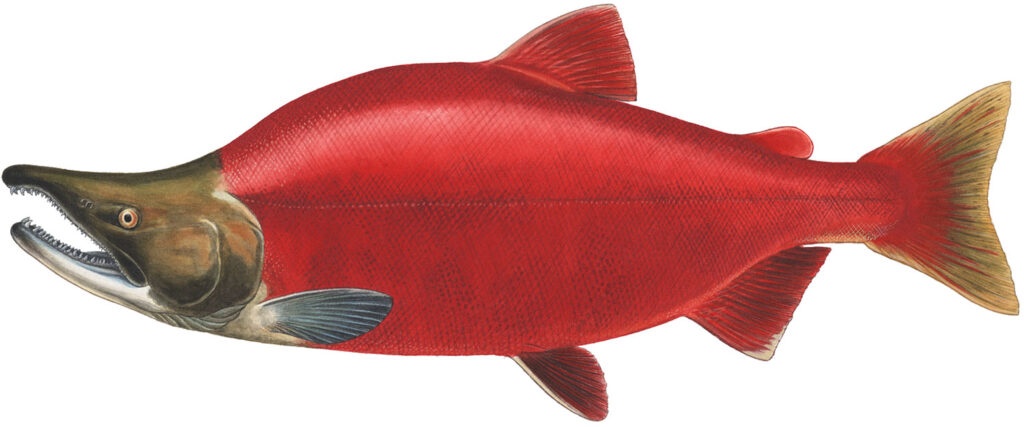
This type of bony fish is most strongly associated with North Pacific basin. For identification, look at body shape, fin placement, mouth position, color pattern, and where the fish is found. Its migration connects rivers and the sea, making habitat access, water quality, and spawning areas especially important. When observing, fishing for, buying, or keeping this fish, use responsible practices and follow local rules so wild populations and habitats remain healthy.
16. Common Carp
Common Carp (Cyprinus carpio) is a freshwater omnivore found in rivers, lakes, ponds, canals, and reservoirs. It is usually recognized by its large scales, barbels, and bottom-feeding mouth, and adults are commonly around 16–32 in depending on age, habitat, food supply, and local conditions. Common carp root through sediment for food, which can affect water clarity in some habitats.
This type of bony fish is most strongly associated with Native to Eurasia; introduced widely. For identification, look at body shape, fin placement, mouth position, color pattern, and where the fish is found. This adaptable feeding style helps it survive in many waters, but it can also disturb habitat when populations become dense. When observing, fishing for, buying, or keeping this fish, use responsible practices and follow local rules so wild populations and habitats remain healthy.
17. Goldfish
Goldfish (Carassius auratus) is a ornamental freshwater fish found in aquariums, ponds, and some introduced waters. It is usually recognized by its domesticated carp with many shapes and colors, and adults are commonly around 2–12 in depending on age, habitat, food supply, and local conditions. Goldfish are hardy but still need space, filtration, and responsible ownership because releases can harm wild habitats.
This type of bony fish is most strongly associated with Domesticated from East Asian carp. For identification, look at body shape, fin placement, mouth position, color pattern, and where the fish is found. In captivity, responsible care matters because ornamental fish should never be released into local waterways. When observing, fishing for, buying, or keeping this fish, use responsible practices and follow local rules so wild populations and habitats remain healthy.
18. Koi
Koi (Cyprinus rubrofuscus) is a ornamental freshwater fish found in garden ponds and ornamental water features. It is usually recognized by its large ornamental carp with bold color patterns, and adults are commonly around 12–36 in depending on age, habitat, food supply, and local conditions. Koi are valued for patterns such as kohaku, showa, and sanke, and they can live for many years in well-managed ponds.
This type of bony fish is most strongly associated with Domesticated from East Asian carp. For identification, look at body shape, fin placement, mouth position, color pattern, and where the fish is found. In captivity, responsible care matters because ornamental fish should never be released into local waterways. When observing, fishing for, buying, or keeping this fish, use responsible practices and follow local rules so wild populations and habitats remain healthy.
19. Zebrafish
Zebrafish (Danio rerio) is a small freshwater fish found in slow streams, rice fields, and aquariums. It is usually recognized by its small striped minnow, and adults are commonly around 1–2 in depending on age, habitat, food supply, and local conditions. Zebrafish are active schooling fish and are also important in biological research because of their fast development.
This type of bony fish is most strongly associated with South Asia. For identification, look at body shape, fin placement, mouth position, color pattern, and where the fish is found. Its small size makes details such as stripes, schooling behavior, and fin shape especially useful for identification. When observing, fishing for, buying, or keeping this fish, use responsible practices and follow local rules so wild populations and habitats remain healthy.
20. Betta Fish
Betta Fish (Betta splendens) is a aquarium fish found in shallow tropical wetlands and aquariums. It is usually recognized by its labyrinth organ and colorful fins, and adults are commonly around 2–3 in depending on age, habitat, food supply, and local conditions. Domestic bettas come in many colors and fin shapes, but males are territorial and usually need careful housing.
This type of bony fish is most strongly associated with Mainland Southeast Asia. For identification, look at body shape, fin placement, mouth position, color pattern, and where the fish is found. Aquarium keepers should focus on stable water, compatible tankmates, and behavior rather than color alone. When observing, fishing for, buying, or keeping this fish, use responsible practices and follow local rules so wild populations and habitats remain healthy.
21. Guppy
Guppy (Poecilia reticulata) is a aquarium livebearer found in streams, pools, ditches, and aquariums. It is usually recognized by its livebearer with colorful males, and adults are commonly around 1–2.5 in depending on age, habitat, food supply, and local conditions. Guppies are small, active, and adaptable, but overbreeding and careless releases can create problems outside their native range.
This type of bony fish is most strongly associated with Northeastern South America and the Caribbean. For identification, look at body shape, fin placement, mouth position, color pattern, and where the fish is found. Livebearers are often active and hardy, but they reproduce quickly and still need balanced water quality. When observing, fishing for, buying, or keeping this fish, use responsible practices and follow local rules so wild populations and habitats remain healthy.
22. Molly
Molly (Poecilia sphenops) is a aquarium livebearer found in fresh, brackish, and coastal waters; aquariums. It is usually recognized by its livebearer tolerant of varied water conditions, and adults are commonly around 2–4 in depending on age, habitat, food supply, and local conditions. Mollies graze on algae and tiny organisms and are often recommended for aquarists who understand stable water quality.
This type of bony fish is most strongly associated with Central America. For identification, look at body shape, fin placement, mouth position, color pattern, and where the fish is found. Livebearers are often active and hardy, but they reproduce quickly and still need balanced water quality. When observing, fishing for, buying, or keeping this fish, use responsible practices and follow local rules so wild populations and habitats remain healthy.
23. Swordtail
Swordtail (Xiphophorus hellerii) is a aquarium livebearer found in streams, rivers, and planted aquariums. It is usually recognized by its male lower tail extension, and adults are commonly around 3–5 in depending on age, habitat, food supply, and local conditions. The sword-like tail on males is a classic identification feature, while females have a more rounded tail.
This type of bony fish is most strongly associated with Central America. For identification, look at body shape, fin placement, mouth position, color pattern, and where the fish is found. Livebearers are often active and hardy, but they reproduce quickly and still need balanced water quality. When observing, fishing for, buying, or keeping this fish, use responsible practices and follow local rules so wild populations and habitats remain healthy.
24. Neon Tetra
Neon Tetra (Paracheirodon innesi) is a small schooling fish found in blackwater streams and aquariums. It is usually recognized by its blue stripe and red lower body, and adults are commonly around 1–1.5 in depending on age, habitat, food supply, and local conditions. Neon tetras are peaceful schooling fish that show best in groups and in calm, planted aquariums.
This type of bony fish is most strongly associated with Upper Amazon region. For identification, look at body shape, fin placement, mouth position, color pattern, and where the fish is found. Schooling behavior is part of its natural security system, so it is easiest to observe when kept or seen in groups. When observing, fishing for, buying, or keeping this fish, use responsible practices and follow local rules so wild populations and habitats remain healthy.
25. Cardinal Tetra
Cardinal Tetra (Paracheirodon axelrodi) is a small schooling fish found in blackwater rivers and aquariums. It is usually recognized by its full-length red stripe below blue stripe, and adults are commonly around 1.5–2 in depending on age, habitat, food supply, and local conditions. Cardinal tetras look similar to neons, but the red color runs farther along the body.
This type of bony fish is most strongly associated with Orinoco and Rio Negro basins. For identification, look at body shape, fin placement, mouth position, color pattern, and where the fish is found. Schooling behavior is part of its natural security system, so it is easiest to observe when kept or seen in groups. When observing, fishing for, buying, or keeping this fish, use responsible practices and follow local rules so wild populations and habitats remain healthy.
26. Freshwater Angelfish
Freshwater Angelfish (Pterophyllum scalare) is a cichlid aquarium fish found in amazon basin floodplains and aquariums. It is usually recognized by its tall triangular fins and flat body, and adults are commonly around Up to 6 in body length depending on age, habitat, food supply, and local conditions. Angelfish use their thin body to move among roots and plants, and their shape makes them instantly recognizable.
This type of bony fish is most strongly associated with Amazon basin. For identification, look at body shape, fin placement, mouth position, color pattern, and where the fish is found. Cichlids are often intelligent and territorial, so behavior is as important as color when identifying and caring for them. When observing, fishing for, buying, or keeping this fish, use responsible practices and follow local rules so wild populations and habitats remain healthy.
27. Oscar
Oscar (Astronotus ocellatus) is a cichlid aquarium fish found in slow rivers, floodplains, and large aquariums. It is usually recognized by its large intelligent cichlid with eye spot, and adults are commonly around 10–14 in depending on age, habitat, food supply, and local conditions. Oscars are personable predators that need large tanks, strong filtration, and careful tankmate choices.
This type of bony fish is most strongly associated with South America. For identification, look at body shape, fin placement, mouth position, color pattern, and where the fish is found. Cichlids are often intelligent and territorial, so behavior is as important as color when identifying and caring for them. When observing, fishing for, buying, or keeping this fish, use responsible practices and follow local rules so wild populations and habitats remain healthy.
28. Discus
Discus (Symphysodon aequifasciatus) is a cichlid aquarium fish found in warm amazon floodplain waters and aquariums. It is usually recognized by its round disc-shaped cichlid, and adults are commonly around 5–8 in depending on age, habitat, food supply, and local conditions. Discus are admired for color and shape but require stable warm water and attentive aquarium care.
This type of bony fish is most strongly associated with Amazon basin. For identification, look at body shape, fin placement, mouth position, color pattern, and where the fish is found. Cichlids are often intelligent and territorial, so behavior is as important as color when identifying and caring for them. When observing, fishing for, buying, or keeping this fish, use responsible practices and follow local rules so wild populations and habitats remain healthy.
29. Ocellaris Clownfish
Ocellaris Clownfish (Amphiprion ocellaris) is a reef fish found in coral reefs and marine aquariums. It is usually recognized by its orange body with white bands, and adults are commonly around 3–4 in depending on age, habitat, food supply, and local conditions. Clownfish are famous for living among sea anemones, where mucus and behavior help protect them from stings.
This type of bony fish is most strongly associated with Indo-Pacific. For identification, look at body shape, fin placement, mouth position, color pattern, and where the fish is found. On reefs, body shape, color pattern, fin placement, and feeding behavior often give the best identification clues. When observing, fishing for, buying, or keeping this fish, use responsible practices and follow local rules so wild populations and habitats remain healthy.
30. Blue Tang
Blue Tang (Paracanthurus hepatus) is a reef fish found in indo-pacific coral reefs. It is usually recognized by its bright blue body and yellow tail, and adults are commonly around 5–12 in depending on age, habitat, food supply, and local conditions. Blue tangs graze and browse on reef algae, helping connect fish behavior with reef ecosystem balance.
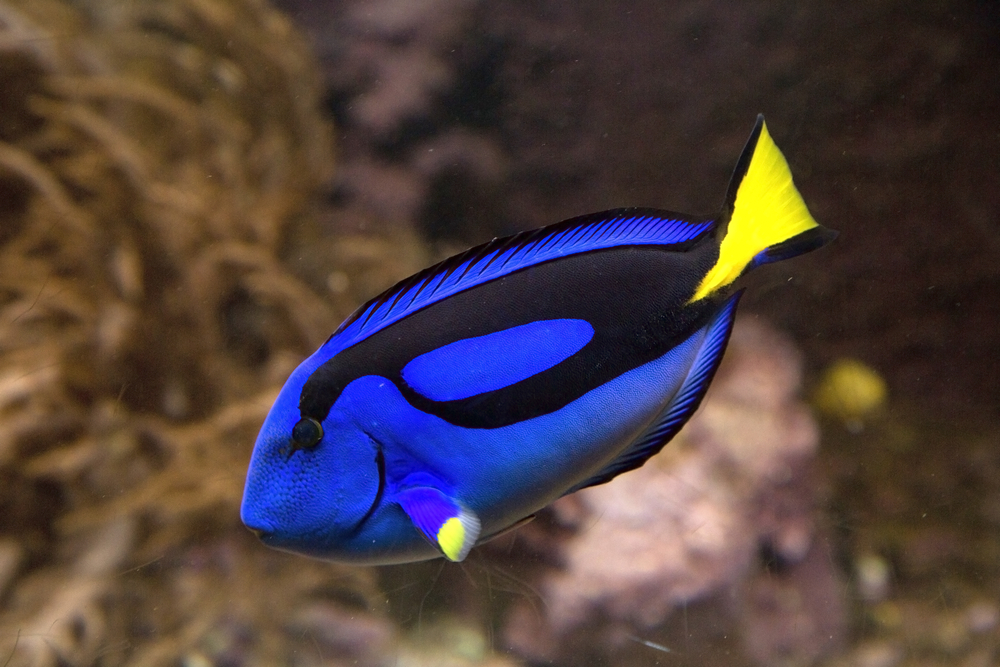
This type of bony fish is most strongly associated with Indo-Pacific. For identification, look at body shape, fin placement, mouth position, color pattern, and where the fish is found. On reefs, body shape, color pattern, fin placement, and feeding behavior often give the best identification clues. When observing, fishing for, buying, or keeping this fish, use responsible practices and follow local rules so wild populations and habitats remain healthy.
31. Yellow Tang
Yellow Tang (Zebrasoma flavescens) is a reef fish found in coral and rocky reefs. It is usually recognized by its solid yellow body and disk shape, and adults are commonly around 4–8 in depending on age, habitat, food supply, and local conditions. This surgeonfish has a sharp tail spine, so it should be observed or handled with respect in aquarium and field contexts.
This type of bony fish is most strongly associated with Central and western Pacific. For identification, look at body shape, fin placement, mouth position, color pattern, and where the fish is found. On reefs, body shape, color pattern, fin placement, and feeding behavior often give the best identification clues. When observing, fishing for, buying, or keeping this fish, use responsible practices and follow local rules so wild populations and habitats remain healthy.
32. Moorish Idol
Moorish Idol (Zanclus cornutus) is a reef fish found in tropical reefs and lagoons. It is usually recognized by its long dorsal streamer and bold bands, and adults are commonly around 6–9 in depending on age, habitat, food supply, and local conditions. Moorish idols are striking reef fish, but they are specialized feeders and are not easy aquarium species for beginners.
This type of bony fish is most strongly associated with Indo-Pacific and eastern Pacific. For identification, look at body shape, fin placement, mouth position, color pattern, and where the fish is found. On reefs, body shape, color pattern, fin placement, and feeding behavior often give the best identification clues. When observing, fishing for, buying, or keeping this fish, use responsible practices and follow local rules so wild populations and habitats remain healthy.
33. Red Lionfish
Red Lionfish (Pterois volitans) is a reef predator found in reefs, rocky areas, and invasive atlantic habitats. It is usually recognized by its venomous spines and fan-like fins, and adults are commonly around 8–15 in depending on age, habitat, food supply, and local conditions. Lionfish are beautiful but can be harmful outside their native range, where they prey heavily on small reef fish.
This type of bony fish is most strongly associated with Indo-Pacific; invasive in western Atlantic. For identification, look at body shape, fin placement, mouth position, color pattern, and where the fish is found. This predator plays a visible role on reef systems, but it should be treated carefully because some species have spines, teeth, or legal protections. When observing, fishing for, buying, or keeping this fish, use responsible practices and follow local rules so wild populations and habitats remain healthy.
34. Common Seahorse
Common Seahorse (Hippocampus kuda) is a syngnathid fish found in seagrass beds, mangroves, reefs, and estuaries. It is usually recognized by its horse-like head and prehensile tail, and adults are commonly around 4–8 in depending on age, habitat, food supply, and local conditions. Seahorses are bony fish with armor-like plates, upright posture, and male pregnancy, making them unlike most familiar fish.
This type of bony fish is most strongly associated with Indo-Pacific. For identification, look at body shape, fin placement, mouth position, color pattern, and where the fish is found. Syngnathids are unusual bony fish with tube-like snouts, slow feeding movements, and special reproductive biology. When observing, fishing for, buying, or keeping this fish, use responsible practices and follow local rules so wild populations and habitats remain healthy.
35. Greater Pipefish
Greater Pipefish (Syngnathus acus) is a syngnathid fish found in seagrass beds, estuaries, and coastal waters. It is usually recognized by its long thin body and tube snout, and adults are commonly around 10–18 in depending on age, habitat, food supply, and local conditions. Pipefish are relatives of seahorses and blend into vegetation, feeding on tiny crustaceans through a narrow snout.
This type of bony fish is most strongly associated with Northeastern Atlantic and Mediterranean. For identification, look at body shape, fin placement, mouth position, color pattern, and where the fish is found. Syngnathids are unusual bony fish with tube-like snouts, slow feeding movements, and special reproductive biology. When observing, fishing for, buying, or keeping this fish, use responsible practices and follow local rules so wild populations and habitats remain healthy.
36. Atlantic Cod
Atlantic Cod (Gadus morhua) is a marine food fish found in cold north atlantic shelves and coastal waters. It is usually recognized by its three dorsal fins and chin barbel, and adults are commonly around 20–40 in depending on age, habitat, food supply, and local conditions. Cod are bottom-associated predators and one of the best-known examples of a bony fish important to human food systems.
This type of bony fish is most strongly associated with North Atlantic. For identification, look at body shape, fin placement, mouth position, color pattern, and where the fish is found. This species also matters to seafood and fishery discussions, so sustainable harvest and correct identification are important. When observing, fishing for, buying, or keeping this fish, use responsible practices and follow local rules so wild populations and habitats remain healthy.
37. Pacific Cod
Pacific Cod (Gadus macrocephalus) is a marine food fish found in north pacific continental shelves. It is usually recognized by its pale lateral line and chin barbel, and adults are commonly around 20–39 in depending on age, habitat, food supply, and local conditions. Pacific cod resemble Atlantic cod but occur across northern Pacific waters and support major commercial fisheries.
This type of bony fish is most strongly associated with North Pacific. For identification, look at body shape, fin placement, mouth position, color pattern, and where the fish is found. This species also matters to seafood and fishery discussions, so sustainable harvest and correct identification are important. When observing, fishing for, buying, or keeping this fish, use responsible practices and follow local rules so wild populations and habitats remain healthy.
38. Haddock
Haddock (Melanogrammus aeglefinus) is a marine food fish found in cold north atlantic seafloors. It is usually recognized by its dark shoulder blotch and black lateral line, and adults are commonly around 15–30 in depending on age, habitat, food supply, and local conditions. The dark thumbprint-like mark near the pectoral fin helps distinguish haddock from similar cod relatives.
This type of bony fish is most strongly associated with North Atlantic. For identification, look at body shape, fin placement, mouth position, color pattern, and where the fish is found. This species also matters to seafood and fishery discussions, so sustainable harvest and correct identification are important. When observing, fishing for, buying, or keeping this fish, use responsible practices and follow local rules so wild populations and habitats remain healthy.
39. Alaska Pollock
Alaska Pollock (Gadus chalcogrammus) is a marine food fish found in north pacific shelf waters. It is usually recognized by its slender cod relative, and adults are commonly around 12–36 in depending on age, habitat, food supply, and local conditions. Alaska pollock school in large numbers and are important in global seafood, marine food webs, and managed fisheries.
This type of bony fish is most strongly associated with North Pacific. For identification, look at body shape, fin placement, mouth position, color pattern, and where the fish is found. This species also matters to seafood and fishery discussions, so sustainable harvest and correct identification are important. When observing, fishing for, buying, or keeping this fish, use responsible practices and follow local rules so wild populations and habitats remain healthy.
40. European Hake
European Hake (Merluccius merluccius) is a marine food fish found in northeastern atlantic and mediterranean waters. It is usually recognized by its long body and large predatory mouth, and adults are commonly around 12–36 in depending on age, habitat, food supply, and local conditions. Hake are active predators with soft white flesh and are commonly associated with deeper shelf waters.
This type of bony fish is most strongly associated with Eastern Atlantic and Mediterranean. For identification, look at body shape, fin placement, mouth position, color pattern, and where the fish is found. This species also matters to seafood and fishery discussions, so sustainable harvest and correct identification are important. When observing, fishing for, buying, or keeping this fish, use responsible practices and follow local rules so wild populations and habitats remain healthy.
41. Atlantic Halibut
Atlantic Halibut (Hippoglossus hippoglossus) is a flatfish found in cold north atlantic seafloors. It is usually recognized by its very large right-eyed flatfish, and adults are commonly around 3–8 ft depending on age, habitat, food supply, and local conditions. Halibut begin life upright like other fish, then one eye migrates as the body becomes adapted for life on the seafloor.
This type of bony fish is most strongly associated with North Atlantic. For identification, look at body shape, fin placement, mouth position, color pattern, and where the fish is found. Flatfish are easy to recognize once you notice the sideways body plan, bottom-camouflage colors, and both eyes on one side. When observing, fishing for, buying, or keeping this fish, use responsible practices and follow local rules so wild populations and habitats remain healthy.
42. Summer Flounder
Summer Flounder (Paralichthys dentatus) is a flatfish found in sandy coastal bottoms, bays, and estuaries. It is usually recognized by its left-eyed flatfish with spots, and adults are commonly around 12–30 in depending on age, habitat, food supply, and local conditions. Also called fluke, summer flounder hide in sand and ambush small fish and crustaceans.
This type of bony fish is most strongly associated with Western Atlantic. For identification, look at body shape, fin placement, mouth position, color pattern, and where the fish is found. Flatfish are easy to recognize once you notice the sideways body plan, bottom-camouflage colors, and both eyes on one side. When observing, fishing for, buying, or keeping this fish, use responsible practices and follow local rules so wild populations and habitats remain healthy.
43. Dover Sole
Dover Sole (Solea solea) is a flatfish found in sandy and muddy seafloors. It is usually recognized by its oval flatfish with small mouth, and adults are commonly around 10–24 in depending on age, habitat, food supply, and local conditions. Dover sole is a true sole, adapted for bottom living with both eyes on one side of the head.
This type of bony fish is most strongly associated with Eastern Atlantic and Mediterranean. For identification, look at body shape, fin placement, mouth position, color pattern, and where the fish is found. Flatfish are easy to recognize once you notice the sideways body plan, bottom-camouflage colors, and both eyes on one side. When observing, fishing for, buying, or keeping this fish, use responsible practices and follow local rules so wild populations and habitats remain healthy.
44. Turbot
Turbot (Scophthalmus maximus) is a flatfish found in northeastern atlantic sandy bottoms. It is usually recognized by its broad diamond-shaped flatfish, and adults are commonly around 16–40 in depending on age, habitat, food supply, and local conditions. Turbot have a wide, rounded body and blend into the seabed with mottled coloration.
This type of bony fish is most strongly associated with Northeastern Atlantic and nearby seas. For identification, look at body shape, fin placement, mouth position, color pattern, and where the fish is found. Flatfish are easy to recognize once you notice the sideways body plan, bottom-camouflage colors, and both eyes on one side. When observing, fishing for, buying, or keeping this fish, use responsible practices and follow local rules so wild populations and habitats remain healthy.
45. European Plaice
European Plaice (Pleuronectes platessa) is a flatfish found in sandy and muddy coastal bottoms. It is usually recognized by its orange spots on upper side, and adults are commonly around 10–28 in depending on age, habitat, food supply, and local conditions. The orange spots on plaice are a helpful field mark for separating it from many other flatfish.
This type of bony fish is most strongly associated with Northeastern Atlantic. For identification, look at body shape, fin placement, mouth position, color pattern, and where the fish is found. Flatfish are easy to recognize once you notice the sideways body plan, bottom-camouflage colors, and both eyes on one side. When observing, fishing for, buying, or keeping this fish, use responsible practices and follow local rules so wild populations and habitats remain healthy.
46. Atlantic Bluefin Tuna
Atlantic Bluefin Tuna (Thunnus thynnus) is a pelagic fish found in open atlantic ocean and mediterranean sea. It is usually recognized by its powerful warm-bodied ocean predator, and adults are commonly around 3–10 ft depending on age, habitat, food supply, and local conditions. Bluefin tuna are fast, muscular, highly migratory bony fish that require careful conservation and fishery management.
This type of bony fish is most strongly associated with Atlantic and Mediterranean. For identification, look at body shape, fin placement, mouth position, color pattern, and where the fish is found. Pelagic fish live in the open water column, so speed, schooling, migration, and streamlined shapes are major clues. When observing, fishing for, buying, or keeping this fish, use responsible practices and follow local rules so wild populations and habitats remain healthy.
47. Yellowfin Tuna
Yellowfin Tuna (Thunnus albacares) is a pelagic fish found in tropical and subtropical open oceans. It is usually recognized by its long yellow second dorsal and anal fins, and adults are commonly around 2–6 ft depending on age, habitat, food supply, and local conditions. Yellowfin tuna travel in schools and are recognizable by their bright finlets and streamlined body.
This type of bony fish is most strongly associated with Worldwide tropical oceans. For identification, look at body shape, fin placement, mouth position, color pattern, and where the fish is found. Pelagic fish live in the open water column, so speed, schooling, migration, and streamlined shapes are major clues. When observing, fishing for, buying, or keeping this fish, use responsible practices and follow local rules so wild populations and habitats remain healthy.
48. Skipjack Tuna
Skipjack Tuna (Katsuwonus pelamis) is a pelagic fish found in warm open oceans. It is usually recognized by its dark horizontal belly stripes, and adults are commonly around 16–32 in depending on age, habitat, food supply, and local conditions. Skipjack are smaller tuna that school near the surface and often associate with birds, baitfish, or floating objects.
This type of bony fish is most strongly associated with Worldwide tropical and subtropical seas. For identification, look at body shape, fin placement, mouth position, color pattern, and where the fish is found. Pelagic fish live in the open water column, so speed, schooling, migration, and streamlined shapes are major clues. When observing, fishing for, buying, or keeping this fish, use responsible practices and follow local rules so wild populations and habitats remain healthy.
49. Mahi-Mahi
Mahi-Mahi (Coryphaena hippurus) is a pelagic fish found in warm open ocean and offshore structure. It is usually recognized by its bright colors and tall forehead in males, and adults are commonly around 2–5 ft depending on age, habitat, food supply, and local conditions. Mahi-mahi grow quickly, follow floating debris, and flash brilliant green, gold, and blue when fresh from the water.
This type of bony fish is most strongly associated with Worldwide warm seas. For identification, look at body shape, fin placement, mouth position, color pattern, and where the fish is found. Pelagic fish live in the open water column, so speed, schooling, migration, and streamlined shapes are major clues. When observing, fishing for, buying, or keeping this fish, use responsible practices and follow local rules so wild populations and habitats remain healthy.
50. Swordfish
Swordfish (Xiphias gladius) is a pelagic predator found in temperate and tropical open oceans. It is usually recognized by its long flattened bill, and adults are commonly around 4–10 ft depending on age, habitat, food supply, and local conditions. Swordfish use their bill and speed to hunt squid and fish, and they can move through a wide range of depths.
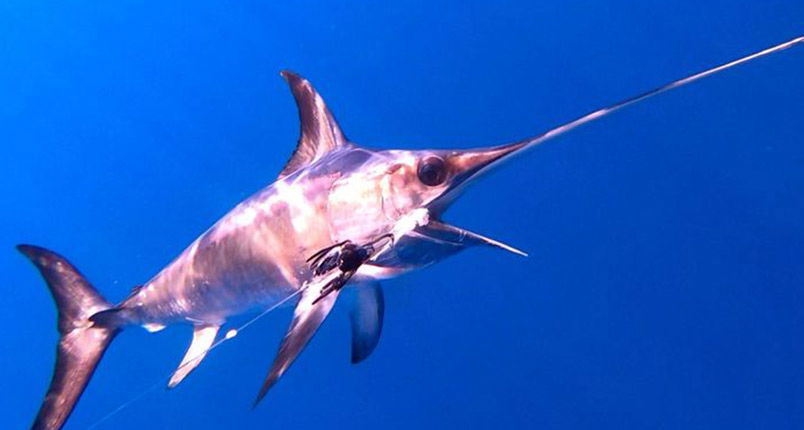
This type of bony fish is most strongly associated with Worldwide oceans. For identification, look at body shape, fin placement, mouth position, color pattern, and where the fish is found. It is a useful example for understanding how bony fish adapt to different aquatic environments. When observing, fishing for, buying, or keeping this fish, use responsible practices and follow local rules so wild populations and habitats remain healthy.
51. Indo-Pacific Sailfish
Indo-Pacific Sailfish (Istiophorus platypterus) is a billfish found in warm open oceans. It is usually recognized by its large sail-like dorsal fin, and adults are commonly around 5–10 ft depending on age, habitat, food supply, and local conditions. Sailfish are famous for speed, schooling baitfish tactics, and a dramatic dorsal fin that can be raised or folded.
This type of bony fish is most strongly associated with Indian and Pacific Oceans. For identification, look at body shape, fin placement, mouth position, color pattern, and where the fish is found. Billfish are large open-ocean predators; their long bills, tall fins, and fast swimming separate them from most other bony fish. When observing, fishing for, buying, or keeping this fish, use responsible practices and follow local rules so wild populations and habitats remain healthy.
52. Atlantic Blue Marlin
Atlantic Blue Marlin (Makaira nigricans) is a billfish found in warm atlantic offshore waters. It is usually recognized by its large billfish with pointed bill, and adults are commonly around 6–14 ft depending on age, habitat, food supply, and local conditions. Blue marlin are large ocean predators and an iconic species for offshore anglers and marine naturalists.
This type of bony fish is most strongly associated with Atlantic Ocean. For identification, look at body shape, fin placement, mouth position, color pattern, and where the fish is found. Billfish are large open-ocean predators; their long bills, tall fins, and fast swimming separate them from most other bony fish. When observing, fishing for, buying, or keeping this fish, use responsible practices and follow local rules so wild populations and habitats remain healthy.
53. Atlantic Mackerel
Atlantic Mackerel (Scomber scombrus) is a pelagic schooling fish found in cool coastal and open waters. It is usually recognized by its wavy dark back stripes, and adults are commonly around 10–18 in depending on age, habitat, food supply, and local conditions. Mackerel are fast-swimming schooling fish with a forked tail and oily flesh that supports seabirds, larger fish, and humans.
This type of bony fish is most strongly associated with North Atlantic. For identification, look at body shape, fin placement, mouth position, color pattern, and where the fish is found. Schooling helps this fish avoid predators, find food, and move efficiently through open water. When observing, fishing for, buying, or keeping this fish, use responsible practices and follow local rules so wild populations and habitats remain healthy.
54. European Pilchard
European Pilchard (Sardina pilchardus) is a forage fish found in coastal waters and open schools. It is usually recognized by its small silvery schooling fish, and adults are commonly around 6–10 in depending on age, habitat, food supply, and local conditions. Sardines are important forage fish, transferring plankton energy to larger predators such as tuna, seabirds, and marine mammals.
This type of bony fish is most strongly associated with Northeastern Atlantic and Mediterranean. For identification, look at body shape, fin placement, mouth position, color pattern, and where the fish is found. Forage fish may be small, but they are vital because they move energy from plankton to larger predators. When observing, fishing for, buying, or keeping this fish, use responsible practices and follow local rules so wild populations and habitats remain healthy.
55. European Anchovy
European Anchovy (Engraulis encrasicolus) is a forage fish found in coastal seas and estuaries. It is usually recognized by its small silvery fish with large mouth, and adults are commonly around 4–8 in depending on age, habitat, food supply, and local conditions. Anchovies feed on plankton and often form dense schools, making them key prey in many marine food webs.
This type of bony fish is most strongly associated with Eastern Atlantic, Mediterranean, and Black Sea. For identification, look at body shape, fin placement, mouth position, color pattern, and where the fish is found. Forage fish may be small, but they are vital because they move energy from plankton to larger predators. When observing, fishing for, buying, or keeping this fish, use responsible practices and follow local rules so wild populations and habitats remain healthy.
56. Atlantic Herring
Atlantic Herring (Clupea harengus) is a forage fish found in cold north atlantic coastal and offshore waters. It is usually recognized by its silvery schooling fish, and adults are commonly around 8–15 in depending on age, habitat, food supply, and local conditions. Herring are classic schooling bony fish that help support cod, seabirds, whales, and many commercial fisheries.
This type of bony fish is most strongly associated with North Atlantic. For identification, look at body shape, fin placement, mouth position, color pattern, and where the fish is found. Forage fish may be small, but they are vital because they move energy from plankton to larger predators. When observing, fishing for, buying, or keeping this fish, use responsible practices and follow local rules so wild populations and habitats remain healthy.
57. Atlantic Tarpon
Atlantic Tarpon (Megalops atlanticus) is a coastal sport fish found in coastal waters, estuaries, lagoons, and rivers. It is usually recognized by its large silver fish that gulps air, and adults are commonly around 3–8 ft depending on age, habitat, food supply, and local conditions. Tarpon have a large swim bladder used for air breathing, helping them survive in warm, low-oxygen habitats.
This type of bony fish is most strongly associated with Western and eastern Atlantic. For identification, look at body shape, fin placement, mouth position, color pattern, and where the fish is found. Coastal anglers often identify this fish by watching tides, current edges, bait movement, and seasonal migrations. When observing, fishing for, buying, or keeping this fish, use responsible practices and follow local rules so wild populations and habitats remain healthy.
58. Bonefish
Bonefish (Albula vulpes) is a coastal fish found in tropical flats, lagoons, and sandy shallows. It is usually recognized by its silver flats fish with pointed snout, and adults are commonly around 12–30 in depending on age, habitat, food supply, and local conditions. Bonefish are built for shallow flats, where they root for small crabs, shrimp, and worms over sand or mud.
This type of bony fish is most strongly associated with Western Atlantic and Caribbean region. For identification, look at body shape, fin placement, mouth position, color pattern, and where the fish is found. This species shows how estuaries, marshes, seagrass, and coastal shallows support many bony fish life cycles. When observing, fishing for, buying, or keeping this fish, use responsible practices and follow local rules so wild populations and habitats remain healthy.
59. Milkfish
Milkfish (Chanos chanos) is a coastal and aquaculture fish found in tropical coastal waters, lagoons, and brackish ponds. It is usually recognized by its forked tail and silvery body, and adults are commonly around 1–5 ft depending on age, habitat, food supply, and local conditions. Milkfish are hardy, schooling bony fish widely associated with brackish habitats and aquaculture in tropical regions.
This type of bony fish is most strongly associated with Indo-Pacific. For identification, look at body shape, fin placement, mouth position, color pattern, and where the fish is found. Its value comes from both wild ecology and food production, which makes responsible management important. When observing, fishing for, buying, or keeping this fish, use responsible practices and follow local rules so wild populations and habitats remain healthy.
60. Great Barracuda
Great Barracuda (Sphyraena barracuda) is a coastal predator found in reefs, seagrass, mangroves, and open coastal water. It is usually recognized by its long body and large teeth, and adults are commonly around 2–6 ft depending on age, habitat, food supply, and local conditions. Barracuda are visual ambush predators; their torpedo shape and toothy jaw make them easy to recognize.
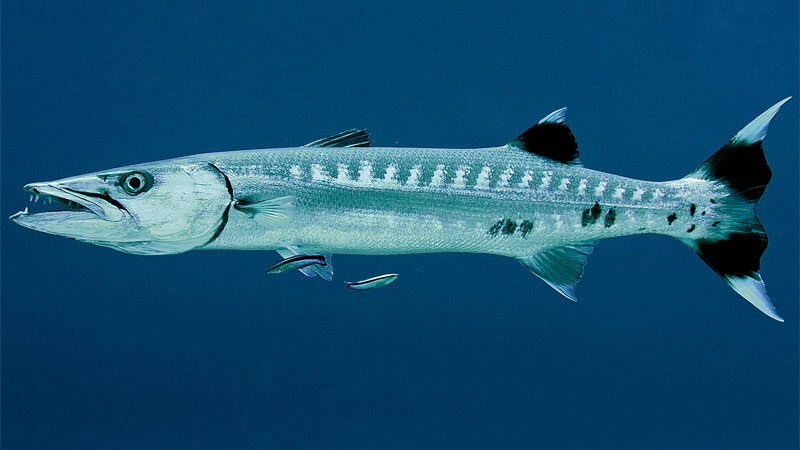
This type of bony fish is most strongly associated with Tropical and subtropical Atlantic and Indo-Pacific. For identification, look at body shape, fin placement, mouth position, color pattern, and where the fish is found. Coastal predators often move between reefs, beaches, mangroves, seagrass, and estuaries as conditions change. When observing, fishing for, buying, or keeping this fish, use responsible practices and follow local rules so wild populations and habitats remain healthy.
61. Goliath Grouper
Goliath Grouper (Epinephelus itajara) is a reef predator found in reefs, wrecks, mangroves, and coastal structure. It is usually recognized by its massive body and broad mouth, and adults are commonly around 3–8 ft depending on age, habitat, food supply, and local conditions. Goliath grouper are large, slow-growing reef fish, so many areas protect them with strict harvest rules.
This type of bony fish is most strongly associated with Western Atlantic and eastern Pacific. For identification, look at body shape, fin placement, mouth position, color pattern, and where the fish is found. This predator plays a visible role on reef systems, but it should be treated carefully because some species have spines, teeth, or legal protections. When observing, fishing for, buying, or keeping this fish, use responsible practices and follow local rules so wild populations and habitats remain healthy.
62. Red Snapper
Red Snapper (Lutjanus campechanus) is a reef and offshore fish found in reefs, ledges, and offshore structures. It is usually recognized by its red body and pointed profile, and adults are commonly around 12–30 in depending on age, habitat, food supply, and local conditions. Red snapper are important reef-associated bony fish, and responsible anglers follow size, season, and bag limits.
This type of bony fish is most strongly associated with Western Atlantic and Gulf of Mexico. For identification, look at body shape, fin placement, mouth position, color pattern, and where the fish is found. This fish often uses reefs, ledges, or hard structure, so habitat awareness is central to finding or identifying it. When observing, fishing for, buying, or keeping this fish, use responsible practices and follow local rules so wild populations and habitats remain healthy.
63. Mutton Snapper
Mutton Snapper (Lutjanus analis) is a reef fish found in reefs, seagrass beds, and clear tropical waters. It is usually recognized by its dark spot and blue cheek lines, and adults are commonly around 16–30 in depending on age, habitat, food supply, and local conditions. Mutton snapper often move between seagrass, mangroves, and reef habitats during their life cycle.
This type of bony fish is most strongly associated with Western Atlantic. For identification, look at body shape, fin placement, mouth position, color pattern, and where the fish is found. On reefs, body shape, color pattern, fin placement, and feeding behavior often give the best identification clues. When observing, fishing for, buying, or keeping this fish, use responsible practices and follow local rules so wild populations and habitats remain healthy.
64. Common Snook
Common Snook (Centropomus undecimalis) is a coastal sport fish found in mangroves, estuaries, beaches, and rivers. It is usually recognized by its black lateral line and sloped forehead, and adults are commonly around 20–40 in depending on age, habitat, food supply, and local conditions. Snook tolerate fresh and salt water and often ambush prey near mangrove roots, bridges, and current edges.
This type of bony fish is most strongly associated with Western Atlantic. For identification, look at body shape, fin placement, mouth position, color pattern, and where the fish is found. Coastal anglers often identify this fish by watching tides, current edges, bait movement, and seasonal migrations. When observing, fishing for, buying, or keeping this fish, use responsible practices and follow local rules so wild populations and habitats remain healthy.
65. Red Drum
Red Drum (Sciaenops ocellatus) is a coastal fish found in estuaries, marshes, beaches, and coastal waters. It is usually recognized by its tail spot and copper body, and adults are commonly around 18–45 in depending on age, habitat, food supply, and local conditions. Red drum, also called redfish, feed on crabs, shrimp, and baitfish and are tied closely to marsh and estuary health.
This type of bony fish is most strongly associated with Western Atlantic and Gulf of Mexico. For identification, look at body shape, fin placement, mouth position, color pattern, and where the fish is found. This species shows how estuaries, marshes, seagrass, and coastal shallows support many bony fish life cycles. When observing, fishing for, buying, or keeping this fish, use responsible practices and follow local rules so wild populations and habitats remain healthy.
66. Spotted Seatrout
Spotted Seatrout (Cynoscion nebulosus) is a coastal fish found in seagrass flats, estuaries, and coastal bays. It is usually recognized by its spotted back and soft mouth, and adults are commonly around 12–28 in depending on age, habitat, food supply, and local conditions. Spotted seatrout are not true trout; they are drum relatives that use shallow grass flats and estuaries.
This type of bony fish is most strongly associated with Western Atlantic and Gulf of Mexico. For identification, look at body shape, fin placement, mouth position, color pattern, and where the fish is found. This species shows how estuaries, marshes, seagrass, and coastal shallows support many bony fish life cycles. When observing, fishing for, buying, or keeping this fish, use responsible practices and follow local rules so wild populations and habitats remain healthy.
67. Black Sea Bass
Black Sea Bass (Centropristis striata) is a temperate reef fish found in rocky bottoms, reefs, wrecks, and nearshore waters. It is usually recognized by its dark body and high dorsal fin, and adults are commonly around 10–20 in depending on age, habitat, food supply, and local conditions. Black sea bass are protogynous hermaphrodites in which some females can become males, an important note for fishery biology.
This type of bony fish is most strongly associated with Western Atlantic. For identification, look at body shape, fin placement, mouth position, color pattern, and where the fish is found. Temperate reef fish may lack tropical colors, but they are important predators on rocky bottoms, wrecks, and nearshore structures. When observing, fishing for, buying, or keeping this fish, use responsible practices and follow local rules so wild populations and habitats remain healthy.
68. European Sea Bass
European Sea Bass (Dicentrarchus labrax) is a coastal predator found in coastal waters, estuaries, and rocky shores. It is usually recognized by its silver body and spiny dorsal fin, and adults are commonly around 12–36 in depending on age, habitat, food supply, and local conditions. European sea bass hunt small fish and crustaceans and are important in both wild fisheries and aquaculture.
This type of bony fish is most strongly associated with Eastern Atlantic and Mediterranean. For identification, look at body shape, fin placement, mouth position, color pattern, and where the fish is found. Coastal predators often move between reefs, beaches, mangroves, seagrass, and estuaries as conditions change. When observing, fishing for, buying, or keeping this fish, use responsible practices and follow local rules so wild populations and habitats remain healthy.
69. Striped Bass
Striped Bass (Morone saxatilis) is a temperate bass found in coastal waters, estuaries, rivers, and reservoirs. It is usually recognized by its horizontal dark stripes, and adults are commonly around 18–50 in depending on age, habitat, food supply, and local conditions. Striped bass can be anadromous or landlocked, making them an excellent example of flexible bony fish life history.
This type of bony fish is most strongly associated with Atlantic coast of North America; introduced inland. For identification, look at body shape, fin placement, mouth position, color pattern, and where the fish is found. Temperate bass are strong schooling predators and are often found where current, baitfish, and open water meet. When observing, fishing for, buying, or keeping this fish, use responsible practices and follow local rules so wild populations and habitats remain healthy.
70. White Bass
White Bass (Morone chrysops) is a temperate bass found in lakes, reservoirs, and large rivers. It is usually recognized by its silvery body with broken stripes, and adults are commonly around 10–17 in depending on age, habitat, food supply, and local conditions. White bass school in open water and often chase baitfish near the surface during feeding activity.

This type of bony fish is most strongly associated with Central North America. For identification, look at body shape, fin placement, mouth position, color pattern, and where the fish is found. Temperate bass are strong schooling predators and are often found where current, baitfish, and open water meet. When observing, fishing for, buying, or keeping this fish, use responsible practices and follow local rules so wild populations and habitats remain healthy.
71. Peacock Bass
Peacock Bass (Cichla ocellaris) is a cichlid predator found in tropical rivers, lagoons, and reservoirs. It is usually recognized by its eye spot and bold color patterns, and adults are commonly around 12–30 in depending on age, habitat, food supply, and local conditions. Despite the name, peacock bass are cichlids, not true black bass, and they are aggressive tropical predators.
This type of bony fish is most strongly associated with South America; introduced in some warm waters. For identification, look at body shape, fin placement, mouth position, color pattern, and where the fish is found. This cichlid is a reminder that common names can be misleading, so scientific names and family relationships matter. When observing, fishing for, buying, or keeping this fish, use responsible practices and follow local rules so wild populations and habitats remain healthy.
72. Arapaima
Arapaima (Arapaima gigas) is a freshwater giant found in amazon floodplains, lakes, and slow rivers. It is usually recognized by its giant air-breathing freshwater fish, and adults are commonly around 6–10 ft depending on age, habitat, food supply, and local conditions. Arapaima are among the largest freshwater bony fish and must surface to breathe air, making them vulnerable to overharvest.
This type of bony fish is most strongly associated with Amazon basin. For identification, look at body shape, fin placement, mouth position, color pattern, and where the fish is found. Large freshwater species often need wide floodplains, careful harvest rules, and protected nursery habitats. When observing, fishing for, buying, or keeping this fish, use responsible practices and follow local rules so wild populations and habitats remain healthy.
73. Silver Arowana
Silver Arowana (Osteoglossum bicirrhosum) is a freshwater predator found in amazon floodplains and slow rivers. It is usually recognized by its surface-feeding fish with upturned mouth, and adults are commonly around 2–3 ft depending on age, habitat, food supply, and local conditions. Silver arowanas patrol near the surface and may leap for insects, making their body shape useful for identifying their feeding style.
This type of bony fish is most strongly associated with Amazon basin. For identification, look at body shape, fin placement, mouth position, color pattern, and where the fish is found. Its predatory habits make it important in food webs, where it helps control smaller fish and other aquatic animals. When observing, fishing for, buying, or keeping this fish, use responsible practices and follow local rules so wild populations and habitats remain healthy.
74. Longnose Gar
Longnose Gar (Lepisosteus osseus) is a ancient ray-finned fish found in rivers, backwaters, lakes, and slow pools. It is usually recognized by its long armored body and needle snout, and adults are commonly around 2–4 ft depending on age, habitat, food supply, and local conditions. Gars are bony fish with hard ganoid scales and an air-breathing swim bladder, linking modern waters to ancient fish lineages.
This type of bony fish is most strongly associated with North America. For identification, look at body shape, fin placement, mouth position, color pattern, and where the fish is found. This fish retains features that help explain early ray-finned fish diversity beyond modern teleosts. When observing, fishing for, buying, or keeping this fish, use responsible practices and follow local rules so wild populations and habitats remain healthy.
75. Bowfin
Bowfin (Amia calva) is a ancient ray-finned fish found in swamps, backwaters, lakes, and slow rivers. It is usually recognized by its long dorsal fin and primitive features, and adults are commonly around 18–30 in depending on age, habitat, food supply, and local conditions. Bowfin are the living representative of an ancient lineage and can gulp air in low-oxygen swampy habitats.
This type of bony fish is most strongly associated with Eastern North America. For identification, look at body shape, fin placement, mouth position, color pattern, and where the fish is found. This fish retains features that help explain early ray-finned fish diversity beyond modern teleosts. When observing, fishing for, buying, or keeping this fish, use responsible practices and follow local rules so wild populations and habitats remain healthy.
76. Lake Sturgeon
Lake Sturgeon (Acipenser fulvescens) is a primitive ray-finned fish found in large rivers and lakes. It is usually recognized by its armored scutes and underside mouth, and adults are commonly around 3–6 ft depending on age, habitat, food supply, and local conditions. Sturgeon are bony fish relatives with many cartilaginous features; they grow slowly and need careful conservation.
This type of bony fish is most strongly associated with North America. For identification, look at body shape, fin placement, mouth position, color pattern, and where the fish is found. Although it belongs among ray-finned fishes, its ancient traits make it different from most modern teleosts. When observing, fishing for, buying, or keeping this fish, use responsible practices and follow local rules so wild populations and habitats remain healthy.
77. American Paddlefish
American Paddlefish (Polyodon spathula) is a filter-feeding fish found in large rivers, reservoirs, and backwaters. It is usually recognized by its long paddle-shaped rostrum, and adults are commonly around 3–6 ft depending on age, habitat, food supply, and local conditions. Paddlefish filter zooplankton and use their distinctive rostrum to sense prey in big river systems.
This type of bony fish is most strongly associated with Mississippi River basin. For identification, look at body shape, fin placement, mouth position, color pattern, and where the fish is found. Filter feeders show that not all large fish are active hunters; some strain tiny food from the water. When observing, fishing for, buying, or keeping this fish, use responsible practices and follow local rules so wild populations and habitats remain healthy.
78. West Indian Ocean Coelacanth
West Indian Ocean Coelacanth (Latimeria chalumnae) is a lobe-finned fish found in deep marine caves and steep volcanic slopes. It is usually recognized by its lobed fins and ancient lineage, and adults are commonly around 4–6 ft depending on age, habitat, food supply, and local conditions. Coelacanths are living lobe-finned bony fish with fleshy fins, helping readers understand why not all bony fish look like trout or bass.
This type of bony fish is most strongly associated with Western Indian Ocean. For identification, look at body shape, fin placement, mouth position, color pattern, and where the fish is found. This species helps explain the lobe-finned branch of bony fish, which is central to the evolutionary story of vertebrates. When observing, fishing for, buying, or keeping this fish, use responsible practices and follow local rules so wild populations and habitats remain healthy.
79. Australian Lungfish
Australian Lungfish (Neoceratodus forsteri) is a lobe-finned fish found in slow rivers and impoundments. It is usually recognized by its lung-like organ and lobed fins, and adults are commonly around 3–5 ft depending on age, habitat, food supply, and local conditions. Australian lungfish can breathe air and are a living example of the lobe-finned branch of bony fish evolution.
This type of bony fish is most strongly associated with Queensland, Australia. For identification, look at body shape, fin placement, mouth position, color pattern, and where the fish is found. This species helps explain the lobe-finned branch of bony fish, which is central to the evolutionary story of vertebrates. When observing, fishing for, buying, or keeping this fish, use responsible practices and follow local rules so wild populations and habitats remain healthy.
80. Ocean Sunfish
Ocean Sunfish (Mola mola) is a pelagic bony fish found in open temperate and tropical oceans. It is usually recognized by its huge flattened body and truncated tail, and adults are commonly around 6–10 ft tall depending on age, habitat, food supply, and local conditions. Ocean sunfish are among the heaviest bony fish, drifting through open water and feeding largely on gelatinous prey.
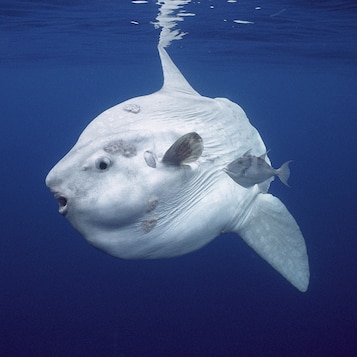
This type of bony fish is most strongly associated with Worldwide temperate and tropical oceans. For identification, look at body shape, fin placement, mouth position, color pattern, and where the fish is found. Its unusual body design proves that bony fish can evolve extreme shapes for life in the open ocean. When observing, fishing for, buying, or keeping this fish, use responsible practices and follow local rules so wild populations and habitats remain healthy.
How Are These Types of Fish Classified?
Bony fish belong to the broad vertebrate group often called Osteichthyes. For everyday readers, the easiest split is between ray-finned fish and lobe-finned fish. Ray-finned fish have fins supported by slender rays and include most fish people encounter in lakes, rivers, aquariums, reefs, seafood markets, and offshore waters. Lobe-finned fish have fleshy fins supported by internal bones and are represented today by living lungfish and coelacanths.
Within ray-finned fish, there are many useful subgroups. Teleosts include most modern bony fish, such as trout, bass, cod, tuna, clownfish, tetras, flatfish, and snapper. Older ray-finned lineages include gars, bowfin, sturgeon, and paddlefish. Classification can be scientific, but for field use it is often practical to group fish by habitat, body shape, feeding style, and behavior.
- Freshwater bony fish: bass, trout, carp, panfish, pike, sturgeon, gar, bowfin, arowana, and arapaima.
- Marine bony fish: cod, tuna, snapper, grouper, flatfish, reef fish, billfish, forage fish, and sunfish.
- Aquarium bony fish: bettas, guppies, mollies, tetras, angelfish, discus, clownfish, and tangs.
- Ancient or primitive-looking bony fish: gar, bowfin, sturgeon, paddlefish, lungfish, and coelacanth.
- Food and fishery species: salmon, cod, pollock, tuna, mackerel, sardine, herring, snapper, and halibut.
Where Do These Fish Live?
Bony fish live in nearly every aquatic environment where fish can survive. They occur in cold mountain streams, warm tropical floodplains, blackwater creeks, estuaries, mangroves, coral reefs, rocky shorelines, sandy seafloors, deep ocean slopes, offshore pelagic waters, and backyard aquariums. Some species spend their entire lives in freshwater, some remain in saltwater, and others move between both.
Habitat is one of the most useful clues for identification. A trout in a cold stream, a flounder on a sandy seabed, a clownfish near reef anemones, a tuna offshore, and a neon tetra in a blackwater stream all have body shapes and behaviors connected to where they live. When identifying bony fish, always combine appearance with habitat, range, season, and behavior.
How to Identify Different Types of Fish
Learning to identify bony fish becomes easier when you focus on repeatable field marks rather than color alone. Color can change with age, sex, water clarity, stress, breeding season, and light, so shape and structure are often more reliable.
- Body shape: Deep-bodied fish like bluegill differ from torpedo-shaped fish like pike, tuna, and barracuda.
- Mouth position: Upturned mouths suggest surface feeding, while underside mouths often indicate bottom feeding.
- Fin shape: Look for spiny dorsal fins, long fin streamers, forked tails, rounded tails, or flattened pectoral fins.
- Color pattern: Bars, stripes, spots, bands, saddles, eye spots, and lateral lines help separate similar species.
- Habitat: A reef, river, estuary, open ocean, pond, or aquarium setting can narrow the possibilities quickly.
- Behavior: Schooling, ambush hunting, bottom resting, air gulping, grazing, or territorial guarding are useful clues.
- Size: Adult size helps separate small forage fish from similar-looking juveniles of larger species.
- Special features: Barbels, bills, armored scales, venomous spines, lobed fins, and flatfish eye placement are important.
Outdoor Tips for Finding and Observing These Species
For EnjoyTheWild.com readers, the best way to learn bony fish is to connect the fish to its environment. In freshwater, start near vegetation, docks, rocks, current seams, deep holes, shade, and transition areas between shallow and deep water. In coastal areas, watch tides, bait movement, mangrove edges, seagrass flats, reef structure, surf zones, and bird activity.
Use polarized sunglasses when observing shallow fish, move slowly near banks, avoid stepping on fragile habitat, and never handle fish longer than necessary. In aquariums, learn from behavior as much as appearance: schooling fish, territorial cichlids, grazing tangs, and surface-feeding arowanas all reveal how body design matches lifestyle.
Fishing Tips and Notes
Many bony fish are popular with anglers, but responsible fishing begins with correct identification. Learn local size limits, seasons, bag limits, protected species rules, and gear restrictions before fishing. Use wet hands when handling fish, keep them in the water when possible, and release unwanted fish quickly.
Match your approach to the fish. Trout often prefer cold, oxygen-rich water and insect activity. Bass relate to cover and structure. Tuna and mahi-mahi roam offshore near bait and floating objects. Flatfish lie on sandy bottoms. Red drum, snook, and spotted seatrout use estuaries and tidal movement. Understanding habitat will make you a better naturalist as well as a better angler.
Aquarium Care Notes
Many aquarium fish are bony fish, but their needs vary widely. A betta, guppy, neon tetra, discus, angelfish, goldfish, koi, clownfish, and tang should not be treated as interchangeable pets. Before buying any fish, research adult size, water temperature, pH, hardness, salinity, swimming space, tankmates, diet, and filtration needs.
Never release aquarium fish into ponds, rivers, canals, or local streams. Released fish can become invasive, spread disease, compete with native species, or die in unsuitable conditions. Responsible aquarium keeping protects both the fish and wild ecosystems.
Safety, Sustainability, and Conservation Notes
Bony fish are incredibly diverse, but many depend on habitats that are easy to damage. Coldwater trout need clean streams, reef fish need healthy coral and structure, estuary species need wetlands and seagrass, migratory salmon need open river routes, and large freshwater fish need connected floodplains. Habitat protection is one of the most important conservation actions for bony fish.
- Follow fishing regulations and learn protected species rules before harvesting fish.
- Use sustainable seafood guidance when buying commonly harvested fish.
- Do not move live fish between water bodies.
- Do not release aquarium fish into the wild.
- Handle venomous or spiny fish, such as lionfish and some surgeonfish, with caution.
- Protect spawning areas, nursery habitats, wetlands, seagrass beds, reefs, and stream banks.
- Report invasive species where local agencies ask for public records.
Fun Facts About Bony Fish
- Most living fish species are bony fish rather than sharks, rays, or jawless fish.
- Ray-finned fish include familiar species such as bass, trout, goldfish, tuna, cod, and clownfish.
- Lobe-finned fish include living lungfish and coelacanths.
- Some bony fish, such as tarpon, gar, bowfin, and lungfish, can breathe air in some way.
- Flatfish begin life with one eye on each side before one eye migrates as they mature.
- Seahorses are bony fish, even though they look very different from most familiar fish.
- Ocean sunfish are among the heaviest bony fish in the sea.
- Tiny schooling fish such as anchovies and sardines support many larger marine predators.
- Some salmon connect rivers, forests, bears, birds, and the ocean through their migrations.
- Many aquarium favorites, including bettas, tetras, guppies, angelfish, and clownfish, are bony fish.
Final Thoughts on Types of Bony Fish
The many types of bony fish show how adaptable fish can be. Some live in mountain streams, some patrol coral reefs, some school in the open ocean, some rest flat on the seafloor, some breathe air, and some have body plans that look almost prehistoric. For beginners, the best way to understand bony fish is to start with the big split between ray-finned and lobe-finned fish, then study habitat, body shape, mouth position, fin structure, color pattern, and behavior.
Whether you enjoy fishing, aquariums, seafood, wildlife watching, or outdoor learning, bony fish are worth studying because they connect so many parts of nature. The more you learn to identify them responsibly, the more clearly you can understand rivers, lakes, wetlands, reefs, estuaries, and oceans.
Frequently Asked Questions
1. What is a bony fish?
A bony fish is a fish with a skeleton made mostly of bone rather than cartilage. Most familiar fish, including bass, trout, salmon, cod, tuna, goldfish, and clownfish, are bony fish.
2. What are the two main types of bony fish?
The two main types are ray-finned fish and lobe-finned fish. Ray-finned fish include most living fish, while living lobe-finned fish include lungfish and coelacanths.
3. Are sharks bony fish?
No. Sharks are cartilaginous fish, meaning their skeletons are made mostly of cartilage rather than bone.
4. Are rays bony fish?
No. Rays are related to sharks and belong to the cartilaginous fish group, not the bony fish group.
5. Are salmon bony fish?
Yes. Salmon are ray-finned bony fish, and many species are famous for migrating between freshwater rivers and the ocean.
6. Are tuna bony fish?
Yes. Tuna are fast-swimming ray-finned bony fish that live in open ocean waters.
7. Are goldfish bony fish?
Yes. Goldfish are domesticated freshwater bony fish related to carp.
8. Are betta fish bony fish?
Yes. Betta fish are small freshwater bony fish known for bright colors, territorial behavior, and a labyrinth organ.
9. Are seahorses bony fish?
Yes. Seahorses are bony fish in the family Syngnathidae, even though their upright posture and body armor make them look unusual.
10. Are cod and haddock bony fish?
Yes. Cod and haddock are marine bony fish and are also important food fish.
11. What is the difference between bony fish and cartilaginous fish?
Bony fish have skeletons made mostly of bone, while cartilaginous fish such as sharks and rays have skeletons made mostly of cartilage. Bony fish also commonly have opercula covering the gills and many have swim bladders.
12. What is a ray-finned fish?
A ray-finned fish has fins supported by thin bony or horny rays. This group includes most familiar fish, from minnows and bass to tuna and reef fish.
13. What is a lobe-finned fish?
A lobe-finned fish has fleshy fins supported by internal bones. Living examples include lungfish and coelacanths.
14. Is a coelacanth a bony fish?
Yes. A coelacanth is a living lobe-finned bony fish and is important for understanding ancient fish lineages.
15. Is a lungfish a bony fish?
Yes. Lungfish are lobe-finned bony fish that can breathe air using lung-like organs.
16. What is the largest bony fish?
The ocean sunfish is often discussed as one of the heaviest living bony fish. Some large billfish, tuna, sturgeon, and arapaima are also impressive examples of large bony fish.
17. What is the smallest bony fish?
Some of the smallest bony fish are tiny freshwater and reef species. Exact rankings can change with taxonomic updates, but many small minnows, gobies, and cyprinids are only a few centimeters long.
18. Do all bony fish have scales?
Many bony fish have scales, but not all have obvious scales. Some have tiny, reduced, modified, or armor-like structures.
19. Do all bony fish have swim bladders?
No. Many bony fish have swim bladders, but some groups have reduced, modified, or absent swim bladders. In some fish, related structures help with air breathing.
20. Do bony fish breathe with gills?
Yes. Bony fish breathe mainly with gills, although some species can also use air-breathing adaptations.
21. Can bony fish live in both freshwater and saltwater?
Some can. Species such as salmon, striped bass, tarpon, and snook may move between fresh, brackish, and salt water during parts of their lives.
22. What bony fish are common in aquariums?
Common aquarium bony fish include bettas, goldfish, guppies, mollies, swordtails, tetras, angelfish, discus, clownfish, tangs, and many cichlids.
23. What bony fish are popular for fishing?
Popular fishing species include bass, trout, salmon, walleye, crappie, pike, muskie, tuna, snapper, grouper, red drum, snook, striped bass, and mahi-mahi.
24. What bony fish are common seafood species?
Common seafood bony fish include cod, haddock, pollock, hake, halibut, flounder, tuna, mackerel, sardine, anchovy, herring, snapper, and sea bass.
25. How do you identify a bony fish?
Look at body shape, mouth position, fin arrangement, scales, color pattern, habitat, behavior, and range. Identification is strongest when several clues match.
26. Why are some bony fish flat?
Flatfish are adapted for life on the seafloor. Their flattened bodies and eye placement help them hide in sand or mud and ambush prey.
27. Why do some bony fish have bright colors?
Bright colors may help with camouflage, species recognition, mating, warning, or reef communication depending on the species and habitat.
28. Why do some bony fish form schools?
Schooling can reduce predation risk, improve feeding success, help fish navigate, and make movement more efficient.
29. Are all bony fish safe to eat?
No. Some bony fish are good food species, but safety depends on species, location, size, handling, local advisories, and possible toxins or contaminants.
30. Are lionfish bony fish?
Yes. Lionfish are bony fish, but their venomous spines require caution when handling.
31. Are sturgeon bony fish?
Yes. Sturgeon are ray-finned bony fish relatives, although they have many cartilaginous features and armored scutes.
32. Are paddlefish bony fish?
Yes. Paddlefish are primitive ray-finned bony fish that filter-feed in large river systems.
33. Are gar bony fish?
Yes. Gars are ancient ray-finned bony fish with hard scales and long jaws.
34. Are bowfin bony fish?
Yes. Bowfin are ray-finned bony fish from an ancient lineage and are found in slow freshwater habitats.
35. What bony fish can breathe air?
Examples include lungfish, gar, bowfin, tarpon, arapaima, and betta fish, though each uses different adaptations.
36. What is the difference between trout and char?
Trout and char are related salmonids, but char often have light spots on a darker body and different fin color patterns. Brook trout are actually char.
37. What is the difference between bass and sea bass?
The word bass is used for several unrelated fish groups. Largemouth bass, striped bass, black sea bass, and European sea bass are not all close relatives.
38. Why are common names confusing for bony fish?
Common names are often based on appearance, taste, location, or tradition rather than scientific relationships. Scientific names help avoid confusion.
39. How many species of bony fish are there?
There are tens of thousands of living bony fish species, and most living fish belong to the ray-finned branch.
40. What habitats do bony fish use?
Bony fish live in streams, lakes, ponds, wetlands, estuaries, seagrass beds, reefs, sandy bottoms, deep slopes, open oceans, and aquariums.
41. What do bony fish eat?
Diets vary widely. Some eat plankton, algae, insects, worms, crustaceans, small fish, squid, plants, detritus, or a mix of foods.
42. Do bony fish have teeth?
Many do, but teeth vary greatly. Some have sharp predatory teeth, some have crushing teeth, some have tiny teeth, and some feed by filtering or grazing.
43. Can bony fish be invasive?
Yes. Some bony fish become invasive when introduced outside their native range. Aquarium releases and unauthorized stocking are common causes.
44. How can anglers protect bony fish populations?
Anglers can follow regulations, identify species correctly, use selective harvest, handle fish carefully, protect habitat, and report tagged or invasive fish when requested.
45. How can aquarium keepers protect wild fish?
Aquarium keepers can buy responsibly sourced fish, provide proper care, avoid overcrowding, quarantine when needed, and never release fish into the wild.
46. Why are forage fish important?
Forage fish such as sardines, anchovies, and herring transfer plankton energy to larger predators, including bigger fish, seabirds, and marine mammals.
47. Why are estuaries important for bony fish?
Estuaries provide nursery habitat, food, shelter, and migration routes for many coastal bony fish.
48. What is the best way to learn bony fish identification?
Start with local species, use a regional field guide, compare body shape and habitat, take photos when legal and safe, and practice with common fish before moving to difficult groups.
49. Should I rely only on color to identify bony fish?
No. Color can change with age, sex, stress, breeding season, and light. Use color together with shape, fins, mouth, habitat, and behavior.
50. Are all aquarium fish bony fish?
Most aquarium fish are bony fish, but not all aquatic aquarium animals are fish. Some tanks may include invertebrates, and marine displays may include rays or sharks in specialized settings.
51. Why are bony fish important to ecosystems?
Bony fish serve as predators, grazers, filter feeders, prey, nutrient movers, and habitat indicators. They support aquatic food webs and many human communities.
SEO Title
80 Types of Bony Fish: Species and ID Guide
Meta Description
Explore 80 types of bony fish with habitats, scientific names, key features, identification tips, and beginner-friendly facts.
Suggested URL Slug
types-of-bony-fish
Internal Link Ideas
- Types of Fish: Popular Species, Habitats, and Identification Tips
- Types of Aquarium Fish for Beginners
- Types of Freshwater Fish Found in Lakes and Rivers
- Types of Ocean Fish and How to Identify Them
- Types of Fish Scales, Fins, and Body Shapes Explained