

Sea snakes are a fascinating group of marine reptiles that have fully adapted to life in the ocean. There are around 70 recognized species worldwide, but only a smaller number are commonly known and studied. In this guide, we explore the types of Sea snakes that are most distinctive, widely documented, and important to marine ecosystems.
Sea snakes are found mainly in warm coastal waters of the Indian and Pacific Oceans. They are air-breathing reptiles but spend nearly their entire lives underwater, using flattened tails for swimming and specialized lungs to control buoyancy. Many people believe all sea snakes are aggressive, but in reality, most are calm, shy, and avoid human contact.
This article provides a clear, beginner-friendly overview of 15 types of Sea snakes, focusing on identification, habitat, behavior, diet, and conservation. If you love wild animals and ocean wildlife, this guide will help you understand what makes Sea snakes such unique and important marine predators.
1. Yellow-Bellied Sea Snake (Hydrophis platurus)
Overview
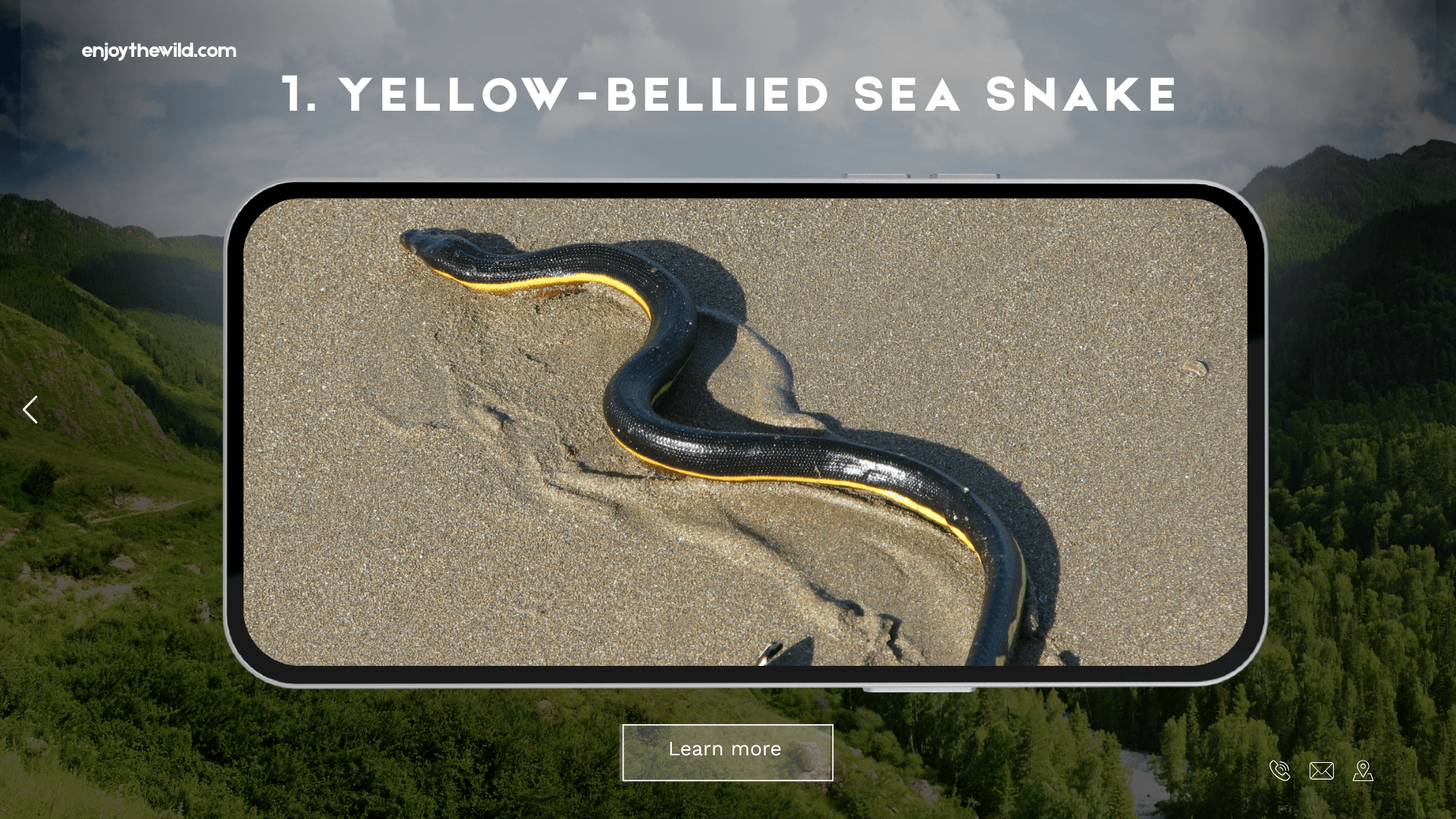
The Yellow-Bellied Sea Snake is the most widespread and well-known of all Sea snakes. It is often considered the true ocean wanderer of the snake world, capable of surviving far from land for long periods. Among the types of Sea snakes, this species stands out for its massive geographic range and fully pelagic lifestyle.
Unlike most Sea snakes that stay near reefs or coastlines, the Yellow-Bellied Sea Snake spends much of its life drifting in open water. This remarkable adaptation allows it to cross entire ocean basins.
Physical Identification
This species is easy to identify once you know what to look for. The upper body is dark brown or black, while the underside is bright yellow, giving the snake its common name. The sharp contrast between the two colors acts as a warning to predators.
The body is laterally compressed, making it excellent for swimming. Its tail is flat like a paddle, which provides strong propulsion. Adults usually measure between 2.5 and 4 feet in length, with females growing slightly larger than males.
Habitat and Distribution
The Yellow-Bellied Sea Snake has the widest distribution of any snake species in the world. It is found throughout the Indian Ocean and Pacific Ocean, from the eastern coast of Africa to the western shores of the Americas.
Unlike reef-dwelling Sea snakes, this species prefers warm surface waters and floating debris lines, where currents gather small fish. It is rarely seen near shore unless storms push it closer to land.
Behavior and Lifestyle
This Sea snake is mostly solitary and spends long periods drifting with ocean currents. It is most active during calm weather when prey is abundant near the surface.
Despite being highly venomous, the Yellow-Bellied Sea Snake is not aggressive. Bites to humans are extremely rare and usually occur only when the snake is handled or trapped.
Diet and Hunting Strategy
The diet consists mainly of small fish and fish larvae. The snake uses a sit-and-wait hunting strategy, floating motionless until prey swims close enough to strike.
Its venom is potent but used sparingly, as the snake relies on efficiency rather than aggression to survive in the open ocean.
Breathing and Ocean Adaptations
This species has one of the most advanced lung systems among reptiles. Its long lung extends through most of the body, helping with buoyancy control.
Additionally, the Yellow-Bellied Sea Snake can absorb small amounts of oxygen through its skin, allowing it to stay submerged longer than most snakes.
Reproduction
Unlike Sea kraits, this species gives birth to live young at sea. Females release fully formed baby snakes directly into the water, eliminating the need to return to land.
This reproductive strategy is one reason the species has been so successful across vast ocean regions.
Predators and Threats
Natural predators include large fish, sharks, and seabirds. The snake’s bright coloration helps deter many potential attackers.
Human threats include plastic pollution, fishing nets, and climate change, which affects ocean temperatures and currents.
Conservation Status
The Yellow-Bellied Sea Snake is currently listed as Least Concern. However, changes in ocean ecosystems could impact future populations.
Why This Species Matters
As one of the most iconic Sea snakes, this species plays a key role in marine food webs. It also serves as a powerful example of how reptiles can fully adapt to ocean life.
Understanding species like this helps us better appreciate the diversity within the types of Sea snakes found across the world’s oceans.
2. Banded Sea Krait (Laticauda colubrina)
Overview
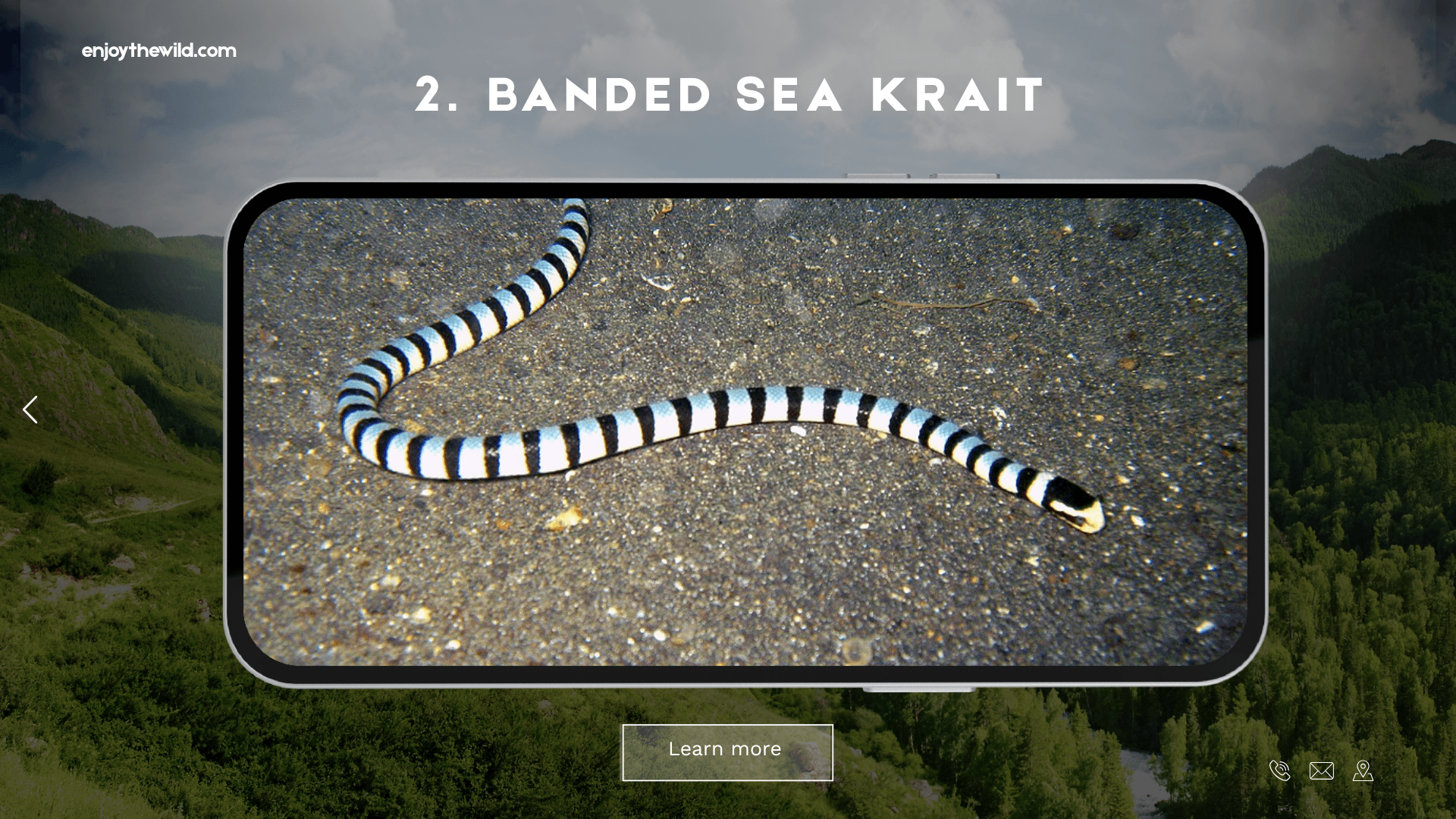
The Banded Sea Krait is one of the most recognizable and scientifically important members among the types of Sea snakes. Unlike fully aquatic Sea snakes, this species lives a dual life between land and sea. It hunts in the ocean but must return to land to rest, digest food, shed its skin, and lay eggs.
This unique lifestyle makes the Banded Sea Krait a critical link between terrestrial snakes and fully marine Sea snakes. Its behavior, anatomy, and movement patterns offer valuable insight into how reptiles gradually adapted to ocean life.
Physical Identification
The Banded Sea Krait has a striking appearance that makes identification relatively easy. Its body is marked with bold black and bluish-white or gray bands that extend from head to tail. These bands are clean, evenly spaced, and sharply contrasted.
The head is slightly flattened but still retains a snake-like shape similar to land snakes. The tail, however, is laterally compressed and paddle-shaped, allowing efficient swimming. Adults typically grow between 3 and 5 feet long, with females noticeably larger than males.
One key identifying feature is its smooth, glossy scales, which reduce drag in water while still functioning well on land.
Habitat and Geographic Range
The Banded Sea Krait is found throughout the Indo-Pacific region. Its range includes coastal areas of Southeast Asia, Indonesia, Papua New Guinea, northern Australia, the Philippines, and many Pacific islands.
This species prefers coral reefs, rocky shorelines, and small offshore islands. Unlike most Sea snakes, it is frequently seen resting on beaches, hiding in rock crevices, or sheltering in coastal vegetation.
Because it relies on land, the Banded Sea Krait is closely tied to healthy coastal ecosystems.
Behavior and Daily Activity
Banded Sea Kraits are mostly nocturnal hunters. At night, they enter the ocean to search for prey, often traveling several miles from shore. During the day, they return to land to rest.
They are strong swimmers but move awkwardly on land compared to fully terrestrial snakes. Despite this, they can climb rocks and navigate narrow coastal spaces with surprising agility.
When threatened, they usually attempt to flee rather than bite. Their calm nature makes them one of the least aggressive Sea snakes.
Diet and Hunting Techniques
The diet of the Banded Sea Krait consists mainly of eels, especially moray eels, which hide in coral crevices. This specialized diet has shaped the snake’s hunting strategy.
It uses its slender body to enter tight spaces in reefs where other predators cannot reach. Once prey is located, the snake delivers a quick venomous bite, then releases the eel until the venom takes effect.
This method reduces the risk of injury from struggling prey.
Venom and Human Interaction
The venom of the Banded Sea Krait is extremely potent, stronger than that of many terrestrial cobras. However, bites to humans are very rare.
This species has a docile temperament and often allows gentle handling without biting. Most recorded bites occur when the snake is accidentally stepped on or restrained.
Despite its venom strength, the Banded Sea Krait poses little threat to humans when left undisturbed.
Breathing and Physiological Adaptations
Unlike fully aquatic Sea snakes, the Banded Sea Krait has smaller lungs and less ability to absorb oxygen through its skin. As a result, it must surface more frequently.
However, it compensates with efficient swimming and the ability to rest on land, reducing the need for extreme underwater endurance.
Reproduction and Life Cycle
The Banded Sea Krait is oviparous, meaning it lays eggs. Females return to land to deposit eggs in sheltered locations such as caves or rock crevices.
Clutches typically contain 5 to 20 eggs. Hatchlings emerge fully formed and instinctively make their way toward the ocean.
This dependence on land for reproduction separates Sea kraits from true Sea snakes.
Social Behavior
Banded Sea Kraits are often seen in groups on land, especially during resting periods. These gatherings provide protection and help regulate body temperature.
In the ocean, they hunt alone and do not show cooperative behavior.
Predators and Natural Threats
Natural predators include large fish, sharks, birds of prey, and monitor lizards when the snakes are on land.
Their bold coloration serves as a warning signal, reducing the likelihood of attacks.
Conservation Status
The Banded Sea Krait is currently listed as Least Concern. However, habitat destruction, coral reef degradation, and coastal development pose growing threats.
Pollution and fishing bycatch also impact local populations.
Ecological Importance
This species helps control eel populations and contributes to the balance of reef ecosystems. As one of the most studied types of Sea snakes, it plays an important role in scientific research.
Protecting the Banded Sea Krait also protects the fragile coastal habitats it depends on.
3. Ringed Sea Snake (Emydocephalus annulatus)
Overview
The Ringed Sea Snake is one of the most unusual and gentle members among the types of Sea snakes. Unlike most Sea snakes, which hunt fish using powerful venom, this species feeds almost exclusively on fish eggs. Because of this highly specialized diet, the Ringed Sea Snake has evolved reduced venom glands and smaller fangs, making it one of the least dangerous Sea snakes to humans.
This species is often referred to as the “egg-eating Sea snake” and is closely associated with coral reef ecosystems. Its calm behavior, unique feeding strategy, and strong reef dependence make it a favorite subject for marine biologists.
Physical Identification
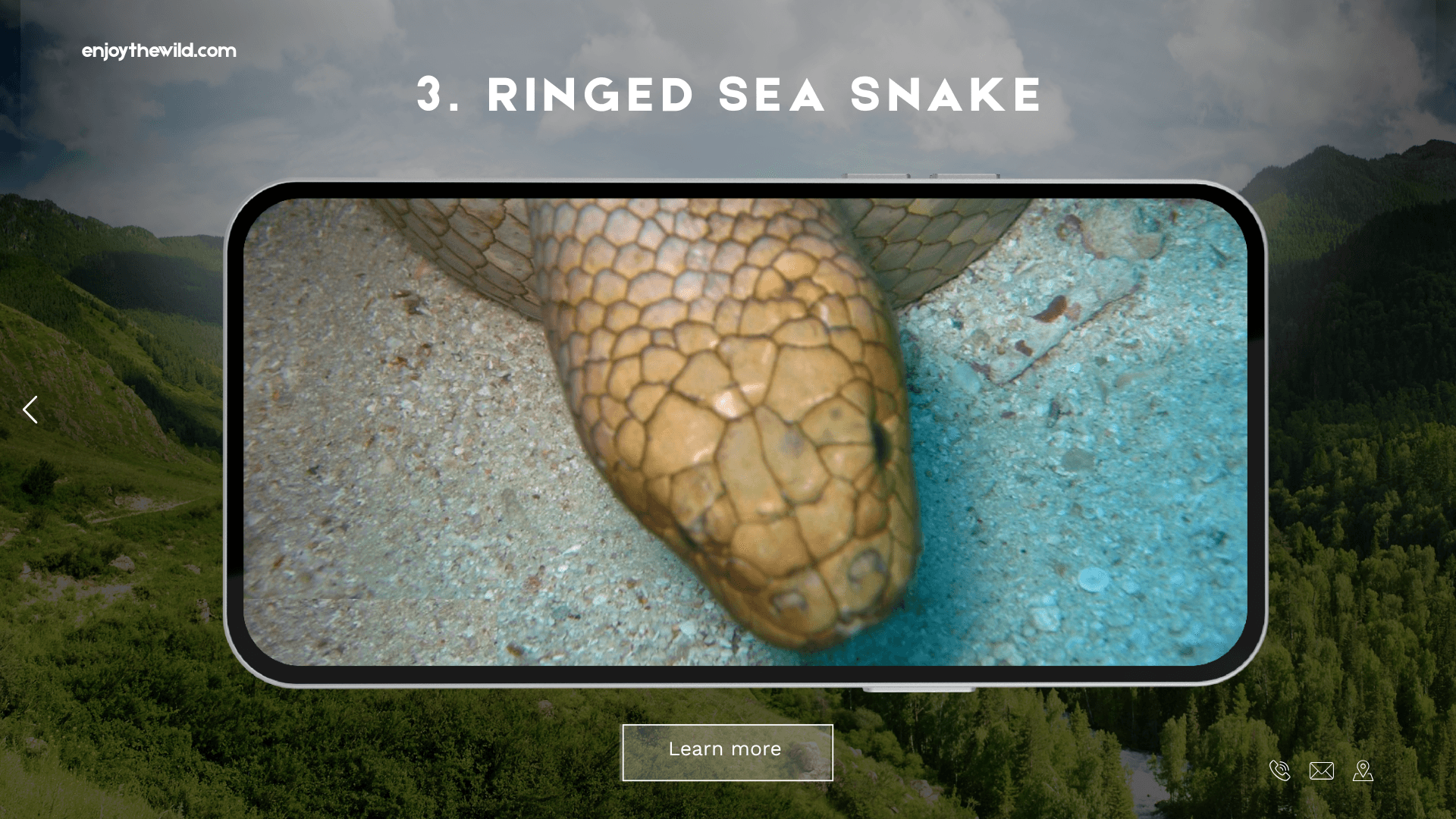
The Ringed Sea Snake is easy to identify by the dark bands or rings that circle its body, giving it its common name. These rings are typically black or dark brown and contrast against a lighter gray, bluish, or cream-colored background.
The body is moderately slender and laterally compressed, especially toward the tail. The head is short and rounded, with small eyes and a blunt snout. Adults usually reach lengths of 2.5 to 3 feet, making them smaller than many other Sea snakes.
Another distinctive feature is its smooth, glossy scales, which help reduce resistance while swimming through reef structures.
Habitat and Distribution
The Ringed Sea Snake is found in the warm waters of the western Pacific Ocean, particularly around coral reefs in Australia, Papua New Guinea, New Caledonia, and parts of Indonesia.
This species strongly prefers shallow reef environments, lagoons, and sheltered coastal waters. It rarely ventures into open ocean or deep water, relying instead on complex reef habitats for food and shelter.
Because of this close relationship with reefs, the Ringed Sea Snake is highly sensitive to environmental changes.
Behavior and Activity Patterns
Ringed Sea Snakes are slow-moving and calm compared to other Sea snakes. They spend much of their time weaving through coral structures in search of fish nests.
They are active during daylight hours, which is unusual for many snake species. Their slow pace and non-aggressive nature make them relatively easy to observe by divers.
When approached, they rarely show defensive behavior and typically retreat rather than strike.
Diet and Specialized Feeding
The diet of the Ringed Sea Snake consists almost entirely of fish eggs. It targets nests guarded by reef fish and uses stealth to access them.
This specialized diet has led to major anatomical changes. The snake’s venom glands are greatly reduced, and its fangs are small and weak compared to other Sea snakes.
Because it does not rely on venom to subdue prey, this species has evolved strong jaw muscles and a precise feeding technique.
Venom and Human Safety
Although technically venomous, the Ringed Sea Snake poses almost no threat to humans. Its venom delivery system is poorly developed, and it is extremely reluctant to bite.
There are no confirmed fatal bites from this species, and even defensive bites are rare.
This makes it one of the safest Sea snakes to encounter in the wild.
Breathing and Marine Adaptations
The Ringed Sea Snake has a long lung that helps with buoyancy control, allowing it to hover near reef surfaces with minimal effort.
It can also absorb small amounts of oxygen through its skin, extending the time it can remain submerged.
These adaptations support its slow, deliberate lifestyle within reef systems.
Reproduction and Life Cycle
This species is ovoviviparous, meaning eggs develop inside the female’s body and hatch internally. Live young are born fully formed into the water.
Females give birth to small litters, usually between 2 and 6 offspring.
Newborn Ringed Sea Snakes immediately begin searching for reef shelter and fish egg nests.
Predators and Defense
Natural predators include large reef fish, sharks, and seabirds. However, the snake’s cryptic coloration and calm behavior help reduce detection.
Rather than aggressive defense, it relies on camouflage and slow retreat to avoid danger.
Conservation Status
The Ringed Sea Snake is currently listed as Least Concern. However, coral reef degradation caused by climate change, pollution, and coastal development poses a serious long-term threat.
Because it depends so heavily on healthy reefs, population declines may serve as early warning signs of reef ecosystem collapse.
Ecological Importance
By feeding on fish eggs, the Ringed Sea Snake plays a subtle but important role in regulating reef fish populations.
As one of the most specialized types of Sea snakes, it highlights the incredible diversity of feeding strategies found within marine reptiles.
4. Beaked Sea Snake (Enhydrina schistosa)
Overview
The Beaked Sea Snake is one of the most infamous members among the types of Sea snakes. Known for its powerful venom and frequent contact with humans, this species has been responsible for more recorded sea snake bites than any other. Despite this reputation, it is not naturally aggressive and usually bites only when provoked or accidentally disturbed.
This Sea snake is a true marine species, spending its entire life in coastal waters. Its ability to thrive in murky, shallow environments brings it into close proximity with fishing communities, making understanding this species especially important.
Physical Identification
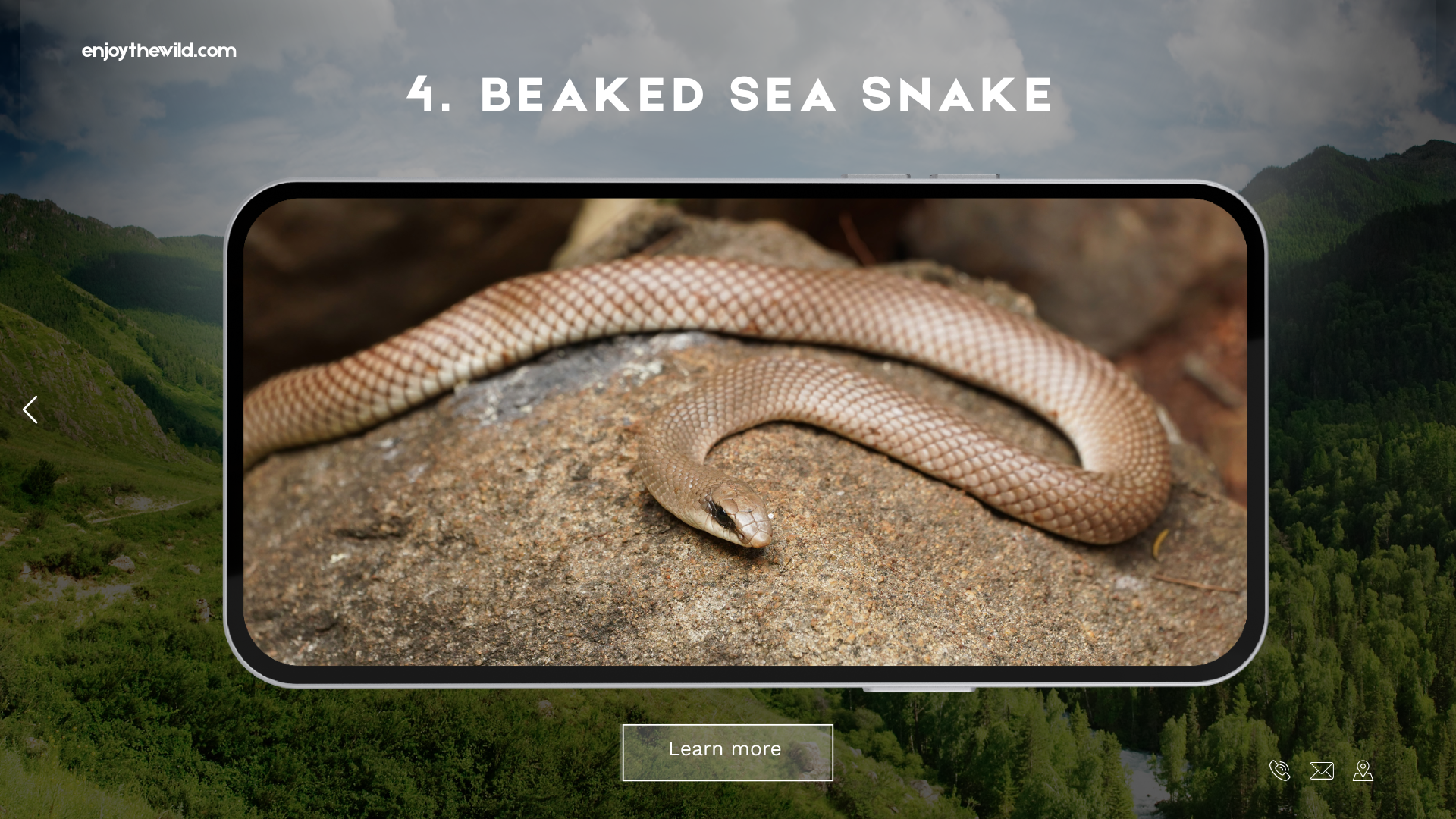
The Beaked Sea Snake gets its name from its distinctive snout, which appears hooked or beak-like when viewed from the side. This feature helps separate it from other Sea snakes with smoother facial profiles.
The body is thick and muscular, with a laterally compressed shape ideal for swimming. Coloration varies widely, ranging from gray and olive to brown or bluish tones, often with darker crossbands that fade with age.
Adults commonly reach lengths of 3 to 4.5 feet. The tail is strongly flattened and paddle-shaped, providing powerful thrust in shallow waters.
Habitat and Distribution
The Beaked Sea Snake is found throughout the Indian Ocean and western Pacific, including coastal waters of India, Sri Lanka, Southeast Asia, Indonesia, northern Australia, and the Persian Gulf.
Unlike reef-dwelling Sea snakes, this species prefers muddy coastal waters, estuaries, mangroves, and river mouths. It can tolerate low salinity and is often found in brackish water.
This habitat preference explains why it is frequently encountered by fishermen using nets in shallow waters.
Behavior and Activity
This Sea snake is primarily nocturnal but may also hunt during the day in cloudy or turbid conditions. It is a strong swimmer but tends to remain close to the seafloor.
When threatened, the Beaked Sea Snake may become defensive. Most bites occur when the snake becomes entangled in fishing nets or is handled accidentally.
In natural settings, it prefers to retreat rather than confront large animals.
Diet and Feeding Strategy
The Beaked Sea Snake feeds mainly on fish, especially bottom-dwelling species such as gobies and catfish. It uses its potent venom to quickly immobilize prey.
Once bitten, prey is usually released and then swallowed after paralysis sets in. This reduces the risk of injury from struggling fish.
The snake’s beaked snout helps it probe into soft substrates where prey hides.
Venom Potency and Human Risk
The venom of the Beaked Sea Snake is extremely powerful and contains strong neurotoxins and myotoxins. Untreated bites can be fatal.
Despite this, bites are relatively rare and almost always defensive. Fishermen are at highest risk due to accidental contact.
Modern medical treatment has significantly reduced fatalities, but this species remains one of the most medically important Sea snakes.
Breathing and Marine Adaptations
This species has a long lung extending nearly the full length of its body, allowing fine control of buoyancy.
It can also absorb oxygen through its skin, which helps extend dive times in shallow waters.
These adaptations allow it to remain underwater for long periods while hunting.
Reproduction and Life Cycle
The Beaked Sea Snake is ovoviviparous, giving birth to live young at sea. Females typically give birth to 6 to 20 offspring.
Young snakes are fully venomous from birth and immediately begin hunting small fish.
There is no parental care after birth.
Predators and Defense Mechanisms
Natural predators include sharks, large fish, and sea birds. The snake relies on venom, warning posture, and escape to defend itself.
Its muscular body allows sudden bursts of speed when retreating.
Conservation Status
The Beaked Sea Snake is currently listed as Least Concern, but local populations may be declining due to fishing pressure and habitat degradation.
Bycatch remains the largest threat to this species.
Ecological Importance
As an active predator of coastal fish, this species helps regulate fish populations in estuarine ecosystems.
Understanding the Beaked Sea Snake improves coexistence between humans and one of the most dangerous yet misunderstood types of Sea snakes.
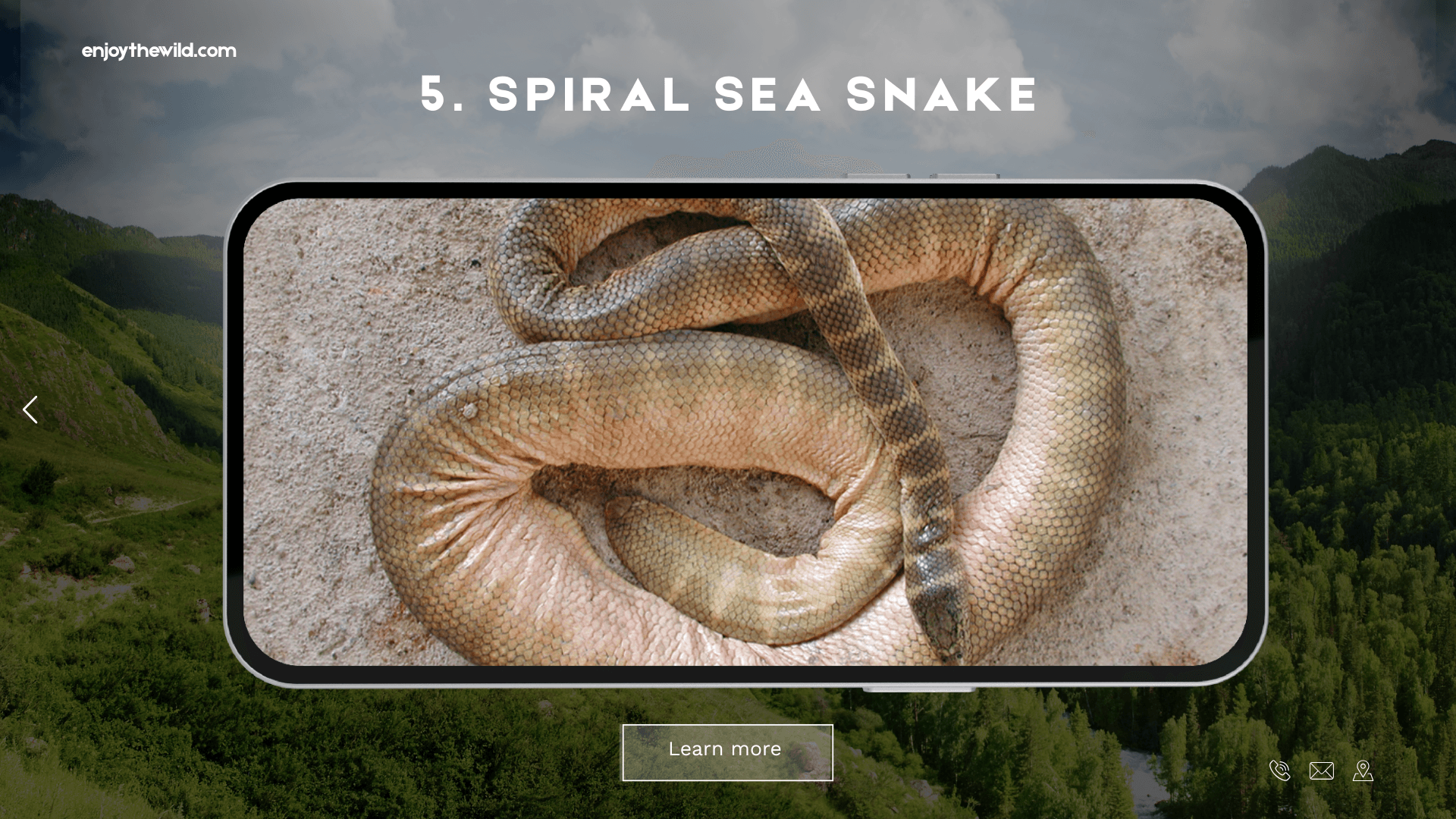
5. Spiral Sea Snake (Hydrophis spiralis)
Overview
The Spiral Sea Snake is one of the largest and most powerful species among the types of Sea snakes. Known for its impressive length and muscular build, this species is a strong swimmer that thrives in open coastal waters. Its name comes from the subtle spiral or twisted appearance created by overlapping dark bands along its body.
Because of its size and venom potency, the Spiral Sea Snake commands respect, yet it remains a shy and non-aggressive animal when left undisturbed. It is a true marine species that spends its entire life in the ocean.
Physical Identification
The Spiral Sea Snake has a long, thick body that can exceed 6 feet in length, making it one of the longest Sea snakes in the world. Its body coloration ranges from olive and brown to gray, with darker bands that may appear faded in older individuals.
The head is relatively large and distinct from the neck. The snout is rounded, and the eyes are small but well adapted for underwater vision. Like other Sea snakes, its tail is strongly flattened from side to side, forming a powerful paddle for swimming.
The scales are smooth and glossy, reducing drag in water and allowing efficient movement over long distances.
Habitat and Geographic Range
The Spiral Sea Snake is widely distributed across the Indian Ocean and western Pacific Ocean. It is commonly found along the coasts of India, Sri Lanka, Southeast Asia, Indonesia, northern Australia, and nearby island regions.
This species prefers open coastal waters, continental shelves, and areas with sandy or muddy seabeds. Unlike reef-specialist Sea snakes, it is often found farther offshore and in deeper water.
It rarely comes close to land unless following prey or affected by strong currents.
Behavior and Daily Activity
The Spiral Sea Snake is mostly active during daylight hours but may also hunt at night. It is a confident swimmer and can travel long distances in search of food.
Despite its large size, it is generally calm and avoids confrontation. When threatened, it may flatten its body or coil defensively, but it usually chooses to flee rather than attack.
Encounters with humans are uncommon due to its offshore habits.
Diet and Feeding Behavior
This species feeds primarily on fish, including bottom-dwelling and mid-water species. Its large body allows it to take bigger prey than many other Sea snakes.
The Spiral Sea Snake uses a strike-and-release technique, delivering a venomous bite and then waiting for the prey to become immobilized before swallowing it head-first.
Its strong jaws and flexible skull allow it to consume relatively large fish whole.
Venom and Medical Significance
The venom of the Spiral Sea Snake is highly potent and contains powerful neurotoxins. However, bites to humans are extremely rare.
This species is not aggressive and typically avoids boats, divers, and swimmers. Most recorded bites involve accidental contact.
With proper medical care, envenomation is treatable, but caution is always advised.
Breathing and Marine Adaptations
The Spiral Sea Snake has an elongated lung that runs nearly the entire length of its body. This structure helps control buoyancy and allows the snake to hover effortlessly in the water.
It can absorb oxygen through its skin, extending dive times and reducing the need to surface frequently.
These adaptations make it well suited for life in deeper coastal waters.
Reproduction and Development
This species is ovoviviparous, giving birth to live young in the ocean. Females typically give birth to 6 to 15 offspring per litter.
Newborns are fully independent and capable of hunting shortly after birth.
There is no parental care beyond birth.
Predators and Defense
Natural predators include sharks, large predatory fish, and occasionally seabirds when juveniles surface.
The snake’s size, speed, and venom provide strong protection against most predators.
Conservation Status
The Spiral Sea Snake is currently classified as Least Concern, but it faces threats from fishing bycatch, marine pollution, and habitat degradation.
Its offshore lifestyle offers some protection, but long-term monitoring is needed.
Ecological Role
As a top predator among Sea snakes, this species helps regulate fish populations in coastal ecosystems.
The Spiral Sea Snake demonstrates the remarkable size range and adaptability found within the types of Sea snakes.
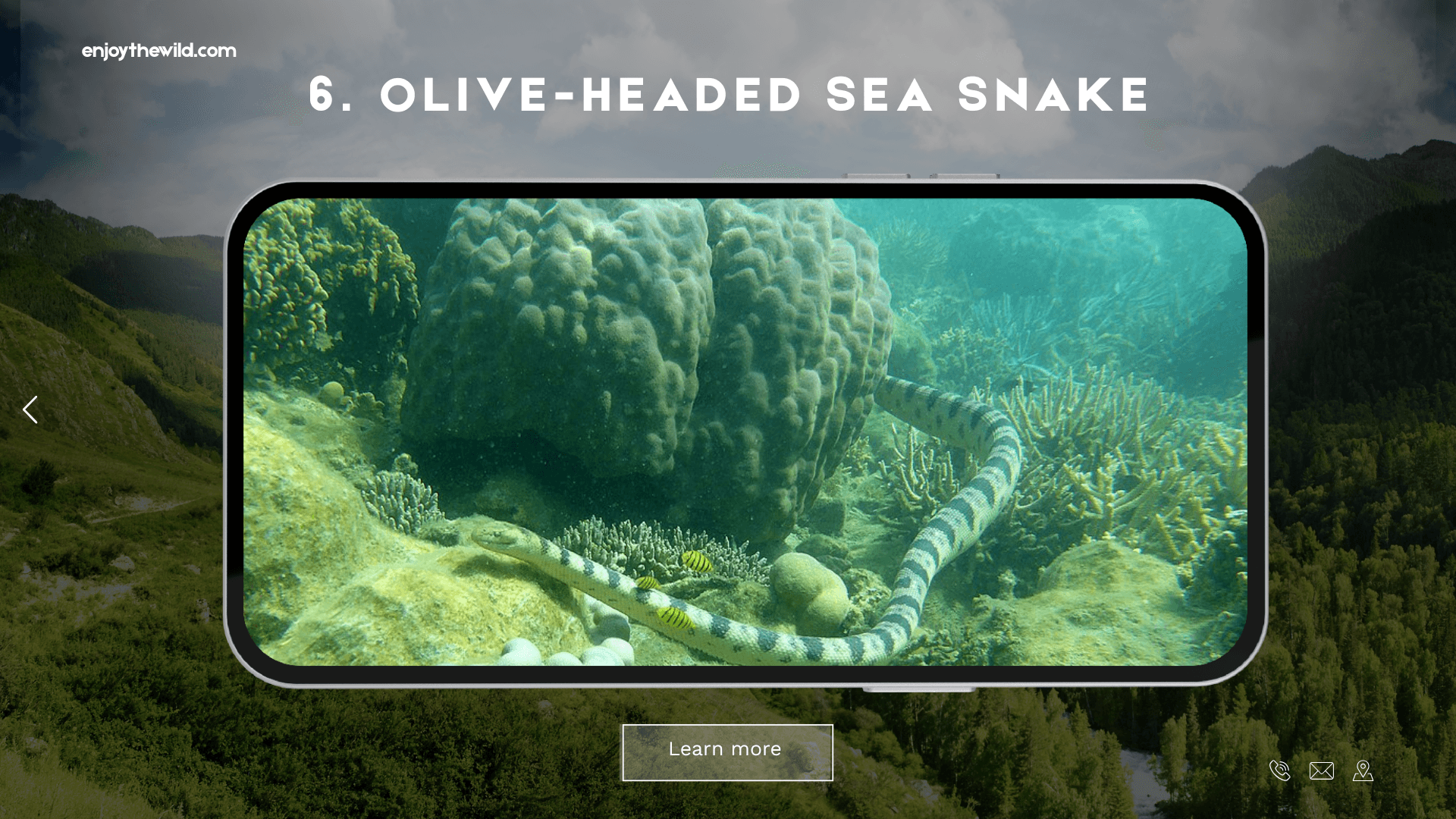
6. Olive-Headed Sea Snake (Hydrophis major)
Overview
The Olive-Headed Sea Snake is a robust, adaptable species that represents the classic image many people imagine when they think of Sea snakes. Among the types of Sea snakes, it is known for its thick body, powerful swimming ability, and preference for shallow coastal waters. This species is especially common in northern Australia and nearby regions, where it plays an important role in nearshore marine ecosystems.
Although it is highly venomous, the Olive-Headed Sea Snake is calm and non-aggressive by nature. Most encounters with humans end without incident, making it a good example of how dangerous animals can still be peaceful when respected.
Physical Identification
The Olive-Headed Sea Snake has a solid, muscular body that gives it a heavier appearance than many other Sea snakes. Adults typically range from 3 to 5 feet in length, though some individuals may grow larger.
As its name suggests, the head is usually olive green or yellowish-olive, while the rest of the body may be brown, gray, or slightly greenish. Dark crossbands are often present, especially in younger snakes, but these markings may fade with age.
The head is broad and slightly flattened, with small eyes positioned high on the head. The tail is strongly compressed from side to side, forming a powerful paddle used for propulsion.
Habitat and Distribution
The Olive-Headed Sea Snake is found primarily in the western Pacific Ocean, especially around northern and eastern Australia, Papua New Guinea, and nearby island regions.
This species prefers shallow coastal waters, coral reefs, sandy bottoms, and seagrass beds. It is often seen near shore and sometimes enters estuaries and bays.
Because of its habitat preferences, it is one of the Sea snakes most likely to be encountered by divers, snorkelers, and fishermen.
Behavior and Activity Patterns
The Olive-Headed Sea Snake is active both day and night, depending on prey availability. It spends much of its time cruising slowly near the seafloor, searching for food.
It is a confident swimmer but not particularly fast unless startled. When threatened, it may flatten its body to appear larger or coil defensively before retreating.
This species is generally tolerant of human presence and often ignores nearby divers if left undisturbed.
Diet and Feeding Habits
The diet of the Olive-Headed Sea Snake consists mainly of fish, including eels, gobies, and other bottom-dwelling species. It is an opportunistic feeder and adapts its diet based on what is available in its environment.
The snake uses a quick venomous strike to immobilize prey. Once the prey is subdued, it is swallowed head-first to prevent fins or spines from catching.
Its strong jaws and flexible skull allow it to handle a wide range of prey sizes.
Venom and Interaction with Humans
The venom of the Olive-Headed Sea Snake is highly toxic and contains powerful neurotoxins. Despite this, bites to humans are rare.
This species does not actively defend territory and usually bites only when handled or trapped, such as in fishing nets.
With prompt medical treatment, envenomation is survivable, but caution and respect are essential.
Breathing and Physiological Adaptations
Like other true Sea snakes, the Olive-Headed Sea Snake has a long lung that extends through most of its body. This helps regulate buoyancy and balance in the water.
It can also absorb oxygen through its skin, allowing it to remain submerged for extended periods.
These adaptations make it well suited for slow, energy-efficient hunting in shallow marine environments.
Reproduction and Life Cycle
The Olive-Headed Sea Snake is ovoviviparous and gives birth to live young in the ocean. Females typically produce between 5 and 15 offspring per litter.
Newborns are fully developed, venomous, and capable of hunting small fish shortly after birth.
There is no parental care beyond birth.
Predators and Natural Threats
Natural predators include sharks, large fish, and sea birds when juveniles surface for air.
The snake’s size, venom, and camouflage provide strong defense against most predators.
Conservation Status
The Olive-Headed Sea Snake is currently classified as Least Concern. However, it faces threats from fishing bycatch, coastal development, and pollution.
Because it lives close to shore, it is especially vulnerable to habitat degradation.
Ecological Importance
This species helps regulate fish populations in coastal ecosystems and contributes to overall marine balance.
As one of the most commonly encountered types of Sea snakes, the Olive-Headed Sea Snake plays an important role in public understanding and conservation of Sea snakes.
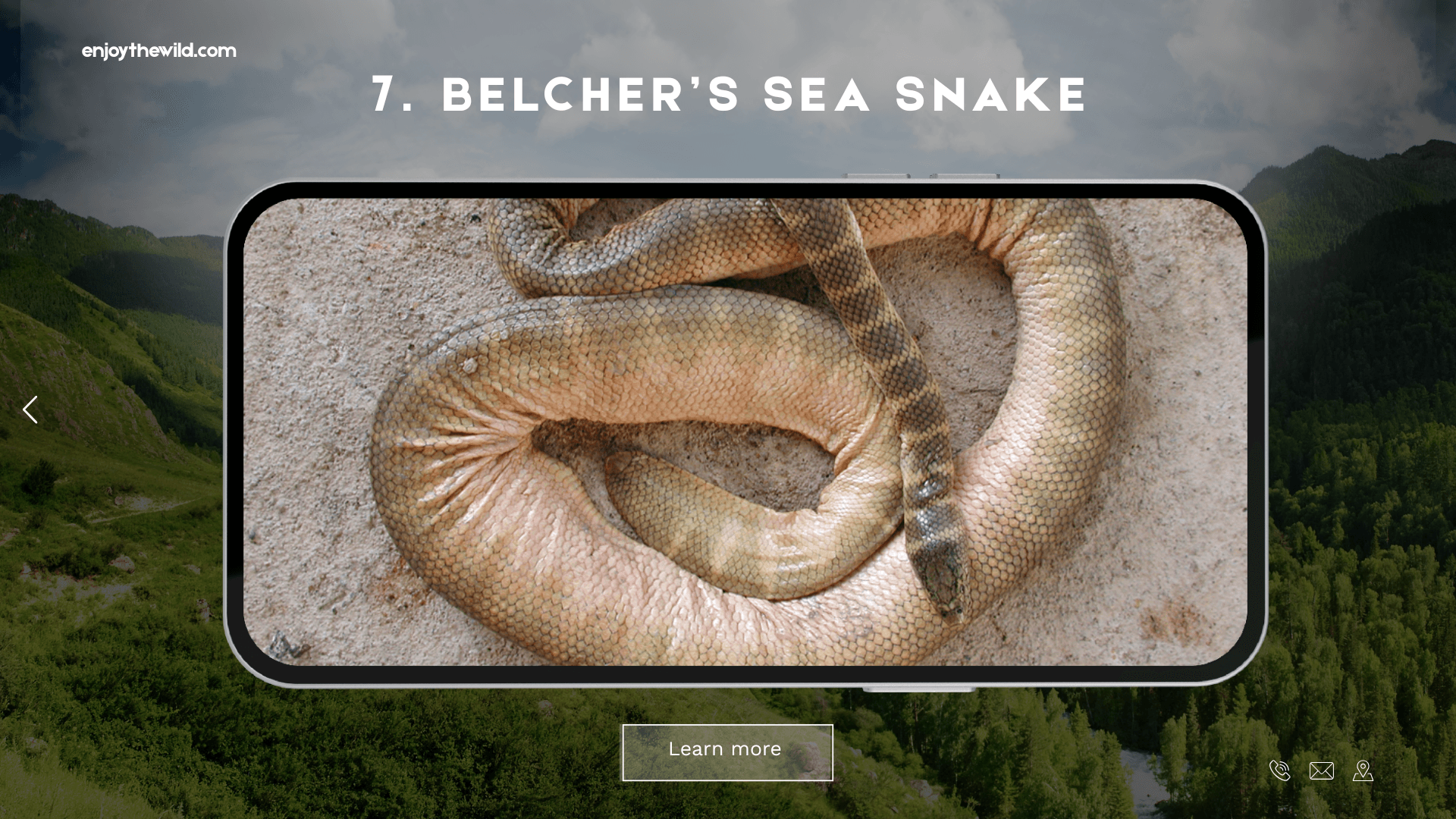
7. Belcher’s Sea Snake (Hydrophis belcheri)
Overview
Belcher’s Sea Snake is often labeled as one of the most venomous snakes in the world, a reputation that has made it famous far beyond scientific circles. Among the types of Sea snakes, it is frequently mentioned in discussions about venom potency. However, this reputation is widely misunderstood. While its venom is indeed powerful, Belcher’s Sea Snake is shy, slow to bite, and rarely aggressive toward humans.
This species is a true Sea snake that spends its entire life in marine environments. It plays an important ecological role in coastal waters and serves as a reminder that venom strength alone does not determine how dangerous an animal truly is.
Physical Identification
Belcher’s Sea Snake has a slender but muscular body, usually measuring between 3 and 4 feet in length. Some individuals may grow slightly longer under ideal conditions.
The body color is pale gray, cream, or light bluish, marked with darker gray or black crossbands that may appear faint or broken. These bands often fade as the snake ages, making older individuals appear almost solid in color.
The head is small and not sharply distinct from the neck. The eyes are relatively small and positioned high on the head, helping the snake see while swimming near the surface. Like all true Sea snakes, the tail is flattened side to side, forming a paddle for efficient movement through water.
Habitat and Geographic Range
Belcher’s Sea Snake is found mainly in the Indian Ocean and parts of the western Pacific. Its range includes coastal waters around Southeast Asia, Indonesia, northern Australia, and nearby island chains.
This species prefers shallow coastal waters, muddy seabeds, and areas near river mouths. It is often found in environments with low visibility, which explains why encounters with humans usually involve fishermen rather than swimmers or divers.
Because it does not rely on coral reefs, it can survive in habitats that many other Sea snakes avoid.
Behavior and Temperament
Despite its fearsome reputation, Belcher’s Sea Snake is calm and non-confrontational. It moves slowly and deliberately and usually ignores nearby humans.
Most bites occur when the snake is accidentally caught in fishing nets or handled. In natural settings, it prefers to flee rather than defend itself.
This gentle temperament greatly reduces the real-world danger posed by the species.
Diet and Feeding Behavior
Belcher’s Sea Snake feeds primarily on fish, especially small bottom-dwelling species. It hunts by cruising slowly near the seafloor and striking quickly when prey is detected.
Like many Sea snakes, it uses a strike-and-release method. After biting, it releases the prey and waits for the venom to take effect before swallowing.
This strategy minimizes injury and energy loss.
Venom Potency and Medical Importance
The venom of Belcher’s Sea Snake is extremely potent, containing powerful neurotoxins that can cause paralysis. However, the amount of venom delivered in a typical bite is small.
Because the snake is reluctant to bite, serious envenomation is rare. With modern medical treatment, survival rates are high.
This species demonstrates why venom potency alone should not define an animal’s threat level.
Breathing and Marine Adaptations
Belcher’s Sea Snake has a long lung that helps control buoyancy and balance. This allows it to hover close to the seabed with minimal effort.
It can also absorb oxygen through its skin, which extends dive times and reduces the need to surface frequently.
These adaptations support its slow, energy-efficient lifestyle.
Reproduction and Development
This species is ovoviviparous, giving birth to live young in the ocean. Females typically give birth to 4 to 12 offspring.
Newborns are fully formed and venomous from birth. They begin hunting small fish shortly after entering the water.
There is no parental care after birth.
Predators and Defense
Natural predators include sharks, large predatory fish, and occasionally seabirds when juveniles surface.
The snake relies on camouflage, venom, and avoidance rather than aggression to survive.
Conservation Status
Belcher’s Sea Snake is currently listed as Least Concern. However, fishing bycatch, pollution, and habitat degradation pose ongoing risks.
Because it often inhabits heavily fished coastal waters, local population declines may go unnoticed.
Ecological Role
As a predator of coastal fish, this species helps maintain balance in marine food webs.
Belcher’s Sea Snake highlights the complexity and misunderstood nature of many types of Sea snakes, proving that even the most venomous animals can be peaceful members of the ecosystem.
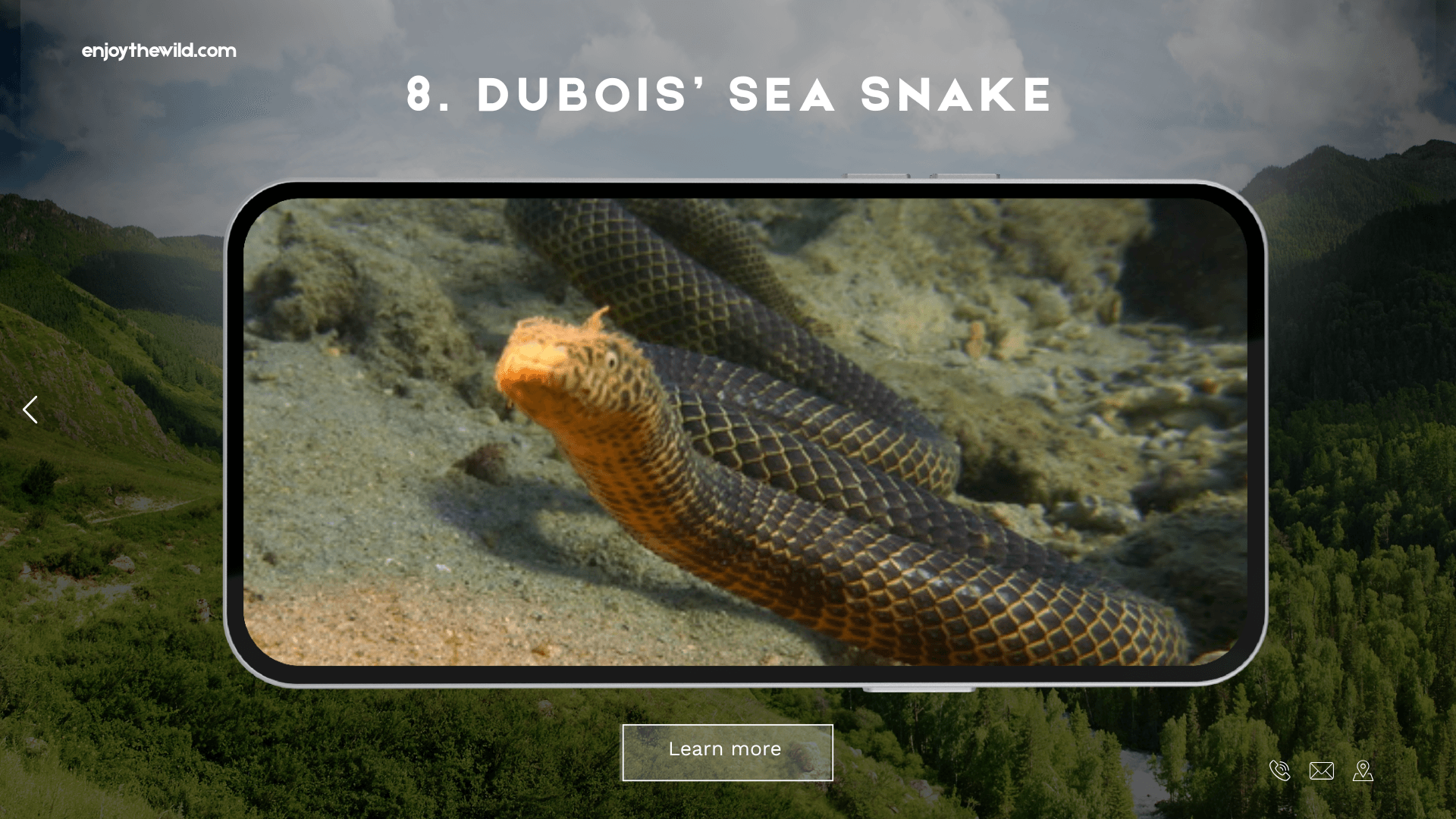
8. Dubois’ Sea Snake (Aipysurus duboisii)
Overview
Dubois’ Sea Snake is one of the most venomous reptiles on Earth and a fascinating example of how evolution shapes predators for life in the ocean. Among the many types of Sea snakes, this species stands out not because of aggression, but because of its extreme specialization for hunting in coral reef environments.
Despite its powerful venom, Dubois’ Sea Snake is calm, slow-moving, and rarely noticed by humans. It spends most of its life near the ocean floor, quietly searching for prey. This combination of deadly venom and gentle behavior makes it one of the most misunderstood Sea snakes in the world.
Physical Identification
Dubois’ Sea Snake has a thick, muscular body compared to many other Sea snakes. Adults typically measure between 3.5 and 5 feet in length, with females often larger than males.
The body coloration ranges from pale gray to brownish or bluish tones, marked with darker crossbands or blotches. These patterns help the snake blend into coral rubble and sandy reef floors.
The head is broad and slightly distinct from the neck, an adaptation that allows space for large venom glands. Its eyes are small but well-positioned for detecting movement in low-light underwater environments.
Like all true Sea snakes, the tail is laterally flattened, forming a powerful paddle used for propulsion.
Habitat and Geographic Distribution
Dubois’ Sea Snake is primarily found in the tropical waters of the Indo-Pacific region. Its range includes northern Australia, Papua New Guinea, Indonesia, and nearby island systems.
This species strongly prefers coral reefs, rocky seabeds, and reef slopes. It is usually observed at depths ranging from shallow coastal waters down to about 50 meters.
Unlike some Sea snakes that tolerate murky estuaries, Dubois’ Sea Snake thrives in clear reef ecosystems where visibility supports precise hunting.
Behavior and Temperament
Dubois’ Sea Snake is slow, deliberate, and non-aggressive. It does not actively defend territory and rarely reacts to divers unless directly disturbed.
When approached, it typically continues its search for prey or retreats calmly. Defensive biting is extremely rare and usually associated with accidental handling.
This relaxed temperament significantly reduces the risk it poses to humans.
Diet and Feeding Strategy
The primary diet of Dubois’ Sea Snake consists of fish, particularly bottom-dwelling species that hide among coral structures.
It uses a sit-and-wait hunting technique, slowly moving along the reef floor and inserting its head into crevices. When prey is located, the snake delivers a quick bite and releases the fish, allowing venom to immobilize it.
This method is highly efficient and minimizes physical struggle.
Venom Characteristics
The venom of Dubois’ Sea Snake is among the most potent of all Sea snakes. It contains strong neurotoxins and myotoxins that rapidly affect the nervous system and muscles.
Despite this potency, the snake delivers small venom doses and is reluctant to bite. Documented envenomation cases are extremely rare.
With prompt medical treatment, survival rates are high.
Marine Adaptations
Dubois’ Sea Snake is perfectly adapted for underwater life. It has a long lung extending much of its body length, allowing precise buoyancy control.
Specialized valves in the nostrils prevent water entry during dives, and oxygen can be absorbed directly through the skin.
These adaptations allow dives lasting well over an hour.
Reproduction and Life Cycle
This species is ovoviviparous, giving birth to live young at sea. Females typically produce between 2 and 10 offspring per breeding cycle.
Newborns are fully developed and venomous at birth, immediately capable of hunting small fish.
No parental care is provided after birth.
Predators and Survival Tactics
Natural predators include reef sharks, large predatory fish, and possibly sea eagles when the snake surfaces.
Its main defenses include camouflage, venom, and avoidance rather than aggression.
Conservation Status and Threats
Dubois’ Sea Snake is currently classified as Least Concern, but its reliance on healthy coral reefs makes it vulnerable to habitat loss.
Coral bleaching, coastal development, and fishing bycatch are the main threats to local populations.
Ecological Importance
By controlling populations of reef-dwelling fish, Dubois’ Sea Snake helps maintain balance within coral ecosystems.
This species highlights the diversity and ecological value of Sea snakes, showing how even the most venomous animals can be peaceful contributors to ocean health.
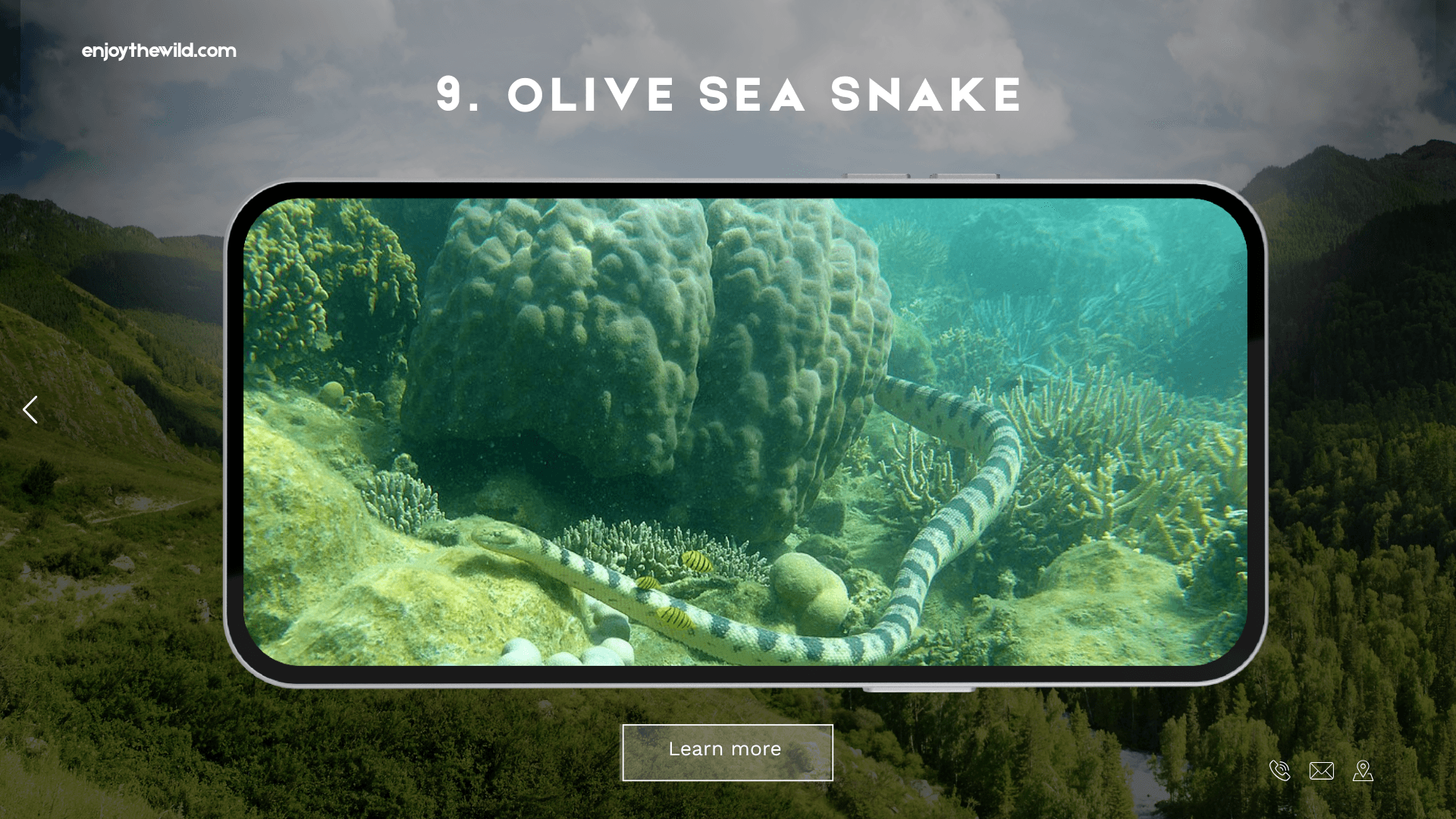
9. Olive Sea Snake (Aipysurus laevis)
Overview
The Olive Sea Snake is one of the most recognizable and frequently encountered species among all types of Sea snakes. Known for its calm nature and wide distribution, this species is often the first Sea snake seen by divers exploring coral reefs in Australia and Southeast Asia.
Despite being highly venomous, the Olive Sea Snake is gentle, curious, and rarely aggressive. Its adaptability to different marine habitats has allowed it to thrive where many other Sea snakes struggle. This combination of visibility, intelligence, and ecological importance makes it one of the most studied Sea snakes in the world.
Physical Identification
Olive Sea Snakes typically grow between 4 and 6 feet in length, with females generally larger than males. Their bodies are thick and muscular, giving them a powerful yet graceful swimming motion.
As the name suggests, the dominant coloration is olive-green to brown, often fading into lighter yellowish tones along the belly. Some individuals may show faint banding or mottled patterns, especially when young.
The head is broad and slightly flattened, with forward-facing eyes that allow good depth perception underwater. The paddle-shaped tail is wide and laterally compressed, providing strong propulsion.
Habitat and Geographic Range
The Olive Sea Snake has one of the widest distributions of any Sea snake. It is found throughout northern Australia, the Great Barrier Reef, Indonesia, Papua New Guinea, and parts of the western Pacific Ocean.
This species favors coral reefs, rocky shorelines, lagoons, and sandy seabeds. It is also known to enter shallow coastal waters and harbors, making human encounters more common than with many other Sea snakes.
Its tolerance for varying water depths and conditions contributes to its success.
Behavior and Interaction with Humans
Olive Sea Snakes are curious rather than defensive. Divers often report individuals approaching slowly, investigating equipment, and then swimming away calmly.
They rarely bite unless restrained or provoked. Many documented bites occur when the snake is accidentally caught in fishing nets.
This peaceful behavior has helped reduce fear and misunderstanding surrounding Sea snakes.
Diet and Feeding Habits
The Olive Sea Snake feeds primarily on fish, including eels, gobies, and reef-dwelling species. It is an active hunter, using its strong body to search crevices and reef edges.
Unlike some Sea snakes that release prey after biting, this species often holds onto fish until venom takes effect.
Its venom acts quickly, minimizing struggle and reducing energy expenditure.
Venom and Medical Significance
The venom of the Olive Sea Snake is highly potent, containing powerful neurotoxins and myotoxins. However, venom yield is moderate, and bites are rare.
Symptoms of envenomation may include muscle pain, weakness, and respiratory difficulty. With timely medical treatment, outcomes are generally favorable.
The species is considered medically important but low risk due to its calm disposition.
Adaptations for Marine Life
This species displays advanced marine adaptations, including cutaneous respiration, allowing oxygen absorption through the skin.
A long lung aids buoyancy control, and specialized salt glands under the tongue help regulate electrolyte balance.
These features enable long dives and extended underwater activity.
Reproduction and Development
The Olive Sea Snake is ovoviviparous, giving birth to live young at sea. Females typically produce between 5 and 20 offspring.
Young snakes are independent immediately after birth and begin hunting small fish within days.
Reproductive cycles may vary depending on water temperature and food availability.
Predators and Defense
Natural predators include sharks, large reef fish, and sea birds when snakes surface.
The Olive Sea Snake relies on camouflage, calm behavior, and venom as deterrents rather than aggression.
Conservation Status
The Olive Sea Snake is currently listed as Least Concern, but localized threats exist.
Habitat degradation, coral loss, and fishing bycatch remain ongoing risks.
Role in the Marine Ecosystem
As a mid-level predator, the Olive Sea Snake helps regulate fish populations and maintain reef balance.
Its presence is a strong indicator of healthy marine ecosystems, highlighting the ecological importance of Sea snakes worldwide.
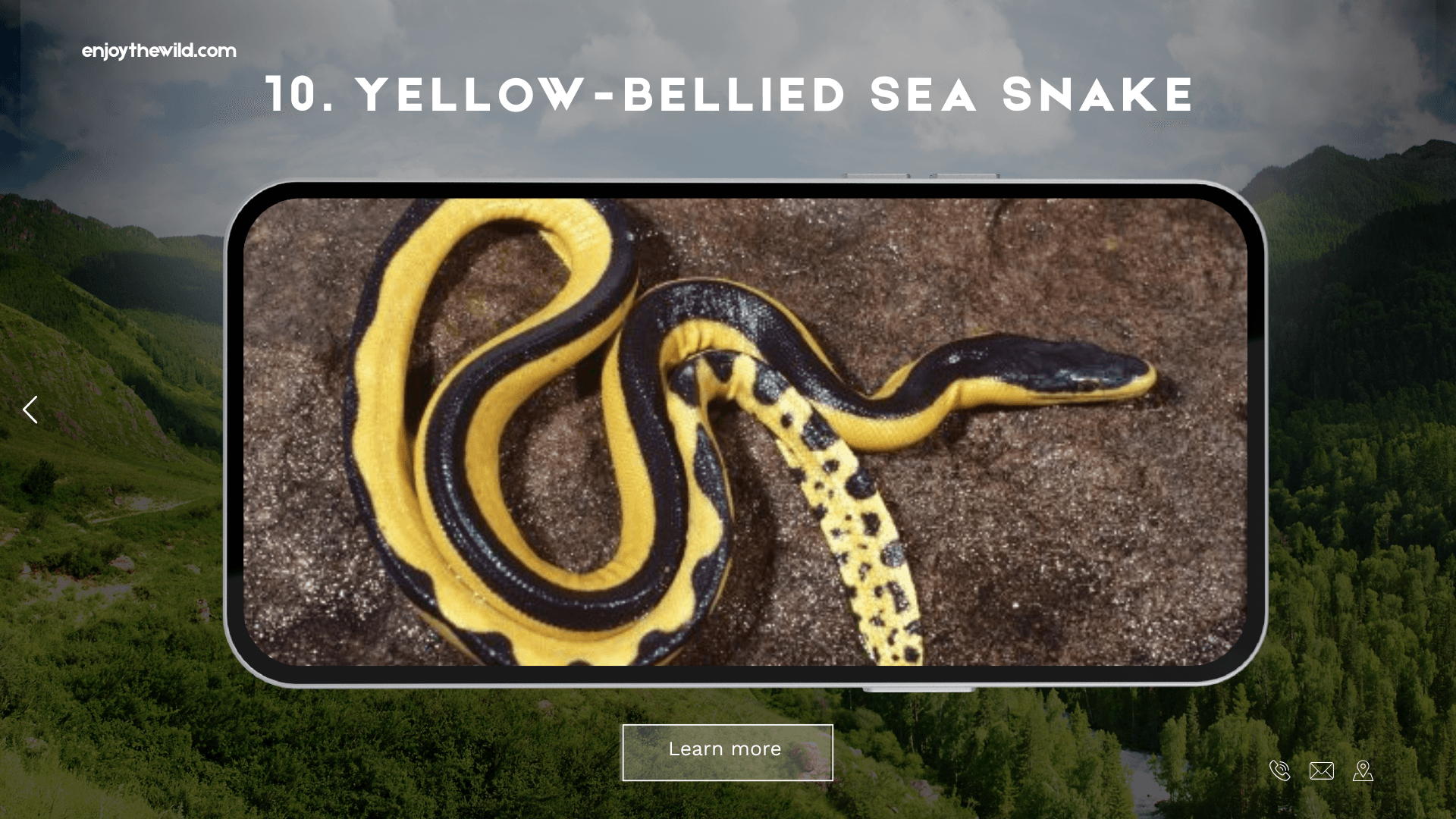
10. Yellow-Bellied Sea Snake (Hydrophis platurus)
Overview
The Yellow-Bellied Sea Snake is one of the most extraordinary members among all types of Sea snakes. Unlike most Sea snakes that stay close to reefs and coastlines, this species lives almost entirely in the open ocean. It is the most widely distributed Sea snake on Earth and one of the few snakes that can truly be called pelagic.
This species is famous for its striking coloration, drifting lifestyle, and remarkable ability to survive far from land. Because of its unique habits, the Yellow-Bellied Sea Snake plays a special role in marine ecosystems and often surprises sailors and fishermen who encounter it floating calmly at the ocean’s surface.
Physical Identification
The Yellow-Bellied Sea Snake is medium-sized, typically measuring between 2.5 and 4 feet in length. Its body is laterally flattened, with a long, paddle-shaped tail that allows efficient swimming in open water.
Its coloration is unmistakable. The upper body is usually dark gray, brown, or black, while the underside is bright yellow, sometimes extending up the sides. This sharp contrast creates a bold two-tone appearance that helps with identification.
The head is small and narrow, with smooth scales and relatively large eyes. The mouth is short, and the nostrils are positioned high on the snout, allowing the snake to breathe easily at the surface.
Global Distribution and Range
The Yellow-Bellied Sea Snake has the widest range of any Sea snake species. It is found throughout tropical and subtropical oceans, including the Indian Ocean, Pacific Ocean, and parts of the eastern Pacific near Central America.
It is often encountered far from shore, sometimes hundreds of miles out to sea. Floating mats of seaweed, warm surface currents, and calm ocean zones provide ideal conditions for this species.
Its ability to tolerate varying salinity and temperature allows it to travel vast distances.
Open-Ocean Lifestyle
Unlike reef-dwelling Sea snakes, the Yellow-Bellied Sea Snake spends most of its life drifting at the ocean’s surface. It often floats motionless, conserving energy while waiting for prey.
This behavior allows it to take advantage of warm surface waters and plankton-rich zones where fish gather.
When threatened, it can swim rapidly using powerful side-to-side movements.
Diet and Hunting Strategy
This species feeds mainly on small fish, especially those that swim near the surface. It is an ambush predator, remaining still until prey approaches.
The snake delivers a quick venomous bite and releases the prey, allowing venom to immobilize the fish before swallowing it whole.
This strategy is highly efficient in the open ocean, where chasing prey would require excessive energy.
Venom Potency and Risk to Humans
The Yellow-Bellied Sea Snake possesses highly potent venom designed to subdue fish quickly. However, it is considered low risk to humans.
Bites are extremely rare, and the snake is not aggressive. Most encounters occur when individuals wash ashore during storms or are accidentally caught in fishing gear.
When left undisturbed, this species poses little danger.
Unique Marine Adaptations
This species has some of the most advanced marine adaptations among Sea snakes. Its skin allows limited oxygen absorption, reducing the need to surface frequently.
A long lung helps control buoyancy, while specialized salt glands remove excess salt from seawater.
These adaptations make it uniquely suited for a fully pelagic existence.
Reproduction and Life Cycle
The Yellow-Bellied Sea Snake is ovoviviparous, giving birth to live young directly in the ocean.
Females typically give birth to 2–6 offspring, fewer than reef-dwelling species due to the challenges of open-ocean survival.
Newborns are independent immediately and begin feeding shortly after birth.
Predators and Natural Threats
Natural predators include large fish, seabirds, and sharks.
The snake’s bold coloration may serve as a warning signal, discouraging predators from attacking.
Floating behavior also reduces energy use and exposure to threats.
Conservation Status
The Yellow-Bellied Sea Snake is currently listed as Least Concern, but it faces indirect threats.
Plastic pollution, climate change, and ocean warming may impact prey availability and migration patterns.
Ecological Importance
As a surface predator, this species helps control populations of small fish in pelagic ecosystems.
Its presence demonstrates the remarkable diversity and adaptability of Sea snakes, highlighting their importance in oceanic food webs.
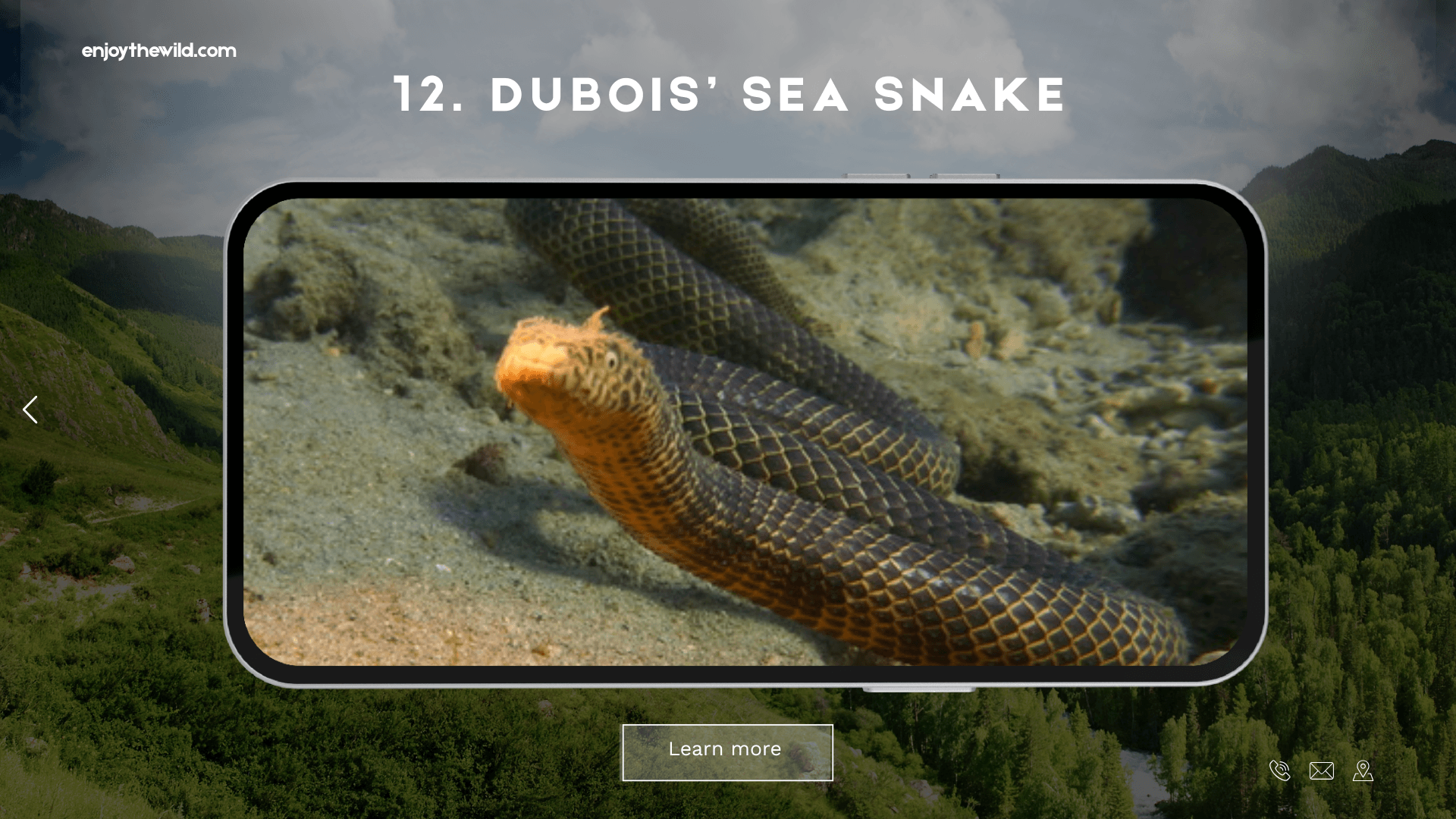
12. Dubois’ Sea Snake (Aipysurus duboisii)
Overview
Dubois’ Sea Snake is a highly venomous species within the types of Sea snakes and is considered one of the most dangerous in terms of venom potency, yet it exhibits a calm and deliberate behavior, moving slowly and methodically along the coral reef floors, often camouflaging itself perfectly among rocks and sand, making it a master of stealth predation while remaining largely unnoticed by humans and other predators in its habitat.
Physical Identification
This species can reach lengths of 3.5 to 5 feet and possesses a robust, muscular body covered in smooth scales that allow it to glide effortlessly through the water; its coloration varies from grayish-blue to brown with faint crossbands or blotches that fade with age, providing effective camouflage within its coral reef environment, while its broad head houses venom glands capable of delivering a rapid neurotoxic strike when needed.
Habitat and Distribution
Dubois’ Sea Snake is native to the tropical waters of the Indo-Pacific, especially around northern Australia, Papua New Guinea, and parts of Indonesia, preferring coral reefs, shallow lagoons, and reef slopes at depths ranging from 1 to 50 meters, which provides both abundant prey and shelter from larger predators while allowing it to exploit specialized hunting techniques unique among marine snakes.
Behavior and Feeding
Primarily a sit-and-wait predator, Dubois’ Sea Snake slowly navigates reef crevices, using its venomous bite to immobilize bottom-dwelling fish, often releasing prey to allow the neurotoxins to act before consuming the immobilized fish whole, demonstrating both energy-efficient hunting strategies and remarkable precision in targeting vulnerable prey species within its highly competitive coral reef ecosystem.
Reproduction and Adaptations
This ovoviviparous Sea snake gives birth to live young in the water, producing between 2 and 10 fully independent and venomous offspring that immediately begin hunting, and it is equipped with cutaneous respiration and an elongated lung extending nearly the entire length of its body, adaptations that allow it to remain submerged for extended periods and thrive in the variable oxygen and salinity conditions found within coral reef habitats.
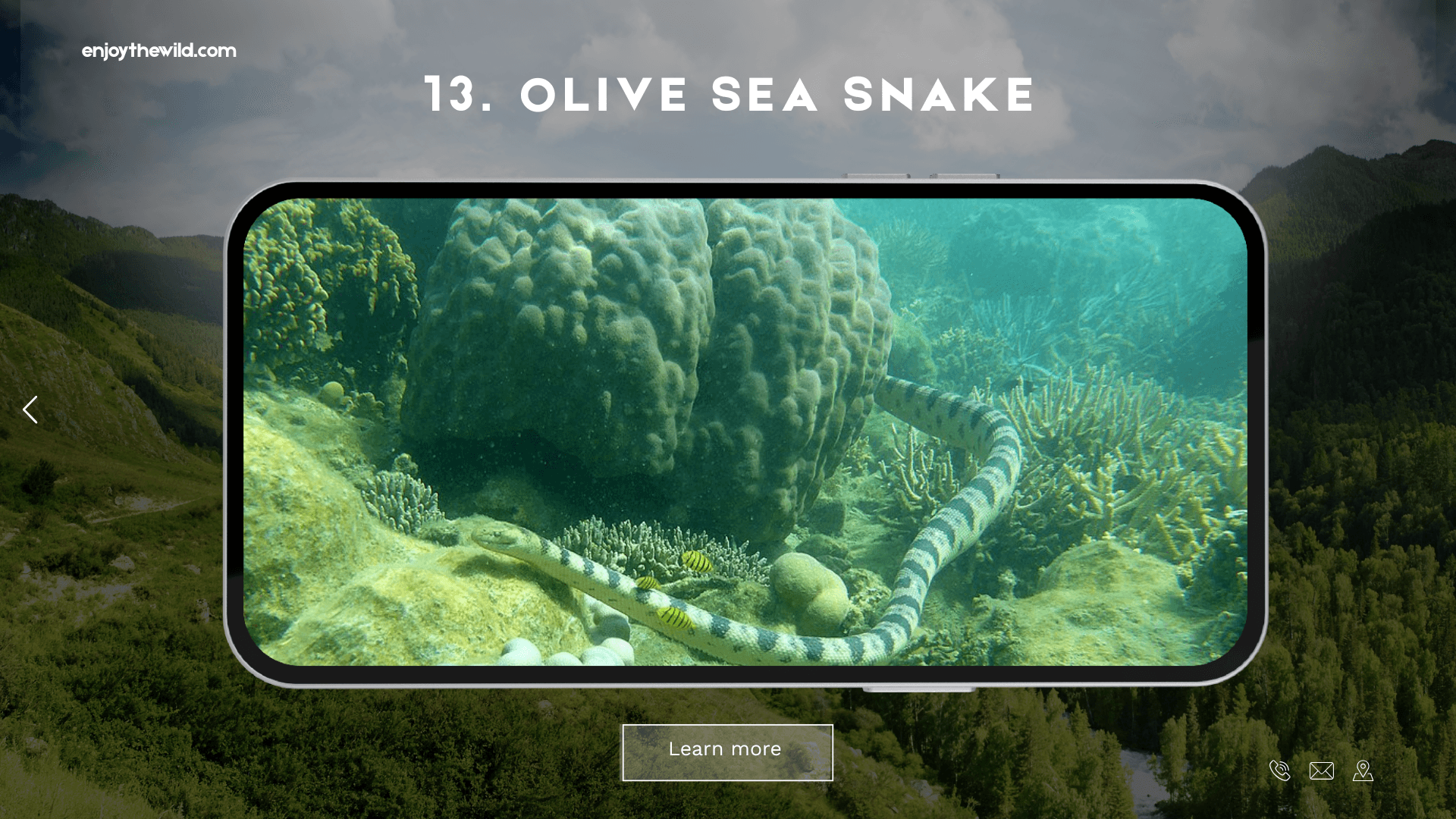
13. Olive Sea Snake (Aipysurus laevis)
Overview
The Olive Sea Snake is a commonly observed species among the types of Sea snakes and is especially notable for its gentle demeanor, striking olive-green coloration, and adaptability to coral reef and coastal environments, where it plays a significant ecological role as a mid-level predator controlling populations of small fish and eels, all while demonstrating behaviors that make it unusually approachable compared to other venomous Sea snakes.
Physical Identification
Olive Sea Snakes typically reach 4 to 6 feet in length, with thick, muscular bodies allowing graceful swimming; their coloration is predominantly olive-green, fading to yellow on the ventral side, with subtle mottling or faint banding in juveniles, and their broad, slightly flattened heads, small eyes, and paddle-like tails make them well-adapted to both navigating tight reef spaces and moving efficiently across open water patches near the reef.
Habitat and Distribution
Widely distributed across northern Australia, Papua New Guinea, Indonesia, and the western Pacific, Olive Sea Snakes prefer coral reefs, seagrass beds, and sandy seabeds where prey is abundant, although they can also be found in estuaries and shallow coastal waters, making them one of the Sea snakes most likely to be observed by divers and snorkelers in tropical waters.
Behavior and Feeding
This species is a patient hunter, often moving slowly along the reef floor or near seagrass beds while searching for small fish such as gobies and eels, using a rapid strike-and-release technique to inject venom and immobilize prey before swallowing it head-first, which minimizes struggle and ensures efficient energy use while feeding in complex reef environments.
Reproduction and Adaptations
Olive Sea Snakes are ovoviviparous, giving birth to live young that are immediately venomous and capable of independent hunting; their physiological adaptations include cutaneous respiration and a long lung for buoyancy control, allowing them to remain submerged for extended periods, while specialized salt glands maintain osmotic balance, enabling survival in both open and brackish waters.
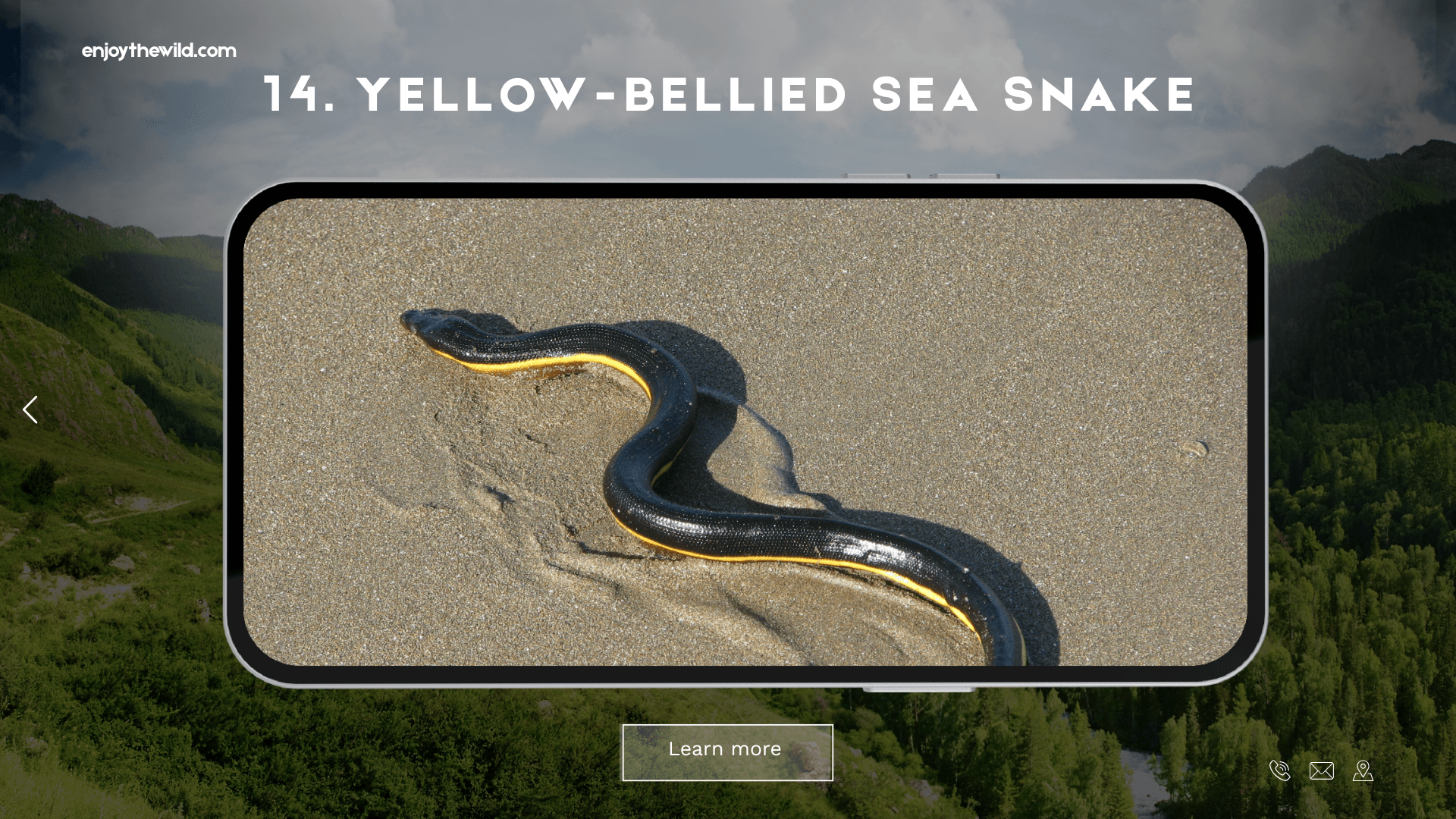
14. Yellow-Bellied Sea Snake (Hydrophis platurus)
Overview
The Yellow-Bellied Sea Snake is a highly remarkable species within the types of Sea snakes due to its unique pelagic lifestyle, enabling it to drift across vast expanses of the tropical and subtropical oceans of the Indian and Pacific, often far from land, while maintaining energy efficiency through floating behavior and slow undulating swimming movements, and it is distinguished by its striking yellow underside and dark dorsal surface, which serve as a warning coloration to potential predators.
Physical Identification
Typically measuring 2.5 to 4 feet in length, this species has a slender, laterally compressed body ideal for open-ocean drifting, with a paddle-shaped tail for propulsion; its dorsal coloration is dark gray to brown, contrasting sharply with the bright yellow ventral surface, creating a visually distinctive pattern that facilitates species identification and may provide protective signaling in the open ocean where there are few hiding places.
Habitat and Distribution
Extensively distributed across the Indian Ocean, western Pacific, and eastern Pacific, the Yellow-Bellied Sea Snake thrives in open-ocean environments, floating among surface currents, sargassum mats, and calm offshore waters, and is highly adapted to survival in variable temperatures, salinity, and prey availability, demonstrating an impressive evolutionary specialization for pelagic life unlike most other Sea snakes, which are reef or coastal specialists.
Behavior and Feeding
This species hunts primarily small surface-dwelling fish using a sit-and-wait strategy, often floating motionless for hours until prey approaches, and then delivering a rapid venomous bite, demonstrating an energy-efficient predatory method suitable for open ocean conditions where actively chasing prey would be highly costly.
Reproduction and Adaptations
The Yellow-Bellied Sea Snake is ovoviviparous, producing live young that are independent at birth, and it possesses advanced adaptations such as cutaneous respiration for extended dives, an elongated lung for buoyancy regulation, and specialized salt glands to maintain osmotic balance in open-ocean conditions, making it one of the most versatile and widely distributed Sea snakes in the world.
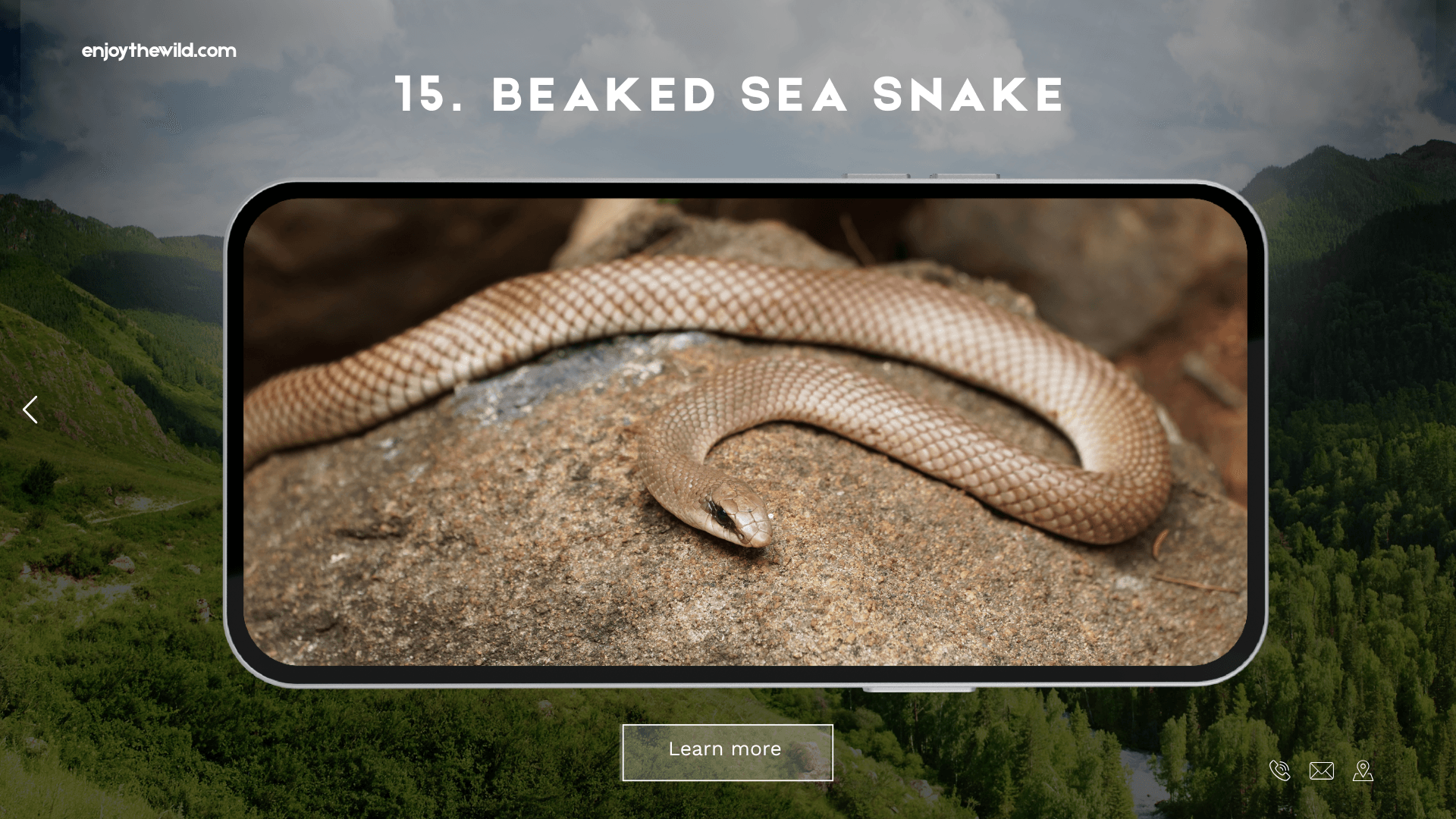
15. Beaked Sea Snake (Hydrophis schistosus)
Overview
The Beaked Sea Snake is among the most medically significant and highly venomous species of the types of Sea snakes, commonly inhabiting shallow coastal waters, estuaries, and river mouths of the Indian Ocean and western Pacific, and while it possesses a fearsome reputation due to its venom potency, it is generally non-aggressive, biting humans only when provoked or accidentally handled, and its specialized beak-like snout allows it to efficiently hunt bottom-dwelling fish that hide in mud or sand.
Physical Identification
Adults of this species typically measure 3 to 4.5 feet in length, with a thick, muscular, and laterally compressed body ideal for swimming in shallow coastal environments; its dorsal coloration is usually gray to brown with dark crossbands that fade with age, while its head is distinctive with a pronounced beak-shaped snout that helps in probing soft substrates for hidden prey, and its tail is strongly flattened for powerful propulsion through the water.
Habitat and Distribution
Beaked Sea Snakes are found throughout the Indian Ocean, including coastal waters of India, Sri Lanka, Southeast Asia, Indonesia, and northern Australia, favoring shallow muddy areas, estuaries, mangroves, and river mouths where they can exploit abundant fish populations, and their tolerance for low salinity allows them to venture into brackish waters rarely used by other Sea snakes.
Behavior and Feeding
This species is mostly nocturnal, hunting fish that dwell on or near the seabed using its venomous bite to immobilize prey, often employing a strike-and-release method to minimize struggle, and despite its reputation for danger, it is generally calm and prefers to retreat from potential threats, making accidental encounters with humans the primary source of recorded bites.
Reproduction and Adaptations
Like many Sea snakes, the Beaked Sea Snake is ovoviviparous, giving birth to live young at sea, typically producing between 6 and 20 offspring, and possesses cutaneous respiration and an elongated lung that supports buoyancy control and extended submersion, adaptations that allow this species to thrive in its shallow coastal environment while hunting efficiently and avoiding predators.
Conclusion
From the shallow coral reefs to the vast open oceans, the world of Sea snakes is incredibly diverse, with each species exhibiting unique adaptations that allow them to thrive in specific marine habitats. Whether it is the calm Olive Sea Snake, the highly venomous Belcher’s Sea Snake, or the open-ocean drifter Yellow-Bellied Sea Snake, these remarkable reptiles play essential roles in maintaining balance within their ecosystems by controlling fish populations, recycling energy, and providing prey for larger predators. Understanding these types of Sea snakes not only helps reduce human fear and misconceptions but also highlights their ecological importance and the need for marine conservation. With their fascinating behaviors, striking appearances, and specialized adaptations, Sea snakes are true marvels of evolution, making us wonder how many more secrets of the ocean remain undiscovered?
50+ FAQ About Types of Sea Snakes
1. What are Sea snakes?
Sea snakes are venomous reptiles adapted to living in marine environments, including coastal waters, reefs, and open oceans.
2. How many types of Sea snakes exist?
There are over 70 recognized species of Sea snakes, with a variety of behaviors, habitats, and appearances.
3. Are all Sea snakes venomous?
Yes, all true Sea snakes are venomous, but they generally pose minimal threat to humans due to their non-aggressive nature.
4. Can Sea snakes bite humans?
Bites are rare and usually occur when a snake is accidentally handled or caught in fishing nets.
5. Are Sea snake bites fatal?
Some species have highly potent venom, but with prompt medical treatment, most bites are survivable.
6. How do Sea snakes breathe underwater?
They have lungs that extend most of their body length and can also absorb some oxygen through their skin.
7. Where do Sea snakes live?
Sea snakes inhabit tropical and subtropical oceans, including coral reefs, estuaries, shallow coastal waters, and open seas.
8. Do Sea snakes lay eggs?
No, most Sea snakes are ovoviviparous, giving birth to live young directly in the water.
9. What do Sea snakes eat?
They primarily feed on fish and eels, using venom to immobilize prey efficiently.
10. How do Sea snakes move?
They use lateral undulation in water, aided by a flattened, paddle-like tail for propulsion.
11. Are Sea snakes aggressive?
Generally, Sea snakes are calm and non-aggressive, avoiding confrontation unless provoked.
12. How long can Sea snakes stay underwater?
Depending on the species, they can remain submerged from 30 minutes up to over an hour using cutaneous respiration and lung capacity.
13. Which is the most venomous Sea snake?
Belcher’s Sea Snake is considered the most venomous, though bites to humans are extremely rare.
14. How do Sea snakes reproduce?
They are ovoviviparous, and newborns are independent and venomous from birth.
15. Can Sea snakes survive in freshwater?
Most Sea snakes prefer saltwater, but a few species tolerate brackish or estuarine environments.
16. What predators eat Sea snakes?
Sharks, large fish, and seabirds are among the natural predators of Sea snakes.
17. How can I identify a Sea snake?
Look for a laterally compressed body, paddle-shaped tail, smooth scales, and in some species, distinctive coloration patterns.
18. Are Sea snakes related to land snakes?
Yes, they evolved from terrestrial elapids but adapted to marine life millions of years ago.
19. How long do Sea snakes live?
Life spans vary by species, generally ranging from 5 to 15 years in the wild.
20. Do Sea snakes have fangs?
Yes, they have short, fixed fangs near the front of the mouth for delivering venom.
21. Why do some Sea snakes have bright colors?
Bright coloration often serves as a warning signal to potential predators or helps with camouflage in reefs.
22. Can Sea snakes swim fast?
Most swim at moderate speeds; they rely on stealth rather than speed to hunt prey.
23. Are Sea snakes endangered?
Many species are Least Concern, but some are threatened by habitat destruction, pollution, and bycatch.
24. Do Sea snakes shed their skin?
Yes, like other snakes, they regularly shed their skin to grow and remove parasites.
25. What is the largest Sea snake?
The Yellow-Bellied Sea Snake and Olive-Headed Sea Snake can reach up to 6 feet in length.
26. Do Sea snakes migrate?
Open-ocean species like the Yellow-Bellied Sea Snake can drift long distances with currents, but most reef species are relatively sedentary.
27. How do Sea snakes avoid predators?
They use camouflage, venomous bites, and avoidance behaviors to reduce predation risk.
28. Can Sea snakes see underwater?
Yes, their eyes are adapted for underwater vision, though some species have limited vision in murky waters.
29. Are Sea snakes poisonous?
They are venomous, not poisonous; venom is injected via a bite, whereas poisonous organisms release toxins when touched or eaten.
30. How do fishermen avoid Sea snake bites?
Wearing gloves and handling nets carefully reduces the risk, as bites usually occur from accidental contact.
31. Do Sea snakes sleep?
Yes, they rest while partially submerged or floating, often using slow undulations to maintain position.
32. Are Sea snakes social?
Most are solitary except during mating season or in areas with abundant prey.
33. How do Sea snakes sense prey?
They use their tongue to detect chemical cues in water and rely on eyesight for movement detection.
34. Can Sea snakes survive out of water?
They can breathe air and survive short periods on land, but they are marine specialists and need water to thrive.
35. What adaptations help Sea snakes dive deep?
They have elongated lungs, flattened tails, and the ability to absorb oxygen through skin, allowing extended dives.
36. Which Sea snake is found in the open ocean?
The Yellow-Bellied Sea Snake is highly adapted to a pelagic lifestyle and can be found far from shore.
37. How do Sea snakes regulate salt in their bodies?
They possess specialized salt glands near the tongue to excrete excess salt from seawater.
38. Are juvenile Sea snakes different in appearance?
Yes, young Sea snakes often have more pronounced banding or brighter colors than adults.
39. How do Sea snakes contribute to marine ecosystems?
They control fish populations, serve as prey for larger predators, and help maintain reef health.
40. Can Sea snakes be kept as pets?
Due to their venom and specialized marine needs, they are not suitable as pets.
41. How do Sea snakes reproduce?
They give live birth (ovoviviparous) in water, producing fully independent venomous offspring.
42. Do Sea snakes migrate with seasons?
Most reef species are sedentary, while open-ocean species drift with currents, sometimes covering large distances.
43. How do Sea snakes avoid dehydration?
They absorb water from the food they eat and excrete excess salt through specialized glands.
44. Can Sea snakes survive in cold water?
No, they are tropical and subtropical species requiring warm ocean temperatures.
45. Are Sea snakes found worldwide?
No, they are restricted to tropical and subtropical oceans, mainly the Indian and Pacific Oceans.
46. How can divers safely observe Sea snakes?
Maintain a respectful distance, avoid touching or cornering the snake, and observe calmly.
47. Do Sea snakes have natural enemies?
Yes, sharks, large fish, and seabirds may prey on them, especially juveniles.
48. What is the most venomous Sea snake?
Belcher’s Sea Snake is the most potent in terms of venom toxicity, but bites are rare.
49. Do all Sea snakes have flat tails?
Yes, all true Sea snakes have laterally flattened tails to aid in swimming.
50. How do Sea snakes affect humans?
They are generally harmless if left alone, but accidental bites may require immediate medical attention.
51. Why are Sea snakes important to marine science?
They provide insights into evolutionary adaptations, venom pharmacology, and ecosystem health.
Read more: