

Learning the main types of bass fish is useful for anglers, aquarium keepers, seafood buyers, divers, and anyone who enjoys outdoor wildlife identification. The word bass is not limited to one single fish family. It can refer to black bass in the sunfish family, temperate bass such as striped bass, many sea bass species, colorful reef basslets, peacock bass cichlids, and even market names such as Chilean sea bass.
This guide explains 80 practical and factual bass fish types, with common names, scientific names where useful, habitat, size notes, key identification features, fishing relevance, and conservation reminders. Some entries are true bass in a strict family sense, while others are fish that are widely called bass by anglers, seafood markets, aquarium hobbyists, or regional field guides.
What Are the Main Types of Bass Fish?
The main types of bass fish include freshwater black bass such as largemouth, smallmouth, spotted, and Guadalupe bass; temperate bass such as striped, white, yellow, and European seabass; marine sea bass such as black sea bass, kelp bass, and sand bass; reef basslets such as royal gramma and candy basslet; and peacock bass, which are actually predatory cichlids. The most important thing to remember is that “bass” is a common name, not one simple scientific group. For identification, always combine body shape, jaw length, color pattern, habitat, geographic range, and local regulations.
| Type | Scientific Name | Habitat | Size | Key Feature |
|---|---|---|---|---|
| Largemouth Bass | Micropterus nigricans | Warm lakes, ponds, reservoirs, sloughs, and slow rivers | Commonly 12–20 in; trophy fish much larger | Large jaw extending past the eye |
| Florida Bass | Micropterus salmoides | Florida, the southeastern United States, and waters where stocked | Often 12–24 in; capable of exceptional trophy size | Largemouth-like appearance with strong trophy growth potential |
| Smallmouth Bass | Micropterus dolomieu | Clear rivers, rocky lakes, cool reservoirs, and gravelly streams | Commonly 10–18 in | Bronze body, smaller mouth, vertical bars |
| Spotted Bass | Micropterus punctulatus | Streams, rivers, reservoirs, rock banks, and deeper structure | Commonly 10–17 in | Rows of small dark spots below the lateral line |
| Alabama Bass | Micropterus henshalli | Mobile River drainage and introduced reservoirs in several states | Commonly 10–18 in | Spotted-bass-like body with strong lateral blotching |
| Shoal Bass | Micropterus cataractae | Rocky shoals and flowing rivers of the southeastern United States | Commonly 10–18 in | Strong river fish linked to shoal habitat |
| Redeye Bass | Micropterus coosae | Clear upland streams of the Coosa River system | Usually smaller than largemouth | Red eye, colorful fins, stream-loving behavior |
| Suwannee Bass | Micropterus notius | Suwannee and Ochlockonee river drainages | Usually modest; often under 16 in | Dark, compact river bass with strong flow preference |
| Guadalupe Bass | Micropterus treculii | Texas Hill Country rivers and clear flowing streams | Commonly 8–14 in | Texas endemic bass adapted to current |
| Choctaw Bass | Micropterus haiaka | Gulf coastal plain streams and river systems | Usually small to medium | A cryptic black bass recognized from regional genetics and range |
| Tallapoosa Bass | Micropterus tallapoosae | Tallapoosa River system | Small to medium stream bass | Drainage-specific redeye-bass relative |
| Chattahoochee Bass | Micropterus chattahoochae | Chattahoochee River drainage | Small to medium | Colorful stream bass from a specific river system |
| Warrior Bass | Micropterus warriorensis | Black Warrior River system | Small to medium | Endemic black bass of Alabama’s Warrior drainage |
| Cahaba Bass | Micropterus cahabae | Cahaba River system | Small to medium | Cahaba-drainage redeye-type bass |
| Bartram’s Bass | Micropterus sp. cf. coosae | Savannah River drainage and related upland streams | Small to medium | Undescribed or taxonomically complex native black bass form |
| Northern Largemouth Bass | Micropterus nigricans | Eastern and central North American lakes, ponds, and rivers | Commonly 12–20 in | Cold-tolerant largemouth form compared with Florida bass |
| Meanmouth Bass | Micropterus hybrid | Managed reservoirs and waters where black bass hybridize | Variable | Hybrid black bass, often involving smallmouth genetics |
| Rock Bass | Ambloplites rupestris | Rocky streams, rivers, and lakes in eastern North America | Usually 6–10 in | Large red eye and dark mottled body |
| Shadow Bass | Ambloplites ariommus | Clear streams of the south-central United States | Usually small | Rock-bass relative with shadowy mottling |
| Ozark Bass | Ambloplites constellatus | Ozark streams with clear water and rocky cover | Usually 6–10 in | Distinct rock-bass relative from Ozark drainages |
| Roanoke Bass | Ambloplites cavifrons | Roanoke and nearby Atlantic-slope drainages | Usually small to medium | Limited-range rock-bass relative |
| White Bass | Morone chrysops | Large rivers, reservoirs, lakes, and open-water schools | Commonly 10–15 in | Silvery body with faint horizontal stripes |
| Yellow Bass | Morone mississippiensis | Lowland rivers, oxbows, reservoirs, and backwaters | Usually 6–12 in | Yellowish sides with dark horizontal stripes |
| Striped Bass | Morone saxatilis | Atlantic coast, estuaries, rivers, reservoirs, and stocked inland lakes | Often 20–40 in in good fisheries | Bold horizontal stripes and anadromous life history |
| White Perch | Morone americana | Estuaries, tidal rivers, brackish bays, and inland lakes | Usually 6–12 in | Small Morone species despite the perch name |
| Hybrid Striped Bass | Morone saxatilis × Morone chrysops | Stocked reservoirs, lakes, and aquaculture systems | Commonly 15–25 in | Striped bass and white bass hybrid often called wiper |
| European Seabass / Branzino | Dicentrarchus labrax | Mediterranean, eastern Atlantic coasts, estuaries, and aquaculture | Commonly market-sized 1–3 lb; wild fish larger | Mild white-fleshed true temperate bass |
| Spotted Seabass | Dicentrarchus punctatus | Eastern Atlantic, Mediterranean, estuaries, and coastal waters | Usually smaller than European seabass | Spotted body markings on a seabass shape |
| Japanese Seabass | Lateolabrax japonicus | Coastal Japan, Korea, China, estuaries, and brackish waters | Often 16–30 in | Popular East Asian sport and food seabass |
| Blackfin Seabass | Lateolabrax latus | Northwestern Pacific coastal and brackish waters | Medium coastal predator | Lateolabrax seabass with darker fin features |
| Chinese Seabass | Lateolabrax maculatus | Chinese coastal waters, estuaries, and aquaculture areas | Medium to large coastal fish | Spotted Asian seabass used in food fisheries |
| Asian Seabass / Barramundi | Lates calcarifer | Indo-Pacific rivers, estuaries, mangroves, and coastal waters | Can exceed 3 ft in strong fisheries | Catadromous predator also called barramundi |
| Australian Bass | Percalates novemaculeata | Eastern Australian coastal rivers and freshwater reaches | Often 10–18 in | Native Australian sport fish with strong current habits |
| Black Sea Bass | Centropristis striata | U.S. Atlantic structured habitats, reefs, wrecks, and rocky bottoms | Commonly 10–20 in | Dark sea bass with structured-bottom lifestyle |
| Bank Sea Bass | Centropristis ocyurus | Western Atlantic offshore bottoms and deeper reefs | Small to medium | Centropristis sea bass of offshore banks |
| Rock Sea Bass | Centropristis philadelphica | Western Atlantic coastal waters, hard bottom, and reefs | Small to medium | Rock-associated Centropristis sea bass |
| Kelp Bass / Calico Bass | Paralabrax clathratus | Kelp forests and rocky reefs of the eastern Pacific | Commonly 10–20 in | Mottled calico pattern and kelp-cover lifestyle |
| Barred Sand Bass | Paralabrax nebulifer | Sandy bottoms, reefs, bays, and coastal structure of California and Baja | Commonly 10–18 in | Vertical barring and sand-bottom behavior |
| Spotted Sand Bass | Paralabrax maculatofasciatus | Bays, estuaries, sandy areas, and rocky edges of the eastern Pacific | Usually 8–15 in | Spotted pattern and bay-oriented habitat |
| Gulf Sand Bass | Paralabrax auroguttatus | Gulf of California and eastern Pacific rocky-sandy bottoms | Small to medium | Sand bass species of the Gulf of California region |
| Barred Sea Bass | Diplectrum formosum | Western Atlantic and Gulf hard bottom, sand, and shell areas | Small reef fish | Slender sea bass with barred markings |
| Sand Sea Bass | Diplectrum radiale | Western Atlantic and Caribbean sandy bottoms and coastal areas | Small | Small Diplectrum sea bass of sandy habitats |
| Chalk Bass | Serranus tortugarum | Caribbean reefs, rubble, and rocky areas | Usually under 4 in | Small reef bass often kept in marine aquariums |
| Harlequin Bass | Serranus tigrinus | Rocky reefs and coral areas of the western Atlantic | Usually small | Tiger-like pattern and reef predator behavior |
| Lantern Bass | Serranus baldwini | Western Atlantic reefs, Bahamas, Caribbean, and Gulf areas | Usually under 5 in | Small orange-brown reef bass with spotted pattern |
| Tobacco Bass | Serranus tabacarius | Western Atlantic reefs and rocky areas | Small | Serranus reef bass with brownish tobacco tones |
| Belted Bass | Serranus subligarius | Western Atlantic coastal and reef habitats | Small | Small bass with belted markings |
| Socorro Bass | Serranus socorroensis | Eastern Pacific island and reef habitats | Small | Island-associated Serranus species |
| Barred Bass | Serranus novemcinctus | Eastern Pacific rocky reef habitats | Small | Barred pattern on a small sea-bass body |
| Royal Gramma / Fairy Basslet | Gramma loreto | Caribbean reef ledges, caves, and overhangs | Usually about 3 in | Purple front half fading to yellow tail |
| Blackcap Basslet | Gramma melacara | Deep Caribbean reef walls and caves | Small reef fish | Purple body with dark cap on head |
| Brazilian Gramma | Gramma brasiliensis | Brazilian reef habitats | Small | Royal-gramma-like basslet from Brazil |
| Candy Basslet | Liopropoma carmabi | Deep tropical Atlantic reefs and rocky shelter | Usually under 3 in | Bright orange, lavender, and red striping |
| Swissguard Basslet / Peppermint Bass | Liopropoma rubre | Western Atlantic reefs, caves, and crevices | Usually under 4 in | Yellow-orange body with dark red-black stripes |
| Cave Bass | Liopropoma mowbrayi | Caribbean caves, reef ledges, and deep shelter | Small | Secretive Liopropoma basslet of caves |
| Pinstriped Basslet | Liopropoma mitratum | Indo-Pacific reef slopes and deep rocky areas | Small | Fine striping on a compact reef-basslet body |
| Pallid Basslet | Liopropoma pallidum | Tropical reef habitats and rocky shelter | Small | Paler Liopropoma basslet |
| Swales’s Basslet | Liopropoma swalesi | Indo-Pacific reefs and crevices | Small | Small striped basslet sometimes seen in aquariums |
| Yellow-spotted Golden Bass | Liopropoma olneyi | Deep Caribbean reef systems | Small | Golden basslet with yellow spotting |
| Spot-tail Golden Bass | Liopropoma santi | Deep southern Caribbean reefs | Small | Golden Liopropoma with spot-tail marking |
| Butterfly Peacock Bass | Cichla ocellaris | South American rivers, lagoons, and introduced warm waters | Often 12–24 in | Ocellated tail spot and cichlid body |
| Speckled Peacock Bass | Cichla temensis | Amazon and Orinoco basin rivers, lagoons, and flooded forests | Can exceed 30 in | Large peacock bass with speckled or bar-pattern forms |
| Blue Peacock Bass | Cichla piquiti | Tocantins-Araguaia basin and introduced tropical waters | Large predatory cichlid | Bluish tones and strong bar pattern |
| Kelberi Peacock Bass | Cichla kelberi | Brazilian river basins and warm managed fisheries | Medium to large | Golden-yellow coloration with peacock markings |
| Monoculus Peacock Bass | Cichla monoculus | Amazon basin floodplains, lakes, and rivers | Medium to large | Eye-like ocellus and classic peacock bass profile |
| Orinoco Peacock Bass | Cichla orinocensis | Orinoco and Negro basin waters | Medium to large | Distinct ocelli and bold side markings |
| Pinima Peacock Bass | Cichla pinima | Amazonian river systems and floodplain habitats | Large | Large Cichla with spotted and barred patterns |
| Intermedia Peacock Bass | Cichla intermedia | Orinoco basin and associated tropical waters | Medium to large | Elongated peacock bass with distinctive spotting |
| Vazzoleri Peacock Bass | Cichla vazzoleri | Amazon basin waters | Medium to large | Regional Cichla species with peacock-bass traits |
| Jari Peacock Bass | Cichla jariina | Jari River drainage and nearby Amazonian waters | Medium to large | Drainage-associated Cichla species |
| Xingu Peacock Bass | Cichla melaniae | Xingu River basin and clear tropical waters | Medium to large | Peacock bass from the Xingu system |
| Mirianae Peacock Bass | Cichla mirianae | Amazonian freshwater systems | Medium to large | Regional peacock bass species |
| Pleiozona Peacock Bass | Cichla pleiozona | Bolivian and Amazonian drainage waters | Medium to large | Cichla species with multiple-zone markings |
| Thyrorus Peacock Bass | Cichla thyrorus | South American tropical freshwater habitats | Medium to large | Less common Cichla species in bass-name discussions |
| Black-spotted Peacock Bass | Cichla nigromaculata | Amazon and Orinoco region waters | Medium to large | Dark-spotted Cichla species |
| Atlantic Wreckfish / Stone Bass | Polyprion americanus | Deep rocky slopes, wrecks, seamounts, and offshore structure | Large deepwater fish | Deepwater fish also sold or known as stone bass |
| Papuan Black Bass | Lutjanus goldiei | New Guinea rivers, estuaries, snags, and brackish systems | Can exceed 30 in | Powerful snapper called bass by anglers |
| White Seabass | Atractoscion nobilis | Eastern Pacific kelp beds, coastal waters, and sandy areas | Large coastal fish | Actually a croaker, not a true sea bass |
| Chilean Sea Bass | Dissostichus eleginoides | Cold deep waters of the Southern Ocean and South Atlantic regions | Large deepwater fish | Market name for Patagonian toothfish |
| Giant Sea Bass | Stereolepis gigas | Eastern Pacific kelp forests, rocky reefs, and deep structure | Can grow extremely large | Massive protected sea-bass relative |
1. Largemouth Bass
Scientific name: Micropterus nigricans. Habitat: Warm lakes, ponds, reservoirs, sloughs, and slow rivers. Typical size: Commonly 12–20 in; trophy fish much larger. Key identification feature: Large jaw extending past the eye.
The largemouth is the fish most beginners picture when they hear the word bass. It is a powerful ambush predator that waits around grass beds, docks, brush, lily pads, and fallen trees, then rushes prey at close range. Its deep green body, dark side stripe, and oversized mouth make it easier to separate from smallmouth and spotted bass. For anglers, it is a year-round target, but it is especially associated with shallow cover in spring and low-light feeding windows in summer. Because it has been stocked widely, always check local rules and never move live bass between waters.

2. Florida Bass
Scientific name: Micropterus salmoides. Habitat: Florida, the southeastern United States, and waters where stocked. Typical size: Often 12–24 in; capable of exceptional trophy size. Key identification feature: Largemouth-like appearance with strong trophy growth potential.
Florida bass are closely associated with the modern trophy bass story. They look so similar to northern largemouth that field identification is usually unreliable without genetics or local stocking history. Anglers often discuss Florida bass because they can reach very large sizes in long-growing-season waters. They prefer warm, productive habitats with vegetation, forage fish, and stable spawning areas. In fisheries management, Florida genetics may be used to improve trophy potential, but they can also complicate identification and native-bass conservation when introduced outside appropriate ranges.
3. Smallmouth Bass
Scientific name: Micropterus dolomieu. Habitat: Clear rivers, rocky lakes, cool reservoirs, and gravelly streams. Typical size: Commonly 10–18 in. Key identification feature: Bronze body, smaller mouth, vertical bars.
Smallmouth bass are built for current, rock, and open-water hunting. Compared with largemouth, they usually have a smaller jaw that does not extend far behind the eye, a bronze to brown body, and irregular vertical barring. They feed heavily on crayfish, minnows, aquatic insects, and other small fish, making rocky points, shoals, ledges, and river seams prime places to search. Smallmouth are famous for hard runs and acrobatic jumps. Because they thrive in clear and relatively cool water, sudden warming, siltation, and poor stream management can reduce habitat quality.
4. Spotted Bass
Scientific name: Micropterus punctulatus. Habitat: Streams, rivers, reservoirs, rock banks, and deeper structure. Typical size: Commonly 10–17 in. Key identification feature: Rows of small dark spots below the lateral line.
Spotted bass sit between largemouth and smallmouth in both appearance and behavior. The jaw usually reaches near the middle of the eye rather than far beyond it, and many fish show small dark spots below the main side stripe. They often use current, rock, and deeper reservoir structure more than largemouth, yet tolerate warmer and slightly more stained water than smallmouth. Anglers frequently catch them on points, bluff ends, bridge pilings, and creek channels. Identification can be tricky where Alabama bass or other black bass have been introduced.
5. Alabama Bass
Scientific name: Micropterus henshalli. Habitat: Mobile River drainage and introduced reservoirs in several states. Typical size: Commonly 10–18 in. Key identification feature: Spotted-bass-like body with strong lateral blotching.
Alabama bass are often confused with spotted bass, and in many regions that confusion matters because introduced Alabama bass can hybridize with native black bass. They are aggressive, structure-oriented fish that do well in reservoirs, rocky banks, and current-influenced river systems. Anglers value them because they fight hard and often school around baitfish. Conservation-minded anglers should learn local identification guidance, especially in waters where Alabama bass threaten smallmouth, shoal, or other endemic bass populations.
6. Shoal Bass
Scientific name: Micropterus cataractae. Habitat: Rocky shoals and flowing rivers of the southeastern United States. Typical size: Commonly 10–18 in. Key identification feature: Strong river fish linked to shoal habitat.
Shoal bass are one of the most habitat-specific black bass. They are strongly tied to clean, rocky, flowing water, especially shoals, ledges, and swift runs. Their body pattern can resemble redeye or smallmouth bass, but the combination of range, habitat, and markings helps with identification. For anglers, shoal bass are prized because they use current well and fight with surprising power in shallow water. Habitat fragmentation, sedimentation, and hybridization with introduced bass are important concerns in several watersheds.
7. Redeye Bass
Scientific name: Micropterus coosae. Habitat: Clear upland streams of the Coosa River system. Typical size: Usually smaller than largemouth. Key identification feature: Red eye, colorful fins, stream-loving behavior.
Redeye bass are small, colorful stream bass that appeal to anglers who enjoy wading creeks and reading current. They are typically associated with rocky runs, pools, and woody cover in clear upland streams. Their red eye, greenish body, and orange or reddish fin accents can make them one of the most attractive black bass. Because several redeye-like species have been split into separate drainage-specific forms, range is a major part of identification. Keeping local populations pure is important where nonnative bass have been stocked.
8. Suwannee Bass
Scientific name: Micropterus notius. Habitat: Suwannee and Ochlockonee river drainages. Typical size: Usually modest; often under 16 in. Key identification feature: Dark, compact river bass with strong flow preference.
Suwannee bass are regional black bass found in a limited part of Florida and Georgia. They prefer flowing rivers, limestone areas, woody cover, and current breaks rather than broad weedy ponds. Many anglers catch them while targeting river bass with small crankbaits, jigs, and crayfish-style lures. They are not usually large, but their limited range makes them special. Responsible catch-and-release and careful identification help protect these native stream bass from pressure and confusion with other black bass.
9. Guadalupe Bass
Scientific name: Micropterus treculii. Habitat: Texas Hill Country rivers and clear flowing streams. Typical size: Commonly 8–14 in. Key identification feature: Texas endemic bass adapted to current.
Guadalupe bass are beloved because they connect fishing with clear Texas rivers. They prefer flowing water, gravel, rock, and natural stream structure. The jaw does not extend beyond the eye like a largemouth, and the body often carries lower side coloration and broken markings. They are not giant fish, but they are quick, strong, and perfectly suited to light tackle and fly fishing. Hybridization with introduced smallmouth has been a major conservation issue, so local restoration and native-stocking programs are especially important.
10. Choctaw Bass
Scientific name: Micropterus haiaka. Habitat: Gulf coastal plain streams and river systems. Typical size: Usually small to medium. Key identification feature: A cryptic black bass recognized from regional genetics and range.
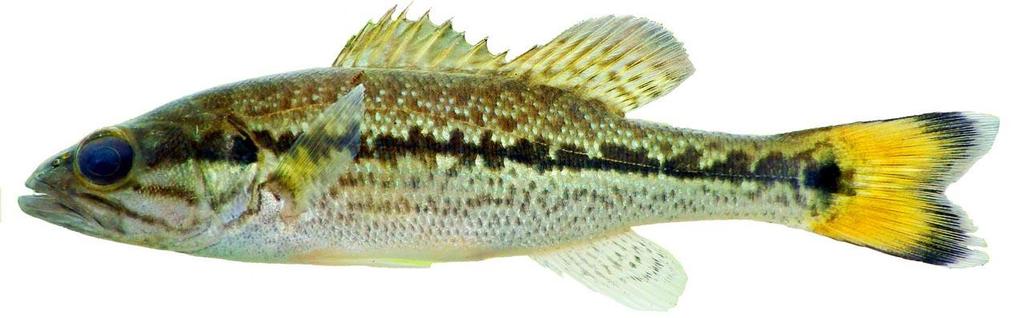
Choctaw bass are a good example of why bass identification can be more complex than a simple field guide suggests. They resemble other spotted-bass-like fish, so location, drainage, and expert identification are important. They occur in parts of the southeastern coastal plain where clear to stained streams, woody cover, and moderate flow provide suitable habitat. For readers, the practical lesson is that many black bass are drainage-specific. Knowing the watershed can be just as important as looking at jaw length or side markings.
11. Tallapoosa Bass
Scientific name: Micropterus tallapoosae. Habitat: Tallapoosa River system. Typical size: Small to medium stream bass. Key identification feature: Drainage-specific redeye-bass relative.
Tallapoosa bass are part of the redeye bass complex of the southeastern United States. They are associated with flowing water, rocks, gravel, and natural cover in their home drainage. In the field, they can look similar to other redeye-type bass, which is why range matters so much. Anglers who seek native stream bass should avoid moving fish, bait, or water between drainages. This type of bass shows how regional biodiversity can exist within a fish name many people once treated as a single species.
12. Chattahoochee Bass
Scientific name: Micropterus chattahoochae. Habitat: Chattahoochee River drainage. Typical size: Small to medium. Key identification feature: Colorful stream bass from a specific river system.
Chattahoochee bass are another regional black bass connected to clean, flowing southeastern streams. Like other redeye-type bass, they are best understood by combining body shape, coloration, and watershed. They use rock, current breaks, woody edges, and small pools where crayfish and minnows are available. For anglers, catching one is less about trophy size and more about appreciating native fish diversity. Protecting stream habitat and avoiding illegal introductions are key to keeping these bass distinct.
13. Warrior Bass
Scientific name: Micropterus warriorensis. Habitat: Black Warrior River system. Typical size: Small to medium. Key identification feature: Endemic black bass of Alabama’s Warrior drainage.
Warrior bass are a regional species in the black bass group and are tied to the Black Warrior River system. They are not usually encountered by casual anglers outside their native range, which makes proper identification and local knowledge important. They prefer natural stream habitats with rock, current, and cover. Because small-ranged bass can be vulnerable to habitat damage and hybridization, anglers should follow harvest rules, report unusual catches when requested by agencies, and avoid moving live fish.
14. Cahaba Bass
Scientific name: Micropterus cahabae. Habitat: Cahaba River system. Typical size: Small to medium. Key identification feature: Cahaba-drainage redeye-type bass.
Cahaba bass represent one of the most localized types of black bass in the Southeast. They are connected to the Cahaba River system, an area known for aquatic biodiversity. Their identification depends heavily on drainage, because many redeye-type bass are similar in size and pattern. They use rocky stream habitats and feed on small fish, crayfish, and aquatic invertebrates. For EnjoyTheWild readers, this species is a reminder that protecting small rivers can protect unique fish found nowhere else.
15. Bartram’s Bass
Scientific name: Micropterus sp. cf. coosae. Habitat: Savannah River drainage and related upland streams. Typical size: Small to medium. Key identification feature: Undescribed or taxonomically complex native black bass form.

Bartram’s bass is commonly discussed as a distinct native bass form within the redeye-bass complex, although formal taxonomy can be complicated. It is associated with specific southeastern drainages and clear stream habitat. Because it has been affected by introductions of nonnative bass in some waters, conservation groups and agencies often emphasize genetic integrity. Anglers should treat this fish carefully: enjoy the catch, photograph it quickly, release it well, and never transplant bass between streams.
16. Northern Largemouth Bass
Scientific name: Micropterus nigricans. Habitat: Eastern and central North American lakes, ponds, and rivers. Typical size: Commonly 12–20 in. Key identification feature: Cold-tolerant largemouth form compared with Florida bass.
Northern largemouth bass are the familiar largemouth form found across much of the eastern and central United States and southern Canada. They tolerate cooler climates better than Florida bass and are commonly found in ponds, natural lakes, reservoirs, and slow rivers. For anglers, this type behaves like a classic ambush predator, using weeds, docks, wood, and shade. It is useful to separate this form from Florida bass in articles because stocking history, trophy potential, and climate tolerance can differ.
17. Meanmouth Bass
Scientific name: Micropterus hybrid. Habitat: Managed reservoirs and waters where black bass hybridize. Typical size: Variable. Key identification feature: Hybrid black bass, often involving smallmouth genetics.
Meanmouth bass is a practical angler term for certain black bass hybrids, commonly involving smallmouth crossed with spotted, largemouth, or other Micropterus species. Because it is a hybrid type rather than a single species, appearance can vary widely. Some individuals show smallmouth coloration with a bigger mouth or spotted-bass features. They may occur naturally where ranges overlap, but many reports are tied to stocking or altered fisheries. Identification is uncertain without genetics, so anglers should follow local regulations for black bass as a group.
18. Rock Bass
Scientific name: Ambloplites rupestris. Habitat: Rocky streams, rivers, and lakes in eastern North America. Typical size: Usually 6–10 in. Key identification feature: Large red eye and dark mottled body.
Rock bass are not black bass, but they are close sunfish relatives and are commonly called bass by anglers. They have a stout body, red eyes, and a large mouth for their size. They often hold around rocks, bridge pilings, undercut banks, and shaded current breaks. Young anglers often meet them while fishing worms or small lures in creeks. Although smaller than largemouth or smallmouth, they are aggressive, easy to identify, and useful indicators of rocky freshwater habitat.
19. Shadow Bass
Scientific name: Ambloplites ariommus. Habitat: Clear streams of the south-central United States. Typical size: Usually small. Key identification feature: Rock-bass relative with shadowy mottling.
Shadow bass resemble rock bass but are more localized and less familiar to casual anglers. They prefer clear streams with rocky cover, root tangles, and moderate current. Their mottled body helps them disappear against dark stones and shaded stream bottoms. Because they are smaller and less famous than black bass, they are often overlooked in general fishing content. Including them helps readers understand that the word bass is used for several sunfish-family fish, not just largemouth and smallmouth.
20. Ozark Bass
Scientific name: Ambloplites constellatus. Habitat: Ozark streams with clear water and rocky cover. Typical size: Usually 6–10 in. Key identification feature: Distinct rock-bass relative from Ozark drainages.
Ozark bass are regional stream fish associated with the clear, rocky waters of the Ozark region. They have a compact shape, mottled pattern, and a willingness to strike small natural baits and lures. Their habitat overlaps with smallmouth waters, but they occupy smaller cover and are usually much smaller. For nature-focused readers, Ozark bass are part of the rich stream community that also includes darters, minnows, crayfish, and aquatic insects. Clean water and stable streambanks are essential for these habitats.
21. Roanoke Bass
Scientific name: Ambloplites cavifrons. Habitat: Roanoke and nearby Atlantic-slope drainages. Typical size: Usually small to medium. Key identification feature: Limited-range rock-bass relative.
Roanoke bass are closely related to rock bass but occur in a more limited region of the eastern United States. They use rocky pools, stream edges, and moderate current where they can ambush small prey. Their range makes them more of a native-species interest than a widely targeted sport fish. Anglers should be careful not to assume every rock-bass-like fish is the same species. In native-fish identification, drainage and local distribution can be the key clues.
22. White Bass
Scientific name: Morone chrysops. Habitat: Large rivers, reservoirs, lakes, and open-water schools. Typical size: Commonly 10–15 in. Key identification feature: Silvery body with faint horizontal stripes.
White bass are true temperate bass and one of the most popular schooling fish in North American reservoirs. They often chase shad in open water, creating surface feeding activity that anglers call boils. Their body is deeper than a striped bass and usually carries broken horizontal lines. In spring, they run into rivers and tributaries to spawn, making them accessible from banks and wading spots. They are excellent for teaching beginners how to locate baitfish, birds, current, and schooling predators.
23. Yellow Bass
Scientific name: Morone mississippiensis. Habitat: Lowland rivers, oxbows, reservoirs, and backwaters. Typical size: Usually 6–12 in. Key identification feature: Yellowish sides with dark horizontal stripes.
Yellow bass look like a smaller, brassy relative of white bass. They are schooling predators that feed on small fish, insects, and crustaceans. Anglers often catch them with small jigs, spoons, minnows, and light spinning tackle. They can be abundant in some waters and less desired in others where they compete with more popular game fish. Identification usually depends on their yellow wash, smaller size, and striping pattern. They are a good example of a bass that is more about numbers and action than trophy size.
24. Striped Bass
Scientific name: Morone saxatilis. Habitat: Atlantic coast, estuaries, rivers, reservoirs, and stocked inland lakes. Typical size: Often 20–40 in in good fisheries. Key identification feature: Bold horizontal stripes and anadromous life history.
Striped bass are among the most iconic bass fish because they connect freshwater rivers, estuaries, surf zones, and open coastal water. Wild Atlantic fish are anadromous, meaning adults may live in salt water but return to fresh or brackish water to spawn. Landlocked populations in reservoirs often roam after shad and other baitfish. Their long body, silver sides, and bold stripes make them easier to identify than white or yellow bass. Regulations are especially important because striped bass management changes with stock status and region.
25. White Perch
Scientific name: Morone americana. Habitat: Estuaries, tidal rivers, brackish bays, and inland lakes. Typical size: Usually 6–12 in. Key identification feature: Small Morone species despite the perch name.
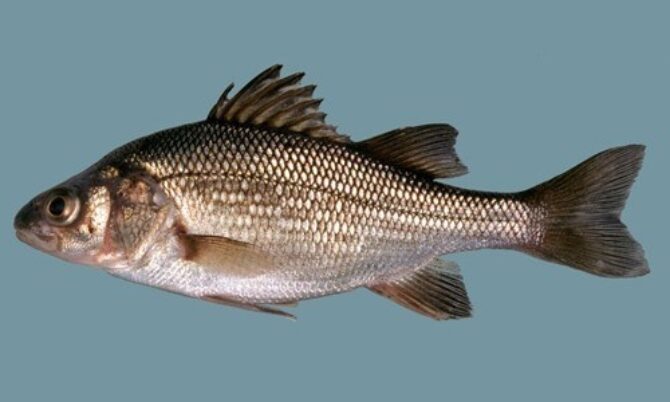
White perch are called perch, but taxonomically they belong with temperate bass in the genus Morone. They have a silvery body, no strong striping, and a compressed shape. They often school in brackish water, tidal creeks, reservoirs, and lakes. In some inland systems they are considered invasive or nuisance fish because they reproduce quickly and compete with other species. For identification, remember that common names can mislead: this fish is more closely related to striped bass and white bass than to true perch.
26. Hybrid Striped Bass
Scientific name: Morone saxatilis × Morone chrysops. Habitat: Stocked reservoirs, lakes, and aquaculture systems. Typical size: Commonly 15–25 in. Key identification feature: Striped bass and white bass hybrid often called wiper.
Hybrid striped bass, often called wipers, combine striped bass size and open-water habits with white bass hardiness. They are commonly stocked in reservoirs where natural striped bass reproduction is limited. Their stripes are often broken or irregular, which helps separate them from pure striped bass. Anglers target them around bait schools, windblown points, humps, dams, and current from water releases. Because they are usually stocked, harvest rules may differ from wild striped bass regulations.
27. European Seabass / Branzino
Scientific name: Dicentrarchus labrax. Habitat: Mediterranean, eastern Atlantic coasts, estuaries, and aquaculture. Typical size: Commonly market-sized 1–3 lb; wild fish larger. Key identification feature: Mild white-fleshed true temperate bass.
European seabass, widely sold as branzino, is one of the best-known food bass. It is a true temperate bass and is common in Mediterranean cooking, where it is often grilled or roasted whole. In the wild it uses coastal waters, estuaries, lagoons, and inshore habitats. Its silver body and relatively streamlined shape are very different from largemouth or reef basslets. For readers, branzino is useful because it shows that bass can be a seafood term as well as a sport-fishing term.
28. Spotted Seabass
Scientific name: Dicentrarchus punctatus. Habitat: Eastern Atlantic, Mediterranean, estuaries, and coastal waters. Typical size: Usually smaller than European seabass. Key identification feature: Spotted body markings on a seabass shape.
Spotted seabass are close relatives of European seabass and share a coastal lifestyle. They are generally smaller and show distinctive dark spots, especially in younger fish. They use inshore waters, lagoons, estuaries, and nearshore marine habitats where small fish and crustaceans are available. They are less familiar to many North American readers but important for understanding the Moronidae family beyond striped and white bass. As with other coastal fish, local rules and sustainable sourcing matter.
29. Japanese Seabass
Scientific name: Lateolabrax japonicus. Habitat: Coastal Japan, Korea, China, estuaries, and brackish waters. Typical size: Often 16–30 in. Key identification feature: Popular East Asian sport and food seabass.
Japanese seabass are important coastal predators in East Asia. They use estuaries, bays, rocky shorelines, surf zones, and river mouths, often feeding on small fish and crustaceans. Anglers target them with plugs, soft plastics, and bait around current lines and night-feeding areas. Although they are not the same as European seabass or striped bass, they fill a similar ecological and culinary role in their region. Their brackish-water tolerance makes river mouths and tidal channels especially productive habitats.
30. Blackfin Seabass
Scientific name: Lateolabrax latus. Habitat: Northwestern Pacific coastal and brackish waters. Typical size: Medium coastal predator. Key identification feature: Lateolabrax seabass with darker fin features.
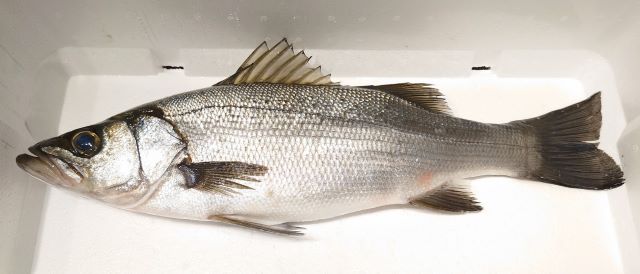
Blackfin seabass are part of the Asian seabass group and are less familiar to global beginners than Japanese seabass. They inhabit coastal marine and brackish environments where tidal movement, structure, and baitfish concentrate prey. Their streamlined body and predatory mouth reflect a fish built for chasing smaller fish. For an identification guide, the key point is that Asian seabasses belong to a different lineage from American black bass, even though the shared common name makes them sound similar.
31. Chinese Seabass
Scientific name: Lateolabrax maculatus. Habitat: Chinese coastal waters, estuaries, and aquaculture areas. Typical size: Medium to large coastal fish. Key identification feature: Spotted Asian seabass used in food fisheries.
Chinese seabass are coastal predators associated with East Asian inshore waters and aquaculture. They use bays, estuaries, and brackish zones where small fish and shrimp are common. Their spotted appearance and regional distribution help separate them from Japanese seabass. In seafood contexts, they may be valued for mild flesh and versatile cooking. In wildlife and fishing contexts, they are a reminder that the bass name travels across cultures, markets, and fisheries, not just North American reservoirs.
32. Asian Seabass / Barramundi
Scientific name: Lates calcarifer. Habitat: Indo-Pacific rivers, estuaries, mangroves, and coastal waters. Typical size: Can exceed 3 ft in strong fisheries. Key identification feature: Catadromous predator also called barramundi.
Asian seabass, better known as barramundi in many places, is one of the world’s most important bass-named food and sport fish. It uses freshwater rivers, estuaries, mangroves, and coastal waters, moving between salinity zones during its life. Anglers value barramundi for explosive strikes and strong runs around snags, rock bars, and tidal drains. It is not a black bass, but it is a true major predatory fish in the bass-name world. Aquaculture has also made it widely available as seafood.
33. Australian Bass
Scientific name: Percalates novemaculeata. Habitat: Eastern Australian coastal rivers and freshwater reaches. Typical size: Often 10–18 in. Key identification feature: Native Australian sport fish with strong current habits.
Australian bass are native sport fish of eastern Australia. They spend much of their life in freshwater river systems but are connected to coastal drainage patterns. Anglers target them with surface lures, small hardbodies, and soft plastics around timber, shade, rock, and current edges. Their common name reflects their role as a bass-like predator rather than close relation to North American black bass. They are excellent examples of how similar ecological niches create similar fishing language around the world.
34. Black Sea Bass
Scientific name: Centropristis striata. Habitat: U.S. Atlantic structured habitats, reefs, wrecks, and rocky bottoms. Typical size: Commonly 10–20 in. Key identification feature: Dark sea bass with structured-bottom lifestyle.
Black sea bass are important Atlantic marine fish that live around structure such as reefs, rock piles, jetties, wrecks, and hard bottom. Smaller fish may look dusky brown, while larger males can appear darker with blue highlights and a pronounced hump during spawning condition. They feed on crabs, shrimp, small fish, and other bottom organisms. For seafood readers, black sea bass is a respected white-fleshed fish. For anglers, the key is bottom structure, seasonal movement, and local size and bag regulations.
35. Bank Sea Bass
Scientific name: Centropristis ocyurus. Habitat: Western Atlantic offshore bottoms and deeper reefs. Typical size: Small to medium. Key identification feature: Centropristis sea bass of offshore banks.
Bank sea bass are relatives of black sea bass found around deeper bottom habitats, banks, and reef-like structure. They are smaller and less widely recognized by casual anglers, but they help show how diverse the Centropristis sea bass group can be. Their body form is adapted for life near the seafloor, where they pick off crustaceans and small fish. Because many sea bass species look similar at first glance, careful attention to range, fin shape, body color, and local species guides is useful.
36. Rock Sea Bass
Scientific name: Centropristis philadelphica. Habitat: Western Atlantic coastal waters, hard bottom, and reefs. Typical size: Small to medium. Key identification feature: Rock-associated Centropristis sea bass.
Rock sea bass are another western Atlantic sea bass associated with hard bottom and nearshore structure. They are not the same as freshwater rock bass, even though the common names are easy to confuse. Their marine habitat, spiny dorsal fin, and serranid body shape separate them from sunfish-family bass. Anglers may encounter them while bottom fishing for mixed reef species. Identification matters because marine regulations often differ by species and region.
37. Kelp Bass / Calico Bass
Scientific name: Paralabrax clathratus. Habitat: Kelp forests and rocky reefs of the eastern Pacific. Typical size: Commonly 10–20 in. Key identification feature: Mottled calico pattern and kelp-cover lifestyle.
Kelp bass, also called calico bass, are classic Southern California sport fish. They live around kelp beds, rocky reefs, boiler rocks, and structure where baitfish and crustaceans concentrate. Their mottled pattern helps them blend into kelp shadows and reef edges. Anglers often target them with swimbaits, surface irons, jerkbaits, and live bait. They are not black bass, but their aggressive strikes around cover make them feel familiar to freshwater bass anglers.
38. Barred Sand Bass
Scientific name: Paralabrax nebulifer. Habitat: Sandy bottoms, reefs, bays, and coastal structure of California and Baja. Typical size: Commonly 10–18 in. Key identification feature: Vertical barring and sand-bottom behavior.
Barred sand bass live over sand, mud, and mixed structure, often near reefs, artificial structure, and bay channels. Their vertical bars and stocky shape help distinguish them from kelp bass. Anglers catch them on swimbaits, jigs, squid, anchovies, and other baits near the bottom. They can gather in groups when feeding or spawning, so local regulations are important. For readers, this fish shows that bass fishing can happen in saltwater with tactics that blend structure fishing and bottom fishing.
39. Spotted Sand Bass
Scientific name: Paralabrax maculatofasciatus. Habitat: Bays, estuaries, sandy areas, and rocky edges of the eastern Pacific. Typical size: Usually 8–15 in. Key identification feature: Spotted pattern and bay-oriented habitat.
Spotted sand bass, often called spotted bay bass in local fishing communities, are popular light-tackle fish in bays and estuaries. They hold around docks, eelgrass, riprap, channels, moorings, and sandy edges. Their spotted markings and smaller average size separate them from barred sand bass and kelp bass. They strike small swimbaits, jigs, jerkbaits, and natural baits. Because they live close to heavily used coastal areas, habitat quality and responsible catch-and-release can be important for local fishing.
40. Gulf Sand Bass
Scientific name: Paralabrax auroguttatus. Habitat: Gulf of California and eastern Pacific rocky-sandy bottoms. Typical size: Small to medium. Key identification feature: Sand bass species of the Gulf of California region.
Gulf sand bass are related to the better-known California sand bass species but are associated with the Gulf of California region. They use rocky-sandy bottoms and coastal structure where small fish and invertebrates are available. For anglers traveling in Baja or the Gulf region, they may appear in mixed catches with other reef and inshore fish. Their inclusion helps broaden a bass guide beyond U.S. freshwater waters and shows the diversity of Paralabrax sea bass along the Pacific coast.
41. Barred Sea Bass
Scientific name: Diplectrum formosum. Habitat: Western Atlantic and Gulf hard bottom, sand, and shell areas. Typical size: Small reef fish. Key identification feature: Slender sea bass with barred markings.
Barred sea bass are smaller marine bass that live near bottom habitat in the western Atlantic and Gulf region. They are often encountered in mixed bottom-fishing situations rather than targeted as trophy fish. Their barred pattern, elongated body, and marine setting help identify them. They feed on small crustaceans and fish near the seafloor. For beginners, they are a reminder that not every bass is a famous game fish; some are smaller ecological members of reef and bottom communities.
42. Sand Sea Bass
Scientific name: Diplectrum radiale. Habitat: Western Atlantic and Caribbean sandy bottoms and coastal areas. Typical size: Small. Key identification feature: Small Diplectrum sea bass of sandy habitats.
Sand sea bass are small bottom-associated fish found in warm western Atlantic and Caribbean habitats. They use sandy or mixed bottoms, often near areas where small invertebrates are abundant. They are more important for biodiversity and identification than for trophy fishing. The name can confuse anglers because it sounds similar to barred sand bass, but the fish belong to a different genus and region. Careful common-name checking prevents mistakes when reading field guides.
43. Chalk Bass
Scientific name: Serranus tortugarum. Habitat: Caribbean reefs, rubble, and rocky areas. Typical size: Usually under 4 in. Key identification feature: Small reef bass often kept in marine aquariums.
Chalk bass are small reef bass from the western Atlantic and Caribbean. They have a soft pastel look, with pale bars and subtle blue to pink tones. In the wild they live around reefs, rubble, and rocky shelter, picking small planktonic and benthic prey. They are also known in the marine aquarium hobby because they stay small and are generally hardier than many delicate reef fish. They show the tiny end of the bass family compared with striped bass or giant sea bass.
44. Harlequin Bass
Scientific name: Serranus tigrinus. Habitat: Rocky reefs and coral areas of the western Atlantic. Typical size: Usually small. Key identification feature: Tiger-like pattern and reef predator behavior.
Harlequin bass are small serranid reef fish with bold patterning that can look tiger-like. They usually live as individuals or pairs around rocky reef areas, coral patches, and shelter. Despite their size, they are predators that take small crustaceans and fish. Aquarium keepers may recognize the name, but in the wild they are part of the secretive reef community. Their shape, spiny dorsal fin, and large mouth identify them as miniature relatives of larger sea bass and groupers.
45. Lantern Bass
Scientific name: Serranus baldwini. Habitat: Western Atlantic reefs, Bahamas, Caribbean, and Gulf areas. Typical size: Usually under 5 in. Key identification feature: Small orange-brown reef bass with spotted pattern.

Lantern bass are small reef bass with attractive orange, brown, and pale markings. They live around reefs and hard structure where they can hover near shelter and dart after small prey. Their maximum size is modest, but they are ecologically interesting because they represent the small predatory fishes that live between coral heads, sponges, and rubble. For marine aquarium readers, they are sometimes seen in the trade, but wild collection and tank suitability should always be considered responsibly.
46. Tobacco Bass
Scientific name: Serranus tabacarius. Habitat: Western Atlantic reefs and rocky areas. Typical size: Small. Key identification feature: Serranus reef bass with brownish tobacco tones.
Tobacco bass are small reef-associated serranids of the western Atlantic. Their common name comes from their muted brownish coloration, which helps them blend into reef shadows and rubble. They are not major sport fish, but they matter for divers, snorkelers, and naturalists learning reef identification. Like other small sea bass, they have a predatory mouth and spiny fins. They feed on small crustaceans and fishes and rely on reef structure for shelter.
47. Belted Bass
Scientific name: Serranus subligarius. Habitat: Western Atlantic coastal and reef habitats. Typical size: Small. Key identification feature: Small bass with belted markings.
Belted bass are another small Serranus species that can be overlooked because of their size. The belted pattern helps break up the body against complex bottom habitats. They occur in warm western Atlantic coastal environments and fit into the food web as small predators. Beginners should not confuse them with young black sea bass or basslets simply because all are small marine fish. The scientific name and local range are useful for correct identification.
48. Socorro Bass
Scientific name: Serranus socorroensis. Habitat: Eastern Pacific island and reef habitats. Typical size: Small. Key identification feature: Island-associated Serranus species.
Socorro bass are associated with the eastern Pacific and show how the bass name appears around island reef systems as well as continental coasts. They are small marine predators that use rocky and reef habitats. Because island species can have limited distributions, responsible diving, collecting, and fishing practices are especially important. For a broad bass guide, Socorro bass adds geographic variety and helps readers see that sea bass diversity extends far beyond the Atlantic species most anglers know.
49. Barred Bass
Scientific name: Serranus novemcinctus. Habitat: Eastern Pacific rocky reef habitats. Typical size: Small. Key identification feature: Barred pattern on a small sea-bass body.
Barred bass are small serranid fish with vertical barring that helps them blend into rocky reef backgrounds. They are not usually the headline species in fishing content, but they are valuable for identification and reef ecology. Their body shape, predatory mouth, and spiny fins link them with other sea bass relatives. When teaching beginners about bass fish, examples like this make it clear that the word includes many small reef predators, not only large freshwater game fish.
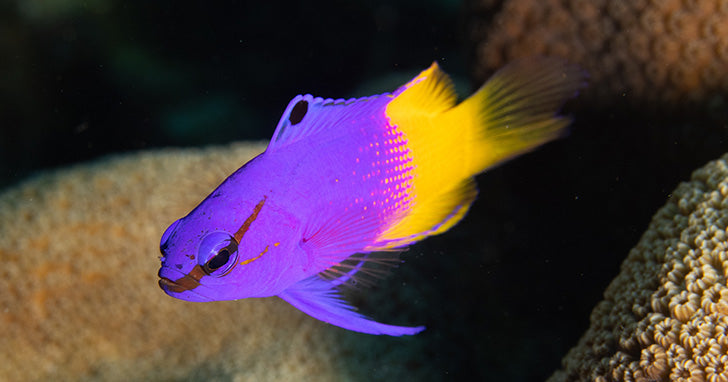
50. Royal Gramma / Fairy Basslet
Scientific name: Gramma loreto. Habitat: Caribbean reef ledges, caves, and overhangs. Typical size: Usually about 3 in. Key identification feature: Purple front half fading to yellow tail.
The royal gramma, also called the fairy basslet, is one of the most recognizable basslet-type reef fish. Its purple and yellow color split makes it popular with divers and aquarium keepers. In nature it often hovers near cave entrances, ledges, and reef walls, retreating quickly when threatened. It is not a sport fish, but it belongs in a broad bass-named guide because basslets are part of reef-fish vocabulary. Its small size also shows the difference between common-name groups and angling categories.
51. Blackcap Basslet
Scientific name: Gramma melacara. Habitat: Deep Caribbean reef walls and caves. Typical size: Small reef fish. Key identification feature: Purple body with dark cap on head.
Blackcap basslets are striking deep-reef relatives of the royal gramma. They prefer steep reef walls, caves, and darker shelter where their purple coloration and black head cap stand out under dive lights. In aquariums they can be secretive, reflecting their natural preference for cover. They are not bass in the freshwater angling sense, but they are an important basslet species for reef identification. Their habitat also reminds readers that many marine bass-named fish live deeper than casual snorkelers expect.
52. Brazilian Gramma
Scientific name: Gramma brasiliensis. Habitat: Brazilian reef habitats. Typical size: Small. Key identification feature: Royal-gramma-like basslet from Brazil.
Brazilian gramma are colorful basslet relatives found in Brazilian reef systems. They are similar in general shape and behavior to other Gramma species, using crevices, overhangs, and reef shelter. Their inclusion helps avoid treating the royal gramma as the only basslet worth knowing. For identification, location is a major clue because many basslets have comparable body forms but different regional distributions. Reef protection is important for these small fish because their lives are tied closely to shelter-rich habitats.
53. Candy Basslet
Scientific name: Liopropoma carmabi. Habitat: Deep tropical Atlantic reefs and rocky shelter. Typical size: Usually under 3 in. Key identification feature: Bright orange, lavender, and red striping.
Candy basslets are among the most colorful reef basslets, with vivid orange and lavender striping. They live in deeper reef zones and rocky shelters, which makes them less commonly seen by casual snorkelers. Their small size, secretive behavior, and high-color pattern make them famous in the marine aquarium world. In a nature guide, they are best presented as deep-reef micro-predators rather than ordinary beginner fish. Responsible sourcing matters because deep-reef species can be difficult and expensive to collect.
54. Swissguard Basslet / Peppermint Bass
Scientific name: Liopropoma rubre. Habitat: Western Atlantic reefs, caves, and crevices. Typical size: Usually under 4 in. Key identification feature: Yellow-orange body with dark red-black stripes.
Swissguard basslets, also called peppermint bass, are secretive reef fish that live in caves, crevices, and shaded reef structure. They have bold horizontal striping and a compact predatory shape. In the aquarium trade they are valued for color and manageable size, but in nature they are shy and easily missed. They feed on small crustaceans and fishes. Their common names show how one species can carry several market and hobby names, so scientific names are useful for clarity.
55. Cave Bass
Scientific name: Liopropoma mowbrayi. Habitat: Caribbean caves, reef ledges, and deep shelter. Typical size: Small. Key identification feature: Secretive Liopropoma basslet of caves.
Cave bass are named for the shadowy habitats they use. They hide in reef caves, cracks, and ledges where they can ambush tiny prey while staying protected from larger predators. Divers may only glimpse them briefly unless they look carefully into structure. Like many Liopropoma species, they are small but visually appealing and biologically interesting. They highlight an important identification lesson: some bass fish are open-water chasers, while others are cryptic shelter specialists.
56. Pinstriped Basslet
Scientific name: Liopropoma mitratum. Habitat: Indo-Pacific reef slopes and deep rocky areas. Typical size: Small. Key identification feature: Fine striping on a compact reef-basslet body.
Pinstriped basslets are small reef basslets with delicate linear markings. They live around reef slopes, rocky structure, and shelter where they can remain hidden much of the time. Their beauty makes them interesting to marine fish enthusiasts, but their secretive nature means they are better appreciated by patient observers. As with other basslets, they are predators in miniature, taking small crustaceans and fish. They add Indo-Pacific diversity to a guide that otherwise might focus too heavily on Atlantic species.
57. Pallid Basslet
Scientific name: Liopropoma pallidum. Habitat: Tropical reef habitats and rocky shelter. Typical size: Small. Key identification feature: Paler Liopropoma basslet.
Pallid basslets are less famous than candy or Swissguard basslets, but they belong to the same general reef-basslet world. Their paler coloration can make them harder to notice in shaded reef habitats. They live close to cover and feed as small predators. For readers building identification skills, species like this are useful because they show that not every bass-named fish is bright, large, or commonly photographed. Many are subtle members of complex reef communities.
58. Swales’s Basslet
Scientific name: Liopropoma swalesi. Habitat: Indo-Pacific reefs and crevices. Typical size: Small. Key identification feature: Small striped basslet sometimes seen in aquariums.
Swales’s basslet is a small, secretive Indo-Pacific reef fish with attractive striping. It uses caves, overhangs, and rocky openings, spending much of its time close to shelter. Aquarium keepers may know it as a colorful but shy species. In the wild, that shyness is survival strategy. It waits near cover, feeds on small prey, and avoids larger reef predators. Including it helps connect the bass guide to both field observation and responsible aquarium learning.
59. Yellow-spotted Golden Bass
Scientific name: Liopropoma olneyi. Habitat: Deep Caribbean reef systems. Typical size: Small. Key identification feature: Golden basslet with yellow spotting.
Yellow-spotted golden bass are deep-reef basslets described from the Caribbean region. They are small, colorful, and tied to habitats that are not easily explored without specialized diving or research. Their discovery and naming remind readers that reef fish diversity is still being documented, especially on deeper mesophotic reefs. In practical terms, they are not a fishing target; they are an identification and biodiversity example. Protecting deep reefs matters because many such species have narrow habitat needs.
60. Spot-tail Golden Bass
Scientific name: Liopropoma santi. Habitat: Deep southern Caribbean reefs. Typical size: Small. Key identification feature: Golden Liopropoma with spot-tail marking.

Spot-tail golden bass are another deep-reef Liopropoma species from the Caribbean. They have the compact body, secretive behavior, and attractive coloration typical of reef basslets. Because deep reef species are less visible to everyday anglers and snorkelers, they are easy to overlook in general fish guides. They are included here to make the article more complete and original, showing that bass fish diversity includes modern deep-reef discoveries as well as familiar game fish.
61. Butterfly Peacock Bass
Scientific name: Cichla ocellaris. Habitat: South American rivers, lagoons, and introduced warm waters. Typical size: Often 12–24 in. Key identification feature: Ocellated tail spot and cichlid body.
Butterfly peacock bass are not true bass; they are large predatory cichlids. They earned the bass name because they strike lures aggressively and fight hard, much like black bass. Native to tropical South America, they also support sport fisheries in warm regions where introduced. Their bright colors, eye-like tail spot, and powerful mouth make them easy to recognize. Because introduced peacock bass can affect native fish communities, they should never be moved or released outside managed waters.
62. Speckled Peacock Bass
Scientific name: Cichla temensis. Habitat: Amazon and Orinoco basin rivers, lagoons, and flooded forests. Typical size: Can exceed 30 in. Key identification feature: Large peacock bass with speckled or bar-pattern forms.
Speckled peacock bass are legendary among traveling anglers because they can grow large and strike surface lures explosively. They live in tropical river systems where seasonal water level changes influence feeding and movement. Their appearance can vary from speckled to boldly barred depending on age, season, and condition. They feed on fish and are built for sudden pursuit. For catch-and-release anglers, careful handling is important because trophy peacock bass are valuable to local ecotourism.
63. Blue Peacock Bass
Scientific name: Cichla piquiti. Habitat: Tocantins-Araguaia basin and introduced tropical waters. Typical size: Large predatory cichlid. Key identification feature: Bluish tones and strong bar pattern.
Blue peacock bass are colorful Cichla that attract anglers with bright markings and aggressive strikes. They prefer warm freshwater systems with structure, baitfish, and enough space to hunt. Like other peacock bass, they are visual predators and often respond to fast-moving lures. In places where they have been introduced, management should consider impacts on native fish. Identification among Cichla species can be challenging, so anglers should use regional guides rather than relying on color alone.
64. Kelberi Peacock Bass
Scientific name: Cichla kelberi. Habitat: Brazilian river basins and warm managed fisheries. Typical size: Medium to large. Key identification feature: Golden-yellow coloration with peacock markings.
Kelberi peacock bass are prized for their golden coloration and aggressive feeding behavior. They are generally smaller than giant speckled peacock bass, but still powerful on tackle. They use warm rivers, reservoirs, and lake-like habitats where prey fish are abundant. In aquarium and fishing circles, the name often appears in discussions of colorful Cichla species. Because peacock bass taxonomy and trade names can be confusing, scientific names and collection region are important for accuracy.
65. Monoculus Peacock Bass
Scientific name: Cichla monoculus. Habitat: Amazon basin floodplains, lakes, and rivers. Typical size: Medium to large. Key identification feature: Eye-like ocellus and classic peacock bass profile.
Monoculus peacock bass are widespread South American Cichla with the classic peacock bass look: strong jaws, bold bars, and an eye-like tail marking. They hunt in warm rivers, floodplain lakes, and backwaters where small fish gather. Anglers may target them with topwater plugs, jerkbaits, jigs, and live bait. Their behavior changes with water levels, so local seasonal knowledge is valuable. They are bass by fishing tradition, not by close relation to largemouth or striped bass.
66. Orinoco Peacock Bass
Scientific name: Cichla orinocensis. Habitat: Orinoco and Negro basin waters. Typical size: Medium to large. Key identification feature: Distinct ocelli and bold side markings.
Orinoco peacock bass are striking cichlids with distinct side spots and strong predatory behavior. They inhabit tropical river systems, lagoons, and flooded habitats where clear to tea-stained water can occur. They are popular with anglers who enjoy visual strikes and powerful short fights near structure. Their distribution and pattern help separate them from other Cichla, but identification can still be difficult where species overlap. Local guides are often the best source for field-level accuracy.
67. Pinima Peacock Bass
Scientific name: Cichla pinima. Habitat: Amazonian river systems and floodplain habitats. Typical size: Large. Key identification feature: Large Cichla with spotted and barred patterns.
Pinima peacock bass are among the large South American peacock bass that interest serious sport anglers. They use warm river channels, lagoons, and flooded forest edges where prey fish are abundant. Their markings can include speckles, bars, and ocelli, which can vary by age and condition. They are strong predators and can be targeted with big topwater lures, jerkbaits, and swimbaits. As with other Cichla, protecting habitat and supporting responsible local fisheries matters.
68. Intermedia Peacock Bass
Scientific name: Cichla intermedia. Habitat: Orinoco basin and associated tropical waters. Typical size: Medium to large. Key identification feature: Elongated peacock bass with distinctive spotting.
Intermedia peacock bass are less familiar to casual readers but important in the diversity of Cichla. They are tropical freshwater predators that use riverine habitats with structure and prey. Identification can involve body shape, spotting, bars, and geographic location. For anglers, they offer the same fast, aggressive hunting style that makes peacock bass famous. For naturalists, they demonstrate how several related predator species can evolve across large South American drainage systems.
69. Vazzoleri Peacock Bass
Scientific name: Cichla vazzoleri. Habitat: Amazon basin waters. Typical size: Medium to large. Key identification feature: Regional Cichla species with peacock-bass traits.
Cichla vazzoleri is one of the lesser-known peacock bass species compared with butterfly or speckled peacock bass. It shares the group’s predatory shape, bold markings, and warm-water habits. Because trade names and local names can vary, using the scientific name is the safest way to discuss it. It belongs in a complete guide because the search phrase types of bass fish includes fish that anglers call bass even when they belong to the cichlid family.
70. Jari Peacock Bass
Scientific name: Cichla jariina. Habitat: Jari River drainage and nearby Amazonian waters. Typical size: Medium to large. Key identification feature: Drainage-associated Cichla species.
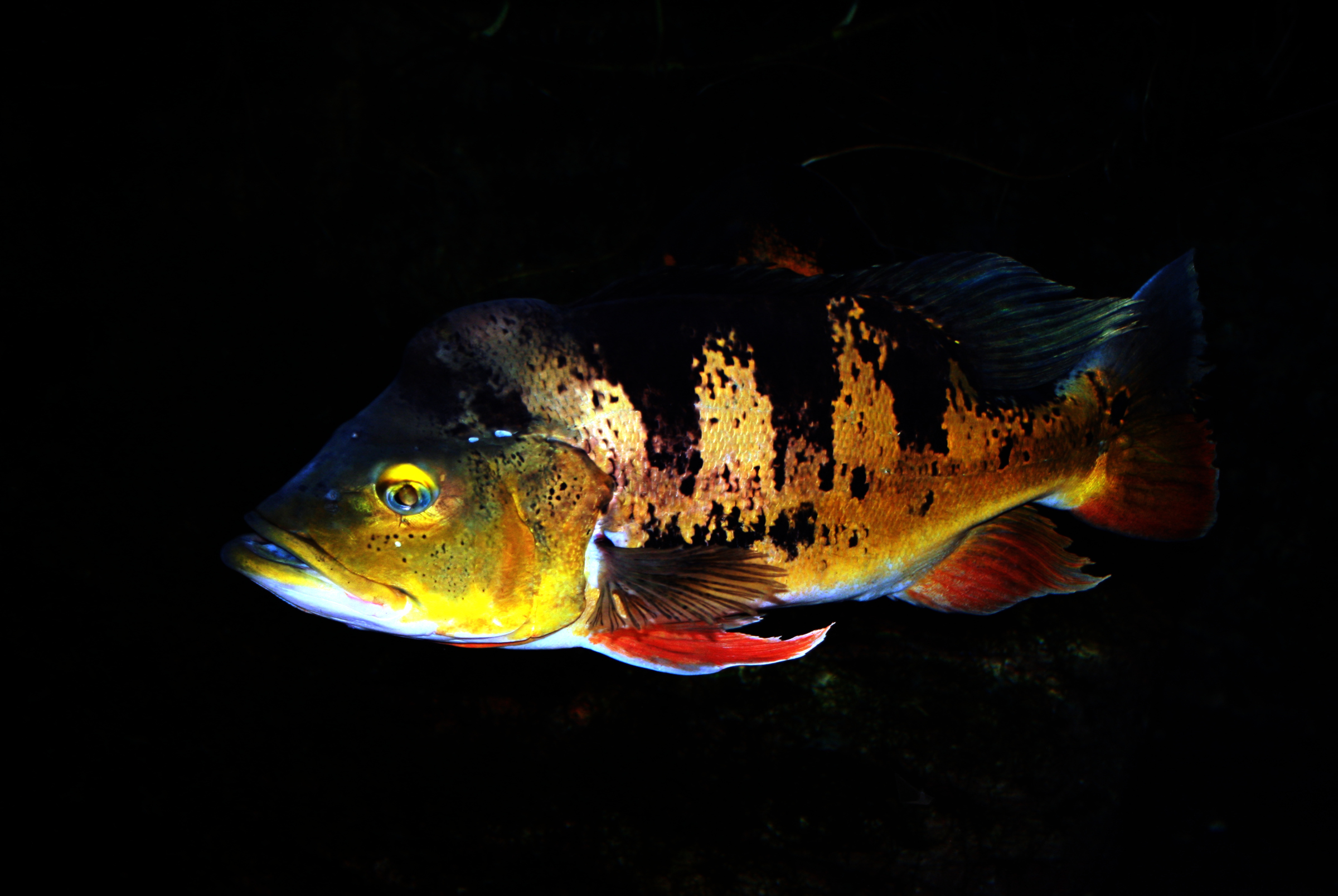
Jari peacock bass are tied to a more specific Amazonian region than the globally famous Cichla names. Their inclusion helps readers understand that peacock bass diversity is not limited to one or two aquarium or sport-fishing species. Like other Cichla, they are fish-eating predators that use warm rivers, lagoons, and structure. Identification relies heavily on location and pattern details. For any traveling angler, local regulations and community-based fishing rules should come first.
71. Xingu Peacock Bass
Scientific name: Cichla melaniae. Habitat: Xingu River basin and clear tropical waters. Typical size: Medium to large. Key identification feature: Peacock bass from the Xingu system.
Xingu peacock bass are associated with the Xingu River basin, an area known for distinctive aquatic life. They are predatory cichlids with the aggressive feeding style that gives peacock bass their angling reputation. Clear-water habitats can make visual fishing exciting, but they also make fish sensitive to disturbance and habitat change. Because Amazonian fish communities can be highly regional, scientific names and river systems are important for serious identification.
72. Mirianae Peacock Bass
Scientific name: Cichla mirianae. Habitat: Amazonian freshwater systems. Typical size: Medium to large. Key identification feature: Regional peacock bass species.
Cichla mirianae is a regional peacock bass species that adds depth to a broad guide. Like other members of the genus, it has a strong predatory mouth, bold patterning, and a preference for warm tropical freshwater. It feeds mainly on other fish and may use structure, edges, and seasonal floodplain habitats. For beginners, the main takeaway is that peacock bass are cichlids, not sunfish or temperate bass, but they are included because anglers around the world use bass language for them.
73. Pleiozona Peacock Bass
Scientific name: Cichla pleiozona. Habitat: Bolivian and Amazonian drainage waters. Typical size: Medium to large. Key identification feature: Cichla species with multiple-zone markings.
Pleiozona peacock bass are another South American cichlid bass valued by specialist anglers and fish enthusiasts. They inhabit warm river systems where seasonal changes influence feeding, spawning, and access. Their patterns can be confusing to beginners, especially when compared with other Cichla, so range and expert references are important. They are predators that require healthy forage bases and connected habitats. This type helps complete the peacock-bass section without pretending all Cichla are the same fish.
74. Thyrorus Peacock Bass
Scientific name: Cichla thyrorus. Habitat: South American tropical freshwater habitats. Typical size: Medium to large. Key identification feature: Less common Cichla species in bass-name discussions.
Cichla thyrorus is one of the lesser-known peacock bass species, but it still belongs in a high-completeness article on bass fish. It shares the general Cichla pattern of warm-water predation, strong jaws, and bold markings. Most casual anglers may never encounter it, yet serious fish enthusiasts benefit from knowing that the peacock bass group is diverse. When exact field identification is important, use regional ichthyology resources rather than aquarium trade names alone.
75. Black-spotted Peacock Bass
Scientific name: Cichla nigromaculata. Habitat: Amazon and Orinoco region waters. Typical size: Medium to large. Key identification feature: Dark-spotted Cichla species.
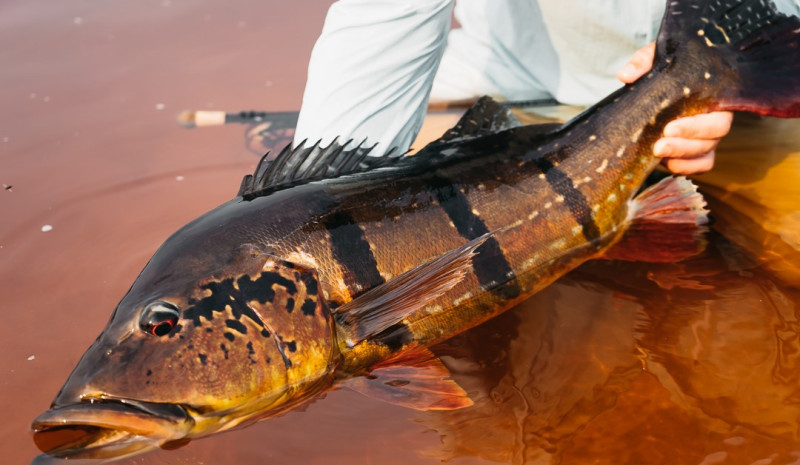
Black-spotted peacock bass are named for their dark markings and belong to the same predatory cichlid group as other Cichla. They live in warm South American freshwater systems, feeding mainly on smaller fish. Their inclusion is useful for readers who want more than a surface-level list of peacock bass types. In practical fishing terms, habitat, water level, and prey movement matter more than memorizing every species name. In identification terms, geography and pattern details are essential.
76. Atlantic Wreckfish / Stone Bass
Scientific name: Polyprion americanus. Habitat: Deep rocky slopes, wrecks, seamounts, and offshore structure. Typical size: Large deepwater fish. Key identification feature: Deepwater fish also sold or known as stone bass.
Atlantic wreckfish are sometimes connected with bass names such as stone bass, especially in seafood and regional fishing contexts. They live around deep rocky structure, wrecks, ledges, and offshore slopes rather than shallow ponds or reefs. Their large size and deepwater habitat make them very different from black bass, but they fit the broader common-name problem readers face when buying fish or reading fishing reports. Because deepwater species can be vulnerable to pressure, management rules and sourcing should be checked carefully.
77. Papuan Black Bass
Scientific name: Lutjanus goldiei. Habitat: New Guinea rivers, estuaries, snags, and brackish systems. Typical size: Can exceed 30 in. Key identification feature: Powerful snapper called bass by anglers.
Papuan black bass are not true bass; they are powerful snapper relatives. Anglers consider them one of the toughest fish in the world because they live around heavy timber, rock, and current, then dive instantly for cover when hooked. They inhabit rivers and estuaries in New Guinea and nearby areas. Their heavy body, crushing strike, and brutal habitat make them famous among adventure anglers. This species is a perfect example of why common names need explanation: bass can mean fishing style, not family relationship.
78. White Seabass
Scientific name: Atractoscion nobilis. Habitat: Eastern Pacific kelp beds, coastal waters, and sandy areas. Typical size: Large coastal fish. Key identification feature: Actually a croaker, not a true sea bass.
White seabass are highly valued California coastal fish, but they are not true sea bass. They belong to the croaker family, which also includes drums. They use kelp beds, coastal flats, squid grounds, and deeper structure, feeding on fish and squid. Their long silver body and large size make them a prized catch. Including them prevents a common mistake: many seafood and fishing names include bass even when the fish is taxonomically unrelated to black bass, temperate bass, or serranid sea bass.
79. Chilean Sea Bass
Scientific name: Dissostichus eleginoides. Habitat: Cold deep waters of the Southern Ocean and South Atlantic regions. Typical size: Large deepwater fish. Key identification feature: Market name for Patagonian toothfish.
Chilean sea bass is a seafood market name for Patagonian toothfish, not a true bass. It became famous because the flesh is rich, white, and forgiving to cook. The fish lives in cold, deep southern waters and grows slowly compared with many shallow-water fish. Sustainability matters greatly with this species, so buyers should look for well-managed sources and reliable certifications. In an identification guide, Chilean sea bass belongs in the article because many readers search bass as a food name, not only a biological category.
80. Giant Sea Bass
Scientific name: Stereolepis gigas. Habitat: Eastern Pacific kelp forests, rocky reefs, and deep structure. Typical size: Can grow extremely large. Key identification feature: Massive protected sea-bass relative.
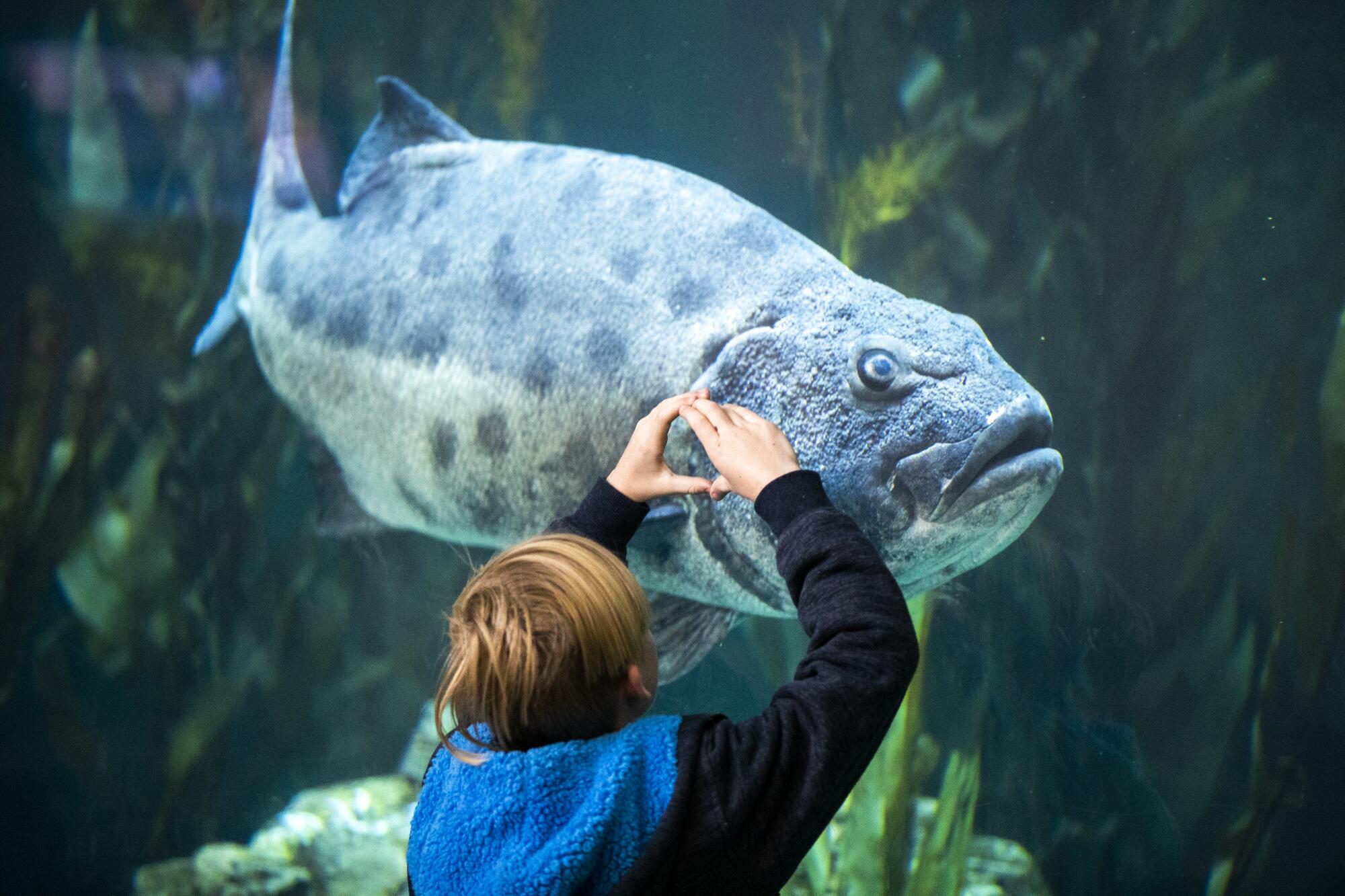
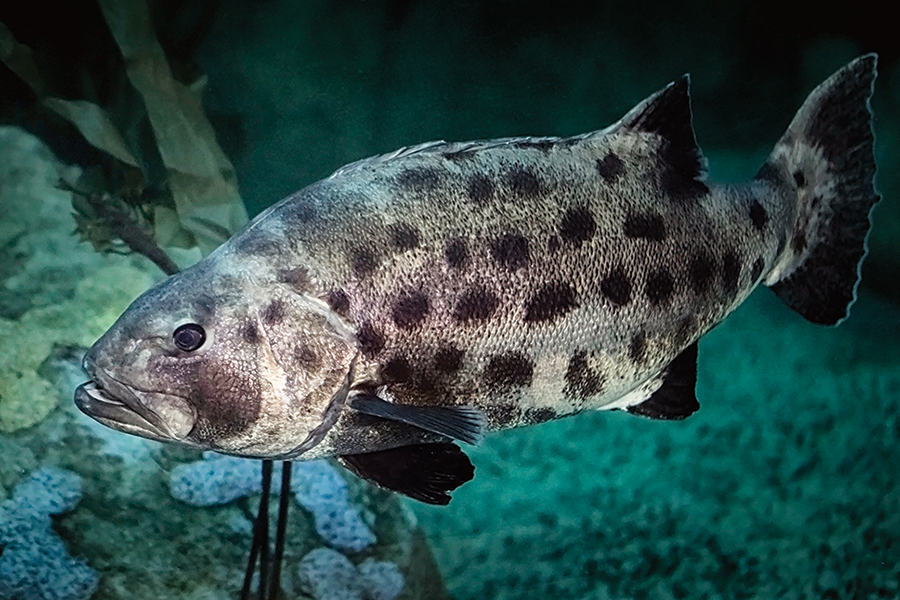
Giant sea bass are among the most impressive bass-named marine fish. They live around kelp forests, rocky reefs, and deeper structure along the eastern Pacific. Their huge size, slow growth, and vulnerability to overharvest have made conservation especially important. Divers may encounter them as slow, powerful reef giants. Anglers and seafood readers should understand that not every large bass-named fish is appropriate to harvest. Local protections and ethical wildlife observation are central to this species.
How Are These Types of Fish Classified?
Bass fish are best classified by family, habitat, and common-name usage rather than by the word bass alone. The black basses, including largemouth, smallmouth, spotted, shoal, and Guadalupe bass, belong to the sunfish family Centrarchidae. Temperate bass such as striped bass, white bass, yellow bass, and European seabass belong to Moronidae. Many marine sea bass belong to Serranidae or related families, while peacock bass belong to the cichlid genus Cichla.
Some bass names are practical fishing or seafood names rather than strict biological labels. White seabass is a croaker, Papuan black bass is a snapper relative, and Chilean sea bass is a market name for Patagonian toothfish. This is why scientific names, range, and habitat are included throughout the guide.
Where Do These Fish Live?
Different types of bass fish live in very different habitats. Freshwater black bass usually prefer lakes, reservoirs, rivers, ponds, and streams with cover such as vegetation, rocks, logs, docks, and current breaks. Temperate bass often use larger rivers, reservoirs, estuaries, and coastal waters. Sea bass species live around reefs, wrecks, hard bottom, kelp forests, sandy bays, and coastal structure. Reef basslets stay near caves, ledges, rubble, and coral shelter, while peacock bass live in warm South American rivers, lagoons, floodplains, and tropical waters where introduced.
Habitat is one of the strongest clues for identification. A green fish hiding under lily pads is more likely to be a largemouth-type bass, while a silver fish with horizontal stripes in a coastal estuary may be striped bass. A tiny purple-and-yellow reef fish under a ledge is a basslet, not a freshwater game bass.
How to Identify Different Types of Bass Fish
- Jaw position: Largemouth bass have an upper jaw that extends past the eye, while smallmouth, spotted, and Guadalupe bass have shorter jaws.
- Body color: Largemouth are often green, smallmouth bronze, striped bass silver, and reef basslets brightly colored.
- Side markings: Look for horizontal stripes, vertical bars, broken blotches, tail spots, or small spots below the lateral line.
- Habitat: Vegetation, rock, current, open water, reefs, kelp, estuaries, and caves all point toward different bass groups.
- Geographic range: Many black bass are drainage-specific, so knowing the river system can prevent misidentification.
- Size and shape: Deep-bodied sunfish relatives, long striped bass, compact reef basslets, and heavy peacock bass have very different silhouettes.
- Regulations: Fishing rules often define bass by local management categories, so always check state, provincial, or national rules before harvest.
Fishing Tips and Notes
For freshwater black bass, start by matching the lure to cover and prey. Use soft plastics, jigs, spinnerbaits, crankbaits, jerkbaits, swimbaits, and topwater lures around grass, wood, docks, points, rocks, and current seams. In rivers, cast upstream or across current and let the lure move naturally through feeding lanes. In reservoirs, learn seasonal movements: shallow spawning areas in spring, deeper structure or shade in summer, baitfish schools in fall, and slow presentations in cold water.
For striped bass, white bass, hybrid bass, and peacock bass, finding baitfish is often the most important step. Watch birds, surface activity, current lines, windblown banks, and sonar if available. For sea bass, focus on bottom structure, reefs, wrecks, kelp edges, and local tide movement. Because many bass fisheries have specific size limits, slot limits, seasons, and closed areas, check current regulations before keeping fish.
Cooking and Buying Tips
Many bass fish are edible, but quality and sustainability vary by species, region, and harvest method. Black sea bass, striped bass, branzino, barramundi, and some sand bass are popular food fish with mild to moderately firm white flesh. Largemouth and smallmouth bass are edible in many places, but some anglers prefer catch-and-release for sport or avoid eating fish from waters with contamination advisories.
When buying seafood labeled bass, read the full market name. Branzino is European seabass, Chilean sea bass is Patagonian toothfish, and white seabass is a croaker. Choose fish with clear labeling, fresh smell, firm flesh, and reliable sourcing. When harvesting your own fish, follow local consumption advisories, especially for large predators from polluted waters.
Safety, Sustainability, and Conservation Notes
- Never move live bass, baitfish, or water between lakes, rivers, or drainages because introductions can damage native fish populations.
- Release native black bass carefully in waters where hybridization or limited range is a concern.
- Use wet hands, rubber nets, and quick photos to reduce handling stress during catch-and-release.
- Check local rules for seasons, size limits, bag limits, marine protected areas, and closed spawning areas.
- Choose sustainably managed seafood, especially for slow-growing or deepwater fish sold under bass market names.
- Protect habitat by avoiding litter, reducing shoreline damage, respecting riparian vegetation, and cleaning gear to prevent invasive species spread.
- Treat reef basslets and other small marine species as wildlife, not decorations; aquarium species should be sourced responsibly and kept only in suitable systems.
Fun Facts About Bass Fish
- The word bass can describe fish from several unrelated families, so common names can be misleading.
- Black bass are actually members of the sunfish family, not true perch.
- Striped bass can move between salt water and fresh water during their life cycle.
- Many small southeastern black bass are tied to specific river drainages.
- Peacock bass are cichlids, yet they are famous sport fish because they strike lures aggressively.
- Royal gramma are often called fairy basslets and live around reef caves and ledges.
- Black sea bass can change sex during their life cycle, a trait seen in some marine fishes.
- Chilean sea bass is a market name, not a biological bass name.
- Kelp bass and sand bass are saltwater favorites for many California anglers.
- Bass identification often depends as much on habitat and location as on color.
Final Thoughts on Types of Bass Fish
The many types of bass fish show how rich and confusing common fish names can be. Largemouth, smallmouth, spotted, striped, white, and black sea bass are familiar to many anglers, but the broader bass world also includes regional stream bass, reef basslets, peacock bass cichlids, Asian seabass, branzino, barramundi, and market names that are not true bass at all. The best way to identify a bass is to combine scientific name, body shape, habitat, range, color pattern, and local rules. Keep learning, fish responsibly, protect habitat, and enjoy the diversity behind one of the most popular names in outdoor fishing.
Frequently Asked Questions
1. What are the most common types of bass fish?
The most common types for anglers are largemouth bass, smallmouth bass, spotted bass, striped bass, white bass, hybrid striped bass, black sea bass, kelp bass, and peacock bass. The exact list depends on whether you mean freshwater fishing, saltwater fishing, seafood, or aquarium fish.
2. Are largemouth bass and smallmouth bass true bass?
They are true black bass in the fishing sense, but scientifically they are members of the sunfish family Centrarchidae. They are not closely related to European seabass or black sea bass.
3. What is the biggest type of bass fish?
It depends on what you include. Giant sea bass can become enormous, striped bass can grow very large, and some peacock bass reach impressive sizes. Among black bass, largemouth and Florida bass are the best-known trophy-size species.
4. What is the best bass fish for beginners to identify?
Largemouth bass is usually the easiest freshwater bass for beginners because of its oversized jaw and dark side stripe. Striped bass is also easy to recognize because of its long silver body and horizontal stripes.
5. What is the difference between black bass and temperate bass?
Black bass such as largemouth and smallmouth belong to the sunfish family. Temperate bass such as striped bass, white bass, yellow bass, and European seabass belong to the Moronidae family.
6. Is striped bass a freshwater or saltwater fish?
Striped bass can be both. Wild Atlantic striped bass are often anadromous, living in coastal waters and spawning in fresh or brackish water, while landlocked striped bass live in stocked reservoirs and lakes.
7. Is peacock bass really a bass?
Peacock bass are not true bass in a scientific sense. They are predatory cichlids in the genus Cichla, but anglers call them bass because they are aggressive sport fish.
8. Is Chilean sea bass really bass?
No. Chilean sea bass is a market name for Patagonian toothfish. It is included in bass guides because many seafood buyers search for it as a bass type.
9. What bass fish live in rivers?
Smallmouth bass, shoal bass, Guadalupe bass, redeye bass, Australian bass, striped bass, white bass, and Papuan black bass can all be associated with rivers, depending on region and salinity.
10. What bass fish live in the ocean?
Black sea bass, European seabass, Japanese seabass, kelp bass, barred sand bass, spotted sand bass, giant sea bass, and white seabass are examples of marine or coastal bass-named fish.
11. How can I tell largemouth bass from smallmouth bass?
Check the jaw and body color. Largemouth bass usually have a jaw extending past the eye and a green body with a dark side stripe. Smallmouth bass are usually bronze with a smaller mouth and vertical barring.
12. How can I tell spotted bass from largemouth bass?
Spotted bass usually have a jaw that does not extend far past the eye and often show small dark spots below the lateral line. Largemouth bass have a larger mouth and usually prefer quieter, weedier cover.
13. What is a Guadalupe bass?
Guadalupe bass is a Texas native black bass adapted to flowing Hill Country rivers and streams. It is smaller than largemouth bass and is important for native fish conservation.
14. What is a shoal bass?
Shoal bass is a southeastern U.S. black bass associated with rocky shoals and flowing rivers. It is prized by anglers who enjoy current, wading, and native stream fish.
15. What is a white bass?
White bass is a temperate bass that forms schools in reservoirs and rivers. It is known for spring spawning runs and fast action when feeding on shad.
16. What is a hybrid striped bass?
A hybrid striped bass is usually a cross between striped bass and white bass. It is commonly stocked in reservoirs and is often called a wiper.
17. Are rock bass actually bass?
Rock bass are members of the sunfish family, related to black bass but not in the same genus as largemouth or smallmouth. They are small, aggressive creek and lake fish.
18. What bass fish are popular for eating?
Black sea bass, striped bass, branzino, barramundi, white seabass, and some sand bass are popular food fish. Always follow local advisories and choose responsibly sourced seafood.
19. Can you eat largemouth bass?
Yes, largemouth bass are edible where regulations and water-quality advisories allow it. Many anglers release larger bass to support sport fisheries, especially in trophy waters.
20. What is branzino?
Branzino is a market and culinary name for European seabass, Dicentrarchus labrax. It is a mild white fish often cooked whole.
21. What is barramundi?
Barramundi is also called Asian seabass. It is a large Indo-Pacific fish that uses rivers, estuaries, mangroves, and coastal waters.
22. What is black sea bass?
Black sea bass is a marine sea bass from the U.S. Atlantic region. It lives around structure such as reefs, wrecks, rock piles, and hard bottom.
23. What is kelp bass?
Kelp bass, also called calico bass, is a saltwater bass of the eastern Pacific. It is strongly associated with kelp forests and rocky reefs.
24. What is the difference between sand bass and sea bass?
Sand bass usually refers to certain Paralabrax or Diplectrum species that live around sandy or mixed bottoms. Sea bass is a broader term that may include many marine species from different families.
25. Are basslets types of bass fish?
Basslets are small reef fish with bass-related common names. Some belong to Grammatidae and others to serranid-related groups. They are important in reef and aquarium contexts, not sport fishing.
26. What is the most colorful bass fish?
Candy basslet, royal gramma, Swissguard basslet, peacock bass, and some redeye-type black bass are among the most colorful bass-named fish.
27. What is the best bass for aquarium keeping?
For marine aquariums, royal gramma and chalk bass are common choices for suitable reef systems. Freshwater black bass and peacock bass are not good casual aquarium fish because they need large tanks, strong filtration, and legal consideration.
28. Do bass fish have teeth?
Most bass have small gripping teeth rather than cutting teeth. Some predatory bass-named fish have strong jaws and rough mouth surfaces suited for holding prey.
29. What do bass fish eat?
Bass diets vary by species, but many eat fish, crayfish, shrimp, crabs, aquatic insects, worms, frogs, squid, or other small animals. Young bass often start with tiny invertebrates.
30. Where do bass spawn?
Many freshwater black bass build nests in shallow water over gravel, sand, or firm bottom. Striped bass spawn in fresh or brackish flowing water. Marine sea bass have different reproductive strategies depending on species.
31. When is the best time to fish for bass?
Spring is often excellent because many freshwater bass move shallow to spawn. Summer low-light periods, fall baitfish movements, and current or tide changes can also produce strong fishing.
32. What lures catch bass?
Common bass lures include soft plastics, jigs, crankbaits, spinnerbaits, jerkbaits, swimbaits, spoons, topwater plugs, and flies. Match lure size and action to prey, habitat, and water clarity.
33. Why are some bass invasive?
Some bass become invasive when moved outside their native range because they prey on native fish, compete for food, or hybridize with local species. Never release live bass into new waters.
34. Why do scientific names matter for bass fish?
Scientific names reduce confusion because many unrelated fish share bass common names. They are especially useful for seafood labels, aquarium fish, and regional native species.
35. Are all sea bass the same?
No. Sea bass is a broad common name used for many marine fish. Some are true seabasses, while others are unrelated fish sold or known under sea bass names.
36. What bass fish are found in Texas?
Texas has largemouth bass, spotted bass in some waters, Guadalupe bass in Hill Country drainages, striped bass and white bass in many systems, and hybrid striped bass in stocked reservoirs.
37. What bass fish are found in California?
California waters can include largemouth, smallmouth, spotted, striped, white bass in some inland waters, and saltwater bass such as kelp bass, barred sand bass, spotted sand bass, white seabass, and giant sea bass.
38. What is the rarest bass fish?
Rarity depends on region and category. Some drainage-specific black bass and deep-reef basslets have limited ranges, while giant sea bass require strong conservation due to their life history and past overharvest.
39. How many types of bass fish are there?
There are more than 80 fish that are species, hybrids, or widely used common-name types associated with bass. This guide uses 80 practical examples rather than every possible regional or market name.
40. What is the easiest way to group bass fish?
Group them as black bass, temperate bass, sea bass, reef basslets, peacock bass, and bass-named market or regional fish. This keeps the topic clearer than relying on the word bass alone.
Read more:
80 Types of Bony Fish: Species and ID Guide