

Few ocean fish inspire as much excitement as marlin. Their long spear-like bills, muscular bodies, dramatic color changes, and powerful runs have made them icons of offshore fishing and open-ocean wildlife. However, the phrase types of marlin fish can be confusing because some sources discuss only the four best-known marlins, while broader scientific lists also include closely related spearfishes in the marlin family.
This guide covers nine practical marlin and spearfish types that readers are most likely to encounter in scientific references, fishing guides, seafood discussions, and identification charts. You will learn their scientific names, appearance, approximate size, habitat, geographic range, feeding habits, fishing relevance, and the features that separate one type from another. The guide also explains why Atlantic and Indo-Pacific blue marlin are sometimes treated as separate species and sometimes grouped together.
What Are the Main Types of Marlin Fish?
The four best-known marlins are blue marlin, black marlin, striped marlin, and white marlin. A broader family-level guide may also include Atlantic and Indo-Pacific blue marlin as separate regional types, plus four closely related spearfishes: shortbill, longbill, Mediterranean, and roundscale spearfish. Sailfish belong to the same family, Istiophoridae, but they are usually discussed separately because of their extremely tall sail-like dorsal fin.
Quick Comparison of the 9 Types
| Number | Common Name | Scientific Name | Main Range | Helpful Identification Feature |
|---|---|---|---|---|
| 1 | Atlantic Blue Marlin | Makaira nigricans | Atlantic Ocean | Large body, pointed fins, flexible pectoral fins |
| 2 | Indo-Pacific Blue Marlin | Makaira mazara in classifications that separate it | Indian and Pacific Oceans | Blue-marlin build with Indo-Pacific distribution |
| 3 | Black Marlin | Istiompax indica | Indian and Pacific Oceans | Rigid pectoral fins that do not fold flat |
| 4 | Striped Marlin | Kajikia audax | Indian and Pacific Oceans | Distinct blue vertical stripes and tall dorsal fin |
| 5 | White Marlin | Kajikia albida | Atlantic Ocean | Rounded dorsal and anal fin tips |
| 6 | Shortbill Spearfish | Tetrapturus angustirostris | Indian and Pacific Oceans | Short bill and relatively slender body |
| 7 | Longbill Spearfish | Tetrapturus pfluegeri | Atlantic Ocean | Longer bill and narrow, lightweight build |
| 8 | Mediterranean Spearfish | Tetrapturus belone | Mediterranean Sea | Regional range and slim body |
| 9 | Roundscale Spearfish | Tetrapturus georgii | Eastern Atlantic and Mediterranean | Rounded scales and white-marlin-like appearance |
1. Atlantic Blue Marlin
The Atlantic blue marlin, Makaira nigricans, is one of the largest and most recognizable billfish in the world. It has a powerful, cylindrical body, a dark cobalt-blue back, pale silvery sides, and a long upper jaw shaped like a round spear. Faint vertical bars may appear along the sides, especially when the fish is excited, feeding, or freshly caught. The first dorsal fin is pointed rather than rounded, and the pectoral fins are flexible enough to fold against the body.

This marlin lives in warm and warm-temperate waters throughout the Atlantic Ocean, including the Gulf of Mexico, Caribbean Sea, and offshore waters along the Americas, Africa, and parts of Europe. It is strongly associated with deep blue water, current boundaries, underwater ledges, seamounts, temperature breaks, and areas where tuna, mackerel, dolphinfish, squid, and other prey gather. Although blue marlin can make deep dives, they spend much of their time in the warmer upper layers of the ocean.
Females grow much larger than males. Very large females may exceed several hundred pounds, while most fish encountered by anglers are considerably smaller than the maximum sizes reported in scientific and sport-fishing records. Their strength, speed, aerial jumps, and long runs make them a prized big-game species.
Atlantic blue marlin are commonly targeted by trolling large artificial lures, rigged natural baits, or combinations of teasers and baits. Identification can be difficult when a fish is in the water, but its thick body, pointed fins, flexible pectoral fins, and Atlantic range help separate it from black and white marlin. Responsible anglers should follow local billfish regulations, use tackle heavy enough to shorten the fight, and release fish in good condition whenever possible.
2. Indo-Pacific Blue Marlin
The Indo-Pacific blue marlin is often listed as Makaira mazara, although some modern authorities treat blue marlin throughout the world as one species, Makaira nigricans. This disagreement is important for readers researching types of marlin fish. In practical fishing and wildlife guides, it is still useful to discuss the Indo-Pacific population separately because its range, fisheries, migration routes, and regional names differ from those of Atlantic blue marlin.
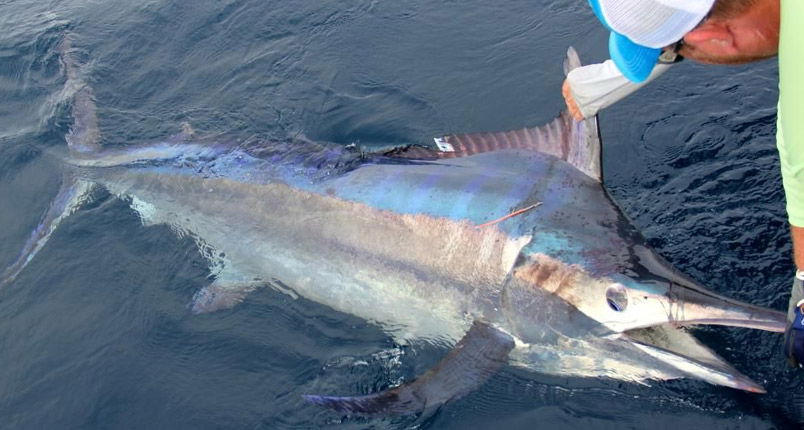
Indo-Pacific blue marlin occur across tropical and subtropical portions of the Indian and Pacific Oceans. Well-known areas include Hawaii, Micronesia, Japan, Southeast Asia, Australia, New Zealand during warm periods, the western coast of the Americas, and many island chains surrounded by deep water. Productive locations often combine warm currents, steep underwater drop-offs, baitfish concentrations, and schools of tuna or skipjack.
Its appearance is extremely similar to that of Atlantic blue marlin: a dark blue upper body, silver-white belly, pointed first dorsal fin, long bill, and flexible pectoral fins. Vertical blue bars can appear on the sides, but these markings may fade quickly. Large females have a deep, muscular profile, while smaller fish may look more streamlined.
This marlin feeds on tuna, mackerel, scads, flyingfish, squid, dolphinfish, and other pelagic animals. It may strike prey with its bill or rush through a bait school before turning to swallow injured fish. Anglers usually target it by trolling skirted lures or rigged baits around current lines, offshore banks, seamounts, floating debris, and areas marked by feeding birds.
Because taxonomic references do not all use the same scientific name, writers should avoid claiming that Atlantic and Indo-Pacific blue marlin are unquestionably separate species. Calling them distinct regional types is a clear and practical solution.
3. Black Marlin
The black marlin, Istiompax indica, is a massive Indo-Pacific billfish famous for its broad shoulders, thick body, and extraordinary power. Despite its name, it is not completely black. The upper body is dark blue to blue-black, while the lower sides and belly are silvery. Its most useful identification feature is the pectoral fin: in adult black marlin, the pectoral fins are rigid and cannot be folded flat against the body.
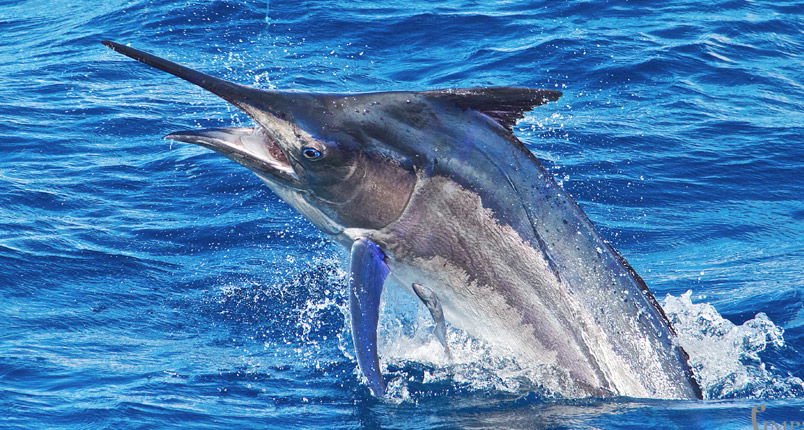
Black marlin occur throughout tropical and subtropical waters of the Indian and Pacific Oceans. They are strongly associated with Australia, Southeast Asia, East Africa, island groups of the western and central Pacific, and parts of the eastern Pacific. Juveniles are often found closer to reefs, continental shelves, and coastal baitfish grounds than many other large marlin. Mature fish also travel through offshore waters and along major current systems.
Black marlin eat tuna, mackerel, scads, bonito, squid, and other fast-moving prey. Their heavy build gives them tremendous acceleration and pulling strength. Large individuals may launch themselves clear of the water, shake their heads at the surface, or make long, forceful runs.
Anglers commonly target black marlin by slow-trolling live tuna, scad, mackerel, or other natural baits near reef edges, drop-offs, current lines, and spawning or feeding areas. Smaller fish may also strike skirted trolling lures. Compared with blue marlin, black marlin usually look thicker through the shoulders and have a lower dorsal profile. The fixed pectoral fin remains the best field mark when it can be observed safely.
Handling should be kept to a minimum. A large black marlin beside a boat is powerful and potentially dangerous because of its bill, tail, and sudden movements. Experienced crews use careful release procedures and avoid bringing oversized fish aboard.
4. Striped Marlin
The striped marlin, Kajikia audax, is one of the easiest marlins to recognize when its markings are visible. Its sides display numerous bright blue vertical stripes formed by dots or narrow bars. These markings can intensify dramatically during feeding, competition, or excitement. The fish also has a relatively tall first dorsal fin, a slender body, and a long, narrow bill.
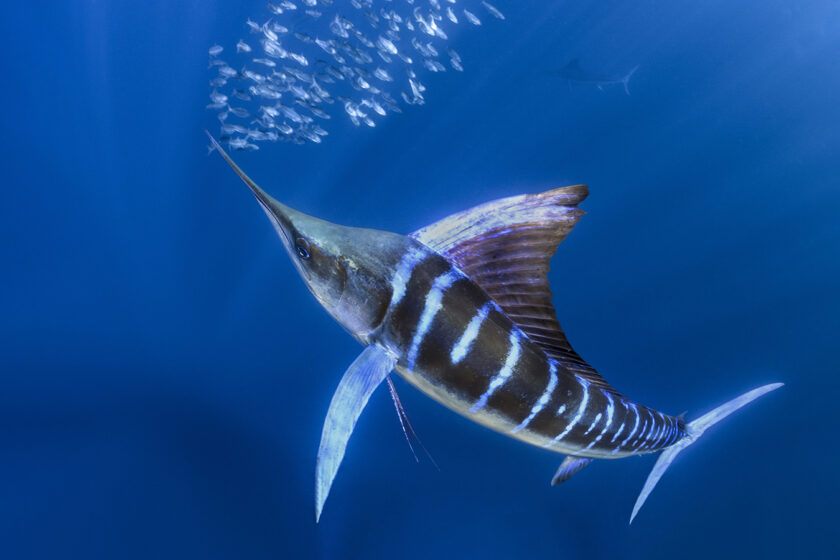
Striped marlin inhabit tropical and subtropical waters of the Indian and Pacific Oceans. Important areas include Baja California, Mexico, the eastern Pacific, Hawaii, Japan, Australia, New Zealand, and portions of the Indian Ocean. They often prefer somewhat cooler water than blue or black marlin and may gather seasonally where sardines, anchovies, mackerel, squid, and other schooling prey become abundant.
Unlike the usually solitary image associated with giant marlin, striped marlin may hunt in loose groups around dense schools of baitfish. They are active near the surface and are often spotted by anglers looking for fins, tails, splashes, feeding birds, or nervous bait. Their ability to light up their stripes during an attack makes them especially striking underwater.
Striped marlin are generally smaller and more slender than blue or black marlin, but they are highly energetic fighters. They are known for repeated jumps, rapid changes of direction, and surface action. Common fishing methods include trolling lures or baits, casting live baits to visible fish, bait-and-switch techniques, and presenting baits near feeding activity.
To distinguish a striped marlin from a blue marlin, look for brighter and more persistent body stripes, a taller dorsal fin relative to body depth, and a slimmer shape. A striped marlin also has flexible pectoral fins, unlike the rigid fins of a black marlin. Because several billfish may occur together, identification should combine markings, body shape, fin shape, and geographic range.
5. White Marlin
The white marlin, Kajikia albida, is an Atlantic species with a lighter, more compact build than a large blue marlin. It has a dark blue to brownish upper body, silver-white lower sides, a long bill, and a visible lateral line. The tips of the first dorsal and anal fins are rounded, which is one of the best ways to separate it from the more sharply pointed fins of a blue marlin.
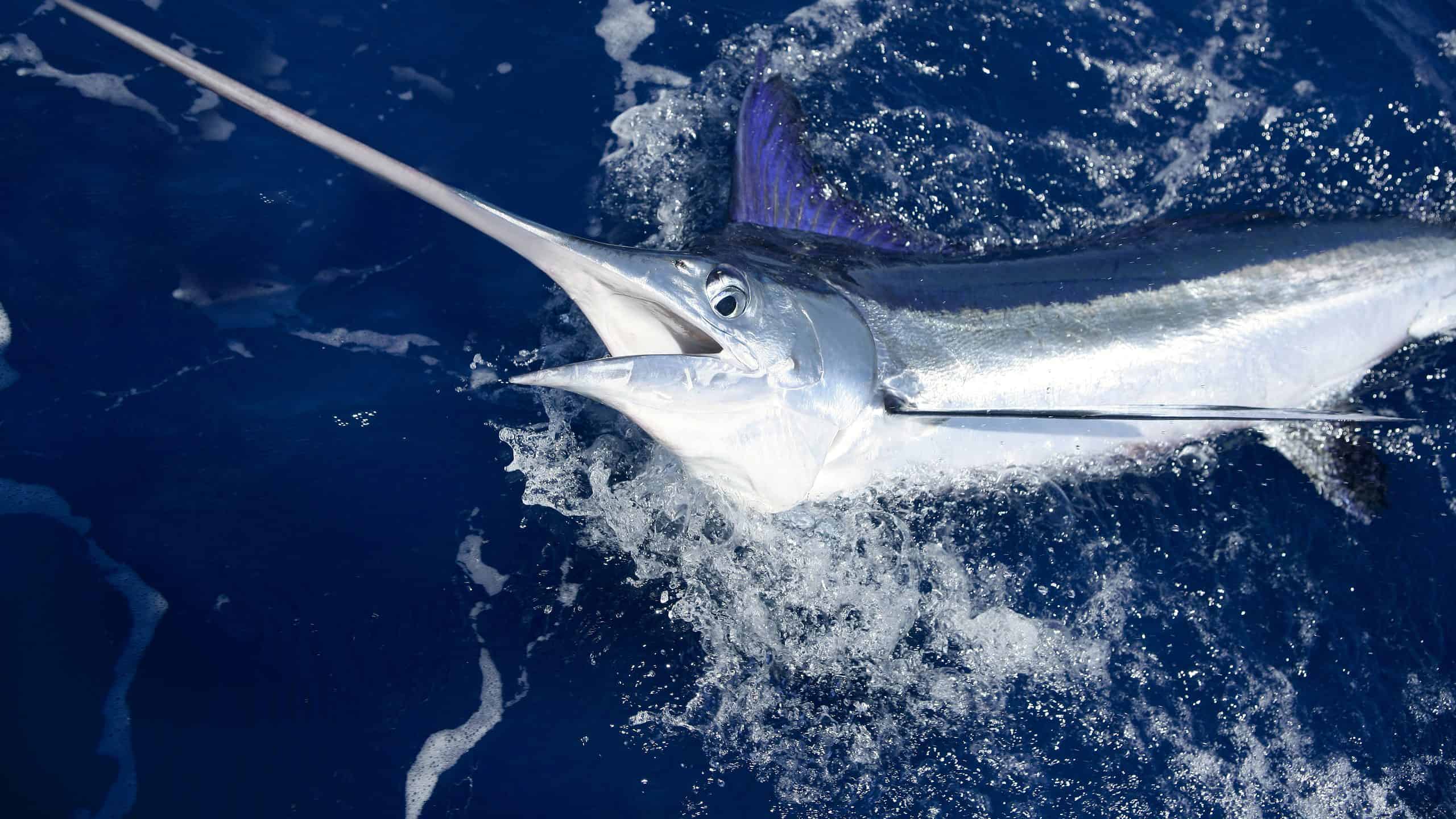
White marlin range widely through warm portions of the Atlantic Ocean, including the western Atlantic, Caribbean, Gulf of Mexico, and waters along South America and Africa. They migrate seasonally and may move northward when summer waters warm. They usually occupy the upper part of the water column, especially around fronts, weed lines, eddies, shelf edges, canyons, and concentrations of small pelagic fish.
The diet includes mackerel, herring-like fish, flyingfish, squid, crabs, and other open-water prey. White marlin often feed near the surface during daylight. Anglers may see them following teasers, investigating baits, or showing a dorsal fin and tail near the surface.
Fishing methods include trolling natural baits, small artificial lures, dredges, spreader bars, and hookless teasers. Skilled crews often use bait-and-switch tactics, drawing the fish close before presenting a rigged bait. Because white marlin have a relatively delicate bill and mouth compared with very large blue marlin, balanced tackle and careful drag settings are important.
White marlin have historically been confused with roundscale spearfish, especially in fisheries data and tournament records. The two can be very difficult to separate without close examination. Rounded fin tips alone are not enough; scale shape, body measurements, anal-fin position, and other anatomical features may be needed for confident identification.
6. Shortbill Spearfish
The shortbill spearfish, Tetrapturus angustirostris, is a slender billfish found in the Indian and Pacific Oceans. It belongs to the same family as marlins and sailfish but is smaller and more lightly built than the famous blue or black marlin. As its common name suggests, its bill is relatively short compared with the bill of a longbill spearfish or many true marlins.
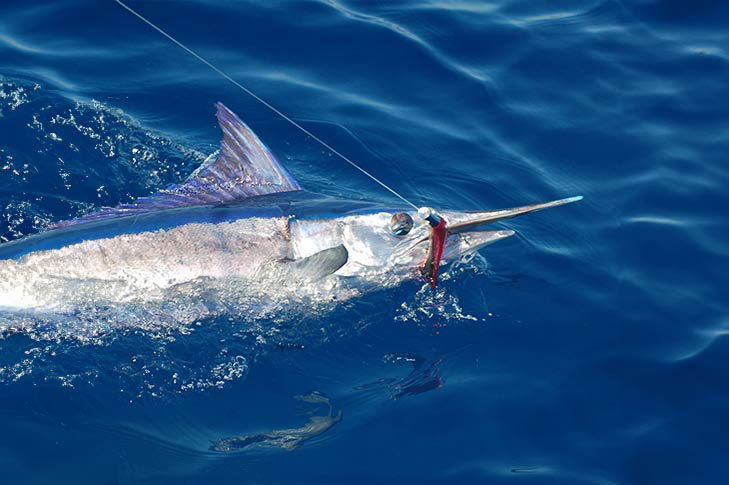
The body is elongated and streamlined, with a dark blue upper surface and pale lower sides. The first dorsal fin is fairly tall near the front and becomes lower toward the rear. The pelvic fins are long and narrow. Because shortbill spearfish are not encountered as frequently as the major marlin species, they may be misidentified as juvenile striped marlin, small blue marlin, or other spearfish.
This species lives in warm offshore waters across a broad Indo-Pacific range. It is usually associated with deep pelagic habitat rather than shallow coastal areas. Shortbill spearfish feed on small fishes, squid, and crustaceans. Their narrow body and lighter weight suit a life spent chasing compact, fast-moving prey in open water.
Most anglers catch shortbill spearfish incidentally while trolling for tuna, marlin, dolphinfish, or wahoo. They may strike small skirted lures, feathers, rigged baits, or live baits. Hawaii is one of the better-known places where anglers encounter this species, though it occurs much more widely.
Identification should focus on the short bill, body proportions, fin shapes, and region. A photograph showing the entire fish from the side is much more useful than a close-up of the head. Because rare billfish can be difficult to identify, anglers contributing data to tagging programs should record length, location, fin details, and clear photographs before release.
7. Longbill Spearfish
The longbill spearfish, Tetrapturus pfluegeri, is an Atlantic billfish with a slim body and a bill that is noticeably longer than that of the shortbill spearfish. It is much smaller and more lightly built than a large blue marlin, yet it shares the family’s basic design: a pointed upper jaw, streamlined body, forked tail, and long first dorsal fin.
Longbill spearfish occur in tropical and subtropical waters of the Atlantic Ocean. They are reported from the western and eastern Atlantic, including offshore waters near the Caribbean, Gulf of Mexico, Atlantic islands, and parts of Africa. They are generally pelagic and are most often encountered over deep water rather than in shallow coastal habitats.
The species feeds on small schooling fishes, squid, and other open-ocean prey. Its narrow shape suggests an emphasis on speed and maneuverability rather than the brute strength seen in giant black or blue marlin. Even so, a hooked longbill spearfish can jump repeatedly and provide an exciting fight on appropriately balanced tackle.
Many captures occur accidentally during offshore trolling for tuna, white marlin, sailfish, or dolphinfish. Small lures and natural baits are more suitable than oversized marlin offerings. When a fish is brought close, anglers should compare bill length, dorsal-fin height, body depth, and pelvic-fin length.
Longbill spearfish may be confused with white marlin, especially at a distance. White marlin typically have a deeper body and rounded fin tips, while longbill spearfish appear more delicate and elongated. Accurate identification matters because catch records, conservation assessments, and fisheries management depend on separating similar billfish correctly.
8. Mediterranean Spearfish
The Mediterranean spearfish, Tetrapturus belone, is a regional billfish centered in the Mediterranean Sea. It is a slim, fast pelagic predator and one of the least familiar members of the marlin family to readers outside Europe and North Africa. Its restricted distribution makes location one of the most useful clues for identification.
The fish has a dark blue back, pale sides, a pointed bill, and an elongated body. The first dorsal fin begins high near the head and gradually lowers toward the tail. It lacks the huge sail of a sailfish and the heavy shoulders of a large blue or black marlin. Compared with the longbill spearfish, identification depends on a combination of range and detailed body measurements rather than one obvious visual feature.
Mediterranean spearfish live in offshore waters and follow seasonal changes in temperature and prey availability. Their diet includes small pelagic fish and squid. They may occur where currents concentrate sardines, anchovies, mackerel, and other schooling species.
The species can be caught by trolling small lures or natural baits, although it is not targeted as intensively as larger marlin in many areas. Incidental capture in commercial pelagic fisheries may be more important than directed recreational fishing. Because the Mediterranean supports many nations with different regulations and reporting systems, anglers should verify current local rules before fishing for billfish.
For field identification, record the exact capture location, body length, bill length, dorsal and anal fin shapes, pelvic fins, and clear side photographs. The fish should be kept in the water whenever possible and released promptly if regulations or conservation practices call for release.
9. Roundscale Spearfish
The roundscale spearfish, Tetrapturus georgii, is an eastern Atlantic and Mediterranean billfish that closely resembles the white marlin. For many years, the two were frequently grouped together in catches, records, and biological samples. Modern identification work has shown that roundscale spearfish are distinct, making them one of the most important examples of why billfish identification can be challenging.

The species has a long bill, dark upper body, silvery lower sides, and rounded-looking fin tips similar to those of a white marlin. The common name refers to the shape of its scales, but scale form is not always easy to judge on a moving fish beside a boat. Specialists may also compare the position of the anal opening, body proportions, lateral-line pattern, and other measurements.
Roundscale spearfish occur mainly in the eastern Atlantic and parts of the Mediterranean, though their full distribution has been difficult to define because of past misidentification. They inhabit open ocean waters and feed on small fish, squid, and other pelagic prey.
Recreational anglers are most likely to encounter one while trolling for white marlin, tuna, or other billfish. Fishing methods therefore overlap with those used for white marlin: small baits, compact lures, teasers, and offshore trolling spreads. The fish can be lively on the line, but it does not reach the enormous proportions of a blue or black marlin.
Photographs are especially important. Capture a full side view, close images of scales and fins, and a measurement reference when safe and legal. When certainty is impossible, recording the fish as an unidentified white-marlin-type billfish is better than forcing a confident but unsupported identification.
How Are These Types of Fish Classified?
Marlin, spearfish, and sailfish belong to the billfish family Istiophoridae. Swordfish are billfish too, but they belong to a separate family, Xiphiidae. The distinction is useful because swordfish have a flatter, broader bill, lack pelvic fins, and have different fin and body structures.
The nine types in this guide fall into four commonly used genera:
- Makaira: Blue marlin, including Atlantic and Indo-Pacific forms under classifications that separate them.
- Istiompax: Black marlin, the only living species generally placed in this genus.
- Kajikia: White marlin and striped marlin.
- Tetrapturus: Shortbill, longbill, Mediterranean, and roundscale spearfishes.
Taxonomy changes as researchers compare genetics, body structure, migration, and population data. The most visible example is blue marlin. Some references recognize Atlantic blue marlin as Makaira nigricans and Indo-Pacific blue marlin as Makaira mazara. Others use Makaira nigricans for blue marlin worldwide. For general readers, treating them as two regional types while explaining the scientific disagreement is accurate and practical.
Where Do These Fish Live?
Marlin and spearfish are pelagic fish, meaning they spend most of their lives in the open ocean rather than resting on the seafloor. They are most common in tropical and subtropical waters, although striped marlin, white marlin, and some spearfishes may enter warm-temperate regions seasonally.
- Atlantic Ocean: Atlantic blue marlin, white marlin, longbill spearfish, and roundscale spearfish.
- Indian and Pacific Oceans: Indo-Pacific blue marlin, black marlin, striped marlin, and shortbill spearfish.
- Mediterranean Sea: Mediterranean spearfish and roundscale spearfish, with occasional records of other billfish.
Productive marlin habitat often includes current edges, temperature breaks, offshore banks, seamounts, canyons, weed lines, steep reef drop-offs, and areas where prey collects. Marlin movements are strongly influenced by water temperature, oxygen levels, currents, spawning cycles, and the distribution of tuna, mackerel, sardines, squid, and flyingfish.
How to Identify Different Types of Marlin Fish
- Pectoral fins: Black marlin have rigid pectoral fins that do not fold flat. Blue, striped, and white marlin have flexible pectoral fins.
- Body depth: Black and large blue marlin look thick and powerful. Spearfishes are generally slimmer.
- Vertical stripes: Striped marlin have strong, clear blue bars. Blue marlin may show fainter bars that can fade.
- Dorsal-fin shape: White marlin have rounded fin tips. Blue marlin have more pointed dorsal and anal fins. Striped marlin have a relatively tall first dorsal fin.
- Bill length: Shortbill spearfish have a relatively short bill, while longbill spearfish have a proportionally longer one.
- Scale shape: Roundscale spearfish have scale features that help specialists separate them from white marlin.
- Geographic range: Location can eliminate several possibilities. Black marlin do not have a regular Atlantic population, while white marlin are Atlantic fish.
- Overall size: Blue and black marlin reach the greatest sizes. Spearfishes are usually much smaller.
- Color changes: Fresh, excited billfish may display bright bars or patches that fade after capture.
- Photographs and measurements: A full side view, fin close-ups, bill length, body length, and capture location greatly improve identification.
Marlin, Sailfish, and Swordfish: What Is the Difference?
| Feature | Marlin | Sailfish | Swordfish |
|---|---|---|---|
| Family | Istiophoridae | Istiophoridae | Xiphiidae |
| Main Dorsal Fin | Tall to moderate, but not a huge sail | Extremely tall and sail-like | Shorter and more separated in adult fish |
| Bill Shape | Round and spear-like | Round and spear-like | Broad and flattened |
| Pelvic Fins | Present | Present | Absent |
| Typical Body | Muscular and streamlined | Slender with a dramatic dorsal sail | Heavy-bodied with large eyes |
Fishing Tips and Notes
- Match the tackle to the fish: Use equipment strong enough to control the fish and reduce fight time, but balanced enough to present the intended bait or lure naturally.
- Find productive water: Look for temperature changes, current seams, bait schools, feeding birds, floating debris, seamounts, canyon edges, and steep drop-offs.
- Use suitable trolling speeds: Natural baits are usually trolled more slowly than many artificial lures. Adjust speed so the lure or bait tracks correctly.
- Watch the spread: Many marlin first appear behind a teaser or lure before striking. A focused crew can react quickly and improve hookup quality.
- Keep hooks appropriate: Circle hooks are required or encouraged in many billfish fisheries because they can reduce deep hooking when used correctly with natural bait.
- Avoid exhausting the fish: Heavy enough tackle, steady pressure, and an experienced boat operator help shorten the fight.
- Prepare release tools: Keep gloves, dehookers, line cutters, tagging equipment, and cameras ready before the fish reaches the boat.
- Record useful data: Note species, location, estimated or measured length, water temperature, lure or bait, and release condition.
- Do not lift large fish by the bill: Supporting or dragging a heavy marlin by its bill can cause injury and creates danger for the crew.
- Check regulations before departure: Billfish rules vary by country, region, fishing method, season, and tournament.
Cooking and Eating Notes
Marlin is eaten in some regions, especially in parts of the Pacific and Asia, where it may be grilled, smoked, seared, dried, or served in other preparations. The flesh is generally firm, dense, and stronger in flavor than mild white fish. However, not every marlin fishery is equally sustainable, and regulations may prohibit retention of certain species or require minimum sizes and reporting.
Large predatory fish can accumulate mercury. Consumption advice differs by country and may be stricter for pregnant people, nursing mothers, young children, and those who eat large ocean predators frequently. Always follow current local health guidance. Keep retained fish chilled immediately, avoid temperature abuse, and clean the fish with sanitary equipment.
Safety, Sustainability, and Conservation Notes
Marlin are highly migratory, so effective conservation often requires cooperation among many countries. They are caught in recreational fisheries, directed commercial fisheries, and as bycatch in tuna and swordfish operations. The condition of a population can differ between oceans and management areas, making broad statements such as “all marlin are sustainable” or “all marlin are endangered” misleading.
- Follow all licensing, size, retention, reporting, gear, and seasonal rules.
- Use release practices that minimize handling and air exposure.
- Keep the boat moving slowly when necessary to pass water across the fish’s gills before release.
- Do not touch the eyes or gills.
- Cut the leader close to the hook when removing the hook would cause more injury.
- Support tagging and scientific reporting programs where available.
- Choose seafood from well-managed fisheries and consult current regional advisories.
- Avoid buying products made from illegally harvested billfish.
- Reduce plastic and fishing-line waste that can harm pelagic wildlife.
- Treat rare spearfish identifications cautiously so fishery data remain reliable.
Fun Facts About Marlin Fish
- Marlin belong to the billfish family Istiophoridae, while swordfish belong to a different family.
- The name “marlin” is often linked to the fish’s resemblance to a sailor’s marlinspike.
- Female blue and black marlin grow much larger than males.
- Black marlin can be identified by rigid pectoral fins that do not fold flat.
- Striped marlin can brighten their blue body bars during feeding activity.
- Marlin often follow warm currents and seasonal movements of prey.
- Blue marlin taxonomy differs among scientific authorities.
- Roundscale spearfish were historically confused with white marlin.
- Marlin bills may help slash, strike, or stun prey during feeding.
- Many modern big-game anglers tag and release marlin rather than keep them.
Final Thoughts on Types of Marlin Fish
The most familiar types of marlin fish are blue, black, striped, and white marlin, but a complete family-level overview also includes several spearfishes. Atlantic and Indo-Pacific blue marlin may be listed as separate species or as regional populations of one worldwide species, so readers should always check which taxonomic system a source uses.
For practical identification, focus on pectoral-fin flexibility, body depth, dorsal-fin shape, stripe pattern, bill length, and geographic range. Whether you are studying marine wildlife, planning an offshore fishing trip, or identifying a photographed billfish, careful observation and accurate reporting help protect these remarkable open-ocean predators.
Frequently Asked Questions
1. How many types of marlin fish are there?
Most general fishing guides focus on four main marlins: blue, black, striped, and white. Broader scientific lists include spearfishes and may separate Atlantic and Indo-Pacific blue marlin, producing a practical list of nine marlin and spearfish types. Including sailfish brings the wider Istiophoridae family total higher.
2. What are the four main types of marlin?
The four best-known types are blue marlin, black marlin, striped marlin, and white marlin. These are the names most commonly used in sport-fishing, wildlife, and general ocean guides.
3. Is a spearfish a marlin?
Spearfishes are close relatives of marlins in the family Istiophoridae. They are often included in broad discussions of marlin-family fish, although their common names and lighter body forms distinguish them from the major marlin species.
4. Is a sailfish a type of marlin?
Sailfish belong to the same family as marlins, but they are usually treated as a separate group. Their huge sail-like first dorsal fin makes them easy to distinguish from true marlins and spearfishes.
5. Is a swordfish a marlin?
No. Swordfish and marlin are both billfish, but swordfish belong to the family Xiphiidae. Marlin belong to Istiophoridae. Swordfish also have a flatter bill, no pelvic fins, and a different body and fin structure.
6. What is the largest type of marlin?
Blue marlin and black marlin are the largest types. Exceptional females of both can reach enormous sizes, while the average fish caught by anglers is much smaller than record-class individuals.
7. What is the smallest marlin-family fish in this guide?
The spearfishes are generally smaller and more slender than blue, black, striped, or white marlin. Roundscale, shortbill, longbill, and Mediterranean spearfish are all relatively lightweight compared with giant marlin.
8. How can you identify a black marlin?
The best feature is its rigid pectoral fins, which do not fold flat against the body. Black marlin also tend to have a thick, powerful body, a lower dorsal profile, and an Indo-Pacific distribution.
9. How can you identify a striped marlin?
Look for vivid blue vertical stripes, a slender body, and a relatively tall first dorsal fin. The stripes can become brighter during feeding or excitement and are usually more obvious than the temporary bars of a blue marlin.
10. How can you tell a white marlin from a blue marlin?
White marlin are smaller and usually have rounded dorsal and anal fin tips. Blue marlin have a heavier body and more pointed fins. Range is also useful because white marlin occur in the Atlantic.
11. Why are white marlin and roundscale spearfish confused?
They share a similar body shape, bill, coloration, and rounded fin appearance. Reliable separation may require examining scales, body proportions, anal-fin position, and other anatomical features rather than using color alone.
12. Are Atlantic and Pacific blue marlin different species?
Scientific authorities do not all agree. Some recognize Atlantic blue marlin as Makaira nigricans and Indo-Pacific blue marlin as Makaira mazara. Others treat blue marlin worldwide as Makaira nigricans. It is safest to describe them as distinct regional types while noting the debate.
13. Where do black marlin live?
Black marlin live mainly in tropical and subtropical waters of the Indian and Pacific Oceans. They are especially associated with Australia, Southeast Asia, East Africa, Pacific islands, and productive reef or shelf-edge habitats.
14. Where do white marlin live?
White marlin are Atlantic fish. They occur in warm offshore waters of the western and eastern Atlantic, including the Gulf of Mexico and Caribbean, and migrate seasonally as water temperatures change.
15. Where do striped marlin live?
Striped marlin inhabit tropical and subtropical waters of the Pacific and Indian Oceans. They are common in several productive fishing regions, including waters near Mexico, Hawaii, Japan, Australia, and New Zealand.
16. What do marlin eat?
Marlin eat pelagic fish and squid. Common prey includes tuna, mackerel, sardines, anchovies, scads, flyingfish, dolphinfish, bonito, and cephalopods. Diet varies with region, fish size, and prey availability.
17. Do marlin use their bills to hunt?
Observations suggest that marlin can use their bills to strike, slash, or stun prey. They may rush through a bait school, injure fish, and then turn back to eat them. The bill is not used like a sword in every feeding event.
18. Are marlin fast fish?
Yes. Marlin are powerful, streamlined pelagic swimmers capable of rapid bursts and long-distance migration. Exact maximum-speed claims are difficult to verify, so extremely precise popular figures should be treated cautiously.
19. Do marlin change color?
Many marlin can intensify blue bars, spots, or body tones when excited, feeding, or stressed. These colors may fade rapidly after the fish calms or dies, which can make identification from old photographs harder.
20. Are marlin dangerous to people?
Marlin do not normally hunt people, but a hooked or restrained fish can be dangerous. The bill, tail, body weight, and sudden movements can injure anglers. Large fish should be handled only by experienced crews using safe release methods.
21. Can marlin be kept in an aquarium?
No ordinary home or public aquarium is suitable for marlin. They are large, fast, highly migratory open-ocean fish that require enormous space, specialized water conditions, and a continuous supply of appropriate food.
22. What is the best bait for marlin?
Effective baits vary by region and species but may include tuna, mackerel, bonito, ballyhoo, scad, mullet, or other local pelagic fish. Live baits, dead rigged baits, and artificial trolling lures can all work when presented correctly.
23. What color lure is best for marlin?
No single color is always best. Successful colors depend on light, water clarity, prey species, weather, and fishing pressure. Dark silhouettes can work in low light, while bright combinations may be visible in clear offshore water.
24. What water temperature do marlin prefer?
Most marlin favor warm tropical or subtropical water, but preferred temperatures differ by species and region. Striped marlin may tolerate cooler conditions than blue or black marlin, and all species follow prey as currents and seasons change.
25. What is a grander marlin?
In sport-fishing language, a “grander” is a marlin weighing at least 1,000 pounds. The term is most often associated with exceptionally large female blue or black marlin.
26. Can you eat marlin?
Marlin is eaten in some regions and has firm, dense flesh. Before keeping or eating one, check fishing regulations, sustainability guidance, and local mercury advisories. Retention may be restricted or discouraged in some fisheries.
27. What does marlin taste like?
Marlin generally has a firm, meaty texture and a stronger flavor than mild white fish. Preparation methods include grilling, smoking, searing, and drying, depending on local cuisine and food-safety practices.
28. Is marlin high in mercury?
As large, long-lived predators, marlin can accumulate mercury. Consumption recommendations vary by country and may advise strict limits or avoidance for pregnant people and young children. Follow current local health guidance.
29. Are marlin endangered?
Conservation status and fishing pressure vary by species and population. Some stocks face overfishing or heavy bycatch, while others are managed more successfully. Check current regional assessments rather than applying one label to every marlin worldwide.
30. Why is catch-and-release common in marlin fishing?
Catch-and-release allows anglers to experience big-game fishing while reducing harvest. Its value depends on careful handling, appropriate tackle, short fight times, minimal air exposure, and releasing the fish in strong condition.
31. Should anglers remove the hook before releasing a marlin?
Remove the hook only when it can be done quickly and safely. If the hook is deep or removal would cause more damage, cutting the leader close to the hook may be the better option. Local tagging programs may provide specific release guidance.
32. Why do marlin jump when hooked?
Jumping may be part of the fish’s attempt to escape pressure and dislodge the hook. Surface runs and leaps are especially common in striped, white, and smaller blue marlin, although behavior varies between individual fish.
33. What is the best time of year to catch marlin?
The best season depends entirely on location, currents, water temperature, and prey migration. Many destinations have a peak season for one species and a different season for another. Regional charter records provide more useful guidance than a single global month.
34. What information helps identify a marlin from a photo?
A clear full-body side view is most useful. Include the pectoral fins, dorsal and anal fins, stripes, bill, tail base, and a size reference. Also record the ocean region, date, water temperature, and approximate length.
35. What is the most reliable way to learn marlin identification?
Use several features together rather than relying on color alone. Compare fin flexibility, body depth, fin-tip shape, bill length, scale pattern, and range. Scientific identification keys and experienced billfish biologists are especially helpful for white-marlin-like spearfishes.
SEO Title
9 Types of Marlin Fish: Identification Guide
Meta Description
Suggested URL Slug
types-of-marlin-fish