

People searching for types of wild cats in michigan often encounter exaggerated lists, unverified sightings, and several names for the same animal. This guide separates established residents from rare visitors and historically native species. It focuses on identification, habitat, tracks, behavior, legal caution, and practical steps for observing wildlife safely.
What Are the Main Types of Wild Cats in Michigan?
The species relevant to Michigan are Bobcat, Cougar and Canada Lynx. Their current status is not equal: Bobcat: Resident; Cougar: Very rare but confirmed; reproduction verified in the Upper Peninsula; Canada Lynx: Extremely rare disperser; no known breeding population. Domestic cats and color-based reports such as “black panthers” are not additional native species.
Wild Cats in Michigan: Quick Comparison
| Species | Scientific Name | Status in Michigan | Best Identification Clue |
|---|---|---|---|
| Bobcat | Lynx rufus | Resident | The short tail is the strongest clue. A bobcat is much larger and more muscular than a house cat but lacks the cougar’s long tail. |
| Cougar | Puma concolor | Very rare but confirmed; reproduction verified in the Upper Peninsula | A genuine cougar has a tail nearly as long as the body and a plain tawny coat. Bobcats, coyotes, deer, and large house cats are frequent sources of mistaken reports. |
| Canada Lynx | Lynx canadensis | Extremely rare disperser; no known breeding population | Compared with a bobcat, a Canada lynx has larger feet, longer legs, more obvious ear tufts, and a tail tip that appears black all the way around. |
1. Bobcat
Scientific name: Lynx rufus
Status in Michigan: Resident.
The bobcat has a short black-tipped tail, facial ruff, pointed ears, long legs, and a buff, gray, or reddish coat marked with spots or bars. It is mostly solitary and most active from dusk through dawn, although it may move in daylight where disturbance is low and feeds on rabbits, rodents, squirrels, birds, reptiles, and other prey it can overpower. Bobcats occupy both peninsulas, with strong associations with forests, swamps, brush, and areas supporting rabbits and other small prey.
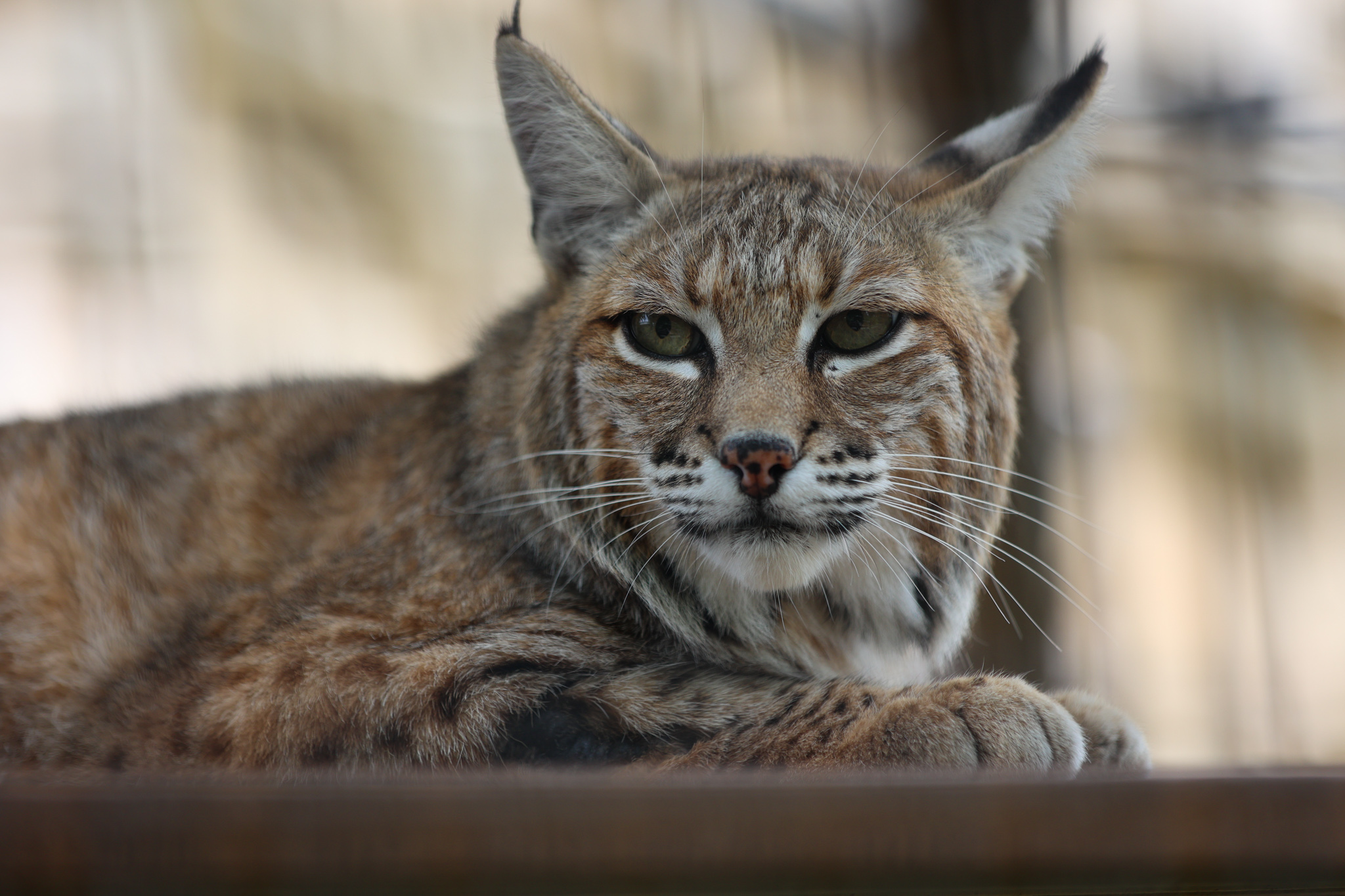
Identification tip: The short tail is the strongest clue. A bobcat is much larger and more muscular than a house cat but lacks the cougar’s long tail. Observe from a distance and use several clues together, including tail length, body proportions, track shape, location, and the original photo or video sequence.
2. Cougar
Scientific name: Puma concolor
Status in Michigan: Very rare but confirmed; reproduction verified in the Upper Peninsula.

The cougar has a large, uniformly tawny body, a small rounded head, powerful hindquarters, and a very long tail with a darker tip. It is secretive, wide-ranging, and generally avoidant of people; dispersing animals can travel hundreds of miles and feeds on primarily deer, with smaller mammals and other available prey also taken. Michigan has documented repeated cougar evidence, and in 2025 the state verified cougar cubs in the Upper Peninsula for the first time in more than a century.
Identification tip: A genuine cougar has a tail nearly as long as the body and a plain tawny coat. Bobcats, coyotes, deer, and large house cats are frequent sources of mistaken reports. Observe from a distance and use several clues together, including tail length, body proportions, track shape, location, and the original photo or video sequence.
3. Canada Lynx
Scientific name: Lynx canadensis
Status in Michigan: Extremely rare disperser; no known breeding population.
The canada lynx has very large snow-adapted paws, long black ear tufts, long hind legs, a gray-brown coat, and a short tail with a fully black tip. It is closely associated with northern forest and snowshoe hare cycles; individuals are elusive and can disperse beyond core range and feeds on mainly snowshoe hares, supplemented by grouse, squirrels, and other small prey. Canada lynx may occasionally reach Michigan, mainly the Upper Peninsula. Verified records are infrequent and there is no indication of a modern breeding population.
Identification tip: Compared with a bobcat, a Canada lynx has larger feet, longer legs, more obvious ear tufts, and a tail tip that appears black all the way around. Observe from a distance and use several clues together, including tail length, body proportions, track shape, location, and the original photo or video sequence.
How Are These Wild Cats Classified?
All of these animals belong to the family Felidae, but they are not interchangeable. Bobcats and Canada lynx belong to the genus Lynx. Cougars belong to the genus Puma. “Panther” is a regional common name rather than a separate North American species, and a feral domestic cat remains Felis catus.
Where Do Wild Cats Live in Michigan?
Michigan offers northern hardwoods, boreal forest, cedar swamps, rocky ridges, snowshoe-hare habitat, and extensive remote country. Bobcats are the regular resident. Cougars remain scarce and concentrated in confirmed reports from the Upper Peninsula, while Canada lynx is an exceptional visitor rather than a dependable sighting.
How to Identify Wild Cats in Michigan
- Check the tail: short on a bobcat or lynx, very long on a cougar.
- Check the pattern: bobcats often show spots or bars; adult cougars are usually plain tawny.
- Check body proportions: a cougar has a long body and powerful hindquarters; a lynx appears high-legged with oversized feet.
- Check the track: feline tracks are rounded and usually lack claw marks.
- Check scale: compare the animal with vegetation, fencing, road width, or a measured object.
- Check the evidence sequence: multiple trail-camera frames are more useful than one blurred image.
- Check official status: a possible sighting does not automatically prove a resident breeding population.
Outdoor Tips for Finding and Observing These Species
- Look for tracks along muddy roads, creek crossings, sandy banks, game trails, and field edges.
- Use trail cameras without bait where wildlife naturally travels.
- Avoid den sites, kittens, carcasses, and animals that appear injured or cornered.
- Keep exact locations private when disclosure could cause harassment or illegal pursuit.
- Record date, time, coordinates, weather, scale, and direction of travel.
- Never imitate prey sounds or approach a cat to obtain a closer photograph.
Safety, Legal, and Conservation Notes
Michigan’s wild-cat picture changed meaningfully in 2025 when cougar reproduction was verified. That event does not mean cougars are common, and Canada lynx remains far rarer than bobcats.
Keep pets supervised, secure poultry and animal feed, and never intentionally feed wild predators. Regulations, seasons, and protected-species rules can change, so consult the current state wildlife agency guidance before taking any action. When a large cat is seen, document it from a safe distance and give the animal room to leave.
Fun Facts About Wild Cats in Michigan
- Bobcats can live surprisingly close to people while remaining rarely seen.
- A bobcat’s common name comes from its naturally shortened tail.
- Feline tracks usually appear rounder than canine tracks.
- Cougars have more common names than almost any other North American mammal.
- Young male cougars can disperse across several states.
- Wild cats rely heavily on hearing and low-light vision.
- Bobcats can swim when necessary.
- Ear tufts alone do not prove an animal is a Canada lynx.
- A single transient cougar does not establish a breeding population.
- Healthy predator habitat usually supports many prey and plant species as well.
Final Thoughts on Types of Wild Cats in Michigan
The factual list of types of wild cats in michigan is much shorter than many online lists suggest. The bobcat is the dependable resident, while the status of larger or more northern cats must be described carefully. Reliable identification depends on tail length, body shape, tracks, scale, high-quality evidence, and current information from wildlife professionals.
Frequently Asked Questions
1. How many wild cat species are associated with Michigan?
Michigan has 3 wild-cat species that are relevant to a factual state guide: Bobcat, Cougar and Canada Lynx. Their status ranges from established resident to rare visitor or historically native species.
2. What is the most common wild cat in Michigan?
The bobcat is the regular resident wild cat. It is widespread, adaptable, and much more likely to be recorded than any larger cat.
3. Are bobcats found throughout Michigan?
Bobcats occur across much of the state wherever suitable cover, prey, and relatively undisturbed travel routes are available. Local abundance varies with habitat.
4. Are mountain lions and cougars the same animal?
Yes. Mountain lion, cougar, puma, catamount, and panther are common names for Puma concolor.
5. Does Michigan have black panthers?
There is no recognized native North American species called a black panther. Reports usually involve poor lighting, distance, domestic cats, bobcats, bears, or other mistaken identities.
6. How can I tell a bobcat from a house cat?
A bobcat has a muscular build, longer legs, a broad face with a ruff, and a short tail. Large domestic cats usually have a long tail and a more lightly built frame.
7. How can I tell a bobcat from a cougar?
A bobcat is smaller, often spotted, and has a short tail. A cougar is much larger, mostly plain tawny, and has a long tail nearly as long as its body.
8. What do bobcats eat in Michigan?
Their diet commonly includes rabbits, rodents, squirrels, birds, and other small animals. They may also take reptiles, carrion, or larger prey when an opportunity arises.
9. Are bobcats dangerous to people?
Bobcats normally avoid people, and attacks are exceptionally uncommon. Never corner, feed, touch, or approach a wild cat, especially one behaving abnormally.
10. What should I do if I see a bobcat?
Stay calm, keep your distance, bring pets and children close, and allow the cat an escape route. A brief sighting does not usually require intervention.
11. What should I do if I see a cougar?
Do not run. Face the animal, stand upright, make yourself look larger, speak firmly, keep children close, and back away slowly while leaving the cat an exit route.
12. Should I report a wild cat sighting?
Report unusual or convincing cougar or lynx evidence to the state wildlife agency. Clear photographs, tracks with scale, location, date, and original trail-camera files are more useful than a verbal description alone.
13. What do bobcat tracks look like?
Bobcat tracks are rounded and usually show four toes with no obvious claw marks. The heel pad has multiple lobes, helping distinguish a feline track from a canine print.
14. Why are claw marks often absent in cat tracks?
Cats normally retract their claws while walking. Claw marks may appear during running, climbing, slipping, or on certain soft surfaces.
15. Do bobcats have short tails?
Yes. The tail is naturally short and often shows dark markings near the tip with lighter fur beneath.
16. Can bobcats climb trees?
Yes. Bobcats are capable climbers and may use trees to escape danger, rest, or investigate prey.
17. Are wild cats active during the day?
They can be, but bobcats and cougars are often most active around dawn, dusk, and night. Weather, prey activity, season, and human disturbance affect movement.
18. Will a bobcat attack a dog or cat?
Bobcats generally avoid conflict, but small unattended pets can be vulnerable to many predators. Supervise pets, especially at night and near dense cover.
19. How can I reduce wild-cat conflicts near my home?
Do not feed wildlife, secure poultry, remove outdoor pet food, control rodents, use sturdy enclosures, trim hiding cover near animal pens, and supervise small pets.
20. Do wild cats live in suburbs?
Bobcats can travel through suburban greenways, creek corridors, golf courses, and undeveloped parcels. They usually remain hidden and avoid close contact.
21. Are feral domestic cats considered wild cats?
Feral cats are domestic cats living without regular human care. They are not native wild-cat species and should not be counted as bobcats, cougars, or lynx.
22. Can coyotes be mistaken for cougars?
Yes. Distance, low light, and a partially hidden tail can make coyotes, deer, dogs, and other animals look catlike in a brief observation.
23. Can a bobcat be completely black?
Very dark bobcats are exceptionally unusual. Most apparently black sightings are caused by shadow, wet fur, distance, or mistaken identification.
24. Do bobcats make screaming sounds?
Bobcats can hiss, growl, yowl, and make sharp mating calls. Many foxes, domestic cats, and other animals also produce screams, so sound alone cannot confirm a species.
25. When do bobcats have kittens?
Timing varies by latitude and individual, but mating often occurs in winter or early spring and kittens are commonly born after a gestation of roughly two months.
26. How large is a bobcat territory?
Home-range size varies widely with sex, prey, habitat, season, and population density. Males generally use larger areas than females.
27. Are wild cats protected in Michigan?
Legal status differs by species and can change. Bobcat seasons may be regulated, while cougars or lynx may receive strong protection. Always check current state rules.
28. Is it legal to keep a wild cat as a pet?
Possession of native wildlife and large exotic cats is tightly regulated and often prohibited without permits. Wild cats also have complex welfare and public-safety needs.
29. Why are wild cats important to ecosystems?
They help regulate prey populations and contribute to natural food webs. Protecting connected habitat also benefits many other wildlife species.
30. What is the best way to photograph a wild cat?
Use a telephoto lens or a fixed trail camera, remain far away, avoid baiting or blocking its route, and never approach a den or kittens.