

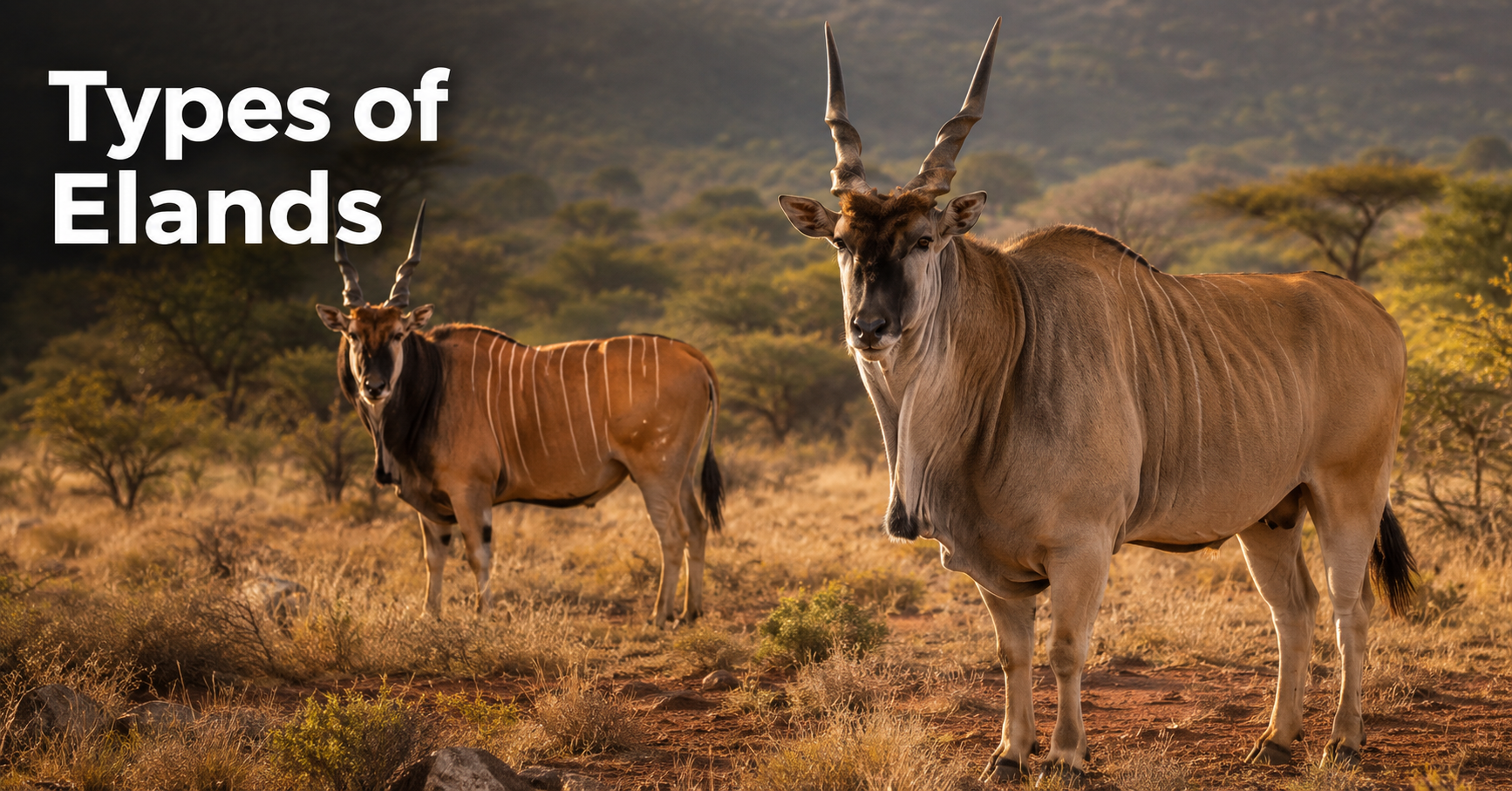
There are two recognized types of elands: the common eland and the giant eland. Both are enormous spiral-horned antelopes native to Africa, but they differ in distribution, markings, habitat preferences, and conservation needs. This guide explains how to identify each species, where elands live, what they eat, how they behave, and what wildlife watchers should know before observing them in the field.
What Are the Main Types of Elands?
The two living eland species are the common eland and the giant eland. The common eland occurs mainly across eastern and southern Africa, while the giant eland has a much more northerly and fragmented distribution in western and central Africa. Both species belong to the spiral-horned antelope group and have horns in males and females.
| Type | Scientific Name | Main Range | Key Identification Feature | Conservation Status |
|---|---|---|---|---|
| Common eland | Tragelaphus oryx | Eastern and southern Africa | Tawny or gray coat with variable or absent body stripes | Least Concern |
| Giant eland | Tragelaphus derbianus | Western and central Africa | Strong white body stripes and dark markings on the neck and legs | Vulnerable |
Note: Many field guides use the older genus name Taurotragus, producing the scientific names Taurotragus oryx and Taurotragus derbianus. Modern mammal classifications increasingly place both species in the genus Tragelaphus, with Taurotragus treated as a subgenus. Both naming systems may therefore appear in wildlife literature.
1. Common Eland
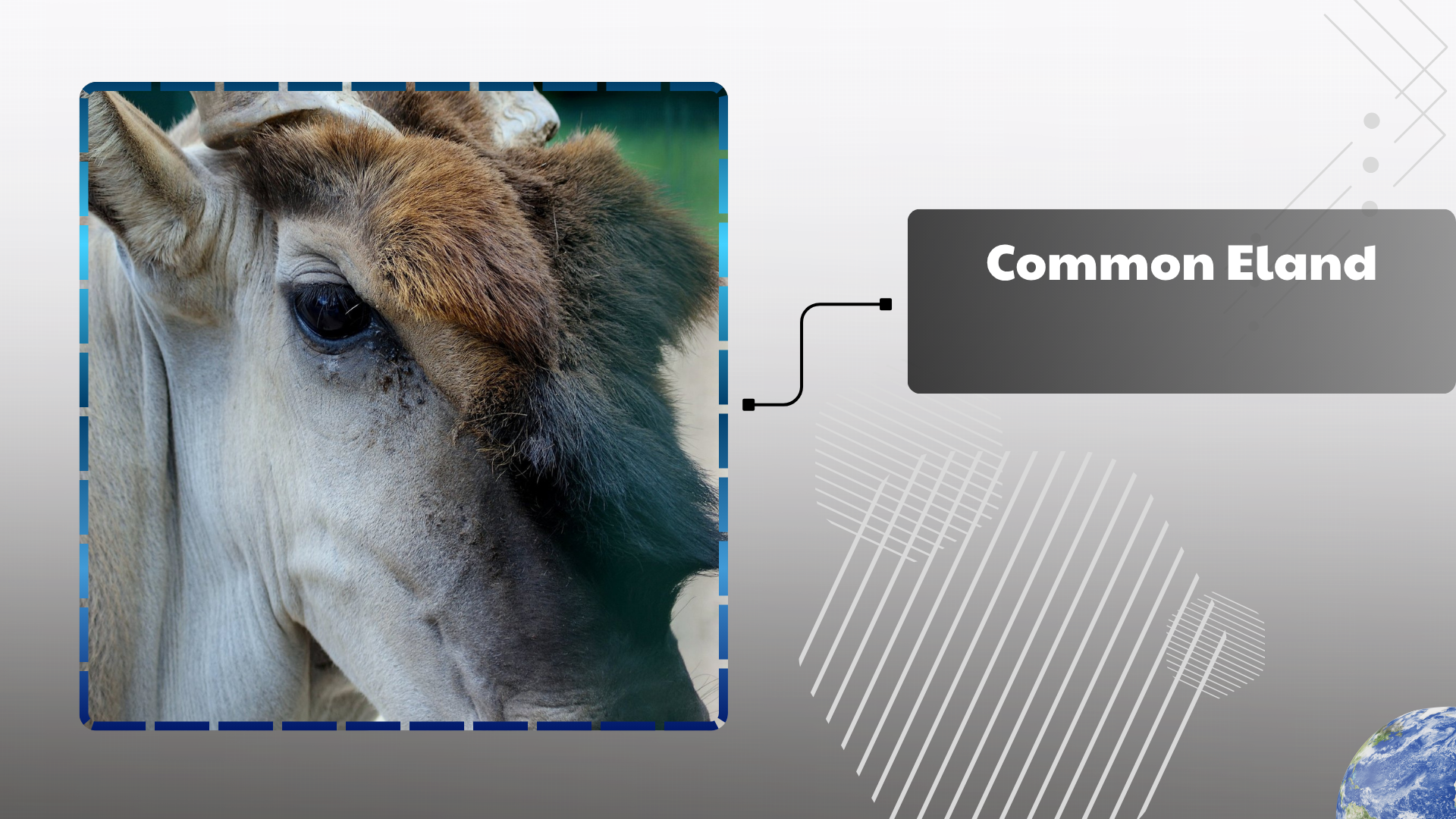
The common eland, also called the southern eland, is the more widespread of the two types of elands. Its scientific name is Tragelaphus oryx, although Taurotragus oryx remains common in field guides and zoo displays. It ranges through large parts of eastern and southern Africa, including Kenya, Tanzania, Uganda, Zambia, Zimbabwe, Botswana, Namibia, and South Africa.
Common elands have massive bodies, long legs, sloping backs, large dewlaps, and tightly spiraled horns. Both sexes carry horns, but bulls generally have heavier horn bases, broader foreheads, and more muscular necks. Females are usually tawny or light brown. Mature males commonly become gray, blue-gray, or dark brown with age.
Body stripes vary considerably. East African and Livingstone’s elands may have several narrow white stripes along their sides, while many adult Cape elands have faint stripes or none at all. This geographic variation explains why coat pattern alone should not be used to identify an eland species.
Common elands inhabit savannas, open woodlands, shrublands, grasslands, and semi-arid country. They generally avoid dense forests, true deserts, and permanently waterlogged habitats. Their movements frequently follow seasonal plant growth, rainfall, and access to nutritious browse.
These elands are mixed feeders. They browse leaves, shoots, herbs, fruits, and seedpods, but they also graze when fresh grass is available. They can obtain considerable moisture from vegetation, although they drink when reliable water is accessible.
Common elands are social but do not maintain rigid, permanent herds. Females and young may gather in larger groups, while mature bulls often travel alone or in small bachelor groups. Temporary aggregations can become much larger when food is abundant. Although they look heavy and cattle-like, common elands can run quickly, maintain a steady trot, and clear surprisingly high obstacles.
Three geographic forms have traditionally been described: Cape eland, Livingstone’s eland, and East African or Patterson’s eland. However, authorities do not universally agree on the validity or boundaries of all three subspecies. For most wildlife watchers, it is more accurate to identify the animal first as a common eland and then describe its regional coat pattern.
2. Giant Eland
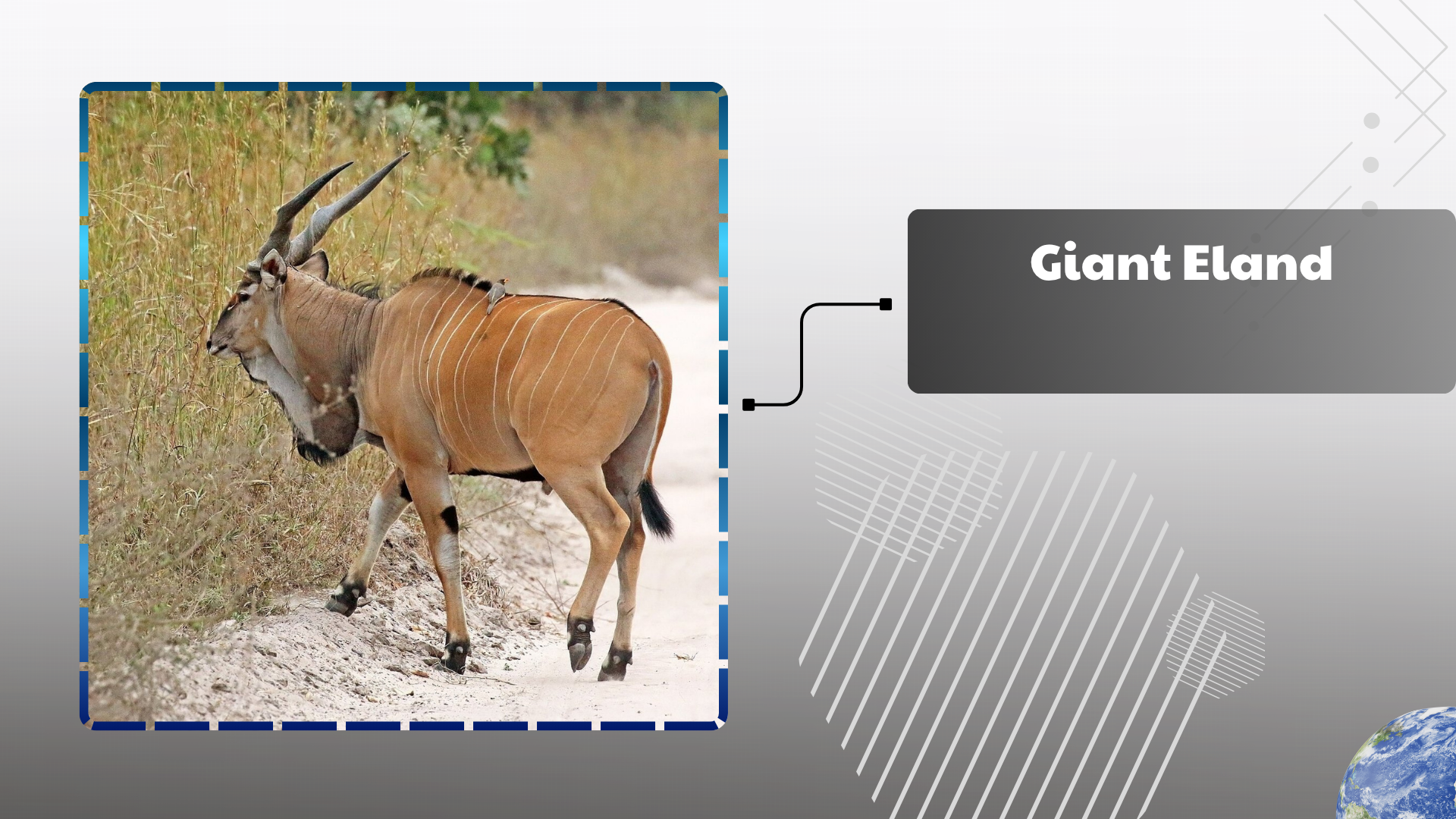
The giant eland, Tragelaphus derbianus, is also known as Lord Derby’s eland or the Derby eland. Older references commonly list it as Taurotragus derbianus. It is generally considered the largest living antelope species, although its size overlaps considerably with that of exceptionally large common eland bulls.
Giant elands are tall, powerful antelopes with reddish-brown to sandy coats. They normally display multiple clear vertical white stripes along the body. Dark facial markings, black areas on the lower legs, a dark neck, and a prominent dewlap give mature animals a strongly patterned appearance. Both males and females have spiraled horns, but the horns of mature bulls are thicker and more widely spread.
This species lives in open woodland, wooded savanna, forest clearings, and areas where grassland meets scattered trees and shrubs. Its range is divided into western and central African populations. Giant elands have historically occurred from Senegal and neighboring parts of West Africa eastward through portions of Cameroon, the Central African Republic, South Sudan, and nearby regions. Their modern distribution is much smaller and more fragmented.
Giant elands feed on grasses, leaves, young branches, herbs, fruits, and other plant material. Their diet changes with season and habitat. Browsing becomes especially important when grasses dry out or lose nutritional value.
They commonly form small or moderately sized herds, although group size can change as animals move between feeding areas. Giant elands are usually cautious and difficult to approach. When alarmed, they may trot away before accelerating into a rapid run. Their striped coats help break up their outlines among woodland shadows, branches, and tall vegetation.
Two regional forms are traditionally discussed: the western giant eland and the eastern giant eland. The western form is associated especially with Senegal and nearby areas, while the eastern form occurs mainly in central Africa. Taxonomic treatment varies, and some modern databases do not recognize both as formally valid subspecies. Their geographic separation remains highly important for conservation.
The giant eland is more threatened than the common eland. Habitat loss, fragmentation, illegal hunting, livestock expansion, insecurity in parts of its range, and isolation of remaining populations all create serious challenges. Protecting large connected landscapes is essential because these animals need room to move between seasonal feeding and watering areas.
How Are These Types of Elands Classified?
Elands are hoofed, ruminant mammals in the family Bovidae. This family also includes cattle, buffalo, sheep, goats, gazelles, and many other antelopes. Within Bovidae, elands belong to the tribe Tragelaphini, the spiral-horned antelopes.
| Classification Level | Group |
|---|---|
| Kingdom | Animalia |
| Class | Mammalia |
| Order | Artiodactyla |
| Family | Bovidae |
| Subfamily | Bovinae |
| Tribe | Tragelaphini |
| Genus | Tragelaphus |
| Species | T. oryx and T. derbianus |
The spiral-horned antelope group also contains kudus, bongos, nyalas, bushbucks, and sitatungas. Members of this group commonly have twisting horns, striped or spotted coats, large ears, and adaptations for browsing among shrubs or woodlands.
Elands were traditionally separated into the genus Taurotragus. Genetic research has shown that they are closely embedded within the broader Tragelaphus lineage. As a result, modern authorities may use Tragelaphus as the genus and retain Taurotragus only as a subgenus.
Common Eland vs. Giant Eland
| Feature | Common Eland | Giant Eland |
|---|---|---|
| Scientific name | Tragelaphus oryx | Tragelaphus derbianus |
| Alternative genus | Taurotragus oryx | Taurotragus derbianus |
| General distribution | Eastern and southern Africa | Western and central Africa |
| Body stripes | Variable, faint, or absent | Usually numerous and conspicuous |
| Typical coat | Tawny, gray, or blue-gray | Reddish, chestnut, or sandy brown |
| Preferred habitat | Open savanna, grassland, and woodland | Wooded savanna, open forest, and clearings |
| Overall abundance | Relatively widespread | Scarce and fragmented |
| Main conservation concern | Local habitat loss and hunting pressure | Range loss, fragmentation, and small isolated populations |
Where Do These Wild Animals Live?
Elands are native to sub-Saharan Africa, but the two species occupy different broad regions. Common elands live mainly in the east and south, whereas giant elands occur farther north in western and central Africa.
Common elands use open environments with a mixture of grass and browse. They may be seen on broad savannas, lightly wooded plains, scrubland, foothills, and open montane grasslands. Seasonal movement allows them to follow rain, fresh grass, flowering plants, and leafy shrubs.
Giant elands are more closely associated with wooded savanna and open forest mosaics. They benefit from landscapes containing both cover and productive feeding areas. Permanent conversion of these habitats into farmland can isolate herds and block movement routes.
Neither species is adapted to thick tropical rainforest. Elands are also generally absent from the most waterlogged wetlands and the driest parts of true deserts. They perform best in varied landscapes where grasses, herbs, trees, and shrubs are available within traveling distance.
How to Identify Different Types of Elands
- Body shape: Look for a very large, cattle-like antelope with long legs, a sloping back, and a heavy chest.
- Horns: Both sexes have permanent horns with a strong spiral twist.
- Dewlap: Mature elands have loose skin hanging beneath the neck, especially adult males.
- Body stripes: Strong, numerous white stripes generally suggest a giant eland, but some common elands are also striped.
- Coat color: Common eland bulls often become gray or blue-gray, while giant elands are commonly reddish or sandy with darker markings.
- Leg markings: Giant elands usually have more conspicuous dark areas around the lower legs.
- Location: Geographic range is one of the most reliable identification clues.
- Habitat: Common elands frequently enter open plains, while giant elands are often associated with wooded savanna and forest edges.
- Sex: Bulls are larger and heavier, with thicker horn bases and more developed dewlaps.
- Age: Older males commonly have darker coats, larger dewlaps, and heavier forequarters than younger animals.
Outdoor Tips for Finding and Observing Elands
- Search during early morning or late afternoon, when elands are more likely to feed and move in the open.
- Scan the edges of woodland, shrubland, and grassy clearings rather than concentrating only on open plains.
- Use binoculars to check horn shape, stripe pattern, leg markings, and body color from a safe distance.
- Look for fresh tracks around water sources, game trails, salt-rich soils, and productive browsing areas.
- Remain quiet and avoid approaching directly, especially when observing a herd with calves.
- Do not block an animal’s path to water, shade, feeding areas, or the rest of its herd.
- Stay inside authorized vehicles where local park rules require it.
- Use an experienced local guide when searching for giant elands because their populations are scattered and difficult to locate.
- Avoid sharing precise locations of vulnerable animals publicly if doing so could increase disturbance or illegal hunting risk.
- Never imitate alarm calls or pressure animals into running for a photograph.
Safety, Sustainability, and Conservation Notes
Elands are generally shy rather than aggressive, but they are extremely large wild animals. A frightened or cornered bull can be dangerous. Wildlife watchers should maintain a respectful distance, follow park regulations, and allow animals an unobstructed escape route.
The common eland is widely classified as Least Concern at the species level, but this does not mean every population is secure. Agricultural expansion, fences, habitat fragmentation, excessive hunting, and competition with livestock can cause local declines.
The giant eland is classified as Vulnerable and has disappeared from parts of its former range. Some remaining populations are small and geographically isolated. Western giant elands are particularly restricted, making well-managed protected areas and community conservation programs critically important.
Effective eland conservation requires more than protecting individual animals. Large connected habitats, responsible tourism, anti-poaching work, cooperation with local communities, and carefully planned livestock management help maintain viable populations and seasonal movement routes.
Fun Facts About Elands
- Elands are the largest members of the antelope family.
- Both male and female elands grow spiraled horns.
- The horns continue growing rather than being shed annually.
- Despite their size, elands can jump remarkably high.
- They can maintain a steady trot over long distances.
- Mature males sometimes produce clicking sounds while walking, although the exact source and function have been debated.
- Elands are ruminants and digest vegetation through a multi-chambered stomach.
- They switch between grazing and browsing as food availability changes.
- The name “eland” came through Afrikaans and Dutch usage.
- Giant elands are named partly for their impressive size and horns, but their body size overlaps with that of large common elands.
Final Thoughts on Types of Elands
There are only two true types of elands: the common eland and the giant eland. The common species is widespread across eastern and southern Africa and has highly variable markings. The giant eland lives in more restricted parts of western and central Africa and usually displays stronger stripes and darker markings. Learning to compare range, habitat, coat pattern, horn shape, and body color makes identification much easier. Responsible observation and habitat protection will help future generations continue encountering these extraordinary African antelopes.
Frequently Asked Questions
1. How many types of elands are there?
There are two living species of elands: the common eland and the giant eland. Regional populations have also been divided into subspecies, but the recognition of some subspecies varies among taxonomic authorities.
2. What are the two species of eland?
The two species are the common eland, Tragelaphus oryx, and the giant eland, Tragelaphus derbianus. They may also be listed under the older genus name Taurotragus.
3. What is the largest type of eland?
The giant eland is generally recognized as the largest eland and the largest living antelope species. However, its size overlaps with that of the biggest common eland bulls.
4. Is a common eland smaller than a giant eland?
On average, the giant eland is usually treated as the larger species. Individual size varies, so a large common eland bull may be heavier than a smaller or younger giant eland.
5. Are elands antelopes or cattle?
Elands are antelopes in the family Bovidae. Their massive bodies and heavy shoulders can resemble cattle, but they belong to the African spiral-horned antelope group.
6. Where are common elands found?
Common elands occur across parts of eastern and southern Africa. Their range includes savannas, grasslands, shrublands, and open woodlands in countries such as Kenya, Tanzania, Botswana, Namibia, Zimbabwe, and South Africa.
7. Where are giant elands found?
Giant elands survive in scattered areas of western and central Africa. Important populations are associated with Senegal, Cameroon, the Central African Republic, and neighboring regions.
8. Do common and giant elands live together?
Their modern core ranges are largely separate. Common elands dominate eastern and southern Africa, while giant elands occur farther north in western and central Africa.
9. What habitat do elands prefer?
Elands prefer habitats offering both grass and browse. Common elands frequently use open savanna and grassland, while giant elands are more strongly associated with wooded savanna, open forest, and forest clearings.
10. Do elands live in forests?
Giant elands may inhabit open forests and woodland edges, but elands generally avoid dense, closed-canopy rainforest. They require openings and mixed vegetation for feeding and movement.
11. What do elands eat?
Elands eat grasses, leaves, herbs, shoots, fruits, seedpods, and small branches. Their diet changes seasonally, making them flexible mixed feeders rather than strict grazers.
12. Do elands need to drink water every day?
Elands can obtain moisture from succulent plants and may tolerate dry conditions for extended periods. They still drink when water is available, particularly during hot or dry weather.
13. Do both male and female elands have horns?
Yes. Males and females of both eland species grow spiral horns. Male horns tend to be thicker and heavier, while female horns are often more slender.
14. Do elands shed their horns?
No. Eland horns are permanent structures with a bony core and keratin covering. Unlike deer antlers, they are not shed and regrown each year.
15. How can you identify a male eland?
Adult males are generally larger and more muscular than females. They often have thicker horn bases, a heavier dewlap, a broad forehead, and a darker or grayer coat.
16. How can you distinguish a giant eland from a common eland?
Check the animal’s location first. Giant elands usually have clearer white body stripes, stronger dark leg markings, and a reddish or sandy coat. Common elands vary more and may have weak stripes or no visible stripes.
17. Are all striped elands giant elands?
No. East African and Livingstone’s forms of the common eland may also have white body stripes. Range, coat color, leg markings, and overall appearance should be considered together.
18. Why do some common elands have no stripes?
Stripe visibility varies with regional ancestry, age, sex, and individual variation. Cape elands often have faint stripes or lose visible striping as they mature.
19. What is a Cape eland?
Cape eland is a traditional name for the southern form of the common eland. It is associated with southern and southwestern Africa and commonly has a relatively plain tawny or gray coat.
20. What is Livingstone’s eland?
Livingstone’s eland is a traditionally recognized regional form of the common eland in south-central Africa. It commonly has a brownish coat with visible vertical stripes.
21. What is Patterson’s eland?
Patterson’s eland, also called the East African eland, is a regional form associated with eastern Africa. Its formal subspecies status is not accepted consistently by every modern authority.
22. What is a western giant eland?
The western giant eland is the western regional form traditionally called Tragelaphus derbianus derbianus. Its remaining wild distribution is extremely restricted and centered especially in Senegal.
23. What is an eastern giant eland?
The eastern giant eland is the central African regional form traditionally called Tragelaphus derbianus gigas. It is associated with areas such as northern Cameroon and the Central African Republic.
24. Why do eland scientific names vary?
Older classifications placed elands in the genus Taurotragus. Many modern mammal authorities include them in Tragelaphus based on their evolutionary relationship with other spiral-horned antelopes.
25. Are elands related to kudus?
Yes. Elands and kudus belong to the tribe Tragelaphini. This group also includes bongos, nyalas, bushbucks, and sitatungas.
26. How fast can an eland run?
Elands can accelerate rapidly and have often been reported reaching approximately 40 miles per hour, or around 65 kilometers per hour, over short distances. They also rely on endurance and a steady trot.
27. Can elands jump?
Yes. Elands are powerful jumpers despite their heavy bodies. Young and athletic individuals can clear surprisingly high fences or obstacles from a near-standing position.
28. Do elands live in herds?
Yes, but herd structure is flexible. Females and calves often form groups, younger males may gather in bachelor herds, and mature bulls may become more solitary.
29. What animals hunt elands?
Lions are important predators of adult elands. Hyenas, African wild dogs, leopards, and other large predators may attack calves, juveniles, or weakened individuals.
30. Are elands dangerous to humans?
Elands usually avoid people, but their size, horns, and strength make them potentially dangerous when cornered, injured, or frightened. They should always be observed from a respectful distance.
31. Are common elands endangered?
The common eland is classified as Least Concern at the species level. Nevertheless, some local populations face pressure from habitat conversion, fences, illegal hunting, and disrupted movement routes.
32. Are giant elands endangered?
The giant eland is classified as Vulnerable. Its limited, fragmented distribution and continuing threats make it a much greater conservation concern than the common eland.
33. What is the biggest threat to giant elands?
Major threats include habitat loss, fragmentation, illegal hunting, livestock expansion, and the isolation of small populations. Instability in some parts of their range can also complicate conservation work.
34. What time of day are elands most active?
Elands commonly feed during the cooler hours of morning and late afternoon. They may rest in shade during the hottest part of the day, although activity changes with weather and disturbance.
35. What is the best way to observe wild elands?
Use binoculars from a vehicle, viewing area, or other safe position. Move quietly, avoid separating herd members, and follow all instructions provided by park staff or local wildlife guides.
36. Why are elands important to their ecosystems?
Elands influence vegetation through grazing and browsing. They also move seeds, recycle nutrients through dung, create prey opportunities for large carnivores, and contribute to the ecological diversity of African savannas and woodlands.
READ MORE:
Types of Duikers: Species, Habitats, and Identification