

The common phrase types of wild cherry trees does not refer to one narrow scientific group. It includes many naturally occurring species in the genus Prunus, from tall forest trees to evergreen small trees and woody shrubs commonly called cherries, bird cherries, chokecherries, or laurel cherries.
This guide focuses on 30 real species from North America, Europe, Asia, and Africa. It emphasizes identification, native range, habitat, wildlife value, and safety. Cultivated orchard varieties such as Bing and Rainier are excluded because they are selections of a species rather than separate wild species.
What Are the Main Types of Wild Cherry Trees?
The best-known wild cherries include European wild sweet cherry, North American black cherry, chokecherry, pin cherry, bitter cherry, and Eurasian bird cherry. Asia supports a particularly rich diversity of wild flowering cherries, while several evergreen species occur in warm temperate and subtropical regions. Some entries are naturally shrubs or small trees, but all belong to the practical wild-cherry group used by botanists, foresters, gardeners, and wildlife observers.
Quick Comparison of Wild Cherry Trees
| No. | Common Name | Scientific Name | Native Range | Growth Form / Key Feature |
|---|---|---|---|---|
| 1 | Wild Sweet Cherry | Prunus avium | Europe and western Asia; naturalized elsewhere | Large deciduous tree with shiny bark, white spring flowers, and red to black cherries |
| 2 | Black Cherry | Prunus serotina | Eastern and central North America; introduced elsewhere | Tall tree with dark scaly bark, narrow flower clusters, and small dark fruits |
| 3 | Chokecherry | Prunus virginiana | North America | Multi-stemmed shrub or small tree with racemes of white flowers and dark red fruit |
| 4 | Pin Cherry | Prunus pensylvanica | Northern North America | Slender small tree with smooth reddish bark and bright red cherries |
| 5 | Bitter Cherry | Prunus emarginata | Western North America | Small tree or shrub with white flowers and small red or dark fruit |
| 6 | European Bird Cherry | Prunus padus | Europe and northern Asia | Tree with fragrant white flower racemes followed by small black fruits |
| 7 | Amur Chokecherry | Prunus maackii | Northeastern Asia | Medium tree with glossy coppery or amber peeling bark and white flower clusters |
| 8 | Japanese Bird Cherry | Prunus grayana | Japan and nearby parts of East Asia | Deciduous tree with long white flower racemes and dark fruits |
| 9 | Hokkaido Bird Cherry | Prunus ssiori | Japan, Sakhalin, and nearby northeastern Asia | Forest tree with white racemes and dark drupes |
| 10 | Miyama Cherry | Prunus maximowiczii | Northeast Asia and Japan | Small tree with clusters of white flowers and red to black fruit |
| 11 | Japanese Mountain Cherry | Prunus jamasakura | Japan | Medium tree with pale pink or white flowers opening with coppery young leaves |
| 12 | Oshima Cherry | Prunus speciosa | Izu Islands and nearby Japan | Broad-crowned tree with large white flowers and aromatic leaves |
| 13 | Japanese Flowering Cherry | Prunus serrulata | East Asia | Small to medium tree with serrated leaves and pink or white flowers |
| 14 | Fuji Cherry | Prunus incisa | Japan | Shrub or small tree with finely toothed leaves and pale spring flowers |
| 15 | Japanese Alpine Cherry | Prunus nipponica | Japan and nearby islands | Compact tree or shrub with white to pale pink flowers |
| 16 | Kasumi Cherry | Prunus verecunda | Japan and nearby East Asia | Deciduous tree with pale flowers and softly colored young leaves |
| 17 | Clove Cherry | Prunus apetala | Japan | Small tree with delicate pale flowers and toothed leaves |
| 18 | Taiwan Cherry | Prunus campanulata | Taiwan and southern China | Small tree with deep pink, bell-shaped flowers |
| 19 | Wild Himalayan Cherry | Prunus cerasoides | Himalayas and parts of South and Southeast Asia | Medium tree with pink to white blossoms that may appear in cool dry seasons |
| 20 | Himalayan Bird Cherry | Prunus cornuta | Himalayas and western China | Tree with elongated clusters of pale flowers and dark fruits |
| 21 | Gray-Leaf Cherry | Prunus canescens | China | Small tree or shrub with grayish leaf undersides and pale flowers |
| 22 | European Dwarf Cherry | Prunus fruticosa | Europe and western Asia | Low thicket-forming shrub with white flowers and red cherries |
| 23 | Mahaleb Cherry | Prunus mahaleb | Europe, western Asia, and North Africa | Small aromatic tree with white flower clusters and small black cherries |
| 24 | Mountain Cherry | Prunus prostrata | Southern Europe, North Africa, and western Asia | Low spreading shrub with pink flowers and small red fruit |
| 25 | African Cherry | Prunus africana | Mountain forests of sub-Saharan Africa and nearby islands | Large evergreen tree with dark bark, glossy leaves, and small fruits |
| 26 | Carolina Laurelcherry | Prunus caroliniana | Southeastern United States | Evergreen tree with glossy leaves, white flower clusters, and black fruits |
| 27 | Hollyleaf Cherry | Prunus ilicifolia | California and northern Baja California | Evergreen shrub or small tree with stiff holly-like leaves and dark fruit |
| 28 | Catalina Cherry | Prunus lyonii | California Channel Islands and nearby coastal areas | Evergreen tree with glossy leaves and dark cherries |
| 29 | Portuguese Laurel | Prunus lusitanica | Southwestern Europe and northwestern Africa | Evergreen tree with dark leaves, reddish petioles, white racemes, and black fruits |
| 30 | Cherry Laurel | Prunus laurocerasus | Southeastern Europe and western Asia | Evergreen tree or large shrub with broad glossy leaves and upright white racemes |
30 Types of Wild Cherry Trees
1. Wild Sweet Cherry
Scientific name: Prunus avium. Native range: Europe and western Asia; naturalized elsewhere. Large deciduous tree with shiny bark, white spring flowers, and red to black cherries. In the wild, look for it in forest edges, hedgerows, and well-drained fertile soils.
Identification and value: Also called gean or mazzard, this is the classic European wild cherry and a major ancestor of cultivated sweet cherries. Birds readily spread the pits. Flowers, fruit arrangement, leaf texture, bark, and growth habit should be considered together because individual traits overlap among species.
2. Black Cherry
Scientific name: Prunus serotina. Native range: Eastern and central North America; introduced elsewhere. Tall tree with dark scaly bark, narrow flower clusters, and small dark fruits. In the wild, look for it in forests, old fields, roadsides, and woodland edges.

Identification and value: Black cherry is a valuable timber and wildlife tree. Crushed twigs and bark may have an almond-like odor, but bark and wilted foliage should not be eaten. Flowers, fruit arrangement, leaf texture, bark, and growth habit should be considered together because individual traits overlap among species.
3. Chokecherry
Scientific name: Prunus virginiana. Native range: North America. Multi-stemmed shrub or small tree with racemes of white flowers and dark red fruit. In the wild, look for it in streambanks, woodland margins, thickets, and open slopes.
Identification and value: The ripe flesh is used traditionally after proper preparation, but the pits, leaves, and stems contain cyanogenic compounds and should not be consumed. Flowers, fruit arrangement, leaf texture, bark, and growth habit should be considered together because individual traits overlap among species.
4. Pin Cherry
Scientific name: Prunus pensylvanica. Native range: Northern North America. Slender small tree with smooth reddish bark and bright red cherries. In the wild, look for it in recently disturbed forests, burns, clearings, and cool slopes.
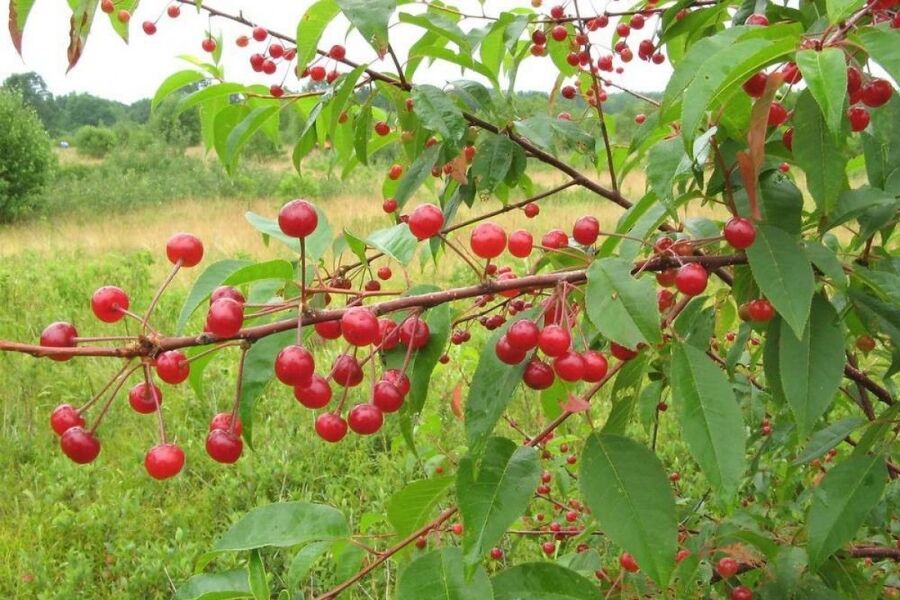
Identification and value: Pin cherry is an early-successional species that quickly colonizes open ground. Its fruit feeds birds and mammals even though it is small and tart. Flowers, fruit arrangement, leaf texture, bark, and growth habit should be considered together because individual traits overlap among species.
5. Bitter Cherry
Scientific name: Prunus emarginata. Native range: Western North America. Small tree or shrub with white flowers and small red or dark fruit. In the wild, look for it in mountain forests, moist slopes, stream edges, and disturbed ground.
Identification and value: Bitter cherry is valuable to wildlife and restoration, but its fruit is generally considered too bitter for ordinary fresh eating. Flowers, fruit arrangement, leaf texture, bark, and growth habit should be considered together because individual traits overlap among species.
6. European Bird Cherry
Scientific name: Prunus padus. Native range: Europe and northern Asia. Tree with fragrant white flower racemes followed by small black fruits. In the wild, look for it in moist woods, riverbanks, and forest margins.
Identification and value: Bird cherry is named for the many birds that eat its fruit. It often grows where soils stay cool and moist. Flowers, fruit arrangement, leaf texture, bark, and growth habit should be considered together because individual traits overlap among species.
7. Amur Chokecherry
Scientific name: Prunus maackii. Native range: Northeastern Asia. Medium tree with glossy coppery or amber peeling bark and white flower clusters. In the wild, look for it in forest margins and cool temperate woodland.
Identification and value: Its polished bark makes it recognizable even outside bloom. The species is also planted ornamentally, though wild populations occur in northeastern Asia. Flowers, fruit arrangement, leaf texture, bark, and growth habit should be considered together because individual traits overlap among species.
8. Japanese Bird Cherry
Scientific name: Prunus grayana. Native range: Japan and nearby parts of East Asia. Deciduous tree with long white flower racemes and dark fruits. In the wild, look for it in mountain forests and woodland edges.
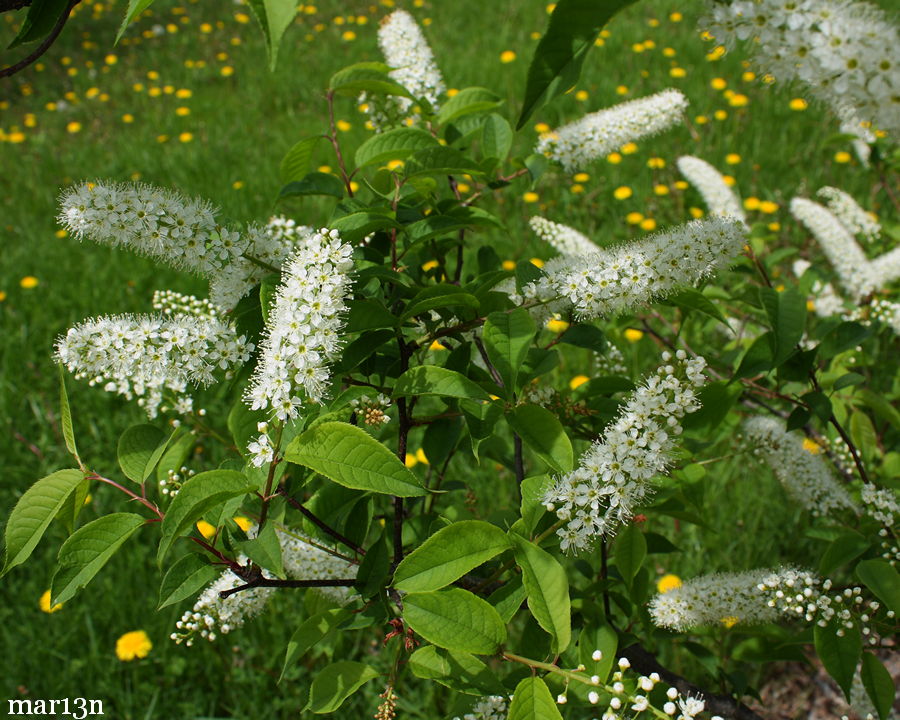
Identification and value: This bird cherry has elongated flower clusters rather than the compact umbels seen on many flowering cherries. Flowers, fruit arrangement, leaf texture, bark, and growth habit should be considered together because individual traits overlap among species.
9. Hokkaido Bird Cherry
Scientific name: Prunus ssiori. Native range: Japan, Sakhalin, and nearby northeastern Asia. Forest tree with white racemes and dark drupes. In the wild, look for it in cool mountain and northern forests.
Identification and value: The species is associated with cool, moist woodland and provides fruit for birds and other forest wildlife. Flowers, fruit arrangement, leaf texture, bark, and growth habit should be considered together because individual traits overlap among species.
10. Miyama Cherry
Scientific name: Prunus maximowiczii. Native range: Northeast Asia and Japan. Small tree with clusters of white flowers and red to black fruit. In the wild, look for it in mountain woods and forest openings.
Identification and value: Miyama cherry is a wild Asian cherry valued for spring flowers and ecological use rather than large dessert fruit. Flowers, fruit arrangement, leaf texture, bark, and growth habit should be considered together because individual traits overlap among species.

11. Japanese Mountain Cherry
Scientific name: Prunus jamasakura. Native range: Japan. Medium tree with pale pink or white flowers opening with coppery young leaves. In the wild, look for it in mountain forests and woodland edges.
Identification and value: Yamazakura is one of Japan’s best-known native wild flowering cherries. Unlike many cultivated forms, it commonly flowers as new leaves emerge. Flowers, fruit arrangement, leaf texture, bark, and growth habit should be considered together because individual traits overlap among species.
12. Oshima Cherry
Scientific name: Prunus speciosa. Native range: Izu Islands and nearby Japan. Broad-crowned tree with large white flowers and aromatic leaves. In the wild, look for it in coastal and island forests.
Identification and value: Oshima cherry contributed genetically to several ornamental cherry cultivars. Its leaves have also been used traditionally for wrapping sweets. Flowers, fruit arrangement, leaf texture, bark, and growth habit should be considered together because individual traits overlap among species.
13. Japanese Flowering Cherry
Scientific name: Prunus serrulata. Native range: East Asia. Small to medium tree with serrated leaves and pink or white flowers. In the wild, look for it in woodland margins and mountain slopes; widely cultivated.
Identification and value: The wild species should be distinguished from the many garden cultivars sold under the same name. Wild forms generally have simpler flowers than double-flowered selections. Flowers, fruit arrangement, leaf texture, bark, and growth habit should be considered together because individual traits overlap among species.
14. Fuji Cherry
Scientific name: Prunus incisa. Native range: Japan. Shrub or small tree with finely toothed leaves and pale spring flowers. In the wild, look for it in mountain slopes and rocky ground.
Identification and value: Named for its deeply incised leaf margins, Fuji cherry stays smaller than many forest cherries and has produced numerous ornamental selections. Flowers, fruit arrangement, leaf texture, bark, and growth habit should be considered together because individual traits overlap among species.
15. Japanese Alpine Cherry
Scientific name: Prunus nipponica. Native range: Japan and nearby islands. Compact tree or shrub with white to pale pink flowers. In the wild, look for it in cool subalpine and mountain habitats.
Identification and value: This cold-adapted cherry grows at higher elevations where wind, snow, and short growing seasons favor a smaller form. Flowers, fruit arrangement, leaf texture, bark, and growth habit should be considered together because individual traits overlap among species.
16. Kasumi Cherry
Scientific name: Prunus verecunda. Native range: Japan and nearby East Asia. Deciduous tree with pale flowers and softly colored young leaves. In the wild, look for it in mountain forests and woodland margins.
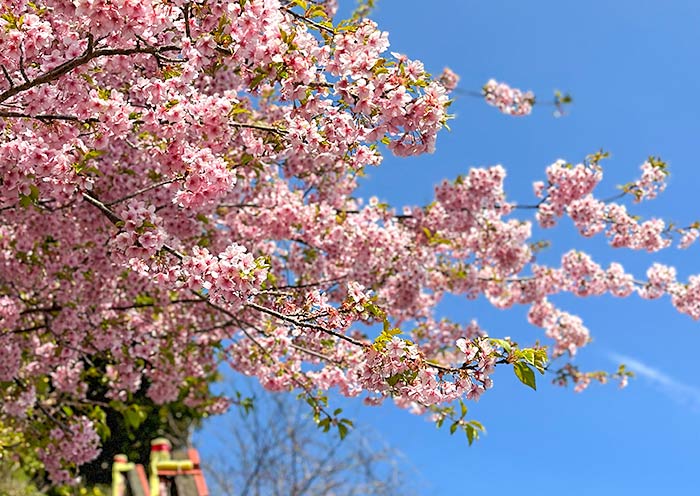
Identification and value: Kasumi cherry is a naturally occurring forest species rather than simply a named garden variety. Flowers, fruit arrangement, leaf texture, bark, and growth habit should be considered together because individual traits overlap among species.
17. Clove Cherry
Scientific name: Prunus apetala. Native range: Japan. Small tree with delicate pale flowers and toothed leaves. In the wild, look for it in mountain woodland.
Identification and value: Clove cherry is less showy than many ornamental cherries but is useful for understanding the diversity of wild Japanese Prunus. Flowers, fruit arrangement, leaf texture, bark, and growth habit should be considered together because individual traits overlap among species.
18. Taiwan Cherry
Scientific name: Prunus campanulata. Native range: Taiwan and southern China. Small tree with deep pink, bell-shaped flowers. In the wild, look for it in warm mountain forests and slopes.
Identification and value: Its strongly colored hanging flowers make Taiwan cherry easy to recognize. It blooms relatively early in mild climates. Flowers, fruit arrangement, leaf texture, bark, and growth habit should be considered together because individual traits overlap among species.
19. Wild Himalayan Cherry
Scientific name: Prunus cerasoides. Native range: Himalayas and parts of South and Southeast Asia. Medium tree with pink to white blossoms that may appear in cool dry seasons. In the wild, look for it in mountain forests and open slopes.
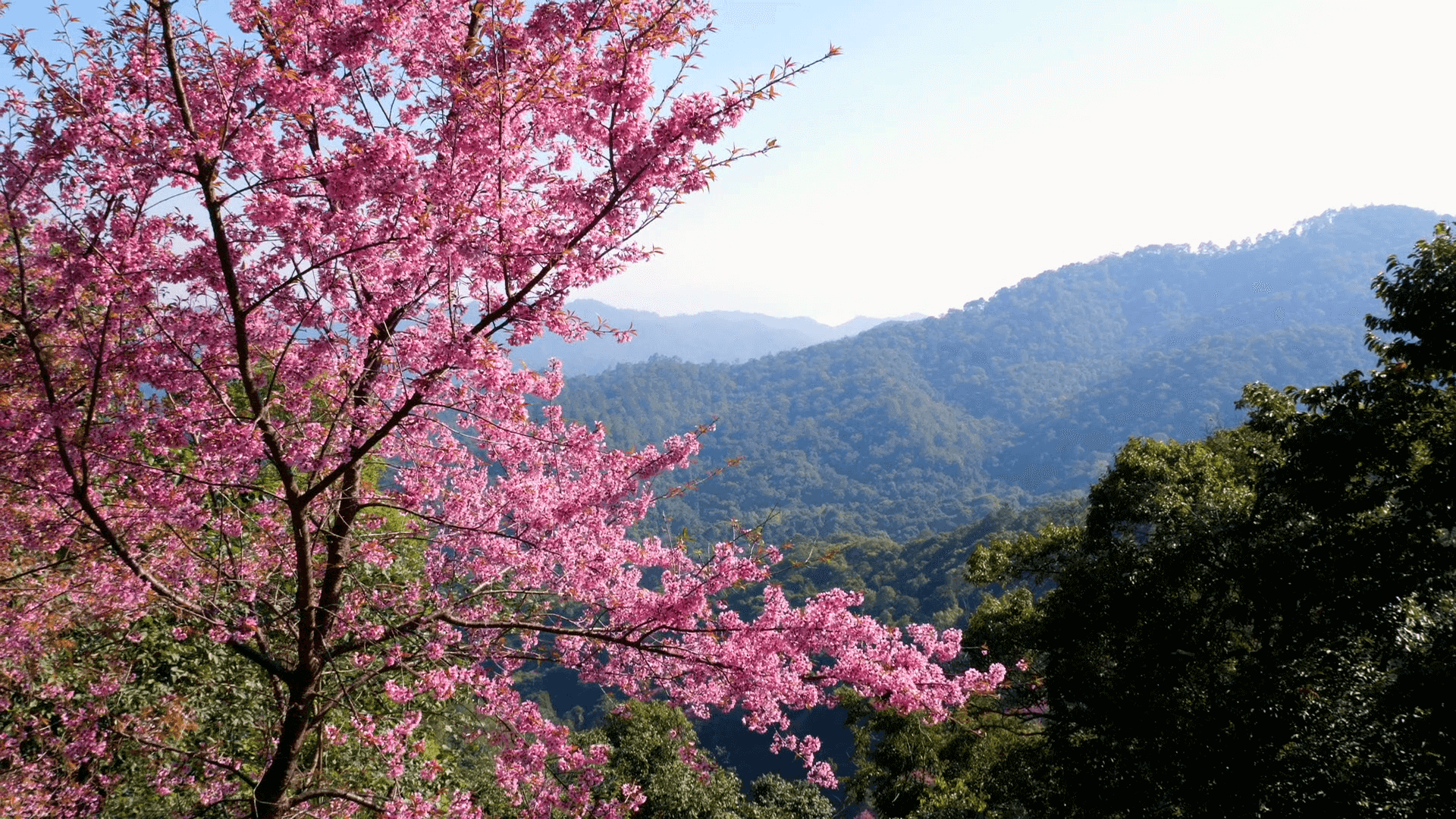
Identification and value: This species can flower when many surrounding trees are not in bloom, creating an important seasonal nectar source. Flowers, fruit arrangement, leaf texture, bark, and growth habit should be considered together because individual traits overlap among species.
20. Himalayan Bird Cherry
Scientific name: Prunus cornuta. Native range: Himalayas and western China. Tree with elongated clusters of pale flowers and dark fruits. In the wild, look for it in moist mountain forests and ravines.
Identification and value: The raceme-shaped flowers and high-elevation habitat help distinguish it from orchard cherries. Flowers, fruit arrangement, leaf texture, bark, and growth habit should be considered together because individual traits overlap among species.
21. Gray-Leaf Cherry
Scientific name: Prunus canescens. Native range: China. Small tree or shrub with grayish leaf undersides and pale flowers. In the wild, look for it in mountain scrub and woodland edges.
Identification and value: The gray-toned foliage is a useful clue, especially after the short flowering period has ended. Flowers, fruit arrangement, leaf texture, bark, and growth habit should be considered together because individual traits overlap among species.
22. European Dwarf Cherry
Scientific name: Prunus fruticosa. Native range: Europe and western Asia. Low thicket-forming shrub with white flowers and red cherries. In the wild, look for it in dry grasslands, steppe, slopes, and woodland margins.
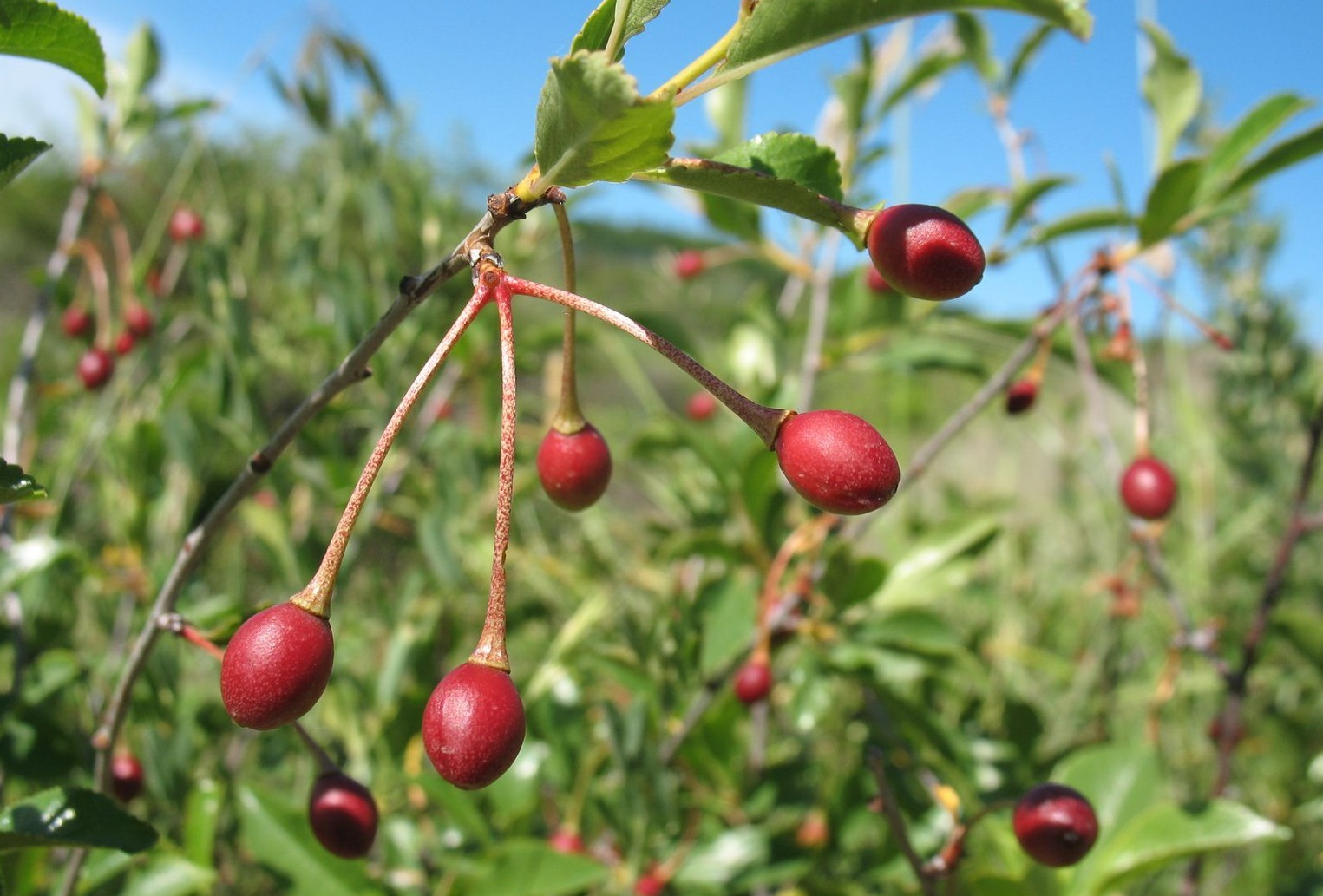
Identification and value: Although usually shrubby, it belongs in a practical wild-cherry guide because it forms woody colonies and is an important relative of cultivated sour cherry. Flowers, fruit arrangement, leaf texture, bark, and growth habit should be considered together because individual traits overlap among species.
23. Mahaleb Cherry
Scientific name: Prunus mahaleb. Native range: Europe, western Asia, and North Africa. Small aromatic tree with white flower clusters and small black cherries. In the wild, look for it in dry rocky slopes, scrub, and open woodland.
Identification and value: Mahaleb cherry is often recognized by the fragrance of its wood and seeds. It is also used as a rootstock in horticulture. Flowers, fruit arrangement, leaf texture, bark, and growth habit should be considered together because individual traits overlap among species.
24. Mountain Cherry
Scientific name: Prunus prostrata. Native range: Southern Europe, North Africa, and western Asia. Low spreading shrub with pink flowers and small red fruit. In the wild, look for it in rocky mountains, cliffs, and high dry slopes.
Identification and value: Its prostrate growth is an adaptation to exposed mountain environments. It is more shrub than tree but is a genuine wild cherry species. Flowers, fruit arrangement, leaf texture, bark, and growth habit should be considered together because individual traits overlap among species.
25. African Cherry
Scientific name: Prunus africana. Native range: Mountain forests of sub-Saharan Africa and nearby islands. Large evergreen tree with dark bark, glossy leaves, and small fruits. In the wild, look for it in cool, moist african montane forests.
Identification and value: African cherry differs from familiar deciduous cherries by being evergreen. Wild harvesting of bark has created conservation concerns in parts of its range. Flowers, fruit arrangement, leaf texture, bark, and growth habit should be considered together because individual traits overlap among species.
26. Carolina Laurelcherry
Scientific name: Prunus caroliniana. Native range: Southeastern United States. Evergreen tree with glossy leaves, white flower clusters, and black fruits. In the wild, look for it in coastal plain woods, thickets, and forest margins.
Identification and value: This native evergreen cherry is widely used in landscaping. Leaves and seeds are not food and can contain cyanogenic compounds. Flowers, fruit arrangement, leaf texture, bark, and growth habit should be considered together because individual traits overlap among species.
27. Hollyleaf Cherry
Scientific name: Prunus ilicifolia. Native range: California and northern Baja California. Evergreen shrub or small tree with stiff holly-like leaves and dark fruit. In the wild, look for it in chaparral, coastal scrub, and dry canyons.
Identification and value: Hollyleaf cherry is drought adapted and valuable to wildlife. Its fruits have a large pit and were traditionally processed rather than casually eaten whole. Flowers, fruit arrangement, leaf texture, bark, and growth habit should be considered together because individual traits overlap among species.
28. Catalina Cherry
Scientific name: Prunus lyonii. Native range: California Channel Islands and nearby coastal areas. Evergreen tree with glossy leaves and dark cherries. In the wild, look for it in island woodland, canyons, and coastal slopes.

Identification and value: Catalina cherry can grow larger than hollyleaf cherry and is closely related to it. It is also cultivated in mild coastal landscapes. Flowers, fruit arrangement, leaf texture, bark, and growth habit should be considered together because individual traits overlap among species.
29. Portuguese Laurel
Scientific name: Prunus lusitanica. Native range: Southwestern Europe and northwestern Africa. Evergreen tree with dark leaves, reddish petioles, white racemes, and black fruits. In the wild, look for it in moist woodland, ravines, and mountain forests.
Identification and value: Despite the laurel name, it is a true Prunus. The long flower racemes and red leaf stalks are useful identification features. Flowers, fruit arrangement, leaf texture, bark, and growth habit should be considered together because individual traits overlap among species.
30. Cherry Laurel
Scientific name: Prunus laurocerasus. Native range: Southeastern Europe and western Asia. Evergreen tree or large shrub with broad glossy leaves and upright white racemes. In the wild, look for it in woodland and forest margins; naturalized in many regions.
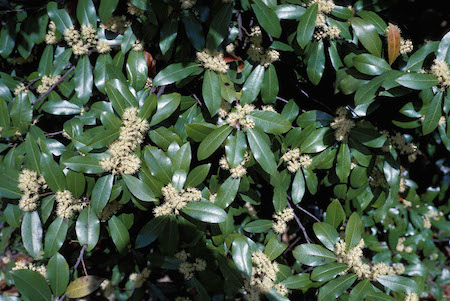
Identification and value: Cherry laurel can spread outside cultivation and shade native ground plants. Leaves and pits are toxic and must not be mistaken for edible bay laurel. Flowers, fruit arrangement, leaf texture, bark, and growth habit should be considered together because individual traits overlap among species.
How Are Wild Cherry Trees Classified?
Wild cherries belong to the rose family, Rosaceae, and the genus Prunus. The same genus also contains plums, peaches, apricots, and almonds, so not every Prunus is a cherry. Botanists use flower arrangement, fruit structure, leaf glands, DNA evidence, and other traits to separate species and major lineages.
For field use, cherries can be divided into species with flowers in compact clusters, bird cherries with elongated racemes, deciduous forest cherries, evergreen laurel cherries, and low shrubby mountain or steppe cherries. These practical groups are useful but do not replace formal taxonomy.
Where Do Wild Cherry Trees Grow?
Wild cherries occur mainly in temperate regions, but some extend into subtropical mountains and African cloud forests. They occupy forest gaps, woodland edges, streambanks, burns, rocky slopes, coastal scrub, island forests, and disturbed ground. Many need good light for flowering and fruiting, while bird cherries often tolerate moist woodland conditions.
How to Identify Different Types of Wild Cherry Trees
- Flowers: Note whether flowers grow singly, in small umbels, or on long racemes.
- Fruit: Compare color, size, stalk length, and whether fruits form tight or elongated clusters.
- Leaves: Examine tooth shape, gloss, underside color, glands near the leaf base, and evergreen versus deciduous habit.
- Bark: Many cherries show horizontal lenticels; some develop peeling copper bark or dark scaly plates.
- Growth form: Separate tall forest trees from thicket-forming shrubs and evergreen small trees.
- Habitat and range: Geography is often the fastest way to narrow similar species.
- Season: Flowering time, leaf emergence, fruiting season, and autumn color provide additional evidence.
Growing and Garden Tips
- Choose a species native or well adapted to your climate and soil.
- Provide adequate space; black cherry and wild sweet cherry can become large trees.
- Avoid planting invasive cherry laurel where it escapes into local woodland.
- Protect young trunks from mower damage and browsing animals.
- Prune with clean tools and avoid unnecessary large cuts.
- Do not move wild seedlings or collect seed where local rules prohibit it.
- Expect seed-grown plants to vary; they will not copy a named cultivated variety.
Safety, Sustainability, and Conservation Notes
Never identify an edible cherry from fruit color alone. Many Prunus leaves, bark, stems, and seeds contain cyanogenic compounds, and pits should not be crushed or eaten. Wilted leaves can also be hazardous to livestock. Harvest only ripe flesh from a positively identified edible species and follow region-specific guidance. Protect wild trees that stabilize slopes, feed birds, and support insects, and avoid stripping bark from African cherry or any other species.
Fun Facts About Wild Cherry Trees
- Birds disperse many cherry seeds after eating ripe fruit.
- Horizontal bark lenticels are common in the genus Prunus.
- Pin cherry often appears after fire or forest disturbance.
- Black cherry can become a valuable timber tree.
- Oshima cherry helped give rise to several famous ornamental cherries.
- Some wild cherries flower as their new leaves emerge.
- African cherry is evergreen, unlike many familiar temperate cherries.
- Cherry laurel is a cherry relative, not a true culinary laurel.
- European dwarf cherry usually grows as a spreading shrub.
- Several cherry species provide early nectar and later fruit for wildlife.
Frequently Asked Questions
1. What is a wild cherry tree?
A wild cherry tree is a naturally occurring cherry species, usually in the genus Prunus, that grows without being a named orchard or ornamental cultivar.
2. How many types of wild cherry trees are there?
There are many wild cherry species worldwide. The exact count depends on taxonomy and on whether bird cherries, laurel cherries, and shrubby cherries are included.
3. What is the most common wild cherry in Europe?
Prunus avium, the wild sweet cherry or gean, is one of the best-known European wild cherries.
4. What is the most common wild cherry in North America?
Black cherry, chokecherry, pin cherry, and bitter cherry are all widespread in different North American regions.
5. Is black cherry the same as wild cherry?
Black cherry is one North American species often called wild cherry, but wild cherry can also refer to Prunus avium and other species.
6. Is chokecherry a tree or shrub?
Chokecherry commonly grows as a large shrub or small multi-stemmed tree, depending on site and genetics.
7. How can I identify a wild cherry tree?
Use flower arrangement, leaf teeth and glands, bark lenticels, fruit clusters, growth form, and geographic range together.
8. Do wild cherry trees have horizontal bark marks?
Many species show horizontal lenticels, especially on younger bark, but this feature is not unique to cherries.
9. Are all wild cherries edible?
No. Edibility varies, and even species with edible ripe flesh may have toxic pits, leaves, stems, or bark.
10. Can you eat wild cherry pits?
No. Do not chew or consume cherry pits because seeds of many Prunus species contain cyanogenic compounds.
11. Are wild cherry leaves toxic?
Leaves of many Prunus species can release toxic cyanide compounds, especially when damaged or wilted. Keep them away from livestock and do not use them as food.
12. Why do birds eat wild cherries safely?
Bird digestion and feeding behavior differ from humans, and many birds swallow fruit while passing or discarding the hard pit.
13. What color are wild cherry flowers?
Most are white to pale pink, while species such as Taiwan cherry can have deep pink flowers.
14. When do wild cherry trees bloom?
Most temperate species bloom in spring, but timing varies with elevation, latitude, and species. Some Himalayan species flower in cooler dry seasons.
15. What animals use wild cherry trees?
Birds and mammals eat fruit, pollinating insects visit flowers, and caterpillars and other invertebrates feed on foliage.
16. Do wild cherries need full sun?
Many flower and fruit best with good sunlight, although some grow naturally in forest edges or moist woodland with partial shade.
17. Can wild cherry trees grow from seed?
Yes, but seeds often need a cold period and may germinate irregularly. Seedlings also vary genetically.
18. Will a cherry grown from a pit match the parent tree?
Not necessarily. Seedlings are genetically different and will not reliably reproduce the traits of a named cultivar.
19. What is a bird cherry?
Bird cherries are Prunus species that commonly bear flowers and fruit on elongated racemes, with fruit frequently eaten by birds.
20. Is cherry laurel a true cherry?
It belongs to Prunus and is related to cherries, but its evergreen leaves and ecology differ from familiar orchard cherries.
21. Is cherry laurel edible?
No. Do not treat its leaves or pits as food. It is not the culinary bay leaf and contains cyanogenic compounds.
22. What is the difference between wild cherry and sweet cherry?
Prunus avium is both the European wild sweet cherry and an ancestor of cultivated sweet-cherry varieties. Orchard cultivars were selected for fruit traits.
23. What is the difference between black cherry and chokecherry?
Black cherry usually becomes a taller single-trunk tree with elongated fruit clusters, while chokecherry often forms a shrub or small tree and dense thickets.
24. Why are wild cherry fruits small?
Wild species evolved for survival and animal dispersal rather than for the large fleshy fruit favored by human cultivation.
25. Do wild cherry trees spread aggressively?
Some spread by seed, suckers, or both. Cherry laurel can be invasive outside its native range, while native pioneer cherries may colonize disturbed ground quickly.
26. Can I plant a wild cherry near livestock?
Use caution because wilted leaves and other tissues of many Prunus species can be poisonous to livestock. Consult local agricultural guidance.
27. What soil do wild cherries prefer?
Preferences vary, but many do best in well-drained soil. Bird cherries may tolerate wetter sites, while mountain cherries favor rocky or dry slopes.
28. How long do wild cherry trees live?
Longevity varies widely by species and site. Pioneer species such as pin cherry are relatively short-lived, while larger forest cherries can persist much longer.
29. Should dead cherry branches be removed?
Remove hazardous branches using sound arboricultural practice, but retain safe wildlife habitat where appropriate. Large-tree work should be handled by a qualified arborist.
30. How can I protect wild cherry diversity?
Plant locally native species, prevent invasive spread, avoid bark harvesting, retain woodland edges and corridors, and source nursery plants responsibly.
Final Thoughts on types of wild cherry trees
Learning about types of wild cherry trees becomes easier when you compare body shape, habitat, behavior, range, and ecological role instead of relying on one feature alone. Use this guide as a practical starting point, observe wildlife responsibly, and confirm difficult identifications with a trusted regional field guide or wildlife agency.
SEO Title
Meta Description
Suggested URL Slug
types-of-wild-cherry-trees