

The world’s types of flying fish belong to the marine family Exocoetidae, a group famous for launching from the sea and gliding on enlarged fins. About 64 species are distributed among seven genera. They are not true powered fliers, but their streamlined bodies, enlarged pectoral fins, specialized tails, and surface-dwelling lifestyle create one of the ocean’s most remarkable escape behaviors.
What Are the Main Types of Flying Fish?
Flying fish are commonly divided into two-wing forms, which rely mainly on enlarged pectoral fins, and four-wing forms, which also have enlarged pelvic fins. The family includes seven genera: Exocoetus, Fodiator, Parexocoetus, Cheilopogon, Cypselurus, Hirundichthys, and Prognichthys. Most live in tropical or warm subtropical surface waters and feed on plankton.
Flying Fish Genera at a Glance
| Example | Scientific name | Body plan | Main habitat |
|---|---|---|---|
| Oceanic Flyingfish | Exocoetus gibbosus | two-winged profile with enlarged pectoral fins | tropical and warm subtropical surface waters |
| Barbel Flyingfish | Exocoetus monocirrhus | two-winged profile with enlarged pectoral fins | open-ocean waters near productive currents |
| Oceanic Two-Wing Flyingfish | Exocoetus obtusirostris | two-winged profile with enlarged pectoral fins | coastal and oceanic waters within its natural range |
| Peruvian Flyingfish | Exocoetus peruvianus | two-winged profile with enlarged pectoral fins | the upper sunlit layer of warm seas |
| Tropical Two-Wing Flyingfish | Exocoetus volitans | two-winged profile with enlarged pectoral fins | tropical and warm subtropical surface waters |
| Sharpchin Flyingfish | Fodiator acutus | two-winged profile with enlarged pectoral fins | open-ocean waters near productive currents |
| Longsnout Flyingfish | Fodiator rostratus | two-winged profile with enlarged pectoral fins | coastal and oceanic waters within its natural range |
| Sailfin Flyingfish | Parexocoetus brachypterus | two-winged profile with enlarged pectoral fins | the upper sunlit layer of warm seas |
| Hillian Flyingfish | Parexocoetus hillianus | two-winged profile with enlarged pectoral fins | tropical and warm subtropical surface waters |
| African Sailfin Flyingfish | Parexocoetus mento | two-winged profile with enlarged pectoral fins | open-ocean waters near productive currents |
| Abe’s Flyingfish | Cheilopogon abei | four-winged profile with enlarged pectoral and pelvic fins | coastal and oceanic waters within its natural range |
| Japanese Flyingfish | Cheilopogon agoo | four-winged profile with enlarged pectoral and pelvic fins | the upper sunlit layer of warm seas |
| Smallhead Flyingfish | Cheilopogon altipennis | four-winged profile with enlarged pectoral and pelvic fins | tropical and warm subtropical surface waters |
| White-Finned Flyingfish | Cheilopogon arcticeps | four-winged profile with enlarged pectoral and pelvic fins | open-ocean waters near productive currents |
How Are Flying Fish Classified?
Flying fish are ray-finned fishes in the family Exocoetidae and order Beloniformes, making them relatives of halfbeaks and needlefishes. The family is divided into four subfamilies and seven living genera. Taxonomy is periodically revised, so older field guides may use different genus combinations or treat subspecies differently.
1. Oceanic Flyingfish
The Oceanic Flyingfish (Exocoetus gibbosus) has a two-winged profile with enlarged pectoral fins. It is most closely associated with tropical and warm subtropical surface waters. Identification should combine body shape, fin placement, markings, and geographic origin rather than relying on color alone.
For readers interested in marine wildlife identification and ocean education, the most useful practical point is that species identification often requires fin pigmentation, scale counts, and range. A responsible decision starts with the scientific name, adult size, natural behavior, and any legal or welfare considerations.
2. Barbel Flyingfish
Barbel Flyingfish, scientifically known as Exocoetus monocirrhus, has a two-winged profile with enlarged pectoral fins. In the wild it is linked with open-ocean waters near productive currents, although local conditions and life stage may influence where it is observed.
This fish matters to marine wildlife identification and ocean education because it is a wild pelagic fish rather than a practical home-aquarium species. When comparing similar species, look for repeatable features such as stripe direction, spot arrangement, tail shape, mouth position, and the proportions of the dorsal and anal fins.
3. Oceanic Two-Wing Flyingfish
The common name Oceanic Two-Wing Flyingfish refers here to Exocoetus obtusirostris. It has a two-winged profile with enlarged pectoral fins. Its typical setting includes coastal and oceanic waters within its natural range, where food availability, current, cover, temperature, and predators shape its behavior.
A practical note for marine wildlife identification and ocean education is that its gliding is an escape response, not powered bird-like flight. Avoid assuming that two fish with similar trade names have identical care, harvest rules, or conservation status.
4. Peruvian Flyingfish
Peruvian Flyingfish (Exocoetus peruvianus) is notable because it has a two-winged profile with enlarged pectoral fins. Most observations come from the upper sunlit layer of warm seas. Juveniles, breeding adults, and stressed individuals may show different colors or patterns.
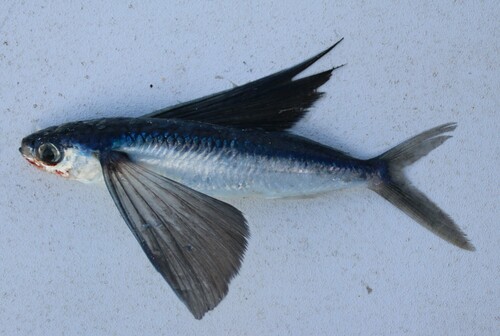
In marine wildlife identification and ocean education, remember that local fishery names may combine several similar species. Good identification photographs should show the full side profile, head, tail, and fins, with the location and approximate size recorded.
5. Tropical Two-Wing Flyingfish
The Tropical Two-Wing Flyingfish (Exocoetus volitans) has a two-winged profile with enlarged pectoral fins. It is most closely associated with tropical and warm subtropical surface waters. Identification should combine body shape, fin placement, markings, and geographic origin rather than relying on color alone.
For readers interested in marine wildlife identification and ocean education, the most useful practical point is that species identification often requires fin pigmentation, scale counts, and range. A responsible decision starts with the scientific name, adult size, natural behavior, and any legal or welfare considerations.
6. Sharpchin Flyingfish
Sharpchin Flyingfish, scientifically known as Fodiator acutus, has a two-winged profile with enlarged pectoral fins. In the wild it is linked with open-ocean waters near productive currents, although local conditions and life stage may influence where it is observed.
This fish matters to marine wildlife identification and ocean education because it is a wild pelagic fish rather than a practical home-aquarium species. When comparing similar species, look for repeatable features such as stripe direction, spot arrangement, tail shape, mouth position, and the proportions of the dorsal and anal fins.
7. Longsnout Flyingfish
The common name Longsnout Flyingfish refers here to Fodiator rostratus. It has a two-winged profile with enlarged pectoral fins. Its typical setting includes coastal and oceanic waters within its natural range, where food availability, current, cover, temperature, and predators shape its behavior.

A practical note for marine wildlife identification and ocean education is that its gliding is an escape response, not powered bird-like flight. Avoid assuming that two fish with similar trade names have identical care, harvest rules, or conservation status.
8. Sailfin Flyingfish
Sailfin Flyingfish (Parexocoetus brachypterus) is notable because it has a two-winged profile with enlarged pectoral fins. Most observations come from the upper sunlit layer of warm seas. Juveniles, breeding adults, and stressed individuals may show different colors or patterns.
In marine wildlife identification and ocean education, remember that local fishery names may combine several similar species. Good identification photographs should show the full side profile, head, tail, and fins, with the location and approximate size recorded.
9. Hillian Flyingfish
The Hillian Flyingfish (Parexocoetus hillianus) has a two-winged profile with enlarged pectoral fins. It is most closely associated with tropical and warm subtropical surface waters. Identification should combine body shape, fin placement, markings, and geographic origin rather than relying on color alone.
For readers interested in marine wildlife identification and ocean education, the most useful practical point is that species identification often requires fin pigmentation, scale counts, and range. A responsible decision starts with the scientific name, adult size, natural behavior, and any legal or welfare considerations.
10. African Sailfin Flyingfish
African Sailfin Flyingfish, scientifically known as Parexocoetus mento, has a two-winged profile with enlarged pectoral fins. In the wild it is linked with open-ocean waters near productive currents, although local conditions and life stage may influence where it is observed.
This fish matters to marine wildlife identification and ocean education because it is a wild pelagic fish rather than a practical home-aquarium species. When comparing similar species, look for repeatable features such as stripe direction, spot arrangement, tail shape, mouth position, and the proportions of the dorsal and anal fins.
11. Abe’s Flyingfish
The common name Abe’s Flyingfish refers here to Cheilopogon abei. It has a four-winged profile with enlarged pectoral and pelvic fins. Its typical setting includes coastal and oceanic waters within its natural range, where food availability, current, cover, temperature, and predators shape its behavior.
A practical note for marine wildlife identification and ocean education is that its gliding is an escape response, not powered bird-like flight. Avoid assuming that two fish with similar trade names have identical care, harvest rules, or conservation status.
12. Japanese Flyingfish
Japanese Flyingfish (Cheilopogon agoo) is notable because it has a four-winged profile with enlarged pectoral and pelvic fins. Most observations come from the upper sunlit layer of warm seas. Juveniles, breeding adults, and stressed individuals may show different colors or patterns.
In marine wildlife identification and ocean education, remember that local fishery names may combine several similar species. Good identification photographs should show the full side profile, head, tail, and fins, with the location and approximate size recorded.
13. Smallhead Flyingfish
The Smallhead Flyingfish (Cheilopogon altipennis) has a four-winged profile with enlarged pectoral and pelvic fins. It is most closely associated with tropical and warm subtropical surface waters. Identification should combine body shape, fin placement, markings, and geographic origin rather than relying on color alone.

For readers interested in marine wildlife identification and ocean education, the most useful practical point is that species identification often requires fin pigmentation, scale counts, and range. A responsible decision starts with the scientific name, adult size, natural behavior, and any legal or welfare considerations.
14. White-Finned Flyingfish
White-Finned Flyingfish, scientifically known as Cheilopogon arcticeps, has a four-winged profile with enlarged pectoral and pelvic fins. In the wild it is linked with open-ocean waters near productive currents, although local conditions and life stage may influence where it is observed.
This fish matters to marine wildlife identification and ocean education because it is a wild pelagic fish rather than a practical home-aquarium species. When comparing similar species, look for repeatable features such as stripe direction, spot arrangement, tail shape, mouth position, and the proportions of the dorsal and anal fins.
15. Glider Flyingfish
The common name Glider Flyingfish refers here to Cheilopogon atrisignis. It has a four-winged profile with enlarged pectoral and pelvic fins. Its typical setting includes coastal and oceanic waters within its natural range, where food availability, current, cover, temperature, and predators shape its behavior.
A practical note for marine wildlife identification and ocean education is that its gliding is an escape response, not powered bird-like flight. Avoid assuming that two fish with similar trade names have identical care, harvest rules, or conservation status.
16. Margined Flyingfish
Margined Flyingfish (Cheilopogon cyanopterus) is notable because it has a four-winged profile with enlarged pectoral and pelvic fins. Most observations come from the upper sunlit layer of warm seas. Juveniles, breeding adults, and stressed individuals may show different colors or patterns.
In marine wildlife identification and ocean education, remember that local fishery names may combine several similar species. Good identification photographs should show the full side profile, head, tail, and fins, with the location and approximate size recorded.
17. Doederlein’s Flyingfish
The Doederlein’s Flyingfish (Cheilopogon doederleinii) has a four-winged profile with enlarged pectoral and pelvic fins. It is most closely associated with tropical and warm subtropical surface waters. Identification should combine body shape, fin placement, markings, and geographic origin rather than relying on color alone.
For readers interested in marine wildlife identification and ocean education, the most useful practical point is that species identification often requires fin pigmentation, scale counts, and range. A responsible decision starts with the scientific name, adult size, natural behavior, and any legal or welfare considerations.
18. Backspot Flyingfish
Backspot Flyingfish, scientifically known as Cheilopogon dorsomacula, has a four-winged profile with enlarged pectoral and pelvic fins. In the wild it is linked with open-ocean waters near productive currents, although local conditions and life stage may influence where it is observed.
This fish matters to marine wildlife identification and ocean education because it is a wild pelagic fish rather than a practical home-aquarium species. When comparing similar species, look for repeatable features such as stripe direction, spot arrangement, tail shape, mouth position, and the proportions of the dorsal and anal fins.
19. Bandwing Flyingfish
The common name Bandwing Flyingfish refers here to Cheilopogon exsiliens. It has a four-winged profile with enlarged pectoral and pelvic fins. Its typical setting includes coastal and oceanic waters within its natural range, where food availability, current, cover, temperature, and predators shape its behavior.

A practical note for marine wildlife identification and ocean education is that its gliding is an escape response, not powered bird-like flight. Avoid assuming that two fish with similar trade names have identical care, harvest rules, or conservation status.
20. Spotfin Flyingfish
Spotfin Flyingfish (Cheilopogon furcatus) is notable because it has a four-winged profile with enlarged pectoral and pelvic fins. Most observations come from the upper sunlit layer of warm seas. Juveniles, breeding adults, and stressed individuals may show different colors or patterns.
In marine wildlife identification and ocean education, remember that local fishery names may combine several similar species. Good identification photographs should show the full side profile, head, tail, and fins, with the location and approximate size recorded.
21. Mediterranean Flyingfish
The Mediterranean Flyingfish (Cheilopogon heterurus) has a four-winged profile with enlarged pectoral and pelvic fins. It is most closely associated with tropical and warm subtropical surface waters. Identification should combine body shape, fin placement, markings, and geographic origin rather than relying on color alone.
For readers interested in marine wildlife identification and ocean education, the most useful practical point is that species identification often requires fin pigmentation, scale counts, and range. A responsible decision starts with the scientific name, adult size, natural behavior, and any legal or welfare considerations.
22. Blotchwing Flyingfish
Blotchwing Flyingfish, scientifically known as Cheilopogon hubbsi, has a four-winged profile with enlarged pectoral and pelvic fins. In the wild it is linked with open-ocean waters near productive currents, although local conditions and life stage may influence where it is observed.
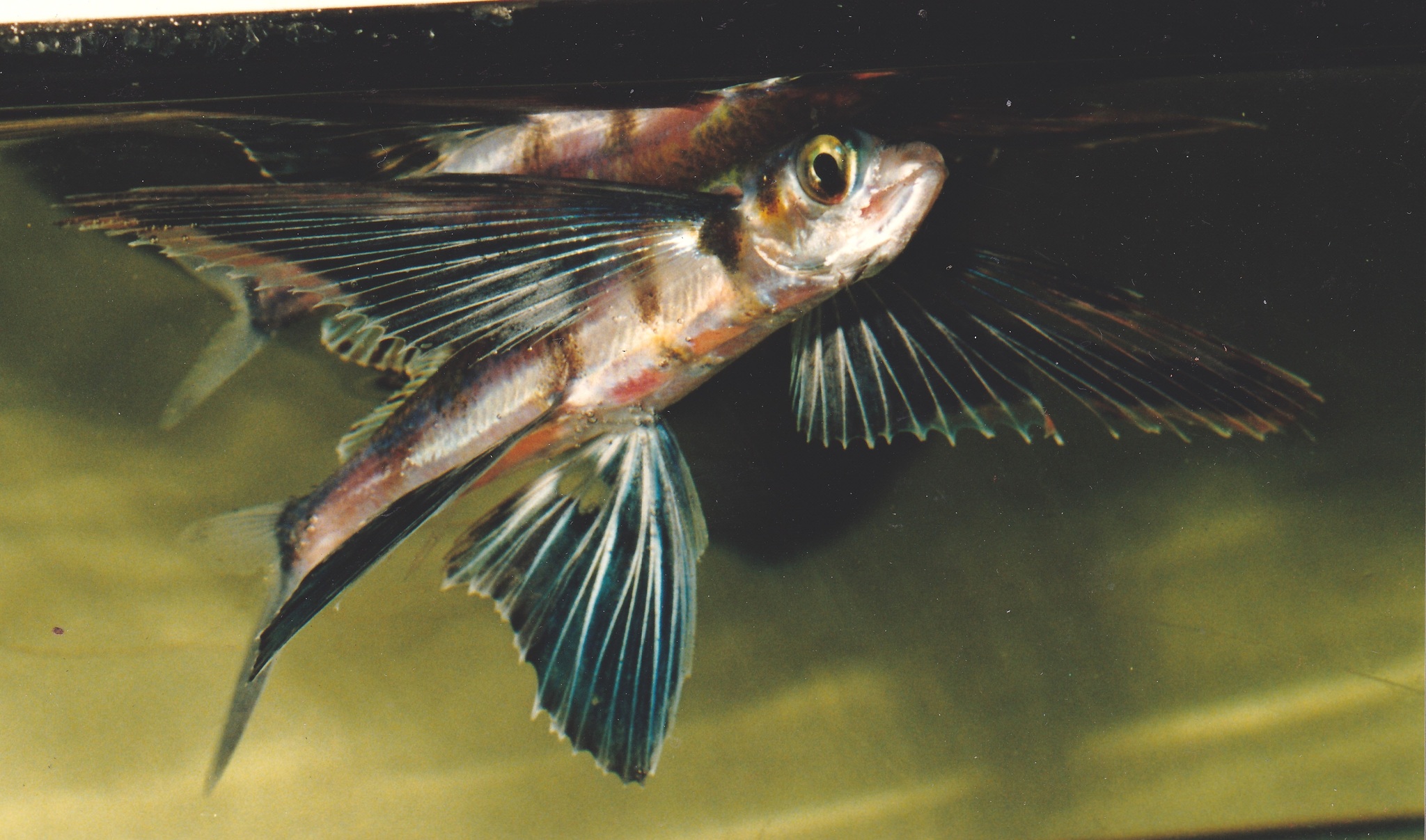
This fish matters to marine wildlife identification and ocean education because it is a wild pelagic fish rather than a practical home-aquarium species. When comparing similar species, look for repeatable features such as stripe direction, spot arrangement, tail shape, mouth position, and the proportions of the dorsal and anal fins.
23. Intermediate Flyingfish
The common name Intermediate Flyingfish refers here to Cheilopogon intermedius. It has a four-winged profile with enlarged pectoral and pelvic fins. Its typical setting includes coastal and oceanic waters within its natural range, where food availability, current, cover, temperature, and predators shape its behavior.
A practical note for marine wildlife identification and ocean education is that its gliding is an escape response, not powered bird-like flight. Avoid assuming that two fish with similar trade names have identical care, harvest rules, or conservation status.
24. Indonesian Flyingfish
Indonesian Flyingfish (Cheilopogon katoptron) is notable because it has a four-winged profile with enlarged pectoral and pelvic fins. Most observations come from the upper sunlit layer of warm seas. Juveniles, breeding adults, and stressed individuals may show different colors or patterns.
In marine wildlife identification and ocean education, remember that local fishery names may combine several similar species. Good identification photographs should show the full side profile, head, tail, and fins, with the location and approximate size recorded.
25. Atlantic Flyingfish
The Atlantic Flyingfish (Cheilopogon melanurus) has a four-winged profile with enlarged pectoral and pelvic fins. It is most closely associated with tropical and warm subtropical surface waters. Identification should combine body shape, fin placement, markings, and geographic origin rather than relying on color alone.

For readers interested in marine wildlife identification and ocean education, the most useful practical point is that species identification often requires fin pigmentation, scale counts, and range. A responsible decision starts with the scientific name, adult size, natural behavior, and any legal or welfare considerations.
26. Guinean Flyingfish
Guinean Flyingfish, scientifically known as Cheilopogon milleri, has a four-winged profile with enlarged pectoral and pelvic fins. In the wild it is linked with open-ocean waters near productive currents, although local conditions and life stage may influence where it is observed.
This fish matters to marine wildlife identification and ocean education because it is a wild pelagic fish rather than a practical home-aquarium species. When comparing similar species, look for repeatable features such as stripe direction, spot arrangement, tail shape, mouth position, and the proportions of the dorsal and anal fins.
27. Blacksail Flyingfish
The common name Blacksail Flyingfish refers here to Cheilopogon nigricans. It has a four-winged profile with enlarged pectoral and pelvic fins. Its typical setting includes coastal and oceanic waters within its natural range, where food availability, current, cover, temperature, and predators shape its behavior.
A practical note for marine wildlife identification and ocean education is that its gliding is an escape response, not powered bird-like flight. Avoid assuming that two fish with similar trade names have identical care, harvest rules, or conservation status.
28. Olga’s Flyingfish
Olga’s Flyingfish (Cheilopogon olgae) is notable because it has a four-winged profile with enlarged pectoral and pelvic fins. Most observations come from the upper sunlit layer of warm seas. Juveniles, breeding adults, and stressed individuals may show different colors or patterns.

In marine wildlife identification and ocean education, remember that local fishery names may combine several similar species. Good identification photographs should show the full side profile, head, tail, and fins, with the location and approximate size recorded.
29. Butterfly Flyingfish
The Butterfly Flyingfish (Cheilopogon papilio) has a four-winged profile with enlarged pectoral and pelvic fins. It is most closely associated with tropical and warm subtropical surface waters. Identification should combine body shape, fin placement, markings, and geographic origin rather than relying on color alone.
For readers interested in marine wildlife identification and ocean education, the most useful practical point is that species identification often requires fin pigmentation, scale counts, and range. A responsible decision starts with the scientific name, adult size, natural behavior, and any legal or welfare considerations.
30. Bennett’s Flyingfish
Bennett’s Flyingfish, scientifically known as Cheilopogon pinnatibarbatus, has a four-winged profile with enlarged pectoral and pelvic fins. In the wild it is linked with open-ocean waters near productive currents, although local conditions and life stage may influence where it is observed.
This fish matters to marine wildlife identification and ocean education because it is a wild pelagic fish rather than a practical home-aquarium species. When comparing similar species, look for repeatable features such as stripe direction, spot arrangement, tail shape, mouth position, and the proportions of the dorsal and anal fins.
31. Pitcairn Flyingfish
The common name Pitcairn Flyingfish refers here to Cheilopogon pitcairnensis. It has a four-winged profile with enlarged pectoral and pelvic fins. Its typical setting includes coastal and oceanic waters within its natural range, where food availability, current, cover, temperature, and predators shape its behavior.

A practical note for marine wildlife identification and ocean education is that its gliding is an escape response, not powered bird-like flight. Avoid assuming that two fish with similar trade names have identical care, harvest rules, or conservation status.
32. Easter Island Flyingfish
Easter Island Flyingfish (Cheilopogon rapanouiensis) is notable because it has a four-winged profile with enlarged pectoral and pelvic fins. Most observations come from the upper sunlit layer of warm seas. Juveniles, breeding adults, and stressed individuals may show different colors or patterns.
In marine wildlife identification and ocean education, remember that local fishery names may combine several similar species. Good identification photographs should show the full side profile, head, tail, and fins, with the location and approximate size recorded.
33. Stained Flyingfish
The Stained Flyingfish (Cheilopogon spilonotopterus) has a four-winged profile with enlarged pectoral and pelvic fins. It is most closely associated with tropical and warm subtropical surface waters. Identification should combine body shape, fin placement, markings, and geographic origin rather than relying on color alone.
For readers interested in marine wildlife identification and ocean education, the most useful practical point is that species identification often requires fin pigmentation, scale counts, and range. A responsible decision starts with the scientific name, adult size, natural behavior, and any legal or welfare considerations.
34. Manyspotted Flyingfish
Manyspotted Flyingfish, scientifically known as Cheilopogon spilopterus, has a four-winged profile with enlarged pectoral and pelvic fins. In the wild it is linked with open-ocean waters near productive currents, although local conditions and life stage may influence where it is observed.

This fish matters to marine wildlife identification and ocean education because it is a wild pelagic fish rather than a practical home-aquarium species. When comparing similar species, look for repeatable features such as stripe direction, spot arrangement, tail shape, mouth position, and the proportions of the dorsal and anal fins.
35. Sutton’s Flyingfish
The common name Sutton’s Flyingfish refers here to Cheilopogon suttoni. It has a four-winged profile with enlarged pectoral and pelvic fins. Its typical setting includes coastal and oceanic waters within its natural range, where food availability, current, cover, temperature, and predators shape its behavior.
A practical note for marine wildlife identification and ocean education is that its gliding is an escape response, not powered bird-like flight. Avoid assuming that two fish with similar trade names have identical care, harvest rules, or conservation status.
36. Limpid-Wing Flyingfish
Limpid-Wing Flyingfish (Cheilopogon unicolor) is notable because it has a four-winged profile with enlarged pectoral and pelvic fins. Most observations come from the upper sunlit layer of warm seas. Juveniles, breeding adults, and stressed individuals may show different colors or patterns.
In marine wildlife identification and ocean education, remember that local fishery names may combine several similar species. Good identification photographs should show the full side profile, head, tail, and fins, with the location and approximate size recorded.
37. Ventralis Flyingfish
The Ventralis Flyingfish (Cheilopogon ventralis) has a four-winged profile with enlarged pectoral and pelvic fins. It is most closely associated with tropical and warm subtropical surface waters. Identification should combine body shape, fin placement, markings, and geographic origin rather than relying on color alone.

For readers interested in marine wildlife identification and ocean education, the most useful practical point is that species identification often requires fin pigmentation, scale counts, and range. A responsible decision starts with the scientific name, adult size, natural behavior, and any legal or welfare considerations.
38. Whitetip Flyingfish
Whitetip Flyingfish, scientifically known as Cheilopogon xenopterus, has a four-winged profile with enlarged pectoral and pelvic fins. In the wild it is linked with open-ocean waters near productive currents, although local conditions and life stage may influence where it is observed.
This fish matters to marine wildlife identification and ocean education because it is a wild pelagic fish rather than a practical home-aquarium species. When comparing similar species, look for repeatable features such as stripe direction, spot arrangement, tail shape, mouth position, and the proportions of the dorsal and anal fins.
39. Narrowhead Flyingfish
The common name Narrowhead Flyingfish refers here to Cypselurus angusticeps. It has a four-winged profile with enlarged pectoral and pelvic fins. Its typical setting includes coastal and oceanic waters within its natural range, where food availability, current, cover, temperature, and predators shape its behavior.
A practical note for marine wildlife identification and ocean education is that its gliding is an escape response, not powered bird-like flight. Avoid assuming that two fish with similar trade names have identical care, harvest rules, or conservation status.
40. Ornamented Flyingfish
Ornamented Flyingfish (Cypselurus callopterus) is notable because it has a four-winged profile with enlarged pectoral and pelvic fins. Most observations come from the upper sunlit layer of warm seas. Juveniles, breeding adults, and stressed individuals may show different colors or patterns.

In marine wildlife identification and ocean education, remember that local fishery names may combine several similar species. Good identification photographs should show the full side profile, head, tail, and fins, with the location and approximate size recorded.
41. Clearwing Flyingfish
The Clearwing Flyingfish (Cypselurus comatus) has a four-winged profile with enlarged pectoral and pelvic fins. It is most closely associated with tropical and warm subtropical surface waters. Identification should combine body shape, fin placement, markings, and geographic origin rather than relying on color alone.
For readers interested in marine wildlife identification and ocean education, the most useful practical point is that species identification often requires fin pigmentation, scale counts, and range. A responsible decision starts with the scientific name, adult size, natural behavior, and any legal or welfare considerations.
42. Darkbar Flyingfish
Darkbar Flyingfish, scientifically known as Cypselurus hexazona, has a four-winged profile with enlarged pectoral and pelvic fins. In the wild it is linked with open-ocean waters near productive currents, although local conditions and life stage may influence where it is observed.
This fish matters to marine wildlife identification and ocean education because it is a wild pelagic fish rather than a practical home-aquarium species. When comparing similar species, look for repeatable features such as stripe direction, spot arrangement, tail shape, mouth position, and the proportions of the dorsal and anal fins.
43. Hirai’s Flyingfish
The common name Hirai’s Flyingfish refers here to Cypselurus hiraii. It has a four-winged profile with enlarged pectoral and pelvic fins. Its typical setting includes coastal and oceanic waters within its natural range, where food availability, current, cover, temperature, and predators shape its behavior.

A practical note for marine wildlife identification and ocean education is that its gliding is an escape response, not powered bird-like flight. Avoid assuming that two fish with similar trade names have identical care, harvest rules, or conservation status.
44. Longbarbel Flyingfish
Longbarbel Flyingfish (Cypselurus longibarbus) is notable because it has a four-winged profile with enlarged pectoral and pelvic fins. Most observations come from the upper sunlit layer of warm seas. Juveniles, breeding adults, and stressed individuals may show different colors or patterns.
In marine wildlife identification and ocean education, remember that local fishery names may combine several similar species. Good identification photographs should show the full side profile, head, tail, and fins, with the location and approximate size recorded.
45. Pharao Flyingfish
The Pharao Flyingfish (Cypselurus naresii) has a four-winged profile with enlarged pectoral and pelvic fins. It is most closely associated with tropical and warm subtropical surface waters. Identification should combine body shape, fin placement, markings, and geographic origin rather than relying on color alone.
For readers interested in marine wildlife identification and ocean education, the most useful practical point is that species identification often requires fin pigmentation, scale counts, and range. A responsible decision starts with the scientific name, adult size, natural behavior, and any legal or welfare considerations.
46. Large-Scale Flyingfish
Large-Scale Flyingfish, scientifically known as Cypselurus oligolepis, has a four-winged profile with enlarged pectoral and pelvic fins. In the wild it is linked with open-ocean waters near productive currents, although local conditions and life stage may influence where it is observed.
This fish matters to marine wildlife identification and ocean education because it is a wild pelagic fish rather than a practical home-aquarium species. When comparing similar species, look for repeatable features such as stripe direction, spot arrangement, tail shape, mouth position, and the proportions of the dorsal and anal fins.
47. Black-Finned Flyingfish
The common name Black-Finned Flyingfish refers here to Cypselurus opisthopus. It has a four-winged profile with enlarged pectoral and pelvic fins. Its typical setting includes coastal and oceanic waters within its natural range, where food availability, current, cover, temperature, and predators shape its behavior.
A practical note for marine wildlife identification and ocean education is that its gliding is an escape response, not powered bird-like flight. Avoid assuming that two fish with similar trade names have identical care, harvest rules, or conservation status.
48. Yellow-Wing Flyingfish
Yellow-Wing Flyingfish (Cypselurus poecilopterus) is notable because it has a four-winged profile with enlarged pectoral and pelvic fins. Most observations come from the upper sunlit layer of warm seas. Juveniles, breeding adults, and stressed individuals may show different colors or patterns.
In marine wildlife identification and ocean education, remember that local fishery names may combine several similar species. Good identification photographs should show the full side profile, head, tail, and fins, with the location and approximate size recorded.
49. Short-Nosed Flyingfish
The Short-Nosed Flyingfish (Cypselurus simus) has a four-winged profile with enlarged pectoral and pelvic fins. It is most closely associated with tropical and warm subtropical surface waters. Identification should combine body shape, fin placement, markings, and geographic origin rather than relying on color alone.
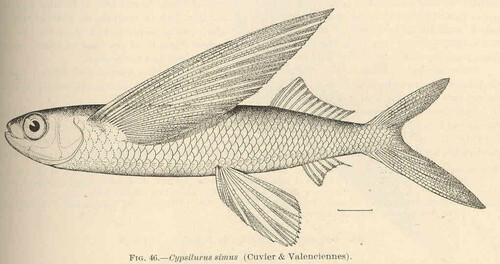
For readers interested in marine wildlife identification and ocean education, the most useful practical point is that species identification often requires fin pigmentation, scale counts, and range. A responsible decision starts with the scientific name, adult size, natural behavior, and any legal or welfare considerations.
50. Starks’ Flyingfish
Starks’ Flyingfish, scientifically known as Cypselurus starksi, has a four-winged profile with enlarged pectoral and pelvic fins. In the wild it is linked with open-ocean waters near productive currents, although local conditions and life stage may influence where it is observed.
This fish matters to marine wildlife identification and ocean education because it is a wild pelagic fish rather than a practical home-aquarium species. When comparing similar species, look for repeatable features such as stripe direction, spot arrangement, tail shape, mouth position, and the proportions of the dorsal and anal fins.
51. Fourwing Flyingfish
The common name Fourwing Flyingfish refers here to Hirundichthys affinis. It has a four-winged profile with enlarged pectoral and pelvic fins. Its typical setting includes coastal and oceanic waters within its natural range, where food availability, current, cover, temperature, and predators shape its behavior.
A practical note for marine wildlife identification and ocean education is that its gliding is an escape response, not powered bird-like flight. Avoid assuming that two fish with similar trade names have identical care, harvest rules, or conservation status.
52. Whitespot Flyingfish
Whitespot Flyingfish (Hirundichthys albimaculatus) is notable because it has a four-winged profile with enlarged pectoral and pelvic fins. Most observations come from the upper sunlit layer of warm seas. Juveniles, breeding adults, and stressed individuals may show different colors or patterns.

In marine wildlife identification and ocean education, remember that local fishery names may combine several similar species. Good identification photographs should show the full side profile, head, tail, and fins, with the location and approximate size recorded.
53. Coromandel Flyingfish
The Coromandel Flyingfish (Hirundichthys coromandelensis) has a four-winged profile with enlarged pectoral and pelvic fins. It is most closely associated with tropical and warm subtropical surface waters. Identification should combine body shape, fin placement, markings, and geographic origin rather than relying on color alone.
For readers interested in marine wildlife identification and ocean education, the most useful practical point is that species identification often requires fin pigmentation, scale counts, and range. A responsible decision starts with the scientific name, adult size, natural behavior, and any legal or welfare considerations.
54. Indian Flyingfish
Indian Flyingfish, scientifically known as Hirundichthys indicus, has a four-winged profile with enlarged pectoral and pelvic fins. In the wild it is linked with open-ocean waters near productive currents, although local conditions and life stage may influence where it is observed.
This fish matters to marine wildlife identification and ocean education because it is a wild pelagic fish rather than a practical home-aquarium species. When comparing similar species, look for repeatable features such as stripe direction, spot arrangement, tail shape, mouth position, and the proportions of the dorsal and anal fins.
55. Banded Flyingfish
The common name Banded Flyingfish refers here to Hirundichthys marginatus. It has a four-winged profile with enlarged pectoral and pelvic fins. Its typical setting includes coastal and oceanic waters within its natural range, where food availability, current, cover, temperature, and predators shape its behavior.
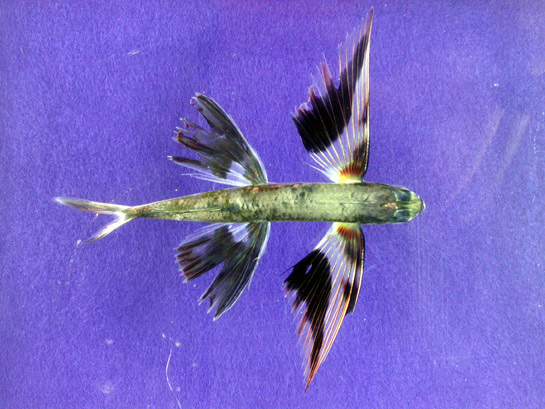
A practical note for marine wildlife identification and ocean education is that its gliding is an escape response, not powered bird-like flight. Avoid assuming that two fish with similar trade names have identical care, harvest rules, or conservation status.
56. Bony Flyingfish
Bony Flyingfish (Hirundichthys oxycephalus) is notable because it has a four-winged profile with enlarged pectoral and pelvic fins. Most observations come from the upper sunlit layer of warm seas. Juveniles, breeding adults, and stressed individuals may show different colors or patterns.

In marine wildlife identification and ocean education, remember that local fishery names may combine several similar species. Good identification photographs should show the full side profile, head, tail, and fins, with the location and approximate size recorded.
57. Redfin Flyingfish
The Redfin Flyingfish (Hirundichthys rufipinnis) has a four-winged profile with enlarged pectoral and pelvic fins. It is most closely associated with tropical and warm subtropical surface waters. Identification should combine body shape, fin placement, markings, and geographic origin rather than relying on color alone.
For readers interested in marine wildlife identification and ocean education, the most useful practical point is that species identification often requires fin pigmentation, scale counts, and range. A responsible decision starts with the scientific name, adult size, natural behavior, and any legal or welfare considerations.
58. Blackwing Flyingfish
Blackwing Flyingfish, scientifically known as Hirundichthys rondeletii, has a four-winged profile with enlarged pectoral and pelvic fins. In the wild it is linked with open-ocean waters near productive currents, although local conditions and life stage may influence where it is observed.
This fish matters to marine wildlife identification and ocean education because it is a wild pelagic fish rather than a practical home-aquarium species. When comparing similar species, look for repeatable features such as stripe direction, spot arrangement, tail shape, mouth position, and the proportions of the dorsal and anal fins.
59. Mirrorwing Flyingfish
The common name Mirrorwing Flyingfish refers here to Hirundichthys speculiger. It has a four-winged profile with enlarged pectoral and pelvic fins. Its typical setting includes coastal and oceanic waters within its natural range, where food availability, current, cover, temperature, and predators shape its behavior.

A practical note for marine wildlife identification and ocean education is that its gliding is an escape response, not powered bird-like flight. Avoid assuming that two fish with similar trade names have identical care, harvest rules, or conservation status.
60. California Flyingfish
California Flyingfish (Hirundichthys volador) is notable because it has a four-winged profile with enlarged pectoral and pelvic fins. Most observations come from the upper sunlit layer of warm seas. Juveniles, breeding adults, and stressed individuals may show different colors or patterns.
In marine wildlife identification and ocean education, remember that local fishery names may combine several similar species. Good identification photographs should show the full side profile, head, tail, and fins, with the location and approximate size recorded.
61. Shortfin Flyingfish
The Shortfin Flyingfish (Prognichthys brevipinnis) has a four-winged profile with enlarged pectoral and pelvic fins. It is most closely associated with tropical and warm subtropical surface waters. Identification should combine body shape, fin placement, markings, and geographic origin rather than relying on color alone.
For readers interested in marine wildlife identification and ocean education, the most useful practical point is that species identification often requires fin pigmentation, scale counts, and range. A responsible decision starts with the scientific name, adult size, natural behavior, and any legal or welfare considerations.
62. Bluntnose Flyingfish
Bluntnose Flyingfish, scientifically known as Prognichthys gibbifrons, has a four-winged profile with enlarged pectoral and pelvic fins. In the wild it is linked with open-ocean waters near productive currents, although local conditions and life stage may influence where it is observed.
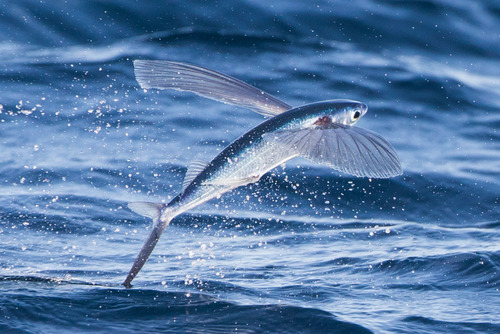
This fish matters to marine wildlife identification and ocean education because it is a wild pelagic fish rather than a practical home-aquarium species. When comparing similar species, look for repeatable features such as stripe direction, spot arrangement, tail shape, mouth position, and the proportions of the dorsal and anal fins.
63. Gyre Flyingfish
The common name Gyre Flyingfish refers here to Prognichthys glaphyrae. It has a four-winged profile with enlarged pectoral and pelvic fins. Its typical setting includes coastal and oceanic waters within its natural range, where food availability, current, cover, temperature, and predators shape its behavior.
A practical note for marine wildlife identification and ocean education is that its gliding is an escape response, not powered bird-like flight. Avoid assuming that two fish with similar trade names have identical care, harvest rules, or conservation status.
64. Tringa Flyingfish
Tringa Flyingfish (Prognichthys tringa) is notable because it has a four-winged profile with enlarged pectoral and pelvic fins. Most observations come from the upper sunlit layer of warm seas. Juveniles, breeding adults, and stressed individuals may show different colors or patterns.

In marine wildlife identification and ocean education, remember that local fishery names may combine several similar species. Good identification photographs should show the full side profile, head, tail, and fins, with the location and approximate size recorded.
Where Do Flying Fish Live?
Flying fish occupy the epipelagic zone, the sunlit upper ocean where plankton is available and predators are abundant. They occur across tropical and warm subtropical Atlantic, Pacific, and Indian Ocean waters. Currents, surface temperature, spawning material, and seasonal productivity influence where schools appear.
How to Identify Different Types of Flying Fish
- Determine whether pelvic fins are also enlarged.
- Compare pectoral-fin color, spots, bands, and clear areas.
- Examine snout length and lower-jaw shape.
- Note the relative positions of dorsal and anal fins.
- Use scale and fin-ray counts for difficult species.
- Confirm ocean basin and regional range.
How Flying Fish Glide
- The fish accelerates below the surface.
- The enlarged lower tail lobe beats rapidly near the water-air boundary.
- The body clears the water and the pectoral fins spread.
- Airflow over the fins creates lift during the glide.
- The tail may touch the surface again to add thrust.
- The fins fold before re-entry.
Fishing, Food, and Cultural Notes
Flying fish support local fisheries in the Caribbean, East Asia, South Asia, Indonesia, and Pacific islands. Flesh, dried fish, and roe are used in regional cuisines. Species identification, seasonal rules, bycatch controls, and local stock information are important for sustainable harvest.
Safety, Sustainability, and Conservation Notes
Flying fish are central prey for many ocean predators, so heavy harvest can affect food webs. Light-based fishing and floating spawning devices should be managed to avoid excessive egg removal or bycatch. Boaters should also remember that startled fish can land on decks at speed.
Fun Facts About Flying Fish
- They glide rather than perform powered flight.
- Some have two enlarged fins and others have four.
- The lower tail lobe is adapted for takeoff thrust.
- They can use wave-created updrafts.
- Gliding helps escape tuna, marlin, and other predators.
- Seabirds can catch them during flight.
- Their eggs may attach to floating objects.
- Barbados is famous for flying fish culture.
- Tobiko is flying fish roe.
- The family occurs in all major warm oceans.
Final Thoughts on Types of Flying Fish
The approximately 64 types of flying fish are best understood through their seven genera, two main gliding body plans, fin patterns, and ocean ranges. They demonstrate how a fish can exploit both water and air without becoming a true flier.
Frequently Asked Questions
1. Do flying fish really fly?
They glide rather than flap their fins for powered flight. They accelerate underwater, launch, spread enlarged fins, and may touch the tail back to the surface for renewed thrust.
2. How many types of flying fish are there?
The family Exocoetidae contains about 64 species in seven genera, although taxonomic revisions can change the exact count.
3. What family do flying fish belong to?
They belong to Exocoetidae in the order Beloniformes.
4. Where do flying fish live?
They occur in tropical and warm subtropical parts of all major oceans, mainly near the surface.
5. Why do flying fish leave the water?
The leading explanation is predator escape, although gliding may also help them move efficiently across disturbed surface water.
6. How far can flying fish glide?
Many glides are tens of meters, while favorable wind and wave conditions can support much longer sequences.
7. How high can flying fish jump?
They can rise several meters above the surface, high enough to land accidentally on small boats.
8. What do flying fish eat?
They feed mainly on plankton and small organisms in the upper ocean.
9. What eats flying fish?
Tuna, mackerel, billfish, squid, dolphins, seabirds, and other predators consume them.
10. What is the difference between two-wing and four-wing flying fish?
Two-wing forms rely mainly on enlarged pectoral fins; four-wing forms also have enlarged pelvic fins that add lifting area.
11. Which genus has two-wing flying fish?
Species of Exocoetus are classic two-wing flying fish, though body plans vary across the family.
12. Are flying fish related to birds?
No. They are ray-finned marine fishes, and their wing-like fins evolved for gliding.
13. Can flying fish breathe air?
No. They breathe with gills and must return to water.
14. Can flying fish live in freshwater?
No. Modern flying fish are marine species.
15. Can flying fish be kept in aquariums?
They are open-ocean, fast-moving fishes and are not realistic home-aquarium animals.
16. What is tobiko?
Tobiko is flying fish roe used in Japanese cuisine, commonly associated with Japanese flying fish fisheries.
17. Are flying fish edible?
Yes. They support regional fisheries and cuisines in several countries.
18. Why is Barbados linked to flying fish?
Flying fish are a national cultural symbol and part of the well-known dish cou-cou and flying fish.
19. How do flying fish take off?
They gain speed underwater, beat the lower tail lobe near the surface, and spread the pectoral fins after breaking free of the water.
20. Do flying fish flap their fins in air?
No. The fins function mainly as fixed gliding surfaces.
21. Can a flying fish change direction?
It can adjust fin angle and may recontact the water with its tail to extend or redirect a glide.
22. Why is the lower tail lobe larger?
The enlarged lower lobe can continue generating thrust while the body is leaving the water.
23. Are flying fish endangered?
Conservation status varies by species and region. Fisheries, climate, prey changes, and habitat conditions can affect populations.
24. How are flying fish caught?
Methods include gillnets, dip nets, lights, and regional traditional techniques, subject to local rules.
25. Are flying fish fast swimmers?
They must accelerate rapidly for takeoff, using powerful tail beats near the surface.
26. What color are flying fish?
Many are dark blue or green above and silvery below, with species-specific fin colors and spots.
27. How big do flying fish grow?
Most are small to medium marine fish, commonly under about 30 centimeters, though sizes vary.
28. Do flying fish lay floating eggs?
Many attach eggs to floating material using filaments, while reproductive details vary among groups.
29. Why do flying fish land on boats?
Their glide path can intersect low decks, especially at night, in wind, or when fleeing predators.
30. Are all gliding fish true flying fish?
No. Other unrelated fish can leap or glide, but true flying fish belong to Exocoetidae.
31. What are the seven flying fish genera?
They are Exocoetus, Fodiator, Parexocoetus, Cheilopogon, Cypselurus, Hirundichthys, and Prognichthys.
32. How can species be identified?
Experts compare fin size and pigmentation, body proportions, scales, fin rays, jaw shape, and geographic range.
33. Do juvenile flying fish look like adults?
Not always. Young fish may have barbels, stronger bars, or different fin patterns.
34. Are flying fish attracted to light?
Some traditional fisheries use lights because flying fish approach illuminated surface areas at night.
35. What is the best way to observe flying fish?
Watch from a moving boat in warm offshore water without chasing or deliberately frightening schools.
Read more:
30 Types of Goldfish: Varieties and Care