

Fancy guppies are one species, Poecilia reticulata, but selective breeding has produced a huge range of tails, colors, and body patterns. This guide to types of guppy fish explains 40 widely used variety names while separating true tail forms from color strains, patterns, and fin traits.
Guppy names are not perfectly standardized. A single fish may be sold under several labels because it can be a blue Moscow, dumbo ear, mosaic, and delta tail at the same time. Use the names as descriptive tools rather than assuming every label represents a separate species.
What Are the Main Types of Guppy Fish?
Guppies are commonly grouped by tail shape, fin form, body pattern, base color, pigment genetics, and established breeder strains. Popular examples include delta, fan, veil, double sword, lyretail, cobra, snakeskin, mosaic, grass, tuxedo, Moscow, koi, dumbo ear, galaxy, and Japan blue guppies.
| Variety | Classification | Key feature |
|---|---|---|
| Delta Tail Guppy | Tail shape | A broad triangular tail that opens from a narrow base |
| Fan Tail Guppy | Tail shape | A rounded fan-shaped caudal fin with a wide spread |
| Veil Tail Guppy | Tail shape | A long flowing tail that drapes behind the body |
| Flag Tail Guppy | Tail shape | A rectangular tail resembling a small flag |
| Round Tail Guppy | Tail shape | A compact circular tail close to the wild-type outline |
| Spade Tail Guppy | Tail shape | A pointed spade-shaped caudal fin |
| Spear Tail Guppy | Tail shape | A narrow tail ending in a spear-like point |
| Pin Tail Guppy | Tail shape | A rounded base with a slender central ray extension |
| Top Swordtail Guppy | Tail shape | An extended upper caudal ray forms a single sword |
| Bottom Swordtail Guppy | Tail shape | An extended lower caudal ray creates the sword |
| Double Swordtail Guppy | Tail shape | Upper and lower rays extend while the center remains shorter |
| Lyretail Guppy | Tail shape | Curved upper and lower extensions create a lyre outline |
| Swallowtail Guppy | Fin form | Multiple elongated fin rays give a feathered or split appearance |
| Ribbon Guppy | Fin form | Elongated fins, often including long pelvic or anal fin rays |
| Cobra Guppy | Pattern | Chain-like vertical markings spread across the body and tail |
| Snakeskin Guppy | Pattern | Fine rosettes or linked reticulation cover much of the body |
| Mosaic Guppy | Pattern | Irregular connected patches form a stained-glass tail design |
| Grass Guppy | Pattern | Numerous tiny dots cover the tail and sometimes the dorsal fin |
| Leopard Guppy | Pattern | Larger rounded dark spots resemble leopard markings |
| Lace Guppy | Pattern | Very fine web-like patterning produces a delicate lace effect |
| Tuxedo Guppy | Color pattern | The rear half of the body is dark, contrasting with a bright front and tail |
| Half-Black Red Guppy | Color pattern | Dark rear body paired with a red caudal fin |
| Half-Black Blue Guppy | Color pattern | Dark rear body with blue or blue-green fins |
| Metal Guppy | Color | Reflective metallic cells create a silver, blue, green, or bronze sheen |
| Platinum Guppy | Color | Pale reflective body with a bright platinum-like finish |
| Albino Guppy | Color genetics | Reduced dark pigment and red or pink eyes |
| Blonde Guppy | Color genetics | Reduced black pigment creates a warm pale body |
| Full Red Guppy | Color strain | Body and fins are bred for extensive red coverage |
| Full Blue Guppy | Color strain | Blue coloration covers most of the body and fins |
| Full Black Guppy | Color strain | Dense dark pigment covers the body and fins |
| Yellow Guppy | Color strain | Yellow or golden fins and body areas dominate the pattern |
| Purple Guppy | Color strain | Violet and purple tones appear across the body and fins |
| Blue Moscow Guppy | Moscow strain | Deep blue iridescence extends from head through the tail |
| Black Moscow Guppy | Moscow strain | Very dark body and fins create a nearly solid black fish |
| Green Moscow Guppy | Moscow strain | Metallic green or blue-green color covers most of the fish |
| Koi Guppy | Color pattern | Orange or red on the head and tail contrasts with a paler body |
| Dragon Guppy | Pattern strain | Metallic body scales combine with bold patterned fins |
| Dumbo Ear Guppy | Fin trait | Enlarged colorful pectoral fins resemble elephant ears |
| Galaxy Guppy | Pattern strain | Dense mixed spots, metallic patches, and multicolor markings create a starry look |
| Japan Blue Guppy | Color strain | A bright electric-blue area usually runs along the rear body or peduncle |
1. Delta Tail Guppy
Delta Tail Guppy is best classified as a tail shape. Its defining feature is a broad triangular tail that opens from a narrow base. Because fancy guppies combine multiple inherited traits, an individual may fit this category while also carrying another tail, pattern, or color label.
Keep water flow moderate so the large fin is not constantly pushed backward. Choose active fish with open fins, a straight body, clear eyes, steady breathing, and no white spots or frayed edges. Quarantine new arrivals when possible because colorful imported strains may have been exposed to different water conditions and pathogens.
2. Fan Tail Guppy
Fan Tail Guppy is best classified as a tail shape. Its defining feature is a rounded fan-shaped caudal fin with a wide spread. Because fancy guppies combine multiple inherited traits, an individual may fit this category while also carrying another tail, pattern, or color label.
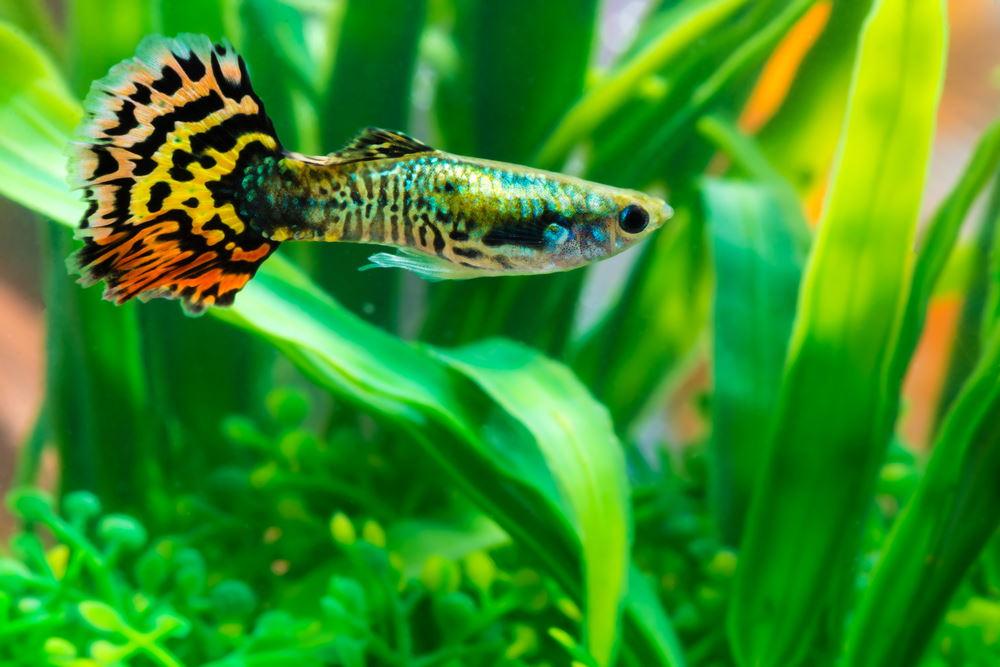
Select fish with even rays and no clamping or tears. Choose active fish with open fins, a straight body, clear eyes, steady breathing, and no white spots or frayed edges. Quarantine new arrivals when possible because colorful imported strains may have been exposed to different water conditions and pathogens.
3. Veil Tail Guppy
Veil Tail Guppy is best classified as a tail shape. Its defining feature is a long flowing tail that drapes behind the body. Because fancy guppies combine multiple inherited traits, an individual may fit this category while also carrying another tail, pattern, or color label.
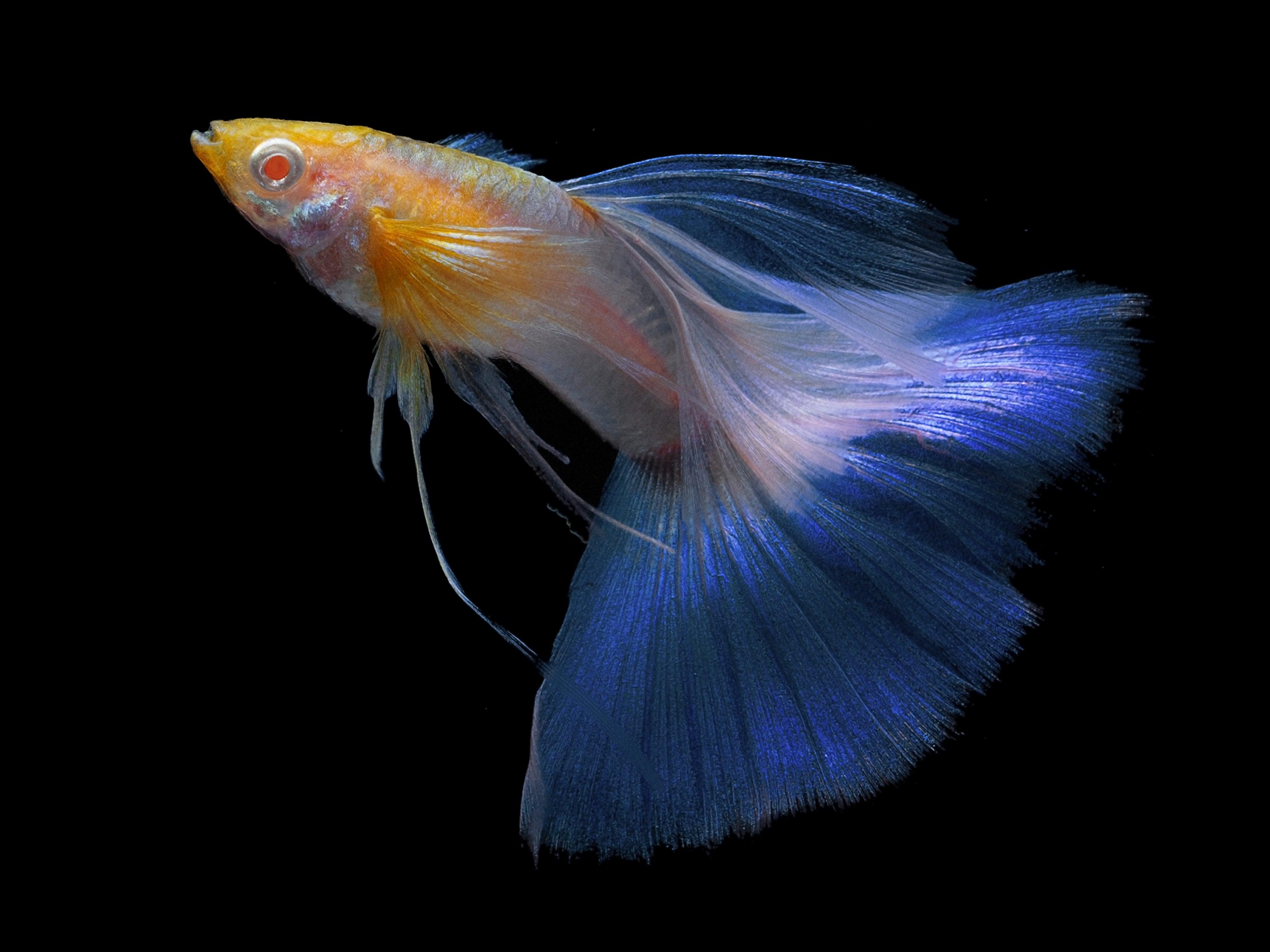
Avoid persistent fin nippers and sharp decorations. Choose active fish with open fins, a straight body, clear eyes, steady breathing, and no white spots or frayed edges. Quarantine new arrivals when possible because colorful imported strains may have been exposed to different water conditions and pathogens.
4. Flag Tail Guppy
Flag Tail Guppy is best classified as a tail shape. Its defining feature is a rectangular tail resembling a small flag. Because fancy guppies combine multiple inherited traits, an individual may fit this category while also carrying another tail, pattern, or color label.
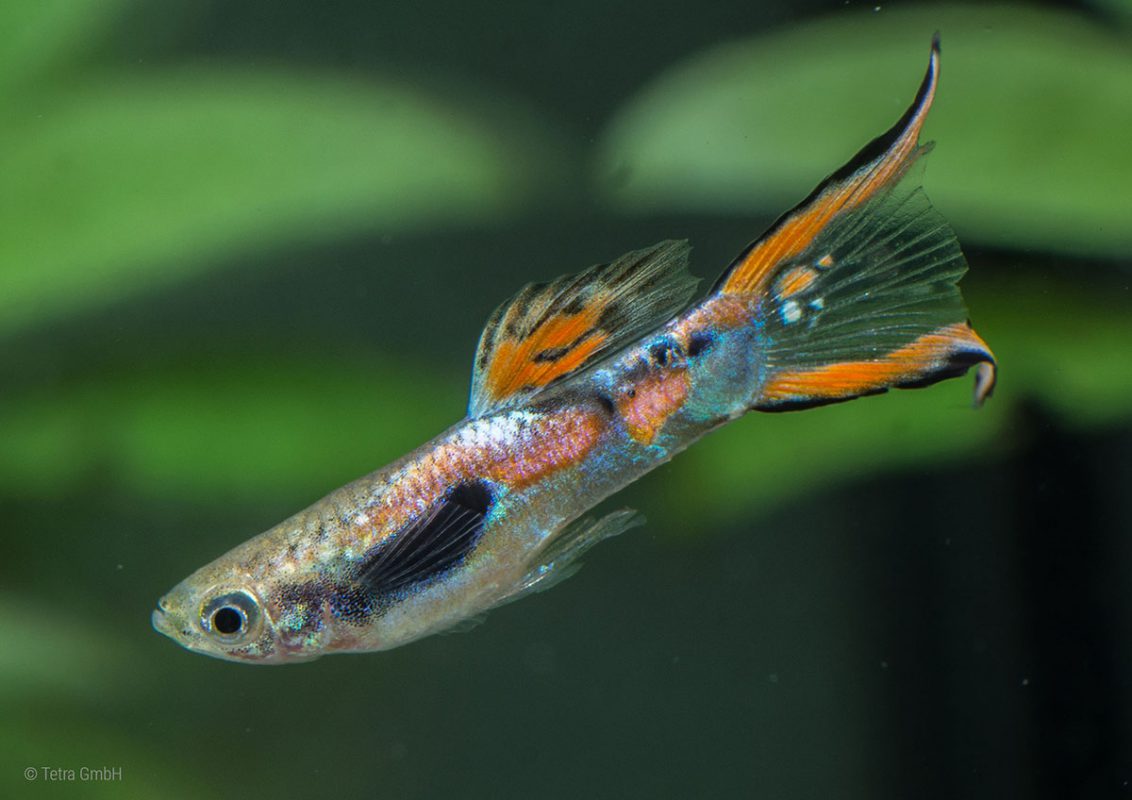
The shorter shape can be easier to swim with than oversized fancy tails. Choose active fish with open fins, a straight body, clear eyes, steady breathing, and no white spots or frayed edges. Quarantine new arrivals when possible because colorful imported strains may have been exposed to different water conditions and pathogens.
5. Round Tail Guppy
Round Tail Guppy is best classified as a tail shape. Its defining feature is a compact circular tail close to the wild-type outline. Because fancy guppies combine multiple inherited traits, an individual may fit this category while also carrying another tail, pattern, or color label.
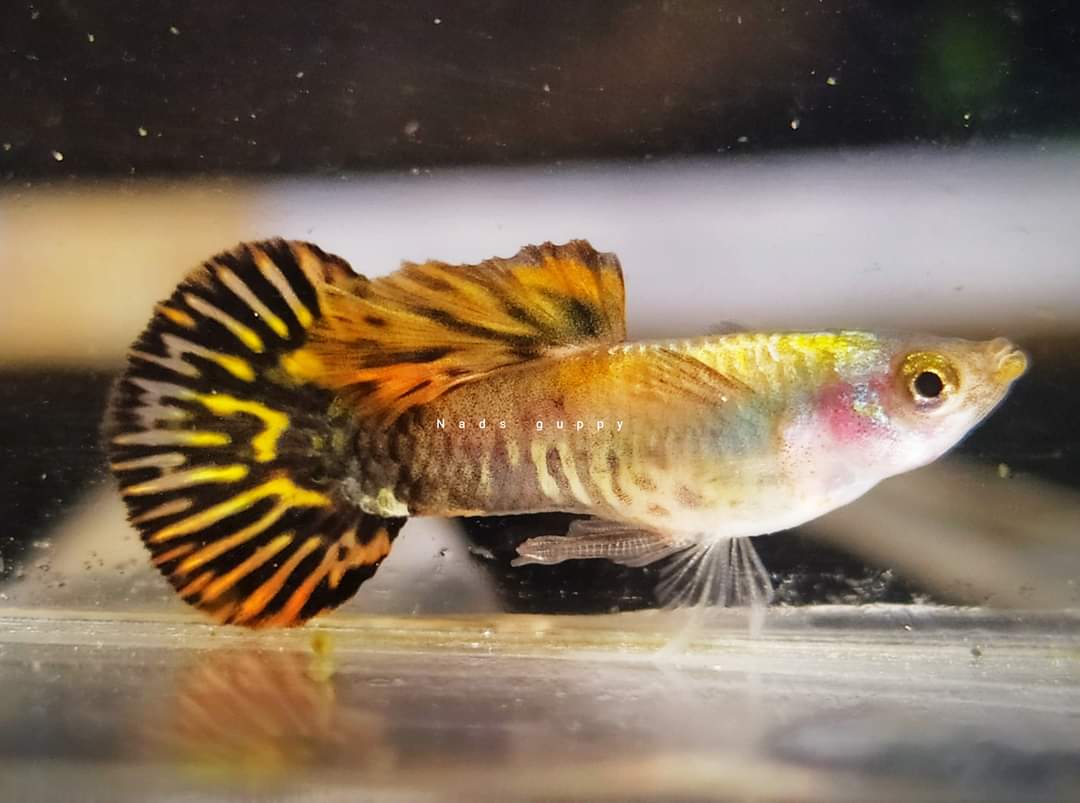
Often active and practical for community aquariums. Choose active fish with open fins, a straight body, clear eyes, steady breathing, and no white spots or frayed edges. Quarantine new arrivals when possible because colorful imported strains may have been exposed to different water conditions and pathogens.
6. Spade Tail Guppy
Spade Tail Guppy is best classified as a tail shape. Its defining feature is a pointed spade-shaped caudal fin. Because fancy guppies combine multiple inherited traits, an individual may fit this category while also carrying another tail, pattern, or color label.
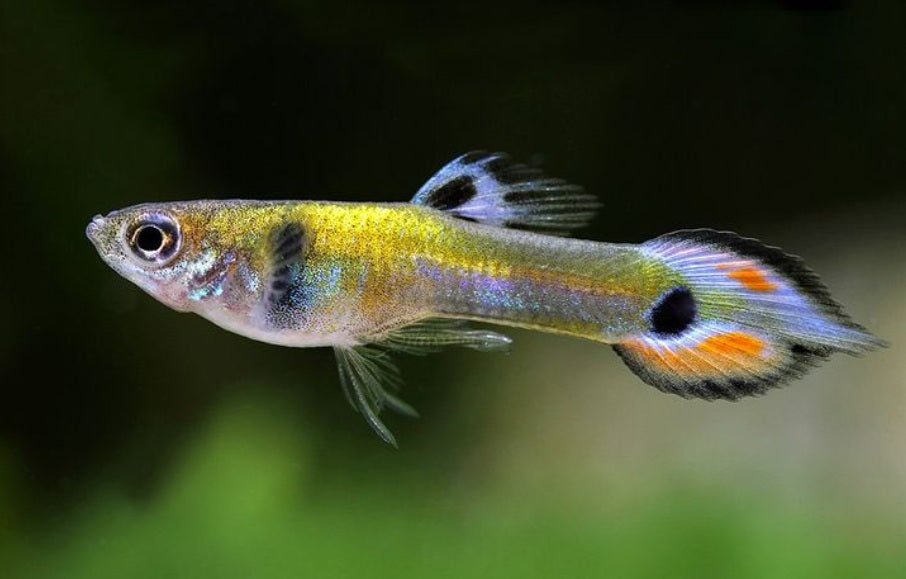
Best judged from the side when the fish is swimming calmly. Choose active fish with open fins, a straight body, clear eyes, steady breathing, and no white spots or frayed edges. Quarantine new arrivals when possible because colorful imported strains may have been exposed to different water conditions and pathogens.
7. Spear Tail Guppy
Spear Tail Guppy is best classified as a tail shape. Its defining feature is a narrow tail ending in a spear-like point. Because fancy guppies combine multiple inherited traits, an individual may fit this category while also carrying another tail, pattern, or color label.
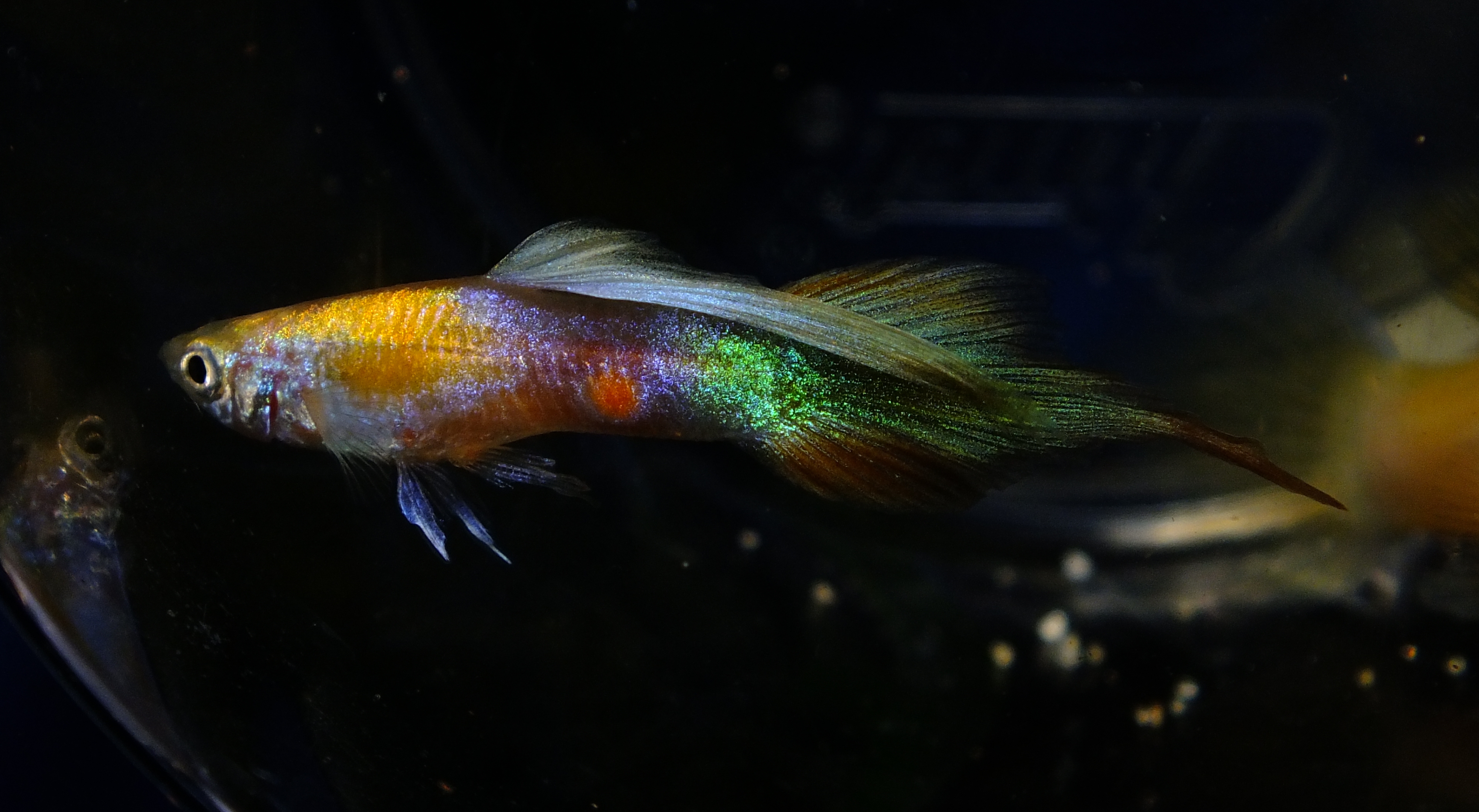
Do not confuse it with a pin tail, which has a thinner central extension. Choose active fish with open fins, a straight body, clear eyes, steady breathing, and no white spots or frayed edges. Quarantine new arrivals when possible because colorful imported strains may have been exposed to different water conditions and pathogens.
8. Pin Tail Guppy
Pin Tail Guppy is best classified as a tail shape. Its defining feature is a rounded base with a slender central ray extension. Because fancy guppies combine multiple inherited traits, an individual may fit this category while also carrying another tail, pattern, or color label.

Fin shape should be naturally symmetrical rather than damaged. Choose active fish with open fins, a straight body, clear eyes, steady breathing, and no white spots or frayed edges. Quarantine new arrivals when possible because colorful imported strains may have been exposed to different water conditions and pathogens.
9. Top Swordtail Guppy
Top Swordtail Guppy is best classified as a tail shape. Its defining feature is an extended upper caudal ray forms a single sword. Because fancy guppies combine multiple inherited traits, an individual may fit this category while also carrying another tail, pattern, or color label.

Provide open swimming room and avoid fish that chase long fins. Choose active fish with open fins, a straight body, clear eyes, steady breathing, and no white spots or frayed edges. Quarantine new arrivals when possible because colorful imported strains may have been exposed to different water conditions and pathogens.
10. Bottom Swordtail Guppy
Bottom Swordtail Guppy is best classified as a tail shape. Its defining feature is an extended lower caudal ray creates the sword. Because fancy guppies combine multiple inherited traits, an individual may fit this category while also carrying another tail, pattern, or color label.

The extension should be straight and supported by healthy rays. Choose active fish with open fins, a straight body, clear eyes, steady breathing, and no white spots or frayed edges. Quarantine new arrivals when possible because colorful imported strains may have been exposed to different water conditions and pathogens.
11. Double Swordtail Guppy
Double Swordtail Guppy is best classified as a tail shape. Its defining feature is upper and lower rays extend while the center remains shorter. Because fancy guppies combine multiple inherited traits, an individual may fit this category while also carrying another tail, pattern, or color label.
One of the most recognizable fancy tail forms. Choose active fish with open fins, a straight body, clear eyes, steady breathing, and no white spots or frayed edges. Quarantine new arrivals when possible because colorful imported strains may have been exposed to different water conditions and pathogens.
12. Lyretail Guppy
Lyretail Guppy is best classified as a tail shape. Its defining feature is curved upper and lower extensions create a lyre outline. Because fancy guppies combine multiple inherited traits, an individual may fit this category while also carrying another tail, pattern, or color label.
Quality strains show balanced extensions rather than ragged fins. Choose active fish with open fins, a straight body, clear eyes, steady breathing, and no white spots or frayed edges. Quarantine new arrivals when possible because colorful imported strains may have been exposed to different water conditions and pathogens.
13. Swallowtail Guppy
Swallowtail Guppy is best classified as a fin form. Its defining feature is multiple elongated fin rays give a feathered or split appearance. Because fancy guppies combine multiple inherited traits, an individual may fit this category while also carrying another tail, pattern, or color label.
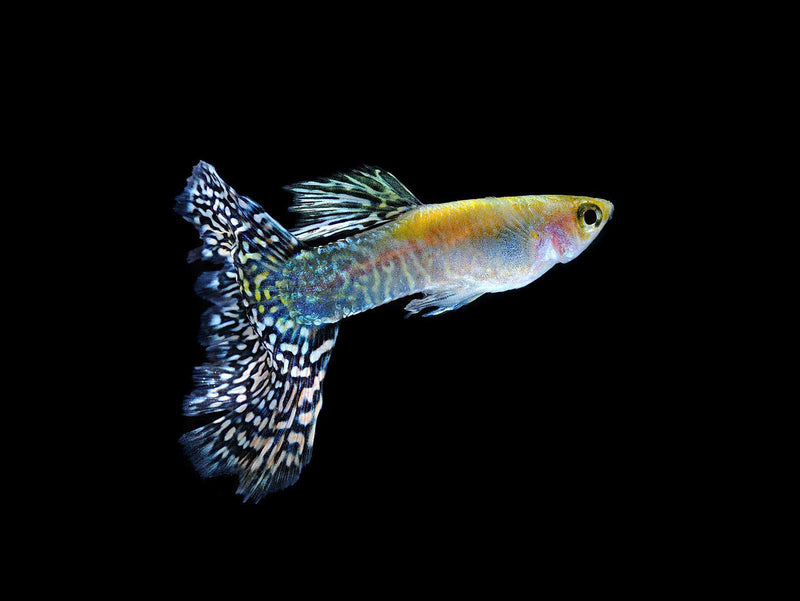
This dramatic trait can be delicate and requires calm tankmates. Choose active fish with open fins, a straight body, clear eyes, steady breathing, and no white spots or frayed edges. Quarantine new arrivals when possible because colorful imported strains may have been exposed to different water conditions and pathogens.
14. Ribbon Guppy
Ribbon Guppy is best classified as a fin form. Its defining feature is elongated fins, often including long pelvic or anal fin rays. Because fancy guppies combine multiple inherited traits, an individual may fit this category while also carrying another tail, pattern, or color label.
Some males with extreme ribbon traits may have reduced breeding ability. Choose active fish with open fins, a straight body, clear eyes, steady breathing, and no white spots or frayed edges. Quarantine new arrivals when possible because colorful imported strains may have been exposed to different water conditions and pathogens.
15. Cobra Guppy
Cobra Guppy is best classified as a pattern. Its defining feature is chain-like vertical markings spread across the body and tail. Because fancy guppies combine multiple inherited traits, an individual may fit this category while also carrying another tail, pattern, or color label.
Also called snakeskin in some trade lines, so labels can overlap. Choose active fish with open fins, a straight body, clear eyes, steady breathing, and no white spots or frayed edges. Quarantine new arrivals when possible because colorful imported strains may have been exposed to different water conditions and pathogens.
16. Snakeskin Guppy
Snakeskin Guppy is best classified as a pattern. Its defining feature is fine rosettes or linked reticulation cover much of the body. Because fancy guppies combine multiple inherited traits, an individual may fit this category while also carrying another tail, pattern, or color label.
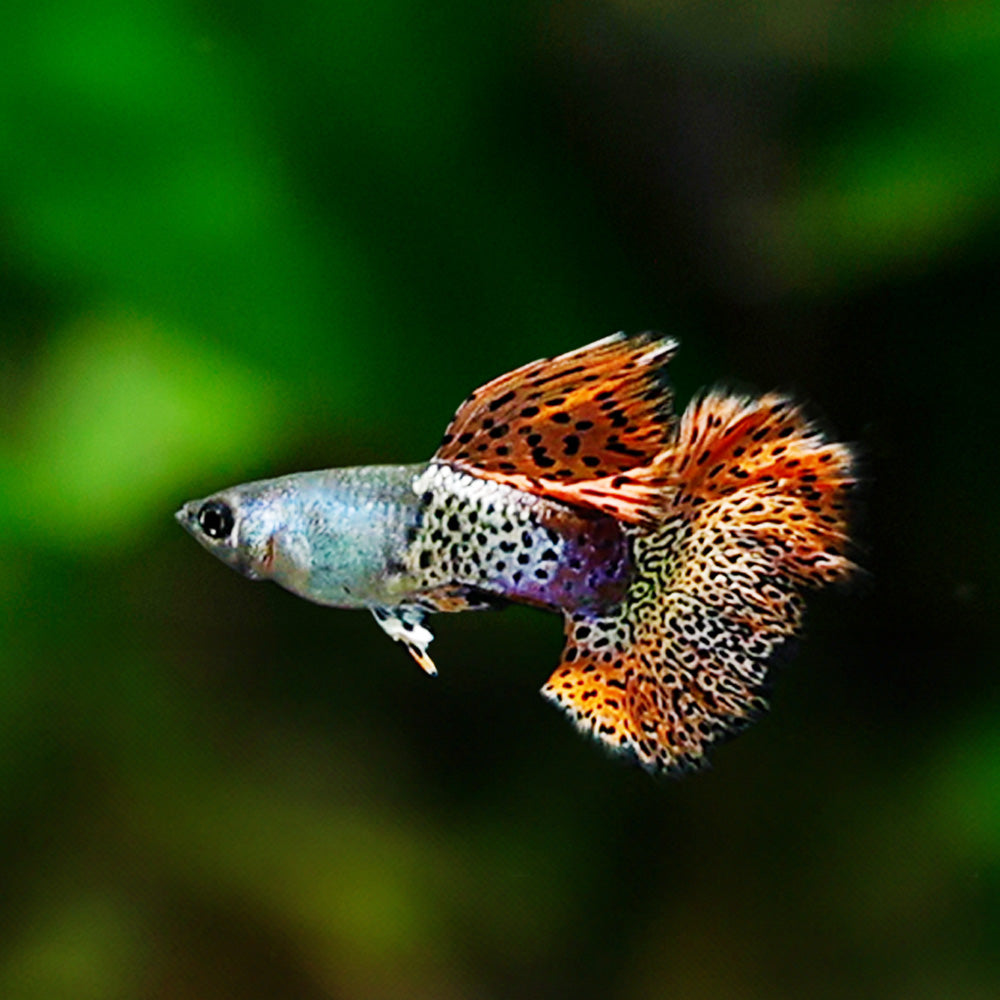
Pattern quality is easier to judge on mature males. Choose active fish with open fins, a straight body, clear eyes, steady breathing, and no white spots or frayed edges. Quarantine new arrivals when possible because colorful imported strains may have been exposed to different water conditions and pathogens.
17. Mosaic Guppy
Mosaic Guppy is best classified as a pattern. Its defining feature is irregular connected patches form a stained-glass tail design. Because fancy guppies combine multiple inherited traits, an individual may fit this category while also carrying another tail, pattern, or color label.
Commonly combined with red, blue, or multicolor backgrounds. Choose active fish with open fins, a straight body, clear eyes, steady breathing, and no white spots or frayed edges. Quarantine new arrivals when possible because colorful imported strains may have been exposed to different water conditions and pathogens.
18. Grass Guppy
Grass Guppy is best classified as a pattern. Its defining feature is numerous tiny dots cover the tail and sometimes the dorsal fin. Because fancy guppies combine multiple inherited traits, an individual may fit this category while also carrying another tail, pattern, or color label.
Fine, even spotting is preferred in exhibition-style fish. Choose active fish with open fins, a straight body, clear eyes, steady breathing, and no white spots or frayed edges. Quarantine new arrivals when possible because colorful imported strains may have been exposed to different water conditions and pathogens.
19. Leopard Guppy
Leopard Guppy is best classified as a pattern. Its defining feature is larger rounded dark spots resemble leopard markings. Because fancy guppies combine multiple inherited traits, an individual may fit this category while also carrying another tail, pattern, or color label.
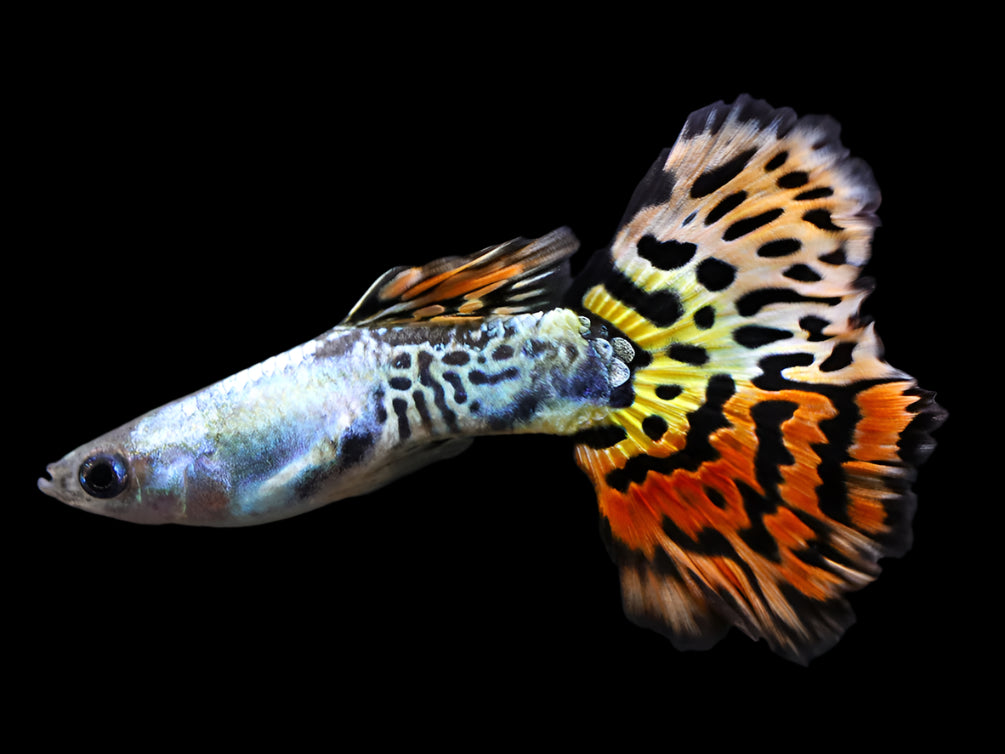
The pattern may appear on a yellow, red, blue, or mixed tail. Choose active fish with open fins, a straight body, clear eyes, steady breathing, and no white spots or frayed edges. Quarantine new arrivals when possible because colorful imported strains may have been exposed to different water conditions and pathogens.
20. Lace Guppy
Lace Guppy is best classified as a pattern. Its defining feature is very fine web-like patterning produces a delicate lace effect. Because fancy guppies combine multiple inherited traits, an individual may fit this category while also carrying another tail, pattern, or color label.
Good lighting reveals detail, but the tank should still offer shaded cover. Choose active fish with open fins, a straight body, clear eyes, steady breathing, and no white spots or frayed edges. Quarantine new arrivals when possible because colorful imported strains may have been exposed to different water conditions and pathogens.
21. Tuxedo Guppy
Tuxedo Guppy is best classified as a color pattern. Its defining feature is the rear half of the body is dark, contrasting with a bright front and tail. Because fancy guppies combine multiple inherited traits, an individual may fit this category while also carrying another tail, pattern, or color label.
Also called half-black in many breeder lines. Choose active fish with open fins, a straight body, clear eyes, steady breathing, and no white spots or frayed edges. Quarantine new arrivals when possible because colorful imported strains may have been exposed to different water conditions and pathogens.
22. Half-Black Red Guppy
Half-Black Red Guppy is best classified as a color pattern. Its defining feature is dark rear body paired with a red caudal fin. Because fancy guppies combine multiple inherited traits, an individual may fit this category while also carrying another tail, pattern, or color label.
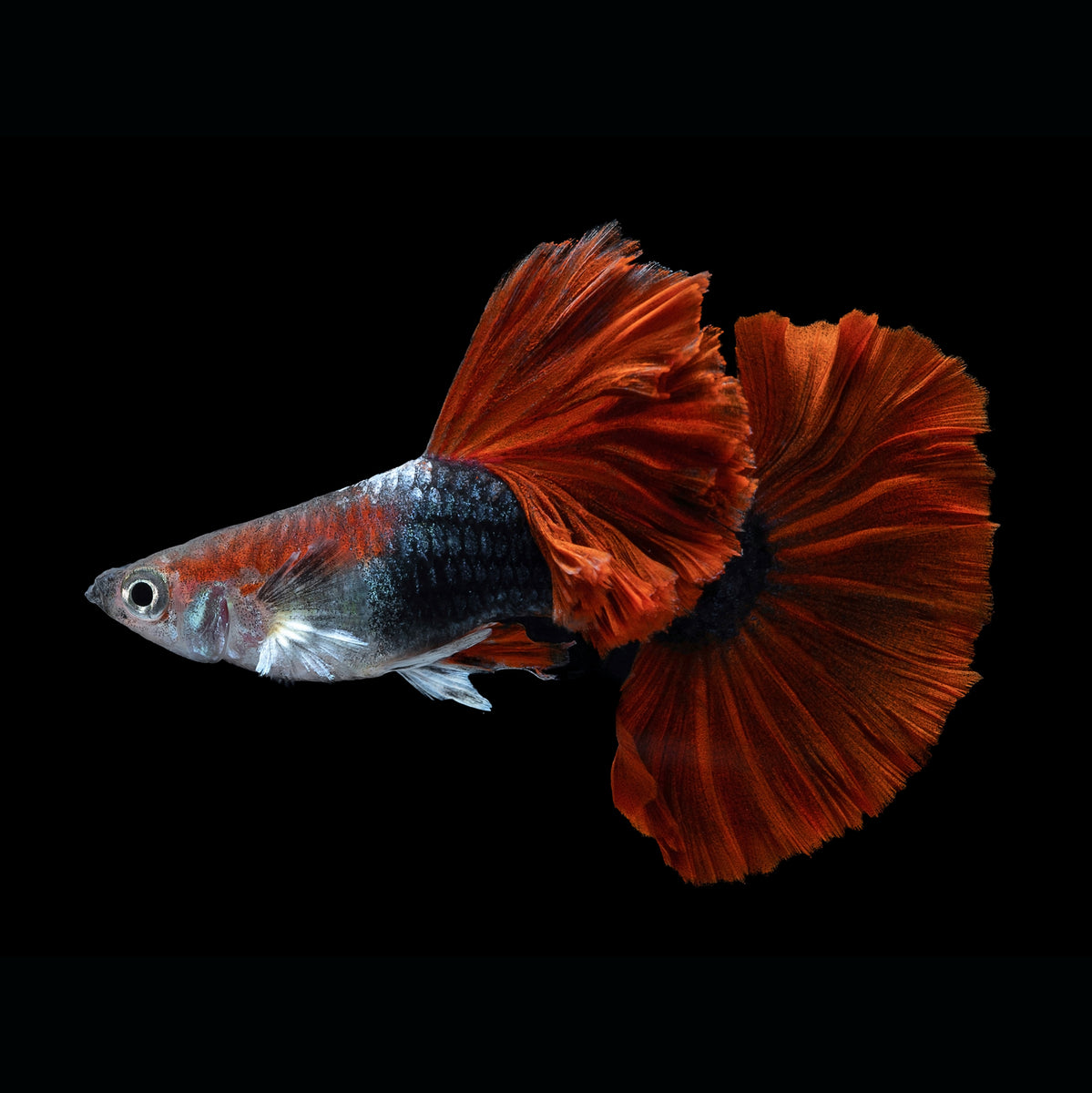
Clean separation between the dark body and red fins defines the look. Choose active fish with open fins, a straight body, clear eyes, steady breathing, and no white spots or frayed edges. Quarantine new arrivals when possible because colorful imported strains may have been exposed to different water conditions and pathogens.
23. Half-Black Blue Guppy
Half-Black Blue Guppy is best classified as a color pattern. Its defining feature is dark rear body with blue or blue-green fins. Because fancy guppies combine multiple inherited traits, an individual may fit this category while also carrying another tail, pattern, or color label.
Color can shift under different lighting and backgrounds. Choose active fish with open fins, a straight body, clear eyes, steady breathing, and no white spots or frayed edges. Quarantine new arrivals when possible because colorful imported strains may have been exposed to different water conditions and pathogens.
24. Metal Guppy
Metal Guppy is best classified as a color. Its defining feature is reflective metallic cells create a silver, blue, green, or bronze sheen. Because fancy guppies combine multiple inherited traits, an individual may fit this category while also carrying another tail, pattern, or color label.
The sheen may be concentrated near the head or cover much of the body. Choose active fish with open fins, a straight body, clear eyes, steady breathing, and no white spots or frayed edges. Quarantine new arrivals when possible because colorful imported strains may have been exposed to different water conditions and pathogens.
25. Platinum Guppy
Platinum Guppy is best classified as a color. Its defining feature is pale reflective body with a bright platinum-like finish. Because fancy guppies combine multiple inherited traits, an individual may fit this category while also carrying another tail, pattern, or color label.
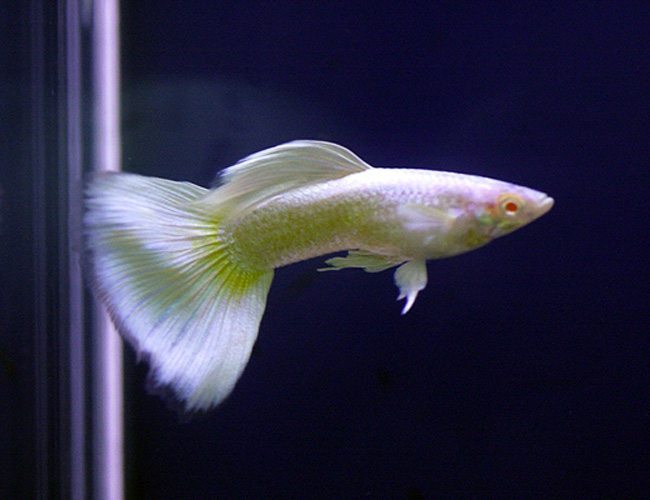
Use dark substrate or background to show the light body clearly. Choose active fish with open fins, a straight body, clear eyes, steady breathing, and no white spots or frayed edges. Quarantine new arrivals when possible because colorful imported strains may have been exposed to different water conditions and pathogens.
26. Albino Guppy
Albino Guppy is best classified as a color genetics. Its defining feature is reduced dark pigment and red or pink eyes. Because fancy guppies combine multiple inherited traits, an individual may fit this category while also carrying another tail, pattern, or color label.
Albino fish may be more light-sensitive and benefit from planted shade. Choose active fish with open fins, a straight body, clear eyes, steady breathing, and no white spots or frayed edges. Quarantine new arrivals when possible because colorful imported strains may have been exposed to different water conditions and pathogens.
27. Blonde Guppy
Blonde Guppy is best classified as a color genetics. Its defining feature is reduced black pigment creates a warm pale body. Because fancy guppies combine multiple inherited traits, an individual may fit this category while also carrying another tail, pattern, or color label.
Blonde is not the same as albino because the eyes remain normally pigmented. Choose active fish with open fins, a straight body, clear eyes, steady breathing, and no white spots or frayed edges. Quarantine new arrivals when possible because colorful imported strains may have been exposed to different water conditions and pathogens.
28. Full Red Guppy
Full Red Guppy is best classified as a color strain. Its defining feature is body and fins are bred for extensive red coverage. Because fancy guppies combine multiple inherited traits, an individual may fit this category while also carrying another tail, pattern, or color label.

Stable color, nutrition, health, and genetics all affect intensity. Choose active fish with open fins, a straight body, clear eyes, steady breathing, and no white spots or frayed edges. Quarantine new arrivals when possible because colorful imported strains may have been exposed to different water conditions and pathogens.
29. Full Blue Guppy
Full Blue Guppy is best classified as a color strain. Its defining feature is blue coloration covers most of the body and fins. Because fancy guppies combine multiple inherited traits, an individual may fit this category while also carrying another tail, pattern, or color label.
Blue may appear turquoise, steel, or violet under different light. Choose active fish with open fins, a straight body, clear eyes, steady breathing, and no white spots or frayed edges. Quarantine new arrivals when possible because colorful imported strains may have been exposed to different water conditions and pathogens.
30. Full Black Guppy
Full Black Guppy is best classified as a color strain. Its defining feature is dense dark pigment covers the body and fins. Because fancy guppies combine multiple inherited traits, an individual may fit this category while also carrying another tail, pattern, or color label.
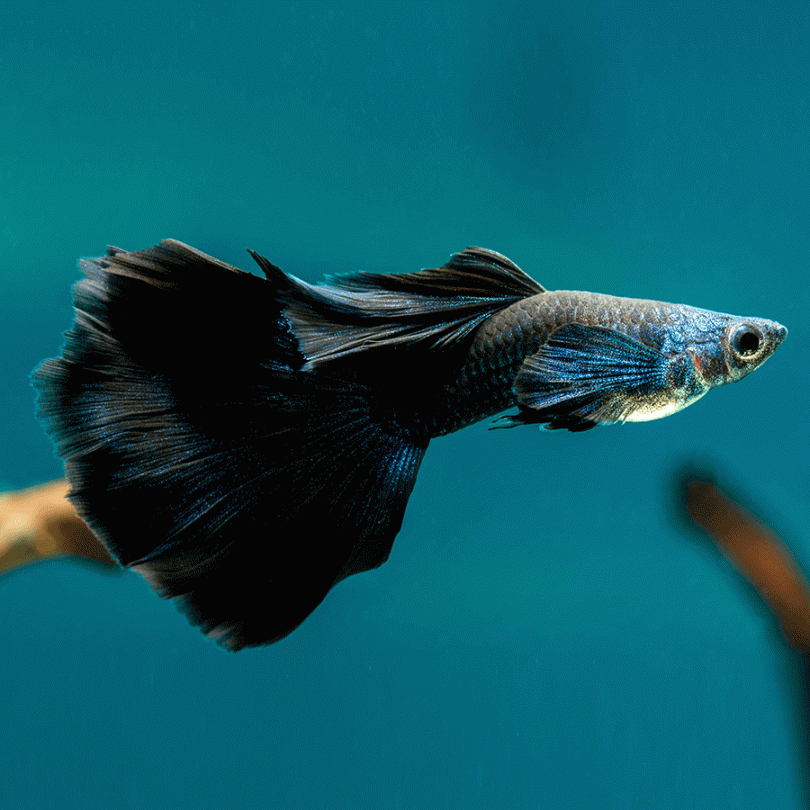
Maintaining broad, even black coverage can be challenging in breeding lines. Choose active fish with open fins, a straight body, clear eyes, steady breathing, and no white spots or frayed edges. Quarantine new arrivals when possible because colorful imported strains may have been exposed to different water conditions and pathogens.
31. Yellow Guppy
Yellow Guppy is best classified as a color strain. Its defining feature is yellow or golden fins and body areas dominate the pattern. Because fancy guppies combine multiple inherited traits, an individual may fit this category while also carrying another tail, pattern, or color label.
Black background and balanced lighting improve visibility. Choose active fish with open fins, a straight body, clear eyes, steady breathing, and no white spots or frayed edges. Quarantine new arrivals when possible because colorful imported strains may have been exposed to different water conditions and pathogens.
32. Purple Guppy
Purple Guppy is best classified as a color strain. Its defining feature is violet and purple tones appear across the body and fins. Because fancy guppies combine multiple inherited traits, an individual may fit this category while also carrying another tail, pattern, or color label.
Many purple strains also show blue depending on viewing angle. Choose active fish with open fins, a straight body, clear eyes, steady breathing, and no white spots or frayed edges. Quarantine new arrivals when possible because colorful imported strains may have been exposed to different water conditions and pathogens.
33. Blue Moscow Guppy
Blue Moscow Guppy is best classified as a moscow strain. Its defining feature is deep blue iridescence extends from head through the tail. Because fancy guppies combine multiple inherited traits, an individual may fit this category while also carrying another tail, pattern, or color label.
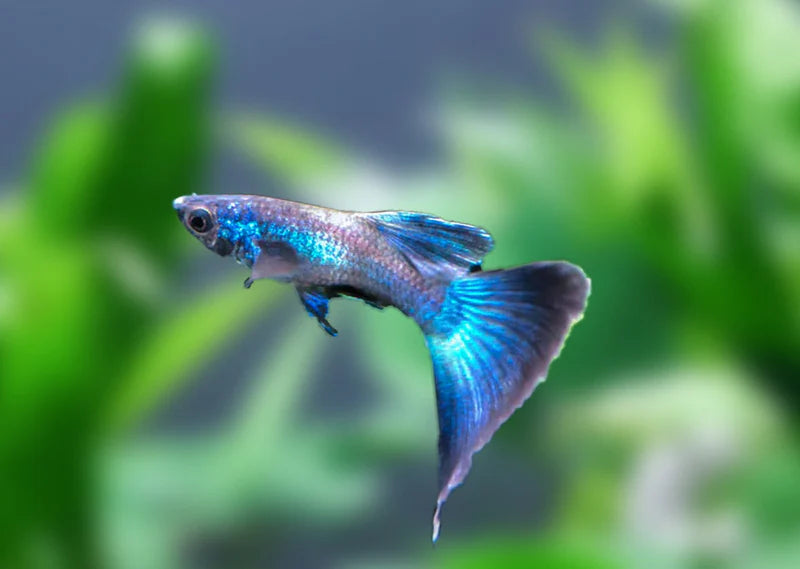
Moscow lines are known for strong body-wide color. Choose active fish with open fins, a straight body, clear eyes, steady breathing, and no white spots or frayed edges. Quarantine new arrivals when possible because colorful imported strains may have been exposed to different water conditions and pathogens.
34. Black Moscow Guppy
Black Moscow Guppy is best classified as a moscow strain. Its defining feature is very dark body and fins create a nearly solid black fish. Because fancy guppies combine multiple inherited traits, an individual may fit this category while also carrying another tail, pattern, or color label.
Good specimens retain a smooth, even dark tone. Choose active fish with open fins, a straight body, clear eyes, steady breathing, and no white spots or frayed edges. Quarantine new arrivals when possible because colorful imported strains may have been exposed to different water conditions and pathogens.
35. Green Moscow Guppy
Green Moscow Guppy is best classified as a moscow strain. Its defining feature is metallic green or blue-green color covers most of the fish. Because fancy guppies combine multiple inherited traits, an individual may fit this category while also carrying another tail, pattern, or color label.

Color is structural and changes with angle and illumination. Choose active fish with open fins, a straight body, clear eyes, steady breathing, and no white spots or frayed edges. Quarantine new arrivals when possible because colorful imported strains may have been exposed to different water conditions and pathogens.
36. Koi Guppy
Koi Guppy is best classified as a color pattern. Its defining feature is orange or red on the head and tail contrasts with a paler body. Because fancy guppies combine multiple inherited traits, an individual may fit this category while also carrying another tail, pattern, or color label.

The name describes a koi-like color arrangement, not a relationship to koi carp. Choose active fish with open fins, a straight body, clear eyes, steady breathing, and no white spots or frayed edges. Quarantine new arrivals when possible because colorful imported strains may have been exposed to different water conditions and pathogens.
37. Dragon Guppy
Dragon Guppy is best classified as a pattern strain. Its defining feature is metallic body scales combine with bold patterned fins. Because fancy guppies combine multiple inherited traits, an individual may fit this category while also carrying another tail, pattern, or color label.
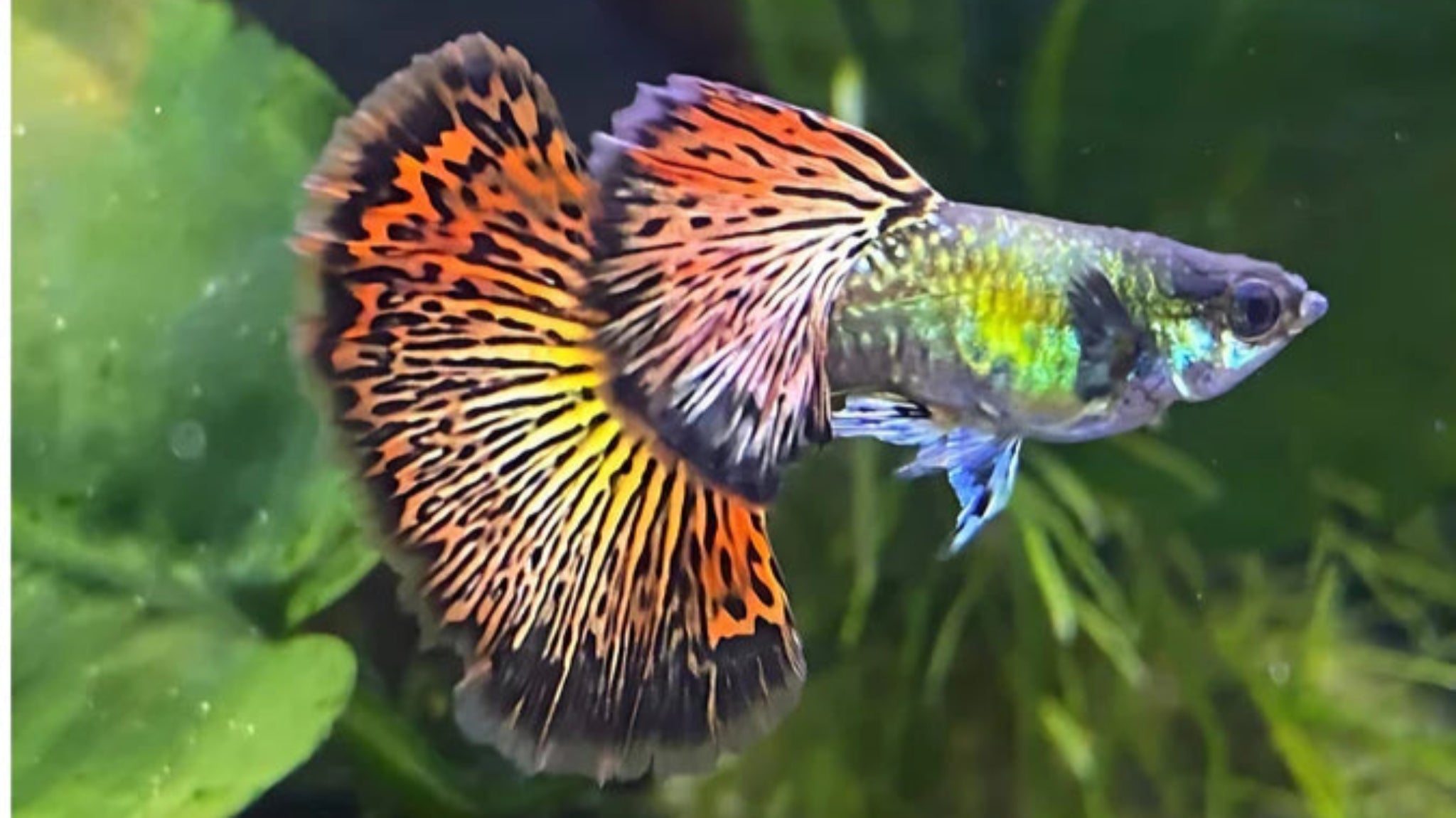
Breeder use of the word “dragon” varies, so inspect the actual fish. Choose active fish with open fins, a straight body, clear eyes, steady breathing, and no white spots or frayed edges. Quarantine new arrivals when possible because colorful imported strains may have been exposed to different water conditions and pathogens.
38. Dumbo Ear Guppy
Dumbo Ear Guppy is best classified as a fin trait. Its defining feature is enlarged colorful pectoral fins resemble elephant ears. Because fancy guppies combine multiple inherited traits, an individual may fit this category while also carrying another tail, pattern, or color label.
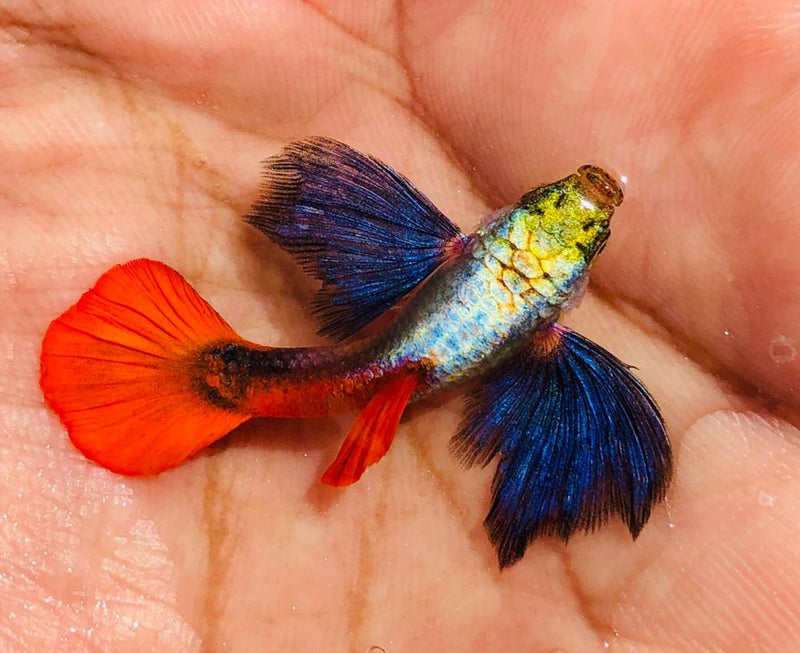
The trait can be combined with many tail and body colors. Choose active fish with open fins, a straight body, clear eyes, steady breathing, and no white spots or frayed edges. Quarantine new arrivals when possible because colorful imported strains may have been exposed to different water conditions and pathogens.
39. Galaxy Guppy
Galaxy Guppy is best classified as a pattern strain. Its defining feature is dense mixed spots, metallic patches, and multicolor markings create a starry look. Because fancy guppies combine multiple inherited traits, an individual may fit this category while also carrying another tail, pattern, or color label.
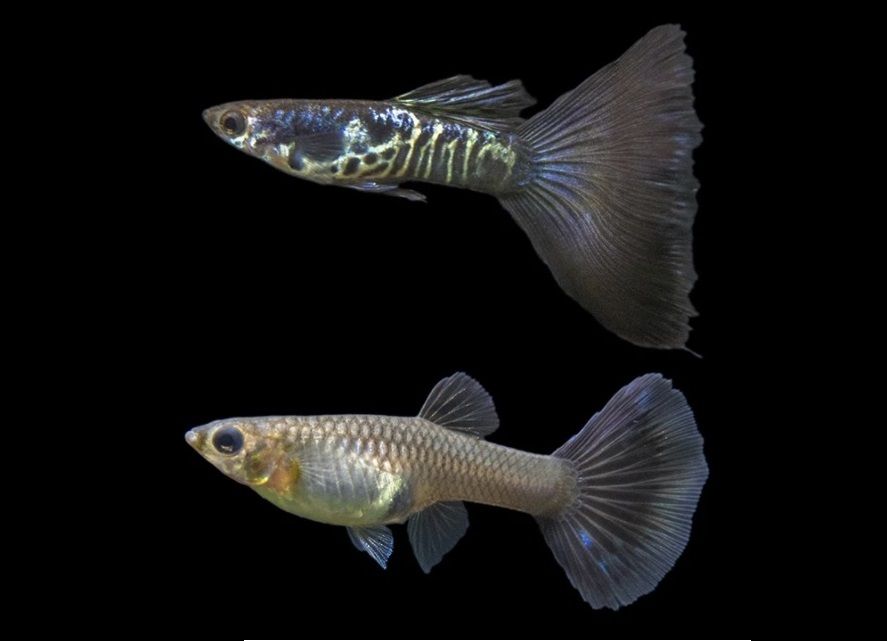
Names and exact genetics differ among breeders. Choose active fish with open fins, a straight body, clear eyes, steady breathing, and no white spots or frayed edges. Quarantine new arrivals when possible because colorful imported strains may have been exposed to different water conditions and pathogens.
40. Japan Blue Guppy
Japan Blue Guppy is best classified as a color strain. Its defining feature is a bright electric-blue area usually runs along the rear body or peduncle. Because fancy guppies combine multiple inherited traits, an individual may fit this category while also carrying another tail, pattern, or color label.
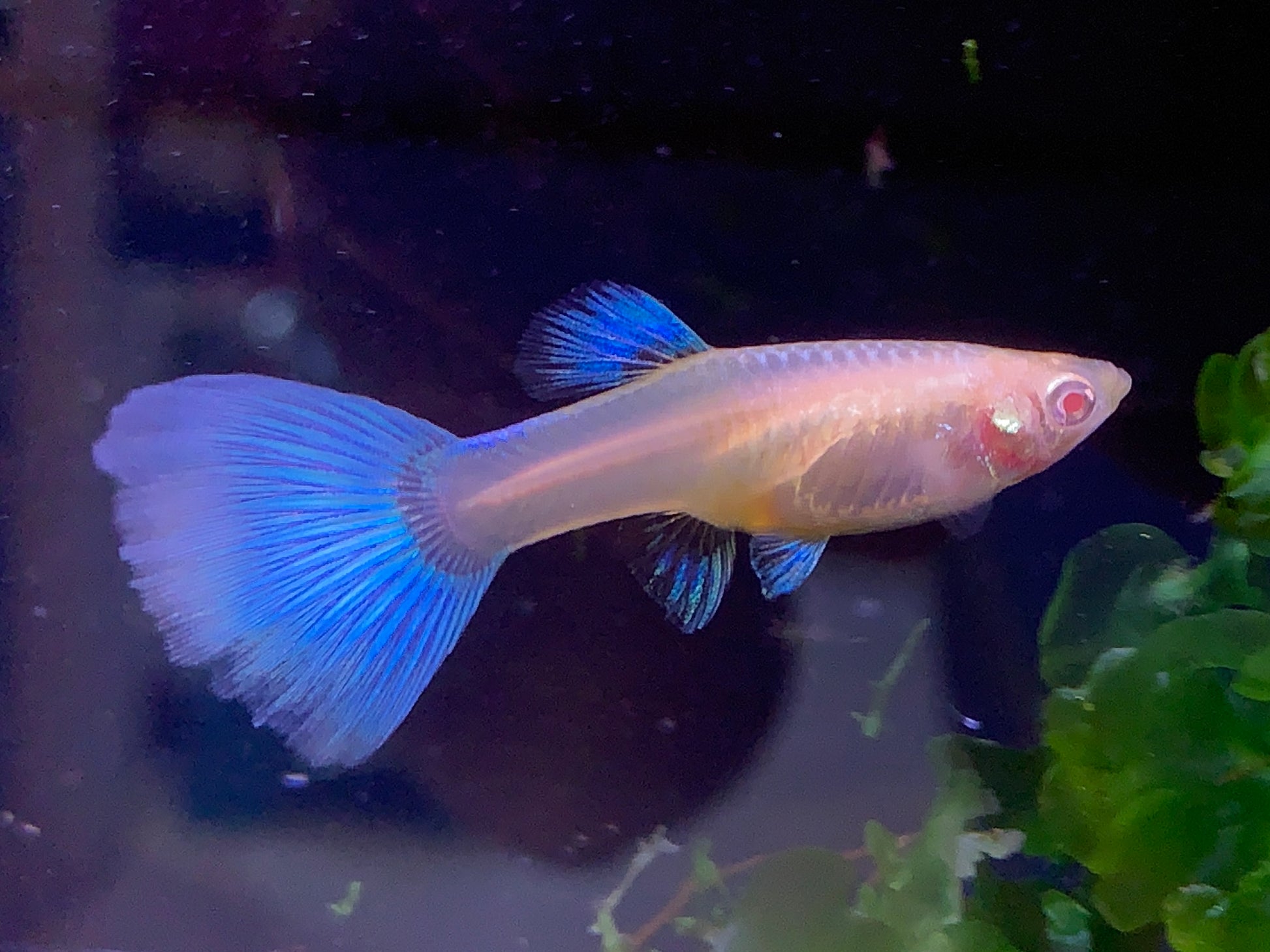
Often crossed with sword, red-tail, or Endler-influenced lines. Choose active fish with open fins, a straight body, clear eyes, steady breathing, and no white spots or frayed edges. Quarantine new arrivals when possible because colorful imported strains may have been exposed to different water conditions and pathogens.
How Are These Types of Fish Classified?
| Classification | Examples | What it describes |
|---|---|---|
| Tail shape | Delta, fan, veil, flag, round, sword, lyre | The outline and ray structure of the caudal fin. |
| Pattern | Cobra, snakeskin, mosaic, grass, leopard, lace | How spots, lines, rosettes, or reticulation are arranged. |
| Color strain | Full red, full blue, yellow, purple, Moscow | The dominant body and fin coloration. |
| Pigment genetics | Albino, blonde, platinum, metal | Underlying pigment reduction or reflective cells. |
| Special fin trait | Dumbo ear, ribbon, swallowtail | Unusual enlargement or elongation of fins. |
Where Do Guppy Fish Come From?
Wild guppies are native to parts of northeastern South America and the southern Caribbean. They have also been introduced widely in warm regions. Domestic fancy guppies are captive-bred and can look very different from wild fish, especially in tail size, body color, and pattern.
How to Identify Different Types of Guppy Fish
- Start with tail outline: decide whether it is triangular, round, flag-shaped, pointed, or extended into one or two swords.
- Separate body and tail pattern: mosaic, grass, leopard, lace, and snakeskin describe different marking scales.
- Look at the base body color: gray, blonde, albino, metallic, and platinum backgrounds change how other colors appear.
- Check pectoral fins: dumbo ear guppies have enlarged, often brightly colored pectorals.
- Use mature males: juvenile fish may not yet show the full tail or color pattern.
- Expect overlap: breeder names can describe combinations rather than exclusive categories.
Aquarium Care Notes
- Use a fully cycled, filtered aquarium with stable temperature and water chemistry.
- Keep guppies in groups and provide more females than males in mixed-sex groups to reduce persistent courtship pressure.
- Offer quality flakes or micro pellets plus varied frozen or live foods in sensible portions.
- Include plants and cover, especially when fry are present.
- Avoid strong current for very large-tailed strains.
- Quarantine new fish and do not add store water to the main aquarium.
- Control breeding by separating sexes or planning safe homes for fry.
Safety, Sustainability, and Conservation Notes
Never release guppies into local waterways. They can establish outside their native range and affect native aquatic communities. Buy healthy captive-bred fish, avoid supporting lines produced through extreme inbreeding, and prioritize normal swimming, feeding, and reproduction over exaggerated fins or body shapes.
Fun Facts About Guppy Fish
- Guppies are livebearers, so females give birth to free-swimming young.
- A female can store sperm and produce later broods without another recent mating.
- Male guppies are usually smaller and more colorful than females.
- Tail shape and color are inherited separately and can be recombined.
- The name “millionfish” reflects their rapid breeding.
- Wild guppies are usually less ornate than domestic fancy strains.
- Moscow guppies are known for strong color extending over much of the body.
- Dumbo ear describes enlarged pectoral fins, not the tail.
- Albino and blonde are different pigment conditions.
- Endler’s livebearer is a closely related species, not simply another guppy color.
Final Thoughts on Types of Guppy Fish
The most useful way to understand types of guppy fish is to separate tail shape, pattern, base color, and special fin traits. Do not be surprised when one guppy has three or four valid descriptive names. Choose healthy, active fish, maintain stable water, prevent uncontrolled breeding, and value sound body structure as much as dramatic color.
Frequently Asked Questions
1. Are fancy guppies different species?
No. Most fancy guppies are domestic varieties of Poecilia reticulata.
2. How many types of guppies are there?
There is no fixed total because breeders continually combine colors, patterns, and tail shapes.
3. What is the most common guppy tail?
Delta and fan-shaped tails are among the most common in the aquarium trade.
4. What is the difference between a fan tail and delta tail?
Both are broad, but delta tails form a clearer triangular outline while fan tails are more rounded.
5. What is a swordtail guppy?
It is a guppy whose upper, lower, or both outer tail rays extend into sword-like points. It is not the same species as the swordtail livebearer.
6. What is a Moscow guppy?
Moscow is a strain group known for strong body-wide metallic color, including blue, green, purple, and black forms.
7. What is a dumbo ear guppy?
It has enlarged pectoral fins that look like rounded ears.
8. What is a tuxedo guppy?
A tuxedo or half-black guppy has a dark rear body that contrasts with the front and tail.
9. Are cobra and snakeskin guppies the same?
The terms overlap in trade, but snakeskin usually describes fine body reticulation while cobra may emphasize chain-like markings.
10. What is the difference between grass and leopard patterns?
Grass has many tiny dots; leopard has larger, more separated spots.
11. Are albino guppies blind?
No. They have reduced pigment and red or pink eyes, but healthy albino guppies can see.
12. Is a blonde guppy an albino?
No. Blonde guppies retain normal eye pigment and have reduced dark body pigment.
13. Do guppy colors change?
Color can intensify with maturity, diet, health, breeding condition, background, and lighting.
14. Why is my guppy losing color?
Stress, poor water quality, illness, bullying, aging, or inadequate diet may reduce color.
15. How large do guppies grow?
Females are generally larger and fuller-bodied than males, while males are smaller with longer ornamental fins.
16. How long do guppies live?
Many live around two to three years, although genetics and care can shorten or extend that range.
17. What temperature do guppies need?
They need stable tropical conditions. Use a heater when room temperature cannot keep the aquarium consistently appropriate.
18. Do guppies need a filter?
Yes. A properly sized filter supports biological filtration and stable water quality.
19. Can guppies live without a heater?
Only where the aquarium remains consistently warm enough. Temperature swings are a common problem.
20. How many guppies should be kept together?
Keep a social group sized for the tank and filtration. Avoid crowding and plan for rapid reproduction.
21. What male-to-female ratio is best?
Many keepers use at least two or three females per male to spread courtship pressure.
22. Can I keep only male guppies?
Yes. An all-male display can prevent fry, although some chasing may still occur.
23. Will guppies eat their fry?
Adults may eat fry. Dense plants and separation increase survival.
24. How often do guppies breed?
Healthy females can produce repeated broods under favorable conditions, which is why population control is important.
25. Can guppies store sperm?
Yes. Females can produce multiple broods after a prior mating.
26. What do guppies eat?
They are omnivores and do well on quality prepared food supplemented with small frozen or live foods and some plant material.
27. Why are guppy fins clamped?
Clamped fins can indicate stress, cold, poor water quality, bullying, or illness.
28. Can guppies live with bettas?
Sometimes, but long fins and bright colors can trigger aggression. Compatibility depends on individual behavior and tank setup.
29. Can guppies live with shrimp?
Adults may coexist with larger shrimp, but guppies may eat baby shrimp.
30. Should I add salt to a guppy tank?
Do not add salt routinely without a reason. It may be unsuitable for plants or tankmates and does not replace good water quality.
31. How often should I change guppy water?
Use regular partial water changes based on tank size, stocking, feeding, and test results rather than a rigid universal amount.
32. Why do fancy guppies get sick easily?
Some heavily selected lines have reduced genetic diversity and may be stressed by transport or sudden water changes.
33. What is guppy quarantine?
It is a separate observation period for new fish before they enter the main aquarium.
34. Is Endler’s livebearer a guppy?
It is a closely related species, Poecilia wingei. It can hybridize with guppies, but it should not be treated as merely a color variety.
35. Can I release unwanted guppies outside?
No. Rehome them through responsible aquarists or stores; releasing aquarium fish can be illegal and ecologically harmful.
Read more:
30 Types of Gourami Fish: Species and Care