

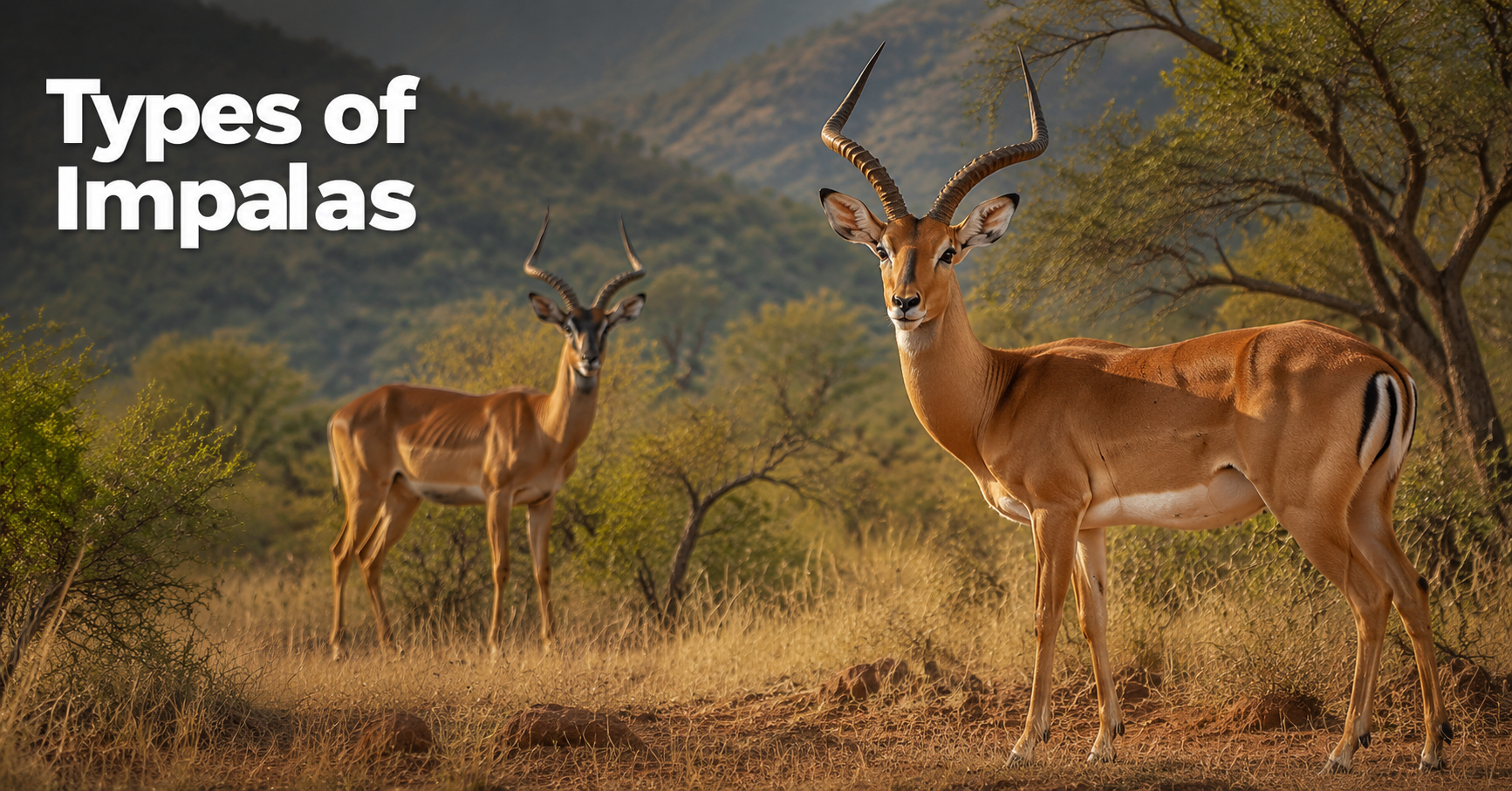
There are two commonly recognized types of impalas: the widespread common impala and the much more localized black-faced impala. Both are graceful African antelopes known for reddish coats, remarkable jumping ability, social herds, and the long, lyre-shaped horns carried by adult males.
This guide explains how the two impala types differ in appearance, size, geographic range, habitat, diet, behavior, and conservation needs. It also clarifies an important taxonomic issue: some authorities classify them as two subspecies, while others treat the black-faced impala as a separate species.
What Are the Main Types of Impalas?
The two living types of impalas are the common impala and the black-faced impala. Under the traditional classification, they are called Aepyceros melampus melampus and Aepyceros melampus petersi. Some newer taxonomic treatments recognize the black-faced form as a separate species, Aepyceros petersi, but both approaches describe the same two distinct living forms.
| Impala Type | Scientific Name | Key Identification Feature | Main Range |
|---|---|---|---|
| Common impala | Aepyceros melampus or A. m. melampus | Reddish-brown coat without a strong black facial stripe | Eastern and southern Africa |
| Black-faced impala | Aepyceros petersi or A. m. petersi | Dark facial stripe extending along the nose toward the forehead | Northwestern Namibia and southwestern Angola |
1. Common Impala
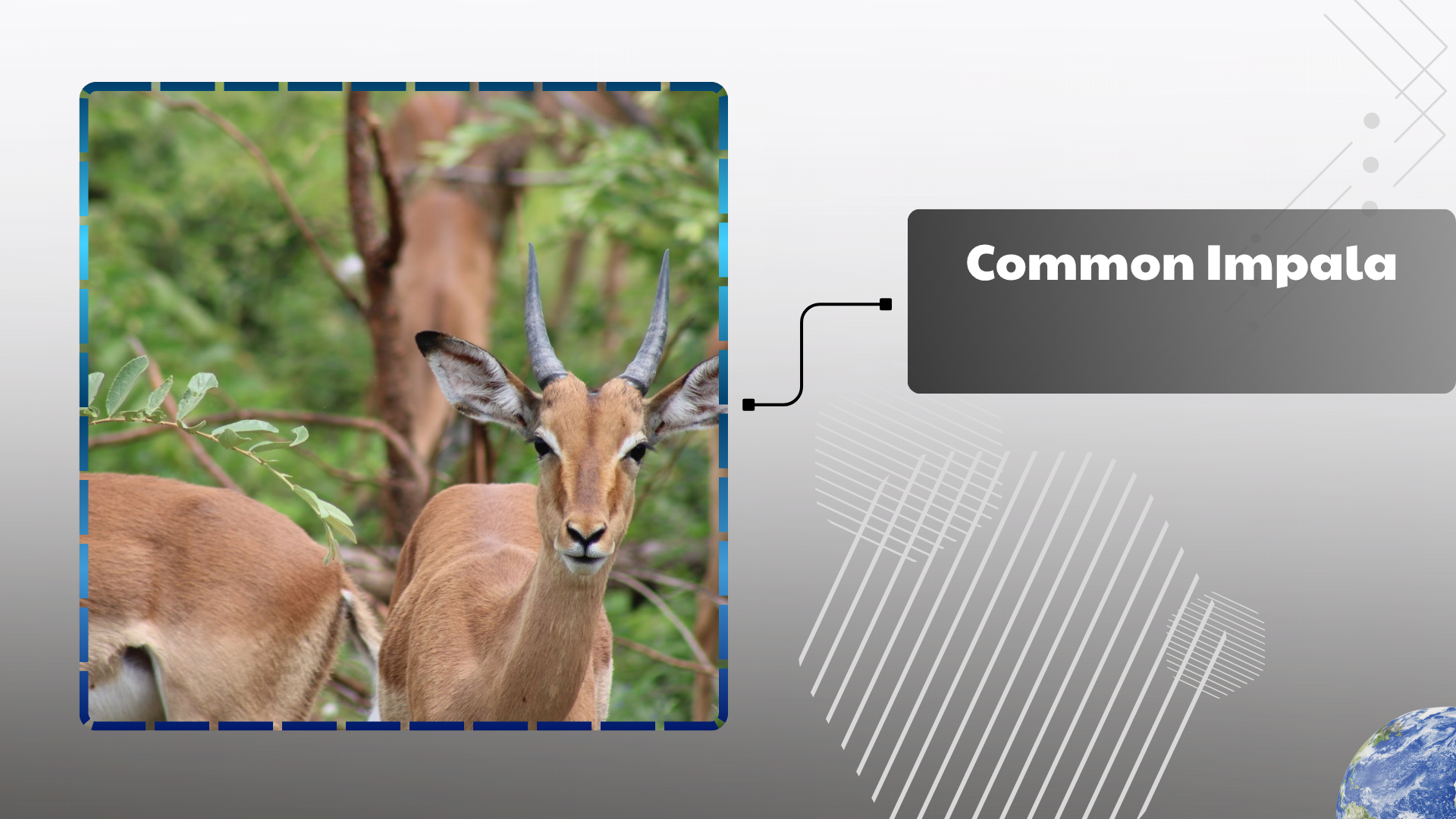
The common impala is the more widespread and familiar of the two types. It occurs across large parts of eastern and southern Africa, including areas of Kenya, Tanzania, Uganda, Zambia, Zimbabwe, Botswana, Mozambique, Malawi, Eswatini, and South Africa. It is frequently seen in wildlife reserves where woodland, savanna, short grass, and dependable water occur close together.
A common impala has a slender body, long legs, a reddish-brown back, tan flanks, and a sharply contrasting white belly. White markings appear around the eyes, above the hooves, under the chin, and around the rump. Black markings are visible on the tail and hindquarters. Seen from behind, these markings can resemble a dark letter M, which has led to the informal nickname “McDonald’s antelope.”
Adult males are larger than females and carry long, ridged horns that curve backward before sweeping outward and upward. The shape is often described as lyre-like. Females are naturally hornless, making sex identification relatively easy when the animals are fully visible. Adult shoulder height is generally about 70–92 centimeters, while body weight varies with sex, age, habitat, and condition.
Common impalas are mixed feeders. They graze on fresh grasses when rainy-season growth is available and switch increasingly to leaves, shoots, herbs, seedpods, and shrubs during drier periods. This ability to alternate between grazing and browsing helps them survive seasonal changes better than animals dependent on only one feeding strategy.
Females and young usually form herds, while young males may gather in bachelor groups. Mature males can become territorial during the breeding season, marking areas, vocalizing, displaying their horns, and challenging rivals. When alarmed, common impalas may scatter in a series of powerful leaps. This unpredictable escape pattern can make it difficult for predators to isolate one animal.
The common impala remains abundant across much of its range, especially in protected areas. Nevertheless, local populations can still be affected by habitat conversion, fencing, drought, illegal hunting, and disruption of access to water.
2. Black-Faced Impala
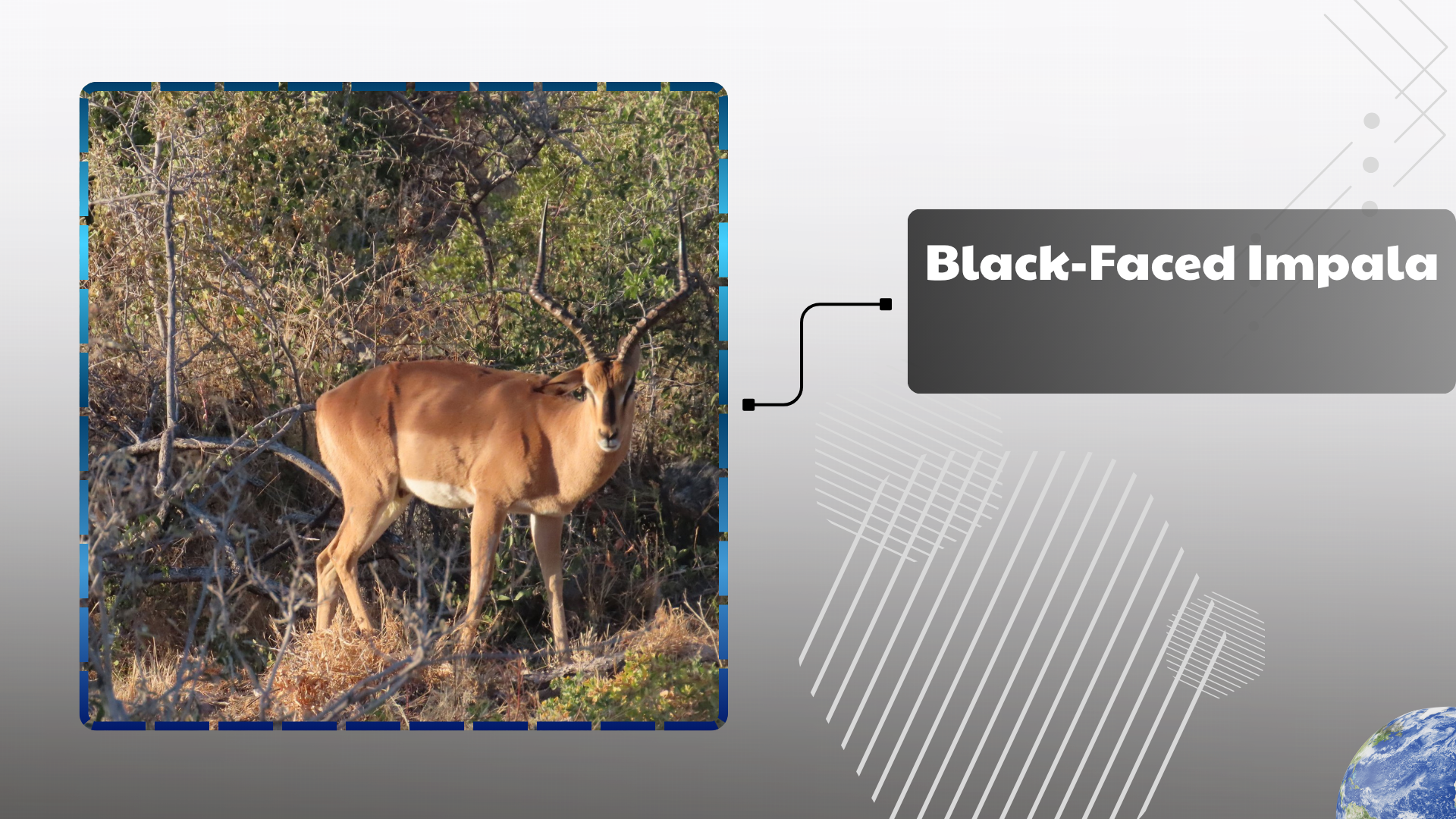
The black-faced impala is the rarer and more geographically restricted type. Its native range is centered in northwestern Namibia and southwestern Angola, particularly in dry savanna, open woodland, and scrub habitats. Managed and translocated populations also occur in protected or privately managed areas within Namibia.
Its most useful field mark is the dark stripe running along the front and sides of the nose toward the forehead and eyes. This facial marking is much stronger than the subtle dark coloration sometimes seen on common impalas. Black-faced impalas are also generally darker and somewhat larger in appearance, with more extensive black on the ears and a relatively bushy tail.
As with common impalas, only males grow horns. Their horns are ridged, hollow at the base, and curved into an elegant lyre shape. Females lack horns but retain the diagnostic facial pattern. Observers should examine the entire animal because shadows, mud, individual variation, and viewing distance can make one dark facial area misleading.
The black-faced impala occupies comparatively arid landscapes, but it still depends on habitats that provide suitable forage, shade, cover, and access to water. It feeds as both a grazer and browser, changing its diet according to seasonal plant availability. Fresh grass is especially valuable after rainfall, while leaves, shoots, herbs, and shrubs become increasingly important during dry periods.
Its social behavior follows the general impala pattern. Females and young gather in herds, nonterritorial males may form bachelor groups, and mature males compete for breeding access. Alarmed animals use sharp turns, sudden acceleration, and high bounding leaps to escape predators such as leopards, cheetahs, wild dogs, lions, and hyenas.
The black-faced impala requires greater conservation attention because of its limited natural distribution. Small or separated populations are more vulnerable to drought, habitat change, poaching, disease, and genetic problems. Conservation programs must also avoid uncontrolled mixing with common impalas, since hybridization could weaken the genetic identity of the black-faced form.
Are There Two Impala Species or Two Subspecies?
Impala classification varies among scientific references. The traditional arrangement recognizes one living species, Aepyceros melampus, divided into two subspecies:
- Common impala: Aepyceros melampus melampus
- Black-faced impala: Aepyceros melampus petersi
Some modern taxonomic authorities elevate the black-faced impala to full species status as Aepyceros petersi. Under that system, the genus Aepyceros contains two living species: A. melampus and A. petersi.
This disagreement does not mean that additional living impala types have been discovered. It reflects different interpretations of genetic, geographic, and physical differences between the same two forms. Older publications have proposed additional regional races, but most modern summaries focus on the common and black-faced impalas.
How Are These Wild Animals Classified?
| Taxonomic Level | Classification |
|---|---|
| Kingdom | Animalia |
| Phylum | Chordata |
| Class | Mammalia |
| Order | Artiodactyla |
| Family | Bovidae |
| Subfamily | Antilopinae |
| Tribe | Aepycerotini |
| Genus | Aepyceros |
Impalas belong to Bovidae, the family containing cattle, sheep, goats, and many other antelopes. They are even-toed hoofed mammals and ruminants, meaning they digest plant material through a specialized multi-chambered stomach.
The living impala lineage is unusual because Aepyceros is the only living genus in its tribe. Impalas may resemble gazelles, but they form their own distinctive evolutionary branch within the bovid family.
Where Do These Wild Animals Live?
Impalas are native to eastern and southern Africa. They are strongly associated with savanna woodland, bushland, and ecological transition zones where grassland meets trees or shrubs. These mixed habitats provide grazing areas, browse, shade, escape cover, and access to water.
Common impalas occupy a broad range extending through much of eastern and southeastern Africa. The black-faced impala has a far smaller natural range in northwestern Namibia and southwestern Angola.
Impalas generally avoid extremely open country without cover and very dense forest where visibility and fast escape become difficult. Habitat use can change between wet and dry seasons as vegetation, water availability, and predator risk change.
Common Impala vs. Black-Faced Impala
| Feature | Common Impala | Black-Faced Impala |
|---|---|---|
| Facial marking | No prominent continuous black facial stripe | Distinct dark stripe along the nose and toward the forehead |
| Overall color | Usually lighter reddish-brown | Generally darker |
| Distribution | Broad range across eastern and southern Africa | Restricted native range in Namibia and Angola |
| Relative abundance | Common in many protected areas | Much less numerous and more localized |
| Conservation concern | Relatively secure overall, with possible local declines | Higher concern because of its small and restricted populations |
| Taxonomic treatment | Usually recognized as A. melampus | Recognized as either A. m. petersi or A. petersi |
How to Identify Different Types of Impalas
- Face: Look for the strong dark nasal stripe of the black-faced impala.
- Coat: Common impalas are typically reddish-brown, while black-faced impalas usually appear darker.
- Horns: Adult males have long, ridged, lyre-shaped horns; females are hornless.
- Rump: Both types have white rump areas bordered by black markings.
- Tail: Look for a white tail with a strong black central stripe.
- Legs: Impalas have long, slender legs with black markings near the rear ankles.
- Body shape: Both types have graceful bodies, narrow waists, and relatively level backs.
- Range: Location is important because wild black-faced impalas have a very restricted native distribution.
- Behavior: Herding, alert postures, and sudden bounding escapes support identification.
- Sex: Horns indicate a male, but horn presence does not distinguish the two impala types.
How to Tell an Impala From Similar Antelopes
Impala vs. Gazelle
Impalas are sometimes casually called gazelles, but they belong to a separate evolutionary group. Many gazelles have more obvious facial stripes, different horn shapes, and a greater preference for open or arid landscapes. The impala’s black rump and hind-leg markings are particularly useful identification clues.
Impala vs. Springbok
A springbok has a bold dark stripe along each side and a white facial pattern. It can also raise a fold of white hair along its back during display. Impalas lack this distinctive dorsal fan and usually occur in somewhat more wooded environments.
Impala vs. Puku
A puku has a heavier body, a more uniformly golden coat, and less dramatic black-and-white rump markings. Its horns are shorter and shaped differently from the sweeping, lyre-shaped horns of a male impala.
Impala vs. Grant’s Gazelle
Grant’s gazelle generally has a paler coat, a larger white rump patch, stronger facial markings, and horns in both sexes, although female horns are smaller. Female impalas never develop normal horns.
Impala Size and Appearance
An adult impala normally stands approximately 70–92 centimeters at the shoulder. Males are heavier and more muscular than females, particularly around the neck and shoulders. A typical adult male may weigh roughly 53–76 kilograms, while females are commonly around 40–53 kilograms.
Male horns vary considerably in length, curvature, and thickness. Mature individuals can carry horns approaching 90 centimeters, although many are shorter. Horn size should not be used to determine impala type because it changes with age and individual development.
What Do Impalas Eat?
Impalas are herbivorous mixed feeders. Their flexible feeding strategy allows them to use grasses and woody vegetation according to seasonal conditions.
- Fresh grass shoots
- Leaves
- Herbs
- Young stems
- Shrub growth
- Seedpods
- Occasional fruits and flowers
During wet periods, impalas commonly graze on nutritious new grasses. As grass quality falls during the dry season, they browse more heavily on leaves, shrubs, and other available plant material. They usually remain within reach of reliable water.
Impala Herds and Social Behavior
Impala society changes with sex, age, season, food supply, and breeding activity. Females often live with calves and other females in breeding herds. Young and nonterritorial males commonly form bachelor groups.
During the breeding season, mature males may establish temporary territories and attempt to keep females within them. Rival males display, roar, chase one another, and sometimes lock horns. These contests can look violent, but many confrontations end after displays establish which male is dominant.
Impalas communicate using posture, scent, snorts, grunts, and alarm behavior. A suddenly alert animal may cause nearby herd members to raise their heads, watch the same direction, and prepare to flee.
Impala Predators and Escape Behavior
Impalas are important prey for several African predators, including lions, leopards, cheetahs, African wild dogs, spotted hyenas, and crocodiles. Young calves may also be vulnerable to smaller predators and large birds of prey.
Their main defenses are vigilance, group awareness, speed, agility, and jumping. An escaping impala may leap over vegetation or bound high enough to see surrounding danger. Herd members often scatter in different directions, making it harder for a predator to focus on one target.
Impala Reproduction and Calves
Breeding timing varies across the impala’s range and is often linked to seasonal rainfall. During the rut, males compete intensely for access to females. After a gestation lasting about six to seven months, a female usually gives birth to one calf.
A mother may keep her newborn hidden for a short period before the calf joins other females and young. Calves have lighter coats and no horns. Young males develop horns gradually as they mature.
Outdoor Tips for Finding and Observing Impalas
- Search woodland edges, lightly wooded savannas, and areas near water.
- Visit during early morning or late afternoon when animals are more active.
- Scan beneath trees during hot periods because herds may rest in shade.
- Use binoculars to inspect facial and rump markings without approaching.
- Watch the entire herd instead of concentrating on one animal.
- Remain inside designated vehicles where park rules require it.
- Never block a herd’s escape route or separate a mother from her calf.
- Keep noise low and avoid sudden movements.
- Do not feed wild impalas.
- Follow instructions from guides, rangers, and protected-area staff.
Safety, Sustainability, and Conservation Notes
The common impala is widespread and remains secure across many parts of its range, but this overall status should not hide local threats. Habitat clearing, fencing, illegal hunting, drought, road development, and loss of access to water can reduce individual populations.
The black-faced impala deserves special attention because its natural range and population are much smaller. Protecting suitable habitat, maintaining genetic diversity, preventing poaching, and carefully managing translocations are important conservation priorities.
Wildlife viewers should observe impalas from a respectful distance and comply with all park regulations. Visitors should never chase animals for photographs, use food to attract them, or pressure a herd to move. Ethical tourism supports conservation when it respects wildlife and contributes to responsible protected-area management.
Fun Facts About Impalas
- Only male impalas grow horns.
- An adult male is commonly called a ram, while a female is called a ewe.
- Impalas can switch between grazing and browsing as seasons change.
- The genus Aepyceros represents a distinctive antelope lineage.
- Black markings on the rump and hind legs help identify an impala.
- Impalas use spectacular leaps to escape danger and cross obstacles.
- Females and young often live in herds, while males may form bachelor groups.
- The black-faced impala has one of the smallest natural ranges of any well-known African antelope form.
- Impalas depend on sharp hearing, smell, eyesight, and herd vigilance to detect predators.
- The Chevrolet Impala automobile was named after this fast and graceful antelope.
Final Thoughts on Types of Impalas
Understanding the types of impalas is simpler when scientific names and color variants are separated clearly. The two living forms are the widespread common impala and the restricted black-faced impala. Some authorities call them subspecies, while others recognize two species, but no additional color form should automatically be presented as a separate scientific type.
Look at facial markings, coat color, geographic location, rump patterns, horn presence, and habitat when identifying an impala. Whether you encounter them on safari, in a wildlife reserve, or through nature study, responsible observation helps protect these graceful African antelopes and the landscapes they depend on.
Frequently Asked Questions
1. How many types of impalas are there?
There are two widely recognized living types: the common impala and the black-faced impala. They may be classified as two subspecies or as two separate species, depending on the taxonomic authority.
2. What are the names of the two impala types?
They are the common impala and the black-faced impala.
3. What is the scientific name of the common impala?
It is generally called Aepyceros melampus. Under the subspecies system, its full name is Aepyceros melampus melampus.
4. What is the scientific name of the black-faced impala?
It may be written as Aepyceros melampus petersi when treated as a subspecies or Aepyceros petersi when recognized as a separate species.
5. Is the black-faced impala a separate species?
Some modern taxonomic references recognize it as a separate species, while other sources continue to classify it as a subspecies of Aepyceros melampus.
6. Which type of impala is most common?
The common impala is far more widespread and numerous. It occurs in many protected areas across eastern and southern Africa.
7. Where do common impalas live?
They inhabit savannas, bushland, open woodland, and grassland edges across eastern and southern Africa, usually where water and cover are available.
8. Where do black-faced impalas live?
Their natural range is concentrated in northwestern Namibia and southwestern Angola. Managed populations also occur elsewhere in Namibia.
9. How can you identify a black-faced impala?
Look for a prominent dark stripe extending along the nose toward the forehead and eyes. Its coat is also generally darker than that of a common impala.
10. Are black impalas and black-faced impalas the same?
No. A black impala is usually a dark color variant produced through selective management or natural color variation. The black-faced impala is a geographically and genetically distinct taxon.
11. Is a white impala a separate type?
No. A white or unusually pale impala is a color variant, not a separate species or recognized geographic type.
12. Are there East African and southern impalas?
These names may describe regional populations, especially in older wildlife or hunting literature. They are not consistently accepted as separate modern species.
13. Are impalas gazelles?
No. Impalas and gazelles are both bovids, but impalas belong to their own distinctive genus and tribe.
14. What is the difference between an impala and a springbok?
Springboks have bold side stripes, distinctive facial markings, and an expandable white dorsal fold. Impalas have characteristic black rump markings and males carry differently shaped horns.
15. Do female impalas have horns?
No. Female impalas are naturally hornless. Long, lyre-shaped horns are a male characteristic.
16. How large is an impala?
Adults usually stand about 70–92 centimeters at the shoulder. Males are generally larger and heavier than females.
17. What color is a common impala?
A common impala normally has a reddish-brown back, tan sides, a white underside, and sharply defined black markings on the tail and hindquarters.
18. What do impalas eat?
They eat grasses, leaves, herbs, shoots, shrubs, seedpods, and other plant material. Their diet changes with seasonal availability.
19. Are impalas grazers or browsers?
They are both. Impalas commonly graze during periods of fresh grass growth and browse more heavily when grass becomes dry or less nutritious.
20. Do impalas need water?
Impalas generally prefer habitats close to dependable water. Their exact drinking needs vary with temperature and the moisture content of their food.
21. Do impalas live in herds?
Yes. Females and young commonly form breeding herds, while young or nonterritorial males may gather in bachelor groups.
22. What is a male impala called?
An adult male is commonly called a ram or buck.
23. What is a female impala called?
An adult female may be called a ewe or doe.
24. What is a baby impala called?
A baby impala is called a calf.
25. How many calves does an impala have?
A female usually gives birth to one calf after a gestation of approximately six to seven months.
26. Why do impalas jump?
They jump to cross obstacles, respond to alarm, and confuse pursuing predators. Bounding can also help an impala see over surrounding vegetation.
27. What predators hunt impalas?
Major predators include lions, leopards, cheetahs, African wild dogs, spotted hyenas, and crocodiles. Calves may face additional predators.
28. Are impalas endangered?
The widespread common impala is not considered globally endangered. The black-faced impala has a much smaller range and faces greater conservation concern.
29. Why is the black-faced impala vulnerable?
Its restricted range and relatively small populations make it more sensitive to drought, habitat loss, poaching, disease, isolation, and genetic mixing.
30. Can common and black-faced impalas interbreed?
They are closely related and may interbreed where humans bring them together. Conservation managers generally try to prevent uncontrolled mixing in areas intended to preserve black-faced impala genetics.
31. Can impalas be kept as pets?
Impalas are wild herd animals with specialized space, habitat, social, veterinary, and legal needs. They are not appropriate household pets.
32. Are impalas dangerous to people?
They normally avoid humans, but any frightened or cornered wild animal can be dangerous. Adult males can injure people with their horns, especially during the breeding season.
33. When is the best time to see impalas?
Early morning and late afternoon are usually productive because impalas are often feeding and temperatures are cooler. They may rest in shade around midday.
34. How should impalas be photographed responsibly?
Use a telephoto lens, remain at a respectful distance, keep noise low, and never chase, surround, feed, or separate the animals.
35. What is the easiest impala feature to recognize?
The combination of a reddish coat, white underside, black rump stripes, slender build, and lyre-shaped male horns is highly distinctive.
36. Why are impalas important to savanna ecosystems?
They influence vegetation through grazing and browsing, disperse nutrients, and provide prey for several major African carnivores.
READ MORE: