

Lobe-finned fishes belong to Sarcopterygii, the vertebrate lineage recognized for paired fins supported by fleshy, bone-containing lobes. Although this lineage was extraordinarily diverse in the fossil record, only eight living fish species remain: two coelacanths and six lungfish. This guide to types of lobe-finned fish reviews every living species without inflating the count with extinct genera or four-limbed vertebrates.
What Are the Main Types Of Lobe-Finned Fish?
The living lobe-finned fish are two coelacanths, the West Indian Ocean and Indonesian coelacanths, plus six lungfish: Australian, South American, West African, marbled, gilled African, and spotted African lungfish. Coelacanths are deep-water marine fish, whereas lungfish live in freshwater and use lungs to breathe air.
Quick Comparison of Types Of Lobe-Finned Fish
| # | Common Name | Scientific Name | Group | Typical Habitat |
|---|---|---|---|---|
| 1 | West Indian Ocean Coelacanth | Latimeria chalumnae | Coelacanth | Deep rocky slopes and submarine caves of the western Indian Ocean |
| 2 | Indonesian Coelacanth | Latimeria menadoensis | Coelacanth | Deep reef slopes and caves near northern Sulawesi, Indonesia |
| 3 | Australian Lungfish | Neoceratodus forsteri | Single-lunged lungfish | Slow rivers and reservoirs of southeastern Queensland, Australia |
| 4 | South American Lungfish | Lepidosiren paradoxa | Paired-lung lungfish | Swamps, floodplains, and slow waters of the Amazon, Paraguay, and lower Paraná basins |
| 5 | West African Lungfish | Protopterus annectens | African lungfish | Floodplains, rivers, marshes, and seasonal waters of western and central Africa |
| 6 | Marbled Lungfish | Protopterus aethiopicus | African lungfish | Lakes, rivers, and wetlands of East and Central Africa |
| 7 | Gilled African Lungfish | Protopterus amphibius | African lungfish | Seasonal lowland waters of East Africa |
| 8 | Spotted African Lungfish | Protopterus dolloi | African lungfish | Congo Basin rivers, swamps, and floodplains |
1. West Indian Ocean Coelacanth
West Indian Ocean Coelacanth (Latimeria chalumnae) belongs to the coelacanth group. It is most closely associated with deep rocky slopes and submarine caves of the western indian ocean. Look for a large blue-gray body, white mottling, three-lobed tail, and fleshy paired fins when making an identification.

Rediscovered alive in 1938 after coelacanths were known only from fossils, this species is nocturnal and slow-moving. It uses an electrosensory rostral organ to detect prey and is exceptionally vulnerable because it grows and reproduces slowly.
2. Indonesian Coelacanth
The Indonesian Coelacanth, scientifically known as Latimeria menadoensis, is a coelacanth. It is most closely associated with deep reef slopes and caves near northern sulawesi, indonesia. Look for a brownish body with pale mottling, lobed fins, and the distinctive coelacanth tail when making an identification.

Recognized as a separate living species in 1999, it shows that modern coelacanths are not confined to the western Indian Ocean. It is rarely observed and should never be targeted or disturbed.
3. Australian Lungfish
Among the most recognizable fish in this guide is the Australian Lungfish (Neoceratodus forsteri), a single-lunged lungfish. It is most closely associated with slow rivers and reservoirs of southeastern queensland, australia. Look for a heavy olive-brown body, large scales, paddle-like fins, and one functional lung when making an identification.
This ancient freshwater fish normally uses gills but can gulp air when water oxygen falls. Unlike African and South American lungfish, it cannot survive complete drying by enclosing itself in a mud cocoon.
4. South American Lungfish
South American Lungfish is the common name used here for Lepidosiren paradoxa, a member of the paired-lung lungfish group. It is most closely associated with swamps, floodplains, and slow waters of the amazon, paraguay, and lower paraná basins. Look for an eel-like body with threadlike paired fins and reduced scales when making an identification.

It survives seasonal low oxygen by breathing air and can endure drought in a burrow. Males guard eggs and develop temporary structures that help supply oxygen to the nest.
5. West African Lungfish
West African Lungfish (Protopterus annectens) belongs to the african lungfish group. It is most closely associated with floodplains, rivers, marshes, and seasonal waters of western and central africa. Look for a long cylindrical body, mottled brown color, and slender filament-like fins when making an identification.

When water disappears, this lungfish can burrow into mud, secrete a protective cocoon, and enter aestivation. It feeds on mollusks, crustaceans, insects, and fish.
6. Marbled Lungfish
The Marbled Lungfish, scientifically known as Protopterus aethiopicus, is a african lungfish. It is most closely associated with lakes, rivers, and wetlands of east and central africa. Look for a very large eel-like body covered in dark marbled blotches when making an identification.

The marbled lungfish is the largest living lungfish. It breathes air, tolerates low oxygen, and occurs in major African lake systems including the Lake Victoria basin.
7. Gilled African Lungfish
Among the most recognizable fish in this guide is the Gilled African Lungfish (Protopterus amphibius), a african lungfish. It is most closely associated with seasonal lowland waters of east africa. Look for a relatively small lungfish with a slender body and external gills retained in juveniles when making an identification.

This is the smallest living lungfish species. Its restricted East African range and dependence on seasonal wetlands make habitat protection especially important.
8. Spotted African Lungfish
Spotted African Lungfish is the common name used here for Protopterus dolloi, a member of the african lungfish group. It is most closely associated with congo basin rivers, swamps, and floodplains. Look for a long dark body with scattered spots and threadlike paired fins when making an identification.
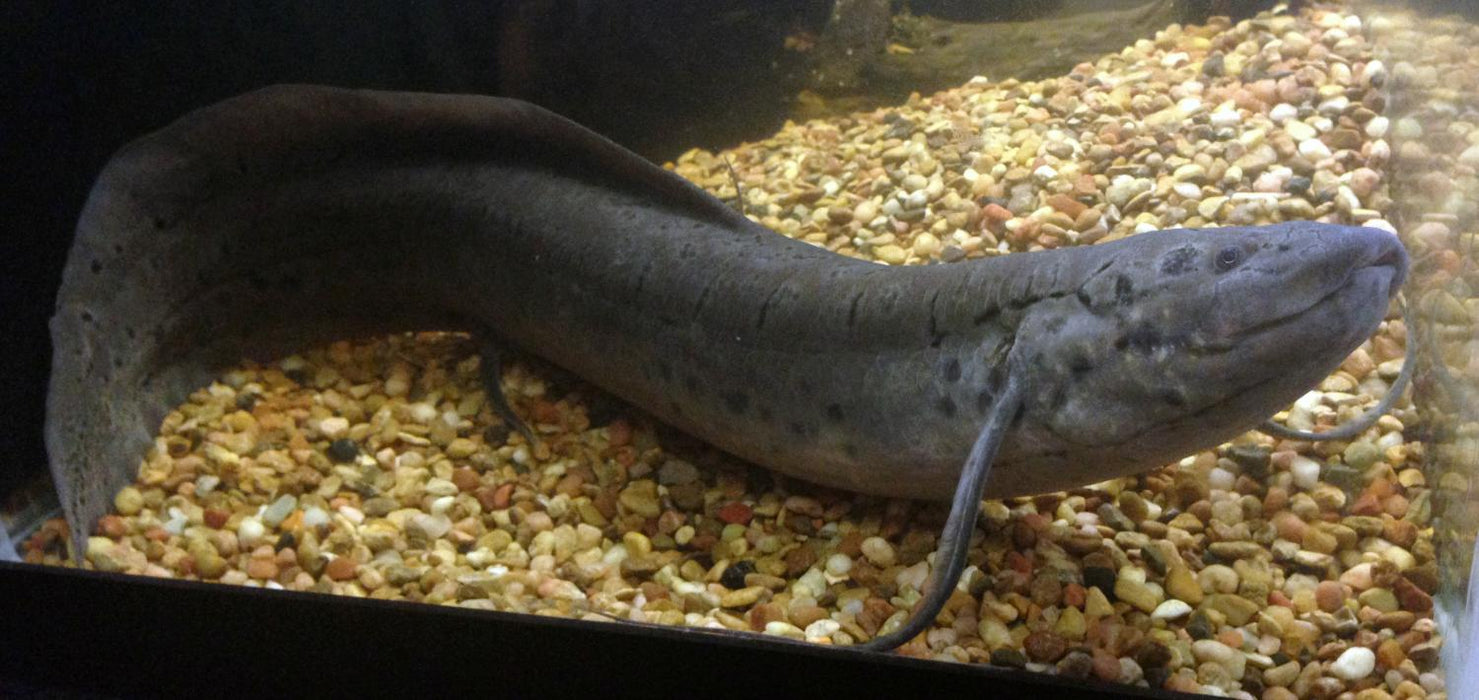
This species lives in warm, slow, oxygen-poor water and relies heavily on air breathing. It may aestivate when habitats shrink, although local conditions influence how often it does so.
How Are These Types of Fish Classified?
Living lobe-finned fish are divided into coelacanths and lungfish. Coelacanths belong to the lineage Actinistia and retain distinctive lobed fins, a three-part tail, and unique skull features. Lungfish belong to Dipnoi and are more closely related to tetrapods than coelacanths are. The broader sarcopterygian lineage also includes tetrapods, but this article limits the numbered list to living animals commonly recognized as fish.
Where Do These Fish Live?
The two coelacanth species occupy deep marine slopes, caves, and rocky structures in the Indian Ocean. Lungfish are freshwater animals distributed across Australia, South America, and Africa. Several African and South American species inhabit seasonal wetlands where air breathing and aestivation provide a survival advantage during drought or low oxygen.
How to Identify Different Types of Fish
- Body shape: Decide whether the fish is deep-bodied, eel-like, torpedo-shaped, flattened, or armored.
- Mouth and teeth: Note whether the mouth points upward, forward, or downward and whether teeth or barbels are visible.
- Tail shape: Forked, rounded, squared, and three-lobed tails are valuable clues.
- Fin pattern: Count separate dorsal fins and look for spines, spots, colored margins, or long filaments.
- Color and markings: Use bars, spots, stripes, mottling, and breeding colors, but do not rely on color alone.
- Habitat: Match the fish to water temperature, depth, current, vegetation, reef, or bottom type.
- Range: Confirm that the species is documented in the state, country, drainage, lake, or ocean region.
Fishing and Outdoor Observation Tips
- Living coelacanths should be observed only through legitimate scientific or conservation programs; they are rare deep-water animals.
- Never collect lungfish from the wild without legal authority.
- For museum study, compare the fleshy fin base, tail structure, skull, scales, and body shape.
- Do not describe lobe-finned fish as unchanged or primitive in a way that suggests they stopped evolving.
- Use current taxonomic names because fossil and living sarcopterygian classification continues to be refined.
Safety, Sustainability, and Conservation Notes
Both coelacanth species are conservation priorities, and several lungfish populations face habitat loss, dams, wetland drainage, water extraction, pollution, or harvest pressure. Their slow life histories and restricted distributions mean local damage may be difficult to reverse. Wildlife trade, collection, and fishing rules must be respected.
Fun Facts About Types Of Lobe-Finned Fish
- Only eight living fish species represent the lobe-finned fish lineages today.
- There are two living coelacanth species.
- There are six living lungfish species.
- The Indonesian coelacanth was recognized as a separate species in 1999.
- Lungfish are the closest living fish relatives of tetrapods.
- African lungfish can form protective cocoons during aestivation.
- Australian lungfish has one functional lung, while other living lungfish have paired lungs.
- Coelacanths possess a unique electrosensory organ in the snout.
- A coelacanth’s fleshy fins move in an alternating pattern reminiscent of tetrapod limbs.
- The fossil record of lobe-finned fish is far more diverse than the modern living fauna.
Final Thoughts on types of lobe-finned fish
The correct modern answer to types of lobe-finned fish is eight living fish species: two coelacanths and six lungfish. Their small surviving diversity hides an enormous evolutionary history that connects ancient aquatic vertebrates with the origin of tetrapods.
Frequently Asked Questions
1. What is a lobe-finned fish?
A lobe-finned fish has paired fins supported by a fleshy internal lobe containing bones and muscles. Living fish representatives are coelacanths and lungfish.
2. How many living lobe-finned fish species are there?
There are eight generally recognized living fish species: two coelacanths and six lungfish. Tetrapods also belong within the broader sarcopterygian lineage, but they are not fish in everyday usage.
3. What are the two main living groups?
The living fish groups are coelacanths and lungfish. Coelacanths are marine, while all living lungfish are freshwater animals.
4. Why are lobe-finned fish important to evolution?
They help scientists understand the anatomical and genetic background from which the first limbed vertebrates evolved. Lungfish are the closest living fish relatives of tetrapods.
5. Are coelacanths ancestors of humans?
No living coelacanth is a direct ancestor of humans. Coelacanths, lungfish, and tetrapods share ancient common ancestors.
6. Can all lungfish survive drought?
African and South American lungfish can survive severe seasonal drying through burrowing and reduced metabolism. Australian lungfish cannot tolerate complete habitat drying in the same way.
7. Do lungfish have gills?
Yes. Lungfish have gills, but the degree to which they rely on gills versus lungs differs by species and life stage.
8. Do coelacanths have lungs?
Living coelacanths have a fat-filled organ related developmentally to a lung, but it is not used as a functional air-breathing lung.
9. Why were coelacanths called living fossils?
They were known from fossils and thought extinct until a living specimen was documented in 1938. The phrase is memorable but can wrongly imply that the fish stopped evolving.
10. Where do living coelacanths occur?
They are known from the western Indian Ocean around East Africa and nearby islands, and from Indonesian waters near Sulawesi.
11. How many fish are included in this types of lobe-finned fish guide?
This guide covers 8 carefully selected fish. The number is kept below 50 and focuses on species or common-name groups that directly match the topic.
12. What are the best-known types of lobe-finned fish?
Widely recognized examples include West Indian Ocean Coelacanth, Indonesian Coelacanth, Australian Lungfish, South American Lungfish, West African Lungfish. Which fish is best known depends on location, fishing culture, and whether the reader is interested in food, sport, aquariums, or conservation.
13. Why do common fish names sometimes cause confusion?
A single common name may refer to different species in different countries, while one species may have several local names. Scientific names are included where useful to reduce confusion.
14. How can beginners identify a fish accurately?
Start with body shape, fin placement, mouth size, color pattern, tail shape, scales or skin, and habitat. Then compare those features with a trusted regional field guide.
15. Does habitat help with fish identification?
Yes. A fish seen on a coral reef, in a cold deep lake, in a muddy pond, or in a fast river belongs to a very different set of likely species.
16. Can fish color change?
Yes. Color can vary with age, sex, breeding condition, stress, water clarity, depth, and lighting. Shape and fin features are often more reliable than color alone.
17. Why is fish size not always a reliable clue?
Young fish may look very different from adults, and growth depends on food, temperature, habitat, and age. Use size together with several other traits.
18. What is the safest way to handle an unfamiliar fish?
Keep hands wet, support the body, avoid gills and eyes, and watch for sharp teeth, fin spines, or venomous spines. When uncertain, minimize contact and use appropriate tools.
19. Should every caught fish be released?
Release decisions depend on local regulations, species status, harvest goals, and whether the fish is invasive. Learn the rules before fishing and never release a prohibited invasive species where regulations forbid it.
20. Why are fishing regulations different between waters?
Fish populations and habitat conditions vary across deep marine slopes and tropical or subtropical freshwater wetlands. Managers adjust seasons, size limits, bag limits, and permitted methods to protect breeding stocks and balance fisheries.
21. What equipment helps with identification?
A regional fish guide, measuring board, camera, polarized glasses, and small notebook are useful. Photograph both sides, the mouth, fins, and distinctive markings when legal and safe.
22. Can an aquarium fish be released into the wild?
No. Aquarium releases can introduce disease, invasive populations, and genetic problems. Rehome unwanted fish through responsible aquarium channels instead.
23. What do these fish eat?
Diets range from plankton and algae to insects, mollusks, crustaceans, and other fish. Mouth position and tooth shape often provide clues to feeding style.
24. Why do some fish school?
Schooling can reduce predation risk, improve feeding efficiency, and help fish find mates. Open-water species are especially likely to form large coordinated groups.
25. Why do some fish stay near the bottom?
Bottom habitats provide insects, mollusks, shelter, and cooler or calmer water. Catfish, loaches, suckers, and many reef fish are adapted to feeding near the substrate.
26. What is the difference between freshwater and marine fish?
Freshwater fish maintain body salts in water with very low salinity, while marine fish manage water loss in salty environments. Some species move between both and are called diadromous or euryhaline.
27. Can the same fish live in rivers and lakes?
Many species use both. Rivers may provide spawning habitat, while lakes offer feeding and nursery areas. Dams and barriers can interrupt these movements.
28. Why are wetlands important to fish?
Wetlands provide nursery habitat, shelter, seasonal food, and flood connections. Losing wetlands can reduce recruitment even when the main lake or river remains.
29. What are the biggest threats to fish diversity?
Common threats include habitat loss, pollution, excessive harvest, dams, water withdrawal, climate change, and invasive species. The most important threat differs by region.
30. How can anglers support conservation?
Follow regulations, prevent litter, clean and dry gear, avoid moving live bait, report tagged or unusual fish, and handle released fish quickly and gently.