

Newts are fascinating amphibians that belong to the family Salamandridae. Known for their vibrant colors, unique life cycles, and adaptability to both aquatic and terrestrial habitats, newts capture the interest of wildlife enthusiasts and researchers alike. In this article, we will explore 30 different types of newts, providing detailed identification tips, natural behaviors, and habitat insights. Whether you’re a beginner interested in amphibians or a seasoned observer, this guide on types of newts offers a comprehensive look at these remarkable creatures. Let’s dive into the colorful world of newts.
1. Eastern Newt (Notophthalmus viridescens)
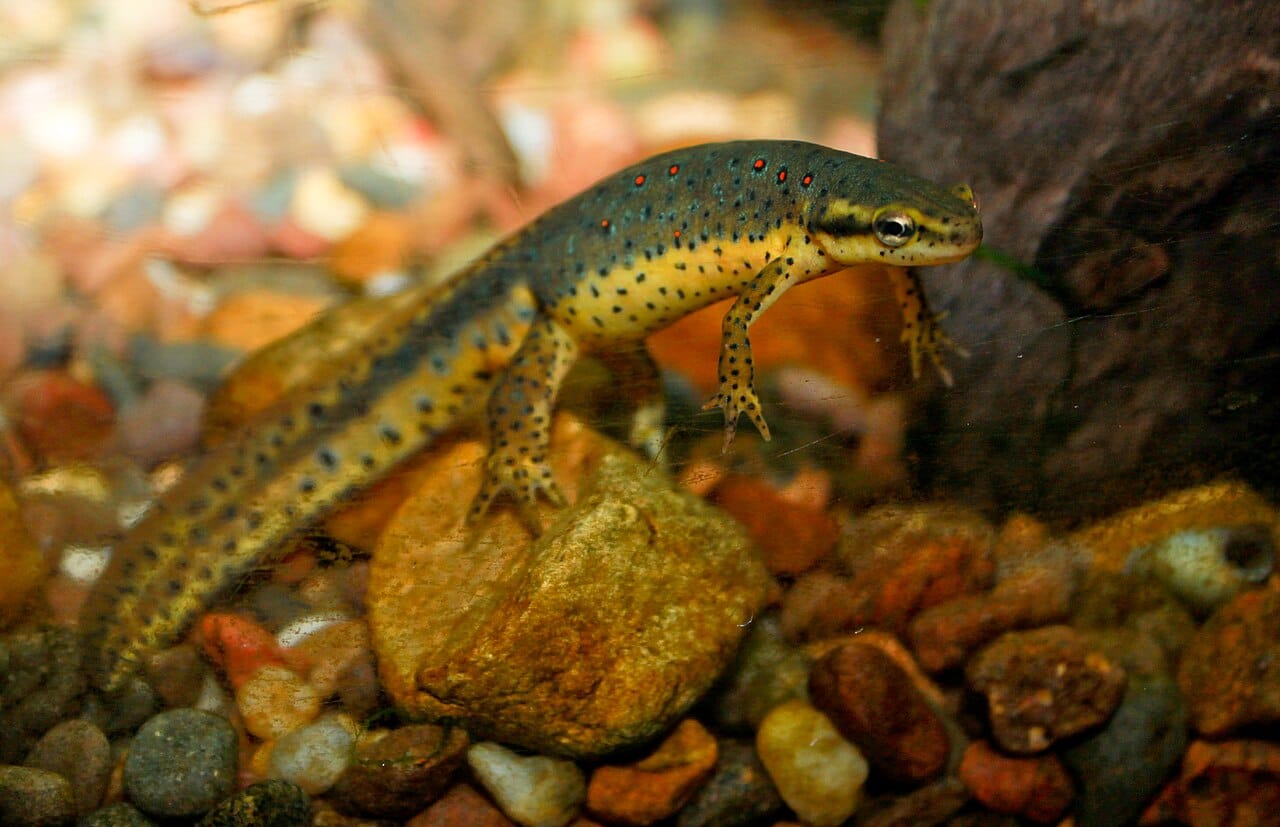
The Eastern Newt is a common species found throughout eastern North America. It is well known for its complex life cycle that includes an aquatic larval stage, a terrestrial juvenile stage called the red eft, and an adult aquatic stage. Adults typically measure 5–7 cm in length and feature olive-green skin with small black spots. The red eft stage, in particular, is bright orange to red with a rough texture, warning predators of its mild toxicity.
Eastern Newts thrive in still, shallow waters like ponds, marshes, and lakes with abundant vegetation. They are carnivorous, feeding primarily on insects, worms, and small crustaceans. Despite their small size, they play an essential role in controlling insect populations and maintaining ecological balance in freshwater habitats.
Behaviorally, Eastern Newts are fascinating. During the breeding season, males develop bright coloration and exhibit elaborate courtship displays in water, fanning their tails to attract females. Their adaptability allows them to survive in both aquatic and terrestrial environments, making them resilient against habitat changes. Eastern Newts are also indicators of environmental health, as they are sensitive to pollution and habitat degradation.
2. Black-Spotted Newt (Notophthalmus meridionalis)
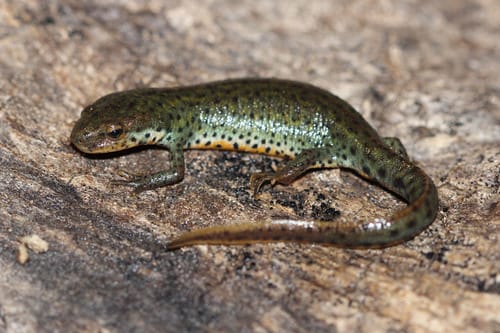
The Black-Spotted Newt, also known as the Southern Newt, is native to the southeastern United States. It is easily recognized by its olive-green body covered with small black spots and a yellow to orange underside. Adults typically measure 6–9 cm in length. Like its close relative, the Eastern Newt, it undergoes a metamorphic life cycle from aquatic larvae to terrestrial juvenile red efts before maturing into an aquatic adult.
Black-Spotted Newts inhabit ponds, marshes, and slow-moving streams, often preferring shaded areas with ample leaf litter for cover. They are nocturnal, actively hunting small invertebrates at night. Their diet includes insects, snails, and small worms, which they capture using their sticky, extendable tongues.
One interesting feature of the Black-Spotted Newt is its chemical defense mechanism. When threatened, it secretes toxins through its skin, deterring predators such as fish, birds, and mammals. Conservation-wise, this species is not currently endangered, but habitat loss and pollution pose ongoing threats. Observing them in the wild provides valuable insights into amphibian ecology and the health of wetland ecosystems.
3. Striped Newt (Notophthalmus perstriatus)
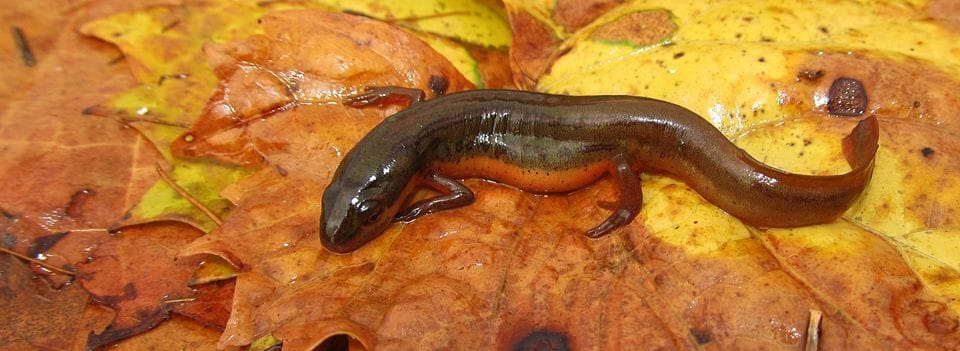
The Striped Newt is a rare species found primarily in the southeastern United States, particularly in Florida. This species is distinguished by its two dark longitudinal stripes running along its back against a lighter green or brown base color. Adults usually grow 5–7 cm long, and like other newts, they experience a metamorphic life cycle including aquatic larvae and terrestrial juveniles.
Striped Newts prefer ephemeral ponds, flatwoods, and scrub habitats with sandy soils. During the breeding season, they migrate to temporary ponds to spawn, which makes them highly dependent on seasonal rainfall. Their diet consists of small invertebrates like insects and crustaceans. Striped Newts exhibit a fascinating behavior called aestivation during dry periods, burrowing underground to maintain moisture levels and avoid desiccation.
Conservation of Striped Newts is critical, as they are considered a threatened species due to habitat destruction and fire suppression altering their natural ecosystems. They serve as an indicator of healthy wetland environments, emphasizing the need for careful habitat management and protection strategies to ensure their survival.
4. California Newt (Taricha torosa)
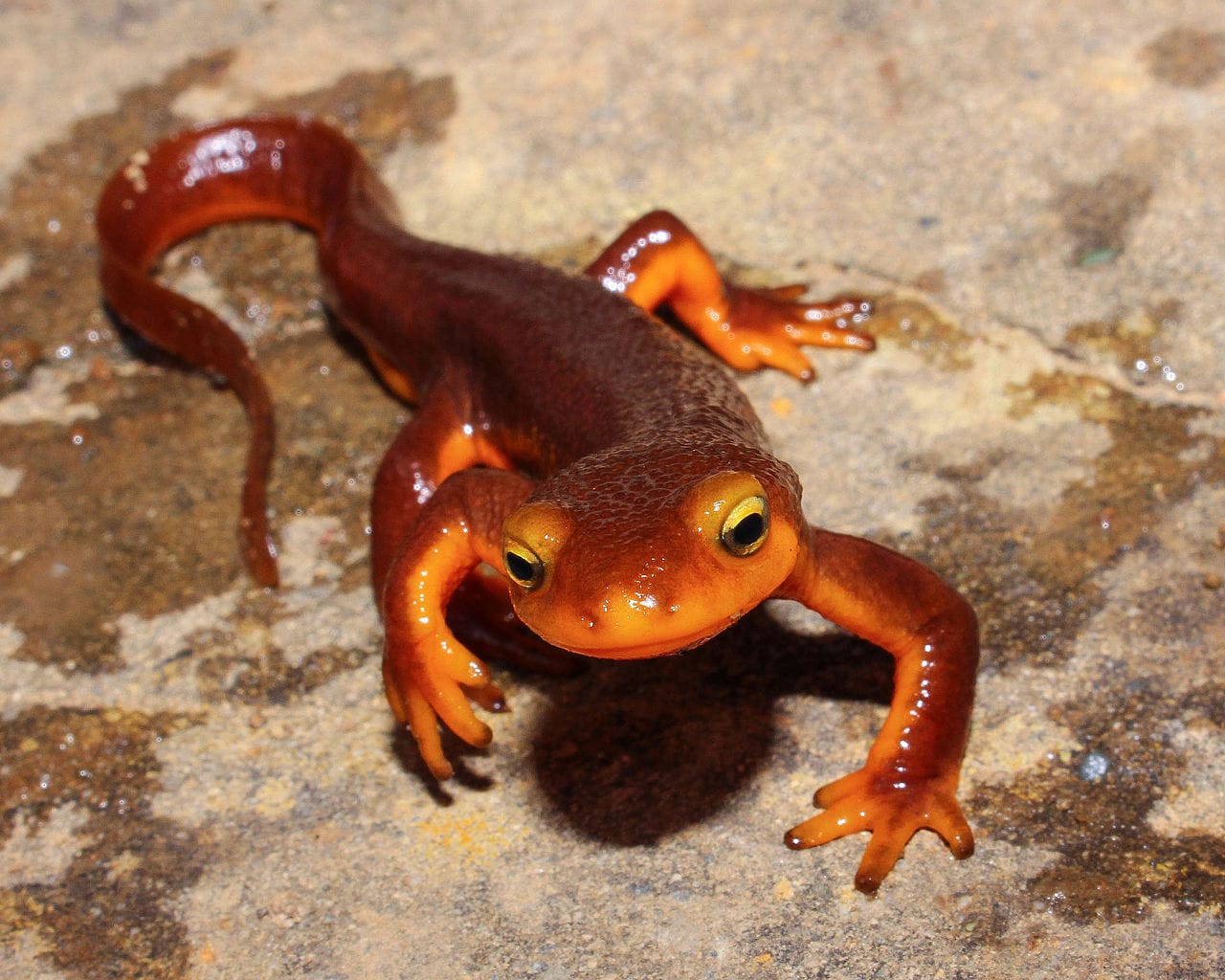
The California Newt is a well-known amphibian native to the western United States, especially California. It has rough, brownish skin with a striking orange to yellow belly. Adults can grow 10–20 cm in length, making it one of the larger newt species. Like many newts, California Newts undergo an aquatic larval stage before becoming terrestrial juveniles and returning to water as adults.
This species is typically found in ponds, streams, and coastal forests. California Newts are active hunters of insects, worms, and small amphibians. They produce potent toxins, particularly tetrodotoxin, which makes them dangerous to predators. Despite their toxicity, they are preyed upon by certain birds and snakes adapted to resist the toxin.
California Newts display remarkable homing abilities, often returning to the same ponds for breeding year after year. Their presence is an indicator of clean water and healthy forest ecosystems. Conservation efforts focus on habitat preservation and monitoring populations to prevent declines due to urbanization and pollution.
5. Rough-Skinned Newt (Taricha granulosa)
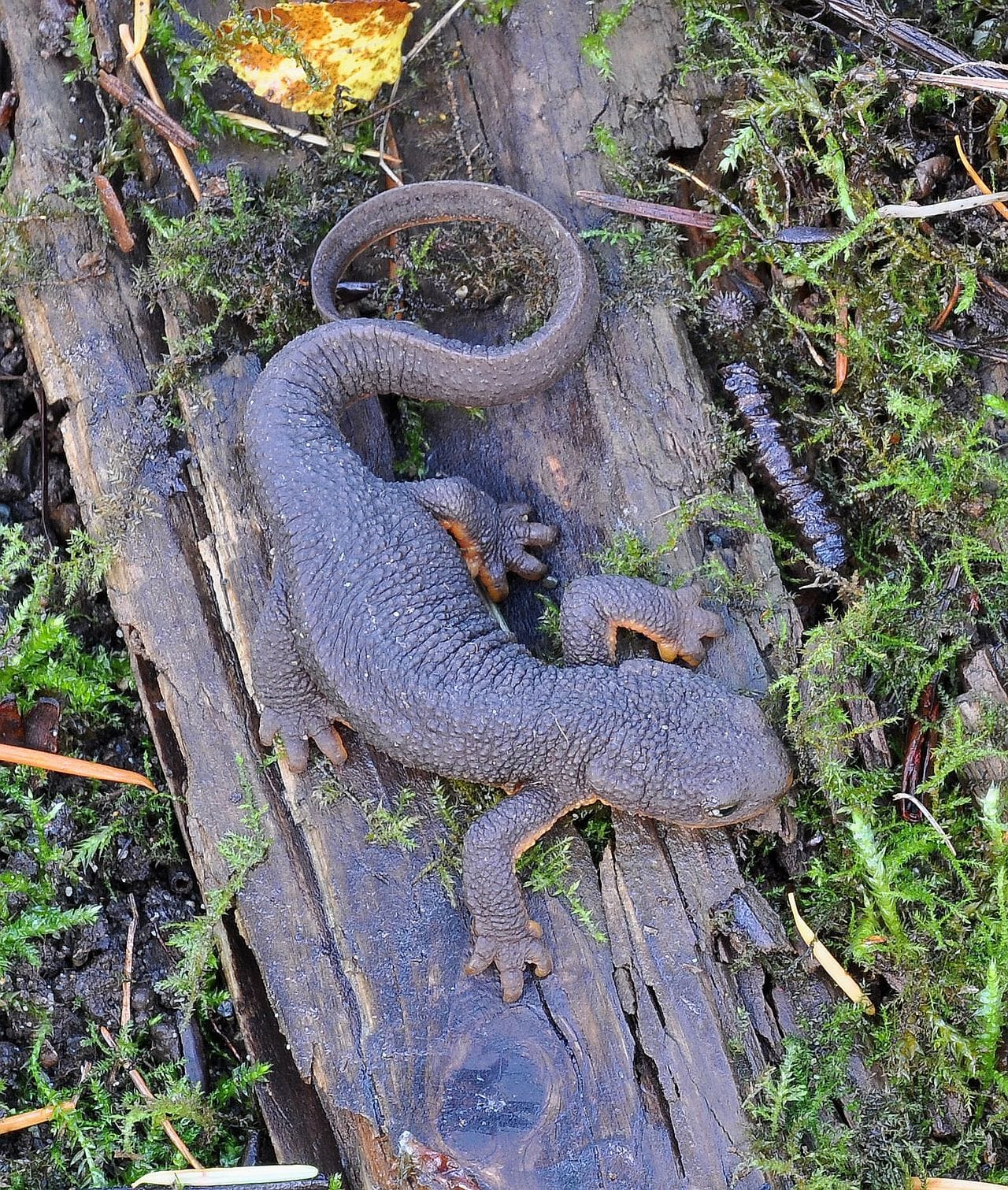
The Rough-Skinned Newt is another remarkable North American species, found along the Pacific Coast from California to Alaska. Its skin is rough and granular, with an olive-brown or reddish hue on the back and a bright orange underside. Adults typically measure 6–12 cm, and like other newts, they undergo a life cycle that includes aquatic larvae, terrestrial juveniles, and aquatic adults.
These newts are highly toxic, producing tetrodotoxin that can be lethal to many predators. They inhabit ponds, lakes, and slow-moving streams and are carnivorous, feeding on insects, worms, and crustaceans. During breeding season, males perform intricate courtship dances, including tail undulations and nudging behaviors to attract females.
Rough-Skinned Newts demonstrate fascinating survival strategies. Populations coexist with garter snakes that have evolved resistance to their toxins, resulting in a unique predator-prey evolutionary arms race. Studying these newts provides valuable insights into evolutionary biology, chemical defense mechanisms, and amphibian ecology. Conservationists monitor them closely to protect their habitats from pollution and development.
6. Red‑bellied Newt (Taricha rivularis)
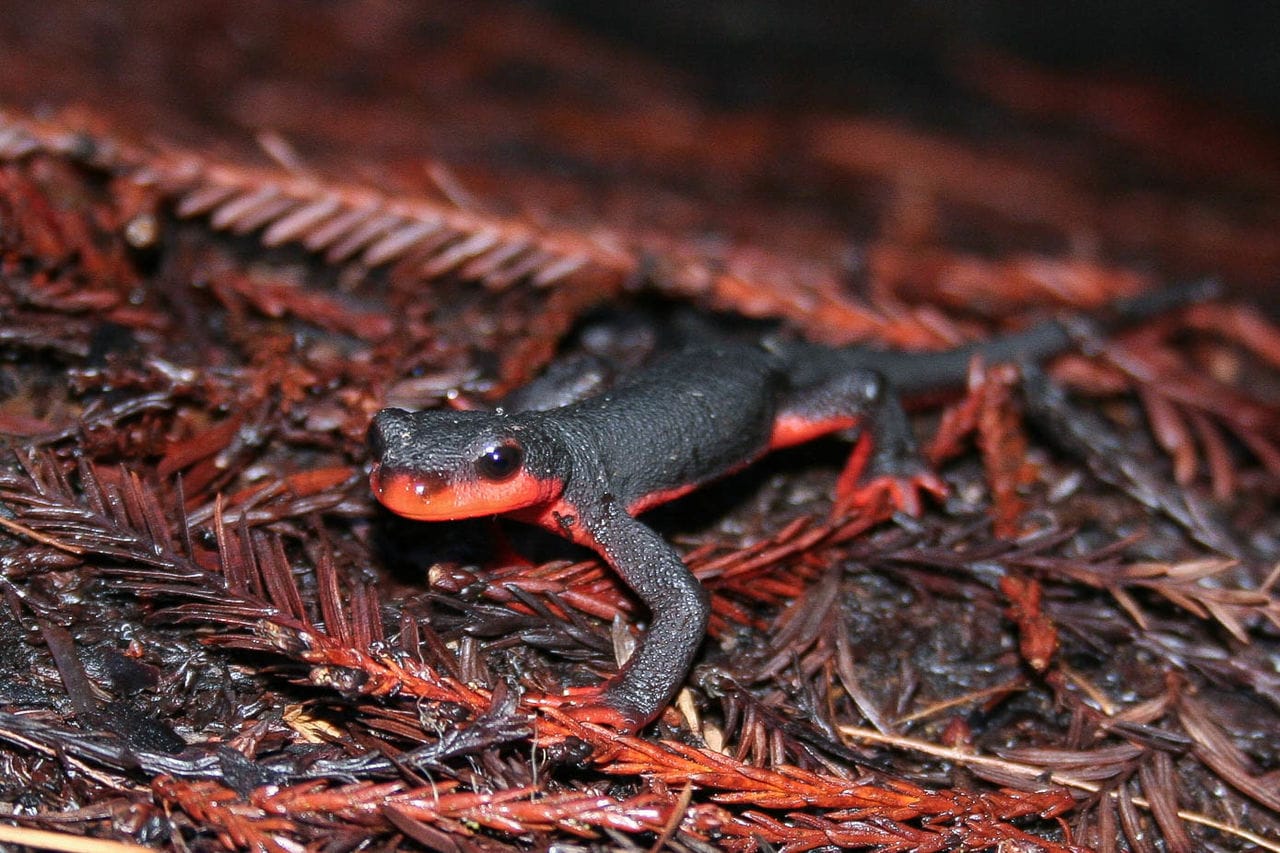
The Red‑bellied Newt is a striking amphibian native to the coastal regions of northern California. Its name comes from its bright red-orange belly, contrasting sharply with its dark brown to olive dorsal side. Adults typically grow between 8–12 cm, making them moderately sized among North American newts. Like other Taricha species, the Red‑bellied Newt undergoes a complex life cycle that includes aquatic larvae, terrestrial juveniles, and aquatic adults.
These newts prefer moist forest floors, creeks, and shaded streams, often hiding under logs and leaf litter. They are nocturnal predators, feeding on insects, worms, and small invertebrates. A remarkable feature is their potent tetrodotoxin, secreted through their skin, which deters most predators and serves as an excellent defense mechanism. Despite their toxicity, they are an essential part of the ecosystem, controlling insect populations and serving as prey for specialized animals that tolerate their toxins.
Breeding typically occurs in slow-moving freshwater streams, where males develop distinct features such as brighter coloration and glandular skin patches to attract females. Studying Red‑bellied Newts provides insights into amphibian evolution, chemical defense strategies, and habitat conservation. Conservationists monitor their populations due to habitat loss and environmental pollution, making them a key indicator species for ecosystem health.
7. Sierra Newt (Taricha sierrae)
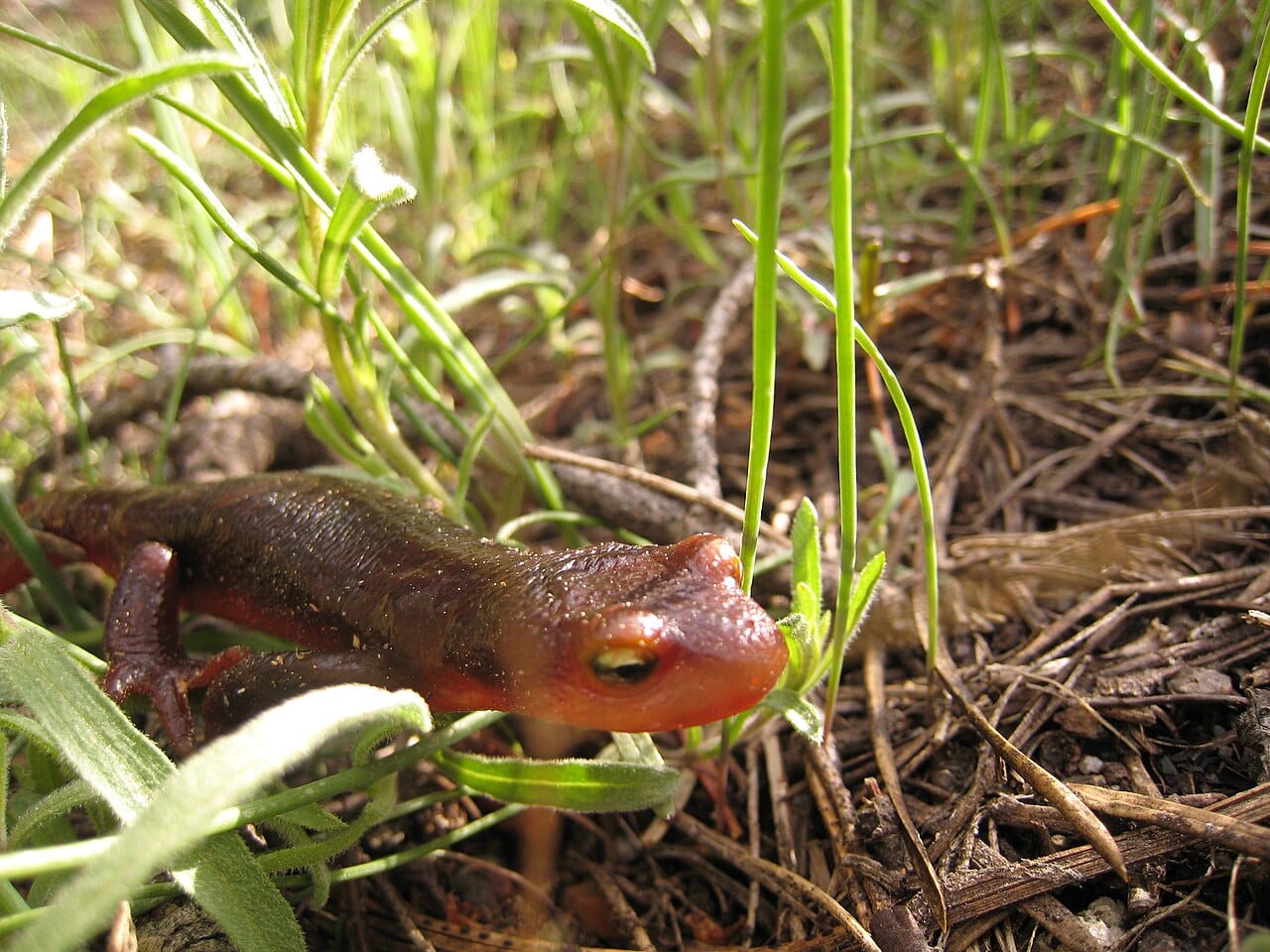
The Sierra Newt is a fascinating species found in the mountainous regions of California, particularly the Sierra Nevada. Adults grow up to 12–18 cm, featuring dark brown to black dorsal skin and a bright yellow to orange belly. Their skin is slightly rough, providing camouflage against forest floors and stream beds. Like other newts, the Sierra Newt undergoes aquatic larval, terrestrial juvenile, and aquatic adult stages.
This species prefers high-elevation ponds, slow streams, and wet forested areas. They are carnivorous, feeding primarily on insects, spiders, worms, and other small invertebrates. Tetrodotoxin produced by the Sierra Newt provides a powerful defense against most predators, though some garter snakes have evolved resistance. Breeding occurs in the spring, with males performing intricate underwater courtship displays to attract females.
Ecologically, Sierra Newts contribute significantly to controlling insect populations and maintaining aquatic ecosystem balance. Their sensitivity to environmental changes makes them excellent bioindicators for water quality and habitat integrity. Conservation efforts focus on protecting streams and wetlands to support their breeding and larval development.
8. Smooth Newt (Lissotriton vulgaris)
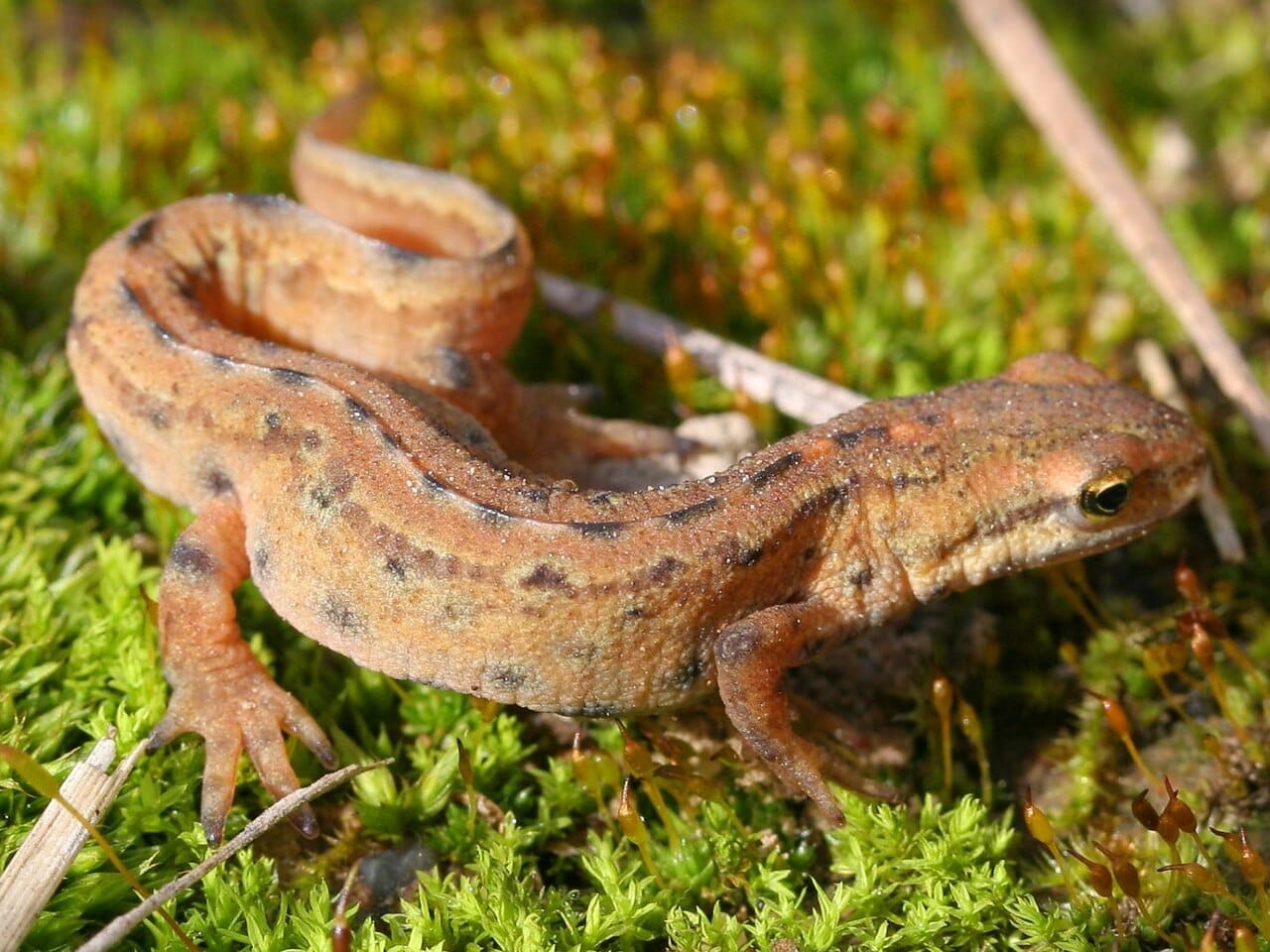
The Smooth Newt is one of Europe’s most widespread newt species, inhabiting ponds, marshes, and slow-flowing streams across the continent. Adults typically measure 7–11 cm, with smooth olive-brown dorsal skin and an orange underside dotted with small black spots. Males develop bright throat coloration and a wavy dorsal crest during the breeding season.
Smooth Newts are versatile, thriving in a variety of aquatic and terrestrial habitats. They are primarily nocturnal hunters, feeding on insects, crustaceans, and small worms. Reproduction involves males performing a complex courtship display, including tail waving and body undulations, to transfer spermatophores to females. Females lay eggs individually on aquatic plants, providing protection from predators.
This species is vital for controlling invertebrate populations and serves as prey for birds, fish, and mammals. They are resilient and adaptable but still sensitive to water pollution and habitat degradation, making them useful indicators of ecosystem health. Observing Smooth Newts can provide a window into European freshwater biodiversity and amphibian behavior.
9. Palmate Newt (Lissotriton helveticus)
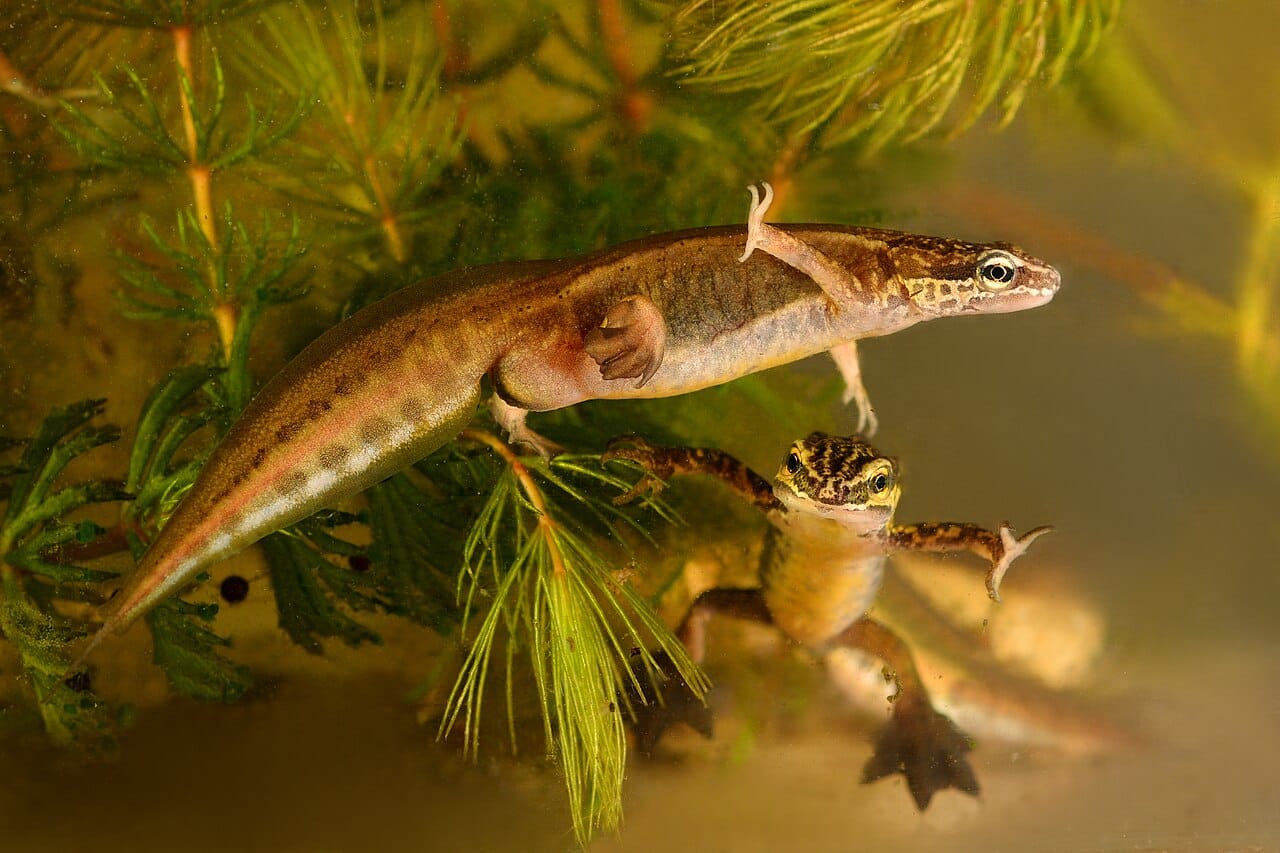
The Palmate Newt, found primarily in western and central Europe, is named for the small webbing between the toes of males during breeding season. Adults are 6–10 cm long, with olive-brown dorsal skin and a lighter ventral side. Males also develop a small filament at the tip of the tail and prominent cloacal swelling during the breeding season.
These newts prefer small ponds, ditches, and slow streams surrounded by woodland or grassland. They feed on small invertebrates, including insects, worms, and larvae. Palmate Newts are active both day and night but are more frequently observed during the breeding season in aquatic habitats. Their breeding behaviors include elaborate courtship displays, with males presenting their webbed hands and tail movements to attract females.
As a species, Palmate Newts contribute to the ecosystem by regulating invertebrate populations and providing food for birds and mammals. They are indicators of freshwater health, as they are highly sensitive to pollution and habitat alteration. Protecting wetlands and ponds is crucial for maintaining stable Palmate Newt populations in Europe.
10. Italian Newt (Lissotriton italicus)
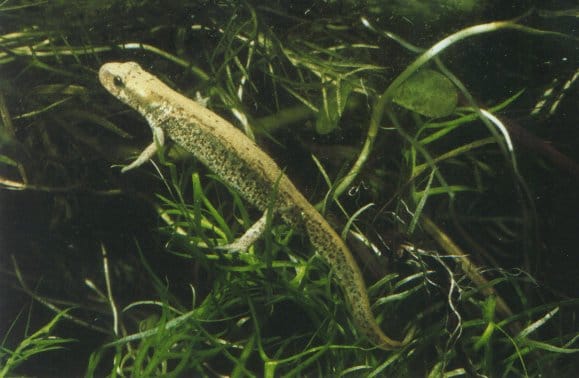
The Italian Newt is a small but captivating amphibian endemic to Italy. Adults typically measure 6–9 cm, with brown or olive dorsal coloration and an orange to yellow belly adorned with small dark spots. Males develop a wavy dorsal crest and bright throat coloration during the breeding season.
Italian Newts inhabit ponds, marshes, and slow streams within Mediterranean environments. Their diet consists of insects, larvae, worms, and other small invertebrates. Reproduction involves males performing tail-fanning courtship rituals and transferring spermatophores to females, who then attach eggs individually to aquatic vegetation. Juveniles develop through the larval stage before transitioning to terrestrial life as efts.
Italian Newts are vital for maintaining balanced invertebrate populations in freshwater ecosystems. They are sensitive to water pollution, habitat fragmentation, and climate change, making them important bioindicators. Conservation efforts emphasize protecting wetlands and small water bodies, ensuring the survival of this unique European newt species.
11. Bosca’s Newt (Lissotriton boscai)
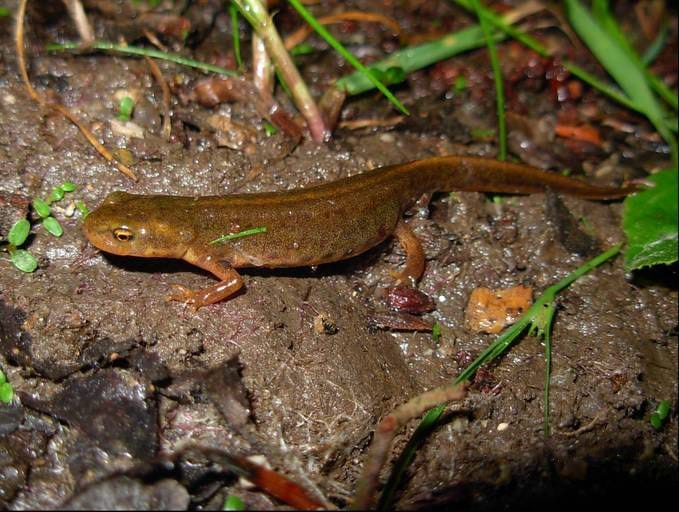
Bosca’s Newt is a small amphibian native to parts of southwestern Europe, particularly Portugal and western Spain. Adults typically measure 6–8 cm in length, with a dark brown to olive dorsal side and a yellowish to orange belly. During the breeding season, males develop a low, wavy dorsal crest and bright throat coloration, which plays a vital role in courtship displays.
These newts inhabit shallow ponds, slow-moving streams, and marshy areas often surrounded by grasslands or low vegetation. They are nocturnal predators, feeding on small invertebrates such as insects, worms, and crustaceans. Bosca’s Newts reproduce via a unique courtship ritual: males perform a series of tail-waving and body undulations to entice females before transferring spermatophores. Females lay their eggs individually on submerged leaves or plant stems, providing protection against predators.
Bosca’s Newts are essential for regulating invertebrate populations in freshwater ecosystems. Their sensitivity to environmental changes makes them excellent indicators of ecosystem health. Conservation efforts focus on preserving wetlands and preventing water pollution, ensuring the species continues to thrive across its native range.
12. Montandon’s Newt (Lissotriton montandoni)
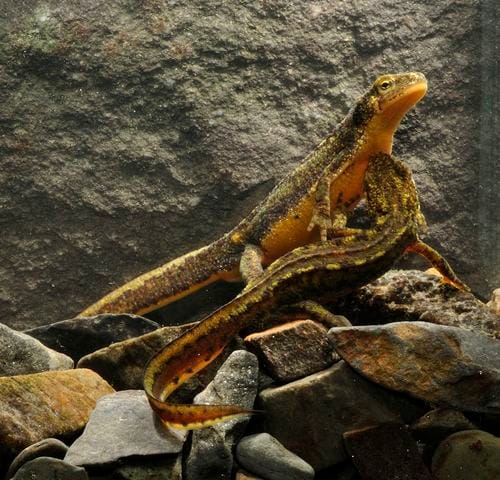
Montandon’s Newt is a rare amphibian found primarily in the Carpathian Mountains of Eastern Europe. Adults grow 7–9 cm long, with olive-brown dorsal skin and a yellowish-orange belly. Breeding males develop a low, serrated dorsal crest and noticeable cloacal swelling, which helps them attract mates.
This species favors high-altitude ponds, small streams, and wet meadows, often avoiding heavily shaded forests. Montandon’s Newts feed on aquatic invertebrates, including insects, larvae, and small crustaceans. Breeding occurs in spring and early summer, with males performing elaborate underwater displays to woo females. Eggs are laid individually on submerged vegetation, and larvae remain in the water until metamorphosis.
Ecologically, Montandon’s Newts play a critical role in maintaining freshwater biodiversity by controlling insect populations. Their restricted range makes them particularly vulnerable to habitat loss, climate change, and water pollution, highlighting the importance of targeted conservation measures.
13. Alpine Newt (Ichthyosaura alpestris)
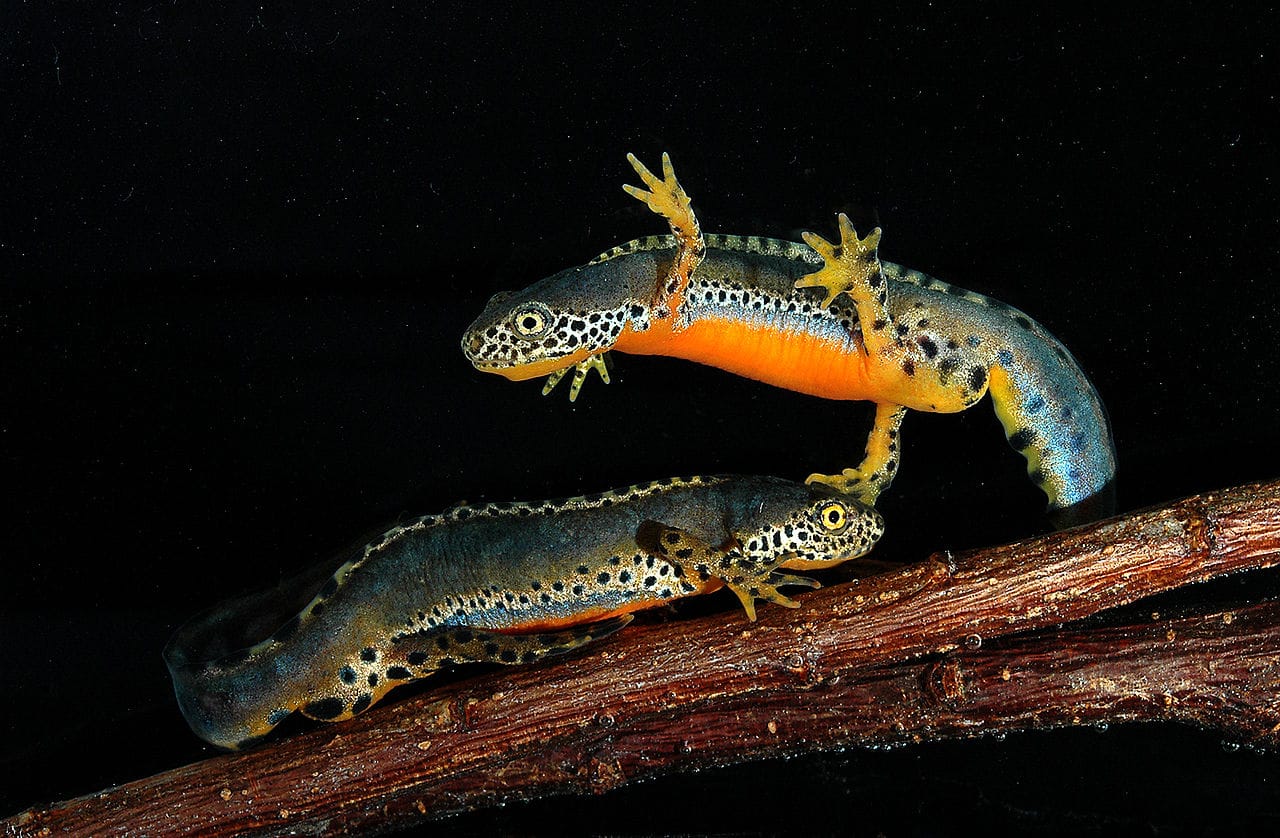
The Alpine Newt is a vibrant European amphibian, widely distributed across mountainous regions from France to the Balkans. Adults measure 7–10 cm, with striking blue or greenish dorsal coloration and an orange belly speckled with black spots. During the breeding season, males develop a prominent, wavy dorsal crest and bright flanks, creating a visually stunning appearance.
Alpine Newts inhabit high-altitude ponds, slow streams, and wet meadows, often remaining hidden under rocks or leaf litter during the day. They are active predators, feeding on insects, worms, and small aquatic invertebrates. Breeding involves males performing intricate underwater courtship dances, including tail undulations and lateral body displays, before transferring spermatophores. Females attach eggs individually to aquatic plants, reducing predation risk.
Alpine Newts are essential for ecosystem balance, regulating invertebrate populations and serving as bioindicators for freshwater habitat quality. Conservation initiatives focus on protecting alpine ponds and maintaining natural water flow to support breeding success.
14. Great Crested Newt (Triturus cristatus)
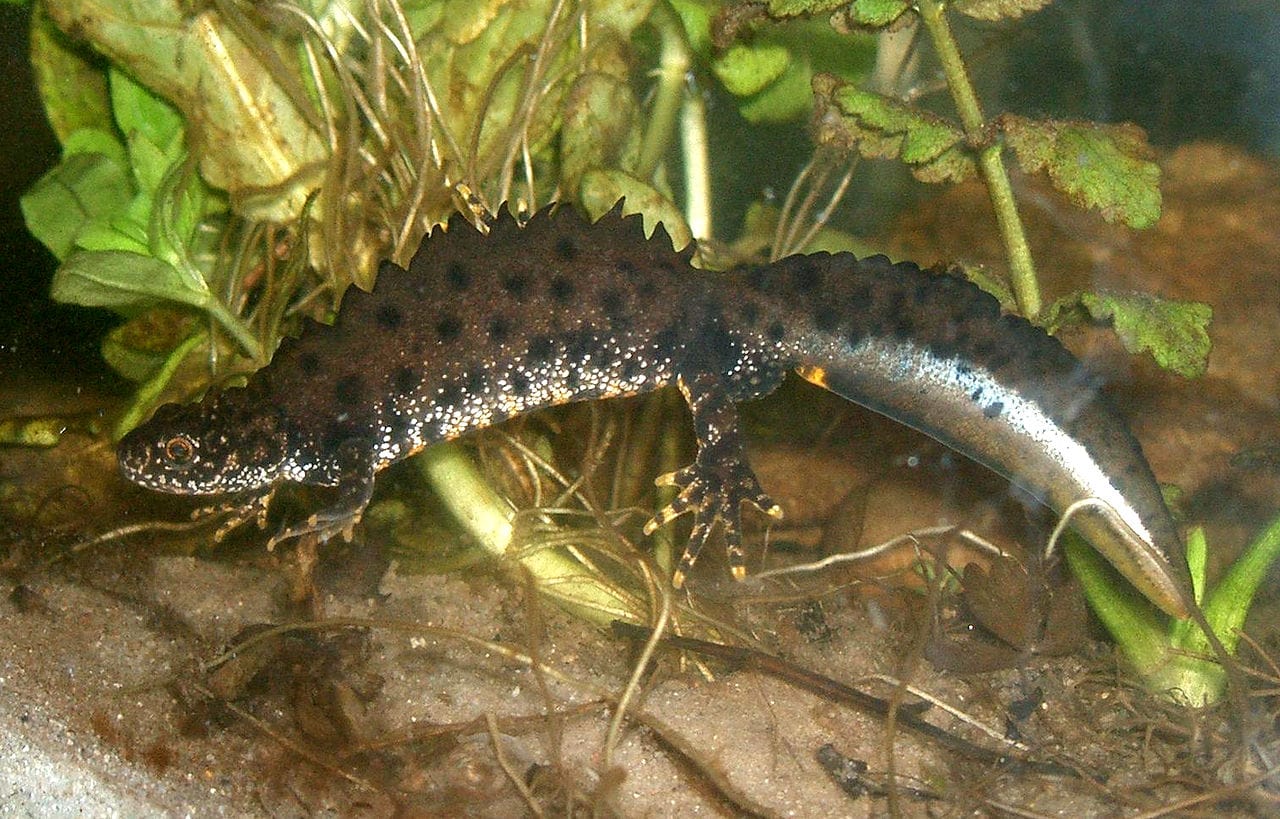
The Great Crested Newt is one of Europe’s largest and most iconic newts, reaching 12–17 cm in length. Adults have dark, rough dorsal skin, a yellow-orange belly adorned with black spots, and males develop a tall, jagged dorsal crest during breeding season. Its impressive size and striking appearance make it a standout among European amphibians.
This species prefers large ponds, slow-flowing streams, and wetlands with abundant vegetation for breeding. Great Crested Newts are nocturnal hunters, feeding on insects, worms, small crustaceans, and amphibian larvae. Courtship involves males performing elaborate underwater displays to entice females, followed by spermatophore transfer. Eggs are laid individually on aquatic plants and larvae develop in the water before metamorphosing into terrestrial juveniles.
Great Crested Newts are crucial for controlling insect populations and maintaining healthy freshwater ecosystems. They are highly sensitive to habitat degradation, pollution, and pond drainage, making them a priority species for European conservation programs. Protection of wetlands and breeding ponds ensures the survival of this remarkable amphibian.
15. Italian Crested Newt (Triturus carnifex)
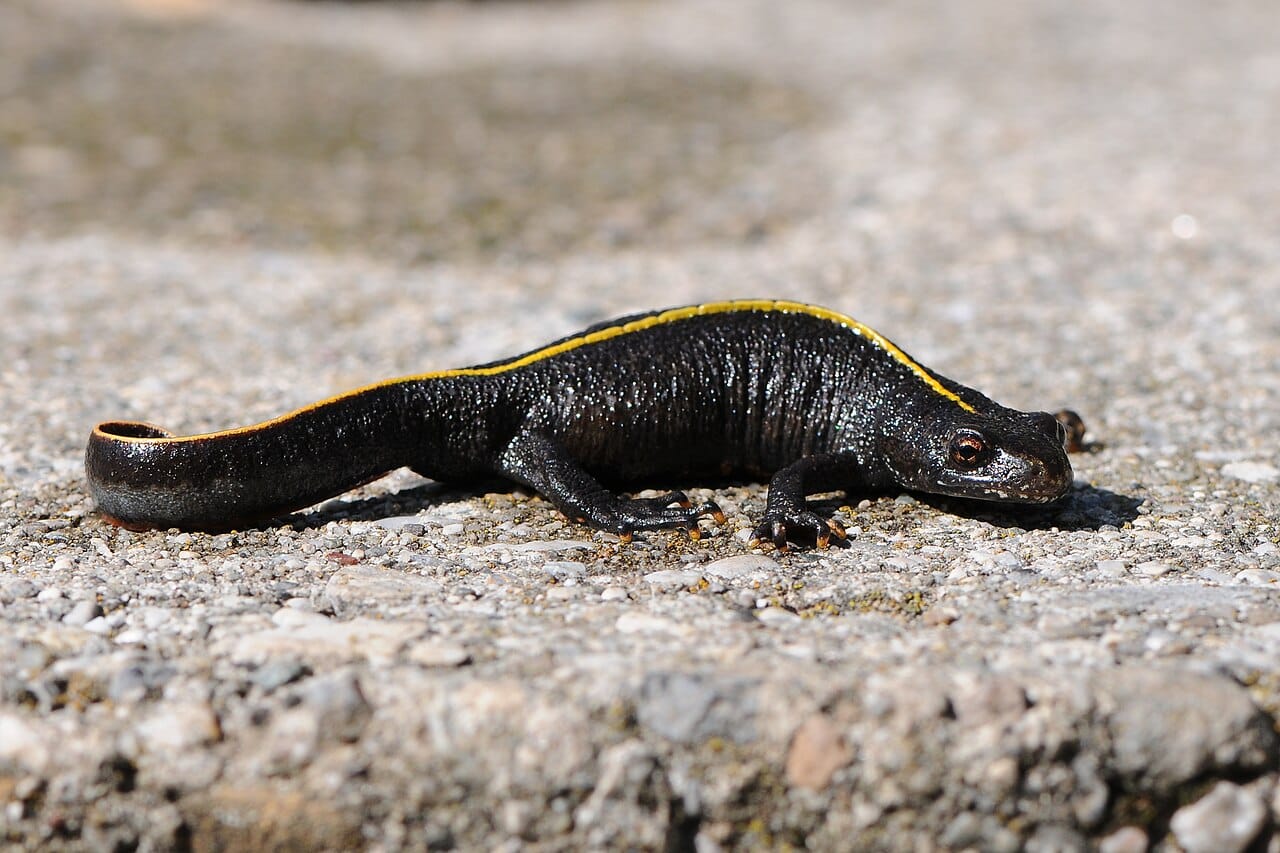
The Italian Crested Newt is a large newt native to Italy and parts of the Balkan Peninsula. Adults measure 12–16 cm long, with dark brown to black dorsal skin and a vibrant orange-yellow belly spotted with black. Breeding males develop a tall, jagged dorsal crest and a bluish coloration along the sides, creating a dramatic display during mating season.
Italian Crested Newts inhabit ponds, canals, and slow-moving streams with abundant vegetation. They feed on a variety of invertebrates, including insects, worms, and aquatic larvae. Reproduction involves males performing complex courtship displays underwater to attract females and transfer spermatophores. Eggs are carefully attached to submerged leaves, protecting them from predation. Larvae develop in water before transitioning to a terrestrial juvenile stage.
These newts are integral to the ecosystem, controlling invertebrate populations and serving as bioindicators of water quality. Conservation efforts focus on maintaining wetlands and preventing water pollution, safeguarding this species’ habitats for future generations. Their presence reflects the health and biodiversity of European freshwater ecosystems.
16. Danube Crested Newt (Triturus dobrogicus)
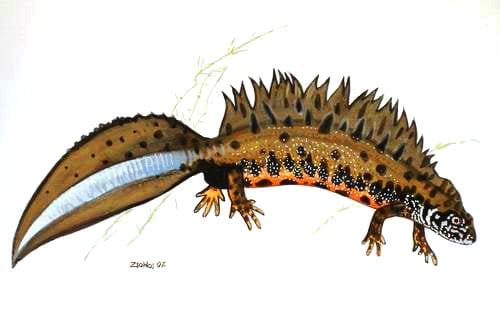
The Danube Crested Newt is a large newt species native to Eastern Europe, particularly along the Danube River basin. Adults reach 12–16 cm in length, with a dark brown to black back and a striking yellow-orange belly patterned with irregular black spots. During the breeding season, males develop a prominent jagged dorsal crest that runs from the neck to the tail, and a bluish hue along the flanks enhances their visual appeal during courtship.
Danube Crested Newts are aquatic during the breeding season, inhabiting ponds, slow-flowing streams, and wetlands rich in submerged vegetation. They are nocturnal predators, feeding on insects, worms, small crustaceans, and amphibian larvae. Males perform elaborate underwater courtship displays, including tail-waving and lateral body movements, before transferring spermatophores to females. Eggs are carefully attached individually to submerged leaves, ensuring protection from predators.
This species plays a critical role in regulating invertebrate populations and maintaining freshwater ecosystem health. Habitat loss, pollution, and drainage of wetlands threaten their survival, making conservation efforts—such as wetland protection and water quality management—vital for their continued presence in Eastern Europe.
17. Macedonian Crested Newt (Triturus macedonicus)
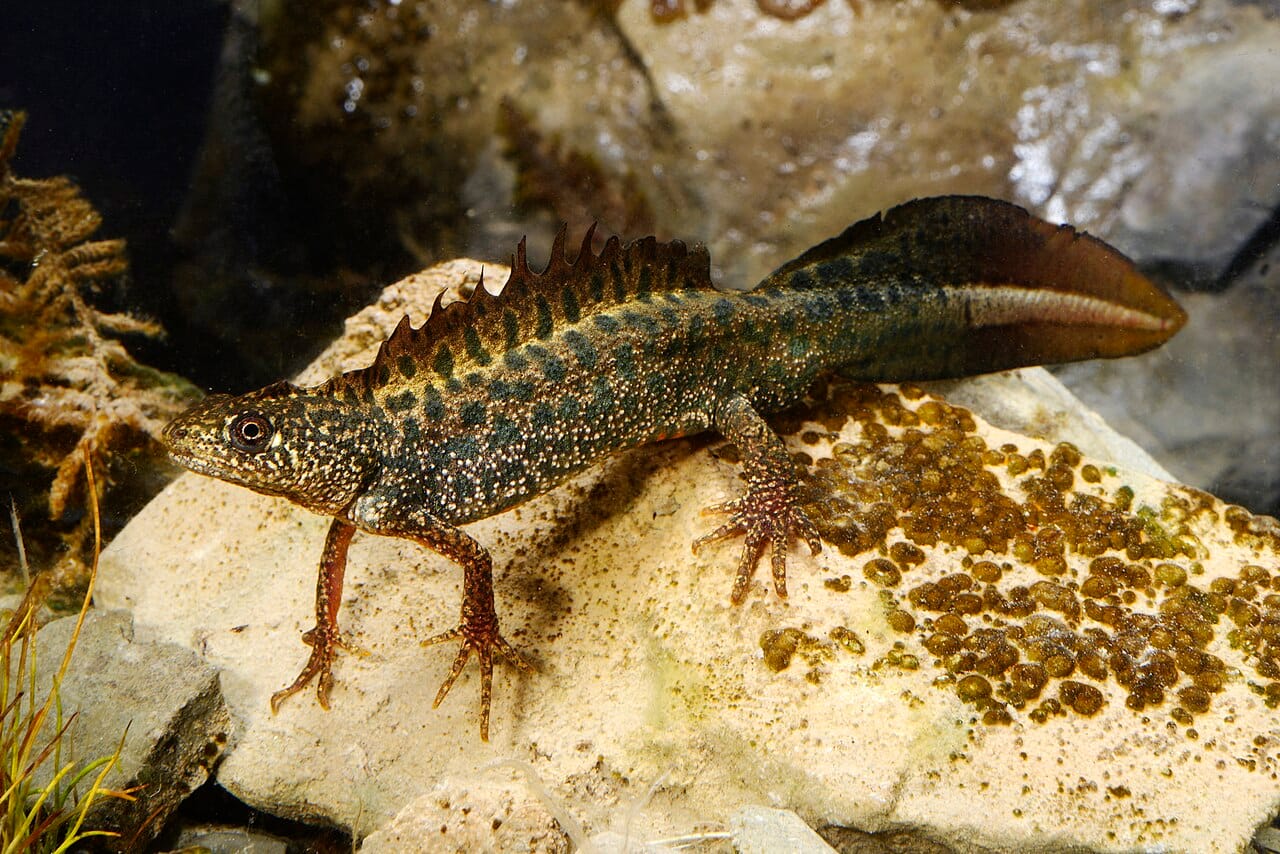
The Macedonian Crested Newt is a medium-to-large newt native to the Balkan Peninsula, particularly Macedonia and neighboring countries. Adults typically measure 11–15 cm, featuring dark dorsal coloration, a yellow-orange belly with black spotting, and males develop an impressive jagged dorsal crest during the breeding season. Their striking appearance is complemented by vibrant bluish lateral coloration, especially in males during mating displays.
They prefer ponds, marshes, and slow-moving streams with dense aquatic vegetation. Macedonian Crested Newts are active predators, feeding on aquatic invertebrates, insect larvae, worms, and small crustaceans. Courtship involves intricate underwater movements, where males wave their tails and undulate their bodies to attract females. Eggs are laid individually on submerged leaves or stems, and larvae undergo aquatic development before metamorphosing into terrestrial juveniles.
This species is ecologically significant, helping maintain balanced invertebrate populations. Threats include habitat degradation, water pollution, and the destruction of breeding ponds. Conservation measures focus on wetland preservation, water quality monitoring, and public awareness to ensure the survival of this remarkable Balkan amphibian.
18. Marbled Newt (Triturus marmoratus)
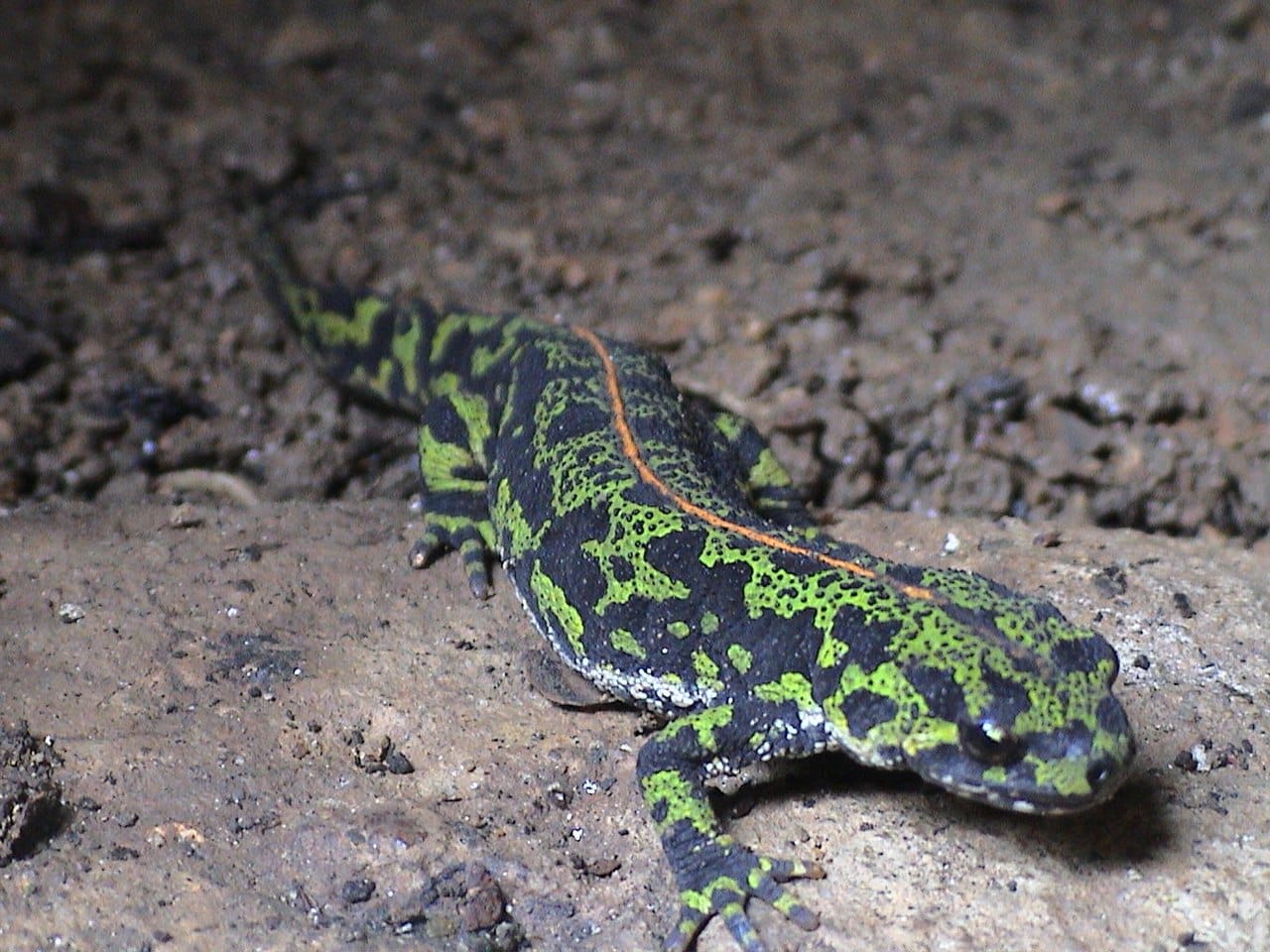
The Marbled Newt is a visually striking amphibian found in Western Europe, including France, Spain, and Portugal. Adults range from 12–16 cm, with dark greenish-brown dorsal coloration and a marbled pattern of black and yellow, giving this species its common name. The ventral side is bright orange with irregular black spots. Breeding males develop a wavy, jagged dorsal crest and a vivid lateral coloration during the reproductive season.
Marbled Newts inhabit ponds, small lakes, slow streams, and marshy areas with abundant submerged plants. They are carnivorous, feeding on insects, worms, mollusks, and small crustaceans. Their breeding behavior involves males performing elaborate courtship dances in water, displaying crest height and tail movements to attract females. Eggs are individually attached to aquatic vegetation and larvae develop fully in aquatic environments.
Ecologically, Marbled Newts contribute to controlling invertebrate populations and serve as indicators of healthy freshwater systems. Habitat loss, water pollution, and wetland drainage pose significant threats. Conservation initiatives aim to protect natural breeding sites and maintain high water quality to support sustainable populations.
19. Pygmy Marbled Newt (Triturus pygmaeus)
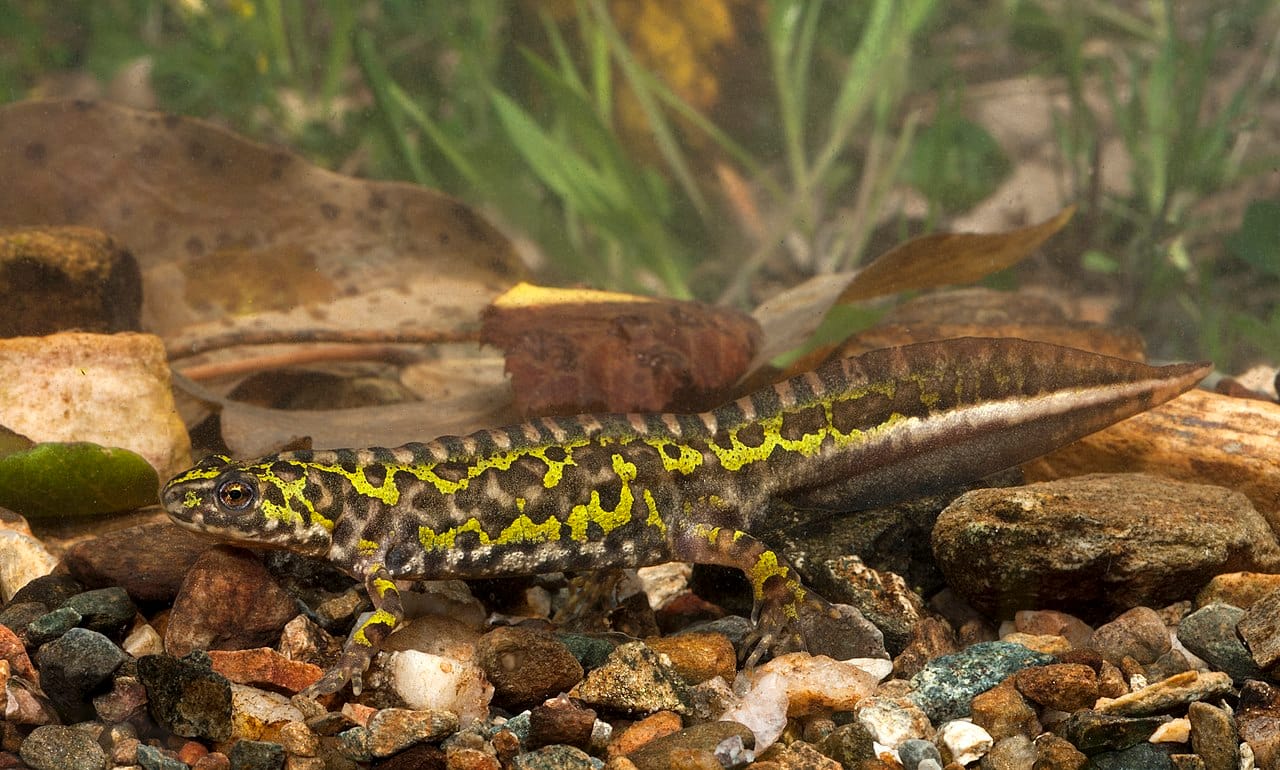
The Pygmy Marbled Newt is a smaller relative of the Marbled Newt, endemic to parts of southwestern Europe. Adults typically measure 7–9 cm, with a dark dorsal side featuring marbled green and brown patterns and a bright orange belly with black spots. During breeding, males develop a subtle jagged dorsal crest and brighter lateral coloration for attracting mates.
This species prefers small ponds, temporary pools, and slow-moving streams with submerged vegetation. Pygmy Marbled Newts are nocturnal hunters, feeding on aquatic invertebrates such as insect larvae, worms, and tiny crustaceans. Breeding males perform underwater courtship rituals, including tail undulations and lateral body displays, before transferring spermatophores. Eggs are laid individually on leaves or stems in shallow water, minimizing predation risk. Larvae remain aquatic until metamorphosis.
These newts are important for freshwater ecosystems, helping maintain invertebrate population balance. Threats include habitat degradation, pollution, and the draining of breeding ponds. Conservation strategies focus on protecting temporary pools and maintaining suitable water quality for reproduction and larval development.
20. Japanese Fire‑bellied Newt (Cynops pyrrhogaster)
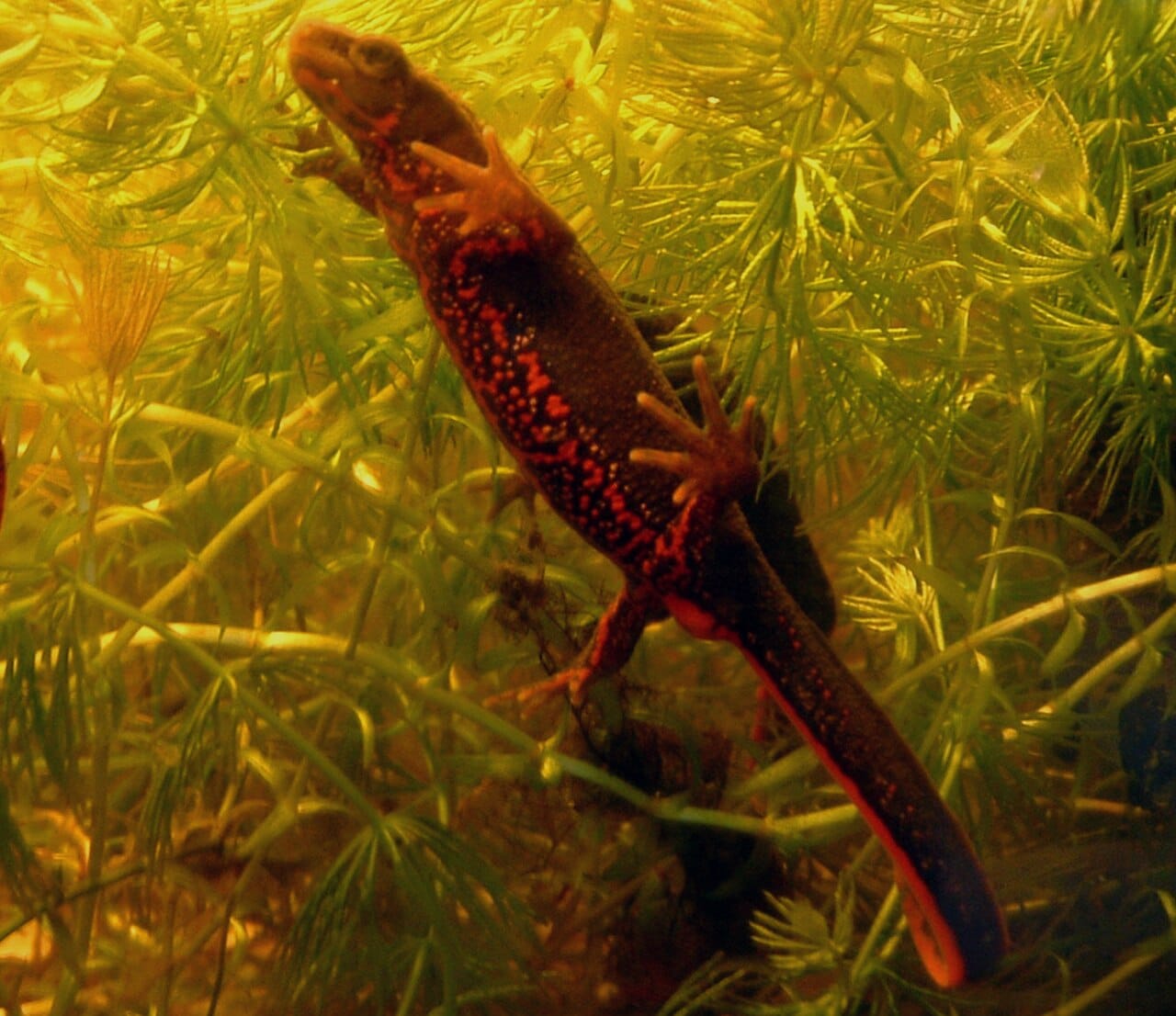
The Japanese Fire‑bellied Newt is an iconic amphibian native to Japan, known for its striking red-orange belly contrasted with a dark green to black dorsal surface. Adults typically measure 7–10 cm in length. The bright ventral coloration serves as a warning to predators, indicating the presence of mild toxins, a classic example of aposematism.
These newts inhabit ponds, rice paddies, slow streams, and wet forest areas. They are active predators, feeding on aquatic insects, larvae, worms, and small crustaceans. During breeding, males develop slightly swollen cloacal regions and perform underwater courtship displays, including tail-waving and lateral body movements to attract females. Eggs are attached individually to submerged leaves, and the larvae remain aquatic until they metamorphose into terrestrial juveniles.
The Japanese Fire‑bellied Newt plays a key ecological role by regulating invertebrate populations and serving as an indicator of aquatic habitat health. Conservation efforts prioritize wetland preservation, control of water pollution, and habitat restoration to ensure sustainable populations in the wild.
21. Chinese Fire‑bellied Newt (Cynops orientalis)
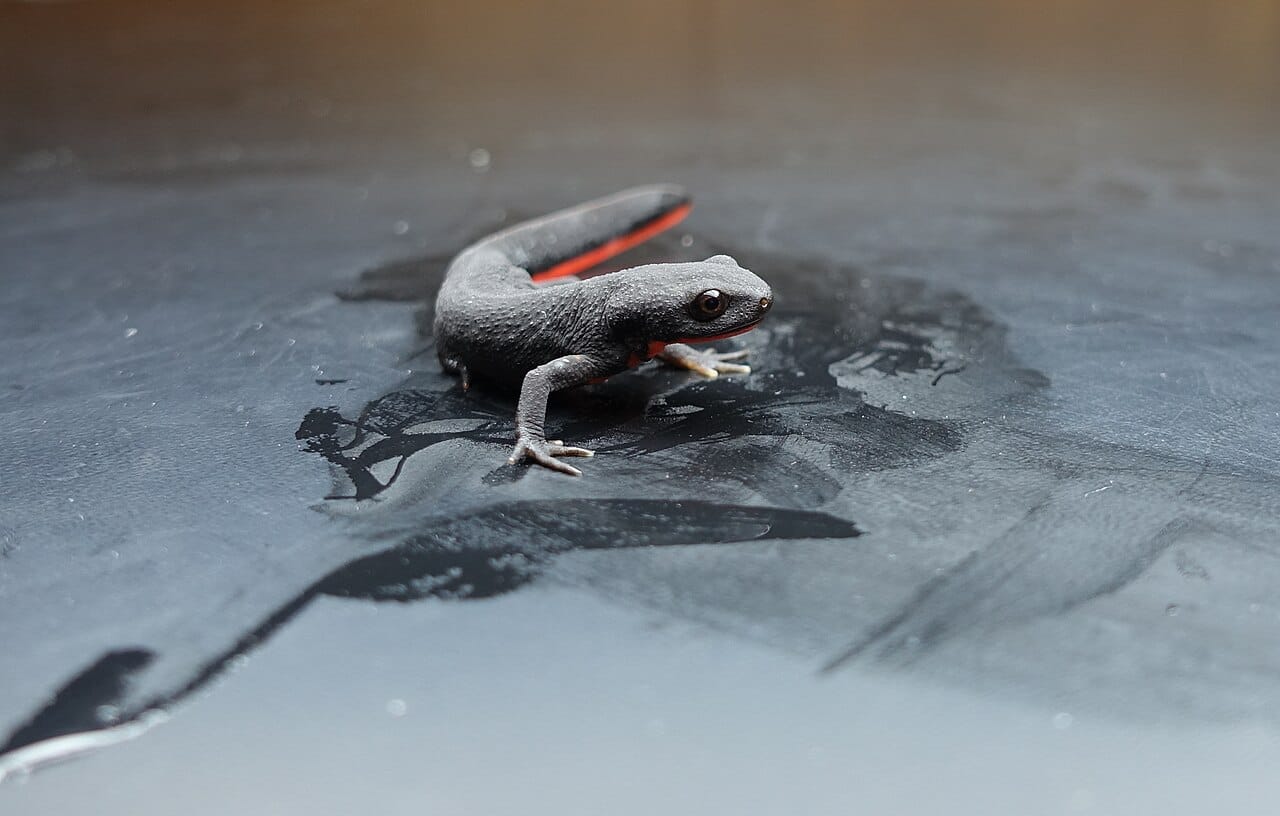
The Chinese Fire‑bellied Newt is a small, vibrant amphibian native to China, typically growing 6–8 cm in length. Its most striking feature is the bright orange-red belly contrasted by a dark green to black dorsal surface, which serves as a warning to potential predators due to its mild toxicity. This aposematic coloration is particularly pronounced in adults and helps deter predation.
They inhabit slow-moving streams, ponds, and rice paddies with abundant aquatic vegetation. These newts are nocturnal feeders, preying on small aquatic invertebrates, insect larvae, and worms. During the breeding season, males perform elaborate underwater courtship displays, including tail-waving and body undulations to attract females. Eggs are attached individually to submerged leaves, and larvae remain aquatic until metamorphosis into terrestrial juveniles.
Chinese Fire‑bellied Newts play a key role in maintaining invertebrate populations in freshwater habitats. They are sensitive to pollution and habitat disturbance, so wetland preservation and water quality management are critical for their survival.
22. Gold Dust Newt (Cynops ensicauda popei)
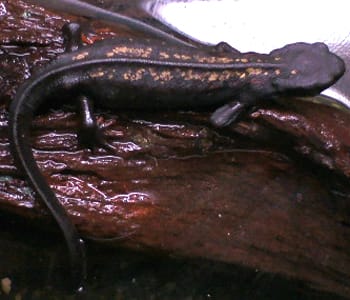
The Gold Dust Newt, native to parts of Asia, is celebrated for its speckled golden dorsal markings that resemble scattered dust, contrasting beautifully with its reddish-orange ventral side. Adults measure 7–10 cm and display robust bodies suited for both aquatic and semi-terrestrial environments. The bright belly serves as a warning to predators of its mildly toxic skin secretions.
Gold Dust Newts favor shallow ponds, marshes, and wetland areas with abundant cover, such as leaf litter and submerged vegetation. They are carnivorous, feeding on aquatic invertebrates, insect larvae, worms, and small crustaceans. Breeding males engage in underwater courtship rituals, exhibiting tail-waving, lateral undulation, and body displays to attract mates. Eggs are carefully attached to submerged leaves or stems, and larvae develop fully in water before transitioning to land.
This species contributes significantly to ecosystem health by controlling insect populations and serving as an indicator of freshwater habitat quality. Threats include wetland drainage, pollution, and habitat fragmentation, making conservation and monitoring essential.
23. Anderson’s Crocodile Newt (Echinotriton andersoni)
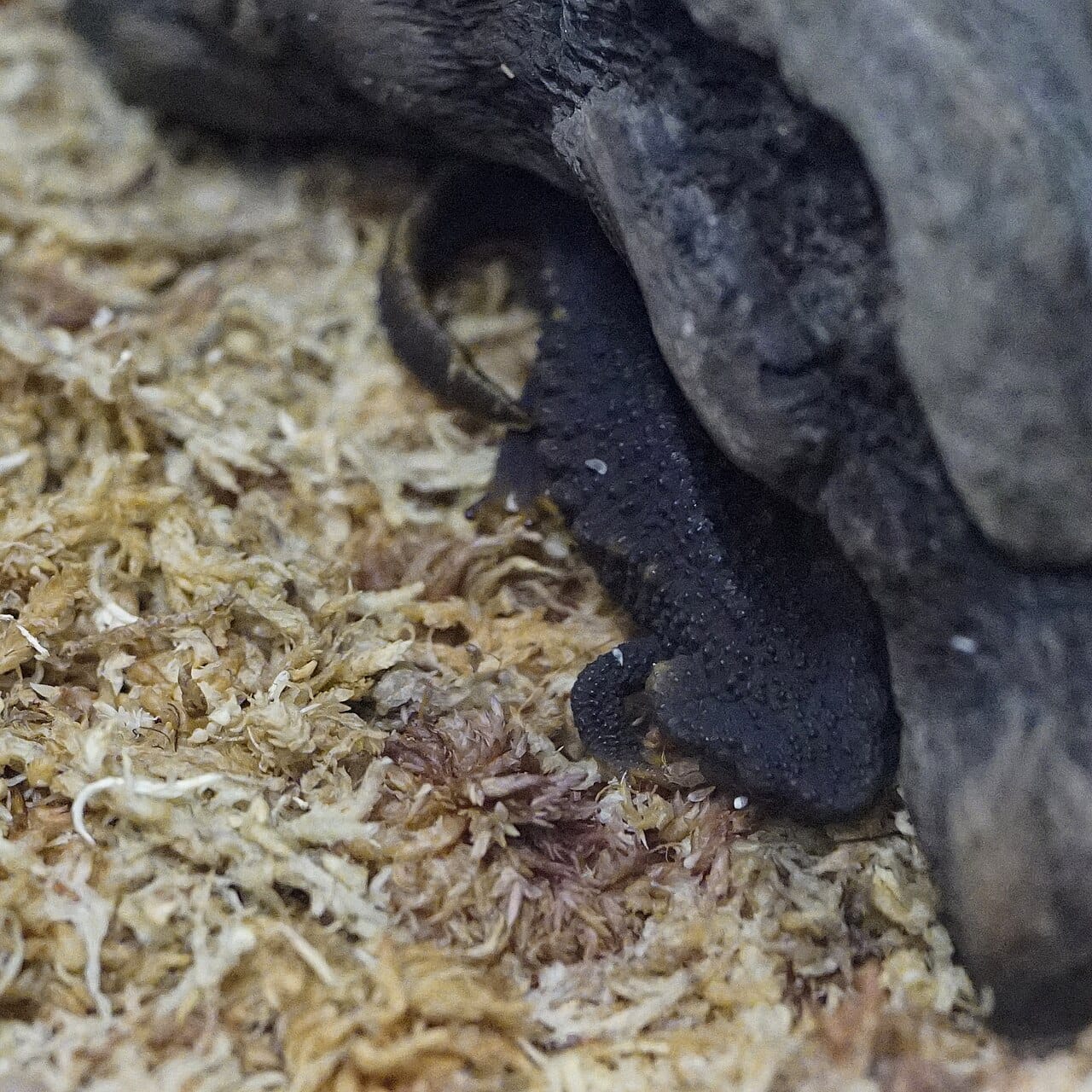
Anderson’s Crocodile Newt is a unique and highly specialized amphibian native to certain Asian regions. Adults can reach lengths of 12–15 cm and are distinguished by their robust, dark brown to black bodies, rough textured skin, and bright orange or red ventral surfaces. The striking belly coloration acts as a warning to predators due to the presence of mild toxins.
This terrestrial newt prefers subtropical forests near streams and shaded wetland areas. It emerges primarily at night to feed on insects, worms, and other small invertebrates. During the breeding season, males perform intricate courtship displays, including tail-undulation and lateral body movements to attract females. Eggs are laid individually in moist substrates close to water bodies, ensuring larvae can safely enter aquatic habitats upon hatching.
Anderson’s Crocodile Newts play a vital ecological role, helping regulate invertebrate populations. Threats include habitat destruction, deforestation, and water pollution. Conservation strategies focus on protecting forested wetlands, controlling pollution, and raising awareness of their ecological importance.
24. Chinhai Spiny Newt (Echinotriton chinhaiensis)
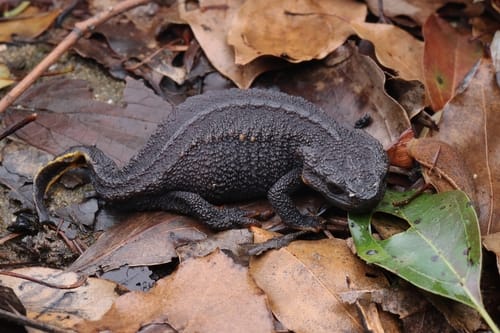
The Chinhai Spiny Newt is a distinctive Asian amphibian known for the small, spiny projections on its dorsal skin and its bright orange-red ventral coloration. Adults typically measure 8–11 cm and exhibit a dark dorsal side, providing camouflage against the forest floor. The ventral warning colors deter predators by signaling mild toxicity.
These newts inhabit subtropical forests, slow streams, and wetland areas with abundant leaf litter. They are carnivorous, feeding on insect larvae, small worms, and aquatic invertebrates. Courtship occurs in shallow water or moist terrestrial areas, with males performing tail and body movements to entice females. Eggs are deposited individually in concealed areas, and larvae develop fully in aquatic environments.
The Chinhai Spiny Newt contributes to ecological balance by controlling invertebrate populations and serves as a bioindicator of habitat health. Conservation is critical, as habitat loss, pollution, and drainage of wetlands threaten their populations.
25. Red‑tailed Knobby Newt (Tylototriton kweichowensis)
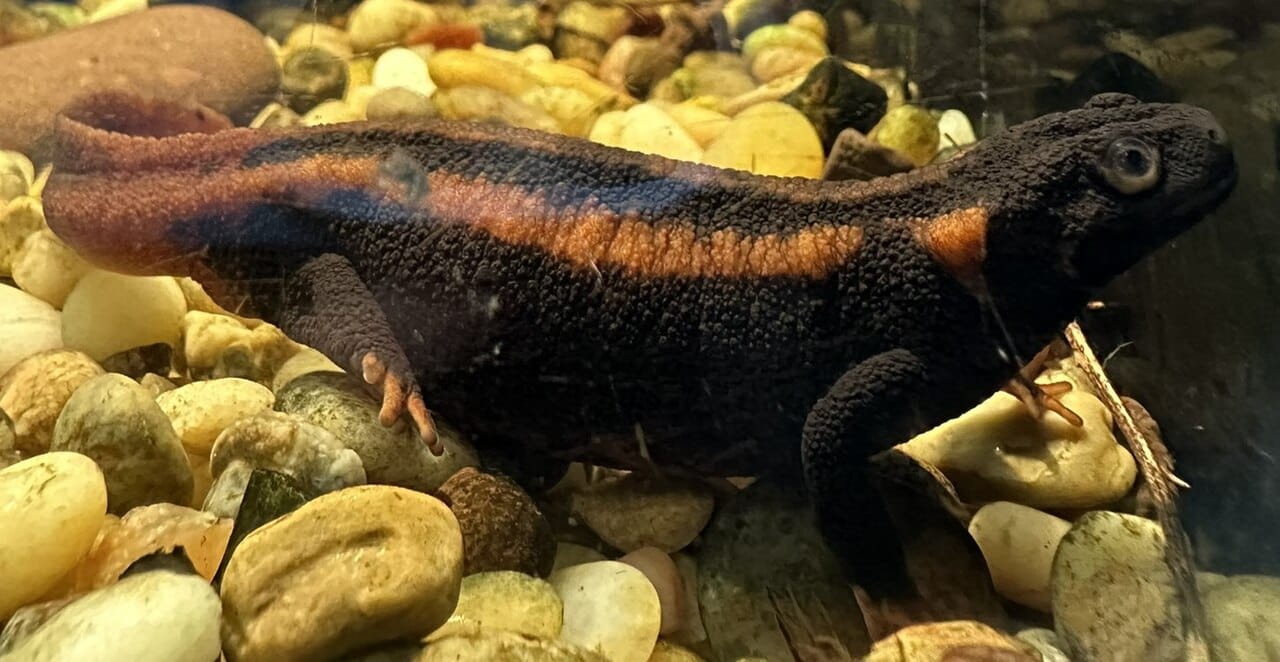
The Red‑tailed Knobby Newt is a medium-sized Asian newt measuring 9–13 cm, recognized for its rough, knobby dorsal skin and vividly colored red-orange tail and ventral side. Its dorsal coloration is dark brown to black, providing camouflage, while the bright red tail and belly serve as warning colors for predators due to toxic skin secretions.
They are primarily found in forested streams, marshes, and slow-moving water bodies with abundant cover. Red‑tailed Knobby Newts are carnivorous, feeding on aquatic insects, worms, and small crustaceans. Breeding males engage in underwater courtship displays involving lateral body movements and tail-waving to attract females. Eggs are laid individually in submerged or moist areas, ensuring safety until larvae emerge and develop in aquatic habitats.
This species is ecologically important, maintaining balanced invertebrate populations and serving as an indicator of wetland health. Habitat loss, water pollution, and human disturbance are major threats. Conservation measures include wetland protection, pollution control, and habitat restoration to support thriving populations.
26. Emperor Newt (Tylototriton shanjing)
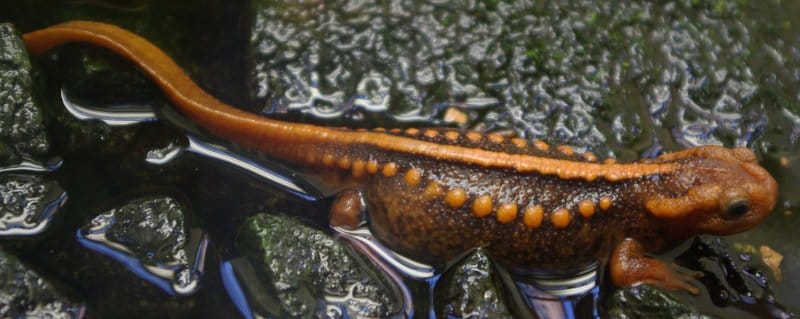
The Emperor Newt is one of Asia’s most striking amphibians, celebrated for its bright orange markings along the edges of its dark brown to black dorsal surface. Adults grow up to 15 cm and display a robust, knobby body. The vivid orange coloration is aposematic, warning predators of the mild toxins present in its skin. This adaptation makes it a fascinating subject for wildlife enthusiasts and ecologists alike.
Emperor Newts inhabit subtropical forests near streams, ponds, and wetlands, requiring moist environments for survival. They are primarily nocturnal, emerging at night to feed on small invertebrates, worms, and aquatic insects. Males engage in complex courtship displays, including tail undulations, body vibrations, and close physical contact to attract females. Eggs are carefully deposited in damp, concealed areas, and larvae develop fully in aquatic habitats before transitioning to terrestrial life.
These newts play a vital ecological role by controlling invertebrate populations and contributing to the overall health of wetland ecosystems. Habitat destruction, pollution, and human disturbance remain significant threats, making conservation of wetland and forest habitats essential for their long-term survival.
27. Himalayan Newt (Tylototriton verrucosus)
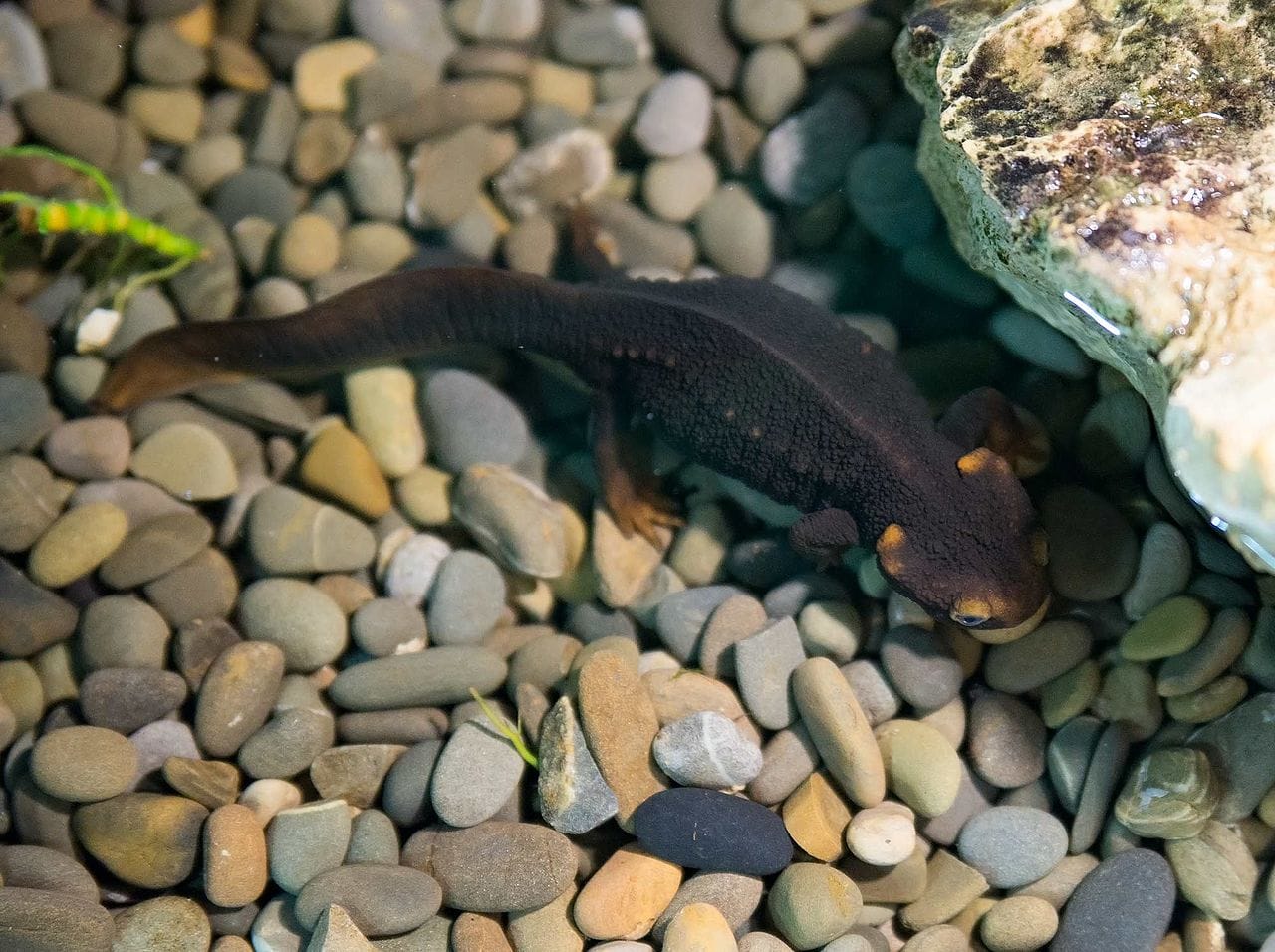
The Himalayan Newt is native to the Himalayan region and is easily recognized by its dark dorsal body adorned with bright orange markings along the ridges of its back and limbs. Adults typically measure 12–16 cm and possess knobby skin that gives them a distinctive “armored” appearance. These warning colors signal their mild toxicity to potential predators.
They inhabit cool, shaded streams and moist forest floors at high altitudes. Himalayan Newts are carnivorous, preying on worms, insect larvae, and small aquatic invertebrates. Breeding males display elaborate courtship behaviors, including circling, tail undulations, and nudging, to entice females. Eggs are laid in carefully selected moist microhabitats to ensure larval survival, which continues in nearby aquatic environments.
This species plays a crucial role in maintaining ecological balance by regulating invertebrate populations and serving as an indicator of clean freshwater habitats. Conservation efforts focus on protecting mountain forests, preventing water pollution, and mitigating human encroachment in their native regions.
28. Hong Kong Warty Newt (Paramesotriton hongkongensis)
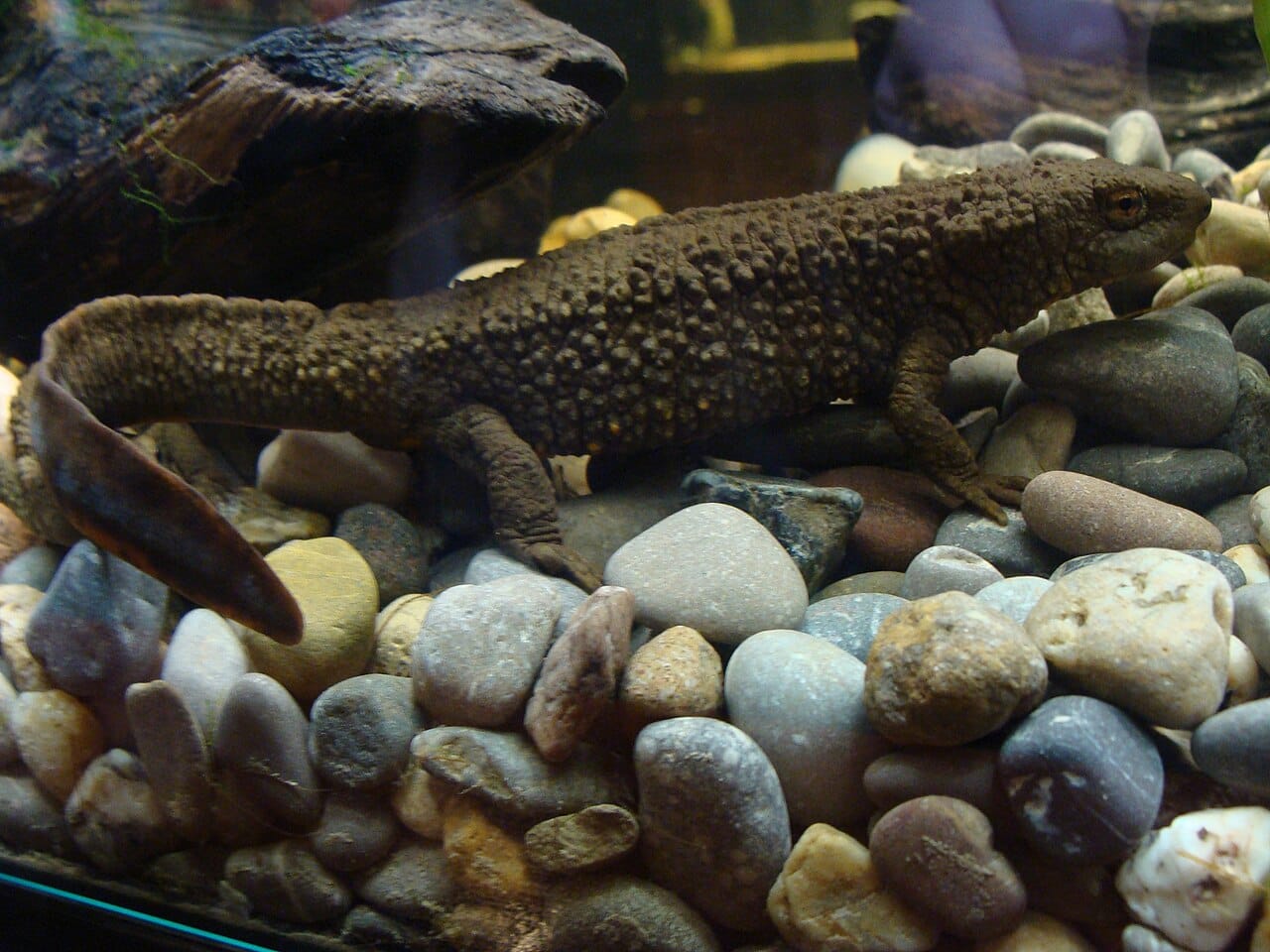
The Hong Kong Warty Newt is a medium-sized, visually striking amphibian endemic to parts of southern China, including Hong Kong. It has a dark brown to black dorsal surface with pronounced warts and bright orange ventral and limb markings. Adults grow up to 11–13 cm and are known for their unique knobby appearance and vibrant warning coloration.
These newts prefer slow-moving streams, forested ponds, and wetland areas with abundant cover. Nocturnal by nature, they feed on aquatic and terrestrial invertebrates such as worms, insect larvae, and small crustaceans. Males perform underwater courtship displays, including tail-waving and lateral undulations, to attract females. Eggs are deposited in well-hidden, damp locations to maximize survival, with larvae developing in aquatic habitats before moving onto land.
The Hong Kong Warty Newt contributes significantly to ecosystem health by controlling invertebrate populations and indicating the quality of freshwater habitats. Threats include habitat loss, pollution, and urbanization. Conservation efforts prioritize wetland protection, habitat restoration, and environmental education to ensure their survival.
29. Spot‑tailed Warty Newt (Paramesotriton caudopunctatus)
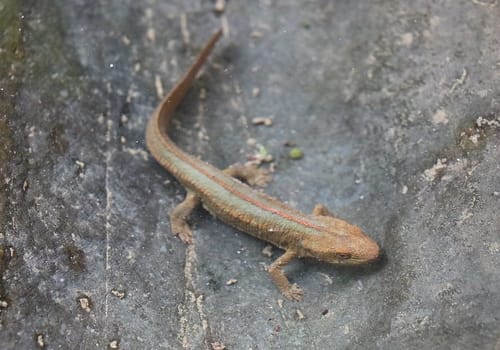
The Spot‑tailed Warty Newt is an Asian species distinguished by its small black dorsal body dotted with bright orange or red spots along its tail and belly. Adults measure approximately 10–12 cm and have characteristic warty skin, which serves as camouflage and protection. Its vivid ventral coloration signals mild toxicity to predators.
They inhabit forest streams, ponds, and marshes with ample cover. Primarily nocturnal, Spot‑tailed Warty Newts feed on small aquatic invertebrates, worms, and insect larvae. Courtship involves males performing tail undulations, circling, and nudging behaviors to attract females. Eggs are laid in secluded, damp locations, with larvae developing in water before metamorphosing to terrestrial juveniles.
This species helps maintain ecological balance by regulating invertebrate populations and indicates healthy freshwater habitats. Conservation concerns include habitat destruction, water pollution, and human disturbance. Protecting forested wetlands and stream ecosystems is vital for their long-term survival.
30. Spotted Paddle‑tail Newt (Pachytriton brevipes)
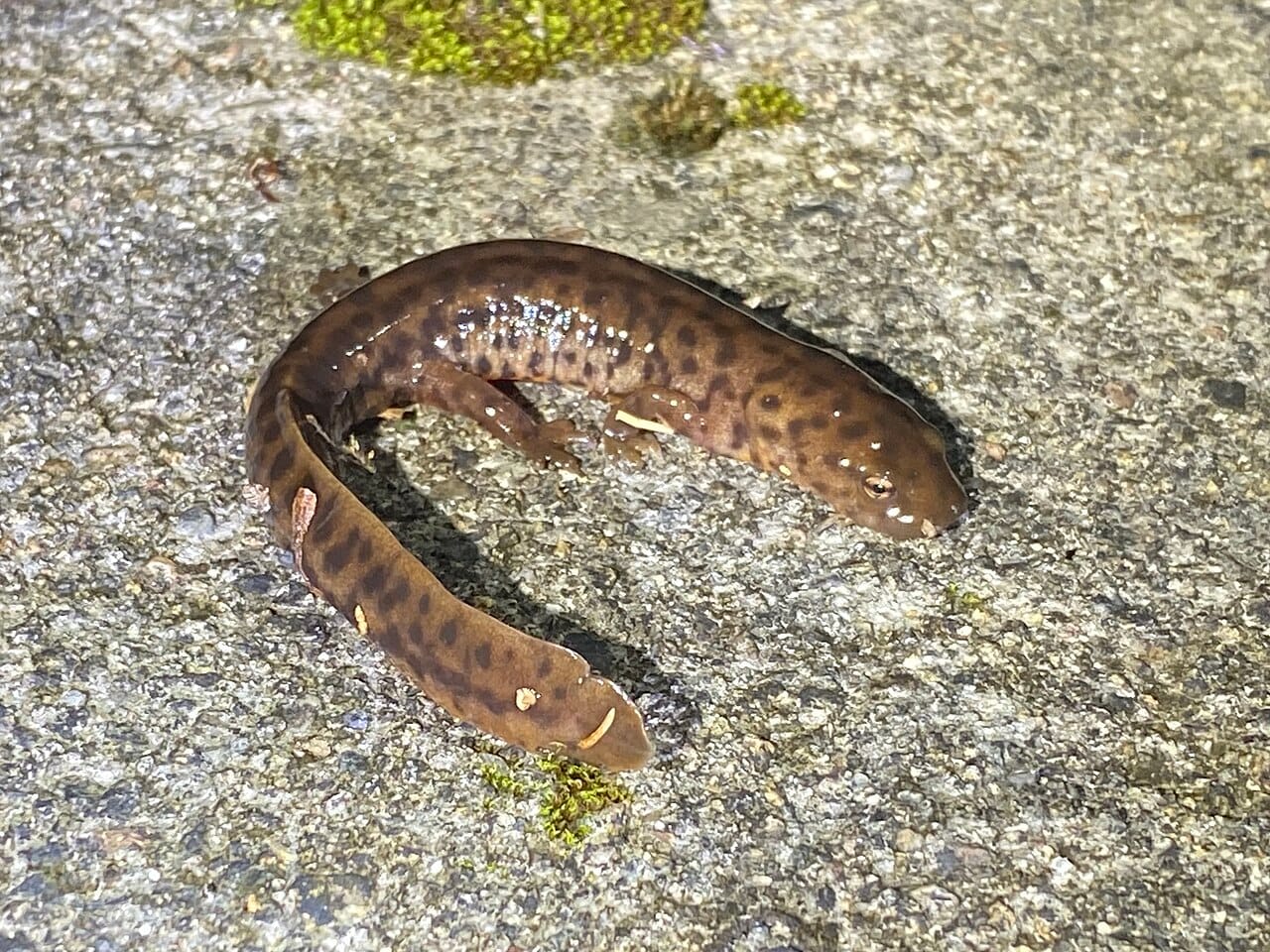
The Spotted Paddle‑tail Newt is a unique amphibian native to southeastern China, recognized for its dark dorsal body with lighter spotted patterns and a distinctive paddle-shaped tail used for swimming. Adults reach 8–10 cm in length, and their bright ventral coloration warns predators of mild toxins. This combination of camouflage and aposematic coloration makes them both elusive and fascinating.
They inhabit streams, ponds, and small rivers with clean, oxygen-rich water. Nocturnal feeders, they prey on small aquatic invertebrates, insect larvae, and worms. Breeding males engage in elaborate displays, including tail undulations and lateral movements to entice females. Eggs are laid in damp, concealed locations, with larvae developing fully in water before transitioning to terrestrial life.
The Spotted Paddle‑tail Newt contributes to ecosystem health by controlling invertebrate populations and serves as an indicator species for freshwater quality. Habitat loss, pollution, and human encroachment pose significant threats, highlighting the importance of wetland conservation, habitat management, and environmental awareness programs.
Conclusion: Explore the Fascinating World of Newts
From the brightly colored Red‑bellied Newt of the western United States to the unique Spotted Paddle‑tail Newt of southeastern China, newts offer an incredible diversity of forms, behaviors, and habitats. These amphibians are not only visually stunning but also play a vital ecological role in controlling invertebrate populations, maintaining wetland health, and serving as indicators of freshwater ecosystem quality. Understanding the different Types of Newts helps us appreciate the complexity of global amphibian biodiversity and the importance of conservation efforts to protect these remarkable creatures. Whether you are a wildlife enthusiast, a researcher, or a beginner exploring amphibians, the world of Newts is rich with fascinating species and stories that inspire curiosity and respect for nature.
Frequently Asked Questions About Types of Newts
1. What are newts?
Newts are small amphibians belonging to the salamander family, typically found in freshwater or moist terrestrial habitats.
2. How many types of newts exist?
There are over 30 recognized types of newts worldwide, each with unique characteristics, habitats, and behaviors.
3. Where do newts live?
Newts inhabit ponds, streams, wetlands, and moist forests across Europe, Asia, and North America.
4. What do newts eat?
Newts are carnivorous, feeding on insects, worms, small crustaceans, and aquatic invertebrates.
5. Are newts poisonous?
Some newts produce mild toxins in their skin to deter predators, but they are generally harmless to humans if not ingested.
6. How long do newts live?
Depending on the species, newts can live from 6 to 15 years in the wild and sometimes longer in captivity.
7. How do newts reproduce?
Newts reproduce by laying eggs in water or damp areas. Larvae hatch and develop in aquatic habitats before transitioning to land.
8. Can newts regenerate limbs?
Yes, newts are famous for their ability to regenerate lost limbs, tails, and even parts of internal organs.
9. Are newts endangered?
Some species of newts face habitat loss, pollution, and climate change, making conservation efforts critical.
10. How do newts defend themselves?
They use camouflage, bright warning colors, toxins, and hiding in burrows or under vegetation to protect themselves.
11. What is the difference between newts and salamanders?
Newts are a subgroup of salamanders, often with more aquatic life stages and unique skin textures or coloration.
12. Do newts hibernate?
Yes, many newts hibernate during cold months, burrowing into mud or leaf litter to survive winter conditions.
13. What is the lifespan of a Red‑bellied Newt?
Red‑bellied Newts can live up to 12–15 years in the wild, thriving in cool freshwater streams.
14. Where is the Japanese Fire‑bellied Newt found?
It is native to Japan and inhabits ponds, rice paddies, and slow-moving streams in forested regions.
15. What makes the Great Crested Newt unique?
This European species is larger than most newts and has a distinctive wavy crest along its back during breeding season.
16. How big do Alpine Newts grow?
Alpine Newts typically reach 9–12 cm in length and display vibrant blue spots along their sides.
17. Are newts nocturnal?
Most newts are primarily nocturnal, foraging at night and hiding under rocks or vegetation during the day.
18. How do newts breathe?
Newts can breathe through their skin, lungs, and gills, depending on life stage and species.
19. What is the diet of the Spotted Paddle‑tail Newt?
It feeds on aquatic insects, worms, larvae, and other small invertebrates in freshwater habitats.
20. How can I tell male and female newts apart?
Males often have larger crests, brighter colors, or thicker tails during the breeding season compared to females.
21. Can newts live in captivity?
Yes, with proper aquatic and terrestrial setups, many newts thrive in captivity while maintaining natural behaviors.
22. What are common threats to newts?
Habitat loss, pollution, invasive species, climate change, and human interference are major threats to newts.
23. What is the Palmate Newt known for?
It is a small European newt with a webbed hind foot, and males develop a thin tail filament during breeding.
24. How do newts attract mates?
Males use elaborate courtship displays, including tail-waving, body undulations, and circling behaviors in water.
25. Are newts social animals?
Newts are generally solitary outside of breeding seasons, interacting mainly for reproduction.
26. What is the habitat of the Smooth Newt?
Smooth Newts inhabit ponds, ditches, and slow-moving water bodies throughout Europe and parts of Asia.
27. How do newts communicate?
They communicate primarily through body movements, pheromones, and visual signals during courtship.
28. Can newts live outside water?
Adult newts can survive on land in damp environments but return to water for breeding and larval development.
29. How does climate affect newts?
Temperature and rainfall influence breeding cycles, hibernation, and habitat suitability for different newt species.
30. Are newts important for ecosystems?
Yes, they control insect populations, serve as prey for birds and mammals, and indicate freshwater ecosystem health.
31. What is the role of toxins in newts?
Toxins in skin deter predators, and their bright ventral colors serve as warning signals.
32. How do newt larvae develop?
Larvae hatch in water with gills, feed on small invertebrates, and gradually metamorphose into terrestrial adults.
33. What is the Red‑tailed Knobby Newt?
It is a Chinese species with bright red tail markings and knobby skin, living in mountain streams.
34. How do newts adapt to seasonal changes?
Newts hibernate, slow metabolism, or seek refuge during extreme temperatures to survive seasonal changes.
35. Are newts indicators of environmental health?
Yes, their presence indicates clean, unpolluted freshwater habitats.
36. Can newts swim efficiently?
Yes, their flattened tails act as paddles, allowing agile swimming in streams and ponds.
37. What is unique about the Marbled Newt?
The Marbled Newt has striking black-and-green patterns, providing camouflage in aquatic vegetation.
38. How do newts protect their eggs?
They lay eggs in hidden or submerged locations to minimize predation risk.
39. What is the lifespan of a Japanese Fire‑bellied Newt?
It can live up to 10–12 years in the wild and slightly longer in captivity.
40. Are newts amphibians or reptiles?
Newts are amphibians, related to salamanders, requiring both aquatic and terrestrial habitats during their lifecycle.
41. How do Himalayan Newts survive cold climates?
They hibernate under leaf litter or burrows and emerge during warmer months for feeding and breeding.
42. Can newts regenerate internal organs?
Yes, they are capable of regenerating limbs, tails, eyes, and parts of some internal organs.
43. How big can Great Crested Newts grow?
Adults can reach up to 17 cm, making them one of the largest newt species in Europe.
44. Are all newts aquatic?
No, while larvae and breeding adults are aquatic, many species spend most of their life on land in moist environments.
45. How do Red‑bellied Newts communicate?
Through visual signals, chemical pheromones, and subtle body movements during courtship.
46. What is the primary diet of Alpine Newts?
They feed on small insects, larvae, worms, and other tiny invertebrates in forest streams.
47. How does pollution affect newts?
Water contamination can reduce survival rates, disrupt breeding, and damage sensitive skin and gills.
48. Do newts hibernate in tropical regions?
Tropical species may not hibernate but instead seek moist microhabitats during dry seasons.
49. Can newts coexist with other amphibians?
Yes, but competition for food and breeding sites may occur in shared habitats.
50. What conservation efforts help newts?
Protecting wetlands, restoring habitats, reducing pollution, and monitoring populations are key conservation strategies.