

There are many types of pleco fish in the aquarium trade, but the word pleco does not describe one species. It is a broad hobby label for suckermouth armored catfishes, ranging from compact cave-dwellers to giant wood-eating fish that can outgrow ordinary aquariums.
This guide compares 30 popular pleco types by pattern, likely adult size, diet, river habitat, and care difficulty. It also explains L-numbers, misleading common names, the difference between algae grazers and protein-oriented species, and why choosing a pleco by juvenile appearance alone can create serious welfare problems later.
What Are the Main Types of Pleco Fish?
The main aquarium pleco groups include bristlenose Ancistrus, wood-eating Panaque and Panaqolus, patterned Hypancistrus, grazing Baryancistrus, protein-oriented Leporacanthicus and Scobinancistrus, hillstream Chaetostoma, and very large Hypostomus, Pterygoplichthys, or Acanthicus. They differ greatly in adult size and diet. A pleco should therefore be selected by verified identity and care needs, not simply because it is sold as an algae eater.
Quick Comparison of the 30 Types of Pleco Fish
| No. | Common Name | Scientific Name | Group | Best Identification Clue |
|---|---|---|---|---|
| 1 | Common Pleco | Hypostomus plecostomus and related trade species | Large omnivorous loricariid | the spotted armor and large adult build |
| 2 | Bristlenose Pleco | Ancistrus cirrhosus and captive Ancistrus forms | Small to medium Ancistrus | the bristles around the snout |
| 3 | Starlight Bristlenose Pleco | Ancistrus dolichopterus, often sold as L183 | Ancistrus | fine white stars plus a light fin seam |
| 4 | Medusa Pleco | Ancistrus ranunculus, L034 | Ancistrus | the thick medusa-like facial tentacles |
| 5 | Clown Pleco | Panaqolus maccus, L104 | Wood-eating Panaqolus | the compact body with wavy tiger bands |
| 6 | Flash Pleco | Panaqolus albivermis, L204 | Wood-eating Panaqolus | the fine bright pinstripes |
| 7 | Tiger Panaque | Panaqolus sp. L002 | Wood-eating Panaqolus | the broad contrasting bands and blunt head |
| 8 | Royal Pleco | Panaque nigrolineatus | Large wood-eating Panaque | the royal longitudinal striping |
| 9 | Blue-Eyed Royal Pleco | Panaque cochliodon group | Large wood-eating Panaque | the bright blue iris |
| 10 | Papa Panaque | Panaque bathyphilus, L090 | Large Panaque | the heavy build and streamer-like fin tips |
| 11 | Zebra Pleco | Hypancistrus zebra, L046 | Protein-oriented Hypancistrus | the sharp black-and-white bands |
| 12 | King Tiger Pleco | Hypancistrus sp. L066 | Hypancistrus L-number pleco | the branching tiger-maze pattern |
| 13 | L333 Pleco | Hypancistrus sp. L333 | Hypancistrus L-number pleco | the variable scribbled light pattern |
| 14 | Queen Arabesque Pleco | Hypancistrus sp. L260 | Hypancistrus L-number pleco | the unusually delicate lace-like lines |
| 15 | Snowball Pleco | Hypancistrus inspector, L102 | Hypancistrus | large round light spots on a dark body |
| 16 | Dwarf Snowball Pleco | Hypancistrus sp. L471 | Small Hypancistrus | minute white snow-like dots |
| 17 | Leopard Frog Pleco | Peckoltia compta, L134 | Peckoltia | the leopard-frog yellow and black pattern |
| 18 | Butterfly Pleco | Dekeyseria brachyura, L168 | Color-changing loricariid | the substrate-linked color change |
| 19 | Gold Nugget Pleco | Baryancistrus xanthellus, including L018, L081, and L177 forms | Baryancistrus | yellow spots with yellow fin seams |
| 20 | Mango Pleco | Baryancistrus chrysolomus, L047 | Baryancistrus | the mango-colored fin edging |
| 21 | Blue Phantom Pleco | Hemiancistrus sp. L128 | Phantom pleco | the blue-gray color and small pale spots |
| 22 | Green Phantom Pleco | Hemiancistrus subviridis, L200 | Phantom pleco | the green body with yellow spotting |
| 23 | Vampire Pleco | Leporacanthicus galaxias, L007 or L029 | Carnivore-leaning Leporacanthicus | the galaxy-like white spotting |
| 24 | Sultan Pleco | Leporacanthicus joselimai, L264 | Leporacanthicus | dense fine spotting over the entire body |
| 25 | Sunshine Pleco | Scobinancistrus aureatus, L014 | Scobinancistrus | the golden fins and spotted dark body |
| 26 | Peppermint Pleco | Parancistrus nudiventris and similar trade forms | Spotted loricariid | the fine pepper-like speckling |
| 27 | Rubber Lip Pleco | Chaetostoma formosae and related Chaetostoma | Hillstream loricariid | the broad soft-looking lips and flattened head |
| 28 | Bulldog Pleco | Chaetostoma species | Hillstream loricariid | the bulldog-like head profile |
| 29 | Leopard Sailfin Pleco | Pterygoplichthys gibbiceps | Large sailfin pleco | the huge sail-like dorsal fin |
| 30 | Adonis Pleco | Acanthicus adonis, L155 | Giant spiny loricariid | the spiny black body and white juvenile spots |
1. Common Pleco
Common Pleco (Hypostomus plecostomus and related trade species) is a large omnivorous loricariid pleco known for a brown armored body covered with dark spots and a tall dorsal fin. It is generally very large for a home aquarium and is associated with tropical South American rivers; the trade name is also applied to several similar species. Its diet should include algae-based foods, vegetables, quality sinking pellets, and occasional protein appropriate to the species; it should never be expected to live on tank algae alone.
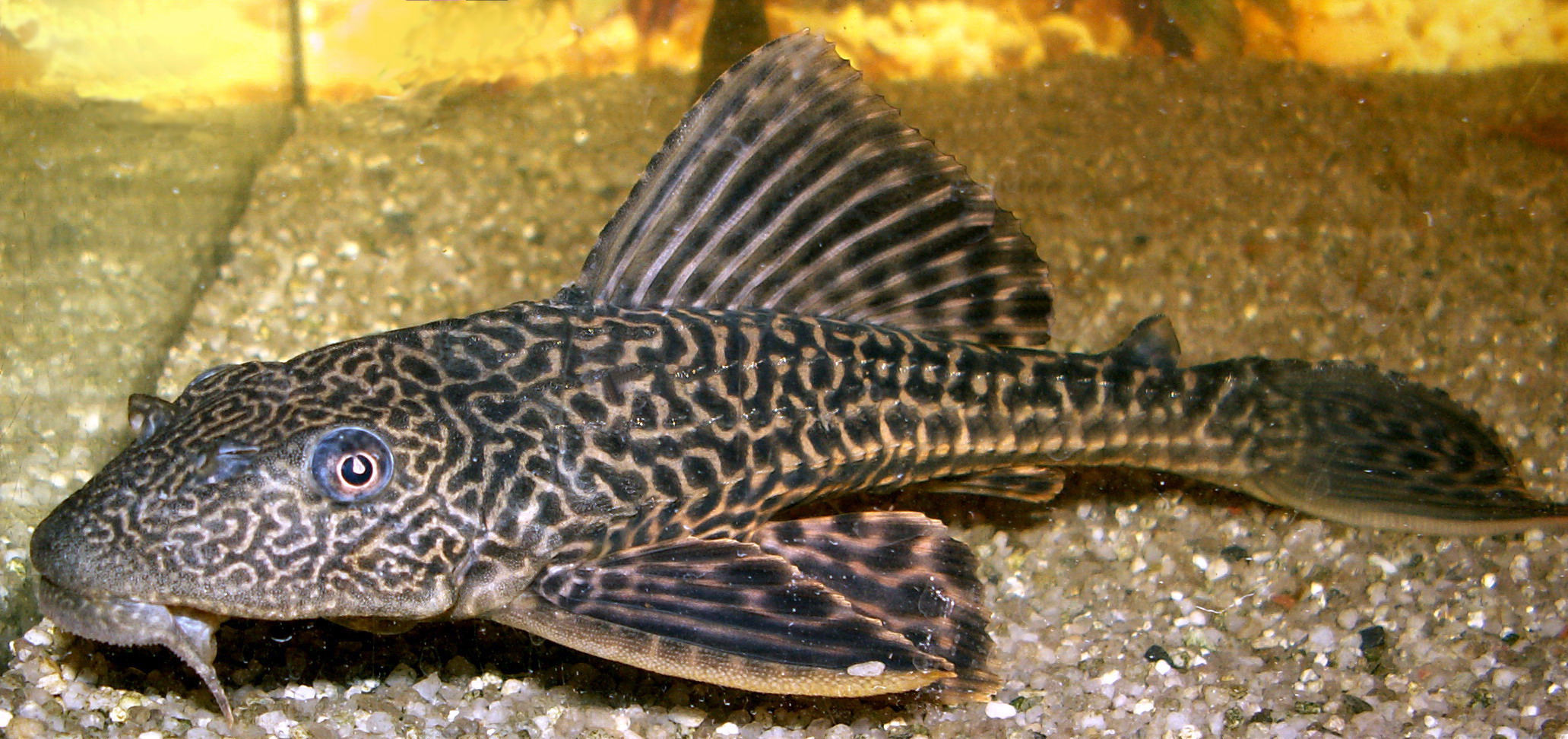
It is hardy but produces heavy waste and needs a genuinely large, mature system with strong filtration. Juveniles are often sold without adequate warning about adult size. A useful identification clue is the spotted armor and large adult build.
2. Bristlenose Pleco
Fishkeepers usually recognize Bristlenose Pleco (Ancistrus cirrhosus and captive Ancistrus forms) by a broad sucker mouth and fleshy tentacles on the snout, especially in mature males. It is generally compact compared with common plecos and is associated with South American streams and widely established captive lines. Its diet should include vegetable matter, algae wafers, soft vegetables, biofilm, and some protein; it should never be expected to live on tank algae alone.
This is one of the most practical plecos for well-maintained community aquariums with caves and driftwood. It still needs deliberate feeding and regular waste removal. A useful identification clue is the bristles around the snout.
3. Starlight Bristlenose Pleco
Starlight Bristlenose Pleco (Ancistrus dolichopterus, often sold as L183) represents the ancistrus side of the pleco hobby, with a dark body sprinkled with small white spots and a pale edging on the fins. It is generally small to medium and is associated with blackwater and clearwater tributaries in northern South America. Its diet should include biofilm, plant-based foods, vegetables, and modest animal protein; it should never be expected to live on tank algae alone.

Soft, clean, oxygen-rich water and shaded caves help maintain condition and breeding behavior. The true species is sometimes confused with other spotted Ancistrus. A useful identification clue is fine white stars plus a light fin seam.
4. Medusa Pleco
For aquarists comparing plecos, Medusa Pleco (Ancistrus ranunculus, L034) stands out because of a broad dark head with thick branching tentacles and a comparatively plain body. It is generally medium and is associated with rocky fast-flowing sections of the Xingu and Tocantins systems. Its diet should include biofilm, vegetable foods, and mixed sinking fare; it should never be expected to live on tank algae alone.
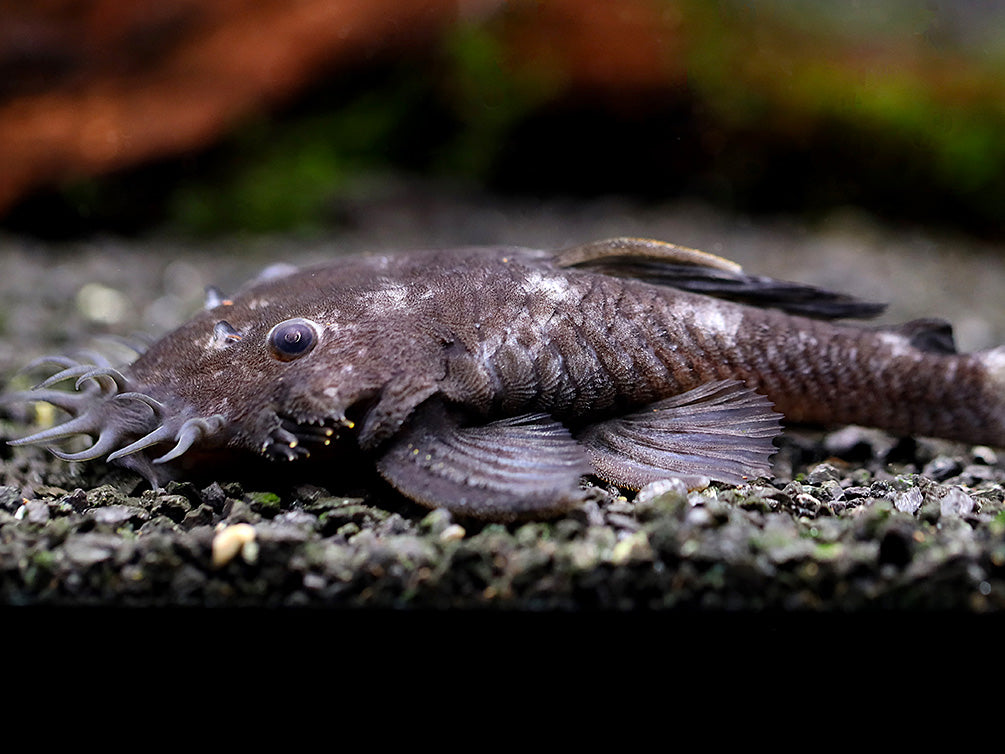
It appreciates high oxygen, current, smooth caves, and stable warm water. Its heavy head shape and adult bristles are more reliable than juvenile color. A useful identification clue is the thick medusa-like facial tentacles.
5. Clown Pleco
Clown Pleco (Panaqolus maccus, L104) is a wood-eating panaqolus pleco known for alternating dark and pale bands across a short compact body. It is generally small and is associated with Venezuelan and Colombian river systems with submerged wood. Its diet should include driftwood, biofilm, vegetable matter, and specialized sinking foods; it should never be expected to live on tank algae alone.
Real wood is a functional part of its habitat and diet, not merely decoration. It is not an efficient glass-cleaning substitute and can be shy by day. A useful identification clue is the compact body with wavy tiger bands.
6. Flash Pleco
Fishkeepers usually recognize Flash Pleco (Panaqolus albivermis, L204) by thin cream lines crossing a dark body and extending onto the fins. It is generally small to medium and is associated with Peruvian Amazon tributaries with wood and current. Its diet should include wood-associated biofilm, plant foods, and balanced sinking diets; it should never be expected to live on tank algae alone.
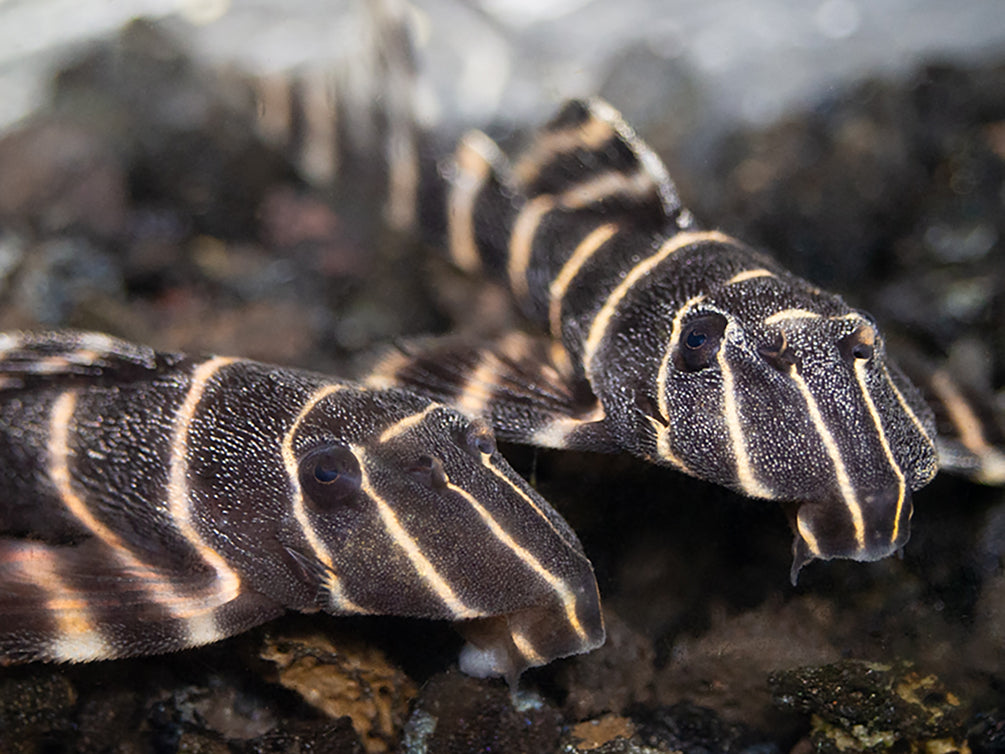
Provide multiple pieces of driftwood, shaded cover, and good circulation. Striping can fade under stress or poor lighting. A useful identification clue is the fine bright pinstripes.
7. Tiger Panaque
Tiger Panaque (Panaqolus sp. L002) represents the wood-eating panaqolus side of the pleco hobby, with bold black and cream bands with a short deep body. It is generally small to medium and is associated with Amazonian tributaries rich in submerged timber. Its diet should include wood, biofilm, vegetable foods, and occasional protein; it should never be expected to live on tank algae alone.
It suits mature aquariums with abundant wood and secure caves. The trade name tiger pleco is used for several different fish. A useful identification clue is the broad contrasting bands and blunt head.
8. Royal Pleco
For aquarists comparing plecos, Royal Pleco (Panaque nigrolineatus) stands out because of long cream or gold lines over a dark armored body with red-brown eyes. It is generally large and is associated with large northern South American rivers with sunken wood. Its diet should include wood, fibrous vegetables, and species-appropriate sinking foods; it should never be expected to live on tank algae alone.

A spacious tank, powerful filtration, and substantial driftwood are essential because this fish creates large amounts of waste. Do not purchase a small juvenile for a modest community tank. A useful identification clue is the royal longitudinal striping.
9. Blue-Eyed Royal Pleco
Blue-Eyed Royal Pleco (Panaque cochliodon group) is a large wood-eating panaque pleco known for a dark body contrasted by vivid blue eyes. It is generally large and is associated with Colombian river systems with rocky and woody substrates. Its diet should include wood, biofilm, vegetables, and formulated foods; it should never be expected to live on tank algae alone.
It requires a long aquarium, heavy filtration, and stable water quality. Several closely related blue-eyed forms occur in trade. A useful identification clue is the bright blue iris.
10. Papa Panaque
Fishkeepers usually recognize Papa Panaque (Panaque bathyphilus, L090) by a bulky armored body with pale markings and long trailing fin extensions in mature fish. It is generally large and is associated with deep channels of the upper and middle Amazon basin. Its diet should include wood and mixed benthic foods; it should never be expected to live on tank algae alone.
It is best reserved for specialist large aquariums with strong oxygenation. Deep-water loricariids should be acclimated carefully. A useful identification clue is the heavy build and streamer-like fin tips.
11. Zebra Pleco
Zebra Pleco (Hypancistrus zebra, L046) represents the protein-oriented hypancistrus side of the pleco hobby, with clean black-and-white bands arranged like a zebra pattern. It is generally small and is associated with fast rocky water in the Xingu River basin. Its diet should include protein-rich sinking foods, small invertebrate-based fare, and some plant material; it should never be expected to live on tank algae alone.
Warm, highly oxygenated water, strong flow, caves, and low waste levels are critical. It is not primarily an algae eater and wild conservation concerns make captive-bred sourcing important. A useful identification clue is the sharp black-and-white bands.
12. King Tiger Pleco
For aquarists comparing plecos, King Tiger Pleco (Hypancistrus sp. L066) stands out because of irregular pale maze-like bands over a dark body. It is generally small to medium and is associated with rocky stretches of the Xingu River system. Its diet should include mixed sinking foods with a strong animal-protein component; it should never be expected to live on tank algae alone.
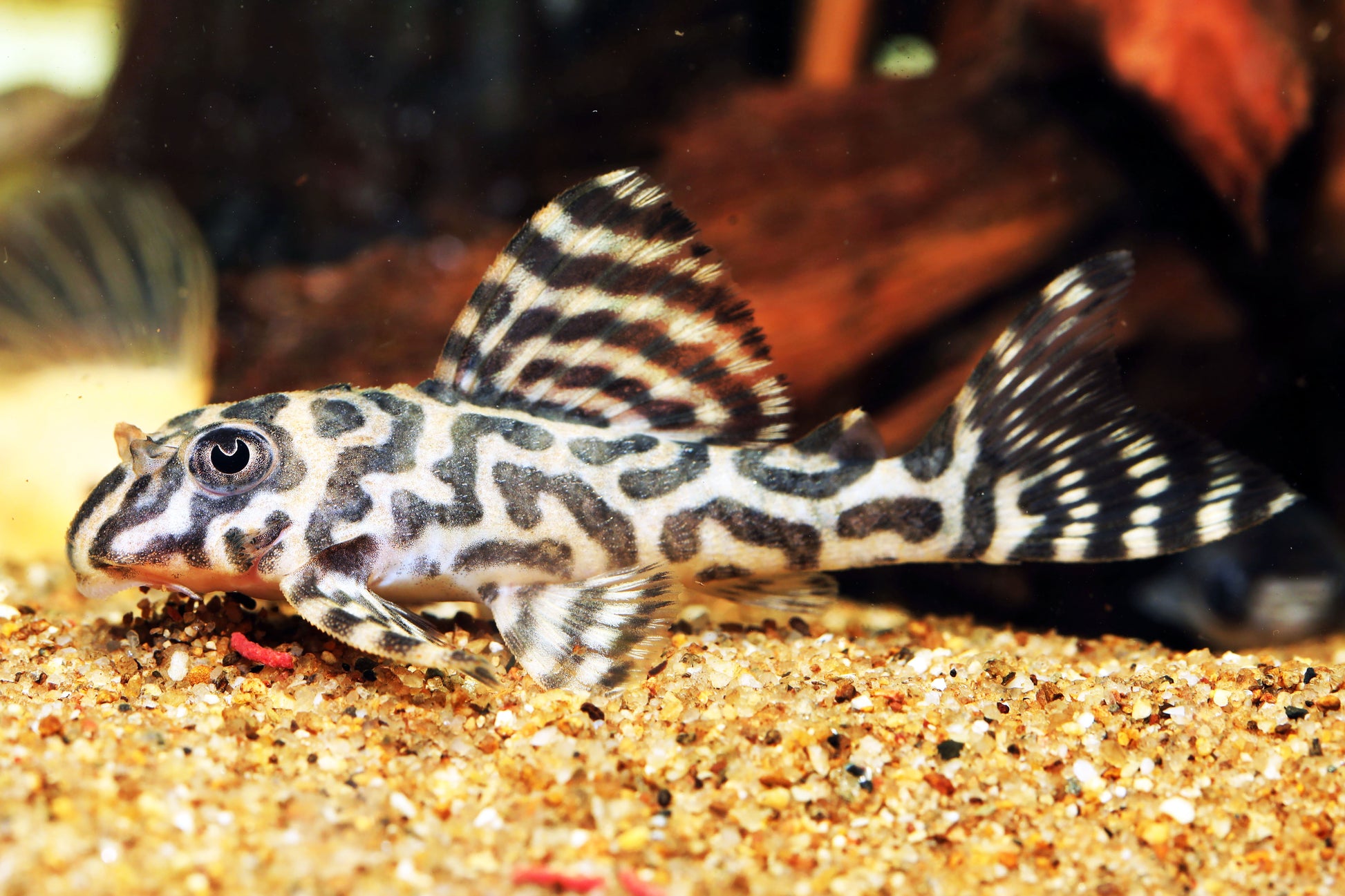
Provide warm current, tight caves, and excellent dissolved oxygen. It can be confused with L333 and related patterned Hypancistrus. A useful identification clue is the branching tiger-maze pattern.
13. L333 Pleco
L333 Pleco (Hypancistrus sp. L333) is a hypancistrus l-number pleco pleco known for highly variable cream lines, squiggles, or honeycomb patterns on dark brown. It is generally small to medium and is associated with the Xingu River basin. Its diet should include invertebrate-based foods, quality pellets, and supplemental plant material; it should never be expected to live on tank algae alone.
It is a cave-oriented warm-water species suited to clean, well-filtered aquariums. Pattern alone is not enough to separate every Xingu Hypancistrus. A useful identification clue is the variable scribbled light pattern.
14. Queen Arabesque Pleco
Fishkeepers usually recognize Queen Arabesque Pleco (Hypancistrus sp. L260) by very fine white arabesque lines covering a black body. It is generally small and is associated with the Tapajós River basin in Brazil. Its diet should include small protein foods and balanced sinking pellets; it should never be expected to live on tank algae alone.
Quiet caves, high oxygen, and consistent water quality suit this shy fish. It may lose feeding opportunities in a boisterous community. A useful identification clue is the unusually delicate lace-like lines.
15. Snowball Pleco
Snowball Pleco (Hypancistrus inspector, L102) represents the hypancistrus side of the pleco hobby, with large pale spots scattered across a charcoal body and fins. It is generally small to medium and is associated with the upper Rio Negro basin. Its diet should include mixed benthic fare with significant animal protein; it should never be expected to live on tank algae alone.
Dim cover and stable warm water encourage natural nocturnal behavior. It is not the same fish as every pleco sold under the snowball name. A useful identification clue is large round light spots on a dark body.
16. Dwarf Snowball Pleco
For aquarists comparing plecos, Dwarf Snowball Pleco (Hypancistrus sp. L471) stands out because of tiny white spots over a nearly black compact body. It is generally very small for a pleco and is associated with rocky South American river habitat represented in the aquarium trade by an L-number. Its diet should include small protein-rich foods plus balanced pellets; it should never be expected to live on tank algae alone.

Its compact size does not reduce the need for clean oxygen-rich water and secure caves. Small fish can be outcompeted at feeding time. A useful identification clue is minute white snow-like dots.
17. Leopard Frog Pleco
Leopard Frog Pleco (Peckoltia compta, L134) is a peckoltia pleco known for yellow to cream bands and blotches over a dark body. It is generally small to medium and is associated with the Tapajós River system. Its diet should include omnivorous sinking foods, invertebrate fare, and some vegetable matter; it should never be expected to live on tank algae alone.
It is a popular cave-spawning pleco that benefits from current and shaded structure. Males may defend caves from one another in cramped layouts. A useful identification clue is the leopard-frog yellow and black pattern.
18. Butterfly Pleco
Fishkeepers usually recognize Butterfly Pleco (Dekeyseria brachyura, L168) by a flattened body with dark bands that can lighten or darken against the substrate. It is generally small to medium and is associated with Rio Negro and nearby blackwater environments. Its diet should include algae, biofilm, vegetables, and varied sinking foods; it should never be expected to live on tank algae alone.
Dark sand, wood, leaf litter, and subdued light reveal its natural camouflage response. It may appear dramatically different on pale versus dark backgrounds. A useful identification clue is the substrate-linked color change.
19. Gold Nugget Pleco
Gold Nugget Pleco (Baryancistrus xanthellus, including L018, L081, and L177 forms) represents the baryancistrus side of the pleco hobby, with bright yellow spots and a yellow fin border on a black body. It is generally medium to large depending on form and is associated with rocky fast-flowing sections of the Xingu River. Its diet should include biofilm, algae-based foods, vegetables, and supplementary protein; it should never be expected to live on tank algae alone.

It needs warm oxygen-rich water, strong filtration, and more space than its juvenile appearance suggests. Several collection forms share the gold nugget name. A useful identification clue is yellow spots with yellow fin seams.
20. Mango Pleco
For aquarists comparing plecos, Mango Pleco (Baryancistrus chrysolomus, L047) stands out because of a dark olive body edged with yellow or orange along the fins. It is generally medium to large and is associated with the Xingu River basin on rocky substrates. Its diet should include grazing foods, vegetable matter, biofilm, and balanced pellets; it should never be expected to live on tank algae alone.
Provide warm, clean, fast-moving water and broad surfaces for grazing. It can become territorial around preferred caves. A useful identification clue is the mango-colored fin edging.
21. Blue Phantom Pleco
Blue Phantom Pleco (Hemiancistrus sp. L128) is a phantom pleco pleco known for a slate-blue body scattered with pale blue or white spots. It is generally medium and is associated with the upper Orinoco system with rocky, oxygen-rich water. Its diet should include algae, biofilm, vegetables, and mixed sinking foods; it should never be expected to live on tank algae alone.
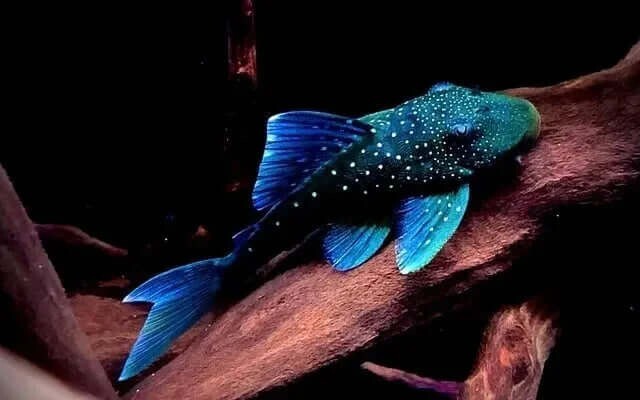
Current, oxygen, and rockwork are more important than heavy planting. Trade identification may remain based on an L-number rather than a formal species name. A useful identification clue is the blue-gray color and small pale spots.
22. Green Phantom Pleco
Fishkeepers usually recognize Green Phantom Pleco (Hemiancistrus subviridis, L200) by an olive-green body with yellowish spots and fin highlights. It is generally medium and is associated with upper Orinoco rocky rapids and channels. Its diet should include biofilm, plant foods, and balanced omnivore fare; it should never be expected to live on tank algae alone.
It thrives with strong flow, high oxygen, and stable warm temperatures. L200 may also be applied to a similar Baryancistrus form, so examine the dorsal and adipose-fin connection. A useful identification clue is the green body with yellow spotting.
23. Vampire Pleco
Vampire Pleco (Leporacanthicus galaxias, L007 or L029) represents the carnivore-leaning leporacanthicus side of the pleco hobby, with white spots across a black body and a long armored head. It is generally medium and is associated with fast rocky waters in the lower Tocantins basin. Its diet should include invertebrate-rich foods, mollusk-based fare, and quality carnivore pellets; it should never be expected to live on tank algae alone.

Caves, current, and targeted feeding are essential. It is not a general-purpose algae eater and may defend territory. A useful identification clue is the galaxy-like white spotting.
24. Sultan Pleco
For aquarists comparing plecos, Sultan Pleco (Leporacanthicus joselimai, L264) stands out because of a charcoal body densely covered with small pale spots. It is generally medium and is associated with the Tapajós River basin. Its diet should include protein-rich sinking foods and some plant material; it should never be expected to live on tank algae alone.
Use smooth caves and maintain high oxygen in warm water. Its specialized teeth and feeding preference differ from herbivorous plecos. A useful identification clue is dense fine spotting over the entire body.
25. Sunshine Pleco
Sunshine Pleco (Scobinancistrus aureatus, L014) is a scobinancistrus pleco known for a dark body with yellow spots and golden-orange fins. It is generally large and is associated with the Xingu River and related rocky channels. Its diet should include protein-rich benthic foods, mussel or shrimp-based fare, and quality pellets; it should never be expected to live on tank algae alone.
It is a powerful, territorial fish for spacious specialist systems. Do not confuse its bright juvenile colors with a small adult size. A useful identification clue is the golden fins and spotted dark body.
26. Peppermint Pleco
Fishkeepers usually recognize Peppermint Pleco (Parancistrus nudiventris and similar trade forms) by many tiny pale dots on a dark flattened body. It is generally medium and is associated with rocky Brazilian river habitats. Its diet should include biofilm, algae-based foods, and mixed sinking diets; it should never be expected to live on tank algae alone.
Broad rocks, current, and high oxygen support grazing behavior. The peppermint name is used inconsistently in the trade. A useful identification clue is the fine pepper-like speckling.
27. Rubber Lip Pleco
Rubber Lip Pleco (Chaetostoma formosae and related Chaetostoma) represents the hillstream loricariid side of the pleco hobby, with a broad rubbery mouth, flattened head, and muted gray-brown mottling. It is generally small to medium and is associated with cooler, fast-flowing Andean foothill streams. Its diet should include aufwuchs, algae, biofilm, and vegetable-based foods; it should never be expected to live on tank algae alone.
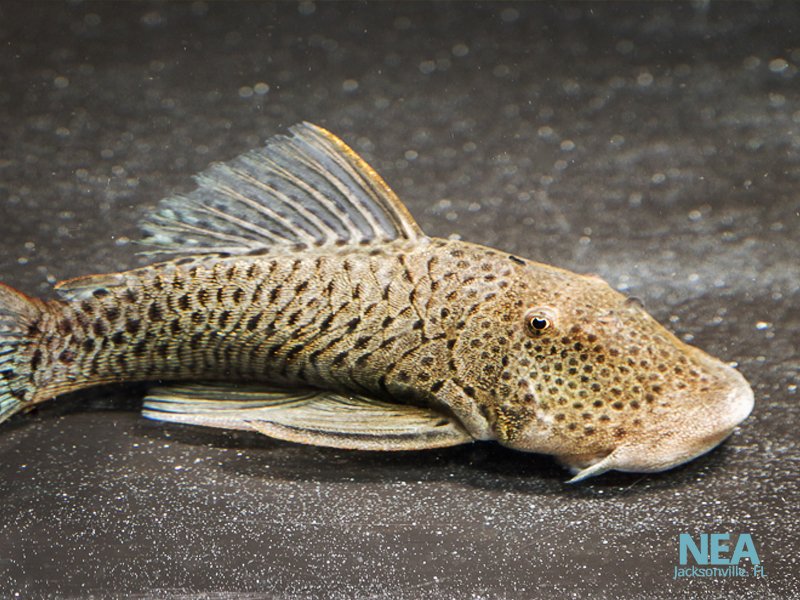
High oxygen, cooler conditions than many Amazon plecos, and strong flow are important. Retail labels may mix several Chaetostoma species with different needs. A useful identification clue is the broad soft-looking lips and flattened head.
28. Bulldog Pleco
For aquarists comparing plecos, Bulldog Pleco (Chaetostoma species) stands out because of a blunt broad head and thick sucker lips on a compact body. It is generally small to medium and is associated with rocky mountain streams in northern South America. Its diet should include algae, biofilm, and plant-focused prepared foods; it should never be expected to live on tank algae alone.
It needs clean cool-to-moderate water with abundant oxygen and current. Warm stagnant tanks are unsuitable even when other tropical fish tolerate them. A useful identification clue is the bulldog-like head profile.
29. Leopard Sailfin Pleco
Leopard Sailfin Pleco (Pterygoplichthys gibbiceps) is a large sailfin pleco pleco known for a honeycomb or leopard pattern and an exceptionally tall multi-rayed dorsal fin. It is generally very large and is associated with large South American rivers and floodplains; introduced populations occur elsewhere. Its diet should include plant matter, detritus, biofilm, and varied sinking foods; it should never be expected to live on tank algae alone.
Only very large aquariums or properly managed ponds can accommodate the adult responsibly. Never release it into the wild because invasive populations damage habitats. A useful identification clue is the huge sail-like dorsal fin.
30. Adonis Pleco
Fishkeepers usually recognize Adonis Pleco (Acanthicus adonis, L155) by white juvenile spots, a black body, and long spines along the fins and flanks. It is generally enormous and is associated with large Amazon and Tocantins-Araguaia river channels. Its diet should include omnivorous foods with substantial protein; it should never be expected to live on tank algae alone.
This is a specialist display fish requiring an exceptionally large system and robust filtration. Adults may become highly territorial and lose much of the juvenile spotting. A useful identification clue is the spiny black body and white juvenile spots.
How Are These Types of Pleco Fish Classified?
Plecos belong to the catfish family Loricariidae, a large South and Central American group characterized by armored plates and a ventral sucker-like mouth. Aquarium labels frequently lag behind scientific research, so a fish may be sold under a common name, a genus name, an L-number, or a combination of all three.
- Ancistrus includes many bristlenose plecos.
- Panaque and Panaqolus are strongly associated with wood and fibrous foods.
- Hypancistrus includes many small patterned cave-dwellers that eat more animal protein than people expect.
- Baryancistrus includes several robust grazing species from warm, fast rivers.
- Chaetostoma are hillstream fish that often prefer cooler, oxygen-rich conditions.
- Pterygoplichthys, Hypostomus, and Acanthicus include species that may become extremely large.
Where Do Pleco Fish Come From?
Most plecos originate from tropical and subtropical freshwater systems in South America, with exceptional diversity in the Amazon, Orinoco, Xingu, Tapajós, Rio Negro, Tocantins, and Andean foothill drainages. Their habitats range from warm rocky rapids to blackwater tributaries and wood-filled channels.
Matching habitat matters. A zebra pleco from warm, turbulent Xingu water should not be kept exactly like a rubber lip pleco from a cooler mountain stream. Flow, oxygen, temperature, substrate, caves, and diet should be researched for the specific fish.
How to Identify Different Types of Plecos
- Check the adult size rather than the size of the juvenile in the store.
- Look at spots, stripes, fin edging, body depth, and head shape.
- Count or compare dorsal-fin rays when distinguishing sailfin forms.
- Note facial bristles, cheek odontodes, and body spines.
- Record the L-number and collection locality when available.
- Ask whether the fish is a grazer, wood eater, omnivore, or protein-oriented feeder.
- Compare reliable adult photographs because juvenile patterns can change.
Aquarium Care Notes
Use a mature aquarium with stable water, strong biological filtration, and enough floor area for the adult. Add caves, smooth rock, and driftwood suited to the species. Feed after lights dim when necessary, placing food near separate shelters so shy or subordinate fish are not excluded.
Monitor waste closely. A tank containing a pleco can look visually clean while dissolved waste rises. Regular water testing, gravel or sand cleaning, filter maintenance, and water changes remain essential.
Safety, Sustainability, and Conservation Notes
Buy captive-bred fish whenever available, especially for species with restricted wild ranges. Verify that the seller is using an accurate name and can explain adult size and dietary needs. Rare appearance is not a substitute for responsible sourcing.
Never release a pleco outdoors. Large loricariids have established invasive populations in many warm regions, where burrowing and grazing can affect riverbanks and native communities. Rehome unwanted fish through responsible aquarium networks.
Fun Facts About Pleco Fish
- Plecos are catfish, not a separate order of fish.
- Their armor is formed by bony plates called scutes.
- Many males develop strong cheek odontodes during breeding condition.
- Some plecos rasp and digest wood-associated material.
- L-numbers help identify fish before formal scientific descriptions are available.
- Bristlenose males often guard eggs inside caves.
- Not every pleco is a useful algae grazer.
- Patterns can change with age, stress, and substrate.
- Several giant plecos are sold as very small juveniles.
- Plecos can live much longer than many common community fish.
Final Thoughts on Types of Pleco Fish
The most important lesson from comparing types of pleco fish is that similar sucker mouths do not mean identical care. Confirm the adult size, diet, water temperature, oxygen requirement, and territorial behavior before buying. A correctly identified pleco in a mature, spacious aquarium can be a fascinating long-term fish; a mislabeled giant in a small tank quickly becomes a preventable problem.
Frequently Asked Questions
1. What is a pleco fish?
Pleco is a hobby name for many suckermouth armored catfishes in the family Loricariidae. It does not refer to one single aquarium species.
2. Are all plecos algae eaters?
No. Some graze algae and biofilm, while others favor wood, vegetables, insect larvae, crustaceans, mollusks, or mixed diets.
3. Can a pleco live only on algae in the tank?
No. Aquarium algae is unreliable and nutritionally incomplete. Every pleco needs a species-appropriate prepared diet and, for some species, wood or animal protein.
4. Which pleco stays small?
Clown plecos, zebra plecos, queen arabesque plecos, and several small Hypancistrus or Panaqolus types remain much smaller than common and sailfin plecos.
5. Which pleco grows the largest?
Adonis plecos, common plecos, sailfin plecos, royal plecos, and several other large loricariids can become unsuitable for ordinary home tanks.
6. What is the best pleco for a beginner?
A responsibly sourced bristlenose pleco is often the most practical beginner choice when the aquarium is mature, filtered well, and large enough for the adult.
7. What are L-numbers?
L-numbers are identification codes created for loricariids in the aquarium trade before or in place of a formal scientific name. One species may have multiple collection forms or codes.
8. Why do pleco names vary between stores?
Common names are not standardized, and several similar species may share one retail label. Scientific names, L-numbers, locality, and photographs provide better identification.
9. Do plecos need driftwood?
Wood is essential for wood-eating Panaque and Panaqolus species and useful as cover for many others. It should not replace a balanced diet.
10. Do plecos clean an aquarium?
Plecos may graze certain surfaces, but they also produce waste and cannot replace scraping, vacuuming, filtration maintenance, or water changes.
11. Are plecos nocturnal?
Many are most active at dusk or at night. Dim lighting, caves, and targeted evening feeding help shy individuals receive enough food.
12. Do plecos need caves?
Most appreciate secure shelters, and many males use caves for breeding. Provide more hiding places than fish to reduce conflict.
13. Can two plecos live together?
Sometimes, but compatibility depends on species, sex, adult size, tank footprint, feeding space, and number of caves. Territorial fights are possible.
14. Can plecos live with community fish?
Many smaller plecos can live with peaceful midwater fish, provided water requirements match and tankmates do not steal all bottom food.
15. Will a pleco eat other fish?
Most do not hunt healthy community fish, but protein-oriented species may eat eggs, tiny animals, or carrion. Large plecos can also disturb resting tankmates.
16. Can plecos attach to slow-moving fish?
An underfed or poorly housed pleco may rasp the slime coat of broad, slow fish. Correct feeding and compatible tankmates reduce this risk.
17. How often should plecos be fed?
Offer appropriate portions regularly, often after lights dim, and remove uneaten food before it fouls the water. Frequency depends on species, age, and tank productivity.
18. What vegetables can plecos eat?
Depending on species, blanched zucchini, squash, green beans, and other safe vegetables may be used. Remove leftovers before they decay.
19. Do carnivorous plecos need vegetables?
Even protein-oriented plecos may benefit from a varied diet, but their nutritional balance differs from that of grazing or wood-eating species.
20. Why is strong filtration important for plecos?
Plecos can produce substantial solid waste, and many originate from highly oxygenated rivers. Efficient biological and mechanical filtration helps maintain stable water.
21. Do plecos need strong water flow?
Many river species benefit from current and high oxygen, but flow should match the exact species and leave sheltered resting areas.
22. What water temperature do plecos need?
There is no single temperature for all plecos. Xingu species often prefer warm water, while some Chaetostoma come from cooler mountain streams.
23. How can I identify a pleco correctly?
Compare body shape, mouth, odontodes, dorsal fin, spots or stripes, adult size, locality, L-number, and whether the adipose and dorsal fins are connected.
24. Why does my pleco hide all day?
Hiding is normal for many species. Excessive hiding can also reflect bright light, insufficient cover, bullying, poor acclimation, or unsuitable water.
25. Why is my pleco pale?
Color may change with stress, substrate, mood, lighting, dominance, or illness. Check behavior and water quality rather than diagnosing from color alone.
26. Do plecos breathe air?
Some loricariids can use air or tolerate low oxygen better than expected, but this is not a reason to neglect aeration. Aquarium water should remain well oxygenated.
27. Can plecos breed in community tanks?
Cave-spawning species such as bristlenose plecos may breed in community aquariums, but eggs or fry can be lost and territorial behavior may increase.
28. Are common plecos invasive?
Several large Pterygoplichthys and related loricariids have become invasive after aquarium releases. They can burrow into banks and alter local ecosystems.
29. Should I release an unwanted pleco?
Never. Rehome it through an aquarium club, retailer, rescue, or experienced keeper. Releasing aquarium fish can be illegal and ecologically harmful.
30. How long do plecos live?
Many plecos are long-lived aquarium fish and may remain with an owner for well over a decade. Adult size and lifespan should be considered before purchase.
Read more:
30 Types of Rainbow Fish: Colors and Care