

The most popular types of rainbow fish are freshwater schooling species from Australia, New Guinea, nearby Indonesian islands, Sulawesi, and Madagascar. Their colors are produced by iridescent scales, contrasting fins, courtship displays, and regional patterns that may become much stronger as the fish mature.
This guide covers 30 practical rainbowfish and blue-eye types, including familiar aquarium favorites and less common locality species. You will learn how to identify them, where they originate, how large they tend to become, what they eat, and why water chemistry, group size, swimming space, and responsible breeding matter.
What Are the Main Types of Rainbow Fish?
The best-known rainbowfish belong to Melanotaenia, Glossolepis, and Chilatherina, while smaller blue-eyes include Pseudomugil species. Threadfin and Celebes rainbowfish have more delicate shapes, and Madagascar rainbowfishes belong to a separate regional lineage. Most are active social fish, but their adult size and preferred water conditions vary too much for one universal care formula.
Quick Comparison of the 30 Types of Rainbow Fish
| No. | Common Name | Scientific Name | Group | Best Identification Clue |
|---|---|---|---|---|
| 1 | Boesemani Rainbowfish | Melanotaenia boesemani | Melanotaenia | the sharp blue-front and orange-rear color split |
| 2 | Turquoise Rainbowfish | Melanotaenia lacustris | Melanotaenia | the luminous blue-green body |
| 3 | Red Rainbowfish | Glossolepis incisus | Glossolepis | the solid red mature male coloration |
| 4 | Dwarf Neon Rainbowfish | Melanotaenia praecox | Melanotaenia | the neon-blue body and warm-colored fins |
| 5 | Banded Rainbowfish | Melanotaenia trifasciata | Melanotaenia | the dark side stripe and locality-specific colors |
| 6 | Australian Rainbowfish | Melanotaenia fluviatilis | Melanotaenia | the silver-green body and southeastern Australian range |
| 7 | Crimsonspotted Rainbowfish | Melanotaenia duboulayi | Melanotaenia | the reddish opercular spot |
| 8 | Eastern Rainbowfish | Melanotaenia splendida splendida | Melanotaenia | the broad iridescent body and eastern range |
| 9 | Desert Rainbowfish | Melanotaenia splendida tatei | Melanotaenia | the understated pale color and desert origin |
| 10 | MacCulloch’s Rainbowfish | Melanotaenia maccullochi | Melanotaenia | the fine dark stripes and reddish fins |
| 11 | Parkinson’s Rainbowfish | Melanotaenia parkinsoni | Melanotaenia | the broken orange-yellow patches on the rear half |
| 12 | New Guinea Rainbowfish | Melanotaenia affinis | Melanotaenia | the dark lateral stripe and variable regional color |
| 13 | Lake Wanam Rainbowfish | Glossolepis wanamensis | Glossolepis | the high green-gold body |
| 14 | Kamaka Rainbowfish | Melanotaenia kamaka | Melanotaenia | the soft powder-blue body |
| 15 | Lake Tebera Rainbowfish | Melanotaenia herbertaxelrodi | Melanotaenia | the yellow body divided by a black side stripe |
| 16 | Aru Rainbowfish | Melanotaenia aruensis | Melanotaenia | the Aru Islands origin |
| 17 | Batanta Rainbowfish | Melanotaenia batanta | Melanotaenia | the slender form and Batanta locality |
| 18 | Bleher’s Rainbowfish | Chilatherina bleheri | Chilatherina | the blue-front to orange-rear gradient |
| 19 | Axelrod’s Rainbowfish | Chilatherina axelrodi | Chilatherina | the clean dark side stripe on a pale body |
| 20 | Sentani Rainbowfish | Chilatherina sentaniensis | Chilatherina | the elongated Chilatherina shape and Sentani origin |
| 21 | Threadfin Rainbowfish | Iriatherina werneri | Threadfin rainbowfish | the long thread-like male fins |
| 22 | Celebes Rainbowfish | Marosatherina ladigesi | Celebes rainbowfish | the blue eyes and black-yellow fin pattern |
| 23 | Forktail Blue-Eye | Pseudomugil furcatus | Blue-eye rainbowfish | the yellow forked tail and glowing blue eyes |
| 24 | Gertrude’s Spotted Blue-Eye | Pseudomugil gertrudae | Blue-eye rainbowfish | the spotted fins and blue eyes |
| 25 | Red Neon Blue-Eye | Pseudomugil luminatus | Blue-eye rainbowfish | the neon red body and blue eyes |
| 26 | Pacific Blue-Eye | Pseudomugil signifer | Blue-eye rainbowfish | the blue eye and coastal Australian range |
| 27 | Honey Blue-Eye | Pseudomugil mellis | Blue-eye rainbowfish | the honey-amber body |
| 28 | Madagascar Rainbowfish | Bedotia madagascariensis | Bedotiid rainbowfish | the dark stripe and yellow-edged fins |
| 29 | Red-Tailed Silverside | Bedotia geayi | Bedotiid rainbowfish | the red tail and Madagascar origin |
| 30 | Ornate Rainbowfish | Rhadinocentrus ornatus | Ornate rainbowfish | the delicate body and highly variable locality colors |
1. Boesemani Rainbowfish
Boesemani Rainbowfish (Melanotaenia boesemani) is admired for a famous two-tone body with blue-purple on the front and orange-yellow on the rear. It originates from the Ayamaru Lakes region of West Papua, Indonesia and is typically medium. It feeds as an omnivore on small insects, crustaceans, algae, and varied prepared foods.
Keep a well-proportioned school in a long planted aquarium with open swimming room and varied food to develop color. Choose captive-bred stock because the wild range is restricted. The clearest identification clue is the sharp blue-front and orange-rear color split.
2. Turquoise Rainbowfish
One of the more memorable rainbowfishes, Turquoise Rainbowfish (Melanotaenia lacustris) displays an iridescent turquoise-blue body with a deep, high-backed adult profile. It originates from Lake Kutubu and connected waters in Papua New Guinea and is typically medium to large. It feeds as an omnivore on insects, small crustaceans, plant matter, and prepared omnivore foods.
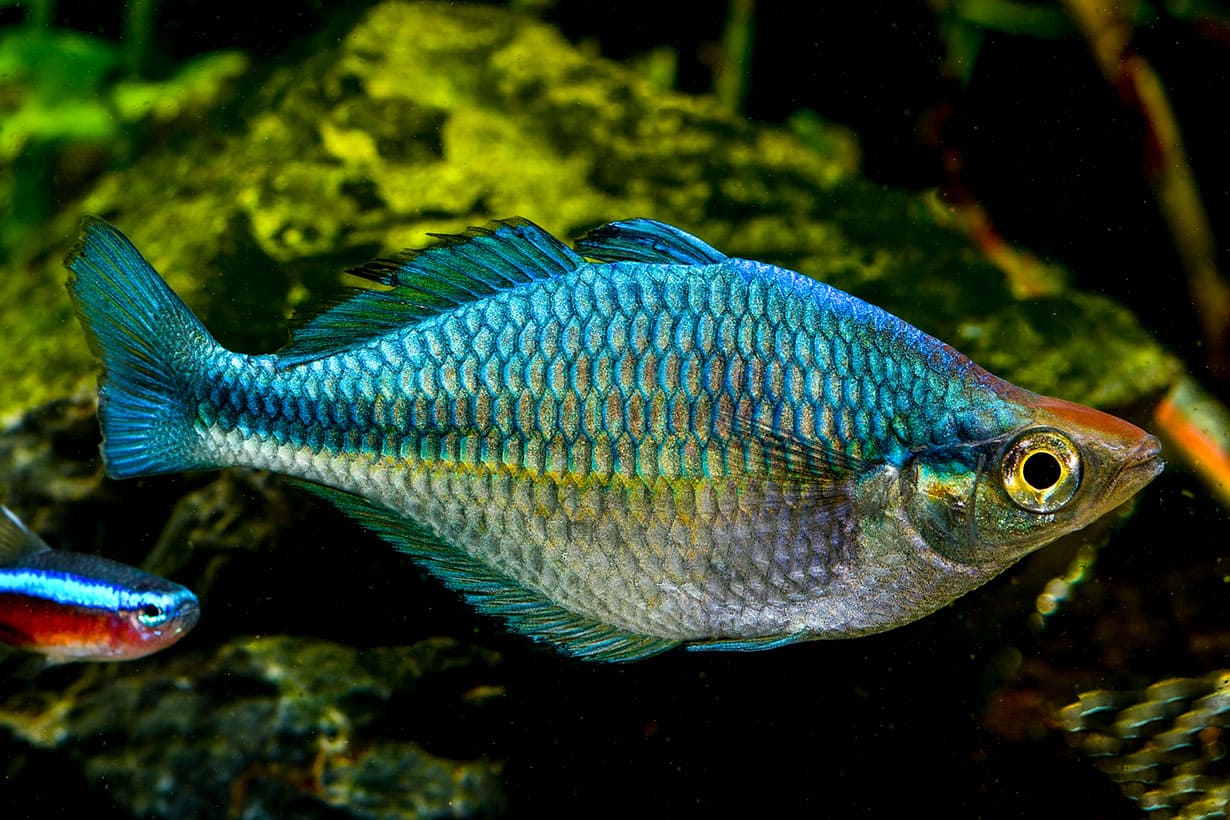
A long aquarium, clean water, and a group with both sexes allow the best display. Its native lake system is geographically limited. The clearest identification clue is the luminous blue-green body.
3. Red Rainbowfish
Red Rainbowfish (Glossolepis incisus) is a glossolepis rainbowfish whose main visual feature is mature males that become intensely red while females remain more olive-silver. It originates from Lake Sentani and nearby waters in Papua, Indonesia and is typically medium to large. It feeds as an omnivore on insects, small aquatic animals, plant material, and varied aquarium foods.
It needs substantial swimming space, regular water changes, and a school rather than solitary housing. Color develops with age, diet, health, and social conditions. The clearest identification clue is the solid red mature male coloration.
4. Dwarf Neon Rainbowfish
Aquarists identify Dwarf Neon Rainbowfish (Melanotaenia praecox) by metallic blue scales paired with bright red or orange fins in males. It originates from tributaries of the Mamberamo River system in New Guinea and is typically small. It feeds as an omnivore on small insects, crustaceans, algae, and fine prepared foods.
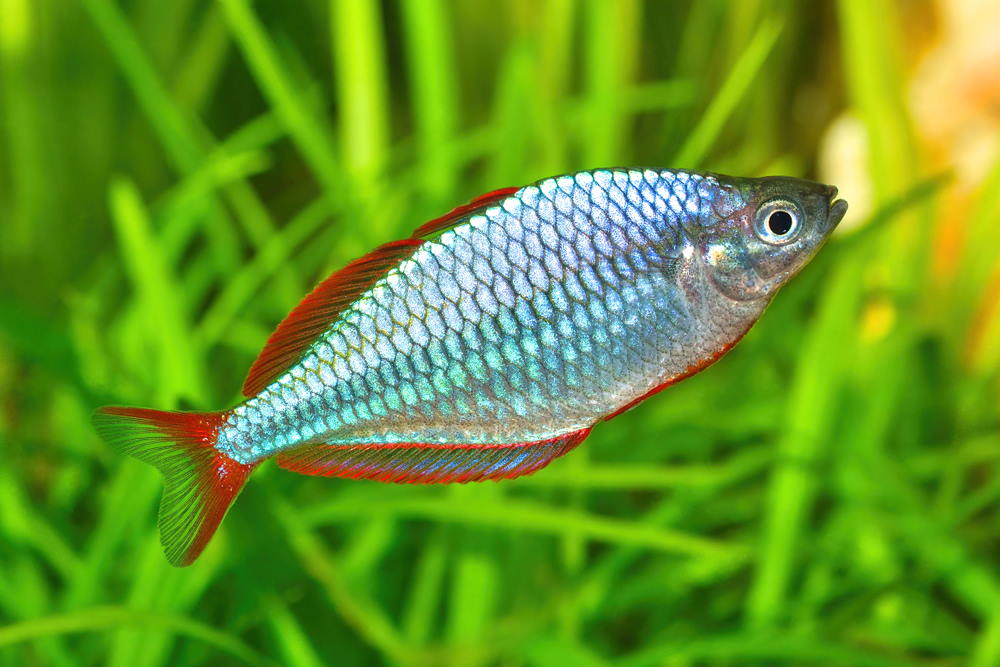
Its smaller body suits modest community aquariums, but it still needs a group and open horizontal space. Avoid keeping only one or two individuals. The clearest identification clue is the neon-blue body and warm-colored fins.
5. Banded Rainbowfish
Banded Rainbowfish (Melanotaenia trifasciata) is admired for a bold mid-lateral stripe with highly variable red, yellow, green, or blue regional color forms. It originates from northern Australian rivers and streams and is typically medium to large. It feeds as an omnivore on insects, crustaceans, algae, and plant material.

Research the collection form because color and preferred water conditions vary by locality. Different geographic forms should not be casually mixed for breeding. The clearest identification clue is the dark side stripe and locality-specific colors.
6. Australian Rainbowfish
One of the more memorable rainbowfishes, Australian Rainbowfish (Melanotaenia fluviatilis) displays a silvery-green body with colored fin margins and a streamlined shape. It originates from southeastern Australian rivers, creeks, and billabongs and is typically medium. It feeds as an omnivore on aquatic insects, small crustaceans, algae, and plant matter.
This active shoaling fish benefits from open swimming room and seasonally moderate temperatures. It may be confused with closely related crimsonspotted rainbowfish. The clearest identification clue is the silver-green body and southeastern Australian range.
7. Crimsonspotted Rainbowfish
Crimsonspotted Rainbowfish (Melanotaenia duboulayi) is a melanotaenia rainbowfish whose main visual feature is blue-green iridescence, red fin markings, and a crimson spot near the gill cover. It originates from eastern Australian coastal drainages and is typically medium. It feeds as an omnivore on insects, zooplankton, algae, and varied prepared foods.
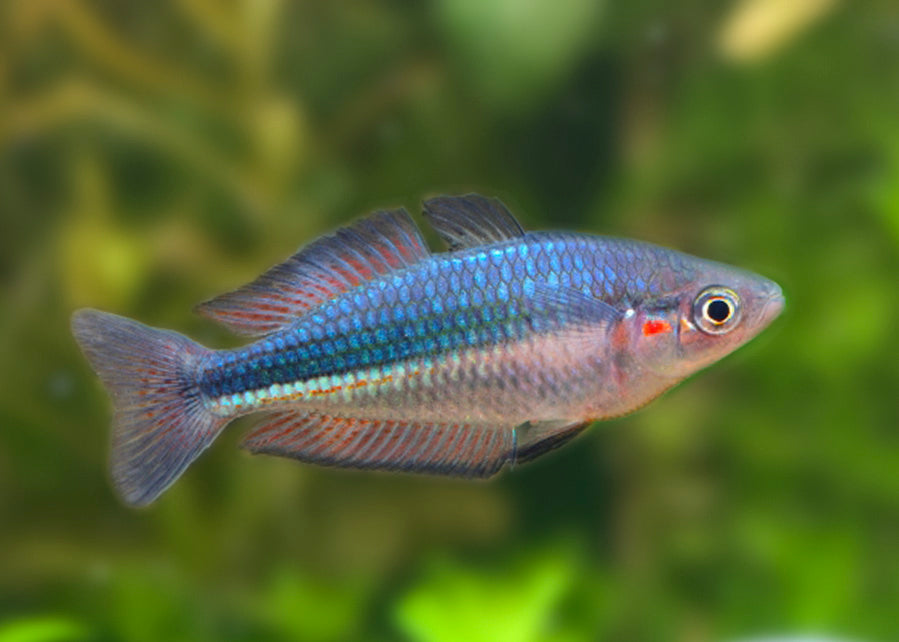
It is active, hardy when well maintained, and best displayed in a planted school. Local forms can differ visibly in color. The clearest identification clue is the reddish opercular spot.
8. Eastern Rainbowfish
Aquarists identify Eastern Rainbowfish (Melanotaenia splendida splendida) by a deep silvery body that can flash blue, green, yellow, and red. It originates from northeastern Australian freshwater systems and is typically medium to large. It feeds as an omnivore on insects, small crustaceans, algae, and detrital plant material.
Provide a long covered aquarium because strong, fast swimmers may jump. The splendida complex contains several regional subspecies. The clearest identification clue is the broad iridescent body and eastern range.
9. Desert Rainbowfish
Desert Rainbowfish (Melanotaenia splendida tatei) is admired for a pale silver body with subtle violet, green, or yellow tones. It originates from arid-zone central Australian rivers and waterholes and is typically medium. It feeds as an omnivore on insects, crustaceans, algae, and other available omnivore foods.
Stable water and swimming space matter more than chasing extreme coloration. Its natural environment experiences large seasonal changes, but aquarium changes should remain gradual. The clearest identification clue is the understated pale color and desert origin.
10. MacCulloch’s Rainbowfish
One of the more memorable rainbowfishes, MacCulloch’s Rainbowfish (Melanotaenia maccullochi) displays a compact silver-green body crossed by thin dark horizontal lines and red-orange fins. It originates from small streams and wetlands in northeastern Australia and southern New Guinea and is typically small. It feeds as an omnivore on small insects, zooplankton, algae, and fine foods.
It suits planted aquariums with gentle cover and peaceful companions. Several geographic forms are maintained by specialist breeders. The clearest identification clue is the fine dark stripes and reddish fins.
11. Parkinson’s Rainbowfish
Parkinson’s Rainbowfish (Melanotaenia parkinsoni) is a melanotaenia rainbowfish whose main visual feature is a silver body splashed with irregular yellow, orange, or red patches toward the rear. It originates from streams of southeastern Papua New Guinea and is typically medium to large. It feeds as an omnivore on insects, crustaceans, plant matter, and prepared omnivore foods.
A roomy aquarium and quality varied food help males develop their strongest rear-body color. Young fish may look plain and should not be judged by juvenile color. The clearest identification clue is the broken orange-yellow patches on the rear half.
12. New Guinea Rainbowfish
Aquarists identify New Guinea Rainbowfish (Melanotaenia affinis) by a variable silver, blue, or bronze body with a dark side stripe. It originates from rivers and lakes across northern New Guinea and is typically medium. It feeds as an omnivore on insects, plankton, algae, and small aquatic organisms.
Because forms differ by locality, water preferences and adult appearance should be checked with the breeder. The common name can refer broadly to several New Guinea rainbowfishes. The clearest identification clue is the dark lateral stripe and variable regional color.
13. Lake Wanam Rainbowfish
Lake Wanam Rainbowfish (Glossolepis wanamensis) is admired for green-gold iridescence with a tall body and orange-red fin accents. It originates from Lake Wanam in Papua New Guinea and is typically medium to large. It feeds as an omnivore on insects, crustaceans, and plant material.
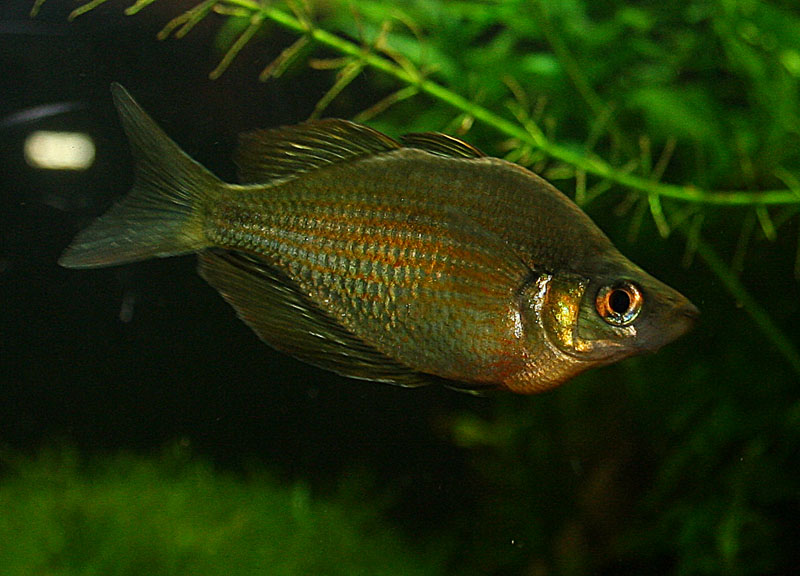
Keep a healthy breeding group in a spacious, clean aquarium and prioritize captive-bred conservation lines. Its naturally restricted habitat makes responsible captive management important. The clearest identification clue is the high green-gold body.
14. Kamaka Rainbowfish
One of the more memorable rainbowfishes, Kamaka Rainbowfish (Melanotaenia kamaka) displays a pale silver-blue body with translucent fins and a clean elegant profile. It originates from Lake Kamakawaiar and nearby waters in West Papua and is typically medium. It feeds as an omnivore on small invertebrates, algae, and varied prepared food.
A calm planted setting and a proper school show its subtle blue sheen better than harsh lighting. It is less intensely colored than some species but should not be overlooked. The clearest identification clue is the soft powder-blue body.
15. Lake Tebera Rainbowfish
Lake Tebera Rainbowfish (Melanotaenia herbertaxelrodi) is a melanotaenia rainbowfish whose main visual feature is a bright yellow body with a strong dark horizontal stripe. It originates from Lake Tebera basin in Papua New Guinea and is typically medium. It feeds as an omnivore on insects, small crustaceans, algae, and prepared foods.

Use dark substrate, plants, and open water to emphasize its yellow coloration. Stable clean water is essential for maintaining color and fin condition. The clearest identification clue is the yellow body divided by a black side stripe.
16. Aru Rainbowfish
Aquarists identify Aru Rainbowfish (Melanotaenia aruensis) by a deep-bodied fish with blue-green iridescence and warm fin color. It originates from freshwaters of the Aru Islands, Indonesia and is typically medium. It feeds as an omnivore on insects, small crustaceans, and plant material.
Maintain a social group, high water quality, and a covered tank with room to swim. Rare locality forms should be bred without accidental hybridization. The clearest identification clue is the Aru Islands origin.
17. Batanta Rainbowfish
Batanta Rainbowfish (Melanotaenia batanta) is admired for a slender silver-blue body with subtle dark striping and colored fins. It originates from streams on Batanta Island in the Raja Ampat region and is typically small to medium. It feeds as an omnivore on insects, small crustaceans, algae, and fine foods.
It benefits from clean flowing water, plants, and gentle but consistent circulation. Island endemics deserve careful captive-line records. The clearest identification clue is the slender form and Batanta locality.
18. Bleher’s Rainbowfish
One of the more memorable rainbowfishes, Bleher’s Rainbowfish (Chilatherina bleheri) displays a broad silver-blue front transitioning to orange or red toward the rear. It originates from Lake Holmes and nearby waters in New Guinea and is typically medium to large. It feeds as an omnivore on insects, small crustaceans, plant matter, and varied foods.
A long aquarium and a mixed-sex group encourage the most impressive adult male profile. It needs more room than dwarf rainbowfish. The clearest identification clue is the blue-front to orange-rear gradient.
19. Axelrod’s Rainbowfish
Axelrod’s Rainbowfish (Chilatherina axelrodi) is a chilatherina rainbowfish whose main visual feature is a pale blue-silver body marked by a distinct dark mid-lateral line. It originates from the Yungkiri Stream region of northern New Guinea and is typically medium. It feeds as an omnivore on insects, crustaceans, algae, and prepared omnivore foods.
Gentle flow, plants, and stable water suit this peaceful schooling fish. It is not as commonly available as the best-known Melanotaenia. The clearest identification clue is the clean dark side stripe on a pale body.
20. Sentani Rainbowfish
Aquarists identify Sentani Rainbowfish (Chilatherina sentaniensis) by a silvery elongated body with reddish fins and subtle lateral markings. It originates from Lake Sentani and associated waters in Papua and is typically medium. It feeds as an omnivore on insects, zooplankton, and plant material.
Captive breeding is valuable because the native habitat faces environmental pressure. Source fish carefully and avoid mixing with similar species in breeding projects. The clearest identification clue is the elongated Chilatherina shape and Sentani origin.
21. Threadfin Rainbowfish
Threadfin Rainbowfish (Iriatherina werneri) is admired for a delicate body with spectacular elongated dorsal and anal fin rays in males. It originates from slow vegetated waters of northern Australia and New Guinea and is typically small. It feeds as an omnivore on tiny live, frozen, and prepared foods sized for its small mouth.
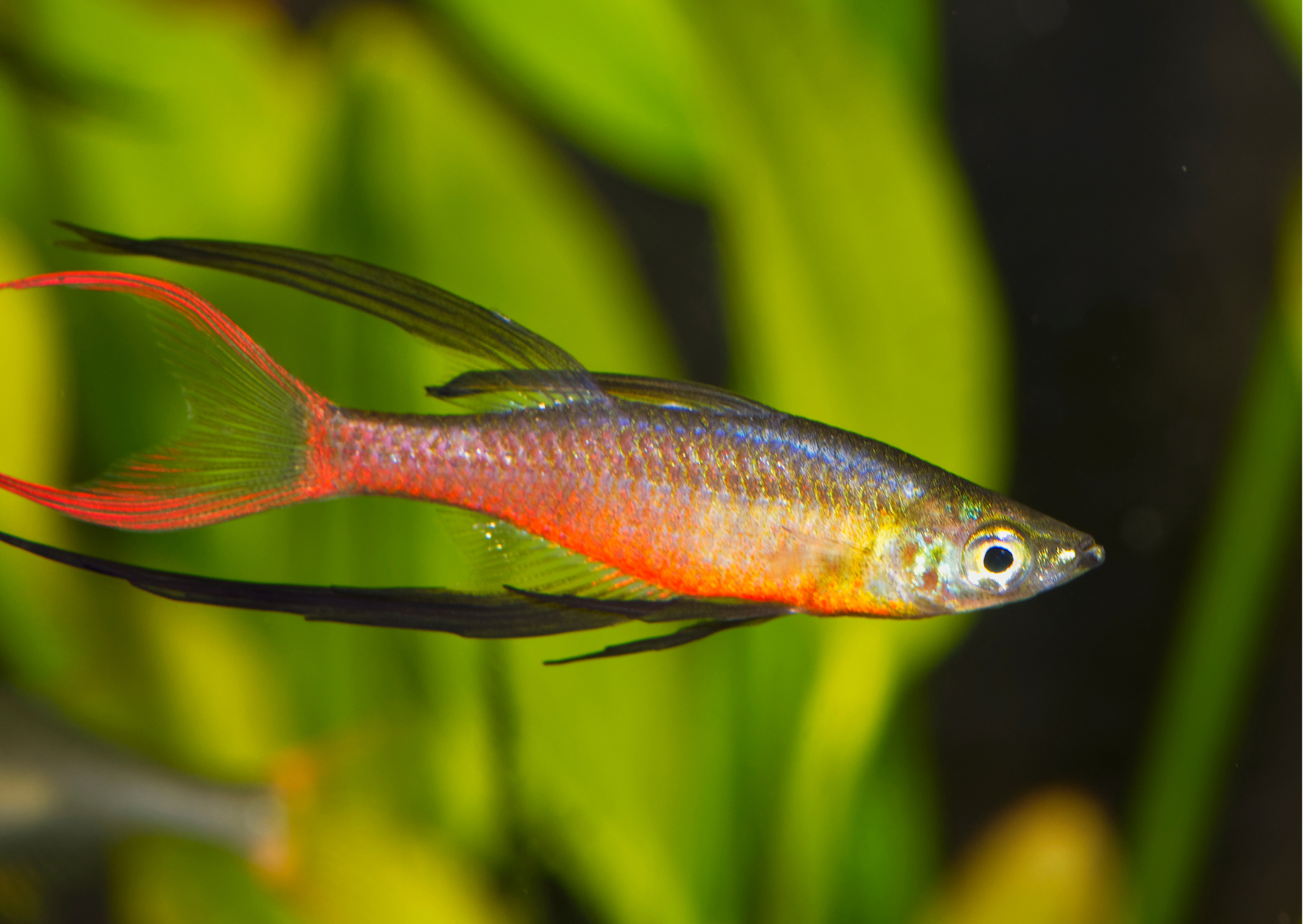
Keep it with gentle tankmates in a planted aquarium and ensure fine food reaches every fish. Fast feeders and fin-nippers are poor companions. The clearest identification clue is the long thread-like male fins.
22. Celebes Rainbowfish
One of the more memorable rainbowfishes, Celebes Rainbowfish (Marosatherina ladigesi) displays a translucent silver body, blue eyes, and yellow-black forked fins. It originates from streams and estuaries of southwestern Sulawesi, Indonesia and is typically small. It feeds as an omnivore on small insects, crustaceans, and fine prepared food.
It prefers clean water and may do well in moderately mineral-rich conditions, depending on stock. It is not a Melanotaenia and has a more delicate body shape. The clearest identification clue is the blue eyes and black-yellow fin pattern.
23. Forktail Blue-Eye
Forktail Blue-Eye (Pseudomugil furcatus) is a blue-eye rainbowfish rainbowfish whose main visual feature is bright blue eyes, yellow-edged fins, and a deeply forked tail. It originates from clear forest streams in southeastern Papua New Guinea and is typically small. It feeds as an omnivore on tiny insects, crustaceans, and fine floating or suspended foods.
A covered planted aquarium with a group and gentle current suits its active display. Its small mouth requires appropriately sized food. The clearest identification clue is the yellow forked tail and glowing blue eyes.
24. Gertrude’s Spotted Blue-Eye
Aquarists identify Gertrude’s Spotted Blue-Eye (Pseudomugil gertrudae) by blue eyes and transparent fins scattered with dark spots. It originates from vegetated swamps and slow streams in northern Australia and New Guinea and is typically very small. It feeds as an omnivore on tiny invertebrates, zooplankton, and fine prepared foods.
Dense plants, calm tankmates, and frequent small feedings help this delicate species thrive. Different collection forms may show distinct fin patterns. The clearest identification clue is the spotted fins and blue eyes.
25. Red Neon Blue-Eye
Red Neon Blue-Eye (Pseudomugil luminatus) is admired for a glowing red-orange body, blue eyes, and contrasting dark fin edges. It originates from slow waters in southern New Guinea and is typically very small. It feeds as an omnivore on minute live and frozen foods plus fine prepared diets.
It is ideal for a carefully managed planted nano community with its own group. Large or aggressive tankmates can intimidate it. The clearest identification clue is the neon red body and blue eyes.
26. Pacific Blue-Eye
One of the more memorable rainbowfishes, Pacific Blue-Eye (Pseudomugil signifer) displays a slim translucent body with vivid blue eyes and variable fin color. It originates from coastal streams, lagoons, and estuaries of eastern Australia and is typically small. It feeds as an omnivore on small insects, zooplankton, and fine foods.
Some populations tolerate brackish influence, so stock origin should guide water conditions. Do not assume every population requires identical salinity or hardness. The clearest identification clue is the blue eye and coastal Australian range.
27. Honey Blue-Eye
Honey Blue-Eye (Pseudomugil mellis) is a blue-eye rainbowfish rainbowfish whose main visual feature is a translucent amber body with blue eyes and fine dark fin markings. It originates from acidic wallum wetlands of southeastern Queensland, Australia and is typically very small. It feeds as an omnivore on tiny insects, crustaceans, and fine foods.
Soft acidic water, gentle filtration, and plant cover are important for this specialized species. It is not a general hard-water community fish. The clearest identification clue is the honey-amber body.
28. Madagascar Rainbowfish
Aquarists identify Madagascar Rainbowfish (Bedotia madagascariensis) by an elongated silver body with a dark side stripe and yellow-red fin accents. It originates from eastern Madagascar streams and is typically medium. It feeds as an omnivore on insects, crustaceans, and mixed prepared foods.
It likes clean, well-oxygenated water and active group swimming space. Madagascan rainbowfishes belong to a different family from Australian and New Guinea rainbowfish. The clearest identification clue is the dark stripe and yellow-edged fins.
29. Red-Tailed Silverside
Red-Tailed Silverside (Bedotia geayi) is admired for a slim silver body with a dark lateral stripe and reddish tail. It originates from freshwater streams of eastern Madagascar and is typically medium. It feeds as an omnivore on insects, small crustaceans, and prepared omnivore foods.
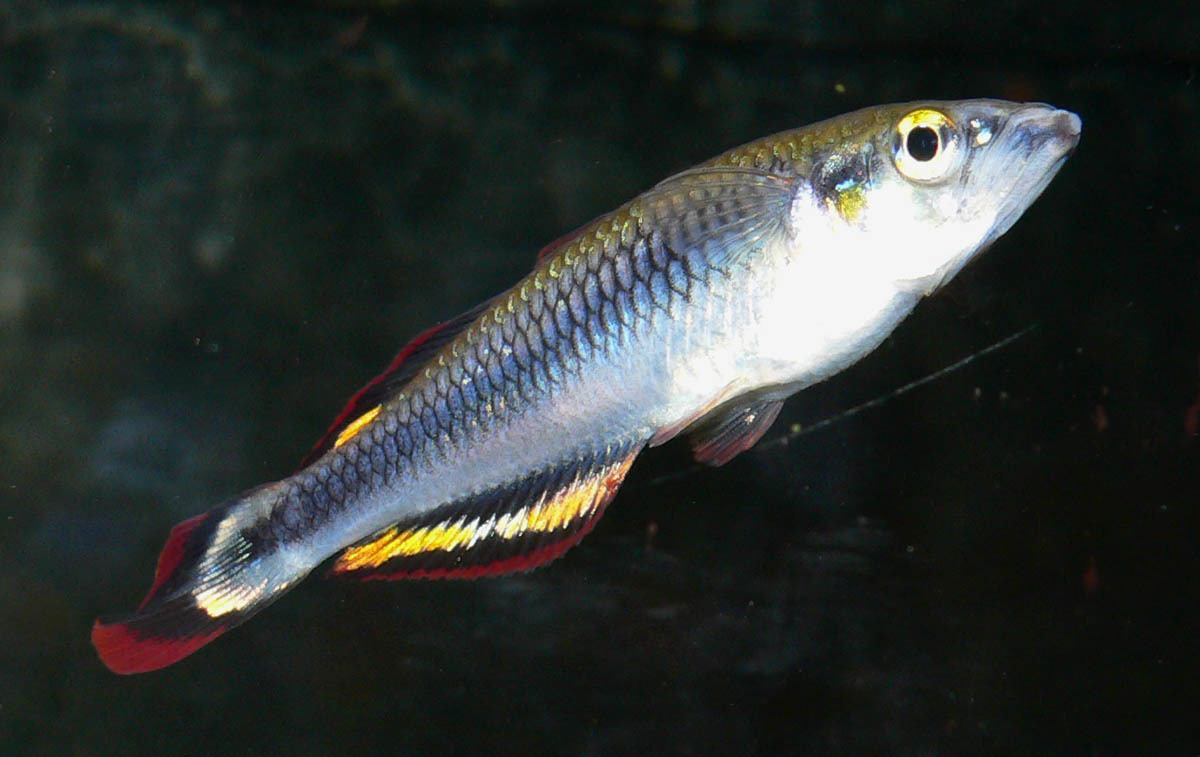
A long planted aquarium with flow and a school suits its active behavior. This name has historically been confused with other Bedotia in the aquarium trade. The clearest identification clue is the red tail and Madagascar origin.
30. Ornate Rainbowfish
One of the more memorable rainbowfishes, Ornate Rainbowfish (Rhadinocentrus ornatus) displays a small slender body that may show blue, red, yellow, or black regional forms. It originates from soft, often tannin-stained coastal waters of eastern Australia and is typically small. It feeds as an omnivore on small insects, zooplankton, and fine prepared foods.
It prefers gentle conditions, plant cover, and peaceful companions rather than a bright high-flow display tank. Local color forms should be kept distinct for breeding. The clearest identification clue is the delicate body and highly variable locality colors.
How Are These Types of Rainbow Fish Classified?
Rainbowfish used in the aquarium hobby are not all members of one genus. The family Melanotaeniidae includes many Australian and New Guinea species, while blue-eyes are often placed in Pseudomugilidae. Celebes rainbowfish and Madagascar rainbowfish belong to additional related freshwater groups.
- Melanotaenia contains many deep-bodied iridescent species.
- Glossolepis includes high-backed fish such as the red rainbowfish.
- Chilatherina species often have elongated profiles and strong male coloration.
- Pseudomugil blue-eyes are small fish with bright eyes and elaborate fins.
- Iriatherina is represented in aquariums by the delicate threadfin rainbowfish.
- Bedotia species are Madagascar rainbowfishes with streamlined bodies.
Where Do Rainbowfish Live?
Wild rainbowfish occupy lakes, clear streams, forest creeks, wetlands, billabongs, estuaries, and seasonally changing river systems. Some live in mineral-rich or even slightly brackish-influenced water, while others come from soft acidic habitats.
Geographic origin should guide aquarium setup. A honey blue-eye from acidic wallum water has different needs from a Celebes rainbowfish associated with more mineralized coastal streams. Captive-bred stock may adapt within a range, but sudden or extreme changes remain harmful.
How to Identify Different Types of Rainbowfish
- Body depth: compare deep-bodied Melanotaenia with slender Pseudomugil and Bedotia.
- Color placement: note whether color covers the whole body, rear half, fins, or a lateral stripe.
- Eye color: blue-eyes have a conspicuous reflective blue iris.
- Fin shape: threadfins and male blue-eyes may have elongated or forked display fins.
- Adult size: distinguish tiny nano species from large, powerful swimmers.
- Locality: lake, island, or river origin can be essential for similar forms.
- Sex: mature males often show stronger color and deeper bodies than females.
Aquarium Care Notes
Keep rainbowfish in groups, provide open horizontal swimming space, and cover the aquarium securely. Plants around the sides and back create security, while moderate flow and strong filtration maintain oxygen and water quality.
Feed a varied diet sized for the fish. Small blue-eyes need tiny foods and calm feeding conditions, while larger Melanotaenia can take a broader range. Avoid overstocking and perform regular water changes because active schools have a meaningful bioload.
Safety, Sustainability, and Conservation Notes
Buy captive-bred fish from breeders who track species and locality. Several rainbowfish have very restricted natural ranges, and careless hybridization can erase distinctive captive lines even when the fish remain healthy.
Never release aquarium fish, eggs, or plants into waterways. Invasive species, pathogens, and genetic mixing can harm native freshwater communities.
Fun Facts About Rainbowfish
- Many rainbowfish become more colorful as they mature.
- Male colors can intensify during early-morning courtship.
- Blue-eye rainbowfish are named for their reflective irises.
- Threadfin males use elongated fins in display behavior.
- Some rainbowfish are restricted to a single lake or small drainage.
- Local populations of one species can look very different.
- Most rainbowfish scatter adhesive eggs among plants.
- Dark backgrounds often make iridescent colors easier to see.
- A proper school can reduce stress and improve natural behavior.
- Madagascar rainbowfish evolved far from Australian species.
Final Thoughts on Types of Rainbow Fish
Comparing types of rainbow fish is about more than choosing the brightest photo. Adult size, school size, water chemistry, food size, swimming room, and locality all influence long-term success. Start with correctly identified captive-bred fish, keep them in a social group, and build the aquarium around their natural movement rather than using color as the only buying criterion.
Frequently Asked Questions
1. What is a rainbowfish?
Rainbowfish are small to medium freshwater fishes best known for iridescent colors and active schooling behavior. The name commonly includes Melanotaeniidae and several related aquarium groups.
2. Where do rainbowfish come from?
Most popular species come from Australia, New Guinea, nearby Indonesian islands, Sulawesi, and Madagascar.
3. Are rainbowfish good community fish?
Many are peaceful community fish when kept in a proper group with non-aggressive tankmates that share similar water requirements.
4. How many rainbowfish should be kept together?
A group of at least six is a common starting point, but a larger balanced school often produces more natural behavior and better color when space allows.
5. Can different rainbowfish species school together?
They may swim together, but each species still benefits from enough members of its own kind. Similar species can also hybridize, which matters to responsible breeders.
6. Do rainbowfish need a long tank?
Yes. Most are active horizontal swimmers, so tank length and open swimming space are often more important than extra height.
7. Do rainbowfish jump?
They can. A secure lid is strongly recommended, especially for fast blue-eyes and active Melanotaenia.
8. What do rainbowfish eat?
They are generally omnivores that benefit from varied prepared food plus appropriately sized frozen or live foods and some plant-based nutrition.
9. How often should rainbowfish be fed?
Small portions once or twice daily are common, but the amount should be limited to what the group consumes promptly without fouling the water.
10. Why are male rainbowfish more colorful?
Males often intensify color during courtship, competition, and spawning. Age, diet, health, lighting, and social conditions also affect appearance.
11. Do female rainbowfish have color?
Yes. Females are often subtler than mature males but can still show attractive silver, blue, gold, yellow, or red tones.
12. How long does it take rainbowfish to color up?
Many juveniles look plain and develop stronger color over months as they mature. Stable water, varied food, and a social group help.
13. What water temperature do rainbowfish need?
Temperature varies by species and locality. Some tropical New Guinea fish prefer warm water, while several Australian species tolerate cooler conditions.
14. Do all rainbowfish like hard water?
No. Some thrive in mineral-rich water, while others come from soft acidic streams or tannin-stained wetlands. Species-specific research is essential.
15. Can rainbowfish live in planted tanks?
Yes. Plants provide security and spawning sites, while an open central or front area should remain available for swimming.
16. Will rainbowfish eat plants?
They may pick at soft material or algae but are not usually destructive plant eaters when well fed.
17. Do rainbowfish eat shrimp?
Large rainbowfish may eat shrimplets or very small shrimp, while tiny blue-eyes may coexist better with adults. There is no guarantee of shrimp safety.
18. Can rainbowfish live with cichlids?
Some peaceful cichlids can be compatible if water conditions and temperament match, but aggressive or predatory cichlids are unsuitable.
19. Can rainbowfish live with bettas?
Compatibility is uncertain because rainbowfish are fast and active while bettas prefer calmer conditions. Fin nipping, feeding competition, and water needs must be considered.
20. Are rainbowfish aggressive?
Most are not strongly aggressive, but males may display, chase, or spar. Crowding and too few females can increase tension.
21. How can I tell male and female rainbowfish apart?
Mature males are often deeper-bodied and more colorful with longer fins, while females tend to be slimmer and less intense. Traits vary by species.
22. How do rainbowfish breed?
They are egg scatterers that deposit adhesive eggs among fine plants or spawning mops, often over several days.
23. Will adult rainbowfish eat their eggs?
They may eat eggs or fry. Breeders commonly remove spawning mops or move adults after spawning.
24. What size food do blue-eye rainbowfish need?
Their mouths are very small, so crushed prepared foods, tiny live foods, and small frozen foods are more appropriate than large pellets.
25. Why is my rainbowfish hiding?
New fish may hide from stress, a small group, aggressive tankmates, bright light, poor water quality, or inadequate cover.
26. Why are my rainbowfish colors dull?
Stress, immaturity, poor diet, unsuitable water, illness, a weak social group, or harsh lighting can reduce visible color.
27. Can rainbowfish be kept singly?
Single housing is not recommended for schooling species. Isolation can lead to stress and unnatural behavior.
28. Are rainbowfish endangered?
Some species have restricted ranges and face habitat degradation or invasive species. Conservation status differs widely by species.
29. Should locality forms be mixed?
For display tanks they may coexist, but serious breeders should avoid crossing distinct locality forms because unique genetic lines can be lost.
30. What is the best rainbowfish for beginners?
Dwarf neon, Boesemani, Australian, or other commonly captive-bred species can be suitable when the aquarium is large enough and water conditions match their needs.
Read more:
40 Types of River Fish: ID, Habitats and Facts