
Squids are among the most fascinating and adaptable creatures in the ocean. With over 300 known species, they range from tiny, elusive reef dwellers to colossal deep-sea giants. Understanding the types of squid helps marine enthusiasts, divers, and researchers identify these intelligent cephalopods, learn about their behavior, and appreciate their ecological importance. In this guide, we review 20 remarkable species of squid, highlighting their unique features, habitats, hunting strategies, and appearance. By the end, you will have a clear understanding of these oceanic marvels and how to spot them in the wild.
1. Giant Squid (Architeuthis)

The Giant Squid is legendary among ocean creatures, largely because it can reach lengths of up to 43 feet. Deep-sea dwellers, these squids are rarely seen alive, but they have captured human imagination for centuries. Their long feeding tentacles are equipped with suckers and hooks, perfect for grasping large prey like deep-sea fish and other squids. The eyes of the Giant Squid are enormous, some of the largest in the animal kingdom, which allows them to detect faint light in the deep ocean.
These squids have a torpedo-shaped body, muscular mantle, and fins for propulsion. Their beak, sharp and powerful, allows them to slice through tough prey. Giant Squids are solitary hunters, and while rarely observed, they are known to battle sperm whales, leaving scars on the whales’ skin. Studying Giant Squid specimens has provided scientists with insight into deep-sea ecosystems, feeding behavior, and cephalopod evolution. Among types of squid, the Giant Squid represents the extreme of size and mystery.
2. Colossal Squid (Mesonychoteuthis hamiltoni)

The Colossal Squid is a close relative of the Giant Squid but distinguished by a heavier, more robust body and larger hooks on its tentacles. Found primarily in the Antarctic waters, it is one of the largest known invertebrates. With estimates reaching over 46 feet in total length, it combines impressive size with remarkable adaptations for cold, deep environments.
Unlike the Giant Squid, the Colossal Squid has swiveling hooks on its tentacles to secure prey more effectively. Its eyes, adapted to the dark Antarctic depths, are massive and sensitive to light. The Colossal Squid primarily hunts large fish and other squids, using stealth and powerful tentacle strikes. Specimens are mostly known from the stomachs of sperm whales and from rare captures by deep-sea trawlers. As one of the most awe-inspiring types of squid, it demonstrates the extremes life can achieve in harsh environments.
3. Humboldt Squid (Dosidicus gigas)

The Humboldt Squid, also called the Jumbo Squid, is a fast, aggressive predator of the Eastern Pacific. They can grow up to 6 feet long and are known for traveling in schools of hundreds, making them a formidable presence in mid-water ecosystems. Humboldt Squid are carnivorous, feeding on fish, crustaceans, and even smaller squids. Their beak is strong enough to tear prey into manageable pieces, and they employ chromatophores to rapidly change color, communicating and camouflaging themselves.
Humboldt Squid are known for their intelligence and hunting coordination. Their large eyes allow them to detect prey even in low-light conditions. Fishermen report their strong, sometimes aggressive behavior when caught, highlighting their assertive nature. Among types of squid, the Humboldt Squid is notable for its size, schooling behavior, and adaptability to changing environmental conditions.
4. Vampire Squid (Vampyroteuthis infernalis)

Despite its ominous name, the Vampire Squid is a small deep-sea cephalopod that feeds on detritus, rather than blood. Found in oxygen-poor zones of the world’s oceans, it has a dark, cloak-like web connecting its arms, which can give it a haunting appearance. Adults grow up to 13 inches in mantle length and are well-adapted to survive in low-oxygen, high-pressure environments.
The Vampire Squid has bioluminescent organs called photophores, used to attract prey or confuse predators. Its diet consists primarily of marine snow—organic debris falling from upper layers of the ocean. While it may look fearsome, the Vampire Squid is harmless to humans and displays fascinating defensive behaviors, including inverting its cloak to appear larger and releasing bioluminescent mucus. Among types of squid, it showcases evolutionary adaptation to extreme habitats and resource-scarce conditions.
5. Japanese Flying Squid (Todarodes pacificus)

The Japanese Flying Squid is a smaller, commercially important species found in the North Pacific. Growing up to 2 feet long, it is highly migratory and supports large fisheries in Japan and neighboring regions. They are named for their remarkable ability to leap out of water and glide short distances to evade predators.
These squids feed on small fish, crustaceans, and other squids. They are also prey for whales, sharks, and humans. Japanese Flying Squid display schooling behavior and rapid swimming, using jet propulsion for movement. Their bodies are streamlined with muscular mantles and large fins to enhance speed. Among types of squid, they are an excellent example of the intersection of ecology and human economic importance, demonstrating adaptability, intelligence, and speed in a dynamic marine environment.
6. Dana Octopus Squid (Taningia danae)
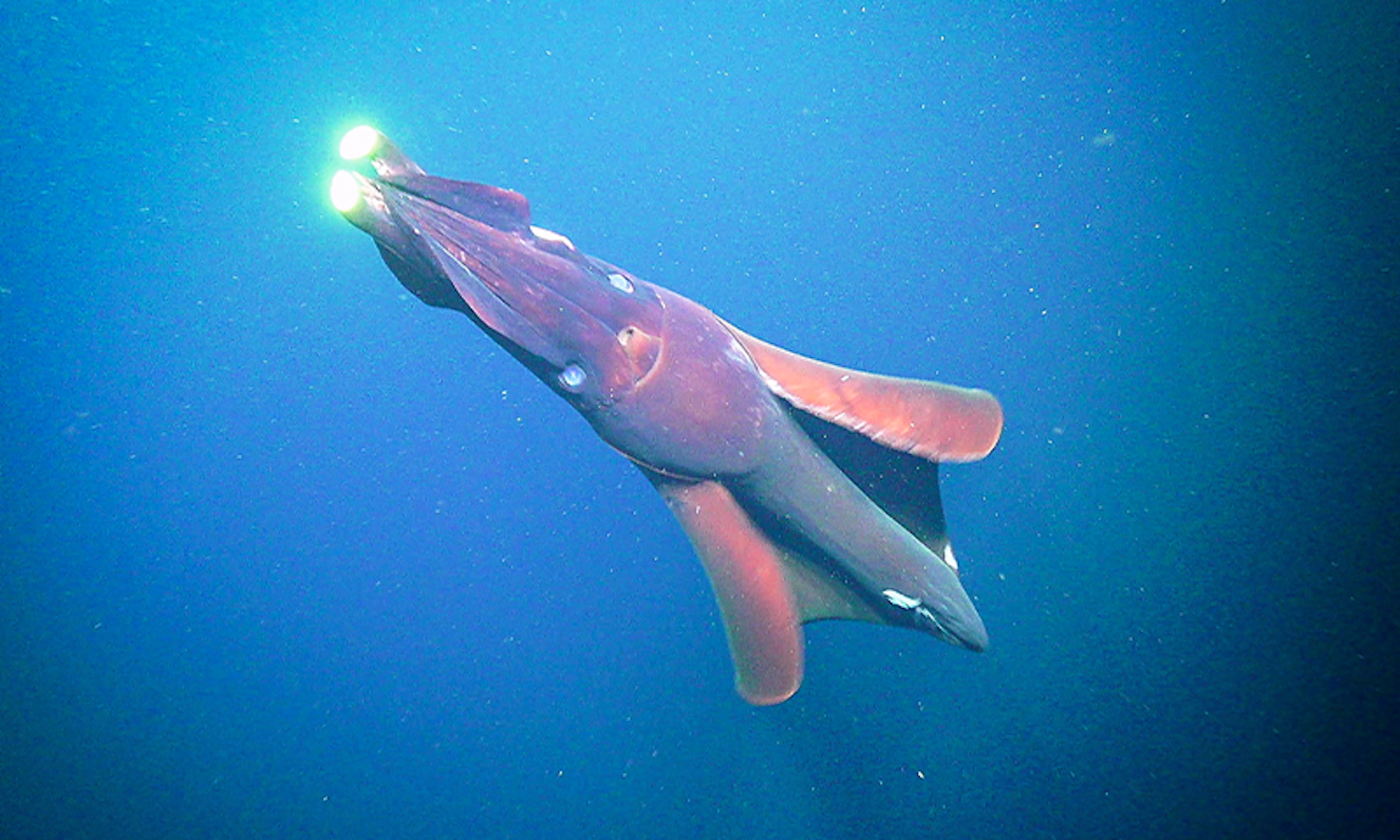
The Dana Octopus Squid is a deep-sea giant, famous for its large size and bioluminescent displays. Growing up to 6 feet in mantle length, this squid dwells in mesopelagic and bathypelagic zones, making it rarely seen by humans. One of its most remarkable features is the pair of light-producing organs at the tips of its arms. These photophores can flash bright blue or green light, possibly used to confuse predators or communicate during mating.
This squid feeds primarily on other deep-sea squids and fish, using strong tentacles and hooks to capture prey. Its body is muscular and streamlined, adapted for bursts of speed in the dark depths. Observations of Dana Octopus Squid are limited, but they reveal a highly specialized predator with unique adaptations among types of squid. Its combination of size, bioluminescence, and deep-sea hunting makes it one of the ocean’s most captivating species.
7. Bigfin Reef Squid (Sepioteuthis lessoniana)

The Bigfin Reef Squid is a shallow-water species found in Indo-Pacific reefs. Adults grow up to 16 inches and are recognized for their wide fins that run almost the entire length of the mantle. These fins give them exceptional maneuverability, allowing them to hover, dart, or glide through coral reefs with ease.
Bigfin Reef Squids are active hunters, feeding on small fish, crustaceans, and other invertebrates. They are masters of camouflage, using chromatophores to rapidly change color and blend into their environment. Socially, they are often observed in small schools during the day. Among types of squid, they are notable for their intelligence, vivid color displays, and reef-adapted hunting strategies.
8. Market Squid (Doryteuthis opalescens)

Market Squid is a commercially important species along the western coast of North America. Adults typically grow to around 12 inches and form large spawning aggregations that support sustainable fisheries. Market Squid are known for their rapid life cycle, with most living less than a year. They are short-lived but prolific breeders, laying thousands of eggs on the ocean floor or among vegetation.
These squids feed on small fish, shrimp, and other planktonic organisms. Their translucent bodies and jet-propelled swimming make them agile hunters. Among types of squid, the Market Squid is an example of a species crucial to both human economies and marine ecosystems, serving as prey for seabirds, fish, and marine mammals while maintaining balance in mid-water food webs.
9. Glass Squid (Cranchiidae family)

Glass Squids are a group of deep-sea squids known for their transparent bodies. Most species have elongated, gelatinous mantles that help them blend into the open ocean’s dim light. This transparency reduces visibility to predators and prey alike, an essential survival strategy in the mesopelagic zone.
Glass Squids range in size from a few inches to over 3 feet, depending on the species. They feed on small fish and other squids and use photophores for camouflage and communication. Among types of squid, Glass Squids are remarkable for their optical adaptations, delicate body structure, and ability to thrive in deep, lightless waters. Their mysterious appearance has fascinated oceanographers for decades.
10. Bobtail Squid (Sepiolidae family)

Bobtail Squids are small, shy squids, typically under 8 inches long. Unlike other squids, they are benthic, living near the sea floor in shallow waters. They are named for their rounded mantle, giving them a “bobtail” appearance. Bobtail Squids are nocturnal hunters, feeding on small crustaceans and worms at night.
One of their most fascinating traits is the symbiotic relationship with bioluminescent bacteria. These bacteria colonize the squid’s light organ, helping it produce light that camouflages the squid from predators below by mimicking moonlight on the water surface. Bobtail Squids also bury themselves in sand for protection. Among types of squid, they are a perfect example of clever adaptation, using both biology and behavior to survive in shallow-water habitats.
11. Firefly Squid (Watasenia scintillans)

The Firefly Squid is a small, bioluminescent species found in the waters off Japan. Adults grow to about 3 inches in mantle length and are famous for their spectacular light displays. During spawning season, millions of Firefly Squids gather near the shore, creating a shimmering spectacle in the ocean. Their photophores, located along the body and tentacles, flash in rhythmic patterns to attract mates and communicate with each other.
Firefly Squids feed on small fish, shrimp, and plankton. They are also prey for larger fish, seabirds, and humans, as they are harvested for food in Japan. Despite their small size, they have fascinating behavior, including synchronized glowing displays and rapid swimming using jet propulsion. Among types of squid, the Firefly Squid stands out for its dazzling bioluminescence and cultural significance in Japan.
12. Caribbean Reef Squid (Sepioteuthis sepioidea)

The Caribbean Reef Squid inhabits coral reefs and shallow waters in the Caribbean Sea. Adults grow up to 16 inches and are known for their agility and ability to hover in place. These squids are masters of camouflage, using chromatophores to change color for communication, mating displays, or avoiding predators.
Caribbean Reef Squids are active predators, feeding on small fish, shrimp, and other invertebrates. They often form small groups and display complex behaviors, including color signaling and coordinated hunting. Among types of squid, this species is notable for intelligence, social interaction, and adaptability in reef ecosystems.
13. Grimaldi‑scaled Squid (Lepidotheutis grimaldii)

The Grimaldi‑scaled Squid is a deep-sea species with distinctive, scale-like structures along its body. Growing to about 18 inches, it inhabits mesopelagic zones and is rarely seen by humans. These scales may aid in camouflage or structural support in high-pressure environments.
Feeding on small fish and other squids, the Grimaldi‑scaled Squid uses stealth and speed to capture prey. Its body is streamlined, with large fins for precise maneuvering. Among types of squid, this species exemplifies deep-sea adaptations, including specialized body structures and elusive behavior.
14. Southern Pygmy Squid (Idiosepius notoides)

The Southern Pygmy Squid is one of the smallest squids, measuring only 0.6–1 inch. Found in shallow coastal waters, it often clings to seagrass and algae using a sticky secretion on its arms. Despite its tiny size, it is a fierce predator, feeding on tiny crustaceans and plankton.
This squid uses camouflage and rapid color changes to avoid predators and communicate. It reproduces by laying eggs attached to vegetation, often dying shortly after spawning. Among types of squid, the Southern Pygmy Squid demonstrates that even the smallest cephalopods possess complex behaviors, intelligence, and adaptability.
15. Robust Clubhook Squid

The Robust Clubhook Squid is a mid-sized deep-sea squid distinguished by its strong, club-shaped hooks on the tentacles. These hooks help secure prey, often other squids or small fish, making it an efficient predator in low-light conditions. Adults typically grow up to 3 feet in length.
Living in mesopelagic depths, the Robust Clubhook Squid uses stealth and rapid tentacle strikes to capture prey. Its body is muscular, and fins aid in hovering or slow swimming, conserving energy in deep waters. Among types of squid, this species is notable for its specialized feeding adaptations, showcasing the diversity of hunting strategies in cephalopods.
16. Ram’s Horn Squid

The Ram’s Horn Squid is a small, deep-sea squid with a rounded, almost circular body, giving it a “ram’s horn” appearance. Typically measuring 4–6 inches, it inhabits mesopelagic zones and feeds on small fish and planktonic organisms. Its compact body and short arms make it highly maneuverable in midwater, allowing it to evade predators and hunt efficiently.
Ram’s Horn Squids have light-producing photophores on their bodies, which help with camouflage and signaling in the dimly lit ocean depths. Despite their size, they are intelligent and responsive hunters. Among types of squid, they are an excellent example of deep-sea adaptations combined with unique body morphology that supports survival in challenging environments.
17. Diamond Squid (Thysanoteuthis rhombus)

The Diamond Squid, named for the diamond-shaped cross-section of its mantle, is a large, fast-swimming squid found in tropical and subtropical waters. Adults can reach up to 3 feet in length, and they are known for powerful, streamlined bodies that support long-distance migration.
Diamond Squids feed on fish, smaller squids, and crustaceans. They use jet propulsion for bursts of speed and can rapidly change color to communicate or avoid predators. Their fins are large and triangular, providing stability during swimming. Among types of squid, the Diamond Squid is remarkable for its combination of speed, agility, and pelagic lifestyle.
18. Longfin Inshore Squid (Doryteuthis pealeii)

The Longfin Inshore Squid inhabits coastal waters along the Atlantic coast of North America. Adults grow up to 12 inches and are highly important both ecologically and commercially. They are preyed upon by larger fish, seabirds, and marine mammals, while feeding on smaller fish and crustaceans.
These squids are notable for their schooling behavior and rapid swimming using long fins and jet propulsion. Their chromatophores allow dynamic color changes for camouflage and signaling. Among types of squid, Longfin Inshore Squid is an excellent example of a species that bridges ecological importance and human economic value.
19. Clawed Armhook Squid (Gonatus onyx)

The Clawed Armhook Squid is a mid-sized squid of the northern Pacific, known for the hooked structures on its arms that secure prey. Adults reach up to 2 feet in length and are active predators of smaller fish and squids. These hooks allow it to capture and hold struggling prey efficiently, even in fast currents.
Clawed Armhook Squids are deep-water dwellers, usually inhabiting depths from 200 to 1000 meters. They are prey for larger fish and marine mammals. Among types of squid, this species illustrates how morphological adaptations like arm hooks can shape feeding behavior and ecological success in cephalopods.
20. Glassy Flying Squid

The Glassy Flying Squid is a pelagic species known for its translucent body and ability to leap out of water and glide briefly, evading predators. Adults typically grow to around 1–2 feet in length and inhabit tropical and subtropical open waters. Their transparent bodies help them avoid detection in midwater, while their fins and tentacles aid in short aerial movements.
Glassy Flying Squids feed on small fish and plankton, using rapid jet propulsion and tentacle strikes to capture prey. Among types of squid, they are unique for combining transparency with gliding ability, making them fascinating examples of cephalopod survival strategies in open-ocean environments.
Conclusion: Exploring the Diversity of Types of Squid
From the colossal deep-sea giants like the Giant and Colossal Squid to the tiny Southern Pygmy Squid, these 20 species showcase the incredible diversity of cephalopods. Squids occupy a wide range of habitats, from shallow reefs to the darkest depths of the ocean, each with specialized adaptations for survival, hunting, and reproduction. Understanding the types of squid provides insight into marine ecosystems and the complex interplay of predator and prey in the ocean.
By studying squids, we can appreciate their intelligence, camouflage abilities, and unique behaviors. Whether observing a shimmering Firefly Squid near Japan’s coast or learning about the stealthy Glass Squid in deep waters, these creatures remind us of the richness of marine life. Recognizing and respecting squids helps promote conservation and a deeper connection with ocean biodiversity, making these fascinating cephalopods both vital and captivating members of our seas.
Frequently Asked Questions About Types of Squid
1. What are the different types of squid?
Squids are cephalopods with over 300 species, ranging from tiny pygmy squids to giant deep-sea squids like Architeuthis and Mesonychoteuthis.
2. How big can a Giant Squid get?
The Giant Squid can reach lengths up to 43 feet, with enormous eyes and long feeding tentacles.
3. What is the Colossal Squid?
The Colossal Squid is a deep-sea species larger than most squids, with heavy bodies, hooks on its tentacles, and inhabiting Antarctic waters.
4. Where can Humboldt Squid be found?
Humboldt Squid are found in the Eastern Pacific, from northern Chile to California, often in midwater zones.
5. Why is the Vampire Squid called so?
Despite its name, the Vampire Squid does not suck blood; it lives in deep, oxygen-poor waters and feeds on detritus using a cloak-like web.
6. How does the Japanese Flying Squid move?
It uses jet propulsion to swim quickly and can leap out of water briefly to escape predators.
7. What is unique about the Dana Octopus Squid?
It has bioluminescent organs at arm tips, allowing it to produce bright flashes of light for communication and defense.
8. Where does the Bigfin Reef Squid live?
Bigfin Reef Squid inhabit shallow reefs in the Indo-Pacific and use wide fins for precise swimming and hovering.
9. What is the size of Market Squid?
Market Squid grow up to 12 inches, form large spawning aggregations, and are important for fisheries.
10. How do Glass Squids camouflage?
Glass Squids have transparent bodies, which make them nearly invisible in the dim light of the deep ocean.
11. What is the Bobtail Squid known for?
It is small, benthic, and has a symbiotic relationship with bioluminescent bacteria to hide from predators.
12. How do Firefly Squid produce light?
They have photophores along their bodies and tentacles, producing flashing lights for communication and mating.
13. Where are Caribbean Reef Squid found?
They live in shallow Caribbean reefs and are excellent at camouflage using dynamic color changes.
14. What is the Grimaldi‑scaled Squid?
A deep-sea squid with scale-like structures along its body, aiding in camouflage and deep-sea survival.
15. How small is the Southern Pygmy Squid?
Adults measure only about 0.6–1 inch and cling to seagrass or algae for shelter and hunting.
16. What are the hooks used for on the Robust Clubhook Squid?
Hooks on the tentacles help capture and hold prey like fish and other squids in deep water.
17. What does the Ram’s Horn Squid look like?
It has a rounded, circular body resembling a ram’s horn, allowing it to maneuver efficiently in midwater.
18. Where is the Diamond Squid found?
Diamond Squid inhabit tropical and subtropical waters and are strong, fast swimmers with triangular fins.
19. How important is the Longfin Inshore Squid?
It is ecologically and commercially important, found along the Atlantic coast and forming prey for many predators.
20. What are Clawed Armhook Squid known for?
They have hooked arms for securing prey and live in the northern Pacific at mid-depths.
21. What is the Glassy Flying Squid?
A pelagic squid with a translucent body that can glide out of the water briefly to avoid predators.
22. Do squids change color?
Yes, most squids use chromatophores to change color for camouflage, signaling, or mating displays.
23. How do squids breathe?
Squids breathe through gills inside their mantle cavity, extracting oxygen from seawater.
24. What do squids eat?
Squids are carnivorous, feeding on fish, shrimp, plankton, and smaller squids depending on species.
25. Are squids intelligent?
Yes, many squids demonstrate problem-solving skills, complex behaviors, and sophisticated hunting strategies.
26. How do squids reproduce?
Squids reproduce sexually, with males transferring spermatophores to females, who lay eggs in clusters or attached to substrates.
27. Can squids camouflage themselves?
Yes, species like Bigfin Reef Squid and Caribbean Reef Squid can change colors to match their environment.
28. Are all squids deep-sea creatures?
No, some, like Market Squid and Longfin Inshore Squid, live in shallow coastal waters, while others inhabit deep ocean zones.
29. How fast can squids swim?
Squid speed varies by species; some like Diamond Squid and Humboldt Squid can swim rapidly using jet propulsion.
30. Do squids have predators?
Yes, sharks, larger fish, seabirds, and marine mammals, including whales, prey on squids of various sizes.
31. What is the lifespan of a squid?
Lifespans vary: small species may live less than a year, while giant squids could live several years in deep-sea environments.
32. How do squids escape predators?
They use camouflage, rapid swimming, bioluminescence, and inking to evade predators.
33. Do squids produce ink?
Yes, most squids release ink clouds to confuse predators and escape attacks.
34. Are squids edible?
Many squid species, such as Market Squid and Japanese Flying Squid, are consumed worldwide as seafood.
35. How do squids use bioluminescence?
Deep-sea squids like Vampire Squid and Dana Octopus Squid use light to communicate, attract prey, or deter predators.
36. Can squids fly?
Some species, like Japanese Flying Squid and Glassy Flying Squid, can leap out of water briefly to glide away from threats.
37. What is the smallest squid?
The Southern Pygmy Squid is among the tiniest, measuring less than an inch in length.
38. What is the largest squid?
The Colossal Squid and Giant Squid are the largest, reaching lengths up to 43–46 feet.
39. How do squids move?
Squids use jet propulsion by expelling water through a funnel and use fins for steering and hovering.
40. Are squids solitary or social?
Behavior varies: some, like Humboldt Squid, form large schools, while others, like Giant Squid, are solitary.
41. Why are squids important in the ocean?
Squids are vital in food webs, serving as both predators and prey, and contribute to marine ecosystem balance.
42. How do scientists study squids?
Scientists study squids through deep-sea submersibles, fisheries, laboratory observations, and examination of washed-up specimens.