

The types of Wildebeest are among the most iconic herbivores in Africa, famous for their massive migrations across the Serengeti and Masai Mara ecosystems. These animals belong to the antelope family and are instantly recognizable by their muscular build, curved horns, and long faces. Wildebeest play a critical role in maintaining grassland ecosystems by grazing and supporting predator populations such as lions, hyenas, and crocodiles.
In this guide, we explore 15 types of Wildebeest, including species, subspecies, and regional populations. Each one has unique adaptations based on habitat, migration routes, and environmental pressure. Let’s begin with the first five most important types found across Africa.
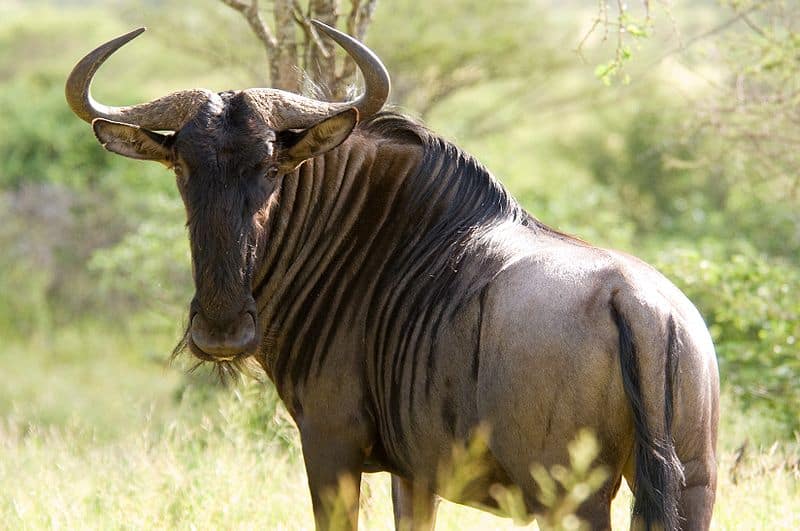
1. Blue Wildebeest (Connochaetes taurinus)
The Blue Wildebeest is the most widely recognized of all types of Wildebeest. It is found across eastern and southern Africa, including Kenya, Tanzania, and South Africa. This species has a bluish-gray coat with darker vertical stripes on the neck and shoulders, giving it a distinctive appearance.
Blue Wildebeest are highly social animals that form large herds, sometimes numbering in the thousands. These herds migrate seasonally in search of fresh grazing lands, creating one of the most spectacular wildlife events on Earth: the Great Migration.
They are built for endurance rather than speed bursts, allowing them to travel long distances across savannahs. Their diet consists mainly of short grasses, which they graze continuously throughout the day.
Ecologically, Blue Wildebeest are essential for maintaining grassland balance and supporting predator populations that depend on them as a primary food source.
2. Black Wildebeest (Connochaetes gnou)
The Black Wildebeest is one of the most visually distinct types of Wildebeest, native to southern Africa, especially South Africa, Lesotho, and Namibia. Unlike its blue counterpart, it has a darker brown to black coat and a striking white tail.
This species is more territorial and less migratory than the Blue Wildebeest. It prefers open plains and grasslands where it can establish and defend breeding territories.
Black Wildebeest are known for their dramatic courtship displays, where males engage in aggressive sparring using their curved horns. These behaviors help establish dominance and mating rights.
Conservation efforts have helped restore their populations after historical declines due to hunting and habitat loss.
3. Serengeti Wildebeest (Regional Blue Wildebeest Population)
The Serengeti Wildebeest is a major migratory population of the Blue Wildebeest and one of the most important types of Wildebeest in Africa. It is primarily found in Tanzania’s Serengeti ecosystem and Kenya’s Masai Mara.
This population is famous for participating in the Great Migration, where millions of wildebeest move in circular patterns following rainfall and fresh grass growth.
Their survival depends heavily on seasonal rainfall patterns and predator-prey dynamics. They face intense predation pressure from lions, crocodiles, and hyenas during migration crossings.
Despite these challenges, the Serengeti Wildebeest population remains one of the most stable and ecologically important wildlife populations in the world.
4. Eastern White-bearded Wildebeest (Connochaetes taurinus albojubatus)
This subspecies is one of the unique types of Wildebeest found in Kenya and northern Tanzania. It is easily identified by its lighter facial markings and white beard-like hair under the chin.
It inhabits savannahs and open grasslands, where it participates in seasonal migrations alongside other herbivores such as zebras and gazelles.
Eastern White-bearded Wildebeest are highly social and form large herds for protection against predators. Their migration patterns are closely tied to rainfall cycles.
They play a key role in nutrient cycling by grazing and fertilizing grasslands through movement.
5. Western White-bearded Wildebeest (Connochaetes taurinus mearnsi)
The Western White-bearded Wildebeest is another important member of the types of Wildebeest, primarily found in the Serengeti-Mara ecosystem.
This subspecies is slightly larger and more robust compared to other blue wildebeest populations. It is one of the main participants in the Great Migration.
They form massive herds that move in synchronized patterns, driven by rainfall and food availability. Their survival strategy relies heavily on group protection.
This subspecies is critical for maintaining predator-prey balance in East African ecosystems.
6. Nyassa Wildebeest (Connochaetes taurinus johnstoni)
The Nyassa Wildebeest is one of the lesser-known but ecologically important types of Wildebeest, found mainly in southern Tanzania and parts of northern Mozambique. It is a regional subspecies of the Blue Wildebeest, adapted to warmer, more variable savannah conditions compared to northern populations.
This wildebeest has a slightly darker coat than some East African forms, with faint striping along the neck and shoulders. Its build is muscular, designed for endurance rather than short bursts of speed. Nyassa Wildebeest are highly social animals, often forming medium to large herds that graze together across open plains.
Unlike the massive migratory populations of the Serengeti, Nyassa Wildebeest movements are more localized and seasonal, depending heavily on rainfall patterns and grass availability. During dry periods, they may concentrate near water sources, creating temporary high-density herds.
Ecologically, they play a vital role in maintaining grassland structure by grazing selectively and preventing overgrowth of dominant grass species. They also serve as an important prey base for predators such as lions and hyenas.
7. Cookson’s Wildebeest (Connochaetes taurinus cooksoni)
Cookson’s Wildebeest is one of the most geographically restricted types of Wildebeest, primarily found in Zambia’s Luangwa Valley. This isolation has made it a distinct regional form adapted to floodplain and woodland-savannah environments.
This population is slightly smaller in body size compared to Serengeti wildebeest, with a lighter coat and less pronounced striping. These adaptations help it blend into mixed woodland habitats where visibility is more limited than open plains.
Cookson’s Wildebeest are not major long-distance migrators but do perform seasonal movements in response to rainfall and vegetation growth. They often mix with other herbivores such as zebras and impalas, forming diverse grazing communities.
Because of its limited range, this subspecies is more vulnerable to habitat changes and human encroachment, making conservation monitoring important for long-term survival.
8. Masai Wildebeest (Serengeti-Mara Population)
The Masai Wildebeest is one of the most famous types of Wildebeest due to its role in the Great Migration. It is primarily found in Kenya’s Masai Mara and Tanzania’s Serengeti ecosystem.
This population is known for its massive herds, which can include hundreds of thousands to over a million individuals during peak migration periods. These movements are driven by seasonal rainfall and the search for fresh grazing land.
Masai Wildebeest are highly synchronized in movement, often traveling alongside zebras and gazelles. This mixed-species migration helps reduce predation risk and improves grazing efficiency.
They are a cornerstone species in East African ecosystems, supporting predators and shaping vegetation patterns through constant grazing and movement.
9. Kruger Blue Wildebeest (Southern Population Variant)
The Kruger Blue Wildebeest represents a southern regional form of the Blue Wildebeest found in and around South Africa’s Kruger National Park. It is one of the more stable types of Wildebeest in terms of population distribution.
This variant is well adapted to savannah and bushveld environments, where it grazes on short and medium-height grasses. It has a robust body and slightly darker coloration compared to some eastern populations.
Kruger Wildebeest are generally non-migratory or only locally migratory, staying within protected park boundaries where resources are relatively stable year-round.
They play an important ecological role in maintaining grass balance and providing a steady food source for large predators in southern African ecosystems.
10. Zambian Wildebeest (Luangwa Population Form)
The Zambian Wildebeest is a regional population found in Zambia’s Luangwa Valley and surrounding ecosystems. It is one of the more ecologically adaptable types of Wildebeest due to its ability to survive in mixed woodland and open grassland habitats.
This population typically shows intermediate physical characteristics between Blue Wildebeest subspecies, with moderate striping and a balanced body structure suited for both endurance and agility.
Zambian Wildebeest are semi-migratory, moving between floodplains and upland areas depending on seasonal water availability. Their movements often overlap with other herbivores, creating rich biodiversity zones.
They contribute significantly to ecosystem stability by grazing on grasses and supporting predator populations such as lions, leopards, and wild dogs.
11. Tanzanian Wildebeest (Eastern Plains Population Variant)
The Tanzanian Wildebeest is one of the most ecologically important regional forms within the broader types of Wildebeest. It is primarily found in the vast grasslands of northern Tanzania, especially within the Serengeti ecosystem, where open plains dominate the landscape. This population is closely linked to seasonal rainfall patterns, which strongly influence its movement and feeding behavior throughout the year.
Physically, Tanzanian Wildebeest are typical Blue Wildebeest in appearance, with a bluish-gray coat, darker shoulder stripes, and a muscular build adapted for long-distance movement. However, individuals in this region often appear slightly leaner due to the demands of constant migration. Their survival depends on endurance rather than short bursts of speed.
One of the most remarkable traits of this population is its participation in the Great Migration, where millions of wildebeest move in a circular route between Tanzania and Kenya. This movement is driven by rainfall and the search for fresh grazing lands. During this journey, they face numerous dangers, including river crossings filled with crocodiles and predators such as lions and hyenas.
Ecologically, Tanzanian Wildebeest are essential for shaping grassland ecosystems. Their grazing prevents overgrowth of dominant grass species, promotes plant diversity, and recycles nutrients back into the soil. They also serve as a primary food source for large carnivores, maintaining a balanced predator-prey dynamic.
12. Kenyan Wildebeest (Northern Migratory Population Form)
The Kenyan Wildebeest represents another major migratory component of the types of Wildebeest, closely connected to the Masai Mara ecosystem. This population is famous for its seasonal movement between Kenya and Tanzania, forming part of the larger Great Migration system.
These wildebeest are highly social and move in extremely large herds that can number in the hundreds of thousands. Their migration is synchronized with rainfall patterns, ensuring access to nutrient-rich grasses throughout the year. This adaptability is one of the key reasons for their ecological success.
Kenyan Wildebeest are slightly smaller in appearance compared to some southern populations, but they are extremely resilient. They rely on group behavior for protection against predators, using sheer numbers to reduce individual risk during migration crossings and feeding periods.
They play a crucial ecological role in nutrient distribution across ecosystems. As they move, they transport nutrients through grazing, defecation, and trampling, which helps maintain soil fertility and supports plant regeneration across vast landscapes.
13. Namibian Black Wildebeest Population
The Namibian Black Wildebeest population represents a regional extension of the Black Wildebeest species, one of the more distinctive types of Wildebeest. Although traditionally associated with South Africa, small populations or reintroduced groups are found in parts of Namibia, particularly in protected reserves and managed conservation areas.
This population is characterized by the same dark brown to black coat and white tail typical of the species. Males are particularly aggressive during breeding season, engaging in territorial displays that include horn clashes and physical posturing.
Unlike Blue Wildebeest populations, Black Wildebeest are not strong migrators. Instead, they are more territorial and prefer open grasslands where they can defend breeding areas. This behavior reduces competition but increases dependence on localized resources.
In Namibia, conservation efforts have helped stabilize their numbers in controlled environments, where they contribute to biodiversity and grassland management through grazing.
14. South African Black Wildebeest Population
The South African Black Wildebeest population is one of the most studied and well-managed of all types of Wildebeest. Historically, this species faced severe decline due to hunting in the 19th and early 20th centuries, but conservation programs have successfully restored its presence in many regions.
These wildebeest are adapted to open grasslands and semi-arid environments. Their distinctive white tail and backward-curving horns make them easy to identify in the wild. Males are highly territorial during breeding season, often engaging in dramatic displays of strength.
They are generally non-migratory, forming stable herds within protected reserves and farmland-adjacent ecosystems. This makes them different from migratory Blue Wildebeest populations.
Ecologically, they contribute to maintaining grassland balance and serve as prey for large predators, particularly in South Africa’s national parks and conservation areas.
15. Hybrid Blue–Black Wildebeest (Rare Cross Population)
The Hybrid Blue–Black Wildebeest is one of the rarest and most unusual types of Wildebeest. It occurs when Blue Wildebeest and Black Wildebeest interbreed in areas where their ranges overlap, often in managed reserves or fenced conservation lands.
These hybrids can display mixed physical characteristics, such as intermediate coat coloration, horn shapes that combine traits from both species, and varied body proportions. However, such hybrids are often sterile, meaning they cannot reproduce further.
Their existence provides valuable insight into evolutionary relationships between the two species. It also highlights the importance of maintaining natural species boundaries in wild ecosystems.
From an ecological perspective, hybrid wildebeest do not play a unique role but are important for scientific study and understanding genetic compatibility between closely related species.
Conclusion
The exploration of the types of Wildebeest shows just how diverse and ecologically important these African herbivores truly are. From the globally famous Blue Wildebeest driving the Great Migration, to the more territorial Black Wildebeest of southern Africa, each type has developed unique adaptations to survive in its specific environment.
Across savannahs, grasslands, and semi-arid regions, wildebeest act as key ecosystem engineers. Their grazing patterns help maintain open landscapes, prevent overgrowth of dominant grasses, and support a wide range of other wildlife species. In turn, they also form a critical food source for large predators such as lions, hyenas, and crocodiles, keeping natural food chains in balance.
What makes wildebeest especially fascinating is their dependence on seasonal cycles. Many populations respond directly to rainfall and vegetation changes, creating some of the most spectacular wildlife movements on Earth. These migrations are not only survival strategies but also essential processes that shape entire ecosystems across East Africa.
However, despite their resilience, wildebeest populations face increasing pressures from habitat fragmentation, climate change, and human development. Protecting migration corridors and natural grasslands is essential to ensure the long-term survival of these animals and the ecosystems they support.
In the end, studying the types of Wildebeest helps us understand how deeply interconnected African wildlife truly is—and how many more ecological secrets might still be hidden within the endless movement of the savannah herds?
50+ Frequently Asked Questions (FAQ) About Wildebeest
1. What is a wildebeest?
A wildebeest is a large African antelope belonging to the genus Connochaetes. It is known for its strong build, curved horns, and massive herd migrations across savannah ecosystems.
2. How many types of wildebeest are there?
There are two main species: the Blue Wildebeest and the Black Wildebeest. Within these, there are several subspecies and regional populations, creating around 10–15 commonly recognized types depending on classification systems.
3. Where do wildebeest live?
Wildebeest are found across eastern and southern Africa, especially in Kenya, Tanzania, Namibia, South Africa, Zambia, and surrounding savannah regions.
4. Why do wildebeest migrate?
Wildebeest migrate in search of fresh grass and water. Their movement is driven by seasonal rainfall patterns, which determine food availability across Africa’s grasslands.
5. What is the Great Migration?
The Great Migration is the world’s largest land animal migration, involving over a million wildebeest moving between Tanzania’s Serengeti and Kenya’s Masai Mara in a continuous cycle.
6. Are wildebeest dangerous?
Wildebeest are generally not dangerous to humans, but they can become aggressive if threatened, especially males during the breeding season.
7. What do wildebeest eat?
They are herbivores that primarily feed on short grasses. During dry seasons, they may also eat shrubs and longer grasses when necessary.
8. How fast can a wildebeest run?
Wildebeest can run up to 60–80 km/h (37–50 mph), which helps them escape predators like lions and hyenas.
9. How long do wildebeest live?
In the wild, wildebeest typically live 15–20 years, depending on predation, food availability, and environmental conditions.
10. What predators hunt wildebeest?
Lions, hyenas, crocodiles, leopards, and African wild dogs are the main predators of wildebeest.
11. Why are wildebeest important to the ecosystem?
They help maintain grassland balance, recycle nutrients, and provide food for large predators, making them a key species in African ecosystems.
12. Do wildebeest live in herds?
Yes, wildebeest are highly social and live in large herds that can range from dozens to hundreds of thousands of individuals during migration.
13. Are wildebeest antelopes?
Yes, wildebeest are a type of antelope belonging to the Bovidae family.
14. What is the difference between blue and black wildebeest?
Blue Wildebeest are larger, more migratory, and widespread, while Black Wildebeest are more territorial, smaller, and mainly found in southern Africa.
15. Do wildebeest fight each other?
Yes, especially males during breeding season. They use their curved horns to compete for dominance and mating rights.
16. When is wildebeest breeding season?
Breeding typically occurs during the rainy season when food is abundant, ensuring higher survival rates for calves.
17. How long is wildebeest pregnancy?
The gestation period is about 8.5 months, after which a single calf is usually born.
18. Do wildebeest protect their babies?
Yes, mothers are highly protective and often keep calves within the safety of the herd for protection from predators.
19. Can wildebeest swim?
Yes, they can swim and often cross rivers during migration, although this is one of the most dangerous parts of their journey.
20. Why do crocodiles hunt wildebeest?
Crocodiles take advantage of river crossings during migration when wildebeest are vulnerable and crowded together.
21. Are wildebeest endangered?
Most wildebeest species are not currently endangered, but habitat loss and migration disruption remain concerns.
22. What is a herd leader in wildebeest?
Wildebeest herds do not have a single leader; instead, movement is driven by collective behavior and environmental cues.
23. How do wildebeest communicate?
They use vocal sounds, body movements, and scent marking to communicate with each other.
24. Why do wildebeest kick their calves?
This is a defensive behavior to help calves stand quickly and avoid predators shortly after birth.
25. Do wildebeest sleep?
Yes, but they sleep lightly and in short periods to remain alert for predators.
26. What makes wildebeest unique?
Their massive migrations, herd behavior, and role in shaping African ecosystems make them one of the most unique large mammals.
27. Where is the best place to see wildebeest?
The Serengeti National Park in Tanzania and the Masai Mara in Kenya are the best places to witness large wildebeest herds.
28. How many wildebeest are in the wild?
There are over 1.5 million wildebeest in Africa, mostly within the Serengeti-Mara ecosystem.
29. Do wildebeest stay in one place?
No, many populations are highly migratory and move seasonally in search of food and water.
30. Why do wildebeest run in circles?
This behavior often occurs during predator attacks, helping confuse predators and increase survival chances.
31. Are wildebeest good swimmers?
They can swim across rivers but are not strong swimmers, making crossings risky during migration.
32. Do wildebeest have horns?
Yes, both males and females have curved horns used for defense and fighting.
33. Why are wildebeest called gnu?
The name “gnu” comes from the sound they make, which resembles a grunt or snort.
34. How do wildebeest survive predators?
They rely on herd size, speed, vigilance, and synchronized movement to reduce predation risk.
35. Do wildebeest migrate with zebras?
Yes, they often migrate alongside zebras, which helps improve grazing efficiency and predator detection.
36. What is wildebeest calving season?
It usually occurs in the early rainy season when grass is abundant, giving calves a better chance of survival.
37. How many calves does a wildebeest have?
Typically, a female wildebeest gives birth to one calf at a time.
38. Are wildebeest noisy?
Yes, they make grunting and snorting sounds for communication within the herd.
39. What habitats do wildebeest prefer?
They prefer open grasslands and savannahs where grazing is abundant and visibility is high for predator detection.
40. Do wildebeest migrate every year?
Yes, many populations migrate annually based on rainfall and grass growth cycles.
41. What is the lifespan of a wildebeest calf?
Calves are highly vulnerable in their first months but grow quickly under herd protection.
42. Why do wildebeest stampede?
Stampedes often occur due to predator attacks or sudden environmental disturbances.
43. Can wildebeest be domesticated?
No, they are wild animals and do not adapt well to domestication.
44. What is the biggest threat to wildebeest?
Habitat loss, fencing of migration routes, and climate change are major threats.
45. How do wildebeest impact grasslands?
Their grazing helps maintain grass height, diversity, and nutrient cycling in ecosystems.
46. Are wildebeest smart animals?
They are not highly intelligent compared to primates, but they show strong survival instincts and herd coordination.
47. Do wildebeest sleep standing up?
Yes, they often rest while standing to stay alert for predators.
48. What is the difference between wildebeest and buffalo?
Wildebeest are antelopes, while buffalo are larger bovines with different body structures and behaviors.
49. Why are wildebeest important for tourism?
They attract millions of tourists each year, especially during the Great Migration, boosting African ecotourism.
50. What would happen if wildebeest disappeared?
The loss of wildebeest would disrupt predator populations, reduce grassland health, and severely impact African ecosystems.
51. Can wildebeest adapt to climate change?
They can adjust migration patterns to some extent, but extreme climate changes may threaten their survival long-term.
52. What makes wildebeest migrations so famous?
Their scale, danger, and synchronization with seasonal cycles make them one of the most iconic wildlife events on Earth.
Read more: