

Hornbills are among the most fascinating birds in the world, known for their large curved bills, colorful casques, and strong connection to tropical forests. In this guide to Types of Hornbills, we explore how these birds differ in size, behavior, habitat, and conservation status. Found mainly in Africa and Asia, hornbills play a vital ecological role by spreading seeds and maintaining healthy forest ecosystems.
This article is written for beginners and wildlife enthusiasts who want clear, reliable information about hornbills without technical jargon. Each species is explained in a friendly, educational way to help you identify hornbills in the wild and understand why they matter. If you are searching for a complete, easy-to-read resource on the Types of Hornbills, you are in the right place.
30 Types of Hornbills
1. Southern Ground Hornbill
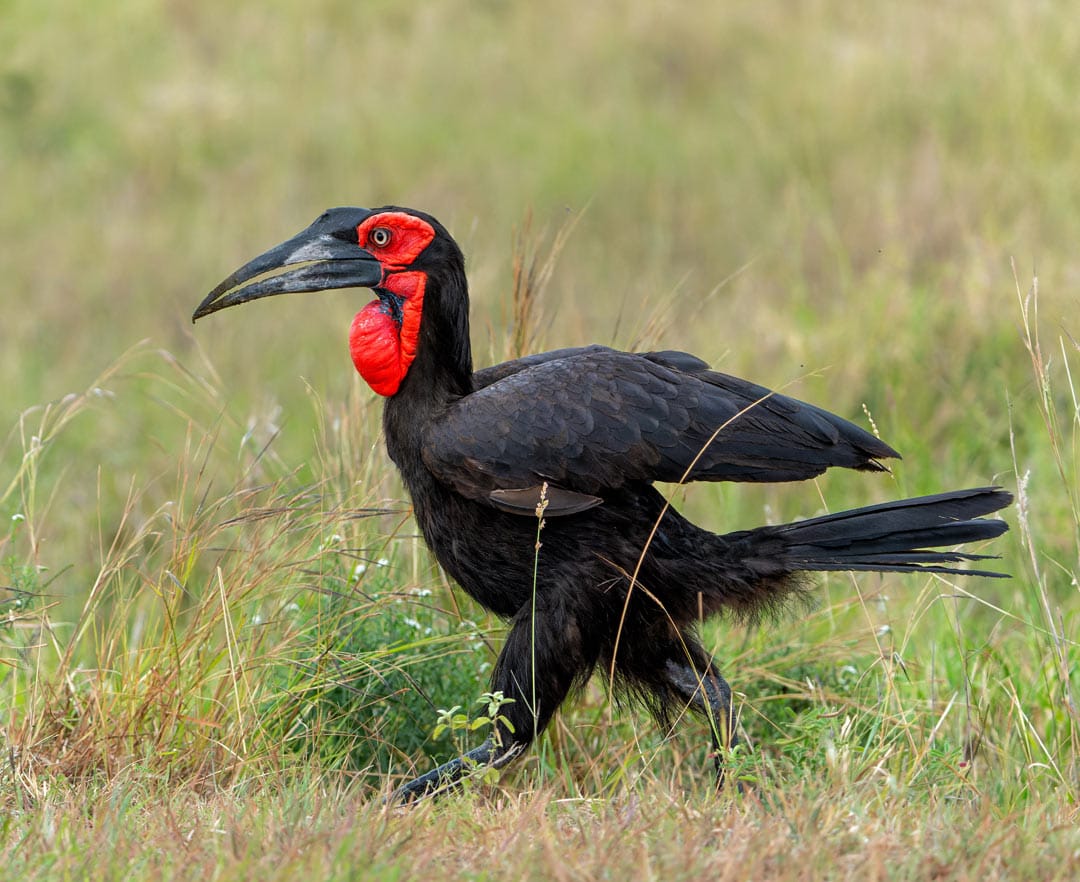
The Southern Ground Hornbill is one of the largest and most striking hornbills in the world. Unlike many hornbill species that spend most of their time in trees, this bird is primarily ground-dwelling. It is easily recognized by its massive black body, long legs, and vivid red facial skin, especially in adult males. Females usually have a patch of blue or purple mixed into the red, making gender identification possible even from a distance.
This hornbill lives mainly in open savannas, grasslands, and lightly wooded areas of southern Africa. Countries such as South Africa, Botswana, Zimbabwe, and Namibia provide ideal habitats where the bird can walk long distances in search of food. Its strong legs allow it to patrol territories that can stretch for many kilometers.
Diet plays a key role in the Southern Ground Hornbill’s behavior. It feeds on insects, small mammals, reptiles, amphibians, and even other birds. Using its powerful bill, it can easily crush prey or dig into soil and leaf litter. This makes it an important predator that helps control pest populations.
One of the most fascinating aspects of this species is its social structure. Southern Ground Hornbills live in cooperative family groups, usually consisting of a dominant breeding pair and several helpers. These helpers assist in raising chicks, defending territory, and finding food. This system increases survival rates but also means the species reproduces very slowly.
Breeding is rare and carefully timed. A single chick may take several years to mature, and groups may only successfully raise one chick every few seasons. Because of this slow reproduction, the species is highly vulnerable to habitat loss and human disturbance.
Today, the Southern Ground Hornbill is considered vulnerable in many regions. Conservation programs focus on habitat protection, reducing poisoning incidents, and educating local communities. As one of the most iconic Hornbills, it serves as a powerful symbol of Africa’s open landscapes.
2. Abyssinian Ground Hornbill
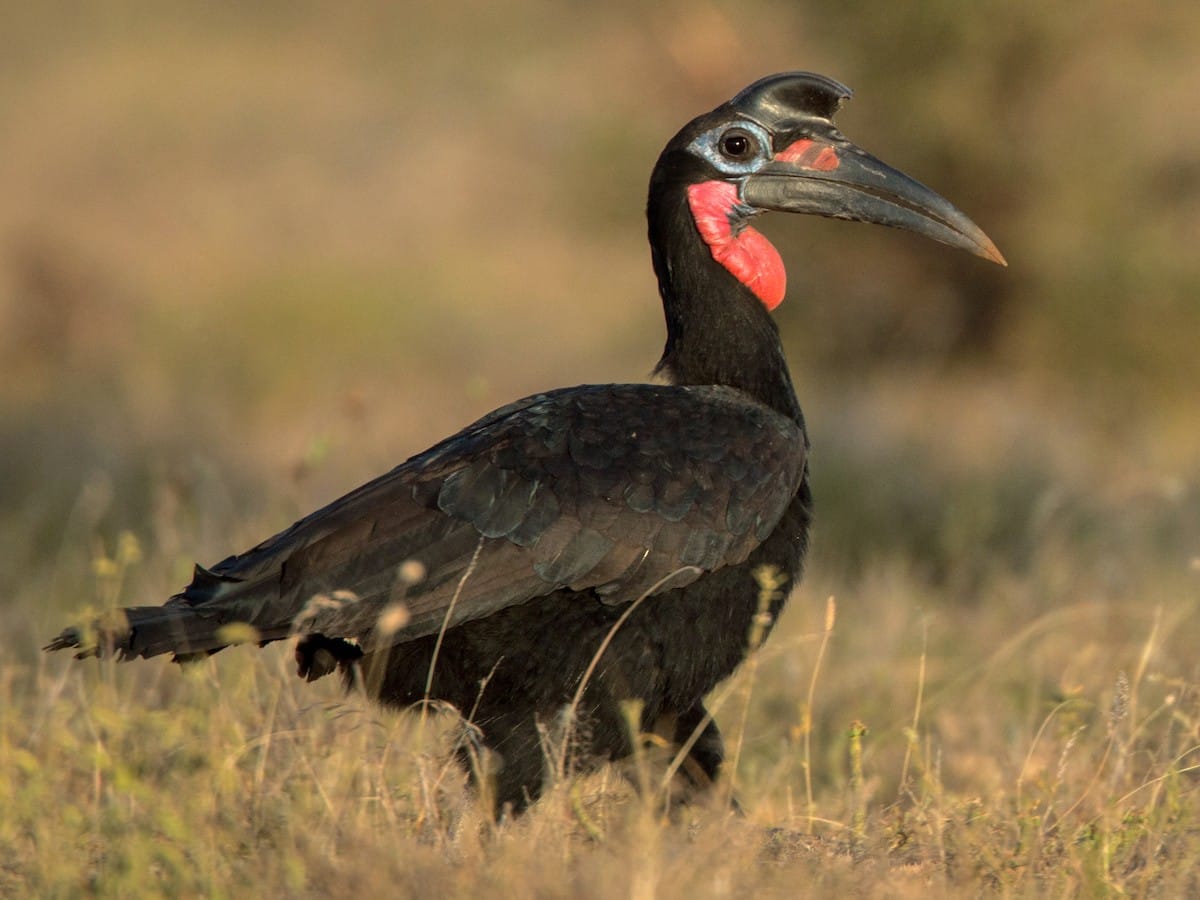
The Abyssinian Ground Hornbill is a close relative of the Southern Ground Hornbill but occupies a different range across eastern and northeastern Africa. It shares the same ground-dwelling lifestyle and impressive size, making it one of the largest flying birds on the continent.
This species is easily identified by its black feathers, white wing patches visible in flight, and bright red facial skin. Males typically have entirely red throats, while females show a mix of blue and red. These colors are not just decorative; they play an important role in communication and mating displays.
Abyssinian Ground Hornbills prefer dry savannas, semi-deserts, and open woodlands. They are especially common in countries like Ethiopia, Kenya, Uganda, and Sudan. Their ability to survive in harsh environments makes them one of the most adaptable Types of Hornbills.
Their diet is similar to their southern cousins. They consume insects, snakes, lizards, rodents, and occasionally carrion. Walking slowly across the ground, they scan for movement before striking with precision. This hunting style reduces competition with tree-dwelling hornbill species.
Social behavior is another defining trait. These birds live in family groups that defend large territories. Their booming calls can be heard over long distances, especially during early mornings. These deep sounds help maintain group contact and warn rivals to stay away.
Although currently more stable than the Southern Ground Hornbill, the Abyssinian Ground Hornbill still faces threats from land conversion and hunting. Protecting open habitats is essential to ensure the survival of this impressive species of hornbill.
3. African Grey Hornbill
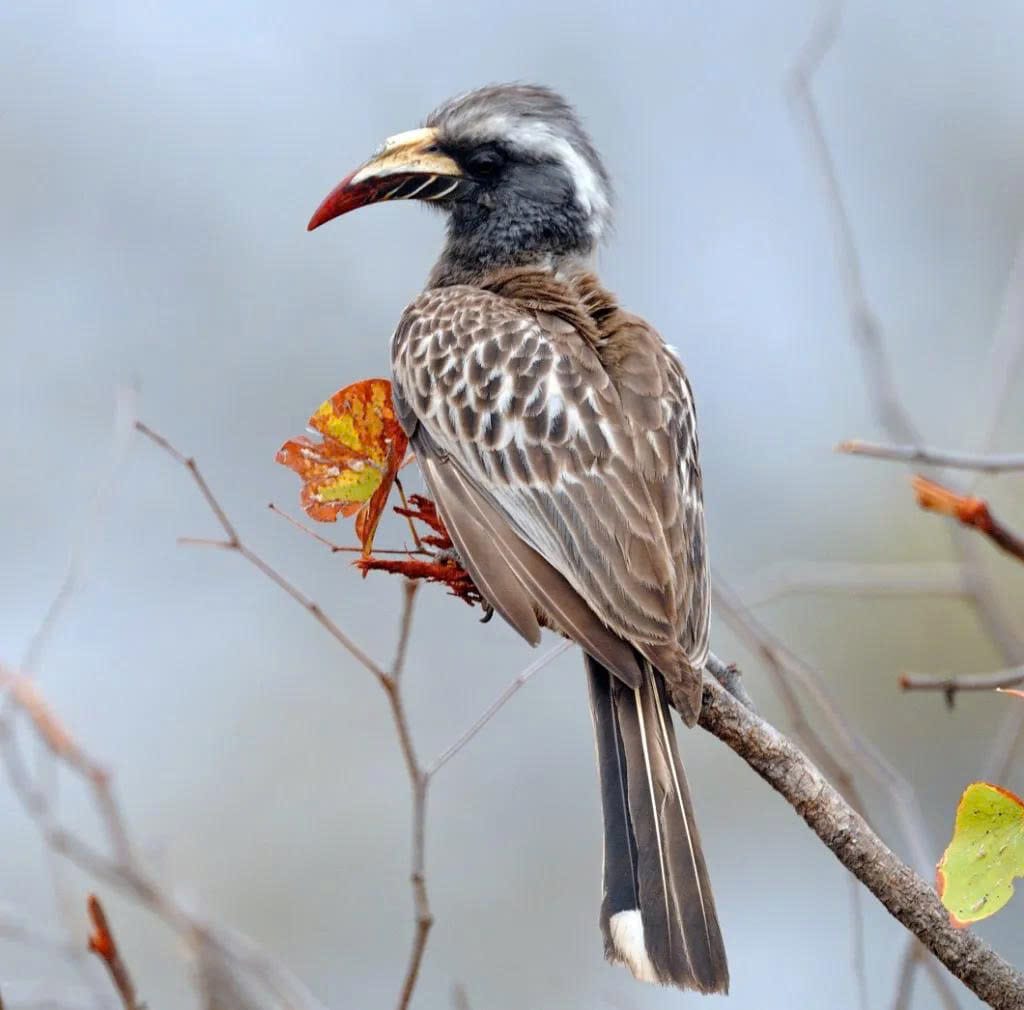
The African Grey Hornbill is much smaller than ground hornbills but is one of the most widespread and adaptable hornbill species in Africa. It has a slender gray body, a long curved bill, and subtle differences between males and females, mainly in bill coloration.
This hornbill is commonly found in woodlands, savannas, gardens, and even near human settlements. Its ability to live close to people has helped it maintain stable populations across much of sub-Saharan Africa.
African Grey Hornbills feed on a varied diet of fruits, insects, small reptiles, and seeds. This mixed diet allows them to switch food sources depending on seasonal availability. As fruit eaters, they play an important role in seed dispersal, helping forests regenerate naturally.
Unlike ground hornbills, this species spends most of its time in trees. It moves gracefully between branches and uses its bill to pluck fruit or catch insects mid-air. Its call is a familiar sound in many African landscapes.
Breeding behavior follows the classic hornbill pattern. The female seals herself inside a tree cavity using mud and droppings, leaving only a narrow slit. The male delivers food throughout the nesting period, demonstrating strong pair bonds.
Because of its adaptability and wide range, the African Grey Hornbill is considered a species of least concern. It remains one of the most commonly seen Hornbills in Africa and an excellent introduction for birdwatchers.
4. Crowned Hornbill
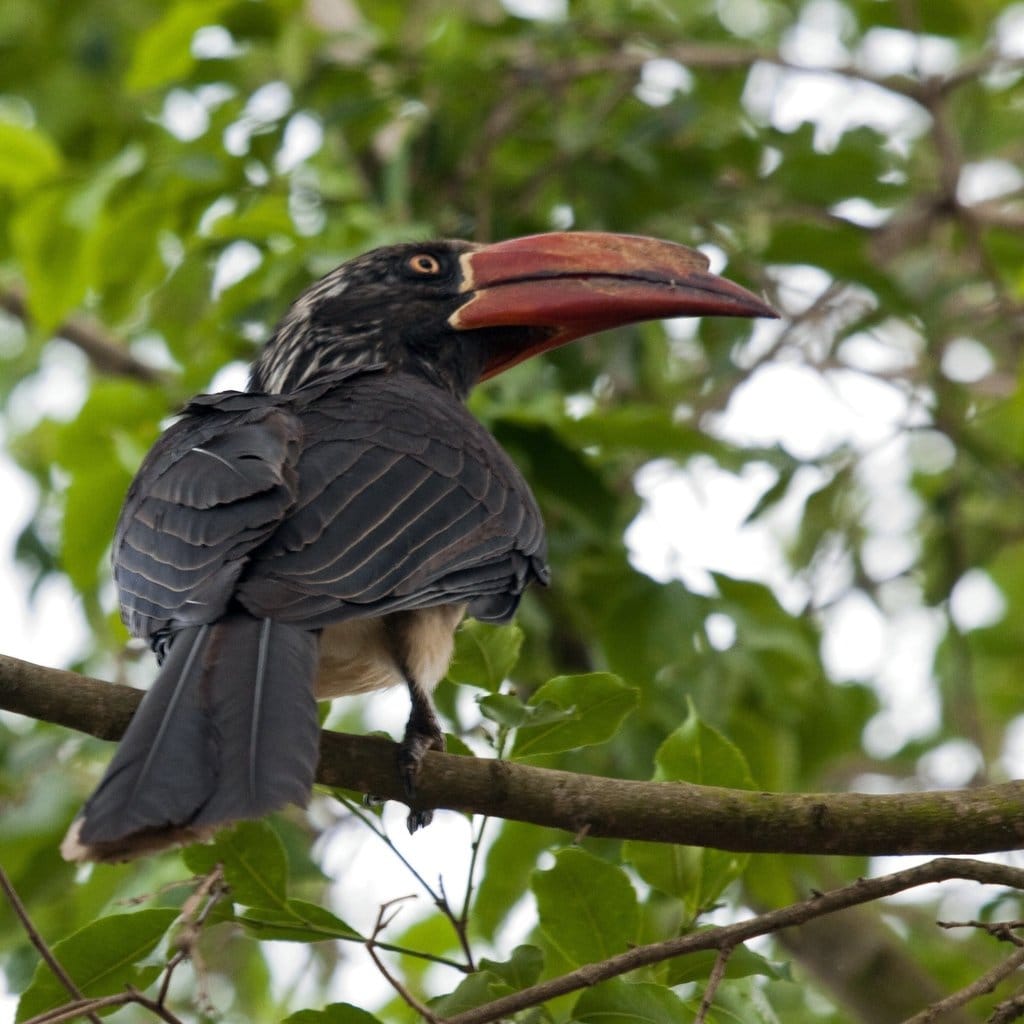
The Crowned Hornbill is a visually distinctive species, named for the raised feathers on its head that resemble a small crown. Its black-and-white plumage and red eyes give it a bold appearance that stands out in African forests.
This hornbill inhabits woodlands, riverine forests, and dense bush areas. It is commonly found in southern and eastern Africa, often moving in pairs or small family groups.
Its diet includes fruits, insects, and small animals. The Crowned Hornbill is an agile forager, hopping between branches and occasionally descending to the ground. Like many hornbills, it plays a vital role in spreading seeds across its habitat.
Crowned Hornbills are known for their loud, laughing calls, which echo through the forest canopy. These vocalizations help pairs stay connected and establish territory boundaries.
During breeding season, the female seals herself inside a nest cavity, relying completely on the male for food. This behavior protects the chicks from predators and harsh weather conditions.
With stable populations and a wide range, the Crowned Hornbill remains one of the more secure Types of Hornbills, though habitat protection is still essential.
5. Red-billed Dwarf Hornbill
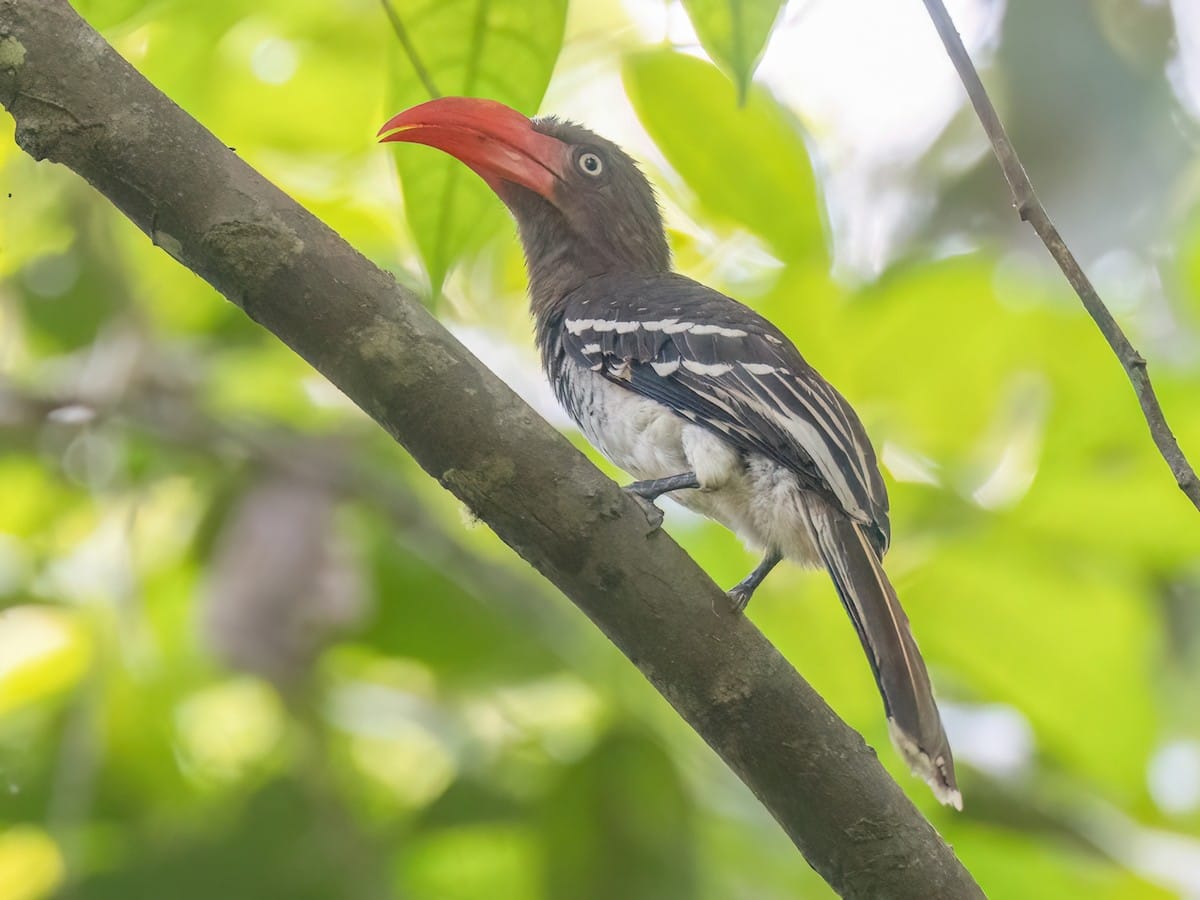
The Red-billed Dwarf Hornbill is one of the smallest hornbill species in the world. Despite its size, it is full of character, with a bright red bill and compact body that make it easy to identify.
This species inhabits dense tropical forests in central and western Africa. It prefers thick canopy cover, where it can move quickly between branches while staying hidden from predators.
Its diet consists mainly of fruits and insects. By consuming fruit and passing seeds through its digestive system, the Red-billed Dwarf Hornbill contributes significantly to forest regeneration.
Unlike larger hornbills, this species is often seen in small groups or pairs. Its soft calls and quick movements make it less noticeable, even in areas where it is common.
Breeding follows the traditional hornbill nesting strategy, though on a smaller scale. The female seals herself into a cavity while the male provides food until the chicks are ready to emerge.
Although not currently threatened, this hornbill depends heavily on intact forests. Deforestation poses a long-term risk, making conservation efforts crucial for its future.
These first five species show the incredible diversity within the Types of Hornbills, from massive ground-dwelling giants to small forest specialists. In the next section, we will continue exploring more remarkable hornbill species from Africa and Asia.
6. Von der Decken’s Hornbill

Von der Decken’s Hornbill is a medium-sized African hornbill known for its striking black-and-white plumage and long, curved bill. Adults typically have a white belly contrasting sharply with black wings and back, and a distinct yellowish bill that makes them easy to identify in the wild. Males and females look very similar, though females often have a slightly smaller bill. These birds are commonly seen perched on tree branches, scanning the savannas for food.
This species is primarily found in dry savannas and open woodlands across East Africa, including countries like Kenya, Tanzania, and Somalia. Their habitat preference allows them to exploit areas rich in insects, small reptiles, and fruits, while avoiding dense forests. Von der Decken’s Hornbills are highly adaptable and can even be spotted near cultivated lands, where they forage on fallen fruits and small rodents.
Their diet is diverse, reflecting their opportunistic feeding behavior. Insects such as beetles, grasshoppers, and termites make up a significant portion of their meals, while lizards, small snakes, and bird eggs provide essential protein. Seasonal fruits, particularly figs, are also highly favored. This balance between animal and plant matter makes them key players in both pest control and seed dispersal, illustrating the ecological importance of Hornbills.
Von der Decken’s Hornbills are monogamous, forming long-term pair bonds. Breeding involves the classic hornbill nesting behavior: the female enters a tree cavity and seals herself inside using mud, droppings, and food remains. The male provides food through a narrow slit for the entire nesting period, which can last several weeks. This strategy protects the female and chicks from predators and harsh environmental conditions.
Vocal communication is another defining trait. Their loud, cackling calls carry across the savanna, helping pairs coordinate and defend territory. They often travel in small family groups, with juveniles following adults to learn foraging techniques and social behaviors.
Although the Von der Decken’s Hornbill is not currently threatened, habitat loss and hunting in some regions are concerns. Preserving open woodlands and maintaining ecological corridors are vital to ensure their continued survival. Observers and birdwatchers in East Africa often consider this hornbill a must-see due to its bold appearance and engaging behavior.
7. Silvery-cheeked Hornbill

The Silvery-cheeked Hornbill is one of the largest hornbills in Africa, easily recognized by its massive black body and striking silvery-white facial feathers. Its large casque atop the bill adds to its regal appearance, making it a favorite among bird enthusiasts and photographers. Adult males display a prominent casque and long tail feathers, while females are slightly smaller and have subtler facial coloring.
This species inhabits montane forests in eastern Africa, particularly in countries such as Kenya, Tanzania, and Ethiopia. Unlike savanna hornbills, Silvery-cheeked Hornbills prefer dense forest canopies where they can forage safely for fruits and small animals. Elevation and forest cover play a key role in their distribution.
Diet primarily consists of large fruits, figs, and seeds, though they occasionally supplement with insects or small vertebrates. Their role as seed dispersers is especially critical in maintaining forest diversity, as the seeds they consume are carried across vast distances before being excreted.
Social behavior includes forming small flocks, usually 5–10 birds, that move together in search of food. Their loud, hollow calls resonate through forest valleys, serving both territorial and communicative functions. Courtship involves elaborate displays, with males showing off their casque and performing aerial acrobatics to attract females.
Breeding follows the characteristic hornbill pattern: the female seals herself in a tree cavity and relies entirely on the male to supply food. This cooperative effort ensures that chicks are protected during their most vulnerable stages. Typically, only one chick survives to fledging, highlighting the species’ slow reproductive rate.
Silvery-cheeked Hornbills are considered near threatened due to deforestation and habitat fragmentation. Conservation programs focused on forest preservation and anti-logging measures are essential to secure their future. Their impressive size and social behavior make them iconic representatives of African hornbill diversity.
8. Yellow-casqued Hornbill

The Yellow-casqued Hornbill is a visually stunning hornbill found primarily in the tropical forests of West and Central Africa. Its large yellow casque and bill set it apart from other species, while black plumage with white underparts creates a striking contrast. Both sexes share similar appearances, although males tend to have slightly larger casques.
These hornbills favor dense lowland forests, often staying high in the canopy to search for fruit and insects. Countries like Ghana, Nigeria, and Cameroon provide ideal habitats, with tall trees offering nesting cavities and ample food sources.
Their diet is dominated by figs, other tropical fruits, and small animals such as insects, lizards, and birds’ eggs. By consuming large quantities of fruit, Yellow-casqued Hornbills contribute significantly to seed dispersal, helping maintain forest regeneration and biodiversity. Observers often notice them moving in pairs or small family groups, calling loudly as they traverse the canopy.
Reproduction involves the female entering a tree cavity and sealing herself inside, leaving a small slit for the male to deliver food. This unique nesting strategy ensures chicks are safe from predators and environmental hazards. Typically, only one or two chicks survive per breeding cycle, underscoring the importance of parental investment.
The Yellow-casqued Hornbill faces threats from deforestation, hunting, and habitat fragmentation. Protecting large tracts of tropical forest is crucial to preserving this species. Their vivid colors, distinctive calls, and ecological role make them an essential part of the Types of Hornbills in Africa.
9. Black-and-white-casqued Hornbill
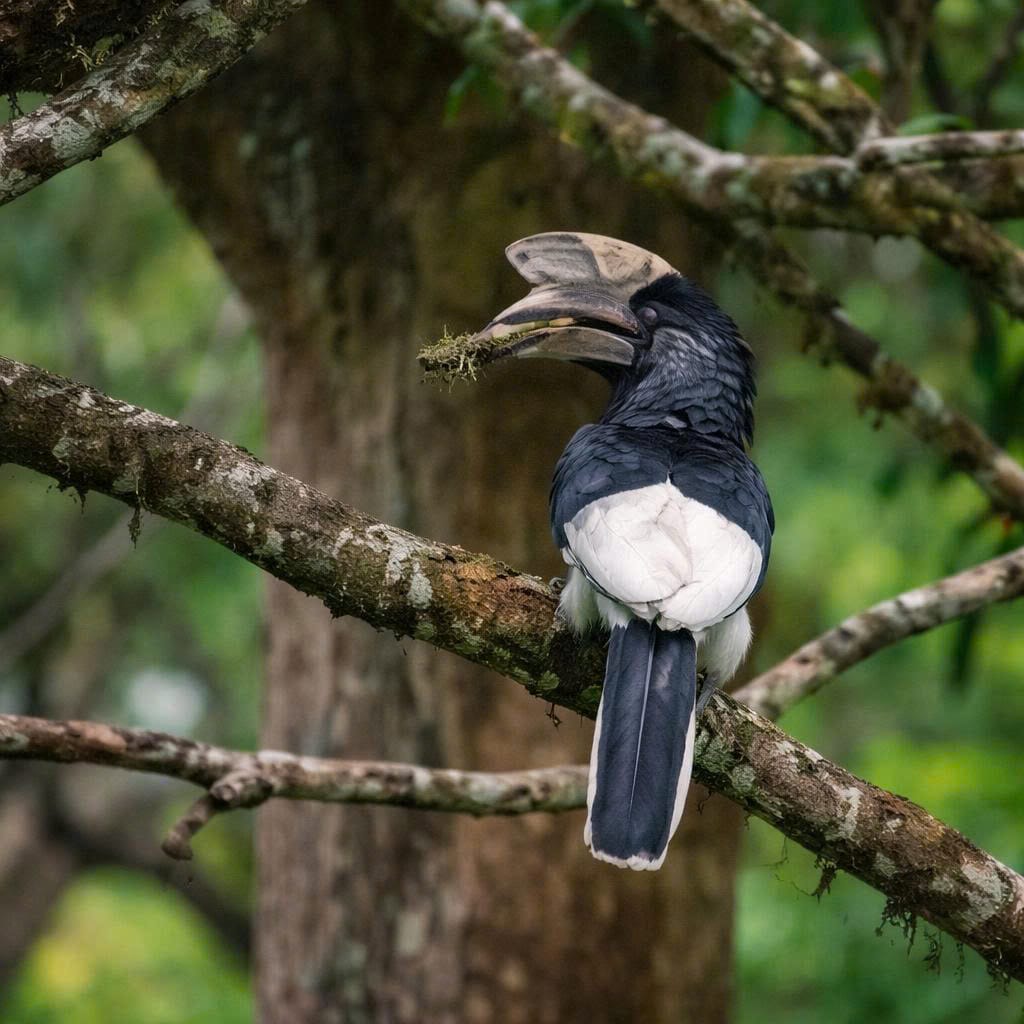
As the name suggests, the Black-and-white-casqued Hornbill displays a bold black-and-white color pattern combined with a prominent casque. Native to West African forests, this medium-sized hornbill is highly social and often spotted in small flocks or family units. Its long tail feathers and strong curved bill are adapted for both foraging and communication.
Habitat preferences include tropical lowland and montane forests, where the bird can access abundant fruits and insect prey. Countries such as Sierra Leone, Liberia, and Ivory Coast host stable populations, though logging and habitat conversion pose risks.
Diet includes a wide range of fruits, particularly figs, along with insects, small reptiles, and occasionally eggs. By feeding on fruits and dispersing seeds, the Black-and-white-casqued Hornbill contributes to forest sustainability and biodiversity maintenance.
Communication is an important aspect of this hornbill’s behavior. Loud, resonant calls help maintain group cohesion and deter intruders. Flight is strong but deliberate, with wingbeats producing distinctive sounds that carry through dense foliage.
Breeding behavior follows typical hornbill patterns. The female seals herself inside a tree cavity, with the male providing all food. Chicks grow slowly, relying on careful parental care. Such high parental investment ensures survival in competitive forest environments.
Conservation measures focus on forest protection and sustainable logging practices. This species, though relatively secure, exemplifies the delicate balance between wildlife and human activity in West Africa. Birdwatchers often consider it a highlight due to its striking appearance and active social behavior.
10. African Pied Hornbill

The African Pied Hornbill is easily recognized by its striking black-and-white plumage and large curved bill. Slightly smaller than some other African hornbills, this species is highly adaptable and often seen near human settlements, in woodlands, and savannas. Its black wings, white underparts, and long tail feathers give it a distinctive silhouette against the African landscape.
This hornbill inhabits sub-Saharan Africa, from Senegal to Uganda and southern Sudan. Its flexibility in habitat selection, ranging from forests to open woodlands and cultivated areas, has contributed to stable populations. Observers often spot African Pied Hornbills perched conspicuously, calling loudly and scanning for insects or fruits.
The species is omnivorous, feeding on insects, small reptiles, fruits, and seeds. By consuming fruit and dispersing seeds across their territory, they play a key role in maintaining forest ecosystems. They also help control insect populations, making them valuable contributors to ecological balance.
Socially, African Pied Hornbills form monogamous pairs, often remaining with the same mate for several breeding seasons. Breeding involves the classic hornbill nesting behavior: the female seals herself in a cavity while the male provides food. Chicks are raised carefully, with strong parental investment ensuring survival.
Vocalizations are loud and distinctive, used to communicate across territories or signal alarm. Their adaptability, striking appearance, and ecological role make African Pied Hornbills a favorite among wildlife enthusiasts and birdwatchers.
By understanding these 5 additional species, we continue to appreciate the diversity within Hornbills. Each has unique behaviors, habitats, and ecological roles, illustrating why hornbills are a vital part of African forests and savannas.
11. Trumpeter Hornbill
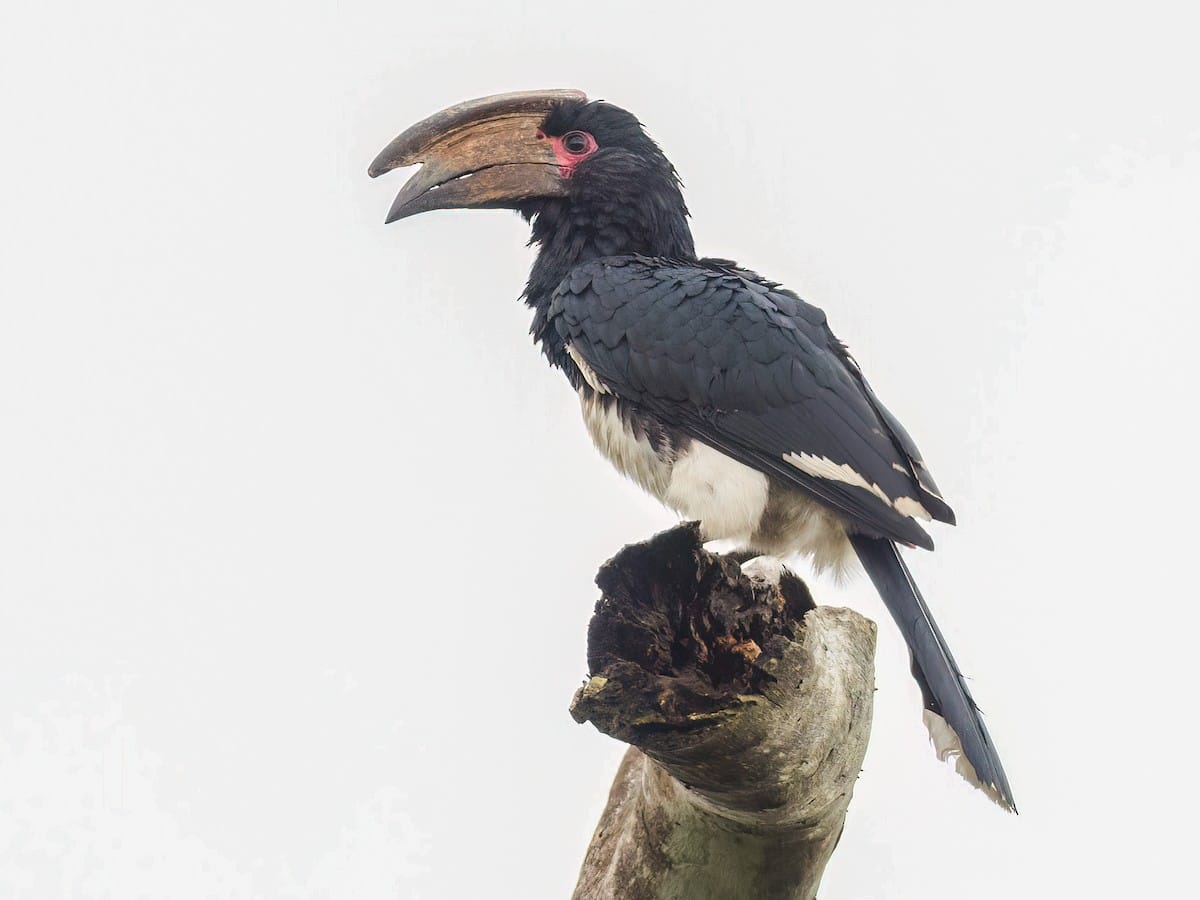
The Trumpeter Hornbill is a medium-sized African hornbill renowned for its distinctive vocalizations, which resemble trumpeting sounds. Its plumage is mostly black with white underparts and a bright red facial patch around the eyes, adding to its striking appearance. Males and females look very similar, although males usually have slightly larger bills and more pronounced red facial skin.
This species inhabits the dense forests and savannas of central and western Africa, often near rivers or forest edges. Its preference for mixed habitats allows it to forage efficiently while avoiding direct competition with larger hornbills.
The diet of the Trumpeter Hornbill includes insects, small reptiles, fruits, and occasionally small birds or eggs. Its versatile feeding strategy makes it an important ecological agent, controlling insect populations and dispersing seeds across the forest floor.
Social behavior is another hallmark of this species. Trumpeter Hornbills are often observed in small groups, calling loudly to maintain contact and warn other groups of their presence. Their vocalizations serve both communication and territorial functions, earning them the “trumpeter” nickname.
Breeding follows classic hornbill patterns. The female enters a tree cavity and seals herself inside, relying entirely on the male to provide food. Only one or two chicks usually survive per breeding season, emphasizing the importance of parental care and cooperation.
Although the Trumpeter Hornbill is not currently considered threatened, ongoing deforestation and habitat fragmentation could impact populations in the future. Conservation efforts focusing on forest protection are essential to maintain healthy populations of this charismatic species.
12. Great Hornbill
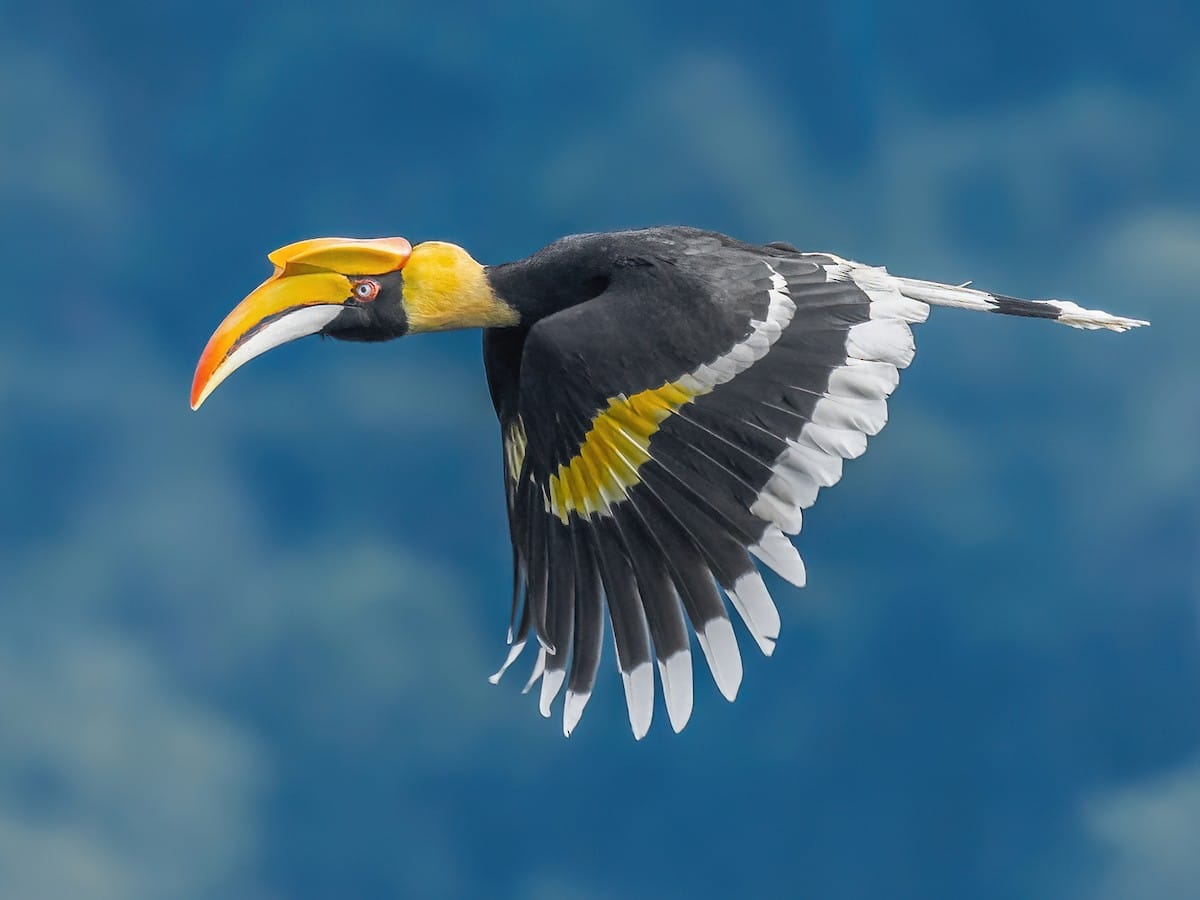
The Great Hornbill is one of the largest and most iconic hornbills in Asia. It is easily recognized by its impressive size, black and white plumage, and massive yellow-and-black casque atop its bill. Males and females differ slightly in bill and casque shape, with males typically having more prominent casques.
This species inhabits dense tropical and subtropical forests in countries such as India, Thailand, Malaysia, and Indonesia. It prefers primary forests with large trees, which provide essential nesting cavities and abundant fruit resources.
The Great Hornbill’s diet is primarily frugivorous, with figs forming a significant part of its meals. However, it also consumes small animals like lizards, birds, and insects when fruits are scarce. By feeding on fruit and dispersing seeds over long distances, it plays a critical role in maintaining forest biodiversity.
Socially, Great Hornbills often travel in pairs or small family groups, moving through the forest canopy in search of food. Their loud, booming calls can be heard over long distances, marking territory and facilitating communication between mates.
Breeding is fascinating: the female seals herself in a tree cavity with mud and droppings, leaving only a small opening. The male delivers food until the chicks are ready to fledge. This high level of parental investment ensures the survival of young in dense forest environments.
Due to habitat loss and hunting for their casques, the Great Hornbill is considered vulnerable in some regions. Protecting large tracts of primary forest and creating awareness among local communities are essential conservation strategies.
13. Helmeted Hornbill
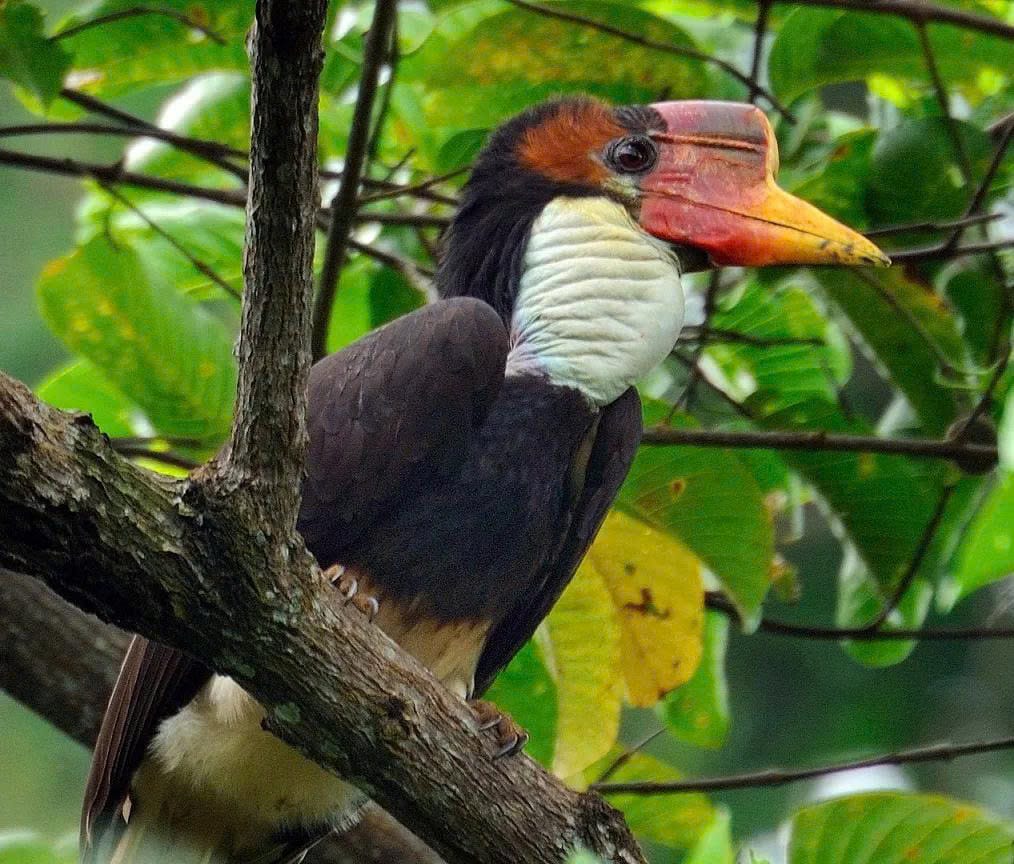
The Helmeted Hornbill is often called the “rhino of the hornbills” because of its solid, helmet-like casque. Native to Southeast Asian forests, it is striking in appearance, with mostly black plumage, white belly, and a prominent casque that males use for aerial jousting during territorial disputes.
This species inhabits primary lowland and montane forests in countries like Indonesia, Malaysia, and Thailand. Its reliance on large forest trees makes it highly vulnerable to deforestation and illegal logging.
Helmeted Hornbills are primarily frugivorous, feeding on large fruits such as figs, which they swallow whole. They occasionally eat small animals or insects, but fruit remains the cornerstone of their diet. Their role as seed dispersers is crucial for forest regeneration.
Social behavior includes flying in pairs or small groups, calling with deep, booming sounds that resonate through the canopy. Males often engage in aerial combat, ramming each other with their solid casques in spectacular displays of dominance.
Breeding follows the typical hornbill strategy. The female seals herself inside a tree cavity for the duration of the incubation and chick-rearing period. The male provides all food, ensuring the safety and development of the young. Only one chick typically survives per cycle due to high parental investment.
The Helmeted Hornbill is critically endangered, primarily due to hunting for its solid casque, highly prized in the illegal wildlife trade. Urgent conservation measures, including forest protection and anti-poaching enforcement, are required to secure the species’ future.
14. Rhinoceros Hornbill

The Rhinoceros Hornbill is a large, majestic bird named for its prominent, curved casque resembling a rhinoceros horn. Found across Southeast Asia, it features black feathers with white underparts, bright orange-yellow bill and casque, and striking red eyes. Males and females are similar, though the male’s casque is often more pronounced.
This hornbill prefers lowland and montane forests with large, old trees that provide suitable nesting cavities. It is commonly found in Malaysia, Indonesia, Thailand, and parts of Borneo and Sumatra.
Diet is primarily frugivorous, with figs forming the majority of its intake, but it also consumes small reptiles, insects, and bird eggs when necessary. By dispersing seeds across large distances, Rhinoceros Hornbills are essential for forest regeneration and biodiversity maintenance.
Socially, these hornbills travel in pairs or small groups. Their deep, booming calls and impressive flight make them one of the most noticeable hornbill species. Courtship involves aerial displays and calling duets between males and females.
Breeding involves the female sealing herself inside a tree cavity while the male provides food. Chicks are carefully nurtured until ready to fledge. The survival of each chick requires extensive parental care, highlighting the importance of both partners.
Though Rhinoceros Hornbills are relatively well-protected in some national parks, habitat loss and poaching remain concerns. Their ecological role as seed dispersers and their cultural significance make them a priority for conservation efforts.
15. Rufous-necked Hornbill

The Rufous-necked Hornbill is a medium-large Asian hornbill characterized by its reddish-brown neck, black body, and white-tipped tail feathers. Its prominent casque is slightly curved and pale in color, adding to its distinctive profile. This species is slightly smaller than the Great Hornbill but shares many behavioral traits.
Native to northeastern India, Bhutan, Myanmar, and Southeast Asia, Rufous-necked Hornbills inhabit tropical and subtropical forests, especially in hilly regions. They require large trees for nesting and foraging, making forest conservation critical for their survival.
Diet primarily consists of fruits, especially figs, along with small animals and insects. By feeding on fruits and dispersing seeds, they play an essential role in maintaining forest health and promoting biodiversity.
Socially, they are often observed in pairs or small family groups. Loud calls help maintain territory and mate coordination. Their movements are typically slow and deliberate, allowing them to forage efficiently in the dense forest canopy.
Breeding follows the classic hornbill strategy: the female seals herself inside a tree cavity for protection, relying entirely on the male to supply food. Chicks grow slowly, reflecting the high parental investment typical of hornbills.
The Rufous-necked Hornbill is classified as vulnerable in parts of its range due to habitat loss from deforestation and hunting. Protecting forested areas and promoting awareness are key strategies to ensure their continued survival. Their elegance, unique calls, and ecological importance make them one of the most admired Types of Hornbills in Asia.
16. Indian Grey Hornbill
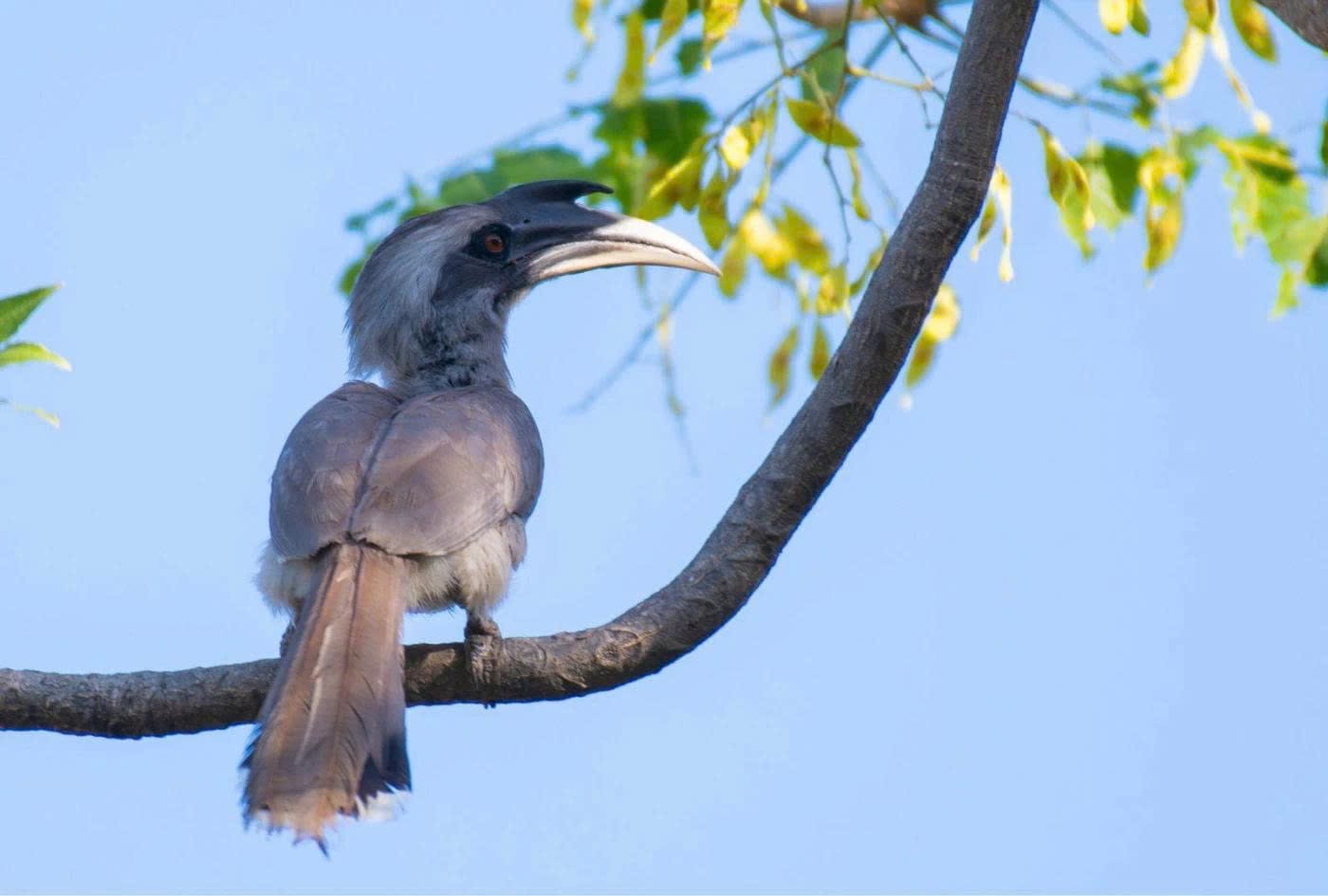
The Indian Grey Hornbill is a medium-sized bird widely found across the Indian subcontinent. Its plumage is primarily grey with lighter underparts, and it has a long, curved yellow bill with a subtle casque. Unlike larger hornbills, it is more compact, making it well-suited for life in urban parks, gardens, and forest edges.
This species is commonly seen in India, Nepal, and Sri Lanka, often perched on trees or moving noisily between branches. Its adaptability allows it to thrive in human-modified landscapes as well as natural forests, making it one of the most familiar hornbills in Asia.
Diet consists mainly of fruits such as figs and berries, supplemented by insects, small lizards, and occasionally eggs. By consuming fruit and dispersing seeds, the Indian Grey Hornbill plays an important role in sustaining forest ecosystems and urban greenery alike.
Socially, it is often seen in pairs or small flocks. Its loud, repetitive calls echo across gardens and forests, serving as both a territorial warning and a communication tool for mates. Their movement through tree canopies is deliberate, making them easy to observe for birdwatchers.
Breeding involves the female sealing herself inside a tree cavity for the duration of egg incubation and chick-rearing. The male provides all food, demonstrating strong parental care. Typically, only one chick survives per nesting period, reflecting the species’ slow reproductive rate.
The Indian Grey Hornbill is considered of least concern due to its adaptability and wide range. It remains a popular species for birdwatchers and educators, illustrating how hornbills can coexist with humans while maintaining ecological roles.
17. Malabar Grey Hornbill

The Malabar Grey Hornbill is a medium-sized hornbill endemic to the Western Ghats of southern India. Its grey body, white underparts, and black tail tipped with white make it visually striking. The bird’s long, curved bill with a small casque adds to its distinctive appearance.
It primarily inhabits dense evergreen forests, semi-evergreen forests, and occasionally plantations. The Western Ghats, a biodiversity hotspot, provide ideal nesting trees and abundant food sources for this species.
Diet consists mainly of fruits, especially figs, supplemented by insects and small vertebrates. By dispersing seeds, the Malabar Grey Hornbill contributes to the maintenance and regeneration of tropical forests, highlighting its ecological importance.
These hornbills are usually seen in small groups or pairs, moving through the canopy with deliberate, cautious movements. Vocal communication includes loud, echoing calls that serve to maintain contact and establish territory.
Breeding involves the female sealing herself inside a tree cavity, leaving a small slit for the male to provide food. Only one or two chicks survive per season, emphasizing the high parental investment and slow reproductive strategy typical of hornbills.
Due to its restricted range, the Malabar Grey Hornbill is vulnerable to deforestation and habitat fragmentation. Protecting the Western Ghats forests is critical to ensuring the survival of this unique and charismatic hornbill.
18. Malabar Pied Hornbill

The Malabar Pied Hornbill is a striking black-and-white hornbill with a large, prominent yellow-and-black bill and casque. Endemic to southern India, it is slightly larger than the grey hornbills and easily recognized by its bold coloration and long tail feathers.
Its habitat includes dense forests, plantations, and wooded areas in the Western Ghats and surrounding regions. Large trees are essential for nesting, while fruiting trees provide a steady food supply.
Diet is predominantly frugivorous, including figs, berries, and other forest fruits. It occasionally consumes small insects, lizards, or eggs. Its seed dispersal activities are vital for forest regeneration and ecosystem health.
Social behavior includes moving in pairs or small family groups. Their loud, deep calls resonate across the forest, helping pairs maintain contact and marking territory. During breeding season, aerial displays and vocalizations are used to attract mates.
Breeding follows the classic hornbill pattern. The female is sealed inside a tree cavity for incubation, with the male providing all food. Only one chick typically survives to fledging, reflecting the slow reproductive rate and high parental investment characteristic of hornbills.
While the Malabar Pied Hornbill is currently stable, habitat destruction due to logging and agriculture poses ongoing threats. Conservation of forested areas and mature trees is essential for the species’ continued survival.
19. Oriental Pied Hornbill

The Oriental Pied Hornbill is a medium-sized hornbill found throughout Southeast Asia. Its black body with white underparts, long curved bill, and pale casque make it easily identifiable. Unlike larger hornbills, it is highly adaptable and often seen near human settlements, parks, and plantations.
This species is distributed across Thailand, Malaysia, Singapore, and Indonesia. Its ability to live in secondary forests and urban areas has contributed to its stable population.
Diet consists of fruits, particularly figs, supplemented by insects, small vertebrates, and eggs. By dispersing seeds, the Oriental Pied Hornbill plays an important ecological role in both natural and human-modified landscapes.
Socially, these hornbills are often seen in pairs or small flocks. They communicate through loud, distinctive calls and perform short flights between trees in search of food. Observing them is relatively easy, making them popular with birdwatchers.
Breeding involves the female sealing herself in a tree cavity, relying entirely on the male for food. Chicks receive intensive care until they are ready to fledge, demonstrating the high level of parental investment characteristic of hornbills.
Due to adaptability and wide distribution, the Oriental Pied Hornbill is of least concern. However, conservation of forest patches and large trees remains important to maintain breeding sites and ensure long-term population stability.
20. Wreathed Hornbill

The Wreathed Hornbill is a large, spectacular hornbill native to Southeast Asian forests. Its black body, white tail, and prominent yellow-and-black bill with a curved casque make it one of the most recognizable species. Both sexes look similar, though males tend to have larger casques.
It inhabits dense lowland and montane forests across Thailand, Malaysia, Borneo, and Sumatra. Large trees are crucial for nesting and foraging, as Wreathed Hornbills rely heavily on forest fruits, especially figs.
Diet consists primarily of fruit, supplemented occasionally by insects or small animals. By dispersing seeds over large distances, Wreathed Hornbills contribute to forest health and biodiversity. Their role as key seed dispersers makes them vital to forest ecosystems.
Socially, they are often observed in small groups, moving deliberately through the canopy. Loud, resonant calls carry over long distances, helping pairs coordinate and maintain territories.
Breeding involves the female sealing herself inside a tree cavity while the male provides food. Only one or two chicks usually survive per nesting period, reflecting the species’ slow reproductive rate and high parental care.
Though relatively widespread, Wreathed Hornbills face threats from habitat loss and hunting. Protecting large, mature forests is critical to ensuring their long-term survival. Their beauty, social behavior, and ecological importance make them a flagship species for conservation in Southeast Asia.
21. Bushy-crested Hornbill
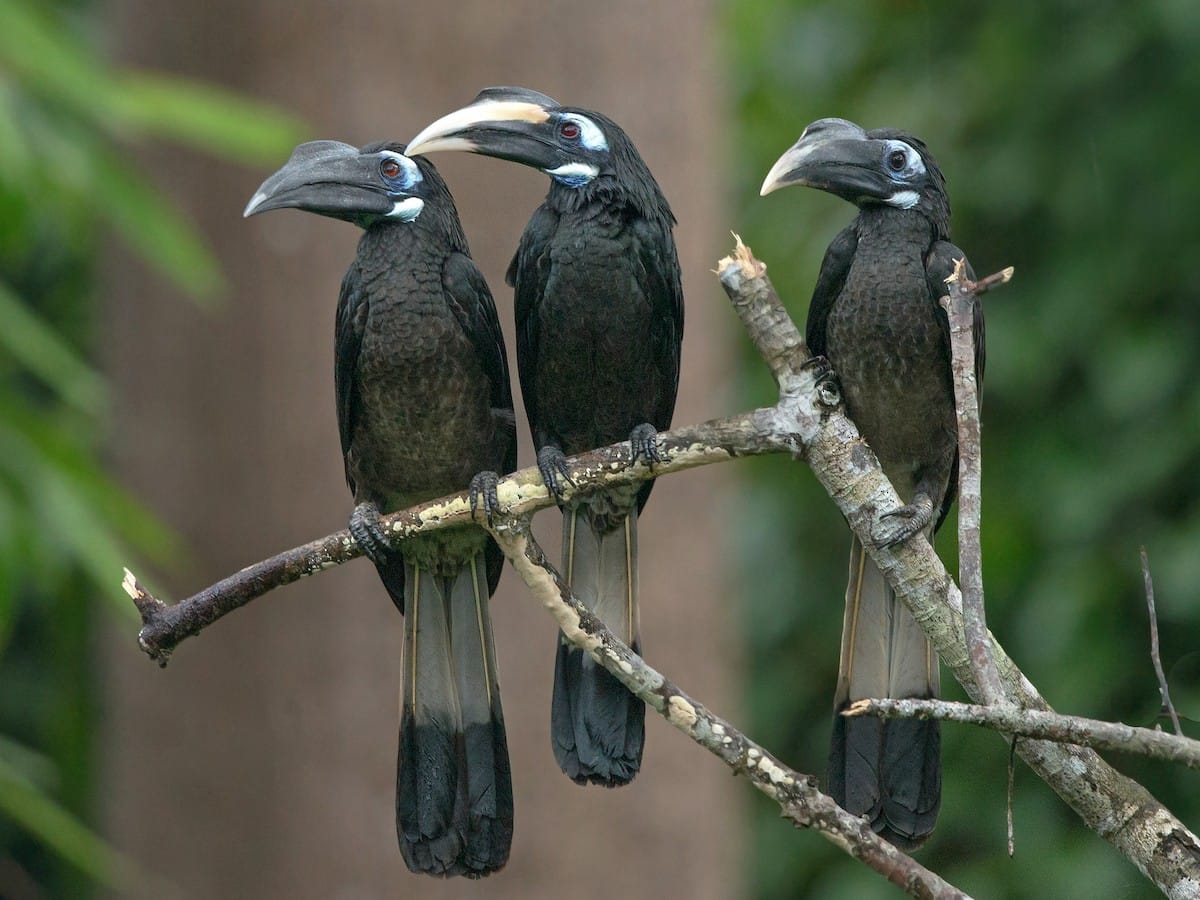
The Bushy-crested Hornbill is a medium-large hornbill native to the tropical forests of Southeast Asia. Its most distinctive feature is the dense, bushy crest on top of its head, giving it a regal appearance. The plumage is mostly black with white underparts and tail feathers, while the bill is bright yellow with a subtle casque, making it easily recognizable.
This species inhabits lowland and hill forests, particularly in Malaysia, Sumatra, and Borneo. It prefers mature forests with large trees that provide nesting cavities and abundant fruit resources. Its dependence on large forest trees makes habitat preservation critical for its survival.
The Bushy-crested Hornbill is primarily frugivorous, feeding mainly on figs and other forest fruits. Occasionally, it supplements its diet with insects, small reptiles, and bird eggs. By dispersing seeds over long distances, it plays a vital role in maintaining forest biodiversity.
Socially, they are often seen in pairs or small family groups. Loud, resonant calls are used for communication between mates and to mark territory. Observers often note their deliberate, graceful movements through the canopy as they search for fruiting trees.
Breeding behavior follows classic hornbill patterns. The female seals herself inside a tree cavity, relying on the male for food during the nesting period. Typically, only one or two chicks survive per season due to high parental investment.
Conservation efforts for the Bushy-crested Hornbill focus on protecting primary forests and preventing illegal logging. Its striking appearance and important ecological role make it a key species for wildlife enthusiasts and conservationists alike.
22. Black Hornbill
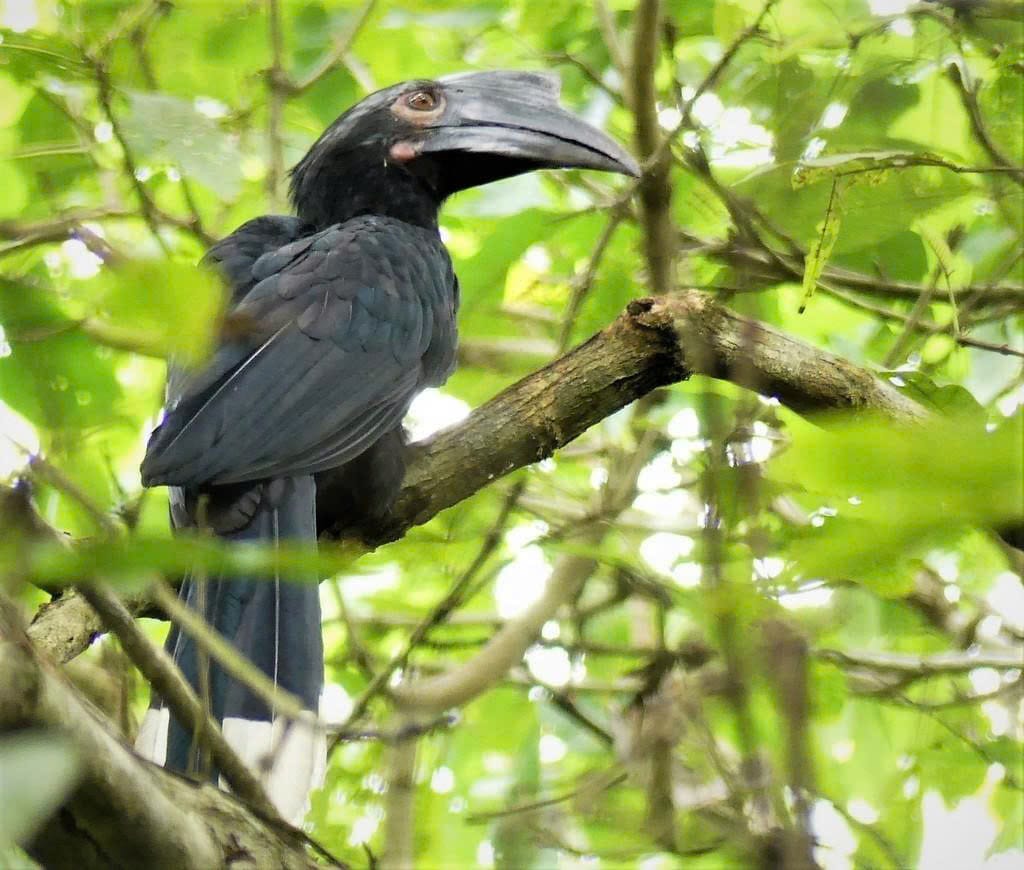
The Black Hornbill is a medium-sized hornbill with mostly black plumage, a pale belly, and a long, slightly curved bill with a modest casque. Native to Southeast Asian forests, it is smaller than some of the more famous hornbills but equally important ecologically.
Its range includes Malaysia, Sumatra, Borneo, and surrounding islands, where it inhabits primary and secondary forests. These hornbills prefer areas with tall trees for nesting and a variety of fruit-bearing plants for food.
Diet consists mainly of fruits, especially figs, supplemented by insects and small animals. By dispersing seeds, Black Hornbills contribute to forest regeneration and biodiversity. Their foraging behavior is deliberate, moving carefully from branch to branch in the mid- to upper canopy.
Social behavior involves moving in pairs or small family groups. Loud calls and occasional wing claps help maintain contact and warn intruders. Their vocalizations are a signature sound of the forest canopy.
Breeding follows typical hornbill nesting habits, with the female sealed inside a cavity while the male provides food. Parental care is extensive, ensuring that the chicks grow safely until they are ready to fledge.
Although not currently critically endangered, habitat loss and fragmentation pose threats. Protecting forested areas and preserving mature trees are essential for maintaining healthy populations of this species.
23. Wrinkled Hornbill
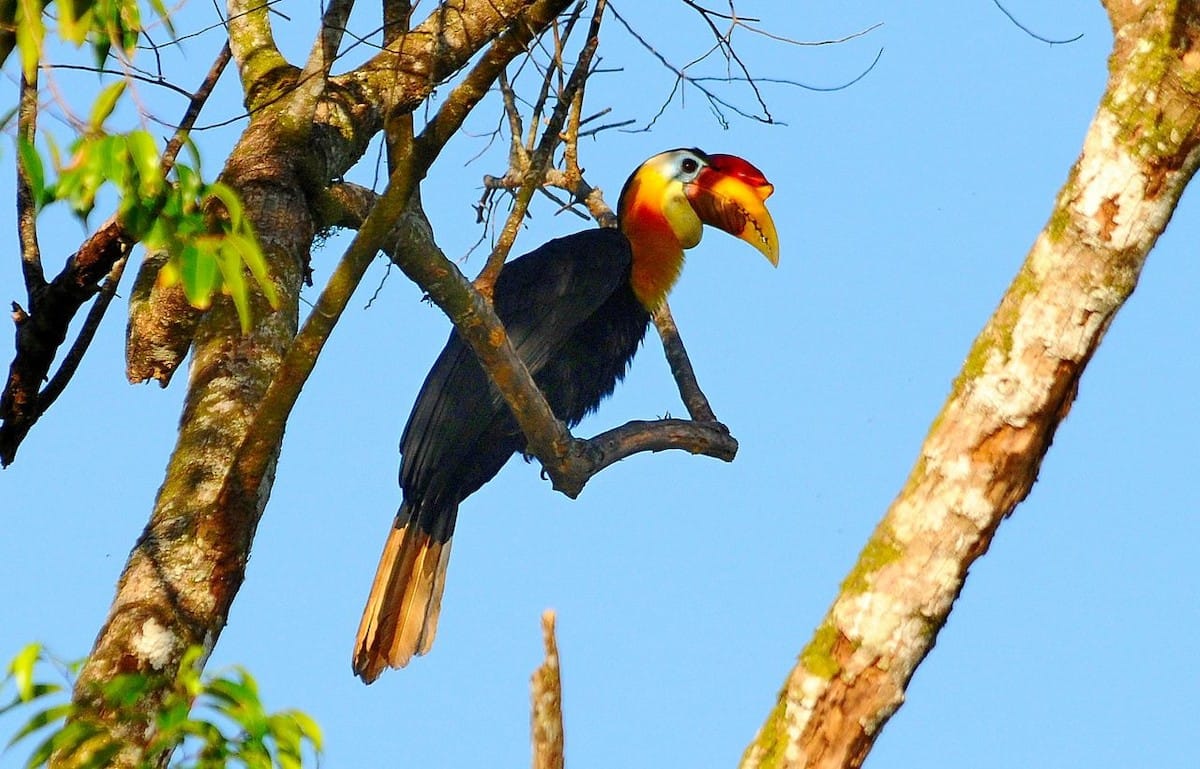
The Wrinkled Hornbill is a large, striking hornbill found in lowland and hill forests of Southeast Asia. Its name comes from the wrinkled appearance of its casque, which is pale yellow and contrasts sharply with black plumage and white tail feathers. Both sexes are similar, though males usually have larger casques.
This species inhabits dense tropical forests in Borneo, Sumatra, and Peninsular Malaysia. They prefer forests with tall, mature trees that provide nesting cavities and plentiful fruiting trees.
The Wrinkled Hornbill is primarily frugivorous, feeding heavily on figs, but will also consume insects and small vertebrates when available. Its role as a seed disperser is vital for forest regeneration and biodiversity.
Socially, these hornbills travel in small groups, calling loudly to maintain contact. Courtship displays involve elaborate vocalizations and flying patterns, which are an important part of mate selection.
Breeding involves the female sealing herself in a tree cavity while the male delivers food. Only one or two chicks usually survive per season due to the high investment in each offspring. This careful care ensures the chicks’ survival in competitive forest environments.
Habitat destruction remains the primary threat to Wrinkled Hornbills. Conservation measures focus on forest preservation, particularly protecting primary forests and large trees suitable for nesting.
24. Blyth’s Hornbill

Blyth’s Hornbill is a large hornbill native to the forests of the Malay Peninsula, Sumatra, Borneo, and nearby islands. Its black body, white tail, and long, curved yellow bill with a prominent casque make it one of the most elegant hornbills in Southeast Asia.
It inhabits tropical lowland and hill forests, often preferring mature trees for nesting and foraging. Large fruiting trees are essential for their diet and reproductive success.
Diet consists primarily of fruits such as figs, supplemented by insects, small reptiles, and eggs. By dispersing seeds over long distances, Blyth’s Hornbill supports forest health and regeneration, playing a crucial ecological role.
These hornbills are social, often traveling in pairs or small family groups. Loud calls resonate through the forest canopy, serving to maintain territory and facilitate communication between mates.
Breeding behavior includes the female sealing herself in a tree cavity while the male delivers food. Only one or two chicks typically survive, reflecting the high parental investment characteristic of hornbills.
Though not critically endangered, habitat destruction due to logging and agriculture threatens their populations. Preserving primary forests and nesting trees is essential for the survival of Blyth’s Hornbill.
25. Narcondam Hornbill

The Narcondam Hornbill is a rare and endemic species found only on Narcondam Island, a small volcanic island in the Andaman Sea. It is medium-sized, with mostly black plumage, white tail tips, and a bright orange-yellow bill with a small casque. Its restricted range makes it one of the most unique and sought-after hornbills for birdwatchers and researchers.
This hornbill inhabits dense tropical forests across the small island, relying heavily on forest fruiting trees for sustenance. Its limited distribution makes the species highly vulnerable to habitat changes and natural disasters.
Diet is predominantly frugivorous, focusing on figs and other native fruits, though insects and small animals are occasionally consumed. By dispersing seeds across the island, Narcondam Hornbills play a crucial role in maintaining forest diversity and ecosystem health.
Socially, they are often observed in small groups or pairs, moving through the canopy with deliberate and cautious movements. Their calls are loud and resonant, aiding in communication and territorial defense.
Breeding involves the female sealing herself in a tree cavity, relying entirely on the male for food during incubation and chick-rearing. Due to its slow reproductive rate, only one chick typically survives per season, highlighting the species’ vulnerability.
The Narcondam Hornbill is classified as endangered due to its extremely limited range. Protecting the island’s forest and preventing human disturbance are critical for its survival. As a rare endemic species, it represents one of the most fascinating and ecologically important Types of Hornbills.
26. Knobbed Hornbill
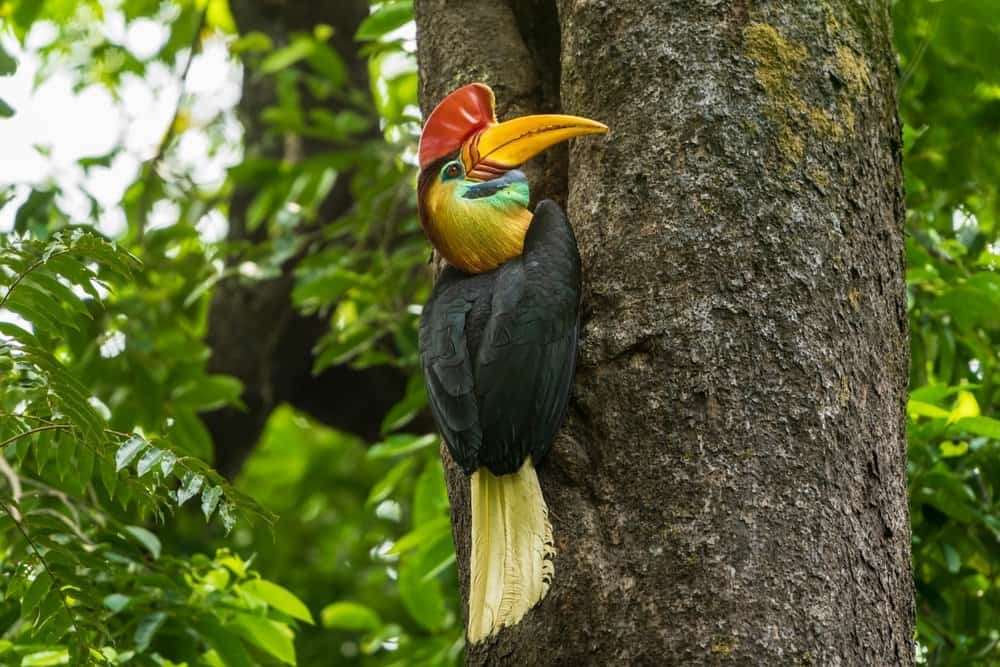
The Knobbed Hornbill is a striking bird native to Southeast Asia, known for its large bill with a distinctive knob on the upper mandible. Its plumage is predominantly black with white underparts and tail feathers, while the casque adds a unique and easily recognizable feature. Both sexes are similar, though males tend to have larger and more prominent knobs.
This hornbill inhabits primary and secondary forests in Borneo, Sumatra, and the Malay Peninsula. It prefers mature forests with large trees, which provide essential nesting cavities and abundant fruiting resources.
Diet is mainly frugivorous, including figs and other tropical fruits, supplemented by insects and small animals. Its seed dispersal activities are vital for maintaining forest health and biodiversity. By moving seeds across the forest canopy and floor, Knobbed Hornbills support regeneration of native tree species.
Socially, they are often seen in pairs or small family groups. Loud calls and occasional aerial displays serve to maintain territory and communicate with mates. Their deliberate foraging behavior makes them fascinating to observe in the wild.
Breeding involves the female sealing herself inside a tree cavity for the duration of incubation and chick-rearing, while the male provides all food. Typically, only one chick survives, reflecting the species’ slow reproductive strategy and high parental investment.
Threats include habitat loss due to logging and forest fragmentation. Conservation strategies focus on protecting mature forests and creating awareness of their ecological importance. The Knobbed Hornbill’s unique appearance and vital role in seed dispersal make it a keystone species in its ecosystem.
27. Sulawesi Hornbill
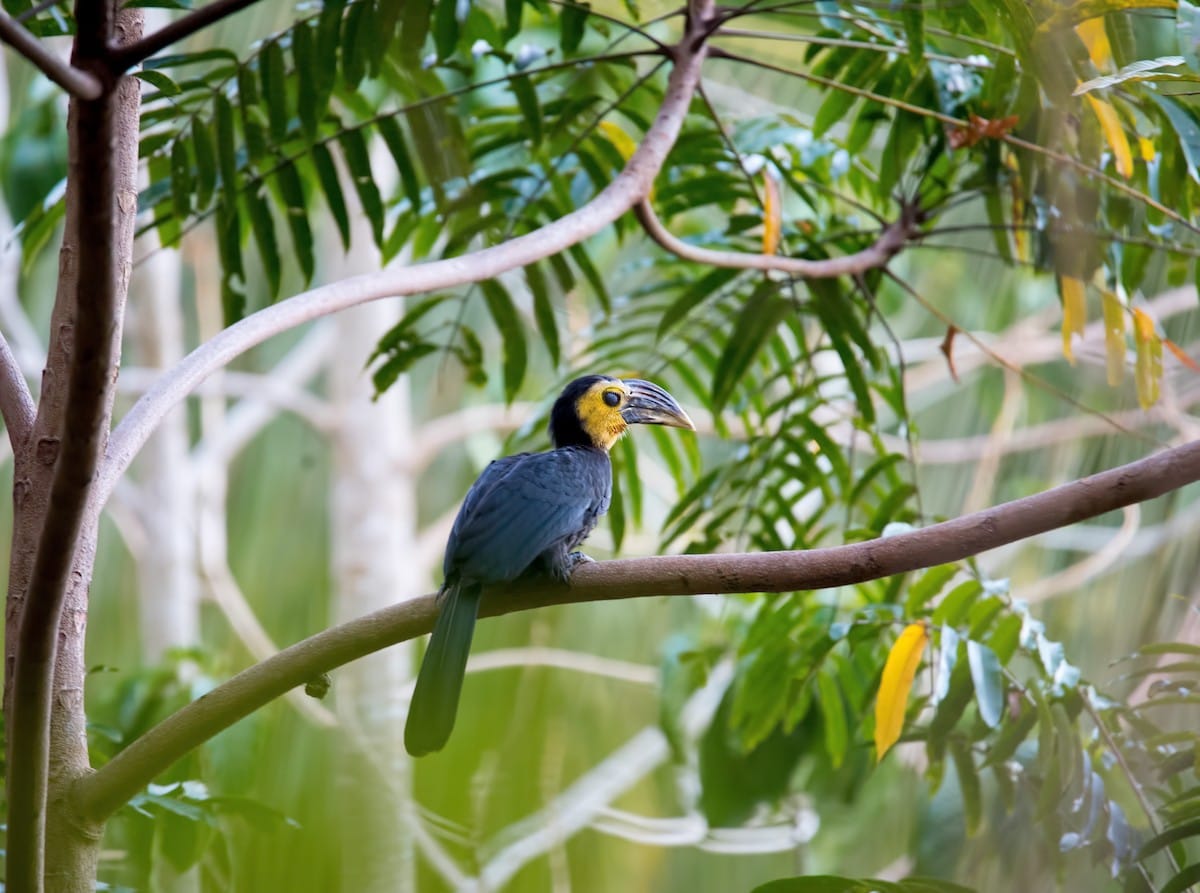
The Sulawesi Hornbill is a medium-sized hornbill endemic to the Indonesian island of Sulawesi. It has black plumage with white underparts and a long, curved bill topped with a modest casque. Its relatively small size and agile movements make it an excellent canopy forager in dense tropical forests.
Habitat includes lowland and montane forests across Sulawesi, where it relies on large fruiting trees for food and nesting. Its restricted range makes it sensitive to deforestation and habitat disturbance.
Diet is primarily frugivorous, consuming figs and other tropical fruits, supplemented by insects and small vertebrates. By dispersing seeds, the Sulawesi Hornbill contributes to the regeneration and sustainability of local forests.
Social behavior includes moving in pairs or small groups, calling loudly to communicate with mates or other groups. Their deliberate, careful movements through the canopy help them avoid predators while foraging efficiently.
Breeding follows the classic hornbill pattern: the female seals herself in a tree cavity, relying entirely on the male to provide food until the chicks are ready to fledge. Only one or two chicks usually survive per nesting season, highlighting the species’ slow reproductive rate.
Conservation priorities include forest protection and preventing habitat fragmentation. The Sulawesi Hornbill is a vital seed disperser and a flagship species for biodiversity on the island.
28. Sumba Hornbill
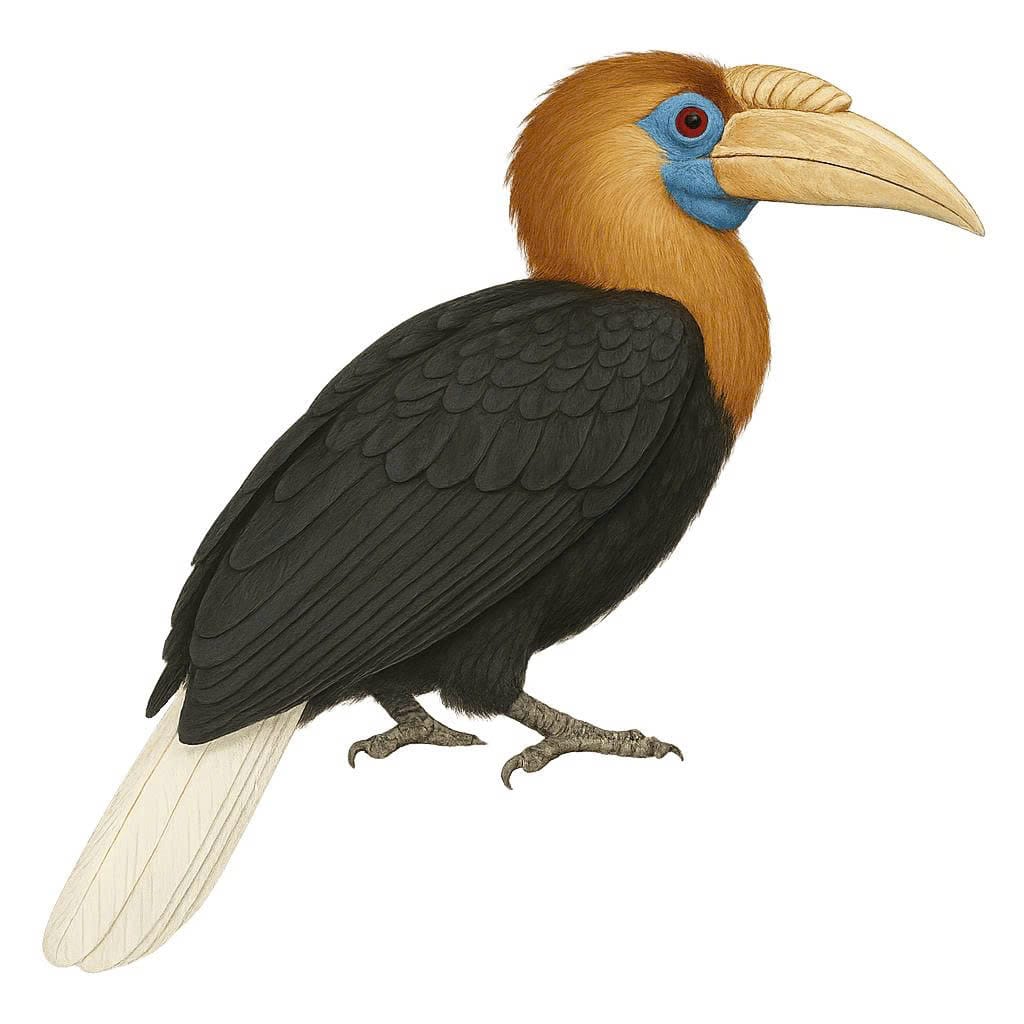
The Sumba Hornbill is a rare hornbill species endemic to the island of Sumba in Indonesia. It is medium-large, with black plumage, white underparts, and a prominent yellow-and-black bill with a small casque. Its limited range makes it highly unique and vulnerable to ecological changes.
It inhabits dry tropical forests and wooded areas on Sumba, where mature trees provide nesting sites and fruiting trees supply food. Habitat preservation is critical for the survival of this species due to its restricted distribution.
Diet consists mainly of fruits, especially figs, along with insects and occasionally small animals. By dispersing seeds, the Sumba Hornbill plays a crucial role in maintaining the island’s forest ecosystem.
Socially, it is often seen in pairs or small family groups. Their loud calls help maintain territory and facilitate communication between mates. Observing these hornbills requires patience due to their cautious behavior in dense forests.
Breeding follows the standard hornbill strategy: the female seals herself in a tree cavity, with the male providing all food until chicks are ready to leave the nest. Typically, only one chick survives per season.
The Sumba Hornbill is classified as endangered due to habitat loss and small population size. Conservation efforts focus on protecting forest habitats and raising awareness of its ecological importance.
29. White-crowned Hornbill
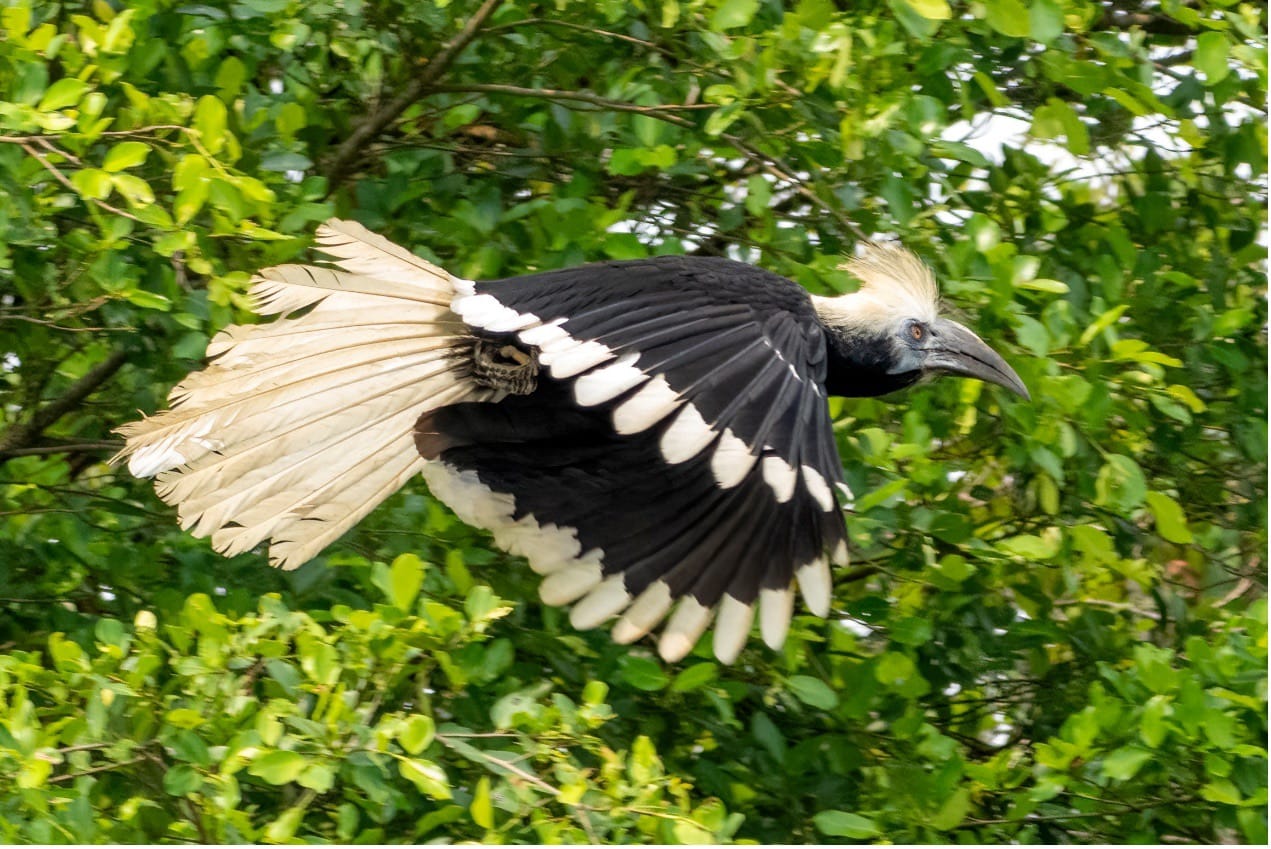
The White-crowned Hornbill is a medium-large hornbill found in the forests of Borneo and Sumatra. Its black body, white crown, and striking white tail feathers make it highly distinctive. The long, curved bill and casque are characteristic features of the species.
This hornbill inhabits primary and secondary tropical forests, preferring tall trees that provide nesting cavities and fruiting opportunities. Their presence indicates healthy, mature forest ecosystems.
Diet consists primarily of fruit, particularly figs, supplemented by insects and small animals. As a seed disperser, the White-crowned Hornbill contributes to forest regeneration and biodiversity maintenance.
Socially, they are often seen in pairs or small family groups. Their loud calls and deliberate canopy movements make them noticeable to birdwatchers. Courtship displays involve vocalizations and bill movements to attract mates.
Breeding involves the female sealing herself in a tree cavity while the male provides food. Only one or two chicks usually survive per season, reflecting the high parental investment typical of hornbills.
Although not critically endangered, habitat loss due to logging and land conversion is a concern. Protecting mature forests is essential to maintaining healthy populations and ensuring their ecological role continues.
30. Wattled Hornbill
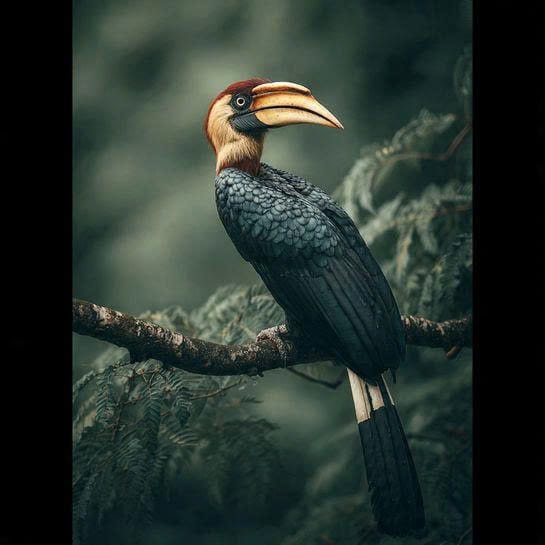
The Wattled Hornbill is a large, impressive bird native to Southeast Asian forests, including Borneo and Sumatra. Its black plumage, white underparts, and striking wattle on the neck make it easily identifiable. The large, curved bill with a prominent casque completes its distinctive appearance.
This species inhabits primary lowland and hill forests, relying on large fruiting trees for sustenance and mature trees for nesting. Its dependence on intact forest makes it particularly sensitive to deforestation and habitat fragmentation.
Diet is primarily frugivorous, feeding on figs and other forest fruits, with occasional insects and small animals. By dispersing seeds across large areas, the Wattled Hornbill plays a vital role in maintaining forest structure and biodiversity.
Social behavior includes moving in pairs or small groups. Loud calls and aerial displays help establish territory, communicate with mates, and strengthen social bonds within the group.
Breeding follows the traditional hornbill pattern. The female seals herself inside a tree cavity while the male provides all food. Only one or two chicks survive per season, emphasizing the species’ high parental investment and slow reproductive rate.
The Wattled Hornbill faces threats from logging, hunting, and forest degradation. Conservation efforts focus on preserving large tracts of primary forest and educating local communities about the importance of this remarkable hornbill species.
These final five species complete our detailed guide to the Types of Hornbills. From the rare and endemic Narcondam and Sumba Hornbills to iconic giants like the Wattled and Great Hornbills, each species showcases unique adaptations, behaviors, and ecological roles, emphasizing why hornbills are vital to tropical forests and savannas worldwide.
Conclusion
Hornbills are some of the most fascinating and ecologically important birds in the world. From the African savannas to the dense tropical forests of Asia, each of the Types of Hornbills we explored showcases unique adaptations, behaviors, and appearances. Whether it is the massive Great Hornbill soaring through the canopy, the rare Narcondam Hornbill confined to a single island, or the social African Pied Hornbill communicating across open woodlands, these birds play vital roles in their ecosystems. Their diets of fruits, insects, and small animals make them key seed dispersers and natural pest controllers, supporting forest regeneration and biodiversity.
Many hornbill species rely on large, mature trees for nesting, highlighting the importance of preserving forests and natural habitats. While some species like the Indian Grey Hornbill adapt well to human-modified landscapes, others such as the Helmeted Hornbill and Sumba Hornbill face critical threats from deforestation, hunting, and habitat fragmentation. Conservation efforts that protect forests, prevent illegal hunting, and maintain ecological corridors are essential to safeguard these remarkable birds for future generations.
By understanding the diversity and behavior of hornbills, birdwatchers, researchers, and conservationists can appreciate their ecological significance and contribute to their preservation. Exploring the vibrant and varied world of hornbills not only enriches our knowledge of wildlife but also reinforces the critical need to protect their habitats. The fascinating variety among the 30 species we reviewed demonstrates why hornbills are celebrated in cultures, ecosystems, and the hearts of bird enthusiasts worldwide. Learning about and conserving these incredible birds ensures that future generations will continue to witness their beauty and ecological importance in the wild.
Frequently Asked Questions (FAQ) About Hornbills
1. What are hornbills?
Hornbills are a family of birds known for their large curved bills, unique casques, and diverse species found across Africa and Asia. They play important ecological roles as seed dispersers and insect controllers.
2. How many types of hornbills are there?
There are over 50 species of hornbills worldwide. This article focuses on 30 of the most well-known and unique Types of Hornbills across Africa and Asia.
3. Where do hornbills live?
Hornbills inhabit diverse habitats including savannas, woodlands, and tropical forests. African species often prefer open savannas, while Asian hornbills are commonly found in dense rainforests.
4. What do hornbills eat?
Hornbills are omnivorous. They primarily eat fruits, especially figs, but also consume insects, small reptiles, and occasionally bird eggs. Their diet varies depending on species and habitat.
5. How do hornbills help the ecosystem?
Hornbills are key seed dispersers. By consuming fruits and excreting seeds across forests, they help maintain biodiversity and regenerate habitats. They also control insect populations.
6. What is a hornbill casque?
The casque is a hollow or solid structure on top of a hornbill’s bill. It varies in shape and size by species and is used for vocal amplification, display, and sometimes combat.
7. Are hornbills endangered?
Some hornbill species are threatened due to deforestation, hunting, and habitat loss. Species like the Helmeted Hornbill and Narcondam Hornbill are considered critically endangered or endangered.
8. How do hornbills breed?
Hornbills follow a unique breeding strategy: the female seals herself inside a tree cavity, leaving a small slit for the male to provide food until the chicks are ready to fledge.
9. Do hornbills live in groups?
Many hornbill species live in pairs or small family groups. Some African hornbills may form small flocks while foraging, but they are generally not highly social birds.
10. How long do hornbills live?
Hornbills can live 15–35 years depending on the species and environmental conditions.
11. What is the largest hornbill species?
The Great Hornbill is one of the largest hornbills in the world, native to Asia, known for its impressive size and massive yellow-and-black casque.
12. What is the smallest hornbill species?
The Oriental Pied Hornbill is one of the smaller species, yet still recognizable with its long curved bill and black-and-white plumage.
13. Which hornbills are found in Africa?
African hornbills include species like the Von der Decken’s Hornbill, Silvery-cheeked Hornbill, Yellow-casqued Hornbill, Black-and-white-casqued Hornbill, and African Pied Hornbill.
14. Which hornbills are found in Asia?
Asian hornbills include the Great Hornbill, Helmeted Hornbill, Rhinoceros Hornbill, Wreathed Hornbill, Malabar Pied Hornbill, and Narcondam Hornbill, among others.
15. Can hornbills fly long distances?
Yes, hornbills are strong fliers. Some species, like the Great Hornbill, can cover long distances in search of fruiting trees, while smaller species typically move shorter distances.
16. How do hornbills communicate?
Hornbills communicate using loud calls, cackles, and sometimes wing sounds. Calls serve to maintain territory, locate mates, and coordinate movements with family groups.
17. What is the purpose of a hornbill’s casque?
Casques serve multiple purposes, including amplifying calls, attracting mates, species recognition, and in some cases, combat during territorial disputes.
18. Are hornbills monogamous?
Yes, most hornbill species form monogamous pairs and often mate for several breeding seasons.
19. What is the role of hornbills in seed dispersal?
By eating fruits and excreting seeds elsewhere, hornbills help plants spread over wide areas, promoting forest regeneration and maintaining biodiversity.
20. Do hornbills live near humans?
Some adaptable species like the Indian Grey Hornbill and Oriental Pied Hornbill can live near human settlements, parks, and gardens, while others require undisturbed forests.
21. How can you identify different hornbill species?
Hornbills can be identified by bill shape, casque size and color, plumage patterns, tail length, and vocalizations. Each species has unique features that aid identification.
22. What is the Narcondam Hornbill?
The Narcondam Hornbill is an endangered species found only on Narcondam Island, India. It is rare and highly localized, making it of significant conservation importance.
23. What is the Helmeted Hornbill known for?
The Helmeted Hornbill is famous for its solid casque, used in aerial combat. It is critically endangered due to hunting for its valuable casque.
24. How do hornbills protect their chicks?
The female seals herself inside a tree cavity during nesting, leaving only a narrow slit. The male feeds her and the chicks, protecting them from predators and environmental threats.
25. Which hornbill species are found in India?
India hosts species like the Great Hornbill, Malabar Grey Hornbill, Malabar Pied Hornbill, Indian Grey Hornbill, and Narcondam Hornbill.
26. How important are hornbills to forests?
Hornbills are essential for forest ecosystems as they control insect populations, disperse seeds, and maintain biodiversity, acting as keystone species.
27. Do hornbills eat meat?
While primarily frugivorous, many hornbill species supplement their diet with insects, small reptiles, and occasionally bird eggs or chicks.
28. Are hornbills nocturnal?
No, hornbills are diurnal. They are active during the day, foraging and calling, and roost in trees at night.
29. How can hornbills be observed in the wild?
Hornbills can be observed in forests, woodlands, and savannas, often perched high in trees or flying between fruiting trees. Early morning and late afternoon are the best times for observation.
30. Do hornbills migrate?
Most hornbills are non-migratory, but some species may make local movements in response to fruit availability.
31. What is the lifespan of a hornbill in the wild?
Hornbills typically live 15–35 years depending on species, habitat quality, and predation pressures.
32. What is a Great Hornbill?
The Great Hornbill is a large Asian species with a striking yellow-and-black casque, black body, and white tail feathers. It is a key seed disperser in tropical forests.
33. Which hornbills are most endangered?
Critically endangered species include the Helmeted Hornbill, Narcondam Hornbill, and Sumba Hornbill, mainly due to habitat loss and hunting.
34. Can hornbills be kept in captivity?
Some hornbills are kept in aviaries or wildlife sanctuaries, but they require large enclosures, proper diets, and environmental enrichment to thrive.
35. How do hornbills choose nesting sites?
Hornbills select large tree cavities, often in mature trees, for nesting. Availability of cavities directly impacts breeding success.
36. How do hornbills defend their territory?
Hornbills use loud calls, wing flaps, and sometimes aerial displays or bill combat to defend territories from rivals.
37. What is a Wreathed Hornbill?
The Wreathed Hornbill is an Asian species with a black body, white tail, and prominent yellow-and-black casque. It is a highly effective seed disperser in tropical forests.
38. Are hornbills migratory birds?
Generally, hornbills do not migrate long distances but may move locally depending on seasonal fruit availability.
39. What is the role of hornbill casques in fights?
In some species, like the Helmeted Hornbill, casques are solid and used in aerial combat between males to establish dominance or territory.
40. How loud are hornbill calls?
Hornbill calls can be very loud, sometimes carrying over several kilometers in dense forests. Calls are used for communication, mating, and territorial defense.
41. How many chicks do hornbills usually raise?
Most hornbill species raise one or two chicks per season due to their high parental investment and nesting strategy.
42. What is the Indian Grey Hornbill?
A small hornbill species found widely across India, Nepal, and Sri Lanka, known for its grey plumage and yellow curved bill. It adapts well to human-modified habitats.
43. Which hornbills are found in Borneo?
Borneo hosts species like the Wreathed Hornbill, Helmeted Hornbill, Wrinkled Hornbill, Wattled Hornbill, and Black Hornbill.
44. How do hornbills help control pests?
Hornbills eat insects and small reptiles, naturally controlling pest populations in forests and sometimes near agricultural areas.
45. Do hornbills have natural predators?
Yes, hornbills may fall prey to large birds of prey, snakes, and mammals when nesting or foraging. Nesting inside cavities helps protect females and chicks.
46. What is a Narcondam Hornbill?
A rare hornbill species endemic to Narcondam Island, India. It is endangered due to its extremely limited range and small population size.
47. Can hornbills coexist with humans?
Some adaptable species like the Oriental Pied Hornbill and Indian Grey Hornbill can live near humans, but forest-dependent species require undisturbed habitats.
48. Which hornbills are endemic to islands?
Island-endemic hornbills include the Narcondam Hornbill (India), Sumba Hornbill (Indonesia), and Sulawesi Hornbill (Indonesia).
49. How can we protect hornbills?
Protecting forests, preserving mature trees for nesting, preventing illegal hunting, and raising awareness are key strategies to conserve hornbills.
50. Why are hornbills important?
Hornbills are essential for ecological balance. They disperse seeds, control insect populations, and help maintain biodiversity in forests across Africa and Asia.
51. Can hornbills be seen in national parks?
Yes, many hornbill species can be observed in protected areas, wildlife sanctuaries, and national parks, making them popular with birdwatchers and ecotourists.
52. How do hornbills choose mates?
Males attract females through vocal displays, aerial acrobatics, and showing off their casque and bill. Pair bonds are often monogamous and long-term.
53. What is the Wattled Hornbill?
The Wattled Hornbill is a large Southeast Asian hornbill with a prominent wattle and casque. It is an effective seed disperser and a flagship species for forest conservation.
54. Do hornbills have cultural significance?
Yes, hornbills are celebrated in many cultures, symbolizing wisdom, strength, and ecological importance. They are often featured in folklore and local art.