

Rivers support an extraordinary variety of fishes, from tiny insect feeders in cold mountain streams to giant catfish, sturgeons, rays, and air-breathing predators in tropical floodplains. The phrase types of river fish therefore covers many unrelated families that share one important feature: flowing freshwater is central to their life cycle.
This global guide introduces 40 representative river fish with identification clues, range, habitat, diet, fishing relevance, and conservation notes. It includes resident freshwater species, fish that move between rivers and oceans, and species that depend on connected floodplains, tributaries, estuaries, or seasonal migration routes.
What Are the Main Types of River Fish?
The main types of river fish include salmon and trout, bass and perch, pike, catfish, carps and other cyprinids, eels, gars, sturgeons, characins, knifefishes, freshwater rays, and giant tropical river specialists. Some live in one stretch of river throughout life, while others migrate hundreds or thousands of miles. Current speed, temperature, oxygen, substrate, and seasonal flooding determine which species can thrive in a given reach.
Quick Comparison of the 40 Types of River Fish
| No. | Common Name | Scientific Name | Group | Best Identification Clue |
|---|---|---|---|---|
| 1 | Atlantic Salmon | Salmo salar | Migratory salmonid | the sparse dark spots and deeply forked migration story |
| 2 | Chinook Salmon | Oncorhynchus tshawytscha | Pacific salmon | the black gums and fully spotted tail |
| 3 | Coho Salmon | Oncorhynchus kisutch | Pacific salmon | spots mostly on the upper tail lobe |
| 4 | Rainbow Trout | Oncorhynchus mykiss | Trout | the rosy stripe and densely spotted tail |
| 5 | Brown Trout | Salmo trutta | Trout | red and black spots on a golden-brown body |
| 6 | Brook Trout | Salvelinus fontinalis | Char | the marbled back and white fin edges |
| 7 | Arctic Grayling | Thymallus arcticus | Grayling | the dramatic colorful dorsal sail |
| 8 | European Perch | Perca fluviatilis | Perch | the dark bars and red pelvic fins |
| 9 | Smallmouth Bass | Micropterus dolomieu | Black bass | the bronze body and smaller mouth |
| 10 | Largemouth Bass | Micropterus salmoides | Black bass | the oversized mouth and horizontal stripe |
| 11 | Walleye | Sander vitreus | Pikeperch | the reflective eyes and white lower tail tip |
| 12 | Northern Pike | Esox lucius | Pike | the long snout and pale spots on a dark green body |
| 13 | Muskellunge | Esox masquinongy | Pike | dark markings on a light body and pointed tail lobes |
| 14 | Channel Catfish | Ictalurus punctatus | North American catfish | the deeply forked tail |
| 15 | Blue Catfish | Ictalurus furcatus | North American catfish | the blue-gray body and long anal fin |
| 16 | Flathead Catfish | Pylodictis olivaris | North American catfish | the flattened head and square-looking tail |
| 17 | European Barbel | Barbus barbus | Cyprinid | the four mouth barbels and low-set mouth |
| 18 | Common Chub | Squalius cephalus | Cyprinid | the blunt head and dark-edged large scales |
| 19 | Common Roach | Rutilus rutilus | Cyprinid | the red eye and reddish lower fins |
| 20 | Common Bream | Abramis brama | Cyprinid | the deep body and very long anal fin |
| 21 | Common Carp | Cyprinus carpio | Cyprinid | the barbels and heavy scaled body |
| 22 | Grass Carp | Ctenopharyngodon idella | Cyprinid | the long body, large scales, and lack of barbels |
| 23 | Tench | Tinca tinca | Cyprinid | the red eye and smooth olive body |
| 24 | European Eel | Anguilla anguilla | Freshwater eel | the long body and continuous fin fringe |
| 25 | American Eel | Anguilla rostrata | Freshwater eel | the snake-like body and western Atlantic range |
| 26 | Alligator Gar | Atractosteus spatula | Gar | the broad snout with two rows of upper-jaw teeth |
| 27 | Longnose Gar | Lepisosteus osseus | Gar | the needle-like snout |
| 28 | American Paddlefish | Polyodon spathula | Paddlefish | the unmistakable paddle snout |
| 29 | Lake Sturgeon | Acipenser fulvescens | Sturgeon | the armored rows and shark-like tail |
| 30 | White Sturgeon | Acipenser transmontanus | Sturgeon | the pale scutes and massive body |
| 31 | Arapaima | Arapaima gigas complex | Arapaimid | the surface-breathing behavior and red tail scales |
| 32 | Red-Bellied Piranha | Pygocentrus nattereri | Characin | the red belly and deep-bodied profile |
| 33 | Tambaqui | Colossoma macropomum | Pacu relative | the deep black-bellied body and molar-like teeth |
| 34 | Electric Eel | Electrophorus species | Knifefish | the eel-like body combined with electric discharge |
| 35 | Goliath Tigerfish | Hydrocynus goliath | African characin | the huge exposed triangular teeth |
| 36 | African Tigerfish | Hydrocynus vittatus | African characin | the black side stripes and pointed teeth |
| 37 | Nile Perch | Lates niloticus | Latid predator | the huge mouth and heavy silver body |
| 38 | Mekong Giant Catfish | Pangasianodon gigas | Pangasiid catfish | the immense smooth body and Mekong range |
| 39 | Giant Freshwater Stingray | Urogymnus polylepis | Freshwater ray | the huge flat disc |
| 40 | Golden Mahseer | Tor putitora | Large cyprinid | the golden scales and large powerful tail |
1. Atlantic Salmon
Atlantic Salmon (Salmo salar) is a migratory salmonid river fish recognized by a streamlined silver body, dark spots above the lateral line, and a narrow tail base. It is found in North Atlantic rivers for spawning and the ocean for much of adult growth. Its diet commonly includes aquatic insects when young and fishes or crustaceans at sea, and its typical size category is large.
It is an anadromous fish that returns from salt water to freshwater spawning grounds. Wild populations are protected or tightly regulated in many rivers. The easiest identification clue is the sparse dark spots and deeply forked migration story.
2. Chinook Salmon
Commonly associated with flowing water, Chinook Salmon (Oncorhynchus tshawytscha) can be identified by a large torpedo-shaped body, black gum line, and spots on both tail lobes. It is found in Pacific-draining rivers of North America and northeastern Asia, with introduced populations elsewhere. Its diet commonly includes insects and small aquatic animals as juveniles, then fishes and squid at sea, and its typical size category is very large.
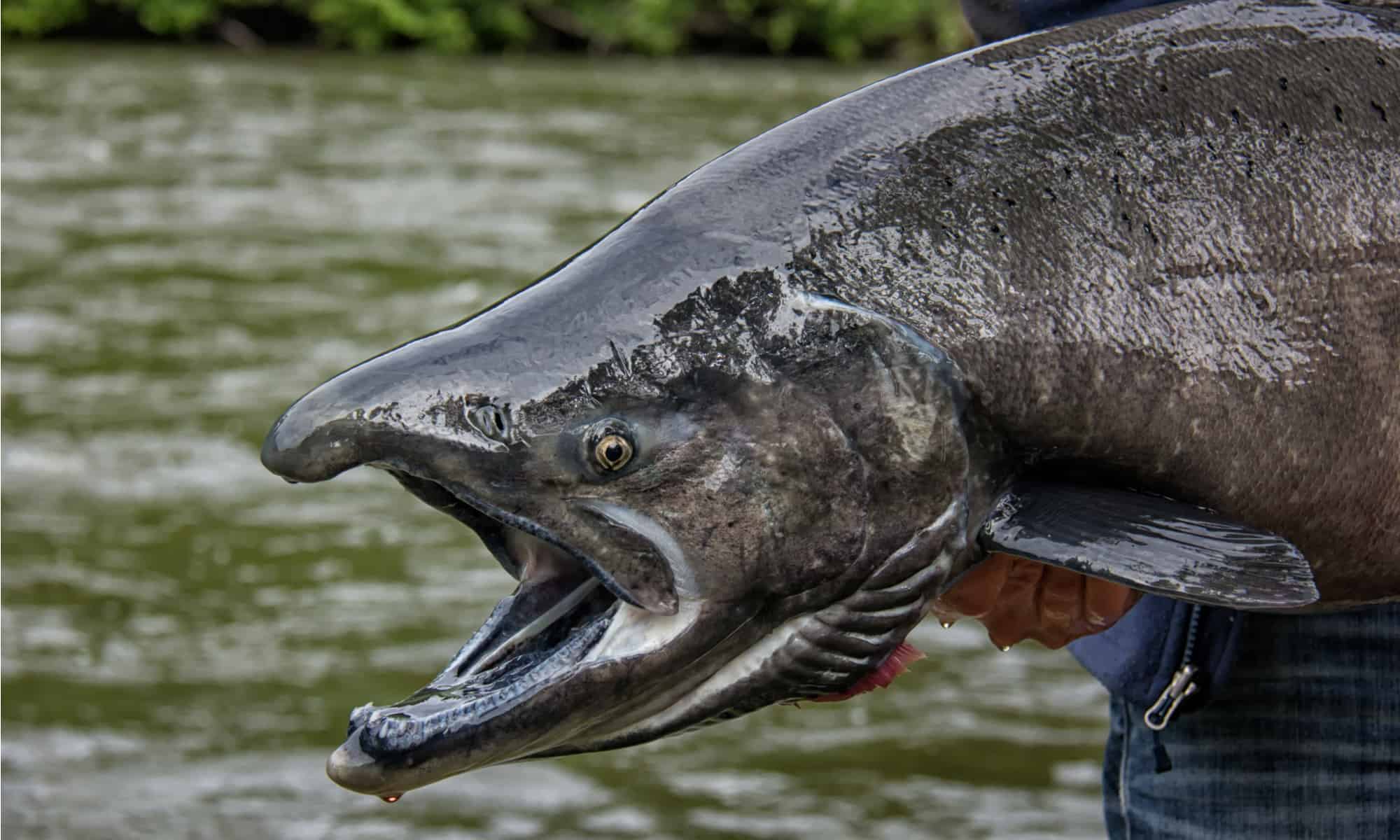
It is the largest Pacific salmon and supports major cultural, recreational, and commercial fisheries. Runs depend on cold connected rivers and access to spawning habitat. The easiest identification clue is the black gums and fully spotted tail.
3. Coho Salmon
Coho Salmon (Oncorhynchus kisutch) occupies the pacific salmon niche in river ecosystems and shows a bright silver body, spots mainly on the upper tail lobe, and pale gums. It is found in cool Pacific coastal rivers and streams before ocean migration. Its diet commonly includes aquatic insects, crustaceans, and small fishes, and its typical size category is large.
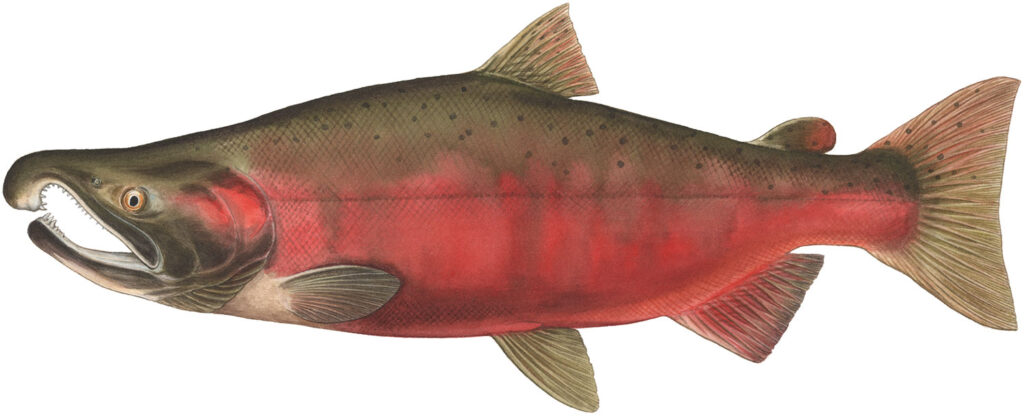
Juveniles often spend an extended period rearing in freshwater channels and side habitat. Protect woody cover, cool pools, and unobstructed migration routes. The easiest identification clue is spots mostly on the upper tail lobe.
4. Rainbow Trout
River observers often recognize Rainbow Trout (Oncorhynchus mykiss) from a pink side stripe and numerous black spots across the body and tail. It is found in cool rivers and streams of the Pacific basin, with worldwide introductions. Its diet commonly includes aquatic insects, crustaceans, and small fishes, and its typical size category is medium to large.
Resident rainbow trout remain in freshwater, while steelhead migrate to the sea. Introduced populations can affect native trout and amphibians. The easiest identification clue is the rosy stripe and densely spotted tail.
5. Brown Trout
Brown Trout (Salmo trutta) is a trout river fish recognized by brown-gold flanks marked with black and red spots often ringed in pale color. It is found in European, western Asian, and North African rivers, plus many introduced waters. Its diet commonly includes insects, crustaceans, and fishes, and its typical size category is medium to large.
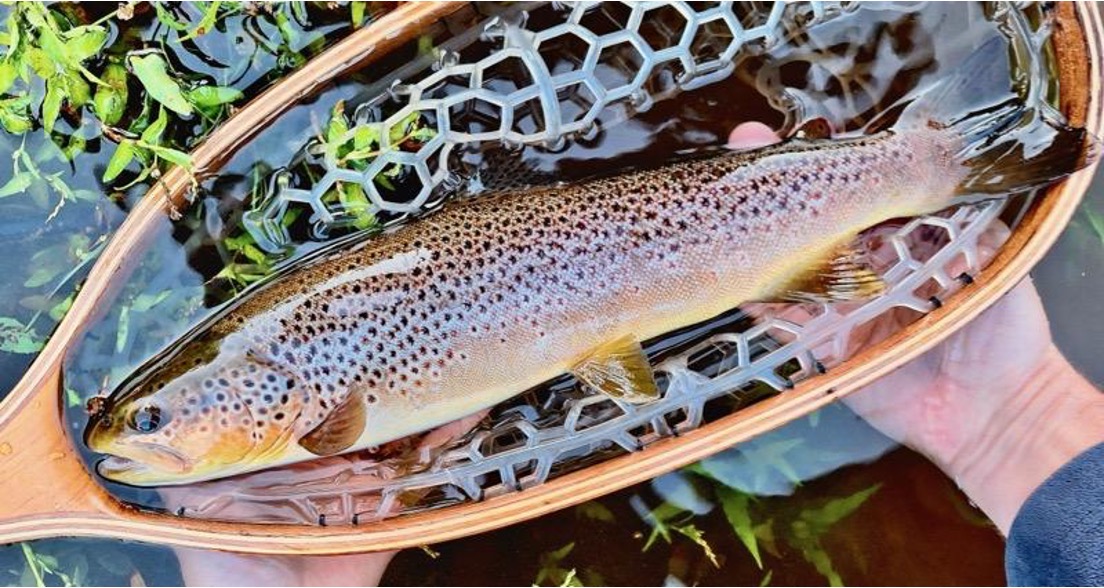
It adapts to streams, rivers, and lakes and may become strongly predatory with age. Follow local rules because introduced brown trout can compete with native species. The easiest identification clue is red and black spots on a golden-brown body.
6. Brook Trout
Commonly associated with flowing water, Brook Trout (Salvelinus fontinalis) can be identified by worm-like markings on the back, red spots with blue halos, and white-edged lower fins. It is found in cold clean streams and rivers of eastern North America. Its diet commonly includes aquatic insects, terrestrial insects, crustaceans, and small fishes, and its typical size category is small to medium.
Despite its name, it is a char rather than a true trout. Warm water and sediment can quickly degrade its habitat. The easiest identification clue is the marbled back and white fin edges.
7. Arctic Grayling
Arctic Grayling (Thymallus arcticus) occupies the grayling niche in river ecosystems and shows a slender silver body and an oversized sail-like dorsal fin marked with color. It is found in cold northern rivers across Alaska, Canada, and Eurasia. Its diet commonly includes insects, small crustaceans, and occasional small fishes, and its typical size category is medium.
It often feeds visibly in clear flowing water and is prized by fly anglers. Handle gently because the large dorsal fin is delicate. The easiest identification clue is the dramatic colorful dorsal sail.
8. European Perch
River observers often recognize European Perch (Perca fluviatilis) from greenish flanks with dark vertical bars and orange-red lower fins. It is found in European and northern Asian rivers, canals, and lakes. Its diet commonly includes invertebrates and fishes, and its typical size category is small to medium.

It uses slower river margins, woody structure, and deeper pools. Introduced populations can become invasive outside the native range. The easiest identification clue is the dark bars and red pelvic fins.
9. Smallmouth Bass
Smallmouth Bass (Micropterus dolomieu) is a black bass river fish recognized by a bronze-green body with vertical bars and an upper jaw that does not extend far behind the eye. It is found in clear rocky rivers and lakes of central and eastern North America, with introductions elsewhere. Its diet commonly includes crayfish, insects, and fishes, and its typical size category is medium to large.
It is strongly associated with current seams, boulders, ledges, and deep pools. Release practices and harvest rules vary by watershed. The easiest identification clue is the bronze body and smaller mouth.
10. Largemouth Bass
Commonly associated with flowing water, Largemouth Bass (Micropterus salmoides) can be identified by a green body, dark horizontal side band, and a very large mouth extending behind the eye. It is found in slow rivers, backwaters, lakes, and vegetated channels of North America and introduced regions. Its diet commonly includes fishes, frogs, crayfish, and large insects, and its typical size category is medium to large.
It prefers quieter river habitat with cover rather than fast open current. It is invasive in some countries and must never be moved illegally. The easiest identification clue is the oversized mouth and horizontal stripe.
11. Walleye
Walleye (Sander vitreus) occupies the pikeperch niche in river ecosystems and shows an elongated olive-gold body, large glassy eyes, and sharp canine teeth. It is found in large North American rivers, reservoirs, and lakes. Its diet commonly includes mostly fishes with some invertebrates, and its typical size category is medium to large.

Its light-sensitive eyes help it hunt in turbid water, deep pools, dawn, and dusk. Spiny fins and teeth require careful handling. The easiest identification clue is the reflective eyes and white lower tail tip.
12. Northern Pike
River observers often recognize Northern Pike (Esox lucius) from a long torpedo body with pale bean-shaped spots and a duckbill-like snout. It is found in vegetated rivers, backwaters, and lakes across the Northern Hemisphere. Its diet commonly includes fishes, amphibians, and other animals it can ambush, and its typical size category is large.
It is an ambush predator that waits beside weeds, logs, and quiet current edges. Use tools and protect hands from sharp teeth. The easiest identification clue is the long snout and pale spots on a dark green body.
13. Muskellunge
Muskellunge (Esox masquinongy) is a pike river fish recognized by a very long body with dark bars or spots on a pale background. It is found in large rivers and lakes of eastern and central North America. Its diet commonly includes fishes and other sizable prey, and its typical size category is very large.
It is a low-density apex predator known for following lures before striking. Specialized landing and release equipment helps reduce stress. The easiest identification clue is dark markings on a light body and pointed tail lobes.
14. Channel Catfish
Commonly associated with flowing water, Channel Catfish (Ictalurus punctatus) can be identified by a forked tail, scattered dark spots in younger fish, and four pairs of barbels. It is found in rivers, reservoirs, and large streams across central North America. Its diet commonly includes insects, mollusks, crustaceans, fishes, and detrital foods, and its typical size category is medium to large.

It feeds actively in current and is one of the continent’s most important sport and food fishes. The dorsal and pectoral spines can puncture skin. The easiest identification clue is the deeply forked tail.
15. Blue Catfish
Blue Catfish (Ictalurus furcatus) occupies the north american catfish niche in river ecosystems and shows a bluish-gray body, deeply forked tail, and long straight-edged anal fin. It is found in large rivers of the Mississippi, Missouri, and Gulf drainages, with introductions elsewhere. Its diet commonly includes fishes, mussels, crustaceans, and other available prey, and its typical size category is very large.
It favors big channels, current breaks, and deep holes. Introduced blue catfish can strongly affect estuarine and river food webs. The easiest identification clue is the blue-gray body and long anal fin.
16. Flathead Catfish
River observers often recognize Flathead Catfish (Pylodictis olivaris) from a broad flattened head, mottled yellow-brown body, and rounded tail. It is found in large warm rivers and reservoirs of central North America. Its diet commonly includes mostly live fishes and large aquatic prey, and its typical size category is very large.
Adults often hold near logs, undercut banks, bridge structure, and deep cover. It is invasive outside parts of its native range. The easiest identification clue is the flattened head and square-looking tail.
17. European Barbel
European Barbel (Barbus barbus) is a cyprinid river fish recognized by a long muscular body, underslung mouth, and four barbels around the lips. It is found in clean, flowing European rivers with gravel or stone bottoms. Its diet commonly includes insect larvae, crustaceans, mollusks, and plant material, and its typical size category is medium to large.
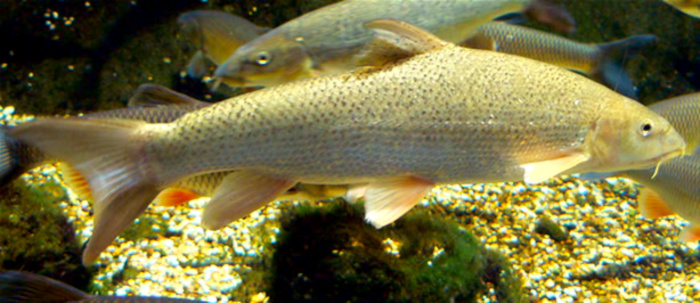
It is built for current and often feeds close to the riverbed. Spawning gravel and water quality are central to healthy populations. The easiest identification clue is the four mouth barbels and low-set mouth.
18. Common Chub
Commonly associated with flowing water, Common Chub (Squalius cephalus) can be identified by a thick cylindrical body, large scales, and a broad blunt head. It is found in European and western Asian rivers from small streams to broad channels. Its diet commonly includes insects, fruit, crustaceans, and small fishes, and its typical size category is medium.
Its flexible diet lets it use pools, undercut banks, and surface feeding opportunities. Avoid assuming every large silver cyprinid is a chub. The easiest identification clue is the blunt head and dark-edged large scales.
19. Common Roach
Common Roach (Rutilus rutilus) occupies the cyprinid niche in river ecosystems and shows a silver body with reddish eyes and orange-red pelvic and anal fins. It is found in slow rivers, canals, lakes, and backwaters across Europe and western Asia. Its diet commonly includes invertebrates, algae, plant material, and detritus, and its typical size category is small to medium.
It often forms large schools in moderate or slow current. It can hybridize with related cyprinids, complicating identification. The easiest identification clue is the red eye and reddish lower fins.
20. Common Bream
River observers often recognize Common Bream (Abramis brama) from a deep laterally compressed bronze-silver body and long anal fin. It is found in slow European rivers, canals, reservoirs, and connected lakes. Its diet commonly includes worms, insect larvae, mollusks, and plant material, and its typical size category is medium to large.
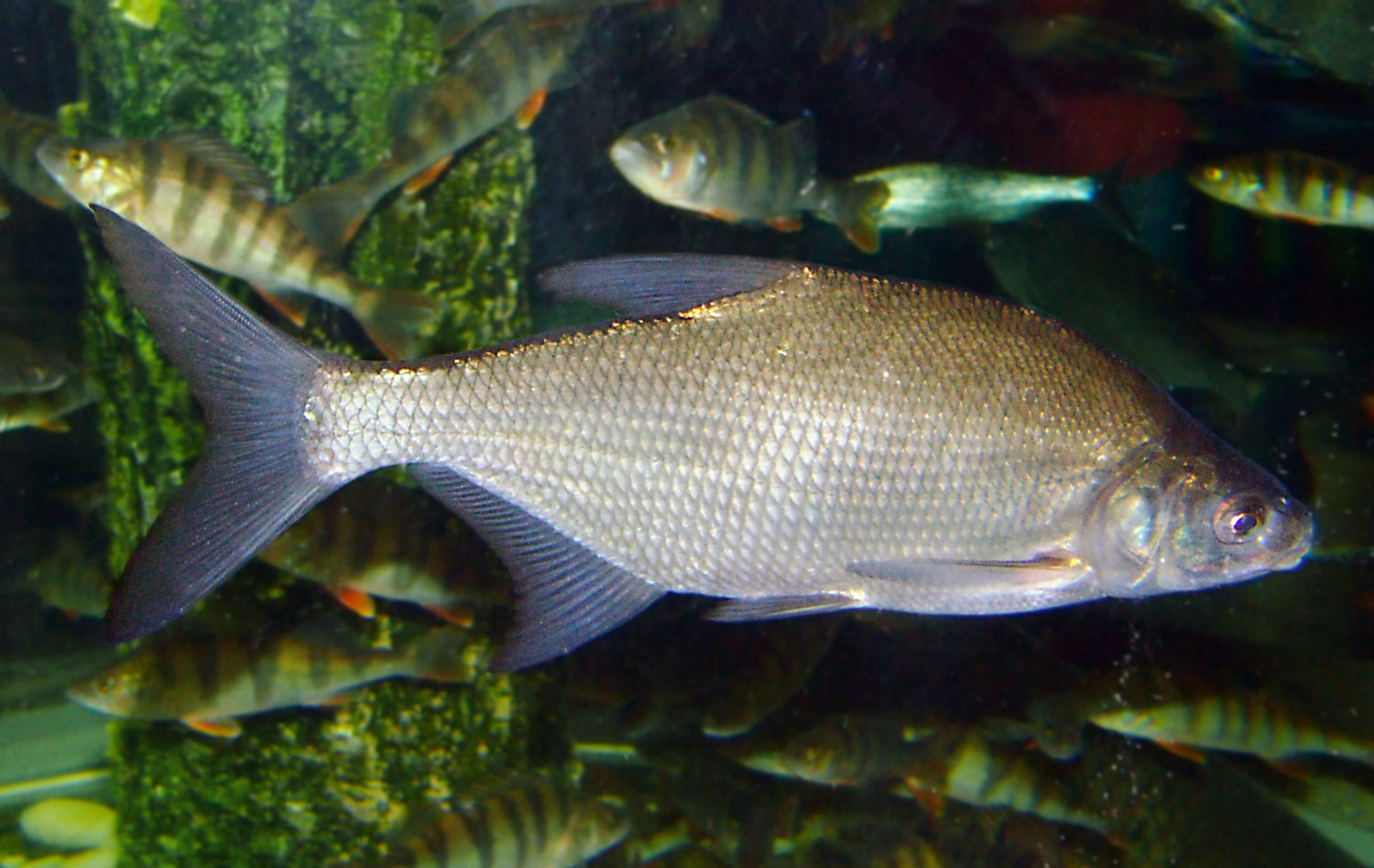
It feeds close to soft bottoms and often gathers in shoals. Young bream resemble several related silver fishes. The easiest identification clue is the deep body and very long anal fin.
21. Common Carp
Common Carp (Cyprinus carpio) is a cyprinid river fish recognized by a deep bronze body with large scales and two pairs of barbels. It is found in slow rivers, floodplains, lakes, and reservoirs across its native and introduced range. Its diet commonly includes bottom invertebrates, seeds, plant material, and detritus, and its typical size category is large.
It is culturally important and highly adaptable but can disturb sediment in introduced habitats. Never transfer carp between waters without legal authorization. The easiest identification clue is the barbels and heavy scaled body.
22. Grass Carp
Commonly associated with flowing water, Grass Carp (Ctenopharyngodon idella) can be identified by a long silver-olive body with large dark-edged scales and no mouth barbels. It is found in large East Asian rivers and many managed or introduced waters. Its diet commonly includes primarily aquatic vegetation, and its typical size category is very large.
It is stocked in some places for vegetation control, often as sterile fish. Unauthorized stocking can seriously alter aquatic plant communities. The easiest identification clue is the long body, large scales, and lack of barbels.
23. Tench
Tench (Tinca tinca) occupies the cyprinid niche in river ecosystems and shows a rounded olive-green body with tiny embedded scales and reddish eyes. It is found in slow rivers, backwaters, ponds, and vegetated lakes across Europe and western Asia. Its diet commonly includes insect larvae, mollusks, crustaceans, and plant matter, and its typical size category is medium.

It prefers soft-bottomed, weedy, low-current habitats. Its mucus-coated body is slippery and should be handled with wet hands. The easiest identification clue is the red eye and smooth olive body.
24. European Eel
River observers often recognize European Eel (Anguilla anguilla) from a snake-like body with continuous dorsal, tail, and anal fins. It is found in European and North African rivers for growth, followed by oceanic spawning migration. Its diet commonly includes invertebrates, fishes, and carrion, and its typical size category is medium to large.
It can cross damp ground and negotiate complex river habitats during migration. The species is critically depleted in much of its range and often strictly regulated. The easiest identification clue is the long body and continuous fin fringe.
25. American Eel
American Eel (Anguilla rostrata) is a freshwater eel river fish recognized by an elongated brown-green body with small pectoral fins and a continuous fin edge. It is found in rivers and estuaries from Greenland to northern South America before migration to the Sargasso Sea. Its diet commonly includes insects, crustaceans, fishes, and other aquatic prey, and its typical size category is medium to large.
It connects ocean and inland food webs through a remarkable catadromous life cycle. Dams and barriers can restrict upstream and downstream passage. The easiest identification clue is the snake-like body and western Atlantic range.
26. Alligator Gar
Commonly associated with flowing water, Alligator Gar (Atractosteus spatula) can be identified by a massive armored body and broad alligator-like snout filled with teeth. It is found in large slow rivers, bayous, floodplains, and estuaries of the southern United States and Mexico. Its diet commonly includes fishes, waterbirds, and other available prey, and its typical size category is enormous.
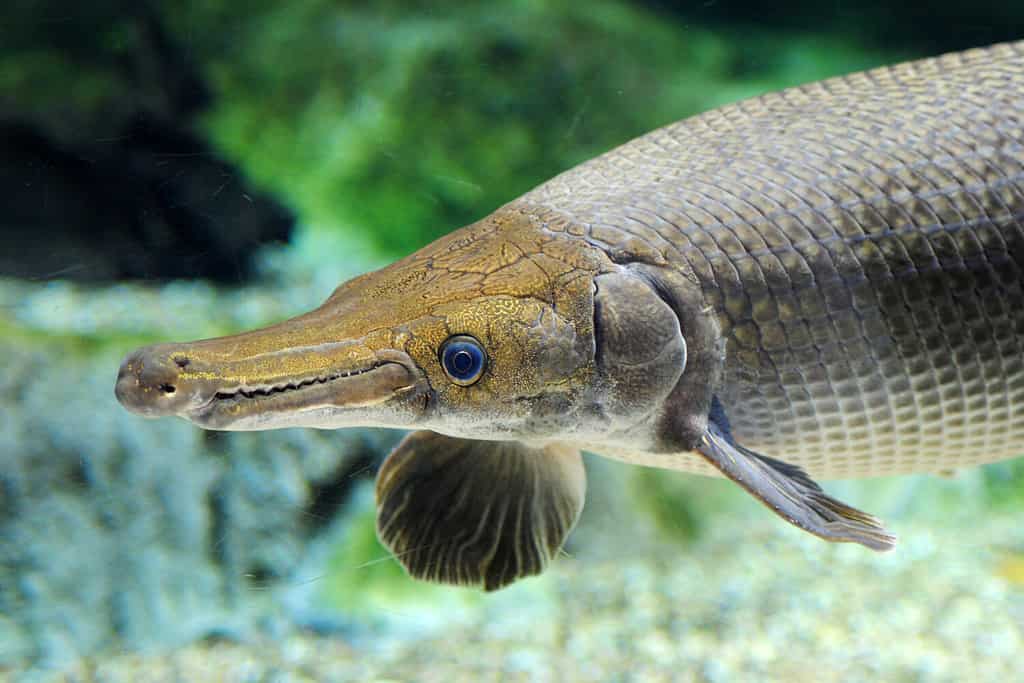
It is an ancient air-breathing predator that can gulp atmospheric oxygen. Large fish require careful legal, ethical, and handling practices. The easiest identification clue is the broad snout with two rows of upper-jaw teeth.
27. Longnose Gar
Longnose Gar (Lepisosteus osseus) occupies the gar niche in river ecosystems and shows a very long narrow snout and cylindrical body covered in hard diamond-shaped scales. It is found in rivers and lakes across much of eastern and central North America. Its diet commonly includes mostly fishes captured with a sideways snap, and its typical size category is large.
It often rests near the surface and can breathe air in low-oxygen water. Ganoid scales and teeth make rough handling unsafe. The easiest identification clue is the needle-like snout.
28. American Paddlefish
River observers often recognize American Paddlefish (Polyodon spathula) from a smooth scaleless body and an exceptionally long paddle-shaped rostrum. It is found in large Mississippi basin rivers and connected reservoirs. Its diet commonly includes zooplankton filtered through gill rakers, and its typical size category is very large.
The rostrum contains electroreceptors that help locate plankton-rich water. Harvest is highly regulated and populations depend on connected river habitat. The easiest identification clue is the unmistakable paddle snout.
29. Lake Sturgeon
Lake Sturgeon (Acipenser fulvescens) is a sturgeon river fish recognized by five rows of bony scutes, a long snout, and four barbels ahead of the mouth. It is found in large North American rivers and lakes. Its diet commonly includes insect larvae, mollusks, crustaceans, and other bottom prey, and its typical size category is very large and long-lived.

It migrates to river spawning grounds and may take many years to mature. Many populations are protected or carefully managed. The easiest identification clue is the armored rows and shark-like tail.
30. White Sturgeon
Commonly associated with flowing water, White Sturgeon (Acipenser transmontanus) can be identified by a long gray body, white scute rows, and an asymmetrical tail. It is found in large Pacific coastal rivers of western North America. Its diet commonly includes bottom invertebrates, fishes, and carrion, and its typical size category is enormous.
It is the largest freshwater fish in North America by mass in some records and can live for decades. Strict size slots, seasons, and release rules may apply. The easiest identification clue is the pale scutes and massive body.
31. Arapaima
Arapaima (Arapaima gigas complex) occupies the arapaimid niche in river ecosystems and shows a huge elongated body, broad head, and reddish-edged scales toward the tail. It is found in Amazonian floodplain rivers, lakes, and flooded forests. Its diet commonly includes fishes and other animals taken near the surface, and its typical size category is enormous.
It must surface to breathe air and has major cultural and fishery importance. Taxonomy includes multiple Arapaima species, and harvest is regulated in many areas. The easiest identification clue is the surface-breathing behavior and red tail scales.
32. Red-Bellied Piranha
River observers often recognize Red-Bellied Piranha (Pygocentrus nattereri) from a deep silver body, red-orange belly, and strong triangular teeth. It is found in slow rivers, floodplains, lakes, and flooded forests in South America. Its diet commonly includes fishes, invertebrates, plant material, and carrion, and its typical size category is medium.

It is an opportunistic schooling fish, not the constantly attacking predator of popular myth. Respect teeth and avoid careless handling. The easiest identification clue is the red belly and deep-bodied profile.
33. Tambaqui
Tambaqui (Colossoma macropomum) is a pacu relative river fish recognized by a deep powerful body with a dark lower half and broad crushing teeth. It is found in Amazon and Orinoco floodplain rivers and forests. Its diet commonly includes fruit, seeds, nuts, zooplankton, and invertebrates, and its typical size category is very large.
It disperses seeds during seasonal floods and is also an important aquaculture fish. Large adults are unsuitable for ordinary home aquariums. The easiest identification clue is the deep black-bellied body and molar-like teeth.
34. Electric Eel
Commonly associated with flowing water, Electric Eel (Electrophorus species) can be identified by a long cylindrical body with no obvious dorsal fin and a long anal fin used for propulsion. It is found in slow rivers, floodplains, and swampy waters in northern South America. Its diet commonly includes fishes and other animals located with electrical sensing, and its typical size category is large.
It is a knifefish rather than a true eel and uses electrical discharges for hunting and defense. Never approach or handle one in the wild. The easiest identification clue is the eel-like body combined with electric discharge.
35. Goliath Tigerfish
Goliath Tigerfish (Hydrocynus goliath) occupies the african characin niche in river ecosystems and shows a muscular silver body and enormous interlocking dagger-like teeth. It is found in the Congo River basin, especially large fast channels and lakes. Its diet commonly includes fishes, and its typical size category is very large.
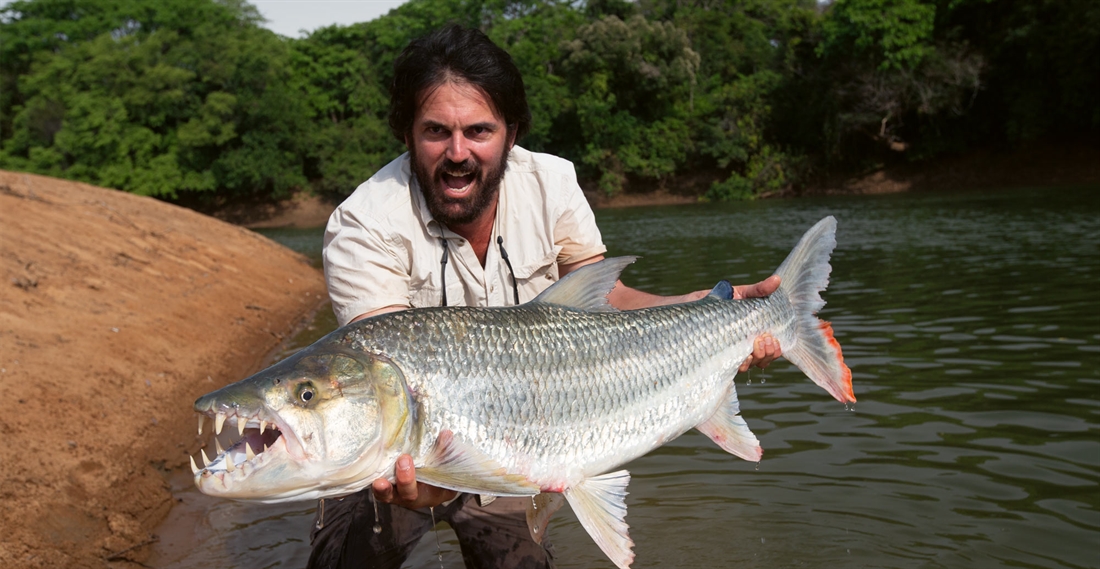
It is a powerful open-water predator adapted to turbulent African rivers. Specialized tackle and expert handling are necessary where legal fishing occurs. The easiest identification clue is the huge exposed triangular teeth.
36. African Tigerfish
River observers often recognize African Tigerfish (Hydrocynus vittatus) from a streamlined silver body with horizontal dark stripes and sharp teeth. It is found in major rivers and lakes across sub-Saharan Africa. Its diet commonly includes schooling fishes and other aquatic prey, and its typical size category is large.
It hunts in current and is famous for speed and explosive strikes. Use long-nose tools and follow local conservation rules. The easiest identification clue is the black side stripes and pointed teeth.
37. Nile Perch
Nile Perch (Lates niloticus) is a latid predator river fish recognized by a deep silver body, large mouth, and dark eye. It is found in major African rivers and lakes, including the Nile system. Its diet commonly includes fishes, crustaceans, and insects when young, and its typical size category is enormous.
It is a major fishery species but has transformed ecosystems where introduced. Its ecological role differs sharply between native and introduced waters. The easiest identification clue is the huge mouth and heavy silver body.
38. Mekong Giant Catfish
Commonly associated with flowing water, Mekong Giant Catfish (Pangasianodon gigas) can be identified by a massive scaleless gray body with a broad blunt head and no adult teeth. It is found in the Mekong River basin. Its diet commonly includes primarily algae and plant material as adults, and its typical size category is enormous.
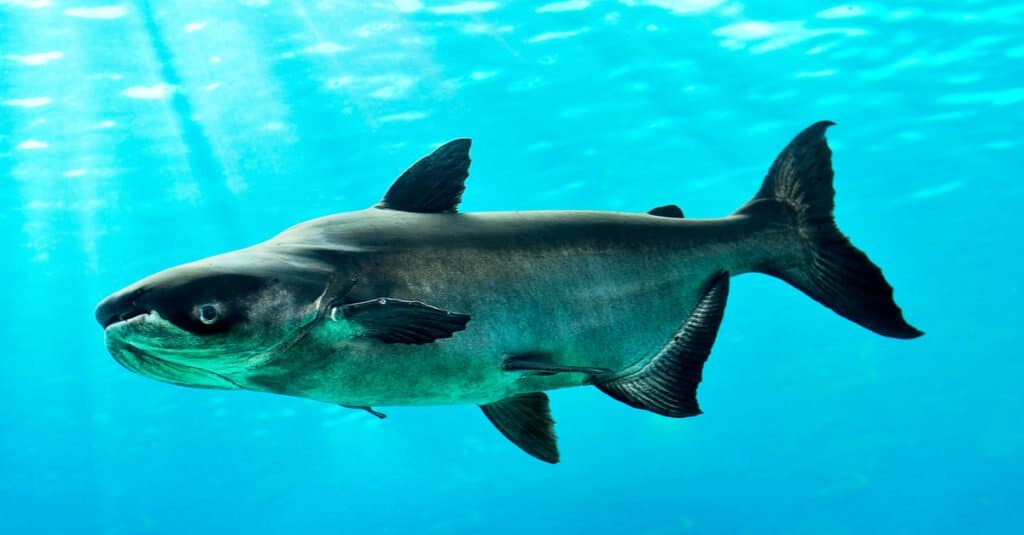
It is one of the world’s largest freshwater fishes and makes long river migrations. It is critically endangered and must be protected from illegal harvest. The easiest identification clue is the immense smooth body and Mekong range.
39. Giant Freshwater Stingray
Giant Freshwater Stingray (Urogymnus polylepis) occupies the freshwater ray niche in river ecosystems and shows a vast circular disc and an extremely long whip tail. It is found in large rivers and estuaries of South and Southeast Asia. Its diet commonly includes fishes, crustaceans, and other bottom animals, and its typical size category is enormous.
It demonstrates that some of the world’s largest river fishes are rays rather than bony fishes. The tail spine is defensive and the species faces significant conservation pressure. The easiest identification clue is the huge flat disc.
40. Golden Mahseer
River observers often recognize Golden Mahseer (Tor putitora) from a powerful golden-bronze body with large scales and reddish fins. It is found in Himalayan and South Asian rivers with clear flowing water. Its diet commonly includes insects, crustaceans, fishes, fruit, and plant material, and its typical size category is very large.
It is a celebrated sport fish and a cultural symbol of healthy connected rivers. Dams, habitat loss, and overfishing threaten many populations. The easiest identification clue is the golden scales and large powerful tail.
How Are These Types of River Fish Classified?
River fish are classified scientifically by ancestry, not by habitat alone. A salmon, catfish, carp, eel, sturgeon, and stingray may all inhabit rivers, yet they belong to very different evolutionary groups. Ecologists also classify them by how they use the river.
- Resident fish complete their life cycle within a river or connected freshwater system.
- Anadromous fish grow at sea and return to freshwater to spawn.
- Catadromous fish grow in rivers and migrate to the ocean to reproduce.
- Rheophilic fish favor current, clean gravel, and high oxygen.
- Floodplain fish exploit seasonal wetlands, flooded forests, and backwaters.
- Main-channel giants depend on deep pools, migration corridors, and large connected basins.
Where Do River Fish Live?
Different species occupy different parts of the river. Cold-water salmonids use shaded headwaters and gravel beds, while bass and pike often hold beside structure or vegetation. Catfish may use deep channels and undercut banks, whereas barbel and mahseer feed in strong current over rock or gravel.
Floodplains, side channels, estuaries, and tributaries are not optional extras. They function as nurseries, feeding areas, migration routes, and refuges during drought or flood. A river can look intact from the bank while losing fish diversity if these connections disappear.
How to Identify Different Types of River Fish
- Mouth position: upward, terminal, or underslung mouths suggest different feeding zones.
- Body shape: streamlined fish handle current; deep bodies often suit slower water.
- Fins: compare forked, rounded, or asymmetrical tails and the presence of an adipose fin.
- Skin and scales: catfish may be scaleless, gars have hard ganoid scales, and sturgeons have scutes.
- Barbels: note their number and position around the mouth.
- Pattern: use spots, bars, stripes, fin edges, and gum color only with other clues.
- Location: river basin and native range eliminate many incorrect identifications.
Fishing Tips and Notes
Read current rather than casting randomly. Fish often hold behind boulders, along seams where fast and slow water meet, beneath overhanging cover, at tributary mouths, and at the head or tail of pools. Seasonal temperature and water level can shift these positions dramatically.
Match tackle to the species and prioritize safe release. Use a net large enough for the fish, keep tools ready, minimize air exposure, and stop targeting cold-water species during stressful high-temperature periods.
Safety, Sustainability, and Conservation Notes
Check local consumption advisories before eating river fish because mercury, industrial chemicals, or other contaminants can vary by species and location. Observe legal limits and never transport live bait or fish between waters without authorization.
Healthy river fisheries require connected habitat, environmental flows, clean water, functioning floodplains, and protected spawning grounds. Dams, channelization, sand mining, pollution, invasive species, and overharvest can combine to reduce populations even when one threat alone seems modest.
Fun Facts About River Fish
- Some salmon return close to the stream where they hatched.
- Freshwater eels reproduce in the ocean.
- Paddlefish detect plankton with electroreceptors in the rostrum.
- Arapaima must surface to breathe air.
- Gars have hard diamond-shaped scales.
- Sturgeons can live for many decades.
- Tambaqui help disperse seeds in flooded forests.
- Electric eels are knifefishes, not true eels.
- Giant freshwater stingrays are among the heaviest river fishes.
- Flood pulses can trigger feeding and spawning migrations.
Final Thoughts on Types of River Fish
The 40 types of river fish in this guide show that a river is not one uniform habitat. Riffles, pools, woody edges, floodplains, estuaries, and migration corridors each support different species. Accurate identification begins with body structure and river basin, while responsible fishing and habitat protection help ensure that both familiar sport fish and rare river giants remain part of these ecosystems.
Frequently Asked Questions
1. What is a river fish?
A river fish is a species that spends all or an important part of its life in flowing freshwater. Some also use lakes, estuaries, floodplains, or the ocean.
2. Are all freshwater fish river fish?
No. Some freshwater species are mainly associated with lakes, ponds, swamps, or isolated wetlands, although many use several connected habitats.
3. What are the main groups of river fish?
Major groups include salmonids, catfishes, carps and minnows, perches, pikes, sturgeons, eels, gars, characins, and many region-specific lineages.
4. Why do rivers support so many fish species?
Rivers contain riffles, pools, runs, floodplains, tributaries, backwaters, gravel beds, woody cover, and seasonal habitats that support different feeding and breeding strategies.
5. What do river fish eat?
River fish may eat insects, algae, plants, seeds, mollusks, crustaceans, other fishes, carrion, or plankton. Diet depends on species, age, season, and habitat.
6. How do fish hold position in strong current?
They use streamlined bodies, large fins, bottom-hugging behavior, current breaks, and efficient swimming. Some have flattened shapes or sucker-like mouths.
7. What is a migratory river fish?
It is a fish that moves between habitats to feed, grow, or reproduce. Migrations may occur entirely within freshwater or between rivers and the sea.
8. What is an anadromous fish?
An anadromous fish grows mainly in the sea and returns to freshwater to spawn. Atlantic and Pacific salmon are familiar examples.
9. What is a catadromous fish?
A catadromous fish grows mainly in freshwater and migrates to the sea to reproduce. Freshwater eels are classic examples.
10. Why are river pools important?
Deep pools provide refuge during drought, winter, high temperature, low flow, and daytime resting periods. They can also concentrate food and predators.
11. Why are riffles important?
Riffles add oxygen, expose clean gravel, and support abundant insect larvae. They are essential feeding or spawning habitat for many species.
12. How do dams affect river fish?
Dams can block migration, alter temperature and sediment, change flood timing, and isolate populations. Fish passages help some species but do not solve every impact.
13. Why do fish need floodplains?
Seasonal floods create feeding, nursery, and spawning habitat. Flooded forests and grasslands can provide insects, fruit, seeds, shelter, and warm shallow water.
14. How can I identify a river fish?
Use body shape, fin position, mouth shape, scales, barbels, spots, stripes, teeth, habitat, geographic range, and local field guides.
15. Is color enough to identify a river fish?
No. Color changes with age, sex, season, water clarity, stress, and locality. Structural features and range are usually more reliable.
16. What is the safest way to handle a caught fish?
Wet your hands, minimize air exposure, support the body horizontally, avoid squeezing, and use appropriate tools. Follow species-specific release guidance.
17. Should fish be held by the gills?
No. Gill tissue is delicate and easily damaged. Support the fish under the body and control it without inserting fingers into the gill openings.
18. Why are barbless hooks useful?
They can reduce handling time and tissue damage during catch-and-release fishing, especially when fish are released quickly.
19. When should anglers avoid targeting cold-water fish?
During unusually warm, low-oxygen conditions, capture and handling can add dangerous stress. Local agencies may issue closures or voluntary restrictions.
20. Are river fish safe to eat?
Many are, but contamination advisories, species rules, size limits, and preparation guidance vary by waterway. Check local public-health and fisheries information.
21. What causes fish kills in rivers?
Low oxygen, extreme heat, pollution, algal blooms, sudden flow changes, disease, and chemical spills are common causes.
22. Why are invasive river fish a problem?
They can prey on native species, compete for food, spread disease, hybridize, damage habitat, or alter the food web.
23. Can aquarium fish survive in rivers?
Some can, especially in warm climates, and may become invasive. Aquarium animals should never be released into natural water.
24. What is electrofishing?
Electrofishing is a scientific sampling method that temporarily stuns nearby fish so trained crews can identify, measure, and release them. It requires specialized permits and equipment.
25. Why are sturgeons unusual?
Sturgeons have rows of bony scutes, a shark-like tail, a protrusible bottom-feeding mouth, and very long lifespans. Many mature late.
26. Are electric eels true eels?
No. They are South American knifefishes that evolved elongated bodies and powerful electric organs.
27. Can rays live in rivers?
Yes. South American river stingrays are fully freshwater, and giant freshwater stingrays use large Asian rivers and estuaries.
28. Which river fish are the largest?
Arapaima, giant catfishes, sturgeons, giant freshwater stingrays, and some gars rank among the largest river fishes.
29. How can people help river fish?
Protect riparian vegetation, keep pollutants out of drains, follow fishing rules, prevent invasive releases, conserve water, and support connected river habitat.
30. Why should local regulations be checked before fishing?
Seasons, tackle rules, harvest limits, protected species, invasive-species requirements, and access rules differ between rivers and can change.