

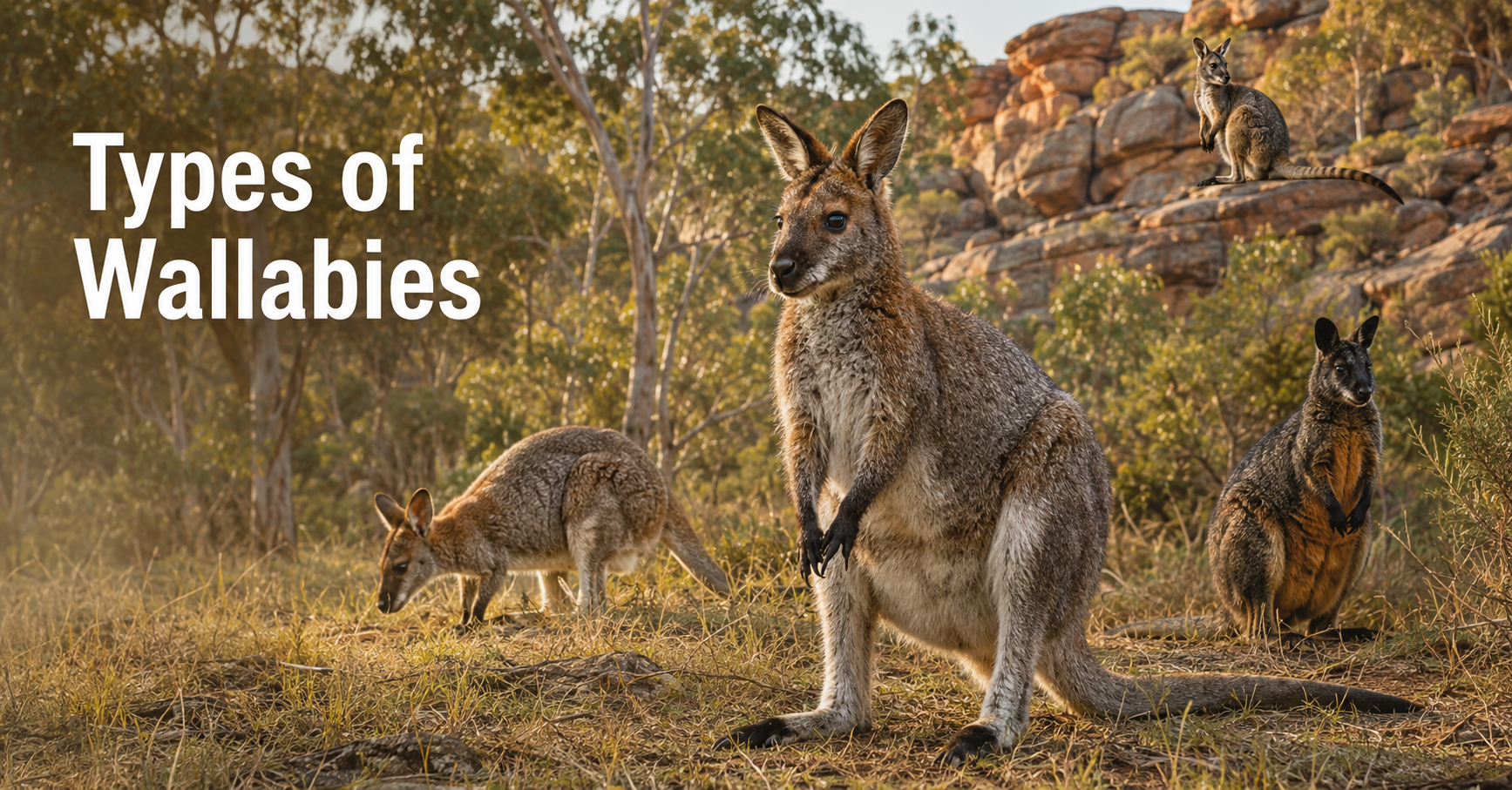
Wallabies are among the most recognizable animals of Australia and New Guinea, yet the name is less precise than many people realize. It is a common label for small to medium-sized members of the kangaroo family rather than a single scientific group. Depending on the source, lists of types of wallabies may include only the familiar brush and rock wallabies or may also cover hare-wallabies, nail-tail wallabies, forest wallabies, pademelons, and the quokka.
This guide uses the broader, field-friendly meaning and profiles 43 living species commonly treated as wallabies or close wallaby groups. You will find current scientific names, practical identification clues, native ranges, preferred habitats, behavior, and conservation context. Taxonomy changes as scientists compare genetics and museum specimens, so a species may appear under an older genus or a different English name in older books.
What Are the Main Types of Wallabies?
The main groups are brush wallabies, the swamp wallaby, rock-wallabies, hare-wallabies, nail-tail wallabies, New Guinea forest wallabies, pademelons, and the quokka. Brush wallabies resemble small kangaroos, while rock-wallabies have compact bodies and feet adapted for steep stone. Hare-wallabies are small and quick, forest wallabies favor dense tropical cover, and pademelons are short, stocky inhabitants of forests and thickets. The quokka is a short-tailed island specialist and the only living member of its genus.
| Group | Living species in this guide | Typical habitat | Useful field clue |
|---|---|---|---|
| Brush wallabies | 7 | Woodland, grassland, forest edge | Kangaroo-like build in a smaller body |
| Swamp wallaby | 1 | Dense eastern Australian scrub | Dark coat with rusty areas |
| Rock-wallabies | 17 | Cliffs, boulder fields, gorges | Long balancing tail and rock-gripping feet |
| Hare-wallabies | 3 | Islands, spinifex, dry shrubland | Small size and hare-like movements |
| Nail-tail wallabies | 2 | Open woodland and tropical savanna | Small horny spur near the tail tip |
| Forest wallabies | 6 | New Guinea rainforest | Stocky body and shorter hind feet |
| Pademelons | 6 | Rainforest and thick undergrowth | Compact body, pointed muzzle, short tail |
| Quokka | 1 | Southwestern islands and dense scrub | Rounded face and relatively short tail |
1. Agile Wallaby
Scientific name: Notamacropus agilis. The agile wallaby is a sandy-brown, long-limbed species of northern Australia and southern New Guinea. A pale cheek stripe, light underparts, and a darker line between the ears help separate it from similar wallabies. It uses tropical savannas, open woodland, floodplains, and coastal grassland, usually where cover and water are nearby.
Agile wallabies graze mainly on grasses but also browse leaves, shoots, fruit, and other plant material when conditions change. They may feed alone or gather in loose groups, especially around good pasture. Dawn, dusk, and cooler night hours are the best times to see them. Their combination of a slim build, long tail, pale face markings, and northern range is the most useful identification pattern.
2. Black-Striped Wallaby
Scientific name: Notamacropus dorsalis. This shy eastern Australian wallaby has gray-brown fur, a pale hip stripe, light cheek markings, and a conspicuous dark stripe running from the crown down the center of the back. It favors dry forest and woodland with thick shrubs, vines, brigalow, or other dense daytime shelter.
The species usually stays hidden until evening and feeds along established paths after dark. It eats grasses and other low vegetation, often close to thickets into which it can retreat. At a distance it can resemble a red-necked or agile wallaby, so observers should confirm the dark dorsal stripe, darker facial pattern, and dense-understory habitat rather than relying on body color alone.
3. Parma Wallaby
Scientific name: Notamacropus parma. The parma wallaby is a small, secretive wallaby native to wet forests of eastern New South Wales. It has gray-brown upperparts, a pale belly, a white cheek stripe, and often a dark line along the back. Its narrow face and modest size give it a delicate appearance.
Parma wallabies spend the day in dense cover and emerge at night to eat grasses and herbs in nearby openings. The species was once feared extinct before populations were rediscovered, an important reminder that elusive forest mammals can survive unnoticed. In the field, its small size, moist forest setting, and clear facial stripe help distinguish it from larger brush wallabies.
4. Red-Necked Wallaby
Scientific name: Notamacropus rufogriseus. Also called Bennett’s wallaby, especially for the Tasmanian form, this robust species has a gray body, reddish shoulders and nape, blackish nose and paws, and a pale underside. It is native to temperate eastern and southeastern Australia, including Tasmania.
Red-necked wallabies use eucalypt forest, woodland, heath, pasture edges, and clearings. They generally rest under cover by day and graze in cooler hours, sometimes forming loose feeding groups. Introduced populations occur outside Australia, but their legal and ecological status differs by country. Look for the rusty neck, heavy build, and dark extremities; young or poorly lit animals may lack an obvious red tone.
5. Tammar Wallaby
Scientific name: Notamacropus eugenii. The tammar, or dama wallaby, is a small wallaby with dark gray-brown upperparts, pale underparts, reddish sides, a small head, and large ears. Native populations survive in southern and western Australia, particularly on islands and in selected mainland areas.
It shelters in low, dense vegetation during the day and comes out at night to graze. Tammars are important research animals because their reproduction, milk biology, vision, and energy-efficient hopping have been studied extensively. For identification, combine compact size with reddish flanks and a southwestern or southern range. In New Zealand, introduced tammar wallabies are managed as invasive animals rather than protected native wildlife.
6. Western Brush Wallaby
Scientific name: Notamacropus irma. This slender wallaby is endemic to southwestern Western Australia. Its strongest markings are black forearms and lower legs, contrasting white facial stripes, and a long tail with a dark tip. The body is mostly gray, with paler underparts.
Western brush wallabies inhabit open forest, woodland, and shrubland, often in a mosaic of feeding areas and protective cover. They browse and graze on grasses, herbs, and leaves and are most active around dawn, dusk, and night. Their black-and-white face pattern and black limbs make them distinctive, but observers should remain still because the species often detects movement and slips into cover before a close view is possible.
7. Whiptail Wallaby
Scientific name: Notamacropus parryi. The whiptail wallaby is also called the pretty-faced wallaby; these are two names for one species, not separate types. It is tall and slim, with a very long tapering tail, gray-brown fur, a white stripe below the eye, and contrasting facial and chest markings.
It occurs in open forest and grassy woodland along eastern Australia from northeastern New South Wales into Queensland. Unlike many secretive wallabies, whiptails often feed in social groups and may be active during daylight when conditions are cool. The unusually slender body, long tail, bright cheek line, and social behavior provide a useful field combination.
8. Swamp Wallaby
Scientific name: Wallabia bicolor. The swamp wallaby is the sole living species in the genus Wallabia. It has coarse dark brown to blackish fur, rusty-orange areas on the chest and belly, a dark tail tip, and a relatively short, broad face. Older regional names include black wallaby and fern wallaby.
This solitary browser lives in forests, heathlands, wetlands, and thick scrub along eastern and southeastern Australia. It eats shrubs, leaves, ferns, grasses, and other vegetation, often taking more browse than grass. Its dark two-toned coat and habit of disappearing into dense vegetation help identify it. Despite its name, it is not limited to swamps.
9. Allied Rock-Wallaby
Scientific name: Petrogale assimilis. The allied rock-wallaby lives in northeastern Queensland, where it occupies rocky hills, escarpments, and boulder piles near feeding areas. It is a medium-sized gray-brown rock-wallaby with a pale underside and subtle facial and side markings.
Several northeastern rock-wallabies look extremely similar, and their ranges may meet at narrow boundaries. Reliable identification may therefore require an exact location rather than color alone. Allied rock-wallabies rest in crevices during hot hours and emerge to graze and browse. Their padded, textured hind feet provide grip on steep stone while the tail works as a counterbalance.
10. Short-Eared Rock-Wallaby
Scientific name: Petrogale brachyotis. This northern Australian rock-wallaby has relatively short ears, a broad muzzle, and subdued gray-brown to reddish coloring that blends into sandstone and broken rock. It occurs in the Kimberley region and adjoining parts of the Northern Territory.
The species shelters among cliffs, scree, and boulder fields and feeds on nearby grasses and foliage. Its appearance varies geographically, and older sources may use the name for populations now separated taxonomically. Confirm a sighting through range, ear proportions, habitat, and local field guides; photographs of the face, flanks, and tail are more useful than a single distant view.
11. Monjon
Scientific name: Petrogale burbidgei. The monjon is the smallest rock-wallaby and one of Australia’s smallest macropods. It is restricted to the rugged northwest Kimberley, where it lives among sandstone cliffs, caves, ledges, and boulder fields. Its compact body, small rounded ears, and long slender tail suit narrow rocky refuges.
Monjons feed on grasses, leaves, fruits, and other available plants, usually close to shelter. Their tiny size separates them from most neighboring rock-wallabies, although distance can make size difficult to judge. Because their range is remote and broken into rocky patches, respectful observation and accurate location records are especially valuable.
12. Cape York Rock-Wallaby
Scientific name: Petrogale coenensis. This poorly known species is confined to northern Cape York Peninsula in Queensland. It occupies rocky slopes, escarpments, and boulder habitats surrounded by tropical woodland. The coat is generally gray-brown, with subdued facial and body markings.
Its restricted distribution is the safest identification clue because several rock-wallabies share similar shapes and colors. Cape York rock-wallabies hide in rocky shelters during the day and forage in cooler periods. Fire patterns, introduced predators, weeds, and changes around small habitat patches can matter greatly to a species with such a narrow range.
13. Nabarlek
Scientific name: Petrogale concinna. The nabarlek is a very small rock-wallaby of northern Australia. It has a compact body, finely built limbs, and a long tail, and is associated with sandstone outcrops, cliffs, caves, and rocky islands.
It is nocturnal and spends daylight hours deep in crevices, emerging to eat grasses, sedges, ferns, and other plants. One remarkable feature is its unusual pattern of continually replacing worn molars, an adaptation useful for processing abrasive vegetation. Its tiny size and northern sandstone habitat are helpful clues, but remoteness and low detectability make verified sightings uncommon.
14. Godman’s Rock-Wallaby
Scientific name: Petrogale godmani. Godman’s rock-wallaby is found in northeastern Queensland, mainly around rocky ranges and escarpments of Cape York. It is a gray-brown species with a lighter underside and variable facial and flank markings.
Like related species, it rests among rocks and moves out to feed on grasses and browse when temperatures fall. Geography is critical when separating it from the allied, Cape York, Mareeba, and other northeastern rock-wallabies. Use a regional distribution map and record the exact site rather than assigning an identification from coat color alone.
15. Herbert’s Rock-Wallaby
Scientific name: Petrogale herberti. Herbert’s rock-wallaby occupies rocky country in southeastern Queensland. It has a typical rock-wallaby silhouette: compact body, strong hindquarters, narrow face, and a long tail used for balance.
Individuals shelter in cliffs, gullies, and boulder piles and feed in adjacent woodland and grassy areas. The species belongs to a complex of closely related eastern rock-wallabies, so location and local range boundaries are often more dependable than minor differences in fur. Quiet evening observation near the base of rocky slopes offers the best chance of seeing animals leave shelter.
16. Unadorned Rock-Wallaby
Scientific name: Petrogale inornata. True to its English name, this northeastern Queensland species usually lacks the bold stripes seen on some rock-wallabies. Its coat is fairly plain gray-brown, sometimes with faint facial or flank contrast.
Unadorned rock-wallabies inhabit rocky hills and escarpments with nearby woodland or grass for feeding. They may live in colonies and use familiar paths between shelter and forage. Because plain coloration is not unique, range is essential for confirmation. In suitable habitat, look for animals sunning near shelter in cool weather or emerging late in the day.
17. Black-Footed Rock-Wallaby
Scientific name: Petrogale lateralis. Also widely called the black-flanked rock-wallaby, this species occurs in scattered rocky habitats across western and central Australia. It typically has a dark side stripe, dark feet and paws, a pale cheek stripe, and a long tail that may end in a brush.
Populations are isolated and several subspecies or regional forms are recognized. Foxes and feral cats, habitat degradation, fire, and competition with introduced herbivores have contributed to declines. Conservation programs use predator control, monitoring, and carefully planned translocations. Observers should avoid approaching refuge caves or blocking the animals’ escape routes.
18. Mareeba Rock-Wallaby
Scientific name: Petrogale mareeba. The Mareeba rock-wallaby is restricted to rocky areas west of Cairns in northeastern Queensland. It has gray-brown fur, pale underparts, and markings that can be difficult to separate visually from neighboring species.
It lives in colonies in granite outcrops, cliffs, and boulder-strewn hills, feeding on grasses and other plants nearby. Location is the strongest field clue. Around visitor sites, never feed rock-wallabies: artificial food can disrupt natural behavior, create crowding, and expose animals to injury or disease.
19. Brush-Tailed Rock-Wallaby
Scientific name: Petrogale penicillata. This southeastern species has a dark, brushy tail tip, a pale cheek stripe, a dark stripe behind the shoulders, and warm brown or reddish tones on the rump. It uses cliffs, rocky escarpments, caves, and boulder piles along and near the Great Dividing Range.
Many populations have become small and isolated after predation, habitat change, competition, and historical hunting. Targeted predator control, captive breeding, genetic management, and reintroduction are helping selected colonies. A brushy tail alone is not enough for identification; confirm the facial stripe, body markings, and southeastern range.
20. Proserpine Rock-Wallaby
Scientific name: Petrogale persephone. The Proserpine rock-wallaby is a restricted-range species from the Whitsunday and Proserpine area of Queensland. It is relatively large for a rock-wallaby, with dark gray-brown fur, a paler underside, and a long tail.
It favors rocky slopes, boulder piles, and vine-forest margins, often close to developed areas. Road collisions, habitat loss and fragmentation, introduced predators, and inappropriate feeding are major practical concerns. Drivers should slow down near signed habitat at dawn, dusk, and night. Exact location and large size help distinguish it from nearby rock-wallabies.
21. Purple-Necked Rock-Wallaby
Scientific name: Petrogale purpureicollis. This distinctive wallaby lives in rocky ranges of northwestern Queensland. Adults may show a rich purple, reddish, or wine-colored wash around the neck and shoulders, produced by pigments associated with skin secretions rather than purple fur alone.
The species shelters in rugged outcrops and feeds on grasses and browse in surrounding dry country. Color intensity varies with age, light, and individual condition, so observers should also use range and body shape. The long tail and agile climbing movements are characteristic of rock-wallabies generally.
22. Rothschild’s Rock-Wallaby
Scientific name: Petrogale rothschildi. Native to the Pilbara and nearby islands of Western Australia, Rothschild’s rock-wallaby is a fairly large, plain-colored species with gray-brown fur and a long tail that darkens toward the tip.
It occupies rocky hills, gorges, scree, and ironstone landscapes, emerging to graze and browse in cooler hours. Its Pilbara distribution and relatively large size are more reliable than subtle coat features. Although some populations remain locally secure, introduced predators and disturbance around rocky refuges can create risks.
23. Mount Claro Rock-Wallaby
Scientific name: Petrogale sharmani. Also called Sharman’s rock-wallaby, this small species has a very limited range in northeastern Queensland. It inhabits rocky hills in woodland, where colonies use crevices and ledges for daytime shelter.
The animal is gray-brown with relatively subtle markings and can be nearly indistinguishable from related species without geographic information. Exact locality is therefore central to field identification. A restricted distribution also means that fire, weeds, quarrying, development, and predator pressure can have outsized local effects.
24. Wilkins’s Rock-Wallaby
Scientific name: Petrogale wilkinsi. Often called the eastern short-eared rock-wallaby, this species occurs in the Top End of the Northern Territory and on some nearby islands. It was historically grouped with the short-eared rock-wallaby but is now recognized separately.
Wilkins’s rock-wallaby tends to show brighter, more contrasting face and side markings than some western short-eared populations, although appearance varies. It uses sandstone escarpments, boulder fields, and monsoon-influenced rocky habitat. Range and up-to-date regional guides are essential when recording it.
25. Yellow-Footed Rock-Wallaby
Scientific name: Petrogale xanthopus. One of the easiest wallabies to recognize, this species has yellow-orange arms, legs, and feet; strong black-and-white facial stripes; a gray body; and a long orange-brown tail marked with dark rings.
It lives in colonies among cliffs, gorges, and rocky ranges in parts of South Australia, New South Wales, and Queensland. It feeds on grasses and browse, sometimes traveling away from shelter when conditions are favorable. Fox control, goat management, habitat protection, and reintroductions are important in portions of its range. Observe from a distance, especially around females carrying joeys.
26. Banded Hare-Wallaby
Scientific name: Lagostrophus fasciatus. This small wallaby has dark horizontal bands across the lower back and rump, giving it a pattern unlike any other living wallaby. It is the sole surviving member of an ancient macropod lineage and is not especially close to the true hare-wallabies in Lagorchestes.
Natural populations survived on predator-free islands off Western Australia after disappearing from the mainland, and conservation translocations have established additional populations. It shelters in dense vegetation and feeds mainly at night. The rump bands, small head, and island range make identification straightforward when a clear view is available.
27. Spectacled Hare-Wallaby
Scientific name: Lagorchestes conspicillatus. A reddish or orange ring around each eye creates the “spectacled” appearance of this small wallaby. The rest of the coat is coarse gray-brown, and the animal has short forelimbs, strong hind legs, and a long tail.
It occurs across parts of northern Australia and southern New Guinea, using tropical grasslands, open woodland, and hummock grass country. By day it hides in a nest or form beneath vegetation and emerges at night. Eye rings are the best clue, but they may be hard to see in poor light; habitat and compact hare-like movement provide supporting evidence.
28. Rufous Hare-Wallaby
Scientific name: Lagorchestes hirsutus. Known in Australia by the Indigenous name mala, this small wallaby has soft rufous to sandy fur and a light, quick build. It once occupied a broad mainland area but survives naturally on islands off Western Australia, with managed and reintroduced populations at protected sites.
Rufous hare-wallabies shelter in shallow forms beneath spinifex or shrubs and forage at night for grasses, seeds, leaves, and herbs. Cats, foxes, altered fire regimes, and habitat change drove major declines. Predator-free islands and fenced reserves now play a central role in recovery.
29. Bridled Nail-Tail Wallaby
Scientific name: Onychogalea fraenata. A white “bridle” line runs from the neck behind the forelimbs, and a dark dorsal stripe contrasts with the gray-brown coat. Like other nail-tail wallabies, it has a small horny spur near the end of the tail.
The species once ranged widely through inland eastern Australia but now persists in a few managed populations and reintroduction sites. It feeds on grasses, herbs, and browse in open woodland and grassland. Introduced predators and habitat change remain serious concerns. The bridle marking is usually easier to see than the tiny tail spur and is the safest field clue.
30. Northern Nail-Tail Wallaby
Scientific name: Onychogalea unguifera. The northern nail-tail wallaby is the largest living member of its group. It has sandy to gray-brown fur, a pale hip stripe, a white cheek line, and the characteristic small nail-like projection near the tail tip.
It inhabits tropical savannas, open woodland, and grassland across northern Australia. The species is mostly nocturnal, resting in shade by day and feeding on grasses, herbs, and leaves at night. Its northern distribution, comparatively large size, and pale flank line help separate it from the much rarer bridled species.
31. Black Forest Wallaby
Scientific name: Dorcopsis atrata. Also called the black dorcopsis, this dark-furred forest wallaby is restricted to Goodenough Island in Papua New Guinea. It has a stocky body, relatively short hind feet, and a tail less specialized for high-speed open-country hopping than those of brush wallabies.
It lives in montane forest and feeds on plant material on or near the forest floor. Its tiny island range makes habitat loss and hunting particularly important concerns. The combination of nearly black fur, heavy forest-wallaby build, and Goodenough Island locality identifies it.
32. White-Striped Forest Wallaby
Scientific name: Dorcopsis hageni. This New Guinea forest wallaby has a stocky brown body and one or more pale stripes along the back or sides. It inhabits lowland tropical forest in northern New Guinea.
White-striped forest wallabies move through dense understory and feed on leaves, shoots, fallen fruit, and other plant matter. They are difficult to observe in thick vegetation, and local hunting can reduce their visibility further. The pale longitudinal stripes are useful when seen clearly, but location remains important because forest light can distort color and contrast.
33. Gray Forest Wallaby
Scientific name: Dorcopsis luctuosa. Also known as the gray dorcopsis, this species occurs in lowland forests of southeastern New Guinea. It has grayish fur, a sturdy body, and the shorter feet and more level-backed posture typical of forest wallabies.
It forages on the rainforest floor for leaves, shoots, fruit, and other vegetation. Forest clearing and hunting have affected parts of its range. Because it is shy and most active under cover, a confirmed location and a photograph showing body proportions are often more useful than a brief color description.
34. Brown Forest Wallaby
Scientific name: Dorcopsis muelleri. The brown dorcopsis is native to western New Guinea and nearby islands. It is a robust, plain brown forest wallaby with a relatively long nose, short hind feet, and a thick tail.
It occupies lowland rainforest, swamp forest, and secondary vegetation and feeds on leaves, shoots, and fruit. Several island and regional forms have been described, which helps explain variation in appearance. Compared with Australian brush wallabies, it looks lower, heavier, and better suited to maneuvering through dense vegetation than to rapid travel across open ground.
35. Macleay’s Forest Wallaby
Scientific name: Dorcopsulus macleayi. This small forest wallaby lives in the mountains of southeastern New Guinea. It has dense dark-brown fur, a compact build, and shorter hind limbs than open-country wallabies.
Macleay’s forest wallaby uses cool montane rainforest and feeds on forest-floor vegetation and fruit. Elevation and southeastern distribution are important identification clues. The genus Dorcopsulus contains the smaller forest wallabies and is distinct from the larger Dorcopsis species, although older sources may use “dorcopsis” loosely for both.
36. Small Forest Wallaby
Scientific name: Dorcopsulus vanheurni. The small forest wallaby occurs in the central highlands of New Guinea. It is a compact, dark-brown montane species with a pointed face, rounded ears, and relatively short hind feet.
It lives in dense high-elevation forest, where it browses close to the ground and uses thick cover for safety. Its range overlaps a region with many localized mammals, and verified observations can be difficult. Scientific spelling varies in older publications, but Dorcopsulus vanheurni is the form readers should look for in current taxonomic resources.
37. Tasmanian Pademelon
Scientific name: Thylogale billardierii. Also called the rufous-bellied pademelon, this compact species has dark gray-brown upperparts and a reddish-brown belly. It is widespread in Tasmania, using rainforest, wet forest, scrub, and forest edges.
Animals shelter in thick vegetation during the day and emerge onto clearings to graze at dusk and night. The short tail, rounded body, and reddish underside distinguish it from the longer-tailed Bennett’s wallaby. Road collisions are a serious local risk, so drivers should reduce speed in wildlife areas after dark.
38. Brown’s Pademelon
Scientific name: Thylogale brownii. Often called the New Guinea pademelon, this brown, stocky species occurs in New Guinea and on parts of the Bismarck Archipelago. It uses tropical and montane forest, secondary growth, and forest-edge vegetation.
Brown’s pademelon feeds on leaves, shoots, grasses, and fallen fruit, usually under cover or in nearby openings. Hunting and forest change affect some populations. Taxonomic treatments have changed, and the mountain pademelon formerly listed as Thylogale lanatus is often included within this species in current checklists.
39. Dusky Pademelon
Scientific name: Thylogale brunii. The dusky pademelon is a dark brown to gray forest animal of southern New Guinea and nearby islands. It has a compact body, short tail, and pointed muzzle, with little of the strong facial striping seen in many Australian brush wallabies.
It lives in lowland rainforest, swamp forest, and dense secondary vegetation, feeding on shoots, leaves, grasses, and fruit. Local names and scientific spellings have varied historically. Range, uniformly dusky color, and pademelon proportions are the best practical identifiers.
40. Calaby’s Pademelon
Scientific name: Thylogale calabyi. Calaby’s pademelon is a little-known montane species restricted to Papua New Guinea. It has dark brown fur, a small stocky body, and the short hind feet typical of pademelons.
It inhabits high-elevation forest and forest-edge environments. Its limited range, hunting pressure, and habitat change make it a conservation priority. Visual identification without locality is unreliable because it resembles other New Guinea pademelons. Observations should record elevation, coordinates, habitat, and photographs whenever it is safe and permitted to do so.
41. Red-Legged Pademelon
Scientific name: Thylogale stigmatica. This rainforest pademelon has gray-brown upperparts, cream facial and hip markings, and rusty or reddish fur on the neck, flanks, and legs. It occurs from northeastern Australia into southern New Guinea.
Red-legged pademelons stay close to dense rainforest or wet forest but visit edges and clearings to feed on fallen fruit, leaves, and grasses. They are generally solitary and most visible at dawn, dusk, or night. Red legs are helpful, but the pale cheek and hip lines plus rainforest habitat make a stronger identification combination.
42. Red-Necked Pademelon
Scientific name: Thylogale thetis. The red-necked pademelon is native to eastern Australian forests. It has a gray-brown body, reddish neck and shoulders, a pale cheek, and the rounded form and short tail of a pademelon.
It shelters in rainforest, wet eucalypt forest, and dense undergrowth, emerging to graze along forest margins. Do not confuse it with the red-necked wallaby, which is larger, longer-tailed, and more kangaroo-like. The pademelon’s compact body, shorter face, shorter tail, and close association with thick forest provide the best separation.
43. Quokka
Scientific name: Setonix brachyurus. Sometimes called the short-tailed scrub wallaby, the quokka is the only living species in its genus. It has a compact body, rounded ears, a broad face, shaggy brown-gray fur, and a tail that is noticeably shorter than those of most wallabies.
The best-known populations occur on Rottnest and Bald Islands off Western Australia, while smaller mainland populations survive in dense southwestern vegetation. Quokkas browse leaves, stems, grasses, and other plants and can obtain moisture from food. Visitors must not touch or feed them. A relaxed facial shape may look like a “smile,” but it should not be interpreted as an invitation to approach.
How Are These Wallabies Classified?
All species in this guide belong to the family Macropodidae, which also contains kangaroos, wallaroos, and tree-kangaroos. They are marsupials in the order Diprotodontia. “Wallaby” is not a formal taxonomic rank; it is a practical common name shaped by body size, appearance, habitat, and historical usage.
- Brush wallabies: seven living species in Notamacropus.
- Swamp wallaby: the single living species of Wallabia.
- Rock-wallabies: 17 living species in Petrogale.
- Hare-wallabies: two living Lagorchestes species plus the banded hare-wallaby in Lagostrophus.
- Nail-tail wallabies: two living species in Onychogalea.
- Forest wallabies: four Dorcopsis and two Dorcopsulus species.
- Pademelons: six living species in Thylogale under the taxonomy used here.
- Quokka: the single species Setonix brachyurus.
Older sources may show different totals. They may exclude pademelons and forest wallabies, count extinct species, retain populations now treated as subspecies, or use earlier combinations such as Macropus agilis instead of Notamacropus agilis.
Where Do Wallabies Live?
Wallabies are native to Australia, New Guinea, Tasmania, and nearby islands. Their habitats range from tropical savanna and open eucalypt woodland to temperate forest, spinifex desert, alpine rainforest, coastal heath, cliffs, gorges, and offshore islands.
Rock-wallabies are concentrated in Australia and specialize in broken stone. Brush wallabies are most diverse in Australian woodland and forest-edge habitats. Pademelons and forest wallabies are strongly associated with dense forest in eastern Australia, Tasmania, and New Guinea. Several species survived severe mainland declines on islands without introduced foxes or cats.
People also introduced some wallabies to New Zealand, the United Kingdom, and other places. An introduced population should not be treated as part of the species’ natural range. In New Zealand, several wallabies are invasive pests because browsing damages native vegetation and forest regeneration.
How to Identify Different Types of Wallabies
- Start with location: many rock-wallabies can be separated more reliably by range than by fur.
- Check habitat: cliffs suggest Petrogale; dense rainforest suggests a pademelon or forest wallaby; open woodland often supports brush wallabies.
- Compare body shape: brush wallabies are long-limbed, pademelons are compact, and forest wallabies have shorter hind feet.
- Study the tail: note its length, thickness, rings, brush, dark tip, or nail-like spur.
- Look at the face: cheek stripes, eye rings, muzzle color, and ear length are useful.
- Inspect the limbs and flanks: black feet, red legs, yellow limbs, hip stripes, or a white bridle may be diagnostic.
- Consider size carefully: distance makes size deceptive, so compare an animal with rocks or vegetation in the same plane.
- Watch movement: rock-wallabies leap precisely over stone, while pademelons often move lower through cover.
- Use several traits: never identify a difficult species from a single color patch.
- Photograph responsibly: capture the face, side, tail, habitat, and location without chasing the animal.
Outdoor Tips for Finding and Observing Wallabies
- Visit suitable habitat at dawn, dusk, or during the first cool hours after sunset.
- Scan forest edges, grassy clearings, rocky ledges, and the base of escarpments before walking closer.
- Move slowly, keep voices low, and avoid shining a strong light directly into an animal’s eyes.
- Use binoculars or a telephoto lens instead of approaching.
- Never enter refuge caves, surround a wallaby, or stand between an adult and its escape route.
- Do not feed wild wallabies, even at locations where animals appear accustomed to visitors.
- Keep dogs leashed and away from wildlife areas.
- Follow park closures, biosecurity rules, cultural guidance, and local wildlife regulations.
- Slow down when driving at night, particularly where warning signs or recent sightings indicate activity.
- Report injured animals to a licensed wildlife rescue service rather than attempting treatment yourself.
Safety, Sustainability, and Conservation Notes
Wallabies are wild animals with powerful hind legs, claws, and teeth. Give them room, never corner them, and do not attempt a selfie at touching distance. Feeding causes nutritional problems and can make animals crowd roads, picnic areas, and people. Human food is not an appropriate wallaby diet.
Introduced foxes and cats, free-ranging dogs, habitat clearing, altered fire, competition from livestock and feral herbivores, hunting, and vehicle collisions affect different species. Small island or cliff colonies are especially vulnerable because one fire, disease event, development, or predator introduction can affect much of a population.
Conservation status can differ between the IUCN Red List and Australian federal, state, or territory law. It can also change after a new assessment. Before publishing a legal status, management recommendation, or population estimate, check the current official listing for the exact species and region.
Fun Facts About Wallabies
- The word “wallaby” is a common name, not a formal branch of the mammal family tree.
- All wallabies are macropods, a name meaning “large foot.”
- A baby wallaby is called a joey and completes much of its early development in the pouch.
- Rock-wallaby feet use textured pads and friction to grip steep stone.
- The nabarlek has an unusual system for replacing worn molar teeth.
- Nail-tail wallabies have a small horny projection near the end of the tail.
- The purple-necked rock-wallaby’s color is associated partly with pigmented skin secretions.
- Whiptail wallaby and pretty-faced wallaby are two names for the same species.
- The banded hare-wallaby is the only living representative of an ancient macropod lineage.
- The quokka’s famous “smile” is a feature of its facial shape, not proof that it wants human contact.
Final Thoughts on Types of Wallabies
The 43 living types of wallabies in this broad guide show how dramatically one common name can span different lifestyles. Some graze in open woodland, others climb cliffs, hide in rainforest, or survive on predator-free islands. The best identification begins with location and habitat, then combines body shape, face markings, limb color, tail features, and behavior. Observe quietly, never feed wildlife, and use current regional sources when a difficult identification or conservation status matters.
Frequently Asked Questions
1. What is a wallaby?
A wallaby is a small or medium-sized member of the kangaroo family, Macropodidae. The term is informal rather than a scientific rank, so its scope varies among sources.
2. How many types of wallabies are there?
There is no single universal total because “wallaby” is not a formal taxonomic group. This guide includes 43 living species under a broad definition that covers brush, swamp, rock, hare, nail-tail, and forest wallabies, pademelons, and the quokka. Narrower sources often say about 30.
3. Are wallabies and kangaroos the same animal?
No, but they are close relatives in the same family. “Kangaroo” is generally reserved for several of the largest macropods, while “wallaby” is used for smaller species not given another common group name.
4. What is the difference between a wallaby and a wallaroo?
Wallaroos are generally heavier and more thickset than most wallabies, with rough fur and a posture suited to rocky or dry country. Common names overlap, so scientific names are the safest way to avoid confusion.
5. What is the most common wallaby?
The answer depends on region. The agile wallaby is widespread and often common in northern Australia, while red-necked and swamp wallabies are familiar in parts of eastern and southeastern Australia.
6. What is the smallest wallaby?
The monjon is widely described as the smallest rock-wallaby and among the smallest living wallabies. Exact comparisons depend on whether all forest-wallaby and pademelon groups are included.
7. What is the largest wallaby?
Large males of species such as the whiptail, agile, and red-necked wallabies can be substantial. “Largest” varies depending on whether weight, body length, or total length including the tail is used.
8. Where are wallabies native?
They are native to Australia, Tasmania, New Guinea, and surrounding islands. Different species occupy deserts, forests, savannas, wetlands, rocky ranges, and offshore islands.
9. Are there wild wallabies outside Australia?
Yes. New Guinea has native wallabies, while people introduced wallabies to New Zealand, the British Isles, and several other locations. Introduced populations may be managed as invasive wildlife.
10. What do wallabies eat?
Most eat grasses, herbs, leaves, shoots, and other plant material. Grazing and browsing proportions differ by species, habitat, and season; forest species may also eat fallen fruit.
11. Do wallabies drink water?
Yes, but some species can meet much of their water requirement through moist food, especially when conditions are favorable. Water dependence varies with diet, climate, and species.
12. Are wallabies nocturnal?
Many are nocturnal or crepuscular, becoming most active at night, dawn, and dusk. Some also feed during cool daylight, especially in shaded habitat or mild weather.
13. Do wallabies live in groups?
Social behavior varies. Many are solitary but gather where food is abundant, while some brush and rock-wallabies form loose groups or colonies.
14. What is a group of wallabies called?
A group is commonly called a mob. “Troupe” or “court” may also appear, but mob is the most familiar Australian usage.
15. What is a baby wallaby called?
A baby is called a joey. It is born extremely undeveloped, crawls to the pouch, attaches to a teat, and continues growing there.
16. How can I tell a wallaby from a pademelon?
Pademelons are usually smaller and stockier, with shorter tails, shorter hind feet, and more compact faces. They also stay closer to thick forest cover than many brush wallabies.
17. How can I identify a rock-wallaby?
Look for a compact wallaby moving confidently over cliffs or boulders, with a long balancing tail and textured foot pads. Species-level identification often requires an exact location and multiple coat markings.
18. Are whiptail and pretty-faced wallabies different?
No. Both names refer to Notamacropus parryi. Listing them separately creates a duplicate rather than an additional species.
19. Is Bennett’s wallaby a separate species?
Bennett’s wallaby usually refers to the Tasmanian form of the red-necked wallaby, Notamacropus rufogriseus. It is not normally counted as a separate living species.
20. Is a quokka a wallaby?
The quokka is a macropod often called the short-tailed scrub wallaby. It belongs to its own genus, Setonix, and is commonly included in broad wallaby guides.
21. Can wallabies swim?
Wallabies can swim when necessary and can move their hind legs independently in water. Swimming is not their normal mode of travel, and wildlife should never be forced toward water.
22. Can wallabies walk backward?
Their large hind feet and heavy tail make backward movement awkward. They can reposition themselves, but they are not built for sustained backward walking.
23. Are wallabies dangerous?
They usually avoid people, but a cornered, habituated, or handled wallaby can kick, scratch, or bite. Keep a respectful distance and never block its escape.
24. Should people feed wild wallabies?
No. Feeding can cause poor nutrition, disease transmission, aggression, crowding, and greater exposure to roads and dogs. Let wild animals choose natural foods.
25. Can wallabies be kept as pets?
Wallabies are wild animals with specialized space, social, dietary, veterinary, and legal needs. Private ownership is restricted or prohibited in many places and is unsuitable for a typical household.
26. Why are some wallabies endangered?
Major causes include predation by introduced foxes and cats, habitat loss, altered fire regimes, hunting, road deaths, competition, and the vulnerability of small isolated populations.
27. Which wallabies have become extinct?
Recently extinct species include the toolache wallaby, crescent nail-tail wallaby, eastern hare-wallaby, and central or Lake Mackay hare-wallaby. Extinct species are not included in the 43 living profiles above.
28. Why do species totals change?
Genetic studies may split or combine populations, common names may cover different groups, and checklists may include or exclude pademelons, forest wallabies, quokkas, subspecies, or extinct species.
29. When is the best time to see wallabies?
Dawn, dusk, and early night are usually best. Cool, still conditions improve the chance of seeing animals feed at forest edges, clearings, or below rocky refuges.
30. What should I do if I find an injured wallaby?
Keep people and pets away, note the exact location, and contact a licensed local wildlife rescue organization. Do not offer food, chase the animal, or open a pouch unless a trained rescuer instructs you.
READ MORE:
Types of Wombats: Identification, Habitat, and Species Guide