

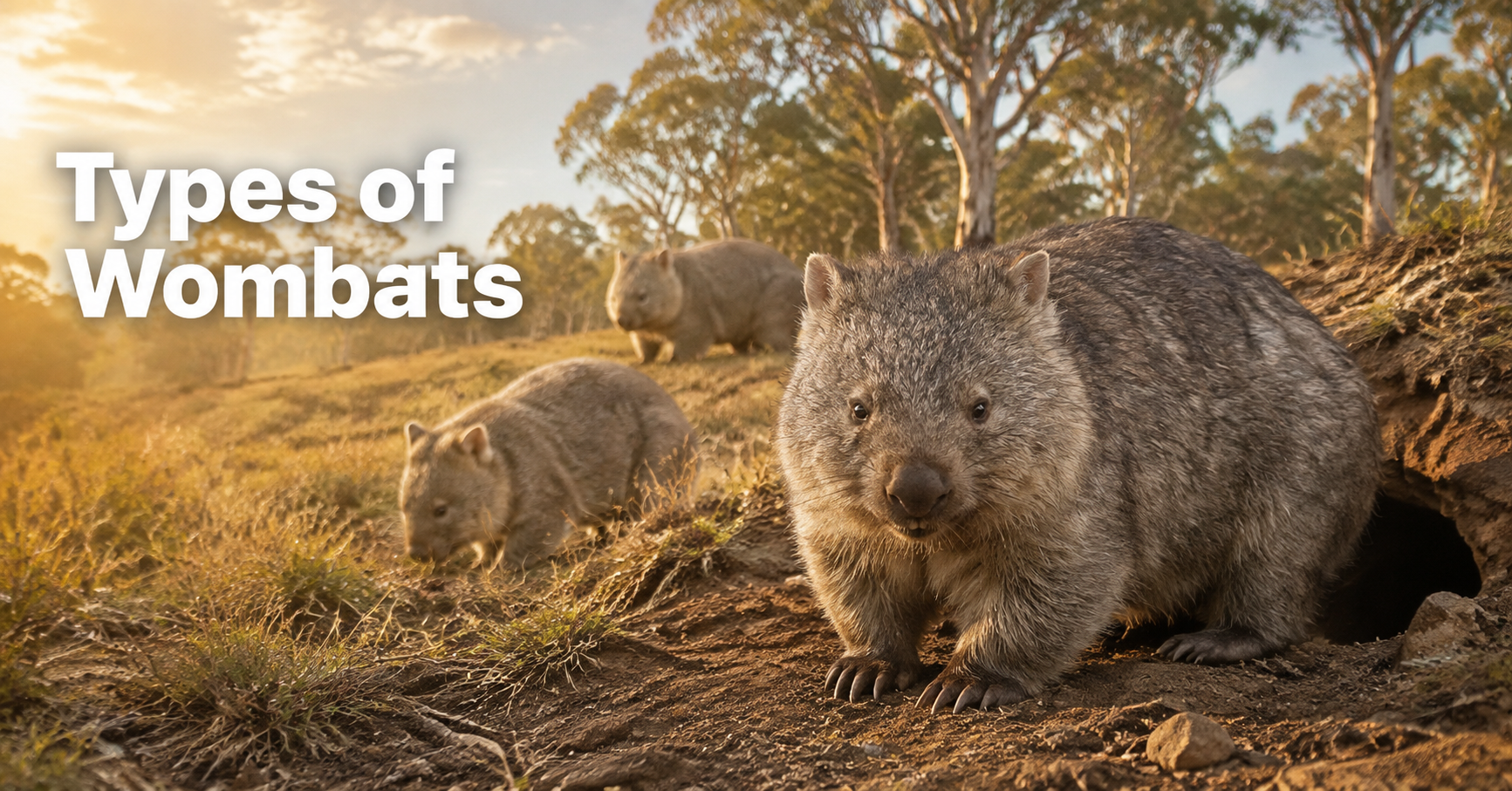
Wombats may look like small bears, but they are powerful burrowing marsupials found only in Australia and nearby islands. There are exactly three living types of wombats: the bare-nosed wombat, the southern hairy-nosed wombat, and the critically endangered northern hairy-nosed wombat. Each has a different nose, ear shape, coat, range, habitat, and conservation story.
This field-friendly guide explains how to identify all three wombat species, where they live, what they eat, how their burrows differ, and what signs they leave behind. It also clears up common confusion about wombat subspecies, offers safe observation tips, and explains why threats such as road collisions, sarcoptic mange, drought, and habitat change do not affect every species in the same way.
What Are the Main Types of Wombats?
The three living wombat species are the bare-nosed wombat (Vombatus ursinus), the southern hairy-nosed wombat (Lasiorhinus latifrons), and the northern hairy-nosed wombat (Lasiorhinus krefftii). The bare-nosed species has a naked, moist-looking nose and small rounded ears. Both hairy-nosed species have fur across the muzzle, longer pointed ears, and softer coats, but they occupy very different ranges and have sharply different conservation situations.
| Species | Best identification clue | Native range | Typical habitat | Conservation context |
|---|---|---|---|---|
| Bare-nosed wombat | Bare nose and short, rounded ears | Southeastern mainland Australia, Tasmania, and selected islands | Forest, woodland, heath, alpine grassland, and coastal scrub | Widespread overall, but local populations face mange, roads, and habitat pressures |
| Southern hairy-nosed wombat | Hairy muzzle, pointed ears, and broad flattened head | Southern South Australia, southeastern Western Australia, and southwestern New South Wales | Semi-arid grassland, shrubland, and open woodland | Protected and sensitive to drought, habitat decline, competition, and climate extremes |
| Northern hairy-nosed wombat | Large size, very broad hairy muzzle, and long pointed ears | Three protected populations in Queensland | Open eucalypt woodland with deep sandy soil and native grass | Critically Endangered and intensively managed |
1. Bare-Nosed Wombat
Scientific name: Vombatus ursinus
Other common names: common wombat, coarse-haired wombat, and naked-nosed wombat
The bare-nosed wombat is the most widespread and familiar of the three wombat species. Its clearest feature is the large nose pad, which is mostly free of fur. The ears are short and rounded, the head is broad, and the coat is usually coarse. Fur color varies greatly and may be sandy brown, gray, dark brown, blackish, or occasionally pale cream. Soil can stain the coat, so color by itself is not a dependable identification feature.
Adults are generally about 75 to 120 centimeters long and commonly weigh around 20 to 35 kilograms, although size differs among regions and subspecies. Mainland animals tend to be larger and more heavily built than many island wombats. Short muscular legs, broad feet, and strong claws allow the animal to excavate long burrows and push through compact soil. Its rump is thick and tough, helping protect it when it retreats into a tunnel.
Bare-nosed wombats occur through suitable areas of southeastern Australia, including Tasmania, eastern New South Wales, eastern Victoria, southern Queensland, and small remnant areas farther west. They use a wide range of environments, from cool wet forest and mountain grassland to coastal heath, woodland, and open country. Suitable soil for digging and reliable ground vegetation are more important than any single forest type.
These wombats are mainly solitary and usually rest underground during the day. They emerge in the evening or at night to graze on grasses, sedges, herbs, roots, and other tough plant material. In cool weather, an individual may sun itself near a burrow entrance or forage during daylight. Each animal may maintain several burrows within its home range and communicate through scent marks, droppings, vocal sounds, and physical signs.
The species is not considered globally threatened as a whole, but that does not mean every local population is secure. Road deaths, habitat fragmentation, persecution, fire, and sarcoptic mange can cause severe local declines. Mange is especially recognizable by hair loss, thick crusted skin, wounds, and abnormal daytime behavior. Anyone who sees an affected wombat should contact a licensed wildlife rescue group or the relevant wildlife authority rather than attempting treatment without guidance.
Recognized Bare-Nosed Wombat Subspecies
- Mainland bare-nosed wombat (Vombatus ursinus hirsutus): found on the southeastern Australian mainland and generally the largest form.
- Tasmanian wombat (Vombatus ursinus tasmaniensis): native to mainland Tasmania and usually smaller than mainland southeastern wombats.
- Flinders Island wombat (Vombatus ursinus ursinus): the smallest recognized form, now naturally restricted to Flinders Island and introduced to Maria Island.
These are geographic forms of one species, not three additional wombat species. Subspecies spellings can vary in older references, so the full scientific name and publication date of a source should be checked when exact taxonomy matters.
2. Southern Hairy-Nosed Wombat
Scientific name: Lasiorhinus latifrons
Other common name: soft-furred wombat
The southern hairy-nosed wombat is the smallest of the three living wombat species, although it remains a powerful animal. It has a broad muzzle covered with fine hair, narrow pointed ears, small eyes, and soft silky fur. The head appears flatter than that of the bare-nosed wombat, and a pale patch may occur beneath or around the nose. Coat color ranges from pale sandy gray to brown or dark gray, helping the animal blend into semi-arid soil and vegetation.
Adults are usually about 75 to 100 centimeters long and often weigh between 19 and 32 kilograms. The body is compact and low to the ground, with wide feet and flattened claws for digging. As in other wombats, the front teeth continue growing throughout life, offsetting wear from abrasive grasses and soil. A backward-opening pouch helps prevent excavated dirt from covering a developing joey.
This species lives in semi-arid parts of southern Australia. Its main range extends across South Australia, with populations in southeastern Western Australia and southwestern New South Wales. It favors open grassland, chenopod shrubland, mallee, and lightly wooded country where soils are deep enough for burrows but firm enough to keep tunnel systems stable.
Southern hairy-nosed wombats often build extensive communal warrens with multiple entrances. Several individuals may use the same warren system, although they do not behave like a tightly coordinated social group. The stable temperature and humidity underground provide shelter from the region’s hot days and cold nights. Wombats usually leave the warren after sunset to graze, sometimes following well-worn paths to feeding areas.
Native grasses make up much of the diet, supplemented by herbs, shoots, roots, and other available plants. The species has a slow metabolism and efficient digestive system suited to dry, fibrous food. It can obtain much of its moisture from vegetation, but prolonged drought reduces food quality and breeding success. Competition with livestock, rabbits, and other grazers can intensify during dry periods.
The southern hairy-nosed wombat is commonly assessed as Near Threatened internationally, while legal or regional classifications may differ. Major concerns include habitat degradation, drought, climate extremes, road collisions, competition for food, disease, and conflict where burrows affect farms or infrastructure. Wombats are protected under applicable wildlife laws, and any management of animals or active warrens must follow current local regulations.
3. Northern Hairy-Nosed Wombat
Scientific name: Lasiorhinus krefftii
Other names: yaminon and Queensland hairy-nosed wombat
The northern hairy-nosed wombat is the largest and rarest living wombat. It has a broad head, a wide muzzle covered with fine hair, long pointed ears, soft gray or gray-brown fur, and faint dark patches around the eyes. Females are often heavier than males. Adults average roughly 32 kilograms, while large individuals may approach 40 kilograms and reach about one meter in length.
The species once occupied a much wider area across eastern inland Australia. By 1982, only about 35 animals remained in a single surviving population at Epping Forest National Park in central Queensland. Decades of protection, predator exclusion, genetic monitoring, habitat management, and translocation have increased the total to more than 400 according to recent Queensland government reporting.
There are now three protected populations in Queensland: the original Epping Forest population, an insurance population at Richard Underwood Nature Refuge, and a newer population at Powrunna State Forest. Establishing multiple populations is vital because a single fire, flood, disease outbreak, drought, or other disaster could otherwise affect most of the species at once. The first wild-born joeys observed at the newest site have provided an encouraging sign, but the species remains Critically Endangered.
Northern hairy-nosed wombats require a specialized combination of deep sandy soil for burrows and nearby native grasses for food. They occur in open eucalypt woodland and related vegetation. Warrens may contain long tunnel networks with several entrances, and more than one wombat may use parts of the same system. High humidity and stable temperatures inside the burrows help the animals conserve water and avoid heat.
These wombats are mostly nocturnal and may spend up to about 18 hours a day underground. Grass forms more than 90 percent of their diet. Their eyesight is limited, but hearing and smell help them navigate and locate food in darkness. They are capable of moving surprisingly quickly over short distances despite their heavy build.
Small population size remains a central risk. Other threats include wild dogs, low genetic diversity, severe fire, flood, drought, disease, weeds, and competition from introduced grazers. The locations are managed conservation sites rather than ordinary wildlife-viewing destinations. Visitors should never attempt to locate burrows or approach animals without authorization.
Quick Comparison of the Three Wombat Species
| Feature | Bare-nosed wombat | Southern hairy-nosed wombat | Northern hairy-nosed wombat |
|---|---|---|---|
| Scientific name | Vombatus ursinus | Lasiorhinus latifrons | Lasiorhinus krefftii |
| Nose | Mostly bare, broad nose pad | Broad and covered with fine hair | Very broad and covered with fine hair |
| Ears | Short and rounded | Longer and pointed | Long and pointed |
| Coat | Coarse; highly variable in color | Soft; sandy, gray, or brown | Soft; usually gray to gray-brown |
| Relative size | Medium, with strong regional variation | Generally the smallest species | Generally the largest species |
| Burrow use | Often solitary; may maintain several burrows | Frequently uses large communal warrens | Uses extensive warrens in managed habitat |
| Climate | Temperate, cool, wet, alpine, and coastal areas | Semi-arid southern country | Warm inland Queensland woodland |
| Global conservation context | Least Concern overall | Commonly assessed as Near Threatened | Critically Endangered |
How Are These Wild Animals Classified?
All living wombats belong to the family Vombatidae within the marsupial order Diprotodontia. Their closest living relative is the koala. Wombats and koalas form the suborder Vombatiformes, although one lives mainly underground and the other is adapted to life in trees.
- Kingdom: Animalia
- Phylum: Chordata
- Class: Mammalia
- Infraclass: Marsupialia
- Order: Diprotodontia
- Suborder: Vombatiformes
- Family: Vombatidae
- Living genera: Vombatus and Lasiorhinus
The bare-nosed wombat is the only living member of Vombatus. The two hairy-nosed wombats belong to Lasiorhinus. Fossil Australia supported several additional wombat genera and other large vombatiform marsupials. Diprotodon, often nicknamed a “giant wombat,” was a related diprotodontid rather than a true species of wombat in the family Vombatidae.
Where Do These Wild Animals Live?
Wombats are native only to Australia and nearby Australian islands. Their combined distribution covers a broad environmental range, but the three species are not evenly spread across the continent.
Bare-nosed wombats favor southeastern Australia and Tasmania, where moderate rainfall supports grasses, sedges, and forest-edge vegetation. They tolerate environments ranging from sea level to mountain country, provided they can find suitable ground for burrows.
Southern hairy-nosed wombats occupy drier regions across southern Australia. Their survival depends on stable burrowing soils and sufficient low vegetation in a climate where heat and drought can sharply limit food. Large warrens create a cooler, more humid refuge than the surface environment.
Northern hairy-nosed wombats now live only in protected Queensland populations. They need deep sandy deposits for burrowing beside heavier soils that support food grasses. This precise habitat requirement helps explain why simply moving animals to any open woodland would not create a viable new population.
How to Identify Different Types of Wombats
- Look at the nose first: a bare nose indicates Vombatus ursinus; a furred muzzle indicates one of the two Lasiorhinus species.
- Check the ears: bare-nosed wombats have small rounded ears, while hairy-nosed wombats have longer pointed ears.
- Consider location: southeastern forests suggest bare-nosed wombats, semi-arid southern country suggests southern hairy-nosed wombats, and protected central or southern Queensland sites may support northern hairy-nosed wombats.
- Compare the head: hairy-nosed wombats have broader, flatter muzzles; the northern species is particularly large-headed.
- Notice the coat: bare-nosed wombats usually have coarse fur, whereas hairy-nosed species have softer, silkier coats.
- Do not rely on color: soil, age, lighting, and individual variation can make any species appear lighter, darker, redder, or grayer.
- Study the burrow setting: large warrens in dry southern plains favor southern hairy-nosed wombats; separate forest burrows are more typical of bare-nosed wombats.
- Use several clues together: nose, ears, range, habitat, size, and coat texture are more reliable as a combination.
How to Recognize Wombat Tracks, Burrows, and Droppings
Wombats often reveal their presence without appearing in daylight. A burrow usually has a low, broad entrance with freshly excavated soil nearby. Repeated use creates smooth surfaces, visible claw marks, compacted tracks, and well-worn trails leading to feeding areas. An entrance alone does not prove that a burrow is currently occupied, so never crawl inside or block it.
Wombat footprints are broad and may show strong claw marks. Because the animal walks low to the ground, front and hind prints may overlap and become difficult to interpret in hard soil. Tracks are most visible in damp sand, mud, or fine dust near a burrow or path.
Wombat droppings are famous for their cube-like form. The shape develops in the final part of the intestine as dry material is compressed by regions with different elasticity. Wombats place droppings on rocks, logs, trail junctions, and other noticeable locations as scent marks. Scat should be observed without handling because it may carry parasites or pathogens.
Wombat Diet and Feeding Behavior
All three species are herbivores adapted to fibrous, low-energy food. Native grasses form the foundation of the diet, while sedges, herbs, roots, shoots, bark, and other vegetation may be eaten according to species and season. Wombats use their continuously growing incisors to crop tough plants close to the ground.
Digestion is extremely slow. Microbes in the large digestive tract break down plant fiber over many days, allowing the animal to extract nutrients and conserve water. This strategy works well in dry or cool environments but makes sudden diet changes inappropriate. Feeding wild wombats bread, fruit, vegetables, or processed food can disrupt natural behavior and nutrition.
Most feeding occurs from dusk through the night. In winter or mild weather, bare-nosed and northern hairy-nosed wombats may sometimes graze during the day. An animal repeatedly wandering in full daylight, appearing disoriented, or showing extensive hair loss may be sick and should be reported.
Burrowing Adaptations
- Powerful forelimbs: short muscular legs and broad claws loosen and move soil.
- Compact body: the low, barrel-shaped form works efficiently in tunnels.
- Protective rump: thick skin, muscle, and cartilage help shield the rear of the body when the animal retreats.
- Backward-facing pouch: the opening faces away from the digging direction, reducing the amount of soil reaching a joey.
- Slow metabolism: low energy demands reduce the amount of time needed above ground to find food.
- Stable burrow climate: tunnels buffer surface heat, cold, and dryness.
- Ever-growing teeth: continuous growth compensates for wear from tough plants and soil.
Outdoor Tips for Finding and Observing Wombats
- Visit known wombat habitat near dusk or shortly after sunrise, when activity is most likely.
- Scan grassland edges, quiet tracks, and open areas near burrows before moving closer.
- Use binoculars or a telephoto lens and allow the wombat to choose its own route.
- Stay clear of burrow entrances and never place a camera, hand, or object inside.
- Keep dogs restrained and well away from burrows, trails, and feeding animals.
- Do not feed, touch, chase, or pose beside a wild wombat.
- Avoid flash photography and bright spotlights directed into the eyes.
- Drive slowly at dusk and night in signed wombat areas, especially near grassy road verges.
- Follow park rules and respect closures around threatened species or research sites.
- Report injured, orphaned, trapped, or visibly diseased wombats to a licensed wildlife rescue service.
Safety, Sustainability, and Conservation Notes
Wombats are not naturally aggressive toward people, but they are strong wild animals capable of biting, scratching, charging, or knocking a person over when frightened or cornered. Never stand between a wombat and its burrow. Give the animal more space if it raises its head, stares, snorts, grinds its teeth, or changes direction to avoid you.
Sarcoptic mange is caused by the mite Sarcoptes scabiei. Signs include scratching, hair loss, thick crusted skin, open lesions, poor body condition, and unusual daytime activity. Treatment requires correct equipment, permits, repeated dosing, and professional guidance. Uncoordinated treatment can fail, expose other animals, or create a false sense that the wombat has recovered.
Road collisions are a major cause of injury and death. If a collision occurs, stop only when it is safe, turn on hazard lights, and contact wildlife rescue or police according to local instructions. Female wombats have pouches, but checking one should be left to trained rescuers whenever possible because traffic, animal movement, and injury create serious risks.
Wildlife protection and burrow-management rules vary among Australian states and territories. Wombats may be protected even where a species is not nationally listed as threatened. Landowners should obtain current official advice before altering an active burrow or warren.
Fun Facts About Wombats
- There are only three living wombat species.
- Their closest living relative is the koala.
- A female wombat’s pouch opens backward, away from flying soil.
- Wombat incisors grow continuously throughout life.
- Their cube-shaped droppings are formed inside the intestine, not at the moment they leave the body.
- Wombats may place droppings on raised objects to mark frequently used areas.
- A wombat can run surprisingly fast over a short distance despite its heavy build.
- Southern hairy-nosed wombats often share extensive warren systems.
- The northern hairy-nosed wombat recovered from only about 35 known animals in the early 1980s to more than 400 in recent government estimates.
- The prehistoric Diprotodon was a wombat relative, not one of the three true living wombat species.
Final Thoughts on Types of Wombats
The three living types of wombats are easy to separate once you focus on the nose, ears, coat texture, size, range, and habitat. The widespread bare-nosed wombat has a naked nose and rounded ears, the southern hairy-nosed wombat is a soft-coated specialist of semi-arid southern landscapes, and the large northern hairy-nosed wombat survives through intensive conservation in Queensland. Learning their differences makes wildlife encounters more meaningful and helps observers respond responsibly to burrows, road hazards, mange, and threatened-species protections.
Frequently Asked Questions
1. How many types of wombats are there?
There are three living species: the bare-nosed wombat, southern hairy-nosed wombat, and northern hairy-nosed wombat.
2. What are the scientific names of the three wombats?
They are Vombatus ursinus, Lasiorhinus latifrons, and Lasiorhinus krefftii, respectively.
3. Is the common wombat different from the bare-nosed wombat?
No. Common wombat and bare-nosed wombat are two names for Vombatus ursinus. “Bare-nosed” is more descriptive and distinguishes it from the two hairy-nosed species.
4. Are Tasmanian wombats a separate species?
No. The Tasmanian wombat is generally treated as a subspecies of the bare-nosed wombat, not a fourth living wombat species.
5. Which wombat is the largest?
The northern hairy-nosed wombat is generally considered the largest living species. Large animals can weigh close to 40 kilograms.
6. Which wombat is the smallest?
The southern hairy-nosed wombat is generally the smallest of the three species, although individuals overlap in size.
7. How can I tell a hairy-nosed wombat from a bare-nosed wombat?
Check the muzzle and ears. Hairy-nosed wombats have fine fur over a broad nose and longer pointed ears; bare-nosed wombats have a mostly naked nose pad and small rounded ears.
8. How do the two hairy-nosed wombats differ?
The northern species is usually larger, has a very broad head, and survives only in protected Queensland populations. The southern species is smaller and occupies semi-arid areas across southern Australia.
9. Where do wombats live?
They live in Australia and nearby Australian islands. Bare-nosed wombats occupy the southeast and Tasmania, southern hairy-nosed wombats live across the semi-arid south, and northern hairy-nosed wombats survive in Queensland.
10. Do wombats live in deserts?
Southern hairy-nosed wombats live in semi-arid grassland and shrubland, but they still need suitable vegetation and stable soil. They are not animals of bare shifting sand or vegetation-free desert.
11. What do wombats eat?
They eat native grasses, sedges, herbs, roots, shoots, bark, and other fibrous plant material. The exact mix depends on species, location, and season.
12. Do wombats drink water?
They can drink, but efficient digestion and moisture from vegetation reduce their water requirements. Hairy-nosed wombats are particularly adapted to dry environments.
13. Are wombats nocturnal?
They are primarily nocturnal or crepuscular. Cool weather, food availability, disturbance, and illness can influence the time at which an animal emerges.
14. Why do wombats build burrows?
Burrows provide shelter from predators, heat, cold, dryness, fire conditions, and other surface extremes. They also offer a safe place to rest and raise young.
15. How large is a wombat burrow?
Size varies from a relatively simple tunnel to a large network with multiple entrances and many meters of passage. Hairy-nosed wombats often create extensive warrens used by several animals.
16. Do wombats share burrows?
Southern and northern hairy-nosed wombats may share warren systems. Bare-nosed wombats are more solitary, although different animals may use burrows at different times.
17. Why is wombat poop cube-shaped?
Different regions of the final intestine compress dry digested material unevenly, creating flat surfaces and corners before it leaves the body.
18. Do all wombat species produce cube-shaped droppings?
Yes, cube-like scat is a characteristic associated with wombats generally, although individual droppings vary in shape and condition.
19. Why do wombats have backward-facing pouches?
The backward opening helps keep excavated soil away from the pouch while the mother digs, protecting the developing joey.
20. What is a baby wombat called?
A baby wombat is called a joey. A female normally raises one joey at a time.
21. Are wombats related to bears?
No. Their bear-like shape is superficial. Wombats are marsupials, and their closest living relative is the koala.
22. Are wombats related to kangaroos?
Both are marsupials in the order Diprotodontia, but wombats are more closely related to koalas than to kangaroos.
23. Is Diprotodon a giant wombat?
Diprotodon is often described informally as a giant wombat, but it belonged to a different family of large vombatiform marsupials. It was a relative, not a true wombat species.
24. Are wombats dangerous?
They usually avoid people, but a frightened or cornered wombat can bite, scratch, charge, or knock someone down. Never block access to its burrow.
25. Can people keep wombats as pets?
Wombats are protected wild animals with demanding digging, diet, space, and veterinary needs. Private possession is illegal or strictly controlled and is unsuitable for a normal home.
26. Why is the northern hairy-nosed wombat endangered?
Historical habitat loss, competition, predation, and population decline left very few animals. Small population size, limited genetic diversity, disease, drought, fire, flood, and wild dogs remain important risks.
27. Are bare-nosed wombats endangered?
The species is not globally considered endangered, but regional populations can decline because of mange, roads, habitat loss, fire, and other local pressures.
28. What is wombat mange?
It is a skin disease caused by the parasitic mite Sarcoptes scabiei. Severe cases cause intense itching, hair loss, crusted skin, wounds, poor body condition, and death without effective treatment.
29. What should I do if I see a sick or injured wombat?
Record the exact location, keep people and pets away, and contact a licensed wildlife rescue organization or government wildlife authority. Do not chase or medicate the animal without guidance.
30. When is the best time to see wild wombats?
Dusk, early night, and dawn are generally best. In cool regions, wombats may also graze or sun themselves during daylight.
READ MORE:
Types of Wallabies: Species, Habitats, and Identification