

True parrotfishes are marine reef fishes in the wrasse family, recognized by fused tooth plates that form a beak. This guide to types of parrot fish covers 40 real marine species from the Atlantic, Caribbean, Indian Ocean, Red Sea, and Pacific. It does not include the freshwater blood parrot cichlid, which is a human-created cichlid hybrid rather than a true parrotfish.
What Are the Main Types of Parrot Fish?
Major parrotfish groups include Scarus, Chlorurus, Sparisoma, Bolbometopon, and Cetoscarus. Scarus species are widespread scrapers, Chlorurus includes powerful excavators, and Sparisoma is especially diverse in the Atlantic and Caribbean. The green humphead parrotfish is the largest, while several seagrass species remain comparatively small.
Quick Comparison of Parrotfish Species
| No. | Parrotfish | Scientific Name | Range | Key Feature |
|---|---|---|---|---|
| 1 | Queen Parrotfish | Scarus vetula | western Atlantic and Caribbean | blue-green terminal males with yellow facial lines |
| 2 | Midnight Parrotfish | Scarus coelestinus | western Atlantic and Caribbean | deep blue to nearly black adult body |
| 3 | Blue Parrotfish | Scarus coeruleus | western Atlantic and Caribbean | mostly blue adult body with blunt head |
| 4 | Rainbow Parrotfish | Scarus guacamaia | western Atlantic and Caribbean | large green-blue body with orange facial areas |
| 5 | Striped Parrotfish | Scarus iseri | western Atlantic and Caribbean | striped initial phase and colorful terminal male |
| 6 | Princess Parrotfish | Scarus taeniopterus | western Atlantic and Caribbean | blue-green body with distinctive facial bands |
| 7 | Greenback Parrotfish | Scarus trispinosus | southwestern Atlantic | large body with greenish back |
| 8 | Ember Parrotfish | Scarus rubroviolaceus | Indo-Pacific and eastern Pacific | reddish initial phase and green-blue terminal phase |
| 9 | Blue-Barred Parrotfish | Scarus ghobban | Indo-Pacific and eastern Pacific | yellow-blue body with blue facial bars |
| 10 | Common Parrotfish | Scarus psittacus | Indo-Pacific | variable green, red, and brown phases |
| 11 | Bridled Parrotfish | Scarus frenatus | Indo-Pacific | blue-green adults with bridle-like facial marks |
| 12 | Swarthy Parrotfish | Scarus niger | Indo-Pacific | dark initial phase and blue-green terminal male |
| 13 | Rivulated Parrotfish | Scarus rivulatus | western Pacific | fine wavy facial and body markings |
| 14 | Yellowband Parrotfish | Scarus schlegeli | Indo-Pacific | yellow band or patch with colorful adult pattern |
| 15 | Yellowbarred Parrotfish | Scarus dimidiatus | Indo-Pacific | yellow bar contrasting with darker body regions |
| 16 | Greensnout Parrotfish | Scarus spinus | Indo-Pacific | green snout and blue-green adult coloration |
| 17 | Dark-Capped Parrotfish | Scarus oviceps | Indo-Pacific | dark head cap and contrasting body |
| 18 | Singapore Parrotfish | Scarus prasiognathos | western Pacific and eastern Indian Ocean | elongated snout and colorful facial pattern |
| 19 | Yellowtail Parrotfish | Scarus chameleon | western Pacific | yellow tail with changing body colors |
| 20 | Festive Parrotfish | Scarus festivus | Indo-Pacific | bright multi-colored terminal phase |
| 21 | Bullethead Parrotfish | Chlorurus sordidus | Indo-Pacific | rounded forehead and variable early phases |
| 22 | Pacific Bullethead Parrotfish | Chlorurus spilurus | central and eastern Pacific | rounded head and blue-green terminal phase |
| 23 | Steephead Parrotfish | Chlorurus microrhinos | Indo-Pacific | large steep forehead and green-blue body |
| 24 | Indian Ocean Steephead Parrotfish | Chlorurus strongylocephalus | Indian Ocean | large blunt head and green body |
| 25 | Red Sea Steephead Parrotfish | Chlorurus gibbus | Red Sea | massive head and bright adult color |
| 26 | Palecheek Parrotfish | Chlorurus japanensis | western Pacific | pale cheek area and colorful body |
| 27 | Bleeker’s Parrotfish | Chlorurus bleekeri | western Pacific | blue-green adult with distinctive facial markings |
| 28 | Bower’s Parrotfish | Chlorurus bowersi | western Pacific | robust body and blue-green terminal phase |
| 29 | Captain Parrotfish | Chlorurus enneacanthus | Indian Ocean and western Pacific | contrasting body patches and strong beak |
| 30 | Pacific Slopehead Parrotfish | Chlorurus frontalis | central Pacific | bulging forehead and turquoise adult color |
| 31 | Greenfin Parrotfish | Chlorurus troschelii | western Pacific | green fins and blue-green terminal phase |
| 32 | Five-Saddle Parrotfish | Chlorurus capistratoides | Indian Ocean | multiple dark saddle-like bars |
| 33 | Stoplight Parrotfish | Sparisoma viride | western Atlantic and Caribbean | red-yellow initial phase and green terminal male |
| 34 | Redband Parrotfish | Sparisoma aurofrenatum | western Atlantic and Caribbean | red band near the pectoral area |
| 35 | Redtail Parrotfish | Sparisoma chrysopterum | western Atlantic and Caribbean | reddish tail and variable body colors |
| 36 | Redfin Parrotfish | Sparisoma rubripinne | western Atlantic and Caribbean | red fins and robust body |
| 37 | Greenblotch Parrotfish | Sparisoma atomarium | western Atlantic and Caribbean | small body with green blotches |
| 38 | Bucktooth Parrotfish | Sparisoma radians | western Atlantic and Caribbean | small body and protruding tooth plates |
| 39 | Green Humphead Parrotfish | Bolbometopon muricatum | Indo-Pacific | huge body and prominent forehead hump |
| 40 | Bicolour Parrotfish | Cetoscarus ocellatus | Indo-Pacific | dramatically different juvenile and adult patterns |
1. Queen Parrotfish
Queen Parrotfish (Scarus vetula) occurs in western Atlantic and Caribbean. It is identified by blue-green terminal males with yellow facial lines and typically scrapes algae from reef surfaces.
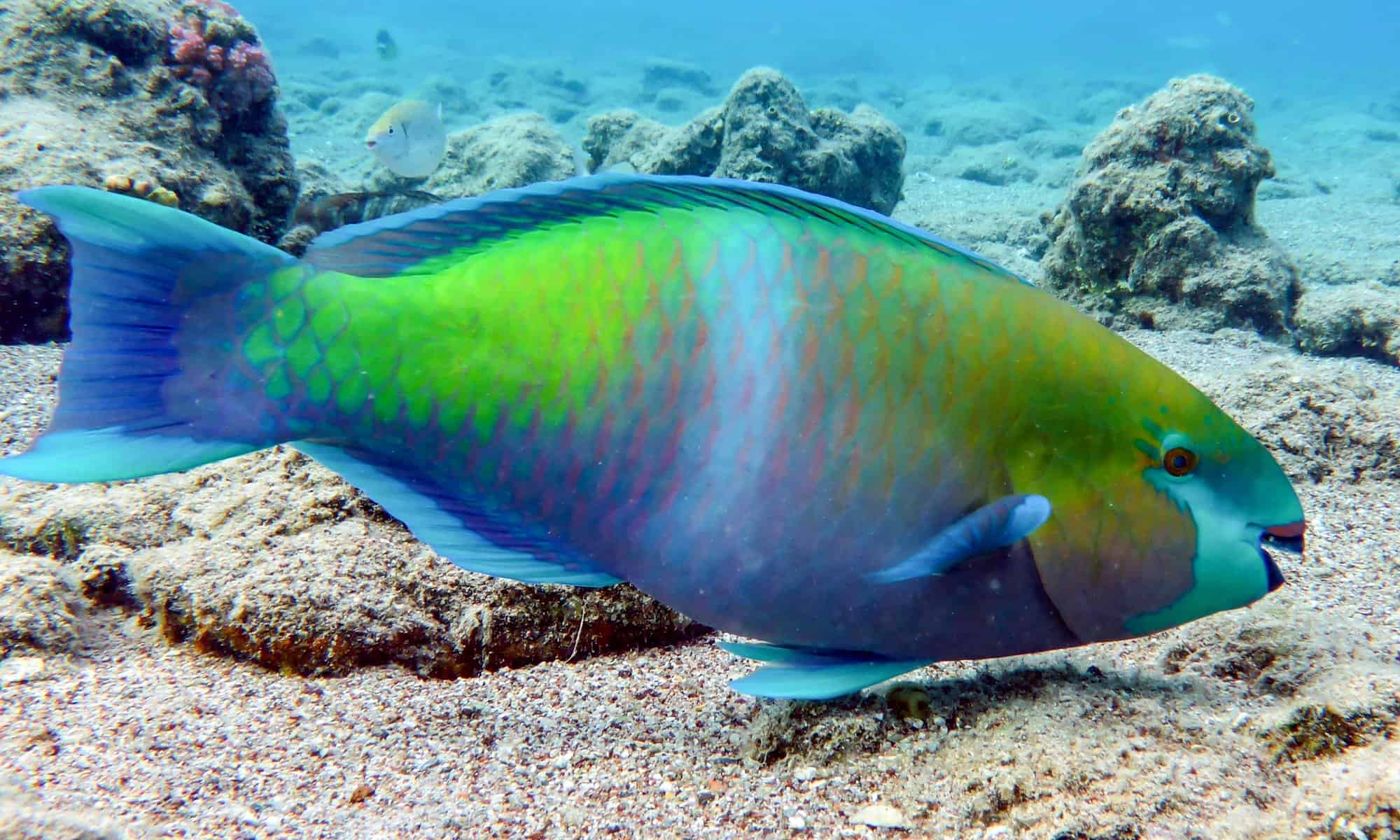
Color can change with age, sex, and social phase, so body shape, head profile, tail, range, and behavior should be used together.
2. Midnight Parrotfish
The Midnight Parrotfish, scientifically Scarus coelestinus, is found in western Atlantic and Caribbean. Look for deep blue to nearly black adult body; ecologically it grazes reefs in large-bodied schools or groups.
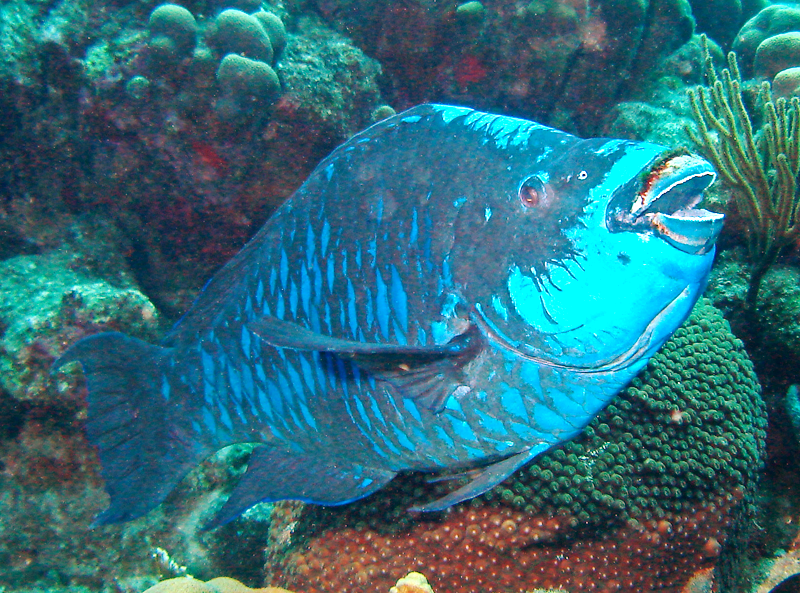
Observe without chasing or feeding. A grazing fish may take repeated bites from algae-covered rock, dead coral, seagrass, or reef framework.
3. Blue Parrotfish
Among the different types of parrot fish, Blue Parrotfish stands out for mostly blue adult body with blunt head. Its range includes western Atlantic and Caribbean, where it feeds on algae and reef material.
Juveniles and initial-phase adults may look unlike terminal males, which makes single-photo identification difficult.
4. Rainbow Parrotfish
Rainbow Parrotfish is the common name for Scarus guacamaia. This species lives in western Atlantic and Caribbean, shows large green-blue body with orange facial areas, and depends strongly on healthy reef and mangrove systems.
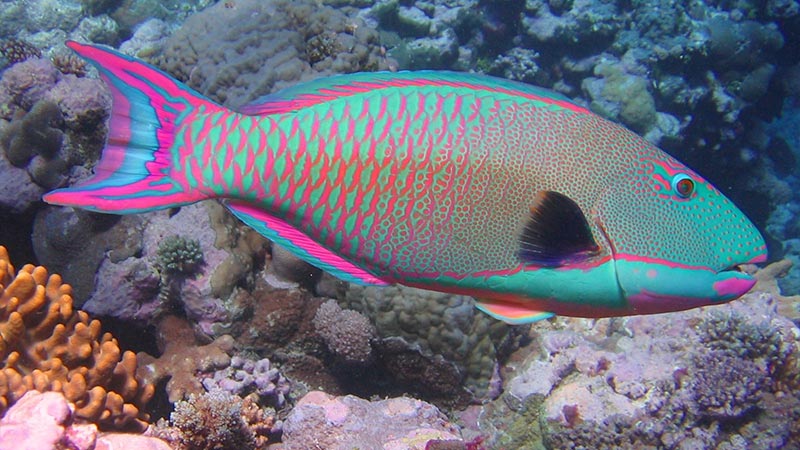
Local harvest and marine protected-area rules should be checked because parrotfish have important ecological functions.
5. Striped Parrotfish
Striped Parrotfish (Scarus iseri) occurs in western Atlantic and Caribbean. It is identified by striped initial phase and colorful terminal male and typically common shallow-reef grazer.
Color can change with age, sex, and social phase, so body shape, head profile, tail, range, and behavior should be used together.
6. Princess Parrotfish
The Princess Parrotfish, scientifically Scarus taeniopterus, is found in western Atlantic and Caribbean. Look for blue-green body with distinctive facial bands; ecologically it grazes algae on coral reefs.
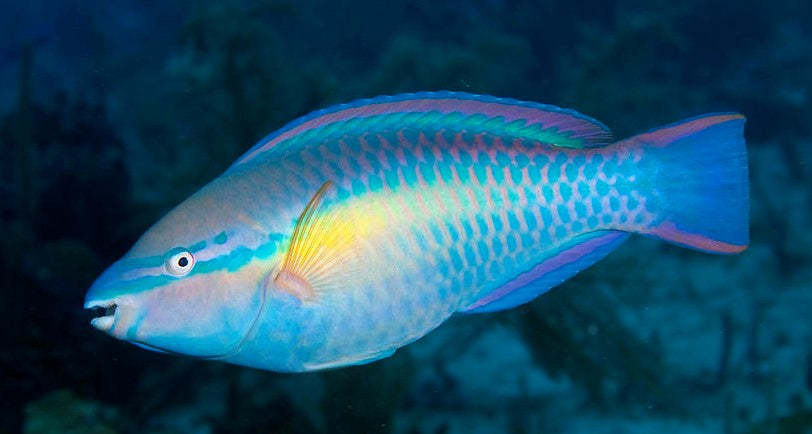
Observe without chasing or feeding. A grazing fish may take repeated bites from algae-covered rock, dead coral, seagrass, or reef framework.
7. Greenback Parrotfish
Among the different types of parrot fish, Greenback Parrotfish stands out for large body with greenish back. Its range includes southwestern Atlantic, where it important Brazilian reef grazer.
Juveniles and initial-phase adults may look unlike terminal males, which makes single-photo identification difficult.
8. Ember Parrotfish
Ember Parrotfish is the common name for Scarus rubroviolaceus. This species lives in Indo-Pacific and eastern Pacific, shows reddish initial phase and green-blue terminal phase, and large roaming reef grazer.

Local harvest and marine protected-area rules should be checked because parrotfish have important ecological functions.
9. Blue-Barred Parrotfish
Blue-Barred Parrotfish (Scarus ghobban) occurs in Indo-Pacific and eastern Pacific. It is identified by yellow-blue body with blue facial bars and typically uses reefs, lagoons, and rocky areas.
Color can change with age, sex, and social phase, so body shape, head profile, tail, range, and behavior should be used together.
10. Common Parrotfish
The Common Parrotfish, scientifically Scarus psittacus, is found in Indo-Pacific. Look for variable green, red, and brown phases; ecologically it widespread shallow-reef scraper.
Observe without chasing or feeding. A grazing fish may take repeated bites from algae-covered rock, dead coral, seagrass, or reef framework.
11. Bridled Parrotfish
Among the different types of parrot fish, Bridled Parrotfish stands out for blue-green adults with bridle-like facial marks. Its range includes Indo-Pacific, where it feeds across reef flats and slopes.
Juveniles and initial-phase adults may look unlike terminal males, which makes single-photo identification difficult.
12. Swarthy Parrotfish
Swarthy Parrotfish is the common name for Scarus niger. This species lives in Indo-Pacific, shows dark initial phase and blue-green terminal male, and common reef grazer.
Local harvest and marine protected-area rules should be checked because parrotfish have important ecological functions.
13. Rivulated Parrotfish
Rivulated Parrotfish (Scarus rivulatus) occurs in western Pacific. It is identified by fine wavy facial and body markings and typically grazes reef and seagrass-associated habitats.
Color can change with age, sex, and social phase, so body shape, head profile, tail, range, and behavior should be used together.
14. Yellowband Parrotfish
The Yellowband Parrotfish, scientifically Scarus schlegeli, is found in Indo-Pacific. Look for yellow band or patch with colorful adult pattern; ecologically it forages on shallow reefs.
Observe without chasing or feeding. A grazing fish may take repeated bites from algae-covered rock, dead coral, seagrass, or reef framework.
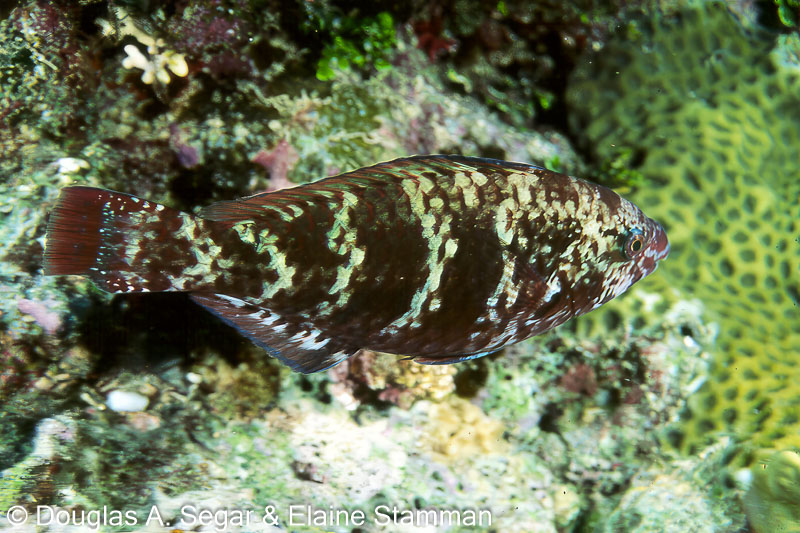
15. Yellowbarred Parrotfish
Among the different types of parrot fish, Yellowbarred Parrotfish stands out for yellow bar contrasting with darker body regions. Its range includes Indo-Pacific, where it small to medium reef scraper.
Juveniles and initial-phase adults may look unlike terminal males, which makes single-photo identification difficult.
16. Greensnout Parrotfish
Greensnout Parrotfish is the common name for Scarus spinus. This species lives in Indo-Pacific, shows green snout and blue-green adult coloration, and grazes coral and rocky surfaces.
Local harvest and marine protected-area rules should be checked because parrotfish have important ecological functions.

17. Dark-Capped Parrotfish
Dark-Capped Parrotfish (Scarus oviceps) occurs in Indo-Pacific. It is identified by dark head cap and contrasting body and typically reef-associated algal feeder.
Color can change with age, sex, and social phase, so body shape, head profile, tail, range, and behavior should be used together.
18. Singapore Parrotfish
The Singapore Parrotfish, scientifically Scarus prasiognathos, is found in western Pacific and eastern Indian Ocean. Look for elongated snout and colorful facial pattern; ecologically it feeds on reef algae.
Observe without chasing or feeding. A grazing fish may take repeated bites from algae-covered rock, dead coral, seagrass, or reef framework.
19. Yellowtail Parrotfish
Among the different types of parrot fish, Yellowtail Parrotfish stands out for yellow tail with changing body colors. Its range includes western Pacific, where it small reef grazer.
Juveniles and initial-phase adults may look unlike terminal males, which makes single-photo identification difficult.
20. Festive Parrotfish
Festive Parrotfish is the common name for Scarus festivus. This species lives in Indo-Pacific, shows bright multi-colored terminal phase, and inhabits reef slopes and lagoons.
Local harvest and marine protected-area rules should be checked because parrotfish have important ecological functions.
21. Bullethead Parrotfish
Bullethead Parrotfish (Chlorurus sordidus) occurs in Indo-Pacific. It is identified by rounded forehead and variable early phases and typically excavates reef surfaces with strong jaws.
Color can change with age, sex, and social phase, so body shape, head profile, tail, range, and behavior should be used together.
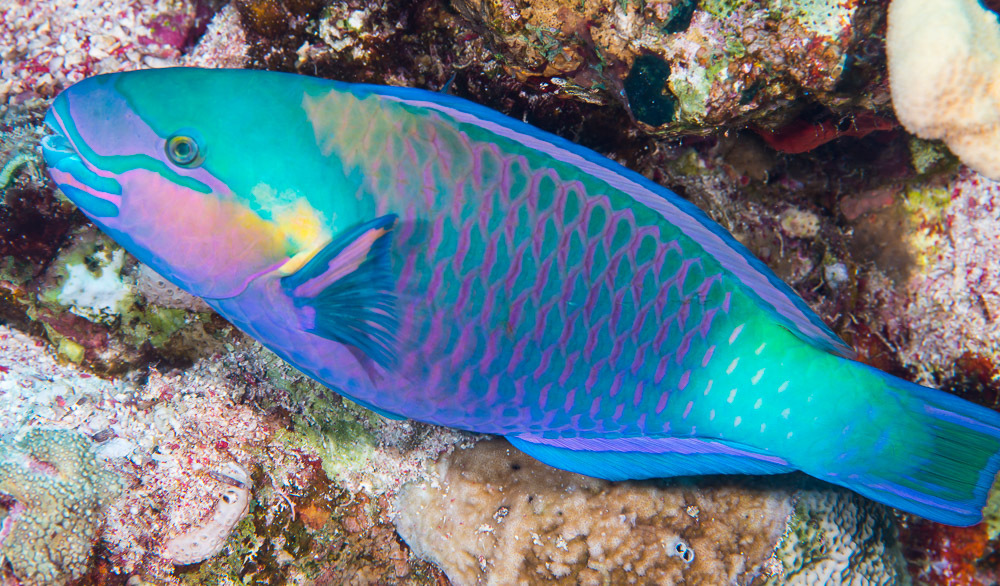
22. Pacific Bullethead Parrotfish
The Pacific Bullethead Parrotfish, scientifically Chlorurus spilurus, is found in central and eastern Pacific. Look for rounded head and blue-green terminal phase; ecologically it grazes and excavates reef substrate.
Observe without chasing or feeding. A grazing fish may take repeated bites from algae-covered rock, dead coral, seagrass, or reef framework.
23. Steephead Parrotfish
Among the different types of parrot fish, Steephead Parrotfish stands out for large steep forehead and green-blue body. Its range includes Indo-Pacific, where it powerful reef excavator.
Juveniles and initial-phase adults may look unlike terminal males, which makes single-photo identification difficult.
24. Indian Ocean Steephead Parrotfish
Indian Ocean Steephead Parrotfish is the common name for Chlorurus strongylocephalus. This species lives in Indian Ocean, shows large blunt head and green body, and removes algae and carbonate while feeding.
Local harvest and marine protected-area rules should be checked because parrotfish have important ecological functions.

25. Red Sea Steephead Parrotfish
Red Sea Steephead Parrotfish (Chlorurus gibbus) occurs in Red Sea. It is identified by massive head and bright adult color and typically large reef excavator.
Color can change with age, sex, and social phase, so body shape, head profile, tail, range, and behavior should be used together.
26. Palecheek Parrotfish
The Palecheek Parrotfish, scientifically Chlorurus japanensis, is found in western Pacific. Look for pale cheek area and colorful body; ecologically it reef-associated scraper and excavator.
Observe without chasing or feeding. A grazing fish may take repeated bites from algae-covered rock, dead coral, seagrass, or reef framework.
27. Bleeker’s Parrotfish
Among the different types of parrot fish, Bleeker’s Parrotfish stands out for blue-green adult with distinctive facial markings. Its range includes western Pacific, where it forages on coral reefs.
Juveniles and initial-phase adults may look unlike terminal males, which makes single-photo identification difficult.
28. Bower’s Parrotfish
Bower’s Parrotfish is the common name for Chlorurus bowersi. This species lives in western Pacific, shows robust body and blue-green terminal phase, and uncommon reef excavator.
Local harvest and marine protected-area rules should be checked because parrotfish have important ecological functions.
29. Captain Parrotfish
Captain Parrotfish (Chlorurus enneacanthus) occurs in Indian Ocean and western Pacific. It is identified by contrasting body patches and strong beak and typically feeds on hard reef surfaces.
Color can change with age, sex, and social phase, so body shape, head profile, tail, range, and behavior should be used together.
30. Pacific Slopehead Parrotfish
The Pacific Slopehead Parrotfish, scientifically Chlorurus frontalis, is found in central Pacific. Look for bulging forehead and turquoise adult color; ecologically it large reef excavator.
Observe without chasing or feeding. A grazing fish may take repeated bites from algae-covered rock, dead coral, seagrass, or reef framework.
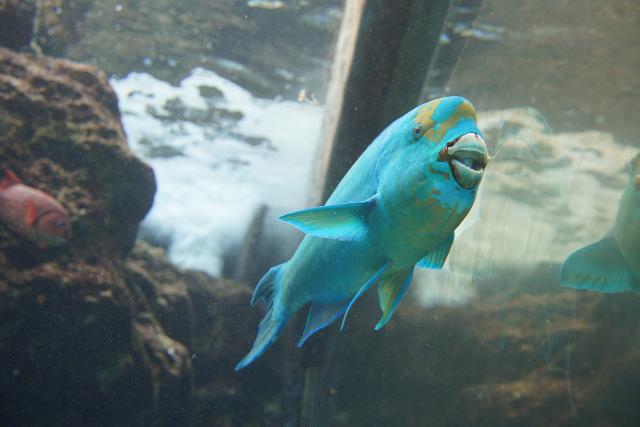
31. Greenfin Parrotfish
Among the different types of parrot fish, Greenfin Parrotfish stands out for green fins and blue-green terminal phase. Its range includes western Pacific, where it grazes reef flats and slopes.
Juveniles and initial-phase adults may look unlike terminal males, which makes single-photo identification difficult.
32. Five-Saddle Parrotfish
Five-Saddle Parrotfish is the common name for Chlorurus capistratoides. This species lives in Indian Ocean, shows multiple dark saddle-like bars, and small reef-associated excavator.
Local harvest and marine protected-area rules should be checked because parrotfish have important ecological functions.

33. Stoplight Parrotfish
Stoplight Parrotfish (Sparisoma viride) occurs in western Atlantic and Caribbean. It is identified by red-yellow initial phase and green terminal male and typically scrapes and excavates reef substrate.
Color can change with age, sex, and social phase, so body shape, head profile, tail, range, and behavior should be used together.
34. Redband Parrotfish
The Redband Parrotfish, scientifically Sparisoma aurofrenatum, is found in western Atlantic and Caribbean. Look for red band near the pectoral area; ecologically it common shallow reef grazer.
Observe without chasing or feeding. A grazing fish may take repeated bites from algae-covered rock, dead coral, seagrass, or reef framework.
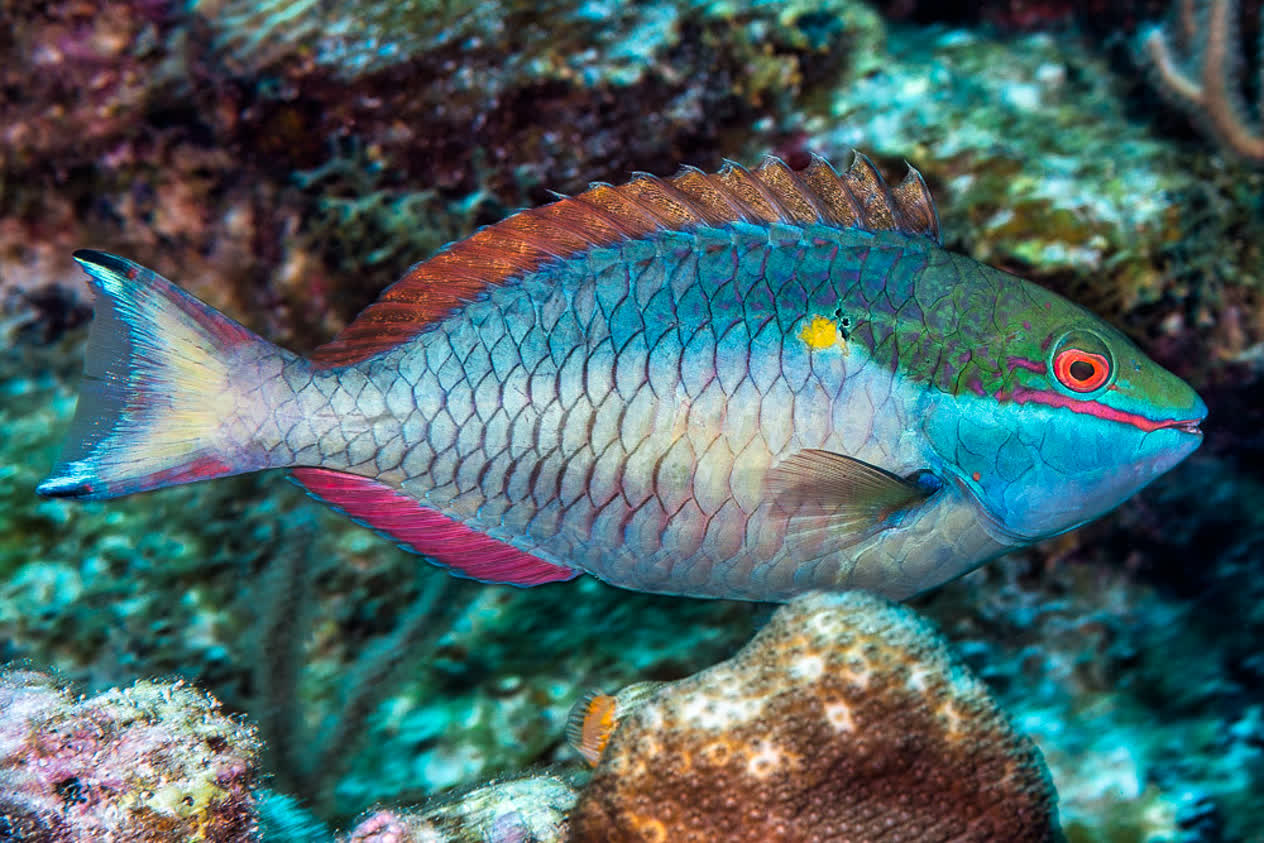
35. Redtail Parrotfish
Among the different types of parrot fish, Redtail Parrotfish stands out for reddish tail and variable body colors. Its range includes western Atlantic and Caribbean, where it feeds on algae and seagrass-associated growth.
Juveniles and initial-phase adults may look unlike terminal males, which makes single-photo identification difficult.
36. Redfin Parrotfish
Redfin Parrotfish is the common name for Sparisoma rubripinne. This species lives in western Atlantic and Caribbean, shows red fins and robust body, and large Caribbean grazer.
Local harvest and marine protected-area rules should be checked because parrotfish have important ecological functions.

37. Greenblotch Parrotfish
Greenblotch Parrotfish (Sparisoma atomarium) occurs in western Atlantic and Caribbean. It is identified by small body with green blotches and typically feeds in seagrass and shallow reef habitats.
Color can change with age, sex, and social phase, so body shape, head profile, tail, range, and behavior should be used together.
38. Bucktooth Parrotfish
The Bucktooth Parrotfish, scientifically Sparisoma radians, is found in western Atlantic and Caribbean. Look for small body and protruding tooth plates; ecologically it strongly associated with seagrass beds.
Observe without chasing or feeding. A grazing fish may take repeated bites from algae-covered rock, dead coral, seagrass, or reef framework.
39. Green Humphead Parrotfish
Among the different types of parrot fish, Green Humphead Parrotfish stands out for huge body and prominent forehead hump. Its range includes Indo-Pacific, where it largest parrotfish and powerful reef bioeroder.
Juveniles and initial-phase adults may look unlike terminal males, which makes single-photo identification difficult.
40. Bicolour Parrotfish
Bicolour Parrotfish is the common name for Cetoscarus ocellatus. This species lives in Indo-Pacific, shows dramatically different juvenile and adult patterns, and large colorful reef grazer.
Local harvest and marine protected-area rules should be checked because parrotfish have important ecological functions.

How Are These Types of Parrot Fish Classified?
Parrotfishes are now generally treated within the wrasse family Labridae, in the scarine lineage or subfamily Scarinae. Older references may list a separate family Scaridae. Their genera differ in head shape, tooth plates, feeding scars, scale counts, color phases, and genetics. Common names can vary by country, making scientific names especially useful.
Where Do Parrot Fish Live?
Most parrotfish inhabit tropical and subtropical coral reefs, rocky reefs, lagoons, reef flats, and seagrass beds. Caribbean species include queen, stoplight, redband, and rainbow parrotfish. Indo-Pacific reefs support steepheads, bulletheads, bicolour, and green humphead parrotfish. Mangroves and seagrass can be important nursery or feeding habitats for selected species.
How to Identify Different Types of Parrot Fish
- Beak: Fused tooth plates create the parrot-like mouth.
- Head profile: Bulletheads, steepheads, and humpheads have distinctive foreheads.
- Color phase: Juvenile, initial, and terminal phases can look dramatically different.
- Tail: Rounded, truncate, forked, or lunate tail shapes help narrow species.
- Range: Atlantic and Indo-Pacific look-alikes are often different species.
- Feeding marks: Scrapers leave fine marks, while excavators remove deeper bites.
Outdoor Tips for Observing Parrotfish
- Watch from the side without blocking the fish’s feeding route.
- Record head shape, cheek lines, tail color, pectoral patch, and body phase.
- Note whether the fish feeds on reef rock, dead coral, or seagrass.
- Use regional guides because common names overlap.
- Do not touch, feed, chase, or collect reef fish.
- Avoid standing on coral while photographing them.
Safety, Sustainability, and Conservation Notes
Parrotfish help control algal growth, recycle reef material, and move carbonate sediment. Their ecological effect differs by species, size, and feeding mode, but heavy harvest can alter reef communities. Follow local fishing rules and marine protected-area restrictions. Large green humphead parrotfish and other slow-recovering populations deserve particular care. Aquarium collection is inappropriate for most large species because they need extensive reef habitat and specialized diets.
Fun Facts About Parrot Fish
- Parrotfish beaks are made from fused tooth plates.
- Additional throat teeth grind swallowed material.
- Many species change sex and color phase.
- Scraping and excavation create distinctive feeding scars.
- Some sediment passes through the digestive tract as fine sand.
- Green humphead parrotfish are the largest living parrotfish.
- Some species sleep in reef crevices.
- Seagrass parrotfish can differ strongly from coral-reef species.
- Juvenile bicolour parrotfish look dramatically unlike adults.
- The blood parrot cichlid is not a true marine parrotfish.
Final Thoughts on Types of Parrot Fish
These 40 types of parrot fish show why color alone is not enough for identification. Range, body shape, beak, forehead, tail, life stage, sex phase, and feeding behavior all matter. Parrotfish are important reef and seagrass grazers, so responsible observation and compliance with local harvest rules help protect both the fish and their habitats.
Frequently Asked Questions
1. What is a parrotfish?
A marine wrasse relative with fused tooth plates forming a beak.
2. Are parrotfish wrasses?
Yes, modern classification places them within the wrasse family Labridae.
3. Is Scaridae still used?
Older sources may use Scaridae as a family, while many modern classifications use Scarinae within Labridae.
4. Is the blood parrot cichlid a parrotfish?
No, it is a freshwater hybrid cichlid.
5. Why are parrotfish colorful?
Color supports sex phase, social signaling, species recognition, and camouflage.
6. Do parrotfish change sex?
Many species can change sex during life, though patterns vary.
7. Why do colors change?
Juvenile, initial-phase, and terminal-phase fish can have different patterns.
8. What do parrotfish eat?
Mostly algae, microbes, and material scraped or excavated from reef and seagrass surfaces.
9. Do parrotfish eat living coral?
Some bites include live coral tissue, but feeding ecology differs among species.
10. Do parrotfish make sand?
Grinding and digestion can produce fine carbonate sediment.
11. Which is the largest parrotfish?
The green humphead parrotfish.
12. Where do parrotfish live?
Mostly tropical reefs, lagoons, rocky areas, mangroves, and seagrass beds.
13. Are there freshwater parrotfish?
True parrotfishes are marine; freshwater fish with parrot names are unrelated.
14. Can parrotfish be kept in aquariums?
Most need very large systems, constant grazing habitat, and specialized care.
15. Why are parrotfish important to reefs?
They remove algae, recycle reef material, and influence sediment movement.
16. What is a scraper?
A parrotfish that removes algae and a thin layer from the feeding surface.
17. What is an excavator?
A parrotfish that removes deeper bites of reef material.
18. How can male and female parrotfish be identified?
Color phase can suggest sex, but species and social system must be known.
19. Why are common names confusing?
The same name may be used for different regional species.
20. How can a parrotfish be identified from a photo?
Use location, head profile, facial lines, tail, pectoral patch, and color phase.
21. Do parrotfish have teeth?
Yes, teeth are fused into plates and additional teeth occur in the throat.
22. Do parrotfish sleep in mucus cocoons?
Some parrotfish produce mucus at night, but this is not universal to every species.
23. Are parrotfish safe for divers?
They are generally not dangerous, but wildlife should not be touched or cornered.
24. Can parrotfish bite?
Their beaks are powerful, though they normally use them for feeding.
25. Are parrotfish eaten by people?
They are harvested in some regions, subject to local rules and health guidance.
26. Are parrotfish protected?
Protection varies by country, species, size, and marine area.
27. What threatens parrotfish?
Overfishing, habitat degradation, pollution, and reef decline.
28. Why are mangroves important to some parrotfish?
They can provide nursery habitat and food.
29. What is the difference between Scarus and Chlorurus?
They differ in anatomy and feeding style; many Chlorurus species are stronger excavators.
30. How many parrotfish species exist?
Roughly around one hundred are recognized, with taxonomy continuing to change.